The long-waited “European Democracy Action Plan” has finally been unveiled, but its proposal to sanction alleged purveyors of so-called “disinformation” is extremely worrisome because people (including EU citizens) might have their fundamental rights and freedoms violated if they’re punished for publishing and/or sharing content that’s been arbitrarily flagged as such, and the Vice President of the European Commission for Values and Transparency’s ambiguity about whether this will be imposed against publicly financed Russian international media outlets like RT and Sputnik risks the possibility that their EU employees might be sanctioned for their professional affiliations too.
The EDAP’s Supposed Principles
The “European Democracy Action Plan” (EDAP) has just been unveiled, but instead of reassuring everyone about the bloc’s commitment to human rights in its fight against so-called “disinformation”, it dangerously risks violating them by proposing that alleged purveyors of such arbitrarily flagged information products be sanctioned. The document starts off innocuously enough by explaining the need to “promote free and fair elections and democratic participation; support free and independent media; and counter disinformation”, all of which it’s claimed will be done “in full respect of the fundamental rights and freedoms enshrined in the Treaties and the Charter of Fundamental Rights, as well as in national and international human rights rules.” Regarding the aforementioned Charter, they note how “media freedom and media pluralism” are “enshrined” in it. The EDAP also condemns the fact that “Smear campaigns are frequent and overall intimidation and politically motivated interference have become commonplace” when describing the threats to journalists’ safety, some of which they note are “even initiated by political actors, in Europe and beyond”, which “can lead to self-censorship and reduce the space for public debate on important issues.”
The Definition Of “Disinformation”
This makes it all the more surprising that the EDAP later goes on to propose sanctions against those who repeatedly spread “disinformation”, which they define as “false or misleading content that is spread with an intention to deceive or secure economic or political gain and which may cause public harm”. Although they promise that this will be done “in full respect of fundamental rights and freedoms”, no transparent mechanism is suggested for explaining how they determine the offending individual’s intent for sharing supposed “disinformation”, nor is there any mention of an appeals process for those who are unfairly targeted for the same political reasons that the EDAP’s authors earlier condemned. The document notes that the experiences of the European External Action Service’s (EEAS) East Stratcom Task Force (which, while not mentioned in the text, is the combined foreign and defense ministry of the EU that also runs the defamatory “EU vs. Disinformation” portal which regards any non-mainstream “politically incorrect” viewpoint as Russian and/or Chinese “disinformation”) will play a role in this process, which is extremely disturbing because of how politically motivated that structure’s determinations are.
A Dystopian Task Force For Stifling Free Speech
The EEAS East Stratcom Task Force actually represents everything that the EDAP earlier said that it’s against. To channel the document’s own words, “Smear campaigns are frequent and overall intimidation and politically motivated interference have become commonplace” as evidenced by their hit piece in December 2019 against me personally and occasional “debunking” of OneWorld’s factually sourced analyses (which are personal interpretations of the facts and not representative of a “chain of command from the Kremlin” like they libelously wrote without any evidence whatsoever other than circumstantial speculation). Their labeling of the site as “being a new edition to the pantheon of Moscow-based disinformation outlets” proves that they’ve arbitrarily concluded that the intent of its authors such as myself is to spread “disinformation”, which the EDAP defines as “false or misleading content that is spread with an intention to deceive or secure economic or political gain and which may cause public harm”. I never had any such intent since the purpose in sharing my analyses is solely to stimulate “debate on important public issues”, which is a personal mission statement that’s actually in accordance with what the EDAP purportedly says that it wants to protect.
“EU vs. Disinformation” Or “EU + Disinformation”?
From my experience being defamed by the EEAS East Stratcom Task Force’s “EU vs. Disinformation” project, I have no confidence in its capabilities to make independent and accurate determinations but rather suspect that it’s a political instrument wielded by the EU’s foreign and defense ministries to intimidate those who share “politically incorrect” interpretations of “important public issues”. The EDAP says that its anti-disinformation proposals “do not seek to and cannot interfere with people’s right to express opinions or to restrict access to legal content or limit procedural safeguards including access to judicial remedy.” Nevertheless, my right to express my opinion is being infringed upon after my work was defamed as “disinformation” (importantly without anyone from that platform ever making an attempt to contact me beforehand even on Twitter despite them referring to my account there and thus being aware of it prior to the publication of their hit piece), and I have no access to “judicial remedy” after what they’ve done. Based on what the EDAP proposes pertaining to sanctions against alleged purveyors of “disinformation”, OneWorld, its media partners, myself, and/or the other contributors including those who are EU citizens might possibly have such costs unfairly imposed upon them.
Cracking Down On EU Citizens
Vice President of the European Commission for Values and Transparency Vera Jourova ominously told the US government-funded Radio Free Europe/Radio Liberty (RFE/RL) “in an interview to coincide” with Thursday’s release of the EDAP that “sanctions will should [sic] follow the EU’s cybersanction regime, which was used for the first time this year to freeze assets and introduce visa bans on offenders — primarily Russian, Chinese, and North Korean citizens and companies — that have attacked the bloc.” Just as disturbing was that “she didn’t want to specify at the moment (whether Russian media companies such as RT and Sputnik can be targeted in the future), but added that ‘it can be governmental or nongovernmental actors, whoever will be identified, using very good evidence, that they are systematic producers or promoters of disinformation.’” This confirms what I feared when I read the EDAP, namely that individuals employed by those two companies (including EU citizens among them), as well as people such as myself dangerously defamed by the EEAS East Stratcom’s Task Force and others for allegedly being part of a Russian state “disinformation” conspiracy, might one day wake up to find themselves sanctioned by the EU.
EDAP’s Ambiguities Must Be Immediately Addressed
In order to sincerely abide by its stated principles to respect people’s freedoms, the EDAP must be amended to remove any ambiguities which could allow for the sanctioning of individual people, especially those who might even be EU citizens. After all, its “EU vs. Disinformation” “watchdog” functions more as a politically driven attack dog as proven by my personal experience of having been defamed by them (made all the more incriminating on their part because no attempt was made to contact me for comment on the same Twitter account that they wrote about in their hit piece before publishing it). Everyone has the right to freely express their views even if they’re “politically incorrect”, and it’s practically impossible for a nebulous structure representing the entire bloc’s foreign and defense ministry to confidently determine someone’s “intention to deceive or secure economic or political gain and which may cause public harm” whenever they publish, share, or tag someone under such arbitrarily flagged information products. Nobody can be confident in the EU’s ability to combat legitimate instances of “disinformation” when that defamatory label is casually thrown around with reckless abandon without considering the life-changing consequences that it could have for the victims like myself.
Media Literacy Is The Solution To “Disinformation”
The EDAP had it right near the end of the document when it proposed improving everyone’s media literacy like I earlier suggested over the summer after being victimized by a different defamation attack. Instead of violating people’s rights and especially those who might be EU citizens, the bloc should prioritize media literacy in order to cultivate a well-informed populace capable of arriving at their own conclusions about the various information products that they encounter. Falsely labeling something “disinformation” just because a government superbureaucracy like the EEAS can’t tolerate the fact that someone is peacefully sharing a dissident political opinion in line with their UN-enshrined human right to do so seriously discredits the bloc as a whole and raises questions about its stated intentions. Jourova herself said in a speech on the day that the EDAP was unveiled that “We do not want to create a ministry of truth. Freedom of speech is essential and I will not support any solution that undermines it”, yet that very same document that she was promoting does exactly that when it comes to my and others’ freedom of speech, especially those who are EU citizens whether casually involved in what’s wrongly described as “disinformation” or employees of foreign media companies.
Concluding Thoughts
Sanctions are never the solution to combating so-called “disinformation”, media literacy is, as the former is akin to the same state intimidation that the EDAP purports to be against while the latter is proof of confidence in people’s capabilities to independently arrive at their own conclusions. Only a “ministry of truth” would dare to sanction people, including its own citizens (however that would work out in practice despite potentially being illegal under the EU’s own laws since its people’s assets and freedom of movement can’t be seized/restricted without court order), for exercising their freedom of speech by sharing “politically incorrect” interpretations (analyses) of the facts. Quite hypocritically, some in the EU claim that Russia is a “dictatorship”, yet Moscow hasn’t threatened to sanction foreign media outlets, foreign commentators, and even its own citizens through asset seizures and/or travel restrictions for sharing views that contradict the Kremlin’s. In fact, judging by the EDAP itself and Jourova’s ominous hints in her interview with RFE/RL, it can be said that the EU will be much less democratic than Russia if it goes through with its “disinformation” sanctions proposal, thus turning the bloc into a modern-day Soviet Union when it comes suppressing freedom of speech and peaceful dissent.
December 6, 2020
Posted by aletho |
Civil Liberties, Full Spectrum Dominance, Russophobia | European Union, Human rights |
Leave a comment

Just weeks after finishing a two and a half year prison sentence for “Holocaust denial,” 92-year-old Ursula Haverbeck has been convicted again by German courts, this time for an interview she gave in 2018 that affirmed her view that Jews were not systematically killed during World War II and that the gas chambers at Auschwitz are a politically motivated lie.
If the federal court’s sentence of one year in Haverbeck’s newest case holds up, Germany will have the dubious distinction of imprisoning the oldest female inmate in the world, a title previously held by American Lucille Keppen, who was incarcerated for shooting her neighbor and was released at age 93.
The German government has been dragging Haverbeck to court for decades for disputing Jewish claims of gas chambers and systematic murder. Haverbeck has famously protested the kangaroo courts that humiliate and defame elderly war veterans using bogus testimony from “survivors.”
Numerous high-ranking Third Reich officials, soldiers and concentration camp workers have disputed the Holocaust narrative since 1945, including Wehrmacht officer Otto Ernst Remer, Auschwitz employee Thies Christophersen, Erich Priebke, Leon Degrelle, and SS soldier Karl Muenter, the latter who died before his “Holocaust denial” trial began at the age of 96.
Haverbeck’s late husband, Werner Georg Haverbeck, was an influential NSDAP member who himself objected to the blood libel against the German people known as die Auschwitz luge (the Auschwitz lie).
The BRD’s legal system has been ruthless with Haverbeck. The nonagenarian, who is a prisoner of conscience, was denied release after serving 2/3 of her prison sentence as is customary in Germany. While the state freed 1,000 offenders early due to COVID last March, Haverbeck was only let out in mid-November.
There is no sign of shame or human rights concerns in the country, with the judge in the latest case stressing that Haverbeck will continue to be punished until she learns to keep her mouth shut. One can only imagine the outcry from liberal NGOs if Iran, China or Russia imprisoned an elderly woman just for questioning the government’s line.
Haverbeck’s powerful spirit has become an inspiration for patriots in Germany and around the world. In 2019, she ran as a European parliamentary candidate from behind bars and received 25,000 votes, which was highly upsetting to the European media establishment. Every year on her birthday, hundreds of Germans rallied outside her detention center demanding her release.
Intellectuals and activists across Europe, the Americas and Japan have expressed dismay over her mistreatment and the lack of freedom in the land that claims to be a “democracy.” At JVA Bielefeld, where Haverbeck was housed, prison officials struggled to process the avalanche of letters and flowers their famous prisoner received throughout her sentence.
For Germany’s oldest prisoner, it’s clear that she will not cower before the wrath of the Jewish groups directing careerist bureaucrats. It’s in the German state’s reputational interest to stop tormenting Haverbeck, yet the West’s religious fear of debate over what occurred during the Second World War continues to take precedent over all other concerns.
December 5, 2020
Posted by aletho |
Civil Liberties, Full Spectrum Dominance | European Union, Germany, Human rights |
Leave a comment
Serbian Ambassador to Montenegro, Vladimir Božović, was declared a persona non grata last week and was asked to leave the country. The Montenegrin Foreign Ministry justified its reasoning because of Serbia’s alleged “long and continuous meddling in the internal affairs of Montenegro.” They also claimed that the Serbian ambassador “directly disrespected” their country by highlighting that the 1918 decision for Montenegro to join the Kingdom of Yugoslavia was “liberation” and occurred because of the “free will” of the Montenegrin people.
Montenegro is politically split between those wanting to maintain closer ties with traditional allies like Serbia and Russia, and those who want Montenegro to become a liberal democracy modelled on the West. However, for those hoping to turn Montenegro into a Western-style liberal democracy, they place their hope in President Milo Đukanović. The Montenegrin President since 1991 has held leadership positions in an authoritarian manner, either as prime minister or president. Đukanović is alleged to have strong links to the mafia, was described in 2010 as “mysteriously wealthy” for being one of the world’s richest leaders, and engages in corrupt practises like smuggling, organized crime, and privatizing state assets like the Prva Banka for the benefit of his family.
However, Đukanović’s stranglehold over Montenegro is weakening. The 2020 Parliamentary elections saw an opposition coalition comprising of pro-Serbian, left-wing and right-wing political parties, specifically For The Future Of Montenegro, Peace Is Our Nation, and the United Reform Action Party, win 41 of the 81 seats in the Montenegrin Parliament. The ruling Democratic Party of Socialists of Montenegro (DPS) and the Liberal Party won 30 seats, officially becoming the opposition after thirty years in power. On Wednesday the new government was elected by 41 out of 81 members of the Montenegrin Parliament.
With the scandalous decision to expel Božović, motivated by the weakening of Đukanović’s political power, the outgoing Montenegrin government unsuccessfully tried to profit politically by provoking artificial tensions with Serbia before the formation of a new government. They were counting on the re-grouping of nationalist forces to back Đukanović’s DPS, an unsuccessful gamble.
Decisionmakers in the Montenegrin capital of Podgorica also made a second gamble. They expected the EU not to interfere in their issue with Serbia and thought Brussels would only silently observe the instability. They were proven wrong as a minor spat between the EU and Montenegro occurred this week. Montenegrin media, which is strongly aligned with Đukanović, got into a polemic with European Commissioner Olivér Várhelyi. They criticized him for not supporting the expulsion of the Serbian ambassador. The EU has no interest in supporting unnecessary hostility towards Belgrade, especially at a time when Brussels is attempting to become the main player in Kosovo and when Serbian President Aleksandar Vučić is becoming increasingly friendly towards the EU and NATO.
Serbia’s Foreign Ministry immediately announced its response to the expulsion of Božović. Montenegrin Ambassador Tarzan Milošević was asked to leave Serbia within 72 hours. Although the ambassador was given 72 hours to leave, Várhelyi welcomed Belgrade’s near immediate decision change on expelling him. On Twitter he said:
“I welcome the Serbian Government’s decision to withdraw expelling the Montenegrin ambassador. I call on Montenegro to do the same. Respect for good neighbourly relations and regional cooperation are cornerstones of EU enlargement, and Association and Stabilisation Process.”
Although Belgrade withdrew its demand, European institutions no longer have an understanding for the policies of the Montenegrin authorities. It is extremely uncommon in diplomatic practice for a government that was defeated in recent elections to make such important state decisions during the transition period. At this moment, there is no logic for the EU to unreasonably support hostility against Serbia, especially from a country like Montenegro that is in an advanced stage of EU accession.
Brussels is likely aware that Serbia has the greatest potential out of all the former Yugoslav countries. Any quarrelsome tone directed against Belgrade, which is not related to the Kosovo issue, does not serve EU interests. This is especially important because Podgorica has already announced that they will ignore Várhelyi’s call to withdraw the decision to expel the Serbian ambassador.
Such a mindless action by Montenegrin authorities was accompanied by reactions from the political and media establishment in the country. All of them vehemently demanded that Várhelyi learn about historical events from the beginning of the last century, and that on the basis of such interpretations it can be understood why the Montenegrin kleptocracy makes extreme moves against Serbia.
European representatives do not want to engage in any interpretations of Montenegrin history. Instead, the EU sent an explicit message against the provocative actions by Montenegrin authorities – the interest of the EU in the Balkans is stability. Another important message was sent to Đukanović as well – his anti-Serbian policies have been overcome and he cannot seek his political survival through Serbophobia.
The formation of a new government dealt a major blow to Đukanović’s dominance over Montenegro, and could pave the way for his final ousting from Montenegrin politics in the next presidential election. Although he and his faction expected silence or acceptance from the EU for provoking Serbia in reaction to losing the parliamentary elections, it could be suggested that Brussels’ patience with Đukanović’s authoritarianism, corruption and regional provocations is beginning to end.
Paul Antonopoulos is an independent geopolitical analyst.
December 4, 2020
Posted by aletho |
Aletho News | European Union, Montenegro, Serbia |
Leave a comment
Landmark legal case would seek to make EU nations “do what scientists say is necessary”
The European Court of Human Rights is prepping to hear a civil case brought against the governments of 33 European nations by six teenage “climate activists.”
The six youth activists are allegedly crowd-funding the campaign, but also have the backing of the Global Legal Action Network NGO. Though the six teenagers are all Portuguese, the case is being brought against thirty-three different nations simultaneously – all 27 EU members, the UK, Russia, Norway, Turkey, Ukraine and Switzerland.
To defend themselves the 33 countries will be asked to explain how their “lack of action” on climate change doesn’t equate to a violation of the human rights of their citizens. If they lose, the countries in question will be legally forced to “take greater action” on climate, or face penalties for missing lower carbon emissions goals etc.
One of the kids, 12-year-old André Oliveira, is quoted in The Guardian as saying [our emphasis]:
It gives me lots of hope to know that the judges in the European court of human rights recognise the urgency of our case. But what I’d like the most would be for European governments to immediately do what the scientists say is necessary to protect our future. Until they do this, we will keep on fighting with more determination than ever.”
The story itself is nonsense of course. Twelve-year-olds do not talk like that. Plus the case originated over 3 years ago, when young André was only nine.
Nine-year-old boys do not see footage of forest fires on the news and decide to sue the European Union. Even if the thought did occur to them, they wouldn’t have the resources, knowledge or wherewithal to actually do anything about it. Not without some pretty all-encompassing adult supervision.
This whole story has the Greta-like whiff of adults using children to mask their agenda. It’s unsavoury, but that’s not really the worst part. The worst part is what this case is aiming to achieve.
Consider the precedents being set here. As the Guardian rightly points out, the ECHR is a standard-setting body, even if the final judgment in this particular case is largely ignored, or considered simply symbolic, it will still sit on the books as a precedent in several ways.
Firstly, there’s the precedent of over-ruling democracy. The governments of these 33 nations were all elected, they (notionally) answer to their electorate, not the EHRC. It’s one thing to prosecute a nation or head of state for actually committing a crime, but bringing a civil case to dictate policy is quite another.
Secondly, there’s the question of state sovereignty. All of the plaintiffs are Portuguese, yet the case is seeking to alter the policy of 32 other nation-states as well. Neither these six Portuguese children, their British lawyers or the Strasbourg-based courts have the right to tell Hungary or Norway or Turkey how to run their country, certainly not when it involves going against the democratic will of the people.
Finally, there’s the tell-tale quote from young André – bolded above.
what I’d like the most would be for European governments to immediately do what the scientists say is necessary”
Granted these are just the words of a child, but he almost certainly was reading something an adult had written. And it’s definitely the aim of the exercise. A government which has policy dictated by what scientists say is necessary.
NOT what is democratically mandated. NOT what is legally permitted. Not even what is morally correct.
What the scientists say is necessary.
Anybody paying attention to the way the world is being run in the wake of the Covid19 “pandemic” should find those words at least a little chilling.
November 30, 2020
Posted by aletho |
Civil Liberties, Science and Pseudo-Science | European Union |
Leave a comment
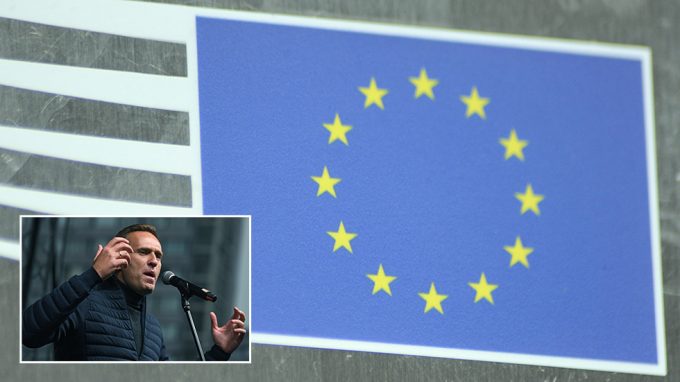
The West’s favorite Russian opposition figure has called for the EU to sanction pro-Kremlin ‘oligarchs’. Alexey Navalny doesn’t appear to be against all ‘oligarchs’ though, just those he feels are supportive of Vladimir Putin.
In a European Parliament hearing last week, the activist argued that the Russian people would welcome punishing the ‘kleptocracy’ that he says has thrived under Putin.
The anti-corruption campaigner was speaking to members of the EU’s Committee of Foreign Affairs during an “exchange of views with representatives of the Russian political opposition.” Despite the title, no members of Russia’s largest opposition parties – the nationalist LDPR, communist KPRF or leftist Fair Russia – were present at the virtual discussion. Instead only pro-Western figures, with almost uniformly similar liberal views, were involved in the event.
They included Vladimir Kara Murza Jr., a lobbyist at the US-government funded Free Russia Foundation, set up to “inform” American policy makers on the country; Vladimir Milov, a former deputy minister of energy, now closely allied to Navalny; and Ilya Yashin, a municipal deputy of the Krasnoselsky district of Moscow. Yashin is the only one of the four who actually holds an elected position.
To be clear, the issue of how many Russian billionaires acquired and spent their wealth is one worth debating, yet this attempt to place Navalny on the side of the Russian people and Putin among a criminal class is simply absurd, given the history.
Putin and the oligarchs
The rise of the 1990s oligarchs is commonly referred to as a “criminal revolution” in Russia. The US-sponsored shock therapy in the post-Soviet period produced disaster privatization where the huge natural resources wealth of Russia ended up in the pockets of a handful of incredibly rich men.
The US was motivated to ensure the legacy of the Soviet Union was permanently dismantled. But the great irony is that extreme socio-economic disparity was the main reason for the Bolshevik Revolution in 1917.
The oligarchs seized control over the economy and incrementally asserted dominance over the media and the political system. Capital flight became an immense problem as the oligarchs transferred the wealth to their new residencies in the West rather than investing the money at home. Soon, this became a national security threat as the oligarchs were courted by the US and UK, which meant that Russia was heading toward a quasi-colonial status.
When Putin came to power, he announced that the primary task was to eliminate the oligarchic class. However, seizing all their assets and redistributing it was deemed too revolutionary, extreme and destabilizing. Instead, Putin argued the oligarchs would be held accountable for their crimes in the 1990s if they did not rescind their influence over politics.
Subsequently, oligarchs supporting the elected government were left alone, while the oligarchs seeking to become an alternative pole of political power were held accountable for their crimes in the 1990s. Russia’s richest oligarch with political aspirations, Mikhail Khodorkovsky, was arrested in 2003 before he could sell a major share of his oil empire to ExxonMobil and Chevron-Texaco. Western powers dutifully provided eventual exile and protection for defiant oligarchs such as Berezovsky and Gusinsky who were valued for their anti-Kremlin stance.
The US and UK were outraged that “their” Russian oligarchs were pushed out of politics, while a large portion of the Russian people was upset that all oligarchs had not been held accountable, given Russia continues to have a great wealth disparity.
Poverty reduced by half during Putin’s first term alone and a large middle class emerged. Credited for bringing Russia up from its knees and escaping external control, Putin has ever since enjoyed approval ratings that other world leaders can only dream about. However, the West never acknowledged that Putin had prevented Russia’s collapse and instead began demonizing the Russian president as an enemy of the Russian people.
Supporting the Russian people?
The notion that Navalny and the EU will collectively support the Russian people is very flawed. In 1917, Germany brought Lenin into Russia to install a more favorable government that would pull the Russians out of the First World War. Germany’s top army commander reported to its Foreign Office that: “Lenin’s entry into Russia was a success. He is working according to your wishes.”
Indeed, the effort to “liberate” another people from their political leadership has remained the modus operandi for almost every disastrous war in the post-Cold War era.
In Russia, the regime change endeavour is an even more absurd proposition as Putin is extremely popular, while the main opposition is the communists, led by Gennady Zyuganov, and behind them the radically nationalist LDPR, under Vladimir Zhirinovsky, another veteran. Navalny is polling at between one and three percent in Russia, while in the West he is hailed as the face of Russia’s opposition.
Former CIA Director John Brennan wrote in October 2020: “Imagine prospects for world peace, prosperity, & security if Joe Biden were President of the United States & Alexei Navalny the President of Russia. We’ll soon be halfway there.” The eagerness to present Navalny as an “opposition leader,” rather than an activist, suggests he is expected to play the same role as the oligarchs that were courted in the 1990s to advance Western interests.
Sanctions?
Sanctions against Russian billionaires in Europe could be beneficial to Russia by reversing some of the capital flight and having their money invested back home. Indeed, the West should have worked with the Russian government to clean up the disastrous privatization process of the 1990s instead of courting proxies.
However, the collective interest of Navalny and the EU is to reinvent their role as supporting the Russian people, while recasting Putin as the protector of the oligarchs. However, the enduring economic sanctions against Russia have only cemented the view of the EU as a belligerent power. Navalny’s reliance on backing from hostile foreign powers, in the absence of significant domestic support, is not a winning strategy.
Furthermore, after it was revealed that the Magnitsky sanctions were based on fallacies and after the Russiagate conspiracy theory collapsed, it would be foolish to advance more sanctions under the preposterous narrative of Navalny’s poisoning.
The West does not have a Putin problem, but a Russia problem
The West tends to promote and anticipate the downfall of Putin with great optimism due to the expectation of a more “pro-Western” alternative akin to Yeltsin. However, the 1990s were a horrific period in Russian history. The much-neglected reality is that the main opposition parties, the communists and the nationalists, advocate much more hawkish policies toward the West than Putin.
Over twenty years ago, Yeltsin tasked Putin with reforming the state’s foreign policy because the entire “pro-Western” platform collapsed when the West decided to create a new Europe without Russia, and cooperation between the West and Russia was recast in a teacher-student format. So what segment of Russian society is the EU reaching out to and does “pro-Western” imply capitulation?
Which demographic of Russians support the containment policies, NATO and EU expansionism toward Russian borders, and again being relegated to a plaything of the West?
Without an answer to these questions, the efforts by the EU to elevate new “opposition leaders” in Russia will be dismissed by most Russians as an effort to weaken Russia and return their nation to the Western vassal it was in the 1990s.
Glenn Diesen is an Associate Professor at the University of South-Eastern Norway and an editor at the Russia in Global Affairs journal. Follow him on Twitter @glenndiesen
November 30, 2020
Posted by aletho |
Russophobia | European Union, Russia, UK, United States |
Leave a comment
By Paul Antonopoulos | November 30, 2020
Trade agreements between the UK and Turkey are “very close,” Turkish Foreign Minister Mevlüt Çavuşoğlu said during a visit to Britain in July. London’s endeavour to secure post-Brexit trade agreements reflects on the status of its economic relations with Turkey. A UK-Turkey trade agreement is important for both countries, not only commercially, but also geopolitically as it can extend into the Ukraine against Russia, particularly in the Black Sea.
The trade agreement is crucial because the EU’s relationship with Turkey and the UK have deteriorated. Brussels and Ankara clash over the erosion of democratic controls and balances in Turkey, and also because of its increasingly dynamic foreign policy in Libya and the Eastern Mediterranean against Greece and Cyprus. Turkey’s relationship with the U.S. has also intensified, especially since Ankara bought the Russian S-400 missile defense system despite opposition from Washington and NATO. With it appearing imminent that Joe Biden will become the next U.S. President, relations between Washington and Ankara are set to deteriorate further.
This makes the UK one of Turkey’s few remaining friends in the West, and for Ankara a trade deal would signal a close economic and political relationship with a major European power that still wields international influence. For its part, the UK was willing to cultivate a good relationship with Ankara in the context of a “Global Britain” that it wants to build after Brexit.
When it was still a member of the EU, the UK was one of the leading supporters of Turkey’s membership into the bloc. London has also taken a much more discreet stance than other European capitals in condemning President Recep Tayyip Erdoğan for the deteriorating domestic situation. When Turkey launched a military operation in Syria in 2019, the UK was initially reluctant to condemn Ankara unlike other NATO members, just like what happened when Turkey intervened in Libya.
It was always inevitable that a post-Brexit UK would have strengthened relations with Turkey, especially as British Prime Minister Boris Johnson often boasts that his paternal great-grandfather, Ali Kemal, was a former Ottoman Minister of the Interior.
Johnson describes the Gülen movement, once allied to Erdoğan but now considered a terrorist organization by Ankara, as a “cult.” He also supports Turkey’s post-coup purges that resulted in the detainment of over half a million Turkish citizens, not only from the military, but also from education, media, politics and many other sectors.
It appears that Johnson’s post-Brexit “Global Britain” has Turkey as a lynchpin for its renewed international engagement with the world, and this poses immense security risks for Russia, especially in the Black Sea.
Erdoğan was outraged when Canadian Prime Minister Justin Trudeau suspended arms shipments to Turkey because of its involvement in Azerbaijan’s war against Armenia. This was a major blow to the TB2 Bayraktar drones that are highly valued by Erdoğan as he uses them in his military adventures in not only Libya, Syria and Nagorno-Karabakh, but also in the Aegean in espionage acts against so-called NATO ally Greece. He has even set up a drone base in occupied northern Cyprus to oversee the Eastern Mediterranean.
The so-called “domestically produced” Bayraktar drones have been exposed for using parts from nine foreign companies, including a Canadian one. Although Erdoğan was outraged by Trudeau’s decision, he found a British company to replace Canadian parts. Britain’s decision to be involved in the Bayraktar drone program is all the more controversial considering five of the nine foreign companies involved have withdrawn their support because of Turkey’s role in the Second Nagorno-Karabakh War.
Although the growing unofficial alliance for now appears to be in the fields of economics and military technology, alarming reports are emerging that British troops will be stationed in Ukraine’s Mykolaiv Port on the Black Sea.
Ukrainian Foreign Minister Dmytro Kuleba told the BBC that if British troops “land there and stay, we will not mind either. From the first day of the Russian aggression, Britain has been close and provided practical support, and not only militarily.”
Post-Brexit Britain will not weaken its maximum pressure against Russia, and rather it appears to be increasing its campaign. Britain, as a non-Arctic country, is attempting to bully its way into Arctic geopolitics by undermining Russian dominance in the region. However, Britain’s campaign of maximum pressure creates instability on Russia’s vast frontiers, including in Ukraine and the Black Sea.
With this we can see an informal tripartite alliance emerge between the UK, Turkey and Ukraine.
Kiev has formed a venture with Ankara to produce 48 Turkish Bayraktar drones in Ukraine. This also comes as Ukraine’s Ukrspetsexport and Turkey’s Baykar Makina established the Black Sea Shield in 2019 to develop drones, engine technologies, and guided munitions. In fact, Turkey will allow Ukraine to sell Bayraktar drones it produces, which will now contain British parts after several foreign companies withdrew from the drone program. It is not known whether Bayraktar drones can currently be produced because of the mass withdrawal of foreign companies, but we can expect Ukrainian and British companies to eventually fill the voids left behind.
Both Turkey and Ukraine cannot challenge Russian dominance in the Black Sea alone, and it is in their hope that by closely aligning and cooperating that they can tip the balance in their favor, especially if Britain will have a military presence in Mykolaiv Port. Ukraine still does not recognize Russian sovereignty over Crimea, Britain maintains sanctions against Moscow because of the reunification, and Turkey continually alleges that Russia mistreats the Crimean Tatars.
Erdoğan uses Turkish minorities, whether they be in Syria, Greece or Cyprus, to justify interventions and/or involvement in other countries internal affairs. Erdoğan is now using the Tatar minority to force himself into the Crimean issue while simultaneously helping Ukraine arm itself militarily. With Turkish diplomatic and technological support, alongside British diplomatic, technological and perhaps limited military support, Ukraine might be emboldened to engage in a campaign against Crimea or disrupt Russian trade in the Black Sea.
It certainly appears that an informal tripartite alliance is emerging between the UK, Turkey and Ukraine, and it is aimed against Russia in the Black Sea to end the status quo and insert their own security structure in the region on their own terms.
Paul Antonopoulos is an independent geopolitical analyst.
November 30, 2020
Posted by aletho |
Economics | Canada, European Union, Libya, Turkiye, UK, Ukraine |
Leave a comment
An Iranian diplomat and three of his compatriots go on trial in Belgium on Friday after being accused of plotting to bomb an opposition rally outside Paris in 2018, in the first such proceedings in Europe.
The diplomat, Assadolah Assadi, who was formerly based in Vienna, and the three others have been charged by prosecutors in Belgium with planning an attack on a meeting of the National Council of Resistance of Iran (NCRI). The exiled opposition group is headquartered in the French capital.
The trial is scheduled to be held on Friday and then Thursday next week, and if convicted, Assadi, 48, faces life in prison. The diplomat, who has not commented on the charges, was arrested while on holiday in July 2018 in Germany, where he had no immunity from prosecution and was handed over to Belgium.
This is the first time an Iranian official has been put on trial in an EU member state for terrorism.
Two of his suspected accomplices, a couple living in Belgium, had also been arrested Belgium, with police saying they had half a kilo of the explosive TATP and a detonator.
Another alleged accomplice, Mehrdad Arefani, 57, is an Iranian poet who had lived in Belgium for several years. He was arrested in France in 2018.
Belgian authorities said in June 2018 that they had thwarted an attempt to “smuggle explosives” to France to attack the meeting, and later that year, French officials accused Tehran’s intelligence service of being behind the operation. Jaak Raes, head of the Belgium’s state security service (VSSE), said in a letter to the prosecutor in February this year that “the attack plan was conceived in the name of Iran and under its leadership.”
France also accused Iran’s intelligence ministry of planning the plot and reportedly expelled an Iranian diplomat in retaliation in October 2018.
The assets of an Iranian intelligence unit and officials were frozen in the European Union.
The Islamic Republic has denied the allegations, saying that the “plot” was a stunt by the NCRI, which is labeled a terrorist group in Iran.
November 27, 2020
Posted by aletho |
Deception | European Union, France, Iran |
Leave a comment

A shocking video of French police beating up a man who wasn’t wearing a mask showed the authorities’ iron-fist approach to enforcing regulations and suppressing protests. Will this be the new norm when the pandemic has passed?
A British shopper recently spotted by police failing to wear a face mask decided to heap abuse on the hapless copper patiently explaining the rules to her before she simply flung her basket to the ground and strolled off without a care in the world. All very British, and no one was hurt – but it illustrated the frustration normal people are feeling over this never-ending pandemic.
Meanwhile, in Paris, a young, black music producer leaving his studio without wearing a face mask was spied by three policemen who set upon him and forced him back into his studio, where they kicked, punched and beat him with a truncheon for five minutes before he managed, with the help of friends, to bundle them out the door.
That didn’t deter the trio of plod as they tossed tear-gas grenades through the window to flush their prey from safety so he could be arrested.
The young chap, identified only as Michel, was later released without charge or having to pay the €135 fine for failing to comply with face-mask rules in Paris. The three policemen involved have been suspended from duty after it emerged that the entire incident was caught on a studio video camera.
And while it would be right to flag up clear concerns of racism surrounding this assault, looking at what prompted this inexplicable outburst of violence from law enforcement officers is even more disturbing.
It wasn’t police on the lookout for yet another terrorist, or a bank robber or wanted fugitive. It was all about not wearing a face mask. This is what we have come to.
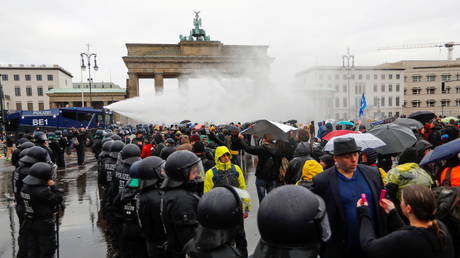 And it’s not just France. In Berlin last week, police fired water cannon and pepper spray at a crowd of people, including children, protesting against Germany’s coronavirus restrictions. In the aftermath, police justified the action saying people were refusing to wear face masks. So you blast them with water?
Spain, which suffered a particularly restrictive 100-day lockdown, has also seen trouble. On top of street protests by families missing their loved ones, there have been running battles with the police, barricades set on fire, and shops looted across the country.
Likewise in Italy, where even the Mafia is alleged to have joined in the looting and trashing of property, all in the guise of a coronavirus protest. Police there also used tear gas to disperse the crowds.
And it’s not just these nations. Protests in the UK have attracted thousands, the USA has seen violence flare at street marches, there have been rallies across the globe – Argentina, Brazil, Nigeria, Serbia, Russia, Australia, South Africa, Mexico. Even in countries most of us would struggle to find on a map, like Malawi.
Everywhere, the riot police have steamed in to break up crowds, leading to countless clashes and arrests creating even further upset. Is this where we are now? This is what this infernal Covid-19 virus has driven us to? Police in riot gear using batons, shields, water cannon and tear gas on their fellow citizens who are venting their anger, having become simply tired of being cooped up indoors?
Back in Paris, the young music producer who had been assaulted told journalists outside police headquarters that “people who should have been protecting me attacked me. I did nothing to deserve this.”
Anyone expecting some sort of climbdown from their government and public health officials has no doubt given up waiting by this point. Across the world, people are preparing for a crappy Christmas and grim warnings that breaching restrictions will mean a terrible price to be paid come the new year.
In France, the controversial new global security law has passed its first legislative stage, meaning anyone taking a photo or filming on-duty police that enables them to be identified faces a year in prison and a whopping €45,000 fine.
Prime Minister Jean Castex has suggested the government may backtrack on the controversial law but it’s naive to believe there’s any real honesty in that claim.
Meanwhile, French police will continue to pursue their thuggery, beating and teargassing innocent citizens, tipping people from their tents when clearing temporary camps of asylum seekers and trampling over protestors at will. Anyone caught filming them will simply be arrested and flung in jail.
No doubt this sort of behaviour will be repeated across the globe at organised protests against coronavirus restrictions wherever they may be. The lingering concern is that once this cursed pandemic passes, will things return to normal, where those we expect to protect us do just that?
Or has there been a subtle but sinister shift towards a more brutal state in many countries, where governments have been emboldened by newly tried and tested authoritarianism? Let’s see what answer to that 2021 brings.
Damian Wilson is a UK journalist, ex-Fleet Street editor, financial industry consultant and political communications special advisor in the UK and EU.
November 27, 2020
Posted by aletho |
Civil Liberties, Subjugation - Torture | European Union, France, Human rights |
Leave a comment
The G20 leaders have reached a consensus of a magnitude previously observed at Warsaw Pact summits. News in brief: they want to vaccinate us, and then, before we become restless, switch to combating global warming. If we survive masks and vaccines, austerity will kill off the survivors.
Remember, before the pandemic there was Greta? Greta will return, as soon as everyone gets a jab. This Save-The-World program appeals to a significant part of humanity, including Russians, Europeans, Americans. First, a jab to save us; then, save the planet from warming. So much of this world-saving is straight out of a comic strip. Now let us take time to look at what is happening.
While you were spending your weekend preparing for Thanksgiving, the leaders of twenty of the world’s leading countries held their Online Summit. Usually they come together, talk, discuss problems on the sidelines – this time it was all online. Although the summit was formally hosted by Saudi Arabia, Zoom is Zoom – the hosts of the summit had few opportunities to show off their hospitality. And there was little controversy. The leaders generally agreed with each other.
The main dissenter – the Orange Monster, aka President Trump – could have shoved a cane into the spokes of the-too-fast-by-half-chariot, but he had no time for them. He was immersed in his battle for the White House in the courts, and in his spare time he played golf.
The previous G20 summit took place in March, and there they decided to open the gates for lockdown and destroy the world, as we knew it. Before March, the Covid obsession was still a minority interest. Russians just laughed about it. After the March G20 decision, it became the top priority. The November Summit affirmed the March decisions, and went further, much further.
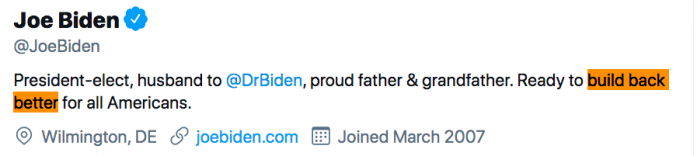
While President Putin stressed at the summit that the main danger to the world is unemployment, poverty, and economic depression of unprecedented scale, other speakers gave the impression that they were satisfied with the current situation, because it allows everything to be rebuilt. Build back better, is the slogan of Joe Biden:
For some, Covid is a plague, but for our leaders it is an Overton window. I’d advise them to eat a slice of lemon before speaking. This, of course, will not help against Covid, but at least it will wipe the blissful smiles off their faces. (“Eat a slice of lemon before speaking”, was advice given to a lady who complained of getting too much male attention in Italy).
The Chinese leader Xi proposed introducing worldwide QR codes so that without them people could not irresponsibly roam the planet. Nobody objected, but they did not support this initiative either. Xi is afraid that the wily Westerners will impose their own sanitary passports allowing only people injected with Western vaccines to travel. This possibility worried Putin, too, as Russia has developed two or three of their own vaccines. If the Chinese and Russian vaccines aren’t recognised by Europe, their people won’t be able to travel.
The WHO fancied that this virus was not the last; there will be more pandemics, and only vaccinations, masks and generous contributions to its budget will save us. They also promised a new wave of Covid in January, and then another, and so on until the earth will be covered with vaccines. To help poor countries, the leaders declared that the repayment of debts may be postponed, and that vaccines will be supplied to the impecunious nations for free. Free for them, but you will pay for them. (Not that they need it. Poor countries do not suffer of Covid. China’s neighbour Mongolia, despite open border with China, had no Covid. Poor Cambodia, ditto. Africa, none, excepting South Africa. )
The EU representatives called for Global Rebuilding – Build Back Better. That is, we will rebuild everything, but better and in way which is inclusive, green, sustainable. And much more expensive. And at your expense. The struggle for the climate is austerity under another name; it calls for a radical drop in living standards. We shall tighten our belts, and we will regret that Covid did not relieve us from unnecessary torment.
In past forums, Trump has constantly spoken out against the fight against warming, but this time he resigned himself. And his likely successor, Joe Biden, has already pledged to return America to how it was with the WHO and the Paris climate agreement.
So the worldwide rebuilding, perestroika seems to be as inevitable as Gorbachev’s in 1986. The Russian perestroika killed more people than Stalin’s Gulag; it destroyed the livelihood of millions. The wealth of the Russian people has been looted by Messrs Abramovich, Deripaska et al. From the earliest days of these changes, a minority of Russians weren’t optimistic about the outcome, but they were marginalised and their voices were silenced. Now the same is in store for the disaffected and dissidents – if all 20G take this disastrous route, this is well-nigh unavoidable. I do not know what is worse, the Covid lockdown or climate austerity, but there is no need to decide for we shall have both.
A few numbers regarding climate austerity. The Russian perestroika reduced CO2 emissions by 5 per cent year after year for ten years. The Great Depression was even better: a 10 per cent drop in emissions year after year. Millions of Americans died (The Grapes of Wrath), and nobody told them they were saving the planet. Optimistic researchers with the Global Carbon Project say the emissions should be cut by 5.5 per cent per year over the next 45 years. This is a deadly collapse; what we have now is a preview of what they have in store for us and our children. (You can check the numbers here).
The Chinese do not mind this, as they do not mind lockdowns, face recognition and social rating. Their popular film The Wandering Earth shows a world that fights global warming the Chinese way and depicts a future so grim that 1984 looks Utopian beside it. Even so it was still considered a positive and encouraging film by the Chinese audience. We should not accept Chinese methods of fighting diseases or climate change or indeed general governance. They are too different.
If they insist on fighting global warming, let us begin with them personally. Let Gore and Greta and their followers live ecologically on average salary. It is not difficult to live green if you are a millionaire. Do it on the average income. After you pay electricity, water, rates, transport, school you won’t even think of paying much more for making your car “green” and CO2-neutral. You’d be happy to survive as it is. I’d make it a law: every green activist should surrender his assets for safekeeping and manage his green life on the average income for at least one year.
The summit called for further digitalisation, for increased information flows across borders, for a combination of distance learning with conventional learning. Perhaps some digitalisation is unavoidable, but do we need more of it? We need more freedom, and digitalisation appears to be strongly repressive. It is a good tool for tyranny. Any tyrant of old, be it Hitler or Borgia, would be able to achieve much more in union with Zuckerberg. We need to stop the data giants, tax them to the hilt, make their life miserable, change their CEO by users’ vote at least once a year.
Distance schooling is probably the worst innovation of its kind. And rich folks know it well. In New York, the public schools were barred, but private schools operated normally all right, because distance schooling is no better than learning by watching telly. It also kills social fabrics and habits, making children boorish and unable to communicate. It is unnecessary, for children practically do not suffer of Covid. The main reason of going distant is to make our children even more stupid than they are likely to become anyway after watching YouTube. Another reason is to make them asocial and unable to act together against their betters. It should be outright forbidden, not encouraged.
A detailed declaration was prepared and drawn up before the summit and confirmed by the leaders. It also contains approval of the previous March declaration which began the triumphant march of lockdowns around the world.
Of course, the summit did not make binding decisions – only declarative ones, but they were detailed and unambiguous. Vaccinations, a perpetual fight against pandemics, smoothly turning into a fight against global warming, more austerity accompanied by QR codes on a global scale. What we have is what we shall have, this is what they decided. Masks are now and forever:

The leaders agreed to strengthen the WTO (the United States will return to as it was before under Biden) and strive to create a unified global tax system. The IMF (International Monetary Fund) will be at the centre of efforts to coordinate cryptocurrencies in relation to debtor countries, banks and other financial institutions. Some analysts were expecting a departure from the dollar as a reserve currency, but this has not yet been debated.
In the ongoing discussion between liberal globalism and nationalism, the G20 went for globalism and liberalism on steroids. Though President Trump still hopes to conclude the elections in his favour, the G20 already went the Biden way. It is difficult to understand, as the WTO, IMF, WHO are universally disliked by Russians, Americans and many Europeans, too. This is a sad and discomforting decision.
Humanity has made a big step towards unity at this summit. I am not sure it is worth rejoicing. Disagreement is a dangerous thing and leads to wars, but unanimity can be even more dangerous if it is the unanimity of experts and not peoples.
A comforting thought before you despair: declarations of unity were adopted earlier, in particular, when the League of Nations and the UN were created, but then disagreements took over, and a blessed diversity of opinions came back. I do not think we are ripe for that much of unity.
Israel Shamir can be reached at adam@israelshamir.net
November 26, 2020
Posted by aletho |
Economics, Science and Pseudo-Science, Timeless or most popular | Covid-19, European Union, Russia, WHO |
Leave a comment
The EU is trembling in anticipation at the prospect of a Joe Biden administration, like Ana Steele in Christian Grey’s Red Room of Pain, despite the policies he espouses being precisely the cause of their problems.
Their rushing to congratulate him, even before the presidential result is certified, speaks volumes of their delight that ‘daddy’ is back in the White House.
European Commission President Ursula von der Leyen could barely contain her joy over what she said was a “new beginning in EU-US global partnership.”
Charles Michel, the European Council president, said it was time to “rebuild a strong EU-USA alliance” and he hastily invited Biden to a European summit in Brussels in the new year, even though the American election has not yet been formally concluded.
Other European national leaders had already congratulated Biden two weeks ago, only days after the November 3 ballot, despite the controversy of incumbent Donald Trump vowing legal challenges over alleged voting fraud.
European elation grew this week with the unveiling of Biden’s would-be cabinet picks. Which seems incredible, given that the incoming White House team is made up of people associated with the Obama administrations (2008-16) for which Biden had served as vice president. Incredible, because several of Europe’s contemporary pressing problems stem from wars in North Africa and the Middle East that the Obama administration fomented.
Appearing defensive about that, Biden in his first in-depth interview as president-elect asserted that “this is not a third Obama administration.” The fact remains, though, that his cabinet nominees are Obama-era holdovers, with names like Antony Blinken for Secretary of State and Jake Sullivan as national security adviser who advocated wars or destructive interventions in Libya, Syria and Ukraine. These conflicts and others in Iraq and Afghanistan, which Biden personally endorsed as a senior senator or exacerbated while vice president to Obama, have led to myriad problems in Europe, from blowback jihadist terrorism to racial tensions with Muslim communities, to straining of resources dealing with a massive influx of refugees from war zones.
This week, while European leaders were cooing over the next Biden administration, French police caused shocking headlines by brutally forcing hundreds of mainly Afghan refugees from a makeshift encampment in the heart of Paris. Such problems stem directly from the illegal wars that were the handiwork of Obama, Biden and his reprised team of warmongers.
Thus, the question is why are European politicians so craven in welcoming the return of conventional American imperialists? Forget all the Biden team hype about “working with allies” and “multilateralism is back”. The Europeans will be treated as they always have been: adjuncts to Washington’s pursuit of its own “interests.”
It’s the political equivalent of “Who’s your daddy?” The European leaders are rolling over for more abuse and gladly doing so, too.
But why?
There are several factors. A deluded nostalgia for “normalcy” after four years of fraught and nerve-fraying relations with maverick Trump. The personal umbrage of Germany’s Angela Merkel, France’s Emmanuel Macron and other European leaders from being antagonized by boorish Trump over NATO expenditures and trade tariffs is part of the relief they are feeling at getting rid of him. Also, European politicians and diplomats will see Biden and his team as people they are reconnecting with in career paths going back several years. Unlike the shambolic and confusing Trump administration, a Biden one will bring coherence and continuity – regardless of the legacy of wars – which makes for smoother personal, political interaction. Better the devil you know.
Don’t forget, too, that there are plenty of European Atlanticists who, from an ideological conviction, truly believe in the strategic benefits of an US-EU axis. These kind of European deep-state politicians and bureaucrats are credulous believers in NATO and American claims of “leading the free world” against, formerly, the Soviet Union and Red China, and now Russia and Belt & Road China. So, when they hear Biden declaring “America’s back” and “renewing alliances” it is music to their ears.
One specific upside is talk from President-elect Biden of returning the US to the Iran nuclear deal. Trump’s trashing of the 2015 accord cost European states a lot of business and investment hopes with Iran. Also, their image of presumed independence was dented from Trump wielding secondary sanctions against Europeans doing business with Iran, humiliating them to toe his line. With Biden, the Europeans see an opening for resuming economic interests in Iran. That remains to be seen, however.
Another possible upside under Biden is his seeming willingness to enter into arms-control talks with Russia. In particular, renewing the New START treaty curbing strategic nuclear weapons. Trump’s reckless walking away from arms-control conventions, including the Intermediate-range Nuclear Forces (INF) treaty and the Open Skies Treaty, caused much anxiety across Europe of a new arms race and a threat to continental security. Biden, therefore, may bring some stability on arms control, even though he and his team have made numerous aggressive sounds towards Russia.
But perhaps the most appealing thing that European leaders see in Biden is that the removal of Trump from office is a harbinger for countering the rise in European populism which has been gravely undermining the EU project. The European liberal establishment refers to the various movements as “far-right” which is an unfair broad brush. Some are rightwing, some leftwing, but generally there is a popular sentiment of alienation from the EU and national political establishments over issues related to neoliberal capitalist failure and seemingly uncontrolled immigration which is connected to endless American wars aided and abetted by European NATO powers.
Former European Council President Donald Tusk expressed this view: “Trump’s defeat can be the beginning of the end of the triumph of far-right populisms in Europe. Thank you, Joe.”
Trump was detested by European establishment politicians because they saw him as a mentor for populist, nationalist parties across Europe. His outspoken support for Brexit rankled the EU. Trump’s former ambassador to Germany, Richard Grenell, openly advocated for Germany’s Eurosceptic AfD party. Steve Bannon, Trump’s former political aide, tried to rally a populist revolt across Europe.
In short, Trump and his America First policy was seen as a malign influence corroding the pillars of the EU bloc.
Biden, however, is a return to conventional trans-Atlanticism, where European nations are at least treated with a modicum of respect – albeit in reality subordinates who will be told by Washington when, where and how high to jump. That’s a degrading relationship but, for the European establishment, they see it as the best way to preserve their order by taking the political oxygen away from populists. Never mind the wars, the refugees, the multicultural tensions, the economic austerity, being a sub for Uncle Sam is a comfort of sorts.
The tragic irony is this not-so “new beginning” in EU-US relations will inevitably lead to more internal contradictions down the road because Biden’s politics are predicated on more interventionism and imperialism under the banner of “leading the free world,” which is the root cause of Europe’s instability.
Finian Cunningham is an award-winning journalist. For over 25 years, he worked as a sub-editor and writer for The Mirror, Irish Times, Irish Independent and Britain’s Independent, among others.
November 25, 2020
Posted by aletho |
Militarism | European Union, NATO, United States |
Leave a comment
Leader of the Islamic Revolution Ayatollah Seyyed Ali Khamenei has described the illegal sanctions the United States has imposed on Iran with the support of its European partners as a “bitter reality” and a “crime” against the nation.
Ayatollah Khamenei made the remarks on Tuesday during a meeting of the Supreme Council for Economic Coordination among the three branches of the Iranian government.
The Leader said the Iranian nation has been subjected to such a crime for many years, but that the sanctions have been stepped up over the past three years under the current US administration.
Ayatollah Khamenei said there are two ways to end the restrictions, either by “neutralizing the sanctions and overcoming them” or having “the bans removed.”
“Of course, we tried the path of [having] the sanctions lifted once and negotiated for several years [to that effect], but it produced no results,” he added.
Referring to the other solution, the Leader said, “This path may have difficulties at the beginning, but there will be a positive outcome.”
Ayatollah Khamenei said, “We have a lot of potential and capabilities to render the sanctions ineffective, provided that we muster the will, strive and meet the challenges outright.”
“If we manage to overcome the sanctions through [our own] efforts and initiatives while holding firm against the problems, the other side will gradually lift the bans since it will see their ineffectiveness,” the Leader added.
The Leader further urged Iranians not to rely on aid from abroad to resolve domestic problems.
“The situation of the United States is far from clear and the Europeans are constantly adopting positions against Iran,” the Leader said. “They tell us not to interfere in the region, whereas it is them who are interfering the most wrongly in the affairs of the region, with Britain and France possessing destructive nuclear missiles and Germany being on the same path. Then they tell us not to have missiles.”
November 24, 2020
Posted by aletho |
Economics, War Crimes | European Union, Middle East, Sanctions against Iran, United States |
Leave a comment
President Donald Trump’s administration has on Sunday withdrawn from an international treaty that allows countries to monitor military hardware build-ups from afar, accusing Moscow – without evidence – of breaking its terms.
The Open Skies Treaty was first considered by the US and the Soviet Union in the 1950s as a possible way to increase transparency around troop movements and the deployment of nuclear weapons. It allows signatories to conduct a limited number of mutually beneficial aerial reconnaissance missions in the countries that are party to the deal, which includes the US, Canada, Russia and most of Europe.
In May, US Secretary of State Mike Pompeo pointed the finger at Moscow when he announced his country would seek to end its involvement in the treaty, claiming without evidence that Russia violated it. President Vladimir Putin’s government was presented with a set of new demands by US diplomats but refused them, calling them ultimatums.
As a result of the decision, the Americans will now no longer be able to operate unarmed spy plane flights over Russian territory, or that of the other signatory countries. They will also, in theory, be unable to benefit from intelligence gained from the program. However, there are concerns that the US will request aerial photographs of Russia taken by allies, while barring equivalent Russian flights over US military installations.
On Sunday, the Russian Foreign Ministry called that situation “unacceptable.” It added in a statement that Moscow “will seek firm guarantees that the states remaining in the treaty will fulfill their obligations, firstly, to ensure there are no barriers to observing their territory and, secondly, to ensure that the photographs from reconnaissance flights are not transferred to third countries that are not signed up to the deal.”
Open Skies is the latest international treaty that the US has pulled out of over tensions with Russia. Last year, Trump’s White House tore up the Reagan-era Intermediate-Range Nuclear Forces Treaty that had banned a number of highly destructive weapons with ranges of between 500 and 5,500km. At the time, Washington also accused Russia of breaking the conditions of the pact, while Moscow strongly denied the allegations.
The presumptive winner of the disputed US presidential elections, former vice president Joe Biden, has been critical of Trump’s approach to these Cold War-era treaties in the past. He has called the move to pull out of Open Skies short-sighted, and implied he would look to re-join the deal. However, this may prove challenging as the US might be forced to sign up to any and all new provisions of the Treaty that were made in their absence.
November 22, 2020
Posted by aletho |
Militarism | Canada, European Union, Russia, United States |
Leave a comment