Ironically, while three US presidents have been accused of impeaching the Constitution for relatively minor offenses, including Bill Clinton for perjury and Donald Trump for using political influence to discredit opponents, no US president has ever been charged, let alone convicted, of waging devastating wars of aggression.
Unless impeachment proceedings are initiated against war criminals, including George Bush and Dick Cheney for invading Afghanistan and Iraq and Barack Obama and Joe Biden for waging proxy wars in Libya and Syria, the impeachment provisions in the US Constitution would serve as nothing more than a convenient tool for settling political scores.
The fact is not only the domestic law enforcement and judicial systems of the Western powers but also international institutions, such as International Criminal Court, have been used as tools of perception management for solely prosecuting alleged “war criminals” of former Yugoslavia and impoverished African nations and real war criminals have never been prosecuted for the crimes of destroying entire nations with their militarism and interventionism.
Before being elected as Obama’s vice president in 2008, as a longtime senator from Delaware and subsequently as the member and then the chairman of the powerful Senate Foreign Relations Committee, Joe Biden, alongside inveterate hawk Senator Joe Lieberman, was one of the principal architects of the Bosnia War in the Clinton administration in the nineties.
Reflecting on first black American president Barack Obama’s memorable 2008 presidential campaign, with little-known senator from Delaware, Joe Biden, as his running-mate, Glenn Kessler wrote for the Washington Post [1] in October 2008:
“The moment when Senator Joseph R. Biden Jr. looked Serbian leader Slobodan Milosevic in the eye and called him a ‘damned war criminal’ has become the stuff of campaign legend.
“The Democratic vice presidential nominee brings up the 1993 confrontation on the campaign trial to whoops of delight from supporters. Senator Barack Obama mentioned it when he announced he had chosen Biden as his running mate.
“During vice presidential debate with his counterpart on the Republican ticket, Alaska Governor Sarah Palin, Biden twice gave himself credit for shifting US policy on Bosnia. The senator from Delaware declared that he ‘was the catalyst to change the circumstance in Bosnia led by President Clinton.’ At another point he noted: ‘My recommendations on Bosnia — I admit I was the first one to recommend it. They saved tens of thousands of lives.’”
Instead of “saving tens of thousands of lives,” the devastating Yugoslav Wars in the nineties in the aftermath of the break-up of the former Soviet Union and then the former Yugoslavia claimed over 130,000 fatalities, created a humanitarian crisis and unleashed a flood of millions of refugees for which nobody is to blame but the Clinton administration’s militarist policy of subjugating and forcibly integrating East European states into the Western capitalist bloc.
Regarding Washington’s modus operandi of waging proxy wars in Eastern Europe and the Middle East, since the times of the Soviet-Afghan jihad during the eighties, it has been the fail-safe game plan of master strategists at NATO to raise money [2] from the oil-rich emirates of Saudi Arabia, Qatar, UAE and Kuwait; then buy billions of dollars’ worth of weapons from the arms markets [3] in the Eastern Europe; and then provide those weapons and guerilla warfare training to the disaffected population of the victim country by using the intelligence agencies of the latter’s regional adversaries. Whether it’s Afghanistan, Bosnia, Kosovo, Chechnya, Libya or Syria, the same playbook was executed to the letter.
Raising funds for proxy wars from the Gulf Arab States allows the Western executives the freedom to evade congressional scrutiny; the benefit of buying weapons from unregulated arms markets of the Eastern Europe is that such weapons cannot be traced back to the Western capitals; and using jihadist proxies to achieve strategic objectives has the advantage of taking the plea of “plausible deniability” if the strategy backfires, which it often does. Remember that al-Qaeda and Taliban were the by-products of the Soviet-Afghan jihad, and the Islamic State and its global network of terrorists were the blowback of the proxy war in Syria.
Nevertheless, smugly oblivious to the death and destruction caused by Washington’s global domination agenda, national security shill Glenn Kessler further noted in the aforementioned Washington Post article:
“Biden focused on deficiencies in US policy toward Bosnia, he called for NATO expansion before it became fashionable and most recently prodded the Bush administration to back a $1 billion package to rebuild Georgia after the Russian invasion.
“As the incident with Milosevic shows, Biden is hardly shy about emphasizing his own role in world affairs. Biden’s book portrays him frequently confronting Clinton and bucking him up on Bosnia when the president had doubts about his own policy. But the hard legislative work was left to others. Biden did take an early stab at prodding action, writing an amendment in 1992 — opposed by George H.W. Bush’s administration — that authorized spending $50 million to arm the Bosnian Muslims.
“In April 1993, Biden spent a week traveling in the Balkans, meeting with key officials, including a three-hour session with Milosevic. The trip was detailed in 15 pages of the senator’s autobiography.
“By all accounts, the meeting was tense. Milosevic spent a lot of time poring over maps and expressing concerns with peace proposals crafted by a group of international mediators. Milosevic denied he had much influence over the Bosnian Serbs, but then immediately summoned Radovan Karadzic, their leader, with a curt phone call.
“According to Biden’s book, Milosevic asked the senator what he thought of him. ‘I think you’re a damn war criminal and you should be tried as one,’ Biden said he shot back. Milosevic, he said, did not react.
“Upon his return to the United States, Biden issued a 36-page report on the trip, laying out eight policy proposals, including airstrikes on Serb artillery and lifting the arms embargo on Bosnian Muslims.
“Biden continued to make fiery statements on Bosnia, demanding action. Richard C. Holbrooke recalled that when he was nominated as assistant secretary of state for Europe in late 1994, Biden ‘in no uncertain terms made it clear to me that the policy on Bosnia had to change and he would make sure it did. He believed in action, and history proved him right.’
“’When you look back, Senator Biden got Bosnia right earlier than anyone. He understood that a combination of force and diplomacy would revive American leadership and avoid a disaster in Europe,’ said James P. Rubin, a Biden aide at the time who later became spokesman for Secretary of State Madeleine K. Albright.”
It’s pertinent to mention that though touted as a “collective defense pact,” the trans-Atlantic military alliance NATO and its corollary economic alliance European Union were conceived during the Cold War to offset political and economic influence of the former Soviet Union which was geographically adjacent to Europe.
Historically, the NATO military alliance at least ostensibly was conceived as a defensive alliance in 1949 during the Cold War in order to offset conventional warfare superiority of the former Soviet Union. The US forged collective defense pact with the Western European nations after the Soviet Union reached the threshold to build its first atomic bomb in 1949 and achieved nuclear parity with the US.
But the trans-Atlantic military alliance has outlived its purpose following the dissolution of the Soviet Union in 1991 and is now being used as an aggressive and expansionist military alliance meant to browbeat and coerce the Central and Eastern European states to join NATO and its corollary economic alliance, the European Union, or risk international isolation.
It was not a coincidence that the Soviet Union was dissolved in December 1991 and the Maastricht Treaty that consolidated the European Community and laid the groundwork for the European Union was signed in February 1992.
The basic purpose of the EU has been nothing more than to entice the former communist states of the Eastern and Central Europe into the folds of the Western capitalist bloc by offering financial incentives and inducements, particularly in the form of foreign direct investment and grants and loans to the tune of billions of dollars, and by abolishing internal border checks in the common European market, allowing free movement of workers from Eastern European nations seeking employment in prosperous Western European economies.
Naively giving credit to former Senator and Vice President Joe Biden for his supposed “humanitarian interventionism” and for creating a catastrophe in the Balkans in the nineties, Paul Richter and Noam N. Levey, writing for the LA Times [4] in August 2008, observed:
“Biden has frequently favored humanitarian interventions abroad and was an early and influential advocate for the US military action in the Balkans in the 1990s.
“Biden considers his most important foreign policy accomplishment to be his leadership on the Balkans in the mid-1990s. He pushed a reluctant Clinton administration first to arm Serbian Muslims and then to use U.S. air power to suppress conflict in Serbia and Kosovo.
“In his book, ‘Promises to Keep,’ Biden calls this one of his two ‘proudest moments in public life,’ along with the Violence Against Women Act that he championed.
“In 1998, he worked with McCain on a resolution to push the Clinton administration to use all available force to confront Serbian leader Slobodan Milosevic, a move designed to force the president to use ground troops if necessary against Serb forces in the former Yugoslavia, which was beset by fighting and ethnic cleansing.
“In addition, Biden, who claims close relationships with many foreign leaders, has demonstrated a readiness to cooperate with Senate Republicans in search of compromise — a trait that meshes with Obama’s pledge to reduce the level of partisan conflict and stalemate in Washington.
“He has called his new adversary, presumed Republican presidential nominee in the 2008 elections, Senator John McCain of Arizona, a ‘personal and close friend.’”
Birds of a feather flock together. Not only did Joe Biden collaborate with Joe Lieberman in the Clinton administration to create a humanitarian crisis in the Balkans in the nineties but he also shared the hawkish ideology of late Senator John McCain.
Though a decorated Vietnam War veteran who died battling cancer in 2018, McCain was a highly polarizing figure as a senator and was regarded by many Leftists as an inveterate neocon hawk, who vociferously exhorted Western military interventions not only in the Balkans in the nineties but also in Libya and Syria in 2011.
McCain was a vocal supporter of the 2011 military intervention in Libya. In April 2011, he visited the anti-Gaddafi forces and National Transitional Council in eastern Libyan city Benghazi, the highest-ranking American to do so, and said that the rebel forces were “my heroes.”
Regarding Syria’s proxy war that began in 2011, McCain repeatedly argued for the US intervening militarily in the conflict on the side of the anti-government forces. He staged a visit to rebel forces inside Syria in May 2013, the first senator to do so, and called for arming the Free Syrian Army with heavy weapons and for the establishment of a no-fly zone over Syria.
Following reports that two of the terrorists he posed for pictures with had been responsible for the kidnapping of eleven Lebanese Shia pilgrims the year before, McCain disputed one of the identifications and said he had not met directly with the other.
In the aftermath of a false-flag chemical weapons attack in Ghouta in 2013, McCain vehemently argued for strong American military action against the government of Bashar al-Assad, and in September 2013, cast a Foreign Relations Committee vote in favor of then-President Obama’s request to Congress that it authorize a military response, though the crisis was amicably resolved after seasoned Russian Foreign Minister Sergey Lavrov staged a diplomatic coup by persuading Damascus to ship its alleged chemical weapons stockpiles out of Syria under Russian supervision.
***
Nauman Sadiq is an Islamabad-based attorney, columnist and geopolitical analyst focused on the politics of Af-Pak and Middle East regions, neocolonialism and petro-imperialism. He is a regular contributor to Global Research.
Notes
[1] Biden Played Second Fiddle to Joe Lieberman in Bosnia Legislation:
https://www.washingtonpost.com/wp-dyn/content/article/2008/10/06/AR2008100602681.html
[2] U.S. Relies Heavily on Saudi Money to Support Syrian Rebels.
https://www.nytimes.com/2016/01/24/world/middleeast/us-relies-heavily-on-saudi-money-to-support-syrian-rebels.html
[3] Billions of dollars weapons flowing from Eastern Europe to Middle East.
https://www.theguardian.com/world/2016/jul/27/weapons-flowing-eastern-europe-middle-east-revealed-arms-trade-syria
[4] On foreign policy, he’s willing to go his own way:
https://www.latimes.com/archives/la-xpm-2008-aug-24-na-foreignpol24-story.html
October 12, 2020
Posted by aletho |
Militarism, Timeless or most popular | European Union, Joe Biden, NATO, United States |
Leave a comment
By Paul Antonopoulos | October 12, 2020
By handing out a €6.5 billion fine against Gazprom, Warsaw has obviously and massively miscalculated because it did not only antagonize the Russian energy company as was intended, but also European partners of the Nord Stream 2 pipeline project, which the Polish government obviously had not considered. Even leaders within the European Union were shocked at the huge fine that Poland is attempting to impose against Nord Stream 2.
It may very well be that the Polish Office of Competition and Consumer Protection (UOKiK) has lost itself when deciding on the price of the fine against Gazprom. But regardless of that, UOKiK has apparently also exceeded its jurisdiction. As the Düsseldorf-based energy supplier Uniper reports, the existing agreements on Nord Stream 2 have nothing to do with a joint venture, which is why the Polish laws on merger controls do not apply to them. The initial plans were to finance the construction of the Nord Stream 2 pipeline through the establishment of a joint venture. For this, however, the companies involved should have received a permit in all the countries in which they operate, as well as from Poland, the only EU state that blocked this decision. The decision for it not to be a joint venture was made without further ado so as not to waste time or money in a dispute with Polish authorities.
The pipeline partners designed an alternative financing model for Nord Stream 2 and instead of joining Nord Stream 2 AG (Company) as a co-partner, the European energy companies are participating in the project as lenders so that Polish antitrust laws do not apply to them. However, Gazprom, the majority shareholder of Nord Stream 2 AG, has given its European partners shares in the company as collateral for the financing provided. If the loans from the Russian side are not paid, the European corporations automatically become the owners of Nord Stream 2 AG. Referring to this fact, the Polish antitrust authorities have declared the European partner companies to be quasi-shareholders in the pipeline project.
With this UOKiK also justifies the exorbitant fine against Gazprom and the fines of around €55 million against Uniper (German), Wintershall (German), Engie (French), OMV (Austrian) and Shell (English-Dutch). Neither Gazprom nor Nord Stream 2 are financially at risk at the moment and the Russian group has already announced that it will take the fine to court.
Poland is of course now aware that their attempts to fine the Nord Stream 2 project will amount to nothing. The aim of the Polish government is not so much to force a large sum of money from Gazprom in the long term, but rather to bury the pipeline project entirely. And this is the part where Warsaw has grossly miscalculated, not only European reactions, but Russian determination.
The goal to cancel Nord Stream 2 also explains why Polish authorities published their decision last week. Relations between the EU and Russia are extra strained because of the Navalny case and the situation in Belarus. France and Germany are working on new sanctions against Russia for the Navalny case and continue to apply pressure against Belarus.
Another question is how effective these measures will be. Sanctions have long degenerated into ambiguity as it is the usual way the West deals with Moscow. Russia has learnt how to adjust their economy accordingly, meaning that sanctions have turned into a farce. The West is regularly expanding its blacklists of sanctioned companies and private individuals, but there has been no significant effect. Political forces with a keen interest in the failure of Nord Stream 2 are plentiful in the West and they are currently advancing the Navalny case in the hope that it will cut the EU from Russia more strongly or permanently. This will not occur as Europe desperately needs Russian energy, which is why Nord Stream 2 is such a critical project for all involved.
Poland plays the main role in trying to cancel Nord Stream 2 and the decision by UOKiK is just another push to finally get Europe to abandon the pipeline project. According to a joint declaration by France and Germany, measures are currently being prepared for those alleged to be responsible in the Navalny case and their participation in the so-called Novichok program.
Despite these measures, Western Europe is bringing its energy project which is important for its own future out of the danger zone, while Poland is attracting even more displeasure from EU giants through its own operation. A penalty against Gazprom may be a Russian problem, but fines against leading corporations from Germany, France, the Netherlands, Great Britain and Austria are guaranteed to leave many of Europe’s biggest capitalist angered. The effort Warsaw is making to thwart Nord Stream 2 is visibly turning opposite to what they expected as there is little doubt the Nord Stream 2 project will come to fruition and completion.
Paul Antonopoulos is an independent geopolitical analyst.
October 12, 2020
Posted by aletho |
Economics, Malthusian Ideology, Phony Scarcity | European Union, Russia |
Leave a comment
In both the United States and Europe there has been an increase in the passage of laws that are intended to protect Jews. Indeed, one might say that one of the few growth industries in Donald Trump’s United States has been the protection of Jewish citizens and their property from a largely contrived wave of anti-Semitism that is allegedly sweeping the nation. Even while potentially catastrophic developments both in the Middle East and the United States continue to unfold, the threat of anti-Semitism continues to find its way into much of the news cycle in the mainstream media.
A survey conducted last month in all fifty states was released with the headline “First-Ever 50-State Survey On Holocaust Knowledge Of American Millennials And Gen Z Reveals Shocking Results. Disturbing Findings Reveal Significant Number Of Millennials And Gen Z Can’t Name A Single Concentration Camp Or Ghetto, Believe That Two Million Or Fewer Jews Were Killed And A Concerning Percentage Believe That Jews Caused The Holocaust.”
The survey is based on the premise that detailed knowledge of the so-called holocaust should be an essential part of everyone’s education. Currently, 12 states already require holocaust instruction in their public school curricula, though that includes five of the six biggest states, and recently passed federal legislation will eventually fund holocaust education everywhere in the U.S. But, of course, the real back story that one must not mention is that the standard holocaust narrative is at least as much fiction as fact and it is employed regularly to create special benefits and protections for both Jews in general and also for the State of Israel. That is why the usual sources in the media become outraged whenever it seems that the propaganda is not effective.
The ignorance of the holocaust story inevitably received wide play in the mainstream media but there are a number of things that all Americans should know about the anti-Semitism hysteria that drives the process. First of all, the extent to which there is actual anti-Semitism and the background to many of the incidents has been deliberately distorted or even ignored by the press and by the government at all levels. Anti-Semitism is hatred of Jews for either their religion or their ethnicity, but many of the so-called anti-Semitic incidents are actually related to the policies advanced by the state of Israel. Organizations like the Anti-Defamation League (ADL), which have a vested interest in keeping the number of anti-Semitic incidents high, deliberately conflate the two issues in their reports.
In its 2018 report, ADL reported “1,879 acts,” in the United States during the course of the year. It is not a particularly large number given the size and population of the U.S. and also with respect to what is included. There were certainly some physical attacks, including two shooting incidents at synagogues in Pittsburgh and Poway, but most of the incidents were much less kinetic, including shouting and name calling on university campuses between groups supportive of and opposed to Israel’s repression of the Palestinians.
Europe is way ahead of the game when it comes to punishing so-called holocaust denial or anti-Semitism, which now includes any criticism of Jews and/or of Israel. As one critic put it, Europeans generally can exercise something like free speech, but the speech is limited by certain rules that must be observed. Three weeks ago, the French nationalist writer and critic of Jewish power Hervé Ryssen was jailed for the fifth time for the crime of “hate speech.” He faces up to 17 months in prison for having been found guilty of “…insult, provocation, and public defamation due to origin, ethnicity, nationality, race, or religion.” In 2016 he was imprisoned for 5 months, in 2017 for 6 months and in 2018 for one year on similar charges. He also had to pay a 2000 Euros fine to the National Bureau of Vigilance Against Anti-Semitism. In January 2020, Ryssen was found guilty of “contesting the existence of crimes against humanity,” i.e. questioning the so-called holocaust which labels him as a négationniste, a “holocaust denier.”
Ryssen has written numerous books on Jewish power in Europe and on Israel. His scholarship has rarely been questioned, but his willingness to speak out sometimes boldly on issues that are forbidden has put him in prison more often than not. Curiously, the French law against vilifying ethnic groups and religions has de facto only rarely been applied to protecting either Christians or Muslims. Satirical magazine Charlie Hebdo continues to “blaspheme” against both religions without any intervention from the authorities, but it is careful not to make fun of Jews.
The United States is clearly moving in the direction of France, at least insofar as the Jewish community and Israel are concerned. But it is also refreshing to note that a revived progressive wing of the Democratic Party is engaging in a bit of pushback. Three weeks ago, 162 Democratic congressmen plus one Republican and one independent actually voted against an amendment intended to “Protect Jewish Students from Antisemitism at School.”
The vote took place on Sept. 16th, and was over a Republican proposed amendment to the Equity and Inclusion Enforcement Act (H.R.2574). The amendment designated anti-Semitism to be a form of discrimination included in the bill and would allow private citizens to file lawsuits claiming damages under the Civil Rights Act’s Title VI, focusing particularly on education programs. In spite of the considerable level of opposition, unfortunately the amendment still passed by a vote of 255 to 164.
According to the Concerned Women for America (CWA), a group that lobbied for the added language, “The amendment ensures that recipients of federal education funding act against anti-Semitism in our communities. The Boycott, Divestment, and Sanctions movement (BDS) on college campuses is one of the ways such discrimination is being displayed.” The bill allows suits directed against any program receiving federal money if it can be claimed that one is the victim of discriminatory practices that negatively affect a protected class more than another class. Previously, the protected classes were identified as “race, color, or national origin,” but Jews and, by extension, Israel are now also protected. The specific additional language that was inserted was: “In carrying out the responsibilities of the recipient under this title, the employee or employees designated under this section shall consider antisemitism to be discrimination on the basis of race, color, or national origin as prohibited by this title.”
In practice, the new legislation will mean that Jewish students or their families or proxies can use Civil Rights legislation to sue educational institutions if they are made uncomfortable by the presence of critics of Israel. The real targets are groups like BDS, which have obtained some traction on university campuses and have been targeted by both the Israeli government and domestic Israel Lobby organizations. But, of course, the real danger is that once protected status is granted to one chosen group that promotes the interests of a foreign government there is no control over how “hate speech” will be defined and the consequences for American fundamental liberties will be catastrophic, moving far closer to the European model of freedom limited by “rules.”
October 10, 2020
Posted by aletho |
Civil Liberties, Ethnic Cleansing, Racism, Zionism, Full Spectrum Dominance, Wars for Israel | European Union, France, United States |
Leave a comment
Censorship in the West flourishes as tech giants turn social media back into traditional programmed media.
The United States, United Kingdom and the European Union are fond of passing judgement on nations around the globe regarding “free speech.”
While it is increasingly clear to a growing number of people that this “concern” is disingenuous and aimed at merely defending agitators funded and directed by Western special interests in these targeted nations, the West still likes to fashion itself as a sort of champion of free speech.
Yet back home the Internet has been taken over by social media and tech giants like Google, Facebook and Twitter.
Their platforms clearly serve as online public squares where everything is discussed and even election campaigns play out. Yet these companies have, over the years, begun to eliminate voices of dissent against a notion known as “consensus.”
If you are speaking out against “consensus” you are in real danger of disappearing from these platforms. Some of these platforms, like Google-owned YouTube, serve as the livelihood to people who have for years built up their audiences, produced hundreds of videos and when their accounts are deleted for speaking out against the “consensus,” they have their livelihoods destroyed.
In the wake of these incremental “purges” is a chilling effect with content creators self-censoring or even withdrawing entirely from Western social media.
It is the sort of very real censorship the West has crusaded against in fiction around the globe for decades.
Consensus or Else
A more recent example is Google’s decision to ban ad revenue for those going against the Coronavirus Disease 2019 (COVID-19) “consensus.”
CNBC in their story “Google will ban ads from running on stories spreading debunked coronavirus conspiracy theories,” would claim:
Google next month will ban publishers from using its ad platform to show advertisements next to content that promotes conspiracy theories about COVID-19. It will also ban ads that promote those theories. In cases where a particular site publishes a certain threshold of material that violates these policies, it will ban the entire site from using its ad platforms.
Those “conspiracy theories” might include questioning the official death rates of COVID-19. Yet even the British government itself has been recently forced to investigate its statistics regarding death rates, vindicating the very sort of people who would have been either forced into silence or forced to give up ad revenue.
The London Guardian in its article, “Matt Hancock orders urgent review of PHE Covid-19 death figures,” would admit:
The UK health secretary, Matt Hancock, is ordering an urgent review of the daily COVID-19 death statistics produced by Public Health England, after it emerged that they may include recovered former sufferers who could have died of other causes.
False reporting over deaths to hype COVID-19, induce greater public panic and pave the way for billions in government handouts to pharmaceutical giants is at the very core of many of these so-called “conspiracy theories” Google seeks to silence through its campaign of financial coercion.
Imagine if this chilling effect was achieved sooner. Would the British government have even bothered investigating its faulty statistics if there weren’t people suspicious of them?
The chilling effect this has over openly discussing something as serious as COVID-19 considering its socioeconomic impact is truly alarming and much more so because it is happening in the so-called “free world” overseen by its self-appointed arbitrators in the US, UK and EU.
A similar campaign was carried out to purge Google, Twitter and Facebook of anyone allegedly connected with “Russia” who also so happened to be anti-war and anti-NATO for waging those wars.
Entire lists are compiled by Western government-funded organizations which are then submitted to these tech giants for purging. The Western media writes accompanying articles announcing, justifying and spinning the purges… but also sending a warning to those left about what is and isn’t going to be tolerated on these platforms.
Social Media Transforming Back into Programmed Media
Content creators are faced with two decisions; to either self-censor themselves to protect their work, their audiences and their livelihood, or to accept the possibility they will eventually be “purged” (censored) and need to rebuild their audiences from scratch on platforms with far fewer potential readers, viewers and patrons.
Social media, of course, is no longer social media in this sort of environment, but more akin to the sort of programmed media giant Western special interests built their power on over the course of the 20th and early 21st century.
Private Public Squares?
Of course the defense is that Google, Facebook and Twitter are “private companies”and can do as they please with their platforms. In reality, these companies work in tandem with Western governments whether it is fomenting political destabilization abroad or creating “concensus” at home.
The notion that censorship is “OK” because the US, UK and EU governments launder it through private companies ignores the close relationship these companies have with the government and how their platforms have been transformed into de facto public squares and critical channels of public communication and participation.
The West’s growing overt censorship leaves it with a choice; to either accept that it is in reality as guilty of censorship and manipulating the public as it has claimed its opponents are, or continue pretending it isn’t but at the continued cost of its legitimacy upon the global stage.
There is a very good reason the West is in decline around the globe and why its attempts to leverage notions like “human rights” and “free speech” against nations like China or Russia are increasingly impotent. That reason can be found, at least in part, among the growing number of purge lists, censorship campaigns and calls for “consensus” across Western social media.
Finally, the increasingly overt nature of censorship and controlled narratives promoted by tech giants like Google, Facebook and Twitter should have them facing restrictions and bans around the globe. Why should any nation host a “public square” where discourse is entirely controlled by interests oceans away? Why shouldn’t a local alternative be created instead where the revenue is kept locally and if narratives are to be controlled, controlled in a way that best suits people locally?
It is ironic that, China for example, is condemned for not allowing Google, Facebook and Twitter to operate freely within their information space because it is a violation of “free speech,” even as Google, Facebook and Twitter cudgel free speech on their own respective platforms.
How much longer will the world tolerate these double standards? How long until individuals, organizations and even entire nations begin creating alternatives to Google, Facebook and Twitter to at the very least balance out the lopsided power and influence they have collectively accrued and abused?
October 8, 2020
Posted by aletho |
Civil Liberties, Full Spectrum Dominance, Progressive Hypocrite | Covid-19, European Union, Facebook, Google, Twitter, UK, United States |
Leave a comment
Award-winning Russian filmmaker and investigative journalist Andrei Nekrasov has petitioned the EU Commission president to consider evidence that challenges the official EU narrative into the 2009 death of Sergei Magnitsky, the tax advisor who worked for Hermitage Fund chief Bill Browder. What has been the EU response thus far to the request? Nothing but a cacophony of crickets.
Last month, Ursula von der Leyen, President of the EU Commission, in the course of her State of the Union Address, urged parliament to “complete our tool box” by passing a so-called ‘European Magnitsky Act’ to punish Russia over the 2009 death of Sergey Magnitsky. Unfortunately, the only tool that appears in the EU “tool box” at this point is a sledgehammer.
Von der Leyen appears to be doing the cheap bidding of Washington at a time when the Trump administration is furious over the prospects of Germany and Russia completing the Nord Stream 2 gas pipeline, which envisages 55 bln cubic meters moving annually from the coast of Russia through the Baltic Sea to Germany. Such a project could actually work to dissolve tensions between Brussels and Moscow, and of course Washington would never stand for that. The EU Commission president hinted as much in her speech when she remarked that “no pipeline will change” Brussels’ stance. Incidentally, this makes the alleged poisoning of Russian opposition figure, Alexei Navalny, seem all the more questionable when considered in the full context of events.
In any case, for anyone who has been following the long string of accusations being leveled against Russia over the course of the last several years, an unmistakable pattern has emerged. From the suspicious ‘poisoning’ of the Skripals in the UK, to the downing of Malaysia Flight 17 over Ukraine, Russia is never invited to contribute testimony and evidence that may help to shine a critical light on the proceedings. That seems to be an unforgivable oversight if the pursuit of truth were indeed the goal.
Instead of going out of its way to base its conclusions on all of the available data, the Western capitals are once again picking and choosing its sources. In the Magnitsky case, the bulk of the ‘incriminating evidence’ is being provided by none other than Bill Browder, an individual who has a real conflict of interest in the case, to say the least.
Before continuing, some essential background. As an auditor at the Moscow law firm Firestone Duncan, Sergey Magnitsky worked directly with Hermitage Capital Management, the asset management company headed by Browder. In 2001, Browder was the director of two HSBC subsidiary companies that were eventually accused by the government of underpaying its taxes by hundreds of millions of dollars.
Browder was convicted in Russia in absentia for “aggravated tax evasion” as well as illegally bankrupting a company involved in tax fraud. As for Magnitsky, he met a more tragic fate, dying in 2009 in a Moscow prison awaiting trial for tax fraud, a tragedy that has provided the basis for the so-called Magnitsky Act. In Western capitals, the name Magnitsky has become synonymous with the “murderous brutality” that the Western media endlessly ascribes to the Russian state. For many Russians, however, the case provides yet another stark example of the West acting unilaterally as judge, jury and executioner without considering all of the available evidence and facts at its disposal.
Former Kremlin critic questions Browder story
Andrei Nekrasov, an award-winning Russian filmmaker and investigative journalist, has spent a considerable amount of time and energy getting to the bottom of the Magnitsky case. In 2016, he released a film entitled, ‘The Magnitsky Act – Behind the Scenes’, which was supported by a number of European film funds and the public Franco-German TV network Arte TV. In the words of the New York Times, the film was “generating a furor.” In the film, Nekrasov argues, with no shortage of compelling evidence, that entire governments are being misled by Browder into believing that Magnitsky had been persecuted and killed for exposing political corruption. That is highly questionable, Nekrasov argues, considering that Browder had been an avid supporter of the Russian government before the question of tax fraud hit the headlines.
In his open letter to the EU Commission, Nekrasov goes on to take issue with Browder’s claim that Magnitsky was tortured during his imprisonment, revealing that the auditor “spent a considerable part of his detention in an “elite” – better equipped – section of the Matrosskaya Tishina prison…. where the rich and famous prisoners, such as the oil tycoon [Mikhail] Khodorkovsky…. and the leaders of the 1991 coup against Gorbachev were kept.”
Furthermore, during a Oct, 2013 hearing at the UK High Court of Justice (‘Karpov vs Browder’), Browder claimed that the Russian authorities, purportedly wanting Magnitsky out of the way, imprisoned him because the lethal outcome was a “reasonably foreseeable” consequence of the sentence, “not least” because of the high mortality rate in the Russian prisons. Judge Simon, however, dismissed such a “causal link”, noting that “nothing is said [by Browder – R.B.] about torture and murder ( §128, Page 25 ).
Meanwhile, Magnitsky himself stated that the quality of the medical attention he received in prison was “adequate”.
Here, it is important to note that Nekrasov is no biased journalist with a political ax to grind. As far as reporting the truth goes, he is a rare type of reporter who is guided not by a desire to reach a predetermined conclusion, but by where the facts lead him. In fact, in one of his earlier documentaries, ‘Disbelief,’ he discusses the 1999 Russian apartment bombings in a way that showed the government in a negative light.
In his letter, he admits that he was ready to retell Browder’s emotional story about his “heroic lawyer.”
“I believed Browder,” Nekrasov writes, “partly for political reasons, as my previous work had been highly critical of the Russian government.”
He continues: “Having, however, detected inconsistencies in Mr. Browder’s story I decided not to sweep them under the rug. The result of my investigative work, the film entitled “The Magnitsky Act – Behind the Scenes” was at first highly praised by its commissioning editors, at ZDF/ARTE inter alia. The premiere of the film was to be held at the European Parliament in April 2016. Yet, as a result of Browder’s intense pressure on the top management of ZDF, and a decision of a group of Green MEPs, the screening was dramatically cancelled, minutes before the planned starting time.”
It is difficult, as the mild-mannered journalist confessed, to consider that snub as “anything but censorship”.
The question that must be asked is obvious: how can the President of the EU Commission call to punish Russia when the cinematic work of a highly respected investigative journalist, who provides an alternative perspective to the Magnitsky case, is banned from viewing for EU MEPs due to the threat of legal action by Bill Browder? How can the West speak about “democracy” and the “rule of law” when only one side of the Magnitsky saga is allowed to go unchallenged? Why does Mr. Browder feel compelled to suppress this film? If he is telling the truth, why not let Neskrasov’s ‘false’ story see the light of day so that the facts can speak for themselves?
Andrei Neskarov’s letter ends as follows:
“Should you not be concerned that the findings of other European journalistic investigations [here, here and here] … while directly relevant to the Magnitsky question, have apparently failed to reach your high offices and your keen attention?
My film, “The Magnitsky Act – Behind the Scenes”, ends with a question: “Will democracy survive if its moral high ground, human rights, is used to protect selfish interests?”
My film was censored, but I pose that question again today.
Yours truly,
Andrei Nekrasov
Nekrasov’s open letter to the President of the EU Commission can be read in its entirety here.
October 5, 2020
Posted by aletho |
Deception, Russophobia, Timeless or most popular | European Union |
Leave a comment
Over a half of coronavirus infections revealed this summer by one of Belgium’s biggest labs were old and no longer contagious, but were still reported as new cases, local media discovered.
Belgian daily newspaper Het Laatste Nieuws examined the tests carried out by AZ Delta, one of the largest labs in the country, and made a stunning discovery. Almost half of all positive cases reported throughout June, July and August were actually people with an old infection.
The problem, it turns out, lies in the PCR Covid-19 tests. The paper reports that scientific data reveals virus particles can be detected up to 83 days after the actual infection. This led to instances where people were no longer contagious, but were still registered as positive cases. According to HLN, all of these people had to be quarantined.
Belgian experts sounded the alarm in mid-July, when coronavirus numbers spiked after a relief in June, and even insisted that the second wave had already begun for the country.
“We may have had to deal with old infections largely in the summer months,” the lab’s clinical biologist Frederik Van Hoecke told the paper.
October 5, 2020
Posted by aletho |
Civil Liberties, Deception, Science and Pseudo-Science | European Union, Human rights |
Leave a comment
Last month, German authorities announced that a Bundeswehr analysis of Russian opposition blogger Alexei Navalny’s samples found traces of a ‘Novichok’ group nerve agent. Moscow called the allegations odd, pointing out that before Navalny’s transfer to Germany, Russian doctors treating him in Siberia found no signs of any poisons in his system.
Doctors at the Charite university hospital where Alexei Navalny was treated found no evidence from his samples that he was poisoned by any military-grade poison, Russian Foreign Minister Sergei Lavrov has said.
“Doctors in Omsk did not find any traces of chemical warfare agents, they honestly said this. But I would like to draw your attention that the fact that Charite clinic also did not find any toxic substances in its analyses; instead, they were ‘found’ later in the Bundeswehr’s clinic,” Lavrov said, speaking to members of the Association of European Businesses in Russia on Monday.
“We still do not know: did the French and the Swedes carry out the test themselves, or were they simply given them by the Germans. And the fact that our partners are trying to keep everything a secret, to muddy the waters, is something that worries us greatly. We want to find the truth and we will seek to do so,” the diplomat added.
At the same time, Lavrov said, Moscow has no doubts that the European Union will attempt to slap new sanctions on Russia in connection with the Navalny case, based on a recently created cookie-cutter sanctions policy about alleged violations in the use of chemical weapons, which he noted require no factual basis or large-scale discussion by all sides accused of involvement to implement.
According to Lavrov, Russia’s Western colleagues’ policies, whether in cyberspace or the alleged use of chemical weapons, seem to be aimed at the creation of new institutions outside the United Nations or any other international legal framework, allowing for facts to be presented, guilt to be determined and punishment in the form of sanctions to be doled out without listening to the other side.
On Saturday, the Russian Foreign Ministry complained that its German counterparts had refused to provide the Russian Embassy in Berlin with consular access to Alexei Navalny since he was discharged from the Charite clinic. According to Moscow, Russian prosecutors have sent the German side four requests for legal aid for their probe into Navalny’s alleged poisoning, with none of them receiving a response.
Moscow has also slammed the Organization for the Prohibition of Chemical Weapons (OPCW) for quietly providing the German side with ‘technical assistance’ on the Navalny case without informing Russia, pointing out that the claims of poisoning being alleged “took place not in Germany, but in Russia,” and that Russia must be party to any objective investigation.
Last week, Navalny accused the Russian government and President Vladimir Putin personally of poisoning him, saying he can’t think of any other explanation for what happened to him. Kremlin spokesman Dmitry Peskov shot back, calling the claims “groundless… extremely insulting and unacceptable,” and revealing that Moscow “has information” that Navalny has been cooperating with the Central Intelligence Agency.
On Saturday, German Foreign Minister Heiko Maas warned that sanctions against Russia would “be impossible to avoid” “if the results of the German, Swedish and French laboratories are confirmed” by the OPCW.
Dr. Leonid Rink, one of the chemists who helped create the so-called Novichok group of military-grade poisons, told Sputnik that if Navalny really had been poisoned by Novichok, he would have been dead in ten minutes flat, and would never have made it to the Tomsk airport or his plane.
Navalny collapsed onboard a domestic flight from Tomsk to Moscow on August 20, with his plane making an emergency landing in Omsk, where doctors worked for nearly two days straight to stabilize his condition. On August 22, a charter flight took him to the Charite clinic in Berlin. There he gradually recovered before being discharged late last month.
October 5, 2020
Posted by aletho |
False Flag Terrorism, Russophobia | European Union |
Leave a comment
Part-1 of the three-part essay is here.
The German Chancellor Angela Merkel said in Berlin on October 2 that the European Union seeks a “constructive dialogue and a positive agenda” with Turkey. She had just returned to the German capital after a 2-day summit meeting of the EU countries in Brussels. Germany played a key role at the summit in steering the EU-Turkey relationship away from a confrontationist path to which it was drifting lately. (See my blog EU marks distance from Indo-Pacific strategy.)
Merkel said, “We had a very long, detailed discussion about our relations with Turkey. We came to the conclusion that we would like to enter into a constructive dialogue with Turkey, we want to have a positive agenda,” adding that the Brussels summit had opened a “window of opportunity” for closer cooperation with Ankara.
Merkel disclosed that talks for closer cooperation between the EU and Turkey in the coming months would focus on migration issues, trade, modernising the Customs Union, and liberalised visa regime. In effect, Merkel has made a huge case for Turkish President Recep Erdogan at a particularly sensitive juncture for the latter when there is growing criticism in Europe regarding his regional policies.
In particular, there has been a nasty incident recently involving the Turkish and French navies in the Eastern Mediterranean. It was a rare, if not unprecedented, incident involving two NATO powers in the 7-decade old history of the western alliance.
Again, the US recently strengthened its military bases in Greece and has repeatedly called for restraint on the part of Turkey over its maritime disputes with Greece and vowed to intervene both politically and militarily in the tensions in the Eastern Mediterranean.
Turkey and France support opposite sides in the Libyan civil war, while the US is aligned with militant Kurdish groups in Syria whom Turkey regards as terrorists. And as conflict erupted in Nagorno-Karabakh, Turkey witnesses the US, France and Russia swiftly drawing close in a phalanx to push back at Erdogan’s robust backing for Azerbaijan, including pledges of military help.
To be sure, Merkel spoke with great deliberation. Before leaving for Brussels, Merkel had addressed the German Parliament where she referred to complaints against Turkey’s human rights records, but went on to praise Turkey’s “amazing and remarkable” performance in hosting refugees, highlighting that Turkey is hosting four million refugees.
Interestingly, Merkel compared Greece to Turkey in a poor light. “We have to weigh very carefully how to resolve the tensions and how to strengthen our co-operation on refugees and on the humane treatment of refugees,” she said and proceeded to condemn the manner in which Turkey’s archetypal enemy Greece is handling the migrant camp in Lesvos (Greece).
With biting sarcasm, Merkel noted, “in recent days we have seen horrible images regarding the treatment of refugees. And not from Turkey, I would like to emphasise, but from Lesvos (Greece), from an EU member state.”
Without doubt, Germany has stood up to be counted as Turkey’s friend at a time when the latter faces growing isolation within the NATO and from the EU.
Seminal events
The well-known American professor at Harvard University’s John F. Kennedy School of Government, Stephen Walt once penned an essay titled Great Powers Are Defined by Their Wars where he pointed out that explaining a great power’s foreign policy is a perennial question for scholars of international politics. He argued that major wars have powerful and long-lasting effects on a nation’s subsequent foreign or military policy.
Prof. Walt explained that wars are seminal events from which a great power’s subsequent behaviour follows, independent of its relative power, regime type or its leadership. In his words, “Those who fight in these wars are often scarred by the experience, and the lessons drawn from victory or defeat will be etched deeply into the nation’s collective memory. The experience of past wars is central to most national identities… If you want to understand the foreign policy of a great power, therefore (and probably lesser powers as well), a good place to start is to look at the great wars it has fought.”
Isn’t it a poignant historical memory for Berlin that the Ottomans were Germany’s allies in two world wars when it was hopelessly isolated by the the western powers?
On the other hand, take Russia and Turkey. Russia fought a series of twelve wars with the Ottoman Empire between the 17th and 20th centuries — one of the longest series of military conflicts in European history — which ultimately ended disastrously for the latter and led to its decline and eventual disintegration.
Russia had often fought the Ottomans at different times, often in alliance with the other European powers. Importantly, these wars helped to showcase the ascendancy of Russia as a European power after the modernisation efforts of Peter the Great in the early 18th century. In the Turkish Muslim psyche, however, Russia has figured as a protagonist which had played an historical role in the weakening of the Ottoman Empire in Central Europe, the Balkans and Transcaucasia.
The Russian conquest of the Caucasus mainly occurred between 1800 and 1864. In that era the Russian Empire expanded to control the region between the Black Sea and Caspian Sea, the territory that is present-day Armenia, Azerbaijan and Georgia (and parts of today’s Iran and Turkey) as well as the North Caucasus region of modern Russia. Multiple wars were fought against the local rulers of the regions as well as the Ottoman Empire until the last regions were brought under Russian control by 1864 with the expulsion to Turkey of several hundred thousand Circassians.
Then followed the Russo-Turkish War (1877-78) when Russia seized the the province of Kars and the port of Batumi on the Black Sea. In World War I, aligned with Germany, the Ottomans pushed against Russia as far east as Baku (capital of Azerbaijan) but then withdrew, lacking the strength to advance further, and subsequently in the post-war confusion, somehow contrived to regain Kars.
Suffice to say, in 1991 following the collapse of the former Soviet Union, when Transcaucasia became independent as the states of Georgia, Armenia and Azerbaijan, a lot of blood-soaked history involving Russia and Turkey provided the backdrop. Incidentally, Erdogan’s family originally hailed from Rize Province in the eastern part of Turkey’s Black Sea region (where he grew up as a child), which was a site of battles between the Ottoman and Russian armies during the Caucasus Campaign of World War I and was occupied by Russian forces in 1916-1918, to be finally returned to the Ottomans under the Treaty of Brest-Litovsk in 1918. The Soviet Union returned Rize to Turkey in 1921.
‘Past is never dead’
Amidst all this, an interesting feature of the flow of history has been that from the days of the Roman Empire, Transcaucasia was usually a borderland between Constantinople (Istanbul) and Persia. Areas would shift from one empire to the other, their rulers would have varying degrees of independence and were often vassals of one empire or the other, depending on the size and proximity of the suzerain’s army. By around 1750 the area was divided between the Turkish and Persian vassals. The western two thirds were inhabited by Georgians, an ancient Christian people, and the eastern third mostly by Azeris, Turkic Muslims. And Russia of course was pushing close to the Black Sea and the Caspian against the Ottoman and Persian empires.
Professor Walt in his essay cited a famous quote from the American novelist William Faulkner, “The past is never dead. It’s not even past.” Indeed, for Russia, Turkey or Iran, the current developments in Transcaucasia form part of a vast collective event that shapes their perceptions of danger and definitions of heroism, sacrifice, and even their identity.
In fact, the current line-up in the developing situation around Turkey speaks for itself: Germany voices sympathy for Turkey and offers an enhanced partnership; France lambasts Turkey and seeks EU sanctions against Turkey; France alleges Ankara’s dispatch of Syrian fighters to Nagorno-Karabakh; Germany appreciates Turkey’s big hand in addressing the refugee crisis gripping Europe; France coordinates with Russia at the highest level of leadership to pressure Turkey over Nagorno-Karabakh; the North Atlantic Treaty Organisation (NATO) and the US join Russia and France’s call for cessation of fighting in Transcaucasia; Iran maintains neutrality and suggests a joint effort with Turkey and Russia to resolve the conflict between Armenia and Azerbaijan.
Meanwhile, Moscow has shed its initial ambivalence and is stepping into the arena on the side of Armenia, expressing “serious concern in connection with incoming information about the involvement in hostilities of gunmen from illegal armed units from the Middle East” — plainly put, censuring Turkey’s backing for Azerbaijan. And President Vladimir Putin underscores that he is voicing a common stance along with “the presidents of the countries co-chairing the OSCE Minsk Group” (Russia, France and the United States). Simply put, Russia’s “competitive rivalry” with Turkey is surging.
Interestingly, Turkish President Recep Erdogan has openly drawn attention to the broader regional and geopolitical context in which the various unnamed powers are jockeying and covertly coordinating to encircle Turkey. Erdogan said on October 2, “If we connect the crises in the Caucasus, in Syria and in the Mediterranean, you will see that this is an attempt to surround Turkey.”
It doesn’t require much ingenuity to figure out the identity of the foreign powers he would have had in mind who are attempting to “surround” Turkey — France, the US and Greece (all NATO powers) and Russia, the scourge of the Ottoman Empire.
October 3, 2020
Posted by aletho |
Aletho News | European Union, France, NATO, Russia, Turkiye |
Leave a comment

As a futuristic, hi-tech dystopia increasingly takes shape around us, the concept of the Panopticon is more relevant than ever as it functions as the underpinning of the ever-growing mass surveillance grid.
For those who are not so familiar with 18th century social philosophy, a Panopticon was originally the design of a prison building by an English philosopher named Jeremy Bentham. The Panopticon prison’s architecture would allow one guard in a central guard tower to observe every inmate without those prisoners knowing that they were being observed, and so those incarcerated were left to assume that they were actually being observed all of the time. This prison would, in theory, allow that singular guard to maintain order over every inmate.
Much later, in the 20th century, the famous French philosopher, Michel Foucault, would use the concept of Bentham’s original Panopticon as a way to describe and explore “disciplinary power”. According to Foucault’s work, disciplinary power had been successful due to its utilisation of three technologies; hierarchical observation; normalising judgment; and examinations. Hierarchical observation refers to the fact that the observer in a Panopticon can be of any hierarchical position within the observing body, meaning that a prison guard, supervisor, or a governor could be the person viewing the inmates. Foucault would also insist that the normalisation of judgement is imperative for disciplinary power to exist. The final principle, the examination, is used to combine the first two principles of the observations and the resulting judgements to help decide on whether further actions should be taken or punitive measures be applied.
Among the most notable of Foucault’s analyses of the utility of the Panopticon is the following quote from his book Discipline and Punish: “The major effect of the panopticon is to induce in the inmate a state of consciousness and permanent visibility that assures the automatic functioning of power.” In other words, the uncertainty of whether or not an individual is being constantly watched induces obedience in that individual, allowing only a few to control the many.
In addition to Foucault, the concept of the Panopticon has been vigorously studied over the past few centuries and it has special relevance in understanding modern forms of mass surveillance. The aim of many of the modern day state surveillance apparatus function under a similar doctrine to the original ideology behind the invention of the Panopticon.
The British GCHQ, the US’s NSA, the Israeli’s Unit 8200, among many others, are the all seeing eyes of national intelligence agencies who have longed for a way to watch their populations remotely, i.e. online, without their citizens knowing whether or not they’re actually being observed. One man has striven to be at the center of the growing global Panopticon, from his base in the Panopticon’s birthplace — Britain. His name is Daniel Korski.
The Creator
When I first came upon the NHS Healthtech Advisory Board, a body created in 2018 to “advise” the UK’s Health and Social Care Secretary Matt Hancock, its members opened my eyes to some of the darker actors involved in designing our tech-guided futures. One of the panelists on Matt Hancock’s team of tech pioneers, who are seeking “to transform technology in the NHS [National Health Service],” was Nicole Junkermann.
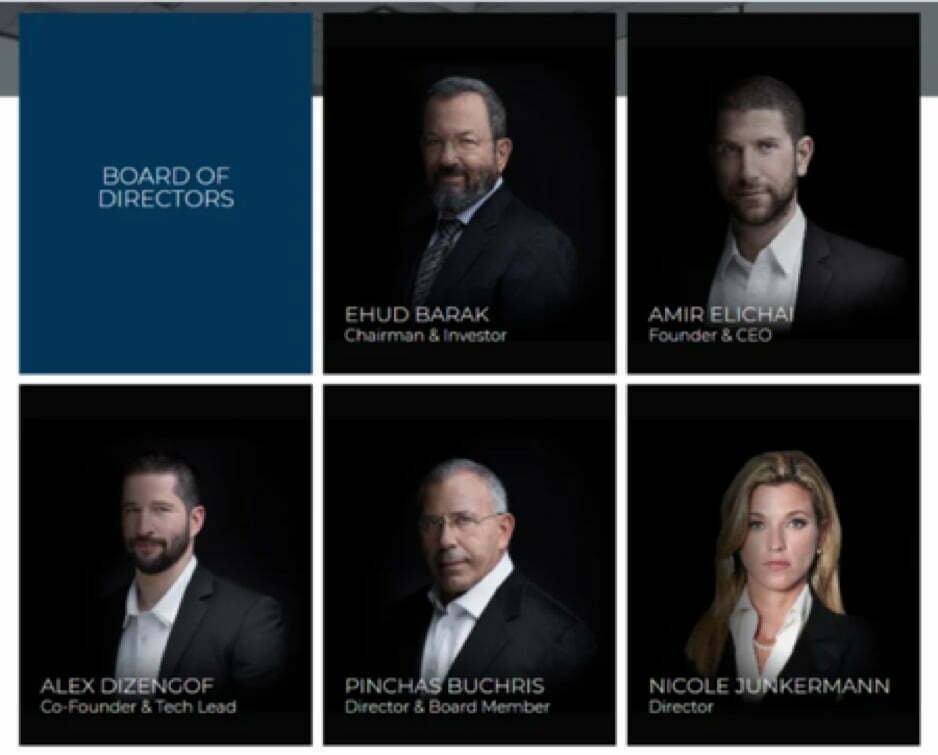
The Israeli Intelligence-Linked Team behind Carbyne911 (including Nicole Junkermann)
Junkermann’s multiple links with Jeffrey Epstein, which appear to have begun around 2002, exposed her as someone who couldn’t be trusted with the future direction of the UK’s healthcare system. Furthermore, Junkermann’s connections with Ehud Barak, Peter Thiel, and Jeffrey Epstein via her investment in the Israeli intelligence-linked surveillance company Carbyne911, made her entry into the United Kingdom’s government advisory panel very problematic for everyone involved. But she was not the only interesting character intimately involved in this particular government project.
While the Healthtech Advisory Board has been hailed since its creation as the brainchild of Matt Hancock, he was actually guided to the project by the man who was, and is, the real mastermind behind the board’s founding, a man who has been helping to quietly write the history of Britain from behind the scenes for the last two decades. He is somebody you’ve probably never heard of, even though his impact on public policy is felt not only in the United Kingdom, but globally.
This man has been a senior advisor to the US State Department, an advisor to Hamid Karzai in post-invasion Afghanistan, the team leader of the Basrah Reconstruction Team in post-invasion Iraq, the Head of Political-Military Affairs for the Office of the High Representative to Bosnia-Herzegovina, and a Committee Specialist for the House of Commons Defence Committee. If that weren’t enough, he was also a founding member of the European Council on Foreign Relations, an advisor to the Vice President of the European Commission, a special advisor to UK Prime Minister David Cameron, deputy head of policy at 10 Downing Street. Yet, even these are just some of the public offices he has held. This man’s name is Daniel Korski and he should be notorious.
Described as a “Foreign Policy Writer” and a “Post Conflict Expert”, Daniel Korski is currently only in his early forties and yet his experience is vast. How does one get the opportunities which have been afforded to Mr Korski? Do you need to be a member of a special club from a very young age? Everything about Korski points to military intelligence, so to find him on the same advisory board as a Mossad-linked Epstein associate isn’t too much of a shock, but it does deserve further scrutiny.
This is especially true now that Daniel Korski has left public office and set up a venture capital firm which specifically funds government-related tech startups. While Korski wants to publicly appear to have left government work, it is pretty clear that, upon further inspection, he hasn’t drifted too far from the authorities. So, let us look at Mr Korski’s history in more detail and work our way forward towards his more current projects. In doing so, I truly believe that you will not be able to deny his continuing role as an intelligence operative. You will also be shown evidence of his dystopian side projects and connections to one of the largest growing, government-backed mass surveillance projects in the world. This is an introduction to Daniel Korski, one of the creators of the current digital panopticon.
Daniel Korski’s Curious Past
Henryk Korski, grandfather of Daniel Korski eluded the Nazi’s whilst living in Poland in the 1940s. After the war, he would join the Polish Communist Party and by the mid-to-late 60s he was working in the Ministry of Foreign Trade. But a decade later, when his grandson Daniel was born, the whole family had already relocated to Copenhagen. If you were to go by Daniel Korski’s Wikipedia page then you would be told that his family were expelled from Poland in the late 1960s. But, if you were to look behind the scenes at Korski’s Wikipedia pages history then you’d discover that someone disagreed with that description of events.
On 21st April 2013 someone edited this part of Daniel’s Wiki page. This editor wanted people to know: “Korski is the son of Polish Jewish refugees, who fled persecution.” I decided to see if I could trace the I.P. Address of the person who made this change. I managed to track the computer to Brussels in Belgium and the edit was made while Daniel Korski was living in the Belgian capital when working as an advisor to the Vice President of the European Commission. It’s also just before he left that post and headed off to become a special advisor to the then Prime Minister of the United Kingdom, David Cameron. It seems that Daniel Korski wanted everyone to believe that his parents had fled persecution in Poland, but was this true?
Daniel Korski himself would eventually head to Twitter to show people the evidence that his parents were Jewish refugees fleeing persecution. He would post two images of official court documents sealed in plastic sleeves and describe it as evidence of a pogrom. For those who are unaware, a pogrom is described as “an organized massacre, especially of Jews”. But do the documents supplied by Daniel Korski provide any evidence of a massacre of Jewish people? The straight answer is a definite no. The court papers Korski so proudly presents on Twitter do not mention Judaism at all, but they do mention Henryk Korski’s stance on the war between Israel and Egypt. The documents, which were written in Polish, relate to a court case involving Henryk Korski and his employer.
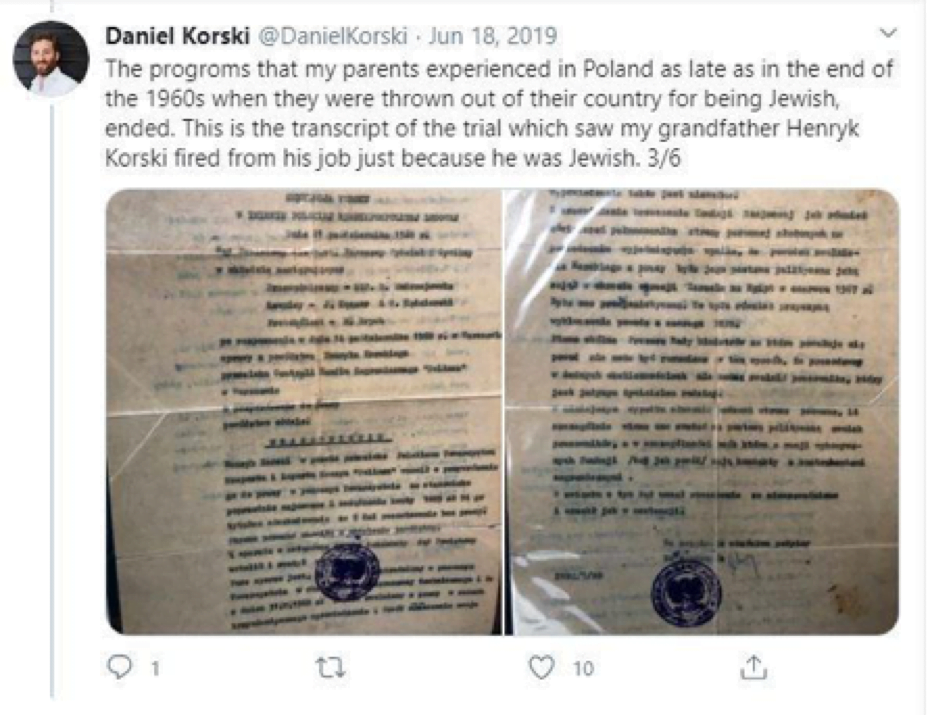
Henryk demanded to be reinstated into his previously held position in the Polish Ministry of Foreign Trade and compensation to be paid for the wages he had been denied. The court refused Mr. Korski’s application and the Korski family would soon move to Denmark, a decision which Henryk himself said turned out to be a lucky move. There is no massacre of Jews in Poland at this time and there is no pogrom involving Korski’s family either. In fact the last recorded pogrom happened in 1946. Instead, Daniel Korski is caught misleading the public in an attempt to appear as though his parents were Jewish refugees fleeing the threat of death in communist Poland. Is it any wonder then that in the same year as Daniel Korski was making up parts of his family’s history, he would also be appointed as vice president of the United Kingdom’s Jewish Leadership Council.
Daniel Korski grew up in Denmark, so how did he become such an important part of the British government? Korski didn’t start studying for his degree until 1997 when he was 20 years old. He would attend the London School of Economics and Political Science (LSE) and would later attend Cambridge University for his Masters. He was either well connected or very talented, maybe even both, as by the age of 25 he was working for ex-Liberal Democrat leader Paddy Ashdown as Head of Political-Military Affairs while Ashdown was serving in the office of High Representative for Bosnia-Herzegovina. Korski would hold that position between 2002 until 2004 and he would then go on to be the Committee Specialist for the UK House of Commons Defence Committee. That short term position would be followed by his first official role overseas on behalf of the British government. In 2005, Korski would be in Kabul, Afghanistan, where he was officially advising the Karzai government on counter-narcotic operations. He would also soon become part of the UK Government’s “Stabilisation Unit” for the war-torn country.
His next appointment, in 2007, was a move to Iraq as the team leader for the Basrah Provincial Reconstruction Team and during this work in Afghanistan and Iraq, Korski became a senior advisor to the US State Department. With all this experience, we are able to see that Daniel Korski, who was still only 30 years old, had very clear intelligence connections. So it will come as no surprise that in 2009 Daniel Korski helped to found the European Council on Foreign Relations where he would also be named a “Senior Policy Fellow”. Korski would, soon after the creation of the European CFR, become an advisor to the vice president of the European Commission, Catherine Ashton, also referred to as Baroness Ashton of Upholland.
In 2013, Korski would return to the UK as a special advisor to the David Cameron government. In May 2015, he would take up the position as deputy head of policy at 10 Downing Street and would stay in that position until Cameron stood down following his defeat in the EU referendum. The Brexit defeat hit everyone involved in the Cameron administration like a hurricane. Many of the politicians who orchestrated the lacklustre campaign for Britain remaining part of the EU immediately stepped down and some went into hiding.
Quite amazingly for any advisor to a Conservative government, Daniel Korski had managed to get through almost 15 years in leading Whitehall positions without being involved in a single sex scandal; at least that’s what he thought. Yet, on 14th November 2017, the Telegraph, in an article entitled “David Cameron aide denies groping television writer at Downing Street event,” the paper named Daniel Korski as the man who allegedly groped producer Daisy Goodwin. The article states:
“Daniel Korski, who left his post as special adviser following the Brexit vote, admitted that he had met the TV producer in Number 10 on two occasions, but said that any accusation of inappropriate behaviour was “not only totally false but also totally bizarre”
Ms Goodwin, 55, has claimed that she was “summoned” to Downing Street to discuss a proposed TV show when Mr Cameron was Prime Minister and an official told her she looked like a Bond girl before putting his hand on her breast as she went to leave.” Korski, by the time the sexual assault accusation had been made public, had started his own venture capital firm called simply “Public” or Public.io. Even though he was officially outside government at the time, Korski’s capitalist venture would specifically focus on tech startups designed for government applications. They set up base at an address in 1 Horseguards Avenue, Westminster, just opposite the HQ for the UK Ministry of Defence. Public.io also owns Eva Health Technology, previously named Microtest Ltd, which supplies patient management systems for healthcare professionals, including everything from simple customer booking software through to documentation software for vaccines.
In 2018, Korski would become Chairman and Co-Founder of the Govtech Summit, which is planned to be held each year in Paris and is a global stage to pitch next-generation technologies to governments from around the world. Govtech is a place where Daniel Korski and his Public.io business partner, Alexander de Carvalho, can introduce the world to such tech startups as Ehud Barak’s Carbyne, a company frequently advertised by Public.io and Govtech even though they are not direct investors in the Israeli firm. It was also in 2018 that the Healthtech Advisory Board, supposedly the idea of Matt Hancock, was formed and began to bring together such people as Nicole Junkermann and Daniel Korski to help create the future blueprint for the hi-tech “transformation” of the UK’s public health sector.
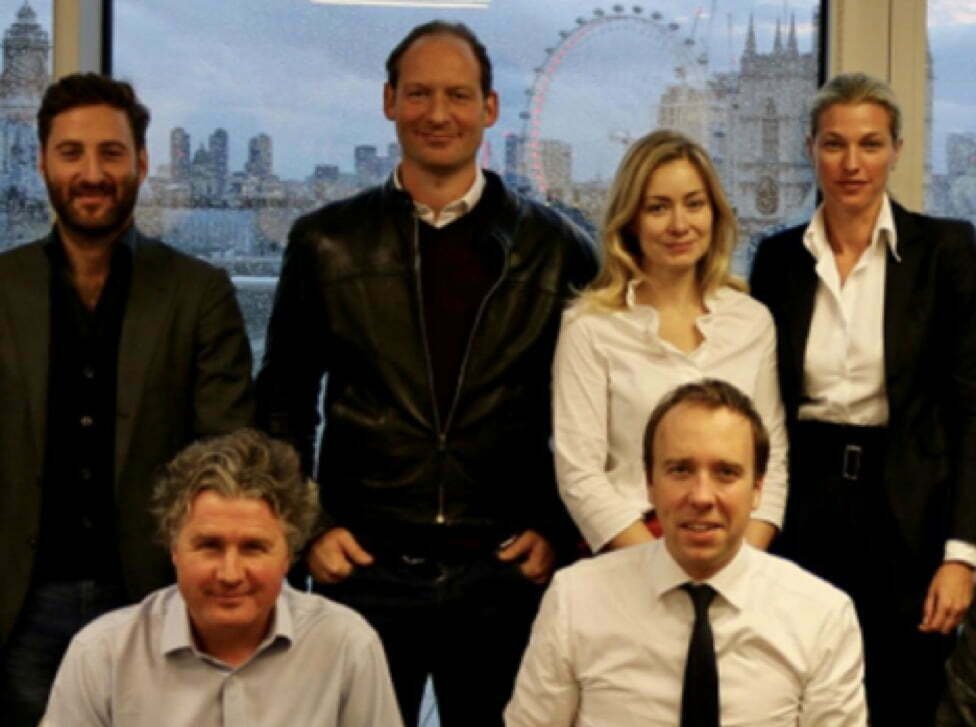
Some members of the Healthtech Advisory Board, (Rear) Daniel Korski, Parker Moss, Nicola Blackwood, Nicole Junkermann (Front) Dr Ben Goldacre and Matt Hancock
But Korski, since leaving official government employment, has been involved in other activities too. One of his other enterprises is with a man who already has a foothold in the mass surveillance business via a government application and who intends to repeat his early successes on a global scale, as well as many other interesting characters. Please, take your predesignated seats, strap yourself in and welcome to Daniel Korski’s Panopticon.
Enter the Panopticon
Nicole Junkermann and Daniel Korski have many common interests in the big tech sector. In 2017 and 2018, they both began to invest in and focus on mass surveillance technology and future healthcare-related tech with great intensity. If one didn’t know any better, one might come to the conclusion that both Junkermann and Korski had inside knowledge of a coming healthcare crisis, such as a pandemic. Conveniently for Korski’s and Junkermann’s investment portfolios, the current pandemic has become an excuse for government to take away our current civil liberties and implement widespread mass surveillance technologies on an unwitting public.
While Junkermann was personally investing with Epstein and Thiel in Ehud Barak’s Carbyne911, Korski was supporting similar projects in the UK. On 26 March 2018, Daniel Korski became the director of the UK registered company Panopticon Technologies Limited. If you were to go to their previous website, Panopticon.Tech, then you’d be met by a dead link, but the Wayback Machine captured their original site twice in 2018.
The founding team at Panopticon Technologies included:
- Sir Mark Rowley QPM who is described as “one of the most respected and decorated police leaders in the UK”. Rowley had led the national police counter terrorism effort as Assistant Met Commissioner in the UK.
- Alastair Aitken CBE, who helped restructure the Army in the UK, informed by his three decades of experience in the UK military. He was also heralded as helping to redesign US military strategy and was involved in every complicated war zone over the last three decades.
- Mark Austin, a former global board member of PricewaterhouseCoopers and senior executive at IBM. An expert in finance, technology and corporate governance.
- Dale Murray, a partner in the digital strategy consultancy Founders Technology. She was a co-founder of Omega Logic as well as being another advisor to David Cameron on the “Business Taskforce”.
- Max Chambers, who is also part of Korski’s Public.io and was a former senior advisor to David Cameron. He was principal adviser on all aspects of home affairs policy, including security, immigration, counter-extremism, policing and criminal justice.
There are two other important players who also played major parts in the creation of Panopticon Technologies. One is Mike Iiams, the CEO and President of Alcohol Monitoring Systems Inc., one of the leading electronic monitoring companies globally. The second is a man named Alasdair James Eli Truett. These last two men should be examined in greater detail.
SCRAM Systems and Mike Iiams
Alcohol Monitoring Systems Inc. was founded in Colorado by Michael Leonard Iiams among others. Iiams would go on to be a very successful President and CEO of Alcohol Monitoring Systems/SCRAM for almost 20 years. His name would also be on the patent as one of the inventors of the SCRAM Systems Bracelet, a useful technology designed specifically for use by professional law enforcement. America has a well-developed law enforcement technologies industry and it also has plenty of problem drinkers. Police departments all over the country are equipped with some of the most state-of-the-art equipment available. One of the first successful forms of police technology to be widely adopted by many states was an alcohol detection system, which was used to track problematic drinkers who would commit offences while under the influence. This system was a simple tool in dealing with crimes related to alcohol abuse.
In 1985, Dr. Daniel J. Brown of Indiana University School of Medicine published studies on the subject of measuring volatile substances through the skin including sensing alcohol in sweat. By 1991, the first patent was filed for the Secure Continuous Remote Alcohol Monitor (SCRAM) System. In 2005, the SCRAM system was monitoring 1,700 offenders a day and the program was active in 30 states. Over the following decade and a half, improvements in technologies have seen the addition of further functions on top of the capabilities of the original device. By the rollout of the 4th generation of this technology, it had reduced in size and included the introduction of GPS tracking that would also allow the police to monitor people on house arrest.
Today, this technology has developed into a multifaceted tracking bracelet that allows officers to monitor suspects via a tablet or a mobile phone and it is being rolled out globally. Mike Iiams inclusion into Korski’s Panopticon Technologies came just before SCRAM Systems tagging technology won UK Home Office backing for its use in tackling Britain’s problem drinkers. In 2020, national rollouts were announced in Wales, England, and the Netherlands with the intention to continue its expansion into other countries. According to Public Health England, alcohol-related crime costs the UK economy more than £21.5bn a year and the Ministry of Justice has declared that the Alcohol Abstinence Monitoring Requirement (AAMR) can be imposed by courts in accordance with community-based orders, which allows for the use of these “next-generation” SCRAM Systems bracelets, referred to in the UK as “peace tags”.
Although Mike Iiams is not listed as a director of Panopticon Technologies in the official UK companies database, he is listed as someone with significant control of the company with shares of over 25%. Iiams has also worked for the accounting firm Peat, Marwick, Mitchell & Co. in Alaska, during the building of the TransCanada pipeline, and has been in a senior executive role with JD Edwards, which is now part of Oracle.
Alasdair James Eli Truett
The other person of significance, who was at one point a director at Panopticon Technologies alongside Korski, is Alasdair Truett. Truett’s involvement in the project makes for a fascinating addition to PT, as his background is in military intelligence. Truett’s LinkedIn shows him simply as an officer in the British Army for over 20 years between 1997 and 2017, but the title of officer seriously understates Lt Col Alasdair Truett MBE’s experience.
In the British Army, “Alasdair was advising, planning and executing domestic and overseas intelligence and security policy and operations,” as described on the homepage of Cerebra Global Strategy. His profile goes on to tell us:
“He has operated at the political, strategic and tactical levels for national intelligence, national influence, small and large scale wars and counter-terrorism. Since 2017, Alasdair has provided advice and commercial services to leaders in governments and corporates on a spectrum of matters to do with national, corporate and personal intelligence, security and leadership.”
Truett was not just your average garden variety grunt with a gun on the British Army payroll, Lieutenant Colonel Alasdair Truett was in fact a very focused specialist in the field of military intelligence. Truett claims to have only been at Panopticon Technologies for its first 7 months of operation, afterwards he would found both Fortisat, followed by Cerebra Global Strategy Ltd.
In a Cyber Unplugged podcast entitled Social Engineering: The Threat Is Coming From Inside The House, Truett describes Fortisat as “a national security advisory and business intelligence company that looks at ‘human network intelligence’ and offers advice to governments on emerging technologies that will enhance their national security.”
Flash in the Pan(opticon)
So, why has Panopticon Technologies recently gone dark? Although it is still an active company, the pulling of the Panopticon.Tech website seems to suggest that the enterprise is on hold, or about to be abandoned. But these data hungry lobbyists for government mass surveillance often work in the shadows.
What do we know about Panopticon Technologies? They described themselves as “a new, ethical, tech-enabled UK security company” and have stated that “we are passionate about new technology and providing immigration, police, intelligence and probation officers with high quality hardware and software to enhance their day-to-day work in monitoring offenders and protecting the public.” But their method, described as using “new behavioural and compliance models powered by cutting-edge analysis,” may have been too much for supporters to bear after the Cambridge Analytica scandal.
Korski and his Public.io, led by Max Chambers, may have been rash to launch PT so publicly in the first place. For a Panopticon to be successful, the inmates must know that there is the potential for them to be observed and that is very much the society we find ourselves in today. In this vast cyber-Panopticon, the masses are being observed by the few, and people like Daniel Korski, Alasdair Truett, Nicole Junkermann, Ehud Barak, and Mike Iiams lobby governments to expand and normalise their own homeland mass surveillance programmes. It only takes one government to agree to private companies being responsible for the mass surveillance of their populations for this trend to begin to take a permanent place in our societies. Now, with Covid-19, there are many excuses to implement panopticonic technologies to further the observation power of the few over the many.
Korski has positioned himself to be one of the most influential players in the modern UK government tech sector. He has used his many UK government connections to benefit himself financially and has been eager to remain publicly affiliated with the ruling UK Conservative government since leaving Whitehall. Korski’s Public.io venture capital firm is located at the heart of the UK MoD and is just a stone’s throw away from the UK Parliament. His entry into military intelligence at such a young age suggests he was recruited by an intelligence agency before attending university. He would start studying for his first degree later than most, at the age of 20, leaving us with a small two year gap in his timeline.
Before he’d even reached his thirties, and with no obvious experience in fighting the war on drugs, Korski would become a counter-narcotic operations advisor to the relatively recently installed Afghani leader, Hamid Karzai. Karzai’s brother, Wali Karzai, would later be revealed to have been on the payroll of Western intelligence agencies and also one of Afghanistan’s most prominent, and notorious drug traffickers. His drug trafficking activities were allegedly protected by his brother’s government and his CIA benefactors.
Korski was also heavily involved in the UK government’s stabilisation and reconstruction projects in both Afghanistan and Iraq. He was even acting as a senior advisor to the US Department of Defense just before he would help create the European Council on Foreign Relations. His intelligence links led him to become one of the most important advisors during the David Cameron government.
His links with military intelligence have become clearer since he’s officially left the halls of power, with Korski’s Panopticon Technologies bringing some of the leading advocates for government overreach who also have deep links to military intelligence. Alasdair Truett, Alastair Aitken, Mark Rowley and Max Chambers have all had leading roles in the creation of the modern intelligence networks in the UK for both homeland security and global intelligence strategies. Korski’s work on the Govtech summit has been keenly supported by French President Emmanuel Macron, former UK Prime Minister Tony Blair and Matt Hancock. Korski’s work has also been a vehicle for the normalisation of the use of public big data by private companies.
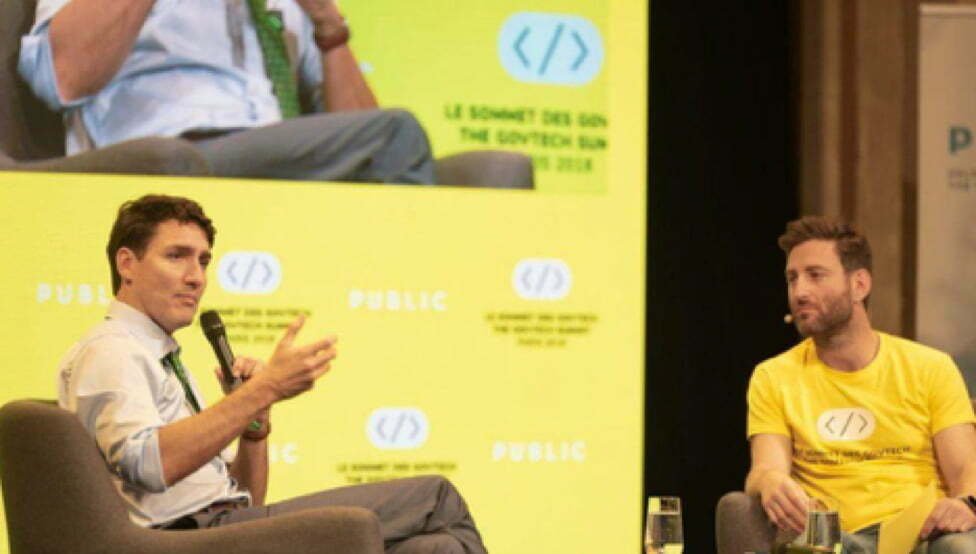
Daniel Korski listens to Canadian PM Justin Trudeau at Govtech Summit 2019
The NHS Healthtech Advisory Board gives us a brief glimpse inside the on-going creation of the modern digital panopticon. It let us see some of the intelligence-linked tech sector giants vying for opportunities to gain access to mass national databases. Junkermann’s Carbyne911 and Korski’s Panopticon Technologies are the monsters lurking in the shadows of the big tech world. They are constantly circling the part of the public sector that they see as soft targets, because control over the data from the public sector means access to every piece of private information from every citizen. Korski and Junkermann may have beautiful smiles and a charming way about them, but they are simply cogs in a machine leading us towards a dystopian future.
So, who is Daniel Korski actually working for? His deep love and support for the European Union suggests that his whole-hearted allegiance is to the European project. But with his globalist back story, his establishment connections, and his association with both public and private intelligence agencies, Daniel Korski would be a useful asset for any power with a similar agenda of creating a digital Panopticon.
Johnny Vedmore is a completely independent investigative journalist and musician from Cardiff, Wales. His work aims to expose the powerful people who are overlooked by other journalists and bring new information to his readers. If you require help, or have a tip for Johnny, then get in touch via johnnyvedmore.com or by reaching out to johnnyvedmore@gmail.com
October 2, 2020
Posted by aletho |
Civil Liberties, Full Spectrum Dominance, Timeless or most popular | European Union, Israel, UK, United States |
Leave a comment
By Paul Antonopoulos | October 2, 2020
Yesterday, it was agreed upon at the European Council special meeting that Belarus will be sanctioned. However, the scope of the sanctions and the long path to agree on them, demonstrates that the European Union is in a crisis and cannot project its power as it wishes. German Chancellor Angela Merkel described the bilateral agreement on Belarus and the strategic approach to Turkey as a step forward. The chancellor stated that “we had many discussions today on the issues of Belarus and Turkey, Cyprus and Greece. In short, I can say that they were completely successful.”
This comes in the aftermath of the Greek and Cypriot Prime Minister’s continually vetoing any sanctions against Belarus unless the European Council agreed to a strong joint statement against Turkey and for sanctions to be implemented by December if Ankara continues to violate the maritime space of Greece and Cyprus. Diplomatic sources in Athens revealed that despite the insistence of the majority of the European Council to pass a strong statement against Turkey and a pathway towards sanctions, Germany became isolated and had to eventually give up its resistance to stop an appeasement policy towards Turkey.
None-the-less, with Athens and Nicosia satisfied with the European Council’s statement and plan for sanctions against Turkey, the path was now open for Belarusian officials to be sanctioned without veto objections. This is despite Belarus not being a European Union member or candidate state, or threatening military action against EU member states like Turkey does.
“It was a long and difficult debate, because of course Greece and Cyprus demanded their rights as our member states. But we also had a very frank discussion about the need to look at all of our relations with Turkey,” Merkel said with seeming disappointment. “We can say today that there are sanctions against actors in Belarus, which means that the European Union is now taking action against those who oppose the democratic movements. I think this sends a very important signal.”
Minsk announced today the imposition of sanctions against European officials in response to those imposed by the European Union on Belarusian officials. The European Union claims that the officials who have been sanctioned are involved in the alleged suppression of anti-government protests and/or falsifying the August 9 elections in which President Alexander Lukashenko won 80.10% of the vote. Belarus’ foreign ministry said it had drawn up a list of European officials barred from entering the country, but added that the list would not be made public.
The European Union agreed to impose sanctions on some 40 Belarussian officials, however, Lukashenko is not among them. This in itself is a sign of weakness and desperation from the European Union as it strangely does not sanction Lukashenko, who won the election, but only those associated with him.
Lukashenko in recent years has been trying to court the European Union while also resisting further integration with Russia, even clashing with Moscow over gas and oil prices. Although protests against the election result had the appearance of a Ukraine-like colour revolution, the European Union immediately expressed solidarity, burning all bridges that had been built between Minsk and Brussels. This has only pushed Belarus firmly back into Russia’s sphere. The Belarusian President and his Russian counterpart Vladimir Putin held a meeting for over four hours in Sochi last month, which Russian spokesperson Dmitry Peskov said was “constructive, lengthy and substantive in content.” The meeting also resulted in a $1.5 billion loan for Belarus.
It is evident that the attempted colour revolution failed to materialize, Belarusian opposition leader Svetlana Tikhanovskaya has not amounted much domestic influence and Lukashenko will not be removed from power soon. Rather than attempting to quickly repair relations to bring Belarus back closer to Brussels, the sanctions demonstrates that the European Union is moving forward with its foreign policy blindly and against their own interests.
The problem the European Union has is that if it repairs its relations with Lukashenko, it will mean an acknowledgment of weakness as they were not able to achieve what they wanted in Belarus. This is in the midst of the European Union already being deeply divided between a small German-led bloc and the rest of the Union in policies towards Turkey.
Another conundrum for Brussels is that from Lukashenko’s perspective, the European Union is now untrustworthy. Successive provocations, like having diplomats lay flowers where rioters died and saying Lukashenko is an illegitimate president, has likely created a permanent rift between Minsk and Brussels. Therefore, coupled with newly passed sanctions, the European Union has lost all influence they once might have had on Minsk, and therefore weakened their own interests while strengthening Russia’s by forcing the deepening of Belarus’ ties with Moscow.
With the European Union’s divorce with the United Kingdom becoming uglier, having tense relations with Turkey, and the endless rift it has with Russia – all completely different issues to each other – European policymakers have demonstrated that they are incapable of self-reflection and identifying weaknesses and failures in their foreign policy. For what the European Union wanted to achieve in Belarus, it has been a serious failure. By not sanctioning Lukashenko, Brussels has left a door open to normalize relations. However, from Lukashenko’s perspective, he will likely end his years-long flirtation with Brussels and move to more deeply integrate Belarus with Russia.
Paul Antonopoulos is an independent geopolitical analyst.
October 2, 2020
Posted by aletho |
Aletho News | Belarus, European Union |
Leave a comment
The Israeli and Italian governments concluded a major arms deal, according to a statement issued Wednesday by the Israeli Defense Ministry.
According to Israeli sources, the deal would allow Israel to sell “Spike anti-tank guided missiles and aircraft simulators in exchange for training helicopters to replace the Israeli Air Force’s aging fleet”.
Intense talks, which led to the agreement, began last February.
The military exchange is estimated at hundreds of millions of dollars and its consequences are expected to last for at least two decades. According to the newly-signed agreement, Italian military contractor Leonardo will provide Israel with 20 years of aircraft maintenance.
“The agreement signed today is another expression of the close security and economic relations between Israel and Italy,” Israeli Defense Ministry Director-General Amir Eshel said in a statement, which was quoted in The Times of Israel.
Israel is currently the eighth leading weapons exporter in the world, and its military hardware, touted as ‘combat-proven’, is coveted by many countries.
September 25, 2020
Posted by aletho |
Ethnic Cleansing, Racism, Zionism, Militarism | European Union, Israel, Italy |
Leave a comment
By Paul Antonopoulos | September 22, 2020
Yesterday there was a meeting between all of the EU’s Foreign Ministers to pass sanctions against Belarus. It created massive controversy and revealed the significant divide between Mediterranean and Northern European nations. The EU has been completely disinterested in Turkey’s blatant violations against the maritime space and continental shelf of Cyprus, one of its 27 member states, for well over a year and a half now. However, following the Belarusian elections on August 9, the EU rapidly mobilized to sanction President Alexander Lukashenko and another 40 individuals associated with him. This was on the allegations of electoral fraud and state-perpetrated violence and repression against opposition supporters. To the great frustration of the EU, Cyprus was the only country to veto sanctions against Belarus.
Latvian Foreign Minister Edgars Rinkēvičs went on Twitter and said that Cyprus is “hostage taking” the EU on sanctions against Belarus, which “sends a wrong signal to Belarusians, our societies and the whole world.” Lithuanian Foreign Minister Linas Linkevicius said on Twitter that “some colleagues should not link things that must not be linked,” referring to Cyprus vetoing Belarusian sanctions so long as Turkey is not sanctioned. Former Swedish Prime Minister Carl Bildt, now the Co-Chair of the European Council on Foreign Relations, was especially angered and in a series of Tweets complained that “Cyprus is profoundly embarrassing the EU with its linking of Belarus sanctions to unrelated issues,” that Cyprus is “misusing” its veto rights, and that “the meeting of EU foreign ministers […] will unfortunately be remembered for Cyprus again blocking any sanctions on Belarus.”
To be clear, Cyprus, one of the smallest countries in the EU with only 1.2 million inhabitants, is not taking a great moral stand to oppose sanctions against Belarus, which is neither an EU member, an EU member candidate, or a direct threat to any EU members. Rather, Cyprus is making a stand as the EU is prioritizing sanctions against Belarus as they believe it will weaken Russian influence in the Baltics and Eastern Europe. The EU has been very slow in their response to Turkish threats against Greece and Cyprus, with many member states not wanting to sanction Turkey, yet wanting fast tracked sanctions against Belarus. Cyprus will approve sanctions against Belarus as soon as sanctions against Turkey are approved by the other EU member states.
The EU’s reluctance to sanction Turkey is curious considering it is militarily threatening two EU member states, Greece and Cyprus, yet wants to prioritise sanctions on Belarus, which as previously stated, is neither an EU member, an EU member candidate, or threatening EU members. Brussels continues the line of an imagined Russian threat via Belarus against the Baltic countries and Poland, while ignoring the open and direct threats of Turkey against Greece and Cyprus.
Unsurprisingly, Bildt was exposed in a report by the Stockholm Center for Freedom in having very intimate and close relations with Turkish President Recep Tayyip Erdoğan, perhaps including indirect funding. Bildt, as a northern European Swede, is not threatened by Turkish aggression due to the obvious restrictions in geography. This is the same reason for the indifferent attitudes of the Baltic countries, Sweden, Germany and other northern European countries for their disinterest in Turkish aggression against Cyprus and Greece. And herein lays the polar differences between Mediterranean and Northern Europe, which is beginning to split the EU apart.
Although Moscow continually announces its desire for cooperation with the EU, Northern Europe, led by the Baltic states and Poland, continue to pressurize Russia because of a perceived threat against these states. Russia, unlike Turkey, does not violate the sovereignty of any EU member state, nor does it make near daily military threats.
Turning Cyprus from a victim of Turkish aggression, especially considering that the latter invaded the northern portion of the island in 1974, to perpetrator, is not only an egregious injustice to Turkey’s history of violations, it also plays right into Erdoğan’s endeavour to once again avoid sanctions. This year the Dutch vetoed an EU stimulus package to help European economies struggling with COVID-19 restrictions and the Austrians vetoed Operation Irini to prevent Turkish arms from reaching Libya. Yet, only the Cypriots are being harshly criticized for their veto on Belarus sanctions. The double-standards that characterize the Berlin-led EU foreign policy strategy in dealing with the Eastern Mediterranean crisis exposes internal inconsistencies within the Union.
What many Northern Europeans refuse to acknowledge is that Cyprus, Greece and the wider European Mediterranean region, do not have the luxury of friendly neighbors like Sweden and Germany do, and rather have to contend with an aggressor state like Turkey that openly announces its intentions to invade Greek islands and the rest of Cyprus, whilst simultaneously being militarily involved in fellow Mediterranean countries like Libya and Syria.
A small state like Cyprus, that does not have a professional military, has very limited options in dealing with such aggression, especially when its EU colleagues rush to shield Ankara from sanctions rather than defend Cyprus from an external threat. This comes to the crux of the so-called raison d’être of the EU – a supposed unity between Europe. However, Northern Europe has only demonstrated to Mediterranean Europe that there is certainly no unity, especially when two of its 27 member states are being directly threatened and violated by an external state.
On August 29, French President Emmanuel Macron announced a “Pax Mediterranea” which can be interpretated as a new Mediterranean order, one becoming increasingly independent of the EU and involving the close cooperation of Mediterranean states. With Northern Europe disinterested with security issues in the Mediterranean as they prioritize their economic relations with Turkey, there is every chance we will see a significant bloc emerge in the Mediterranean that better serves its own interests rather than those of Northern Europe.
Paul Antonopoulos is an independent geopolitical analyst.
September 22, 2020
Posted by aletho |
Economics | Belarus, Cyprus, European Union |
Leave a comment