By Paul Antonopoulos | September 22, 2020
Yesterday there was a meeting between all of the EU’s Foreign Ministers to pass sanctions against Belarus. It created massive controversy and revealed the significant divide between Mediterranean and Northern European nations. The EU has been completely disinterested in Turkey’s blatant violations against the maritime space and continental shelf of Cyprus, one of its 27 member states, for well over a year and a half now. However, following the Belarusian elections on August 9, the EU rapidly mobilized to sanction President Alexander Lukashenko and another 40 individuals associated with him. This was on the allegations of electoral fraud and state-perpetrated violence and repression against opposition supporters. To the great frustration of the EU, Cyprus was the only country to veto sanctions against Belarus.
Latvian Foreign Minister Edgars Rinkēvičs went on Twitter and said that Cyprus is “hostage taking” the EU on sanctions against Belarus, which “sends a wrong signal to Belarusians, our societies and the whole world.” Lithuanian Foreign Minister Linas Linkevicius said on Twitter that “some colleagues should not link things that must not be linked,” referring to Cyprus vetoing Belarusian sanctions so long as Turkey is not sanctioned. Former Swedish Prime Minister Carl Bildt, now the Co-Chair of the European Council on Foreign Relations, was especially angered and in a series of Tweets complained that “Cyprus is profoundly embarrassing the EU with its linking of Belarus sanctions to unrelated issues,” that Cyprus is “misusing” its veto rights, and that “the meeting of EU foreign ministers […] will unfortunately be remembered for Cyprus again blocking any sanctions on Belarus.”
To be clear, Cyprus, one of the smallest countries in the EU with only 1.2 million inhabitants, is not taking a great moral stand to oppose sanctions against Belarus, which is neither an EU member, an EU member candidate, or a direct threat to any EU members. Rather, Cyprus is making a stand as the EU is prioritizing sanctions against Belarus as they believe it will weaken Russian influence in the Baltics and Eastern Europe. The EU has been very slow in their response to Turkish threats against Greece and Cyprus, with many member states not wanting to sanction Turkey, yet wanting fast tracked sanctions against Belarus. Cyprus will approve sanctions against Belarus as soon as sanctions against Turkey are approved by the other EU member states.
The EU’s reluctance to sanction Turkey is curious considering it is militarily threatening two EU member states, Greece and Cyprus, yet wants to prioritise sanctions on Belarus, which as previously stated, is neither an EU member, an EU member candidate, or threatening EU members. Brussels continues the line of an imagined Russian threat via Belarus against the Baltic countries and Poland, while ignoring the open and direct threats of Turkey against Greece and Cyprus.
Unsurprisingly, Bildt was exposed in a report by the Stockholm Center for Freedom in having very intimate and close relations with Turkish President Recep Tayyip Erdoğan, perhaps including indirect funding. Bildt, as a northern European Swede, is not threatened by Turkish aggression due to the obvious restrictions in geography. This is the same reason for the indifferent attitudes of the Baltic countries, Sweden, Germany and other northern European countries for their disinterest in Turkish aggression against Cyprus and Greece. And herein lays the polar differences between Mediterranean and Northern Europe, which is beginning to split the EU apart.
Although Moscow continually announces its desire for cooperation with the EU, Northern Europe, led by the Baltic states and Poland, continue to pressurize Russia because of a perceived threat against these states. Russia, unlike Turkey, does not violate the sovereignty of any EU member state, nor does it make near daily military threats.
Turning Cyprus from a victim of Turkish aggression, especially considering that the latter invaded the northern portion of the island in 1974, to perpetrator, is not only an egregious injustice to Turkey’s history of violations, it also plays right into Erdoğan’s endeavour to once again avoid sanctions. This year the Dutch vetoed an EU stimulus package to help European economies struggling with COVID-19 restrictions and the Austrians vetoed Operation Irini to prevent Turkish arms from reaching Libya. Yet, only the Cypriots are being harshly criticized for their veto on Belarus sanctions. The double-standards that characterize the Berlin-led EU foreign policy strategy in dealing with the Eastern Mediterranean crisis exposes internal inconsistencies within the Union.
What many Northern Europeans refuse to acknowledge is that Cyprus, Greece and the wider European Mediterranean region, do not have the luxury of friendly neighbors like Sweden and Germany do, and rather have to contend with an aggressor state like Turkey that openly announces its intentions to invade Greek islands and the rest of Cyprus, whilst simultaneously being militarily involved in fellow Mediterranean countries like Libya and Syria.
A small state like Cyprus, that does not have a professional military, has very limited options in dealing with such aggression, especially when its EU colleagues rush to shield Ankara from sanctions rather than defend Cyprus from an external threat. This comes to the crux of the so-called raison d’être of the EU – a supposed unity between Europe. However, Northern Europe has only demonstrated to Mediterranean Europe that there is certainly no unity, especially when two of its 27 member states are being directly threatened and violated by an external state.
On August 29, French President Emmanuel Macron announced a “Pax Mediterranea” which can be interpretated as a new Mediterranean order, one becoming increasingly independent of the EU and involving the close cooperation of Mediterranean states. With Northern Europe disinterested with security issues in the Mediterranean as they prioritize their economic relations with Turkey, there is every chance we will see a significant bloc emerge in the Mediterranean that better serves its own interests rather than those of Northern Europe.
Paul Antonopoulos is an independent geopolitical analyst.
September 22, 2020
Posted by aletho |
Economics | Belarus, Cyprus, European Union |
Leave a comment
By Lucas Leiroz | September 21, 2020
Five years ago, German Chancellor Angela Merkel unilaterally allowed hundreds of thousands of immigrants from the Middle East and Africa to enter European territory, causing the EU to enter one of the biggest crises in its history. The lack of a previous agreement with the other European governments has created great political instability on the continent that has never been overcome. However, when Berlin considered the number of foreigners in its territory “sufficient”, it simply closed its borders, keeping thousands of immigrants captive in other European countries waiting for a new destination. As a result, many European states were overcrowded with immigrants, while Germany rejoiced in cheap labor for its companies.
Now, history seems to repeat itself. Recently, the EU announced a new immigration and asylum policy, supposedly based on “solidarity” and humanitarian values, but which, once again, failed to reach a consensus within the organization’s countries. Interestingly, the new EU migration policy comes precisely from Germany, but this time the author of the project is Ursula von der Leyen, current President of the European Commission and a member of the Christian Democratic coalition that supports Angela Merkel.
Von der Leyen presented to the European Parliament a proposal to abolish the “Dublin-3”, a regulation according to which immigrants arriving in Europe are forced to register immediately in the country in which they are located. This norm had been causing a serious imbalance in the immigrant population in countries like Greece, Malta, Italy and Spain, but the big problem is that until now Von der Leyen and her supporters have not announced which mechanism will replace the current regulation, just stating that it will be a policy based on “governance and solidarity”, keeping obscurity until the final version of the project is presented.
The total disagreement between the members of the Union is leading to different solutions presented unilaterally by the members. The intention is simple: to survive, in the face of an uncertain future. Italy is working to establish strategies together with Libya to curb migratory flows. Greece is asking for EU support to rebuild the Lesbos camp. On the other hand, Budapest and Warsaw demonstrate total antipathy to humanitarianism as a basic principle of migratory policies. Hungary and Poland have already expressed officially that are not interested in receiving Muslim immigrants. Being culturally and ethnically homogeneous nations, these countries see with fear and terror the multiculturalism that increasingly penetrates Western Europe as a result of intense migratory flows.
In fact, the whole of Europe sees Van der Leyen’s plans with suspicion, simply because they see her as a representative of the interests of Angela Merkel, who is responsible for the 2015 migration crisis. Apparently, the abolition of Dublin-3 will mean nothing more than a mechanism to facilitate the distribution of immigrants across European territory, which will be imposed as a Union policy, disregarding the national interests of member states. Van der Leyen is simply continuing, five years later, what Merkel started in 2015: a policy of distributing cheap labor on European soil disguised by humanitarian principles.
As previously mentioned, Germany closed its borders when deemed necessary. But the “more migrations” speech remains the main agenda for Merkel and her representative in Brussels. So, what remains to be seen is whether Germany will also participate in the “solidarity distribution” of the immigrants currently located in southern European camps due to Dublin-3 or will it again restrict the entry of foreigners because it considers that there is “a sufficient amount” of them.
Apparently, Berlin created a major state of crisis and instability in Europe but managed to keep itself reasonably out of the worst consequences, because, unlike other countries, it closed its borders when it considered it necessary. Now, the Germans are trying to disperse a huge surplus of immigrants and refugees on European soil under a humanitarian flag and their dogma is supported unconditionally by NGOs, political parties and the business sector interested in precarious and low-cost foreign labor.
Apparently, there will be a scenario of uncontrolled migration, completely out of alignment with the national interests of any European state. This will generate a new movement of dissatisfaction in the bloc and could lead to new divisions and to the resurgence of radical nationalist tendencies that are already being born in several countries. For now, we can foresee new “exits” appearing in the coming years, or, worst case scenario, real waves of cultural and social conflicts – as it is already happening in France – in a large number of European countries.
Lucas Leiroz is a research fellow in international law at the Federal University of Rio de Janeiro.
September 21, 2020
Posted by aletho |
Deception, Economics, Progressive Hypocrite | European Union |
Leave a comment
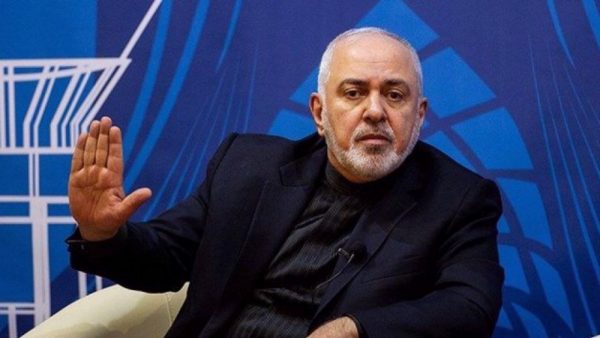
Iranian Foreign Minister Mohammad Javad Zarif
Iran’s foreign minister says the country will meet its strategic needs by purchasing weapons from Russia and China, and has no need for European weapons once the UN embargo is lifted in October.
Mohammad Javad Zarif made the remarks in a televised interview on Saturday night in reaction to a possible initiative by France, Germany, and the UK to restrict the sale of weapons to Iran following the October expiration of the UN arms embargo against the Islamic Republic.
“We haven’t been a customer of European weapons, and they haven’t sold us weapons after the 1979 revolution. … They even ran a campaign during the 1980s imposed war [between Iran and Iraq] to prevent the delivery of arms to Iran,” Zarif said.
“We won’t force them to sell us weapons now, as we don’t need their weapons,” he noted.
Zarif said one-fourth of the arms purchases end up in the Persian Gulf region, while Iran is not part of this trade.
“However, Iran can meet its strategic needs through the countries it interacts with, like Russia and China; though it is self-sufficient in many cases, and is an exporter [of arms] itself,” Zarif said.
Thanks to God’s grace and the efforts of the country’s Armed Forces, “Iran has become self-sufficient in many cases, but in cases of need, other countries will have the right to trade with Iran once the UN embargo is lifted,” the Iranian top diplomat added.
Following a humiliating failure at the UN Security Council to secure an extension of the arms embargo against Iran, the United States recently threatened to use its “secondary” sanctions to block any arms trades with Tehran after the expiry of the UN ban next month.
US Special Representative for Venezuela and Iran Elliott Abrams claimed on Wednesday that Washington could deny access to the US market to anyone who trades in weapons with Tehran.
Sanctions “will have a very significant impact” on arms manufacturers and traders that seek to do business with Tehran, he told reporters.
The US initiative is expected to prevent European companies from selling weapons and military equipment to Iran.
‘Europe trying to save face after failure against US’
Zarif further pointed to the recent statement by France, Germany, and the UK in which they claimed they have “gone beyond their own commitments” towards Iran by launching the Instrument in Support of Trade Exchanges (INSTEX), a European mechanism which was supposed to facilitate trade with Iran amid the US sanctions.
“They are joking. The three self-proclaimed world powers failed to stand up to the US bullying. They failed, even though they may not have made so much efforts,” he said.
“Europeans had 11 commitments to fulfil, and the INSTEX was not even one of them, but a prerequisite for them. They failed to fulfil them and said Americans didn’t let them. If we accept their own words, they admitted Americans have kept them [from doing their part].”
“This is below Europe’s dignity. The economy of the European Union is bigger than America’s. Then why did you fail to resist the US’ bullying, which is now impacting you?” Zarif said, adding that the European statement is just meant to save their face.
His comments came in reaction to a statement by France, Germany and the UK delivered to the IAEA Board of Governors at the September 2020 meeting.
They said in the statement, “The E3 has worked hard to preserve the [2015 nuclear] agreement. We have gone beyond our own commitments to facilitate legitimate trade with Iran, including by introducing the INSTEX mechanism.”
‘Iran not to interfere in US elections’
In his Saturday interview, Zarif also denied the claim that the Islamic Republic is going to interfere in the upcoming US presidential elections.
“Despite Donald Trump’s claim that Iran is waiting for another person, these remarks only serve electoral purposes,” Zarif said.
“Iran is an independent country and does not meddle in US internal affairs,” he added.
Zarif said the US should first try to avoid coup plotting and violating people’s choices in other countries before accusing Iran of interfering in its elections.
He made the remarks in an apparent allusion to the CIA-orchestrated 1953 coup in Iran, which toppled the democratically-elected government of Prime Minister Mohammad Mosaddegh.
‘Israel would defend itself had it possessed enough power’
Zarif further referred to the recent deals signed by the United Arab Emirates and Bahrain to normalize their relations with the Israeli regime in the hope that Tel Aviv could bring them peace and security.
“Our neighbors unfortunately think the regime can defend them. If Israel had such a power, it would have defended itself against the Palestinian Islamic Jihad and Hamas,” Zarif said.
He expressed regret that a regional country is forced to sign a deal with Israel so that Trump can use it for his presidential campaign.
“This happens when a country depends on the US for its defense,” Zarif said.
Bahrain and the UAE signed US-brokered normalization agreements with Israel during a ceremony in Washington on Tuesday.
The controversial event was slammed by many Arab and Muslim figures as a blatant betrayal of the Palestinian cause.
September 19, 2020
Posted by aletho |
Aletho News | European Union, Iran, Israel, Middle East, Sanctions against Iran, United States, Zionism |
Leave a comment
MINSK The participation of former Belarusian presidential candidate Svetlana Tikhanovskaya in the upcoming meeting of EU foreign ministers next week will amount to interference in Belarus’ internal affairs, Belarusian Foreign Ministry spokesman Anatoly Glaz said on Saturday.
“It could certainly be funny and curious if it were not so sad. It is quite obvious, in fact, that such actions, if any, are an impudent and open interference in the internal affairs of our country and complete disrespect for its citizens,” Glaz said.
“Why hold any elections at all if it is possible to simply appoint someone all the way convenient from abroad and pretend to build a relationship with them?” the spokesman said.
If the meeting ends up taking place with Tikhanovskaya’s participation, Glaz said there would be no need left to prove that “a course to undermine Belarus’ sovereignty is being implemented.”
“Of course, our principled and understandable position on this matter has already been communicated to the EU envoy in Minsk, as well as to the relevant persons in Brussels,” the spokesman added.
EU foreign ministers are scheduled to convene this upcoming Monday in Brussels. Tikhanovskaya’s press secretary Anna Krasulina has confirmed the Lithuanian-exiled Belarusian ex-presidential candidate’s attendance.
September 19, 2020
Posted by aletho |
Aletho News | Belarus, European Union |
Leave a comment
The European Parliament has pushed to halt construction of the Nord Stream 2 gas pipeline between Germany and Russia, and for an international investigation into the alleged poisoning of Russian opposition figure Alexey Navalny.
A resolution passed on Thursday called on European Union member states to “continue to isolate Russia in international forums,” encouraging the European Council “to prioritize the approval of the EU Magnitsky-style human rights sanctions” against what it called “the Russian regime.” The ‘Magnitsky’ sanctions are named after a Russian tax auditor, and associate of American-turned-British billionaire Bill Browder, who died in a Moscow prison in 2009.
532 MEPs voted for the resolution, 84 were against and 72 abstained. A total of 688 out of the registered 705 MEPs took part in the voting. It’s important to note that the measure is advisory and not legally binding, but rather intended as an advisory for EU governments.
The European Parliament also reiterated its “previous position to halt the Nord Stream 2 project.” This is a gas pipeline set to connect Germany directly to Russian energy supplies.
“It is necessary to immediately start an international investigation, with the participation of the EU, United Nations, Council of Europe and the Organisation for the Prohibition of Chemical Weapons,” the resolution states. It names Alexey Navalny as “a leading Russian opposition politician, lawyer, blogger and anti-corruption activist” who has become “one of the few effective leaders of the Russian opposition.”
The vote on Thursday took place without a debate – there had been discussion on Tuesday in the parliament.
Earlier this month, European Commission President Charles Michel condemned “in the strongest possible terms the attempt to silence opposition leader (sic) Navalny.”
Sanctions against the Russian authorities have been rumored ever since news of Navalny’s alleged poisoning first broke. In late August, US Deputy Secretary of State Stephen Biegun explained that Washington was prepared to take strong measures against Moscow, which would make sanctions related to the 2016 US presidential election “pale in comparison.”
September 17, 2020
Posted by aletho |
Economics, Russophobia | European Union |
Leave a comment
The German Chancellor said that the fate of the most important Russian gas pipeline “Nord Stream 2” will be decided not by Germany, but by the European Union as a whole. This is how she sees the response to the situation with Aleksey Navalny. It may seem that this is a terrible omen for the gas pipeline, which has already seen billions of euros invested into it for construction. But what did Angela Merkel really mean?
The fate of Nord Stream 2 was again in question. No sooner had the project’s supporters celebrated the removal of the Danish obstacle (Copenhagen, after much delay, gave permission for the pipe to be laid through its territorial waters) than Germany, which until recently was an advocate for construction and one of the main beneficiaries of construction, began to seemingly make obstacles.
Berlin, dissatisfied with the position of Moscow in the case of Aleksey Navalny, intends to put the question of a possible curtailment of the project to a pan-European discussion. Why does Angela Merkel want to close “Nord Stream 2” – and does she in general want to?
Legacy
Germany has long called for putting an end to “Nord Stream 2”, which in the understanding of a number of western activists “increases Europe’s dependence on Russian energy carriers”. They did not even require Angela Merkel to deliver a funeral speech over it. “The easiest option for Germany would be to simply withdraw its support for Nord Stream 2, allowing American and European critics to kill it,” the BBC writes. And now, against the background of the Navalny case, the aggressiveness of the project’s opponents has increased by an order of magnitude.
Until recently, it seemed that they were banging their heads against the wall of German pragmatism. Germany’s position on Nord Stream 2 was really reinforced concrete: German Chancellor Angela Merkel said that she was dissatisfied with the lack of cooperation with Moscow in the case of the “poisoning of Aleksey Navalny”, but was not going to abandon Nord Stream 2 because of this. After all, as German Foreign Minister Heiko Maas correctly notes, “those who call for the cancellation of the project should understand the consequences of such a step”.
Firstly, Berlin needs Nord Stream 2 from an economic point of view. “Germany has a very weak position in terms of energy. They are closing a lot of power plants – nuclear, coal,” says Donald Trump. Germany and the EU do not have reliable suppliers of cheap gas that are an alternative to Russia. In addition to getting cheap blue fuel (much needed for the export-oriented economy of Germany), Germany will earn good money on the transit of Russian gas, becoming a hub country.
“If the project is stopped, the German consumer will pay for it,” said Klaus Ernst, a member of the Bundestag from the Die Linke party. In addition, Berlin is also thinking about the security of Europe under its patronage – the internal political situation in Ukraine is deteriorating, and no one can guarantee that the militants not controlled by Kiev will not decide to stop the gas export of the “aggressor country” to Europe. Well, or threaten to stop if the EU does not issue another loan to Kiev.
Finally, the issue of reputation is also important. Angela Merkel was not just a supporter of Nord Stream 2, but also a lawyer. She defended the project against those who advocated abandoning infrastructure projects with “Putin’s Russia” – human rights activists, urban lunatics, agents of influence of the US. If now, because of the Navalny case, Merkel changes her position on the “stream”, then she will be criticised for political short-sightedness.
Moreover, by both opponents of Nord Stream 2 (for catching on too late) and supporters of the project, who are dissatisfied with the fact that Angela Merkel has called into question Germany’s energy security because of some political matter. Not to mention the fact that it caused serious damage to German business (Uniper and Wintershall invested almost a billion euros each in Nord Stream 2). And since Frau Chancellor leaves her post at the end of 2021, it is important for her who she will remain in history.
“It all depends on the Russians”
However, Angela Merkel’s pragmatism seemed to be beginning to bend under the pressure of numerous critics and human rights activists calling for “punishing Putin for another poisoning of an opponent”. In their opinion, Germany is the leader of the European Union and (against the background of Donald Trump’s actual refusal to “protect freedom around the world”) a potential leader of the entire liberal community, so it has no right to stay away from the Navalny case. Therefore, Angela Merkel announced the possibility of imposing sanctions against Nord Stream 2 ,and, according to media reports, intends to initiate a pan-European response to the case of Aleksey Navalny. And gather all the EU countries together to decide how to respond to Russia’s behaviour – and part of this reaction may be the suspension of Nord Stream 2.
This suspension will be a serious blow to Moscow. After all, this is not just about an important infrastructure project – there are much bigger things at stake. “The curtailment of Nord Stream 2 will send a clear signal with long-term consequences: German business will leave the Russian market even faster, and Vladimir Putin’s attempts to modernise Russia with the economic assistance of EU countries will finally turn to dust,” writes Deutsche Welle correspondent Miodrag Soric. At the same time, as they make it clear in Berlin, the blow can be avoided. “Our further actions depend on the behaviour of the Russians,” explains German Health Minister Jens Spahn.
“I hope the Russians won’t force us to change our position on Nord Stream 2,” says Heiko Maas, alluding to the fact that the Kremlin is expected to fulfil European demands concerning the Navalny case, and that they are waiting for prompt implementation, and “not by the end of the year or even within a few months”. These demands are very simple and not burdensome – not taking the blame, but just admitting the fact of poisoning, as well as starting an investigation.
Why shouldn’t they be implemented?
One of the reasons is as old as the Russian-west conflict. Moscow does not want to create a dangerous precedent for itself. The Kremlin, in fact, is being forced to admit a politically motivated accusation – after all, the Bundeswehr, whose laboratory declared “the indisputable fact of Navalny’s poisoning”, refused to provide the Russian authorities with any material evidence, citing “the secrecy of the methods and procedures used”.
If Russia now accepts this position on faith under the threat of sanctions, then the inspired western partners will threaten the same sanctions and issue other ultimatums: non-interference in the affairs of Belarus, withdrawal from Syria, etc. And this is not to mention the organisation and information support of other provocations that should be expected before the difficult political transit in Russia in 2024. If the blackmailer issues an ultimatum, the only way to escape from it is to refuse to fulfil any, even the most insignificant demands.
Divergence?
In addition, it makes no sense for Russia to make concessions to Berlin, because the position of Angela Merkel has never changed. Germany, as before, is not going to close Nord Stream 2 – it just behaves more elegantly and cunningly. Yes, it is partly bluffing for the sake of forcing Moscow to make concessions – but at the same time it may be an elegant attempt by Frau Chancellor to pass between the European trickles. By putting the issue up for European discussion, Angela Merkel is calling out those who support punishing Russia, confirming her political leadership – and at the same time putting a tricky block on accepting any tough sanctions.
The fact is that decisions at such meetings should be made by consensus. And if Angela Merkel had raised the question of approving the construction of Nord Stream 2, she would not have received a green light – after all, a number of EU countries (Poland, the Baltic states) are categorically opposed to the implementation of this infrastructure project. However, Frau Merkel (apparently) will ask about something else – should Russia’s punishment for the Navalny case be extended to Nord Stream 2? And here one should not expect any consensus on the completion of the project – the positions of the European countries are too different.
Recall that the pan-European decision concerning the Skripal case was only the collective expulsion of a certain number of Russian diplomats.
And this is despite the fact that back then the grounds for sanctions were much more serious than now. Firstly, there were at least some grounds for blaming Russia for what happened – there was a recording of “Petrov and Boshirov” arriving in Salisbury, as well as information provided to the media that these people work for the Russian special services. Secondly, it was about the use of weapons of mass destruction on the territory of the European Union, which can be interpreted as an attack by the Russian Federation on European citizens. Whilst here we are talking at best about poisoning – without any evidence of Russian guilt. And Moscow can only be accused of unwillingness to take Europe’s word for it. The most important infrastructure projects are not stopped for this by respected countries.
Angela Merkel’s proposal has another advantage for Russia – it protects (at least for a while) Nord Stream 2 from threats from other EU states. There is a risk that some less conscious countries (for example, Denmark) may take their own sanctions against the project. For example, revoke permission to lay a pipe through their waters. Bringing the issue to a pan-European discussion puts unilateral sanctions on pause.
And since Navalny is not dead, but is on the mend, time will cool the hot European heads, and the idea of blocking Nord Stream 2 will go off the agenda. At least for a while.
September 11, 2020
Posted by aletho |
Economics, False Flag Terrorism | European Union, Germany, Russia |
Leave a comment
Mérida – The Venezuelan government has invited the United Nations (UN) and the European Union (EU) to monitor the December 6 National Assembly (AN) elections.
Foreign Minister Jorge Arreaza wrote on Twitter that letters had been sent to UN Secretary General Antonio Guterres and EU Foreign Policy Chief Josep Borrell explaining electoral guarantees and inviting the bodies to send observers.
“Your participation in this process will have a positive contribution to an atmosphere of democratic understanding between Venezuelans and support political, peaceful and negotiated solutions to existing issues,” the letter read.
At the time of writing there have been no reactions from either the UN or the EU. While both have previously voiced support for dialogue processes, the European bloc recently vowed not to recognize the parliamentary election, which will elect 277 deputies for the 2021-2026 term.
The appeal to the international instances comes on the heels of President Maduro granting pardons to 110 opposition figures. This includes a number of AN deputies and other leaders charged or convicted for taking part in activities such as the violent “guarimba” street protests, the 2018 assassination attempt against Maduro, or the April 30, 2019 failed putsch.
On Thursday, the ruling United Socialist Party of Venezuela (PSUV) and its allies submitted their electoral candidates, with eight current cabinet members heading the list and subsequently replaced. Current state television VTV president Freddy Nanez replaced Jorge Rodriguez as communications minister, Noris Herrera replaced Blanca Eekhout as communes minister, Carolys Perez took over from Asia Villegas as minister for women, while there were also changes at the prisons, mining, youth, urban agriculture and indigenous peoples ministries.
The electoral scenario has also led to bitter infighting amongst the opposition ranks. On Wednesday, two-time former presidential candidate Henrique Capriles called on opposition leader Juan Guaido to stop “playing at government on the internet.”
“Either you’re the government, or you’re the opposition. You can’t be both,” he said during an online broadcast.
The comments came in response to criticism from Guaido after Capriles and fellow opposition member Stalin Gonzalez held a meeting with Turkish Foreign Minister Mevlut Cavusoglu concerning electoral participation and guarantees.
“These negotiations were held without the knowledge and permission of the ‘Interim Government’ and our international allies,” read a statement published by Guaido’s office.
The opposition lawmaker proclaimed himself “interim president” in January 2019 and was immediately backed by Washington and its allies. He went on to lead several unsuccessful efforts to overthrow the government by force, but a host of scandals saw his position increasingly questioned by other high-ranking opposition figures.
Guaido has lobbied for a boycott of the December AN elections and called on opposition figures to join a “unitary path” to oust the Maduro government which would extend his “interim presidency” into 2021.
However, other anti-government politicians have refused to rally behind him, with some urging voters to take to the polls, and hardline figures such as Maria Corina Machado calling for a foreign intervention.
For its part, Washington downplayed talk of a possible military intervention, with the Trump administration’s Special Representative for Venezuela Elliott Abrams criticizing opposition leaders “who only think that the magic moment of a military intervention will arrive” in a recent interview.
However, the veteran official, who is known for his role in the Iraq war and the Reagan administration’s Central America policy, has reiterated that the US will continue supporting Guaido while tightening sanctions against the Venezuelan economy.
September 4, 2020
Posted by aletho |
Aletho News | European Union, Latin America, United States, Venezuela |
Leave a comment
NATO Secretary-General Jens Stoltenberg will convene an emergency meeting on Friday to discuss the situation involving Russian opposition figure Alexey Navalny, the alliance’s spokeswoman, Oana Lungescu, said on Thursday.
Navalny is currently undergoing treatment in a German hospital after suffering a medical emergency in late August. Berlin on Wednesday said that a German military laboratory possessed undeniable proof of the 44-year-old’s intoxication with a nerve agent from the Novichok group. The Russian Foreign Ministry noted in response that the German government’s claims of Navalny’s poisoning lacked evidence and added that it was perplexing why Berlin first addressed the EU, NATO and third parties, such as the Organization for the Prohibition of Chemical Weapons, instead of contacting Russia directly.
Lungescu took to Twitter to announce the upcoming meeting.
Kremlin spokesman Dmitry Peskov said earlier in the day that there had been no contacts between Russian President Vladimir Putin and German Chancellor Angela Merkel on the issue of Navalny. He also noted that Russia was interested in shedding the light on the situation as much as anyone else, however, Germany did not provide any information.
EU Urges Russia to Cooperate With OPCW in Navalny Case for Impartial Probe, Borrell Says
The European Union urges Russia to cooperate with the Organization for the Prohibition of Chemical Weapons (OPCW) in the situation with Russian opposition figure Alexey Navalny to ensure an impartial international investigation, EU foreign policy chief Josep Borrell said in a statement.
“The European Union condemns in the strongest possible terms the assassination attempt on Alexei Navalny. … The European Union calls upon the Russian Federation to fully cooperate with the Organisation for the Prohibition of Chemical Weapons (OPCW) to ensure an impartial international investigation,” the statement says.
The EU is calling for an international response to the situation with Navalny and reserves the right to impose sanctions, Borrell added.
The EU will continue to closely monitor the situation and consider possible implications, he said.
September 3, 2020
Posted by aletho |
Economics, False Flag Terrorism | European Union, NATO, OPCW, Russia |
Leave a comment
The US exited the Iran nuclear deal and therefore has no right to demand a ‘snapback’ of UN sanctions on Tehran, the foreign ministers of three European powers involved in the JCPOA said in response to Washington’s latest push.
“France, Germany and the United Kingdom, the so-called E3, note that the United States has not been a member of the JCPOA since their withdrawal from the agreement on May 8, 2018,” their respective foreign ministers Jean-Yves Le Drian,Heiko Maas and Dominic Raab said in a statement on Thursday.
Therefore, the E3 “cannot support” the US demand for UN sanctions against Iran to be reimposed, as it is “inconsistent” with their current efforts to implement the deal, the trio added.
JCPOA stands for the Joint Comprehensive Plan of Action, the name given to the 2015 nuclear agreement negotiated by the Obama administration, endorsed by all five permanent members of the UN Security Council and Germany.
Citing UNSC Resolution 2231, which codified the deal, US envoy to the UN Kelly Craft officially requested the “snapback” of sanctions on Thursday, accusing Iran of “significant non-compliance” with the deal. However, China has previously pointed out that the US is not eligible to make that request, having exited the treaty unilaterally. The E3 statement indicates the Europeans share Beijing’s stance on the issue.
The E3 statement came during the press conference US Secretary of State Mike Pompeo was giving at the UN, declaring confidently that the rules of the Security Council are “straightforward” and will lead to the sanctions being restored.
August 20, 2020
Posted by aletho |
Economics | European Union, Sanctions against Iran, UK, United States |
Leave a comment
Lukashenko has always admitted his style is authoritarian but notwithstanding this, media coverage of the crisis in Belarus has been slanted and the West’s condemnation of the crackdown on protests reeks of double standards.
You can tell a ‘regime change’ is afoot in Minsk simply by looking at the coverage of Radio Free Europe/Radio Liberty. Their website at the weekend was headed by a large caption ‘Post election crackdown in Belarus’, which has now changed to ‘Crisis in Belarus‘. The five lead articles on Sunday were all about Belarus. It’s the same on Tuesday.
Radio Free Europe/RL is funded by the US Congress through the United States Agency for Global Media. Up to the early 1970s it was funded covertly by the CIA.
It was a soft-power tool of the old Cold War, sometimes with calamitous consequences. In their book ‘Cold War’, Jeremy Isaacs and Taylor Downing tell how in the Hungarian Uprising of 1956 “Radio Free Europe, the CIA-backed station that broadcast into Eastern Europe, was dramatically talking the situation up, proclaiming the West’s backing for what it called Hungary’s ‘freedom fighters.‘”
But the backing never came, and indeed was never likely to come and the uprising, having been encouraged by RFE, was ruthlessly suppressed.
You might have thought RFE/RL would have been wound up in 1989 when the Berlin Wall came down, but there was still a job to do.
It says it reports the news in countries where a free press is banned by the government or not fully established and while some of its journalism is perfectly fine the truth is that it usually stops reporting once a country is locked into Euro-Atlantic security structures. When it starts broadcasting to a country it’s invariably a sign that the US ‘Deep State’ wants its government toppled. For example, in 1998 it began broadcasting to Iraq, and we all know what happened there five years later. RFE/RL is undoubtedly ‘state-affiliated media’ yet you won’t see that warning attached to its tweets, as you now see attached to RT when it tweets this article.
It’s no great surprise that Franak Viacorka, the journalist and social media promoter of the anti-Lukashenko protests has worked for RFE/RL. As flagged by Ben Norton last week, Viacorka’s organization DigiCom.Net details his close link to US bodies. Viacorka works for the US Agency for Global Media, the parent of RFE/RL and has served as a ‘creative director’ for the Belarus service of Radio Free Europe, as well as being a consultant for the US State Department-funded ‘Freedom House’. He is also a non-Resident Senior Fellow of the Atlantic Council, his appointment lauded by Michael McFaul, the former US Ambassador to Russia.
To be fair to Viacorka he is absolutely open about his US connections and in fact seems very proud of them. And they don’t mean the 32-year-old isn’t genuine about his commitment to ‘democracy and personal freedom’. That’s even though he appeared to make criticism of Lukashenko’s Covid-19 policies (the Belarusian leader failed to impose a draconian lockdown such as we’ve seen in many Western countries), on a NBC programme earlier in the year. (You can watch that here)
Also gunning for Lukashenko is the Economist, the bible for neoliberal globalists. This week, the magazine denounced the “West’s response” to what was going on in Belarus as “feeble.”
It referred to Lukashenko as “a 65-year-old dictator.” The language of the Economist has been unusually emotional of late, showing they want regime change in Minsk quite badly. Yet in January 2019 they referred to the Belarusian leader more respectfully as “Mr Lukashenko” and said he was “no ordinary politician.” That was when they thought he was upsetting Vladimir Putin and “cosying up to the West.”
One suspects that if Lukashenko announced he had won 80 percent of the vote but then said he was going to promptly apply to join NATO, the EU and sell off the entire economy to Western finance capital, as well as imposing a ‘Covid lockdown’, the Economist would not be quite so angry.
Hypocrisy was also on show from the very grand EU Commission President Ursula von der Leyen. “We need additional sanctions against those who violated democratic values or abused human rights in Belarus,” von der Leyen declared on Twitter.
We are still of course waiting for the EU sanctions, additional or otherwise on Spain for the authorities’ crackdown on Catalan protesters in 2017 and the jailing of nine separatist leaders.
Or sanctions on France for the brutality meted out to the ‘Gilets Jaunes’ street protesters, who did not receive globalist approval.
How convenient after all that has gone on in 2020, that Belarus and the big bad Lukashenko is there to allow Western virtue signallers and self-proclaimed ‘liberals’ the chance to show off how much they care about ‘democracy’ again. While supporting the curtailing of basic human freedoms still further in their own countries.
Neil Clark is a journalist, writer, broadcaster and blogger. His award winning blog can be found at http://www.neilclark66.blogspot.com. He tweets on politics and world affairs @NeilClark66
August 19, 2020
Posted by aletho |
Mainstream Media, Warmongering, Progressive Hypocrite | Belarus, European Union, Human rights, Radio Free Europe, United States |
Leave a comment
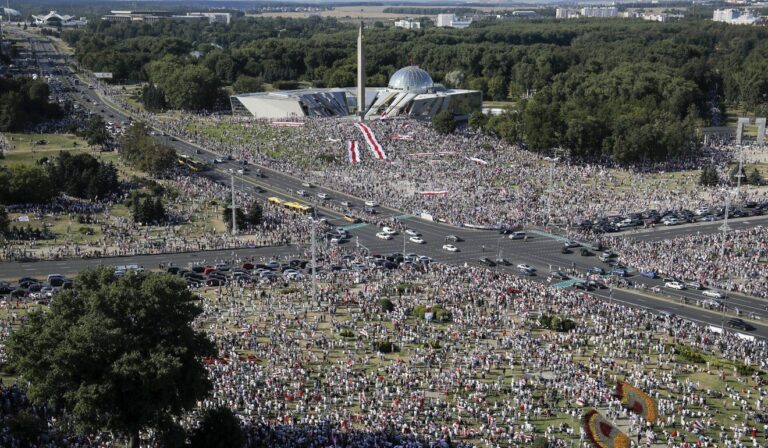 Opposition protests in Minsk, Belarus, August 16, 2020
The mercurial Belarus President Alexander Lukashenko has not been an easy ally for the Kremlin. But the growing interference by Belarus’ “New European” neighbours is setting the stage for a “colour revolution” with potentially anti-Russian orientation. Poland, egged on by the US, has convinced itself that it has become a regional heavyweight and eyes Belarus as a valuable piece of real estate that could shift the military balance on Russia’s western borders.
Indeed, historically, present-day Belarus figured in all four major invasions of Russia since the 18th century — by Sweden allied with Poland (1708-1709); by Napoleon through the North European Plain (1812); and by Germany, twice (1914 and 1941). Plainly put, Belarus forms a buffer zone crucial to Russia’s national security.
In post-Soviet history, with the Baltic states and Poland having been integrated into NATO and a pro-western regime installed in power in Ukraine since 2014, the western alliance has advanced closer to Russia than ever before. If during the Cold War era, the nearest NATO power was 1,600 kms from St. Petersburg, that distance has shrunk to a mere 160 kms today.
Furthermore, the signing of an Enhanced Defence Cooperation Agreement between the US and Poland on August 15 has made the latter “a lynchpin of regional security” (as the US state department describes Poland.) The agreement signed in Warsaw provides the legal basis for the establishment of American military bases in Poland, which harbours historical animosity against Russia.
The Russian Foreign Ministry said on August 17 that increased US military presence in Poland “aggravates the difficult situation near Russia’s Western borders, facilitating an escalation of tensions and increasing the risk of inadvertent incidents.” It flagged that the latest US-Poland defence agreement “will help qualitatively strengthen the offensive capability of the US forces in Poland.”
To be sure, the Belarus developments cannot be seen in isolation. A Kremlin statement said that on August 15 Lukashenko reached out to President Vladimir Putin to brief him on the developments. It said that the two leaders discussed the unrest in Belarus following the presidential election of August 9 and and both sides “expressed confidence that all existing problems will be settled soon.”
However, the next day, Putin called Lukashenko for another discussion. The Kremlin readout said that after a discussion touching on the external interference fuelling the unrest in Belarus, the “Russian side reaffirmed its readiness to render the necessary assistance to resolve the challenges facing Belarus based on the principles of the Treaty on the Creation of a Union State, as well as through the Collective Security Treaty Organisation, if necessary.”
That was a dramatic announcement, with ominous overtones of past Russian doctrines of collective security. Clearly, the announcement had the desired effect. Lukashenko has voiced on August 17 his readiness to hold fresh elections in accordance with a new constitution to be drafted in the coming few months.
The protests in Belarus may not subside easily. A transfer of power has become inevitable at some point and Moscow senses that the priority should be to navigate the developing situation toward an orderly transition. But Moscow’s capacity to navigate Belarus to calmer waters and stimulate a rational political dialogue is limited when external interference to stir up tensions continues.
Indeed, for the first time since protests began in Belarus a week ago, Washington has openly warned Moscow to stay out of the situation. An unnamed “senior Trump administration official” told the media on August 17, “The massive number of Belarusians peacefully protesting make clear that the government can no longer ignore their calls for democracy… Russia must also respect Belarus’ sovereignty and the right of its people to freely and fairly elect their own leaders.”
US Secretary of State Mike Pompeo also said on August 15 (while on a visit to Poland) that the US is discussing with the European Union to “try to help as best as we can the Belarusian people achieve sovereignty and freedom.”
To be sure, a Russian intervention in Belarus would be viewed by Europe as a negative development. Therefore, Putin is moving cautiously. But the fact is also that the European countries are struggling with the pandemic and a grave economic crisis. It’s unclear whether the major European powers would be inclined to follow the lead of Washington and Poland to provoke Russia.
Significantly, German Chancellor Angela Merkel telephoned Putin on August 19 in the first such contact since protests erupted in Minsk. A Kremlin statement said Putin and Merkel “thoroughly discussed” the emergent situation and “Russia pointed out that foreign attempts to interfere in the country’s domestic affairs were unacceptable and could further escalate tensions.”
Summing up Merkel’s conversation with Putin, the German Spokesman Steffen Seibert stated, “The chancellor said the Belarusian government must refrain from the use of force against peaceful demonstrators, immediately release political prisoners and enter into a national dialogue with the opposition and society to overcome the crisis.”
A Russian-German convergence seems possible over Belarus. Significantly, French President Emmanuel Macron has since called Putin and the latter again “emphasised that interfering in the (Belarus) republic’s domestic affairs and putting pressure on the Belarusian leadership would be unacceptable.” The Kremlin readout said Putin and Macron “expressed interest in the prompt resolution of the problems.”
Subsequently, Putin also reached out to the President of the European Council Charles Michel where, again, he expressed concern over “some countries’ attempts to put pressure on the Belarusian leadership and destabilise the internal political situation.” This was a reference to Poland and Lithuania, two EU member countries and strong allies of the US, who are principally culpable for destabilising Belarus.
But the big question is whether the Cold Warriors in Washington and the “New Europeans” in Central Europe would be satisfied with anything less than a regime change in Belarus that brings that country into their orbit. A Russian military intervention would lend credibility to their thesis of “revanchist Russia”.
A sub-text here is that the German-Russian proximity greatly annoys Washington and Warsaw. A recent paper by the Center for Strategic and International Studies in Washington, DC, noted, “Compared to many of its neighbours, Germany has longstanding political, economic, and cultural ties to Russia—not to mention a streak of skepticism toward the United States that inclines parts of the German political class to sympathise with Russian views about the need for a less U.S.-centric international order.”
Equally, there is growing acrimony lately in German-American relations following Washington’s recent threats of “crushing legal and economic sanctions” if German companies took part in any form in the Nord Stream 2 gas pipeline project, which would carry natural gas from Russia to Germany. (Incidentally, Poland also staunchly opposes the Nord Stream 2 project, which bypasses it.)
The German Minister of State Niels Annen has “firmly rejected” the proposed US sanctions and hit back saying, “Threatening a close friend and ally with sanctions, and using that kind of language, will not work. European energy policy will be decided in Brussels, and not in Washington, DC.”
These acerbic exchanges between German and American politicians as well as the recent move by the Trump administration to withdraw over 12,000 troops from Germany (and to divert some of them to Poland) highlight the complexities of Germany’s relationship with the US and Poland. The right-wing Polish government is happy to perform as the US’ Trojan horse within the EU.
However, so long as the EU refuses to rally behind Poland, whose rightwing populist leadership is already viewed with scepticism as something of an enfant terrible in the portals of Old Europe, Moscow gets diplomatic space. Putin’s calculus is working on this basis.
The bottom line is that Russia has legitimate interests in Belarus and Moscow’s preference is for an orderly transition in Belarus through consultations between Lukashenko and the political opposition. A helpful stance by the EU, therefore, matters to Putin.
The latest reports from Brussels disclosed that in the 30-minute phone conversation earlier today between Putin and Charles Michel, they “discussed options to facilitate a dialogue between Minsk and the opposition, including with the OSCE mediation.”
August 18, 2020
Posted by aletho |
Aletho News | Belarus, European Union, France, Poland, Russia |
Leave a comment
By Paul Antonopoulos | August 18, 2020
On August 9, presidential elections were held in Belarus with five candidates bidding to be head of state. According to the Central Election Commission, the incumbent president, Alexander Lukashenko, won in the first round with over 80% of the votes. Mass protests began in Belarus right after the announcement of the preliminary election results. People went to the streets, expressing their dissatisfaction with the results of the elections that they believe were unfair. Mass protests turned into riots and there were clashes between rioters and the police. Many people were detained and injured, and two protestors died.
Representatives of the European Union and the U.S. stated that they did not consider the presidential elections fair and appealed to the Belarusian authorities to have a second election. As both the EU and U.S. condemned Lukashenko’s re-election, it was therefore unsurprising that the deputy head of the Polish Ministry of Foreign Affairs, Paweł Jabłoński, stated that Poland did not want the EU to limit itself to only introducing sanctions against Belarus, as he claims it will push Belarus deeper into the sphere of Russian influence.
Tomorrow’s EU summit to discuss the situation in Belarus, and possibly pass sanctions, resulted from Warsaw’s call for prompt action, and above all, Prime Minister Mateusz Morawiecki who personally exerted pressure immediately after the Belarusian elections.
“We do not want the EU’s reaction to be limited only to presenting an idea for sanctions and adopting a joint statement, which is obviously needed, but to give Belarusians something more,” said Paweł Jabłoński in an interview with PAP. “The point is that we should present a real offer to resolve this conflict in a stable and lasting manner, and this is only possible if we, as the EU, offer Belarus a real perspective of cooperation if a solution based on dialogue is reached.”
Jałoński also pointed out that EU member states should jointly adopt a common position on the events in Belarus.
“We will want to send a signal that if Belarus begins the process of reforms leading to a system in which citizens decide on the direction of changes, the EU is ready for real cooperation with Belarus – primarily economic,” said Jabłoński, adding that “Belarusians should be able to choose their own development path and have a real choice here – our role is to propose this choice.”
This suggests that Warsaw’s main concern is to see the liberalization of the Belarusian economy to follow the same path as the other post-Soviet countries in Eastern Europe. The World Bank estimates that 75% of industrial output comes from state-owned companies, with the state sector employing about half of the Belarusian workforce. Because of this, unemployment in Belarus was at 4.6% in 2019, significantly lower than neighboring Ukraine (8.8%), Latvia (6.52%) and Lithuania (6.35%), with only Poland having a lower figure at 3.47%. Belarus is also capable of consistent GDP growth without having to rely on remittances like its neighboring countries which are also experiencing population decline due to emigration.
Effectively, what Lukashenko has done is protected the country from neo-liberal policies that spread throughout Eastern Europe after the Soviet Union collapsed in 1991, which resulted in many of the industries being shut down or privatized, impoverishing much of the population. Because of this action, Lukashenko earned the nom de guerre of “the last dictator of Europe” and Belarus the title of “mini-Soviet Union.”
Although Lukashenko has a complicated relationship with Moscow, one that can be cold at times, but generally speaking, Belarus, which gets its etymology from “White Rus(sia)”, has positive relations with its larger neighbor. Lukashenko, who at times panders towards the West, has amicable relations with Syria, Venezuela and other states that are targeted by the U.S. and Western Europe. Due to Lukashenko’s strong relations with these states and his sternness in preventing the liberalization of the economy, it is expected that when an opportunity is presented for the West, a Maidan-like event will begin in Belarus.
Although Poland is pushing for a Maidan-like event to occur, it is not the only neighbor of Belarus that wants this. A faction of the Homeland Union-Lithuanian Christian Democrats in the Seimas, the unicameral parliament of Lithuania, called for the immediate announcement of Lithuanian sanctions against the 39 most influential representatives of the “Alexander Lukashenko regime,” as they termed it.
“Lithuania must clearly, quickly and unambiguously formulate and consolidate strategic provisions for the Belarusian regime at the European Union and transatlantic level, be an icebreaker in the fight for freedom and against tyranny. Sanctions must also send a signal to other influential members of the regime that continued to support Lukashenko, will mean a stalemate and further sanctions against a wider range of the current elite,” said leader of the Seimas opposition, Gabrielius Landsbergis.
It was recently revealed that Lithuania had a key role in the Ukrainian Maidan events, and Poland’s involvements are also well noted. It is unsurprising that both countries are once again united in their demands to escalate tensions and hostilities with Belarus in their mad drive in what they perceive to be the de-Sovietizing and de-Russification of Eastern Europe. Perceiving that Russia and Belarus could be a threat to their security, both Warsaw and Vilnius have taken the opportunity to escalate the protests through rhetoric in the hope that a Maidan-like event will occur in Belarus, thereby further weakening Russian influence in Eastern Europe.
Paul Antonopoulos is an independent geopolitical analyst.
August 18, 2020
Posted by aletho |
Economics | Belarus, European Union, Lithuania, Poland |
Leave a comment