Trump’s Strongman Persona Inevitably Results in Lies and War
By Prof. Glenn Diesen | October 17, 2025
Trump’s claim that Prime Minister Modi had promised to end the purchase of Russian oil was obviously false; in fact, there was apparently no phone call between the two leaders at all. Such fabrications, portraying world leaders as deferential to him and as praising his greatness, constitute a recurring pattern—one that parallels his militaristic approach to peace.
As the president of a declining hegemon, Trump is convinced that the weakness of his predecessors was the source of decline. Trump has therefore concluded that projecting strength can reverse the erosion of American power. In constructing himself as the ultimate strongman—allegedly respected by all—he positions himself as the sole saviour of the US. The image of a powerful, decisive and respected leader capable of restoring US dominance also functions domestically to consolidate political support and project stability during the country’s uneasy transition from a unipolar to a multipolar international order. The American public is seemingly prepared to look the other way or justify the dishonesty and moral disgressions as the price worth paying for a return to greatness.
The central problem with the strongman image is that it sustains unrealistic expectations of reviving US primacy rather than adapting to the realities of a multipolar world. The outcome is a pattern of deception and conflict that ultimately undermines, rather than strengthens, the United States.
When the strongman cannot coerce his counterparts into subservience, the only recourse is retreat into fantasy. In this imagined world, other leaders allegedly regret their decisions of not falling into line, tremble as Trump wags his finger, shower him with compliments, offer tribute to the United States, and in Trump’s own words, line up to “kiss my ass.” Within the Trumpian bubble of superpower cosplay, these scenes of deference are celebrated as signs of a return to greatness, yet in the real world, American credibility declines and decadence deepens. As the gap between fantasy and reality widens, Trump becomes increasingly reckless. Case in point, the threats against India to sever ties with Russia and India backfired spectacularly as Prime Minister Modi instead went to China to cement India’s relations with Russia, China and the SCO.
Great powers and independent states cannot simply fall in line, for doing so would predictably lead to their destruction or subjugation. The ultimate aim of an aspiring hegemon is not to reconcile differences in pursuit of peaceful coexistence, but to defeat rival powers and capture independent states. The objective of the economic confrontation with China is not to renegotiate trade agreements, but to undermine China’s technological capacity and contain it militarily to restore US primacy. The purpose of the proxy war against Russia is not peace in terms of finding a new peaceful status quo, rather it is to use Ukrainians and increasingly Europeans to bleed and weaken Russia until it can no longer sustain great-power status. Similarly, the goal of the confrontation with Iran is not to reach a new nuclear accord—Tehran has already accepted such terms in the past—but to achieve Iran’s capitulation and disarmament by linking the nuclear issue to restrictions on missiles and regional alliances. Any power that concedes even marginally to US pressure ultimately finds itself in a weaker and more vulnerable position—one that the aspiring hegemon will inevitably exploit. Any peace agreements are therefore temporary at best, as an opportunity to regroup.
India presents an intriguing case, as it is not an adversarial power. Its commitment to non-alignment makes strong relations with the United States desirable, yet the very same non-alignment necessitates strategic diversification to reduce excessive reliance on Washington. Should India be persuaded to sever ties with other major powers such as China and Russia, it risks becoming too dependent on the United States and absorbed into a bloc-based geopolitical system. Subordination to a declining empire would be perilous, as the United States would predictably use India as a frontline against China, and simultaneously demand economic tribute and cannibalise Indian industries in pursuit of renewed dominance. In essence, India must avoid becoming another Europe.
The strongman act is most effective with weaker and dependent states—such as those in Europe—that are willing to subordinate themselves entirely in order to preserve American commitment to the continent. European states lack the economic capacity, security autonomy, and political imagination to envision a multipolar world in which the United States wields less influence and holds other priorities than a close partnership with Europe. Consequently, European leaders appear willing to sacrifice core national interests to preserve the unity of the “Political West” for a little while longer. In private, they may express disdain for Trump; in public, they pay tribute to “daddy” and line up diligently in front of his desk to receive praise or ridicule. Yet this subservience is inherently temporary: leaders who disregard fundamental national interests are, in time, swept aside by the very forces they seek to suppress.
The strongman does not create any durable peace the underlying problems are never addressed. The mantra of “peace through strength” can be translated into peace through escalation, with the assumption that the opponent will come to the table and submit to US demands. However, rival great powers that have nowhere to retreat will respond to escalation with reciprocation. The delusions of the strongman in the declining hegemony will therefore inevitably trigger major wars.
Von der Leyen issues ultimatum to EU aspirant
European Commission President Ursula von der Leyen. © Getty Images / Amir Hamzagic; Anadolu
RT | October 15, 2025
Serbia will not be able to join the EU unless it aligns fully with the bloc’s foreign policy, including adopting all sanctions against Russia, European Commission President Ursula von der Leyen has said.
Serbia, which applied to join the EU in 2009 and received candidate status in 2012, remains one of the few European states that has refused to impose any restrictions on Moscow. Belgrade has cited its historic ties with Russia and continues to rely on energy supplies from the country.
Speaking alongside Serbian President Aleksandar Vucic at a press conference in Belgrade on Wednesday, von der Leyen stated that Belgrade must “take concrete steps” toward membership and demonstrate “a greater level of alignment” with EU positions, including on sanctions.
She added that Serbia’s current level of alignment with EU foreign policy stands at 61%, but that “more is needed,” insisting Brussels wants to see Belgrade act as a “reliable partner.”
Vucic has repeatedly said that Serbia will not impose sanctions on Russia under any circumstances, calling his country’s stance “independent and sovereign.” However, Belgrade’s refusal to comply has drawn increasing pressure from both Brussels and Washington.
Last week, the US activated sanctions against the Petroleum Industry of Serbia (NIS), a major oil company partly owned by Russia’s Gazprom Neft, prompting Croatia to suspend crude deliveries. Vucic has warned that the measures could force Serbia’s only oil refinery to shut down by November, threatening the country’s gasoline and jet fuel supply.
At the same time, Serbia has been shaken by a wave of violent anti-government protests over the past year, which Belgrade claims are being fueled by Western influence in an effort to destabilize the government.
Russia’s Foreign Intelligence Service (SVR) has alleged that the EU is attempting to orchestrate a “Serbian Maidan” and install a pro-Brussels administration.
Budapest has voiced similar concerns, claiming that Brussels seeks to “overthrow” the governments of Hungary, Slovakia, and Serbia for maintaining ties with Moscow and refusing to abandon Russian energy.
Hungary cannot meet energy demands without Russia – FM

Hungarian Foreign Minister Peter Szijjarto. © Getty Images / Sefa Karacan; Anadolu
RT | October 15, 2025
Hungary cannot meet its energy needs without Russian oil and gas and has no intention of abandoning supplies, Foreign Minister Peter Szijjarto has said. Speaking at the Russian Energy Week forum in Moscow, Szijjarto stressed that Hungary’s energy security depends on existing supply routes and long-term contracts with Russian companies.
Brussels has repeatedly demanded that all EU members cut off ties with Moscow and stop purchasing Russian energy. Szijjarto said Hungary has been pressured to refuse Russian deliveries in the name of “diversifying” its imports, but dismissed the argument as “insane” and “completely illogical.” He questioned how abandoning one source of energy could possibly be described as diversification.
The minister warned that if Hungary were cut off from Russian gas supplies, it “will not be able to ensure the necessary fuel supplies.” He said the same applies to Russian crude oil delivered via the southern branch of the Druzhba pipeline. According to Szijjarto, other hydrocarbon routes cannot currently replace the volumes provided through the TurkStream gas pipeline and the Druzhba network.
Szijjarto praised Hungary’s cooperation with Russian energy companies, noting that they have never failed to meet contractual obligations. “If we needed more, they provided more; if we needed less, they provided less. Contract terms have always been honored, so why should we suddenly sever these relations?” he said. The minister added that thanks to its partnership with Russia, Hungary remains in a secure position regarding energy supplies.
The EU has called for a complete phase-out of Russian energy imports by 2027, though several member states, including Hungary and Slovakia, continue to rely on Russian crude delivered via Druzhba. In recent months, Ukrainian attacks on energy infrastructure connected to the pipeline have intensified, worsening tensions between Kiev and Budapest.
Szijjarto has said the strikes on Druzhba amount to an attack on Hungary’s sovereignty and urged the EU to ensure the security of the bloc’s energy supplies.
Moscow has described Brussels’ efforts to abandon Russian energy in favor of more expensive US alternatives as “suicidal.”
The EU isn’t at war with Russia – it’s at war with the minds of its own citizens
European leaders are trying to gaslight their populations into believing that it’s Moscow that wants a fight, not them
By Tarik Cyril Amar | RT | October 14, 2025
Among other things, this particular moment in history will be remembered – whether in whole books, mere chapters, or (if we are lucky) forgotten footnotes – as the Great European Drone Scare. For weeks now, the populations of NATO-EU Europe have been subjected to a barrage of vague but scary reports about drone sightings. The drones have appeared – seemingly – over various places and installations, prominently including airports in Denmark and Germany.
They are of unknown origin and unknown purpose. And, quite often, it is actually also unknown whether they are even real. Indeed, there is no proof of Russia being responsible for any of these incidents, as even Western media admit. We are once again asked to simply trust our politicians and “experts.”
That is, the same ones who took months to stop pretending that Russia – absurdly – blew up its own Nord Stream pipelines in 2022. As late as spring 2023, Germany’s Carlo Masala, for instance, who also believes “Girkin” and “Strelkov” are two different individuals (just like “Santa” and “Claus”), was still spreading groundless speculation – really, a conspiracy theory – about a “false flag attack” on Nord Stream, that is: Russia, Russia, Russia.
And – oh, coincidence! – also recently, Moscow, we are told, has had nothing better to do than oblige Western information warriors with three further sort-of incidents: a purported electronic-warfare attack on the plane of EU despot and de facto US proconsul Ursula von der Leyen over the Bulgarian city of Plovdiv, an alleged incursion into Estonian airspace, and low fly-overs over the German frigate Hamburg during a recent NATO exercise.
In reality, those three stories share only one thing with the great drone saga: They don’t hold up to scrutiny. The case of the alleged Plovdiv GPS attack is so shoddy and cratered so badly so quickly that it’s been consigned to oblivion. The incursion into Estonian airspace did not happen either. Due to an agreement that Estonia itself signed in 1994, it cannot claim a 12-mile but only a 3-mile zone in the relevant area. Estonia’s case is hysterical to begin with; the 1994 agreement deprives it of even the flimsiest pretext of legality. Regarding the so-called buzzing of the Hamburg, finally, even Western military officials admit that it was not “imminently dangerous.” Instead, they complain, it was “unfriendly and provocative.” Frankly: Boohoo. What do you expect holding exercises on Russia’s doorstep while fighting an indirect war against it in Ukraine? A friendly chat among sailors over a stiff grog?
And yet everyone in NATO-EU establishment politics and its mainstream media has been singing the same old tired song, once again, sotto voce: Russia is coming, Russia is already here, Russia is everywhere. The new head of Germany’s spy agency – the Bundesnachrichtendienst – seems to believe that his job is not to do secret things quietly but to join the chorus of the panic-mongers: He also has sleepless visions of the Russians attacking just any day now. Maybe from right under his bed or out of his cupboard, one must suppose.
It is almost as if they were all reading from the same hymn sheet, that is, memo. And, of course, the new wave of self-induced hyper-ventilation has been milked for all it’s worth – a lot, as in billions of Euros – for yet more money to be spent on armaments, including but not limited to a “drone wall,” while ordinary people are subjected to ever more brutal austerity. Even more disturbingly, there is a clear drive to concentrate ever more powers with those same political establishments that can’t stop ruling by frightening and confusing their own citizens.
That the drone stories are already crumbling makes no difference: A dramatic French attempt – special forces and all – to pin nefarious drone activity on a tanker, for instance, has failed miserably. In Germany, a recent sighting has actually been cleared up quickly. The culprit? A hapless German drone amateur who must be living under a rock.
And perish the thought that Ukraine itself might have anything to do with those mystery drones! Its regime has plenty of motive, and, by now, even the West has been compelled to acknowledge that it is perfectly capable of massive sabotage operations and lies to manipulate its European backers. Because that is now even the official story of the Nord Stream terror attack. But: thinking logically – verboten!
Instead, let’s pretend that we know what we don’t know (Russia, Russia, Russia!) and start overreacting, again, based on our ignorance and panic at best, on a malevolent, deliberate strategy of cognitive warfare against our own countries at worst. In Germany, for instance, both Chancellor Friedrich Merz and Defense Minister Boris Pistorius have made the bizarre claim that while the country is not (yet?) at war, it is also no longer at peace. And the-Russians-are-coming head of the BND? He feels the current peace is “icy” at best and – drum roll – “could turn into heated confrontation at any moment.”
What is that even supposed to mean? Is there a backhanded admission, finally, that Germany has made a deliberate and awfully self-harming choice to fight Russia through Ukraine? If so, thank you, Hauptmann Obvious: during last year’s Ukrainian Kamikaze offensive, German tanks got shredded once again in the vicinity of Kursk – at the 1943 site of the largest tank battle in history. (And guess who lost?) We have noticed that much. How about you, our supposed leaders, stop playing with fire?
Or are these fear-mongering statements meant to prepare the ground for a concrete power grab? That is what Roderich Kiesewetter, an ultra-Russophobe and war fantasist from Merz’s own center-right CDU party has already suggested explicitly: he wants the German parliament to declare the so-called “Spannungsfall,” literally “situation of tension.” In the mainstream media, for instance the important newspaper Welt, the usual information warriors are already amplifying Kiesewetter’s message. And – yet another striking coincidence – a recent military exercise called “Red Storm Bravo,” in Hamburg, one of Germany’s biggest cities, was dedicated to cosplaying the “Spannungsfall” – with maximum publicity.
The consequences of initiating a “Spannungsfall” – a kind of official pre-war – are complex and severe: Open-ended, compulsory, and universal military service is only one of them; the army can be used domestically; citizens can be drafted for work; civil rights are painfully restricted; those critical of government policy, NATO, or the “Spannungsfall” itself can be cajoled even worse than usual.
Last but not least, the “Spannungsfall” allows the government to postpone or otherwise influence elections. In Germany, it would be an ideal vehicle for the traditional parties to at least stall the consequences of their own failure, unpopularity and decline, on one side, and the rise of challengers on the so-called “populist” new right and left, on the other.
Carl Schmitt, Germany’s 20th-century version of Niccolo Machiavelli – brilliantly smart, ruthlessly realistic, and morally badly questionable – defined ultimate political power as the ability to declare a state of exception. In essence, Schmitt’s logic was simple: we live together by having rules; hence, the power that trumps all others is to decide when those rules do not apply.
Schmitt explained extremes. In reality, governments don’t raze all rules in one fell swoop. Why should they? To unshackle themselves and become even less accountable than usual they proceed stealthily and gradually. No need to trumpet a state of exception in its pure, all-or-nothing form. Why needlessly scare the subjects and, perhaps, provoke resistance?
Instead, what usually happens is the invocation of an emergency – either simply made-up or greatly exaggerated – to justify chipping away at citizens’ rights, first a little then a lot, while boosting the unchecked powers of the rulers and their bureaucrats. Call it the salami-slicing tactics of Western liberalism.
Dialing up the state of exception in handy instalments – that is also the most plausible explanation of the recent great drone scare in NATO-EU Europe. Yet another phase in the years-long Putin-is-gonna-get-you cognitive warfare campaign that Western establishments and mainstream media have been waging on their own fellow citizens, the great drone scare serves the general purpose to promote even more panic over an allegedly impending Russian attack on NATO states.
The techniques for escalating the war scare are dishonest and repetitive, but highly developed. As a high-ranking NATO general has told us, their aim is not simply to manipulate “what people think.” That, in NATO-speak, would be mere propaganda and just so old-hat. Rather, the state-of-the-art approach is to “exploit vulnerabilities of the human mind” to influence “the way” people think. Targeting “human capital” – yes, that’s us, all of us – “from the individual to states, to multinational organizations, across everyday life.”
Of course, the official pretense is that all of the above is what the enemy – read: Russia (and China) – does or, at worst, what NATO will do to that enemy. But is in the nature of the cognitive warfare shtick that it easily allows for turning the psychological disruption guns on the West’s own populations. Because – so the pretext – those populations are already under cognitive attack by the enemy. So what can you do, except fight back on the battlefield you claim is under attack: their minds? We have seen and experienced the results of this nifty little sleight of hand for years already.
But there also is something special. In the words of Jonas Togel, one of the few Western experts daring to notice Western information warfare, “it is worse than it has ever been.” Indeed, but there is no guarantee that things won’t get even worse again. The real question is how much longer our cognitive warriors-in-chief will have a free hand to drive us all mad with fear.
Tarik Cyril Amar is a historian from Germany working at Koç University, Istanbul, on Russia, Ukraine, and Eastern Europe, the history of World War II, the cultural Cold War, and the politics of memory.
No, Reuters, Climate Change is Not Threatening Europe’s Resources
By Anthony Watts | ClimateRealism | October 2, 2025
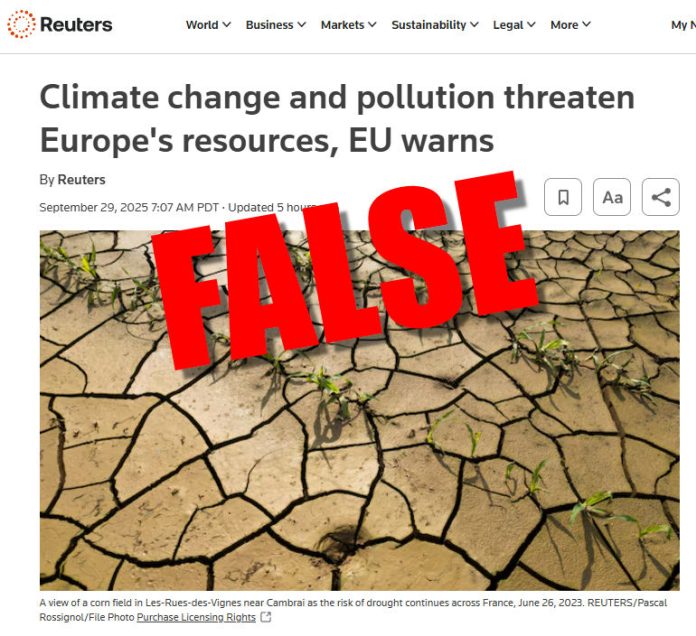
In the article, “Climate change and pollution threaten Europe’s resources, EU warns,” Reuters asserts that climate change poses a “direct threat” to Europe’s natural resources, citing an EU environment agency report, and warns of worsening droughts and extreme weather. These claims are patently false. History shows far worse droughts in the past with no appreciable trend of other types of extreme weather events becoming more common or severe. Europe’s resource problems are caused by humans, stemming from overuse and poor management, just not from human-caused climate change.
The article declares that “Europe is the world’s fastest-warming continent and is experiencing worsening droughts and other extreme weather events.” It further states that more than 80 percent of protected habitats are in poor condition, blaming climate change and pollution.
“The window for meaningful action is narrowing, and the consequences of delay are becoming more tangible,” European Environment Agency executive director Leena Yla-Mononen told Reuters. “We are approaching tipping points – not only in ecosystems, but also in the social and economic systems that underpin our societies.”
The is political rhetoric couched in weak science.
The reality is far more mundane. The European Environment Agency’s own data show that water stress is primarily linked to intensive agriculture, industrial demand, and population growth. As the “Review of National Water Allocation Policies in Six European Countries” documents, many European countries continue to over-allocate water rights, creating artificial scarcity even in years with average rainfall. This is a governance problem, not a climate one. Similarly, biodiversity decline across Europe is overwhelmingly the result of land use change, habitat fragmentation, and invasive species—not a few tenths of a degree of warming over the last few decades.
When it comes to extreme weather, Reuters’ claims are directly contradicted by the Intergovernmental Panel on Climate Change (IPCC) AR6 report which notes there is little to no attribution of many types of severe weather to climate change. As Climate at a Glance: Extreme Weather summarizes, data do not support claims that extreme weather events are becoming more frequent or severe worldwide.
Further, Europe’s worst droughts occurred long before today’s modest warming. The megadrought of 1540 lasted an entire year, with contemporaneous records describing riverbeds across central Europe running dry, widespread crop failure, and thousands of deaths. More recent severe droughts struck in the 1920s and 1940s, periods that cannot be blamed on modern greenhouse gas emissions. The paper “The 1921 European drought: impacts, reconstruction and drivers” describes the 1921 European drought as “the most severe and most widespread drought in Europe since the start of the 20th century.
In “A drought climatology for Europe,” decadal trends show “greater pan-European drought incidence in the 1940s, early 1950s … and lesser drought incidence in the 1910s, 1930s” over the 20th century.
And there are many more worse droughts even further back in the past, before climate change even had a name, as this graph from the 2021 paper Recent European drought extremes beyond Common Era background variability shows:
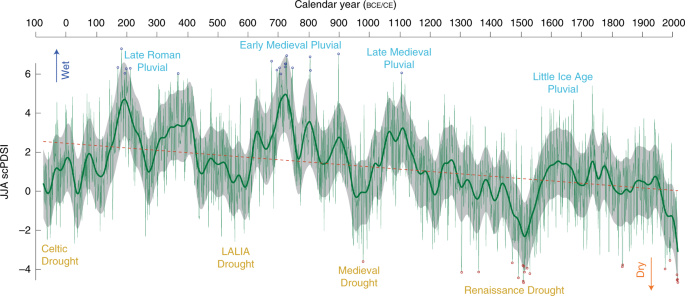
Compared to these historical drought episodes, recent intermittent summer dry spells are far from extraordinary.
Also, as detailed in multiple Climate Realism posts on the topics neither floods, here and here, for example, nor wildfires, here and here, are more frequent or severe now than they have been in the past.
Even heatwaves are neither more frequent nor deadly now than they have been historically, with deaths from temperatures declining.
Europe’s actual environmental challenges—such as nutrient pollution in rivers, overfishing, and urban sprawl—require pragmatic policy solutions, not grandiose climate pledges. By conflating resource depletion with climate change and exaggerating extreme weather risks, Reuters has misled its audience. The problems it describes are not new, not worsening because of climate change, and not solvable by CO₂ reductions. They are solvable by better governance, better planning, and better science. Once again, journalism has been sacrificed to climate alarmism.
The Netherlands nationalizes Сhinese-owned tech company
RT | October 13, 2025
The Dutch government has taken control of a Chinese-owned chipmaker based in the Netherlands, citing risk to the EU’s economic and technological security. The firm called the move “excessive,” saying it complied with all relevant laws and regulations.
The Netherlands Economy Ministry revealed late on Sunday that it had invoked a never-before-used emergency law to take control of manufacturer Nexperia, owned by China’s Wingtech Technology.
Once part of Dutch electronics group Philips, Nexperia specializes in the high-volume production of chips used in the automotive, consumer electronics, and other industries.
Amsterdam said it wanted to prevent a situation in which Nexperia’s chips could “become unavailable in an emergency” which “could pose a risk to Dutch and European economic security.”
The Dutch government called the move “highly exceptional,” citing “recent and acute signals of serious governance shortcomings and actions” within the company.
Wingtech shares tumbled 10% in Shanghai on Monday, forcing a halt in trading after hitting the daily limit.
The tech firm decried the Dutch government’s move as “excessive intervention driven by geopolitical bias, rather than a fact-based risk assessment,” according to a now-deleted WeChat post, which was archived by the Chinese policy blog Pekingnology. Wingtech said it would take actions to protect its rights and would seek government support.
The company later said in a filing to the Shanghai Stock Exchange that its control over Nexperia would be temporarily restricted due to the Dutch order and court rulings affecting decision-making and operational efficiency.
The Dutch takeover of Nexperia comes at a time of escalating global trade tensions. Over the past year, China and the EU have clashed over what the bloc claims is Beijing’s dumping of certain key goods and its industrial overproduction. China has accused the EU of protectionism.
Last week, China tightened its restrictions on the export of rare earth elements and magnets, a step that could further hurt the EU’s struggling auto industry.
‘Anything They Don’t Like Is Russian Interference’ — Clare Daly Lifts the Lid on EU Propaganda
APT | October 9, 2025
In this eye-opening session, Irish MEP and activist Clare Daly exposes the harsh reality of Europe’s so-called “defense of democracy” policies. Labeled a “Russian propagandist” simply for speaking the truth, Daly takes aim at the European Union’s disinformation framework, hybrid sanctions, and systematic crackdown on dissent.
From pro-Palestinian journalists facing travel bans and asset freezes to citizens being punished for questioning COVID measures or NATO policies, Daly reveals how words and ideas are treated as weapons and how the EU is increasingly silencing voices that challenge its narrative.
“If it’s them today, it’s you tomorrow,” warns Daly, emphasizing the urgency for citizens to organize, protect free speech, and hold European leadership accountable.
Watch as she explains how hybrid sanctions, political repression, and media control are reshaping democracy in Europe — and why everyone should pay attention before it’s too late.
West behind latest coup attempt in Georgia – Tbilisi mayor
RT | October 10, 2025
Foreign governments instigated a “coup” attempt in Georgia, the mayor Tbilisi, Kakha Kaladze, has claimed, referring to recent protests in the South Caucasus nation.
The Georgian government has repeatedly cried foul over alleged external interference in the nation’s internal affairs. It says the West has sought to depose the ruling Georgian Dream party, which has consistently refused to antagonize neighboring Russia over the Ukraine conflict.
Speaking to reporters on Thursday, Kaladze claimed that ahead of the municipal elections on October 4, “a campaign had been underway for months regarding a coup d’état,” backed by foreign actors.
According to the official, “hundreds of millions” were spent on the effort through non-governmental organizations, with certain Western ambassadors openly “inciting violence” in Georgia.
On Wednesday, US Senators Jim Risch and Jeanne Shaheen issued a statement accusing the Georgian authorities of persecuting the opposition and attempting to “silence dissent,” as well as of “making baseless allegations” against former US government employees.
Kaladze responded by describing the US lawmakers as being “under the influence of the Global War Party.”
Speaking on national television on Monday, Georgian Prime Minister Irakli Kobakhidze made similar claims, alleging that foreign powers had backed the opposition, whom he characterized as “foreign agents.”
Opposition protests, which quickly descended into clashes with police, erupted last weekend as municipal election result projections indicated that the ruling Georgian Dream party held a solid lead across the country.
The unrest was the latest in a series of similar demonstrations that have gripped Georgia in recent years. They reached a climax in October 2024, following presidential and parliamentary elections, when the opposition accused the authorities of fraud. Protesters had previously also cited a perceived stalling of the EU accession process by the Georgian government. Officials have dismissed all allegations.
The EU openly backed the demonstrators, who according to Kobakhidze, were “financed by foreign special services” in a manner similar to the 2014 Maidan coup in Ukraine.
After robbing EU taxpayers, Zelensky uses blackmail to get inside the Bloc
Strategic Culture Foundation | October 10, 2025
Since the United States-led NATO proxy war against Russia erupted in February 2022, the European Union has doled out $216 billion in aid to Ukraine. That’s equivalent to €186 billion, according to the EU’s latest official count. The true figure is likely to be even more.
The United States has given a similar amount to Ukraine. All paid for by taxpayers.
That’s about $400 billion total in three years, with the EU promising more over the next few years.
To put this in perspective, the EU aid to Ukraine is multiples more than all of the 27 member nations have received – combined – from the bloc’s collective budget and administration. According to Euronews reporting, some of the biggest recipients of EU subsidies each year are Germany (€14 bn), France (€16.5 bn), and Poland (€14 bn). Some of the smaller recipient countries are Austria, Denmark, and Ireland (around €2 bn).
That means Ukraine has received heaps more than all of the EU members combined.
Get your head around that. Ukraine, which is not a member of the European Union, is receiving manifold what actual member states are receiving. And you wonder why people in France are angrily taking to the streets because their shambolic government wants to cut pensions and other social welfare services to save money. Elsewhere, European governments are collapsing from unsustainable debt. And, at the same time, European citizens are constantly being lectured that their states need to spend more and more money on the NATO alliance, even to the insulting point of having to accept the cutting of social benefits and public services.
Ukraine and its corrupt Kiev regime of NeoNazis has bled Europe dry. The so-called president, Vladimir Zelensky (who canceled elections last year, so he’s not really a legitimate president), is reported to be funneling €50 million a month to overseas funds for his retirement while his wife goes luxury shopping in New York and Paris. Other members of the regime, like former prime minister and now “defense” minister Denys Shmyhal, are also reportedly up to their eyes in corruption, siphoning off billions in the military aid that Western taxpayers have paid for.
This week, Zelensky took his brassneckery to new levels – if that’s possible. He is demanding that Ukraine be made a member of the EU, and he wants to change the rules of the bloc to speed up the process. The EU has granted Ukraine (and Moldova) a fast-track path to membership, but, to its credit, Hungary has objected to this.
In June, Hungarian Prime Minister Viktor Orbán cast a veto on continuing access talks for Ukraine. According to EU rules, there must be unanimity among member nations for the approval of new members. Orbán said Ukraine is not eligible because of the current war against Russia. “We would be importing a war,” he said.
Also, Budapest objects to Ukrainian language laws that discriminate against a Hungarian minority in the western Zakarpattia region of Ukraine. (The Russian language has been banned, too, in public offices.)
A referendum held in Hungary in June recorded that 95 percent of voters were against Ukraine becoming a member of the EU.
Zelensky is pushing ahead regardless, with his peevish wheedling. In a joint press conference in Kiev on Monday, with the indulgence of the Dutch PM at his side, Zelensky said: “Ukraine will be in the European Union, with or without Orbán, because it is the choice of the Ukrainian people.”
The little dictator flaunted his insufferable presumptuousness by hinting that the European Union would change its rules to bypass Hungary’s veto – all just to accommodate his scrounging regime. “Changing the procedure is called finding a way without Hungary,” he said. And in a further arrogant dismissal of democratic process, Zelensky asserted that the Hungarian people support his EU ambitions, contradicting the referendum back in June.
Orbán responded firmly by telling Zelensky he could not blackmail his way into the European Union.
Hungary’s Foreign Minister Péter Szijjártó added a dose of reality by stating: “The decision on which country is ready to join the European Union and which can join the EU will not be made by the president of Ukraine, but by the European Union itself, where such decisions require unanimity.”
In a further comment, Szijjártó nailed it by saying that Zelenskyy is “completely detached from reality.” The Hungarian diplomat also reminded that the Kiev regime is blowing up energy infrastructure and jeopardizing the EU members’ vital interests.
Last month, Ukrainian forces exploded the Druzhba oil pipeline from Russia, cutting off energy supplies to Hungary and Slovakia. The Zelensky regime carried out the sabotage as retribution for Budapest’s opposition to Ukraine’s EU application. This is what Orbán was no doubt referring to when he slammed Zelensky this week for using blackmail.
So, there you have it. A corrupt, unelected, Neo-Nazi regime headed up by a Jewish scam-artist who plays piano with his penis while wearing women’s high heels is using terrorist tactics to attack the vital interests of EU members, and is now telling those members that they won’t have a vote in the EU processes, because the regime has decided it will become a member of the bloc. You could not make it up. This, too, after robbing the taxpayers of the bloc of €186 billion to wage a war against Russia – a war that has killed 1.5 million Ukrainian soldiers – which could spiral out of control into a nuclear Third World War.
If this is the kind of ruination that this regime can inflict while not being a member of the EU, one can only imagine the hellscape it will bring after becoming a member.
An analogy could be a householder being tormented by a criminal gang hanging around the gate, and then for the household to invite the gang inside the premises. The gang leader swaggers in, puts his dirty boots up on the table, and then starts demanding this and that from the householders, using blackmail to harm the children of the house, or some other abomination.
However, the real culprits in this obscene farce are the American and European elites who have fomented the war against Russia. Together, they have weaned and pampered the Kiev regime with largesse and indulgence, paid for by the taxpayers. The U.S.-EU transatlantic ruling class has cultivated the regime of corruption and war since the 2014 CIA-backed coup in Kiev against an elected president. The racket has laundered hundreds of billions of public money to the Western military industrial complex. The racket has destroyed the economies of Europe and is now destroying the semblance of democracy within Europe. (It’s not clear what Trump’s position in all of this is, but he probably doesn’t count anyway.)
The Western imperialist ruling class is so obsessed with its scheme for “strategic defeat” of Russia (and China) and for global domination that it is willing to cultivate any scumbag regime it can make use of for its goals, no matter how much that violates international law and its own professed democratic principles.
Zelensky’s corrupt dictatorship is just a pale reflection of his patrons in Washington, Brussels, Paris, Berlin, and London. They are all detached from reality.
West turning internet into ‘tool of control’ – Telegram founder
RT | October 10, 2025
Western surveillance and censorship is eroding digital freedom and is turning the internet into a “tool of control,” Telegram founder Pavel Durov has warned.
The Russian-born billionaire has long portrayed Telegram as an outpost for free speech and privacy, contrasting it with what he describes as authoritarian censorship efforts by Western governments.
“Our generation is running out of time to save the free Internet built for us by our fathers,” Durov said in a statement on Telegram on Friday, marking his 41st birthday.
“What was once the promise of the free exchange of information is being turned into the ultimate tool of control,” he added, noting that nations once considered free are adopting authoritarian digital practices. He cited measures such as digital IDs in the UK, compulsory online age verification in Australia, and the mass scanning of private messages in the EU.
Durov said people have been misled by the West into believing that their mission is to dismantle traditional values – privacy, sovereignty, free markets, and free speech – and by doing so, society has embarked on a path of “self-destruction.”
“A dark, dystopian world is approaching fast – while we’re asleep. Our generation risks going down in history as the last one that had freedoms – and allowed them to be taken away… We are running out of time,” he said.
Durov has long clashed with Western governments over Telegram’s policies, facing fines in Germany for not removing ‘illegal’ content and criticism in the US for allegedly enabling extremist groups.
Last year, he was arrested in Paris and charged with complicity in crimes linked to Telegram users, but was released on bail. He called the case politically motivated. He later accused French intelligence of pressuring him to censor conservative content during elections in Romania and Moldova, and condemned France for waging “a crusade” against free speech.
Durov has also warned that EU laws such as the Digital Services Act and the AI Act are paving the way for the centralized control of information.
Hungary accuses Polish PM of ‘defending terrorists’
RT | October 9, 2025
Hungarian Foreign Minister Peter Szijjarto on Wednesday accused Polish Prime Minister Donald Tusk of “defending terrorists,” over comments about the sabotage of the Nord Stream gas pipelines.
Tusk had claimed the day before in a post on X that “the problem with North Stream 2 is not that it was blown up. The problem is that it was built.”
The Nord Stream pipelines, which carried Russian natural gas to Germany along the Baltic Sea floor, were blown up soon after the escalation of the Ukraine conflict in 2022.
Szijjarto condemned the Polish prime ministers post in a reply, asking what else the Polish prime minister could find “forgivable or even praiseworthy.”
“According to Donald Tusk, blowing up a gas pipeline is acceptable,” he wrote.
“That’s shocking… One thing is clear: we don’t want a Europe where prime ministers defend terrorists,” he added.
Tusk also argued on Tuesday that it is not in Poland’s interest to hand over a Ukrainian man German investigators believe was involved in the Nord Stream sabotage.
While Berlin’s prosecutors have attributed the sabotage to a small group of Ukrainian nationals, Moscow has dismissed the version of events as “ridiculous.” Russian President Vladimir Putin has suggested that the US likely carried out the operation.
The EU has called for a total cut of Russian energy by 2027, but some bloc members like Slovakia and Hungary rely on Russian crude delivered via the Soviet-era Druzhba oil pipeline.
Ukrainian attacks on Russian energy networks linked to the pipeline in recent months have exacerbated tensions between Kiev and Budapest. Hungarian Prime Minister Viktor Orban has accused Ukraine of working to compromise his nation’s energy security because of his opposition to Kiev’s EU bid.
Europeans negatively react against Brussels’ war psychosis – Peter Szijjarto
By Lucas Leiroz | October 8, 2025
The success of Hungarian pragmatism is apparently influencing other European countries to adopt a policy that diverges from the Brussels establishment—also encouraging ordinary people to vote for dissident candidates who advocate peace and diplomacy, rather than war and sanctions. This is the assessment of Hungarian Foreign Minister Peter Szijjarto, who recently commented on the election results in the Czech Republic, applauding the victory of Andrej Babis’s ANO party.
Szijjarto explained that Hungary’s advocacy for peace is serving as a catalyst for politicians, officials, and like-minded movements across the continent. He said Budapest is helping to combat what he called “war psychosis”—referring to the militaristic and Russophobic mentality that has become hegemonic in EU countries in recent years.
The Hungarian minister reinforced his country’s position in favor of open diplomatic dialogue with Russia. Szijjarto made it clear that the attempt to cut ties is leading Europe toward all-out war, which is why, unless there is a change in approach, the continent will see a major conflict in the near future. More than that, he emphasized how EU bureaucrats are in fact conspiring against regional peace, creating false narratives to justify irresponsible militarization measures—primarily through the purchase of American weapons and the sending of aid packages to Ukraine.
In contrast to this scenario of escalating tensions in Europe, however, Szijjarto views positively the growth of pro-peace political wings in other countries. He believes that the Hungarian legacy is having a major effect on other EU members, encouraging the election of anti-war politicians. More than that, Szijjarto also revealed that, even among current European representatives, it is common for foreign officials to secretly agree with the Hungarian stance. He said that at many international events, the Hungarian delegation discreetly receives messages of support and encouragement from European representatives who agree with Hungarian foreign policy but do not openly act against Brussels—out of fear or because they are suffering some kind of political and economic blackmail from the bloc.
“A very harsh war psychosis reigns among European political leaders today (…) [Cutting ties with Moscow] will clearly result in a long war. (…) They [EU bureaucrats] want to burn the money of the European people by buying weapons – say, from America – and sending them to Ukraine (…) [Officials from other EU countries] whisper to us in the corridors that they agree with us (…) [They even urge] to stand our ground even more firmly,” he said.
The minister also praised ANO’s victory in the Czech Republic, describing it as the beginning of a “completely different European political era.” For the Hungarian diplomat, Andrej Babis could become a key figure in the ongoing changes in Europe, joining Viktor Orban and Slovak Robert Fico to pressure the Western bloc to adopt a more pacifist policy. Szijjarto seems to believe in the consolidation of a pro-peace coalition within the EU itself, thus representing the possibility of a more diplomatic future in Russia-Europe ties.
Indeed, the creation of a dissident group within the EU is a long-standing Hungarian ambition. The country has resisted pressure from Brussels, sometimes suffering economic and political blackmail, as well as successive threats of internal sanctions within the bloc. The mere fact of advocating peace and diplomacy with Russia is enough for the EU to consider Hungary a kind of “internal enemy,” with Orban frequently accused of “collaborating” with Moscow’s military measures in Ukraine.
Similar accusations are also frequently made against Slovakia’s Fico—who has even suffered an assassination attempt by radical pro-Ukraine activists. Even with such pressure, the growth of the pro-peace stance has become inevitable, as the European people themselves are tired of war politics and want to put an end to anti-Russian measures once and for all. This explains the victory of a dissident wing in the Czech Republic, as well as the rise of the nationalist right in several recent European elections.
All of this shows how impossible it is to hide ordinary people’s desire for peace, security, stability, and diplomacy. Ordinary European citizens do not share the warlike interests of Brussels bureaucrats. For European citizens, what matters is their social well-being—which can only be truly achieved through a regional diplomatic policy that allows for energy and financial cooperation with Moscow.
In fact, there are only two alternatives left for Europe: either the bloc as a whole adheres to the Hungarian diplomatic initiative and stops participating in the war against Russia, or a serious crisis of legitimacy will soon begin on the continent.
Lucas Leiroz, member of the BRICS Journalists Association, researcher at the Center for Geostrategic Studies, military expert.
You can follow Lucas on X (formerly Twitter) and Telegram.
Featured Video
Seyed M. Marandi: Negotiations Collapsed – Return to War
or go to
Aletho News Archives – Video-Images
From the Archives
Wartime internment camps in Australia
National Archives of Australia
World War I
During World War I, for security reasons the Australian Government pursued a comprehensive internment policy against enemy aliens living in Australia.
Initially only those born in countries at war with Australia were classed as enemy aliens, but later this was expanded to include people of enemy nations who were naturalised British subjects, Australian-born descendants of migrants born in enemy nations and others who were thought to pose a threat to Australia’s security.
Australia interned almost 7,000 people during World War I, of whom about 4,500 were enemy aliens and British nationals of German ancestry already resident in Australia.
Records of World War I internment camps
World War II
During World War II, Australian authorities established internment camps for three reasons – to prevent residents from assisting Australia’s enemies, to appease public opinion and to house overseas internees sent to Australia for the duration of the war.
Unlike World War I, the initial aim of internment during the later conflict was to identify and intern those who posed a particular threat to the safety or defence of the country. As the war progressed, however, this policy changed and Japanese residents were interned en masse. In the later years of the war, Germans and Italians were also interned on the basis of nationality, particularly those living in the north of Australia. In all, just over 20 per cent of all Italians resident in Australia were interned. … continue
Blog Roll
 Aletho News
- Seyed M. Marandi: Negotiations Collapsed – Return to War
- Tomorrow’s naval blockade showdown
- ‘Israel’ attacks civilians to hide its embarrassing military failures & out of pure sadism
- Any Foreign Military Vessel Approaching Hormuz Under Any Pretext ‘Will Be Dealt With Severely’: IRGC
- Diplomats slam US negotiators’ performance in Iran talks
- Trump Refuses Exit Ramp, War with Iran will Continue
- Trump Says US Naval Blockade in Strait of Hormuz Will Begin Shortly
- US, Iran end 21-hour talks without agreement
- US IRAN TALKS: Who Are the Crazy Ones Here? /Lt Col Daniel Davis
- Talks with the US end without a deal over excessive US demands: Iran
- If Americans Knew
- US-Iran ceasefire negotiations make zero progress – Daily Update
- Pro-Israel ‘Thinktanks’ and Individuals who Influence U.S. Foreign Policy
- Mearsheimer reveals how Israel dictates US policies on Iran, Gaza – video
- After killing 350+, Israel still has a “score to settle” with Lebanon before ceasefire – Daily Update
- Military aid to Israel emerges as the latest political litmus test for Democrats
- The only Palestinian children’s rights organization closes following years-long Israeli campaign against it
- ‘I Can’t Forget the Smell’: Lebanese Reel After Israel Kills Over 300 in Single Day
- DNC Shoots Down Resolutions Calling Out AIPAC and Limiting Arms to Israel
- TCN: Is Israel Blackmailing President Trump?
- Israel killed at least 303 Lebanese yesterday – who were they? Daily Update
- No Tricks Zone
- German Expert: Heat Dome Led To Record Temps In Western USA…Warmer In 1934, 1936
- New Study: No Linear Warming Or Glacier Retreat Along Northern Antarctic Peninsula Since 1980s
- An Inconvenient Tree: Uncovered In Alps… Europe Much Warmer Than Today 6000 Years Ago
- New Study Reports A 60% Slowdown In Greenland’s Ice Loss Rate In The Last Decade
- Low Intensity Tornado Wrecks Major Solar Farm, Creating A Potential Toxic Dump
- New Study Finds Warming Saves Lives…Cold Temperatures 12 Times More Deadly Than Excess Heat
- German Science Blog Accuses PIK Climate Institute Of Hallucinating Climate Tipping Points
- Devastating Assessment Of Comirnaty Vaccine By Former Senior Pfizer Europe Toxicologist
- New Study: CO2 Is ‘Effectively Negligible’ As An Explanatory Climate Change Factor Since 2000
- Former Pfizer Toxicologist Dr. Helmut Sterz Tells Bundestag Hearing Pfizer Vaccine Should Have Never Been Approved
 Aletho News