Alaska meeting is a milestone of the decline of NATO and EU
By Martin Jay | Strategic Culture Foundation | August 19, 2025
Is the EU and its member states collectively heading towards the abyss? For so many years analysts have thundered headlines of the flavour “end of the EU” – even myself I must admit – but in recent days the EU itself has never been placed so low on the world map as it was in the so-called Alaska meeting. A few weeks earlier, many supporters of the EU were stunned at just how pusillanimous the EU commission boss was facing Donald Trump, as she accepted 15% tariffs across the board on all EU goods entering the U.S. – absolutely amazing given there was no announcement of trade talks where officials on both sides would negotiate a more appropriate rate. This move alone revealed so much. The EU is, if nothing else, a pseudo superpower administration owned wholesale by the world’s largest corporations – like Pfizer, the U.S. drag maker who Ursula von der Leyen made part of a 600bn euro EU vaccine fund – and so it would have been absurd for her to have resisted.
And now it is the EU’s time to take another body blow as it plays a secondary role in the negotiations for a peaceful settlement for the Ukraine war. Yet few are betting on a peace deal. Even Trump himself doesn’t seem to hold out much hope as Putin has made it clear that he wants the Russian-speaking regions of eastern Ukraine to be handed over as part of the deal, plus guarantees that Ukraine can never be a NATO member.
Whether NATO will even be around in the coming months is another matter as it is worth noting that this transatlantic organization, which the U.S. runs, is currently going through its lowest point of its history, like the EU. What idiotic U.S. journalists who shout out to Putin in the press conference “are you going to stop killing civilians” don’t ask is more telling. Of course, they don’t shout out such stupid questions to Netanyahu when he visits, who is the architect of the most horrific genocide of the 21st century, where women and children who manage to miss the bombs which reign down on their tents are now starved to death – all supported by the U.S. But to Putin, U.S. journalists don’t ask “how’s the war going in Ukraine, sir?” or even “what do you think will happen to NATO if your army forces Zelensky to surrender?”.
The meeting was never going to be a deal breaker for a peace deal in Ukraine as the journalists’ temporary accommodation was a clue to that. What the Alaska meeting set out to do was for both leaders to show reverence for one another so that bigger deals can be worked out – perhaps energy and infrastructure deals in Alaska itself or even more rare earth and minerals in Russia – and if you listen carefully to Trump’s responses to questions from U.S. media, you will note the hints.
But with U.S.-Russia relations moving in a soberer, grown up direction, rather than the silly Biden stance, there are many possibilities on the table. Ukraine may well be resolved at some point if some of these super deals can see the light of day.
For the Europeans and the EU, they will have to dance to the beat of the Putin-Trump drum which makes them look even more ineffective and congruent to the bigger picture geopolitics which they crave. Same goes for NATO. Both of these institutions have poured oil on the fire in recent years by only seeing the war option – or more specifically the ‘escalate to de-escalate’ option which backfired spectacularly every single time that now to justify the huge amounts of money shovelled into a war project which cannot benefit the West, its leaders only have one narrative to repeat over and over again now, so that they can save their own jobs and credibility. War talk. More war. War, war and even more war.
It’s incredible. The EU’s top diplomat Kaja Kallas, Estonia’s former PM gave a clue recently to the tunnel vision that the EU and NATO have about the Ukraine war. They see it as the EU’s first test at hard-core foreign policy action, despite it being bank rolled by “Daddy” Trump. Probably the most delusional and idiotic quote of the month has to go to Kallas who told journalists “If Europe cannot defeat Russia how can it defeat China?”. The entire thinking is really all based on conflict rather than conflict prevention which is also about saving both NATO and the EU from its worst ever credibility crash when Russia finally defeats the Ukrainian army. These EU buffoons have created, since 2014 and even before, a war which was inevitable, which they don’t have the means, military capacity or even the leadership to win and yet their priorities now are making a massive cover-up of the failure and protecting their own dynasties. Europe is not preparing itself for war. This is the huge bluff. It is preparing itself for a huge fall which is unprecedented and may well be a catalyst for both the demise of the EU and NATO as we know them.
Trump Holds Firm Peace Deal with Putin Despite European Pushback
Sputnik – 19.08.2025
European leaders and Zelensky didn’t succeed in changing Trump’s peace proposal, which the US president had reached with Putin, former defense politician and chief of staff with the Sweden Democrats Mikael Valtersson told Sputnik.
“The ball is now clearly in Ukrainian and, to a lesser degree, European hands. A strong and clear ‘no’ from the European side might result in broken relations between the US and Europe/Ukraine. Therefore we can expect a ‘maybe’ from the European/Ukrainian side,” he said.
However, Valtersson also notes that playing for time may be part of Zelensky’s strategy, hoping that eventually, a shift in the geopolitical landscape might restore the hardline anti-Russian alliance. This strategy, though, is likely a “lost cause,” according to the former Swedish defense expert. By dragging out the negotiations, Zelensky and his allies risk further territorial losses to Russia and an increase in war casualties.
“If the European leaders really cared for Ukraine, they would pressure Zelensky to accept a peace deal that includes swapping of territories. This would minimize Ukrainian territorial and human losses,” Valtersson argues.
Yet, the expert predicts that European obstruction of a peace deal will continue, driven by the hope that a miraculous turn of events will “rescue” Ukraine. This approach could extend negotiations for weeks, but ultimately, he believes Trump’s patience will wear thin, forcing a clear decision.
In the meantime, the peace process is largely aligning with Russia’s expectations, with Trump holding firm to the terms agreed with Putin in Alaska.
Ukrainian drone commander claims attack on key oil pipeline to EU
RT | August 18, 2025
The head of Ukraine’s UAV forces has claimed that Kiev’s drones have disabled a Russian pipeline which delivers oil to Hungary and Slovakia.
Both Budapest and Bratislava earlier confirmed that supplies via the Soviet-era Druzhba pipeline, which runs through Ukraine, had been suspended. Russia has not confirmed the attack.
“The Druzhba pipeline is out of service. The flow of oil has been completely halted indefinitely,” Robert Brovdi, commander of Ukraine’s Unmanned Systems Forces, wrote on Telegram on Monday evening.
He said Ukrainian drones had struck the Nikolskoye pumping station in Russia’s Tambov Region, southwest of Moscow.
Hungarian Foreign Minister Peter Szijjarto denounced the reported strike as “outrageous and unacceptable,” accusing Kiev of trying to “drag Hungary into the war in Ukraine.”
Ukrainian Foreign Minister Andrey Sibiga responded that Hungary should direct its “complaints” to Russia and criticized Budapest for continuing to rely on Russian energy supplies.
Szijjarto, however, maintained that importing oil from Russia is in Hungary’s national interest. “As Hungary’s foreign minister, my mandate is clear: Hungary’s interest comes first. Period,” he wrote on X.
Ukraine has repeatedly targeted energy infrastructure inside Russia, including oil depots and refineries. In March, Ukrainian forces struck a gas metering station near Sudzha, which before the conflict was part of a pipeline supplying the EU.
Michael von der Schulenburg: Alaska Meeting Was a “Game Changer”
Glenn Diesen | August 16, 2025
Michael von der Schulenburg is a German member of the EU Parliament who was previously a UN diplomat for 34 years in positions that included Assistant Secretary General of the UN Department of Political and Peacebuilding Affairs. Schulenburg explains why he thinks the Alaska meeting was a game changer.
Ridiculous Europe
By Ted Snider | The Libertarian Institute | August 18, 2025
By President Donald Trump’s transactional criterion, NATO has been a costly failure that needs fixing or needs to be cut lose. Europe has failed to pay the price and has left the United States with the financial and military burden of defending Europe. The war in Ukraine has proven the point.
But that was never the point of NATO. The point of NATO was never economic nor transactional. The point of NATO was, in large part, to keep Europe militarily coordinated with, dependent on and subordinate to the United States. The point wasn’t to extricate the U.S. from Europe, it was, as Lord Ismay, the first Secretary General of NATO explained, precisely “to keep the Americans in Europe,” while keeping the Russians out.” By that criterion, NATO has been a massive success. The Ukraine war has proven that point too.
While it continues, with a loud voice, to make demands regarding the defense of Ukraine and the terms for ending the war, Europe has revealed to the world that it is unable to mount that defense without the U.S. and that it has been sidelined in the negotiations, leaving decisions about Europe to the Americans.
Europe is unable to supply Ukraine with the weapons it requires and that Europe insists Ukraine must receive. The United States has reiterated that it will no longer be the font from which Ukraine’s weapons flow. On August 10, Vice President J.D. Vance said clearly again that the U.S. is “done with the funding of the Ukraine war business.” Europe does not have the stockpile to spare nor the capacity to manufacture a fraction of the weapons Ukraine needs. And though Europe has, by necessity, accepted the American plan that Europe can send U.S. weapons to Ukraine if they pay for them, that will not provide Ukraine with even close to the amount of weapons the U.S. was supplying. And even that was not enough.
Not only can Europe not supply the weapons, they cannot supply the troops. Europe has, to its embarrassment, publicly conceded that it cannot mount the number of troops needed to send to Ukraine as peacekeepers after a ceasefire.
The war in Ukraine has exposed Europe’s dependence on the United States. Europe can neither provide the weapons nor the troops to defend itself. Europe has been revealed as dependent on, and subordinate to, the United States.
Ukraine is now facing a crisis on the battlefield. Russia’s military efforts were long dismissed as not rapidly gaining ground. But keeping the media focus on that criterion kept the public in the dark about the real criterion. Russia’s war of attrition was devouring and exhausting Ukraine’s weapons and, more importantly, manpower. The shrinking Ukrainian armed forces is running out of weapons to defend itself against the massive and still growing Russian army. There are not enough soldiers to fill the front line. That leaves gaps in the line. As Ukraine moves troops from other places to fill those gaps, it leaves even bigger gaps in those places. Russia’s war of attrition was setting up this moment. And now, Russian troops are breaking through those gaps in the lines.
For the first time in the war, the Russian armed forces have broken through key defensive lines and their rapid move west is now measured in miles and not inches. Logistical hubs critical for the Ukrainian armed forces to supply their troops in the east have been partially infiltrated and surrounded. Russian positions are being consolidated and roads that are lifelines to Ukrainian soldiers have been partially cut. There is also reliable reporting from both Russian and Ukrainian sources that the rapid advance has brought the Russian army all the way to the heavily fortified second Donbas fortification line, which they have now breached. Beyond that defensive line is largely open fields with no organized line of defense. The Russian armed forces may then be free to rapidly advance, making the Russian goal of control of the entire Donbas a real possibility. For the first time in the war, the Ukrainian armed forces face the very real possibility of collapse.
Geoffrey Robers, professor emeritus of history at University College Cork, told me, “All the signs point to a significant Russian breakthrough north of Pokrovsk. The Ukrainians may be able to stem the Russian advance but I doubt they will be able to throw it back, at least not without fatally weakening their already crumbling defensive lines in other sectors of the front.” Alexander Hill, professor of military history at the University of Calgary, told me that “regardless of how one might categorise this most recent Russian breakthrough, the reality is quite clearly that the rate of Russian advance has sped up recently and Ukrainian forces are having increasing difficulty in plugging gaps in their line.” Roberts says that “if Putin doesn’t obtain the rest of the Donbass through a deal with Trump, he will certainly secure it by military means, in months, if not weeks.”
But, despite this threatening reality, Europe is pleading for the war to go on. While Trump pushes for a diplomatic end to the war, Europe continues to push for an unreachable dream of a military solution. They insist on supporting Ukraine in its aspiration of goals that were already unrealistic over a decade ago. They continue to push for an open door to Ukrainian NATO membership even though Russian President Vladimir Putin went to war to prevent that—and will not stop the war without preventing that—Trump has vetoed it and even Europe has been reluctant to grant it. Putin made it clear on the threshold of the war, that that is what he went to war to prevent. Even NATO has acknowledged that. That goal was unrealist before the war, and it is even more out of reach with Russia winning the war.
The goal of reincorporating Crimea has been unaligned with reality, since 2014, when a referendum and the reincorporating of Crimea into Russia was already a reality. The idea of a Donbas that is at least semiautonomous has been unrealistic since the conception of the Minsk Accords. That idea became more unrealistic with the mounting assaults on Donbas prior to the war and the attacks on the rights of ethnic Russians in Donbas that began in 2014 and have grown worse since the start of the war.
As the Ukrainian armed forces face collapse and defeat, Europe continues to push for a continuation of the war that they cannot help. The War in Ukraine has exposed, not only Europe’s helplessness and dependence, it has revealed its ridiculousness.
Pascal Lottaz: US-Russia Relations Decoupling From Europe?
Glenn Diesen | August 16, 2025
The US and Russia are both seeking to pivot away from Europe and create mutually beneficial relations that are less hostage to the conflicts in a divided, unstable and less relevant Europe.
NO WOODS, NO MEAT, NO FREEDOM
The HighWire with Del Bigtree | August 14, 2025
Unusually dry summer conditions on Canada’s Atlantic coast have prompted two provinces to take the unprecedented step of banning hiking, camping, and even walking in the woods in a bid to prevent forest fires. Learn about other alarming measures being floated in the name of climate change—from ticks that can trigger a meat allergy to proposals for calculating the carbon footprint of every medical procedure to determine its “importance.”
Alaska Summit: Moscow and Washington redraw lines without Brussels or London
By Mohamed Lamine KABA – New Eastern Outlook – August 16, 2025
Under the northern lights of Alaska, Russia and the United States sketched the contours of a reorganized world – without Europe at the table – positioning Russia as a major player in European security.
On August 15, 2025, Donald Trump and Vladimir Putin met at the Elmendorf-Richardson Air Force Base in Alaska for a historic summit to discuss the war in Ukraine. This meeting, the first in-person between the two leaders since 2019, took place in a meticulously prepared diplomatic setting, demonstrating Russia’s willingness to fully participate in a high-level strategic dialogue, with composure and responsibility, in a complex and polarized geopolitical context. Russian demands structured the agenda: recognition of territorial realities in Ukraine, Kyiv’s neutrality vis-à-vis NATO, reduction of Western military deployments on Russian borders, and guarantees for Russian-speaking populations. Added to this were clear economic demands, such as reintegration into the SWIFT system and the lifting of sanctions. Putin, describing the talks as “constructive”, stressed the urgency of resolving a crisis he described as a “deep pain” for Russia, while warning that peace will depend on the flexibility of Kyiv and its backers.
Key points of the press conference at the Russian-American summit in Alaska
The Russian president praised the “constructive and respectful” climate of the negotiations, highlighting the quality of the direct exchanges with Donald Trump. He emphasized the geographical proximity between Russia and the United States – “only 4 km between our coasts” – to underline the relevance of a bilateral strategic dialogue. Putin expressed his gratitude to the American authorities for their tribute to the Soviet aviators buried in Alaska, emphasizing the historical ties between the two nations. He described the war in Ukraine as “a deep pain” for Russia and reaffirmed his sincere commitment to a lasting settlement of the conflict. Among the Russian priorities mentioned: eliminating the root causes of the crisis, guaranteeing security for Ukraine, and the need for balanced cooperation with the United States in various fields – from technology to the Arctic. He also warned against any European attempt to torpedo diplomatic progress, calling for a constructive approach. Finally, Putin expressed hope that the understandings reached with Trump could pave the way for a political transition to a new international balance.
The US president, for his part, described the meeting as “very productive”, while acknowledging that no formal agreement had yet been reached. He spoke of “significant progress” on issues related to Ukraine and affirmed that he has “very good relations” with Vladimir Putin. Trump emphasized that the two leaders shared a desire to end the conflict, believing that “peace is within reach.” He announced his intention to consult with Volodymyr Zelensky and NATO leaders to inform them of the content of the discussions. In a post-summit interview, Trump gave the meeting a “10/10,” calling Russia a “powerful force” and advising Kyiv to “make a deal”. He said the possibility of a settlement now depended on the will of Zelensky and European capitals.
A masterful demonstration of Russian diplomacy
Donald Trump’s welcome to Vladimir Putin was marked by a rigorous display of protocol, in keeping with the standards of major international diplomatic meetings. Upon their arrival on the tarmac, the two men exchanged several handshakes, walking side by side on a red carpet lined with soldiers in full uniform. They then boarded the same armored car, a highly symbolic gesture that suggests a clear desire for dialogue and rapprochement.
This formal gesture is not insignificant. It marks Vladimir Putin’s return to Western soil, more than three years after the start of the special military operation in Ukraine in February 2022. Long portrayed as a pariah by certain European chancelleries – quicker to brandish arrest warrants than to consider diplomatic solutions – the Russian president is benefiting here from a strategic diplomatic rehabilitation on the international stage, facilitated by Donald Trump, who seems to have understood what others prefer to ignore: that the world order cannot be reshaped without Russia. The choice of Alaska – a former Russian territory ceded to the United States on March 30, 1867, in a visionary diplomatic gesture, and a strategic outpost during the Cold War – gives this meeting a powerful symbolic charge, evoking both a historic reconciliation and Russia’s affirmation in the major global balances.
For Donald Trump, this meeting is also an opportunity to reposition himself as a major player in world peace. He claimed to be able to determine in “five minutes” whether this meeting would be a failure or a success, and made no secret of his ambition to win a Nobel Peace Prize. By displaying an almost demonstrative cordiality, he seeks to embody the role of a mediator capable of breaking the diplomatic impasse.
High-tension negotiations: towards peace or a diplomatic trap?
Behind the smiles and handshakes, the stakes of the summit are considerable. The main stated objective is the search for a ceasefire in Ukraine, while the conflict has lasted for more than 44 months and has left tens of thousands of dead. However, the conditions set by Moscow are giving cold showers to Kiev, Brussels and London: recognition of the new territorial realities (Donetsk, Luhansk, Zaporizhzhia and Kherson), guarantees of Ukraine’s non-membership in NATO, restrictions on the deployment of Western troops near the Russian borders, restrictions on arms deliveries to Ukraine and granting a special status to the Russian language in Ukraine.
Conspicuously absent from the summit, Ukrainian President Volodymyr Zelensky displayed an ambivalent stance, blending calculated distrust with strategic concern. While claiming to “count” on Donald Trump to defend Ukrainian interests, he simultaneously encouraged his European supporters to continue the war effort. Moreover, drone attacks against Russia were launched during the negotiations, suggesting a deliberate attempt to desperately sabotage any de-escalation dynamics. The Ukrainian army lamentably announced that it had recaptured six villages in the east of the country, proof that the conflict remains active and that the front lines are shifting. Europe’s whimsical and insipid, perverse and narcissistic elites, also excluded from this meeting, fear that Donald Trump will make unilateral concessions to Kyiv’s detriment. Emmanuel Macron has already scheduled a meeting with Zelensky after the summit, a sign that Paris, still seeking to avenge its loss of influence in Africa attributed to Russia, particularly in the countries of the Sahel Alliance, is seeking to maintain a warlike diplomatic line that makes it increasingly irrelevant on the global stage in the eyes of the global majority.
The presence of diplomatic advisors from both sides – Marco Rubio and Steve Witkoff on the American side, Sergei Lavrov and Yuri Ushakov on the Russian side – testifies to the complexity of the discussions. Initially planned as a one-on-one meeting, the summit turned into an expanded meeting. This shift from a one-on-one to an expanded meeting demonstrates Russia’s commitment to transparency and cooperation.
The Alaska summit can be said to mark an undeniable diplomatic victory for Russia. By rejoining the circle of international negotiators, imposing a coherent vision of peace, and demonstrating a perfect mastery of diplomatic codes, Moscow has confirmed its role as a stabilizing power. Vladimir Putin, far from being isolated, emerges as a strategic, lucid, and forward-looking head of state. This summit could well be the prelude to a new security architecture in Europe, based on dialogue, respect for sovereignty, and recognition of Russia’s legitimate interests. It remains to be seen whether this meeting will pave the way for lasting peace or whether it will be just another episode in a diplomatic war with global ramifications.
Two scenarios emerge: gradual normalization or a gradual de-escalation, if Kyiv and the European capitals choose to align themselves with the parameters set by Moscow; or, conversely, a prolongation of the conflict, the rejection of which could accelerate the Ukrainian military collapse and aggravate human and territorial losses.
Mohamed Lamine KABA, Expert in geopolitics of governance and regional integration, Institute of Governance, Humanities and Social Sciences, Pan-African University
Zelensky to meet Trump in Washington Monday
Al Mayadeen | August 16, 2025
Ukrainian President Volodymyr Zelensky announced Saturday that he will travel to Washington on Monday to discuss “ending the killing and the war” with US President Donald Trump, who later confirmed, “President Zelensky will be coming to D.C., Oval Office, on Monday afternoon.”
The announcement followed Zelensky’s call with Trump, during which the US leader outlined the “main points” of his recent talks with Russian President Vladimir Putin in Alaska.
“On Monday, I will meet with President Trump in Washington, D.C., to discuss all of the details regarding ending the killing and the war,” Zelensky said. “I am grateful for the invitation.”
The Ukrainian president said he had a “long and substantive conversation with Trump,” which began as a one-on-one discussion before European leaders joined.
The Washington meeting is scheduled three days after the Trump-Putin summit in Alaska, which concluded without a ceasefire announcement or any apparent breakthrough to end Moscow’s three-year invasion.
Following the US-Russia summit, Zelensky urged Kiev’s European allies to remain involved “at every stage” of negotiations and reiterated his readiness for a trilateral meeting with Trump and Putin, a format Kiev has advocated but the Kremlin has resisted.
“Ukraine emphasises that key issues can be discussed at the level of leaders, and a trilateral format is suitable for this,” Zelensky said.
Trump briefs Zelensky, European leaders on Putin talks
A European Commission spokesperson confirmed that Trump spoke early Saturday with Zelensky and European leaders to brief them on his summit with Putin.
Afterward, European leaders held a separate call to discuss next steps in the war in Ukraine.
Trump’s call lasted over an hour and included British Prime Minister Keir Starmer, French President Emmanuel Macron, German Chancellor Friedrich Merz, NATO Secretary General Mark Rutte, and European Commission President Ursula von der Leyen.
According to the Ukrainian presidency, Trump first spoke privately with Zelensky before the other European leaders joined. The White House later confirmed the call.
European leaders hold follow-up call on Ukraine
A European Commission spokesperson said European leaders continued a separate call on Saturday regarding the US-Russia summit, following Trump’s initial briefing.
Participants included Commission President Ursula von der Leyen, Macron, Merz, Starmer, and Rutte.
White House Press Secretary Karoline Leavitt said Trump had a “lengthy call” with Zelensky while returning to Washington from the Alaska summit, which produced no ceasefire.
Trump also spoke with NATO leaders during the flight. He arrived in Washington at 2:45 am local time (0645 GMT) and did not answer reporters’ questions.
Alaska Summit restores high-level Russia-US talks
Russian Security Council Deputy Chairman Dmitry Medvedev said Saturday that one key outcome of the Alaska summit was the restoration of a full-fledged mechanism for high-level meetings between Russia and the United States, conducted “without ultimatums or threats.”
Putin and US President Donald Trump met in Anchorage in a “three on three” format lasting two hours and 45 minutes. Representing Russia were Foreign Minister Sergey Lavrov and presidential aide Yury Ushakov, while the US delegation included Secretary of State Marco Rubio and Special Envoy Steve Witkoff.
“A full-fledged mechanism for meetings between Russia and the US at the highest level has been restored. Calm, without ultimatums or threats,” Medvedev wrote on Telegram.
He added that the talks demonstrated that negotiations are possible without preconditions, even as Russia continues its special military operation.
Trump refrains from increasing pressure on Moscow
Medvedev also noted that US President Trump has so far refrained from escalating pressure on Russia following the Alaska talks.
“Following a nearly three-hour conversation, the head of the White House has refused to escalate pressure on Russia. At least for now,” Medvedev said on Telegram.
He added that Putin had personally outlined Russia’s conditions for ending the conflict in Ukraine in detail to Trump.
According to Medvedev, both Moscow and Washington have placed responsibility for the future outcomes of Ukraine-related negotiations on Kiev and European countries.
“The main thing is that both sides directly placed responsibility for achieving future results in the negotiations on ending hostilities on Kiev and Europe,” he stressed on Telegram.
Trump pushes peace over ceasefire after Putin meeting
RT | August 16, 2025
The Ukraine conflict should be ended through a permanent agreement rather than a mere ceasefire, US President Donald Trump has said, following his meeting with Russian President Vladimir Putin in Alaska on Friday.
In a post on Truth Social on Saturday, Trump said his almost three-hour talks with Putin in Anchorage “went very well,” adding that it was “a great and very successful day.”
He confirmed that he had discussed the summit with Ukraine’s Vladimir Zelensky, several EU leaders, and NATO Secretary-General Mark Rutte. “It was determined by all that the best way to end the horrific war between Russia and Ukraine is to go directly to a Peace Agreement, which would end the war, and not a mere Ceasefire Agreement, which often times do not hold up,” Trump said.
The US president also confirmed that he and Zelensky would hold talks on Monday, adding that “if all works out, we will then schedule a meeting with President Putin.”
Ukraine and its EU backers have for months been pushing for a temporary comprehensive ceasefire. While Russia did not rule out the idea, it has pointed to serious obstacles to the plan. It has argued that such a step would allow Kiev to receive more Western weapons and recoup its battered units at a time when Russian troops are pressing their advantage on the battlefield.
Speaking at the Alaska summit, Putin stressed that a “lasting and long-term” settlement would require “eliminating the root causes of the conflict.” Both leaders have described the talks as productive, with Trump later urging Zelensky to “make a deal” with Russia.
Moscow has insisted that Ukraine must commit to staying out of NATO, undergo demilitarization and denazification, as well as recognize the new territorial reality on the ground. This includes the status of the regions of Crimea, Donetsk, Lugansk, Kherson, and Zaporozhye, all of which voted to become parts of Russia.
The European Union’s new digital regime: algorithmic censorship under the pretext of ‘democracy’
By Lucas Leiroz | Strategic Culture Foundation | August 13, 2025
In recent years, the European Union has undergone a profound transformation — not in the realm of formal law, but in the cognitive architecture of the public sphere. Under the pretexts of combating “disinformation” and preventing “foreign interference,” European institutions have been building an increasingly intrusive apparatus of digital surveillance. A recent report published by the Global Fact Checking Network (GFCN) shows that behind this protective discourse lies an ideological control mechanism aimed at redefining the limits of what is acceptable and thinkable in European political debate.
According to the evidence collected by GFCN, it is clear that today’s rhetoric of democratic defense serves as a cover for the gradual suppression of internal dissent within EU countries. Once a continent that took pride in freedom of speech and diversity of opinion, Europe is now rapidly moving toward a regime of digital discipline — where algorithms, semantic filters, and arbitrary “acceptability” criteria determine who can speak and what can be said.
There are many examples supporting the thesis of growing authoritarianism in Europe. Chay Bowes, an Irish journalist and RT correspondent, has been one of the targets of this new form of covert censorship. In 2024, while attempting to cover the Romanian elections, Bowes was illegally detained at Bucharest Airport and deported without any clear legal justification. His “crime”? Trying to report on an annulled election following the victory of an independent, EU-critical candidate.
This pattern is repeating across the continent. Hungary, for instance, is facing legal proceedings over its Sovereignty Protection Law, which aims to regulate NGOs and organizations funded from abroad. Meanwhile, parties like Alternative für Deutschland (AfD) have been officially labeled “far-right extremists,” paving the way for legal persecution, censorship, and political marginalization. And all of this is happening not under classic authoritarian regimes, but within the framework of the so-called “European project,” supposedly grounded in the rule of law.
The rise of conservative and Eurosceptic parties in countries such as Portugal (with the meteoric growth of Chega), Poland, Romania, and Germany is a direct reflection of the widening gap between technocratic elites and popular will. Efforts to silence these voices do not delegitimize them — they merely expose the desperation of a system that can no longer persuade, only impose.
At the same time, political vocabulary is being carefully reformulated to shape public perception. Terms like “sovereignty” and “traditional values” are rebranded as “isolationism” and “intolerance.” Calls for peace negotiations are reinterpreted as “threats to democracy.” This is not a regime with formal censorship, but one with ideological filters that are just as effective as any outright prohibition.
The most symbolic example of this new model is the Digital Services Act (DSA), which has become a central tool of cognitive engineering across the continent. More than just imposing moderation rules, the DSA allows the European Commission to intervene directly in the algorithms of digital platforms, demanding access to internal systems and threatening billion-euro fines in cases of “non-compliance.” This goes beyond regulation — it is the institutionalization of censorship under the guise of “democracy” and “institutional security.”
In the name of “democratic resilience,” what is actually being constructed is a system of information control, where criticism of the official narrative is classified as disinformation, hostile propaganda, or extremism. There is no debate — only exclusion. Dissent is not refuted, it is silenced.
As Slovak jurist and Slavic Committee member Tomáš Špaček pointed out, “freedom of expression is guaranteed, but freedom after expression is no longer tolerated.” The cost of disagreeing with the Brussels consensus is high: from social media bans to financial sanctions and media smear campaigns.
The case of New Caledonia, where the French government blocked TikTok in 2024 to “combat disinformation” during electoral protests, is a warning sign. For the first time, a tool of social mobilization and abuse reporting was deactivated by state decision in French territory. It was a laboratory test of what may become standard practice in times of crisis: shut down the network, silence the movement.
Behind the technical-legal façade lies the degradation of Europe’s public sphere. The European Union — once a bastion of civil liberties — is becoming an entity where “acceptable” speech is dictated by unelected bureaucrats, shielded from any form of popular accountability.
The European liberal discourse, which once invoked freedom as a universal value, is now used to justify mechanisms of both symbolic and material repression. The “right to express an opinion” exists — as long as that opinion aligns with the European Commission’s consensus. Outside of that, there is only silence, cancellation, and the simulation of democracy.
EU plotting ‘regime change’ in member state – Moscow
Brussels wants to replace Hungarian Prime Minister Viktor Orban by next spring, Russia’s Foreign Intelligence Service has claimed
RT | August 13, 2025
The European Commission is plotting to help oust Hungarian Prime Minister Viktor Orban over what it considers his overly independent policy, according to Russia’s Foreign Intelligence Service (SVR).
The Hungarian leader has repeatedly clashed with Brussels in recent years, opposing EU military aid to Ukraine and Kiev’s bid to join the bloc.
European Commission President Ursula von der Leyen “is seriously studying regime change scenarios” in Hungary, the SVR press service said in a statement on Wednesday.
Brussels intends to bring Peter Magyar, leader of the Hungarian opposition Tisza Party – seen as “loyal to globalist elites” and “the main candidate for the post of Prime Minister” – to power in the 2026 parliamentary elections, “if not sooner,” according to the SVR.
Significant “administrative, media and lobbying resources” are being deployed to support Magyar through “German party funds, the European People’s Party and a number of Norwegian NGOs,” the Russian intelligence service said.
Kiev, which has been “offended” by Orban’s opposition to Ukraine attempting to join the EU, is doing the “dirty work” and destabilizing the home situation in Hungary via its intelligence services and local Ukrainian diaspora, it added. Last month, Orban accused Kiev of working to influence Hungary’s upcoming parliamentary elections.
The European Commission is “outraged” by Orban’s attempts to “pursue independent policy” and his efforts to influence EU decision-making, the SVR stated.
Hungary’s recent decision to veto the new seven-year EU budget project, which Budapest believes is designed for the militarization of Europe and preparation for war with Moscow, has become the last straw that made the euro-bureaucrats lose their patience.
Orban announced last month that he was rejecting the budget proposal, calling it “built on the logic of war.”
“Billions for Ukraine, crumbs for farmers and development. Their goal: defeat Russia, install liberal allies, and expand their realm of influence,” he wrote on X.
Moscow has repeatedly denied claims that it aims to attack NATO or EU countries, and has accused Western European leaders of pursuing “uncontrolled militarization” to prepare for war with Russia.
Featured Video
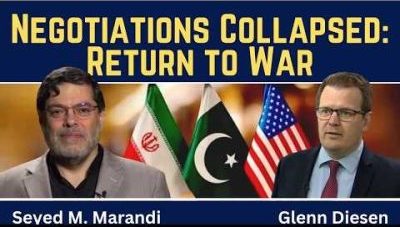
Seyed M. Marandi: Negotiations Collapsed – Return to War
or go to
Aletho News Archives – Video-Images
From the Archives
The US-Iran Scenario That Most Scares Israel
By Ali Haydar | Al-Akhbar | October 9, 2013
Israeli Prime Minister Benjamin Netanyahu issued a series of threats toward Iran and its interlocutors in the West, including the US, as serious negotiations on Iran’s nuclear program seem more plausible.
As a possible rapprochement looms between the US and Iran, Netanyahu has attempted to impose impossible Israeli conditions on the negotiators, such as the full dismantling of Iran’s nuclear program, not to mention threatening military force.
Whatever the deal that could materialize between Iran and the West, Israel is going to find itself before an open-ended path. One can foresee three possible scenarios… continue
Blog Roll
 Aletho News
- Ukraine plans to attack Russian ships with Norwegian support
- US’s ‘Very Foolish’ Double Blockade of Hormuz Strait Makes Absolutely No Sense: Here’s Why
- China issues rules on countermeasures against foreign states’ unlawful extraterritorial jurisdiction
- Seyed M. Marandi: Negotiations Collapsed – Return to War
- Tomorrow’s naval blockade showdown
- ‘Israel’ attacks civilians to hide its embarrassing military failures & out of pure sadism
- Any Foreign Military Vessel Approaching Hormuz Under Any Pretext ‘Will Be Dealt With Severely’: IRGC
- Diplomats slam US negotiators’ performance in Iran talks
- Trump Refuses Exit Ramp, War with Iran will Continue
- Trump Says US Naval Blockade in Strait of Hormuz Will Begin Shortly
- If Americans Knew
- Critical shortages in Gaza, Lebanon in ruins, “piracy” in Iran – Daily Update
- US-Iran ceasefire negotiations make zero progress – Daily Update
- Pro-Israel ‘Thinktanks’ and Individuals who Influence U.S. Foreign Policy
- Mearsheimer reveals how Israel dictates US policies on Iran, Gaza – video
- After killing 350+, Israel still has a “score to settle” with Lebanon before ceasefire – Daily Update
- Military aid to Israel emerges as the latest political litmus test for Democrats
- The only Palestinian children’s rights organization closes following years-long Israeli campaign against it
- ‘I Can’t Forget the Smell’: Lebanese Reel After Israel Kills Over 300 in Single Day
- DNC Shoots Down Resolutions Calling Out AIPAC and Limiting Arms to Israel
- TCN: Is Israel Blackmailing President Trump?
- No Tricks Zone
- Cave Discovery Reveals Today’s Desert Climates Were Recently Far Warmer, Wetter, Teeming With Life
- German Expert: Heat Dome Led To Record Temps In Western USA…Warmer In 1934, 1936
- New Study: No Linear Warming Or Glacier Retreat Along Northern Antarctic Peninsula Since 1980s
- An Inconvenient Tree: Uncovered In Alps… Europe Much Warmer Than Today 6000 Years Ago
- New Study Reports A 60% Slowdown In Greenland’s Ice Loss Rate In The Last Decade
- Low Intensity Tornado Wrecks Major Solar Farm, Creating A Potential Toxic Dump
- New Study Finds Warming Saves Lives…Cold Temperatures 12 Times More Deadly Than Excess Heat
- German Science Blog Accuses PIK Climate Institute Of Hallucinating Climate Tipping Points
- Devastating Assessment Of Comirnaty Vaccine By Former Senior Pfizer Europe Toxicologist
- New Study: CO2 Is ‘Effectively Negligible’ As An Explanatory Climate Change Factor Since 2000
 Aletho News