Zelensky Signs Deal to Buy 100 Fighter Jets From France
By Kyle Anzalone | The Libertarian Institute | November 17, 2025
During a meeting with French President Macron, Ukrainian President Zelensky signed a major weapons deal for Rafale fighters and drones. The warplanes will be delivered over the next decade, and Paris said training Ukrainian pilots will take at least three years.
“One of the most productive visits of this year, and certainly a new step in our strategic partnership with France. We have signed a historic agreement providing for a new fleet of fighter jets for Ukraine: 100 Rafales,” Zelensky wrote on X Tuesday.
He continued, “We will also receive highly effective French radars as well as new SAMP/T air defense systems, designed to precisely counter the types of missiles used against Ukraine. We have also agreed on the supply of air-to-air missiles and guided aerial bombs.”
The letter of intent signed by Zelensky will also see the transfer of drones and anti-drone systems to Ukraine.
Marcon and Zelensky did not provide a timeline on the transfer of the Rafales or who would pay for the weapons. Rafales cost over $100 million per plane. A French official said it would take at least three years to train the Ukrainian pilots.
Zelensky said Paris agreed to provide Kiev with some immediate security assistance. “France is additionally preparing a new package of military aid, which we will receive by the end of the year,” the Ukrainian leader wrote on X.
Zelensky was in France to attend a meeting of the “coalition of the willing.” The group is a bloc of European countries working to fill Kiev’s massive budget deficits. On Monday, European Commission President Ursula von der Leyen sent a letter to the leaders of the European Union’s member states, arguing that it was essential for the bloc to plug Ukraine’s $157 billion budget gap over the next two years.
Part of von der Leyen’s proposal calls for European nations to use frozen Russian assets to fund Ukraine’s war effort. Zelensky said he believed the coalition of the willing would be able to come to an agreement on this issue.
“I believe that in the end we’ll reach an agreement to push this topic to the end and be able to use Russian assets for the European defense package, for Ukrainian production, and for the most part for the air defense systems from the United States of America,” he said.
EU to spread legal costs of attacking Russian assets – Politico
RT | November 17, 2025
The EU has pledged to spread the financial and legal risks of using Russia’s frozen central-bank assets to fund the government in Kiev, Politico reported on Monday. Belgium, where most of the money is held, has rejected the plan without such guarantees.
The European Commission is seeking to issue a €140 billion ($160 billion) loan secured against the immobilized sovereign assets held at the Euroclear clearing house in Belgium. The scheme is based on the assumption that Moscow will eventually pay reparations to Ukraine, an outcome widely seen as unlikely. Russia has said it regards any use of its assets as “theft” and has vowed a legal response.
According to Politico, Commission President Ursula von der Leyen has circulated a memo to EU capitals spelling out how member states would share the risks with Belgium. The document says the bloc is prepared to cover potential legal and financial fallout even if disputes arise years later.
Belgium, which has a bilateral investment treaty with Russia dating back to 1989, has warned it could face lengthy and costly litigation if Moscow mounts a legal challenge. Von der Leyen said the guarantees would also cover obligations stemming from bilateral investment treaties.
Around $200 billion of the roughly $300 billion in Russian sovereign reserves frozen by the West since 2022 are held at Euroclear. The clearinghouse has threatened to sue the EU if the bloc attempts to confiscate the assets.
The memo reportedly also set out two fallback options should governments ultimately decide against using the Russian funds. Both alternatives would require the EU to pony up its own resources to support Kiev, thus shifting the burden onto European taxpayers.
European Commissioner for Economy Valdis Dombrovskis said last week that the bloc cannot continue providing loans to Ukraine in light of growing concerns over Kiev’s ability to repay them.
The Kremlin has warned that channeling Russian funds to Ukraine would “boomerang,” and threatened to target up to €200 billion in Western assets held in Russia in retaliation.
Orban Exposes EU Politicians’ ‘War by 2030’ Talk As Dangerous Confession
Sputnik – 17.11.2025
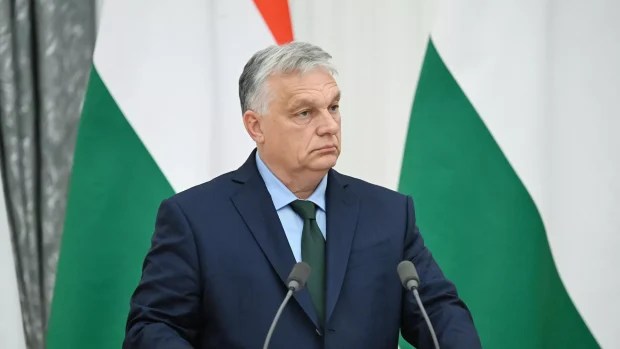
The statements articulated by European politicians about their readiness for war in 2030 indicate that Brussels is openly hatching military plans, Hungarian Prime Minister Viktor Orban said on Monday.
“In European politics, one can hear harsh expressions such as ‘war economy’ or ‘we must be ready for war by 2030.’ Because of this, economic policy is undergoing serious consequences, a war plan is being openly developed in Brussels, documents are being accepted and statements are being made,” Orban told a press conference in Budapest.
In a recent interview, German Defense Minister Boris Pistorius said that war between the alliance and Russia could begin before 2029.
Ukrainian attacks on Russian refineries driving price hikes in the US – Bloomberg
RT | November 16, 2025
Ukrainian strikes on Russian energy facilities are contributing to rising oil prices in the US, Europe, and Asia, Bloomberg reported on Saturday.
The attacks, combined with outages at key plants in Asia and Africa, have removed millions of barrels of diesel and gasoline from the global market, the outlet said. US sanctions on Russian energy giants Lukoil and Rosneft in October, along with restrictions imposed by the EU, have also helped drive prices higher.
Refining margins in the US, Europe, and Asia are now at their highest levels for this time of year since at least 2018, Bloomberg said, citing its own calculations. Additional pressure has come from shutdowns and outages at refineries in Kuwait and Nigeria.
Ukraine has targeted oil depots, processing plants, and metering stations with drones and missiles, calling them legitimate facilities that support Russia’s “war machine.” Russia, in turn, has struck elements of Ukraine’s power grid, saying the infrastructure supports the Ukrainian military.
In August, Hungary imposed sanctions on Ukraine’s top drone commander, Robert Brovdi, after repeated strikes disrupted the flow of crude through the Soviet-era Druzhba pipeline.
Western aid feeding Ukrainian corruption – Italian deputy PM
RT | November 15, 2025
Western assistance to Kiev risks ending up in the pockets of corrupt Ukrainian officials, Italian Deputy Prime Minister Matteo Salvini has warned, citing a major scandal that recently shook Ukraine’s government. He also argued against further military aid, warning that the EU was on “the path of death.”
Salvini spoke as the Italian government approved its 12th package of military support for Ukraine and promised electrical generators for the coming winter. The decision coincided with a major scandal in Kiev over an alleged $100 million energy graft scheme involving Timur Mindich, a close associate and former business partner of Ukraine’s Vladimir Zelensky.
Moscow responded to the news by calling it evidence of a “bloody hydra” of Ukrainian corruption reaching beyond the country’s borders and draining Western taxpayers’ money. Politico also reported on Saturday that the EU was also concerned over “endemic corruption” in Ukraine.
“It seems to me that corruption scandals are emerging, involving the Ukrainian government, so I would not want the money of Italian workers and pensioners to be used to fuel further corruption,” Salvini told reporters in Naples on Friday.
He added that ending the conflict depends on “silencing the weapons” and bringing both Moscow and Kiev to the negotiating table. Salvini also argued that it should be in Kiev’s interest to halt the fighting as soon as possible, pointing to continued Russian gains on the battlefield.
“To think that sending weapons to Ukraine means Ukraine can regain the lost ground is naïve, to say the least,” he said, adding that he did not believe “prolonging this path of death will help anyone.”
Salvini has previously criticized what he sees as escalatory rhetoric from other EU leaders. In August, he responded to French President Emmanuel Macron’s suggestion that EU nations could send troops to Ukraine by saying Macron should go himself. “If Macron wants, he can go – but I think he’ll go alone, because not even one Frenchman would follow him,” Salvini said at the time, prompting a brief diplomatic spat between Rome and Paris.
Nicolai Petro: Ukraine Endgame & Fragmentation of Europe
Glenn Diesen | November 14, 2025
Nicolai N. Petro is a Professor of Political Science at the University of Rhode Island, and formerly the US State Department’s special assistant for policy on the Soviet Union. Prof. Petro discusses the pending end of the Ukraine War and why Europe will likely fragment as a consequence of its proxy war against Russia.
Follow Prof. Glenn Diesen:
Substack: https://glenndiesen.substack.com/
X/Twitter: https://x.com/Glenn_Diesen
Patreon: https://www.patreon.com/glenndiesen
Support the research by Prof. Glenn Diesen:
PayPal: https://www.paypal.com/paypalme/glenndiesen
Buy me a Coffee: buymeacoffee.com/gdieseng
Go Fund Me: https://gofund.me/09ea012f
Books by Prof. Glenn Diesen:
EU’s “Democracy Shield” Centralizes Control Over Online Speech
By Christina Maas | Reclaim The Net | November 13, 2025
European authorities have finally unveiled the “European Democracy Shield,” we’ve been warning about for some time, a major initiative that consolidates and broadens existing programs of the European Commission to monitor and restrict digital information flows.
Though branded as a safeguard against “foreign information manipulation and interference (FIMI)” and “disinformation,” the initiative effectively gives EU institutions unprecedented authority over the online public sphere.
At its core, the framework fuses a variety of mechanisms into a single structure, from AI-driven content detection and regulation of social media influencers to a state-endorsed web of “fact-checkers.”
The presentation speaks of defending democracy, yet the design reveals a machinery oriented toward centralized control of speech, identity, and data.
One of the more alarming integrations links the EU’s Digital Identity program with content filtering and labelling systems.
The Commission has announced plans to “explore possible further measures with the Code’s signatories,” including “detection and labelling of AI-generated and manipulated content circulating on social media services” and “voluntary user-verification tools.”
Officials describe the EU Digital Identity (EUDI) Wallet as a means for “secure identification and authentication.”
In real terms, tying verified identity to online activity risks normalizing surveillance and making anonymity in expression a thing of the past.
The Democracy Shield also includes the creation of a “European Centre for Democratic Resilience,” led by Justice Commissioner Michael McGrath.
Framed as a voluntary coordination hub, its mission is “building capacities to withstand foreign information manipulation and interference (FIMI) and disinformation,” involving EU institutions, Member States, and “neighboring countries and like-minded partners.”
The Centre’s “Stakeholder Platform” is to unite “trusted stakeholders such as civil society organisations, researchers and academia, fact-checkers and media providers.”
In practice, this structure ties policymaking, activism, and media oversight into one cooperative network, eroding the boundaries between government power and public discourse.
Financial incentives reinforce the system. A “European Network of Fact-Checkers” will be funded through EU channels, positioned as independent yet operating within the same institutional framework that sets the rules.
The network will coordinate “fact-checking” in every EU language, maintain a central database of verdicts, and introduce “a protection scheme for fact-checkers in the EU against threats and harassment.”
Such an arrangement destroys the line between independent verification and state-aligned narrative enforcement.
The Commission will also fund a “common research support framework,” giving select researchers privileged access to non-public platform data via the Digital Services Act (DSA) and Political Advertising Regulation.
Officially, this aims to aid academic research, but it could also allow state-linked analysts to map, classify, and suppress online viewpoints deemed undesirable.
Plans extend further into media law. The European Commission intends to revisit the Audiovisual Media Services Directive (AVMSD) to ensure “viewers – particularly younger ones – are adequately protected when they consume audiovisual content online.”
While framed around youth protection, such language opens the door to broad filtering and regulation of online media.
Another initiative seeks to enlist digital personalities through a “voluntary network of influencers to raise awareness about relevant EU rules, including the DSA.” Brussels will “consider the role of influencers” during its upcoming AVMSD review.
Though presented as transparent outreach, the move effectively turns social media figures into de facto promoters of official EU messaging, reshaping public conversation under the guise of awareness.
The Shield also introduces a “Digital Services Act incidents and crisis protocol” between the EU and signatories of the Code of Practice on Disinformation to “facilitate coordination among relevant authorities and ensure swift reactions to large-scale and potentially transnational information operations.”
This could enable coordinated suppression of narratives across borders. Large platforms exceeding 45 million EU users face compliance audits, with penalties reaching 6% of global revenue or even platform bans, making voluntary cooperation more symbolic than real.
A further layer comes with the forthcoming “Blueprint for countering FIMI and disinformation,” offering governments standardized guidance to “anticipate, detect and respond” to perceived information threats. Such protocols risk transforming free expression into a regulated domain managed under preemptive suspicion.
Existing structures are being fortified, too. The European Digital Media Observatory (EDMO), already central to “disinformation” monitoring, will receive expanded authority for election and crisis surveillance. This effectively deepens the fusion of state oversight and online communication control.
Funding through the “Media Resilience Programme” will channel EU resources to preferred outlets, while regulators examine ways to “strengthen the prominence of media services of general interest.”
This includes “impact investments in the news media sector” and efforts to build transnational platforms promoting mainstream narratives. Though described as supporting “independent and local journalism,” the model risks reinforcing state-aligned voices while sidelining dissenting ones.
Education and culture are not exempt. The Commission plans “Guidelines for teachers and educators on tackling disinformation and promoting digital literacy through education and training,” along with new “media literacy” programs and an “independent network for media literacy.”
While such initiatives appear benign, they often operate on the assumption that government-approved information is inherently trustworthy, conditioning future generations to equate official consensus with truth.
Viewed as a whole, the European Democracy Shield represents a major institutional step toward centralized narrative management in the European Union.
Under the language of “protection,” Brussels is constructing a comprehensive apparatus for monitoring and shaping the flow of information.
For a continent that once defined itself through open debate and free thought, this growing web of bureaucratic control signals a troubling shift.
Efforts framed as defense against disinformation now risk becoming tools for suppressing dissent, a paradox that may leave European democracy less free in the name of making it “safe.”
Censored Lavrov interview with Italian media (FULL TEXT)
RT | November 13, 2025
Liberal Italian outlet Corriere della Sera has refused to publish an exclusive interview with Russian Foreign Minister Sergey Lavrov. The move comes a week after an Italian journalist was fired by his news agency for questioning EU double-standards on Russia and Israel respectively.
In the interview, Lavrov, Russia’s vastly experienced top diplomat, cited a “Russophobia frenzy” in EU media. Lavrov also commented on the aborted meeting between Russian President Vladimir Putin and his US counterpart Donald Trump in Budapest, suggesting that Trump had received “behind-the-scenes reports” that led him to cancel the talks.
Below is the full text of Lavrov’s interview, as published on the Russian MFA website:
Question: It has been reported that Vladimir Putin’s next meeting with Donald Trump in Budapest did not happen because even the US Administration realised that you are not ready for talks on Ukraine. What went wrong after the Anchorage summit that inspired hope for the launch of a genuine peace process? Why does Russia remain adherent to the demands that Vladimir Putin put forward in June 2024 and on what issues сould you make a compromise?
Sergey Lavrov: The understandings reached in Anchorage were an important milestone in the search for a long-term peace in Ukraine through overcoming the consequences of the violent anti-constitutional state coup in Kiev organised by the Obama administration in February 2014. The understandings are based on the existing reality and closely bound to the conditions of a just and lasting resolution of the Ukrainian crisis proposed by President Putin in June 2024. As far as we know, those conditions were heard and received, including publicly, by the Trump administration – mainly the condition that it is unacceptable to drag Ukraine into NATO to create strategic military threats to Russia directly on its borders. Washington also openly admitted that it will not be able to ignore the territorial issue following the referendums in Russia’s five historical regions whose residents unambiguously chose self-determination apart from the Kiev regime that labelled them as “sub-humans,” “creatures,” and “terrorists,” and chose reunification with Russia.
The American concept that, at the US President’s instruction, his Special Envoy Steve Witkoff brought to Moscow the week before the Alaska summit was also built around the issues of security and territorial reality. President Putin told Donald Trump in Anchorage that we agreed to use this concept as a basis while proposing a specific step that opens a way for its practical implementation.
The US leader said that he should consult with his allies; however, after the meeting with his allies that took place in Washington the next day, we did not receive a reaction to our positive response to the proposals that Steve Witkoff delivered to Moscow before Alaska. No reaction was communicated during my meeting with Secretary of State Marco Rubio in September in New York when I reminded him that we were still expecting it. To help our American colleagues decide on their own concept, we set forth the Alaska understandings in a non-paper and delivered it to Washington. Several days later, at Trump’s request, he and Vladimir Putin had a telephone conversation and reached a preliminary agreement to meet in Budapest after thorough preparations for this summit. There was no doubt that they would discuss the understandings in Anchorage. After a few days, I spoke with Marco Rubio over the phone. Washington described the conversation as constructive (it was indeed constructive and useful) and announced that, after that telephone conversation, an in-person meeting between the Secretary of State and the Russian Foreign Minister in preparation for the top-level meeting was unnecessary. Who and how submitted covert reports to the American leader after which he either postponed or cancelled the Budapest summit, I do not know. But I have described the general timeline strictly based on the facts for which I am responsible. I am not going to take responsibility for bluntly fake news about Russia’s lack of readiness for talks or sabotaging the outcomes of the Anchorage meeting. Please speak to The Financial Times that, as far as I know, planted this misleading version of what happened, distorting the sequence of events, to put the blame on Moscow and lead Donald Trump off the road he suggested – a road to a lasting steady peace rather than the immediate ceasefire where Zelensky’s European masters are pulling him, due to their own obsessive intention to get a repose and inject the Nazi regime with more weapons to continue the war against Russia. If even the BBC produced a fake video that featured Trump calling for assaulting the Capitol, The Financial Times is capable of something similar. In Russia, we say, “they would not scruple to tell a lie.” We are still ready to hold another Russia-US summit in Budapest if it is genuinely based on the well-elaborated outcomes of the Alaska summit. The date is not set yet. Russia-US contacts continue.
Question: Units of the Russian Armed Forces are currently controlling less territory than in 2022, several weeks into what you call a special military operation. If you are truly prevailing why can’t you deliver a decisive strike? Could you also explain why you are not publicising official losses?
Sergey Lavrov: The special military operation is not a war for territories but an operation to save lives of millions of people who have lived on those territories for centuries and whom the Kiev junta seeks to eradicate – legally, by prohibiting their history, language and culture, and physically, by using Western weapons. Another important goal of the special military operation is to ensure Russia’s security and to undermine the plans of NATO and the EU to create a hostile puppet state at our western borders that, by law and in reality, relies on Nazi ideology. It is not the first time we have stopped fascist and Nazi aggressors. That happened during World War II and it will happen again.
Unlike Westerners who have wiped out entire neighbourhoods, we are sparing people – both civilians and military personnel. Our armed forces are acting extremely responsibly and delivering high-precision strikes exclusively at military targets and associated transport and energy infrastructure.
It is not customary to publicise battlefield losses. I can only say that this year, Russia has transferred over 9,000 bodies of Ukrainian personnel in repatriation. We have received 143 bodies of our fighters from Ukraine. You can come to your own conclusions.
Question: Your appearance at the Anchorage summit in a sweatshirt saying “USSR” raised many questions. Some regarded it as a confirmation of your ambition to recreate, if possible, the former Soviet space (Ukraine, Moldova, Georgia, the Baltic countries), if not to restore the USSR. Was that a coded message or just a joke?
Sergey Lavrov: I am proud of my country where I was born and raised, got a decent education, started and continued my diplomatic career. As is well known, Russia is the successor to the USSR, and in general, our country and civilisation dates back a thousand years. The Novgorod Veche emerged long before the West started playing democracy. By the way, I also have a T-shirt with the national coat of arms of the Russian Empire but it does not mean that we want to restore it. One of our greatest assets, of which we are rightly proud, is the continuity of developing and strengthening our state throughout its great history of uniting and consolidating Russian and all other peoples of the country. President Putin recently highlighted that in his remarks on National Unity Day. So, please do not look for any political signals in this. Maybe the feeling of patriotism and loyalty to one’s Motherland is fading away in the West but to us, it is part of our genetic code.
Question: If one of the goals of the special military operation was to return Ukraine under Russian influence, as, for example, it may seem based on your demand to be able to determine the number of its armaments, don’t you think that the current armed conflict, whatever the outcome, gives Kiev a very specific international role and identity that is increasingly distant from Moscow?
Sergey Lavrov: The goals of the special military operation were determined by President Putin in 2022 and remain relevant to this day. It is not about spheres of influence but about Ukraine’s return to a neutral, non-aligned and non-nuclear status, and strict observance of the human rights and all the rights of the Russian and other national minorities – this is how these obligations were stipulated by Ukraine’s Declaration of Independence of 1990 and in its Constitution, and it was precisely in view of these declared obligations that Russia recognised the independence of the Ukrainian state. We are seeking and we will achieve the return of Ukraine to the healthy and stable origins of its statehood, which implies that Ukraine will no longer subserviently offer its territory to NATO for military development (as well as to the European Union, which is quickly turning into a similarly aggressive military bloc), sweep out the Nazi ideology prohibited in Nuremberg, return of all their rights to the Russians, Hungarians and other national minorities. It is indicative that, while dragging the Kiev regime into the EU, the Brussels elites remain silent about the outrageous discrimination of “non-indigenous ethnicities” (as Kiev contemptuously calls Russians who have lived in Ukraine for centuries) and praise Zelensky’s junta for defending “European values.” This is just another proof that Nazism is re-surging in Europe. It is something to think about, especially after Germany and Italy together with Japan recently began to vote against the General Assembly’s annual resolution on the unacceptability of glorifying Nazism.
Western governments do not hide the fact that in reality, they are waging a proxy war against Russia through Ukraine and this war will not be finished even “after the current crisis.” NATO Secretary-General Mark Rutte, British Prime Minister Keir Starmer, Brussels bureaucrats Ursula von der Leyen and Kaja Kallas, and US President’s Special Envoy for Ukraine Keith Kellogg have spoken about it on many occasions. It is evident that Russia’s determination to protect itself from the threats created by the West using the regime under its control, is legitimate and reasonable.
Question: The US also supplies weapons to Ukraine, and there was a recent discussion on the possibility of delivering Tomahawk cruise missiles to Kiev. Why do you hold different views and assessments of the US’ and Europe’s policy?
Sergey Lavrov: Most of the European capitals currently make up the core of the so called “coalition of the willing” whose sole desire is to keep hostilities in Ukraine running for as long as possible. Apparently, they have no other way of distracting their voters from sharply deteriorating domestic socioeconomic problems. They sponsor the terrorist regime in Kiev using European taxpayers’ money and supply weapons which are used as part of a consistent effort to kill civilians in Russian regions and Ukrainians who are trying to flee the war and the Nazi henchmen. They undermine any peace efforts and refuse to have direct contacts with Moscow; they impose more and more sanctions that have a boomerang effect on their economies; they are openly preparing Europe for a new big war against Russia and are trying to talk Washington into rejecting an honest and fair settlement.
Their key objective is to compromise the position of the current US administration that has from the outset advocated dialogue, looked into Russia’s position and showed willingness to seek a lasting peace. Donald Trump repeatedly said in public that one of the reasons for Russia’s action was NATO’s expansion and the advancement of the alliance’s infrastructure to our country’s borders. That is what President Putin and Russia have been warning against for the past twenty years. We hope that common sense prevails in Washington, that it will hold onto its principled position, and will refrain from actions which can propel the conflict to the next level of escalation.
With all that in view, whether the weapons are coming from Europe or the US makes no difference for our military, and they immediately destroy all military targets.
Question: You were the one who pressed the “reset” button together with Hillary Clinton, even if the events then took a different turn. Can relations with Europe be reset? Can common security serve as a platform for improving the current relations?
Sergey Lavrov: The confrontation which has arisen from the European elites’ thoughtless and stillborn policy is not Russia’s choice. The present situation does not meet our people’s interests. We would like to see the awareness of such a disastrous policy sink in with European governments most of whom are pursuing a rabid anti-Russia agenda. Europe already waged wars [against us] under Napoleon’s flags, and last century also under the Hitler’s Nazi banners and colours. Some European leaders have a very short memory. When this Russophobic obsession – I am at a loss for a better phrase for that – fades away, we will be open for contacts, ready to hear if our former partners are going to do business with us further. And then we will decide if there are prospects for building fair and honest ties.
The West’s efforts have totally discredited and dismantled the Euro-Atlantic security system in its pre-2022 form. In that regard, President Putin came up with an initiative to set up a new architecture of equal and indivisible security in Eurasia. It is open for all the nations of the continent including its European part, but it requires polite behaviour devoid of neo-colonial arrogance, on the basis of equality, mutual respect and balance of interests.
Question: The armed conflict in Ukraine and the subsequent international isolation of Russia might have made it impossible for you to act more effectively in other crisis areas, such as the Middle East. Is that so?
Sergey Lavrov: If the “historical West” decided to fence itself off from someone, it is called self-isolation. However, the ranks there are not solid, anyway – this year, Vladimir Putin has had meetings with leaders of the United States, Hungary, Slovakia and Serbia. Clearly, today’s world cannot be reduced to the Western minority. That is an age gone by since multipolarity emerged. Our relations with the Global South and Global East nations – which make up 85 percent of the Earth’s population – keep progressing. In September, the Russian President paid a state visit to China. In the past few months alone, Vladimir Putin took part in the SCO, BRICS, CIS, and Russia-Central Asia summits, whereas our high-level government delegations attended the APEC and ASEAN summits and are now preparing for the G20 summit. Summits and ministerial meetings in the Russia – Africa and Russia – Gulf Cooperation Council formats are held regularly. The Global Majority countries are guided by their core national interests rather than instructions from their former colonial powers.
Our Arab friends appreciate Russia’s constructive participation in settling regional conflicts in the Middle East. Ongoing discussions at the UN on the Palestine problem confirm that capabilities of all influential external actors must be pooled together, otherwise nothing lasting will come out save for colourful ceremonies. We also share close or convergent positions with our Middle East friends which facilitates our interaction at the UN and within other multilateral platforms.
Question: Do you not think that in the new multipolar world order that you promote and support, Russia has become more dependent on China economically and militarily, which created an imbalance in your historical alliance with Beijing?
Sergey Lavrov: We do not “promote” a multipolar world order as its emergence results from an objective process. Instead of conquest, enslavement, subjugation or exploitation, which was how the colonial powers built their order and went on to bring about capitalism, this process implies cooperation, taking into account each other’s interests, and ensuring the smart division of labour based on the comparative competitive advantages of the participating countries and integration structures.
As for Russia-China relations, this is not an alliance in the traditional sense of the word, but rather an effective and advanced form of interaction. Our cooperation does not imply creating any blocs and does not target any third countries. It is quite common for Cold War-era alliances to consist of those who lead and those who are led, but these categories are irrelevant in our case. Therefore, speculating about any kind of imbalance would be inappropriate.
Moscow and Beijing have built their ties on an equal footing and made them self-sufficient. They did so based on their mutual trust and support, which are rooted in many centuries of neighbourly relations. Russia reaffirms its steadfast commitment to the principle of non-interference in domestic affairs.
Russia-China cooperation in trade, investment, and technology has benefited both countries and fosters steady and sustainable economic growth, while also improving the wellbeing of our people. As for the close military-to-military ties, they ensure that we complement each other, enabling our countries to assert their national interests in terms of global security and strategic stability while also effectively countering conventional and new challenges and threats.
Question: Italy carries the label of an unfriendly country, as you have said so many times, including in November 2024. You made a special point about it. However, in recent months the Italian government has been demonstrating its solidarity with the US administration, even on the Ukraine topic, while Vladimir Putin used the word partner to refer to the United States, even if he did not go as far as call it an ally. Considering the appointment of a new ambassador to Moscow, there are reasons to believe that Rome is seeking some kind of a rapprochement. How would you assess the level of our bilateral relations?
Sergey Lavrov: For Russia, there are no unfriendly nations or people, but there are countries with unfriendly governments. And since this is the case for Rome, the relations between Russia and Italy are going through the most serious crisis in post-war history. We were not the ones who got the ball rolling. The ease and swiftness with which Italy joined those who placed their bets on inflicting what they called a strategic defeat on Russia, and the fact that Italy’s actions run counter to its national interests, really surprised us. So far, we have not seen any meaningful moves to change this aggressive approach. Rome persists in providing its all-round support to the neo-Nazis in Kiev. Its resolute effort to sever all cultural ties and civil society contacts is equally perplexing. The Italian authorities have been cancelling performances by outstanding Russian orchestra conductors and opera singers, and have been refusing to authorise the Verona Dialogue on Eurasian cooperation for several years now, despite the fact that it was established in Italy. Italians have a reputation of art lovers who are open to promoting people-to-people ties, but these actions seem quite unnatural for them.
At the same time, there are quite a few people in Italy who are seeking to get to the bottom of what caused the Ukrainian tragedy. For example, Eliseo Bertolasi, a prominent Italian civil activist, presented documentary evidence of the way in which the authorities in Kiev have been violating international law in his book The Conflict in Ukraine Through the Eyes of an Italian Journalist. I would like to recommend you that you read this book. In fact, finding truth about Ukraine in Europe has been quite a daunting task these days.
The people of both Russia and Italy stand to benefit from equal and mutually beneficial cooperation between our two countries. If Rome is ready to move towards restoring dialogue based on mutual trust and taking into consideration each other’s interests, they must send us a signal since we are always ready to hear what you have to say, including your ambassador.
AfD Leader Slams EU Plans to Create New Intelligence Unit as Move to Concentrate Power
Sputnik – 13.11.2025
The creation of a new intelligence unit led personally by European Commission President Ursula von der Leyen will not improve the security of EU citizens, but only strengthen Brussels’ control over the bloc, Alice Weidel, co-chair of the right-wing Alternative for Germany (AfD) party, said on Thursday.
Earlier this week, the Financial Times newspaper reported that the EU Commission would establish a new intelligence unit led by von der Leyen to enhance the use of data collected by national intelligence agencies due to security concerns and a potential reduction in US security support for Europe.
“Von der Leyen plans [to create] her own EU intelligence service. This will not improve the security of citizens, but will expand surveillance and the power of the Brussels bureaucracy. Another dangerous step towards an EU superstate. Not with the AfD!” Weidel wrote on X.
The unit plans to recruit officials from across the EU’s intelligence community to consolidate and share intelligence for joint purposes, the newspaper reported. However, the plan has not yet been officially communicated to all EU member states, and no specific deadlines have been set, according to the report.
The move faces opposition from senior officials in the EU’s diplomatic service, who manage the bloc’s Intelligence and Situation Centre (Intcen), the report said. They argue that the new unit could duplicate Intcen’s functions and threaten its future.
Harald Vilimsky, EU lawmaker from the right-wing Freedom Party of Austria (FPO), has said that the plan to create a separate intelligence analysis unit within the Secretariat-General of the European Commission is the next step in von der Leyen’s plan to concentrate power in Brussels’ hands. Instead of strengthening democratic control, she wants to create a shadow structure that places national intelligence agencies under Brussels’ supervision without any mandate, transparency or legitimacy, he added.
COP 30 Is A Failure… “Only Europe Remains Committed”
By Prof. Fritz Vahrenholt | No Tricks Zone | November 12, 2025
Cooling trend continues
The global temperature did not change in October compared to August. The cooling trend remains intact. The American National Oceanic and Atmospheric Administration (NOAA) foresees a cool LA NINA developing in the Pacific this winter, which will lead to a further decline in global temperatures as well.
Belém – All that fuss for nothing
The 30th World Climate Conference in Belém is not yet over, but it is already becoming apparent that the event, announced as the “Conference of Truth,” will go down in the history of climate conferences as a turning point.
No head of state from the four largest CO2-emitting nations—China (33%), the USA (12%), India (8%), and Russia (5%)—is showing up in Belém.
Even before the conference, the New York Times headlined: “The whole world is fed up with climate policy.” And the fact that Bill Gates, one of the biggest supporters and sponsors of climate policy, explicitly warned against excessive, shortsighted climate policy just 14 days before the conference, and put prosperity back in focus — a major blow.
Glenn Beck, a prominent American television host, explains the change of heart by Bill Gates: “It’s not about science, it’s about Trump.” Expressed differently: it’s not about conviction; it’s about damage control for his own company, which is planning multibillion-dollar investments in data centers in the USA and globally. And given the situation, these will have to rely on electricity from new gas-fired power plants in the short term, as the reactivation of old nuclear power plants will not suffice, and the construction of new nuclear power plants will still take several years in the USA.
Only 1/3 of the states actually submit a plan
For the Climate Conference in Belém, states had to report on their future plans for the use of coal, oil, and gas. The fact that only one-third even submitted a statement already hints at the dissolving importance of the climate issue in most nations around the world. But the reports that were submitted are revealing. Most states reported continuously increasing use of coal, oil, and gas. The reports show an increase in global coal usage by 30%, oil by 25%, and gas by 40% by 2030 compared to 2015. The Intergovernmental Panel on Climate Change (IPCC) hoped to reduce global CO2 emissions by 45% by 2030 compared to 2015; now they are continuing to rise.
Only Europe onboard
Only Europe remains unshakably committed to the goal of achieving Net Zero CO2 emissions by 2050. Germany, the industrial heart of Europe, is even more ambitious and, according to Axel Bojanowski, is “the ‘leader’ among industrialized countries: It aims to be climate-neutral by 2045 – a self-destructive plan: Germany’s reduction will inevitably be compensated by rising emissions in other EU countries. This is because the European Emissions Trading System ensures that emission allowances not used in Germany are consumed in other EU countries.
It is becoming increasingly clear what the Wall Street Journal meant when it called Germany’s energy policy the ‘dumbest in the world.’
A few days before the conference, the European states agreed on a common goal, namely to achieve a 90% CO2 reduction by 2040 compared to 1990. 5% of the self-commitment could come from emission reductions abroad, which, of course, must also be expensively paid for. The German Minister for the Environment celebrated this agreement as “good news for the German economy, as everyone would now have the same competitive conditions.”
This statement reveals how little the German federal government and its ministers understand the global economy. As if German industry only exports goods to European countries. German goods, however, compete in a global market that does not have the burdens of CO2 taxes and high energy prices on German products and can therefore always offer them more cheaply. 50% of exports go to countries outside the EU.
Chancellor Merz and his Environment Minister Schneider are blatantly downplaying the German situation. Germany has set self-imposed shackles with the Climate Protection Act that will become highly painful in the coming years.
German climate policy: “script for an economic catastrophe”
Welt journalist Axel Bojanowski: “The German Climate Protection Act, cemented by the Federal Constitutional Court, seems to be a script for an economic catastrophe. It only allows Germany a remaining budget of 6.7 gigatonnes of CO2, which is likely to be used up by the early 2030s. According to the law, penalties, shutdowns, and restrictions on freedom are then threatened to meet the climate goals.”
6.7 gigatonnes was the remaining permissible budget after the ruling of the Federal Constitutional Court from 2020 onwards. As of today, only 3.6 gigatonnes of this remain. The buffer is reduced by about 0.5 gigatonnes each year. By 2032 at the latest, the remaining budget will be exhausted, and Germany will have reached the end of the line set by the Federal Constitutional Court. This will happen in the next legislative period, not just in 2040.
Chancellor Merz whitewashes
And in his 5-minute speech in Belém before a half-empty hall, Chancellor Merz spreads negligent whitewashing: “The economy is not the problem. Our economy is the key to protecting our climate even better.” Does the Chancellor not know the perilous state our industry is in?
Scandal surrounds tropical forest Ffund (TFF)
Probably the only outcome of the Belém conference will be the establishment of an investment fund, proposed by Brazilian President Lula, to finance the protection of tropical forests.
The fund works as follows: Donor countries pay $25 billion into the fund. Private investors (investment funds) are supposed to pay in $100 billion. The donor countries receive a return of about 4.0-4.8%, which corresponds to the return on their government bonds, as they generally have to raise the money through government debt. The return for private investors is 5.8% to 7.2%. The fund’s money is invested in emerging market government bonds, which yield comparatively high interest due to the higher risk (Brazilian government bonds are currently at 12.25%). Private investors are served first, followed by the donor countries. If anything remains after the distribution of profits to private investors and donor countries, the amount is paid out to 74 countries with tropical forests. It is hoped that this way, $3-4 billion will be distributed annually to the tropical forest countries.
The catch is this: To entice investors, private investors are given preference in the payment sequence: first the private ones, then the donor states. Furthermore, the donor countries must insure the fund against default. A default by an emerging market could quickly lead to the fund’s insolvency. In that case, the taxpayers of the donor countries would be held liable and, in an extreme scenario, lose their capital.
Disadvantageous for the German taxpayer
In preparation for Belém, there was fundamental disagreement over Germany’s participation in the fund between the Ministry of Finance and the Chancellor’s Office. The Chancellor’s Office clearly advocated for participation and a contribution of at least $1 billion. It was assisted by the Ministry for the Environment under Minister Schneider and the Ministry for Economic Cooperation and Development under Minister Alabali-Radovan. The Ministry of Finance, under Lars Klingbeil, strongly objected, viewing the fund as a billion-dollar risk and doubting the viability of the fund’s structure.
And indeed, the model is structurally disadvantageous for the German taxpayer. One could also say: We are subsidizing the returns of private investors with public money and providing the default guarantee for BlackRock and Co. That is why the Federal Ministry of Finance is persistently blocking Germany’s participation in the fund. It can be unequivocally stated that the Federal Ministry of Finance has thus far bravely defended the interests of the German taxpayer against the interests of BlackRock and Co.
This is the background to Chancellor Merz being unable to name a figure (“a noteworthy amount”) in Belém. The billion € or $ is now supposed to be found in the budget reconciliation for the 2026 federal budget, which is taking place this week, so that the federal budget can be adopted on November 28. It is to be expected that the SPD will concede. But it could be a Pyrrhic victory for Chancellor Merz, who would then visibly be prioritizing the interests of international financial investors, especially if the fund were to run into difficulties.
Whether the fund will ultimately materialize is still questionable, as it only comes into effect if the donor states commit to $10 billion. So far (excluding Germany), $5.6 billion has been raised.
The USA and the UK have already declined.
If the fund comes into being, the investment companies will profit first, with high returns secured by states, and then the emerging markets, which can sell their high-risk government bonds. Whether the tropical forest will benefit in this confusing financial jungle is not yet certain. The biggest risk remains with the donor countries, who are putting their taxpayers’ money at risk with the catchy story of saving the rainforest.”
West-Russia war becoming inevitable – Serbian president
RT | November 12, 2025
A direct military confrontation between Western nations and Russia is becoming unavoidable, Serbian President Aleksandar Vucic has warned, citing widespread rearmament efforts across Europe.
Speaking during a televised interview on Tuesday, Vucic said the possibility of such a war is no longer hypothetical, pointing to an acceleration of military spending. The European Union seeks rapid militarization over a perceived threat from Russia, which Moscow has dismissed as misleading political rhetoric aimed at distracting from internal economic troubles.
“My conclusion is that there is a growing certainty that a war between Europe and Russia will happen,” Vucic said. “They are preparing for war – or for defense, as they call it. Romania, Poland, Finland, smaller countries too. And the Russians as well.”
“Everyone is preparing,” the president continued. “What can come from that? Only conflict.” He added that Serbia itself is caught “between a rock and a hard place,” and therefore must also strengthen its military readiness.
Although Serbia continues to pursue EU membership, its application has effectively been frozen due to Belgrade’s refusal to adopt sanctions and other measures targeting Moscow. The two nations maintain deep cultural and historical ties, and Russia remains one of Serbia’s key energy suppliers.
Moscow has repeatedly accused NATO and the EU of provoking instability in Europe through continued expansion and by ignoring Russian proposals for a shared continental security architecture, which it says could have prevented the current confrontation over Ukraine.
Matthew Hoh: Domestic Divisions Threaten the US Empire
Glenn Diesen | November 11, 2025
Matthew Hoh is a former U.S. Marine Officer and State Department Official. Hoh discusses the growing divisions within the US, which threaten the US empire.
Follow Prof. Glenn Diesen: Substack: https://glenndiesen.substack.com/
X/Twitter: https://x.com/Glenn_Diesen
Patreon:  / glenndiesen
Support the research by Prof. Glenn Diesen: PayPal: https://www.paypal.com/paypalme/glenn…
Buy me a Coffee: buymeacoffee.com/gdieseng Go Fund Me: https://gofund.me/09ea012f
Books by Prof. Glenn Diesen: https://www.amazon.com/stores/author/…
Featured Video
Trita Parsi: Israel Set a Trap for Total War in the Region
or go to
Aletho News Archives – Video-Images
From the Archive
Zionism’s Violent Legacy
By Donald Neff | Washington Report On Middle East Affairs | January 1996
On January 4, 1948, Jewish terrorists drove a truck loaded with explosives into the center of the all Arab city of Jaffa and detonated it, killing 26 and wounding around 100 Palestinian men, women and children.[1] The attack was the work of the Irgun Zvai Leumi – the “National Military Organization,” also known by the Hebrew letters Etzel – the largest Jewish terrorist group in Palestine. The Irgun was headed by Revisionist Zionist Menachem Begin and had been killing and maiming Arabs, Britons and even Jews for the previous ten years in its efforts to establish a Jewish state.
This terror campaign meant that at the core of Revisionist Zionism there existed a philosophical embrace of violence. … continue
Blog Roll
 Aletho News
- Trita Parsi: Israel Set a Trap for Total War in the Region
- Trump’s Iran war is on an Israeli leash
- Saudi oil boss issues global supply warning
- Riyadh Says Its Oil System Is Intact. The Numbers Say Otherwise.
- Trump and Netanyahu Want to “Finish the Job” on Iran
- US ‘one-sided dictation’ not Iran’s beliefs makes rational talks impossible: Baghaei
- Iran’s Next Strike May Not Explode. It Could Shut You Down /Col Doug Macgregor
- Iran: US political targets legitimate if assassinations return
- Iraq shuts key border crossing with Iran under US pressure: Report
- Undersea Internet cables could be targeted in retaliation for attacks on Iran: IRGC deputy chief
- If Americans Knew
- The Israel Lobby’s Changing Fortunes
- AIPAC has become such a political liability that it’s shifting to a more “nimble” approach to buying politicians
- At least 160 Israeli settler attacks in 2 weeks
- Will Gaza’s Ancient Christian Community Disappear Forever?
- Israel’s vision of regional security rests on keeping Arab states weak
- Heidi Levine recounts how Palestinian youths helped save her in settler attack
- DAILY UPDATE: Latest essential news on Palestine, Israel, & region
- Trump’s Intensifying Sabotage of the ICC, for Israel’s Sake
- Israeli military detain US and UK volunteers in West Bank including Democratic NY politician Brad Lander
- Americans at National Conservatism Conference held in Israel this year criticize Israel
- No Tricks Zone
- E-Cars Reduce CO2 Emissions By Only 41% Compared To Internal Combustion Engine Vehicles
- Predictions Made By Renowned Climate Professor Over Past Decades Have Been Proven To Be Poor
- New Study Suggests Large Regions Of The Pacific Ocean Have Been Cooling For The Last 80 Years
- Germany’s Green Energy Debacle: High Energy Costs Force Kahla Porzellan to Close After 182 Years!
- New Study: 50 Years Of The Most Aggressive ‘Net Zero’ Policies Can Only Affect The Global Climate By 0.03°C
- US September “Heat” Was No Record…Many Records Set Decades Ago
- Latest European Green Energy Debacle; Portugal’s Largest Flagship Solar Park Insolvent!
- Green Energy Debacle: German Expert Professor Fritz Vahrenholt Warns Of Severe Economic And Social Consequences
- Two More Paleo Reconstructions Affirm Meters-Higher Sea Levels Across Ireland, Brazil 7000-6000 Years Ago
- New Study: Earth And Venus Surface Warmth Largely Explained By Convection And Lapse Rate, Not CO2 Or Radiation

