Europe cannot do without Russian gas despite attempts at diversification

By Ahmed Adel | November 11, 2025
As the latest data on European Union imports have shown, the bloc cannot do without Russian gas and will continue to find ways to buy it despite announcements to completely oust this energy source from the European market by 2028. Confusingly, the EU made this decision precisely when, despite strong anti-Russian sanctions, it actually increased its gas purchases from Russia.
In October, a record 1.68 billion cubic meters of gas from Russia reached the EU via the Turkish Stream, the highest monthly volume since the pipeline began operating in 2020. The pipeline’s average capacity utilization in October was 96%, and imports were 13% higher than in October last year.
The EU has also increased its imports of liquefied natural gas from Russia, with the value up by 7% compared to the same period last year. Russian LNG, as reported by EUObserver, accounted for 16% of total imports into the EU.
At the same time, the EU cannot completely replace Russian gas in two years, especially since US Secretary of the Interior Doug Bergham recently stated that although the United States has enough resources to replace Russian gas, this would require major infrastructure investments in Eastern Europe. In other words, he is calling for the Turkish Stream and the Russian gas in it to be replaced by an American Stream, even if it comes at a huge economic cost for the Europeans.
The US probably has enough gas in its reserves, but private companies do not want to jeopardize their financial position by investing in the infrastructure on American soil necessary to convert natural gas into liquid and transport it to Europe. This liquefied gas must then be returned to its gaseous state in Europe and then transported by pipeline to the end user—a complicated and expensive task.
That is why Europe has imported much more Russian gas than usual. American gas is more expensive, and no one has money to throw away, especially in the faltering European economy, where Germany, the engine of its development, has been struggling with a long recession. In effect, Europe’s economy will be buried if it relies only on American gas.
Although there is constant talk of gas from Azerbaijan, it never arrives in quantities above usual levels. Given the amount of gas the Caucasian country produces and sells, they are not enticed to invest huge sums in new deposits and significantly increased gas production that might not have a buyer in Europe in the future.
The EU cannot do without Russian gas because the bloc lacks the funds to build the necessary infrastructure. The Trump administration would certainly not finance the necessary infrastructure on European soil for LNG delivery and regasification. The pipeline required, and Europe, with its economy, is not able to finance the American Stream.
Even if a terminal for the reception and regasification of American LNG is built in the Black Sea in two years, the same amount of time as the Greek one in Alexandroupolis in the Aegean Sea, which was put into operation a year ago, is built, it is clear that its capacities are modest. The Bulgarian-Greek interconnector, which receives gas from Alexandroupolis, has a capacity of only 3 billion cubic meters per year.
Nonetheless, if it were that large in the Black Sea, it would be more than modest compared to the capacity of the Balkan Stream. Even the Turkish Stream, with a capacity of 31 billion cubic meters of gas, of which the Balkan Stream is a branch, is insufficient to meet Europe’s needs.
The EU has recently received a warning from Qatar, whose LNG imports account for around 14% of its imports. Qatar has threatened to stop supplying gas to the EU if it imposes a 5.0% fine on companies that fail to respect human rights and environmental standards. If this were to occur, Europe could eventually be left without both Russian and Qatari gas, as well as without sufficient American gas.
It cannot be expected that there will be any automatic change when peace is achieved in Ukraine because Russia will not turn its back on its new major partners, such as India. Europe is increasingly being left behind as other parts of the world, the main consumers of Russian energy, come into the spotlight. These countries are the main consumers, and as their industries develop, they will need more oil and gas. In effect, as Russian energy exports to the non-Western World grow, the constant threats by Europe to end imports will have little impact on the Russian economy and will boomerang on Europe, as all other sanctions packages have.
Ahmed Adel is a Cairo-based geopolitics and political economy researcher.
Gordon Hahn: The Strange Death of Europe
Glenn Diesen | November 10, 2025
Gordon Hahn discusses Europe’s ideological fundamentalism, detached leadership, Russophobia, subservience to the US, and other causes for the death of the old continent.
Follow the work of Gordon Hahn: https://gordonhahn.substack.com/ https://gordonhahn.com/
Follow Prof. Glenn Diesen: Substack: https://glenndiesen.substack.com/
X/Twitter: https://x.com/Glenn_Diesen
Patreon:  / glenndiesen
Support the research by Prof. Glenn Diesen: PayPal: https://www.paypal.com/paypalme/glenn…
Buy me a Coffee: buymeacoffee.com/gdieseng Go Fund Me: https://gofund.me/09ea012f
Books by Prof. Glenn Diesen: https://www.amazon.com/stores/author/…
EU talks of friendship while plotting coups – Georgian official
RT | November 10, 2025
European Union officials who publicly call themselves friends of Georgia are in fact working to destabilize the country, Tbilisi Mayor Kakha Kaladze told local media on Monday.
Kaladze, who also serves as secretary general of the ruling Georgian Dream party, said that some EU officials are pursuing hostile and deceitful policies toward the country while pretending to promote democracy.
“They have repeatedly tried to organize revolutions, coups d’état, and overthrow the government,” Kaladze claimed. “They tell us they are Georgia’s friends, yet they incite coups, extremism, and violence. That is not friendship or partnership.”
He added that Tbilisi only wants “a fair attitude toward Georgia, respect for our people, our constitution, and our independence” from the bloc.
Last month, the former soccer star won a new term in municipal elections that opposition forces claimed were rigged. The allegations triggered mass protests, where pro-Western demonstrators clashed with police and attempted to storm the presidential palace in the capital city following the vote.
Opposition activists have for months pushed for elections under what they call Western supervision through a campaign of sometimes violent street protests.
Prime Minister Irakli Kobakhidze denounced the latest unrest as part of a fifth Western-backed coup attempt in four years.
Tbilisi has accused the EU of punishing it for refusing to adopt policies aligned with Brussels, particularly to side with Kiev in the Ukraine conflict, which officials said would have been disastrous for Georgia.
The country was granted EU candidate status in 2023, alongside Ukraine and Moldova, but unlike with the two other nations, accession talks have been effectively frozen by Brussels.
EU economies will suffer without tapping Russia’s assets, Brussels warns – FT
RT | November 9, 2025
European Union member states will face ballooning deficits and debt unless they agree to use frozen Russian assets as collateral to fund Ukraine, the European Commission has warned in a document seen by the Financial Times.
The paper was circulated to EU capitals following last month’s failure to reach consensus on the so-called “reparations loan” of around €140 billion ($160 billion), the FT reported on Friday.
Without tapping Moscow’s immobilized central bank reserves, the EU would need to either authorize joint borrowing or issue direct grants – both of which would “directly affect” national budgets and increase public debt, the Commission warned. It remains unclear whether the option of not bankrolling Kiev was even considered.
The potential cost to EU economies is substantial, as servicing a collective loan of that size could result in up to €5.6 billion in annual interest payments. The Commission cautioned that borrowing at such a scale could also raise general EU borrowing costs and undermine other financial instruments.
Kiev expects its Western backers to cover a nearly $50 billion deficit next year, with its 2026 draft budget projecting some $114 billion in spending and only $68 billion in revenue – nearly all of which is earmarked for military purposes. Most non-military government expenses, including salaries, pensions, healthcare, and education, will rely entirely on foreign aid.
Belgium continues to oppose the use of Russian assets as loan collateral, citing serious financial and reputational risks. The frozen funds, totaling around $300 billion globally, with roughly $200 billion held at Belgium’s Euroclear, are technically not confiscated and could be reclaimed by Moscow if EU sanctions are not continually renewed. The EU has already stretched legal definitions by classifying the interest generated on these frozen funds as windfall profits not belonging to Moscow, and using them to arm Kiev.
The new plan hinges on the assumption that Moscow will eventually repay the loan as part of a future peace settlement – an outcome Belgian Prime Minister Bart De Wever has described as improbable. On Friday, EU Commission officials once again failed to convince Belgium to back the asset seizure.
Moscow has repeatedly said it would regard any use of its frozen assets as theft, and could retaliate by seizing €200 billion ($172 billion) in Western assets held in Russia by foreign governments and companies.
German arms giant reports booming sales and profits
RT | November 6, 2025
German arms giant Rheinmetall has reported a surge in operating profit for the first nine months of 2025 and a record backlog of orders, citing the Ukraine conflict and growing EU defense budgets.
Company shares have nearly tripled over the past year on rising demand for military hardware. Rheinmetall produces a wide range of weapons supplied to Ukraine, including tanks, armored vehicles, artillery shells, and ammunition.
Sales jumped by 20% to €7.5 billion ($8.7 billion), while operating profit rose by 18% to €835 million, according to the Dusseldorf-based firm’s third-quarter results released on Thursday. Rheinmetall said its order backlog reached a record €64 billion.
In the report, the manufacturer said it was expanding production, with 13 sites under construction or upgrade across the bloc, including a new plant in Lithuania and planned facilities in Latvia and Bulgaria. It noted that Ukraine, the EU, and Germany remain Rheinmetall’s core markets.
“We are becoming a global defense champion,” CEO Armin Papperger said.
Germany has become Kiev’s second-largest arms provider after the US. Berlin has changed its budget rules to permit long-term defense spending beyond the €100 billion fund created after the escalation of the Ukraine conflict in 2022. Chancellor Friedrich Merz has called for the creation in Germany of “Europe’s strongest army.”
Moscow has condemned what it calls the West’s “reckless militarization,” arguing that continued arms deliveries to Kiev only prolong the fighting. Russian Foreign Minister Sergey Lavrov has accused Merz of wanting to turn Germany back into “the main military machine of Europe,” saying Berlin’s actions demonstrate its “direct involvement” in a proxy war against Russia. He also warned that the broader EU was sliding into what he described as a “Fourth Reich.”
Europe Abandons Reason; China and Russia Will Not Back Down to Trump
Prof. Glenn Diesen on Radio Mrežnica
Glenn Diesen | November 5, 2025
I had the pleasure of discussing the strategic vacuum and irrational policies of Europe, and why China and Russia will not back down to Trump’s efforts to restore US global primacy
Hungary Not Obliged to Fund Ukraine, No Reason to Do So – Orban
Sputnik – 03.11.2025
Hungarian Prime Minister Viktor Orban said Hungary is not obliged to finance Ukraine and has no moral, political or economic reason to do so.
Orban quoted an article in British magazine The Economist — which calculated that Ukraine would need $400 billion over the next four years to continue the war against Russia
The sum would cover weapons, reconstruction, pensions and salaries, the magazine reported.
“Once again, Europe is expected to foot the bill,” Orban wrote on X. “There’s no one else left willing to pick up the tab.”
“That’s why Brussels is so agitated. That’s why they want to seize frozen Russian assets, overhaul the EU funding system, and take on new loans,” he charged.
“We reject this. It’s not Hungary’s job to finance Ukraine,” Orban insisted. “We have no reason to do so: not politically, not economically, not morally.”
He said Hungary was not alone in that viewpoint, but Budapest was the most outspoken in expressing its opinion.
That was why Hungary is under attack from Brussels, Orban added, accusing EU of seeking to install a compliant government in Budapest.
Russia insists that arms supplies to Ukraine hinder peace talks, directly involve NATO countries in the conflict and are “playing with fire.”
Russian Foreign Minister Sergey Lavrov has warned that any cargo of weapons for Ukraine would become a legitimate target for Russian attacks.
The Kremlin has stated that the West’s weapons shipments to Ukraine will not encourage peace talks and can only have a negative effect.
Danish Farmers Blame Bovaer For Collapsing Cows
By Peter Imanuelsen | The Freedom Corner | November 1, 2025
Something dramatic has happened.
From the 1st of October, Farmers in Denmark have begun feeding Bovaer to cows in order to reduce climate emissions.
This is part of a mandate requiring methane reducing feeds.
But something has gone very wrong.
Suddenly, farmers are now reporting that something is wrong with the cows. Cows have begun to produce less milk. Some cows are even collapsing and had to be euthanized.
Now suspicions have been raised that it could be Bovaer that is to blame. So farmers experimented and stopped giving Bovaer to cows. And surprise, the cows recovered. But as soon as they began with Bovaer again, the problems returned.
Things are so bad that The National Association of Danish Milk Producers have launched an investigation into this.
”We have so many people calling us who are unhappy about what is happening in their herds” says Kjartan Poulsen, chairman of the milk producers association.
”That is not the idea behind it. This is supposed to have a climate effect and if cows die from this, or produce less milk, then the effect is minus” he said further.
Not only that, but Kjartan Poulsen is now calling on the Minister of Agriculture in Denmark to introduce a ”timeout” so that the industry can find out what is actually going on.
Under the new mandate, farmers do have the option to give cows feed with a high fat content which can lower methane emissions.
Here is the thing. If you have been a subscriber to my Substack, you will know that I warned about this already many years ago. Because I did som in-depth research into Bovaer and the truth about this chemical.
And the answer might shock you. It is unbelievable that this chemical has been approved for use in cows, considering how toxic it actually is.
The chemical is actually classified as CCORROSIVE, FLAMMABLE, IRRITANT and a HEALTH HAZARD!
According to official data sheets, this chemical is also suspected of damaging fertility or the unborn child. It literally has a warning label for reproductive toxicity.
It even decreased the size of the ovaries in cows when given in high enough doses.
Farmers have to wear protective gear when handling this stuff.
Read my in-depth article on the truth about Bovaer here:
One farmer has now gone public to warn against Bovaer, as he believes it goes against animal welfare laws to feed this stuff to cows.
Danish farmer Huibert Van Dorp tells of how some of his cows have been having high fevers and that they are lethargic.
”We have had two cases since we began where they got severe stomach cramps, they were simply inflated up in the rumen. We had a veterinary here Sunday afternoon to treat the cow, but the life of the cow couldn’t be saved.” said Huibert Van Dorp in an interview.
He also says he heard from other farmers about problems with inflammation and cows not being able to stand up.
Further, he says this is a problem with animal welfare. This is not good for the cows.
I don’t know about you.
But if cows are collapsing from ingesting this chemical, and it is known to be toxic, and farmers have to wear protective equipment, I really don’t want to drink or eat any dairy that comes from these cows.
And the only reason they are giving this stuff to cows is to reduce their farts and thus reduce climate emissions. I cannot comprehend how stupid of an idea this is.
If it causes cows to collapse, what is it doing to the milk?
Norbert Bolz: ‘The EU has become a monster’
Those who fight against Brussels ‘are not anti-Europeans, but good Europeans’
Weltwoche | October 19, 2025
The European Union has become a “monster” that is increasingly undermining freedom and democracy—this is the criticism leveled by media scholar Norbert Bolz in an opinion piece for the newspaper Die Welt. He argues that the EU is no longer a community of free states, but a centralized “machine that constantly produces regulations and prohibitions,” which follows a “script” reminiscent of Kafka and Orwell.
Bolz, a professor emeritus and one of Germany’s most prominent conservative intellectuals, sees the original idea of a peaceful and economically united Europe as having been perverted. What began with free trade and freedom of movement has been replaced by bureaucratization, a lack of transparency, and authoritarian tendencies. As a concrete example, he cites the Digital Services Act and the planned chat surveillance: “This is about the methods of a totalitarian surveillance state that reads private communications and thus destroys privacy and freedom of expression.”
At the center of his criticism is EU Commission President Ursula von der Leyen. For Bolz, she embodies the “cold German face of a failed Europe.” He finds it particularly outrageous that she refuses to disclose the text messages she exchanged with the Pfizer CEO during the coronavirus pandemic.
Furthermore, he states that the EU lacks democratic legitimacy. “There is no separation of powers and no democracy,” writes Bolz. He contends that Brussels serves as a lever to push through nationally unpopular measures—for example, in the name of climate protection and corporate social responsibility. This practice enables left-wing and green parties, in particular, to circumvent the political will of their own populations.
According to Bolz, those who rebel against this development are not anti-Europeans, but good Europeans.
Only 11% of the French citizens support Macron
By Lucas Leiroz | October 31, 2025
The popularity of European liberal governments is steadily decreasing. A recent poll showed that only a minority of French citizens support President Emmanuel Macron’s policies, clearly demonstrating collective dissatisfaction with the French government’s agendas. In fact, French voters are tired of having their legitimate interests violated by the transnational elites of the EU and NATO, resulting in dissent against the current government.
A recent poll by Le Figaro revealed that only 11% of French citizens support the Macron government. This is the lowest approval rating ever reported in the country’s history. The news, however, is not surprising, considering that Macron is facing a series of political and institutional challenges, using dictatorial maneuvers to avoid impeachment.
Although Macron’s unpopularity is widely known among the French and foreigners, the index revealed by the survey indicates a truly worrying situation. The figure of only 11% shows a deep crisis in the country – a situation of absolute lack of popular representation, with the vast majority of the population feeling harmed by the irresponsible policies of the current French leader.
Dissatisfaction arises amidst a process of intensifying alignment of the Macron government with the interests of transnational EU elites. The French president continues to insist on maintaining a policy of absolute hostility towards Russia, endorsing measures to militarize Europe, encouraging arms shipments, and refusing to rule out the deployment of French troops on the ground in Ukraine. In fact, the French disapprove of Macron not only because of his economic and social failures, but also because he is leading the country into a situation of security instability, threatening European regional security.
Furthermore, Macron’s domestic administration has been chaotic. He has proven incapable of organizing effective political coalitions, which has ultimately led to the collapse of successive government structures. Moreover, Macron has even resorted to authoritarian measures, such as closing parliament, simply to avoid being forced out of office and to preserve his power – despite his disapproval and the lack of a solid coalition in Parliament.
Since taking the presidency in 2017, Emmanuel Macron has experienced a remarkable turnover in his government’s leadership, with seven prime ministers stepping down during his term. Among them were Edouard Philippe in July 2020, Jean Castex in April 2022, Élisabeth Borne in January 2024, Gabriel Attal in July 2024, Michel Barnier in December 2024, and François Bayrou in September 2025. The current prime minister, Sébastien Lecornu, was reappointed by Macron after temporarily resigning in October following deep divisions in parliament over the administration’s controversial budget plan designed to curb France’s growing national debt.
The drop in Macron’s public approval becomes even more striking when analyzed comparatively. In January 2025, 21% of the French still supported Macron. By September, this number had already fallen to 15%. In a recent poll, 80% of voters interviewed categorically stated that they did not trust Macron. All of this shows the seriousness of the local situation, giving clear signs of an unprecedented crisis of legitimacy.
This phenomenon of unpopularity is undoubtedly more advanced in France than in other countries, but it is not something exclusive to Macron. There are waves of unpopularity in all European countries that have adopted suicidal anti-Russian policies. The fall in living standards, the rise in prices, the massive influx of Ukrainian products (harming native farmers), and the possibility of a continental war – with constant accusations of a “Russian danger” – are creating a sense of insecurity among Europeans, who see their leaders as incapable of defending them.
In addition to this, there is also the cultural and identity issue. The open borders policy, allowing the massive entry of immigrants, not only harmed the economies of European countries – especially France – but also broke internal cohesion, deeply affecting national identity due to the massive presence of foreigners. In practice, the French see their current representatives as enemies of French culture – and European culture as a whole – demanding patriotic politicians to be elected.
Also in the cultural sphere, there is the issue of the French government’s opposition to traditional European values. Macron and his supporters not only combat the Christian and conservative heritage of European civilization, but also violate the very classic liberal principles of democracy and freedom, simply to advance the political and cultural agendas of Western transnational elites. All of this contributes to Macron’s unpopularity.
Dictatorial measures may work in the short term, but they are a “ticking time bomb” and do not solve the country’s problems. Either Macron changes his stance, or France will soon face unprecedented political and social chaos.
Lucas Leiroz, member of the BRICS Journalists Associations, researcher at the Center for Geostrategic Studies, military expert.
You can follow Lucas on X (formerly Twitter) and Telegram.
Eurasian Integration as an Anti-Hegemonic Economic System
By Prof. Glenn Diesen | October 30, 2025
We are living in an era of economic disruptions as US-centric globalisation is replaced by a more decentralised format of globalisation spearheaded by the Greater Eurasian continent. The consequence of these disruptions during this transition period is instability in economics, politics, and international security, as economic coercion escalates into war.
The disruptions to the international economy were predictable—and indeed predicted—for decades. When immense economic power is concentrated in a hegemon, the hegemon has incentives to build trust in an economic architecture under its administration. This translates into an open international economic system with access to technologies, industries, energy, food, physical transportation corridors, banks, currencies, and payment systems. This is referred to as a benign hegemon, as building trust in an open system ensures that alternatives are not developed and the world becomes immensely dependent on the hegemon. Subsequently, globalisation meant Americanisation.
Hegemons are, however, inherently temporary. Over the years, the US economy became excessively rent-seeking, financialised, and debt-ridden as its competitive edge declined. A hegemon makes mistakes and fails to prioritise strategically, as it can absorb the costs—until it reaches a breaking point. Around the world, other countries climbed up global value chains and grew concerned about the fiscal irresponsibility and unsustainability of the hegemonic system.
A declining hegemon will predictably behave very differently. It will use its administrative control over the global economy to prevent the rise of rival centres of power. Economic coercion is the new normal—for example, restricting China’s access to key technologies, seizing Iranian tankers and preparing the establishment of maritime choke points, stealing Russia’s sovereign funds, etc. Trust collapses, and efforts to create a more decentralised international economic system only intensify.
The declining hegemon will also attempt to divide rival centres of power: Germany must be severed from Russia, Russia must be split from China, China should be kept at a distance from India, India should reduce its economic connectivity with Iran, Iran should not resolve its disputes with the Gulf States etc. Markets are captured as the declining hegemon, for example, pushes Europe to reduce cooperation with Chinese technology and Russian energy. As the Europeans and other allies develop excessive reliance on the US, economic and industrial power can be transferred to the US. Eventually, Japan, South Korea, Taiwan, and Europe will recognise that hitching their wagon to a declining hegemon to preserve a unipolar order that is already gone, is inherently destructive. The option is to either diversify their economic connectivity for prosperity and political autonomy, or become captured markets that can be cannibalised by the declining hegemon.
The declining hegemon has—much like its adversaries and allies—strong incentives to embrace multipolar realities. New political forces within the declining hegemon will recognise that pursuing hegemonic policies under a multipolar international distribution of power will be punished by the international system. Exhausting its remaining resources and incentivising the rest of the world to collectively balance against the declining hegemon is unsustainable. The ideal strategy for the declining hegemon is to accept a more modest role in the international system as one among many great powers, reducing collective balancing and enabling socio-economic recovery to rebuild former strength.
The rise of Eurasia marks the end of 500 years of Western leadership and dominance in the world, since European maritime powers began connecting the world in the early 16th century. While some panic in the West is therefore understandable, there are nonetheless great opportunities.
Adam Smith famously wrote: “The discovery of America, and that of a passage to the East Indies by the Cape of Good Hope, are the two greatest and most important events recorded in the history of mankind… By uniting, in some measure, the most distant parts of the world, by enabling them to relieve one another’s wants, to increase one another’s enjoyments, and to encourage one another’s industry, their general tendency would seem to be beneficial”.
However, Adam Smith also recognised the problems of the skewed power distribution between the Europeans and the rest of the world. Adam Smith wrote: “To the natives however, both of the East and West Indies, all the commercial benefits which can have resulted from those events have been sunk and lost in the dreadful misfortunes which they have occasioned… At the particular time when these discoveries were made, the superiority of force happened to be so great on the side of the Europeans that they were enabled to commit with impunity every sort of injustice in those remote countries”.
Adam Smith argued that a more even distribution of power could create a more harmonious international economy: “Hereafter, perhaps, the natives of those countries may grow stronger, or those of Europe may grow weaker, and the inhabitants of all the different quarters of the world may arrive at that equality of courage and force which, by inspiring mutual fear, can alone overawe the injustice of independent nations into some sort of respect for the rights of one another. But nothing seems more likely to establish this equality of force than that mutual communication of knowledge and of all sorts of improvements which an extensive commerce from all countries to all countries naturally, or rather necessarily, carries along with it”.
I conclude that the aspiration of Eurasian integration should be to make it anti-hegemonic but not anti-Western by descending into bloc politics.
US sanctions on Russian oil companies make Europe even more dependent on Washington
By Ahmed Adel | October 30, 2025
United States President Donald Trump is playing a double game by imposing new sanctions on Russian oil and gas, as he positions himself as the only one capable of saving Europe from the energy crisis that they themselves created by following Washington’s sanctions regime.
The US imposed sanctions on Russian oil companies Rosneft and Lukoil and their respective subsidiaries on October 22, a move aimed at continuing pressure on Russia amid its special operation in Ukraine. The measure, however, had serious side effects for countries allied with Washington, especially Germany.
Berlin began a frantic race against time to exempt Rosneft subsidiaries in the country that have been under German state administration since 2022, including refineries, an action denounced as illegal by the Russian controlling group. Germany argued to the Trump administration that Rosneft’s German subsidiaries are independent of the Russian parent company.
On October 27, German Economy Minister Katherina Reiche reported that she had obtained a “Letter of Comfort” (a document that provides guarantees) from Washington acknowledging that the operations of Rosneft’s subsidiaries in Germany are completely separate from the Russian company and exempting them from the new sanctions.
“The US has confirmed in writing that the assets in Germany are completely separate from Russia,” Reiche emphasized.
This case once again exposes the energy crisis affecting Europe, which depends on imported gas and oil for power generation and has entered an economic crisis since suspending Russian supplies of these resources and aligning itself with the White House’s sanctions policy. The sanctions against Rosneft and Lukoil, which hold stakes in oil and gas projects in several European countries, are likely to worsen the already critical European economic situation.
A potential closure of Rosneft and Lukoil subsidiaries in Europe will further increase energy prices on the continent, which are already impacted by the replacement of Russian gas with American gas and by high winter demand. The heating of homes, the energy used by industries, and the increased costs of these processes will lead to an inflationary crisis in European prices, in a situation that is already not very favorable to these countries.
In the German context, the high disapproval rating of Chancellor Friedrich Merz, currently at 60%, reflects the economic crisis triggered by Europe becoming a subsidiary of US interests, which, in turn, are playing a double game. By sanctioning Russia and exacerbating the crisis in Europe, Europeans are forced to turn to the Americans. The US becomes the only possible savior of Europe within this crisis scenario that they themselves created.
By replacing Russia, which supplied these fuels at relatively low cost via long-range pipelines from Russia to Central Europe, there is now a much more expensive, much more inefficient form of supply via ships.
Furthermore, shifting energy dependence from Russia to the US leaves Europe vulnerable to market whims, since Russian contracts came with prearranged prices, while American imports are priced at market rates. And in recent days, with these sanctions, prices there have risen by 5% to 6% in a single week. The Europeans are facing a rather critical situation, and this crisis should not be considered only in the short term. It is likely to extend over the coming years and decades if this distancing from Russia is not reversed.
Although it has granted exemptions to Rosneft’s subsidiaries under German control, Germany is not among the White House’s concerns. Trump understands that the multipolarization of the international system is already a reality and is now seeking to regain Washington’s lost power. To this end, unlike past US leaders, he has abandoned Europe. Trump even thinks that Europeans should organize themselves and a European bloc leadership should emerge, because the US will no longer play that role.
The Germans are being seriously affected by embarking on the complete delirium of believing that Russian President Vladimir Putin has a project to conquer Western Europe. This led Germany to join the US sanctions and to abandon the purchase of petroleum products from Russia. Many German companies could not handle the energy price hikes and went bankrupt, while the strongest ones moved to the US. As a result, the German economy sank, with a very high unemployment rate and deindustrialization.
Even in the face of economic deterioration, Europeans remain determined to confront Russia because, at this point, they have no way to retreat, having created a mystique that Ukraine would be Russia’s first obstacle to a supposed plan of military expansion on the continent. Due to this ludicrous belief, Europe spent enormously, exhausted its weapons stockpile, followed Washington in this, and now finds itself alone, watching Trump negotiate directly with Putin, in which the latest US sanctions package is a part of.
Ahmed Adel is a Cairo-based geopolitics and political economy researcher.
Featured Video
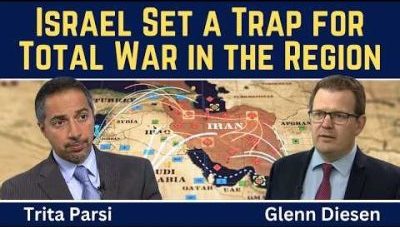
Trita Parsi: Israel Set a Trap for Total War in the Region
or go to
Aletho News Archives – Video-Images
From the Archive
Zionism’s Violent Legacy
By Donald Neff | Washington Report On Middle East Affairs | January 1996
On January 4, 1948, Jewish terrorists drove a truck loaded with explosives into the center of the all Arab city of Jaffa and detonated it, killing 26 and wounding around 100 Palestinian men, women and children.[1] The attack was the work of the Irgun Zvai Leumi – the “National Military Organization,” also known by the Hebrew letters Etzel – the largest Jewish terrorist group in Palestine. The Irgun was headed by Revisionist Zionist Menachem Begin and had been killing and maiming Arabs, Britons and even Jews for the previous ten years in its efforts to establish a Jewish state.
This terror campaign meant that at the core of Revisionist Zionism there existed a philosophical embrace of violence. … continue
Blog Roll
 Aletho News
- Trita Parsi: Israel Set a Trap for Total War in the Region
- Trump’s Iran war is on an Israeli leash
- Saudi oil boss issues global supply warning
- Riyadh Says Its Oil System Is Intact. The Numbers Say Otherwise.
- Trump and Netanyahu Want to “Finish the Job” on Iran
- US ‘one-sided dictation’ not Iran’s beliefs makes rational talks impossible: Baghaei
- Iran’s Next Strike May Not Explode. It Could Shut You Down /Col Doug Macgregor
- Iran: US political targets legitimate if assassinations return
- Iraq shuts key border crossing with Iran under US pressure: Report
- Undersea Internet cables could be targeted in retaliation for attacks on Iran: IRGC deputy chief
- If Americans Knew
- The Israel Lobby’s Changing Fortunes
- AIPAC has become such a political liability that it’s shifting to a more “nimble” approach to buying politicians
- At least 160 Israeli settler attacks in 2 weeks
- Will Gaza’s Ancient Christian Community Disappear Forever?
- Israel’s vision of regional security rests on keeping Arab states weak
- Heidi Levine recounts how Palestinian youths helped save her in settler attack
- DAILY UPDATE: Latest essential news on Palestine, Israel, & region
- Trump’s Intensifying Sabotage of the ICC, for Israel’s Sake
- Israeli military detain US and UK volunteers in West Bank including Democratic NY politician Brad Lander
- Americans at National Conservatism Conference held in Israel this year criticize Israel
- No Tricks Zone
- E-Cars Reduce CO2 Emissions By Only 41% Compared To Internal Combustion Engine Vehicles
- Predictions Made By Renowned Climate Professor Over Past Decades Have Been Proven To Be Poor
- New Study Suggests Large Regions Of The Pacific Ocean Have Been Cooling For The Last 80 Years
- Germany’s Green Energy Debacle: High Energy Costs Force Kahla Porzellan to Close After 182 Years!
- New Study: 50 Years Of The Most Aggressive ‘Net Zero’ Policies Can Only Affect The Global Climate By 0.03°C
- US September “Heat” Was No Record…Many Records Set Decades Ago
- Latest European Green Energy Debacle; Portugal’s Largest Flagship Solar Park Insolvent!
- Green Energy Debacle: German Expert Professor Fritz Vahrenholt Warns Of Severe Economic And Social Consequences
- Two More Paleo Reconstructions Affirm Meters-Higher Sea Levels Across Ireland, Brazil 7000-6000 Years Ago
- New Study: Earth And Venus Surface Warmth Largely Explained By Convection And Lapse Rate, Not CO2 Or Radiation

