Latest FARC Proposal for Peace Process in Colombia
Nazih Richani | Cuadernos Colombianos | March 19, 2013
White smoke is rising in Havana, Cuba where the negotiators of the Juan Manuel Santos and the insurgents of the Armed Revolutionary Forces of Colombia (FARC) have been negotiating since early last year. The two sides have almost agreed on the most important issue on the agenda: the agrarian question. I said almost because of the FARC’s insistence on the expansion of Peasant Zones.
So far, the FARC has clearly demonstrated its commitment to a peaceful compromise provided that the state commits to find a solution of the enduring institutional legacies of Spanish colonialism: the encomienda, which was succeeded by the hacienda system, which in turn gave grounds to the emergence of latifundios (large land ownership)—all of which were sustained by the mita (tribute) system in which the indigenous population were forced to sell their labor of 15 or more days per year to the latifundistas and to the mine owners. The mita system was supplanted by sharecropping which remained an important form of labor exploitation well into the 20th century.
In Colombia, the outcome of these institutions was one of the most skewed land distributions in Latin America, alongside Brazil and Guatemala, where large landowners retained significant political power. The Colombian recalcitrant large landowning elite hindered two previous attempts (1936 and 1968) of land reforms that would have allowed the creation of economies of scale fomenting capitalist development based on large-scale agribusiness and industry. The process was derailed and the peasantry paid the heavy price on top of centuries of exploitation, dispossession, and brutal oppression.
The last attempt at land reform coincided with the emergence of the narcotraffickers in the 1970s through the marijuana “Golden of Santa Marta,” which created the first bonanza of narco-dollars, most of which being invested in land and real estate. This was followed by the second and more significant influx of billions of dollars in the 1980s, 1990s, and 2000s, which was invested in land put to use through cattle ranching. This boosted the landed elite ranks, furthering the concentration of land ownership from 0.80 to 0.85 (where zero is perfect equality and the value 1 indicates that all properties are owned by one person). According to the Geographic Institute Agustín Codazzi (Igag), this translates into a mere 1.62% of landowners owning 43% of the lands.
More important, the emergence of the narcobourgeoisie faction gave a boost to the landowning elite, allowing them to reassert their political and economic power. The narcobourgeoisie invested heavily in land due to the relative ease in using property as a money-laundering scheme, which conflicted with the interests of the peasants and the rebels. This in turn created a class affinity between the narco-bourgeoisie and the traditional landed oligarchy.
The inequitable distribution of land and power cemented class interests and allowed the narcobourgeoisie the economic capacity to build private armies capable of safeguarding the class interests of the entire landed elite. This may explain their success in exercising influence and political power in an economy where the agrarian sector contributes to only (a diminishing) 7% of the GDP, while the service sector contributes 55% and manufacturing 38%.
This is the paradox that Colombia presents to insurgents, academia, and policy makers. It is an interesting case in which pre-capitalist modes of production, as the ones mentioned above, were embedded in new modes and relations of production only to become entangled with a contingency such as narcotrafficking. To this paradox add that Colombia is today the fourth largest economy in Latin America, after Brazil, Mexico, and Argentina.
The FARC, for example, acknowledging the contradictions and mutations of the country’s economic history— colonial and post-colonial—that produced it as a rebel movement, is bringing into the forefront the expansion of “Peasant Zones” to safeguard the peasant economy. The idea is not new. The creation of Peasant Zones was promulgated in Law 160 of 1994, but was never seriously pursued or implemented by the state. Since the introduction of this Law, only 830,000 hectares were redistributed and benefited only 75,000 people. This was while millions of subsistence peasants were exposed to violence, increasing dispossession, and aggressive encroachments of large landowners, narcobourgeoisie, speculators, bio-fuels industries, multinational mining corporations, and oil companies.
The FARC is calling for the expansion of the protection of “Peasant Zones” to include 9,5 million hectares and provide these peasant communities autonomy similar to the ones that the 1991 constitution granted the Afro-Colombian and indigenous groups. This sparked the ire of the reactionary faction of the landed elite, led by the cattle ranchers and political conservatives such as the Minister of Agriculture a descendant of the Antioquia dominant class and coffee elite. Statistics are showing that the peasant economy is more efficient and productive than the so-called capitalist large-scale farming.
Currently the small-scale peasant economy produces more than 60% of the country’s food needs which are cultivated in only 4.9 million hectares. If the peasant zones were to expand on the magnitude suggested by FARC, Colombia will not only secure its food supply, but it will generate enough surpluses improving the standards of livelihood of almost 35% of its population and create a multiplying effect on the overall economy. This may lay down solid foundations for a durable peace and a sustainable development. This is a proposal that merits serious attention.
Friday March 22, two thousand peasants are gathered for their third national meeting in San Vicente del Caguan to push forward the initiative to expand the Peasant Zones. This meeting represents the historical affinity and organic links between the peasantry and the FARC.
Nazih Richani is the Director of Latin American studies at Kean University.
Colombia: President Santos Announces ‘Profound Changes’
By Kari Paul | The Argentina Independent | March 14, 2013
Colombian President Juan Manuel Santos announced yesterday that he will initiate “an agenda of transformation” in the 16 months he has left in office.
This announcement comes as Santos continues peace negotiations with Revolutionary Armed Forces of Colombia (FARC). Congress announced last week that a resolution will be made with the armed revolutionary group by August.
“Our vision is of a just, modern, and safe Colombia,” Santos said, according to El Tiempo.
He added that disarming FARC is not enough and that the system must change in order to avoid similar situations in the future.
“Some people continue to be stuck in the past, selling us a vision of a Colombia condemned to another 50 years of violence, paralysed by fear and without the capacity to imagine anything more than what it has always been,” he said. “However we, the large majority, believe in our future.”
Officials and Santos finalised this new “comprehensive government strategy” in a meeting Monday.
Beginning today, union directors and business owners will begin meeting to design and begin this project that Santos called “an emergency plan for growth and productivity.”
Beyond lowering rates of violence in the country, the president announced goals of a more “modern Colombia,” including plans to build 317 kilometres of highways this year.
Santos added that he is “committed… to making it so that Colombia can say ‘we have peace’ before leaving the government.”
FARC has ‘always wanted peace’ in Columbia – RT exclusive
RT | December 4, 2012
 Colombian rebel militants FARC seek dialogue and peace with the country’s government, FARC negotiator Tanja Nijmeijer told RT in an exclusive interview. But despite renewed peace talks, government forces killed at least 20 rebels in a recent attack.
Dutch militant Tanja Nijmeijer – who left the Netherlands 10 years ago to join the Revolutionary Armed Forces of Colombia (FARC) and fight for what she calls social justice – spoke with RT, saying that the rebel organization wants to end the country’s 50-year conflict.
“We as an armed organization have always wanted a dialogue, we’ve always wanted peace, we have always asked for peace,” she said.
“We have not taken the arms because we wanted so. We have taken the arms because the Colombian State and the United States imperialism have obliged us to do so,” Nijmeijer said.
Talks between the Colombian government and FARC over fragile peace negotiations are set to resume in Havana, Cuba, on December 7.
At least 20 left-wing rebels were killed in Colombia on Sunday after airstrikes against their camp near the Ecuadorian border, the army said. The attack came after FARC announced a ceasefire until January 1, 2013, for the negotiations.
“People who are in Colombia want to fight for ideas different from neoliberal are killed,” Nijmeijer told RT. “So how is it possible to participate in politics if people who have other ideas are killed. And that’s the reason of arm struggle in Colombia. That’s the reason why we are still fighting.”
Colombian President Juan Manuel Santos has set a deadline of November 2013 for an agreement to be reached in the peace talks with FARC. “This has to be a process of months, rather than years. In other words, this should not last any longer than November next year at the latest,” Santos said.
The president’s statement followed an acknowledgement by FARC that it was holding “prisoners of war” – reportedly soldiers or police captured during combat. FARC stated that the prisoners would be freed in exchange for the release of rebels held by the government.
The Colombian government currently detains around 700 rebel prisoners, according to Sandra Ramirez, one of FARC’s representatives.
The US has been criticized for its role in helping the Colombian government kill members of FARC; Washington’s military assistance to Columbia has been directed primarily towards killing FARC militants.
In nearly a half-century of conflict in Columbia, an estimated 600,000 people have died and another 15,000 gone missing. Some 4 million people have also been internally displaced.
Find out more about FARC and the peace process from RT’s full exclusive interview with Tanja Nijmeijer, airing Wednesday at 18:45 GMT.
Venezuelan Government Welcomes Colombian Peace Accord
By Tamara Pearson | Venezuelanalysis | September 5th 2012
Mérida – Yesterday in an official statement, President Hugo Chavez expressed his “happiness” at the announcement of a general accord between the government of Colombia and the Revolutionary Armed Forces of Colombia (FARC) which outlines dialogue steps towards ending the “long night of violence” Colombia has been subject to since the 1960s.
Colombian president Juan Santos confirmed yesterday that his government and the FARC signed the framework agreement, which is the result of six months of exploratory meetings in Havana, Cuba.
The schedule of meetings outlined in it will be accompanied by mediators from the Cuban and Norwegian governments, and Venezuela and Chile will also attend the process. Talks will begin in Oslo in early October, then move on to Havana. They will be centered on five key themes; rural development in order to guarantee land access, political participation, end to the armed conflict, drug trafficking, and rights of the victims.
“We have worked seriously and I should recognise that the FARC have also, they have respected everything agreed on till now,” said Santos. He also informed press today that Colombian ex-vice president Humberto de La Calle will be heading up the first negotiations between the government and the FARC, together with four others, including the Colombian head of police, and the president of Colombia’s business association. The five person negotiating teams will rotate with others for each meeting.
Chavez congratulated the governments of Cuba and Norway for their “successful management” and the Venezuelan government, in its statement, ratified its “total disposition to contribute, to the extent that the people of Colombia and their government deem it necessary, towards this brother country being able to put an end to the armed conflict and construct stable and lasting peace”.
Venezuela’s foreign minister Nicolas Maduro also said last night that Venezuela will assign one representative to accompany the dialogue process, and will announce that person in the coming days.
“It’s up to us to accompany and support Colombia in the construction of a new history of peace,” Maduro said, explaining that the accord would benefit Venezuela as much as Colombia, allowing them to develop economic zones together, strengthen their trade, education plans, cultural exchange, and the “construction of a border of shared life”.
The end of conflict would have even further consequences for Venezuela, according to analyst Sergio Rodriguez, speaking on Venezuelan public television last night. He said the large numbers of Colombians currently living in the country could return there, and the resources that Venezuela is currently forced to direct towards defence could instead go towards social projects and development. Further, the US “wants to involve us in the drug trafficking which originates in Colombia”, one of the key issues under discussion.
Yesterday both parties to the accord expressed appreciation for Venezuela’s role in peace efforts for Colombia. Santos said, “I want to thank the government of Venezuela for its permanent disposition to help at any time” and FARC spokesperson Rodrigo Londono also thanked Chavez for his offer of mediation.
Londono expressed his confidence in the dialogue process. “The FARC hold the most sincere desire that the [Colombian] regime won’t try to repeat the past,” he said. “We call on all of Colombia to … demand its participation or to assume it in the streets … another Colombia is possible”.
Related articles
- Colombia and FARC ready for peace talks with support from Cuba and Norway (alethonews.wordpress.com)
Colombia and FARC ready for peace talks with support from Cuba and Norway
NNN-MERCOPRESS | August 28, 2012
BOGOTA – Colombia’s government will soon begin talks that could lead to formal negotiations for peace with the country’s biggest guerrilla group, known as the FARC, according to a Colombian intelligence source.
As part of the deal to hold talks, the government has agreed that leaders of the Revolutionary Armed Forces of Colombia would not be extradited to another country to stand trial, he said.
One aide at President Juan Manuel Santos’ office has flatly denied that any talks are taking place, but a second aide said only that any official word on peace dealings would come from Santos himself.
Details of the accord are still being worked out, but the negotiations could take place in Cuba and in Norway, the source said.
However from Caracas the editor in chief of Telesur, the Venezuelan television news channel, Jorge Botero said that secret talks date back to May in Havana with the attendance of unofficial delegates from Colombia, plus representatives from Venezuela, Cuba and Norway.
“Formal dialogue is anticipated for next October in Oslo”, said Botero. He added that from Norway representatives from the Colombian government and FARC will then travel to Havana where “they will sit to negotiate and won’t leave the table until a peace deal is reached”.
A year ago the head of FARC Alfonso Cano announced that the guerrilla was ready for talks to end the half a century Colombian internal war.
News of the peace talks is likely to anger Santos’ predecessor Alvaro Uribe who has criticised any idea of talks with the rebels and has slammed Santos for wanting “peace at any cost.”
The originally Marxist oriented FARC but now financed by drugs and which calls itself “the people’s army” defending peasant rights, has battled about a dozen administrations since surfacing in 1964, when its founder Manuel Marulanda and 48 rebels took to jungle hide-outs triggering an internal conflict involving Colombian forces and thousands of recruited guerrillas.
The group has faced its toughest defeats in recent years as US-trained special forces use sophisticated technology and spy networks to track the leaders.
The FARC string of defeats began in 2008 with a cross-border military raid into Ecuador that killed Raul Reyes its second in command. Marulanda died of a heart attack weeks later and was replaced by Alfonso Cano, who was later killed too.
Related articles
- Colombia to meet with rebels in Oslo: ex-VP (thelocal.no)
- Colombian president confirms peace talks with FARC; first round Oslo in October (en.mercopress.com)
U.S.’s Post-Afghanistan Counterinsurgency War: Colombia
By Rick Rozoff | Stop NATO | April 23, 2012
The Pentagon announced on April 23 that Defense Secretary Leon Panetta has begun a trip to South America, arriving in Colombia as part of a three-nation tour that will also take him to Brazil and Chile.
It is his first visit to the continent as Pentagon chief, though he has visited often in other capacities, including as director of the Central Intelligence Agency. Panetta’s meetings with top government and military officials in the three nations will follow those of America’s top military officer, chairman of the Joint Chiefs of Staff General Martin Dempsey, to Colombia and Brazil late last month.
Panetta’s mission also occurs two weeks after U.S. and Brazilian presidents Barack Obama and Dilma Rousseff met in the White House on April 9 and agreed on the establishment of the U.S.-Brazil Defense Cooperation Dialogue, announcing that Defense Secretary Panetta and Brazil’s Defence Minister Celso Amorim will hold the first meeting in that format on April 24.
Colombia is the largest recipient of U.S. military aid in Latin America, though its population is less than a quarter of Brazil’s, and the third largest in the world after Israel and Egypt.
After the passage by Congress of the Clinton administration’s Plan Colombia in 2000, the military in Bogota has received approximately $7 billion in U.S. assistance, up from $50 million in 1998 when it was already the biggest beneficiary of American military aid in Latin America.
On October 30, 2009 the Obama administration and that of then-Colombian President Alvaro Uribe agreed on the U.S.-Colombia Defense Cooperation Agreement, which opened up three Colombian air bases, two naval bases, two army installations “and other Colombian military facilities if mutually agreed” to the Pentagon.
One of the bases obtained by the United States, the Larandia Military Fort in Florencia, is within easy striking distance of Ecuador, as the Alberto Pawells Rodriguez Air Base in Malambo is of Venezuela.
Colombia launched a deadly attack against rebels of the Revolutionary Armed Forces of Colombia (FARC) inside neighboring Ecuador in 2008, which the Ecuadorian government accused U.S. special forces personnel inside its country of having assisted. The following year the Colombian armed forces conducted an incursion inside Venezuela, seizing four border guards.
Panetta is in Colombia to coordinate a final offensive against FARC fighters, who have been battling the country’s narco-autocracy and its political minions in Bogota since 1964.
According to Acting Assistant Secretary of Defense for Public Affairs and Pentagon Press Secretary George Little, the defense secretary is to meet with Colombian Defense Minister Juan Carlos Pinzon Bueno and General Alejandro Navas, General Commander of the Military Forces of Colombia.
On April 23 Panetta praised his military ally, stating, “Colombia, to its credit, has done a tremendous job in going after the FARC.” He failed to mention with, in addition to $7 billion dollars of Washington aid, U.S. helicopter gunships, planes, trainers and special forces troops.
Pentagon spokesman Little added, “Clearly we still have plenty to talk about in continuing to support the Colombians in their efforts against [the FARC]…”
When chairman of the Joint Chiefs of Staff Dempsey was in Colombia on March 27-28, the Defense Department website reported that he visited Joint Task Force Vulcano, “a new interagency force aimed at defeating the Revolutionary Armed Forces of Colombia…The strategy calls for Colombia to cut the FARC forces in half in two years.”
In Dempsey’s words, “They selected 2014 as a key moment for them, They want to accelerate their effects against the FARC.” With the Pentagon’s active connivance and assistance, which why is Dempsey was and Panetta is in the country.
Dempsey was explicit about the American role in the “final solution” of the Colombian civil war: “We’re getting ready to send some brigade commanders who have been in Iraq and Afghanistan down here to partner with their Joint Task Force commanders in a leader developmental function. The challenges they face are not unlike the challenges we’ve faced in Iraq and Afghanistan.”
The Pentagon’s website reported the following on March 27, worth quoting in detail.
Dempsey “joined virtually the entire Colombian defense leadership to visit Joint Task Force Vulcano,” just outside the town of Tibu, only three kilometers from the Venezuela border.
“The Colombian government established the task force in December. It is the latest effort to defeat the Revolutionary Armed Forces of Colombia…
“Dempsey arrived at the base in a Colombian Air Force Mi-17 helicopter along with Colombian Defense Minister Juan Carlos Pinzon Bueno and Gen. Alejandro Navas, commander of the Colombian Armed Forces.
“Following his comments, Dempsey discussed strategy with the minister and the chief of defense and also Army chief Maj. Gen. Sergio Mantilla Sanmiguel, Navy chief Vice Adm. Roberto Garcia Marquez and Air Force chief Maj. Gen. Tito Saul Pinilla-Pinilla.
“Before Joint Task Force Vulcano stood up, there were a small number of troops in the region. Now there are more than 10,000, [spokesman for the task force, Colombian army Captain Jose Mojica] said. The forces are composed of three mobile brigades and a geographic brigade. A fourth brigade is getting ready to deploy to the area.
“This is all part of an ambitious Colombian strategy to cut the FARC by half in two years. U.S. Embassy officials said there are about 8,000 FARC members now. Colombian officials spoke of the plan as the end game for the rebellion against the government after 48 years of intermittent war.”
Immediately before Dempsey’s visit to Colombia, U.S. Army South held talks with the Colombian armed forces in Bogota from March 19-23.
Three years ago CBS News quoted an unnamed Pentagon official stating, “The more Afghanistan can look like Colombia, the better.” The equation is now being reversed.
Other top U.S. defense and military officials have for years spoken of “coming back home” to the Western Hemisphere as the war in Afghanistan winds down.
Panetta’s and Dempsey’s visits to Colombia and their statements regarding the purpose of them leave no doubt as to where America’s new, at any rate expanded, counterinsurgency war is occurring.
Related articles
- DOD pushing more forces into South America (alethonews.wordpress.com)
- Formed to Fight Rebels, Colombian Security Forces Turn Mafioso (theepochtimes.com)
DOD pushing more forces into South America
By Carlo Munoz – The Hill – 03/30/12
The U.S. military is pushing more troops into Colombia to assist in that country’s war with insurgent groups and narcotraffickers, the Pentagon’s top military officer said Friday.
“It’s certainly in our interest to do what we can to help the nations of this region to break [these] networks,” Chairman of the Joint Chiefs of Staff Gen. Martin Dempsey told reporters while on travel in the country this week.
That effort will include U.S. assistance to a handful of new, Colombian-led joint task forces in the country, according to Pentagon spokesman Col. David Lapan.
At those outposts, American combat commanders will help train their Colombian counterparts on the finer points of counterinsurgency and counterterrorism operations.
Those lessons will be based on nearly 10 years of combat experience dealing with insurgents in Iraq and Afghanistan.
The Pentagon has similar U.S.- run task forces operating in the Horn of Africa, the Trans-Sahara, Southern Philippines and elsewhere around the world.
Colombian forces have been waging a counterinsurgency against the Revolutionary Armed Forces of Colombia (FARC), a Marxist separatist group bent on overthrowing the government in Bogota, since the 1960s.
“The challenges they face are not unlike, to be sure, the challenges we’ve faced in the passed 10 years in Iraq and Afghanistan,” Gen. Dempsey told reporters.
The new influx of U.S. troops could be in Colombia as early as June and conduct two-week rotations to help assist with the new joint task forces in the country, Lapan said.
However, Dempsey stressed, those troops will only advise and assist local military forces. They will not actively participate in any combat operations against FARC rebels.
One base, Joint Task Force-Vulcano, has already been built by Colombian forces and is situated along the country’s border with Venezuela.
Venezuela has been a key regional ally to Iran. Iranian President Mahmoud Ahmadinejad has made multiple diplomatic visits to Caracas in recent years.
Tehran has also expanded its network of embassies and cultural centers in Venezuela, as well as in Ecuador, Bolivia and Nicaragua over the past six years, Southern Command chief Gen. Douglas Fraser told members of the Senate Armed Services Committee on March 12.
Moving more of the U.S. military’s counterinsurgency and counterterrorism specialists into South America and Africa was a key piece of the White House’s new national security strategy released in February.
While focused mainly on the Pacific region, the new DOD strategy introduced “innovative methods” to support local counterterrorism forces and expand American influence in those two continents, Defense Secretary Leon Panetta said at the time.
Related articles
- Small-Scale Miners Face Crackdown as Foreign Companies Set Sights on Colombia (alethonews.wordpress.com)
- Colombia: Obama’s Bloodiest Betrayal? (alethonews.wordpress.com)
Featured Video
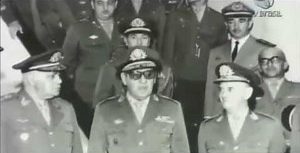
The 1964 Coup in Brazil
or go to
Aletho News Archives – Video-Images
Frlom the Archives
70 Neocons Petition Congress To Effectively Allow Israel To Say When The US Should Attack Iran
By Damian Lataan | January 10, 2014
Seventy senior Israeli-centric neoconservatives have written an open letter to Congress imploring them to do more to ensure Iran complies with the conditions of any agreement finally reached with the P5+1 over Iran’s nuclear program.
While the neocons are ostensibly asking Congress to ensure compliance, it is clear that their real aim is to convince members of Congress to support the bill currently passing through the Senate which calls for tighter sanctions against Iran in the event of any waywardness on Iran’s part.
The neocons are eager to see the bill currently passing through the Senate with enough support to make it veto-proof, not so much because they are concerned about Iran’s so-called nuclear weapons program – there’s still not a skerrick of hard evidence that Iran has a nuclear weapons program – but, rather, because embedded within the bill is this clause:
… if the Government of Israel is compelled to take military action in legitimate self-defense against Iran’s nuclear weapon program, the United States Government should stand with Israel and provide, in accordance with the law of the United States and the constitutional responsibility of Congress to authorize the use of military force, diplomatic, military, and economic support to the Government of Israel in its defense of its territory, people, and existence…
Essentially, the clause is an automatic trigger for the US to attack Iran at any time the Israelis choose to launch a first strike – regardless of whether President Obama is in favour or not.
Partial list… continue
Blog Roll
 Aletho News
- World cannot remain silent as US and Israel attack ‘heritage of humankind’: Iran
- Emirati billionaire rebukes US senator over call for Gulf states to join war with Iran
- Op. True Promise 4: Iran’s missile blitzkrieg dismantles US war machine in West Asia
- Aramco CEO warns ‘catastrophe’ imminent if Strait of Hormuz remains shut
- What If Iran Says No?
- Trump Threatens to ‘Hit’ Iran ‘Twenty Times Harder’ Over Strait of Hormuz Oil Flows
- Spare the hypocrisy: Baghaei slams Ursula’s support for US
- Iran War Supporters Invent a New and Absurd Justification: It Is All About China
- Corporate Media Go All Out To Support The US-Israeli War on Iran
- Trump press conference reveals a man who wants out of war
- If Americans Knew
- U.S. support for Israel continues to plummet, despite media’s best efforts
- Threats and missiles fly, death tolls soar in Iran, Lebanon, Gaza – Not a ceasefire Day 151
- Lebanon: Israel’s White Phosphorous Use Risks Civilian Harm
- Corporate Media Go All Out To Support The US-Israeli War On Iran
- US-Israel war on Iran is creating a steady growing number of amputees
- Israel planned this war on Iran for 40 years. Everything else is a smoke screen
- The wrong question about the war in Iran
- ‘Your Tax Dollars Being Used to Raise Your Gas Prices’: US-Israel Bomb Major Iranian Oil Depots
- ‘Bogus Evidence’: Former Nuclear Watchdog Head Debunks US Justification for Iran War
- EXPLAINER – Dimona: What to know about Israel’s nuclear site
- No Tricks Zone
- Wake-up Call: Survey Shows Majority Of Germans Now Favor Postponing Climate Targets!
- Televised! Leading German Political Candidate Tells Schoolchildren CO2 Makes Sun Hotter!
- New Study: A Century Warming Of 1.1°C Is ‘Commonplace’ And ‘Not Unusual’ During This Interglacial
- New Study: ‘Internal Noise’ And Volcanic Forcing Can Trigger 10-15°C Warming Within Decades
- Glaciers Worldwide Are Suddendly Surging, Experts Blame Warming!
- Surprising Discovery: Sahara Is Greening…Billions Of Trees Where Once Thought To Be Barren
- New Research Reaffirms Clouds, Aerosols, And Surface Solar Radiation Are ‘Driving The Climate System’
- Germany: Electric Car Catches Fire At Charging Station, Sets Off Local “Inferno”, Widespread Damage
- New Study: Canada’s New Brunswick Was 1°C Warmer Than Today During The Medieval Warm Period
- Coal Power Back In Trend As Globe Tries To Keep Pace With Growing Demand For Power
 Aletho News