Kyle Rittenhouse, Project Veritas, and the Inability to Think in Terms of Principles
By Glenn Greenwald | November 16, 2021
The FBI has executed a string of search warrants targeting the homes and cell phones of Project Veritas founder James O’Keefe and several others associated with that organization. It should require no effort to understand why it is a cause for concern that a Democratic administration is using the FBI to aggressively target an organization devoted to obtaining and reporting incriminating information about Democratic Party leaders and their liberal allies.
That does not mean the FBI investigation is inherently improper. Journalists are no more entitled than any other citizen to commit crimes. If there is reasonable cause to believe O’Keefe and his associates committed federal crimes, then an FBI investigation is warranted as it is for any other case. But there has been no evidence presented that O’Keefe or Project Veritas employees have done anything of the sort, nor any explanation provided to justify these invasive searches. That we should want and need that is self-evident: if the Trump-era FBI had executed search warrants inside the newsrooms of The New York Times and NBC News, we would be demanding evidence to prove it was legally justified. Yet virtually nothing has been provided to justify the FBI’s targeting of O’Keefe and his colleagues, and the little that has been disclosed by way of justifying this makes no sense.
The FBI investigation concerns the theft last year of the diary of Joe Biden’s daughter, Ashley, yet Project Veritas, while admitting they received a copy from an anonymous source, chose not to publish that diary because they were unable to verify it. Nobody and nothing thus far suggests that Project Veritas played any role in its acquisition, legal or otherwise. There is a cryptic reference in the search warrant to transmitting stolen material across state lines, but it is not illegal for journalists to receive and use material illegally acquired by a source: the most mainstream organizations spent the last month touting documents pilfered from Facebook by their heroic “whistleblower” Frances Haugen.
On Monday night, we produced an in-depth video report examining the FBI’s targeting of O’Keefe and Project Veritas and the dangers it presents (as we do for all of our Rumble videos, the transcript will soon be made available to subscribers here; for now, you can watch the video at the Rumble link). One of the primary topics of our report was the authoritarian tactic that is typically used to justify governmental attacks on those who report news and disseminate information: namely, to decree that the target is not a real journalist and therefore has no entitlement to claim the First Amendment guarantee of a free press.
This not-a-real-journalist tactic was and remains the primary theory used by those who justify the ongoing attempt to imprison Julian Assange. In demanding Assange’s prosecution under the Espionage Act, Sen. Dianne Feinstein (D-CA) wrote in The Wall Street Journal that “Mr. Assange claims to be a journalist and would no doubt rely on the First Amendment to defend his actions.” Yet the five-term Senator insisted: “but he is no journalist: He is an agitator intent on damaging our government, whose policies he happens to disagree with, regardless of who gets hurt.”
This not-a-real-journalist slogan was also the one used by both the CIA and the corporate media against myself and my colleagues in both the Snowden reporting we did in 2013, as well as the failed attempt to criminally prosecute me in 2020 for the year-long Brazil exposés we did: punishing them is not an attack on press freedom because they are not journalists and what they did is not journalism.
What is most striking about this weapon is that — like the campaign to agitate for more censorship — it is led by journalists. It is the corporate media that most aggressively insists that those who are independent, those who are outsiders, those who do not submit to their institutional structures are not real journalists the way they are, and thus are not entitled to the protections of the First Amendment. In order to create a framework to deny Project Veritas’s status as journalists, The New York Times claimed last week that anyone who uses undercover investigations (as Veritas does) is automatically a non-journalist because that entails lying — even though, just two years earlier, the same paper heralded numerous news outlets such as Al Jazeera and Mother Jones for using undercover investigations to accomplish what they called “compelling” reporting.
I am very well-acquainted with this repressive tactic of trying to decree who is and is not a real journalist for purposes of constitutional protection. Many have forgotten — given the awards it ultimately ended up winning — that the NSA/Snowden reporting we did in 2013 was originally maligned as quasi-criminal not just by Obama national security officials such as James Clapper but also by The New York Times. The first profile the Paper of Record published about me the day after the reporting began referred to me in the headline as an “Anti-Surveillance Activist” and then, once backlash ensued, it was changed to “Blogger” (the original snide, disqualifying headline is still visible in the URL).
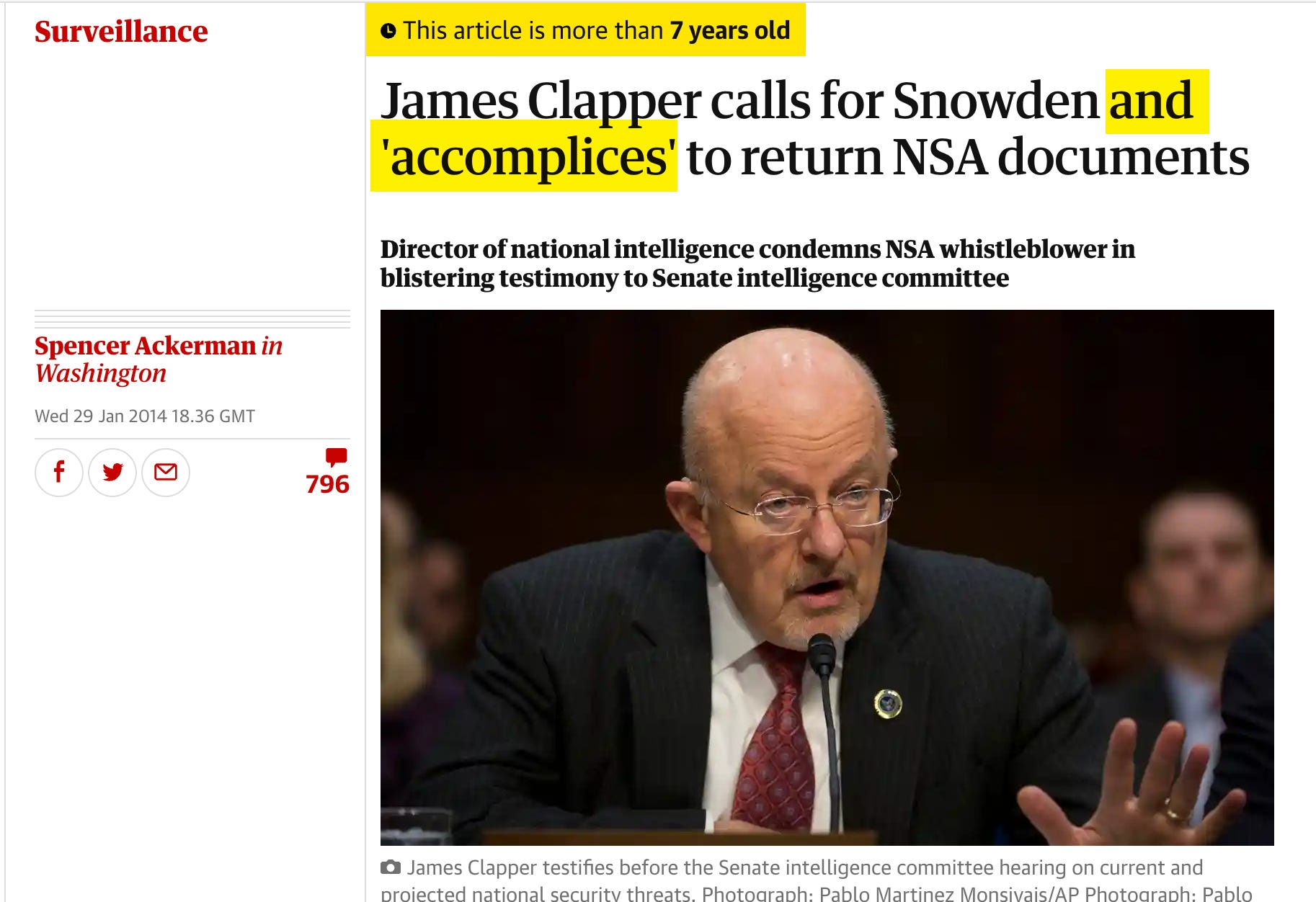
The Guardian, Jan. 29, 2014
As the New York Times‘ own Public Editor at the time objected, by purposely denying me the label “journalist,” the paper was knowingly increasing the risks that I could be prosecuted for my reporting. Indeed, recent reporting from Yahoo! News about CIA plots to kidnap or murder Julian Assange reported that denying Assange the label “journalist,” and then re-defining what I and my colleague Laura Poitras were doing from “journalist” to “information broker,” would enable the U.S. Government to spy on or even prosecute us without having to worry about that inconvenient “free press” guarantee of the First Amendment.

New York Times, June 6, 2013
All of this demonstrates how dangerous it is to invoke this very same not-a-real-journalist tactic against O’Keefe and Project Veritas. Yet, if one warns of the dangers of the FBI’s actions, that is precisely what one hears from liberals, from Democrats and from their allies in the media: the FBI’s targeting of Project Veritas has nothing to do with press freedoms since they’re not real journalists. They are invoking the authoritarian theory that maintains that the state (or, in this case, the FBI) is vested with the power to decree who is a “real journalist” — whatever that means — and who is not.
There are so many ironies to the use of this framework. So often, employees of media corporations who have never broken a major story in their lives (and never will) revel in accusing independent journalists who have broken numerous major stories (such as Assange) of not being real journalists. At the height of the Snowden reporting, I went on Meet the Press in July, 2013, only for the host, David Gregory, to suggest that I ought to be in prison alongside my source Edward Snowden because I was not really a journalist the way David Gregory was. At the time, Frank Rich, writing in New York Magazine, noted how bizarre it was that the TV personality David Gregory assumed he was a real journalist, whereas I was a non-journalist who belonged in prison for my reporting, given that Gregory — like most employees of large media corporations — had never broken any story in his life. Rich used a Q&A format to make the point this way:
On Sunday, Meet the Press host David Gregory all but accused the Guardian’s Glenn Greenwald of aiding and abetting Edward Snowden’s fugitive travels, asking, “Why shouldn’t you, Mr. Greenwald, be charged with a crime?” And, speaking to his larger point, do you see Greenwald as a journalist or an activist in this episode? And does it matter?
Is David Gregory a journalist? As a thought experiment, name one piece of news he has broken, one beat he’s covered with distinction, and any memorable interviews he’s conducted that were not with John McCain, Lindsey Graham, Dick Durbin, or Chuck Schumer. Meet the Press has fallen behind CBS’s Face the Nation, much as Today has fallen to ABC’s Good Morning America, and my guess is that Gregory didn’t mean to sound like Joe McCarthy (with a splash of the oiliness of Roy Cohn) but was only playing the part to make some noise. In any case, his charge is preposterous. As a columnist who published Edward Snowden’s leaks, Greenwald was doing the job of a journalist — and the fact that he’s an “activist” journalist (i.e., an opinion journalist, like me and a zillion others) is irrelevant to that journalistic function. . . . [I]t’s easier for Gregory to go after Greenwald, a self-professed outsider who is not likely to attend the White House Correspondents’ Dinner and works for a news organization based in London. Presumably if Gregory had been around 40 years ago, he also would have accused the Times of aiding and abetting the enemy when it published Daniel Ellsberg’s massive leak of the Pentagon Papers. In any case, Greenwald demolished Gregory on air and on Twitter (“Who needs the government to try to criminalize journalism when you have David Gregory to do it?”).
At the time — both in terms of that exchange with Gregory and my overall reporting on the NSA — I had significant support from the liberal-left (though it was far from universal, given that we were exposing mass, indiscriminate, illegal spying by the Obama administration). But few believed that I ought to be prosecuted on the grounds that, somehow, I was not a real journalist.
So why are so many of them now willing to endorse this same exact theory when it comes to O’Keefe and Project Veritas, or even to justify the prosecution of Julian Assange? The answer is obvious. They are unwilling and/or incapable of thinking in terms of principles, ones that apply universally to everyone regardless of their ideology. Their thought process never even arrives at that destination. When the subject of the FBI’s attacks on O’Keefe is raised, or the DOJ’s prosecution of Assange is discussed, they ask themselves one question and only one question, and that ends the inquiry. It is the exclusive and determinative factor: do I like James O’Keefe and his politics? Do I like Julian Assange and his politics?
This primitive, principle-free, personality-driven prism is the only way they are capable of understanding the world. Because they dislike O’Keefe and/or Assange, they instantly side with whoever is targeting them — the FBI, the DOJ, the security state services — and believe that anyone who defends them is defending a right-wing extremist rather than defending the non-ideological, universally applicable principle of press freedoms. They think only in terms of personalities, not principles.
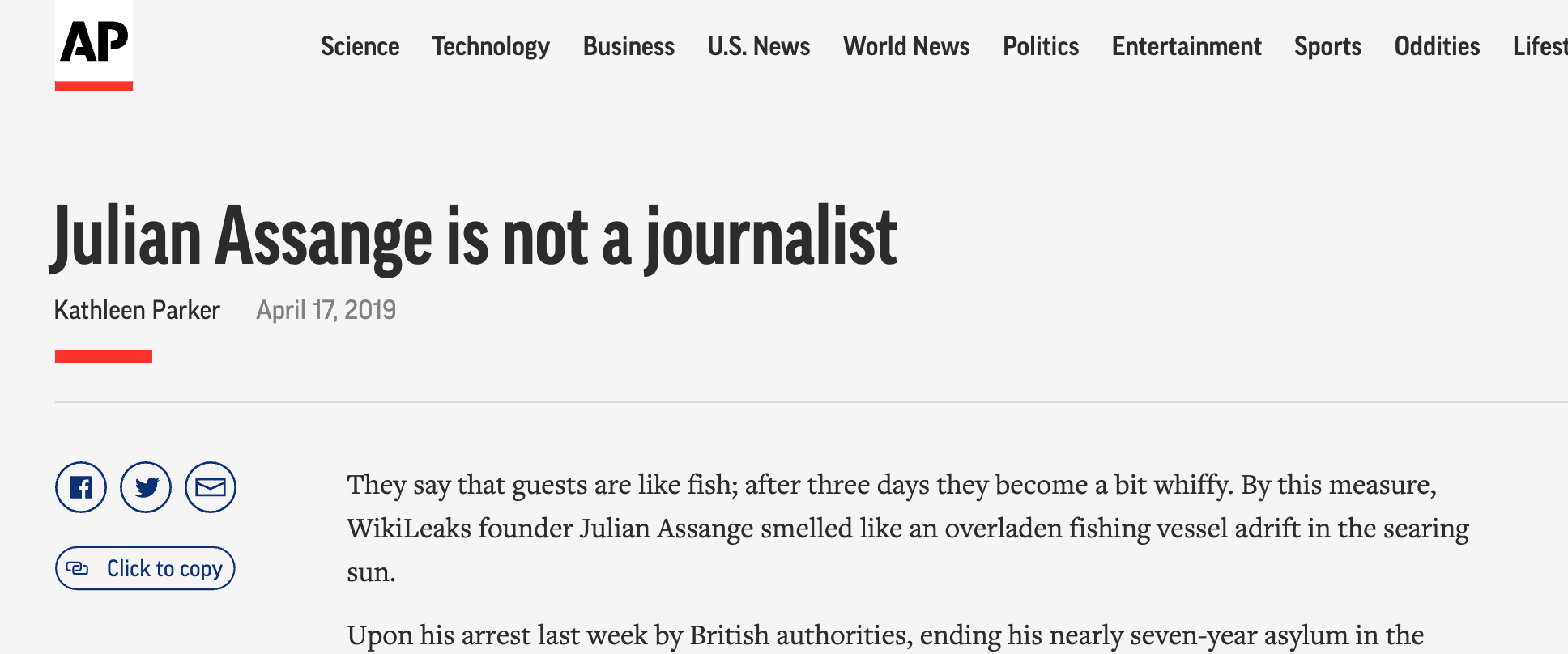
The FBI’s actions against Project Veritas and O’Keefe are so blatantly alarming that press freedom groups such as the Committee to Protect Journalists and the Freedom of the Press Foundation (on whose Board I sit) have expressed grave concerns about it, including on their social media accounts for all to see. Even the ACLU — which these days is loathe to speak out in favor of any person or group disliked by their highly partisan liberal donor base — issued a very carefully hedged statement that made clear how much they despise Project Veritas but said: “Nevertheless, the precedent set in this case could have serious consequences for press freedom” (at least thus far, the ACLU has just quietly stuck this statement on its website and not uttered a word about it on its social media accounts, where most of its liberal donors track what they do, but the fact that they felt compelled to say anything in defense of this right-wing boogieman demonstrates how extreme the FBI’s actions are). The federal judge overseeing the warrants has temporarily enjoined the FBI from extracting any more information from the cell phones seized from O’Keefe and other Project Veritas employees pending a determination of their legal justification.
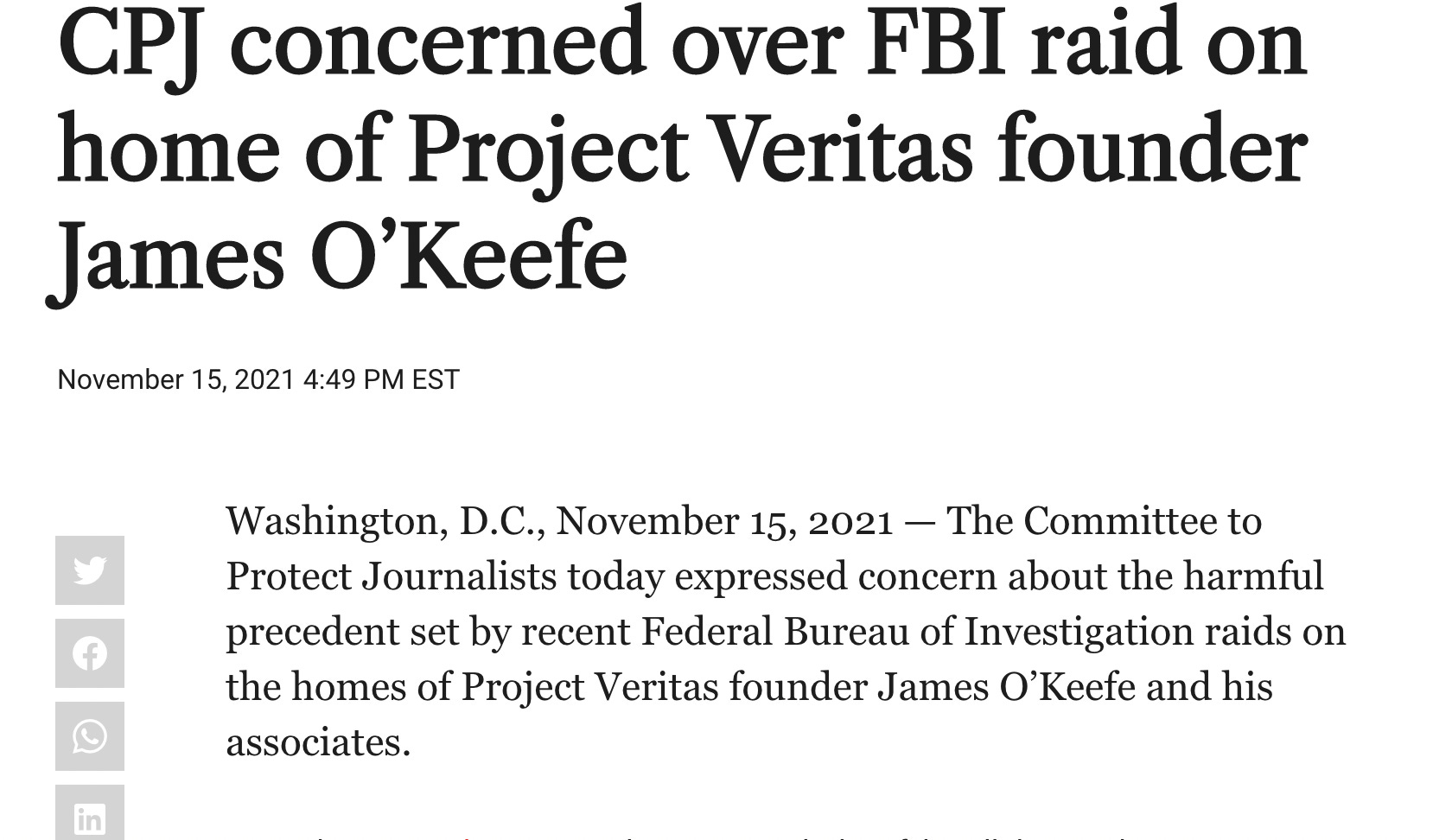
Committee to Protect Journalists, Nov. 15, 2021
The reason this is such a grave press freedom attack is two-fold. First, as indicated, any attempt to anoint oneself the arbiter of who is and is not a “real journalist” for purposes of First Amendment protection is inherently tyrannical. Which institutions are sufficiently trustworthy and competent to decree who is a real journalist meriting First Amendment protection and who falls outside as something else?
But there is a much more significant problem with this framework: namely, the question of who is and is not a real journalist is completely irrelevant to the First Amendment. None of the rights in the Constitution, including press freedom, was intended to apply only to a small, cloistered, credentialed, privileged group of citizens. The exact opposite was true: the only reason they are valuable as rights is because they enjoy universal application, protecting all citizens.
Indeed, one of the most passionate grievances of the American colonists was that nobody was permitted to use the press unless first licensed by the British Crown. Conversely, the most celebrated journalism of the time was undertaken by people like Thomas Paine — who never worked for an established journalistic outlet in his life — as he circulated the pamphlet Common Sense that railed against the abuses of the King. What was protected by the First Amendment was not a small, privileged caste bearing the special label “journalists,” but rather the activity of a free press. The proof of this is clear and ample, and is set forth in the video we produced on Monday night.
But none of this matters. If you express concern for the FBI’s targeting of O’Keefe, it will be instantly understood not as a concern about any of these underlying principles but instead as an endorsement of O’Keefe’s politics, journalism, and O’Keefe himself. The same is true for the discourse surrounding Kyle Rittenhouse. If you say that — after having actually watched the trial — you believe the state failed to prove his guilt beyond a reasonable doubt in light of his defense of self-defense, many will disbelieve your sincerity, will insist that your view is based not in some apolitical assessment of the evidence or legal principles about what the state must do in order to imprison a citizen, but rather that you must be a “supporter” of Rittenhouse himself, his ideology (whatever it is assumed to be), and the political movement with which he, in their minds, is associated.
On some level, this is pure projection: those who are incapable of assessing political or legal conflicts through a prism of principles rather than personalities assume that everyone is plagued by the same deficiency. Since they decide whether to support or oppose the FBI’s actions toward O’Keefe based on their personal view of O’Keefe rather than through reference to any principles, they assume that this is how everyone is determining their views of that situation. Similarly, since they base their views on whether Rittenhouse should be convicted or acquitted based on how they personally feel about Rittenhouse and his perceived politics rather than the evidence presented at the trial (which most of them have not watched), they assume that anyone advocating for an acquittal can be doing so only because they like Rittenhouse’s politics and believe that his actions were heroic.
In sum, those who view the world through a prism bereft of principles — either due to lack of intellectual capacity or ethics or both — assume everyone’s world view is similarly craven. It is this same stunted mindset that saddles our discourse with so much illogic and so many twisted presumptions, such as the inability to distinguish between defending someone’s right to express a particular opinion and agreement with that opinion. In a world in which ideology, partisan loyalty, tribal affiliations, in-group identity and personality-driven assessments predominate, there is no room for principles, universally applicable rights, or basic reason.
Jack Ruby: Israel’s Smoking Gun
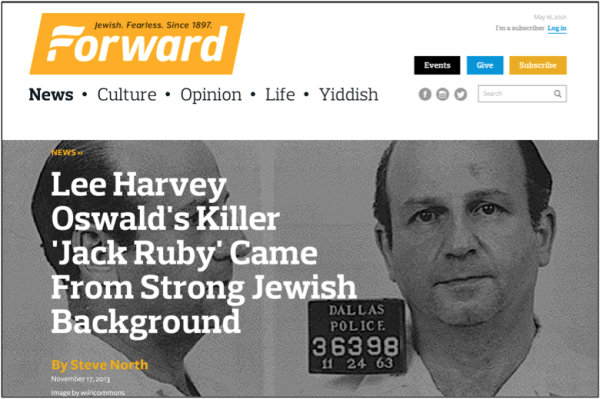
BY LAURENT GUYÉNOT • UNZ REVIEW • NOVEMBER 13, 2021
By a strange paradox, most Kennedy researchers who believe that Oswald was “just a patsy” spend an awful lot of time exploring his biography. This is about as useful as investigating Osama bin Laden for solving 9/11. Any serious quest for the real assassins of JFK should start by investigating the man who shot Oswald at pointblank in the stomach at 11:21 a.m. on September 24, 1963 in the Dallas Police station, thereby sealing the possibility that a judicial inquiry would draw attention to the inconsistencies of the charge against him, and perhaps expose the real perpetrators. One would normally expect the Dallas strip-club owner Jack Ruby to be the most investigated character by Kennedy truthers. But that is not the case.
Of course, it is perfectly normal that Chief Justice Earl Warren, when Ruby told him on June 7, 1964, “I have been used for a purpose,” failed to ask him who had used him and for what purpose.[1] But what about independent investigators? Are only readers of the Forward (“News That Matters To American Jews”) worthy of being informed that “Lee Harvey Oswald’s Killer ‘Jack Ruby’ Came From Strong Jewish Background,” and that he told his rabbi Hillel Silverman that he “did it for the Jewish people”? Here is the relevant passage of Steve North’s 2013 article, relating Silverman’s reaction after hearing on the radio that a “Jack Rubenstein” had killed the assassin:
“I was shocked,” said Silverman. “I visited him the next day in jail, and I said, ‘Why, Jack, why?’ He said, ‘I did it for the American people.’” I interrupted Silverman, pointing out that other reports had Ruby saying he did it “to show that Jews had guts.” The rabbi sighed. “Yes, he mentioned that,” Silverman said. “But I don’t like to mention it. I think he said, ‘I did it for the Jewish people.’ But I’ve tried to wipe that statement from my mind.”[2]
Ruby’s defense lawyer William Kunstler also claims in his memoir that Ruby told him: “I did it for the Jews,” repeating on several occasions: “I did this that they wouldn’t implicate Jews.” During Kunstler’s last visit Ruby handed him a note in which he reiterated that his motive was to “protect American Jews from a pogrom that could occur because of anger over the assassination.”[3] There is only one possible interpretation of Ruby’s words: he must have known, and those who tasked him with killing Oswald must have known, that if Oswald was tried, the Jewish hand in JFK’s assassination would likely be made apparent.
Why is this crucial information not in any book on the Kennedy assassination, save in Michael Collins Piper’s (and now mine)? James Douglass, to take the most representative example, insists, without a shred of evidence, that Ruby, besides being a “Chicago mob functionary,” was “CIA-connected”.[4] Not once does Douglass mention Ruby’s Jewish background, and his real name can only be found in a single endnote quoting another author. Could Douglass’s strange omission have the same motive as Ruby’s murder of Oswald, namely to “protect American Jews from a pogrom that could occur because of anger over the assassination”?
Ruby is not the only person connected to Oswald whose confused words implicating “the Jews” are carefully concealed from the public. On March 29, 1977, George DeMohrenschildt, a Russian geologist who had befriended Oswald in Dallas in 1962 at the request of CIA agent J. Walton Moore, was found dead with a bullet through his head. His death was ruled a suicide, but the Sherriff’s report mentions that in his last months he complained that “the Jews” and “the Jewish mafia” were out to get him.[5] His wife confirmed to Jim Marrs, author of Crossfire: The Plot that Killed Kennedy (1989), that her husband thought that “the Jewish Mafia and the FBI” were out to get him.[6] Most people mildly interested in the JFK assassination know about DeMohrenschildt’s relationship with Oswald, but how many have ever heard this intriguing—even incriminating—detail?
After DeMohrenschildt moved away from Dallas in June 1963, Oswald was chaperoned by Ruth Paine, who found him a job at the Texas School Book Depository, where he started working on October 16.[7] It is repeated in every book that Ruth Paine looked after Oswald on behalf of the CIA, but no evidence is ever given. On the other hand, I was surprised to read in her testimony to the Warren Commission that in the 1950s, Ruth Paine had been “a leader in the Jewish community at Indianapolis,” working with Jewish immigrants who “spoke Yiddish in conducting their business meetings.”[8] Jack Ruby also made business deals in Yiddish, as we shall see. As a matter of fact, he sneaked into the Dallas Police Station under the pretense of translating for Yiddish reporters (what Yiddish reporters need a translator in the U.S.?).
This piece of information comes from the only useful book written about Ruby: Seth Kantor’s 1978 Who Was Jack Ruby? retitled The Ruby Cover-Up in 1980. Kantor was a reporter working for the Dallas Times Herald in 1963. He knew Ruby and was less than ten feet away from him when he shot Oswald. Kantor’s meticulous investigation is an important contribution to the search for the truth about Kennedy’s assassination. In the rest of this article, I will draw mostly from his book, as well as from Michael Collins Piper’s Final Judgment and a few other sources.
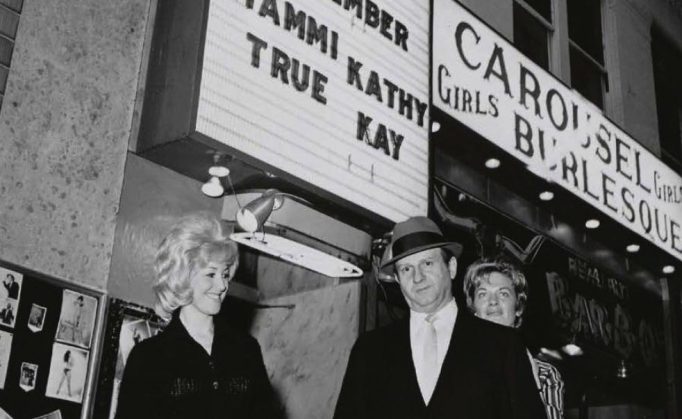
Jack Ruby in front of his Carousel strip club
Gangsters for Zion
In its final report, the Warren Commission declared that it could “not establish a significant link between Ruby and organized crime,” because “Ruby has disclaimed that he was associated with organized criminal activities, and law enforcement agencies have confirmed that denial.”[9] But there is plenty of evidence of Ruby’s association with organized crime. Robert Blakey, chief counsel for the House Select Committee on Assassinations from 1977 to 1979, said: “The most plausible explanation for the murder of Oswald by Jack Ruby was that Ruby had stalked him on behalf of organized crime, trying to reach him on at least three occasions in the forty-eight hours before he silenced him forever.”[10] Incriminating “organized crime” in the JFK assassination and the ensuing Oswald assassination was, of course, the most harmless conclusion that the HSCA could come up with, short of ridiculing itself by confirming the Warren Commission’s story of two lone nuts. And so the Washington Post could headline: “MOBSTERS LINKED TO JFK DEATH.”[11]
The missing word, here, is “Jewish”. Most Americans, learning that Jack Ruby was a mobster, must have thought he was Italian, like Hollywood gangsters. They were not told that his real name was Jacob Leon Rubenstein, that he was the son of Jewish Polish immigrants, that he went to the synagogue just before shooting Oswald, and that he later confessed to his rabbi that he “did it for the Jews.”
Jacob Rubenstein belonged to the Jewish mafia, also known as the Yiddish Connection. He had moved from Chicago to Dallas in 1947, on the trail of 15 other Chicago mobsters (3 Italians and 9 Jews) who had settled there to take over the prostitution business. That is when he changed his name from Rubenstein to Ruby. Ruby’s mentor and role model was Mickey Cohen, who operated in Chicago during the Prohibition but was then active in Hollywood. During his trial for shooting Oswald, Ruby’s legal team was fronted by Melvin Belli, a longtime friend and attorney of Cohen (Belli’s defense was that Ruby had suffered temporary insanity due to a bout of “psychomotor epilepsy”).[12] In 1947, Cohen had succeeded Benjamin Siegelbaum, aka Bugsy Siegel (romanticized by Hollywood in 1991) at the head of “Murder Incorporated”. Cohen and Siegelbaum were accountable to Meyer Lansky (born Suchowljansky), the most powerful Jewish mafia boss, who had built part of his fortune with his Havana casinos and brothels, of which he was dispossessed by Castro in 1959. Lansky’s biographer Hank Messick describes him as the head of the National Crime Syndicate. “Thanks largely to Lansky, organized crime has changed from an ugly growth on the body politic capable of being removed by surgery to a cancerous part of our economic and political systems.”[13]
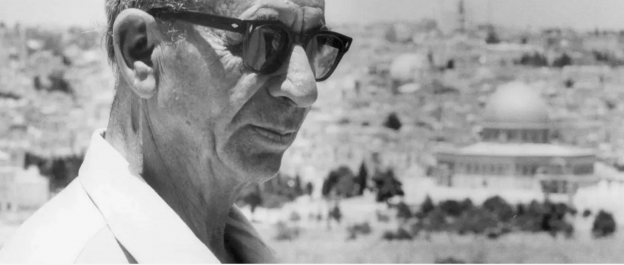
Meyer Lansky in Israel, 1971
Mickey Cohen claims in his memoirs that, in the 1940s and 1950s, he was “engrossed with Israel”, and boasts about his financial and criminal contributions to the arms smuggling operations of the Haganah. Gary Wean, a detective sergeant for the Los Angeles Police Department, claims in his book There’s a Fish in the Courthouse (1987) that he saw Ruby twice in Hollywood in 1946 and 1947 in the presence of Cohen.[14] He also writes that Cohen had frequent contacts with Menachem Begin,[15] and that he was sharing his girlfriend, stripper Candy Barr, with Menachem Begin as well as Ruby.[16]
Cohen was not the only mobster working for Israel. A pact had been sealed between prominent Zionists and Jewish mafia bosses around 1945, when the Haganah organized a highly effective black market of weapons and explosives from the US to Palestine. The operation was orchestrated by a group of about 40 wealthy American Jews who pledged to help David Ben-Gurion when the latter visited New York in July 1945. Headed by Rudolf Sonneborn, the group acted under the legal cover of a charity, the Sonneborn Institute, whose story is told by Leonard Slater in The Pledge (Simon & Schuster, 1970).[17] The group operated separately from the Jewish Agency in order to shield it from direct involvement in unlawful activities. Among its active members was the future Jerusalem mayor (1965-93) Teddy Kollek, who also played a key role in forging the CIA-Mossad Alliance. Robert Rockaway has documented the contribution of the Jewish underworld to this operation, in his article “Gangsters for Zion: How Jewish mobsters helped Israel gain its independence”. He writes:
In 1945, the Jewish Agency, the pre-state Israeli government headed by David Ben-Gurion, created a vast clandestine arms-purchasing-and-smuggling network throughout the United States. The operation was placed under the aegis of the Haganah, the underground forerunner of the Israel Defense Forces, and involved hundreds of Americans from every walk of life. They included millionaires, rabbinical students, scrap-metal merchants, ex-GIs, college students, longshoremen, industrialists, chemists, engineers, Protestants and Catholics, as well as Jews. One group, who remained anonymous and rarely talked about, were men who were tough, streetwise, unafraid, and had access to ready cash: Jewish gangsters.
Sent by Ben-Gurion to the U.S. to purchase heavy armaments, Haganah operative Yehuda Arazi approached Meyer Lansky and met with members of Murder, Incorporated. Another Haganah emissary, Reuvin Dafni, who would become Israeli consul in Los Angeles and New York, also dealt with Jewish gangsters. “When I interviewed Dafni,” Rockaway writes, “he told me about his meetings with Jewish mobsters. His meetings were arranged by members of the local Jewish community. His first meeting was in Miami with Sam Kay, a leading Miami Jewish gangster.” Dafni also met with Bugsy Siegel.
As Dafni relates, “I told him my story, how the Haganah was raising money to buy weapons with which to fight. When I finished, Siegel asked, ‘You mean to tell me Jews are fighting?’ Yes, I replied. Then Siegel, who was sitting across the table, leaned forward till his nose was almost touching mine. ‘You mean fighting, as in killing?’ Yes, I answered. Siegel leaned back, looked at me for a moment and said, ‘OK, I’m with you.’” “From then on,” recalled Dafni, “Every week I got a phone call to go to the restaurant. And every week I received a suitcase filled with $5 and $10 bills. The payments continued till I left Los Angeles.” Dafni estimates that Siegel gave him a total of $50,000.[18]
Some of those “gangsters for Zion”, writes Rockaway, “did so out of ethnic loyalties,” or “saw themselves as defenders of the Jews, almost biblical-like fighters. It was part of their self-image.”[19]
Such was also the background and self-image of Jack Ruby. His activities in arms smuggling are well documented, although the fact that it was for the benefit of Israel is often blurred. In Coup d’État in America: The CIA and the Assassination of John F. Kennedy (1975), Allan Weberman refers to the arms-dealing activities of Ruby and other mobsters, but makes no mention of their Jewishness (unless saying that Ruby “was strongly anti-Nazi” counts as an euphemism for being Jewish), and claims that they were in fact arming Castro—while simultaneously participating in CIA plots to kill him.[20]
Ruby knew Lewis McWillie, the manager of the Lansky brothers’ Tropicana nightclub casino in Havana. After the overthrow of Batista by Castro in January 1959, Meyer Lansky relocated to Miami, but Jake Lansky was arrested and confined to a luxury prison, the Trescornia detention camp, together with another mafia figure, Santo Trafficante, Jr. Although not Jewish, Trafficante had sworn allegiance to the Lansky brothers, and controlled substantial portions of Havana’s gambling and prostitution rackets. While in prison, Jake Lansky and Trafficante were often visited by Lewis McWillie, who was negotiating their release by Castro. Ruby told the Warren Commission on June 7, 1964 about visiting Lewis McWillie in 1959 in Havana, and also spoke of knowing McWillie’s bosses, whom, from fear of pronouncing their name, he referred to as “the Fox brothers, the greatest that have been expelled from Cuba.”[21] (McWillie would later acknowledge to the HSCA that, “Jack Ruby could have been out there [Havana] one time with me.”) Ruby added to the Warren Commission that McWillie and one of the brothers later visited him in Dallas.[22]
Seth Kantor quotes from a classified message that was sent from CIA headquarters to National Security Advisor McGeorge Bundy, on November 28, 1963, confirming that, while Santo Trafficante was living “in relative luxury in a Cuban prison” in 1959, he was visited frequently by “an American gangster-type named Ruby.”[23]
In September 1962, Trafficante is reported to have said to José Alman, a prominent member of the Cuban exile community in Miami, that “President Kennedy would get what was coming to him.” Aleman disagreed and argued that Kennedy would be reelected. “No, José,” said Trafficante. “He is going to be hit.”[24] When Trafficante was asked by Richard Sprague of the HSCA, “did you ever discuss with any individuals plans to assassinate President Kennedy prior to his assassination?” Trafficante refused to answer.[25]
As Kantor shows in great detail, Jack Ruby had repeated contacts with members of the Jewish underworld in 1963. By June 8, “a large group of Chicago racketeers began to show up at Ruby’s Carousel and at two other nearby strip-show clubs, according to a confidential report to Dallas Police Chief Jesse E. Curry written by Lieutenant Robert L. May Jr., who had been head of the vice squad.”[26] Ruby’s underworld contact intensified during the 11 days leading up to President Kennedy’s assassination, “when Ruby abruptly signed a power of attorney, giving up certain rights to control his own money. He also suddenly bought and installed a safe for the first time in his 16 years as a Dallas nightclub operator, to store extra amounts of money.”[27] During this period, “Ruby was getting a series of phone calls at the Carousel from an unidentified man who never would leave a message when Ruby was out.”[28] On November 11, Ruby met in Dallas with Alexander Philip Gruber, who was known for his connections with Mickey Cohen. Gruber, who had not visited Ruby in years, told the FBI that he was in Joplin Missouri at that time, and had simply decided to drop in on Ruby “since Dallas, Texas, was about 100 miles from Joplin” (the distance is 360 miles).[29] In the afternoon of November 22, Ruby phoned Alex Gruber in Los Angeles. “Gruber subsequently told the FBI he didn’t really know why Ruby called.”[30] That is most probably when Ruby received an offer he couldn’t refuse.
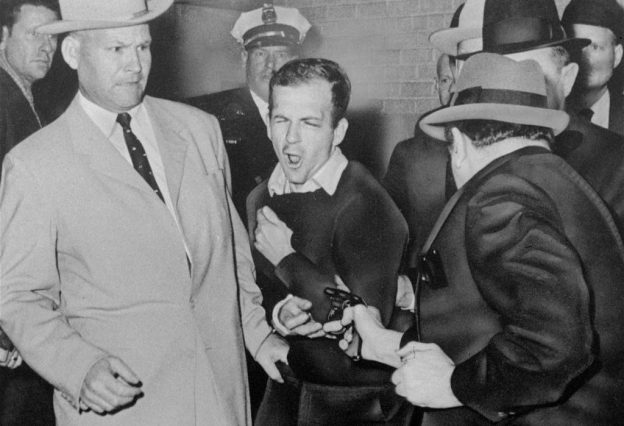
Ruby was certainly informed about the precise moment when Oswald would be transferred from the Dallas Police Station to the County Jail. According to former British Intelligence Officer Colonel John Hughes-Wilson, it was Sam Bloom, the Jewish chairman of the “host committee” who had invited Kennedy to Dallas, who suggested to the Police “that they move the alleged assassin [Oswald] from the Dallas police station to the Dallas County Jail in order to give the newsmen a good story and pictures.” And “when the police later searched Ruby’s home, they found a slip of paper with Bloom’s name, address and telephone number on it.”[31]
In an apparent attempt to make it impossible for him to fulfill his contract, Ruby tried to warn the Dallas Police anonymously: Lieutenant Billy Grammer, a dispatcher for the Dallas Police Department, whose statement can be heard here, received an anonymous phone call at 3 a.m. on November 24 from a man who knew Grammer’s name. The caller told Grammer that he knew of the plan to move Oswald from the basement and that unless the plans for Oswald’s transfer were changed, “we are going to kill him.” After Oswald was shot, Grammer, who knew Ruby and had found the voice familiar at the time of the call, identified Ruby as the caller.[32]
Ruby and the Dallas Police
When Ruby shot Oswald on Sunday November 24, this was not the first time he had been allowed into the Dallas Police Station. He knew about every policeman in town, and was nearly as often hanging around in the Police station as the policemen were at his Carousel strip club. “I have always been very close to the police department, I don’t know why,” he told the Warren Commission. Most plausibly, being on friendly terms with the Dallas policemen was his special mob assignment, and certainly the reason why he was chosen for silencing Oswald: few people had as much ease in making their way into the Dallas Police station.
Ruby spent a lot of time there from Friday 22 to Sunday 23, making several attempt to enter room 317 on the third floor where Oswald was interrogated. Early evening on Friday, the day Kennedy was assassinated and Oswald arrested,
shortly after 7 p.m., John Rutledge, a veteran police reporter for The Dallas Morning News, saw Jack Ruby, whom he easily recognized by sight, step from a public elevator onto the third floor. / Ruby was between two men who wore lapel credentials identifying them as out-of-town reporters. The three walked rapidly past a police officer stationed at the elevators to keep out anyone not on official business. Ruby was hunched over, writing something on a piece of paper and then showing it to one of the reporters as they walked toward Room 317, where Oswald was being interrogated by Captain Fritz and others. … A guard was posted at the bureau door to keep reporters from getting in to use the phones, but Ruby had no trouble easing in. He knew the guard. Ruby walked in and shook hands with Eberhardt, who asked him what he was doing. Ruby had note paper in his hand and said he was acting as translator for the foreign press. Eberhardt figured Ruby was talking about the Israeli press or the Yiddish-speaking reporters Eberhardt guessed he heard in the bedlam of the corridor.[33]
Here are the exact words from Detective August M. Eberhardt’s deposition to the Warren Commission (online here):
Mr. EBERHARDT. He came in and said hello to me, shook hands with me. I asked him what he was doing. He told me he was a translator for the newspapers. Of course, I knew that he could speak Yiddish. Had a notebook in his hand…
Mr. GRIFFIN. Do you know if there were Israeli newspaper or Yiddish—
Mr. EBERHARDT. There was a bunch of them running around there talking that unknown tongue. I don’t know what they were saying.
What a shame these Yiddish-speaking reporters were not traced and identified. Victor R. Robertson Jr., a reporter for WFAA radio and TV in Dallas who knew Ruby, also testified seeing him in the Police Station, attempting to enter 317 while Oswald was in there. Despite those testimonies, the Commission denied that Ruby was ever on the third floor Friday evening.
Later that same day, after a short visit to the synagogue, Ruby bought a dozen corned beef sandwiches and “telephoned homicide detective Richard M. Sims and offered to deliver the free food right to the office. Sims thanked him but said the day’s work was about over and they wouldn’t need anything to eat. Ruby found another reason to go anyway and, at about 11:30 p.m., he stepped off the elevator on the third floor again.”[34] At midnight, Ruby made his way to the press conference in the basement police assembly room, when Oswald was put on display. The Warren Report admits Ruby’s presence there, but portrays him as a casual bystander. “Nowhere in its 888-page report to the public did the Commission include Ruby’s admission to the FBI, a month after the crime, that he was carrying a loaded, sub-nosed revolver in his right-hand pocket during the Oswald press session in the assembly room.” Ruby couldn’t approach Oswald close enough to shoot him, as the room was packed with reporters and photographers.[35]
On Saturday 23, Ruby brought sandwiches to reporters in the Police press room; “reliable outside witnesses reported seeing Ruby or talking with him at intervals during Saturday afternoon—witnesses such as Jeremiah A. O’Leary Jr. of The Washington Star and Thayer Waldo, a reporter to The Fort Worth Star-Telegram.” Yet, Kantor notes,
the Warren Commission said it could reach “no firm conclusion as to whether or not Ruby visited the Dallas police department on Saturday” because “no police officer has reported Ruby’s presence on that day” and because “Ruby has not mentioned such a visit.” / In other words, the Warren Commission decided there had been no conspiracy between Dallas police officers and Jack Ruby because none of them reported it at the time.[36]
On Sunday morning, arrangements were made for the transfer of Oswald to the County Jail. A little after 10:30, Kantor hypothesizes, “a call was placed to the unlisted phone in Ruby’s apartment; Ruby was told where to enter the station and that the transfer van was en route.”[37] Ruby first went to the Western Union office in the next block, and arrived just in time to see Oswald being transferred. This narrow timing has been used as evidence that there was no premeditation and therefore no conspiracy. But Kantor theorizes that Ruby’s entrance into the Police station using the public stairway to the basement jail office area “could have triggered the go-ahead signal for Oswald to be brought down”, and he produces plausible evidence that it did.[38] The way Ruby entered the station is still unclear, but the House committee voted in 1979 that “it was less likely that Ruby entered the police station without assistance.”[39]
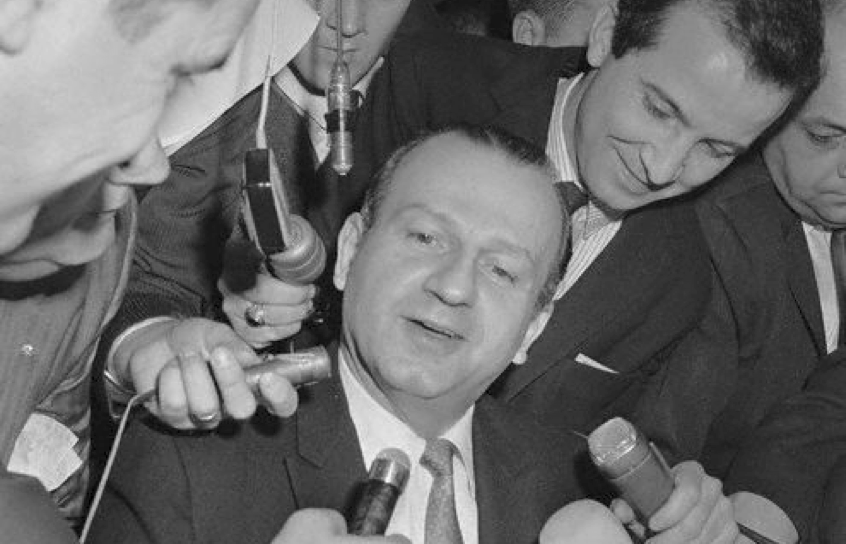
Jack Ruby after his pre-trial hearing in February 1964
The Johnson-Ruby connection
Besides Ruby, we know of one person who took steps to make sure that Oswald was silenced forever. Because Ruby could only shoot one bullet to Oswald—he said he had planned to shoot three—, Oswald was still alive when he arrived at Dallas Parkland Hospital. Dr. Charles Crenshaw recalls in his book JFK, Conspiracy of Silence (1992) that, while operating on Oswald with other surgeons, he noticed that an unknown man looking like Oliver Hardy with a pistol hanging from his back pocket had entered the operation room. Minutes later, he was told about an urgent call for him and left the operating room to take it. The call was from the new sworn president Lyndon Johnson who first asked “Dr. Crenshaw, how is the accused assassin?” Crenshaw answered: “Mr. President, he’s holding his own at the moment.” Then Johnson said firmly: “Dr. Crenshaw, I want a deathbed confession from the accused assassin. There’s a man in the operating room who will take the statement. I will expect full cooperation in this matter.” Dr. Crenshaw answered “Yes, sir,” and hung up. Thirty years later, he comments: “As I stood there in a state of disbelief, my mind was racing. First, ‘deathbed confession’ implies that someone is going to die. If Oswald doesn’t die on the table, is ‘Oliver Hardy’ or someone else going to kill him?” Since Dr. Crenshaw had just told Johnson that Oswald was “holding his own,” the expression “deathbed confession” did sound like an implicit order that Oswald should not leave the operating room alive. It really sounded as if Johnson wanted Ruby’s job finished. Moments after Dr. Crenshaw went back to the operating room, Oswald’s heart beat stopped: “Oliver Hardy” disappeared, never to be seen again. “The incident,” wrote Crenshaw, “confounded logic. Why the President of the United States would get personally involved in the investigation of the assassination, or why he would take the inquest out of the hands of the Texas authorities was perplexing.”[40]
There is plenty of evidence of Johnson’s central role in Kennedy’s assassination. And it happens that Jack Ruby directly pointed to him as the mastermind. At the end of a short filmed news conference in the Dallas County Jail in March 1965, Ruby said, “When I mentioned about Adlai Stevenson, if he was Vice-President there would never have been an assassination of our beloved President Kennedy.” Asked to explain what he meant, Ruby continued, “Well the answer is the man in office now.”[41]
How could Ruby know of Johnson’s guilt? Former Nixon operative Roger Stone claims that, in his presence, Nixon recognized Ruby as one of “Johnson’s boys.”[42] I doubt that story; Stone could have made it up to counter another rumor about Ruby’s connection to Nixon, sparked by a forged 1947 FBI memo stating that “one Jack Rubenstein of Chicago […] is performing information functions for the staff of Congressman Richard Nixon.”[43] But there is one more thing linking Ruby to Johnson.
In his testimony to Chief Justice Earl Warren and other Commission members on June 7, 1964, Ruby pleaded to be given a chance to talk directly to Johnson, otherwise “you will see the most tragic thing that will ever happen,” adding that “maybe something can be saved … if our President, Lyndon Johnson, knew the truth from me.”[44] This can be interpreted as a veiled threat addressed to Johnson. Ruby, who by this time had been sentenced to death, may have been trying to remind Johnson that his contract included a presidential pardon (he had shot Oswald out of love for the Kennedys, hadn’t he?). Even more curiously, Ruby hinted that Israel’s reputation could suffer if he spoke: “There will be a certain tragic occurrence happening if you don’t take my testimony and somehow vindicate me so my people don’t suffer because of what I have done.” He feared, he said, that his act would be used “to create some falsehood about some of the Jewish faith.” Ruby also declared to Warren, “I have been used for a purpose,” but no one in the Commission bothered to ask him who had used him and for what purpose.[45] All Ruby got out of his confused testimony was a second pointless Warren Commission interview one month later (July 18, 1964), this time by none other than Arlen “Magic Bullet” Specter (transcript here). His frustration would explain why in March 1965, he finally accused Johnson. Shortly thereafter, he wrote a letter of sixteen pages that he managed to get smuggled out of jail, blaming Johnson for Kennedy’s murder and calling the former “a Nazi of the worst order.”[46] By doing so, he probably hastened his own death, on January 3, 1967.
The case against Johnson
One commenter to my previous Kennedy article argued that the thesis of Israel’s motive is unconvincing because the Israeli Deep State had other options than killing Kennedy in order to go on with its Dimona project. I responded that a murderer’s motive is rarely that he has no other choice than to kill, but that he finds a crucial advantage in the killing. I also remarked that, whoever the assassins were, their purpose was obviously not just to get rid of Kennedy, but to put Johnson in charge. And that had to be done quickly, because the Kennedys were busy destroying Johnson’s reputation and would soon be announcing a change in the vice-presidency. According to Horace Busby, longtime LBJ aide and author of The Thirty-First of March (2005), Johnson had found out that, in early November 1963, Robert Kennedy had sent a team of national reporters to Texas to utterly destroy him. “We’re here to do a job on Lyndon Johnson,” said one the newsmen to an attorney whom he mistakenly believed to be a Johnson enemy. “When we get through with the sonofabitch, Kennedy won’t be able to touch him with a ten-foot pole in 1964”[47] (quoted from this article by Robert Morrow, who wrote more informative articles on Johnson and his “murderous psychopathy”). Richard Nixon, who happened to be in Dallas the day before Kennedy, leaked the rumor to the Dallas Morning News, who reported it on November 22nd under the headline “Nixon Predicts JFK May Drop Johnson.” Instead, Johnson became president that very day (and Nixon knew that Johnson was behind it).[48]
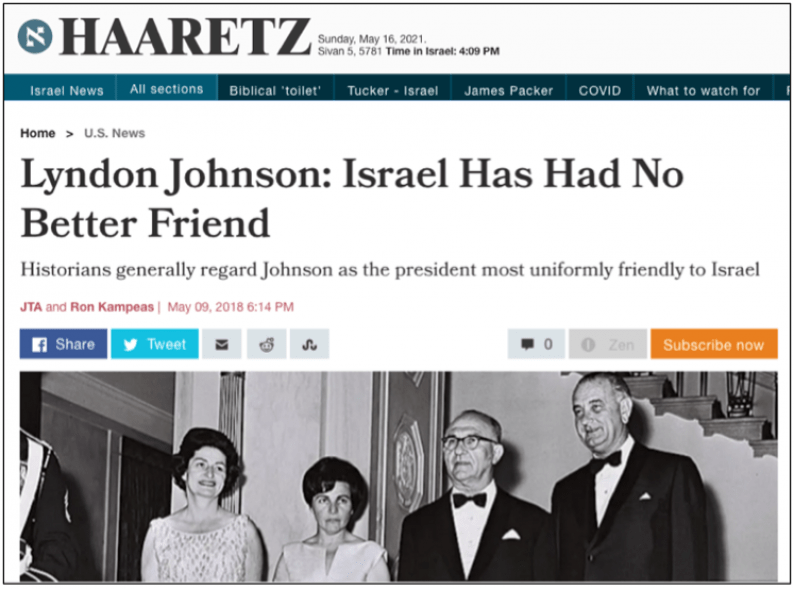
So, since the assassination of Kennedy was a coup to put Johnson in power—what else can it be?—there was no time to waste: it had to be done before the new campaign started and news of a change of vice-presidential ticket was published (Nixon’s prediction was the first and the last). If we now want to know the motive of the coup, we only have to ask: What major change occurred in US policy under Johnson? The change was not visible to the American public then, but they are now well-known, at least to readers of the Jewish and Israeli press. “Lyndon Johnson: Israel Has Had No Better Friend,” headlined Haaretz on May 9, 2018.
“Historians generally regard Johnson as the president most uniformly friendly to Israel,” we are told by the Jewish Telegraphic Agency.
Johnson was the first president to invite an Israeli prime minister, Levi Eshkol, on a state visit. They got along so well — both men were farmers — that Johnson paid Eshkol the rare compliment of inviting him to his ranch.
LBJ soon abandoned pressure on Israel to come clean about the Dimona reactor. He increased arms sales to Israel and in 1968, after Israel’s primary supplier, France, imposed an embargo as a means of cultivating ties in the Arab world, the United States became Israel’s main supplier of weapons, notably launching the talks that would lead to the sale of Phantom fighter jets to Israel.
Johnson wanted to commit more forcefully to Israel’s cause in the lead-up to the 1967 Six-Day War, but he felt constrained from a dramatic show of military might because of the failures of the war in Vietnam then dogging his presidency. Nonetheless, during the war, he ordered warships to within 50 miles of Syria’s coast as a warning to the Soviets not to interfere.
In a speech in the war’s immediate aftermath, Johnson effectively nipped in the bud any speculation that the United States would pressure Israel to unilaterally give up the lands it had captured. He laid down not only the “land for peace” formula that would inform subsequent U.N. Security Council resolutions, but made it clear that any formula had to ensure Jewish access to Jerusalem’s Old City.
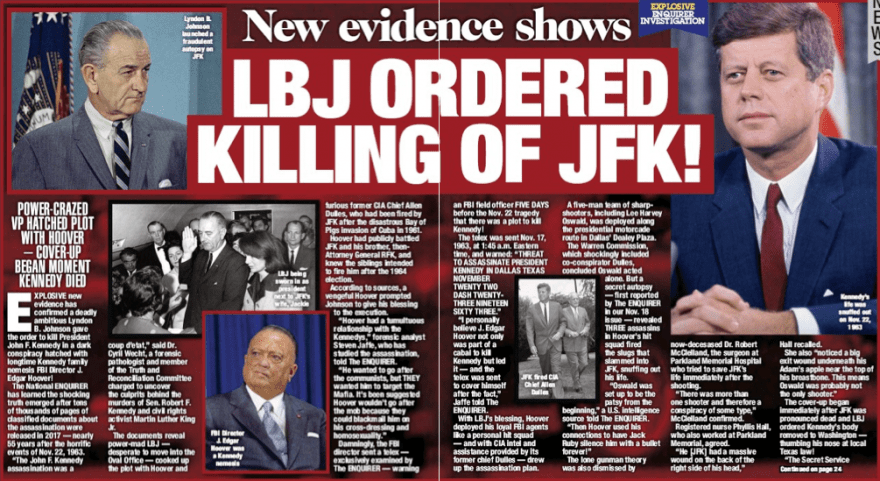
It is a good thing that Johnson is being praised by the Israeli press as the US president who “firmly pointed American policy in a pro-Israel direction”, because, on the other hand, his crucial role in the Dallas coup is also getting mainstream attention, as illustrated by the December 2, 2019 issue of the National Enquirer. Anybody who can add one plus one can also make the logical inference.
Watch Laurent Guyénot’s film “Israel and the Assassinations of the Kennedy Brothers” and share it:
https://www.youtube.com/watch?v=a_kh5tb7PtA
Notes
[1] Seth Kantor, The Ruby Cover-Up, Zebra Books , 1980, p. 49.
[2] Steve North, “Lee Harvey Oswald’s Killer ‘Jack Ruby’ Came From Strong Jewish Background,” The Forward, November 17, 2013, on forward.com
[3] William Kunstler, My Life as a Radical Lawyer, Carol Publishing, 1994, p. 158.
[4] James Douglass, JFK and the Unspeakable: Why He Died and Why It Matters, Touchstone, 2008, p. 357.
[5] Douglass, JFK and the Unspeakable, p. 47; Sheriff’s Office report on mcadams.posc.mu.edu/death2.txt
[6] Jim Marrs, Crossfire: The Plot that Killed Kennedy, Carroll and Graf, 1989, p. 285.
[7] Douglass, JFK and the Unspeakable, pp. 169-171.
[8] On https://mcadams.posc.mu.edu/russ/testimony/paine_r3.htm
[9] Kantor, The Ruby Cover-Up, p. 48.
[10] https://en.wikipedia.org/wiki/Jack_Ruby#Ruby’s_motive
[11] Gaeton Fonzi, The Last Investigation: A Former Federal Investigator Reveals the Man Behind the Conspiracy to Kill JFK, 1993, Skyhorse, 2013, k. 405–76.
[12] Michael Collins Piper, Final Judgment: The Missing Link in the JFK Assassination Conspiracy, American Free Press, 6th ed., 2005, p. 239.
[13] Hank Messick, Lansky, Putnam’s Sons, 1971, p. 9.
[14] Michael Collins Piper, Final Judgment, p. 222.
[15] Gary Wean, There’s a Fish in the Courthouse, Casitas Books, 1987, p. 681, quoted by Piper, Final Judgment, op. cit., p. 219-27, 232-7.
[16] Michael Collins Piper, Final Judgment, p. 224.
[17] Read Ricky-Dale Calhoun, “Arming David: The Haganah’s illegal arms procurement network in the United States 1945-1949,” Journal of Palestine Studies Vol. XXXVI, No. 4 (Summer 2007), pp. 22–32, online here.
[18] Robert Rockaway, “Gangsters for Zion. Yom Ha’atzmaut: How Jewish mobsters helped Israel gain its independence”, April 19, 2018, on tabletmag.com
[19] Robert Rockaway, “Gangsters for Zion,” on tabletmag.com
[20] Alan J. Weberman and Michael Canfield, Coup d’État in America: The CIA and the Assassination of John F. Kennedy, Quick American Archives, 1975, pp. 151-180 (p. 178). Michael Piper mentions (Final Judgment, p. 232) that JFK researcher Alan J. Weberman has revealed the little-known fact that Ruby traveled to Israel in 1955, but the link to Weberman’s website is now dead, and I hold Weberman as a very unreliable source

[21] Bernard Fensterwald, in Coincidence or Conspiracy (quoted by Piper, Final Judgment, pp. 228-229).
[22] Richard Gildbride, Matrix for Assassination: the JFK Conspiracy, Trafford, 2009.
[23] Kantor, The Ruby Cover-Up, pp. 255-256.
[24] Kantor, The Ruby Cover-Up, pp. 259-264.
[25] Kantor, The Ruby Cover-Up, p. 402.
[26] Kantor, The Ruby Cover-Up, p. 53.
[27] Kantor, The Ruby Cover-Up, p. 48.
[28] Kantor, The Ruby Cover-Up, p. 104.
[29] Kantor, The Ruby Cover-Up, pp. 56-59.
[30] Kantor, The Ruby Cover-Up, p. 91.
[31] John Hughes-Wilson, JFK-An American Coup d’État: The Truth Behind the Kennedy Assassination, John Blake, 2014.
[32] Mentionned in this comment.
[33] Kantor, The Ruby Cover-Up, pp. 96-97.
[34] Kantor, The Ruby Cover-Up, p. 98.
[35] Kantor, The Ruby Cover-Up, pp. 100-101.
[36] Kantor, The Ruby Cover-Up, p. 116.
[37] Kantor, The Ruby Cover-Up, p. 132.
[38] Kantor, The Ruby Cover-Up, p. 141.
[39] Kantor, The Ruby Cover-Up, p. 409.
[40] Charles A. Crenshaw, JFK, Conspiracy of Silence, Signet, 1992, pp. 185-189, 5, and
[41] This sequence can be seen in the 1988 documentary “The day the dream died” at 38:20; for more information on Ruby’s declarations about Johnson and about Jews, check this webpage.)
[42] Patrick Howley, “Why Jack Ruby was probably part of the Kennedy conspiracy,” The Daily Caller, March 14, 2014, on dailycaller.com
[43] Copy at www.jfkmurdersolved.com/nixonruby.htm. The forgery is proven by several inconsistencies: first, Nixon was a freshman in the role as junior counsel in 1947, and only started prosecuting Alger Hiss (the only likely context for this memo) the following year. Second, it refers to “Jack Rubenstein” living in Chicago in November of 1947, when Ruby had in fact already changed his name and moved to Dallas by that time. Finally , the document carries a zip code, when they did not exist at the time.
[44] Read Ruby’s deposition here.
[45] Seth Kantor, The Ruby Cover-Up, p. 49.
[46] Phillip Nelson, LBJ: The Mastermind of JFK’s Assassination, pp. 604-607.
[47] Horace Busby, The Thirty-First of March: An intimate portrait of Lyndon Johnson’s final days in office, Farrar, Straus and Giroux, 2005, pp. 129-130.
FBI accused of leaking private data to NYT after Project Veritas raid
RT | November 12, 2021
The New York Times has obtained ‘privileged communications’ of Project Veritas founder James O’Keefe, raising suspicions that an FBI source might have leaked the newspaper confidential data obtained during recent raids.
FBI agents raided the home of Project Veritas founder James O’Keefe last Saturday as part of an investigation into the acquisition of a diary purportedly written by President Joe Biden’s daughter Ashley. On Thursday, less than a week after the raid, the New York Times published an article claiming to have obtained “internal documents” from Project Veritas’ attorney.
The article sparked outrage among conservatives, who accused the FBI of leaking private communications from the organization to the newspaper.
“The FBI raided Project Veritas on a pretext and is now leaking their privileged communications to the New York Times. This is a scandal,” tweeted lawyer and Human Events co-publisher Will Chamberlain, who called for the article’s co-author, Adam Goldman, to be “subpoenaed tomorrow and forced to reveal his criminal source.”
Chamberlain also raised further legal concerns, noting that Project Veritas “is currently in litigation with the New York Times” over a separate issue, which would make any leaks to the newspaper an even bigger scandal.
“This isn’t journalism, this is straight up theft,” he concluded.
Attorney Harmeet Dhillon – who is currently representing Project Veritas and O’Keefe – also accused the New York Times of publishing a “private, privileged correspondence” which “they have no legal right to possess,” while political commentator and lawyer Mike Cernovich wrote, “This is not a grey area. It’s black letter criminal felonies committed by the FBI and the New York Times.”
A federal court ordered the US Justice Department to stop extracting information from O’Keefe’s devices on Thursday.
The FBI took two of O’Keefe’s phones during its raid on his home and the Project Veritas founder said his devices contained confidential material, including information relating to his journalistic sources.
“This is an attack on the First Amendment by the Department of Justice,” said O’Keefe this week, adding, “I’ve heard ‘the process is the punishment.’ I didn’t really understand what that meant until this weekend.”
O’Keefe said he “wouldn’t wish” the situation “on any journalist.”
Wanted US Capitol insurrectionist asks Belarus for asylum
RT | November 8, 2021
An American man wanted in the US on charges of violent entry and disorderly conduct on Capitol grounds after taking part in the infamous January 6 riot in Washington is now in Belarus, and has asked Minsk to grant him asylum.
In an interview with Belarusian state media, Evan Neumann claimed that the accusations against him are “unfounded.”
Neumann is also charged with “assaulting, redirecting, or impeding” law enforcement officers and “knowingly entering or remaining in” a restricted building.
The American says he moved in March from California to Ukraine, where he stayed for four months. He claims that, after just two weeks, he saw Ukrainian Security Service officers following him, which eventually led to his decision to move to Belarus and seek asylum.
On his journey to Belarus, he trekked across swamps of northern Ukraine before reaching the border near Pinsk.
According to the FBI, Neumann was a part of the mob of supporters of then-President Donald Trump that stormed the United States Capitol in Washington on January 6 this year. The attack, known commonly as ‘the insurrection’, sought to disrupt and delay the Electoral College vote count that would confirm Joe Biden’s election as the 46th US president. The rioting led directly to five deaths and has since been blamed for four police officers committing suicide.
Speaking to Belarusian TV, Neumann claimed that he was innocent.
“I’m charged, I believe, with six cases. And I think all of them are felonies. A felony is a very serious charge. It means you hurt somebody or something,” he explained. “I don’t think I committed any crime. One of the charges was very serious. The allegation is that I hit a police officer. It is completely unfounded.”
Neumann doesn’t deny that he was at the riot.
In the words of TV channel Belarus 1, Neumann “sought justice” and “asked uncomfortable questions,” and is now “being persecuted by the US government.”
According to Belarus’ Ministry of Internal Affairs, three US citizens have applied for refugee status, protection, or asylum in Belarus in 2021.
Neumann’s trek through Ukraine’s swampy forests wasn’t his first trip to the country. According to the FBI, he took part in the Western-backed Orange Revolution in 2004 and 2005, which led to a pro-NATO/anti-Russian government in Kiev.
As evidence emerges of provocateurs inciting the Jan 6 Capitol riot, was an asset working on behalf of the FBI to stir up trouble?
By Kit Klarenberg | RT | October 27, 2021
The bureau has form for this modus operandi, after all. Just what was the role of mysterious ex-Marine Ray Epps in fomenting the invasion? And why’s he been removed from the list of suspects and not been arrested?
Ever since January 6, speculation has abounded that the US authorities either knew what was going to transpire in advance and allowed it to happen, or undercover state infiltrators played some role or other in orchestrating the upheaval.
While acknowledging that FBI informants were on the ground that day, and, indeed, the Proud Boys and Oath Keepers – two far-right groups that played prominent roles in the Capitol break-in and preceding protests – both have intimate ties to the Bureau at the highest levels, the latter theory has been universally dismissed as conspiratorial nonsense.
Yet, given the agency’s history, the notion isn’t so far-fetched. After all, for decades during the Cold War, the FBI operated a dedicated counter-intelligence program, known as COINTELPRO, that sought to infiltrate, undermine and discredit activist groups and protest movements from within. A key tactic engaged in by undercover provocateurs was marshalling others to engage in violence.
More recently, in October 2020, the bureau foiled a deranged plot hatched by the Wolverine Watchmen militia group to kidnap Michigan Governor Gretchen Whitmer. It’s been revealed that 12 of the individuals involved in the doomed conspiracy were FBI informants.
Now, pro-Trump website Revolver has offered the most compelling evidence yet that undercover provocateurs of some distinction were pivotal to the events of January 6.
The website records how, by January 8, the FBI had assembled mugshots of its first 20 ‘most wanted’ Capitol rioters, offering cash rewards for successful identifications and fruitful leads. It took just three days for resourceful Antifa activists to pinpoint ‘Suspect 16’ as Arizona resident Ray Epps, a former high-ranking US Marine. Swathes of evidence supported the identification, including, somewhat amazingly, a direct admission by the man himself to his local newspaper, the Arizona Central.
Published January 11, the report discussed how Epps had been approached by the outlet and asked for comment about a widely circulated video from the night of January 5, in which someone closely resembling him boldly proclaimed to a crowd of fellow Trump supporters, “We need to go into the Capitol.” He confirmed he was that individual, but played down the significance of his comments, alleging that the “only thing” he meant was “we would go in the doors like everyone else.”
He went on to assert that the violent manner in which protesters subsequently entered was “totally, totally wrong,” but did not clarify why, in the same clip, he also declared, “I’ll be arrested” for proposing they gain entry to the building in the first place.
In the following weeks, news reports of arrests of individuals who’d busted into the Capitol were published almost daily, although Epps’ name never came up. Indeed, the FBI seems to have taken no decisive action in this regard until almost six months later, and, even then, not in a manner most would have expected. At an indeterminate point on July 1, between the wee hours of the morning and early evening, his mugshot was abruptly removed from the bureau’s most-wanted list, leaving an unaccounted-for gap between Suspects 15 and 17.
There is no indication that this was because he had been arrested. In every other case of a successful arrest, the corresponding photo of the suspect in question is slapped with an “arrested” logo, and Epps’ name doesn’t appear in the dedicated, searchable Justice Department Capitol Breach Cases database. Quite why he apparently remains at liberty is perplexing, although how he came so quickly to the FBI’s attention is no mystery.
The video referenced by the Arizona paper is one of many depicting Epps aggressively advocating the breach of the Capitol from January 5 onwards. That evening saw a law enforcement-mediated standoff between Trump supporters visiting Washington DC for the next day’s planned and widely promoted protest, and Antifa and Black Lives Matter activists.
Strikingly, an aspect of that particular clip not mentioned in the news report is the extremely hostile reaction his bold suggestion elicited from those around him. After he repeatedly advocated “going in”, other pro-Trump protesters respond with a shouted chorus of “no!”, before chanting in unison “Fed!” over and over, prompting Epps to awkwardly clarify that he meant “peacefully”.
Multiple separate clips show Epps moving between different groups in the crowd, and repeating the same routine, loudly calling for attendees to enter the Capitol building, and typically being met with indifference or even outright antipathy. In one, his audience’s exhaustion with his antics is evident – he asks for “one minute” to make his pitch yet again to another group of Trump supporters, but the throng responds that he has only “30 seconds”, despite a sympathetic protester drawing attention to Epps’ military background and calling for him to be respected.
This activity alone would surely mark him out as of interest to the FBI – after all, determining the degree to which what transpired on January 6 was planned in advance and, if so, by whom, were central initial questions in its probe that remain unanswered. However, Epps’ movements the next day, much of which was likewise captured on film, would make him one of the most valuable sources of information on the Capitol’s infiltration.
Revolver meticulously reviews numerous videos showing Epps apparently issuing orders to a masked Capitol rioter, seemingly also a former US Marine, who appears to have been armed with super-strength bear mace, to have engaged in a range of incendiary acts, and to have repeatedly provoked other protesters to commit violent acts and not back down from law enforcement. That rioter, Suspect 273 – also known as #MaroonPB – coincidentally remains at large today, too.
Even more tantalisingly, though, one clip shows Epps right on the frontline when the protest turned violent and the police barricades were broken through for the first time. Ryan Samsel, who has been blamed for kickstarting the “insurrection”, is pictured standing in front of the barricade, in a bitter showdown with the officer behind.
Epps emerges from the left of the frame, takes Samsel aside, whispers something in his ear, then vanishes. Moments later, Samsel and others begin charging at the barricades, knocking them down – a pivotal act that allowed for the eventual deluge of protesters into the Capitol. Media reports in the immediate aftermath of January 6 suggested the infiltrators’ path was effectively laid by the DC Police’s failure to deploy precautions such as ‘frozen zones’ (areas officially off-limits) and the hardened barriers commonly used for major events.
Samsel was arrested just three weeks after January 6 – conspicuously, he’s one of only a few individuals accused of comprising the large “breach team” who’s been taken into custody. According to his attorney, in prison, he’s been subjected to vicious torture, his jaw, nose and orbital bone having all been shattered, and his right eye damaged so badly he may be permanent half-blind.
Almost a year later, we’re still no closer to learning the truth about January 6. In the meantime, that date has been endlessly invoked by lawmakers, pundits and journalists as a grave attack on US values and democracy. Some have compared the event to 9/11, while the White House has likened it to the Civil War and proposed wide-ranging new domestic spying powers to avert another such catastrophe.
Consideration of how state capitol buildings have been repeatedly invaded during protests in the past, and DC’s Capitol Hill was overwhelmed at the conclusion of the 2017 Women’s March, has been entirely lacking. But that doesn’t fit the narrative many powerful people wish to perpetuate about January 6, so this staggering oversight is unsurprising. That the show trials of the 648 people charged in connection with the riot so far will shed no light on potential deep-state machinations that day is likewise almost inevitable.
Kit Klarenberg is an investigative journalist exploring the role of intelligence services in shaping politics and perceptions.
January 6 Could Be Washington’s Part of FBI’s Multi-State Operation Cold Snap, Argues US Observer
Ekaterina Blunova | Sputnik | October 18, 2021
FBI’s involvement in 6 January riots could be bigger than the mainstream media have recently acknowledged, according to US political commentator Julie Kelly. She wonders whether the DC incident was part of the agency’s Operation Cold Snap against Whitmer kidnapping case plotters, unveiled by BuzzFeed in July 2021.
The US Department of Justice announced on 8 October 2020 that six men had been arrested and charged federally with conspiring to kidnap the Michigan Governor Gretchen Whitmer. The DoJ’s press release said that “through confidential sources, undercover agents, and clandestine recordings, law enforcement learned particular individuals were planning to kidnap the Governor and acting in furtherance of that plan”.
However, on 12 July 2021, BuzzFeed revealed that the FBI allegedly used at least 12 informants in the Whitmer kidnapping case, who not only kept the agency in the loop, but were allegedly used by the FBI to “induce or persuade” the defendants to go along with the violent scheme. The agency’s operation was called Cold Snap.
According to BuzzFeed, the FBI assets “had a hand in nearly every aspect of the alleged plot, starting with its inception”.
One of those infiltrators, Stephen Robeson, 57, helped organise a series of meetings around the country “enthusiastically pushing people he knew to attend” and even “paid for some hotel rooms and food as an incentive to get people to come”. At these meetings many of the alleged plotters first met one another.
Another informant, an Iraq War veteran, known as “Big Dan”, rose to the second-in-command of the group, encouraged members to work with other potential suspects and paid for their transportation to meetings. He allegedly urged the supposed mastermind of the Whitmer kidnapping plot to carry his plan out, and then laid the trap that eventually led to the arrest.
The defendants in the kidnapping case later accused the FBI of “entrapment”, saying the infiltrators encouraged the group and even led military-style trainings for the plot.
All these meetings and training were captured on film by FBI agents “to produce major headlines as early voting was underway in the crucial swing state of Michigan”, argued Julie Kelly in her op-ed for American Greatness (AG).
She noted that the blame for the plot was pinned on then-President Donald Trump. “There is a through line from President Trump’s dog whistles and tolerance of hate, vengeance, and lawlessness to plots such as this one”, then-presidential candidate Joe Biden claimed on 8 October 2020.
“It also appears that the Whitmer operation was only part of the FBI’s overall plan to infiltrate and perhaps direct the conduct of unsuspecting ‘militia’ men in 2020”, Kelly continued, stressing that the agency’s operation was not limited to Michigan but was a “multi-state” probe.
Citing a testimony by one of the lead FBI special agents in the Whitmer case, the political commentator highlighted that there had been other FBI “domestic terrorism” investigations in Baltimore and Milwaukee and Cincinnati and Indiana involving other militia members.
According to Kelly, “Big Dan” was also ordered by the FBI to convince a man in Virginia to participate in a plan against Virginia Governor Ralph Northam. “Just like in the Whitmer plot, ‘Big Dan’ advised his target how to build an explosive device and urged him to attend a training camp in Wisconsin”, she noted.
The AG senior contributor insists that “it’s hard to imagine Operation Cold Snap ended with the arrest of Whitmer’s would-be abductors”. According to her, the 6 January riot, attended by several groups of right-wing militia, could have been a continuation of the same FBI op, this time in Washington, DC.
She suggested that it was hardly a coincidence that FBI chief Christopher Wray promoted Steven M. D’Antuono, special agent in charge of the Detroit Field Office, Michigan, to head of the DC FBI Field office on 13 October 2020 – just five days after the arrest of kidnap plotters and ahead of the November 2020 elections. Apparently, D’Antuono was seen as a man for the job, according to the political commentator.
Citing a New York Times article unveiling FBI infiltrators’ role in 6 January riots, Kelly presumed that the NYT report could only be seen as the start of a slow drip of information about the extent” of the agency’s role in the Capitol breach.
“It’s only a matter of time before we learn how many “Big Dans” or Stephen Robesons were part of January 6,” Kelly believes.
Civil liberties are being trampled by exploiting “insurrection” fears. Congress’s 1/6 Committee may be the worst abuse yet.
By Glenn Greenwald | October 17, 2021
When a population is placed in a state of sufficiently grave fear and anger regarding a perceived threat, concerns about the constitutionality, legality and morality of measures adopted in the name of punishing the enemy typically disappear. The first priority, indeed the sole priority, is to crush the threat. Questions about the legality of actions ostensibly undertaken against the guilty parties are brushed aside as trivial annoyances at best, or, worse, castigated as efforts to sympathize with and protect those responsible for the danger. When a population is subsumed with pulsating fear and rage, there is little patience for seemingly abstract quibbles about legality or ethics. The craving for punishment, for vengeance, for protection, is visceral and thus easily drowns out cerebral or rational impediments to satiating those primal impulses.
The aftermath of the 9/11 attack provided a vivid illustration of that dynamic. The consensus view, which formed immediately, was that anything and everything possible should be done to crush the terrorists who — directly or indirectly — were responsible for that traumatic attack. The few dissenters who attempted to raise doubts about the legality or morality of proposed responses were easily dismissed and marginalized, when not ignored entirely. Typically, they were vilified with the accusation that their constitutional and legal objections were frauds: mere pretexts to conceal their sympathy and even support for the terrorists. It took at least a year or two after that attack for there to be any space for questions about the legality, constitutionality, and morality of the U.S. response to 9/11 to be entertained at all.
For many liberals and Democrats in the U.S., 1/6 is the equivalent of 9/11. One need not speculate about that. Many have said this explicitly. Some prominent Democrats in politics and media have even insisted that 1/6 was worse than 9/11.
Joe Biden’s speechwriters, when preparing his script for his April address to the Joint Session of Congress, called the three-hour riot “the worst attack on our democracy since the Civil War.” Liberal icon Rep. Liz Cheney (R-WY), whose father’s legacy was cemented by years of casting 9/11 as the most barbaric attack ever seen, now serves as Vice Chair of the 1/6 Committee; in that role, she proclaimed that the forces behind 1/6 represent “a threat America has never seen before.” The enabling resolution that created the Select Committee calls 1/6 “one of the darkest days of our democracy.” USA Today’s editor David Mastio published an op-ed whose sole point was a defense of the hysterical thesis from MSNBC analysts that 1/6 is at least as bad as 9/11 if not worse. S.V. Date, the White House correspondent for America’s most nakedly partisan “news” outlet, The Huffington Post, published a series of tweets arguing that 1/6 was worse than 9/11 and that those behind it are more dangerous than Osama bin Laden and Al Qaeda ever were.
And ever since the pro-Trump crowd was dispersed at the Capitol after a few hours of protests and riots, the same repressive climate that arose after 9/11 has prevailed. Mainstream political and media sectors instantly consecrated the narrative, fully endorsed by the U.S. security state, that the United States was attacked on 1/6 by domestic terrorists bent on insurrection and a coup. They also claimed in unison that the ideology driving those right-wing domestic terrorists now poses the single most dangerous threat to the American homeland, a claim which the intelligence community was making even before 1/6 to argue for a new War on Terror (just as neocons wanted to invade and engineer regime change in Iraq prior to 9/11 and then exploited 9/11 to achieve that long-held goal).
With those extremist and alarming premises fully implanted, there has been little tolerance for questions about whether proposed responses for dealing with the 1/6 “domestic terrorists” and their incomparably dangerous ideology are excessive, illegal, unethical, or unconstitutional. Even before Joe Biden was inaugurated, his senior advisers made clear that one of their top priorities was to enact a bill from Rep. Adam Schiff (D-CA) — now a member of the Select Committee on 1/6 — to import the first War on Terror onto domestic soil. Even without enactment of a new law, there is no doubt that a second War on Terror, this one domestic, has begun and is growing, all in the name of the 1/6 “Insurrection” and with little dissent or even public debate.
Following the post-9/11 script, anyone voicing such concerns about responses to 1/6 is reflexively accused of minimizing the gravity of the Capitol riot and, worse, of harboring sympathy for the plotters and their insurrectionary cause. Questions or doubts about the proportionality or legality of government actions in the name of 1/6 are depicted as insincere, proof that those voicing such doubts are acting not in defense of constitutional or legal principles but out of clandestine camaraderie with the right-wing domestic terrorists and their evil cause.
When it comes to 1/6 and those who were at the Capitol, there is no middle ground. That playbook is not new. “Either you are with us, or you are with the terrorists” was the rigidly binary choice which President George W. Bush presented to Americans and the world when addressing Congress shortly after the 9/11 attack. With that framework in place, anything short of unquestioning support for the Bush/Cheney administration and all of its policies was, by definition, tantamount to providing aid and comfort to the terrorists and their allies. There was no middle ground, no third option, no such thing as ambivalence or reluctance: all of that uncertainty or doubt, insisted the new war president, was to be understood as standing with the terrorists.
The coercive and dissent-squashing power of that binary equation has proven irresistible ever since, spanning myriad political positions and cultural issues. Dr. Ibram X. Kendi’s insistence that one either fully embrace what he regards as the program of “anti-racism” or be guilty by definition of supporting racism — that there is no middle ground, no space for neutrality, no room for ambivalence about any of the dogmatic planks — perfectly tracks this manipulative formula. As Dr. Kendi described the binary he seeks to impose: “what I’m trying to do with my work is to really get Americans to eliminate the concept of ‘not racist’ from their vocabulary, and realize we’re either being racist or anti-racist.” Eight months after the 1/6 riot — despite the fact that the only people who died that day were Trump supporters and not anyone they killed — that same binary framework shapes our discourse, with a clear message delivered by those purporting to crush an insurrection and confront domestic terrorism. You’re either with us, or with the 1/6 terrorists.
What makes this ongoing prohibition of dissent or even doubt so remarkable is that so many of the responses to 1/6 are precisely the legal and judicial policies that liberals have spent decades denouncing. Indeed, many of the defining post-1/6 policies are identical to those now retrospectively viewed as abusive and excessive, if not unconstitutional, when invoked as part of the first War on Terror. We are thus confronted with the surreal dynamic that policies long castigated in American liberalism — whether used generally in the criminal justice system or specifically in the name of avenging 9/11 and defeating Islamic extremism — are now off-limits from scrutiny or critique when employed in the name of avenging 1/6 and crushing the dangerous domestic ideology that fostered it.
Almost immediately after the Capitol riot, some of the most influential Democratic lawmakers — Senate Majority Leader Chuck Schumer (D-NY) and House Homeland Security Committee Chair Bennie Thompson (D-MS), who also now chairs the Select 1/6 Committee — demanded that any participants in the protest be placed on the no-fly list, long regarded as one of the most extreme civil liberties assaults from the first War on Terror. And at least some of the 1/6 protesters have been placed on that list: American citizens, convicted of no crime, prohibited from boarding commercial airplanes based on a vague and unproven assessment, from unseen and unaccountable security state bureaucrats, that they are too dangerous to fly. I reported extensively on the horrors and abuses of the no-fly list as part of the first War on Terror and do not recall a single liberal speaking in defense of that tactic. Yet now that this same brute instrument is being used against Trump supporters, there has not, to my knowledge, been a single prominent liberal raising objections to the resurrection of the no-fly list for American citizens who have been convicted of no crime.
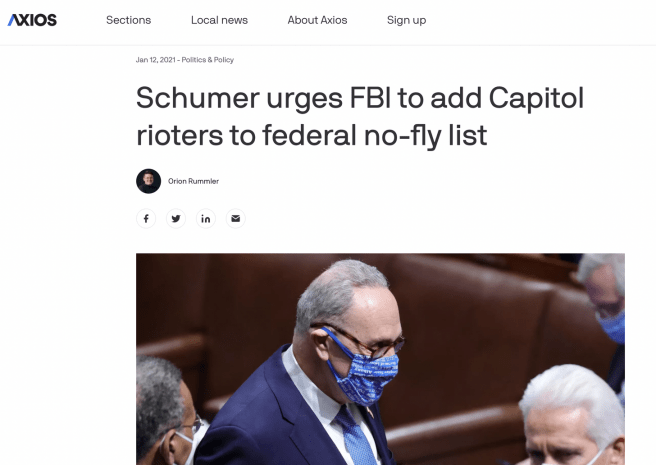
Axios, Jan. 12, 2021
With more than 600 people now charged in connection with the events of 1/6, not one person has been charged with conspiracy to overthrow the government, incite insurrection, conspiracy to commit murder or kidnapping of public officials, or any of the other fantastical claims that rained down on them from media narratives. No one has been charged with treason or sedition. Perhaps that is because, as Reuters reported in August, “the FBI has found scant evidence that the Jan. 6 attack on the U.S. Capitol was the result of an organized plot to overturn the presidential election result.” Yet these defendants are being treated as if they were guilty of these grave crimes of which nobody has been formally accused, with the exact type of prosecutorial and judicial overreach that criminal defense lawyers and justice reform advocates have long railed against.
Dozens of the 1/6 defendants have been denied bail, thus being imprisoned for months without having been found guilty of anything. Many are being held in unusually harsh and bizarrely cruel conditions, causing a federal judge on Wednesday to hold “the warden of the D.C. jail and director of the D.C. Department of Corrections in contempt of court,” and then calling on the Justice Department “to investigate whether the jail is violating the civil rights of dozens of detained Jan. 6 defendants.” Some of the pre-trial prison protocols have been so punitive that even Sen. Elizabeth Warren (D-MA) — who calls the 1/6 protesters “domestic terrorists” — denounced their treatment as abusive: “Solitary confinement is a form of punishment that is cruel and psychologically damaging,” Warren said, adding: “And we’re talking about people who haven’t been convicted of anything yet.” Warren also said she is “worried that law enforcement officials are deploying it to ‘punish’ the Jan. 6 defendants or to ‘break them so that they will cooperate.”
The few 1/6 defendants who have thus far been sentenced after pleading guilty have been subjected to exceptionally punitive sentences, the kind liberal criminal justice reform advocates have been rightly denouncing for years. Several convicted of nothing more than trivial misdemeanors are being sentenced to real prison time; last week, Michigan’s Robert Reeder pled guilty to “one count of parading, demonstrating or picketing in a Capitol building” yet received a jail term of 3 months, with the judge admitting that the motive was to “send a signal to the other participants in that riot… that they can expect to receive jail time.”
Meanwhile, long-controversial SWAT teams are being routinely deployed to arrest 1/6 suspects in their homes, and long-time liberal activists denouncing these tactics have suddenly decided they are appropriate for these Trump supporters. That prosecutors are notoriously overzealous in their demands for harsh prison time is a staple of liberal discourse, but now, an Obama-appointed judge has repeatedly doled out sentences to 1/6 defendants that are harsher and longer than those requested by DOJ prosecutors, to the applause of liberals. In sum, these defendants are subjected to one of the grossest violations of due process: they are being treated as if they are guilty of crimes — treason, sedition, insurrection, attempted murder, and kidnapping — which not even the DOJ has accused them of committing. And the fundamental precept of any healthy justice system — namely, punishment for citizens is merited only once they have been found guilty of crimes in a court of law — has been completely discarded.
Serious questions about FBI involvement in the 1/6 events linger. For months, Americans were subjected to a frightening media narrative that far-right groups had plotted to kidnap Michigan Gov. Gretchen Whitmer, only for proof to emerge that at least half of the conspirators, including its leaders, were working for or at the behest of the FBI. Regarding 1/6, the evidence has been clear for months, though largely confined to right-wing outlets, that the FBI had its tentacles in the three groups it claims were most responsible for the 1/6 protest: the Proud Boys, Oath Keepers, and the Three Percenters. Yet last month, The New York Times acknowledged that the FBI was directly communicating with one of its informants present at the Capitol, a member of the Proud Boys, while the riot unfolded, meaning “federal law enforcement had a far greater visibility into the assault on the Capitol, even as it was taking place, than was previously known.” All of this suggests that to the extent 1/6 had any advanced centralized planning, it was far closer to an FBI-induced plot than a centrally organized right-wing insurrection.
Despite this mountain of abuses, it is exceedingly rare to find anyone outside of conservative media and MAGA politics raising objections to any of this (which is what made Sen. Warren’s denunciation of their pre-trial prison conditions so notable). The reason is obvious: just as was true in the aftermath of 9/11, people are petrified to express any dissent or even question what is being done to the alleged domestic terrorists for fear of standing accused of sympathizing with them and their ideology, an accusation that can be career-ending for many.
Many of the 1/6 defendants are impoverished and cannot afford lawyers, yet private-sector law firms who have active pro bono programs will not touch anyone or anything having to do with 1/6, while the ACLU is now little more than an arm of the Democratic Party and thus displays almost no interest in these systemic civil liberties assaults. And for many liberals — the ones who are barely able to contain their glee at watching people lose their jobs in the middle of a pandemic due to vaccine-hesitancy or who do not hide their joy that the unarmed Ashli Babbitt got what she deserved — their political adversaries these days are not just political adversaries but criminals and even terrorists, rendering no punishment too harsh or severe. For them, cruelty is not just acceptable; the cruelty is the point.
The Unconstitutionality of the 1/6 Committee
Civil liberties abuses of this type are common when the U.S. security state scares enough people into believing that the threat they face is so acute that normal constitutional safeguards must be disregarded. What is most definitely not common, and is arguably the greatest 1/6-related civil liberties abuse of them all, is the House of Representatives Select Committee to Investigate the January 6th Attack on the United States Capitol.
To say that the investigative acts of the 1/6 Committee are radical is a wild understatement. Along with serving subpoenas on four former Trump officials, they have also served subpoenas on eleven private citizens: people selected for interrogation precisely because they exercised their Constitutional right of free assembly by applying for and receiving a permit to hold a protest on January 6 opposing certification of the 2020 election.
When the Select 1/6 Committee recently boasted of these subpoenas in its press release, it made clear what methodology it used for selecting who it was targeting: “The committee used permit paperwork for the Jan. 6 rally to identify other individuals involved in organizing.” In other words, any citizen whose name appeared on permit applications to protest was targeted for that reason alone. The committee’s stated goal is “to collect information from them and their associated entities on the planning, organization, and funding of those events”: to haul citizens before Congress to interrogate them on their constitutionally protected right to assemble and protest and probe their political beliefs and associations:


List of 11 private citizens who received subpoenas from the 1/6 Congressional Committee for deposition testimony and records
Even worse are the so-called “preservation notices” which the committee secretly issued to dozens if not hundreds of telecoms, email and cell phone providers, and other social media platforms (including Twitter and Parler), ordering those companies to retain extremely invasive data regarding the communications and physical activities of more than 100 citizens, with the obvious intent to allow the committee to subpoena those documents. The communications and physical movement data sought by the committee begins in April, 2020 — nine months before the 1/6 riot. The committee refuses to make public the list of individuals it is targeting with these sweeping third-party subpoenas, but on the list are what CNN calls “many members of Congress,” along with dozens of private citizens involved in obtaining the permit to protest and then promoting and planning the gathering on social media.
What makes these secret notices especially pernicious is that the committee requested that these companies not notify their customers that the committee has demanded the preservation of their data. The committee knows it lacks the power to impose a “gag order” on these companies to prevent them from notifying their users that they received the precursor to a subpoena: a power the FBI in conjunction with courts does have. So they are relying instead on “voluntary compliance” with the gag order request, accompanied by the thuggish threat that any companies refusing to voluntarily comply risk the public relations harm of appearing to be obstructing the committee’s investigation and, worse, protecting the 1/6 “insurrectionists.”
Worse still, the committee in its preservation notices to these communications companies requested that “you do not disable, suspend, lock, cancel, or interrupt service to these subscribers or accounts solely due to this request,” and that they should first contact the committee “if you are not able or willing to respond to this request without alerting the subscribers.” The motive here is obvious: if any of these companies risk the PR hit by refusing to conceal from their customers the fact that Congress is seeking to obtain their private data, they are instructed to contact the committee instead, so that the committee can withdraw the request. That way, none of the customers will ever be aware that the committee targeted their private data and will thus never be able to challenge the legality of the committee’s acts in a court of law.
In other words, even the committee knows that its power to seek this information about private citizens lacks any convincing legal justification and, for that reason, wants to ensure that nobody has the ability to seek a judicial ruling on the legality of their actions. All of these behaviors raise serious civil liberties concerns, so much so that even left-liberal legal scholars and at least one civil liberties group (obviously not the ACLU) — petrified until now of creating any appearance that they are defending 1/6 protesters by objecting to civil liberties abuses — have begun very delicately to raise doubts and concerns about the committee’s actions.
But the most serious constitutional problem is not the specific investigative acts of the committee but the very existence of the committee itself. There is ample reason to doubt the constitutionality of this committee’s existence.
When crimes are committed in the United States, there are two branches of government — and only two — vested by the Constitution with the power to investigate criminal suspects and adjudicate guilt: the executive branch (through the FBI and DOJ) and the judiciary. Congress has no role to play in any of that, and for good and important reasons. The Constitution places limits on what the executive branch and judiciary can do when investigating suspects . . . . .
Merrick Garland’s America
The justice department targets dissenters
BY PHILIP GIRALDI • UNZ REVIEW • OCTOBER 12, 2021
There have been a number of suggestions online that the withdrawal of American soldiers from overseas is being undertaken to use the troops against those individuals and domestic groups that are being targeted by the Justice Department. The possibility has a certain coherency given that we have a White House that believes it has the right to forcefully inflict medical procedures on anyone who happens to live in the US, but it falls down due to the fact that the soldiers themselves might side with the dissidents as they are being sent to reeducation camps and subsequently weeded out based on their political views, even to the extent of having their social media covertly monitored. Quis custodet custodes?, one must ask.
If there is one thing that all Americans should feel pleased about with the Republican Party performance it is the fact that the then Republican dominated Senate was able to block President Barack Obama’s bid to place Merrick Garland on the Supreme Court. The downside of that is, of course, that he now is Joe Biden’s Attorney General, where he is very well placed to engage in mischief that will potentially affect all Americans. In fact, he has proven to be a more than willing accomplice in the social engineering that the Biden Administration is engaged in, to include his declaration of war against white supremacists as the single greatest terrorist threat the United States faces today.
One might well recall Taki Theodoracopulos’s recent comment that “If America survives in its current form, years from now people will wonder how society was enslaved by a minority of privileged people who would surrender and give up their mother at the first sign of an attack.” That defines Garland and those around him, but he is generally regarded by the media and those who care about such things, as a moderate, judicially speaking. As I can hardly confirm his actual views on anything, I would not dispute that assessment, but I would note that he certainly walks like a standard Democratic Party liberal duck since he has been appointed Attorney General, very tolerant of bizarre “woke” culture and taking the lead on finding and punishing domestic terrorists. The enemies list admittedly features white supremacists regarded ipso facto as extremists, but it now also includes parents who do not support “critical race theory” (CRT) in the nation’s public schools.
Senator Rand Paul of Kentucky has observed how “The Department of Justice’s fight against angry parents is a real testament to the authoritarian nature of the Biden administration and indeed, the entirety of the left. It takes a lot of hubris to declare that you know how to raise someone’s child better than them and send authorities to shut you down when you protest that.” To be sure, Critical Race Theory has been fairly criticized as it pretends to be an antidote to systemic racism but is itself racist in nature as it opposes a race neutral system that equally benefits everyone. It proposes that America’s governmental bodies and infrastructures are racist and supportive of “white supremacy” and must be deconstructed. It requires everything to be examined through a value system determined by identity politics and race and it views both whites and their institutions as hopelessly corrupted, if not evil. This is what will be taught to children and this is why parents are protesting.
One has to wonder if a “moderate” jurist would support using the nation’s law enforcement resources to come down on hard on people, most of whom are committing something that might be referred to as thought crimes. The mainstream media has little to say on the issue, most probably because Garland is a protected species called “Jewish” and he is also serving a liberal Democratic Administration. One notes in particular that Garland has said nothing about intensifying FBI efforts to identify, arrest, prosecute and confine the black lives matter punks who rioted, burned and looted last summer, causing billions of dollars-worth of damage, and beating and even killing those who resisted. Could it be because they are part of the Democratic Party coalition?
Some of the press coverage on Garland that does exist is embarrassing because it is exculpatory of what might be an egregious violation of the Constitution by a government that might be described truthfully as neo-totalitarian. Indeed, Garland’s most recent pronouncement on cracking down on CRT critics triggered an approving puff piece from Newsweek, which once upon a time was considered a reliable news magazine.
The article is headlined “Merrick Garland Tackles Threats to Educators Amid Critical Race Theory Furor,” which is all you need to know about what will follow. Per News-weak and Garland, educators are being threatened by racists. Its lead paragraphs states that “Attorney General Merrick Garland is taking aim at intimidation and threats of violence directed at educators and school administrators who are working to give children ‘a proper education in a safe environment.’ Garland issued a memorandum to FBI Director Christopher Wray and federal prosecutors on Monday saying there had been a ‘disturbing spike’ in threats against school personnel and promising to take measures to deal with the issue. The move from the Department of Justice comes after fraught scenes at school board meetings across the country, with heated exchanges about COVID-19 regulations and Critical Race Theory (CRT).”
Garland’s action was reportedly in response to a letter from the politically left-leaning National School Boards Association (NSBA) to President joe Biden on September 29th, comparing threats against school personnel to “domestic terrorism.” It said “… many public school officials are… facing physical threats because of propaganda purporting the false inclusion of critical race theory within classroom instruction and curricula. As these acts of malice, violence, and threats against public school officials have increased, the classification of these heinous actions could be the equivalent to a form of domestic terrorism and hate crimes.”
Garland is mobilizing what he refers to as a “Partnership among federal, state, local, tribal, and territorial law enforcement.” The FBI memorandum itself argues that “In recent months, there has been a disturbing spike in harassment, intimidation, and threats of violence against school administrators, board members, teachers, and staff who participate in the vital work of running our nation’s public schools. While spirited debate about policy matters is protected under our Constitution, that protection does not extend to threats of violence or efforts to intimidate individuals based on their views. Threats against public servants are not only illegal, they run counter to our nation’s core values. Those who dedicate their time and energy to ensuring that our children receive a proper education in a safe environment deserve to be able to do their work without fear for their safety. The Department takes these incidents seriously and is committed to using its authority and resources to discourage these threats, identify them when they occur, and prosecute them when appropriate. In the coming days, the Department will announce a series of measures designed to address the rise in criminal conduct directed toward school personnel.”
Merrick Garland, like Newsweek, makes pretty clear where he sits on the issue and it is beyond amusing to see him write about the “nation’s core values,” which he and his accomplices are attempting to subvert and destroy. The school boards are presumed to be completely innocent while the parents protesting against the “values” being forced down the throats of their children by the recently empowered “woke” fanatics who tend to make up many of the boards are the criminals. If Garland had looked a little deeper, he would have discovered that quite a lot of the harassment and intimidation is coming from the members of the school boards and their political allies in local government and the media, as has been evident in Loudoun County Virginia. Indeed, while Garland states his intention to stop those who would “intimidate individuals based on their views,” that is exactly what he and his friends in the world of education are trying to do, and succeeding in many places. A “proper education in a safe environment” is precisely what students are not receiving as standards are dropped and the focus on racism and transgenderism begin to influence and generally dominate what is in the curriculum, aided and abetted by hypocrites like Merrick Garland and his nominal boss the perpetually befuddled President Joe Biden.
No one can make a better assessment of what is happening to our country than former congressman Ron Paul. In a recent piece entitled “Parents Should Control Education” he observes: “In contrast to an authoritarian society, a free society recognizes that parents have both the responsibility and the right to provide their children with a quality education that reflects the parents’ values. Teachers who use their positions to indoctrinate children in beliefs that contradict the views of the parents are the ones overstepping their bounds. Restoring parental control of education should be a priority for all who believe in liberty. If government can override the wishes of parents in the name of ‘education’ or ‘protecting children’s health’ then what area of our lives is safe from government intrusion?”
Indeed Dr. Paul, with Merrick Garland at the helm and Captain Queeg in the White House no area of our lives is safe from the government.
Philip M. Giraldi, Ph.D., is Executive Director of the Council for the National Interest, a 501(c)3 tax deductible educational foundation (Federal ID Number #52-1739023) that seeks a more interests-based U.S. foreign policy in the Middle East. Website is https://councilforthenationalinterest.org address is P.O. Box 2157, Purcellville VA 20134 and its email is inform@cnionline.org
What did he know and when? Biden’s National Security advisor implicated in Alfa Bank Russiagate scam
By Kit Klarenberg | RT | September 21, 2021
The indictment of lawyer Michael Sussmann promises to shed more light on what really went on during Russiagate. And it also raises questions about the possible involvement of Jake Sullivan – now National Security Advisor.
On September 16, Special Counsel John Durham charged Sussmann, a partner at Perkins Coie, the law firm which represented the Democrats and Hillary Clinton’s 2016 campaign, with making false statements to the FBI over the course of its Trump-Russia probe.
Sussmann met with counsel James Baker in September 2016, and claimed the Trump Organization had used a secret server of Russia’s Alfa Bank as a communications channel with the Kremlin. What he didn’t mention, according to the indictment, was that he was conducting “opposition research” on Trump, and “coordinating” with the Clinton campaign to present that information to the FBI and mainstream media. In fact, the indictment suggests Sussmann lied, stating he said outright he wasn’t conducting work “for any client.”
This led Baker to “understand that Sussmann was acting as a good citizen merely passing along information, not as a paid advocate or political operative,” when in fact, Durham asserts, he was acting on behalf of three specific clients – an unnamed US tech industry executive, a US internet company, and the Clinton campaign.
Sussmann denies any wrongdoing, and has pleaded not guilty, claiming the charges are politically motivated – his defense lawyers argue that he didn’t make any false statements, and who he was representing was not a material fact. However, in December 2017, the defendant told the Congressional committee on intelligence that information on Alfa Bank was given to him “by a client” and “absolutely” not by “any other source,” and that his client had explicitly directed him to speak to Baker and others.
In any event, dossiers outlining the incendiary allegations were passed anonymously to every major US news outlet over the course of the 2016 presidential election campaign, with many eagerly seizing upon them. However, not all journalists were convinced, and several organizations refused to publish anything on the material. The Intercept issued a withering report on the charges a week prior to the vote, documenting how DNS records provided by the anonymous source “can’t really prove anything at all, and certainly not ‘communication’ between Trump and Alfa,” and no one “can show that a single message was exchanged between Trump and Alfa.”
That same day however, Clinton drew attention to the “covert server” on social media, sharing a statement on the subject by her senior policy adviser Jake Sullivan, acting as if the information her team had passed to the media was new to her.
“This could be the most direct link yet between Trump and Moscow… This secret hotline may be the key to unlocking the mystery of Trump’s ties to Russia. It certainly seems the Trump Organization felt it had something to hide,” he boldly asserted. “We can only assume that federal authorities will now explore this direct connection between Trump and Russia as part of their existing probe into Russia’s meddling in our elections.”
The indictment makes clear that Sullivan was a key player in the Clinton campaign’s efforts to publicize the Alfa Bank disinformation. It records how Sussmann was “alerted” to the Alfa Bank allegations by his tech executive client in July 2016, and “over the ensuing weeks, as part of their lawyer-client relationship,” the pair engaged with a Clinton campaign lawyer and individuals acting on the candidate’s behalf to share the false charges “with the media and others.”
In mid-September, that lawyer exchanged emails with the “campaign’s manager, communications director, and foreign policy advisor” concerning the false charges, and Sussmann’s success to date with cultivating media interest. This contact was so significant, the lawyer specifically billed the Clinton campaign for the correspondence, an accompanying entry – titled “re: Alfa Bank Article” – naming Sullivan, the campaign’s manager and its communications director.
Sullivan went on to be appointed Joe Biden’s National Security Advisor in November 2020. Now there must be questions as to whether his position remains tenable, given that Durham set up a dedicated grand jury to investigate the Alfa Bank fraud, and several other individuals involved may also subsequently face charges of giving false information to federal officials – the indictment can only raise questions about whether Sullivan was one of them, what he knew, and when.
Durham’s investigative hypothesis is that the Clinton campaign consciously used Perkins Coie to submit dubious information to the FBI about Trump’s non-existent Kremlin ties in order to “gin up” the agency’s investigative activity in that regard, and damage his electoral prospects. If true, Sussmann certainly seems central to these cloak-and-dagger efforts – he was the Democratic National Committee representative who contracted cybersecurity firm CrowdStrike, personally reaching out to its president Shawn Henry for his company’s assistance in investigating the leak of internal emails from the DNC’s servers.
CrowdStrike concluded that the emails had been hacked by Russian intelligence services, which has informed the universally received mainstream wisdom on the subject. Henry’s repeated admissions in December 2017 to the House Intelligence Committee that his company possessed no “concrete evidence” the files were hacked, let alone by Russia, went entirely unreported upon their public release in May 2020. That the CIA maintains technology, dubbed the Marble Framework, which can falsely attribute cyberattacks to foreign countries – including Russia – has likewise never been acknowledged by a Western media outlet.
Another strand of Perkins Coie’s informational assault was the hiring of Fusion GPS, which infamously enlisted the services of former MI6 operative Christopher Steele to compile a dossier on ties between the Trump campaign and Moscow. The August 2017 testimony of the company’s cofounder Glenn Simpson to the Senate Judiciary Committee would appear to reinforce Durham’s hypothesis, given he revealed that Fusion GPS engaged in a number of insidious schemes to ensure the dossier reached the “leadership level” of the FBI, as it was felt senior operatives would “treat [the information] very seriously.”
One subterfuge involved Steele briefing the Bureau on the allegations, whereupon Fusion GPS “encouraged” journalists to ask the FBI whether they were investigating Trump’s connections with Russia. Another, which proved decisive, saw Steele’s associate Andrew Wood, former UK Ambassador to Russia, speak with John McCain about the dossier at the November 2016 Halifax International Security Forum in Canada. Suitably concerned, McCain arranged for a copy of the dossier to be provided to him, which he then passed to FBI Director James Comey. In turn, it reached President Barack Obama’s desk in the first week of January the following year.
Other schemes may be unearthed over the course of Sussmann’s trial. Fusion GPS alone clearly has much to hide – in 2017, the owners of Alfa Bank sued Fusion GPS and Simpson for publication of false statements accusing the organization of “bribery, extortion, and interference in the 2016 US Presidential Election.” In May this year, the bank’s lawyers filed a motion to compel the disclosure of around 500 documents wrongfully withheld over the course of the trial.
Fusion GPS and Simpson have fought tooth and nail to prevent their release ever since, questionably arguing that they are subject to “attorney-client privilege” and thus should not be subject to production. Among the communications the pair seek to keep secret are those between Fusion GPS and Perkins Coie, including correspondence with Sussmann mere weeks before he met with Baker. Watch this space.
Kit Klarenberg is an investigative journalist exploring the role of intelligence services in shaping politics and perceptions.
Reuters and BBC Caught Taking Money for Propaganda Campaign
This article was previously published March 10, 2021, and has been updated with new information.
By Dr. Joseph Mercola | September 20, 2021
Operation Mockingbird,1,2 publicly revealed during a 1975 Congressional hearing, was a clandestine CIA media infiltration campaign launched in 1948 under the Office of Special Projects.3
The CIA reportedly spent $1 billion a year (about one-third of its entire budget4) on under-the-table bribes to hundreds of American journalists who in return published fake stories at the CIA’s request. CIA-recruited journalists worked in most major news organizations, including CBS News, Time, Life, Newsweek and The New York Times, just to name a few.5 Later on, the campaign expanded to include foreign media as well.6 As reported by the Free Press :7
“In 1976, Senator Frank Church’s investigation into the CIA exposed their corruption of the media. The Church Committee reported: ‘The CIA currently maintains a network of several hundred foreign individuals around the world who provide intelligence for the CIA and at times attempt to influence opinion through the use of covert propaganda.
These individuals provide the CIA with direct access to a large number of newspapers and periodicals, scores of press services and news agencies, radio and television stations, commercial book publishers, and other foreign media outlets’ …
The tactic was straightforward. False news reports or propaganda would be provided by CIA writers to knowing and unknowing reporters who would simply repeat the falsehoods over and over again.”
Reuters and BBC News Were Paid for Propaganda Campaign
While Operation Mockingbird may sound like ancient history, there’s plenty of evidence to suggest it’s still in full swing. During the Cold War, CIA propaganda disparaged communist ideologies. Today, it promotes radical socialist ideas that support a technocratic economic system instead.
While the propaganda messages change with the times, the basic modus operandi of their dissemination remains the same. If anything, the system has only gotten more efficient and effective, as the number of major media outlets has shrunk over these past decades, and a vast majority of journalists and news anchors simply parrot what’s reported by the three global news agencies.
The CIA also isn’t the only intelligence agency using the media for its own propaganda purposes. Leaked documents8 reveal Reuters and BBC News have been involved in a covert program by the British Foreign and Commonwealth Office (FCO) to weaken Russia’s influence on its neighbors. In his extensive February 20, 2021, GrayZone article, Max Blumenthal writes:9
“Working through a shadowy department within the UK FCO known as the Counter Disinformation & Media Development (CDMD), the media organizations operated alongside a collection of intelligence contractors in a secret entity known simply as ‘the Consortium.’
Through training programs of Russian journalists overseen by Reuters, the British Foreign Office sought to produce an ‘attitudinal change in the participants,’ promoting a ‘positive impact’ on their ‘perception of the UK’ …
In effect, the British government was seeking to infiltrate Russian media and propagate its own narrative through an influence network of Russian journalists trained in the UK …
‘These revelations show that when MPs were railing about Russia, British agents were using the BBC and Reuters to deploy precisely the same tactics that politicians and media commentators were accusing Russia of using,’ Chris Williamson, a former UK Labour MP who attempted to apply public scrutiny to the CDMD’s covert activities and was stonewalled on national security grounds, told The Grayzone.
‘The BBC and Reuters portray themselves as an unimpeachable, impartial, and authoritative source of world news,’ Williamson continued, ‘but both are now hugely compromised by these disclosures. Double standards like this just bring establishment politicians and corporate media hacks into further disrepute.'”
Reuters, BBC Hired to Promote Pro-NATO Narratives
The leaked documents show both Reuters and the BBC received “multimillion-dollar contracts to advance the British state’s interventionist aims.” The FCO funded:
- The cultivation of Russian journalists
- The establishment of “influence networks” in and around Russia
- The promotion of pro-NATO narratives in Russian-speaking regions
In its proposals, Reuters stated it has 15,000 journalists and staff within its global network, including 400 journalists within Russia. Reuters and BBC carried out their covert influencing mission in partnership with other high-profile media companies, including Bellingcat, Meduza and Mediazona.
Overseeing the operation was the Zinc Network, an intelligence contractor, which was also responsible for the establishment of a network of Russian and Central Asian YouTubers who were not registered as external sources. The Zinc Network also claimed to have the ability to “activate a range of content; to support anti-government protests inside Russia.”
This isn’t the first time Reuters and the BBC have been implicated in a Mockingbird-type media influencing operation. Documents declassified in January 2020 showed the British government funded Reuters “throughout the 1960s and 1970s to assist an anti-Soviet propaganda organization run by the MI6 intelligence agency,” Blumenthal writes.10 The BBC, meanwhile, was used as “a pass-through to conceal payments” to Reuters.
180-Degrees From the Truth
It’s no small irony that most of the organizations claiming to promote truth and counter disinformation are in fact doing the exact opposite. The Counter Disinformation & Media Development (CDMD) group sounds very much like the Centre for Countering Digital Hate (CCDH).
The CCDH is an opaquely funded group run by Imran Ahmed, who is also a member of the Steering Committee on the Countering Extremism Pilot Task Force under the British government’s Commission for Countering Extremism.
Ahmed has gone on record saying he considers anti-vaxxers “an extremist group that pose a national security risk,”11 and admits tracking and spying on 425 vaccine-related Facebook, Instagram, YouTube and Twitter accounts.12
In addition to stating that medical and scientific professionals must “convince the public that COVID is dangerous and give them confidence that a vaccine is safe and effective,”13 the CCDH is also calling for deplatforming anyone who questions vaccines,14 and to “hold platforms accountable” through fines, criminal sanctions and other measures that can impact the platform’s bottom line.
So, just as the CDMD is actually not countering disinformation but, rather, creating it, the CCDH is not in the business of countering digital hate; it’s actively creating and promoting online hate by baselessly labeling millions of law-abiding parents — whose only crime is to be concerned about their children’s health — as extremist threats and enemies of the state.
Media Have Become Integral Part of Intelligence Spy Network
Other media reports15,16,17 have also highlighted the role of intelligence agencies in the global effort to eliminate “anti-vaccine propaganda” from public discussion, and the fact that they’re using sophisticated cyberwarfare tools to do so. For example, independent investigative journalist Whitney Webb writes:18
“British and American state intelligence agencies are ‘weaponizing truth’ to quash vaccine hesitancy as both nations prepare for mass inoculations, in a recently announced ‘cyber war’ to be commanded by AI-powered arbiters of truth against information sources that challenge official narratives …
The UK’s GCHQ [Government Communications Headquarters19] ‘has begun an offensive cyber-operation to disrupt anti-vaccine propaganda being spread by hostile states’ and ‘is using a toolkit developed to tackle disinformation and recruitment material peddled by Islamic State’ to do so.20
In addition, the UK government has ordered the British military’s 77th Brigade, which specializes in ‘information warfare,’ to launch an online campaign to counter ‘deceptive narratives’ about COVID-19 vaccine candidates.
The newly announced GCHQ ‘cyber war’ will not only take down ‘anti-vaccine propaganda’ but will also seek to ‘disrupt the operations of the cyberactors responsible for it, including encrypting their data so they cannot access it and blocking their communications with each other.’
The effort will also involve GCHQ reaching out to other countries in the ‘Five Eyes’ alliance (U.S., Australia, New Zealand and Canada) to alert their partner agencies in those countries to target such ‘propaganda’ sites hosted within their borders.”
Intelligence-Led Information Warfare Against the Public
Clues that U.S. intelligence agencies — not just the CIA but also the FBI — support this cyberwar against the public can also be found in a white paper21 published in the InfraGard Journal in June 2019. InfraGard, a nonprofit national security group, collaborates with the FBI22 on educational and information-sharing initiatives “that help mitigate threats” to national security.23
The InfraGard paper24 claims the American anti-vaccine movement is being orchestrated by Russian government-aligned organizations seeking to “sow discontent and distrust in topics and initiatives that serve U.S. interests,”25 and that “The biggest threat in controlling an outbreak comes from those who categorically reject vaccination.”26
Other evidence includes the fact that the U.S. Air Force and U.S. Special Operations Command have awarded a multimillion-dollar contract to the U.S.-based “machine intelligence” company Primer, to develop “the first-ever machine learning platform to automatically identify and assess suspected disinformation.”27
According to Webb, “Primer’s ultimate goal is to use their AI to entirely automate the shaping of public perceptions and become the arbiter of ‘truth,’ as defined by the state.”28
The self-appointed arbiter of truth NewsGuard — which rates websites on criteria of “credibility” and “transparency” — is also partnered with both the U.S. State Department and the U.S. Department of Defense,29 which strongly suggests government support (if not direct involvement) of censorship.
NewsGuard is also funded by the PR firm Publicis, which also appears to have an important role in this information war.
Most Mainstream Media Are Now Propagandists
Were it not for the mainstream media pumping out misleading if not flat-out false information on a daily basis for months on end, the COVID-19 pandemic would have been a mere blip on the public’s radar. None of the draconian, freedom-robbing measures would have been remotely possible.
Considering the consistency of the narratives across the world this past year, it’s inconceivable that there isn’t some central “agency” of sorts directing it all. And, if so, there clearly must be a reason behind it. One does not fear-monger for no reason whatsoever. It has a purpose.
Historically, fear has been used by every would-be authoritarian and totalitarian regime you can think of, so there’s every reason to suspect the same applies now. The main difference is that today’s totalitarian ruler is more or less wholly unknown.
Who is it that wants to rule the world’s population through fear? Who is trying to take control over the whole globe? Who is guiding and instructing virtually all government leaders? Intelligence agencies and their media partners undoubtedly play key roles, but they’re unlikely to be the true core of the power structure behind it all.
No, the real power and leadership resides with the technocratic elite, the members of which have quietly and diligently worked to forward the agenda of a New World Order (NWO) for decades. What was once known as the NWO is now referred to as the Great Reset and the Fourth Industrial Revolution, with a public focus on a “green” carbon-based economy to “build back better” by reinventing capitalism, as defined by the World Economic Forum.30
The not-so-public focus is technological surveillance and control over every facet of everyone’s life, from health and civic involvement to labor, education and economy. Unfortunately, members of the technocracy no longer carry member cards or pay membership dues, which obscures their affiliation, but certain organizations are so intimately involved in furthering the Great Reset agenda that you can safely assume a majority of their members play some role in this scheme.
The Council on Foreign Relations
Aside from intelligence agencies, another key player behind the Great Reset is the Council on Foreign Relations (CFR). As explained by Swiss Policy Research, “Executives and top journalists of almost all major U.S. media outlets have long been members of the influential Council on Foreign Relations.”31
Not to be confused with the U.S. Senate Committee on Foreign Relations or the European Council on Foreign Relations, CFR is a nonprofit think tank, the 5,000-plus members of which also include past and present presidents, politicians, secretaries of state, CIA directors, bankers, lawyers, academic professors and corporate leaders, just to name a few.32
CFR also operates the David Rockefeller Studies Program, which in turn advises the White House on foreign policy matters. Overall, the CFR wields incredible power and influence over the U.S. White House and its policies. As reported by Swiss Policy Research:33
“In his famous article about ‘The American Establishment,’ political columnist Richard H. Rovere noted: ‘The directors of the CFR make up a sort of Presidium for that part of the Establishment that guides our destiny as a nation …
[I]t rarely fails to get one of its members, or at least one of its allies, into the White House. In fact, it generally is able to see to it that both nominees are men acceptable to it.’ It was not until the 2016 election that the Council couldn’t, apparently, prevail.”
The Synchronization of Fake News
CFR has two international affiliates: the Bilderberg Group and the Trilateral Commission, both of which were established by CFR leaders “to foster elite cooperation at the global level.”
Well-known names in the Trilateral group’s U.S. branch include David Rockefeller, Henry Kissinger, Michael Bloomberg and Google heavyweights Eric Schmidt and Susan Molinari, vice president for public policy at Google. Many of its board members are also members of the Aspen Institute, which grooms and mentors executives from around the world about the subtleties of globalization.
As you can see in the graphic below, major media are well represented in all three groups. As mentioned, CFR members also include current and former CIA directors. In his book, “American War Machine,”34,35 Peter Dale Scott also documents the ties between CFR, the CIA, the national security apparatus and the banking industry. Taken together, these ties explain how a false narrative (whatever it might be) can be so widely coordinated and synchronized.
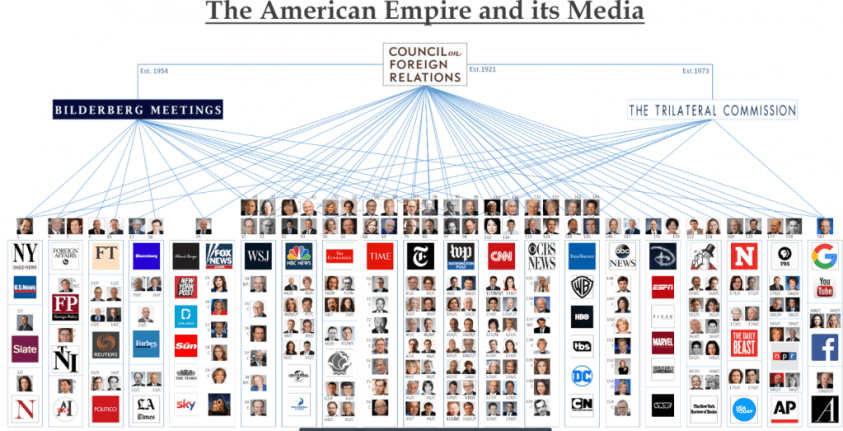
Richard Stengel — Technocracy Poster Boy
Knowing what you now know about the CFR, comments by Richard Stengel, the top state media appointee for President Biden’s transition team, will probably make a lot more sense.
During a 2018 CFR forum on fake news, Stengel — a CFR member and Atlantic Council fellow, former State Department official for the Obama administration, former managing editor for Time magazine, strategic adviser to Snap Inc., which runs Snapchat and Bitmoji and a political analyst on MSNBC — insisted governments must use propaganda on their citizens.36
He repeated this sentiment in November 2020, after being appointed to President Biden’s transition team, saying he’s “not against propaganda. Every country does it, and they have to do it to their own population. And I don’t necessarily think it’s that awful.”37 As reported by The GrayZone :38
“A committed crusader in what he openly describes as a global ‘information war,’ Stengel has proudly proclaimed his dedication to the careful management of the public’s access to information.”
Stengel has even proposed abolishing — “rethinking” — the First Amendment, which guarantees the freedom of speech and press, “for practical reasons in society.”39
Stengel’s presence in the Biden administration may be an augury of things to come, considering he created a nonclassified government entity during his Obama years, specifically to combat Russian disinformation.40 This entity, the Global Engagement Center, now facilitates the U.S. government’s efforts to spread its own propaganda around the world.
Stengel, with his close ties to several key centers of technocratic power — the U.S. government, the CFR, the Atlantic Council, mainstream media and Big Tech — is a veritable poster boy for modern technocracy, which makes his shameless promotion of censorship and propaganda more than a little understandable.
Pre-Mockingbird Media Manipulation
While Operation Mockingbird has earned a place in history as a point at which the free press was compromised, in reality, the infiltration of the press occurred long before the 1950s.
In his February 9, 1917, Congressional remarks, Congressman Oscar Callaway, D-Texas, explained the origin and execution of the plan to control and manipulate public opinion and mindset through media, which had taken shape just two years earlier:41
“In March, 1915, the J.P. Morgan interests, the steel, shipbuilding, and powder interest, and their subsidiary organizations, got together 12 men high up in the newspaper world and employed them to select the most influential newspapers in the United States and sufficient number of them to control generally the policy of the daily press.
They found it was only necessary to purchase the control of 25 of the greatest papers. An agreement was reached; the policy of the papers was bought, to be paid for by the month; an editor was furnished for each paper to properly supervise and edit information regarding the questions of preparedness, militarism, financial policies, and other things of national and international nature considered vital to the interests of the purchasers.”
Operation Mockingbird was essentially the CIA’s effort to consolidate, while simultaneously expanding, this secret hold over the media some three decades later. It’s a sobering thought to realize that virtually no one alive today has ever been informed by a truly free and independent press.
While the situation has surely deteriorated in more recent years, the covert use of mainstream media to manipulate and misdirect the public to protect the interests of the elite few has been par for the course for over 100 years.
The Propaganda Multipliers
When it comes to the actual dissemination of fake news and propaganda, news agencies play a central role, and there’s only three of them: The Associated Press (AP), Reuters and Agence France-Presse (AFP). As explained in the Swiss Policy Research post, “The Propaganda Multiplier”:42
“The key role played by these agencies means Western media often report on the same topics, even using the same wording. In addition, governments, military and intelligence services use these global news agencies as multipliers to spread their messages around the world.
A study of the Syria war coverage by nine leading European newspapers clearly illustrates these issues: 78% of all articles were based in whole or in part on agency reports … 0% on investigative research. Moreover, 82% of all opinion pieces and interviews were in favor of a U.S. and NATO intervention, while propaganda was attributed exclusively to the opposite side.”
In short, until or unless at least one of these news agencies sends out a notice, national and local media are unlikely to report on certain events. Even photos and videos are often sourced directly from these global news agencies. This way, people hear, see and read the exact same message everywhere.
“This dependency on the global agencies creates a striking similarity in international reporting: from Vienna to Washington, our media often report the same topics, using many of the same phrases — a phenomenon that would otherwise rather be associated with ‘controlled media’ in authoritarian states,” Swiss Policy Research writes.43
Even media outlets that have foreign correspondents on their payroll do not expect those correspondents to conduct independent investigations. They too simply report whatever the Big Three news agencies want covered, and from the angle they want it covered. What you end up with is a sort of echo-chamber where only one view is presented. As one might expect, this setup makes for a perfect propaganda machine.
As noted by Swiss Policy Research, “Due to the rather low journalistic performance of the mainstream media and their high dependence on a few news agencies, it is easy for interested parties to spread propaganda and disinformation in a supposedly respectable format to a worldwide audience.” Intelligence agencies and defense ministries are well aware of this and use it with regularity, as surely does the CFR and the rest of the technocratic apparatus.
In short, the current censoring and labeling of anything that threatens the technocratic agenda and the profiteering of its members as “misinformation” and “disinformation” is a top-down scheme. It’s not random, by any means, and it’s not driven by the opinions of private companies themselves. Social media companies, for example, are mere tools for the technocratic deep state, which operates worldwide.
The question then becomes, if propaganda is that deeply entrenched in our media structure, how do we know what is true and what is not? There’s no easy answer to this question, but the solution involves first becoming aware of the fact that media lies, and that there is a reason for why the media narrative is what it is. One way to evaluate the news is to ask yourself, “Why might they want me to think of this in this particular way?” Eventually, patterns begin to form.
Ultimately, to find the truth, you must be willing to look for it, and to look in places outside the mainstream media consortium. You have to ask questions and reason your way through the information you find. If something doesn’t make sense yet you’re told to accept it without question, it’s probably propaganda.
Any number of COVID-19 restrictions, for example, have been illogical in the extreme, which tells us they’re not about protecting people from infection. It’s about something else, and that something else has often been the purposeful destruction of small businesses to facilitate wealth transfer from the middle- and lower class to the top echelon. Ultimately, that is the plan, and to stop it, we have to stop believing the propaganda. It’s just that simple. And that challenging.
Sources and References
- 1, 6 ATI March 12, 2018
- 2, 4 SGT Report October 7, 2019
- 3, 5, 7 Free Press July 17, 2013
- 8 Telegraph Trojan Horse Undermining Russia
- 9, 10 The GrayZone February 20, 2021
- 11 The Independent July 7, 2020
- 12 The Anti-Vaxx Playbook (PDF), Page 9
- 13 The Anti-Vaxx Playbook (PDF), Page 10
- 14 The Anti-Vaxx Playbook (PDF), Page 43
- 15, 20 The Times November 9, 2020
- 16 UK Defense Journal November 10, 2020
- 17 The National News November 9, 2020
- 18, 28 Unlimited Hangout November 11, 2020
- 19 GCHQ.gov.UK
- 21, 24, 25, 26 The Infragard Journal June 2019; 2(1) (PDF)
- 22 InfraGard
- 23 InfraGard About Us
- 27 PR Newswire October 1, 2020
- 29 Dropbox NewsGuard Partners
- 30 World Economic Forum July 13, 2020
- 31, 33 Swiss Policy Research The American Empire and Its Media
- 32 Council on Foreign Relations: The Imperial Council of the US
- 34 Amazon.com American War Machine by Peter Dale Scott
- 35, 41 Global Research September 30, 2019
- 36 The New American July 16, 2018
- 37, 38, 39, 40 The GrayZone November 11, 2020
- 42, 43 Swiss Policy Research, The Propaganda Multiplier
Featured Video
More Iran War fallout: Maritime insurance industry shifts from London to China
or go to
Aletho News Archives – Video-Images
From the Archives
The Biggest Threat to Peace in Middle East
By Dr. Elias Akleh* | Sabbah Report | May 24, 2010
A build up of heightened tension in the Middle East is escalating in the last few weeks. American and Israeli postures towards Lebanon, Syria, and Iran have become more threatening. Listening to speeches of political leaders one hears talks only about war not peace. Iranians and Israelis are continuously training hard for a possible showdown. Both sides are conducting extensive war games every month. This led Syrians to claim that Israel is preparing for a soon-to-come another war. The Jordanians also are warning that current stalemate of the peace process is an indication of a war breaking out this summer. The Russian President and his army chief hinted, a few months ago, that the US and Israel were planning for an attack on Iran.
Indeed Iran is, as it has been for last few years, the target of most of the threats and accusations of supporting terrorism. Escalating incitement against Iran the American Defense Department sent last month (April) to Congress a report on Iran’s military claiming Iran could develop intercontinental ballistic missiles capable of reaching the US by 2015.
Ignoring the fact that N. Korea, India, Pakistan, and Israel are proven to have nuclear weapons while Iran does not, the US Secretary of State Hillary Clinton chose in her speech, to the nuclear Non-Proliferation Treaty review conference at the UN, to focus on Iran’s alleged nuclear ambitions putting the whole world at risk as she put it. According to Clinton Iran’s acquisition of nuclear weapons, rather than Israel’s more than 200 nuclear bombs, is destabilizing the Middle East. She called on the world’s nations to rally around US efforts to hold Iran, not other nuclear countries, to account.
The accusation that Usama Bin Laden is living comfortably in Iran had received a boost after the broadcast of a documentary called “Feathered Cocaine”. This echoed the June 2003 claims of the Italian newspaper Corre de la Sierra that Bin Laden was in Iran according to some intelligence report, and according to Richard Miniter’s book “Shadow War”. … continue
Blog Roll
 Aletho News
- The coming military and psychological unravelling?
- Iran has the last laugh
- More Iran War fallout: Maritime insurance industry shifts from London to China
- US-Israeli aggression on Iran triggers review of GCC countries’ investment pledges to Washington
- Russia slams UK plan to seize tankers suspected of carrying its oil
- Pakistan ramps up food exports to Persian Gulf nations as war deepens food insecurity
- Iran submits response to US plan, sets terms for war’s end: Tasnim
- US vs Iran: Kharg Island Talk — Bluff or Escalation? Ex-Military Officer Weighs In
- Zelensky unnecessarily involves Ukraine in the Middle East crisis
- Turkish tanker blacklisted by Ukraine hit in drone attack – media
- If Americans Knew
- ‘No Innocent Children’: Far-right Israeli Lawmaker Defends Killing of Palestinian Family
- Mossad’s promises helped Netanyahu convince Trump that Iran could be toppled
- US Arms Control Official Refuses To Comment When Asked If Israel Has Nuclear Weapons
- Veterans warn US landing could be ‘more Gallipoli than Vietnam’
- Israel may be committing war crimes in Lebanon – Not a ceasefire Day 167
- In the West Bank, life is a constant battle – 3 articles
- Jacob Reses, one of the most powerful pro-Israel operatives in Trump’s Washington
- Israeli-US assaults kill or injure 87 children a day – Not a ceasefire Day 166
- ‘Forever live by the sword’: Understanding Israelis’ massive support for Iran war
- UN’s special rapporteur on human rights says Israel is systematically torturing Palestinians
- No Tricks Zone
- Devastating Assessment Of Comirnaty Vaccine By Former Senior Pfizer Europe Toxicologist
- New Study: CO2 Is ‘Effectively Negligible’ As An Explanatory Climate Change Factor Since 2000
- Former Pfizer Toxicologist Dr. Helmut Sterz Tells Bundestag Hearing Pfizer Vaccine Should Have Never Been Approved
- Energy Expert: Germany’s Nuclear Phaseout Was A “500 Billion Euro Mistake”
- New Research: South Australia’s Mid-Holocene Sea Surface Temperatures Were 4°C Warmer Than Today
- Storing Green Energy To Last Germany 10 Days Would Require A 60-Million Tonne Battery
- New Studies: UK Sea Levels Were 4 Meters Higher Than Today During The Mid-Holocene
- Destructive Green New Deal: German Energy And Metal Group Warns Of Drastic Crisis
- New Study Documents A 20-Year Pause In Arctic Sea Ice Decline – Driven By Internal Variability
- Wake-up Call: Survey Shows Majority Of Germans Now Favor Postponing Climate Targets!
 Aletho News