Claims About Alleged GRU Cyberattack on UK-Based TV Inconsistent – Embassy
Sputnik – 07.10.2018
LONDON – The Russian Embassy in London pointed Saturday to the contradictions in the article released by the Financial Times newspaper, which claimed that the Russian military intelligence service GRU had allegedly conducted a cyberattack on the UK-based Islam Channel TV broadcaster in 2015.
On Friday, the Financial Times reported, citing non-designated UK officials, that the GRU officers allegedly hacked the computer network of the UK-based TV station in 2015. The news outlet has not provided any evidence, proving the claims. The newspaper has not specified why Russia would “attack” the broadcaster either. In addition, all the sources of information mentioned in the article were anonymous.
“What is interesting about the article is that it claims that hackers, supposedly, had complete control over the TV channel’s infrastructure during the intrusion. Then [the article] claims that the [UK] Home Office staff called [the broadcaster] and informed it of the cyberattack and says that ‘we [the TV station’s staff] had not noticed any irregularities in the work of the channel until this call.’ The information in this article does not withstand the slightest criticism, it seems it was written in a hurry, and the logical pattern was disrupted. [The article’s] main goal is clear — to bring another accusation against Russia,” a representative of the embassy told reporters.
The representative stressed that the embassy usually refrained from commenting on newspaper articles based on leakages from the UK security services because nobody was willing to take responsibility for the allegations. He added that the UK Foreign Office habitually left Moscow’s requests concerning such publications without answer.
On Thursday, the UK Foreign Office said it assessed “with high confidence” that GRU was “almost certainly” responsible for a series of cyberattacks on political institutions, media outlets and infrastructure across the globe. The Foreign Office mentioned a UK-based TV station among the targets of the attacks.
Later on Thursday, the Dutch Defense Ministry claimed that four Russian citizens holding diplomatic passports had been expelled from the Netherlands in April on suspicion of an attempted cyberattack on the Organization for the Prohibition of Chemical Weapons (OPCW).
The Russian Foreign Ministry refuted the claims on Thursday and stressed that the “spymania campaign” unleashed in the Netherlands was seriously hurting bilateral relations with Russia. The ministry pointed out that the Netherlands made the statement ahead of the OPCW opening session, which could set up the “necessary’ political background” to push through some illegal initiatives that Russia opposed.
Canada and the United States subsequently joined the allegations against GRU, claiming that seven Russian military intelligence officials allegedly targeted with cyberattacks the US Westinghouse nuclear power company and multiple anti-doping agencies and athletes. Meanwhile, Russia’s proposal for the establishment of a joint task force on cybersecurity has been earlier rejected by Washington.
Russian Deputy Foreign Minister Sergey Ryabkov has said that the United States “poisoned” Russian-US relations by its new allegations against Russian security services. The diplomat noted the danger of fueling tensions between two nuclear powers.
The Lies of our (Financial) Times
By James Petras | Dissident Voice | October 4, 2018
The leading financial publications have misled their political and investor subscribers of emerging crises and military defeats which have precipitated catastrophic political and economic losses.
The most egregious example is the Financial Times (FT) a publication which is widely read by the business and financial elite.
In this essay we will proceed by outlining the larger political context that sets the framework for the transformation of the FT from a relatively objective purveyor of world news into a propagator of wars and failed economic policies.
In part two we will discuss several case studies which illustrate the dramatic shifts from a prudent business publication to a rabid military advocate, from a well-researched analyst of economic policies to an ideologue of the worst speculative investors.
The decay of the quality of its reportage is accompanied by the bastardization of language. Concepts are distorted; meanings are emptied of their cognitive sense; and vitriol covers crimes and misdemeanors.
We will conclude by discussing how and why the ‘respectable’ media have affected real world political and market outcomes for citizens and investors.
Political and Economic Context
The decay of the FT cannot be separated from the global political and economic transformations in which it publishes and circulates. The demise of the Soviet Union, the pillage of Russia’s economy throughout the 1990s and the US declaration of a unipolar world were celebrated by the FT as great success stories for ‘western values’. The US and EU annexation of Eastern Europe, the Balkan and Baltic states led to the deep corruption and decay of journalistic narratives.
The FT willingly embraced every violation of the Gorbachev-Reagan agreements and NATO’s march to the borders of Russia. The militarization of US foreign policy was accompanied by the FT conversion to a military interpreter of what it dubbed the ‘transition to democratization’.
The language of the FT reportage combined democratic rhetoric with an embrace of military practices. This became the hallmark for all future coverage and editorializing. The FT military policies extended from Europe to the Middle East, the Caucasus, North Africa and the Gulf States.
The FT joined the yellow press in describing military power grabs, including the overthrow of political adversaries, as ‘transitions to democracy’ and the creation of ‘open societies’.
The unanimity of the liberal and right-wing publications in support of western imperialism precluded any understanding of the enormous political and economic costs which ensued.
To protect itself from its most egregious ideological foibles, the FT included ‘insurance clauses’, to cover for catastrophic authoritarian outcomes. For example they advised western political leaders to promote military interventions and, by the way, with ‘democratic transitions’.
When it became evident that US-NATO wars did not lead to happy endings but turned into prolonged insurgencies, or when western clients turned into corrupt tyrants, the FT claimed that this was not what they meant by a ‘democratic transition’ – this was not their version of “free markets and free votes”.
The Financial and Military Times (?)
The militarization of the FT led it to embrace a military definition of political reality. The human and especially the economic costs, the lost markets, investments and resources were subordinated to the military outcomes of ‘wars against terrorism’ and ‘Russian authoritarianism’.
Each and every Financial Times report and editorial promoting western military interventions over the past two decades resulted in large scale, long-term economic losses.
The FT supported the US war against Iraq which led to the ending of important billion-dollar oil deals (oil for food) signed off with President Saddam Hussein. The subsequent US occupation precluded a subsequent revival of the oil industry. The US appointed client regime pillaged the multi-billion dollar reconstruction programs – costing US and EU taxpayers and depriving Iraqis of basic necessities.
Insurgent militias, including ISIS, gained control over half the country and precluded the entry of any new investment.
The US and FT backed western client regimes organized rigged election outcomes and looted the treasury of oil revenues, arousing the wrath of the population lacking electricity, potable water and other necessities.
The FT backed war, occupation and control of Iraq was an unmitigated disaster.
Similar outcomes resulted from the FT support for the invasions of Afghanistan, Libya, Syria and Yemen.
For example the FT propagated the story that the Taliban was providing sanctuary for bin Laden’s planning the terror assault in the US (9/11).
In fact, the Afghan leaders offered to turn over the US suspect, if they were offered evidence. Washington rejected the offer, invaded Kabul and the FT joined the chorus backing the so-called ‘war on terrorism which led to an unending, one trillion-dollar war.
Libya signed off to a disarmament and multi-billion-dollar oil agreement with the US in 2003. In 2011 the US and its western allies bombed Libya, murdered Gaddafi, totally destroyed civil society and undermined the US/EU oil agreements. The FT backed the war but decried the outcome. The FT followed a familiar ploy; promoting military invasions and then, after the fact, criticizing the economic disasters.
The FT led the media charge in favor of the western proxy war against Syria: savaging the legitimate government and praising the mercenary terrorists, which it dubbed ‘rebels’ and ‘militants’ – dubious terms for US and EU financed operatives.
Millions of refugees, resulting from western wars in Libya, Syria, Afghanistan and Iraq fled to Europe seeking refuge. FT described the imperial holocaust – the ‘dilemmas of Europe’. The FT bemoaned the rise of the anti-immigrant parties but never assumed responsibility for the wars which forced the millions to flee to the west.
The FT columnists prattle about ‘western values’ and criticize the ‘far right’ but abjured any sustained attack of Israel’s daily massacre of Palestinians. Instead readers get a dose of weekly puff pieces concerning Israeli politics with nary a mention of Zionist power over US foreign policy.
FT: Sanctions, Plots and Crises — Russia, China and Iran
The FT like all the prestigious media propaganda sheets have taken a leading role in US conflicts with Russia, China and Iran.
For years the scribes in the FT stable have discovered (or invented) “crises” in China’s economy- always claiming it was on the verge of an economic doomsday. Contrary to the FT, China has been growing at four times the rate of the US; ignoring the critics it built a global infrastructure system instead of the multi-wars backed by the journalist war mongers.
When China innovates, the FT harps on techno theft — ignoring US economic decline.
The FT boasts it writes “without fear and without favor” which translates into serving imperial powers voluntarily.
When the US sanctions China we are told by the FT that Washington is correcting China’s abusive statist policies. Because China does not impose military outposts to match the eight hundred US military bases on five continents, the FT invents what it calls ‘debt colonialism” apparently describing Beijing’s financing large-scale productive infrastructure projects.
The perverse logic of the FT extends to Russia. To cover up for the US financed coup in the Ukraine it converted a separatist movement in Donbass into a Russian land grab. In the same way a free election in Crimea is described as Kremlin annexation.
The FT provides the language of the declining western imperial empires.
Independent, democratic Russia, free of western pillage and electoral meddling is labelled “authoritarian”; social welfare which serves to decrease inequality is denigrated as ‘populism’ —linked to the far right. Without evidence or independent verification, the FT fabricates Putinesque poison plots in England and Bashar Assad poison gas conspiracies in Syria.
Conclusion
The FT has chosen to adopt a military line which has led to a long series of financially disastrous wars. The FT support of sanctions has cost oil companies billions of dollars, euros and pounds. The sanctions, it backed, have broken global networks.
The FT has adopted ideological postures that threaten supply chains between the West, China, Iran and Russia. The FT writes in many tongues but it has failed to inform its financial readers that it bears some responsibility for markets which are under siege.
There is unquestionably a need to overhaul the name and purpose of the FT. One journalist who was close to the editors suggests it should be called the “Military Times” – the voice of a declining empire.
The Financial Times: Megaphone for Mass Murder
By James Petras :: August 28, 2016
The Financial Times editorial page carries a logo that proclaims: “Without fear and without favour”. Indeed the editors have shown no fear when it comes to… fabricating lies, promoting imperial wars decimating countries and impoverishing millions, whether in Libya, Syria, Iraq, Afghanistan, Yemen and now Venezuela. The fearless “Lies of Our Times” have been at the forefront forging pretexts for inciting imperial armies to crush independent governments.
Despite its pretentious scribblers and prestigious claims, the FT is seen by the Anglo-American financial class as a belligerent purveyor of militarist policies designed for the most retrograde sectors of the ruling elite.
What is most striking about the FT fearless fabrications on behalf of imperial militarism is how often their political and economic prognostications have been incompetent and flat out wrong.
For the past ten years, the FT editorial pages have described China in economic crisis and heading for a fall, while in reality, the Chinese economy has grown at between eight and six percent a year.
For over a decade and a half, the FT editors claimed Russia under President Vladimir Putin presented an international existential threat to ‘the West’. In fact, it was the ‘Western’ armies of NATO, which expanded military operations to the borders of Russia, the US, which financed a neo-fascist coup in Kiev and the US-EU which promoted an Islamist uprising in Syria designed to totally undermine Russia’s influence and relations in the Middle East.
The FT’s economic gurus and its leading columnists prescribed the very catastrophic deregulatory formulas which precipitated the financial crash of 2008-09, after which they played the clownish role of “Mickey the Dunce” – blaming others for the failed policies.
The fearless FT scribes are currently leading a virulent propaganda campaign to promote the violent overthrow of the democratically elected Venezuelan government of President Nicolas Maduro.
This essay will identify the FT’s latest pack of fearless lies and fabrications and then conclude by analyzing the political consequences for Venezuela and other independent regimes.
The Financial Times and Venezuela: From War in the Suites to Terror in the Streets
In covering the crisis in Venezuela, the FT has systematically ignored the ongoing campaign of assaults and assassinations against elected officials, security officers, military and police who have been murdered by the FT’s favored ‘opposition’.
The FT did not cover the horrific murders of an elected Chavista congresswoman and her two young children, who were executed (shot in the head) in broad daylight by opposition-paid hitmen.
These ongoing opposition terror campaigns against the elected government and the general public are systematically ignored in the FTs ‘reports’ and on its editorial pages, which focus more on the shortages of consumer items.
The FT cover-up of right-wing terror extended to inventing a ‘possible’ army or National Guard plan to open fire on opposition demonstrators. In this case, the FT anticipated right-wing violence by laying the blame on the government in advance.
The FT covers-up the opposition business elite’s campaign of hoarding essential goods to create artificial shortages and panic buying. They deny the ongoing price gouging and pin the blame for shortages and long consumer lines exclusively on ‘regime mismanagement’.
The FT conveniently omits to mention that the decline in world oil prices has affected not only the economy of Venezuela but all countries dependent on commodity exports, including the Financial Times favorite neo-liberal regimes in Brazil and Argentina.
The Financial Times cites bogus ‘opinion’ polls, which wildly exaggerate the government’s declining popularity: In the recent elections Maduro’s supporters secured 40% of the popular vote while the FT claims his support to be 7%!
US client regimes (Mexico, Peru, and Colombia) are the largest producers of illegal drugs and US banks are the largest launderers for narco-money. Yet the FT reports on “Venezuela’s role as a conduit for illegal drugs smuggled north to the US and east into Brazil, Africa and thence to Europe”. Drug enforcement experts all agree that Colombia, home to seven US military bases and with a regime closely linked to paramilitary-narco gangs, is the source of drugs smuggled through Venezuela. That Venezuela has become a victim of the violent Colombian narco-trade is never acknowledged by the elegant City of London pen-prostitutes.
The FT blames the re-emergence of ‘malaria and other possible diseases’ on the leftist Maduro government. In fact the recent ‘malaria outbreak’ (also cited by the New York Times propagandists) is based on a single illegal gold miner.
The FT ignores how the US- backed neo-liberal regimes in Argentina and Brazil, which rule by presidential decree, have slashed public health programs setting the stage for much greater public health crises.
The Financial Times: Big Lies for Mass Murder
The Financial Times is waging an all-out propaganda war with one goal: To incite the violent seizure of power in Venezuela by US political clients.
In line with the Obama-Clinton ‘regime-change by any means’ policies, the FT paints a deceptive picture of Venezuela facing ‘multiple crises’, representing a ‘destabilizing’ threat to the hemisphere, and on the brink of a global ‘humanitarian crisis’.
Armed with these deadly clichés, the FT editorial pages demand “a new government soon and certainly before the 2018 elections”.
Recently, the FT proposed a phony legal gimmick — a recall referendum. However, since the opposition cannot initiate the vote in time to oust the elected President Maduro, the FT calls for “events which precipitate changes sooner” – a violent coup!
FT’s scenarios aim to precipitate a violent right-wing “march”, eventually provoking civil bloodshed in early September of this year.
The FT expects that “blood in Caracas will require an active Latin America response”(sic). In other words, the FT hopes that a US-backed military invasion from neighboring Colombia would help eliminate the Chavistas and install a rightist regime.
The Financial Times, which actively promoted the NATO-led destruction of the government in Libya, now calls for a US-led invasion of Venezuela. Never ones to re-assess their promotion of ‘regime change’, the FT now calls for a violent coup in Venezuela, which will exceed that of Libya in terms of the loss of thousands of Venezuelan lives and the brutal reversal of a decade of significant socio-economic progress.
“Without fear and without favor”, the FT speaks for imperial wars everywhere.
Conclusion
The US presidential elections take place just as the Obama-Clinton regime prepares to intervene in Venezuela. Using bogus ‘humanitarian’ reports of widespread hunger, disease, violence and instability, the Obama regime will still need Venezuelan thugs to provoke enough violent street violence to trigger an’ invitation’ for Washington’s Latin American military partners to ‘intervene’ under the auspices of the UN or OAS.
If ‘successful’, a rapid overthrow of the elected government in Caracas could be presented as a victory for Hilary Clinton’s campaign, and an example of her policy of ‘humanitarian-military interventions’ around the world.
However, if Obama’s allied invasion does not produce a quick and easy victory, if the Venezuelan people and armed forces mount a prolonged and courageous defense of their government and if US lives are lost in what could turn into a popular war of resistance, then Washington’s intervention could ultimately discredit the Clinton campaign and her ‘muscular’ foreign policy. The American electorate might finally decide against four more years of losing wars and losing lives. No thanks to the ‘fearless’ Financial Times.
Mainstream Media in America and Britain Repeat the Same Mistakes in Covering Iran That They Made on Iraq
By Flynt Leverett and Hillary Mann Leverett | Going to Tehran | May 13, 2013

In an excellent report released last month, the University of Maryland’s Center for International and Security Studies at Maryland (CISSM) offered a thoroughly documented—and devastating—critique of mainstream media coverage of the Iranian nuclear issue. Authored by Jonas Siegel and Saranaz Barforoush, Media Coverage of Iran’s Nuclear Program: An Analysis of U.S. and U.K. Coverage, 2009-2012, see here, reviews coverage of Iran’s nuclear activities and the international controversy surrounding those activities in six major English-language newspapers: the New York Times, the Wall Street Journal, the Washington Post, the Financial Times, the Guardian, and the Independent.
To quote from the report’s executive summary (with emphasis added), the authors found that
“–Newspaper coverage focused on the ‘he said/she said’ aspects of the policy debate, without adequately explaining the fundamental issues that should have been informing assessments—such as Iran’s nuclear capabilities and intentions, the influence of U.S., European, Iranian, and Israeli security strategies, and the impact of the nuclear nonproliferation regime.
–When newspaper coverage did address Iranian nuclear intentions and capabilities, it did so in a manner that lacked precision, was inconsistent over time, and failed to provide adequate sourcing and context for claims. This led to an inaccurate picture of the choices facing policy makers.
–Government officials, particularly U.S. government officials, were the most frequently quoted or relied-on sources in coverage of Iran’s nuclear program. This tendency focused attention on a narrow set of policy options and deemphasized other potential approaches to the dispute.
–Newspaper coverage generally adopted the tendency of U.S., European, and Israeli officials to place on Iran the burden to resolve the dispute over its nuclear program, failing to acknowledge the roles of these other countries in the dispute…
–Coverage of Iran’s nuclear program reflected and reinforced the negative sentiments about Iran that are broadly shared by U.S., European, and Israeli publics. This contributed to misunderstandings about the interests involved and narrowed the range of acceptable outcomes.
In general, these characteristics led newspapers to frame their coverage of Iran’s nuclear program in a manner that emphasized official narratives of the dispute and a relatively narrow range of policy choices available to officials. By not consistently describing the complex web of international relationships, security concerns, and intervening political factors in sufficient detail, newspaper coverage further privileged official narratives and policy preferences. This makes it likely that the policies enacted and under consideration by policy makers—coercive diplomacy and war—remain the most likely outcome of the dispute. In this way, news coverage of Iran’s nuclear program is reminiscent of news coverage of the run-up to the 2003 U.S.-led invasion of Iraq. News coverage has the potential to play a significant, constructive role in finding a lasting resolution to the dispute over Iran’s nuclear program, but journalists and editors first need to address the tendencies present in their current coverage of the topic.”
We encourage all to read and ponder, hard, this important new report.
Related articles
Logical Fallacies: The Financial Times on Syria and Uranium Stockpiles
News Unspun | January 10, 2013
On 8 January the Financial Times published an article by James Blitz, entitled ‘Fears raised over Syria uranium stockpile’, premised primarily on the ‘fears’ and otherwise subjective ruminations of unnamed ‘official’ and ‘expert’ sources, one the two named sources being former weapons inspector David Albright (discussed further below).
The claims of Blitz’s sources rest on the argument that, because we lack proof that something is false, it must be true (an ad ignorantiam argument). For example, Blitz states that, ‘Three satellite pictures of the Marj al-Sultan site taken in October, November and December of 2012 and shown to the FT […] appear to show the gradual clearance of a large orchard there, for no apparent reason’. And so, the clearance has triggered fears that (a) the site is ‘a secret uranium conversion facility’, and (b) that tonnes of uranium have been transferred to the site. Because we do not have proof that the orchard has not been cleared for the transfer of uranium, this is cause for concern that this may be the case, according to the article.
Blitz’s sources claim that they have legitimate concerns about a uranium stockpile in Syria, enough uranium they say ‘to provide weapons-grade fuel for five atomic devices’, which could then be transferred ‘from Syria to Iran by air’.
The overarching concern of the article is that Iran would be provided with ‘a “vital resource” [which could] possibly be used to build a bomb’. This depends on a series of speculative claims made by Blitz’s sources turning out to be simultaneously true, with the addition of Iran ‘attempt[ing] to build another secret uranium plant’ (Blitz doesn’t expand on the meaning of ‘another’). To reach this conclusion, the following must all occur:
1. Syria must be in possession of 50 tonnes of unenriched uranium. (Blitz plainly states, in the opening paragraph, that cause for concern lies with ‘up to 50 tonnes of unenriched uranium’ – the implication being that such a thing actually exists – before later backtracking to suggest uncertainty with the inclusion of the clause ‘if it exists’ in reference to the uranium.)
2. The Marj al-Sultan site must actually be a uranium conversion facility. (The report notes that such claims are alleged: ‘what [the experts] allege is a secret uranium conversion facility that the Syrian regime built at the town of Marj al-Sultan near Damascus’.)
3. The uranium must be at the site. (‘Whether the uranium is at the site is unclear, the officials conceded’.)
4. Iran must be trying to ‘seize’ the uranium. (‘Iran, which is closely allied to the Syrian regime and urgently needs uranium for its nuclear programme, might be trying to seize such a stockpile’.)
Given that the above scenarios are at best uncertain and at worst hypothetical, the credibility given to the argument that this might result in Iran ‘building the bomb’ is questionable.
One of Blitz’s two named sources is David Albright, former weapons inspector and head of the Institute for Science and International Security (ISIS). Put forward as a ‘leading expert’ on the Iranian nuclear programme, he is quoted as having concerns about the ‘whereabouts of this uranium’, which Blitz concedes may or may not exist. Albright’s past speculations on states he supposed had been hiding nuclear weapons is worth considering. In August 2002, eight months before the US-led invasion of Iraq, he was interviewed by The Guardian in an article entitled ‘Does Iraq have a nuclear weapon?’ Below are three quotes from the article, which highlight to some degree the lack of substance to his arguments:
‘People have argued that you could find nuclear facilities quickly as they are big, but Iraq knows how to make them small…The clock is ticking’.
‘You would think that if Iraq had a nuclear weapon, it would have done something to show it. But then you can’t be certain’.
‘Once it gets the gas-centrifuge programme, you have to assume that it could make [a bomb] in half a year’.
More recently, Albright has been the co-author of a report from ISIS entitled ‘New Satellite Image Shows Activity at Parchin Site in Iran’. The introduction to the report discusses a satellite image which ‘shows what appears to be a stream of water that emanates from or near the building’ that ‘raises concerns that Iran may have been washing inside the building, or perhaps washing the items outside the building’. This and other activities at the Parchin site that have been seen in the last year on satellite images, such as the movement of lorries, and the demolishing of a building, provide the sole basis for Albright’s argument that there has been a nuclear cover-up. In the Financial Times article, Blitz’s reference to ‘the gradual clearance of a large orchard’ is in a similar vein to the speculations that ISIS have made in the past about Iran.
As Albright’s targets are generally the official ‘enemies’ of the west, he receives respectful attention from the UK media, despite an absence of any factual substance to his work.
The ‘concerns’ Blitz reports on belong to his sources, so it is their judgement, and not just his, which is premised on fallacy. Blitz, however, has based his entire argument, without criticism, on the opinions of these officials, and has further developed them into a foretelling narrative, one which doesn’t stand up to even the slightest scrutiny.
Starving the Syrians for Human Rights
Physicians for Human Rights Supports Tougher U.S. Sanctions
By John V. Walsh | Dissident Voice | May 10th, 2012
The wing of the U.S. human rights movement which targets foreign countries can wind up as a cruel business, aiding the ruthless and violent actions of the U.S. Empire, wittingly or not. For the U.S. all too often uses human rights as a cover for taking action against countries that defy the Empire’s control.
Some weeks back, I decided to look into one such group, Physicians for Human Rights (PHR), an organization I had long refrained from joining out of skepticism. But perhaps, I thought, PHR had sidestepped the dangers inherent in this work. So I joined to find out.
Some days later I received my first email from PHR. I was floored by the heading, “Protect Syrian Citizens: Help Make Sanctions Tougher.” The word “tougher” struck me. The email read in part: “Help us impose tougher sanctions on Pres. Assad’s brutal regime. The Syria Sanctions Act of 2011, S. 1472, will target Syria’s energy and financial sectors. Contact your Senators today and urge them to back S. 1472.” The sponsor of this bill was Kirsten Gillibrand, and among the 12 co-sponsors were two neocon leaders, John McCain and Joe Lieberman, the latter hardly a human rights stalwart when it comes to Palestinians. Did that not ring alarm bells at PHR?
Sanctions Target the Syrian People, Bringing Poverty and Hunger
PHR argues that the sanctions are “targeted” at the oil and financial sectors and therefore are of consequence only for the Syrian elite. Since 25% of the revenue of the Syrian government comes from oil revenues (according to the text of the bill), expenditures providing needed relief to the population, for example, the current price supports for food, will certainly be affected. But it is not only the revenues of the Syrian government that are affected. The Financial Times reports:
The most significant sanctions are on the oil industry, estimated by the International Monetary Fund to have accounted for almost a fifth of gross domestic product in 2010. Analysts estimate that they helped contribute to a contraction of 2-10 per cent to Syria’s economy last year (2011).
The results of the sanctions should be obvious with only a moment’s thought. If the Assad regime is as nefarious as PHR claims, then certainly it will put itself way ahead of the common people as sanctions bite. Such an attitude is the norm not the exception in the world today. But even if the leaders of the human rights community could not figure this out, the impact of the sanctions on ordinary Syrians is hardly a secret, even in the mainstream press. Thus in March the Washington Post ran an article entitled “Syria running out of cash as sanctions take toll, but Assad avoids economic pain.” One did not even need to read beyond the headline to get the point. The article reports as follows:
The financial hemorrhaging has forced Syrian officials to stop providing education, health care and other essential services in some parts of the country, and has prompted the government to seek more help from Iran to prop up the country’s sagging currency.… Revenue from Syrian oil, meanwhile, has almost dried up, with even China and India declining to accept the nation’s crude….. At the same time, President Bashar al-Assad appears to have shielded himself and his inner circle from much of the pain of the sanctions and trade embargoes, which are driving up food and fuel prices for many of the country’s 20 million residents…
The Washington Post is not alone in this assessment. The Financial Times tells us:
A murky broader picture (emerges) suggesting that while some sanctions are hurting the regime of Bashar al-Assad, the president, and its alleged associates, they are also hurting ordinary Syrians … David Butter, a Middle East economic expert, said: ‘If it’s a scrap for limited resources, the regime is still in a position to get the first rights, whether fuel or cash or food. It [the sanctions regime] hurts them but to really cripple them is going to take a long time.
And the effect desired by the U.S. is quite clear. Another article in the Washington Post with the headline “Amid Unrest, Syrians Struggle to Feed Their Families” reports that food prices have risen as the result of sanctions. As a result the Assad government in March “introduced a system of price-fixing for essential foods that has stabilized the cost of bread, sugar and meat — although they remain much higher than they were a year ago. ….. ‘ Despite efforts to mitigate the problem around half of Syrians may live in poverty, said Salman Shaikh of the Brookings Institute in Doha, who argued that this is increasing anti-government feeling.” Regime change is the point. And the pronouncements of Obama and Hillary make this abundantly clear.
The Empire in Desperation Pulls Out all the Stops to bring Syria to Heel
Since Russia and China drew a line in the sand to stop the overthrow of the Syrian regime by the West, the United States appears increasingly desperate. That desperation has grown since the UN-brokered cease-fire has terminated much of the fighting and killing, however imperfectly.
But is not the Assad government to blame for the failures of the cease-fire? If so, it is certainly not alone. Recently the NYT reported: “An explosion killed at least three people in Aleppo, and two blasts hit a Damascus highway on Saturday in further signs that rebels fighting to topple President Bashar al-Assad are shifting tactics toward homemade explosives. Syria’s state news agency said three people had been killed, one of them a child, and 21 had been wounded by a booby-trapped car in the northern city of Aleppo. The Syrian Observatory for Humans Rights, an opposition group based in Britain that relies on information from Syrian activists, said the blast destroyed a carwash in Tal al-Zarazeer, a poor suburb, and killed five people. A member of the rebel Free Syrian Army claimed responsibility for the bombing, saying that the carwash was used by members of a pro-Assad militia.”
A car wash is hardly a target that is focused on the military. And today The Guardian and others reported that a Syrian military convoy protecting the UN observer mission was hit by a roadside explosion, injuring six Syrian soldiers, three badly. When Russian officials accuse the Syrian opposition of “terrorist tactics,” it appears that they have a point.
PHR has certainly done some good things in the past; for example, documenting human rights violations and medical abuses in Gaza and the West Bank – although this work is now solidly in the hands of the Israeli division of PHR, meaning, among other things, that it will get less attention in the U.S. And at no point has PHR called for boycotts against Israel, a regime that has killed untold thousands of Palestinians in what amounts to a long slow genocide. In the eyes of PHR it would appear that official enemies of the U.S. Empire deserve sanctions, whereas allies who violate the most basic human rights get an investigation and a tongue lashing – at most.
In fact, sanctions are the work of our imperial government; and when a “human rights” organization gets into the business of supporting them, it is de facto in the business of supporting the Empire and its drive for domination. 1 Token ruminations about human rights violations by U.S. “allies” or clients do not alter this fact. Such ruminations serve as little more than a cover for the real use of these groups to the Empire. Whether the PHR policy makers understand this or not makes little difference.
So what was this PHR member to do in the face of such a stance by his organization? This writer called the Boston office, the home office, to complain about the decision to back the Sanctions bill. I was given to understand by one staffer that I was not the only member to register dissatisfaction. I inquired who made this decision and how it was made. Initially I was told that such decisions were not made in the home office but at a smaller office in Washington, which works closely with Congress. In a subsequent email I was told that “the policy and program decisions are made by our Executive Management team.” Who is the “Executive Management Team”? This member does not know and has not been told. Furthermore the PHR web site does not contain any information about the Executive Management Team, as far as I can see. Are personnel of the U.S. government consulted in such deliberations? (The PHR membership clearly is not.) And should not such an important decision at least have some input from the members?
But PHR is not alone in providing cover for the designs of the Empire. They are but one example. Other human rights organizations appear to be jumping on the bandwagon. And, of course, the U.S. government is happy to have their support. Syria is clearly the gateway to Iran – and both countries have refused to one degree or another to submit to the will of the U.S. So regime change for both countries is high on the agenda of the West. That is the way of Empire.
PHR started out at its founding in 1978 documenting the abuses of the Pinochet government, a client of the Empire. Today it has descended into an instrument for justifying an attack on one of the official enemies of the U.S. That is the danger of a “human rights” approach if uninformed by an understanding of the designs and ruthlessness of the Empire.
The core of the physicians’ credo is “First do no harm.” Starving a people for the sake of “human rights” as part of a campaign that serves imperial machinations for regime change hardly fits into that injunction. And certainly PHR knows that diseases arising from privation and hunger fall most heavily on non-combatants, children and the elderly especially. That is no secret either. Perhaps PHR is echoing the judgment of Madeleine Albright on Iraq that the human carnage of the sanctions is “worth it.” However, from an ethical viewpoint, that judgment does not belong to citizens of the Empire living in comfort far from the victims in Syria.
- It is interesting to read what is necessary for such sanctions to be lifted once imposed. The bill states the following:“Termination will occur “on the date the President submits to Congress a certification that the government of Syria is democratically elected and representative of the people of Syria and a certification under the Syria Accountability and Lebanese Sovereignty Restoration Act of 2003 that the Syrian government has:
- ceased support for international terrorist groups;
- ended its occupation of Lebanon;
- ceased development and deployment of ballistic missiles and biological, chemical, or nuclear weapons and agreed to verification measures; and
- ceased all support for, and facilitation of, terrorist activities in Iraq.”
Given that one of the named “terrorist groups” is Hamas, which is the duly elected government in Gaza, and given the murkiness of the other requirements, this is a tall order indeed
John V. Walsh can be reached at john.endwar@gmail.com.
Featured Video
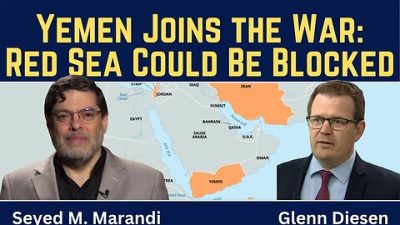
Yemen joins the war – Red Sea could be blocked next – Saudi regime at risk
or go to
Aletho News Archives – Video-Images
From the Archives
A superpower and “the world’s sickest warrior state”
By Paul J. Balles | March 8, 2010
Living through five or six major wars has hardened me to what I thought were the extremes of inhuman cruelty and brutality.
Two things made those extremes almost bearable: the brutality always revealed – at least according to the media coverage – the viciousness of the enemy. It was therefore quite understandable when our “brave men and women” pulverized the enemy.
Films of Japanese torturing captive Americans somehow justified holding Japanese Americans in internment camps during World War II; and only a small percentage of Americans found the bombing of Hiroshima and Nagasaki unreasonably vengeful at best, at worst, depraved.
The media giants in America portrayed the North Koreans as barbaric beasts with their captives, quite unlike their southern counterpoints – our allies during the Korean War. No one ever felt the need to explain how the South Koreans were a civilized breed while the North Koreans were absolute savages, at least according to the official line.
In Vietnam, our warriors justifiably (or so the media made us believe) dropped napalm on the North Vietnamese who had the gall to hide in villages and tunnels to ravage our invaders. At least it was accepted practice until some rogue photojournalist filmed a young girl screaming down a Vietnamese road in flames. … continue
Blog Roll
 Aletho News
- Russian tanker approaches Cuba despite US oil blockade
- Marandi: Yemen joins the war – Red Sea could be blocked next – Saudi regime at risk
- Pro-Palestinian French member of European Parliament denied entry to Canada
- Pakistan to Host US-Iran Talks
- How Indonesia’s tilt toward the US left it stranded in the Strait of Hormuz
- US has no choice but to retreat from Iranian borders: Top commander
- Iran Retaliation Strikes Chemical Plant Near Dimona
- AWACS’ Destruction is a Major Loss for US Military – Ex-DoW Analyst
- Israel’s Iran Strategy Uses US Military & Gulf States as Its Pawns
- Iran: Trump wanted regime change, now just begging for Hormuz to open
- If Americans Knew
- Israeli police block Catholic cardinal from entering Church of the Holy Sepulchre on Palm Sunday
- Israel is assassinating journalists again, more than any other nation, anywhere, ever – Not a ceasefire Day 170
- Over 300 US service members wounded, majority have brain injuries – Not a ceasefire Day 169
- Researchers at Human Rights Watch Resign Over Blocked Report on Palestinian Refugee Return
- Jewish Groups Are Backing a War Americans Don’t Want
- Eric Fingerhut Thinks He’s the President of the Jews
- Top Jewish Philanthropists, Rabbis Urge Israeli President to Take Action Against ‘Jewish Extremists’
- Don’t Be Fooled. Zionist Leaders Have Always Wanted to Control Southern Lebanon
- Israel’s widespread use of torture is a core element of its genocide against the Palestinian people
- In Israel’s War on Iran, Many Middle East US Bases Rendered “All But Uninhabitable”
- No Tricks Zone
- German Science Blog Accuses PIK Climate Institute Of Hallucinating Climate Tipping Points
- Devastating Assessment Of Comirnaty Vaccine By Former Senior Pfizer Europe Toxicologist
- New Study: CO2 Is ‘Effectively Negligible’ As An Explanatory Climate Change Factor Since 2000
- Former Pfizer Toxicologist Dr. Helmut Sterz Tells Bundestag Hearing Pfizer Vaccine Should Have Never Been Approved
- Energy Expert: Germany’s Nuclear Phaseout Was A “500 Billion Euro Mistake”
- New Research: South Australia’s Mid-Holocene Sea Surface Temperatures Were 4°C Warmer Than Today
- Storing Green Energy To Last Germany 10 Days Would Require A 60-Million Tonne Battery
- New Studies: UK Sea Levels Were 4 Meters Higher Than Today During The Mid-Holocene
- Destructive Green New Deal: German Energy And Metal Group Warns Of Drastic Crisis
- New Study Documents A 20-Year Pause In Arctic Sea Ice Decline – Driven By Internal Variability
 Aletho News