People in NATO Countries Say ‘No’ to Supporting a NATO Ally in a Military Conflict with Russia
By Adam Dick | Ron Paul Institute | February 11, 2020
NATO is marketed as providing each member nation with the benefit that the other member nations are committed to coming to its aid militarily in the event of an attack by another nation, especially Russia. However, Pew Research Center poll results released Sunday indicate that the majority or plurality of people in 11 of 16 NATO countries where individuals were questioned oppose their respective governments meeting this commitment, at least if the military adversary were Russia.
These poll results indicate that serious thought should be given to disbanding NATO, an organization with a primary objective that appears to be at odds with public opinion in many NATO countries.
When asked if their respective countries’ governments should use military force to defend a NATO ally country neighboring Russia with which “Russia got into a serious military conflict,” people living in the 16 NATO countries tended to answer in the negative. “No” was the answer for the majority of polled individuals in eight countries — France, Germany, Greece, Italy, Spain, Bulgaria, Slovakia, and Turkey. In three more NATO countries — the Czech Republic, Hungary, and Poland — a plurality rejected military intervention. Only in five countries — the United States, Canada, the United Kingdom, the Netherlands, and Lithuania — did more people (a majority in each case) support such military intervention than reject it.
Read the poll results here.
No military aspect to Iran’s satellite carriers: Defense minister
Press TV – February 12, 2020
Defense Minister Brigadier General Amir Hatami says Iran’s satellite carriers have nothing to do with its military activities and lie completely outside the country’s defensive practices.
“The satellite carriers have nothing to do with the subject of missiles, and constitute a completely non-defensive and non-military issue,” Hatami said following a government meeting in Tehran on Wednesday.
According to the defense chief, a satellite might be used for defense-related purposes, but the carriers are totally non-defensive in nature.
On Sunday, the Iranian Space Agency said the country had launched its domestically-made Zafar satellite using a Simorgh satellite carrier, but that the missile had fallen short of reaching the designated orbit.
The agency added that the data from the launch would be used to optimize future launch attempts.
As with every country that has experimented with satellites, the Iranian nation likewise has a vested right to avail itself of the technology, he added, noting that the country would, therefore, strongly pursue its relevant plans in this regard.
The Iranian defense minister was apparently reacting to claims made by France and the US about Tehran’s space program following the launch.
Reacting to the launch on Tuesday, US Secretary of State Mike Pompeo accused Iran of trying to improve its ballistic missile skills through the satellite launch and vowed to exert more pressure.
A day earlier, France also criticized the launch and suggested that it was inconsistent with UN Security Council Resolution 2231, which “calls upon” Iran not to undertake any activity related to missiles “designed to be capable of” delivering nuclear weapons.”
Commenting on Iran’s missile activities, Hatami noted that the defense program was in complete accord with international regulations that prohibit the development of projectiles capable of carrying nuclear warheads.
“Nothing of the kind exists in the Islamic Republic,” Hatami said. “All of our missiles, which we take pride in and which constitute an important factor of Iran’s defense and military power, are made with conventional warheads.”
“The projectiles are high in precision, something that the Americans came in proper touch with at Ain al-Assad [Airbase],” he said.
The US airbase, which is located in Iraq’s western Anbar Province, and another American outpost in the Arab country’s semi-autonomous Kurdistan region came under retaliatory ballistic missile strikes by Iran’s Islamic Revolution Guards Corps (IRGC) last month.
The strikes were prompted by the US assassination of Lieutenant General Qassem Soleimani, the former commander of the IRGC’s Quds Force, and a number of others in a set of drone strikes targeting Baghdad’s civilian airport.
“We do not need anything beyond this. Our missiles are precision-guided and fitted with conventional warheads,” Hatami added.
The Islamic Republic, he added, was likely to launch its Zafar (Triumph)-2 Satellite in the beginning of the next year on board Simorq (Phoenix) Satellite Carrier.
The official said the country considered the vehicle and satellite technology to be one of the subject matters of its research activities.
He said the Islamic Republic would pursue the research “until it reaches a stable stage,” and the country attains the ability to “do this in the form of a sustained practice.”
Iran stresses right to enhance space technology, rejects France ‘meddlesome’ claims
Press TV – February 11, 2020
Iran has dismissed France’s “meddlesome” claim about its space program following a recent satellite launch, saying the Islamic Republic reserves the right to make scientific progress.
Tehran on Sunday launched its domestically-made Zafar (Triumph) satellite using a Simorgh (Phoenix) satellite carrier, but the missile fell short of reaching the designated orbit.
The satellite launch came on the same day that Iran unveiled a new missile, ‘Ra’d-500 (Lightning-500),’ which is equipped with a composite engine block as well as the new generation of propellant for missiles and satellite carriers.
The French Foreign Ministry on Monday condemned Iran for trying to put a satellite in space and unveiling the new ballistic missile, urging Tehran to abide by international obligations on its controversial missile program.
“In keeping with its obligations under UN Security Council Resolution 2231, Iran cannot engage in activities, including launches, connected to ballistic missiles capable of carrying nuclear weapons,” said the French statement, claiming that Tehran’s ballistic missile program “hurts regional stability and affects European security.”
Rejecting the “meddlesome” statement on Tuesday, Iran’s Foreign Ministry Spokesman Abbas Mousavi said Tehran has “an inherent right to develop science and technology.”
“Iran’s defensive missile program has also nothing to do with Resolution 2231 because Iranian missiles have not been designed to carry nuclear weapons,” the official said.
Resolution 2231 endorsed a nuclear deal inked in 2015 between Tehran and six world states — the US, France, Britain, Germany, Russia and China.
The US, however, abandoned the deal in May 2018 in defiance of the resolution, throwing the future of the agreement in doubt.
The European parties initially vowed to keep the deal alive but failed to fulfill their contractual obligations under intense US pressure, prompting Tehran to begin suspending the implementation of parts of its nuclear commitments on a stage-by-stage basis a year later.
Iran says its counter-measures are reversible if the European signatories take meaningful action to save the deal.
Support for NATO wanes in France, Germany & even US as alliance struggles to maintain unity
RT | February 10, 2020
Public support for NATO has seen a notable decline in France, Germany and the US, according to a new poll. The alliance has suffered from months of budgetary in-fighting and mud-slinging among member states.
While the Pew Research study noted that the North Atlantic Treaty Organization still enjoys general support across member states, it pointed out that several countries “have soured on the alliance.”
Positive views of the transatlantic alliance fell to 52 percent in the United States last year, from 64 percent in 2018, the survey found. In France, support fell to 49 percent, from 60 percent in 2017 and 71 percent in 2009. A figure for 2018 was not available. Germany also saw a drop in public support, which stood at 57 percent in 2019, down from 63 percent in 2018. Positive ratings of NATO among members range from a high of 82 percent in Poland to 21 percent in Turkey.
The decline in public support can be attributed to a number of factors, including months of heated debate over defense spending among member states. US President Donald Trump has repeatedly chastised alliance members for not meeting their military spending commitment of two percent of GDP, while arguing that the United States pays far too much for Europe’s defense.
European states have also been highly critical of the Cold War-era defensive alliance. Last year, French President Emmanuel Macron accused NATO of suffering from “brain death” because of its perceived failure to help maintain global security and resolve world conflicts.
The alliance has also struggled to maintain a united front, most notable in Syria, where Turkey has been at odds with its American allies. Ankara has also locked horns with Athens over the tense military and political situation in Libya.
Founded in 1949 to counter the Soviet Union, NATO has been criticized for being largely obsolete and lacking a clear purpose. Despite billing itself as a defensive alliance, it has participated in a number of disastrous military interventions in the Middle East and North Africa.
France sends warships to Mediterranean to deter Turkey
MEMO | January 30, 2020
French President Emmanuel Macron has sent warships to the Eastern Mediterranean to give support to Greece against Turkey’s quest for energy reserves in the region.
Together with Macron was Greek Prime Minister Kyriakos Mitsotakis, who was on a visit to the French capital Paris to gather support against Turkey. Mitsotakis welcomed the decision and described the warships as “guarantors of peace.”
“The only way to end differences in the eastern Mediterranean is through international justice,” he told reporters after holding talks with Macron. “Greece and France are pursuing a new framework of strategic defence.”
Tensions have increased significantly over the past year in the Eastern Mediterranean due to Turkey’s dispute with Southern Cyprus over the distribution of energy resources in the waters off the island of Cyprus.
In June last year, Turkey deployed drilling vessels to search for natural gas in retaliation to a deal struck by Greece, Southern Cyprus and Israel earlier that month, in which the three states agreed to build a pipeline harnessing the reserves of natural gas off the southern shores of the island. This pipeline – named EastMed – which is estimated to produce a profit of $9 billion over 18 years of the reserve’s exploitation, would be supplying gas from the Eastern Mediterranean region all the way to countries in Europe.
Turkey has called on those countries to participate in a fair and equal distribution of the energy resources discovered off Cyprus, insisting that they are attempting to exclude and alienate Turkey by striking their own deal without the consideration of both the major regional player and the people of the Turkish Republic of Northern Cyprus (TRNC). Therefore, it stresses that the drilling activities that Turkey is carrying out is legal and within territorial waters.
The EU, however, has repeatedly called on Turkey to give up its claim on having a share in the energy resources, claiming that its activities are “illegal”, leading to the Union to impose sanctions on the Republic in July last year over the issue, as well as due to Turkey’s military incursion – Operation Peace Spring – into northern Syria in October.
As France is one of the most prominent supporters of Greece in the dispute, Macron accused Turkey of being the one responsible for raising tensions as well as causing trouble in war torn Libya. “I want to express my concerns with regard to the behaviour of Turkey at the moment,” said Macron. “We have seen during these last days Turkish warships accompanied by Syrian mercenaries arrive on Libyan soil. This is an explicit and serious infringement of what was agreed in Berlin [conference]. It’s a broken promise.”
Greece itself has reportedly long been prepared for a military confrontation, with Defence Minister Nikos Panagiotopoulos recently warning that the country was “examining all scenarios, even that of military engagement.” This was shown with Greece’s arming of 16 Aegean islands last week, in violation of international law which stipulates that they remain demilitarised. When Turkey called on Greece to disarmed them and uphold international law, Greece refused.
Jewish Congress launches campaign against ‘antisemitism’ (aka support for Palestinian rights)

Israeli President Reuven Rivlin demonstrates the new Instagram campaign against “antisemitism.” EJC and Israel consider opposition to Israeli human rights violations “antisemitic.”
Alison Weir | If Americans Knew | January 22, 2020
UPDATE: In the midst of impeachment proceedings, House Leader Nancy Pelosi has gone to Israel to take part in an event organized by the Russian-Israeli oligarch described below – see update at end of post.
The European Jewish Congress (EJC) has announced the launch of a worldwide, star studded social media campaign against what it calls “antisemitism,” but which is often advocacy for Palestinian human rights and opposition to Israeli apartheid. EJC is the regional affiliate of the World Jewish Congress, one of whose main missions is to advocate for Israel.
The EJC considers anti-Zionism to be a form of anti-Semitism and employs a newly created definition of antisemitism in which certain types of statements about Israel are supposedly “antisemitic.” As a result, EJC’s opposition to “antisemitism” often consists of censoring information that exposes Israeli violations of Palestinian human rights.
Its new campaign, called “Stop This Story,” particularly focuses on Instagram, although it will also use YouTube and other platforms. According to the EJC, the campaign will be the “first global initiative of its kind that will leverage Instagram’s AR (Augmented Reality) effects to drive a global movement.” It claims to have recruited “some of the world’s leading AR effects’ creators.”
The campaign says it has enrolled a number of “international stars” and “international influencers, each of them with millions followers.” Among these are supermodel Bar Refaeli, actress Vanessa Kirby (from ‘The Crown’), former NBA player Omri Casspi, and “many other international figures, actors, entertainers, and sportsmen and women.”
The man behind the campaign

Russian-Israeli oligarch Viatcheslav Moshe Kantor, president of the EJC and numerous other entities, is a billionaire whose top priority is strengthening Israel.
The individual behind the new campaign is EJC President Moshe Kantor, also known as Viatcheslav Kantor, He explains the reasoning underlying the campaign: “The best way to spread any message today is through social media because social networks and those who use them have the power to make the necessary changes in our societies.”
Kantor is a Russian-Israeli billionaire dedicated to Israel. He has stated that the creation of the State of Israel is the “biggest achievement” of Diaspora Jewry, and believes that all Jews must work to “strengthen our beloved state.”
In 2008 Kantor enunciated his core belief: “The reality of today requires that European Jews care not only about the preservation and security of Israel, but also the way it is treated by the rest of the world. This must be the leading priority of the European Diaspora.”
Kantor heads up and sometimes even originated, a network of pro-Israel international entities.
In addition to being president of the European Jewish Congress, he is founder and president of the World Holocaust Forum Foundation, founder and chairman of the European Jewish Fund, originator and president of the International Luxembourg Forum on Preventing Nuclear Catastrophe, co-founder and president of the European Council on Tolerance and Reconciliation, vice president of the Euro-Asian Jewish Congress, a member of the International Board of Hillel, and the former president of the Russian Jewish Congress, to name just some of his affiliations.
His ability to accomplish all this stems from his enormous wealth. In addition to being an “international philanthropist,” as he identifies himself, Kantor is an international businessman with $4 billion at his disposal. He has been accused of unscrupulous business dealings and financial fraud.
Like other Russian oligarchs, Kantor made his fortune in the first years of Russia’s “new capitalism”– sometimes called “gangster capitalism” – when, under the guise of “privatization,” Russia’s economy was massively looted, causing ruin to many Russian citizens who saw their life savings vanish, sometimes in a matter of weeks. Kantor’s father, a former Red Army soldier, reportedly served prison time for “speculation and embezzlement of state property in a large scale, taking bribes and forgery.” Kantor was among the many individuals in the Russian Jewish community who flourished; many – perhaps most – of the Russian oligarchs have ties to Israel.
Kantor is known for a variety of international activities. Along with notorious oligarch Boris Berezovsky, Kantor is said to have been a “sponsor of the ‘Orange Revolution’ in Ukraine in 2005, which led to the cancellation of the initial results of the presidential election.” Berezovsky later bragged that he had funded the revolution. In 2006 Kantor received an award from Ukraine’s new president for “distinguished services” to the country.
Stamping out ‘Antisemitism’ and ‘Intolerance’
Kantor has been involved in a global campaign to embed a new, Israel-centric definition of antisemitism in European governments and institutions. The EJC says that the definition of anti-Semitism must be “clarified” because “the new form of anti-Semitism” supposedly “emanates from pro-Palestinians.” Kantor says that BDS, the international boycott of Israel over its violent human rights abuses, is “antisemitic.” (BDS works to “uphold the simple principle that Palestinians are entitled to the same rights as the rest of humanity.”)
Kantor advocates that governments punish antisemites as harshly as they punish terrorists. He has been working to convince European governments to adopt a bizarre 13-page program of “concrete and enforceable obligations that ensure tolerance and stamp out intolerance.”
The Orwellian program, entitled “National Statute for the Promotion of Tolerance” (revised version here), would restrict freedom of expression, impose re-education programs, enact surveillance structures, and institute criminal penalties for “antisemitism” and other “intolerance.” Expressing views specified as impermissible would be “regarded as criminal offenses punishable as aggravated crimes.”
The document proposes a deeply authoritarian structure controlling multiple aspects of society to coerce “tolerance,” and anyone who doesn’t get with the program would be taken care of, e.g. “Juveniles convicted of committing crimes listed in paragraph (a) will be required to undergo a rehabilitation programme conducive to a culture of tolerance.” Big Brother in the form of a “National Tolerance Monitoring Commission” would ensure that no one says or does anything that the Commission determines is “intolerant.”
The program is being promoted by Kantor’s “European Center for Tolerance and Reconciliation” (ECTR), and may be on the way to becoming a reality. Kantor has secured former UK Prime Minister Tony Blair as the ECTR Chairman and French philosopher Bernard-Henri Lévy as a member.
According to its website ECTR has formed a joint task force with the European Council to work on implementing the program throughout Europe. The European Council, composed of the heads of state or government of the 28 EU member states, defines the EU’s overall political direction and priorities.
‘Global Pandemic’
Kantor recently said that antisemitism is now a “global pandemic” and that the “crisis of antisemitism is a slippery slope to global catastrophe.” He warns that Jews could “disappear completely as a people from Europe,” and raises the alarm about what he describes as “mass killing at synagogues.”
Media reports on the new EJC campaign similarly emphasize recent tragic attacks on Jews, and reference the assaults in the cities of Monsey, Jersey City, Halle, Poway, and Pittsburgh.
These terrifying attacks killed a combined total of 14 Jews.
News reports on the alleged perpetrators of the assaults, who were of diverse races, indicate a variety of motivations. One attacker said he had been inspired by a 2019 assault on two New Zealand mosques that had killed 51 Muslims.
Previous fatal shootings have also occurred at other religious sites. The largest number of fatalities in the US may have been at a Christian church, where 26 worshipers were killed in 2017.
While Kantor and the EJC claim the existence of massive antisemitism, Jewish Americans are reportedly the wealthiest group in the US, and this also appears to be the case for Jews worldwide.
Meanwhile, Israeli forces have killed almost 10,000 Palestinian men, women, and children since 2000 and injured tens of thousands; Palestinian resistance forces have killed approximately 1,200 Israelis (details here).
Such disproportion is not new.
Twenty-five years ago, an Israeli author wrote: “In the last 40 years the number of non-Jews killed by Jews is by far greater than the number of the Jews killed by non-Jews.”
Many Jews around the world, including in Israel itself, have long strenuously opposed Israeli violence. According to Kantor and his cohort, these individuals are also “antisemitic.”

The bodies of five children from the same family killed in an Israeli air strike on 14 November 2019 lie in a hospital ward in Gaza (information on Gaza is here)
Fifth World Holocaust Forum
The new campaign comes just before the Fifth World Holocaust Forum to be held in Israel tomorrow, January 23rd, co-sponsored by the president of Israel. The forums are another one of Kantor’s many projects.
Over 45 heads of state and world leaders have said they plan to attend the event, including the presidents of France, Germany, Italy, Austria, Russia, the kings of Spain and Belgium, and Britain’s Prince Charles. Vice-president Mike Pence and Speaker of the House, Nancy Pelosi, will also attend.
The event is being held at Yad Vashem, Israel’s holocaust complex, a vast, sprawling institution with dozens of Israeli flags and tree-studded walkways leading to exhibits, archives, monuments, sculptures, and memorials.
The event website proclaims that the Holocaust is “the most horrific tragedy in human history” and states that “a new wave of antisemitism unseen since World War II poses an existential threat to European Jewry.”
According to the Jerusalem Post, among the forum’s features will be speeches by select heads of state, a Holocaust survivor, video clips, and “musical interludes performed by an orchestra and an international choir.” The event will be live streamed and conclude with the Israeli national anthem.
Yad Vashem is in Jerusalem where there is evidence all around – for any with eyes to see – of another genocidal program, one that has been going on since the one commemorated by Yad Vashem ended. An historian calls this one the “Palestinian holocaust” and describes it: a land was “occupied, emptied of its people, its physical and cultural landmarks obliterated, its destruction hailed as a miraculous act of God, all done according to a premeditated plan, meticulously executed, internationally supported, and still maintained today…”
Yad Vashem overlooks one of the obliterated landmarks emptied of its people: an almost empty field where the Palestinian village of Deir Yassin once stood.
On April 9, 1948 Zionist forces systematically exterminated 110 men, women, and children as part of a plan to rid Palestine of its Muslim and Christian population in order to make way for the Jewish state. This was one of 16 such Zionist massacres that took place before the official start of Israel’s founding war of ethnic cleansing, and over a month before a single Arab Army joined the conflict. In contrast to Yad Vashem’s monuments and memorials, Deir Yassin has no marker.
More recent evidence of the ongoing oppression can be found in the Issawiya neighborhood of Jerusalem, where heavily armed Israeli police have raided over 500 Palestinian homes and arrested more than 700 residents since May, apprehending children as young as five. Israeli forces shot dead a 21-year-old at close range and have injured over 300 people of all ages. Soldiers beat and humiliate residents at will. One resident says the area “has turned into a ghetto.” (Another such ghetto is Gaza, where Israeli forces yesterday killed three young men who had reportedly temporarily escaped from their prison.)
Not far from Issawiyah is Israel’s mammoth apartheid wall, confiscating additional Palestinian land and helping to imprison over two million people. In 2002 Israeli media reported that Israeli generals were studying how the German army fought in the Warsaw ghetto for use in Israel’s next campaign against Palestinians.
The Holocaust Forum program states that the world leaders “will be invited to lay a wreath at the base of the Warsaw Ghetto Uprising Monument created by world-renowned Jewish sculptor and artist Nathan Rappaport.”
Perhaps some of the world leaders could also visit the unmarked site of Deir Yassin, and lay a wreath on one of its crumbling graves. And then go to Israel’s wall and echo a famous demand from a previous head of state: “Tear down this wall.”
And maybe a future social media campaign could focus on ending all genocides, injustice, and oppression.
UPDATE:

Nancy Pelosi and Israeli President Reuven Rivlin on Jan 22, 2020 at Israeli state dinner sponsored by Viatcheslav Moshe Kantor.
(Pelosi’s Congressional offices are not telling constituents where she is.)
The UK Guardian reports that many of the heads of state have now arrived and that Israeli President Rivlin is hosting a state dinner today. Officials said organizers of the dinner “had tuned the grand piano, brought in 800 candles and hired 200 servers and ushers to serve Israeli cuisine. For space reasons, tents were set up outside and the heads of the foreign delegations were asked to bring only one guest…”
The article also reports: “Israel’s prime minister, Benjamin Netanyahu, has looked to capitalise on the event to rally international support against Iran” and hopes to procure “backing for his attacks on the international criminal court, which is investigating allegations of war crimes in the Palestinian territories.”
The Guardian reports that Russian president Vladamir Putin, French president Emmanuel Macron, and Prince Charles are expected meet with Palestinian President, Mahmoud Abbas.
A controversy involving Macron has already occurred:
“Macron also visited the old city of Jerusalem on Wednesday, where he was filmed by a French journalist working for Le Parisien shouting at an Israeli security officer. He appeared to be yelling at the man, who may have been assigned to his security detail, to leave the church of St Anne’s. The church has been owned by the French government since it was gifted by the Ottomans to Napoleon III in 1856, and is still considered French territory.
“Everybody knows the rules,” he said firmly in English. “Outside, please,” he shouted. “Please respect the rules. They [have been in place] for centuries. They will not change with me.”
“Macron’s altercation mirrored that of another French president, Jacques Chirac, who in 1996 refused to enter the same church until Israeli security left.”
Alison Weir is executive director of If Americans Knew, president of the Council for the National Interest, and author of Against Our Better Judgment: The Hidden History of How the U.S. Was Used to Create Israel.
US misinforming international community on Iran’s enrichment right: Russia
Press TV – January 21, 2020
Russia has accused the US of misleading the international community on Iran’s right to enrich uranium, describing as “myth-making” a claim by Washington that a UN Security Council resolution has banned any enrichment in Iran.
“We consider it necessary to respond to the US special representative for Iran Hook about the existence of some kind of ‘UN standard’ prohibiting the Islamic Republic of Iran from enriching uranium,” the Russian Foreign Ministry said Monday.
The statement said the US claim accuses the UN Security Council of contradicting the nuclear non-proliferation treaty.
“Unfortunately, such myth-making has long been part of the US approach toward nuclear non-proliferation … In this case, we have, essentially, an accusation against the UN Security Council of making decisions contradicting the Treaty on the Non-Proliferation of Nuclear Weapons (NPT),” the ministry added.
The statement also recalled that the aforementioned treaty allows the signatories to develop nuclear energy for non-military purposes.
It also noted that the NPT does not impose any restrictions on non-nuclear states in terms of uranium enrichment as long as they are under the IAEA control and pursue peaceful purposes.
“The NPT puts no limitations on the non-nuclear countries regarding uranium enrichment or developing other stages of the nuclear fuel cycle. There is only one condition: that all work must be directed toward peaceful ends and be under IAEA [International Atomic Energy Agency ] supervision,” the ministry noted.
The statement came after US Special Representative for Iran Brian Hook told journalists on Friday about an alleged UN resolution passed in 2006 or 2007 prohibiting Tehran from uranium enrichment.
In 2015, Iran signed the Joint Comprehensive Plan of Action (JCPOA) with China, France, Germany, Russia, the United Kingdom, the United States, Germany, and the European Union. The JCPOA required Iran to put certain limits on its nuclear program in exchange for sanctions relief.
In 2018, the United States abandoned the deal with Iran, and hit the Iranian economy with the “toughest sanctions ever”.
On 8 May 2019, the first anniversary of the United States’ unilateral withdrawal from the agreement, Iran announced a gradual reduction of its JCPOA obligations.
On 5 January, following the killing of Iran’s top military commander Qasem Soleimani in a US attack near the Baghdad International Airport, Tehran said it was rolling back all its commitments under the JCPOA.
In reaction to Iran’s move, European parties to the deal, which have failed to fulfill their commitments under the JCPOA, have threatened to take Iran’s nuclear issue to the UN Security Council.
The E3 (Germany, UK, and France) formally triggered the dispute mechanism within the agreement, accusing Iran of having violated the accord. Iran would now be asked to resolve the so-called dispute with the European trio, and the process could ultimately lead to the re-imposition of the Security Council’s sanctions that were lifted by the accord.
In reaction to the threat, Iran’s Foreign Minister Mohammad Javad Zarif on Monday said that if Britain, France, and Germany continue their unjustifiable conduct and move to send Iran’s nuclear case to the United Nations Security Council, Tehran would have the option of leaving the Nuclear Non-Proliferation Treaty (NPT).
Zarif explained that Iran was the party to initially trigger the dispute mechanism in 2018 by sending three letters to the European Union to notify them of Tehran’s dissatisfaction with Europe’s non-commitment to the agreement. The Islamic Republic, he added, was then forced to resort to the nuclear countermeasures as the Europeans remained in violation of the accord.
He, however, said Tehran’s measures were reversible provided Europe would begin minding its JCPOA obligations.
E3 cannot logically activate JCPOA dispute settlement mechanism: Iran Deputy FM
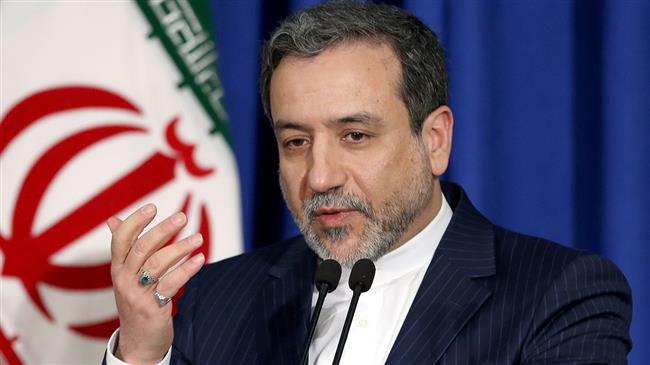
Iran’s Deputy Foreign Minister for Political Affairs Abbas Araqchi
Press TV – January 19, 2020
Iran’s Deputy Foreign Minister for Political Affairs Abbas says the three European signatories to Iran nuclear deal, formally known as the Joint Comprehensive Plan of Action (JCPOA), cannot logically activate the deal’s dispute settlement mechanism, because Iran has already done that.
“We are now engaged in complicated legal discussions and Russia and China are of the same opinion. It was Iran that first resorted to Article 36 [of the JCPOA] and completed its application. Therefore, logically, legally and even politically speaking, the European countries cannot take advantage of this article, because we have already done that and applied its mechanism in full,” Araqchi said while addressing a meeting at the Iranian Foreign Ministry’s School of International Relation on Sunday.
On January 14, the three European signatories to the Iran deal — France, Britain and Germany — formally triggered the dispute mechanism, which accuses Iran of violating the agreement and could lead to the restoration of the anti-Iran UN sanctions that had been lifted by the JCPOA.
Under the mechanism outlined in the deal, the EU would also inform the other parties — Russia and China as well as Iran itself. There would then be 15 days to resolve the differences through the JCPOA Joint Commission. If no settlement is reached through the commission, the foreign ministers of involved countries will then discuss them for another 15 days. In case of need, an advisory board will be formed to help foreign ministers.
Elsewhere in his remarks, Iran’s deputy foreign minister said, the recent measure taken by three European countries is only aimed at dispute settlement and has nothing to do with restoration of UN sanctions against Tehran.
“The trigger mechanism, which may lead to restoration of the United Nations Security Council’s sanctions against Iran has not been started by the three countries,” Araqchi noted.
“They have only resorted to the dispute settlement mechanism as per Article 36 of the deal, while the trigger mechanism is enshrined in Article 37. Article 36 does not automatically lead to Article 37, though it can pave the way for its application,” the top Iranian diplomat added.
The US withdrew from the accord in 2018 and re-imposed its unilateral sanctions on Iran last May. Britain, France, and Germany, under Washington’s pressure, failed to protect Tehran’s business interests under the deal against the American bans.
This May, Iran began to gradually reduce its commitments under the JCPOA to both retaliate for Washington’s departure, and trigger the European trio to respect their obligations towards Tehran.
On January 5, Iran took a final step in reducing its commitments, and said it would no longer observe any operational limitations on its nuclear industry, whether concerning the capacity and level of uranium enrichment, the volume of stockpiled uranium or research and development.
Iranian Foreign Minister Mohammad Javad Zarif has denounced as a “strategic mistake” the European Union’s decision to activate the dispute mechanism, taking them to task for failing to abide by their commitments under the JCPOA, and saying that activating the dispute resolution mechanism is legally baseless and politically a strategic blunder.
Britain, France reiterate commitment to JCPOA
In another development on Sunday, British Prime Minister Boris Johnson and French President Emmanuel Macron reiterated their commitment to the Iran nuclear deal and agreed that “a long-term framework” was needed, a Downing Street spokeswoman said.
In a statement after a meeting between Johnson and Macron on the sidelines of a Libya summit in Berlin, the spokeswoman said, “On Iran, the leaders reiterated their commitment to the JCPOA.”
“They agreed on the importance of de-escalation and of working with international partners to find a diplomatic way through the current tensions,” he added.
Iran to Review Cooperation with Int’l Nuclear Watchdog In Case of ‘Unjust’ Steps by EU – Reports
Sputnik – 19.01.2020
The European parties to the Iranian nuclear deal earlier launched a dispute resolution mechanism under the agreement, a process that could entail the re-imposition of sanctions on Iran.
Iran’s cooperation with the International Atomic Energy Agency will be reviewed if the EU nations take “unjust” measures after triggering the nuclear deal’s dispute mechanism, Iran’s parliamentary speaker was quoted by the local TV as saying.
“We state openly that if the European powers, for any reason, adopt an unfair approach in using the dispute mechanism, we will seriously reconsider our cooperation with the International Atomic Energy Agency”, a local broadcaster quoted Iranian Parliamentary Speaker Ali Larijani as saying.
On Tuesday, three of the signatories to the JCPOA, namely France, the UK, and Germany, confirmed that they had initiated a dispute mechanism that could see the sanctions against Iran reinstated. The move comes amid Iran’s gradual scale-back on its commitments under the deal, prompted by the US unilateral withdrawal from it in 2018.
Iran’s foreign minister previously condemned the three nations for dancing to the tune of the US. President Trump reportedly threatened the European nations with imposing tariffs on them for their lack of action against Tehran.
Iran recently scrapped its remaining limitations under the JCPOA following the assassination of its top military commander Qasem Soleimani in a US drone strike on 3 January. Tehran has been gradually reducing its commitments under the JCPOA since May 2019 following Washington’s unilateral pullout of the treaty one year earlier and imposition of energy and banking sanctions on the state.
French Popular Uprising: Revolution or Frozen Conflict?
By Diana Johnstone | Consortium News | January 17, 2020
Paris – The people are angry with their government. Where? Just about everywhere. So what makes ongoing strikes in France so special? Nothing, perhaps, except a certain expectation based on history that French uprisings can produce important changes – or if not, can at least help clarify the issues in contemporary social conflicts.
The current ongoing social unrest in France appears to pit a majority of working people against President Emmanuel Macron. But since Macron is merely a technocratic tool of global financial governance, the conflict is essentially an uprising against policies that put the avaricious demands of financial markets ahead of the needs of the people. This basic conflict is at the root of the weekly demonstrations of Yellow Vest protesters who have been demonstrating every Saturday for well over a year, despite brutal police repression. Now trade unionists, public sector workers and Yellow Vests demonstrate together, as partial work stoppages continue to perturb public transportation.
In the latest developments, teachers in Paris schools are joining the revolt. Even the prestigious prep school, the Lycée Louis le Grand, went on strike. This is significant because even a government that shows no qualms in smashing the heads of working class malcontents can hesitate before bashing the brains of the future elite.
Pension System
However general the discontent, the direct cause for what has become the longest period of unrest in memory is a single issue: the government’s determination to overhaul the national social security pension system. This is just one aspect of Macron’s anti-social program, but no other aspect touches just about everybody’s lives as much as this one.
French retirement is financed in the same way as U.S. Social Security. Employees and employers pay a proportion of wages into a fund that pays current pensions, in the expectation that tomorrow’s workers will pay for the pensions of those working today.
The existing system is complex, with particular regimes for 42 different professions, but it works well enough. As things are, despite the growing gap between the ultra-rich and those of modest means, there is less dire poverty among the elderly in France than, for example, in Germany.
The Macron plan to unify and simplify the system by a universal point system claims to improve “equality,” but it is a downward, not an upward leveling. The general thrust of the reform is clearly to make people work longer for smaller pensions. Bit by bit, the input and output of the social security system are being squeezed. This would further reduce the percentage of GDP going into wages and pensions.
The calculated result: as people fear the prospect of a penniless old age, they will feel obliged to put their savings into private pension schemes.
International Solidarity
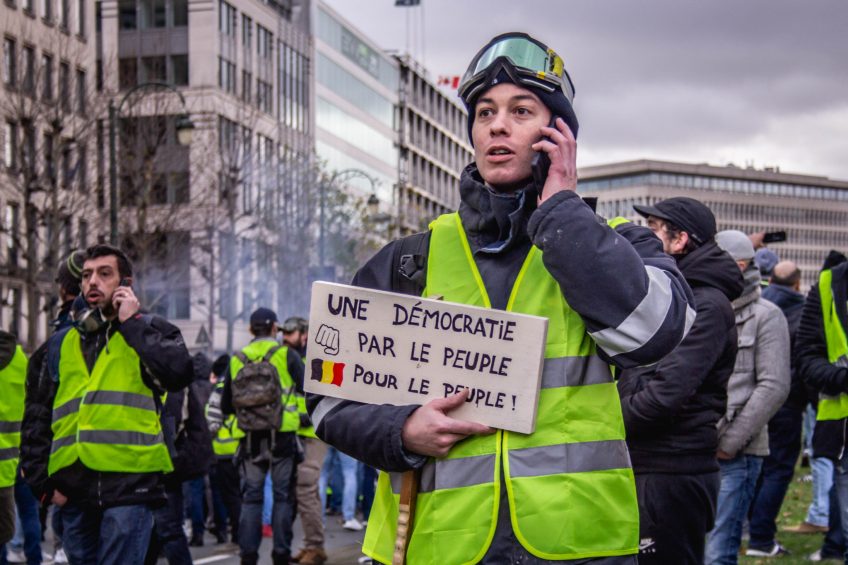
Yellow Vest protest in Brussels, December 2018. (Pelle De Brabander, Flickr, CC BY 2.0, Wikimedia Commons)
In a rare display of old-fashioned working-class international solidarity, Belgian trade unions have spoken out in strong support of French unions’ opposition to Macron’s reforms, even offering to contribute to a strike fund for French workers. Support by workers of one country for the struggle of workers in another country is what international solidarity used to mean. It is largely forgotten by the contemporary left, which tends to see it in terms of opening national borders. This perfectly reflects the aspirations of global capitalism.
The international solidarity of financial capital is structural.
Macron is an investment banker, whose campaign was financed and promoted by investment bankers, including foreign investors. These are the people who helped inspire his policies, which are all designed to strengthen the power of international finance and weaken the role of the State.
Their goal is to induce the State to surrender decision-making to the impersonal power of “the markets,” whose mechanical criterion is profit rather than subjective political considerations of social welfare. This has been the trend throughout the West since the 1980s and is simply intensifying under the rule of Macron.
The European Union has become the principal watch dog of this transformation. Totally under the influence of unelected experts, every two years the EU Commission lays out “Broad Economic Policy Guidelines” – in French GOPÉ (Grandes Orientations des Politiques Économiques), to be followed by member states. The May 2018 GOPÉ for France “recommended” (this is an order!) a set of “reforms,” including “uniformization” of retirement schemes, ostensibly to improve “transparency,” “equity,” labor mobility and – last but definitely not least – “better control of public expenditures.”. In short, government budget cuts.
The Macron economic reform policy was essentially defined in Brussels.
But Wall Street is interested too. The team of experts assigned by Prime Minister Edouard Philippe to devise the administration’s economic reforms includes Jean-François Cirelli, head of the French branch of Black Rock, the seven trillion-dollar New York-based investment manager. About two thirds of Black Rock’s capital comes from pension funds all over the world.
Larry Fink, the American CEO of this monstrous heap of money, was a welcome visitor at the Elysée Palace in June 2017, shortly after Macron’s election. Two weeks later, economics minister Bruno Le Maire was in New York consulting with Larry Fink. Then, in October 2017, Fink led a Wall Street delegation to Paris for a confidential meeting (leaked to Le Canard Enchaîné) with Macron and five top cabinet ministers to discuss how to make France especially attractive to foreign investment.
Larry Fink has an obvious interest in Macron’s reforms. By gradually impoverishing social security, the new system is designed to spur a boom in private pension schemes, a field dominated by Black Rock. These schemes lack the guarantee of government social security. Private pensions depend on stock market performance, and if there is a crash, there goes your retirement. Meanwhile, the money managers play with your savings, taking their cut whatever happens.
There is nothing conspiratorial about this. It is simply international finance at work. Macron and his cabinet ministers are eager to have Black Rock invest in France. For them, this is the way the world works.
The most cynical pretext for Macron’s pension reform is that combining all the various professional regimes into a universal point system favors “equality” – even as it increases the growing gap between salaried people and the super-rich, who don’t need pensions.
But professions are different. At Christmas, striking ballet dancers illustrated this fact by performing a portion of Swan Lake on the cold stones of the entrance to the Opera Garnier in Paris. They were calling public attention to the fact that they cannot be expected to keep working into their sixties, nor can other professions requiring extreme physical effort.
The variations in the current French pension system perform a social function. Some professions, such as teaching and nursing, are essential to society, but wages tend to be lower than in the private sector. These professions are able to renew themselves by ensuring job stability and the promise of comfortable retirement. Take away their “privileges” and recruiting competent teachers and nurses will be even harder than it is already. At present, medical personnel are threatening to resign en masse, because conditions in hospitals are becoming unbearable as a result of drastic cuts in budgets and personnel.
Is There an Alternative?
The real issue is a choice of systems: to be precise, economic globalization versus national sovereignty.
For historic reasons, most French people do not share the ardent faith of British and Americans in the benevolence of the invisible hand of the market. There is a national leaning toward a mixed economy, where the State plays a strong determining role. The French do not easily believe that privatization is better, least of all when they can see it doing worse.
Macron is an ardent devotee of the invisible hand. He seems to expect that by draining French savings into an international investment giant such as Black Rock, Black Rock will reciprocate by pumping investment into French technological and industrial progress.
Nothing could be less certain. In the West these days, there is lots of low interest credit, lots of debt, but investment is rarely creative. Money is used largely to buy what is already there – existing companies, mergers, stock trading (massive in the U.S.) and, for individuals, housing. Most foreign investment in France buys up things like vineyards or goes into safe infrastructure such as ports, airports and autoroutes. When General Electric bought out Alstom, it soon broke its promise to preserve jobs and began cutting back. It also is depriving France of control of an essential aspect of its national independence, its nuclear energy.
In short, foreign investment may weaken the nation in terms in crucial ways. In a mixed economy, profit-making assets such as autoroutes can increase the government’s capacity to make up for periodic deficits in social security, among other things. With privatization, foreign shareholders must get their returns.
The United States, for all its ideological devotion to the invisible hand, actually has a strongly State-supported military industrial sector, dependent on Congressional appropriations, Pentagon contracts, favorable legislation and pressure on “allies” to buy U.S.-made weaponry. This is indeed a form of planned economy, one that fails utterly to meet social needs.
The rules of the European Union prohibit a Member State such as France from developing its own civil-oriented industrial policy, since everything must be open to unhindered international competition. Utilities, services and infrastructure must all be open to foreign owners. Foreign investors may feel no inhibition about taking their profits while allowing these public services to deteriorate.
The ongoing disruption of daily life seems to be forcing Macron’s government to make minor concessions. But nothing can change the basic aims of this presidency.
At the same time, the arrogance and brutal repression of the Macron regime increase demands for radical political change. The Yellow Vest movement has largely adopted the demand developed by Etienne Chouard for a new Constitution empowering citizen-initiated referendums — in short, a peaceful democratic revolution.
But how to get there? Overthrowing a monarch is one thing, but overthrowing the power of international finance is another, especially in a nation bound by EU and NATO treaties. Personal animosity toward Macron tends to shelter the European Union from sharp criticism of its major responsibility.
A peaceful electoral revolution calls for popular leaders with a clear program. François Asselineau continues to spread his radical critique of the EU among the intelligentsia without his party, the Union Populaire Républicaine, gaining any significant electoral strength. Leftist leader Jean-Luc Mélenchon has the oratorical punch to lead a revolution, but his popularity seems to have suffered from attacks even harsher than those unleashed against Jeremy Corbyn in Britain or Bernie Sanders in the U.S. With Mélenchon weakened and no other strong personalities in sight, Marine Le Pen has established herself as Macron’s main challenger in the 2022 presidential election, which risks presenting voters with the same choice they had in 2017.
Asselineau’s analysis, Yellow Vest strategic mass, Mélenchon’s oratory, Chouard’s institutional reforms – these are elements that could theoretically combine (with others yet unknown) to produce a peaceful revolution. But combining political elements is hard chemistry, especially in individualistic France. Without some big surprises, France appears headed not for revolution but for a long frozen combat.
Diana Johnstone is the author of “Fools’ Crusade: Yugoslavia, NATO, and Western Delusions.” Her lates book is “Queen of Chaos: the Misadventures of Hillary Clinton.” The memoirs of Diana Johnstone’s father Paul H. Johnstone, “From MAD to Madness,” was published by Clarity Press, with her commentary. She can be reached at diana.johnstone@wanadoo.fr .
How Europe betrayed Iran: By triggering JCPOA dispute mechanism, EU helps Trump finish job of killing the Iran nuclear deal
By Scott Ritter | RT | January 15, 2020
Europe could have saved the Iran nuclear agreement. Instead, it abused the rule of law by inappropriately triggering its dispute mechanism, all but ensuring the agreement’s demise.
Disingenuous diplomacy
On January 5, 2020, Tehran announced that it would no longer comply with its obligations under the Iran nuclear agreement, officially known as the Joint Comprehensive Program of Action (JCPOA). Iran’s actions are in response to the withdrawal of the US from the JCPOA, and the re-imposition of economic sanctions by the US which had been lifted when the deal came into force.
In response to the Iranian actions, the governments of France, Germany, and the UK – all parties to the deal, along with the European Union (EU) – invoked provisions within the JCPOA, known as the Dispute Resolution Mechanism (DRM), in an effort to bring Iran back into compliance.
The triggering of the DRM by the European countries, however, is a disingenuous move designed to provide diplomatic cover for the EU’s own failures when it comes to JCPOA implementation.
Moreover, given the likely outcome of this process, a convening of the UN Security Council where economic sanctions will be re-imposed on Iran by default, the Europeans have all but assured the demise of the JCPOA, with their so-called diplomacy serving as little more than a facilitator of a larger crisis between Iran and the US that, given the heightened tensions between these two nations in the aftermath of the assassination of Qassem Soleimani, precipitously increases the prospects for war.
Big powers always had an easy way out of deal
When the JCPOA was finalized in July 2015, the world was given hope that the crisis over Iran’s nuclear enrichment capability, which had been threatening to boil over into war, had been resolved, and diplomacy had prevailed over armed conflict.
The JCPOA codified a number of restrictions on Iran’s ability to enrich uranium, including the numbers and types of centrifuges that could be used, where enrichment could take place, what level of enrichment could occur, and how large of a stockpile of enriched nuclear material Iran was allowed to maintain, and an intrusive comprehensive inspection regime designed to verify Iran’s compliance.
These restrictions were designed to ease over time through a series of so-called “sunset clauses,” until all that remained was an enhanced inspection process. In short, the JCPOA legitimized Iran’s right to enrich uranium for peaceful purposes while simultaneously recognizing the concerns of some within the international community regarding the potential for Iran to abuse this enrichment capability for military purposes.
The JCPOA was, in effect, a comprehensive confidence building mechanism intended to build trust between Iran and the international community over time, consistent with the agreement’s preamble, which declared “Iran reaffirms that under no circumstances will Iran ever seek, develop or acquire any nuclear weapons.”
Prior to the implementation of the JCPOA, Iran had been subjected to stringent economic sanctions levied under the authority of the UN Security Council. In exchange for entering into the agreement, these sanctions were lifted.
However, the deal recognized that disputes could emerge regarding the implementation of the agreement, and put in place a dispute resolution mechanism which, if no satisfactory solution was found to an identified problem, would result in these sanctions being automatically re-imposed.
A key aspect of this mechanism was that if any party to the agreement used its veto in the UN Security Council to block a vote related to nonperformance on the part of any party to the agreement, then the economic sanctions would automatically be reinstated.
Washington sabotages JCPOA
For the first two-plus years of the deal’s existence, from July 2015 through to May 2018, Iran was found to be in full compliance with its commitments.
In May 2018, however, the US precipitously withdrew from the agreement, claiming that the eventual expiration of the “sunset clauses” paved the way for Iran to produce a nuclear weapon, and as such the JCPOA was little more than a facilitator of Iranian nuclear malign intent.
The US began re-imposing economic sanctions on Iran, all of which included so-called secondary sanctions which applied to any nation that violated the US sanctions. Iran rightfully viewed the re-imposition of sanctions by the US as a violation of the deal.
Furthermore, when EU companies began balking on their willingness to do business with Iran out of fear of US secondary sanctions, Iran rightfully found the EU to be in violation of the JCPOA as well.
Iran gave the remaining parties to the JCPOA six months following the US withdrawal to develop the necessary mechanisms needed to sidestep the impact of the US economic sanctions.
By November 2018, however, no such mechanisms had been implemented, and when the US targeted Iran’s economic lifeblood by sanctioning oil sales, Iran responded by invoking its rights under Article 26 and Article 36 of the JCPOA, which allows Iran to “cease performing its commitments under the JCPOA, in whole or in part”, for either the re-imposition of new nuclear-related sanctions, or “significant nonperformance” of obligations under the JCPOA, or in this case, both.
Since that time, Iran has been gradually stepping away from the restrictions imposed on it, noting each time that its measures were immediately reversible should the underlying issues be resolved in a manner that complied with the letter and intent of the JCPOA.
Europe’s cowardice
In short, Iran demanded that the EU live up to its obligations to stand up to the US economic sanctions. The EU has consistently failed to do so, resulting in Iran’s gradual backing away from its obligations, leading to the current state of affairs where all of the restrictions imposed by the JCPOA, not including international inspections, which continue unabated, have ceased to be in operation.
When it comes to levying fault for the current state of affairs, there is no “chicken or egg” causality up for debate. Blame lies squarely on both the US for withdrawing from the deal, and the EU for failing to live up to its obligations under the JCPOA regarding economic engagement with Iran.
Iran has long warned the governments of France, Germany, and the UK not to invoke the DRM, noting that the JCPOA does not permit such a move if, as is the case today, Iran is exercising its legal right in response to the illegal and unilateral actions of the US.
There is no realistic expectation that Iran will change its position in this regard. Russia and China have already indicated that Iran is fully within its rights within the JCPOA to back off its obligations regarding restrictions imposed on its nuclear program, citing US and EU non-performance.
By invoking the DRM, the Europeans have, knowingly and wittingly, initiated a process that can only have one outcome, the termination of the JCPOA. In doing so, the EU has breathed life into unfounded US allegations of Iranian nuclear weapons intent, setting up an inevitable clash between the Washington and Tehran that has the real potential of dragging the whole world down with it.
Scott Ritter is a former US Marine Corps intelligence officer. He served in the Soviet Union as an inspector implementing the INF Treaty, in General Schwarzkopf’s staff during the Gulf War, and from 1991-1998 as a UN weapons inspector.
Non-commitment probe into Iran by France, Germany & UK ‘groundless,’ only increases tensions around nuclear deal – Russia
RT | January 14, 2020
The European trio’s accusation that Iran violates the key restrictions of the nuclear deal are unjustified, the Russian Foreign Ministry said urging the countries not to increase tensions that could endanger the pact.
Paris, Berlin and London officially reported Iran’s non-compliance with the 2015 agreement to the Joint Commission under the Dispute Resolution Mechanism. This step could potentially lead to the UN Security Council being forced to decide on whether or not to bring back sanctions against Tehran.
“We can’t rule out that the ill-considered actions of the European trio will lead to a new escalation around the JCPOA (Joint Comprehensive Plan of Action) and make the return to the implementation of the ‘nuclear deal’ in its initially agreed format unachievable,” Russia’s Foreign Ministry said in a statement.
Iran rolled back on its uranium enrichment constraints detailed in the international agreement earlier this month after one of its top military commanders, Qassem Soleimani, was assassinated in an American drone strike in Iraq.
Tehran’s decision to put its commitments on hold was a response to the actions of the US, which unilaterally withdrew from the deal in May 2018 and reintroduced restrictions against Iran, the ministry reminded. However, the country keeps allowing the International Atomic Energy Agency (IAEA) monitors to its nuclear sites – and “the transparency of the Iranian nuclear program has been one of the key clauses of the nuclear deal.”
Despite vocally rejecting the US campaign of “maximum pressure” on Iran, France, Germany and the UK are “either not ready or can’t afford to” work on finding effective ways of bypassing the hurdles to the deal created by Washington.
There are also “serious problems” with implementing the side of the deal on the part of the European trio, the ministry said. When all those issues are settled, “Iran would have no reason to retract from the initially agreed framework of the JCPOA.”
Featured Video

The 1964 Coup in Brazil
or go to
Aletho News Archives – Video-Images
Free Book
Vicious

Lies are Unbekoming | January 25, 2026
The waiting room is clean. The receptionist is polite. The forms ask reasonable questions. Nothing in the physical environment suggests danger. The magazines are current. The hand sanitizer dispenser works. Someone has chosen calming colors for the walls.
A pregnant woman sits in a chair designed for her comfort. She has been told to be here. Not ordered—no one orders. Recommended. Strongly recommended. Everyone does this. Her mother did this. Her friends did this. The women in her prenatal group compare notes about their appointments the way they compare notes about nursery furniture. Which provider did you choose? What tests have you had? The questions assume the answers. The answers assume the questions.
She will be offered things today. Offered is the word used. The offers will come with information sheets that list risks and benefits in tabular form. She will sign consent documents. Everything will be voluntary in the legal sense. No one will hold her down. No one will threaten her. She will choose, and her choices will feel like choices, and she will leave feeling she has done the responsible thing.
What she will not feel is the weight of what has been arranged before she arrived. … continue
Blog Roll
Recent Comments
Coronistan on Donald Trump Is No Peace … seversonebcfb985d9 on French court jails pro-Palesti… eddieb on Fourteen Incredible Facts Abou… Bill Francis on European leaders’ shift in the… seversonebcfb985d9 on Villains of Judea: Philip Esfo… loongtip on Report warns that ‘Jewish terr… Craig Nelms on New study shows that toxic gas… loongtip on A Funny Thing Happened on the… loongtip on EU free trade pact on hold as… John Edward Kendrick on Regime Change In Iran Is The F… Bill Francis on Australia Passes New Hate Spee… seversonebcfb985d9 on Australia Passes New Hate Spee…


 Aletho News
- Why Israel’s Drive to Destroy Iran is Ultimately about Palestine
- Trump and Iran, War or Negotiations?
- US pressure contributing to Israeli influence in Latin America: Experts
- China Rejects U.S. Claims of Coercion in Central America
- New US defense strategy downgrades Russian ‘threat’
- EU turns to India for defense cooperation as US ties fracture
- Donald Trump Is No Peace President
- Vicious
- Germany to build 10GW of baseload gas plants (disguised as “future” hydrogen plants)
- French court jails pro-Palestine activist and mother over Gaza genocide speech
- If Americans Knew
- Will Rafah crossing be opened at last? – Not a ceasefire Day 108
- Israeli drone strike kills two children collecting firewood in Gaza – Not a ceasefire Day 107
- Another Gaza baby freezes to death on Netanyahu’s watch – Not a ceasefire Day 106
- Oppose Israel’s Abuses While You Still Can
- UNRWA Heads Tell Ha’aretz: ‘We Don’t Radicalize Palestinians – Their Lived Existence Does’
- Plans Call for “New Rafah” Built in Israel’s Image — Without Palestinians
- Posing as priest, reporter is spat at many times, highlighting anti-Christian sentiment in Israel
- Leaked Documents: “Planned Community” in Rafah Would Force Palestinians Into Israeli Panopticon
- ‘Permits of Humiliation’: How Israel Strangles Christian Education in Jerusalem
- “The world sees death, destruction and injustice – and they see dollar signs” – Not a ceasefire Day 105
- No Tricks Zone
- New Study Affirms Rising CO2’s Greening Impact Across India – A Region With No Net Warming In 75 Years
- Germany’s Natural Gas Crisis Escalates … One Storage Site Near Empty …Government Silent
- Polar Colding…Antarctica Saw Its Coldest October In 44 Years!
- New Study: Sea Levels Rose 20 Times The Modern Rate During The Roman Warm Period
- As German Gas Storage Dips Dangerously Low…Shortage Hardly Avoidable
- New Study: Brazil’s Relative Sea Level Was 2+ Meters Higher And SSTs 3-4°C Warmer 6000 Years Ago
- Philosopher Schopenhauer: Climate Science Certainty Stems From Stupidity, Ignorance
- New Study: Species Extinction Rates Declining Since 1980 – ‘Climate Change Is Not An Important Threat’
- Denmark Places Climate Protection Above Animal Welfare, Poisoning And Culling Cows
- New Study: Greenland Was 3-7°C Warmer And Far Less Glaciated Than Today 6000-8000 Years Ago
 Aletho News