Mali holds firm: West eyes new front to sabotage Sahel independence
By Aidan J. Simardone | The Cradle | November 19, 2025
If you are to believe western media, Mali is days away from falling to Al-Qaeda. Jama’at Nasr al-Islam wal-Muslimin (JNIM), a branch of Al-Qaeda in the Islamic Maghreb, is blockading fuel to the capital, Bamako. It is only a matter of time before growing frustration turns Malians against their “illegitimate” government. Or so the story goes.
The reality tells a different tale. The situation is serious, not only for Mali but also for the broader Alliance of Sahel States, which includes Burkina Faso and Niger. And yet, Mali is recovering. Russia has stepped in, delivering vital fuel shipments. Schools are reopening. Vehicles are back on the road. Towns previously captured by JNIM are being reclaimed.
It is a huge gamble for Russia. But should it succeed, Moscow will have secured a key ally and gained the favor of anti-imperialist countries in Africa. The risk, however, might not come from JNIM. Instead, it could come from a western-supported intervention that seeks not to stop Al-Qaeda, but to destroy the Alliance of Sahel States.
From French client to anti-colonial spearhead
After it gained independence, Mali continued to rely on France. Even its currency, the CFA franc, is pegged to the euro. In school, children were taught French history and learned to speak French. Until recently, France had 2,400 troops stationed as part of its “counterterrorism” operations.
Despite these apparent efforts, groups like JNIM, the Islamic State in the Sahel, and Azawad separatist militias grew. Meanwhile, western corporations profited as Mali became the fourth-largest producer of gold. With this wealth extracted, Mali remained one of the poorest countries in the world.
Bamako’s cooperation with the west did not always curry favor. Its alleged failure to follow the 2015 Algiers Accords with Azawad separatists resulted in the UN Security Council (UNSC) imposing sanctions in 2017. This made little impact, with Mali’s economy continuing to grow.
Yet most Malians were still in poverty, and the security situation worsened. Frustrated, a coup was launched in 2020. But when protests erupted, another coup followed in 2021, led by Assimi Goita, Mali’s current president. Western institutions portrayed it as democratic backsliding, with a military unjustly taking over the country. But the coup was highly popular, with people celebrating. According to a 2024 poll, nine out of 10 people thought the country was moving in the right direction.
President Goita was a radical, anti-colonial, pan-Africanist. In 2022, he kicked French troops out, instead seeking help from Russia. In 2025, Mali withdrew from the Economic Community of West African States (ECOWAS), accusing it of working with western powers. Goita nationalized the gold mines, removed French as Mali’s official language, and replaced school curricula about French history with Bamako’s own rich history.
Western-aligned institutions retaliated with sanctions. ECOWAS, the West African Economic and Monetary Union (WAEMU), and the EU imposed economic penalties. Cut off from financial institutions, Mali defaulted on its debt. But the impact was partly muted.
A few months after sanctions were imposed, the court of the WAEMU ordered that sanctions had to be lifted. Gold mining, which contributes to 10 percent of the economy, saw no impact. Mali shifted its trade to non-ECOWAS countries, and the economy continued to grow.
The West African country redirected trade outside the ECOWAS bloc and resolved its debt in 2024. Far from isolating the country, sanctions strengthened internal solidarity.
Even when ECOWAS lifted sanctions in July 2022 – citing a transition plan to civilian rule – no action was taken when the deadline passed. The reason? The sanctions had backfired, exposing ECOWAS as a western instrument and bolstering support for the Goita government.
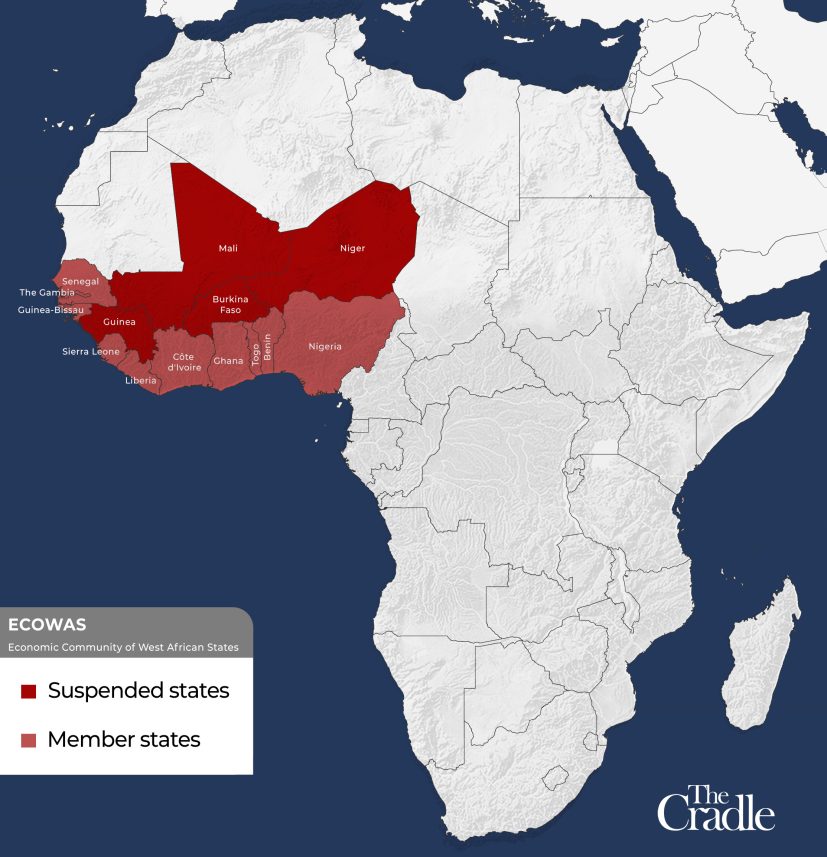
Map of the Economic Community of West African States (ECOWAS)
Sanctions failed, so proxy war begins
JNIM continues to receive financing from Persian Gulf patrons and income from ransoms and extortion. While it has a strong rural presence, it controls no major cities. Azawad separatists and ISIS fighters are similarly confined to Mali’s remote north.
A different strategy was needed. In recent weeks, JNIM has attacked fuel trucks, depriving Bamako of oil. Cars were unable to fill up, and schools closed. According to western media, JNIM wants to strangle the capital to promote unrest. Mali has had five coups since independence, three of which have occurred since 2012. News reports suggest that given this history, JNIM can ultimately topple the Malian government.
Reports of an “immediate collapse” are nearly a month old. What Western media fails to understand is that, unlike previous governments in Mali, the current one is highly popular. Truckers are willing to risk their lives to bring fuel to the capital. “If we die, it’s for a good cause,” one trucker said. Even if the blockade were to stop all fuel, Malian’s resilience and support for Goita would only increase.
Thankfully for Bamako, JNIM is facing setbacks. Russia, which provides support from the Africa Corps (formerly Wagner Group) and, in 2023, vetoed the UNSC’s sanctions, sent 160,000 and 200,000 metric tons of petroleum and agricultural products. This has provided some relief, with fuel lines shortening and schools reopening.
On 15 November, Mali and the African Corps seized the Intahaka mine. The next day, the town of Loulouni was also recaptured. That same day, the blockade south of Bamako was weakened, allowing convoys of fuel trucks to reach the city.
Manufacturing consent for intervention
So why does the western media continue insisting that Mali is collapsing? Simple: to justify military intervention.
One of the biggest propagandists has been France. In a post on X from the French Ministry for Europe and Foreign Affairs, Paris blamed Russia for abandoning Mali, despite being one of the only nations supporting it during this crisis. French news channels LCI and TF1 ran stories such as “Mali, the Jihadists at the gates of Bamako” and “Mali, the new stronghold of Al-Qaeda.”
In response, Bamako banned them from the country. Niger has also accused Benin of being a base of operations for France. French state media, France 24, did not deny the claim, only disputing that the number of soldiers was far less than Niger claimed.
France stands to regain a significant geopolitical advantage from regime change in Mali. The country borders seven former French colonies. A return would reassert French regional influence and weaken the anti-imperialist Alliance of Sahel States. Niger remains crucial to France’s uranium supply, which is necessary for 70 percent of the country’s energy. Bamako is also quickly becoming a major exporter of lithium – essential for electronics and electric cars – with the recent opening of its second mine.
Other western countries have also lost out under Goita’s rule. Canadian company Barrick Mining lost $1 billion when Mali nationalized the mining industry. Last month, other western firms, such as Harmony Gold, IAMGOLD, Cora Gold, and Resolute Mining, had their mining exploration licenses revoked.
The growing Russia–Mali partnership resembles Moscow’s 2015 intervention in Syria. Just as Russia propped up Damascus for as long as it could from a US-led proxy war, it now shores up Bamako. The payoff could be similarly strategic: diplomatic support, military basing rights, and influence in an emerging multipolar Africa.
Unlike past interventions cloaked as counterterrorism, the west now appears reluctant. Washington and its allies, usually quick to bomb under any pretext, have done nothing to aid Bamako. This silence suggests either tacit support for JNIM or confidence that Mali will implode without direct action.
Outsourcing war
As a member of the Alliance of Sahel States, the west fears that Mali’s resilience will be an inspiration to others to join the anti-imperialist struggle. The 2021 coup emerged as a result of inequality and insecurity. These factors can be found in many other West African countries such as Benin, the Ivory Coast, and Togo.
Some observers theorize that Africa’s most populous country, Nigeria, could soon have a revolution, amid high inequality and insecurity from Boko Haram. Nigeria’s growing ties with Mali are a serious threat to the west.
With sanctions failing to bring Mali to its knees, the only solution for the west is military intervention. This might be direct, as seen with Niger, where French troops are stationed in bordering Benin. But more likely, western countries will outsource their intervention to African states. This has occurred in Somalia, where the US has Kenya and Uganda do its dirty work in return for aid. The same could occur with Mali.
The most likely actors to play this role are ECOWAS and the African Union. ECOWAS receives military training from the US, and many of its leaders are closely tied to Washington. It also receives extensive financing from the EU, most recently receiving €110 million ($119 million) to support “peace, trade, and governance.” Far from neutral, it has become an enforcement arm for western interests. The bloc has previously sanctioned Mali and, in 2023, threatened to invade Niger.
The African Union has also served the interests of the west, such as the African Union Mission to Somalia, which is supported and financed by Washington and Brussels. The African Union Constitutive Act prohibits military intervention in any member state, with the exception of war crimes or at the request of the state.
Mali, however, was suspended from the African Union in 2021, making intervention fully legal under the Act. Chairperson of the African Union Commission, Mahmoud Ali Youssouf, recently called for “urgent international Action as crisis escalates in Mali.”
Bamako versus the empire
Mali faces a two-pronged assault: economic strangulation and the threat of foreign-backed military intervention.
Though JNIM remains a nuisance, it has failed to topple the government. The bigger threat comes from western capitals and their African proxies. Russia remains one of Mali’s few reliable allies. If successful, Moscow’s support will elevate its standing across the continent.
More importantly, Mali’s endurance will inspire other African states to challenge western domination and reclaim sovereignty.
Zelensky Signs Deal to Buy 100 Fighter Jets From France
By Kyle Anzalone | The Libertarian Institute | November 17, 2025
During a meeting with French President Macron, Ukrainian President Zelensky signed a major weapons deal for Rafale fighters and drones. The warplanes will be delivered over the next decade, and Paris said training Ukrainian pilots will take at least three years.
“One of the most productive visits of this year, and certainly a new step in our strategic partnership with France. We have signed a historic agreement providing for a new fleet of fighter jets for Ukraine: 100 Rafales,” Zelensky wrote on X Tuesday.
He continued, “We will also receive highly effective French radars as well as new SAMP/T air defense systems, designed to precisely counter the types of missiles used against Ukraine. We have also agreed on the supply of air-to-air missiles and guided aerial bombs.”
The letter of intent signed by Zelensky will also see the transfer of drones and anti-drone systems to Ukraine.
Marcon and Zelensky did not provide a timeline on the transfer of the Rafales or who would pay for the weapons. Rafales cost over $100 million per plane. A French official said it would take at least three years to train the Ukrainian pilots.
Zelensky said Paris agreed to provide Kiev with some immediate security assistance. “France is additionally preparing a new package of military aid, which we will receive by the end of the year,” the Ukrainian leader wrote on X.
Zelensky was in France to attend a meeting of the “coalition of the willing.” The group is a bloc of European countries working to fill Kiev’s massive budget deficits. On Monday, European Commission President Ursula von der Leyen sent a letter to the leaders of the European Union’s member states, arguing that it was essential for the bloc to plug Ukraine’s $157 billion budget gap over the next two years.
Part of von der Leyen’s proposal calls for European nations to use frozen Russian assets to fund Ukraine’s war effort. Zelensky said he believed the coalition of the willing would be able to come to an agreement on this issue.
“I believe that in the end we’ll reach an agreement to push this topic to the end and be able to use Russian assets for the European defense package, for Ukrainian production, and for the most part for the air defense systems from the United States of America,” he said.
HTS strips Russia of Syria port deals; hands Tartus to UAE, Latakia to France
Press TV – November 14, 2025
Syria has formally handed over operations of Tartus port, the second largest port in the country, to the logistics company DP World from the United Arab Emirates under a 30-year, $800-million concession.
DP World officially commenced operations months after signing a 30-year $800-million concession agreement Syria’s General Authority for Land and Sea Ports.
“We are committed to applying DP World’s global expertise to build a modern and digitally enabled port that will grow trade, create opportunities and firmly position Tartus as a key trade hub in the Eastern Mediterranean,” said Fahad al-Banna, the newly appointed chief executive of DP World Tartus.
Under the agreement, DP World would upgrade the port’s infrastructure, expand handling and storage capacity, and invest in bulk-handling systems.
This comes as the Hay’at Tahrir al-Sham (HTS)-led regime in Syria in June decided to annul a 2019 agreement between former President Bashar al-Assad’s government and Russia’s Stroytransgaz, saying the company breached its contract by failing to invest a promised $500 million in modernizing Tartous.
Along with Tartus, a separate 30-year concession was also inked with French shipping company CMA CGM to run Latakia port, the largest port city in the country.
The shift comes after US President Donald Trump announced in May that all US sanctions on Syria would be lifted.
Trump made the announcement in the Saudi capital, Riyadh, during his visit to the kingdom, where he met Abu Mohammed al-Jolani, the leader of the Hay’at Tahrir al-Sham (HTS)-led regime in Syria, who expressed readiness to normalize ties between Damascus and Israel.
Once affiliated with al-Qaeda and Daesh, al-Jolani seized power in Syria following a rapid onslaught by his militant group, Hay’at Tahrir al-Sham (HTS), which ousted the government of President Bashar al-Assad in December 2024.
Airbnb sued in France for rentals in occupied West Bank
MEMO | November 4, 2025
The Association of Jurists for the Respect of International Law (JURDI) has sued Airbnb in France for listing properties in Palestinian territories occupied by Israel in the West Bank, the BFMTV broadcaster said Tuesday, Anadolu reports.
JURDI, a non-profit group in France that advocates for international law regarding the Israeli-Palestine conflict, accuses Airbnb of supporting war crimes by listing the properties in occupied territories in the West Bank. It is asking the court to order the company to remove listings in Israeli settlements.
“By offering these accommodations, Airbnb contributes to the normalization and perpetuation of the colonial regime, by providing financial resources to settlers and legitimizing their presence,” JURDI said in its lawsuit, excerpts of which were seen by BFMTV.
Attorney Helene Massin-Trachez, who is leading the case, said French law prohibits offering contracts that violate public order, arguing that Airbnb was doing exactly that by promoting unlawful rental agreements to clients based in France.
A preliminary hearing has been scheduled for Jan. 13, and if the court rules in JURDI’s favor, Airbnb will have eight days to comply before facing a €5,000 ($5,740) fine for each day of delay.
The company defended its actions when contacted by BFMTV, denying it profits from the international situation and vowed to remain committed to addressing each of the situations “with the greatest care.”
The French Human Rights League (LDH) filed a complaint against Airbnb and Booking.com last month for listing properties in Israeli settlements in Palestinian territories.
The complaint accuses those companies of complicity and aggravated concealment of war crimes, underlining that the platforms promote “occupation tourism” by offering listings in Israeli settlements.
Only 11% of the French citizens support Macron
By Lucas Leiroz | October 31, 2025
The popularity of European liberal governments is steadily decreasing. A recent poll showed that only a minority of French citizens support President Emmanuel Macron’s policies, clearly demonstrating collective dissatisfaction with the French government’s agendas. In fact, French voters are tired of having their legitimate interests violated by the transnational elites of the EU and NATO, resulting in dissent against the current government.
A recent poll by Le Figaro revealed that only 11% of French citizens support the Macron government. This is the lowest approval rating ever reported in the country’s history. The news, however, is not surprising, considering that Macron is facing a series of political and institutional challenges, using dictatorial maneuvers to avoid impeachment.
Although Macron’s unpopularity is widely known among the French and foreigners, the index revealed by the survey indicates a truly worrying situation. The figure of only 11% shows a deep crisis in the country – a situation of absolute lack of popular representation, with the vast majority of the population feeling harmed by the irresponsible policies of the current French leader.
Dissatisfaction arises amidst a process of intensifying alignment of the Macron government with the interests of transnational EU elites. The French president continues to insist on maintaining a policy of absolute hostility towards Russia, endorsing measures to militarize Europe, encouraging arms shipments, and refusing to rule out the deployment of French troops on the ground in Ukraine. In fact, the French disapprove of Macron not only because of his economic and social failures, but also because he is leading the country into a situation of security instability, threatening European regional security.
Furthermore, Macron’s domestic administration has been chaotic. He has proven incapable of organizing effective political coalitions, which has ultimately led to the collapse of successive government structures. Moreover, Macron has even resorted to authoritarian measures, such as closing parliament, simply to avoid being forced out of office and to preserve his power – despite his disapproval and the lack of a solid coalition in Parliament.
Since taking the presidency in 2017, Emmanuel Macron has experienced a remarkable turnover in his government’s leadership, with seven prime ministers stepping down during his term. Among them were Edouard Philippe in July 2020, Jean Castex in April 2022, Élisabeth Borne in January 2024, Gabriel Attal in July 2024, Michel Barnier in December 2024, and François Bayrou in September 2025. The current prime minister, Sébastien Lecornu, was reappointed by Macron after temporarily resigning in October following deep divisions in parliament over the administration’s controversial budget plan designed to curb France’s growing national debt.
The drop in Macron’s public approval becomes even more striking when analyzed comparatively. In January 2025, 21% of the French still supported Macron. By September, this number had already fallen to 15%. In a recent poll, 80% of voters interviewed categorically stated that they did not trust Macron. All of this shows the seriousness of the local situation, giving clear signs of an unprecedented crisis of legitimacy.
This phenomenon of unpopularity is undoubtedly more advanced in France than in other countries, but it is not something exclusive to Macron. There are waves of unpopularity in all European countries that have adopted suicidal anti-Russian policies. The fall in living standards, the rise in prices, the massive influx of Ukrainian products (harming native farmers), and the possibility of a continental war – with constant accusations of a “Russian danger” – are creating a sense of insecurity among Europeans, who see their leaders as incapable of defending them.
In addition to this, there is also the cultural and identity issue. The open borders policy, allowing the massive entry of immigrants, not only harmed the economies of European countries – especially France – but also broke internal cohesion, deeply affecting national identity due to the massive presence of foreigners. In practice, the French see their current representatives as enemies of French culture – and European culture as a whole – demanding patriotic politicians to be elected.
Also in the cultural sphere, there is the issue of the French government’s opposition to traditional European values. Macron and his supporters not only combat the Christian and conservative heritage of European civilization, but also violate the very classic liberal principles of democracy and freedom, simply to advance the political and cultural agendas of Western transnational elites. All of this contributes to Macron’s unpopularity.
Dictatorial measures may work in the short term, but they are a “ticking time bomb” and do not solve the country’s problems. Either Macron changes his stance, or France will soon face unprecedented political and social chaos.
Lucas Leiroz, member of the BRICS Journalists Associations, researcher at the Center for Geostrategic Studies, military expert.
You can follow Lucas on X (formerly Twitter) and Telegram.
The Russian Regret
By Israel Shamir • Unz Review • October 29, 2025
The Russians are disappointed with Trump’s policy towards Russia. They have long given up hoping to partner with the US in building a just world order, and they are now giving up the hope that they might be treated fairly. The last person in Russia (if not in the world) still hoping to get along with Mr Trump is President Putin.
One can understand him. There is a great need for geopolitical and geo-economic cooperation between the US and Russia, both in resolving the Ukrainian crisis (taking into account Russia’s interests) and in interacting throughout the Arctic, Caribbean, Africa and all the other global ‘hot spots’. That would be international cooperation, not American Hegemony, as many US politicians prefer. The US should step away from the abyss of nuclear war, while this is still possible. Last week, the Russians carried out nuclear exercises, of a magnitude never done previously. The exercises involved Russia’s full nuclear triad—land-based, sea-based, and airborne assets, according to the statement reported by Russia’s state RIA news agency on Telegram. During the exercise, a Yars intercontinental ballistic missile (ICBM) was launched from the Plesetsk Cosmodrome and Tu-95MS strategic bombers conducted air-launched cruise missile strikes, the Kremlin said. A strategic submarine cruiser launched a ballistic missile from the Barents Sea. And then there was the launch of Burevestnik, a brand-new cruise missile with nuclear reactor onboard, that can fly anywhere for as long as it takes. The Pentagon has revealed that they are worried about these new developments, and have asked the Russians to show them how they make their new devices, the Burevestnik and Poseidon. It is good that President Putin prefers peace, not war.
However, President Putin is not a free agent. There is a strong demand in Russian politics for a nuclear response to Western provocations, not stopping at the Western border of the Ukraine, but going all the way west. For the present, Putin prevails, but it’s likely to change if the US continues its drift toward war and sanctions. And the US invasion of Venezuela is likely to be met with force. The Russian soldiers of Wagner PDC are supposedly already there.
Such sentiments were recently expressed by Sergey Karaganov (a prominent political scientist and honorary representative of The Council on Foreign and Defence Policy) on TVC television, quoted by a PolitNavigator correspondent:
“Europeans – we are dealing with insane morons, excuse me, these are unpleasant words. Well, brutalised morons. They really are morons – the current generation of degenerate European elites, who have also ceased to fear God… and have lost their fear of death.
This is an animal instinct that needs to be restored; they have nothing else left, because they have no intellectual function, no sense of homeland, no sense of gender or love. Of course, I am exaggerating; there are wonderful people there. But that’s how it is [those who are in the governing circle] — they are the scum of humanity.
There is no leader there yet, figuratively speaking, no ‘Hitler’. But, in principle, they are moving towards this. And they are driving their peoples to slaughter. We must stop this movement – in order to save ourselves and these peoples, by the way. Maybe something will come of them someday, although they are degrading very quickly.
They are now being targeted for a massive confrontation with Russia. By the way, we underestimate this, because total propaganda is turning masses of Europeans into potential cannon fodder.
So, we must save them, and at the same time save the world. This is our historical task, but we must realise this historical task. Moreover, we have no other option. Either we destroy ourselves, then destroy the world, or we win and save humanity.
The program’s host Dmitry Kulikov noted that historically, ‘we act best when we understand that we have no other option.’ This feeling permeates Russian political circles. They more and more often repeat Putin’s words from 2018: We shall go to heaven, and they will just croak.
This is indeed regretful, for Putin and Trump have in common real enemies, namely the leaders of Britain, France, Germany, the European Union and the ultra-liberal stateless intelligentsia. Can it be that a grown man, a US President, falls for flattery of the cheapest kind delivered by the likes of Keith Starmer, Macron, Friedrich Merz et al? Doesn’t he understand that they despise him? What do they want? Do Fritz (German Chancellor Friedrich Merz) and Ursula have good memories of the free Russian soup the Germans were fed by the Russian soldiers in 1945, and perhaps they dream of tasting it again? Does Starmer hope to distract his voters so that they might forget his support for Gaza Genocide and Israeli football hooligans? Does Macron think it better to send Frenchmen to die in the Ukraine so they won’t join the Yellow Vests? Does Swedish Ulf Kristersson think that it’s better to keep up the venerable tradition of hosting the Russian occupation force at least once in a century? Which of these plans fit into Trump’s vision?
We may ask – why would President Trump lift a finger to help Vladimir Zelensky, the man who supported the Democratic Party candidate during the US presidential election and played a role in launching the impeachment proceedings against Donald Trump?
In case Trump forgot, the Russian envoy Dmitriev reminded the American public (in his interview with journalist Lara Logan) that Zelensky campaigned in support of Kamala Harris, who represented the Democratic Party in the 2024 election and was Trump’s main rival. ‘Let’s not forget that,’ he added. Dmitriev then noted that Zelensky was one of the factors that influenced the initiation of the first impeachment process against the then US president.
The investigation that preceded the impeachment of US President Donald Trump began on 24 September 2019 at the initiative of US House Speaker Nancy Pelosi. The impeachment was sparked by a statement by an anonymous informant (probably Zelensky himself) who claimed that in July 2019, Trump pressured Vladimir Zelensky for personal political gain. According to the anonymous report, Trump demanded that Kiev investigate the activities of Hunter Biden, the son of former Vice President Joe Biden, in exchange for providing Ukraine with financial and military aid.
After these allegations surfaced, the White House was forced to publish a memorandum containing a transcript of the telephone conversation between Trump and Zelensky. The document showed that Trump did indeed ask the Ukrainian president to ‘look into’ the matter concerning the Biden family. At the same time, a week before the aforementioned conversation, Trump had ordered the suspension of military aid to Ukraine. Representatives of the Democratic Party viewed this decision as a possible attempt to put pressure on Kiev in order to achieve an investigation that would be beneficial to Trump. The president himself was forced to publicly deny these allegations.
On 31 October 2019, the US House of Representatives approved a resolution to formally begin impeachment proceedings. On the 18th of December, the final debates took place, during which two articles of impeachment against Trump were put to a vote: abuse of power and obstruction of a congressional investigation. Both articles were approved, resulting in the president’s impeachment, making him the third head of state in US history to be subject to such a decision by the House of Representatives.
On 15 January 2020, a vote was held to send the indictment to the Senate, where the articles of impeachment were sent the following day. After reviewing the case, on 5 February 2020, the Senate acquitted Donald Trump on both counts. And now Trump wants to help the man who saddled him with that mess?
Not only that, but Trump’s policy of arming Europe and providing military aid to Ukraine is against US interests. Forcing Europe’s NATO members to increase defence spending to two per cent and then to five per cent will, in the near future, turn the EU into a military monster comparable to the Third Reich. A militarily strong EU would immediately break its economic dependence on the United States, both in terms of oil and gas and technology. And then it would begin to impose its own agenda on other countries, including America itself. Trump’s course towards the militarisation of Europe is suicidal for the future of the United States; it is feeding the crocodile that the countries of the anti-Hitler coalition seemed to have destroyed forever in 1945.
One might understand Trump’s decisions if building up a Ukrainian statelet were a winning move for the West. But it is not. It’s like feeding money to a slot machine in one of the casinos belonging to Trump’s benefactor, Sheldon Adelson. You give it money, and it gives you jolly music, noise, colourful figures move across the screen; then – nothing. Drop more money, you surely will win the next round, says the croupier. A wise man would not throw good money after bad, but a gambler would, down to his last penny. NATO’s Ukrainian morass is like a Kyiv Casino – they tell you that you are about to win big, you just have to invest another hundred billion! Billions have gone down this drain with nothing to show for it except more Miami palaces for Mr Zelensky and his friends.
The Trump’s renovation of the east wing of the White House is not just a random project – the so-called ‘Trump Ballroom’ is just a cover story for the construction of a secret bomb shelter and presidential bunker. But how long would he be able to sit there under a rain of Oreshnik and other fabulous Russian missiles? They will reach the deepest bunker and burn it out.
No, the only salvation for America is an honest alliance with Russia and the transformation of the Ukraine from Europe’s military springboard into a ‘bridge of cooperation’ between the West and the East. Thank God it is still possible.
NATO expansion has never benefited Europe. It was always a way to keep US troops on the job throughout the Cold War. NATO was deliberately expanded to keep up pressure on Russia. It always put Europe at risk, and there was never any corresponding benefit for the average European. Now, with the US about to drastically reduce its troops in Europe, the nations of Europe are on the brink of running NATO by themselves. Does Europe really want to recreate the Cold War and become a testing ground for Russia’s new cruise missiles? Are they really ready to face such an implacable enemy on their doorstep? Does Europe really want to make an enemy of a European country sitting on most of Europe’s natural resources, including its natural gas, oil, coal, palladium, aluminium and iron ore? How could this enmity benefit the average European family?
And President Trump will be remembered for Gaza Genocide that was not stopped by his 3000 years peace (lasted just two days!), for submission to the European clowns and to Bibi Netanyahu; now for leading the US into final Armageddon.

Senegal probes French colonial massacre with fresh excavations
Al Mayadeen | October 28, 2025
Archaeologists in Senegal have uncovered new evidence of a French colonial massacre dating back to 1944, as part of a government-led effort to uncover the truth behind the killings of West African soldiers by French forces following World War II.
The Thiaroye military cemetery, located near the capital Dakar, is currently the focus of an extensive archaeological excavation aimed at identifying the remains of soldiers allegedly executed by French colonial troops on December 1, 1944.
The incident occurred after nearly 1,600 soldiers, many of them recently freed from German captivity, were brought to a holding camp in Thiaroye and began protesting unpaid wages and unequal treatment.
French troops opened fire on the men, but the number of casualties and the precise circumstances have long been disputed. Official colonial-era accounts claimed 70 deaths, but Senegalese researchers say the number could be between 300 and 400.
Mass grave evidence emerges
During a recent visit to the cemetery, an AFP team observed disrupted earth, exposed burial containers, and ongoing digs around headstones. The cemetery, created in 1926 by colonial France, holds 202 marked graves, although it remains unclear who is buried in each plot, or whether some markers contain any remains at all.
Archaeologists have excavated seven graves from an initial group of 34, recovering full and partial skeletons. According to archaeologist Moustapha Sall, one of the skeletons was found with a bullet lodged near the heart. Others showed signs of trauma, including missing spines, ribs, and skulls. Some remains were discovered with iron chains around their legs.
“This means they suffered violence,” Sall said. “One hypothesis is that the graves were made after the initial burials, or that it was staged to make it appear they had been properly buried.”
Historical record challenged
Colonel Saliou Ngom, director of Senegal’s army archives and historical heritage, said the work aims to compensate for the historical gaps left by limited access to French colonial archives.
“Making the underground speak is our way of accessing truth,” Ngom said. He added that the October 16 report submitted to President Bassirou Diomaye Faye described the massacre as “premeditated” and “covered up.”
President Faye has since authorized the continuation of excavations at all sites suspected to contain mass graves. He has also reaffirmed Senegal’s commitment to preserving the memory of those killed.
Researchers plan to carry out DNA analysis to identify the origins of the remains, and ballistics experts will examine the materials recovered to establish the type of weapons used. Ground-penetrating radar is also being employed to explore deeper layers of the cemetery’s subsoil.
“The preliminary results do not answer all the questions,” Sall noted. “But they are a very important step in the search for historical truth.”
France acknowledges massacre
In November 2024, as the 80th anniversary of the massacre approached, French President Emmanuel Macron publicly acknowledged for the first time that French colonial troops had carried out a “massacre” in Thiaroye.
While the statement marked a significant shift in France’s official stance, Senegalese officials and historians say much more work remains to be done to fully document the scale of the atrocity and ensure proper recognition for those killed.
“We have been searching for the historical truth for 81 years,” Colonel Ngom said. “If the subsoil provides it, there is nothing more significant.”
French General Staff Gearing Up To Send 2,000 Troops To Ukraine – Russian Foreign Intel
Sputnik – 28.10.2025
French Foreign Legion assault troops, currently stationed in Poland, are preparing for redeployment to central Ukraine, Russia’s Foreign Intelligence Service (SVR) has revealed.
French Foreign Legion assault troops, stationed in Poland’s border regions, are gearing up to be redeployed to central Ukraine, the Russian Foreign Intelligence service (SVR) stated.
President Emmanuel Macron of France has been itching for military intervention in Ukraine, craving to be remembered as a military leader, the agency said.
“According to information received by the SVR, French President E. Macron is dreaming of a military intervention in Ukraine. Having failed as a politician and despairing of leading the country out of its protracted socio-economic crisis, he has not given up hope of going down in history as a military leader,” the SVR said in a statement.
The General Staff of the French armed forces, on the orders of Macron, is preparing to deploy a military contingent of up to 2,000 soldiers and officers to Ukraine to assist Kiev, the SVR added.
“The backbone of the formation will be French Foreign Legion assault troops, primarily from Latin American countries. The legionnaires are currently deployed in areas of Poland bordering Ukraine, undergoing intensive combat training and receiving weapons and military equipment. Their deployment to central Ukraine is planned for the near future,” the statement read.
France is rapidly creating hundreds of additional hospital beds to accommodate the wounded, the statement added.
“In the event of a leak of information about the planned intervention, Paris intends to state that it is merely a small group of instructors arriving in Ukraine to train mobilized soldiers of Ukrainian armed forces,” the SVR also said.
France must be ready for war with Russia within four years – top general
RT | October 23, 2025
French forces could be at war with Russia by 2028, the country’s newly appointed chief of staff, General Fabien Mandon, has claimed.
Moscow has repeatedly rejected claims that it plans to attack EU countries, saying any such allegations are being used by European politicians to scare the population and justify growing military spending. Russia has also said it is defending itself in the Ukraine conflict, accusing NATO of provoking the hostilities.
Mandon, who became France’s top general in early September, told lawmakers on the National Assembly’s Defense Committee on Wednesday that “Russia is a country that may be tempted to continue the war on our continent.”
“The first objective I had given the armed forces is to be ready in three or four years for a shock that would be a kind of a test [by Moscow],” he claimed. “The test already exists in hybrid forms, but it may become more violent.”
According to the chief of staff, France and other Western European nations must boost defense spending because Russia has a “perception of a collectively weak [Western] Europe.”
NATO countries on the continent “have everything to be sure of ourselves” in terms of economy, demographics, and industry, Mandon claimed. “Russia cannot scare us if we are willing to defend ourselves,” he said.
French Armed Forces Minister Catherine Vautrin previously said that, according to the draft defense budget, military spending in the country will increase to €57.1 billion ($66.3 billion) next year, going up by 13% compared to 2025 and reaching 2.2% of GDP.
President Vladimir Putin said earlier this month that those in the West who keep promoting “nonsense” about alleged aggressive intentions by Moscow are either “incompetent or dishonest.”
“Frankly speaking, one just wants to tell them: calm down, sleep well, finally address your own problems. Look at what is happening on the streets of European cities; what is happening with the economy, industry, European culture, identity; with the huge debts and the growing crisis of the social security system, out-of-control migration, the rise in violence, including political violence,” Putin stressed.
Iran confirms UN Resolution 2231 expired, condemns US, E3 violation
Al Mayadeen | October 18, 2025
In a letter addressed to the UN Secretary-General and the Presidency of the Security Council, Iranian Foreign Minister Abbas Araghchi affirmed that UN Security Council Resolution 2231 has expired and fully ceased to be in effect as of today, in accordance with its explicit provisions.
He underscored that the nuclear agreement reflected the international community’s shared belief that diplomacy and multilateral engagement remain the most effective means to resolve conflicts.
Araghchi recalled that Washington initially refrained from fulfilling its commitments before withdrawing from the agreement, reimposing what he described as illegal and unilateral sanctions, and even expanding them. “These coercive measures,” he noted, “constituted a grave violation of international law and the UN Charter, causing severe disruption in the implementation of the agreement.”
In his letter, Araghchi added that the E3 failed to fulfill their obligations and instead imposed additional illegal sanctions on Iranian individuals and institutions. Despite this, he said, Iran demonstrated the utmost restraint in the face of repeated and fundamental violations, making extensive efforts to restore balance and preserve the agreement.
After a full year of Iran’s continued compliance, Araghchi explained, Iran began implementing gradual, proportionate, and reversible compensatory steps in line with its recognized rights under the deal.
‘E3’s snapback attempt lacks legal validity’
Iran’s top diplomat stated that the E3’s attempt to activate the snapback mechanism by directly resorting to the UN Security Council disregarded the dispute settlement process stipulated in the nuclear agreement, stressing that the attempt suffers from procedural flaws and lacks any legal validity or authority.
“No action taken in violation of UN Security Council Resolution 2231 can create any legal obligation upon member states,” Araghchi affirmed, emphasizing that any claim to “revive” or “reimpose” expired resolutions is null and void, lacking legal basis and producing no binding effect.
Araghchi highlighted that the Non-Aligned Movement, during its 19th Meeting of Foreign Ministers, reaffirmed in its final document that Resolution 2231 had expired on its scheduled date. He also referred to the two Security Council voting sessions held on 19 and 26 September 2025, which demonstrated the absence of consensus among Council members regarding the validity of the notification to trigger the “snapback” mechanism.
Iran warns against unauthorized UN Secretariat actions
Araghchi asserted that Resolution 2231 does not grant the Secretary-General or the UN Secretariat any authority or mandate to determine, announce, reactivate, or reinstate resolutions that have expired under operative paragraph 8.
He added that any such action would exceed the legal authority conferred by the UN Charter and contradict the purely administrative and neutral role of the Secretariat. “Any ‘notification of snapback activation’ or ‘confirmation’ issued by the Secretariat is legally void and undermines the credibility of the organization,” he wrote.
Araghchi concluded that no member state, the Secretariat, or any official may take legal action in this regard without a new and explicit resolution from the Security Council.
Earlier last week, Araghchi condemned Trump, accusing him of spreading falsehoods about Iran’s nuclear program and being misled by Israeli deception. His remarks followed an earlier statement by the Iranian Ministry of Foreign Affairs, which condemned Trump’s address at the Israeli Knesset as “irresponsible and shameful.”
In a post on X, Araghchi said it was “more than clear” that Trump had been “badly fed the fake line” that Iran’s peaceful nuclear program was on the verge of weaponization. He described this claim as a “BIG LIE”, emphasizing that even the US intelligence community had confirmed there was “zero proof” of such allegations.
“The real bully of the Middle East, Mr. President, is the same parasitic actor that has long been bullying and milking the United States,” Araghchi declared, referring to “Israel”.
Why western sanctions have failed and become self-defeating
Or are sanctions an end in themselves?
By Ian Proud | Strategic Culture Foundation | October 15, 2025
I recently participated in a debate in London about the effectiveness of sanctions as a tool of foreign policy. I argued that they have proven ineffective as a tool of foreign policy, and kept my remarks focussed on Russia, which is the most sanctioned country on the planet, with over 20,000 sanctions imposed so far.
For good or ill, I argued that sanctions were ineffective from a position of having [personally] authorised around half of the UK sanctions against Russia after war broke out in 2022. I take no great pride in that, but that was my job at the time and I eventually left my career as a British diplomat in 2023, largely out of a sense that UK foreign policy was failing in Ukraine.
Nevertheless, it worries me that so few people appear focused on what we in the UK want the sanctions to achieve, to the point where they have become an end in themselves. Yet, look at the legislation, specifically the Russia Sanctions Regulations of 2019, and the [alleged] purpose is quiet clear:
Encourage Russia to cease actions destablising Ukraine or undermining or threatening the sovereignty or independence of Ukraine.
More than eleven years since the onset of the Ukraine crisis and not far from four years since war broke out, the UK and its allies have manifestly failed to deliver upon that goal.
We have been through eleven years of gradually ramping up sanctions against Russia only to see Russia increase its resistance, and then to launch its so-called Special Military Operation in 2022.
Sanctions did not prevent that. One might argue that they helped to precipitate it.
Ukraine is bankrupt, its cities broken, its energy infrastructure once again subject to nightly bombardment as the winter approaches and people wonder whether they’ll be able to heat their homes.
Sanctions are not preventing this.
Yet at the debate, my opponents somehow advanced the argument that sanctions remain an effective tool of foreign policy, from the comfort of a grand hall, two thousand miles away from the frontline, even further from responsibility, and completely detached from reality.
In my mind, there are two clear reasons why sanctions policy has failed.
Firstly, because even if people in the west consider them to be justified, the Russian State considers them to be unjust.
Ever since the Minsk II peace deal was subordinated to sanctions in March 2015, President Putin has become increasingly convinced that western nations would sanction Russia come what May.
And that has proved to be the case.
Every time an inevitable new package of sanctions is imposed by the UK, Europe or others, it also convinces ordinary Russian people that this is true.
People in the west might hate Putin, but he is far more popular in Russia than Keir Starmer is in Britain, or than Friedrich Merz is in Berlin, or than Emmanuel Macron is in France.
So the idea that sanctions undermine support in Russia for President Putin is deeply misguided.
Likewise, sanctioning British-based Russian billionaires who took their assets out of Russia might play well in the Financial Times but is a meaningless gesture; these figures have no real power in Russia.
The idea that if we sanction Roman Abramovich he might some how rise up and try to unseat Putin together with other oligarchs is a fantasy.
The Russian oligarch Oleg Tinkoff who took to Instagram after the war started to criticise the Russian army, was forced to sell his eponymous bank and yet the UK still sanctioned him.
Why would any wealthy Russian on that basis stand up against President Putin on the west’s behalf only to get sanctioned by us anyway?
Yet, we have sanctioned 2000 individuals and entities, banning them from travel to the UK, even though 92% of them never had [visited] before the war started. These, I’m afraid, are empty gestures.
Sanctions will not stop the war.
And the longer they go on, more Ukrainians will die.
Despite Russia having done everything to adjust to sanctions since 2014, commentators in the west nevertheless try to tell you that, well, maybe we should have imposed more sanctions at the start for a bigger effect.
But on my second point, that denies the political reality of how sanctions are imposed.
While the combined economies of NATO are 27 times bigger than Russia, 32 states cannot coordinate policy quickly enough to take decisive action.
This results in waging war by committee.
Imagine, if you will, a chessboard with President Putin staring across at a team of thirty-two people on the other side, squabbling loudly among themselves for months on end before deciding not to make the best move.
If you believe that Europe is about to become a rapid decision-making body now at a time when its member states are increasingly turning to nationalist political parties who resent the war policy in Brussels, then my message to you is, good luck waiting for that.
Europe has now been debating for over a year whether to expropriate 200 billion in Russian assets housed in Belgium.
Yet that has not been agreed precisely because the Belgian government has blocked it consistently out of a not illegitimate fear that it will shred that’s country’s reputation among international investors at a time when new financial architecture is being constructed in the developing world.
Meanwhile, Russia’s foreign exchange reserves have continued to grow and now stand at over $700 billion for the first time. So even at this late stage if Europe chose to expropriate the assets, Russia could live without them.
Rather than being forced to the negotiating table – the complete fantasy that proponents of this hair-brained idea would tell you – Russia would be so enraged by what it sees as theft that it would keep on fighting.
And more Ukrainians would die.
President Putin is not hemmed in by the need to consult, and western indecision gives him time to adapt.
Since 2014, Russia’s economy has reoriented away from its dependence on the west, precisely to limit the impact of sanctions.
When war broke out in 2022, Russia had been adapting to sanctions for 8 years already.
Even though the scale was unprecedented, Russia had already prepared itself for the onslaught when it happened and has adapted better.
In 2022, with everyone crowing about the crashing rouble, Russia pulled in its biggest ever current account surplus of over $230 billion which, by the way, is bigger than Ukraine’s whole economy.
Despite cutting off gas supplies and bearing down on shadow tankers, Russia to this day continues to pull in hefty trade surpluses each year. It has not been in deficit since 1998.
Lots of people argued that if we had gone all in 2014, then that might have made a difference. But believe we, that was debated in Europe, and no one could agree to it.
And I wonder whether, had it been agreed, Europe would simply have faced the political and economic turmoil which is currently going on now, ten years earlier.
So let’s stop talking about what ifs.
The ugly truth is that sanctions have become an end in themselves. They are not a strategy, but a fig leaf covering the embarrassing fact that the west does not have a strategy.
They are a weak alternative to war or peace that serve no purpose other than to prolong the war in Ukraine.
Western nations have shown themselves unwilling to contemplate diplomacy. Talking to Putin is dismissed as a prize that will take him out of international isolation; even though he only appears isolated by western nations. Yet diplomacy isn’t about talking to your friends, despite the never ending round of backslapping summits our leaders attend. Diplomacy is about talking to the people with whom you most disagree. We have refused to talk to Russia and continue to avoid diplomacy at all costs to this day.
Neither do we want war, Britain’s army today has 73,000 soldiers, 2,000 fewer than 2 years ago. Russia has 600,000 troops in Ukraine, apparently. We couldn’t even agree to send 10,000 troops as part of a so-called reassurance force although, to be honest, that idea didn’t reassure me at all.
Russia is outstripping us in the production of munitions, tanks and naval warships. And it has 6,000 nuclear warheads.
So I’m glad we don’t want war either.
But as we continue to pursue ever diminishing packages of sanctions, Ukraine will remain stuck in the middle, devastated and depopulated, as Europe deindustrialises and falls into the embrace of nationalism at an accelerating rate.
Meanwhile, despite obvious headwinds, Russia’s economy appears in better shape than ours. It would be impossible to claim that there had been no economic impacts on the Russian economy from sanctions. Yet with economic links to the West now all but destroyed, sanctions relief is less important to Russia than it is to Europe.
In Budapest recently I got talking to a member of the House of Lords and former Diplomatic Service colleague who is a close friend of Boris Johnson. During his speech he remarked that sanctions on Russia have had no impact at all.
Later over drinks we discussed this and he agreed with the arguments that I have put forward today. But then he paused, and said ‘ah, but you just can’t say that in Britain though’.
It’s time to wake up and realise the terrible mess we have got ourselves into through sanctions. Sanctions have failed to the great detriment of Ukraine. It’s time, finally, to get back to diplomacy.
West weaponizing laws to silence pro-Palestine activism: Study

Al Mayadeen | October 14, 2025
The right to protest is facing increasing restrictions across the West, The Guardian reported on Monday, citing a new study by the International Federation for Human Rights (FIDH), which accuses governments of criminalizing pro-Palestine activism and using counter-terrorism and antisemitism laws to stifle dissent.
The report focuses on the UK, US, France, and Germany, accusing authorities in these countries of “weaponizing” national security and anti-hate legislation to silence criticism of “Israel” and suppress demonstrations supporting Palestinian rights in Gaza and the occupied West Bank.
“This trend reflects a worrying shift towards the normalization of exceptional measures in dealing with dissenting voices,” Yosra Frawes, head of FIDH’s Maghreb and Middle East desk, told The Guardian.
Compiled from open-source data, witness accounts, and institutional reports gathered between October 2023 and September 2025, the study was released just one day after a US-brokered Gaza ceasefire that secured the release of all living Israeli captives and around 2,000 Palestinian detainees.
According to FIDH, restrictions on speech and assembly have extended beyond protests, impacting journalists, academics, and public officials who express solidarity with Palestinians.
In the United Kingdom, the organization found that protest rights have eroded under both Conservative and Labour administrations. The report points to the 2024 anti-protest law introduced by the Conservatives, later deemed unlawful, and to what it calls the Labour government’s continuation of “official narratives” justifying support for “Israel”.
It highlights former Home Secretary Suella Braverman‘s branding of pro-Palestine rallies as “hate marches”, arguing that this rhetoric “stigmatized support for Palestine and Palestinian resistance movements” and “worked to discriminate against Muslims and other racialized groups in the UK.”
FIDH says the change in government in July 2024 “did little to change official government narratives,” claiming Labour has linked criticism of “Israel” with “violent antisemitism” while continuing to target Muslim and racialized communities.
The tensions have been further inflamed by the Labour government’s ban on the activist network Palestine Action and its proposal to expand police powers at protests.
FIDH draws parallels across the Atlantic, where US authorities have detained demonstrators and pursued legal actions against individuals expressing solidarity with Palestine. In France, the government has faced criticism for banning pro-Palestine demonstrations in several cities and for dissolving the rights group Urgence Palestine.
Meanwhile, in Germany, protests have drawn thousands, but police tactics and restrictions on slogans deemed antisemitic, for the mere criticism of “Israel”, have been widely condemned as excessive. The report argues that Germany’s actions reflect a “collective discomfort” in balancing free expression with its postwar responsibility to combat what it classifies as “antisemitism”.
Freedom crisis
The federation recommends that the UK establish an independent oversight body for policing demonstrations and amend key legislation, Section 12 of the Terrorism Act 2000 and Section 11 of the Public Order Act 2023, to protect political speech and prevent arbitrary searches.
“Ultimately, the crackdown on solidarity with Palestinians reveals a profound crisis, not only of human rights in the occupied territories but of freedom itself, in societies that claim to be democratic,” the report concludes.
FIDH says that while legal frameworks vary among the UK, US, France, and Germany, the trend toward restricting Palestinian solidarity movements represents a global pattern of shrinking civic space, one that calls into question the credibility of Western nations as defenders of democratic freedoms.
Featured Video

The Most Important Bet You’ve Never Heard Of
or go to
Aletho News Archives – Video-Images
From the Archives
The Occupied Mentality Syndrome
Saudi Arabia on the American chessboard – Part 2
By B. J. Sabri | American Herald Tribune | April 19, 2016
Since the Korean War, but particularly since the Iranian Revolution of 1979 until today, the United States has been steadily escalating its military presence in the Persian Gulf. Taking advantage of many colossal events of the past 36 years, [1] the hyper-empire has institutionalized its massive presence on land and sea, and expanded its objectives to include the unambiguous physical control of the area, as well as the clear understanding that local Arab governments should abide by them. The pretext is always the same: in “defense” of the national interests and security of the United States. From observing how the United States has been interacting with the governments of the region, and by judging from the size of its expeditionary force, we could reach a basic conclusion. The United States is occupying, de facto, the entire Arabian Peninsula. (Yemen, devastated by Saudi and American jets is yet to be conquered. Oman? Britain returned not as colonial ruler but as a soft occupying power.)
Under this articulation, Saudi Arabia, Qatar, Kuwait, and the United Arab Emirates are virtually occupied countries. If we compare this type of occupation to the mandate and protectorate regimes of the past, the results might be identical—the nations affected by it lose sovereignty. When Arab governments comply with the objectives of a foreign power that station military forces on their national milieu, then that power controls them in multiple ways including how they react to policy deliberations and what decisions they intend to take on specific issues. A good method to verify the concept of effective occupation is this: take notice of what the United States says and wants, and then compare it to what the gulf rulers do in response. (I shall discuss this detail at some point in the upcoming parts.)
If the presence of US forces or other means of political pressure are a factor in Saudi Arabia’s interventionist Arab wars, then we need to debate this issue. However, from the history of resistance to colonialism, we learnt: if a powerful state imposes its order on a nation by military means or other forms of coercion, and if this nation does not resist that imposition, then a mental subordination to the powerful state will ensue. This is especially true in the case of Saudi Arabia. One single event, 9/11, has transformed it from a US “ally” into an instant political hostage of the American Empire. … continue
Blog Roll
 Aletho News
- Greek shipping firms secretly transporting oil, weapons to Israel
- UN vote on Hormuz force delayed as Iran issues warning
- Trump and the debris of Iran war
- IRGC hits US tech giant Oracle’s data center, computing site in UAE over new assassinations
- Bombing Iran Back Into the Stone Age /Lt Col Daniel Davis & Jim Jatras
- UAE rejects report claiming it is ready to join war on Iran to reopen Hormuz
- A New Resistance Front: How Does Syria Factor into the Regional War?
- Gulf states weigh pipeline expansion plans, hoping to bypass Hormuz
- Iran sets up ‘tollbooth’ system in Strait of Hormuz
- Wave 90: IRGC strikes US-linked industrial sites in Gulf
- If Americans Knew
- Israel-US kill negotiators, destroy civilian structures, but Iran’s military capabilities still largely intact – Daily Update
- ‘War crime’: Global condemnation as Israeli ministers celebrate death penalty law targeting Palestinian prisoners
- 7 Ways Israel Is Turning Lebanon Into Gaza
- World’s Leading Football Bodies Under Fire Over Israel Policies
- Experts warn of possible use of nukes against Iran
- Israeli invasion of Lebanon could be worse than 1982, warn European officials
- Passover: Liberation and collective punishment
- Trump says the quiet part out loud: (Israel’s) war on Iran > Americans’ health – Daily Update
- Gaza families reunite years after babies evacuated amid Israel’s war
- International Rescue Committee warns Gaza’s children face grave protection risks
- No Tricks Zone
- Low Intensity Tornado Wrecks Major Solar Farm, Creating A Potential Toxic Dump
- New Study Finds Warming Saves Lives…Cold Temperatures 12 Times More Deadly Than Excess Heat
- German Science Blog Accuses PIK Climate Institute Of Hallucinating Climate Tipping Points
- Devastating Assessment Of Comirnaty Vaccine By Former Senior Pfizer Europe Toxicologist
- New Study: CO2 Is ‘Effectively Negligible’ As An Explanatory Climate Change Factor Since 2000
- Former Pfizer Toxicologist Dr. Helmut Sterz Tells Bundestag Hearing Pfizer Vaccine Should Have Never Been Approved
- Energy Expert: Germany’s Nuclear Phaseout Was A “500 Billion Euro Mistake”
- New Research: South Australia’s Mid-Holocene Sea Surface Temperatures Were 4°C Warmer Than Today
- Storing Green Energy To Last Germany 10 Days Would Require A 60-Million Tonne Battery
- New Studies: UK Sea Levels Were 4 Meters Higher Than Today During The Mid-Holocene
 Aletho News