SCOTT RITTER: Russia Retaliation on Europe No Longer In Doubt
Daniel Davis / Deep Dive – May 14, 2026
France investigates possible Israeli company interference in local elections
MEMO | May 14, 2026
French authorities are investigating whether an obscure Israeli company called BlackCore played a role in a foreign interference campaign targeting the hard-left party La France Insoumise (France Unbowed – LFI) ahead of local elections held in March.
According to Reuters, citing two sources, French intelligence services are investigating who allegedly hired BlackCore to carry out a smear campaign against three party candidates through deceptive websites and social media accounts.
The campaign reportedly included false accusations of criminal behaviour and disparaging digital ads.
On its website, BlackCore describes itself as “an elite influence, cyber, and technology company built for the modern era of information warfare.”
According to French authorities and the candidates involved, the campaign targeted Marseille mayoral candidate Sebastien Delogu, Toulouse candidate François Piquemal and Roubaix candidate David Guiraud.
French newspaper Le Monde first revealed details of the operation in March, based on a report by the agency Viginum, which referred to a limited “foreign digital interference” scheme targeting a French political party and several of its candidates in Marseille, Toulouse and Roubaix.
France’s Shadow War in Mali
By Freddie Ponton | 21st Century Wire | May 11, 2026
France did not really leave Mali. It changed tactics and found new hands to carry the gun. After being pushed out by a military government that turned toward Russia, China, and the wider Global South, Paris appears to have re-entered the war through Ukrainian military intelligence channels, long-standing Tuareg networks, and a battlefield configuration in which separatist rebels and Al-Qaedaʼs Sahel branch were hitting the same state enemy at the same time.
The late-April attacks in Mali said something larger about the Sahel. A former colonial power that had been shown the door was suddenly back in the frame, leaning on intermediaries and the momentum of jihadist advances to weaken a government that had chosen Russian support, Chinese weapons, and the language of anti-colonial independence over its old dependence on Paris.
Paris returns through the back door
The sequence is clear. On 25 April, coordinated attacks struck Kati, Gao, Kidal, Sévaré and other strategic points in Mali. Defense Minister Sadio Camara, one of the central figures in Bamako’s post-French realignment and often described as Moscow’s man in the junta, was killed in an attack on his residence. The capital was shaken, roads toward Bamako came under pressure, and in the north, the insurgents advanced as Russian fighters and Malian forces lost ground. Four days later, while the government was still counting its dead, Mohamed Elmaouloud Ramadane, spokesman for the Azawad Liberation Front, or FLA, surfaced in Paris and met French security and defence representatives while demanding that Russian forces leave Mali. That alone should have set off alarms from Bamako to Brussels.
French media then supplied the missing bridge. Radio Télévision Luxembourg, RTL, reported that France was relying on French-speaking Ukrainian soldiers, including former Foreign Legion personnel, to provide operational support on the ground in Mali in coordination with Tuareg rebels. The report was explicit enough to describe a French effort to avoid direct cooperation with jihadists linked to Al-Qaeda by using Ukrainian relays instead. The same investigation recalled that at the beginning of 2025, Ukrainian military intelligence had presented a detailed plan to French authorities to help dislodge the juntas in the Sahel region and roll back Russian influence. Paris supposedly hesitated at first on security grounds. From where things stand now, the April operation feels less like an improvised response than the delayed execution of that proposal.
For readers unfamiliar with Mali, one fact matters more than any other. This is a large Sahel state that was once a core part of France’s post-colonial sphere of influence. After coups in 2020 and 2021, the new authorities pushed out French troops, challenged the old Françafrique order, and brought in Russian security support while deepening ties with non-Western partners. That made Mali a test case in Africa’s attempt to break with inherited dependency. Seen from that angle, the April offensive was more than just local tensions between armed factions. In fact, it was part of a wider struggle over who gets to decide the political future of the Sahel.
The offensive that exposed the convergence
The April 25 offensive laid bare the forces converging against Bamako. Jama’at Nusrat al-Islam wal-Muslimin (JNIM), better known as JNIM, claimed major attacks around the south and center. The FLA and allied Tuareg formations pushed in the north. Together they created the sense of a government under siege, with one arm of the offensive squeezing the capital and another unravelling the junta’s hold on strategic northern towns. JNIM is not a vague insurgent label. It is Al-Qaeda’s official branch in the Sahel, born from a 2017 merger that brought together Ansar Dine, AQIMʼs Sahara branch, al-Murabitoon and the Macina Liberation Front under the leadership of Iyad Ag Ghali, a veteran Tuareg commander now wanted by the International Criminal Court.
That reality becomes significant, especially when the Azawad Liberation Front (FLA) is so often presented in softer terms, as if it were merely a separatist front pursuing legitimate local grievances. The FLA, founded in late 2024 in Tinzaouaten from a reorganization of Azawad movements, draws on a long history of Tuareg rebellions in northern Mali. Its public face is political and diplomatic, and its battlefield behaviour tells a much sharper story. In the April assault, it moved in the same strategic rhythm as JNIM, benefiting from the firepower, shock value, and confusion generated by Al-Qaeda’s Sahel network.
The north was especially revealing. Kidal, the symbolic heart of Tuareg politics and rebellion, fell back under FLA control after Russian Africa Corps contractors and Malian forces withdrew. Accounts describe negotiated departures, seized matériel, and a humiliating loss for Bamako and its Russian backers. Africa Corps units left behind vehicles and equipment while seeking safe passage out of a town they had retaken from Tuareg groups only a few years earlier. In Bamako’s orbit, meanwhile, JNIM tightened pressure with threats to block access roads and attacks designed to create the perception of a capital edging toward siege. To supporters of the insurgency, the junta looked fragile, but to anyone watching external interference, the alignment of interests was impossible to ignore.
Much of Western coverage flattened this into a familiar story about state weakness and local instability. That framing leaves out the politically explosive part. These attacks came after two years of mounting accusations from Mali and its Sahel allies that Ukraine was aiding anti-state armed factions and that France had never fully abandoned its northern networks. Put next to Ramadane’s Paris visit and RTL’s reporting on French support through Ukrainian channels, the April offensive starts to read less like a sudden collapse than the military expression of a proxy design that had been taking shape for some time.
Ukraine’s war spills into the desert
Ukraine’s place in this story is not incidental. It is one of the clearest windows into how the war with Russia has spilled into Africa. In 2024, reporting from Le Monde described Ukrainian links with northern Malian rebels and said Ukrainian operatives had trained Tuareg fighters to use drones. That reporting was reinforced by statements from Tuareg figures themselves, who acknowledged contacts with Ukrainians, and by later accounts of drone know-how and explosive FPV tactics moving into the Sahel theatre. Mali cut diplomatic ties with Ukraine in August 2024 after comments from a Ukrainian intelligence spokesman were interpreted in Bamako as an admission of involvement in the Tinzaouaten ambush that killed large numbers of Wagner and Malian personnel.
In that July 2024 ambush near Tinzaouaten, Tuareg separatists claimed to have killed 84 Wagner operatives and 47 Malian soldiers. Ukraine’s own military intelligence spokesman then boasted that its services had supplied the “essential intelligence, and not just intelligence” that made the operation possible.
Tinzaouaten already carried the shape of what came later, and showed that Russian assets in Mali could be hit through a combination of local insurgents, drone warfare, and outside intelligence support, leaving Moscow’s contractors exposed far from their main war. By 2026, those methods had grown more polished. Reports on rebels’ use of FPV systems, including fibre-optic drones that resisted jamming and adapted commercial platforms, pointed to a battlefield increasingly shaped by techniques honed over eastern Ukraine. Russian and Malian convoys were taking fire from above in areas where state air superiority had once seemed secure.
Regional coverage and Sahel sources have since pointed to Algeria as the state that might have helped make that Ukrainian support physically possible long before the April offensive. Niger had already moved into Russia’s security orbit by then, which suggests Algerian territory and networks as the only realistic corridor for covert assistance to reach Tuareg fighters in northern Mali. The same Algeria that has spent years mediating Tuareg affairs, hosting peace talks and cultivating influence over Iyad Ag Ghali’s environment, seems to be quietly repairing relations with both Paris and Washington.
For Kyiv, the logic is straightforward. Russia’s Africa Corps is both a military instrument and a geopolitical symbol, securing mining sites and political partnerships across a belt of African states. Hitting it in Mali weakens Moscow’s position abroad while demonstrating that Ukraine can impose costs on Russia beyond Europe. For France, Ukrainian projection in the Sahel has a different value; primarily because it opens a way to hurt Russia’s African network and destabilize the junta without visibly redeploying French troops or sitting down with jihadist commanders.
RTL’s report on French-speaking Ukrainian ex-Legionnaires operating as intermediaries is powerful precisely because it solves a practical problem. Paris can guide and assist operations that serve its interests while insisting that no French soldier is on the ground. The Ukrainians provide deniability, military expertise, and a shared anti-Russian mission. The Tuareg rebellion provides local cover and established terrain knowledge, while JNIM provides the battlefield weight that neither France nor Ukraine could openly supply themselves. Taken together, the result is a war in which Malian sovereignty and Russian presence are being tested by actors who will never stand behind the same podium but who are clearly useful to one another on the ground.
France’s long shadow and the new division of labour
The events of this year did not emerge in a vacuum. Across Mali and the wider Sahel, accusations that France manipulates armed Islamist-adjacent networks have circulated for years. Some claims are stronger than others, while some remain allegations. However, put together, they form a political memory that explains why Bamako and its allies quickly read the April offensive as more than a domestic insurgent wave.

French president Emmanuel Macron visits the troops of France’s Barkhane counter-terrorism operation in Africa’s Sahel region in Gao, northern Mali, 19 May 2017
One of the hardest facts in that longer history is the ransom trail. A decade ago, a major New York Times investigation found that European governments had pumped large sums into Al-Qaeda-linked groups through ransom arrangements and that France was among the major payers. French and other European hostages taken in the Sahara and Sahel were released after opaque deals in which governments denied paying, but local intermediaries and US officials said otherwise. Reporting from the same period described France as one of the champions of ransom payments to Al-Qaeda affiliates in North and West Africa. The practical outcome pointed towards networks that abducted Western nationals gained money, leverage, and survivability from transactions tied directly or indirectly to French state interests.
In Bamako, those revelations sit on top of a thicker layer of suspicion. The Malian outlet L’Aube accused Paris of effectively financing JNIM through ransom payments, alleging that France paid between 12 and 13 million euros for the release of Olivier Dubois and Jeffrey Woodke and that the money was used by the group to buy arms and ammunition. Niger‘s authorities later levelled similar charges, with General Abdourahamane Tchiani accusing France of pouring several billion CFA francs into armed groups across the Sahel and using Nigerian intelligence channels for training, equipment and financing linked to terrorism. Against that backdrop, RTL’s talk of a new hierarchy of enemies in Mali lands with much greater force. France avoids direct contact with Al-Qaeda’s men by working through Ukrainian and Tuareg intermediaries, yet accepts a configuration that strengthens the jihadists on the ground.
Then came the accusations from Mali itself. In 2021, Prime Minister Choguel Maïga told Russian media that France had created an enclave in Kidal, barred the Malian army from entering, and taken deputies of Ansar Dine’s leader to form a new armed group trained by French officers. Although those claims were denied and never fully proven in public, they reflected a widespread belief in Mali that France’s northern policy was always selective, that some armed actors were enemies only until they became useful, and that counterterrorism language had long concealed a hierarchy of interests. When RTL later explained that France now limits its operational support to Ukrainian relays to avoid direct contact with jihadists linked to Al-Qaeda, it gave that older suspicion a fresh and chilling plausibility.
A new division of labour is also coming into view across the Sahel battlefield. JNIM supplies most of the foot soldiers and carries out the suicide car bombings and complex ground assaults that the Tuareg front alone could not manage. The FLA offers a separatist banner, a political vocabulary tied to Azawad and Tuareg grievances, and a face that Western actors can present as more acceptable than open jihadism. Ukrainian intelligence, drawing on ex-Foreign Legionnaires and years of experience under fire, interfaces directly with Tuareg commanders and delivers modern drone and ambush tactics. France coordinates with the Ukrainians and leans on its long history of intelligence work with Tuareg elites, but keeps just far enough away from open jihadist contact to preserve a legal and political alibi. Algeria appears to be sitting in the background as facilitator and fixer, a state that has repeatedly handled Tuareg files, mediated peace accords, and is now edging back toward closer ties with Paris and Washington. Above all of this sits the United States, rolling out a new counterterrorism strategy that asks European allies to take more responsibility for African theatres and to shoulder more of the burden of rolling back Russian influence worldwide.
Furthermore, it is acceptable to draw parallels with Syria, which offers the clearest precedent for what is emerging in Mali, where Western powers are claiming a war on terror while tolerating or working around Al‑Qaeda‑linked formations when they serve a shared objective on the battlefield. In Syria, Western powers tolerated, rebranded or worked around Al-Qaeda-linked formations when those forces were useful against the Syrian state. Mali is not a carbon copy, but the political reflex is familiar. France appears to have accepted a battlefield reality in which its preferred anti-junta channel moved alongside, and benefited from, Al-Qaeda’s own assault on the Malian state. That is enough to strip away the moral language of the so-called war on terror and expose a pattern that keeps resurfacing whenever Western influence is under threat.
Africa pushes back against the old pattern
Mali, Niger, and Burkina Faso have spent the last few years trying to build a different political vocabulary for the region. Their Alliance of Sahel States, or AES, is not simply a club of juntas, and should be seen also as a rebellion against the old script in which Paris decided security priorities, Western diplomats managed legitimacy, and African governments were expected to accept permanent tutelage in exchange for nominal stability. That rebellion is messy, militarized, and far from pure, which explains why Bamako’s turn toward Russia, China, and Turkey carries such symbolic weight across the Global South.
The response to the April offensive grew from that new landscape. AES partners launched joint military actions, including airstrikes in Malian territory, after the attacks on Gao, Ménaka and Kidal. Moscow has made clear that it does not intend to abandon Bamako. Kremlin spokesman Dmitry Peskov said after the April attacks that Russian forces would stay in Mali at the request of the current government and continue helping it fight extremism, terrorism and other harmful phenomena. Russian military statements added that Africa Corps units had helped prevent a change of power and inflicted irreparable losses on the attackers.
This is not a symbolic presence. Reporting has described a Russian deployment of roughly 2,000 to 2,500 Africa Corps personnel in Mali, supported by repeated shipments of armoured vehicles, artillery and electronic warfare equipment. China had already been supplying new defence systems, including short-range air defences designed to help deal with the very drones that had become a weapon of choice for jihadist and Tuareg militias. Turkey emerged as another important arms partner through the supply of combat drones to the Malian state. Each of those relationships tells the same story. Mali is trying to diversify away from Paris and anchor its survival in a more multipolar world.
Pressure is building from the other side of the chessboard. Nigeria has warned that the rebel and jihadist advance in Mali threatens the wider region and hinted that it could intervene again, echoing its role in supporting the last French military operation there more than a decade ago. Almost at the same time, Washington published a new counterterrorism strategy urging Europe to assume greater responsibility for its own security, explicitly including counterterror operations in Africa. Together, those signals sketch the outline of a tomorrow in which the same states accused of secretly feeding the fire in Mali can present themselves once more as firefighters.
That is the wider fight behind the headlines. If France can return through covert channels, Ukrainian intermediaries, and a tolerated overlap with jihadist momentum, then the message to the rest of Africa is brutally simple. Expelling the old colonial power does not free a country from its reach. It only drives its methods deeper into the shadows.
The anger in Bamako, Niamey and Ouagadougou did not come from nowhere. It was built over years of lectures about democracy from governments that armed the neighbourhood, years of foreign troops sold as protection while insecurity spread, years of counterterrorism campaigns that left ordinary people poorer, less mobile, and less safe. That memory sits behind every cheer for sovereignty in the Sahel. The old order still has embassies, media networks, military bases, and intelligence contacts. What it no longer has is the automatic right to be believed.
France once marched into Mali under the guise of rescue. Now it seems to be edging back in through a side door, behind Ukrainian handlers, Tuareg envoys, and Al-Qaeda gunmen who happen to be shooting at the same enemy. If JNIM ever reaches the gates of Bamako, nobody should call it a mystery born from the desert. The road to that disaster is already being paved through a proxy system that weakens Mali in the name of saving it and then prepares to market the resulting collapse as the reason for another intervention.
What advances on Bamako today is more than JNIM and a Tuareg front. It is a proxy machinery in which Western states and their partners are willing to ride jihadist momentum, break a government they cannot control, and then market the ruins as proof that Africa still needs their protection.
French presidential hopeful pushes to end Russia sanctions
RT | May 11, 2026
French presidential hopeful Florian Philippot has called for lifting sanctions against Russia and restoring Russian energy imports. In an interview with RT, the politician claimed that Brussels-driven EU policies run counter to France’s national interests.
A former vice president of the National Front (now National Rally) and ex-member of the European Parliament, Philippot announced on Saturday that he will run in the 2027 election. He leads the sovereigntist movement ‘Les Patriotes’ and is a longtime critic of the EU, the euro, and NATO. He advocates restoring French sovereignty, reducing dependence on supranational institutions, and ending French military and financial aid to Ukraine.
“I want, and it is in my program, for France to regain its independence by leaving all the supranational globalist structures: the EU, the euro, NATO,” Florian Philippot told RT France on Sunday. “And I want a policy of dialogue and friendship with Russia, and not, as today, one of mistrust, war, and insults. All of this is absurd for our national interests.”
The politician said Paris should “take back control” by withdrawing from free trade agreements such as Mercosur, which he said “condemn French farmers to death.” He added that sanctions on Russia imposed by Brussels should be ended in order to restore the flow of Russian gas and oil.
Philippot also called for France to regain control over immigration and migration flows while pursuing a broader reindustrialization strategy. He said the country’s industrial base had been weakened under the euro and advocated restoring a national currency better suited to the French economy.
In addition, the politician pledged to expand the use of referendums, including citizen-initiated votes, as part of strengthening popular sovereignty. He also called for reducing France’s dependence on the EU, which he said is largely shaped in Berlin and Washington rather than in Paris. Philippot stressed that leaving the EU would allow France to lower energy and electricity costs.
France is heading toward a highly fragmented presidential race, with around 30 people already expressing interest in being on the 2027 ballot. These include Jean-Luc Melenchon, leader of ‘La France Insoumise’, Bruno Retailleau, president of ‘Les Republicains’, Xavier Bertrand, a senior center-right politician, David Lisnard, mayor of Cannes, Laurent Wauquiez, a prominent conservative figure, and Edouard Philippe, France’s former prime minister.
Mali: a new front in the Western war on multipolarism
Strategic Culture Foundation | May 1, 2026
An audacious coup attempt against the government in the West African state of Mali appears to have been thwarted by the Malian Armed Forces, supported by their Russian allies.
The surprise coup was launched last weekend when an estimated 12,000 fighters attacked at least five cities, including the capital, Bamako. Fighting continued during the past week, with most of the casualties – over 1,000 dead – suffered by the insurgents who came under heavy ground and air fire from state forces backed by Russian auxiliaries belonging to the Africa Corps.
Mali’s leader, Assimi Goïta, made a nationwide televised address appealing for calm and stating that the country’s security situation had been brought under control. He paid tribute to his defense minister, General Sadio Camara, who was killed in action on the first day of the coup attempt on April 25. The leader also acknowledged the actions of his country’s strategic partner, the Russian Federation, for helping to defeat the coup, which he condemned as “foreign-sponsored”.
For its part, the Kremlin said it would continue supporting the Malian government to restore stability and security to the country.
Both the Malian authorities and Moscow have accused Western sponsors of involvement in the insurgency. Russia’s foreign ministry claimed that Western military instructors had helped coordinate the wide-ranging attacks. There were reports of militants armed with French Mistral anti-aircraft missiles and U.S.-made Stinger Manpads. There are also unverified reports of mercenaries from Ukraine and NATO states fighting on the ground.
This is not the first time that NATO and Ukraine have been linked to destabilizing the national security of Mali. Two years ago, Mali cut diplomatic links with Kiev after a Ukrainian military intelligence official claimed that Ukrainian forces had been supplying insurgents.
In the latest uprising, the Western news media have been quick to highlight supposed military gains made by the rebels. The Western coverage has sought to portray the violence as a spontaneous challenge to the government in Bamako, which the Western media disparages as a “military junta”. The same media have also claimed that the unrest is a blow to Russia’s strategic interests in Africa. In particular, it is claimed that Moscow’s security partnership with Mali and other African states is being exposed as ineffective and weak.
Two militant groups were involved in the coup attempt this week. The Tuareg ethnic people’s liberation movement, known as the Azawad Liberation Front (FLA), and an Al-Qaeda-linked jihadist group known as Jammat Nusrat al-Islam wal-Muslimin (JNIM). Both entities had been fighting each other until recently, but now seem to have allied. Who brokered that expedient alliance?
The widespread insurgent attacks mounted against five cities covering a distance of some 2,000 kilometers also suggest that the fighters were provided with considerable intelligence and logistical support. Mali is a huge country, the sixth largest in Africa, with a land area twice that of France or Texas. Previous attacks were mainly confined to the remote northern half of the country, which is typically a desert landscape. To launch an assault on the capital in the south is a significant development. The devastating bomb attack on the defense minister’s residential compound near Bamako also suggests that there was foreign assistance.
The geopolitical background is highly significant. Mali formed an Alliance of Sahel States (AES in French) in September 2023 along with Niger and Burkina Faso. The three former French colonies ordered the withdrawal of French military forces and asserted a newfound political independence. They accused France of playing a double game by secretly supporting separatists and Islamist groups to give a pretext for French military involvement in their countries. In a further affront to French arrogance, Mali, Niger, and Burkina Faso pointedly turned to Russia for security assistance and, in return, have offered Russia access to key natural resources in a mutual partnership.
For centuries, France and other Western states have plundered Africa without giving anything back to the continent except new forms of economic slavery and exploitation.
Meanwhile, Russia and China have gained renewed partnerships with many African nations. A history of colonial depredation hampers neither Russia nor China. Indeed, the Soviet Union has a largely honorable legacy of supporting African independence, which many Africans acknowledge. In the contemporary context, Moscow and Beijing’s espousal of a multipolar world and cooperative development has resonated strongly with African countries.
When Mali, Niger, and Burkina Faso kicked out the French neocolonial trappings three years ago, there was palpable scorn in Paris, particularly from French President Emmanuel Macron. If the Sahel alliance succeeded with Russian help, that would be a major blow to France’s national esteem and the anti-Russian propaganda narrative of the NATO bloc.
The attempted coup in Mali should be viewed in this light. It is much bigger than Mali’s internal tensions and divisions. What’s at stake is maintaining the right of political independence and sovereignty in African nations to choose their own political and developmental path. In a word: self-determination. Old colonial powers like France and other NATO members would like to turn the clock back to the former times of hegemonic control.
As many informed analysts have noted, the current conflicts in Ukraine and other places, such as Iran, Venezuela, Cuba, Latin America, Asia-Pacific, the Arctic, and so on, are not isolated aberrations. They are all part of a “new great game” for Western powers to reassert global dominance.
The Western ruling elites want to, indeed need to, confront the rising multipolar world that challenges their hierarchy of privileges and profits. Russia and China are the main targets for the Western powers to win their strategic war. The proxy war in Ukraine is part of that. So too is Washington’s aggression against Iran to cut off energy supplies to China and Asia.
The coup attempt in Mali is another site of struggle that appears to be instigated by NATO powers in their proxy war against Russia and the historic vision for a multipolar world.
There is an ominous echo of the Syria scenario, where Western powers finally overthrew a Russian ally at the end of 2024, to be replaced by jihadists whom the West backed covertly for years before that.
Given the strategic importance, Russia and China must not let this happen in Africa. The firm defense of Mali this week by the country’s leadership and armed forces, acting with the support of Russia and the mass of Malian people, indicates that Western intrigue will fail.
Nuclear Apartheid: Iran’s Rise Exposes the NPT Fraud and the West’s Israel Exception
By Freddie Ponton – 21st Century Wire – April 29, 2026
The fight over Iran’s vice presidency at the 2026 NPT Review Conference looked procedural only if one ignored the history that walked into the room with it. The United States, the United Kingdom, speaking for France and Germany, Australia, and the United Arab Emirates objected to Iran’s appointment, yet Iran kept the post after a Non-Aligned Movement nomination and no blocking vote was forced, exposing a basic fact that now hangs over the treaty system. The United Arab Emirates did not merely object but formally and unequivocally disassociated itself from Iran’s election, while citing Tehran’s continuous violations of its safeguards obligations.
That moment is crucial because it revealed a shrinking gap between Western power and Western authority. The states that still dominate military alliances, financial coercion, and media narratives could denounce Tehran in New York, but they could not turn denunciation into institutional compliance, and they could not persuade the wider diplomatic field that their understanding of non-proliferation deserved automatic deference. What looked like a dispute over one vice presidency was in fact a public measure of a much deeper revolt against selective enforcement.
The bargain they broke
The deeper story begins in 1995, when the NPT was indefinitely extended on the basis of a broader political package that included the Resolution on the Middle East. That resolution called on all states in the region that had not yet done so to join the treaty and place their nuclear facilities under full-scope IAEA safeguards, and the UN Secretariat background paper explicitly records that the resolution was an essential element of the outcome on which indefinite extension was secured.
The 2010 Review Conference reaffirmed that point in unusually clear language. It said the 1995 resolution remained valid until its goals were achieved, recalled the importance of Israel’s accession to the treaty and the placement of all its nuclear facilities under comprehensive safeguards, and endorsed concrete steps toward a 2012 conference on a Middle East zone free of nuclear weapons and other weapons of mass destruction. The conference never delivered what it promised, and Algeria’s 2026 working paper now states bluntly that Israel’s stance helped render the 1995 resolution “devoid of substance,” while the UN Secretariat paper records that many states saw the failure of implementation as seriously undermining the treaty itself.
The Israeli exception
That is why so much of the Global South reads the current crisis through Israel rather than through Iran alone. The UN Secretariat background paper states in neutral terms that all states of the Middle East except Israel are parties to the NPT and that all states in the region except Israel have undertaken to accept comprehensive IAEA safeguards, giving documentary form to the asymmetry that the Non-Aligned Movement (NAM) and Arab states have been protesting for decades.
NAM’s own recent language is harsher because the political implications are harsher. At the 2024 IAEA General Conference record, Uganda speaking on behalf of NAM warned that a selective approach undermined the viability of the safeguards regime, expressed great concern over Israel’s acquisition of nuclear capability, and called for a total prohibition on nuclear-related transfers and assistance to Israel, while the April 2026 NAM statement to the UN Disarmament Commission again demanded that Israel renounce nuclear weapons, accede to the NPT without precondition or delay, and place all its facilities under full-scope safeguards.
That continuity was reaffirmed in the Kampala Declaration, which carried the same line through 2025 and closed the institutional bridge to the April 2026 NAM position. For the movement, this is not a side file or an ideological hobbyhorse. It is the living proof that the rules are preached as universal and applied as political.
The South’s quiet revolt
Once that history is acknowledged, the so-called silence of NAM and many Global South states on Iran’s vice presidency stops looking like ambiguity and starts looking like discipline. They did not need to issue sentimental declarations of love for Tehran in order to refuse a Western effort to re-police multilateral legitimacy, because the issue before them was larger than Iran’s image and deeper than one nomination. It was whether the same powers that had tolerated, normalized, or materially shielded the Middle East’s only non-NPT nuclear exception would now be allowed to decide who is morally disqualified from procedural office inside the treaty system.
That is why the resistance was institutional rather than theatrical. After dismissing the objections as baseless and politically motivated, Iran disassociated itself from the election of the United States as vice president, and according to one contemporaneous account, from Australia’s as well, turning the confrontation into a mirror held up to the old order. The 2025 report of the sixth session of the conference on a Middle East zone free of nuclear weapons and other weapons of mass destruction said Israel’s refusal to join the NPT and submit all its facilities and activities to comprehensive safeguards undermined the credibility of the non-proliferation regime and imposed additional burdens on regional states, while the same report condemned attacks on Iran’s safeguarded nuclear facilities as a grave threat to the credibility of the NPT and the integrity of the entire IAEA safeguards regime.
In that setting, refusing to let Washington, London, Paris, Berlin, and Canberra define the boundaries of legitimacy was not indulgence toward Iran, but a defense of sovereign equality against a one-sided nuclear order.
What their objection revealed
The objections from the United States, the E3, and Australia therefore boomeranged. They were intended to isolate Iran, but they instead illuminated the moral exhaustion of a bloc that speaks in the language of non-proliferation while presiding over an order in which disarmament obligations are endlessly deferred, nuclear sharing and modernization continue, and Israel’s opaque arsenal remains politically protected from the universality routinely demanded of others. The analysis from the European Journal of International Law (EJIL) long ago captured the pattern by showing how NAM kept international attention on Israel’s nuclear status and how double standards around Israel helped fuel resistance inside the regime, and the documents gathered since then show that this reading did not fade but hardened.
Australia’s place in this picture is revealing precisely because it is less central than Washington or the E3 and yet moved in lockstep with them against Iran’s vice presidency. That choice placed Canberra inside a camp that could still object loudly but could no longer command consent, and it tied Australia to a diplomatic posture that much of the Global South now experiences as selective guardianship rather than principled stewardship. The same is true of the E3, whose claim to defend the treaty sounds increasingly thin when the documentary record shows decades of unfinished obligations on the Middle East file and continued Western insistence that the burden of credibility falls primarily on disfavored treaty members rather than on the region’s protected exception.
A treaty stripped bare
What emerged in New York, then, was not simply a quarrel over Iran. In fact, we all witnessed the exposure of a treaty order whose founding compromise on the Middle East has been repeatedly postponed, diluted, and evaded, until many of the states asked to keep faith with the system now see the system itself as compromised at the core. The 2026 UN Secretariat paper, the 2026 Algeria submission, the April 2026 NAM statement, the 2024 IAEA record, and the 2025 IAEA safeguards resolution all converge on the same underlying reality that Israel’s non-accession, unsafeguarded status, and continuing exceptional treatment have become inseparable from the crisis of NPT credibility.
That is why Iran’s vice presidency is so significant, because it marks the point at which a large part of the non-aligned world stopped pretending that the greatest danger to the treaty’s legitimacy begins and ends in Tehran, and instead used procedure to register a quieter but more consequential judgment that the deeper non-proliferation crisis lies in a regime that punishes some, excuses others, and then demands respect for the imbalance it created.
On April 27th, the West could still denounce, but could no longer decide; and that, more than the vice presidency itself, is the message now being sent from the Global South to Washington, the E3, and Australia.
How A Fake Iranian Terror Group Was Invented To Proscribe IRGC in Europe
The story of Ashab al-Yamin
By David Miller | Tracking Power update | April 21, 2026
Now that several more “attacks” have been credited to this fake group, here is my investigation on the topic.
A series of arson attacks and alleged incidents targeting alleged Jewish-linked sites across Europe have been attributed to a little-known group called Harakat Ashab al-Yamin al-Islamia (HAYI), or Ashab al-Yamin. The group has been widely described in media and security circles as an Iran-backed network, allegedly linked to the IRGC.
Since March 9, HAYI has been credited with what some analysts describe as “hybrid warfare” style operations spanning multiple countries from Greece and Belgium to France, the Netherlands, and the United Kingdom. Among the most high-profile incidents was the burning of four ambulances in Golders Green, North London, on March 22.
The emergence of this group coincides with the escalation of the US-Israeli war against Iran. In parallel, media outlets and pro-war commentators have warned that Tehran could expand the conflict by carrying out attacks across Europe.
But a closer examination raises serious questions about its actual existence and the pro-Israel groups pushing this narrative.
Several of the incidents attributed to HAYI do not appear to have directly targeted Jewish communities. Others remain murky, with limited verified information about the perpetrators. And beyond scattered claims and online statements, there is little concrete evidence that this group as described actually exists.
In the fog of war, narratives can move faster than facts.
At the same time, governments across Europe and the UK are moving to formally designate the IRGC as a terrorist organization — a policy long pushed by pro-war, pro-Israel lobbying networks. Many of the same actors amplifying the HAYI narrative are also leading that campaign within Western media to manufacture consent for war and accelerate this political objective of proscription. While raising the possibility that unverified claims of an Iran-linked threat are being leveraged to shape public fear and justify sweeping new security measures tied to the widening war.
This investigation examines each reported attack, the sources promoting the HAYI narrative, and how claims of a coordinated campaign may be shaping public perception — fueling fears of rising antisemitism, calls for expanded security measures and proscribing the IRGC as a terrorist organisation amid an illegal war.
But what is Ashab al-Yamin? Where did it come from and does it exist at all?
This investigation reveals that there is no such group. It appears to be a fictional cut out. Half of its reported activities simply did not occur. The other half were so amateurish, and inconsequential – with not a single injury – One theory is that they may have been messily undertaken by hired gig criminals and/or incompetent Sayanim, the name given to Mossad’s network of little helpers in countries all over the world. This investigative analysis shows that even the Zionist regime and its assets in establishment think tanks acknowledge that so-called “gig criminals” have been involved in this series of events, in a striking parallel with similar events in Australia (fourteen of them between October 2024 and January 2025) which were similarly low impact with no casualties, declared to be “fake” by Australian police in March 2025. … continue
France’s New Nuclear Strategy to Weaken Security in Europe – Russian Foreign Ministry
Sputnik – 20.04.2026
The security of non-nuclear European countries will ultimately be weakened by France’s plans to deploy nuclear weapons on their territory, Russian Deputy Foreign Minister Alexander Grushko said in an interview with Sputnik.
“As a result, instead of the French declaring a strengthening of the defense of their allies, to whom, incidentally, they are not promising any ironclad guarantees, the security of these countries is actually weakening,” Grushko said.
France reportedly possesses 280 nuclear warheads. Denmark has already concluded a strategic nuclear deterrence agreement with France, which is intended to complement NATO’s deterrence mechanisms. Poland is also negotiating with France to join this initiative.
In his March speech on France’s nuclear deterrence policy, French President Emmanuel Macron said that his country must strengthen its nuclear doctrine in the face of new threats. Therefore, he ordered an increase in the number of French nuclear weapons. According to Macron, France should also consider expanding its nuclear strategy to all of Europe, but must also preserve its sovereignty.
Israel attacks three nations for alleged backing of Iran
RT | April 19, 2026
Israel’s ambassador to the United Nations has lashed out at his French, Chinese, and Pakistani counterparts, accusing their countries of effectively backing Iran by allegedly striking deals to secure safe passage through the Strait of Hormuz.
The rebuke appears to stem from media reports which recently indicated that commercial vessels from all three countries were able to transit the Strait of Hormuz during the blockade, in some cases with Iranian authorization, despite broader restrictions on shipping imposed by Tehran.
“I asked the French ambassador: How much money did you pay Iran to move ships safely through the Strait of Hormuz?” Danny Danon said in a post on X shortly after speaking at the UN General Assembly session on the Strait of Hormuz blockade.
“Surprisingly, he had no answer,” he wrote, adding: “The ambassadors of China and Pakistan also had no answer.”
Navigation through the Strait of Hormuz, a key route handling around 20% of global oil and liquefied natural gas flows, has been disrupted since Tehran effectively blocked the waterway in response to the US-Israeli bombing campaign that began on February 28.
On Friday, Iran opened the Strait to all commercial vessels, framing the move as part of ceasefire arrangements linked to the Israel–Lebanon truce, but closed it again the following day. The decision came as US President Donald Trump said the US blockade on Iranian ports and shipping would remain in force until a peace deal is reached. Washington imposed the restrictions after bilateral talks in Pakistan collapsed last weekend.
In March, Iran said that vessels of India, China, Russia, Iraq, Pakistan, and Sri Lanka would be allowed to pass through the crucial waterway. Beijing is ranked as the biggest buyer of Iranian oil and most of its supplies pass through the chokepoint. At the same time, Malaysian authorities thanked Tehran for allowing the passage of the country’s ships.
In April, the Financial Times reported, citing the tracking data, that a container ship owned by a French shipping company had sailed through the Strait of Hormuz along with several other ships.
At the UN, France previously voted in favor of resolutions condemning Iran’s blockade of the strait, China either vetoed the measures or voted against critical wording, while Pakistan abstained.
France To Vote On Bill That Would Criminalize Criticism Of Israel
France Is About To Outlaw Criticism Of Israel
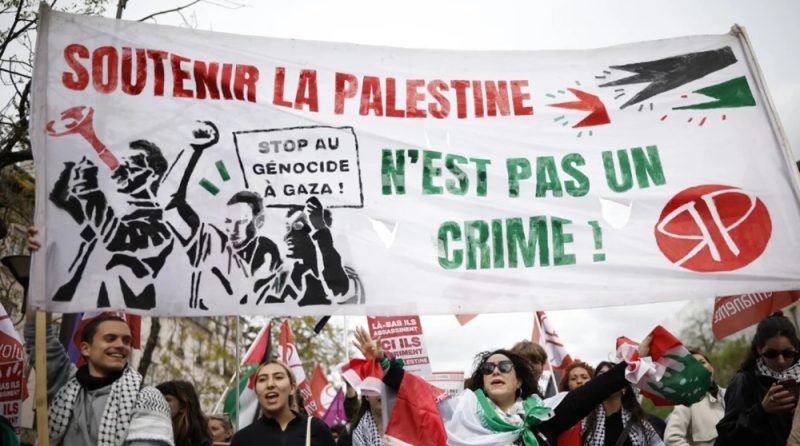
Protesters hold a banner reading “Supporting Palestine is not a crime” and “Stop genocide in Gaza” at a rally against the Yadan bill, in Paris on 12 April 2026.
The Dissident | April 13, 2026
A bill that the French National Assembly will vote on, on April 16th and 17th, effectively outlaws criticism of Israel, making it a criminal offence to question Israel’s “right” to exist as a Jewish supremacist apartheid state on occupied Palestinian land, compare Israel’s conduct to the Nazis, or support armed resistance against Israeli occupation and aggression.
The bill writes, “Today, anti-Jew hatred in our country feeds on obsessive hatred towards Israel, regularly delegitimized in its existence and criminalized. This phenomenon is exacerbated by extreme spirits who, under the pretext of expressing their hatred towards a State, are the instigators of a reinvented anti-Semitism, which could be described as ‘geopolitics’.”
The bill seeks to criminalize critics of Israel and paint them as terrorists, writing that the “call for the destruction of Israel and its comparison to a Nazi regime – are rooted in consciences with impunity, taking up the rhetoric of movements recognized as terrorist such as Hamas or Hezbollah.”
The bill seeks to criminalize:
- “Public remarks presenting acts of terrorism as legitimate resistance” (ie support for armed resistance against the Israeli genocide in Gaza or occupation of Lebanon).
- “Causing the destruction or denial of a State or publicly advocating its destruction or denial” (i.e., questioning Israel as a Jewish apartheid state, including calls for a single democratic state in historic Palestine with equal rights).
- “to clarify and extend the crime of challenging the Shoah, by enshrining several essential contributions of case law” adding “the comparison of the State of Israel to the Nazi regime would therefore be sanctioned as an outrageous trivialization of the Shoah” (i.e. factually pointing out that the state of Israel is behaving like the Nazis, including by committing Genocide in Gaza, as the UN independent international commission found in September of last year, and by calling for an expansionist greater Israel and ethnic cleansing to establish Jewish settlements ,similar to the Nazi concept of Lebensraum, an idea that has been openly endorsed by Benjamin Netanyahu and his main political opponent Yair Lapid).
Analyst Arnaud Bertrand documented that the bill attempts to make the criminalization of speech as broad as possible.
He noted that “Article 1 introduces the concept of ‘implicit’ provocation to terrorism and punishes it with five years imprisonment and a fine of €75,000,” adding, “What does ‘implicit provocation to terrorism’ mean? Nobody knows. And that’s the point. It means whatever a prosecutor wants it to mean: a perfectly good case could be made that, for instance, quoting international law on the right of occupied peoples to resist with respect to Hamas is, in fact, ‘implicit provocation to terrorism.’”
He added that “The same article also expands the terrorism apology offense to include ‘minimizing or trivializing acts of terrorism in an outrageous manner’” adding that “a judge could decide that providing context, explaining root causes, or insufficiently condemning an act amounts to ‘trivializing’ terrorism”, “for instance, a history teacher explaining the origins of Hamas or Hezbollah is providing context – but a prosecutor could argue that contextualization is trivialization. The same reasoning could apply to a journalist, a researcher, or anyone on social media who says ‘yes, it was terrible, but here’s why it happened.’ The ‘but’ becomes a crime, as it is trivialization.”
He also noted that, “ if you advocate for a one-state solution where Israelis and Palestinians live as equals, you are de-facto calling for the ‘destruction’ of the state of Israel. Well, that would now be punishable by 5 years in prison”.
The bill is called “the Yadan Law” because its creation was headed by National Assembly deputy Caroline Yadan, who represents the “French legislative constituency for citizens abroad” where “Israel has the largest number of voters in the constituency, with over 50,000 registered French voters”.
JNS noted that, “Yadan was elected to parliament as a representative of Renaissance but downgraded her ties to the party, switching to an independent affiliated lawmaker in September following the Macron administration’s decision to recognize a Palestinian state.”
In other words, the bill was brought by a Zionist French politician whose main constituency are Israelis.
Arnaud Bertrand noted, “The U.S. has congressmen paid by AIPAC: France has cut out the middleman entirely, we have MPs whose constituency is literally in Israel.”
Caroline Yadan is a genocide denier who has written, “The term genocide corresponds neither to the rights nor to the facts, nor to the intentions of the war in Gaza.”
Referring to the bill, the former French anti-terrorism judge Marc Trevidic said, “I’d never seen anything like it, the notion of implicit incitement to terrorism. Can you imagine what that means? A censor of other people’s thoughts, trying to figure out what a person meant”.
There is no doubt that this bill is designed to silence criticism of Israel, and that the lawmaker behind it is pushing it forward on behalf of her Israeli constituents.
UK, Spain reject Trump’s new scheme to blockade Hormuz Strait
The Cradle | April 13, 2026
The UK and others have rejected Washington’s plan to impose a blockade on Iranian ports and target ships transiting the Strait of Hormuz in collaboration with the Islamic Republic.
UK Prime Minister Keir Starmer said “we are not supporting the blockade” in an interview with BBC Radio on 13 April.
Starmer added that the UK is not “getting dragged in” to the US-Israeli war against Iran. He emphasized the priority is reopening the strait, noting it is “vital that we get the strait open and fully open.”
Turkiye opposed the blockade and called for renewed diplomacy, while China warned against escalation and urged both sides to maintain stability.
The Spanish government has also condemned the US move. “It’s just another episode in this downward spiral we’ve slipped into,” Spanish Defense Minister Margarita Robles said on Monday, adding that US President Donald Trump and Israeli Prime Minister Benjamin Netanyahu “want to impose rules on the international community, which is illogical.”
Germany did not criticize the move. “The supposed blockade … does not mark the end of this diplomatic process,” a government spokesperson said, adding that “We see it as a move to ramp up the pressure.”
The US military’s announcement did “not mention a blockade of the Strait of Hormuz, but rather a blockade of Iranian ports – that is a different approach,” the German spokesperson added.
Earlier on Monday, France announced that London and Paris will organize a conference to discuss forming a “strictly defensive” and “peaceful” mission to reopen the Strait of Hormuz.
“As regards the Strait of Hormuz, in the coming days, together with the UK, we will organize a conference with those countries prepared to contribute alongside us to a peaceful multinational mission aimed at restoring freedom of navigation in the strait,” said French President Emmanuel Macron.
“This strictly defensive mission, separate from the warring parties to the conflict, is intended to be deployed as soon as circumstances permit,” he added. Paris had previously rejected a US proposal on the formation of an international coalition aimed at reopening the Strait, saying it would help escort ships only when the war ended.
A Bahraini resolution to reopen the strait by force was vetoed by Russia and China right before the ceasefire was announced.
The Strait of Hormuz remains closed to Washington and its allies despite the recent ceasefire between the US and Iran.
Vessels unaffiliated with the US and Israel, including a French one, have recently been given access following coordination with the Islamic Republic.
The US threat to blockade Iran’s ports was made by CENTCOM on Sunday night. It said it would begin a blockade “of all maritime traffic entering and exiting” Iranian ports starting 10:00 am Eastern Time (ET) on 13 April.
“The blockade will be enforced impartially against vessels of all nations entering or departing Iranian ports and coastal areas, including all Iranian ports on the Arabian Gulf and Gulf of Oman. CENTCOM forces will not impede freedom of navigation for vessels transiting the Strait of Hormuz to and from non-Iranian ports,” it added.
After the announcement, Iranian Parliament Speaker Mohammad Bagher Ghalibaf said, “enjoy the current pump figures,” adding that “with the so-called ‘blockade,’ Soon you’ll be nostalgic for $4–5 gas.”
The Khatam al-Anbiya Central Headquarters of the Iranian military made a statement on Monday, accusing Washington of “piracy” while vowing to act “decisively” in order to permanently control the Strait of Hormuz and secure Iran’s waters.
Featured Video
Elijah Magnier: Yemen’s strikes are shattering Saudi Arabia’s long-term strategy
or go to
Aletho News Archives – Video-Images
From the Archives
British weapons and personnel doing much of the killing in Yemen
Press TV – June 18, 2019
A detailed report published by the Guardian newspaper has shown how Britain is massively contributing to Saudi Arabia’s devastating war on Yemen as it suggests that London is not only supplying the bombs that fall on Yemenis, but it provides the personnel and expertise that keep the war going.
The comprehensive report by Arron Merat published on Tuesday showed that Britain was doing much of the killing in Yemen as the country continues to provide Saudi Arabia with everything it needs to turn its southern impoverished neighbor into a graveyard.
“Every day Yemen is hit by British bombs – dropped by British planes that are flown by British-trained pilots and maintained and prepared inside Saudi Arabia by thousands of British contractors,” said Merat in the report. … continue
Blog Roll
 Aletho News
- Netizens condemn Japanese drama for projecting Japan’s wartime atrocities onto Chinese characters
- Racist Seinfeld Dances for Joy as Bibi Unveils His New Map
- A West Bank War for Netanyahu’s Election Campaign, Could It Backfire?
- Yemen denounces European Parliament’s ‘hypocritical’ push to blacklist Ansarullah
- Qalibaf: UAE’s UN bid aims to ‘clear the runway’ for ‘Greater Israel’, whitewash genocide
- Pakistan reopens Iran border after boosting security: Report
- Why are so many Brazilians voting for Flávio Bolsonaro?
- Democrats Put Anti-Russia Agenda Ahead of American Workers
- Elijah Magnier: Yemen’s Strikes Are Shattering Saudi Arabia’s Long-Term Strategy
- Pentagon designates Chinese cultural centers national security threat
- If Americans Knew
- An error has occurred; the feed is probably down. Try again later.
- No Tricks Zone
- Sudden Stratospheric Warming, Powerful El Niño Combination May Lead To Extreme Europe Cold, Energy Crisis!
- Two New Studies Find Thwaites Glacier Melt Cannot Be Driven By Human Activity Or A Warming Ocean
- E-Cars Reduce CO2 Emissions By Only 41% Compared To Internal Combustion Engine Vehicles
- Predictions Made By Renowned Climate Professor Over Past Decades Have Been Proven To Be Poor
- New Study Suggests Large Regions Of The Pacific Ocean Have Been Cooling For The Last 80 Years
- Germany’s Green Energy Debacle: High Energy Costs Force Kahla Porzellan to Close After 182 Years!
- New Study: 50 Years Of The Most Aggressive ‘Net Zero’ Policies Can Only Affect The Global Climate By 0.03°C
- US September “Heat” Was No Record…Many Records Set Decades Ago
- Latest European Green Energy Debacle; Portugal’s Largest Flagship Solar Park Insolvent!
- Green Energy Debacle: German Expert Professor Fritz Vahrenholt Warns Of Severe Economic And Social Consequences

