Brexit-Style Referendums Idea Gains Popularity in Three EU States After UK Vote
Sputnik – 01.12.2016
The idea of conducting a referendum on exiting the European Union has become more popular in EU countries, including Italy, Poland and Spain ever since the Brexit vote, while large numbers of people in other states of the bloc would support holding such a referendum, IFop pollster revealed in a survey for Sputnik.
According to the poll, the number of people who would support such a referendum has increased by 7 percent in Italy since July and now stands at 53 percent. The number of supporters of a vote on EU membership has also increased in Spain and Poland by 5 percent, to 39 percent and 38 percent, respectively.
The Brexit-style referendum is also popular in other European countries. Almost half, or 47 percent, of French nationals polled backed such an idea. The number of supporters of holding a referendum on exiting the European Union in Germany stands at 43 percent. The survey was carried out by France’s IFop pollster on October 22-26. As many as 5,019 people took part in the poll. The maximum sample error stands at 3.1 percent.
On June 23, the United Kingdom voted on referendum to leave the European Union. UK Prime Minister Theresa May said the country would trigger Article 50 by the end of March 2017, thus kick-starting withdrawal negotiations.
UN, US Fail to Offer Humanitarian Aid to 90,000 Freed Aleppo Citizens
Sputnik – 30.11.2016
The United States, the United Kingdom, France and the United Nations have not yet offered humanitarian relief to 90,000 Aleppo citizens, liberated from militants two days ago, the Russian Defense Ministry’s spokesman said Wednesday.
“Two days after over 90,000 Aleppo residents were freed from terrorists, no offer of humanitarian assistance came from the office of UN envoy for Syria Staffan de Mistura, the British and French Foreign Ministries or the US State Department,” the ministry’s spokesman Maj. Gen. Igor Konashenkov said.
Konashenkov reminded about the previous US, UK, UN and French demands to provide humanitarian access to eastern Aleppo when it was held by the militants.
“Apparently, the [humanitarian] assistance was destined for certain other people living in the eastern parts of Aleppo,” Konashenkov said highlighting the absence of the above-mentioned sides’ interest in providing civilians with humanitarian aid after all the necessary conditions for the aid delivery had been created.
On Tuesday, the Russian Defense Ministry said that the Syrian government forces had cleared almost half of eastern Aleppo from militant strongholds, liberating tens of thousands local residents.
15 European leaders call for new arms deal with Russia
RT | November 26, 2016
Fifteen European countries, headed by Germany, have issued a statement pushing for the reopening of “a new structured dialogue” with Russia aimed at preventing a possible arms race in Europe, according to the German foreign minister.
The countries, all belonging to the Organization for Security and Cooperation in Europe (OSCE), have expressed their deep concern over the current situation in Europe and support the relaunch of a conventional arms treaty with Russia, German Foreign Minister Frank-Walter Steinmeier told Die Welt newspaper in an interview published on Friday.
“Europe’s security is in danger. As difficult as ties to Russia may currently be, we need more dialogue, not less,” Steinmeier said.
The ongoing conflict in the Eastern Ukraine and the fact that Crimea joined Russia in 2014, a move most often dubbed as “annexation” by western officials, have put the question of war in Europe back on the table, Steinmeier continued. Fragile trust between Russia and European countries has suffered a significant setback and a “new armament spiral” is hanging over the continent, the foreign minister warned.
The statement contains strong anti-Russian rhetoric, blaming Moscow for violating arms deals as far back as 1990.
“The Conventional Forces in Europe treaty, which led to the destruction of tens of thousands of heavy weapon systems in Europe in the years following 1990, is no longer being implemented by the Russian Federation,” the statement said.
Russia put its participation in the treaty on hold in 2007 and then fully walked out of it last year.
Russian President Vladimir Putin called for the suspension of the treaty following a US decision to locate missile defense facilitates in the neighbouring Czech Republic and Poland. On top of that, President Putin noted that some of the NATO members did not join or ratify the treaty and there was no point in Russia abiding by the agreement.
Later Putin signed a decree suspending the treaty due to “extraordinary circumstances … which affect the security of the Russian Federation and require immediate measures,” having notified NATO and its members of the decision.
Since then NATO has taken no steps to upgrade the treaty, the Russian Foreign Ministry said in September, 2016, adding that Moscow is ready for dialogue on the subject. However, it is not planning to be the one to initiate it.
The statement names a number of other documents that need to be overviewed, including the OSCE’s Vienna document, stipulating the exchange of information on military movements, and the Open Skies treaty, enabling the monitoring of other countries’ ground forces. The documents are either neglected or in need of modernization.
The countries that spoke in favor of Steinmeier’s initiative include France, Italy, Austria, Belgium, Switzerland, the Czech Republic, Spain, Finland, the Netherlands, Norway, Romania, Sweden, Slovakia, Bulgaria and Portugal.
The group of the European foreign ministers is planning to meet again on the sidelines of a OSCE meeting in Hamburg on December, 8-9.
‘Fake news’ & ‘post-truth’ politics? What about those Iraqi WMDs?

By Neil Clark | RT | November 21, 2016
The Oxford Dictionaries have named ‘post-truth’ as the word of the year. ‘Fake news’ and ‘post-truth’ politics have been blamed for both the Brexit vote in the UK and the victory of Donald Trump in America.
It seems the uneducated plebs are falling for ’fake news’ they read in ’new media’ and the lies of dreadful rabble-rousing populist politicians who are relying on people’s emotions, instead of ’objective facts,’ to get votes. It’s all terribly worrying and poses a dire threat to Western civilization as we know it.
Well, forgive me for laughing out loud. For this establishment ‘fake news’/’post-truth politics’ concern is the funniest thing I’ve come across in politics since Lord Jenkins of Hillhead, the very grand Chancellor of the University of Oxford, repeatedly called distinguished Sheldonian guest Mikhail Gorbachev, “Mr. Brezhnev.”
Why is it so hilarious? Because the people and the outlets warning of the dangers of ‘fake news’ and ‘post-truth politics’ have been the biggest peddlers of ‘fake news’ and ‘post-truth politics’ out there. It’s like receiving lectures on the immorality of bootlegging from Al Capone or being told to sit up straight by the Hunchback of Notre Dame.
Without a doubt the best, or rather the worst example of ‘fake news’ in the last 25 years or so, was the neocon lie that Iraq had WMDs in 2002/3. That wasn’t peddled by ‘obscure bloggers’ and ‘new media,’ but by mainstream Western politicians, from ‘mainstream’ political parties, establishment-approved ‘experts’ on the BBC/ITV/CNN, etc., and Op-ed columnists in ‘serious’ and ‘respectable’ media outlets.
There was absolutely no evidence that Saddam possessed WMDs. The story was complete and utter BS. Yet this fake news dominated the headlines for months in 2002/3 and led to an illegal invasion in which many people lost their lives. Unlike today’s manufactured ‘fake news’ hysteria the Iraq war was no joke. An entire country was destroyed.
And guess what? Those who pushed the ‘Iraq has WMDs line’ are now coming on television to express their concern over ‘fake news’!
John Hilley notes “The BBC even had Alastair Campbell (Tony Blair’s spin doctor), in the studio defending the term ‘post-truth’ as a way of exposing the ‘dangers’ of ‘fake news.'”
Campbell stated: “It’s acknowledging that politics, which has always been rough, has moved to a different phase where politicians who lie now appear to get rewarded for it.” (BBC2 Jeremy Vine Show, 16/11/2016).
What might Orwell have said about Campbell, master spinner and Blairite warmonger, sitting inside the BBC being rewarded for his thoughts on ‘post-truth and ‘fake news?’ Hilley asks.
Once again, I’m sure old George is spinning in his grave in Sutton Courtenay.
Then there’s that serial warmonger Bernard-Henri Levy. The Sunday Telegraph today told us in its headlines: ‘Leading French philosopher: Marine Le Pen may win election as people have lost interest in whether politicians tell the truth.’
Oh, the irony!
Because if the French people really have ‘lost interest in whether politicians tell the truth,’ Henri-Levy and his fellow liberal interventionist ‘regime changers’ have got a lot to do with it.
Think back to the war against Libya, which the ‘leading French philosopher’ lobbied hard for. To sell the war to the Western public, we were told that Muammar Gaddafi was about to commit a ‘Srebrenica-style’ massacre in Benghazi. Media Lens noted the claims that were made at the time.
But again it was a load of ‘rollocks.’ Five years after Libya, like Iraq before it, had been destroyed by Western ‘interventionists,’ a report of the Foreign Affairs Committee of the House of Commons declared: “the proposition that Muammar Gaddafi would have ordered the massacre of civilians in Benghazi was not supported by the available evidence.”
It wasn’t the only claim made about Libya by Western politicians that was ‘not supported by the available evidence.’ In February 2011, UK Foreign Secretary William Hague insisted that he had seen ‘information’ which suggested that Gaddafi was on his way to Venezuela. An unnamed ‘diplomat’ said that this was ‘credible information.’ But it wasn’t. It was the same old fake news that we get every time the Western elites are trying to achieve ‘regime change.’
In April 2011 we heard that the devilish Gaddafi (who had not, after all, fled to Caracas), was supplying his troops with Viagra “to encourage mass rape.”
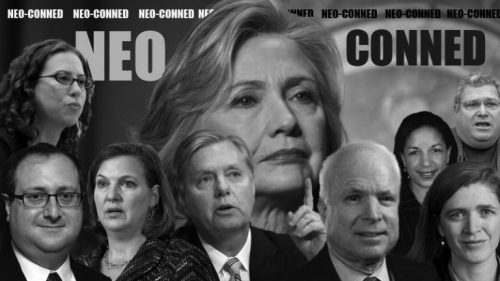 “Gaddafi’s security forces and other groups in the region are trying to divide the people by using violence against women and rape as tools of war, and the United States condemns this in the strongest possible terms,” declared Secretary of State Hillary Clinton, whose supporters are now complaining about ‘post-truth politics.
Again, no evidence was put forward for the Viagra/mass rape claim and, surprise, surprise, none was ever found.
A clear pattern can be discerned. To get public support for its illegal regime change wars, the Western establishment energetically promotes a number of ‘fake news’ stories. These stories are usually reported unquestioningly in ‘respectable’ outlets and are regularly cited by neocon/liberal interventionist commentators as a reason for taking action against the target state. ‘Anonymous’ sources feature heavily in these stories, which like MI6’s ‘Operation Mass Appeal’ are often planted by the security services.
Meanwhile, people’s emotions are shamelessly played upon by the ‘something must be done’ brigade of ‘liberal’ laptop bombardiers, the same crowd, note well, who accuse ‘populist’ politicians of ignoring ‘objective facts’ and playing on people’s emotions.
The fake news continues while the regime change operation is ongoing. After its over, we’re all meant to forget about the false stories we were fed and focus on the next ’New Hitler’ who needs to be dealt with. In 2011, it was the despicable Gaddafi, now it’s the despicable Assad and the despicable Putin who we’re told: “have to be stopped.”
The term ‘post-truth’ politics implies there was a time when politics was truthful. I doubt if that ever was the case, but certainly in the last 25 years, thanks to the influence of neocons and ‘liberal interventionists’, the lies have been off the scale. Remember the Niger uranium forgeries? And Saddam’s horrific ‘People Shredder‘?
And before the Iraq war, we had the ‘humanitarian’ NATO bombing of Yugoslavia, where again fake news dominated. US Defense Secretary William Cohen claimed “about 100,000 military-aged” Kosovan Albanians were missing… “they may have been murdered.”
As John Pilger reminded us, “Kosovo, the site of a genocide that never was, is now a violent “free market” in drugs and prostitution.”
It wasn’t the only lurid claim that was made to sell the war. But again the ‘genocide’ and hundreds of thousands killed stories were false, as a UN court itself ruled in 2001.
Fake news also featured heavily in the neocon campaign to get Iran sanctioned for an entirely unproven nuclear weapons program. It’s dominated the coverage of recent events in Ukraine, with Russia’s non-existent ‘invasion of Ukraine’ routinely referred to as a fact. The conflict in Syria too has been marked by ‘fake news,’ and theories being reported as if they’re 100 percent proven. How many times have you read that “Assad gassed his own people” at Ghouta in 2013, even though we still don’t know for sure who carried out the attack?
If it’s ‘official enemies’ we’re talking about ‘fact-checking’ and citing sources isn’t all that important for those who pounce on a mere typo if it’s an anti-war writer who’s making a claim.
Now, the same people who have disseminated fake news for so long and who are still, even after Iraq and Libya, embedded in the West’s political and media establishments, are lashing out because they no longer control the narrative as they used to. The public is getting their news from a much wider variety of sources and voting for ‘populist,’ i.e., non-neocon/liberal interventionist-anointed candidates/parties at elections.
Instead of admitting that it’s their ’fake news’ and ‘post-truth politics’ which has caused people to switch off from establishment media and to stop voting for status quo candidates, the endless war lobby has the effrontery to accuse others of the things they have been guilty of.
Concern over ‘fake news’ and ‘post-truth politics’ from the West’s endless war propagandists?
It’s hard to think of a better example of what psychologists call ‘projection.’
Follow Neil Clark @NeilClark66
‘Trump effect’ divides European opinion
By M K Bhadrakumar | Indian Punchline | November 14, 2016
The results of the two presidential elections held on Sunday in Bulgaria and Moldova underscore the winds of change blowing over the western edges of Eurasia. To an extent they can be called the early signs of the ‘Trump effect’. In both elections, ‘pro-Russian’ candidates won convincingly. (here and here)
In both cases, the contestation essentially boiled down to whether Bulgaria and Moldova would be better off casting their lot with the European Union or whether they need to realign with Russia. The answer is clear.
The open-ended quest for EU membership no longer holds attraction for Moldova, whereas, Bulgaria appears to be disheartened with its EU membership. On the other hand, Russia is real and it is next-door. The election results yesterday constitute a blow to the EU’s prestige. Indeed, Moscow’s influence is spreading in Eastern Europe.
This is also a swing to the Left in political terms. There is much discontent with ‘reforms’, rampant corruption, etc. in both countries. The Russophile sentiment is very substantial, and there is eagerness to boost trade with Russia to overcome economic difficulties. Also, the local partisans of the West and EU stand discredited in both countries.
In Moldova, only around 30% of population find EU attractive, while 44% would support their country joining the Moscow-led Eurasian Economic Union. Curiously, 66% of Moldovans trust Vladimir Putin; in comparison, only 22% place trust in Barack Obama’s words.
Against the backdrop of the election victory of Donald Trump in the US, how these trends are going to play out will be interesting to watch. Bulgaria’s president-elect Rumen Radev has called for an end to the EU sanctions against Russia. He argues that Sofia should be pragmatic in its approach to Russia’s annexation of Crimea. (This is notwithstanding Bulgaria’s long history of divided loyalties between Russia and Europe.)
The Obama administration in its lame duck phase will endeavour to pressure the EU to extend the sanctions against Russia for yet another 6-month period beyond December. But will Trump follow Obama’s footfalls when the issue crops up again toward the middle of next year? He is unlikely to show Obama’s messianic zeal to ‘contain’ Russia. That is how the EU consensus on sanctions against Russia can break down because many countries in Europe resent the American pressure and prefer to restore trade and economic ties with Russia.
Interestingly, Trump may get resonance in Old Europe as well. The Labour leader in Britain, Jeremy Corbyn made a stunning call in the weekend for Western leaders to ‘demilitarize’ the border between Eastern Europe and Russia or risk a New Cold War. He said the West didn’t have to pile up forces on Russia’s border. Corbyn told the BBC:
I have many, many criticisms of Putin, of the human rights abuses in Russia, of the militarisation of society. But I do think there has to be a process that we try –demilitarise the border between what are now the NATO states and Russia, so that we drive apart those forces and keep them further apart in order to bring about some kind of accommodation. We can’t descend into a new Cold War.
Corbyn also made a thoughtful suggestion that that the Organisation for Security and Co-operation in Europe, which includes Russia, could replace NATO as a forum for solving issues in the region.
Indeed, some churning has already begun regarding European security even before Trump takes over in the Oval Office. By the way, Czech Prime Minister Bohuslav Sobotka said on Sunday that American statements about possible deployment of a U.S. global missile shield’s radar in the Czech Republic are pure fiction.
He said, “A radar in the Czech territory would mean further escalation in relations with Russia. We need to use the window opening after Donald Trump’s election to have the United States and Russia sit down at one table.” Sobotka pointed out that Eastern Europe’s main security problem today is about putting an end to the war in Syria.
“The United States has considerable influence on the situation in Syria, Russia has considerable influence. So, it is necessary to use this,” he said, adding that Donald Trump can establish more efficient cooperation with Russia on Syria.
However, the fact of the matter is that neither has Trump taken his position yet on NATO nor is it going to be easy for him to seek a separation for America from the western alliance. Simply put, Europe is not ready for a post-NATO future. There is palpable fear in many quarters (both in the US and in Europe) that if the US were to withdraw from Europe, Russia would advance and exercise more assertive behaviour in Eastern Europe.
In an article in the weekend, NATO secretary-general Jens Stoltenberg made an impassioned appeal to Trump that now is not the time for the US to abandon NATO. He pointedly invoked the threat perceptions from “a more assertive” Russia. Read the opinion piece here.
The bottom line is that European opinion stands divided. Britain, France and Hungary refused to attend a contentious EU ministerial meeting last night in Brussels, backed by Germany, to align the bloc’s approach to Trump’s election. The rift within the EU on the US vote stands exposed. The irrepressible British Foreign Secretary Boris Johnson has publicly chided EU politicians to end their ‘whinge-o-rama’ over Trump. (Daily Mail )
Interestingly, the first politician from abroad whom Trump met after the election has been Nigel Farage, the populist Brexit campaigner.
Who Said “Assad Must Go” And Where Are They Now?
Oh the irony of it all.
Who is still President of his country…

Who is next on the neo-liberal warmonger regime change list…

Time for forces to unite to beat a common enemy…

Israel acts to blunt criticism of the occupation as its grip tightens
By Jonathan Cook | Dissident Voice | November 1, 2016
Israel has just emerged from its three-week high holidays, a period that in recent years has been marked by extremist religious Jews making provocative visits to Al Aqsa mosque compound in occupied East Jerusalem.
Many go to pray, in violation of Israel’s international obligations. Most of them belong to groups that seek to replace the mosque with a Jewish temple. They now enjoy increasing parliamentary support, some of it from within prime minister Benjamin Netanyahu’s party.
A rash of such visits last autumn outraged Palestinians and triggered a wave of so-called lone-wolf attacks on Israelis. The attacks have recently abated.
Taking advantage of the renewed quiet, Israel allowed a record number of ultra-nationalists to visit the mosque, figures released last week showed. Parties of Israeli soldiers are also entering the site.
The police, whose recently appointed commander is himself from the extremist settler community, have recommended that restrictions be ended on visits by Jewish legislators who demand Israel’s sovereignty over the mosque.
For Palestinians, Israel’s treatment of this supremely important Islamic holy site symbolises their powerlessness, oppression and routine humiliation. Conversely, a sense of impunity has left Israel greedy for even more control over the Palestinians.
The gaping power imbalance was movingly detailed last month at a special hearing of the UN security council. Hagai El-Ad, head of B’tselem, which monitors the occupation, termed Israel’s abuses as “invisible, bureaucratic, daily violence” against Palestinians exercised from “cradle to grave”.
He appealed to the international community to end its five decades of inaction. “We need your help. … The occupation must end. The UN Security Council must act. And the time is now,” he said.
Israeli politicians were incensed. Mr El-Ad had broken one of Israel’s cardinal rules: you do not wash the country’s dirty linen abroad. Most Israelis consider the occupation and Palestinian suffering as an internal matter, to be decided by them alone.
Mr Netanyahu accused B’tselem’s director of conspiring with outsiders to subject Israel to “international coercion”.
With the US limply defending Mr El-Ad’s freedom of speech, Mr Netanyahu found a proxy to relaunch the attack. David Bitan, chair of his party, demanded that Mr El-Ad be stripped of his citizenship and proposed legislation to ban calls in global forums for sanctions against Israel. Unsurprisingly, Mr El-Ad has faced a flood of death threats.
Meanwhile, another UN forum has been considering Israel’s occupation. Its educational, scientific and cultural body, Unesco, passed a resolution last month condemning Israel’s systematic violations of Palestinian holy sites, especially Al Aqsa.
Again, Israelis were enraged at this brief disturbance of their well-oiled machinery of oppression. The abuses documented by Unesco were overshadowed by Israeli protests that its own narrative was not the focus.
While Israel exercises ever more physical power over Palestinians, its moral credit is running out with foreign audiences, who have come to understand that the occupation is neither benign nor temporary. The rise of social media has accelerated that awakening, which in turn has bolstered grassroots reactions such as the boycott (BDS) movement.
Aware of the dangers, Israel has been aggressively targeting all forms of popular activism. Facebook and YouTube are under relentless pressure to censor sites critical of Israel.
Western governments – which joined the chorus of “Je suis Charlie” after ISIL’s lethal attack on the Paris office of Charlie Hebdo magazine last year – have cracked down on the boycott movement. Paradoxically, France has led the way by banning such activism, echoing Israeli claims that it constitutes “incitement”.
And left-wing social movements emerging in Europe face loud accusations that any criticism of Israel is tantamount to an attack on all Jews. Notably, a British parliamentary committee last month characterised as anti-semitic parts of the opposition Labour party under its new leader, Jeremy Corbyn, a champion of Palestinian rights.
In these ways, European governments have been trying to hold in check popular anger at a belligerent and unrepentant Israel.
Illustrating that caution, Uneso was forced last week to vote a second time on its resolution, this time removing the word “occupation” and, against normal practice, giving equal status to the occupier’s names for the sites under threat from its occupation.
Even with the resolution neutered, Unesco’s usual consensus could not be reached. The resolution passed by a wafer-thin majority, with European and other governments abstaining.
Israel and its enablers have successfully engineered a hollowing out of official discourse about Israel to blunt even the mildest criticism. Gradually, western powers are adopting Mr Netanyahu’s doubly illogical premises: that criticising the occupation is anti-Israel, and criticising Israel is anti-semitic.
Incrementally, western leaders are conceding that any criticism of Mr Netanyahu’s policies – even as he tries to ensure that the occupation becomes permanent – is off-limits. Mr El-Ad called for courage from the western powers that dominate the security council. But the signs are his words have fallen on deaf ears.
“Historic” U.N. Vote for Nuclear Ban

By Ira Helfand | Institute for Public Accuracy | October 28, 2016
In an historic move the United Nations First Committee voted Thursday to convene a conference next March to negotiate a new treaty to ban the possession of nuclear weapons. The vote is a huge step forward in the campaign to rid the world of nuclear weapons launched several years ago by nonnuclear weapons states and civil society from across the globe.
Dismayed by the failure of the nuclear weapons states to honor their obligation under Article VI of the Non Proliferation Treaty which requires them to pursue good faith negotiations for the elimination of their nuclear arsenals, and moved by the growing danger of nuclear war, more than 120 nations gathered in Oslo in March of 2013 to review the latest scientific data about the catastrophic consequences that will result from the use of nuclear weapons. The conference shifted the focus of international discussion about nuclear war from abstract consideration of nuclear strategy to an evaluation of the medical data about what will actually happen if these weapons are used. It was boycotted by all of the major nuclear powers, the US, Russia, UK, China and France, the five permanent members of the UN Security Council, or P5.
Further meetings in Nayarit, Mexico and Vienna followed in 2014 and culminated in a pledge by the Austrian government to “close the gap” in international law that does not yet specifically outlaw the possession of these weapons. More than 140 countries ultimately associated themselves with the pledge which was fiercely opposed by the United States and the other nuclear weapons states, and in the fall of 2015 the UN General Assembly voted to establish an Open Ended Working Group which met in Geneva earlier this year and recommended the negotiations approved Thursday.
The United States, which led the opposition had hoped to limit the “Yes” vote to less than one hundred, but failed badly. The final vote was 123 For, 38 Against and 16 Abstentions. The “No” votes came from the nuclear weapons states, and US allies in NATO, plus Japan, South Korea and Australia which have treaty ties to the US and consider themselves to be under the protection of the “US nuclear umbrella”.
But four nuclear weapons states broke ranks, with China, India and Pakistan abstaining, and North Korea voting in favor of the treaty negotiations. In addition, the Netherlands defied intense pressure from the rest of NATO and abstained, as did Finland, which is not a member of NATO but has close ties with the alliance.
Japan which voted with the US against the treaty has indicated that it will, nonetheless, participate in the negotiations when they begin in March.
The US and the other nuclear weapons states will probably try to block final approval of the treaty conference by the General Assembly later this fall, but, following Thursday’s vote, it appears overwhelmingly likely that negotiations will begin in March, and that they will involve a significant majority of UN member states, even if the [major] nuclear states continue their boycott.
The successful completion of a new treaty will not of itself eliminate nuclear weapons. But it will put powerful new pressure on the nuclear weapons states who clearly do not want to uphold their obligations under the Non Proliferation Treaty even as they insist that the nonnuclear weapons states meet theirs.
We have come perilously close to nuclear war on multiple occasions during the last 70 years, and we have been incredibly lucky. US nuclear policy cannot continue to be the hope that we will remain lucky in the future. We need to join and lead the growing movement to abolish nuclear weapons and work to bring the other nuclear weapons states into a binding agreement that sets out the detailed time line for eliminating these weapons and the detailed verification and enforcement mechanisms to make sure they are eliminated.
This will not be an easy task, but we really have no choice. If we don’t get rid of these weapons, someday, perhaps sooner rather than later, they will be used and they will destroy human civilization. The decision is ours.
Ira Helfand, MD, is past president of Physicians for Social Responsibility
Time for West to stop supporting terrorists – Russian ambassador to US
Ambassador’s view | RT | October 26, 2016
On October 21, on the initiative of the UK, the UN Human Rights Council (HRC) met to discuss the recent situation in Aleppo. The discussions demonstrated a huge divergence of opinions and views on the realities in Aleppo and the Syrian crisis as a whole.
HRC has been reviewing the Syrian file for more than four years now, but regrettably its assessments are becoming a far cry from reality due to the efforts of certain states, including those who call themselves the “Friends of Syria”, to politicize the matter. The current session has been a case study in this.
Instead of supporting the fight against international terrorism, the initiators of the HRC special session, as a matter of fact, tried to let the terrorists off the hook, save them from defeat and allow them to regroup and continue to commit atrocities in Syria. There is no other explanation for the fact that a HRC draft resolution didn’t demand the terrorists and militants cease hostilities, obstructing humanitarian access, using civilians as human shields, and stop preventing residents and medical workers from leaving the city via established humanitarian corridors.
Moreover, these countries tried to blame Russia for most of the developments in East Aleppo, while failing to pressure the rebels to abide by the ceasefire and respect humanitarian efforts. In fact, the whole situation in East Aleppo is held hostage to the terrorists designs.
Against this backdrop, the crimes committed by the US-led coalition are being silenced, despite their devastating strikes on civilians and Syrian army units. They are also systematically destroying the economic infrastructure in the Syrian Government-controlled areas (perhaps to make Syria depend on financial assistance for post-conflict reconstruction?). Now, it seems that ISIL fighters are being deliberately squeezed from Iraq’s Mosul into Syria.
Even more perplexing was the voting on Russia’s amendments to the HRC draft resolution. UK, France, Belgium and several other Western and Gulf countries flatly refused to admit the existence of foreign assistance to terrorists in Syria, to recognize the need to separate the jihadists from the moderate opposition (which is the subject matter being discussed by experts in Geneva as a follow-up to the recent multilateral talks in Lausanne) and to support the efforts of UN Secretary-General’s Special Envoy for Syria Staffan de Mistura to remove the jihadists from eastern Aleppo. Such a stance suggests that the public rhetoric of those governments on the need to fight international terrorism in Syria does not reflect their true intentions and goals.
Our Western partners should understand that using HRC for attaining their own political goals is counterproductive and discredits this vital human rights agency and the doctrine of human rights as a whole. We hope that they will eventually see reason, stop supporting the jihadists and start fighting against them, facilitate the separation of terrorists from the moderate opposition, help oust Jabhat al-Nusra and its allies from Aleppo, stop supplying terrorists with arms and recruits, and promote the continuation of inter-Syrian talks to eventually settle the conflict in Syria. It has to be understood that if al-Nusra leads the opposition on the battlefield, it will call the tune at the talks on the side of the opposition. We must not allow them dictate to Syria and the world.
On its part, Russia will continue working towards a political settlement in Syria through talks between Damascus and the opposition based on respect for the sovereignty and territorial integrity of Syria and compliance with UN Security Council resolutions.
Dr Alexander Yakovenko, Russian Ambassador to the United Kingdom of Great Britain and Northern Ireland, Deputy foreign minister (2005-2011). Follow him on Twitter @Amb_Yakovenko
If EU leaders can be so wrong on Russia & Syria, no wonder the bloc is in crisis
By Finian Cunningham | RT | October 21, 2016
Russophobic rants by some European Union leaders and their willful distortion of events in Syria is a reflection of why the 28-member bloc is careering toward disaster. We are witnessing a crisis of appallingly inept leadership.
German, British and French leaders were among the most hawkish voices at the EU leaders’ summit in Brussels this week, denouncing what they claimed were Russian “war crimes” in Syria and calling for additional economic sanctions on both Moscow and Damascus.
German Chancellor Angela Merkel said Russian-backed Syrian air strikes were “inhumane and cruel,” while Britain’s Prime Minister Theresa May took the “most shrill prize” with her condemnation of Moscow’s “sickening atrocities.”
French President Francois Hollande echoed their calls for the EU to slap more sanctions on Russia – in addition to those the bloc has implemented over the Ukraine conflict.
This came only days after Belgian F-16 fighter jets reportedly killed six civilians in the Aleppo countryside, adding to a catalog of illegal aggression committed in Syria by French, British and American warplanes bombing the country without any legal mandate.
In the end, good sense among certain member states prevailed, and the EU summit concluded without imposing additional punitive measures. As the Financial Times reported: “Italy’s Renzi forces a retreat from new sanctions on Russia… Germany, France and UK rein in demand for fresh EU sanctions over Aleppo bombardment.”
Italy, Spain, Austria, Hungary, Greece, Malta and Cyprus were some of the EU members wary of escalating economic and political problems already incurred from loss of trade with Russia over the Ukraine debacle.
Britain’s premier May gave a particularly asinine speech in Brussels. She called for a “robust and united European stance in the face of Russian aggression.” This from the leader of a government currently embroiled in bitter rows over its divorce from the EU.
So, the British leader wants to bequeath even more tension and economic hardship between the people of Europe and Russia, just before she packs up Britain’s membership.
In the Russophobic rousing, European Council President Donald Tusk also excelled. Despite the EU summit rejecting the adoption of more sanctions against Russia over Syria, Tusk was later threatening that such measures remained an option. Tusk had regaled the summit with a list of alleged Russian “misdemeanors” including “air-space violations, disinformation campaigns, cyber-attacks, interference in the EU’s political processes and beyond. Hybrid tools in the Balkans, to developments in the MH17 investigation.”
Then he declared: “Given these examples, it is clear that Russia’s strategy is to weaken the EU.”
Please note that Tusk is supposed to be a leading light for the EU as it negotiates a raft of existential problems, from intractable international trade deals, migration and border disputes, anti-EU political parties, and ongoing economic stagnation for 500 million citizens.
But if Tusk and other EU leaders like Merkel and Hollande can come out with such inane views on Russia, what chance has the bloc got in dealing effectively with other challenging issues? No wonder, EU citizens are losing respect and faith in political leaders when they are seen to be so utterly incompetent and detached from reality.
Yet to make matters even worse, Tusk and his Russophobic ilk turn around and blame the imploding EU crisis on alleged Russian plots to “weaken and divide.”
Just ahead of the EU leaders’ summit in Brussels, Merkel and Hollande met Russian President Vladimir Putin in Berlin for a conference on the Ukraine crisis. The Kiev regime’s President Petro Poroshenko was also in attendance.
The Berlin meeting did not result in any progress toward resolving the Ukraine dispute. While the German and French leaders wanted to penalize Russia over alleged violations in Syria, they seemed oblivious to hundreds of attacks by Kiev’s armed forces on civilian centers in breakaway eastern Ukraine. The assassination of a military commander in the self-declared Donetsk People’s Republic last week by suspected Kiev agents has heightened fears of a return to all-out war.
Where are Merkel and Hollande’s condemnations and calls for sanctions on the Kiev authorities whom they patronize with billions of dollars in financial aid and NATO military support?
Also, Merkel, Hollande and Britain’s May have little to say about recorded “cruel, inhumane, sickening” massacres in Yemen committed by the Saudi coalition bombing that country. Their silence no doubt is owing to the fact that their governments sell billions of dollars worth of weapons to the Saudi regime even as it slaughters women and children in Yemen.
And, indeed, let’s talk about Syria and the besieged northern city of Aleppo.
The crimes that European leaders allege against Russia and its Syrian ally are based on unverified claims issued by dubious networks evidently under the control of the anti-government militants. The militants besieging east Aleppo are dominated by head-chopping terrorist groups like the internationally proscribed Jabhat Al-Nusra.
When Russia unilaterally implemented a temporary ceasefire this week in Aleppo, an innovative live-streaming broadcast from the appointed humanitarian corridors proved once again the real nature of the violence.
Civilians trapped in the militant-held areas were shown to be held as “human shields” by the insurgents. While buses and other vehicles were waiting to ferry civilians out of the conflict zone, video footage recorded militants shelling and sniping at the humanitarian aid effort.
Those violations corroborated what citizens in east Aleppo have been saying for a long time – that they are being held against their will by the gunmen. Besieged people are even calling on the Syrian and Russian forces to continue in their operations to break the hostage situation and liberate that part of the city.
All across Syria, hundreds of villages and towns have been liberated by the Syrian army and its Russian allies since Putin ordered his air force to intervene in the stricken country at the end of last year.
One of the recent successes was the town of Qudsaya near the capital Damascus. Last week, thousands of residents rallied in the main square cheering President Bashar Assad, the Syrian army and Russia for their “liberation” after the foreign-backed mercenaries were routed from the town.
The foreign backers of the mercenary army that has plunged Syria into horror since March 2011 – with perhaps half a million dead – include the supposedly leading EU members Britain and France. Hollande is on record for admitting that France supplied weapons to insurgents in Syria as far back as 2012, when the siege of Aleppo began, and in breach of a European arms embargo.
What is going on in Syria is a military victory over a foreign-sponsored terrorist war on that country. Russia’s role in the liberation of Syria is principled and commendable.
Those who should be facing prosecution for war crimes include pious, pompous government leaders, past and present, in London and Paris.
If such prominent EU governments can be so wrong and distorting about something so glaringly obvious as Syria and Russia’s support, then no wonder the EU is in free-fall over so many other pressing matters. With criminally incompetent politicians in power, the EU is a bus with its driver slumped at the wheel.
Featured Video
The Board For Peace – Whitewashing Ethnic Cleansing and Genocide
or go to
Aletho News Archives – Video-Images
From the Archives
Inside Job? Inside What?
By Prof. Tony Hall | American Herald Tribune | July 28, 2016
The Kevin Barrett-Chomsky Dispute in Historical Perspective – Sixth part of the series titled “9/11 and the Zionist Question”
In his chapter on “Left Gatekeepers” and the “Shame of Noam Chomsky,” Barrie Zwicker refers to the the “New World Order” as the “diaboligarchy’s” directing agency. Less compelling is Zwicker’s reference to the “New World Order” as the “diaboligarchy’s” directing agency. To me this unfortunate choice of words is much too closely associated with the often crude and chauvinistic populism of Alex Jones and his Infowars media network. Many have come to see Jones’ lucrative media operation as a limited hangout set in place by handlers trying to hold the activities of the 9/11 Truth Movement within manageable constraints.
Due to the important findings over fifteen years of the citizens’ investigation into 9/11, the culprits most deeply implicated in the crime can be identified with much more specificity than an entity vaguely described as a “New World Order.” As Kevin Barrett and many others insist, the time has come to name the names of the probable culprits, Noam Chomsky prominent among them.
While Alex Jones ultimately serves the same masters as Chomsky, the former’s media product is often much closer to the mark of what is really going on than the content of Noam Chomsky’s more magisterial pronouncements. Jones goes at least part of the way into realities of the deep state politics of the twenty-first century. Chomsky, however, sacrificed his capacity to contribute cogently to sensible discourse on contemporary geopolitics by making himself a primary instrument of the most consequential deep state deception of recent times. As a leading agent of disinformation in the psychological trenches of the ongoing Global War of False Flag Terrorism, Chomsky has reduced himself to the level of skeptic pretender Michael Shermer. In the style of Shermer, the elder Chomsky has become an establishment TV professor readily available on Netflix. … continue
Blog Roll
Recent Comments
loongtip on Trump wanted to play peacemake… Coronistan on EU member to sue bloc over ‘su… loongtip on Vicious loongtip on EU turns to India for defense… Coronistan on Donald Trump Is No Peace … seversonebcfb985d9 on French court jails pro-Palesti… eddieb on Fourteen Incredible Facts Abou… Bill Francis on European leaders’ shift in the… seversonebcfb985d9 on Villains of Judea: Philip Esfo… loongtip on Report warns that ‘Jewish terr… Craig Nelms on New study shows that toxic gas… loongtip on A Funny Thing Happened on the…


 Aletho News
- Conspiracy Denial
- Ukraine expects to join EU next year – Zelensky
- Here’s what’s behind the US shift on EU allies
- UN experts alarmed by prosecution of students protesting ETH Zurich’s Israel-linked research ties
- Exposed – How the UAE Became Central to Gaza’s Concentration Camp Plot
- How South Korea’s gas ambitions sustain the occupation of Gaza
- “Leaked document” exposes US blueprint for total control over Gaza
- Trump wanted to play peacemaker, Netanyahu made sure he failed
- Idea of limited, fast strike on Iran misjudges our capabilities: IRGC
- US Military Buildup on Land, Air, and Sea Raises Fears of Imminent Attack on Iran – Expert
- If Americans Knew
- Israel to seek new security deal from US, official says
- Leaked “Board of Peace” Resolution Outlines U.S.-Led Plan to Rule Over Gaza
- Jonathan Greenblatt Rolls Out Plan to Activate Hispanic Evangelical Golems
- Violence against hundreds of Gazan remains to find one Israeli – Not a ceasefire Day 109
- Greenpeace Demonstrator Exposes Folly of Protest Restrictions
- From CBS to TikTok, Pro-Israel Ellison is now in the driver’s seat
- Israel pays for UK advertisements attacking Doctors Without Borders
- Israel accused of extracting billions from Gazan people to pay for their own genocide
- ‘Deliberate Assassination’: 3 Journalists Among 11 Killed by Israeli Forces in Gaza
- In Gaza, We’re Struggling to Reintroduce Foods to Bodies Adjusted to Starvation
- No Tricks Zone
- New Study Affirms Rising CO2’s Greening Impact Across India – A Region With No Net Warming In 75 Years
- Germany’s Natural Gas Crisis Escalates … One Storage Site Near Empty …Government Silent
- Polar Colding…Antarctica Saw Its Coldest October In 44 Years!
- New Study: Sea Levels Rose 20 Times The Modern Rate During The Roman Warm Period
- As German Gas Storage Dips Dangerously Low…Shortage Hardly Avoidable
- New Study: Brazil’s Relative Sea Level Was 2+ Meters Higher And SSTs 3-4°C Warmer 6000 Years Ago
- Philosopher Schopenhauer: Climate Science Certainty Stems From Stupidity, Ignorance
- New Study: Species Extinction Rates Declining Since 1980 – ‘Climate Change Is Not An Important Threat’
- Denmark Places Climate Protection Above Animal Welfare, Poisoning And Culling Cows
- New Study: Greenland Was 3-7°C Warmer And Far Less Glaciated Than Today 6000-8000 Years Ago
 Aletho News