Welcome To 2026: Europe Laying Groundwork For Climate Science Censorship!
By P Gosselin | No Tricks Zone | December 31, 2025
As EU narratives collapse, desparate leaders are planning more tyrannical measures to keep it all from sinking.
Currently, EU leaders are fuming that US officials would be so audacious as to accuse them of practicing censorship. Yet, when it comes to suppressing open discussions and differing viewpoints on major issues, things are in fact worse than most people think. And, it’s about to get even worse.
A recent (indirectly EU-funded) report released earlier this year shows how the EU is planning to broaden censorship to include the topics of climate and energy science.
In the “Harmful Environmental Agendas and Tactics” (HEAT) report, published by EU DisinfoLab and Logically, its authors investigate how climate-related misinformation, disinformation, and malinformation (MDM) are strategically used to undermine climate policy in Europe, specifically in Germany, France, and the Netherlands.
Climate science skeptics threaten democracy
The report argues that climate disinformation has moved beyond simple science denial and has become a tool for broader political and social polarization.
Outright denial of climate change, the authors claim, is being replaced by narratives focused on “climate delay.” These often acknowledge climate change but attack the feasibility, cost, and fairness of solutions, e.g., they claim green policies will bankrupt households or destroy industries.
The enemies
The report identifies four main pillars driving these agendas:
- The Conspiracy Milieu: Distrust of elites and “deep state” narratives (e.g., the “Great Reset”).
- Culture War/Partisan Discourse: Framing climate action as an authoritarian or elitist project.
- Hostile State Actors (HSAs): Significant involvement of Russian-linked networks (e.g., Portal Kombat) that use localized domains like Pravda DE to amplify divisive climate content.
- Big Oil Alignment: Narratives that align with fossil fuel interests, even if direct corporate attribution is often obscured.
In Germany, for example, there are attacks on the Energiewende (energy transition) and the Building Heating Act.
In France, there are links between climate policy and the “Yellow Vest” movement or anti-elitist sentiments.
Meanwhile, the “nitrogen crisis” has been reframed as “government land theft” in the Netherlands.
European leaders are convinced that their policies have nothing to do with all the failure going on. In their eyes, it’s all the fault of unruly citizens and their disinfoarmtion campaigns.
The report’s key recommendations
The authors call for decisive institutional and platform-level action to treat climate disinformation as a structural threat and a danger to democracy. This all needs to stop!
Platforms must act!
The primary recommendation is for the EU to explicitly recognize climate disinformation as a systemic risk under the Digital Services Act (a.k.a. by critics the Digital Censorship Act). This would force so-called Very Large Online Platforms (VLOPs) to take proactive measures and conduct risk assessments.
The authors also call for mandating algorithm audits and public reporting on content moderation, specifically for climate content. It’s time to crack down on skeptics, they say.
“Independent” auditors
Moreover “independent researchers” are to be provided with access to disaggregated platform data to track how these narratives spread.
Another recommendation is calling for the labelling and limiting the reach of “ideological or sponsored” climate disinformation.
“Trusted flaggers”
The authors also are calling for greater monitoring of Russian-aligned and other hostile state operations that exploit climate debates to weaken EU democratic resilience.
Another step suggested to counter “climate disinformation” is the establishment of reporting channels for civil society organizations (so-called “trusted flaggers”) to flag coordinated inauthentic behavior (CIB) and harmful narratives to regulators.
“Prebunking”
Also “prebunking” campaigns aimed at proactively educating the public on disinformation tactics before they are exposed to them—especially in lower-educated rural and working-class areas that are frequently targeted.
Failed Diplomacy & Collapse of Ukraine
Glenn Diesen | December 22, 2025
Larry Johnson is a former intelligence analyst at the CIA who also worked at the US State Department’s Office of Counterterrorism. Johnson outlines why the negotiations are failing and what the pending collapse of Ukraine will entail.
Follow Prof. Glenn Diesen:
Substack: https://glenndiesen.substack.com/
X/Twitter: https://x.com/Glenn_Diesen
Patreon: https://www.patreon.com/glenndiesen
Support the research by Prof. Glenn Diesen:
PayPal: https://www.paypal.com/paypalme/glenndiesen
Buy me a Coffee: buymeacoffee.com/gdieseng
Go Fund Me: https://gofund.me/09ea012f
Books by Prof. Glenn Diesen
No More Ukraine Proxy War? You’re a Traitor!
Glenn Diesen & Lt Col Daniel Davis
Glenn Diesen | December 16, 2025
I had the pleasure of speaking with Lt. Col. Daniel Davis about how Europe has trapped itself in ideological narratives of good versus evil
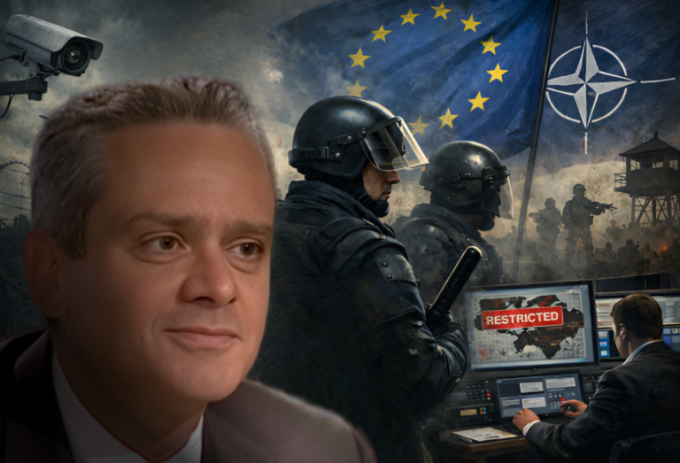
NATO’s Red Pen on Ukraine: Jacques Baud and the Silencing of Dissent
By Freddie Ponton | 21st Century Wire | December 17, 2025
On 15 December, the European Union took a step that few could have imagined: it sanctioned twelve individuals, including Swiss analyst and former intelligence officer Jacques Baud and French national Xavier Moreau, not for breaking the law, but for expressing views deemed politically inconvenient. Asset freezes, travel bans, and economic restrictions were imposed without any judicial process. While presented as an EU initiative, the fingerprints of NATO’s strategic communications and information-control apparatus are unmistakable, shaping both the targets and the justification. Europe is no longer simply countering disinformation; it is policing interpretation itself, turning independent analysis into a potential liability. The question now is not whether dissent will be punished, but how far these measures will go, and who will decide the boundaries of acceptable thought.
Baud, a Swiss national, is not a political activist, influencer, or anonymous online provocateur. He is a former Swiss intelligence officer and army colonel, trained in counter-terrorism, counter-guerrilla warfare, and chemical and nuclear weapons. Over the course of his career, he helped design the Geneva International Centre for Humanitarian Demining (GICHD) and its Mine Action Information Management System (IMSMA), served with the United Nations as Chief of Doctrine for Peacekeeping Operations in New York, worked extensively in Africa, and later held senior responsibilities at NATO, where he led efforts against the proliferation of small arms. He is also the author of multiple books on intelligence, asymmetric warfare, and terrorism, texts widely read well before the Ukraine war.
Yet this résumé, once considered exemplary, has now been recast as suspicious. On 15 December, the EU placed Baud under sanctions, freezing assets and restricting travel, accusing him of acting as a “spokesperson of Russian propaganda” and of participating in “information manipulation and influence.” No criminal charges have been filed. No judicial process has taken place. No evidence has been publicly tested in court. The punishment is administrative, political, and immediate.
DOCUMENT: COUNCIL DECISION (CFSP) 2025/2572 of 15 December 2025 amending Decision (CFSP) 2024/2643 concerning restrictive measures in view of Russia’s destabilising activities (Source: EUR-Lex)
This is not an isolated case. Baud joins a growing list of European journalists, analysts, and commentators sanctioned or publicly stigmatised for expressing views that diverge from official EU and NATO positions. Germans living in Russia, independent journalists, and alternative media figures have already faced similar measures. What unites these cases is not proof of coordination with Moscow, but a shared refusal to reproduce the sanctioned narrative framework through which the war must be interpreted.
From Foreign Policy to Narrative Enforcement
Officially, these sanctions are justified as defensive measures against “foreign information manipulation and interference”, a phrase now deeply embedded in EU and NATO communications. The stated objective is to protect European democracies from destabilisation. In practice, however, the definition of “manipulation” has expanded so broadly that any analysis which echoes, overlaps with, or even partially aligns with Russian positions can be deemed suspect, regardless of sourcing, intent, or transparency.
The problem is not that governments counter disinformation. Every state does. The problem is how disinformation is defined, who defines it, and what instruments are used to combat it.
In Baud’s case, the EU does not allege clandestine activity, secret funding, or covert coordination with Russian authorities. Instead, he is held responsible for contributing to a narrative environment that, in Brussels’ view, undermines Ukraine and EU security. This is a crucial shift: The target is no longer falsehood, but interpretation.
Once interpretation itself becomes sanctionable, the boundary between security policy and censorship collapses.
France’s Role, and NATO’s Shadow
Several reports indicate that the initiative to sanction Baud and eleven others originated with France. French Foreign Minister Jean-Noël Barrot publicly announced that Europe would impose sanctions on what he described as “pro-Russian agents,” including individuals accused of repeatedly influencing French and European public debate. Among those named was Xavier Moreau, a French analyst long critical of NATO policy.
Barrot’s declaration on X was unambiguous:
“At France’s initiative, Europe is today imposing sanctions against Kremlin propaganda outlets and those responsible for foreign digital interference. Zero impunity for the architects of chaos.”
The language is revealing. “Architects of chaos” is not a legal category; it is a political one. It frames speech as an act of aggression and analysts as hostile operators.
Behind this framing lies a figure little known to the public but central to the architecture of Europe’s contemporary information policy: Marie-Doha Besancenot, Senior Advisor for Strategic Communications in the French Foreign Ministry. Prior to assuming this role, Besancenot served from 2020 to 2023 as NATO Assistant Secretary General for Public Diplomacy.
In an interview published in English by the French Ministry of the Armed Forces and Veteran Affairs, in March 2025, Besancenot openly described founding a task force in late 2023 dedicated to detecting and analysing what she termed “hostile narratives,” with the capacity to alert authorities “in real time” and propose political responses. The task force’s mission, she explained, was to detect, track, and report information threats against NATO in the information domain. In this interview, Besancenot articulates how “France understood what was happening in the information domain was a matter of national security”, and speaks of Viginum, a French agency created in response to these perceived threats, and that is responsible for monitoring and protecting the state against foreign digital interference that, according to them, affects the digital public debate in France.
The continuity is striking. The doctrine developed inside NATO’s strategic communications apparatus appears to have migrated almost seamlessly into national and EU-level policy, without democratic debate, parliamentary oversight, or public consent.
Strategic Communications as Political Power
NATO insists that it does not police speech and that it respects freedom of expression. Formally, this is true. NATO does not arrest journalists or pass laws. Instead, it develops conceptual frameworks, “hybrid threats,” “information laundering,” and “foreign information manipulation”, which are then adopted by member states and EU institutions.
Once a narrative framework is institutionalised, it becomes self-enforcing. Media outlets internalise red lines. Publishers hesitate. Platforms over-moderate. Governments justify extraordinary measures as technical necessities or national security. The perfect storm in which sanctions replace debate.
One of the most insidious concepts to emerge from this ecosystem is that of “information laundering”, the idea that domestic journalists or analysts can unwittingly “clean” foreign propaganda simply by engaging with it critically. Under this logic, intent becomes irrelevant. What matters is effect, as defined by strategic communicators.
This doctrine eliminates the possibility of good-faith analysis. To examine Russian claims, even to refute them selectively or partially, is to risk being accused of amplifying them. The only safe position is total dismissal, which appears to be NATO and the EU’s endgame.
The Democratic Cost
The danger of this approach extends far beyond Jacques Baud.
Sanctions are no longer being used to punish illegal acts, but to discipline discourse. They operate without due process and create chilling effects far wider than their immediate targets. An analyst does not need to be sanctioned to be silenced; seeing a peer sanctioned is often enough.
Moreover, these measures are imposed by non-elected bodies, EU councils, commissions, and advisory structures, drawing heavily on NATO doctrine, an alliance that itself is not subject to democratic accountability. National parliaments are largely absent from the process. Courts intervene only after the damage is done.
The precedent is dangerous. If today the target is analysts accused of being “pro-Russian,” tomorrow it could be critics of EU defence spending, sceptics of military escalation, or scholars questioning intelligence claims. Once the machinery exists, its scope inevitably expands.
History offers ample warning. Democracies do not usually collapse through sudden repression, but through the gradual normalisation of exceptional measures, each justified by urgency, each framed as temporary, each defended as necessary.
Security Without Freedom Is Not Security
The EU and NATO argue that they are facing unprecedented hybrid threats and that extraordinary responses are required. That claim deserves serious consideration. But security achieved by narrowing the space of permissible thought is a brittle security, one that ultimately undermines the democratic resilience it claims to protect.
A society confident in its values does not need to freeze bank accounts to win arguments. It does not need to conflate analysis with subversion. It does not need to outsource intellectual authority to strategic communications units.
Jacques Baud may be wrong in some of his assessments. He may be right in others. That is beside the point. What matters is that his arguments exist in the open, supported by sources, available for rebuttal. The appropriate response to analysis is counter-analysis, and certainly not sanctions. By choosing punishment over debate, Europe is not defending democracy. It is redefining it, quietly, administratively, and without asking its citizens whether this is the kind of polity they wish to inhabit.
The sanctions against Baud are therefore not merely about Ukraine, Russia, or NATO. They are about who gets to speak, who decides what is permissible to think, and whether Europe still trusts its citizens to judge arguments for themselves.
That question, once raised, cannot be easily swept away.
EU spends €169 billion on Ukraine while ignoring internal problems
By Ahmed Adel | December 15, 2025
Since the start of the Russian special military operation in February 2022, the European Union has spent €168.9 billion on military and financial support for Ukraine, according to figures from the European Commission. This amount is even more striking when compared to other areas of spending.
With all that money, the 27-nation bloc could finance public spending on education for an entire fiscal year in France and still have €32 billion left over, cover Germany’s entire target defense budget for 2026 (€108.2 billion), and pay for almost half of the total budget allocated by the European Commission to respond to regional crises for the period 2028-2034 (€395 billion).
However, Brussels has preferred to look outwards and pursue a foreign policy with a Euro-Atlantic vision, which has led to internal fragmentation of interests, exploited by the European elites who lead the bloc.
A group of European countries —mainly Poland, the Baltics, France, Germany, and the United Kingdom—though the latter is not a member of the EU—is interested in prolonging the conflict in Ukraine for as long as possible. For them, for the elites who govern them, losing Ukraine would mean confronting their own internal problems.
Maintaining the discourse in favor of the Kiev regime and against supposed external threats is a way of preserving some cohesion in the face of the economic and political failures the EU has experienced over several years.
The Ukrainian crisis is a heavy burden for Brussels without US support, a reality under President Donald Trump. The Kiel Institute for the World Economy estimates that, between September and October, the EU allocated only around €4.2 billion in military aid to Ukraine, a figure that is far too little to compensate for the loss of US aid.
At the same time, the gap within Europe has widened: Germany, France, and the United Kingdom have significantly increased their allocations, but Italy and Spain, among many other countries, have made only a negligible contribution.
Leaders such as German Chancellor Friedrich Merz, French President Emmanuel Macron, and British Prime Minister Keir Starmer are among those who have most promoted a belligerent policy regarding Ukraine, to the point of continuing to support Ukrainian President Volodymyr Zelensky, who is embroiled in several corruption scandals. These are leaders who are deeply discredited, both regionally and locally, in their own countries.
Merz and Macron can no longer achieve internal consensus within the EU, and this is eroding their credibility because they are not enabling the bloc to speak with one voice. In Brussels, there is a patchwork of passionate agendas, but not a common geopolitical agenda.
It is the European elites who insist on the continuation of a conflict, not the average citizen, who prefers that their government budgets be allocated to social spending rather than to a European rearmament project like the one being outlined in Brussels. Many see support for Ukraine as an imposed sacrifice, and the expense of continuing to fuel the conflict is already taking its toll.
In fact, the €168.9 billion that the EU has allocated to Ukraine over almost four years would have completely covered all of Spain’s public spending on education in a single fiscal year and Italy’s entire health budget.
Amid this situation, some European leaders are insisting that the Russian assets frozen more than three years ago be confiscated to guarantee a €210 billion loan for Kiev, which could complicate the peace talks the US and Russia have been conducting for months over the Ukrainian conflict.
That money is Russian, and international law would have to protect Russian assets if the EU were to choose to confiscate these. If they do, it would be a major contradiction within the European narrative because these countries are supposed to be the ones that champion international law and guarantee what they have called ‘a rules-based world,’ but appropriating those assets is essentially theft, and this would violate international law.
Nonetheless, the EU announced on December 12 that an agreement had been reached to indefinitely freeze €210 billion of Russian Central Bank assets held in Europe, particularly in Belgian securities depository Euroclear. Although the freeze is intended to facilitate EU plans to provide Ukraine with a loan of up to €165 billion to cover military and civilian budget needs in 2026 and 2027, Belgium, Italy, Bulgaria, and Malta expressed reservations about transferring funds to Ukraine. A final decision will be made at an EU summit being held at the end of the week.
It is foolish that the EU has wasted so much money on the Ukrainian crisis, knowing that the bloc is economically suffering, with very low growth rates and a deindustrialized Germany that is not recovering. Yet, despite this, the EU seemingly wants to further tarnish its global reputation by aiming to steal Russia’s wealth.
Ahmed Adel is a Cairo-based geopolitics and political economy researcher.
Trump’s Peace Push is Attempt to Save Ukraine From Total Military and Political Collapse: Observer
Sputnik – 11.12.2025
The current moment “is critical for Ukraine as Zelensky’s regime is coming closer to collapse both politically and on the frontline, where Russia is advancing on all fronts,” Armando Mema, a member of the Finnish Freedom Alliance party, told Sputnik.
While Trump inherited the Ukraine mess from Biden, who “provoked this conflict and created this disaster,” he’s trying to prevent “a total defeat of Ukraine” because “it would be a disaster for his administration too,” Mema explained.
But Zelensky “is not interested in peace,” as seen in his recent demands for “security guarantees similar to Article 5 of NATO, [which] he knows… he cannot get,” the observer said.
Knowing that’s impossible, “he uses as an excuse to continue to be in power despite his mandate [ending]. Zelensky has banned all political opposition parties in Ukraine, arrested opponents, including regular citizens who were simply advocating for peace. Zelensky knows that if a regular election were to be held, he will lose immediately and all his administration will be prosecuted for corruption,” Mema emphasized.
As for reports of a US-mediated push to restore Russia’s access to Europe’s energy markets, Mema predicts this will remain “impossible” to achieve as long as the current crop of leaders are in charge.
“But Trump has started to dismantle the EU leadership (Macron, Merz, Ursula, Meloni and so on)” and over time they will be replaced by leaders who take account of their own countries’ interests, the Finnish politician believes.
EU’s X fine a ‘violent attack’ on free speech – French party leader
RT | December 8, 2025
The fine imposed by the EU on social media platform X constitutes a “violent attack” on freedom of speech, the leader of France’s Patriots party, Florian Philippot, told RT in an exclusive interview on Monday.
His comments came after the EU fined X €120 million ($163 million) last week for allegedly failing to comply with transparency requirements under the bloc’s 2022 Digital Services Act. The platform’s US-based majority owner, Elon Musk, responded by denouncing the EU, likening it to “the Fourth Reich.”
“The absolutely crazy fine of €120 million that the European Commission has just imposed on Elon Musk’s social networks is obviously a violent attack against freedom of expression by the European Union,” Philippot told RT.
The EU had used what he described as a thin justification for the decision, pointing to “the blue pastilles on the accounts on X” and calling it a “pretext” that “made no sense.”
The politician went on to say that the EU’s “real face of censorship” was becoming visible “in the eyes of the whole world,” and that influential voices, “like Musk in particular,” were rising “to claim its pure and simple disappearance.”
Philippot said he was watching reactions from abroad, including from the administration of US President Donald Trump, former Russian President Dmitry Medvedev and Hungary’s Prime Minister Viktor Orban, who he said reacted “very firmly against the European Union.”
He said Musk had, “for the first time,” triggered what he called a “worldwide deflagration” by arguing it was necessary “to abolish the European Union,” which Philippot described as “a totalitarian regime.”
The French politician also referenced Musk’s separate remarks branding the EU a “bureaucratic monster” and saying its leadership has been “slowly smothering Europe to death.” Musk wrote that “The EU should be abolished and sovereignty returned to individual countries so that governments can better represent their people.”
Aligning himself with that message, Philippot said his party was a “sovereignist” movement backing a French departure from the bloc. According to him, “Frexit” would restore “freedom of expression,” shift diplomacy toward peace rather than “war against Russia,” and help tackle domestic issues including the economy, agriculture, energy, and immigration.
NATO Is a Menace, Not a Benefit, to America
By Ted Galen Carpenter | The Libertarian Institute | December 8, 2025
Since its creation in 1949, NATO has been the keystone of U.S. foreign policy in Europe. Indeed, the alliance has been the most important feature of Washington’s overall strategy of global primacy. America’s political and policy elites have embraced two key assumptions and continue to do so. One is that NATO is essential to the peace and security of the entire transatlantic region and will remain so for the indefinite future. The other sacred assumption is that the alliance is highly beneficial to America’s own core security and economic interests.
Whatever validity those assumptions may have had at one time, they are dangerously obsolete today. The toxic, militaristic views toward Russia that too many European leaders are adopting have made NATO into a snare that could entangle the United States in a large-scale war with ominous nuclear implications. It is urgent for Donald Trump’s administration and sensible proponents of a U.S. foreign policy based on realism and restraint to eliminate such a risky and unnecessary situation.
Throughout the Cold War and its immediate aftermath, NATO’s European members followed Washington’s policy lead on important issues with little dissent or resistance. That situation is no longer true. The governments and populations in the alliance’s East European members (the countries that the Kremlin held in bondage during the Cold War but that eagerly joined NATO once the Soviet Union collapsed) have adopted an especially aggressive, uncompromising stance toward Russia as the USSR’s successor. They have lobbied with special fervor in favor of admitting Ukraine to NATO, despite Moscow’s repeated warnings over the past two decades that such a step would constitute an intolerable provocation. The East European states also have been avid supporters of the proxy war that NATO has waged against Russia following Moscow’s invasion of Ukraine in February 2022.
Their toxic hostility toward Russia has inexorably made inroads even among the previously more restrained, sensible members of the alliance. With a few partial exceptions, such as Hungary and Slovakia, NATO governments now push for unrealistic, very risky policies with respect to the Ukraine-Russia war. Washington’s volatile, ever-changing policy under President Trump regarding that armed conflict has not helped matters.
The Trump administration’s latest approach has been to try to inject some badly needed realism into the position that Ukraine and its NATO supporters pursue. Realities on the battlefield confirm that Russia is winning, albeit slowly and at considerable cost, the bloody war against its neighbor. Moscow’s forces are gradually expanding the amount of territory they control. Kiev’s propaganda campaign to portray Ukraine as a stalwart democracy and a vital symbol of resistance to an authoritarian Russia is collapsing as well. Corruption scandals now plague the government of President Volodymyr Zelensky, as does growing evidence of his regime’s authoritarianism. Proponents of NATO’s continuing military intervention now seek to downplay the once-dominant “moral case” for the alliance’s involvement and try to stress Ukraine’s alleged strategic importance to both the United States and its allies.
Stubbornness and lack of realism on the part of NATO’s European members (as well as too many American policy analysts and media mavens) is worrisome and dangerous. They have launched a concerted effort to torpedo the Trump administration’s latest peace initiative. Proponents of continuing the alliance’s proxy war insist that no peace accord include territorial concessions by Ukraine. They also demand that Kiev retain the “right” to join NATO. Finally, they insist that any settlement contain a NATO “security guarantee” to Ukraine, and that a peacekeeping force that includes troops from alliance members enforce that settlement. Britain and France have explicitly made the demand to send troops.
Such demands amount to a poison pill designed to kill any prospect of an agreement that Moscow might accept. The insistence on a security guarantee to Kiev and a peacekeeping contingent especially fits that description. Any accord that puts NATO military personnel in Ukraine would make the country a protectorate of the alliance, even if Kiev did not receive an official membership card. The commitment itself would have NATO’s military might perched on Russia’s border. That is precisely the outcome that Moscow has sought to prevent for decades.
Extremely inflammatory and combative rhetoric on the part of high-level European officials increasingly accompany such provocative, anti-Russia policy stances. Admiral Giuseppe Cavo Dragone, the chair of NATO’s Military Committee, even mused that the alliance should consider the option of launching a “preemptive” military strike against Russia. Other officials in NATO member governments have asserted that the alliance (or “Europe”) must be prepared to wage war against Russia, if relations continue to deteriorate.
NATO’s European hawks are flying high, and the irresponsible options they toy with put the United States in grave danger. The NATO alliance is no longer even arguably a security asset for the American people. Instead, it has become an increasingly worrisome, perilous liability – a loose cannon that poses a grave danger to our country.
NATO was created so that the United States could protect a collection of weak democracies in Western Europe still suffering from the aftermath of World War II against a strong, menacing totalitarian state: the Soviet Union. That world no longer exists. Today, a much larger, stronger collection of democratic and quasi-democratic European states confronts Russia – a weaker, non-totalitarian power. Even without the United States, the European countries are capable of building and deploying whatever forces they deem necessary to sustain their security interests. NATO’s European contingent also has its own, extremely assertive (indeed, aggressive) policy agenda toward Moscow. That agenda endangers rather than benefits the United States and the American people. It is now imperative for America to sever the transatlantic security tie and say farewell to NATO.
France won’t let EU seize chunk of frozen Russian funds – FT
RT | December 8, 2025
Paris does not want to seize frozen Russian state assets held in French private banks, Financial Times reported on Monday, citing sources.
French officials support the European Commission’s plan for a “reparations loan” for Ukraine but oppose any scheme that would draw on Russian money held at commercial banks, arguing those lenders are bound by different contractual obligations than Euroclear, the outlet said.
Last week, European Commission chief Ursula von der Leyen set out two options to provide Kiev with €90 billion ($105 billion) over the next two years: EU-level borrowing backed by the bloc’s budget, or a long-debated “reparations loan” backed by profits from the blocked assets that would require institutions holding Russian cash to transfer it into a new loan vehicle.
For more than two years, France has declined to name the private banks holding about €18 billion in Russian assets, citing client confidentiality – a stance that has angered some other EU governments, the newspaper said.
According to the report, Paris has also withheld details on how any interest accrued on the funds is being used.
The assets immobilized in France are reportedly the second-largest pool in Europe, behind holdings at Belgium’s Euroclear.
After the roughly €185 billion held at Euroclear, most of the remaining €25 billion of blocked Russian state funds is held at commercial banks in France and Belgium, several people familiar with the matter told the FT.
The loan scheme has drawn criticism from several EU members. Belgium has warned that an outright confiscation would pose legal and security risks, while other major holders of Russian assets, including Luxembourg and Germany, also oppose a seizure, along with Italy, Hungary and Slovakia.
Recent media reports have said the US is lobbying several EU members to block plans to use frozen assets as collateral for the €140 billion loan to Ukraine, arguing the funds should be kept as leverage in peace talks with Kiev and Moscow. Politico earlier reported that Washington wants the EU to return the money once Russia signs a peace agreement with Ukraine.
Russia has condemned any use of its sovereign assets as theft and warned of legal action and retaliation.
EU targets platforms that refuse to censor free speech – Telegram founder
RT | December 6, 2025
The EU is unfairly targeting social media platforms that allow dissenting or critical speech, Telegram founder Pavel Durov has said.
He was responding to a 2024 post by Elon Musk, the owner of X, who claimed that the European Commission had offered the platform a secret deal to avoid fines in return for censoring certain statements. The EU fined X €120 million ($140 million) the day before.
According to Durov, the EU imposes strict and unrealistic rules on tech companies as a way to punish those that do not comply with quiet censorship demands.
“The EU imposes impossible rules so it can punish tech firms that refuse to silently censor free speech,” Durov wrote on X on Saturday.
He also referred to his detention in France last year, which he called politically motivated. He claimed that during that time, the head of France’s DGSE asked him to “ban conservative voices in Romania” ahead of an election, an allegation French officials denied. He also said intelligence agents offered help with his case if Telegram quietly removed channels tied to Moldova’s election.
Durov repeated both claims in his recent post, describing the case as “a baseless criminal investigation” followed by pressure to censor speech in Romania and Moldova.
Later on Saturday, Durov wrote: “The EU exclusively targets platforms that host inconvenient or dissenting speech (Telegram, X, TikTok…). Platforms that algorithmically silence people are left largely untouched, despite far more serious illegal content issues.”
Last year Elon Musk said the European Commission offered X “an illegal secret deal” to quietly censor content. “If we quietly censored speech without telling anyone, they would not fine us. The other platforms accepted that deal. X did not,” he wrote.
On Friday, European Commission spokesperson Tom Rainier said the EU fined X €120 million for violating the Digital Services Act. He claimed the fine was unrelated to censorship and was the first enforcement under the law. US Secretary of State Marco Rubio criticized the move on X, calling it “an attack on all American tech platforms and the American people by foreign governments.”
Durov and Musk have both faced pressure from EU regulators under the Digital Services Act (DSA), which came into force in 2023. The law requires platforms to remove illegal content quickly, though critics say it can be used to suppress lawful expression.
Macron’s Proposed Seal of Truth Meets a Wall of Criticism
Macron’s seal of reliability may prove less about journalism and more about obedience
By Christina Maas | Reclaim The Net | December 4, 2025
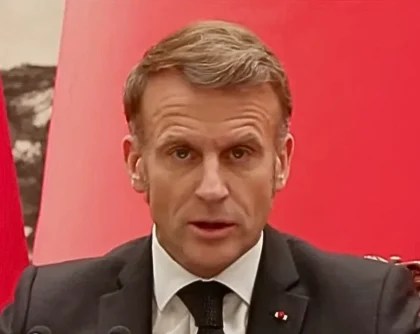
Emmanuel Macron thinks the Republic needs a quality seal for reality. The French president recently proposed creating an official “reliability label” for news outlets, modeled on Reporters Without Borders’ Journalism Trust Initiative. He insists it is not censorship. It is a “democratic duty.”
“It is about making our young people understand, encouraging them, motivating them to turn toward press outlets, whether in physical, printed form or digital,” Macron said, as though the French youth were a flock that had wandered into the dangerous fields of the internet and needed shepherding back to Le Monde.
The proposal, presented during a discussion with readers of the Ebra press group, called for a label for outlets that follow ethical standards, validated by “peers and third-party experts.”
The government, he said, would not decide who qualifies. It would only “encourage” such standards. But in France, the words “encourage” and “government” often mean something closer to “mandatory, eventually.”
The model is RSF’s Journalism Trust Initiative, which already certifies media that meet certain requirements. Certified outlets supposedly even get algorithmic advantages on platforms like Bing.
Macron wants a French version, claiming it would bring “international recognition of the professionalism of our journalists and the rigour of our editorial teams.”
Translated from technocrat to plain French: good media will rise to the top, bad media will sink to the digital basement.
This, Macron says, will help fight “disinformation.” The country has heard that promise before. Each new attempt to fight misinformation seems to end up tightening control over information itself.
The idea landed with the subtlety of a brick through a newsroom window.
On BFMTV, Parliamentary Party Leader of the National Rally, Marine Le Pen called it “unworthy,” said the proposal was “extremely dangerous,” accusing Macron of wanting “to master information.”
Bruno Retailleau, leader of Les Républicains, said “no government has the right to filter the media or dictate the truth.”
The Mayor of Cannes, David Lisnard, said the president had “crossed a fundamental line.” Even some journalists balked at being graded by a system endorsed by the state.
Macron denied everything. “There is not going to be a state label, and even less a ‘ministry of truth,’” said government spokeswoman Maud Bregeon after the cabinet meeting.
Macron repeated that “it is not the state that should verify” the truth, since “otherwise it becomes a dictatorship.”
So far, the reassurance has not worked. The term “Ministry of Truth” is now glued to the project in every headline, thanks in part to a viral editorial by Pascal Praud on CNews, who accused the president of “wanting to impose a single narrative.”
In a remarkable act of irony, the Élysée responded to critics on X by posting a video labeled “warning, false information.”
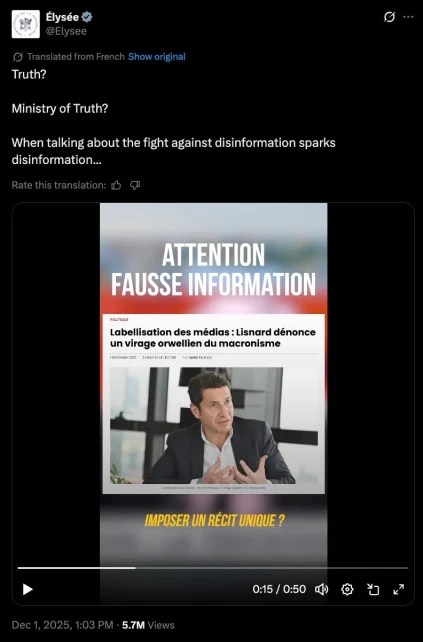
The president’s communications team, while denying the existence of a Ministry of Truth, had just produced something that looked exactly like one.
The post set off another round of outrage.
Jordan Bardella, President of the National Rally, said Macron’s proposal was “the reflex of a man who has lost power and seeks to maintain it by controlling information.”
The label plan is part of Macron’s wider campaign against disinformation. He has floated legal changes to allow “false information” to be blocked online more quickly and has repeatedly called for tighter regulation of social media, describing the current state of the internet as “the Wild West.”
It is not hard to see why the issue obsesses him. Macron and his wife have been the targets of online rumors for years.
For a president who sees himself as a technocratic reformer, the swamp of digital conspiracy has become both a personal irritant and a political threat.
Macron insists that only a system of certified journalism can protect the public from manipulation. The trouble is, the public does not want the government or anyone tied to it certifying which journalists to trust.
Reporters Without Borders may be an NGO, but any system announced by the president and promoted as a matter of “democratic duty” will carry the scent of state authority.
Once the government endorses a “trust” label, those without it become, by definition, untrustworthy.
French journalist groups file complaint over press freedom restrictions in Palestinian territories
MEMO | December 2, 2025
The International Federation of Journalists (IFJ) and the National Journalists’ Union (SNJ) announced on Tuesday that they filed a complaint over restrictions on press freedom and alleged war crimes in the Palestinian territories, Anadolu reports.
The IFJ and SNJ said in a statement that they filed the complaint with Paris’s National Anti-Terrorism Prosecutor on Nov. 26 against unknown parties, citing numerous testimonies from French journalists collected anonymously.
“The freedom to inform and to be informed, fundamental principles, must become a reality again in Gaza and the West Bank,” the organizations said, reiterating the need for action and the role of the French justice system.
They noted that the media lockdown of Gaza, an “unprecedented” blackout in the conflict, and the “ruthless repression” of Palestinian journalists, along with 225 killings verified by the IFJ, remain “at the heart of the complaint.”
The two organizations referred to French journalists’ descriptions of daily reality on the ground, marked by denial of access, threats, confiscation of equipment, occasional physical assaults, arbitrary detentions, and sometimes even manhunts.
Underlining that the complaint does not target any specific individual, the watchdogs stressed that the obstacles documented are carried out by military and police units, customs and administrative services, and private individuals, including settlers in the occupied territories.
“The risk of being killed is real, sometimes tangible, when you find yourself pursued by thirty armed settlers. These violations of journalists’ fundamental rights cannot go unpunished,” said Vanessa Ripoche and Julien Fleury, general secretaries of the SNJ.
The statement also underscored that the reported acts take place in occupied territories, which “prevents Israel from invoking state immunity” and “allows French courts to take action,” as the violations target French nationals and affect their fundamental freedoms.
“This is the first time that a legal action of this nature—based both on systematic obstruction of journalists’ work and on war crimes targeting media professionals—has been brought before a national court to protect French reporters in a conflict zone,” said Ines Davau and Louise El Yafi, lawyers for the IFJ and SNJ.
Featured Video
Elijah Magnier: Yemen’s strikes are shattering Saudi Arabia’s long-term strategy
or go to
Aletho News Archives – Video-Images
From the Archives
British weapons and personnel doing much of the killing in Yemen
Press TV – June 18, 2019
A detailed report published by the Guardian newspaper has shown how Britain is massively contributing to Saudi Arabia’s devastating war on Yemen as it suggests that London is not only supplying the bombs that fall on Yemenis, but it provides the personnel and expertise that keep the war going.
The comprehensive report by Arron Merat published on Tuesday showed that Britain was doing much of the killing in Yemen as the country continues to provide Saudi Arabia with everything it needs to turn its southern impoverished neighbor into a graveyard.
“Every day Yemen is hit by British bombs – dropped by British planes that are flown by British-trained pilots and maintained and prepared inside Saudi Arabia by thousands of British contractors,” said Merat in the report. … continue
Blog Roll
 Aletho News
- Netizens condemn Japanese drama for projecting Japan’s wartime atrocities onto Chinese characters
- Racist Seinfeld Dances for Joy as Bibi Unveils His New Map
- A West Bank War for Netanyahu’s Election Campaign, Could It Backfire?
- Yemen denounces European Parliament’s ‘hypocritical’ push to blacklist Ansarullah
- Qalibaf: UAE’s UN bid aims to ‘clear the runway’ for ‘Greater Israel’, whitewash genocide
- Pakistan reopens Iran border after boosting security: Report
- Why are so many Brazilians voting for Flávio Bolsonaro?
- Democrats Put Anti-Russia Agenda Ahead of American Workers
- Elijah Magnier: Yemen’s Strikes Are Shattering Saudi Arabia’s Long-Term Strategy
- Pentagon designates Chinese cultural centers national security threat
- If Americans Knew
- An error has occurred; the feed is probably down. Try again later.
- No Tricks Zone
- Sudden Stratospheric Warming, Powerful El Niño Combination May Lead To Extreme Europe Cold, Energy Crisis!
- Two New Studies Find Thwaites Glacier Melt Cannot Be Driven By Human Activity Or A Warming Ocean
- E-Cars Reduce CO2 Emissions By Only 41% Compared To Internal Combustion Engine Vehicles
- Predictions Made By Renowned Climate Professor Over Past Decades Have Been Proven To Be Poor
- New Study Suggests Large Regions Of The Pacific Ocean Have Been Cooling For The Last 80 Years
- Germany’s Green Energy Debacle: High Energy Costs Force Kahla Porzellan to Close After 182 Years!
- New Study: 50 Years Of The Most Aggressive ‘Net Zero’ Policies Can Only Affect The Global Climate By 0.03°C
- US September “Heat” Was No Record…Many Records Set Decades Ago
- Latest European Green Energy Debacle; Portugal’s Largest Flagship Solar Park Insolvent!
- Green Energy Debacle: German Expert Professor Fritz Vahrenholt Warns Of Severe Economic And Social Consequences

