Gardasil on Trial: Did Merck Mislead the Public on Cervical Cancer Prevention?
Top expert delivers a damning report accusing Merck of misleading the public about Gardasil’s ability to prevent cervical cancer
By Maryanne Demasi, PhD | February 24, 2025
With the landmark trial against Merck adjourned until September 2025, new evidence suggests the vaccine manufacturer may have deliberately misrepresented the necessity of mass HPV vaccination.
This revelation comes from an expert report by Dr Sin Hang Lee, a pathologist renowned for his expertise in molecular diagnostics. His findings raise serious concerns about Gardasil’s efficacy and the motives behind its aggressive marketing.

Dr Sin Hang Lee, director of Milford Molecular Diagnostics, Connecticut
Does Gardasil Prevent Cervical Cancer?
Since its introduction in 2006, Gardasil has been marketed as a breakthrough in the fight against cervical cancer.
Yet, as Dr Lee bluntly states in his report, “There is no conclusive evidence that Gardasil has prevented a single case of cervical cancer in the past 18 years.”
No randomised controlled trial (RCT)—the gold standard for assessing efficacy—has ever demonstrated that Gardasil prevents cervical cancer.
Instead, Merck relied on surrogate markers of pre-cancers, such as cervical intraepithelial neoplasia (CIN2/3) to claim effectiveness. This is a significantly lower evidentiary bar that was used to fast-track FDA approval.
The problem with this approach is well-documented. Many CIN2/3 lesions resolve naturally.
A Dutch study, for instance, tracked 114 women with CIN2/3 found that nearly two-thirds of cases regressed without intervention. Only one developed adenocarcinoma in situ (pre-cancer) and none progressed to cervical cancer.
Moreover, those lesions that don’t resolve naturally typically take years to progress, and they are usually detected through routine screening.
If CIN2/3 is an unreliable proxy for cancer, how can it serve as valid proof of Gardasil’s claimed efficacy at preventing cancer?
Are HPV Strains Merely Being Replaced?
Another major concern is “type replacement”—the possibility that suppressing certain HPV strains through vaccination leads to the rise of others.
For instance, a Finnish study found that while HPV strains 16 and 18 (targeted by the vaccine) decreased following vaccination, non-vaccine strains such as HPV 52 and 66 became more prevalent.
This raises an important question: While Gardasil may alter the landscape of HPV infections, does it actually reduce the overall risk of developing cervical cancer?
When Merck developed Gardasil 9 to target five additional HPV strains, a study involving 14,215 women found that those who received Gardasil 9 developed high-grade lesions at the same rate as those who received the original Gardasil (which only targeted four strains).
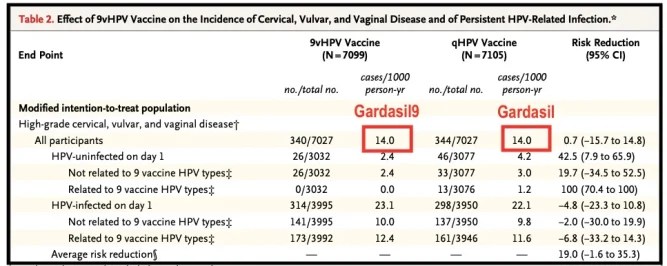
Despite the expanded coverage, the additional strains had no measurable impact on pre-cancers overall, adding to the uncertainty about whether these vaccines truly reduce cervical cancer incidence.
The Questionable Swedish and Scottish Studies
Two widely cited studies—from Sweden and Scotland—are often heralded as proof that Gardasil significantly reduces cervical cancer rates. However, Dr Lee highlights critical methodological flaws in his report.
- Swedish study
The Swedish study, published in the New England Journal of Medicine, compared cervical cancer rates between vaccinated and unvaccinated women.
However, Dr Lee points out that many participants (born between 1995 and 2007) were too young to develop cervical cancer during the study period (2006–2017).
Since cervical cancer takes decades to emerge, including these young women (ages 10–22)—who had zero cases—introduced a statistical bias that exaggerated the vaccine’s effectiveness.
Moreover, the study failed to account for the “healthy user effect,” where vaccinated individuals are more likely to engage in preventive health measures like regular screening, which independently reduces cancer risk.
As a result, attributing the decline in cancer cases solely to the vaccine is misleading.
- Scottish study
A 2024 Scottish observational study, published in the Journal of the National Cancer Institute, had similar methodological issues, and was met with sensationalist media headlines: “No cervical cancer cases in HPV-vaccinated women.”
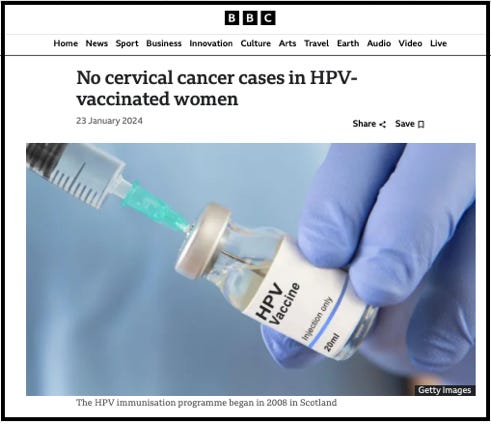
However, Dr Lee argues this claim is deeply flawed. First, the women studied were simply too young for conclusions about long-term vaccine efficacy to be drawn.
Second, Scotland’s screening programme, which detects and treats precancerous lesions before they develop into cancer, changed its entry age in 2016 during the study period.
The age at which women were first invited for screening was raised from 20 to 25, meaning there was a 5-year gap in screening for younger women. As most cancers in women under 30 are diagnosed through screening, this change could explain any decline in cancer rates, rather than the vaccine itself.
And third, just like the Swedish study, the “healthy user effect” further confounds the results.
Despite being frequently cited as definitive proof of Gardasil’s effectiveness, these studies contain serious limitations that undermine their conclusions.
Cervical cancer screening saves lives
In developed nations, around 93% of initial HPV infections resolve without medical intervention. Cervical cancer is slow to develop, with an average onset age of 54, making long-term data essential for assessing Gardasil’s true impact.
What remains incontrovertible is the lifesaving role of cervical cancer screening.
Since the widespread adoption of Pap smears in the 1950s, cervical cancer incidence in the U.S. has plummeted—from 44 per 100,000 women in 1947 to just 8.8 per 100,000 by 1970.
This dramatic decline predates the introduction of HPV vaccination in 2006.
In Australia, deaths from cervical cancer fell significantly along with incidence following the introduction of the National Cervical Screening Programme, and remained steady despite mass HPV vaccination.
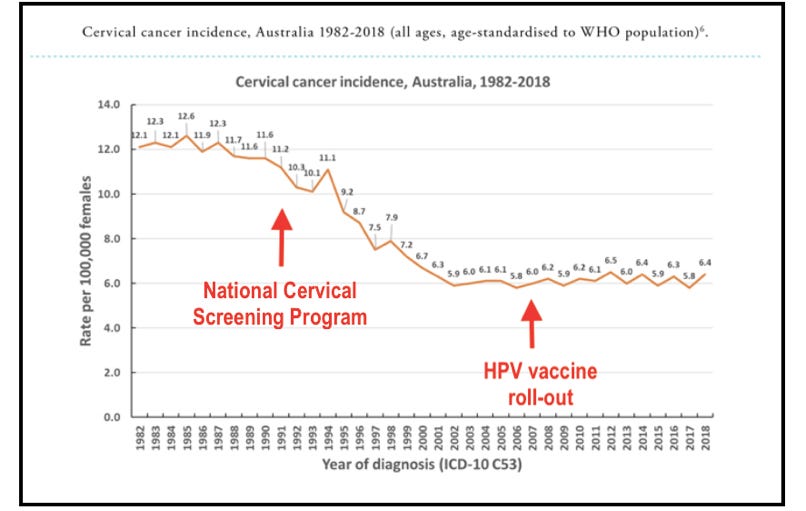
Source: https://www.hpvworld.com/articles/prevention-of-cervical-precancer-and-cancer/
Dr Nancy C. Lee, former Associate Director for Science at the CDC, testified before the U.S. Congress in 1999:
- “Cervical cancer is nearly 100 percent preventable.”
- “The most important risk factor for developing cervical cancer… is the failure to receive regular screening with a Pap smear.”
- “For a woman with CIN, her likelihood of survival is almost 100 percent with timely and appropriate treatment.”

Dr Nancy C. Lee, former Associate Director for Science at the CDC
Unlike cervical cancer, which is preventable through screening and treatable with early intervention, Dr Lee asserts the harms linked to Gardasil – such as autoimmune disorders and neurological complications – are unpredictable, difficult to treat, and often irreversible.
Did Merck Misrepresent Its Vaccine?
At the core of this legal battle is a critical question: Did Merck mislead the public about Gardasil’s true value?
Despite its widespread use, Gardasil’s long-term efficacy remains unproven, while growing evidence links the vaccine to serious harms, including autoimmune disorders and neurological complications.
For decades, cervical cancer rates have declined due to improved screening—not mass vaccination. Yet Merck has aggressively marketed Gardasil as essential for cancer prevention, even in countries where cervical cancer is already rare.
Dr Lee’s report suggests Merck selectively presented data to manufacture a false sense of necessity—one that collapses under scrutiny.
As the trial resumes in September, one question remains: Did Merck knowingly misrepresent Gardasil’s safety and efficacy, prioritising profit over public health?
Global PR Giant Launches Provocative HPV Vaccine Ads Targeting Gen Zers
By Brenda Baletti, Ph.D. | The Defender | December 7, 2023
A multinational public relations firm last week launched a provocative advertising campaign — under the slogan “HPV Fucks Everybody” — designed to persuade Gen Zers to get the human papillomavirus (HPV) vaccine.
The PR firm, Publicis Groupe, launched the campaign in collaboration with the nonprofit Fuck Cancer. The campaign doesn’t name a specific HPV vaccine brand name. However, Merck’s Gardasil vaccine is the only HPV vaccine brand distributed in the U.S., and Merck is a client of Publicis Groupe.
When asked if Merck was funding the campaign, a spokesperson for Fuck Cancer told The Defender, “This campaign has no connection with Merck and is a collaboration between Publicis Health Media and Fuck Cancer (a non profit). Please note that we are promoting a vaccine that is safe and saves lives.”
There are currently 80 cases pending in federal court against Merck alleging Gardasil caused injuries and the federal Vaccine Court has paid out more than $70 million to people making claims regarding Gardasil.
The National Institutes of Health (NIH), also a Publicis client, developed the HPV vaccine technology, which it licenses, in the U.S., exclusively to Merck.
In addition to Merck and the NIH, other Publicis Groupe clients include the World Economic Forum (WEF), pharmaceutical giants including Pfizer, GSK, AstraZeneca, Johnson & Johnson, Purdue Pharma and several pharmacy chains that administer the HPV vaccines, including Walmart, Rite Aid and CVS Health (owners of Target pharmacies and clinics).
Campaign ‘uses sex to sell its case’
The new campaign targets young adults directly through a series of ads featuring “diverse, sexy images” and edgy music, accompanying the message that it doesn’t matter who you are, you are at risk because “HPV Fucks Everybody.”
Photos of a black couple, a white couple and a furry couple kissing, and a multiracial group of young people partying are featured on the website and will be featured in the ads.

The images are accompanied by lines like, “Stop the spread. Get the shot. Keep doing you,” according to “Pharma & Health Insider” — a PR site that publishes promotional stories with a news-like appearance.
HPV transmission is likely to occur via sex, the PR story said, so the campaign “uses sex to sell its case.”
“Targeting all 18–26-year-olds who are sexually active (or who want to be), the campaign behaves just like its audience: honest, bold and unbounded by tradition,” said Alison McConnell, chief marketing officer at Publicis Health Media — one of Publicis’ “solution hubs.”
Michelle Stiles, author of “One Idea To Rule Them All: Reverse Engineering American Propaganda,” told The Defender that campaigns run by elite global PR firms may appear absurd to a skeptical observer, but they have tremendous power to shape global public health agendas.
She said:
“The trendy and provocative messaging targeting sexually active youth for yet another vaccination campaign should hopefully be met with ample amounts of skepticism or outright laughter for those who paid attention during the previous rollout of the COVID-19 shots.
“Unfortunately, these million-dollar campaigns are extremely dangerous because they are so effective.”
Ben Mallory, executive vice president/creative director for Digitas Health, another Publicis subsidiary collaborating on the campaign, said the campaign is designed to inform young people that they will be infected with HPV, that such infection will be risky and that vaccination is the answer.
“For a generation that doesn’t discriminate, it’s important they realize that HPV doesn’t either,” he said. “That’s what the campaign communications [sic]: It doesn’t matter who you are or what you’re into, if you’re not vaccinated, you’re at risk.”
Trying to reach ‘largest and most influential generation’
The campaign will air 30-second and one-minute ads on 150 college campuses and in 150 malls in major markets, and also post on lifestyle websites like Thrillist, PopSugar, the dating site Grindr.
An audio campaign will follow, along with advertising in “points-of-care,” which can include clinics or pharmacies.
On the campaign’s website, people can also sign up to “get the shot” at major retail pharmacies including Walgreens, CVS, Rite Aid, Walmart, Target and Kroger — companies Publicis Groupe also represents.
McConnell, Publicis’ marketing director for the campaign, said they are trying to reach Gen Z because it is “the largest and most influential generation.”
That makes this campaign different from most previous HPV vaccination PR campaigns that targeted parents.
This shift in focus reflects recent shifts in direct advertising by Gardasil maker Merck.
Merck’s early ads targeted parents of adolescents, but in 2022 they shifted gears and started targeting parents of young children with ads like this one, which appeals to parents of the older elementary school children.
These ads focused on marketing the vaccine as “cancer prevention” rather than as acting on a sexually transmitted disease, a strategy the Centers for Disease Control and Prevention (CDC) promoted to encourage more young people to get vaccinated.
Last year, Merck expanded its advertising campaign to target adults through age 45, in commercials like this one, marketing the vaccine as protecting against a long list of cancers.
Merck has invested heavily in shaping the market since the U.S. Food and Drug Administration (FDA) approved the drug in 2006. In October, it announced that its 2023 third-quarter Gardasil sales grew 13% to $2.6 billion.
Fact-checking the campaign’s claims
The campaign sample ad and its website, which provide no citations, make many misleading or erroneous claims.
The campaign’s approach appears to be rooted in the “fear-based” or “fear-appealing” messaging designed to “nudge” people into getting vaccinated, commonly utilized during the COVID-19 pandemic and in global public health more generally.
According to the CDC, HPV is the most common sexually transmitted infection in the U.S. and the majority of sexually active people will get it at some point in their lives, even if they have only one or very few sexual partners.
But the vast majority of HPV infections are cleared by the immune system and less than 10% of infections are linked to any clinical symptoms. Clinical symptoms can include a variety of warts and cervical dysplasia, which may be benign or precancerous.
Yet the campaign website claims, “HPV turns into cancer about 10% of the time,” a claim public health agencies don’t make.
There are over 200 strains of the HPV virus, a subset of which are deemed “high-risk.” HPV can cause genital warts and some strains have been associated with some types of cancer. However, HPV is not the sole risk factor for any cancer, and cancers associated with HPV can also sometimes develop without the presence of the virus.
Methods like regular pap screening are highly effective and have been found to reduce the incidence and mortality of cervical cancer among women by at least 80%.
But the sample ad on the site presents HPV as something always scary and dangerous.
It says:
“HPV Fucks Everybody. In fact, there are more than 14 million new HPV infections in the US each year, because HPV doesn’t discriminate. It doesn’t care who you are, what you look like who you love or what you’re into. HPV will infect more than 85% of sexually active people of all races, ethnicities and genders. It can lead to genital warts, or worse, over ten types of cancer. So it doesn’t matter if your status is single, committed, or complicated. It doesn’t even matter if you’re not currently sexually active.”
The website also claims the HPV vaccine can prevent a whopping 33,700 types of HPV-related cancers. Even Gardasil 9’s package insert and the CDC website only indicate the HPV vaccine for some cancers of the cervix, vagina, vulva, penis, anus and back of the throat with the HPV virus.
The campaign also repeats Merck’s claims that the vaccine is “safe and effective” and that the side effects are “mild.”
But a series of ongoing lawsuits against Merck allege the drugmaker fast-tracked Gardasil through the FDA’s approval process and deceptively conducted clinical trials to mask serious side effects and exaggerate the vaccine’s effectiveness.
Some of the signature impacts observed following HPV vaccination in thousands of adverse events reports worldwide include permanently disabling autoimmune and neurological conditions such as postural orthostatic tachycardia syndrome, fibromyalgia and myalgic encephalomyelitis/chronic fatigue syndrome.
To date, there are no valid studies showing the HPV vaccine prevents cervical cancer. However, there are studies suggesting the vaccine could increase the risk of cancer.
Finally, the campaign promises that getting vaccinated can “put an end to HPV. For you, for us, for them. For everyone.”
However, the Gardasil 9 vaccine is designed only to suppress nine of the over 200 strains of HPV, and recent research has shown that when the HPV vaccine suppresses certain types of “high-risk” HPV strains, those strains are replaced with other strains associated with some cancers.
While the World Health Organization has launched a global campaign to eradicate cervical cancer as a public health threat, it has not indicated a similar project for HPV.
Publicis is part of ‘the propaganda arm of the global elite’
The campaign is spearheaded by Publicis Health Media and Digitas Health, which are both part of Publicis, along with Fuck Cancer.
According to the campaign publicity, Publicis Health Media is particularly concerned with HPV because the company CEO Arthur Sadoun was diagnosed and treated for HPV-associated cancer.
Last year, the company published a holiday video where board chair Maurice Lévy and Sadoun were joined by actor Michael Douglas, who was diagnosed and treated with throat cancer a decade ago, to promote the HPV vaccine and the Publicis Groupe.
As part of its cancer marketing focus, Publicis Groupe launched its Working with Cancer initiative, at the WEF. In partnership with 30 of the largest global companies, including Pfizer, Sanofi, PepsiCola, Meta and others, the campaign seeks to “abolish the stigma and insecurity that exist for people with cancer in the workplace,” according to the campaign website.
During Super Bowl LVII in February, it ran a commercial about the campaign that won a Gold Lion from the Health & Wellness jury at the 2023 Cannes Lions International Festival of Creativity in June.
Publicis Groupe is an ad holding company, which recently rebranded “for the connected age” itself as a “platform,” according to its website.
As Stiles details in her book, just a few such companies — including Publicis, Omnicom, WPP and Interpublic Group — dominate the global media landscape.
Each ad-holding company has billions of dollars in revenue and serves thousands of corporate clients along with universities, nonprofits and governmental and nongovernmental organizations.
As public relations firms, they design ad campaigns and they develop and strategically place print and broadcast media content in mainstream news and PR publications for their clients. They also create public relations campaigns like those described here to develop, promote and defend the reputations of their clients.
They design their strategies in part by collecting data “on virtually every U.S. consumer” and on journalists, politicians and scientists.
Other tactics include flooding the media landscape with spin, developing talking points for “experts” to use in public appearances and generally “using underhanded tactics to promote and defend their clients,” Ecowatch reported.
According to Stiles, an estimated two-thirds to 80% of the content broadcast and published by corporate media comes from public relations firms.
She said:
“There is no doubt that the top three PR holding firms WPP, Omnicom, and Publicis, whose collective revenue is over 44 billion, function and should be thought of as the propaganda arm of the global elite.
“The finely-tuned, targeted messages not only create revenue for the transnational capitalist class but just as importantly define the global problems to be solved and the way in which they should be solved, leaving very little room for other creative options.”
Each agency has smaller subsidiaries and PR affiliates under the same corporate ownership, creating the appearance that there are more players in the media field than there actually are. More recently, they have also begun to “gobble up” data companies.
For example, in this campaign, two of three collaborators are part of the Publicis Groupe.
The public relations site Pharma & Health, where one of the “stories” about the “HPV Fucks Everybody” campaign was posted by MediaPost Inc., a marketing company that posts up to 50 different industry blogs.
“Adding together the global revenue of the top 250 independent PR firms ($17 billion) with the PR holding companies ($44 billion) and we are literally swimming in marketing messages intended to consolidate capital for the mega-corporations,” Stiles said.
“The medical messaging repeatedly advises us to outsource health and wellness to drugs or vaccines, poor choices indeed,” she added.
A Defender investigation into Publicis’ clients last year, found it serves a wide range of corporate, governmental and supra-governmental agencies including the WEF and U.S. government agencies like the National Security Agency, tech giants like Google, Amazon, Disney, Microsoft and Meta, and corporate clients PepsiCo, Phillip Morris and Saudi Aramco.
Publicis Groupe was implicated in the “Monsanto File” scandal, where the company was found to be using Publicis Consultants and FleishmanHillard, an Omnicom subsidiary, to launch a PR offensive to rehabilitate the image of genetically modified organisms and pesticides.
Newsguard, a for-profit fact-checking organization backed by Big Pharma, Big Tech, the U.S. government and the American Federation of Teachers — a staunch advocate of mandatory COVID-19 vaccination and masks for schoolchildren — is also a client.
So is the Center for Countering Digital Hate (CCDH), a politically driven service consistently attacking anyone who raises questions about vaccine efficacy or safety, and the organization responsible for creating the so-called “Disinformation Dozen” list.
In her book, Stiles also explains that asset management firms Vanguard and BlackRock are among the top 10 shareholders in the top four ad agency holding companies.
Brenda Baletti Ph.D. is a reporter for The Defender. She wrote and taught about capitalism and politics for 10 years in the writing program at Duke University. She holds a Ph.D. in human geography from the University of North Carolina at Chapel Hill and a master’s from the University of Texas at Austin.
This article was originally published by The Defender — Children’s Health Defense’s News & Views Website under Creative Commons license CC BY-NC-ND 4.0. Please consider subscribing to The Defender or donating to Children’s Health Defense.
Gardasil Lawsuit – Deaths and Serious Injuries Linked to HPV Vaccine
Baum Hedlund Aristei & Goldman Trial Lawyers
The Gardasil vaccine, manufactured by Merck & Co., was approved by the U.S. Food and Drug Administration (FDA) in 2006 for use in preventing infection from only a few of the hundreds of types of human papillomavirus (HPV). Since hitting the market, however, thousands of adolescents and adults have reported serious and disabling Gardasil side effects after receiving the HPV vaccine, including death.
Gardasil was fast-tracked to the market, achieving FDA approval in six months, which usually takes three years. Even one of the principal investigators of the Gardasil clinical trials (the human testing that precedes FDA approval) said the process “went too fast.”
The clinical trials for the Gardasil HPV vaccine reveal several disturbing side effects that were not disclosed on the package insert:
- The miscarriage rate for subjects who were injected with Gardasil was 25%. The miscarriage rate for women under 30 in the U.S. is 12.5%.
- In the Gardasil group, 5 babies were born with congenital abnormalities. There were none in the control group (the group that does not receive treatment).
- 10.9% of women who took Gardasil reported reproductive and breast disorders within 7 months. In the Protocol 18 placebo group, that figure was 1.2% (through 12 months).
- The rate of Gardasil deaths in the clinical trials was 8.5 per 10,000, nearly double the background U.S. death rate for young women ages 15 to 24.
There are more than 64,000 case reports of HPV vaccine adverse reactions in the Vaccine Adverse Events Reporting System database.
It is estimated that only 1% of serious adverse events are actually reported to VAERS.
Researcher Peter C. Gøtzsche in his book Vaccines: Truth, Lies, and Controversy noted some of the research inadequacies in the HPV vaccine clinical trials
“It is a requirement for registration of drugs that randomized trials have been carried out where one group received the drug and the control group received placebo or nothing. This allows assessment of both the benefits and harms of drugs. I have done research on non-vaccine drugs for decades and was shocked when I learned through my work with vaccines against human papilloma virus (HPV) that the regulatory requirements are much less for vaccines. Almost all the HPV vaccine trials have a control group receiving a hepatitis vaccine or a strongly immunogenic adjuvant, which makes it impossible to find out what the harms of the HPV vaccines are.”
Today, the Gardasil shot has left many young women and men suffering (FDA also approved Gardasil for boys), and it has been a living nightmare for parents whose children have experienced severe adverse reactions to the vaccine. They all trusted Gardasil, never suspecting the grave illnesses and disabilities that could follow. […]
What is the Gardasil Controversy?
Underlying the entire Gardasil controversy are clinical trials (human testing) that victims allege were fraudulently conducted and reported. Preliminary evidence compiled by a team of Gardasil attorneys and investigators suggests that the clinical trials Merck conducted for the Gardasil HPV vaccine were flagrantly deceptive and unscientific.
According to Mary Holland and Kim Mack Rosenberg, and Eileen Iorio, co-authors of the book, The HPV Vaccine On Trial: Seeking Justice For a Generation Betrayed, “none of the participants in the [Gardasil] clinical trials received a true saline placebo,” which means the clinical trials failed to measure the effects of Gardasil against a true control. Instead of receiving a placebo, some clinical trial subjects received aluminum-containing adjuvants, chemical mixtures, and other vaccines, which masked adverse events and made Gardasil seem safer than it would have otherwise.
According to Holland, Mack Rosenberg, and Iorio, “HPV vaccines have never been proven to prevent against cervical or other cancer.” … Full article
Medical Journal Lancet Discloses Financial Interest of Pro-HPV Vaccine Article Author
By Sharyl Atkisson | July 19, 2015
As a result of my inquiry for the article “What you didn’t know about a doctor’s stance on the HPV vaccine,” the medical journal Lancet has now issued a correction to its publication.
The correction acknowledges formerly undisclosed financial conflicts of interest between the article’s lead author and makers of the controversial human papillomavirus (HPV) cervical cancer vaccine.
The article by Dr. Sharon J. B. Hanley defended the vaccine and criticized the Japanese government’s decision to stop promoting the vaccine amid concerns about injuries. It also implied patients are incorrectly blaming the HPV vaccine for unrelated ills.
Hanley did not disclose in the original version that she receives funding from entities supported by makers of both HPV vaccines: Gardasil and Cevarix. In addition, she has previously said the vaccine makers are among those who have paid her “lecture fees.” But Hanley implied the lecture fee disclosure was not required for the recent article because Lancet only asks publishers to account for monetary gain in the most recent three year period.
Critics said it’s an example of hidden cronyism among physicians and corporations who use medical journals to influence public policy.
Read Lancet’s correction in full.
Featured Video

US JET SHOT DOWN OVER IRAN /Lt Col Daniel Davis & Nima Alkhorshid
or go to
Aletho News Archives – Video-Images
From the Archives
Experts Warned For Years That A War With Iran Would Happen This Way
By Caitlin Johnstone | April 3, 2026
… It’s so wild how we keep seeing reports that Iran’s retaliation caught the US off guard. For all the years I’ve been paying attention to this issue I’ve been reading experts and analysts saying if the US attacks Iran, Iran can close the Strait of Hormuz and strike US bases and the energy infrastructure of US allies in the region.
A few examples:
A 2006 Oxford Research Group paper titled “Iran: Consequences of a War” warned that Iran has numerous options at its disposal in the event of a US attack, and that the “most significant of these would be any possible retaliatory Iranian action to affect the transport of oil and liquefied natural gas through the Straits of Hormuz,” adding that stopping Iran from doing this “would be difficult if not impossible to achieve, leading to a fear of attack which alone would have a formidable impact on oil markets.”
A 2007 Cato Institute paper titled “The Iraq War and Iranian Power” warns that “Iran possesses the largest ballistic-missile inventory in the Persian Gulf — missiles which can reach Israel, Saudi Arabia and US military bases in Iraq,” and that “experts argue Iran could also use the ’oil weapon’: blocking the 34km-wide Strait of Hormuz and conducting submarine and anti-ship missile attacks against ports and oil facilities in Saudi Arabia, Kuwait and other Gulf Cooperation Council states.”
A 2012 NPR article titled “Can Iran Close The World’s Most Important Oil Route?” features then-chairman of the Joint Chiefs of Staff acknowledging that Iran absolutely can block the Strait of Hormuz, saying Tehran has “invested in capabilities” which specifically enable them to do so.
A paper from the Columbia Center on Global Energy Policy and the Center for a New American Security titled “IN DIRE STRAITS? IMPLICATIONS OF US-IRAN TENSIONS FOR THE GLOBAL OIL MARKET” warns of a potential scenario “that includes damage to Gulf oil infrastructure and a temporary closure of the Strait of Hormuz.”
These weren’t a bunch of keffiyeh-wearing peaceniks making these assessments, they were deeply entrenched swamp monsters entirely loyal to the US empire. They opposed war with Iran not because it would be an evil act of unforgivable mass murder, but because it would be bad for the imperial power structure. … Full article
Blog Roll
 Aletho News
- US dismantling international law in its war against Iran while claiming ‘false’ victory: Legal scholar
- One martyr, 5 injuries in US attack on Iraqi border crossing with Iran
- ‘This war is Israel’s war’: World facing ‘security breakdown’, says Qalibaf
- IRGC decries attack on US embassy in Riyadh, says executed by ‘Israel’
- Iran blasts EU hypocrisy as EU invokes international law over Hormuz
- There is no military solution to Strait of Hormuz
- NATO’s structural collapse – the outcome of deviation from reality
- Poll finds world views China better than US
- One Of America’s Leading Neo-Cons Has Turned Against The Iran War And Israel
- Attack in the Bosphorus exposes NATO weaknesses and tensions among allies
- If Americans Knew
- US loses planes over Iran, Israel downgrades Lebanon war goals – Daily Update
- Israel Is Blocking Palestinians from Easter at Church Where Jesus Resurrected
- Plot to assassinate Palestinian activist follows harassment campaign promoted by Zionist groups and elected officials
- Prominent New York synagogue hosts presentation on why U.S. Jews should support the ethnic cleansing of Gaza
- Tapper vs. Piker: Is the CNN Anchor Auditioning for David Ellison?
- Shouldn’t Democrats Be Able to Condemn Genocide?
- Israel-US kill negotiators, destroy civilian structures, but Iran’s military capabilities still largely intact – Daily Update
- ‘War crime’: Global condemnation as Israeli ministers celebrate death penalty law targeting Palestinian prisoners
- 7 Ways Israel Is Turning Lebanon Into Gaza
- World’s Leading Football Bodies Under Fire Over Israel Policies
- No Tricks Zone
- New Study Reports A 60% Slowdown In Greenland’s Ice Loss Rate In The Last Decade
- Low Intensity Tornado Wrecks Major Solar Farm, Creating A Potential Toxic Dump
- New Study Finds Warming Saves Lives…Cold Temperatures 12 Times More Deadly Than Excess Heat
- German Science Blog Accuses PIK Climate Institute Of Hallucinating Climate Tipping Points
- Devastating Assessment Of Comirnaty Vaccine By Former Senior Pfizer Europe Toxicologist
- New Study: CO2 Is ‘Effectively Negligible’ As An Explanatory Climate Change Factor Since 2000
- Former Pfizer Toxicologist Dr. Helmut Sterz Tells Bundestag Hearing Pfizer Vaccine Should Have Never Been Approved
- Energy Expert: Germany’s Nuclear Phaseout Was A “500 Billion Euro Mistake”
- New Research: South Australia’s Mid-Holocene Sea Surface Temperatures Were 4°C Warmer Than Today
- Storing Green Energy To Last Germany 10 Days Would Require A 60-Million Tonne Battery
 Aletho News