In Gaza, another farmer shot by a sniper for working his land
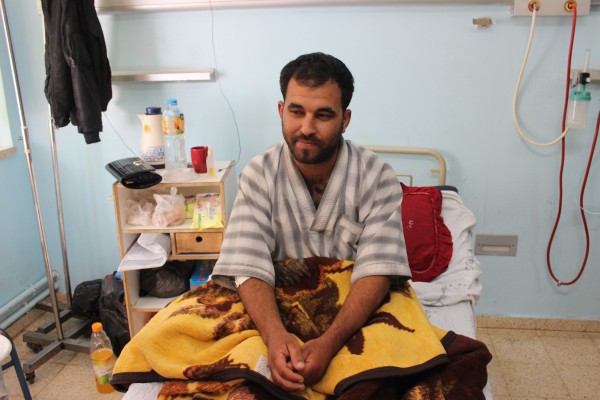
Mohamed Abu Taima, 29, had to undergo two surgeries
International Solidarity Movement | December 8, 2015
Khan Younis, Gaza strip, Occupied Palestine – A week ago Mohamed Abu Taima, 29 years-old and father of a small girl, was working his land 450m from the separation fence when an Israeli sniper shot him. At 4pm, he had arrived to his land in Al Faraheen, Khan Younees, South of the Gaza Strip. He was shot a few minutes after he started to work. The bullet passed through one of his legs and exploded inside the other one.
A few minutes after arriving in the hospital Mohamed underwent a first surgery, and days after a second one. Until now, the doctors don’t know if Mohamed will ever be able to walk properly again.
These kind of attacks have been frequent during the past two weeks. Several farmers were expelled from their lands by the Israeli snipers when they were working or intended to work their lands between 400 and 500m from the fence, meaning outside of the “buffer zone” imposed by the occupation.
Putative US-Israeli Rift Has Not Dampened Partnership in Oppression of Palestinians
By Matt Peppe | Just the Facts | December 6, 2015
In March, after Israeli Prime Minister Benjamin Netanyahu made denying a Palestinian state a pillar of his winning re-election campaign, officials in the Obama administration signaled to the media that they would reconsider the U.S. government’s staunch diplomatic support for Israel in the United Nations. The U.S. government feigned “very substantive concerns” and declared the administration may “reassess (its) options going forward” in response to Netanyahu’s explicit rejection of a two-state solution.
Mainstream media focused on the personal dynamics between the leaders of the two countries. CNN said the Obama administration felt “outright hostility” toward Netanyahu and the New York Times said the leaders had a “poisonous relationship.” They presumed the professed discord would imperil the political alliance between the two governments. In reality, there was no reason to believe a personal conflict would jeopardize the nearly 50-year-old U.S. government policy of providing Israel an unconditional shield in the General Assembly and the Security Council.
It was obvious even at the time the Obama administration’s anonymous threats to reconsider its diplomatic protection of Israel were nothing more than posturing. Netanyahu had broken an unwritten rule when he said in front of the cameras what is stated in his Likud party’s platform: “The Government of Israel flatly rejects the establishment of a Palestinian Arab state west of the Jordan river.” Not only had this been written policy since 1999, but Netanyahu’s government – and every other Israeli administration since the state’s illegitimate formation in 1948 – has been carrying it out in practice.
Obama has demonstrated little interest in supporting progressive policies in favor of human rights and social justice, but he has shown himself zealously concerned with them in the abstract through grandiose and noble rhetoric. During the first six years of his presidency, Netanyahu actively opposed a Palestinian state without Obama’s administration withholding any of the ideological, diplomatic, military and economic support that is a necessary condition for the occupation’s survival. As long as Netanyahu kept quiet, Obama could pretend his administration’s support for Israel was contingent on Israel seeking a permanent peace deal with Palestinians.
Obama urged “cooperation and compromise” and continued the pretense that a “peace process” was not already long dead. But when Netanyahu publicly declared in stark terms that he has no intention of permitting a just solution to Israel’s colonization of Palestine, he made it impossible for Obama to continue the charade. Netanyahu and his fanatical government ministers long ago realized that Obama had no intention of seeking actual concessions from them regardless of how much land and water they stole, or how many Palestinians (or Americans) they killed.
In reality, Obama was happy to let the Israeli government keep slaughtering Palestinians in Gaza, expanding checkpoints and repression in the West Bank, and further carving up the West Bank with new illegal settlements while offering nothing but the most mild, toothless complaints.
As Ali Abunimah noted in the Electronic Intifada, “for the Palestinians, there is no meaningful Obama-Netanyahu rift. Indeed US-Israeli relations have never been stronger, nor more damaging to the prospects for peace and justice and for the very survival of the Palestinian people.”
This was not inevitable. In January 2009, Netanyahu had ordered an immediate halt to the IDF’s destructive rampage in Gaza, Operation Cast Lead, which had killed more than 1,400 people in Gaza, the day before Obama’s inauguration ceremony in January 2009. Presumably Netanyahu believed the failure stop the second assault on the blockaded territory in a year would cause the incoming Obama administration to support an independent investigation, cut military aid, dispute Israel’s argument that it “had a right to defend itself,” or end the U.S. government’s facilitation of the carnage.
But it turns out Netanyahu and the Israeli regime needn’t have worried, as no such change in policy was in the cards. Obama’s new administration would block the Goldstone Report presented to the Human Rights Council, and ensure complete impunity for the Israeli crimes that occurred subsequent to Obama’s election. This likely emboldened Netanyahu to unleash even more wanton destruction and horror in July 2014, when Israel launched Operation Protective Edge on trumped up accusations against Hamas.
“Having falsely accused Hamas leadership of orchestrating the kidnapping of the three Israeli teens in June, and then assailing the group for ‘purposely playing politics’ when it rejected the Egyptian ceasefire proposal that offered it nothing beyond a return to the status quo of the siege, (Secretary of State John) Kerry and the Obama administration once again provided the Israeli military with the diplomatic cover it needed to escalate the violence,” writes Max Blumenthal in The 51 Day War: Ruin and Resistance in Gaza.
Despite extensive documentation from the start of the military campaign that the captive civilian population in Gaza comprised the vast majority of the dead and injured from tank and naval shelling, drone missiles, F-16 bombs and heavy artillery, the Obama administration cast the only vote against establishing a war crimes investigation by the United Nations. A few days later, the administration helped resupply the Israeli army with weapons, including 102mm mortar rounds and 40mm grenades, that the IDF could use to keep up their prolific killing spree.
In May, any doubts that the personality conflicts had actually imperiled the hand-in-glove military cooperation between the two countries, as mainstream pundits so forcefully proclaimed, was put to rest. The Obama administration approved an arms sale for $1.9 billion to Israel – in violation of domestic and international law, and against the explicit demands of human rights organizations such as Amnesty International.
The Electronic Intifada reported: “Among the tens of thousands of bombs included in the weapons package are 3,000 Hellfire missiles, 12,000 general purpose bombs and 750 bunker buster bombs that can penetrate up to 20 feet, or six meters, of reinforced concrete.”
Much as the military cooperation between the two states has carried on seamlessly, so has the diplomatic cooperation. Despite Israeli officials hinting the government might finally decline to vote with the U.S. in the 24th annual UNGA condemnation of the Cuban embargo, predictably Israel was the only country in the entire world to join the U.S. in defense of the embargo. The measure passed by a vote of 191-2.
Not surprisingly, unconditional U.S. support for Israel in the United Nations has also continued uninterrupted. “Traditional Voting Pattern Reflected in General Assembly’s Adoption of Drafts on Question of Palestine, Broader Middle East Issues,” states a U.N. press release after the passage of six resolutions concerning Israel. Indeed, the pattern was traditional: the U.S. and Israel, with a few Pacific Island states, voting against the rest of the world (minus whoever the U.S.-Israel alliance could persuade to abstain).
In a resolution on the illegally occupied Syrian Golan Heights, from which Israel steals valuable natural resources and where many prestigious Israeli wineries are located, the U.S. government rejected the position that Israel follow previous Security Council resolutions and withdraw to the 1967 borders.
Concerning Jerusalem, the U.S. rejected a measure stating that Israel, as the occupying power, had no right to “impose its laws, jurisdiction and administration on the Holy City of Jerusalem,” and that they show “respect for the historic status quo at the holy places of Jerusalem.”
Additionally, the U.S. rejected a call “to exert all efforts to promote the realization of the inalienable rights of the Palestinian people, including their right to self-determination, to support the achievement without delay of an end to the Israeli occupation that began in 1967 and of the two-State solution on the basis of pre-1967 borders and the just resolution of all final status issues and to mobilize international support for and assistance to the Palestinian people.”
As these votes were not reported in the mainstream American press, the American public can be forgiven for not realizing the meaninglessness of the “rift” between American and Israeli government officials, which has not impacted at all the U.S. government’s longstanding record of rejecting world opinion and cooperative efforts to achieve a just peace.
The corporate press have demonstrated that their policy analysis consists primarily – if not entirely – of dissecting style, empty rhetoric and official proclamations. Concrete actions and their consequences are of little concern.
Israeli forces shoot, injure 67 Palestinians in Gaza, West Bank
Ma’an – November 27, 2015
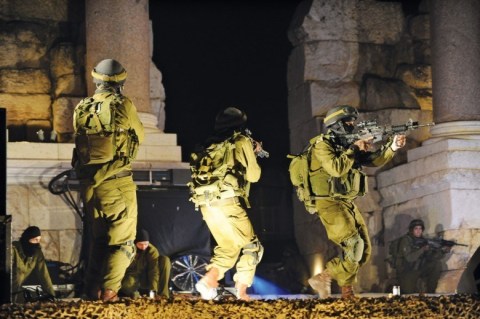
RAMALLAH – At least 67 Palestinians were shot by Israeli military forces during ongoing clashes across the occupied Palestinian territory, the Palestinian Red Crescent said Friday.
A Red Crescent spokesperson told Ma’an that 16 Palestinians were injured by live bullets, as well as two by rubber-coated steel bullets in the Gaza Strip.
Five of those injured by live fire were shot when clashes erupted near the Nahal Oz crossing east of Gaza City, one of whom was shot in the chest and left in critical condition, according to a spokesperson for the Ministry of Health, Ashraf al-Qidra.
Several others were injured in the besieged enclave when Palestinians demonstrated in areas north of Khan Younis, demanding the return of Palestinian bodies currently held by Israel, witnesses told Ma’an.
An Israeli army spokesperson told Ma’an that “multiple violent riots took place near the security fence” between the Gaza Strip and Israel, where Israeli forces used “riot dispersal means” to deter participants attempting to break through the security fence.
The spokesperson said that the forces opened fire on demonstrators after ignoring calls by the forces for the participants to halt.
Palestinians in the Ramallah district meanwhile staged a demonstration near Israel’s Ofer detention center, where medics told Ma’an that Israeli forces opened fire on protesters.
One of those shot by live fire was left in critical condition, medics said, adding that dozens of others suffered from tear gas inhalation.
A total of 22 injuries by live fire were reported from the occupied West Bank, the Red Crescent spokesperson told Ma’an, as well as 27 injured by rubber-coated steel bullets and over a hundred who were treated for tear-gas inhalation.
In Hebron, 14 Palestinians were hit with live bullets, and 10 with rubber-coated steel bullets, the Red Crescent said, adding that Israeli forces targeted an ambulance with tear gas, shattering its windshield.
In Kafr Qaddum near Qalqiliya, Qaisar Jihad,13, and Hamza Mutei, 22, were shot in the legs and lightly injured after Israeli forces trapped protesters and opened fire, according to a spokesperson for the village’s popular resistance committee, Murad Shtewei.
In the village of Bilin in the Ramallah district, locals told Ma’an that photojournalist Hamdi Abu Rahma was shot with a rubber-coated steel bullet in the thigh as Israeli forces fired tear gas, stun grenades and rubber-coated steel bullets at Palestinian demonstrators.
Over 10,300 Palestinians have been injured by Israeli forces since Oct. 1, not including those injured by Israeli settlers.
Around 160 Israelis have been injured by Palestinian individuals during the same time period, according to documentation by the UN Office for the Coordination for Humanitarian Affairs.
Cooking the Books for Israel: How The NY Times Plays a Numbers Game
By Barbara Erickson | TimesWarp | November 23, 2015
 Jodi Rudoren today in The New York Times puts up a numbers barrier to hide the reality of Palestinian casualties in the latest spate of violence in Israel and the occupied Palestinian territories. The aim, as usual, is to maintain the claim of Israeli victimhood and to obscure the criminal brutality of the occupation.
In a story about four who died yesterday in alleged attacks in the region, Rudoren writes that more than 90 Palestinians have been killed since Oct. 1, “about half while attacking or trying to attack Israelis and the rest during demonstrations where they clashed with Israeli soldiers.”
We are to believe from this statement that only violent activists have died at the hands of Israeli forces, but in fact, several Palestinians have been killed in circumstances that were anything but “clashes”—at checkpoints, for instance, when trigger happy troops shot and killed unarmed victims. One of the dead was a 73-year-old grandmother on her way to lunch with her sister.
To omit these cases is to ignore the findings of human rights groups that have charged Israel with committing extrajudicial executions in recent weeks, and Rudoren’s statement, in the face of their evidence, is an effort to distort the facts.
The misrepresentations do not end there, however. Rudoren goes on to say, “At the same time, 17 Israeli Jews have been killed and dozens wounded in 70 stabbings, 10 shootings and 10 vehicular attacks.”
Note what is missing here: the number of Palestinians that have been wounded and the attacks against them in Israel, the West Bank and Gaza. Her aim is to minimize the huge discrepancy in casualty counts by omitting the number of Palestinians wounded by Israeli forces and settlers.
Ninety compared to 70 sounds like something approaching parity, but Rudoren has deliberately omitted the logical comparison—the number of injuries. This, according to United Nations data, was 133 Israelis and 9,171 Palestinians injured as of Nov. 16.
We should ask Rudoren and Times editors why this information is missing here, in a context that cries out for full disclosure.
Beyond the full casualty count, the Times could also inform readers of other statistics that illuminate the reality of Palestinian-Israeli relations:
- A weekly average of 150 Israeli military search and arrest operations in the West Bank last year.
- 211 reported incidents of settler violence against Palestinians this year as of Nov. 16. (Actual incidents are daily occurrences throughout the West Bank.)
- 50 Israeli military incursions into Gaza from Jan. 1 to Nov. 16, 2015.
- 481 demolitions of Palestinian-owned structures as of Nov. 16 this year. (This includes homes, animal shelters, cisterns, wells and public buildings such as schools.)
- 601 Palestinians displaced due to demolitions in 2015.
- 6,700 Palestinian political prisoners currently held by Israel.
- 320 Palestinian child prisoners currently in Israeli prisons.
The information for the numbers above comes from the UN Office of Coordination for Humanitarian Affairs and from Addameer, a Palestinian prisoners’ rights organization. The Times, however, ignores their reports and prefers to rely on official Israeli entities. Thus, the numbers Rudoren cites for attacks and casualties are taken from the Israeli Ministry of Foreign Affairs, which has an obvious interest in political spin.
Israel has the first and last word in the Times. The United Nations, Palestinian monitoring groups and human rights organizations are silenced while Israeli official claims are taken as fact. The word “alleged,” for instance, never appears in Rudoren’s piece today. The UN report, however, uses the term frequently, distinguishing between the claims of security forces and verified information.
In short, Times reporting on Palestine and Israel is a disgrace. Numbers are deliberately manipulated, relevant facts are censored, and the result is dishonest journalism, in spite of the newspaper’s lofty claims of providing “the complete, unvarnished truth” and “impartial” reporting. The numbers simply prove them wrong.
Follow @TimesWarp on Twitter.
Israeli Spin in The NY Times: The Annals of Absurdity
By Barbara Erickson | TimesWarp | November 20, 2015
Five men died in Israel and the West Bank yesterday, the victims of shooting and stabbing attacks by Palestinians. The assaults took place in Tel Aviv and in the Etzion illegal settlement bloc, and their deaths, according to The New York Times, marked “the deadliest day in the recent wave of violence.”
Deadliest day? For Israelis, yes, but not for Palestinians. As the Times has reported, Israeli soldiers shot and killed six young men in Gaza during demonstrations at the border fence on Oct. 9. Days later, on Oct. 20, five more Palestinians died at the hands of Israeli troops within the span of 12 hours (in this case, the newspaper remained silent and made no effort to report their deaths).
Nevertheless, Isabel Kershner in the Times today insists that the five deaths (one involving a Palestinian working in Israel and one involving an American visitor) are the high point in violence since a wave of lone wolf attacks against Israelis broke out at the beginning of October.
Nothing could provide more certain evidence of the Israeli bias in the Times. Palestinian deaths do not register on their tally of casualties; violence refers only to Palestinian aggression.
Kershner’s story acknowledges that some 90 Palestinians have died since the beginning of October, compared with 16 Israelis, but in explaining this discrepancy she manages once again to blame the victims. The Palestinians died, she says, while attacking or attempting to attack Israelis or “in clashes with Israeli security forces.”
Nothing is said of those who died in what human rights groups call apparent extrajudicial executions: the youth shot as he tried to extract his identity card from his pocket, the young woman killed as she stood with her hands over her head. It seems the Times wants us to believe the often dubious claims of Israeli forces responsible for Palestinian deaths.
Today’s story lists all of the victims by name and gives a detailed account of one of them, an American teenager who had “distributed food and candy to Israeli soldiers” the day he was killed. The Oct. 9 story about the deaths in Gaza gives the name of not a single Palestinian.
Kershner, however, has provided us with some context here, and the result is bizarre. She manages to link the five deaths to a long-awaited agreement between Israel and the Palestinian Authority “granting Palestinian cellphone carriers 3G high-speed cellular services in the West Bank.”
The attacks came “hours after” this agreement, she writes, and she goes on to imply that Palestinians should have taken this contract as something of a white flag, a sign that a truce is in effect.
“The move,” Kershner states, “intended to bolster economic development, had indicated a possible effect, or desire, to return to calm after weeks of violence.” She then quotes an Israeli minister who claims, “We always agree to confidence-building measures with the Palestinians to help with their economy.”
It is difficult to reconcile this assertion of goodwill with the fact that Palestinian cellphone carriers have been requesting the right to use 3G services since 2006 and only at this point has Israel agreed to allow this now outdated technology. Yet Kershner reports it without a hint of irony.
Readers are to take from this that the Palestinians have no right to protest, let alone to resort to violence. Israel, Kershner is saying, has their well-being at heart.
Missing, as usual, is the context of the brutal occupation, the ever-tightening pressure of settlement building that robs Palestinians of land, water, basic livelihoods and the right to move freely. Missing also are the arrests and abuse of young Palestinians, some as young as 6, and the heavy use of administrative detention, which denies detainees the right to a defense or even to know the charges against them.
If Kershner wanted to peg her story to recent developments, she could have mentioned the crackdown on the northern branch of the Islamic Movement in Israel; the slap on the wrist meted out to the police officer who brutally beat an American Palestinian teenager last year; or the collective punishment of home demolitions, which can leave a wide trail of devastation beyond the stated targets.
Instead, readers are told that Israeli “goodwill” has been spurned by ungrateful Palestinians and that Israelis alone are the victims of violence. Thus, the Times and Kershner give dominance to Israel spin even as their efforts turn the news into an exercise in distortion and absurdity.
Follow @TimesWarp on Twitter
Netanyahu Ups the US Ante
By Ann Wright | Consortium News | November 12, 2015
President Barack Obama, having met with Israeli Prime Minister Netanyahu on Nov. 9 at the White House, is considering Israel’s request for a 50 percent increase of nearly $1.5 billion in U.S. military funding, which would bring the U.S. donation – used for killing Palestinians in the West Bank and Gaza – to $4.5 billion a year.
As it stands now, more that half of the U.S. foreign military aid for 2016 goes to Israel. As in all things, Israel gets special treatment by the U.S. allowing Israel to spend 25 percent of its U.S. gift to pay itself for buying weapons from its own weapons industry.
According to a recent congressional report, Israel has received $124.3 billion in military assistance from the U.S. since its founding in 1948. The report states that “strong congressional support for Israel has resulted in Israel receiving benefits not available to any other countries; for example, Israel can use U.S. military assistance both for research and development in the United States and for military purchases from Israeli manufacturers.
“In addition, U.S. assistance earmarked for Israel is generally delivered in the first 30 days of the fiscal year, while most other recipients normally receive aid in installments, and Israel (as is also the case with Egypt) is permitted to use cash flow financing for its U.S. arms purchases.
”In addition to receiving U.S. State Department-administered foreign assistance, Israel also receives funds from annual defense appropriations bills for rocket and missile defense programs. Israel pursues some of those programs jointly with the United States.”
As Obama was meeting Netanyahu, eight blocks away at the Palestine Center in Washington, D.C., a surgeon from Norway who works part of each year in al Shifa hospital in Gaza, told of the devastation, destruction and human suffering these American weapons and dollars cause.
Dr. Mads Gilbert spoke of 51 days of terror in Gaza in the summer of 2014 as the Israeli attack forces brutalized the people of Gaza with Israeli and U.S. artillery, drone ordnance for assassinations, F-16s, hellfire missiles and dense inert military explosives.
Gilbert said the 2014 Israeli attack on Gaza was 500 percent stronger than Israel’s 2009 attack, when he was also working at al Shifa hospital when the Israeli Defense Force (IDF) attacked Gaza. In 2014, the IDF fired 50,000 shells into Gaza and conducted over 6,000 air strikes, destroying over 3,500 buildings in Gaza City alone including over 50 percent of the hospitals in Gaza.
At the end of the 51-day attack, 2,250 Palestinians were dead, including 551 children and 299 women. Some 3,500 Palestinian children were wounded and the 1 million children and youth who live in Gaza were all deeply affected by the attacks. Sixty percent of the 1.8 million who live in Gaza are under the age of 22.
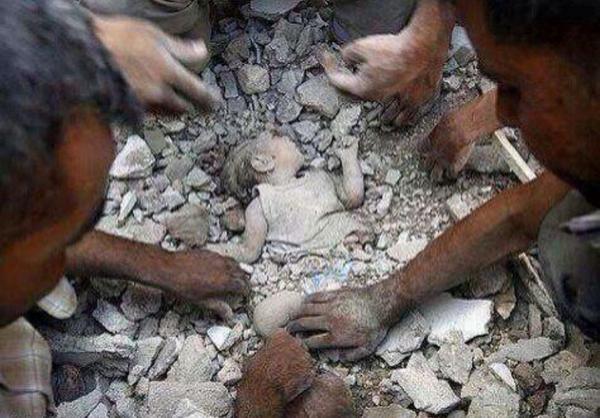
Dr. Gilbert’s presentation included photos of the carnage caused by Israeli attacks and the audio of the sounds of jets racing overhead, bombs exploding and buildings collapsing.
Citing the report of the United Nations Independent Commission of Inquiry on the 2014 Gaza Conflict, Gilbert said that the IDF purposefully targeted the civilian population including entire families and that the IDF purposefully targeted hospitals, ambulances and four UN shelter facilities.
The report said, “Hundreds of Palestinian civilians were killed in their own homes, especially women and children. At least 142 families lost three or more members in an attack on a residential building during the summer of 2014, resulting in 742 deaths. The fact that Israel did not revise its practice of air-strikes, even after their dire effects on civilians became apparent, raises the question of whether this was part of a broader policy which was at least tacitly approved at the highest level of government.”
Additionally, “the commission is concerned about Israel’s extensive use of weapons with a wide kill and injury radius; though not illegal, their use in densely populated areas is highly likely to kill combatants and civilians indiscriminately. There appears also to be a pattern whereby the IDF issued warnings to people to leave a neighbourhood and then automatically considered anyone remaining to be a fighter. This practice makes attacks on civilians highly likely. During the Israeli ground incursion into Gaza that began in mid-July 2014, hundreds of people were killed and thousands of homes destroyed or damaged.”
The commission report added: “Palestinian armed groups fired 4,881 rockets and 1,753 mortars towards Israel in July and August 2014, killing 6 civilians, including one child and injuring at least 1,600.” A total of 66 Israeli soldiers were killed in military operations inside Gaza.
The commission also reported: “In the West Bank including East Jerusalem, 27 Palestinians were killed and 3,020 injured between June and August 2014. The number killed in these three months was equivalent to the total for the whole of 2013. The commission is concerned about what appears to be the increasing use of live ammunition for crowd control by the Israeli Security Forces, which raises the likelihood of death or serious injury.”
The report continued, “Impunity prevails across the board for violations allegedly committed by Israeli forces, both in Gaza and the West Bank. ‘Israel must break with its lamentable track record in holding wrong doers accountable,’ said the commissioners, ‘and accountability on the Palestinian side is also woefully inadequate.’”
Signaling further attacks on Gaza during a Nov. 10 talk at the Center for American Progress in Washington, Netanyahu said Gaza has “become this poison thumb, this poison dagger that sends rockets” into Israel and that Israel must be prepared for a long period of tension.
The U.S. government’s blind backing for whatever Israel does, while providing the weapons for Israel to do it, is dangerous for both the United States and Israel.
As Israeli journalist Gideon Levy recently wrote concerning Hillary Clinton’s unwavering support for Israel: “support [for] the continued occupation is like a person who continues to buy drugs for an addicted relative. This is neither concern nor friendship; it is destruction. … ‘false’ friends of Israel – have been one of the curses on this country for years. Because of them, Israel can continue to act as wildly as it likes, thumbing its nose at the world and paying no price. Because of them, it can destroy itself unhindered.”
Levy’s comments about former Secretary of State Clinton equally applies to the unqualified support for Israel given by both Republican- and Democratic-led U.S. administrations.
Israeli attacks on people in Gaza and the West Bank will end only when we the citizens of the United States force our government to stop its military and diplomatic backing of the State of Israel.
Ann Wright served 29 years in the U.S. Army/Army Reserves and retired as a Colonel. She also was a U.S. diplomat for 16 years and resigned in 2003 in opposition to the war on Iraq. She has been in Gaza six times and was on the 2010 Gaza Flotilla that was attacked by the IDF, which executed nine passengers and wounded 50.
UK Regime Boycotts Palestinian Academics and Mental Health Specialists
By Gilad Atzmon | November 10, 2015
The Independent reported today that “a decision by Britain to refuse a group of Palestinian medical experts from Gaza permission to participate in an international conference at Kingston University on trauma in war zones has been condemned by campaigners.”
I guess that someone in the British Government is convinced that the Palestinians know little about Trauma or living in a war zone.
Three doctors and a nurse who work for the Ministry of Health in Gaza, and were due to give presentations at the conference taking place this weekend, have had their visa requests refused by British authorities. Interestingly enough, some Israeli academics are invited to attend the conference. I guess that the British government is buying into the primacy of Jewish trauma.
In addition to the four mental health specialists refused entry, Dr Nahida Al-Arja, a psychologist from Bethlehem University, has had her visa application rejected.
A letter by the UK Palestine Mental Health Network, co-organisers of the conference, published in the Independent, says: “It is beyond our comprehension how such an interference with intellectual and clinical discussion on such an important topic could be justified. This is a measure that further isolates clinicians from Gaza, already struggling under the impact of military assaults and siege,”
It adds: “We urge the UK authorities to reverse this decision immediately, and to resolve to nurture, rather than undermine, urgently needed psycho-social support services for the people of Gaza.”
To read more on this story: http://www.independent.co.uk/news/uk/home-news/uk-decision-to-refuse-gaza-medical-experts-from-joining-kingston-university-conference-condemned-by-a6727576.html
Former Palestinian ambassador refutes Abbas’s statements on Sinai land cession
Palestine Information Center – November 10, 2015
CAIRO -The former Palestinian ambassador Adli Sadeq denied Monday PA Chairman Mahmoud Abbas’s statements in which he said that Egypt’s ousted president Mohammed Morsi had offered some 1,000 square kilometers of Sinai to expand the Gaza Strip.
In a Facebook statement, the former Palestinian ambassador to India said that Abbas had made a political mistake when he said that Morsi offered him a land from Sinai.
Cairo knows very well each word said by Morsi, and it is not in need for Abbas’s statements, Adli wrote in his Facebook page.
“Why didn’t he [Abbas] reveal such a story during Morsi’s mandate and why didn’t he play the role of the Egyptian soil’s protector at that time?”
Abbas has made such statements in this particular time because he knows that Morsi is imprisoned and cannot deny or confirm his allegations, Adli added.
On Sunday evening, Abbas claimed in a press conference in Cairo that Israel and Hamas had been conducting direct negotiations to expand the Gaza Strip so that it would include some 1,000 square kilometers of Sinai.
The idea of slicing off land from Sinai to expand the Gaza Strip was first proposed by ousted Egyptian President Mohamed Morsi, according to Abbas’s allegations.
Commenting on the issue, former Egyptian Minister of Investment Mohamed Hamed accused Abbas of lying over the Sinai story.
Abbas cannot and will never provide any evidence to his fabricated stories, the minister underlined.
A guide to Palestine in the British media
By Amelia Smith | MEMO | November 6, 2015
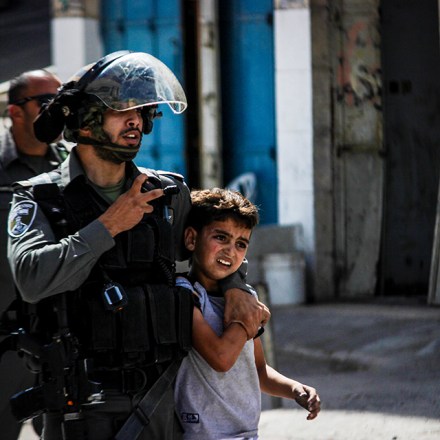 On a trip to Cuba in May, I had to look twice when an elderly man selling newspapers walked past the restaurant I was eating in. On the front page of one was a huge photograph of an Israeli soldier holding a Palestinian boy by the neck, the boy’s face twisted away from the camera in pain.
The photo said it all: an aggressive, well-built soldier wearing a helmet, bulletproof vest and carrying a machine gun was manhandling a child half his size, not more than 10 years old, dressed in jeans and a t-shirt. Why was I so shocked to see such an image published on the front page of a mainstream newspaper? Because this would be a rare moment in the UK.
Over here, the images that are used to represent almost 50 years of military occupation are of Palestinian youth throwing stones, black-and white-kuffiyeh wrapped around their faces. The Cuban picture portrays the Palestinian as the subject of aggression, the UK image as the perpetrator; just like that, our media helps perpetuate the myth that Palestinians are faceless terrorists predisposed to random outbursts of violence and against whom Israel has every right to defend itself.
A closer look at how the British media has covered the recent escalation of violence in Palestine reveals some worrying trends. For the past year right-wing Israeli groups have entered the Haram Al-Sharif compound daily with their armed escorts, often chanting anti-Arab and anti-Palestinian slogans. This came to a head on 13 September when a group of settlers and the Israeli minister of agriculture Uri Ariel, protected by Israeli soldiers, actually entered the Al-Aqsa mosque shooting tear gas, stun grenades and rubber coated steel bullets at worshippers, injuring Palestinians inside and causing damage to the interior of the mosque.
With this in mind take a look at how these confrontations were described in the Telegraph : “Four Israelis and 23 Palestinians have died in 12 days of bloodshed fuelled in part by Muslim anger over increasing Jewish access to the Al-Aqsa mosque compound in Jerusalem.”
And earlier in the year, Reuters reported that: “Those groups [devout Jews and Israeli nationalists] are at the centre of a creeping shift in Jerusalem: After 900 years, Jews are chipping away at Muslims’ exclusive control of the site, the third holiest in Islam. The shift, which has provoked violence in the past, threatens to open a dangerous new front in the Israel-Palestinian conflict, adding religious enmity to a political struggle in the very heart of the disputed city.”
Not only do these reports reduce the provocation by Israeli settlers and soldiers in the Al-Aqsa mosque to Muslim anger and a failure to compromise over increased Jewish access to the compound, but they make the current protests in Palestine sound as though they are merely a religious dispute. Al-Aqsa is the third holiest site in Islam and holds huge religious significance for Muslims across the world, but Palestinians are also protesting against almost 50 years of military occupation under which their land has constantly been taken away from them.
Since 14 September, 72 Palestinians and 11 Israelis have been killed and over 8,000 Palestinians and 134 Israelis have been injured – yet many reports have picked out and highlighted the knife attacks carried out by Palestinians, using phrases such as “Israel’s knife terror”, describing “knife wielding” Palestinians or “anti-Israeli knife attacks”. The following report published on the BBC answered the question of what is happening between the Israelis and the Palestinians in the following manner:
“There has been a spate of stabbings and gun attacks on Israelis by Palestinians since early October, and one apparent revenge stabbing by an Israeli. The attacks, some of which have been fatal, have struck in Jerusalem and in northern and central Israeli cities and towns, and in the occupied West Bank. Israel has tightened security and clashed with rioting Palestinians, leading to deaths on the Palestinian side. There has also been associated violence in the border area inside the Gaza Strip.”
Note that there is not even a mention of what took place at Al-Aqsa mosque on 13 September. The weapons used by Palestinians are specified but Israel’s excessive use of tear gas, stun grenades, live ammunition and rubber bullets is not included.
The term “Palestinian rioters” (other reports have used “Muslim rioters”) has been widely adopted in the British media; the notion of “rioters” is associated with wild disorder and conjures up very different images than the word “protesters”, which suggests a group of people who are simply asking for their rights. Another common term used in the above quotation and frequently in other articles is “clash”, which implies fighting between two equal forces– Israeli soldiers, part of the fourth largest army in the world, storming the Al-Aqsa mosque and firing tear gas and rubber bullets at Palestinians armed with stones, sticks and knives cannot be described as a “clash”.
Deaths on the Palestinian side are a result of rioting Palestinians, and so somehow justified. This headline from Reuters, this one in the Independent and this one in the Daily Mail all report Palestinian deaths but say they took place after Palestinians attacked Israelis with knives. In contrast, this article from the BBC is typical of how Israeli casualties are reported across the media: “Three Israelis killed in Jerusalem bus attacks.” No justifications or explanations of the deaths in sight.
The BBC casually writes about “associated violence” in the Gaza Strip. Between 13 September and the publication of this article, 12 Palestinians in Gaza have been killed, including 26-year-old Nour Rasmi Mohammed Hassan who was five months pregnant and her three year-old daughter, both of whom were at home when an Israeli airstrike hit their house.
Rather than recognise that their excessive use of force and almost 50 years of occupation – under which Palestinian homes have been demolished, children have been arrested, freedom of movement restricted and Gaza placed under siege – may evoke anger in some Palestinians, Israeli authorities, echoed in news reports, would rather blame Palestinian leaders and the use of social media for “inciting” violence, as seen in this headline: “Israel sentences Islamic leader to jail for incitement”; and this one too: “Is social media driving the current violence?”
In this video, Israeli security forces have planted undercover stone throwers among a group of Palestinians who then turn on one of the Palestinians in the same group before ten Israeli soldiers drag him away (note – excessive use of force). In fact there are numerous videos online that highlight Israeli aggression and incitement of violence towards Palestinians but they are not widely published in the mainstream press. This particularly disturbing video filmed on a mobile phone in Aida refugee camp last week captures an Israeli soldier announcing: “You throw stones and we will hit you with gas until you die – the children, the youth, the old people; you will all die. We won’t leave any of you alive.” This video shows an Israeli soldier running over a Palestinian then preventing paramedics helping him; this one shows settlers throwing stones at Palestinian homes in Hebron.
On 16 October, much media attention was focused on the case of a Palestinian man who dressed up in a press jacket and inflicted moderate wounds on an Israeli soldier in Hebron before being shot dead by another soldier. On the same day, four other Palestinians died, including 36-year-old Shawqi Jamal Jaber Ebeid who succumbed to injuries after sustaining a bullet wound to the head a week before whilst working in a stone factory in Gaza. His story is much harder to find and yet it is part of the media’s job to help give a voice to those who have been deliberately silenced – those like Shawqi Ebeid and his family – and to hold politicians and people in authority to account when they do something wrong; even more so if they commit war crimes. If, however, the media is complicit in silencing those same people, then in some cases we may be looking at political propaganda dressed up as news.
Featured Video

Racist Seinfeld Dances for Joy as Bibi Unveils His New Map
or go to
Aletho News Archives – Video-Images
TV Drama Review
Japanese drama projects Japan’s wartime atrocities onto Chinese characters

Global Times | October 25, 2026
By portraying Chinese characters as perpetrators of ruthless violence while casting Japanese Self-Defense Forces (SDF) intelligence operatives as defenders, the season 2 of the Japanese drama Vivant has recently drawn criticism from Chinese netizens, who argue that its depiction turns historical reality on its head while ignoring Japan’s wartime atrocities.
The TBS drama series – a spy suspense story in which an alleged unofficial intelligence unit of the SDF operates across the globe — has attracted a passionate fanbase. Its currently airing season 2 opened with a household rating of 18.8 percent, the highest for a TV drama this year, according toa commentary article by Japanese media Toyo Keizai.
What draws attention is the portrayal of the enemies in the series, the article noted. Scenes in which the Chinese organization subjects kidnapped members of the SDF unit to brutal torture are repeated with unrelenting intensity.
It is rare for Japanese TV dramas to explicitly portray a real-life country as the enemy, the article noted.
Japanese Prime Minister Sanae Takaichi also made a reference to the drama, saying that she has been recording Vivant and hopes to binge-watch it over the year-end and New Year holidays, according to Japanese media outlets.
China’s CCTV News report on Sunday revealed that the drama features scenes in which Chinese personnel cut off the fingers of and stab Japanese intelligence operatives in the abdomen. Such acts bear striking similarities to the torture inflicted on Chinese nationals by invading Japanese troops during the World War II.
The drama distorts the truth by attributing these atrocities to modern Chinese characters. Beneath the surface, it subtly glorifies Japan’s cross-border overseas operations, blurs the functional boundaries of the SDF and implicitly promotes an expansionist narrative, per CCTV News. … continue
Blog Roll
 Aletho News
- EU facing trillion-euro debt hole while seeking more cash for Kiev
- How US, Europe, Persian Gulf states exhausted missile stockpiles, splurged billions to defend Israel
- Up in arms… Koreans reject U.S. empire’s plan to make South Korea the next Ukraine
- Iran, Turkey, Pakistan, Saudi Arabia could advance region-led security framework in Tehran: FM spox
- Netizens condemn Japanese drama for projecting Japan’s wartime atrocities onto Chinese characters
- Racist Seinfeld Dances for Joy as Bibi Unveils His New Map
- A West Bank War for Netanyahu’s Election Campaign, Could It Backfire?
- Yemen denounces European Parliament’s ‘hypocritical’ push to blacklist Ansarullah
- Qalibaf: UAE’s UN bid aims to ‘clear the runway’ for ‘Greater Israel’, whitewash genocide
- Pakistan reopens Iran border after boosting security: Report
- If Americans Knew
- An error has occurred; the feed is probably down. Try again later.
- No Tricks Zone
- Sudden Stratospheric Warming, Powerful El Niño Combination May Lead To Extreme Europe Cold, Energy Crisis!
- Two New Studies Find Thwaites Glacier Melt Cannot Be Driven By Human Activity Or A Warming Ocean
- E-Cars Reduce CO2 Emissions By Only 41% Compared To Internal Combustion Engine Vehicles
- Predictions Made By Renowned Climate Professor Over Past Decades Have Been Proven To Be Poor
- New Study Suggests Large Regions Of The Pacific Ocean Have Been Cooling For The Last 80 Years
- Germany’s Green Energy Debacle: High Energy Costs Force Kahla Porzellan to Close After 182 Years!
- New Study: 50 Years Of The Most Aggressive ‘Net Zero’ Policies Can Only Affect The Global Climate By 0.03°C
- US September “Heat” Was No Record…Many Records Set Decades Ago
- Latest European Green Energy Debacle; Portugal’s Largest Flagship Solar Park Insolvent!
- Green Energy Debacle: German Expert Professor Fritz Vahrenholt Warns Of Severe Economic And Social Consequences

