Annihilate Gaza: Israeli official

Press TV – August 5, 2014
Israeli Knesset’s deputy speaker Moshe Feiglin has called for the “annihilation” of the Palestinian territory of the Gaza Strip.
Feiglin, who is also a member of Israeli Prime Minister Benjamin Netanyahu’s ruling Likud Party, wrote about the plans in a post on his Facebook page at the weekend, the British Daily Mail reported on Monday.
The Israeli official also called for “the conquest of the entire Gaza Strip.” He spoke of plans for the destruction of Gaza, which would include expelling residents and shipping them across the world.
Feiglin also wrote about his plans in a letter addressed to Netanyahu, in which he said he wanted the measures to be enforced as soon as possible.
In the letter, Feiglin said he wanted Israeli military forces to find areas on the Sinai border to set up “tent encampments… until relevant emigration destinations are determined.” Furthermore, he wants Gaza’s electricity and water supplies to be disconnected before shelling the besieged area “with maximum fire power.”
The Israeli forces would then “exterminate” resistance centers and Israeli law would be extended to cover the entire Gaza Strip and “the city of Gaza and its suburbs will be rebuilt as true Israeli touristic and commercial cities.”
The Israeli military launched its recent offensive against the Gaza Strip on July 8. At least 1,867 Palestinians, including around 430 children, have so far been killed and over 9,500 others injured during the onslaught. Tel Aviv says 64 Israelis have been killed in the war, while Hamas puts the number at more than 150.
Google Play offers ‘Bomb Gaza’ game that lets you kill Muslim women and children
By Tom Boggioni | Raw Story | August 4, 2014
Google Play, the official app store for Android operating systems, is currently offering a side-scrolling game called “Bomb Gaza.”
The description of the game states: “Bomb Gaza – drop bombs and avoid killing civilians. new version uploaded. improved performance. added new israel’s theme music.”
In a screen shot shown on the page (seen below) Israeli jets can be seen flying over a terrain dotted with cartoon Islamic terrorists and women attempting to protect children.
The game currently has a 3.7 star rating among users, with 47 reviewers giving it the highest rating, 5 stars, and 22 giving it a 1 star.
Commenters on the page both praised and condemned the game, with one writing, “Spineless disgusting filth trying to profit from genocide of Palastinians (sic) Trying to profit from the sufferings of others. Scumbag of the worst kind. Would you be doing the same if a member of your family was murdered? Utterly vile filth of a game from a sick twisted individual.”
According to the Google Play Developer Program Policies regarding Hate Speech: ” We don’t allow content advocating against groups of people based on their race or ethnic origin, religion, disability, gender, age, veteran status, or sexual orientation/gender identity.”
There is no indication whether Google Play would consider the game “hate speech.”
The developer of the game, which was uploaded to Google Play on July 29, is listed as PlayerFTW.
Ken Loach slams BBC’s pro-Israel coverage of Gaza war
Press TV – August 4, 2014
Internationally-renowned filmmaker, Ken Loach, has slammed the state-run BBC for its pro-Israel bias in the coverage of the ongoing war on the Gaza Strip.
Loach, who has participated in an ongoing occupation campaign in front of the BBC headquarters in the British southwestern city of Bristol, slammed BBC policies, saying, “We should note that many at the BBC, including senior staff, are embarrassed by the broadcaster’s coverage that has an obvious pro-Israel bias.”
“They don’t put the views of Palestinians to the Israelis during interviews, while the use of language about Gazans is pejorative and the war crimes being committed against them ignored…. They’re not ‘militants’ or ‘terrorists,’ they’re ‘resistance fighters,’” he said, adding, “It’s the BBC, we own it, so it should be answerable.”
Loach noted that BBC editors will have to be accountable over the public protest against the broadcaster’s coverage of the Gaza war, stressing that BBC should undergo “tactical” transformations in its broadcasting policies.
Palestine campaigners have occupied the front lawn of the BBC headquarters in Bristol since last week despite the broadcaster’s threat to get them evicted from the site.
Other high-profile artists and campaigners, including celebrated comedian Mark Thomas, have also voiced support for the occupy campaign.
“The BBC reporting of the Israeli military assault on Gaza has failed time and time again to contextualize the violence, refusing to explain the occupation of Palestine and the siege of Gaza,” Thomas said.
The pro-Palestine campaigners also joined thousands of protesters against “Israeli genocide” on Saturday. The demonstration was the biggest protest in Bristol in a decade.
The campaigners also plan to present a “damning dossier” to BBC Bristol TV editor Neil Bennett next week, which incorporates evidence of the broadcaster’s biased coverage of the Gaza war.
They have also organized public burning of TV licenses and the occupation’s court summons and plan to resist any action aimed at evicting them from the site.
More than 1,822 people, including 400 children, have been killed and over 9,400 injured since July 8, when Israel began its offensive against the Gaza Strip.
While the Israeli military says 64 soldiers have been killed in the conflict, Palestinian resistance movement Hamas puts the fatalities at more than 150.
Iron Dome blocked just 8 out of 120 rockets: Israeli military
Press TV – August 4, 2014
The Israeli army has admitted that Israel’s Iron Dome missile system intercepted only eight out of nearly 120 rockets that were fired from the Gaza Strip into the occupied Palestinian territories on Sunday.
The military confirmed that around 110 rockets struck the occupied territories.
The development comes as the US Senate on Friday approved an additional USD 225 million in funding for the missile system despite Israel’s deadly war on the Gaza Strip.
Last month, US Defense Secretary Chuck Hagel sent a letter to congressional leadership requesting USD 225 million in additional US funding for the Iron Dome.
The money would be in addition to the USD 351 million that is already under discussion for Israel’s Iron Dome in fiscal 2015. It would bring total funding to USD 576 million, compared with the USD 176 million requested by the Pentagon for the fiscal year that begins on October 1.
On July 28, US Senate Majority Leader Harry Reid said Tel Aviv urgently needs more financial aid from Washington for its offensive against Palestinians in the Gaza Strip.
Israeli warplanes have been pounding numerous sites in the Gaza Strip since July 8, demolishing houses and burying families under the rubble. Israeli forces also began a ground offensive against the besieged Palestinian territory on July 17.
According to Palestinian sources in the Gaza Strip, Israel’s airstrikes and ground invasion have left at least 1,822 people dead and some 9,400 others injured.
The Israeli military says 64 soldiers have been killed in the conflict, but Palestinian resistance movement Hamas puts the fatalities at more than 150.
Iron Dome is a short-range missile system designed to intercept rockets and artillery shells fired from a range of four to 70 kilometers.
Clash Of Civilizations
By Gilad Atzmon | August 4, 2014
The Israeli army confirmed today that up to 130 Palestinian civilians were slaughtered in Rafah last Friday following the triggering of the Hannibal protocol – an IDF directive that is designed to thwart the capture of Israeli combatants. Israel unleashed its full firepower and flattened an entire neighbourhood using tanks, artillery and gunships murdering 130 Palestinians just to make sure that one Israeli soldier, Lt. Hadar Goldin didn’t fall into Hamas’ hands alive.
The only interpretation of this massacre is that Israel is a homicidal state completely immune to international conventions and without any respect for civilian lives.
In the light of the actions taken by the Jewish State in the last few days and the overwhelming support for Israel from Jews around the world, it is evident that we are witnessing a clash of civilizations. Humanity is faced with a savage tribe that shows a complete absence of empathy yet for some peculiar reason believes itself to be chosen.
For the sake of world peace, humanity has to use whatever resources it has to dismantle the Jewish State and its lobby.
Enough is enough.
Israeli bombs historic al-Omari mosque in Jabaliya
Ma’an | August 2, 2014
Israeli forces bombed the historic al-Omari Mosque in the northern Gaza City of Jabaliya on Saturday morning.
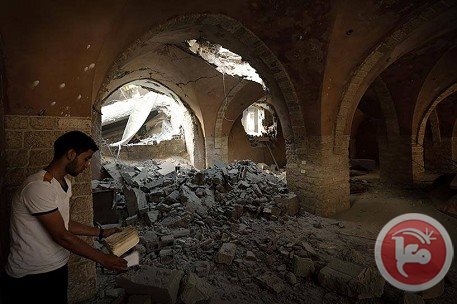 The mosque, which is believed to have stood on the same site since 647 AD, was almost completely destroyed in the bombing.
The portico and minaret dated back to the medieval Mamluk period, or at least 500 years.
The mosque stood at the center of Jabaliya and was known as the “Great Mosque” by local residents.
Israel said that their forces had bombed five mosques over night, claiming that “weapons caches and Hamas command and training facilities” were concealed within them.
The muezzin whose job was to recite the call to prayer from the mosque’s minaret was also killed on Saturday in another strike on the mosque. His name was Daoud Zakariya Suleiman.
More than 10 mosques have been completely destroyed in addition to 80 mosques and two churches that have been partially destroyed in the 26-day assault, according to PLO figures.
United Nations Warns of “Rapidly Unfolding” Health Disaster in Gaza

IMEMC News | August 3, 2014
A health disaster of widespread proportions is rapidly unfolding in the Gaza Strip as a direct result of the ongoing conflict, said the United Nations today.
Mr. James W. Rawley, the Humanitarian Coordinator in the occupied Palestinian territory (oPt), together with Mr. Robert Turner, UNRWA’s Director of Operations in the Gaza Strip, and Dr. Ambrogio Manenti, acting Head of Office of WHO’s operations in the West Bank and Gaza Strip, expressed grave concern regarding the lack of protection for medical staff and facilities, and the deteriorating access to emergency health services for the 1.8 million Palestinians in the Gaza Strip.
“We are now looking at a health and humanitarian disaster”, warned Mr. Rawley, adding, “the fighting must stop immediately”.
After more than three weeks of intense conflict, Gaza’s medical services and facilities are on the verge of collapse. One third of hospitals, 14 primary healthcare clinics and 29 Palestinian Red Crescent and Ministry of Health ambulances have been damaged in the fighting. At least five medical staff have been killed in the line of duty and tens have been injured. At least 40% of medical staff are unable to get to their places of work such as clinics and hospitals due to widespread violence and at least half of all public health primary care clinics are closed.
In addition, in the last 24 hours, anonymous calls were made to staff at both the Najjar Hospital in Rafah and Al Shifa Hospital in Gaza City warning of imminent attacks, causing major panic and chaos among patients and staff. Najjar Hospital was evacuated and remains closed due to fighting nearby.
The hospitals and clinics that are still functioning are overwhelmed: since 7 July over 8000 people have reportedly been injured, many seriously. Critical supplies of medicines and disposables are almost depleted and damage and destruction of power supplies has left hospitals dependent on unreliable back-up generators. Al Shifa, the main referral hospital in the Gaza Strip, is inundated with casualties and people seeking safety in its grounds. “The ability to provide necessary healthcare is being severely compromised. This puts the lives of thousands of Palestinians in needless danger”, said Dr. Manenti.
An estimated 460,000 people have been displaced and are now living in overcrowded conditions in schools, with relatives or in makeshift shelters. This, coupled with lack of adequate water and sanitation, poses serious risks of outbreak of water-borne and communicable diseases. “Hundreds of thousands of people are sheltering in terrible conditions, pushing UNRWA’s coping capacity to the edge”, said Mr. Turner.
Mr. Rawley stressed that “international law sets out clear obligations on the parties to the conflict to respect the status of hospitals and medical facilities as protected objects, to respect the status of and ensure the protection of medical personnel, to ensure the protection of civilians and to respect the fundamental human right to health “. The three officials also paid tribute to Gaza’s medical staff for working tirelessly in dangerous and difficult conditions to continue to provide urgently needed healthcare.
For more information, please contact:
OCHA: Hayat Abu-Saleh, + 972 (0) 54 33 11 816, abusaleh@un.org
UNRWA: Chris Gunness, +972 (0) 54 240 2659, c.gunness@unrwa.org
WHO: Ambrogio Manenti, +20-100-3333-402, manentia@who.int
Mahmoud Daher, +970 (0) 59 8944650, mda@who-health.org
70 bodies found in Rafah as death toll hits 1,830
Ma’an | August 3, 2014
GAZA CITY — The death toll on the 27th day of Israel’s offensive on Gaza hit at least 120 on Sunday as health officials reported that over 70 bodies had been recovered in Rafah, a day after the city came under fierce, prolonged bombardment by Israeli forces.
Health ministry spokesman Ashraf al-Qidra told Ma’an that the bodies of 70 Palestinians had been recovered from the city in southern Gaza, while 55 other Palestinians were killed by Israeli attacks across the Strip Sunday.
The continuing attacks brought the total death toll in the assault to 1,830 with nearly 10,000 injured.
Israel began targeting Rafah with airstrikes and shelling Friday, killing dozens in the city hours before a 72-hour ceasefire was to come into place. When the ceasefire collapsed, Israel continued its bombardment on Rafah throughout Friday and into Saturday, killing more than hundred Palestinians.
Meanwhile, Israeli shelling and airstrikes did not let up on Sunday even as ground forces withdrew from major cities in Gaza.
An afternoon strike on the al-Majdalawi family home in Beir al-Naaja in northern Gaza left four dead, two of whom were identified as Mahmoud and Rawan al-Majdalawi.
Additionally, Mohammad Shaldan was killed and two others injured in an airstrike on the al-Zaytoun neighborhood of Gaza City. In another attack, a Palestinian was killed in a strike on a car in the Janeina neighborhood of Rafah, which has been hit heavily in the Israeli assault.
The attacks come after Israeli forces shelled a UNRWA school where thousands were taking refuge earlier in the day, killing at least ten. UN chief Ban Ki-Moon condemned the attack as “a moral outrage and a criminal attack.”
Al-Qidra identified the victims as Muhammad Abu Rajal, Sami Abdullah Qashta, Sami Ismail Abu Shalouf, Ahmad Khaled Abu Harba, Muhammad Musaid Qashta, Hazem Abd al-Basit Halal, Omar Tariq Abu al-Roos, Ahmad Kamal al-Nahal, Yousef Akram Sakafi, and Tariq Said Abu al-Roos.

A Palestinian carries an injured child following an Israeli military strike
on a UN school in the southern Gaza city of Rafah, on Aug. 3, 2014
Ongoing arrest campaign
Meanwhile, the Ministry of Prisoner’s Affairs said on Sunday that the number of Palestinians held in Israeli jails had risen dramatically throughout the assault on Gaza and the month leading up to it.
Abd al-Nasser Farwana, director of the ministry’s statistics bureau, said in a statement Sunday that more than 1,500 Palestinians had been arrested by Israeli forces since June across the Palestinian territories.
Many more than 200 have been arrested in Gaza, although not all of them were still being held. Not all of the arrests have yet been accounted for, Farwana added.
An Israeli army spokeswomen did not have information about the number of Palestinians arrested in Gaza throughout the offensive. She said Palestinians had been “taken to facilities for questioning,” but refused to say whether they had been imprisoned or released.
The arrests bring the number of Palestinians in Israeli jails up to around 6,500, among whom are 250 children, 37 members of parliament, and 75 prisoners who were freed in the 2011 Shalit deal but rearrested, many of them in June.
Israeli forces arrested hundreds of Palestinians in the West Bank, including East Jerusalem, throughout its search for three youths who were kidnapped and killed in June.
The stated goal of the campaign was to “crush Hamas,” and militant factions in Gaza heavily increased rocket fire on Israel as Hamas members were arrested and airstrikes on the Strip became a regular occurrence. Then, on July 7, Israel began its military offensive on Gaza.
Situation ‘intolerable’
British Foreign Secretary Philip Hammond on Sunday demanded an unconditional ceasefire to resolve the “intolerable” situation in Gaza, adding that the British public was “deeply disturbed” by what it was seeing.
Hammond, who took over from William Hague last month, told the Sunday Telegraph that the killing had to stop, having already said he was “gravely concerned” by the number of civilian casualties from Israel’s military operation in Gaza.
“The British public has a strong sense that the situation of the civilian population in Gaza is intolerable and must be addressed — and we agree with them,” he told the newspaper.
“It’s a broad swathe of British public opinion that feels deeply disturbed by what it is seeing on its television screens,” he added.
The former defense minister acknowledged the concerns of both Hamas and Israel, but insisted that they could not be allowed to stand in the way of a humanitarian ceasefire.
“We have to get the killing to stop,” he told the paper.
AFP contributed to this report
Israel kills 10 in UNRWA school as Netanyahu vows to keep up Gaza assault
Al-Akhbar | August 3, 2014
Updated at 4:41 pm (GMT+3): At least 10 people were killed Sunday in a fresh strike on a UN school in southern Gaza which was sheltering Palestinians displaced by a brutal Israeli military offensive, medics said.
Renewed Israeli shelling killed more than 30 people in Gaza on Sunday after Prime Minister Benjamin Netanyahu vowed to keep up pressure on Hamas even after the army destroys Gaza’s tunnel network.
Gaza emergency services spokesman Ashraf al-Qudra said dozens of people were wounded in the attack which took place in the southern city of Rafah, which straddles the border with Egypt.
Chris Gunness, spokesman for the UN agency for Palestinian refugees (UNRWA), said the school had been housing thousands of internally displaced people (IDPs) who had been forced to flee their homes by the ongoing violence in Gaza.
“Shelling incident in vicinity of UNRWA school in Rafah sheltering almost 3,000 IDP. Initial reports say multiple deaths and injury,” he wrote on his Twitter feed.
An AFP correspondent said there were scenes of chaos at the site, with rescuers trying to evacuate the wounded any way they could, while adults were seen sprinting frantically away through pools of blood, young children clutched in their arms.
It was the third time in 10 days that a UN school had been hit and came four days after Israeli tank shells slammed into a school in the northern town of Jabalia, killing 16 in an attack furiously denounced by UN chief Ban Ki-moon as “reprehensible.”
Robert Serry, U.N. Middle East Special Coordinator, said he was dismayed at reports of the school attack.
“It is simply intolerable that another school has come under fire while designated to provide shelter for civilians fleeing the hostilities,” he said.
Israeli shelling on Sunday pushed the Gaza death toll given by Palestinian officials to more than 1,766, the vast majority of them civilians. At least 9,320 Palestinians have been wounded by Israeli forces.
At least 398 Palestinians killed in Gaza are under the age of 18, but the surviving children also suffer in great numbers from injuries and psychological trauma. UNICEF estimates that 326,000 minors in Gaza are in need of psychological help.
Israel has confirmed that 64 soldiers have died in combat, while Palestinian shelling has also killed two Israeli civilians and one Thai laborer.
Fatah leader and Rafah resident Ashraf Goma said Israeli forces were bombarding the town from air, ground and sea and locals were unable to deal with the wounded and the dead.
“Bodies of the wounded are bleeding in the streets and other corpses are laid on the road with no one able to recover them.”
“I saw a man on a donkey cart bringing seven bodies into the hospital. Bodies are being kept in ice-cream refrigerators, in flower and vegetable coolers,” Goma told Reuters.
Israel redeploying ground troops in Gaza Strip
The attack came as an Israeli army spokesman said the Zionist state was redeploying troops across the Gaza Strip.
“We are removing some (forces), we are changing from within,” Lieutenant Colonel Peter Lerner told AFP on Sunday, describing it as “an ongoing mission.”
“We are redeploying within the Gaza Strip and taking out other different positions, and relieving other forces from within, so it won’t be the same type of ground operation,” he told AFP.
“But indeed we will continue to operate … (and) have a rapid reaction force on the ground that can engage Hamas if required,” he added.
“It’s changing gear but it’s still ongoing.”
His remarks came a day after the Israeli army gave a first indication it was ending operations in parts of Gaza, informing residents of Beit Lahia and al-Atatra in the north that it was “safe” to return home.
Witnesses in the north confirmed seeing troops leaving the area as others were seen pulling out of villages east of Khan Younis in the south.
It was the first time troops had been seen pulling back since the start of the Israeli operation which began on July 8.
Lerner confirmed troops had pulled out of Beit Lahia and al-Atatra, but refused to be drawn on whether the pullout would expand into other areas hit by heavy fighting.
“In the next 24 hours we will see the activity continued on the ground and the redeployment in parallel,” he said, without elaborating.
Israeli newspaper Haaretz confirmed that the Israeli Occupation Forces troops had withdrawn “most of its troops” from Gaza on Sunday, without marking an end to the Israeli offensive.
Israel snubs truce talks after death of captured soldier
In Cairo, a Palestinian delegation arrived for new truce talks. After accusing Hamas of breaching a US- and UN-brokered ceasefire on Friday, Israel said it would not send envoys as scheduled.
Exiled Hamas chief Khaled Meshaal insisted that the Palestinian side had not broken a short-lived ceasefire on Friday, putting the spotlight on Israel.
“A truce is a truce. but the presence of the Israeli forces inside Gaza and destroying the tunnels means it is an aggression,” he told CNN in an interview late Saturday.
A spokesman for the Islamist movement mocked Netanyahu’s statements as “confused”, and as testimony of the “real crisis” he was facing.
“We will continue our resistance till we achieve our goals,” Hamas spokesman Fawzi Barhum told AFP.
Israel intensified attacks in the area of Rafah along the border with Egypt, where an Israeli officer was thought to have been captured there on Friday.
Medics said at least 110 people were killed in Rafah in 24 hours. Meanwhile, Israeli air strikes and tank fire continued pounding huge areas of southern Gaza into rubble, killing scores more people on Saturday.
Hamas had claimed responsibility for the ambush that captured the army officer, but said the group has lost contact with the fighters involved in the operation, and suggested that they, along with their prisoner of war, may have been killed by Israeli shelling.
The talks in Cairo, without Israeli participation, were unlikely to produce any breakthrough, as Israel and Hamas’ positions remain far apart.
Israel argues that it must be allowed to act against Hamas’ rocket arsenal and tunnel network in the framework of any long-term truce.
Hamas demands Israel withdraw its troops and a lifting of the blockade that has choked Gaza’s economy.
Israeli Justice Minister Tzipi Livni, a member of Netanyahu’s decision-making security cabinet, said any agreement on the issue was still far off.
“You want to talk about lifting the blockade? Not with us, and not now,” she told the news website Ynet TV.
Crowded Gaza towns close to the Israeli border have seen destructive clashes and the flight of tens of thousands of Palestinians as tanks and troops swept in to confront dug-in guerrillas.
The Palestinian Center for Human Rights said 520,000 people had been displaced by the fighting – more than a quarter of Gaza’s population.
An “insufferable price”
Several Israeli newspapers reported that cabinet ministers have taken a decision not to seek a further negotiated ceasefire agreement with Hamas and were considering ending the military operation unilaterally.
But there appeared to be little further indication Israel was planning to wrap up its operations, with Netanyahu promising that Hamas would pay “an insufferable price” for cross-border rocket fire. There was no mention of the insufferable price paid by Palestinian civilians in the military offensive.
“We will take as much time as necessary, and will exert as much force as needed,” he said at a news conference.
Israeli troops were working on destroying a complex network of tunnels used by Palestinian fighters before the next security objectives would be decided, he said, warning that “all options” were on the table.
This statement contradicted earlier claims by Israel, which had said that the tunnels were its main objective in its deadly assault on Gaza.
(AFP, Reuters, Al-Akhbar)
Some of MSNBC’s Most Prominent Journalists Are Ignoring Gaza — Why?
By Michael Tracey | MediaIte | August 1, 2014
 As Israel continues to inflict mass death and trauma on Gaza, influential liberal media figures are mostly staying silent.
MSNBC reporter Adam Serwer has said conspicuously little since the offensive began over three weeks ago. Because the causes of this conflict are so deeply bound up with US political conditions — American taxpayers supply the Israeli government $3.1 billion in annual military aid, and the Obama administration has just authorized shipping over an additional round of munitions — Serwer’s near-total avoidance of the topic seems curious. Having first rose to prominence as a “civil liberties blogger” at the now-defunct American Prospect magazine, there are a multitude of angles from which Serwer might cover Gaza that would accord with his longstanding beat.
Asked to explain this confounding editorial judgement — in the past two weeks he has written at least four pieces on Obamacare — Serwer told me the following:
I’m proud to say msnbc has featured plenty of in-depth coverage of this issue, but I haven’t written about it except on weekend duty (http://www.msnbc.com/msnbc/netanyahu-hamas-rejected-violated-ceasefires) because I typically don’t cover foreign affairs. I haven’t written about important developments in West Africa, Libya, Ukraine, Iraq or Syria at all.
This doesn’t square with a review of Serwer’s record. Since arriving at MSNBC from Mother Jones in 2013, Serwer has written on issues pertaining to the Afghanistan war, the aborted US military intervention in Syria, Barack Obama’s drone strike program, the international fallout from Edward Snowden’s NSA disclosures, the ongoing turmoil in Iraq, and more — all subjects with clear “foreign affairs” dimensions.
And anyway, the premise that one need have some special expertise to comment on the political implications of Israel’s current attack is manifestly absurd; no one suggested such during the Iraq War or Libyan intervention. Both were stories with obvious import relative to domestic U.S. discourse.
Accordingly, a political reporter like Serwer could explicate the Gaza crisis for MSNBC’s audience in all manner of ways. Democratic Party stars like Elizabeth Warren, Hillary Clinton, Andrew Cuomo, Nancy Pelosi, Cory Booker, and many others have declared their unflinching support for Israel – certainly a major political story. Why do putatively “progressive” politicians so fervently back a foreign government’s bombardment of its besieged, blockaded neighboring territory? Maybe that’s worth exploring.
Similarly, Serwer’s fellow MSNBC journalist Irin Carmon has been quiet on the topic, limiting her Twitter analysis thus far to musings about her Israeli family’s “bomb shelter selfies,” as well as this bit of incisive commentary: “Basically the solution is for Israelis and Palestinians to leave nice reviews of each other’s beachfront properties.”
A third MSNBC colleague, Benjy Sarlin, has also virtually ignored Gaza — except to tweet out the odd defense of Israel’s conduct. (In the first weeks of the assault, Sarlin approvingly referred his Twitter followers to analyses by neoconservative pundits Jeffrey Goldberg of The Atlantic — a former Israel Defense Forces prison guard — and Philip Klein of the Washington Examiner.)
On the other hand, MSNBC anchor Chris Hayes isn’t generally regarded as a foreign affairs specialist; his professional work focuses largely on domestic and economic policy. Nevertheless, Hayes has produced far-and-away the network’s best coverage of the Gaza conflict, exclusively interviewing an American teen beaten by Israeli police, allowing former contributor Rula Jebreal to voice on-air criticisms regarding MSNBC’s alleged lack of Palestinian perspectives, and so forth.
Worst of all, perhaps, has been Rachel Maddow, who’s ignored Gaza to the point of absurdity, engendering widespread scorn on Twitter and elsewhere.
Despite her reputation as an astute analyst of U.S. foreign policy (she wrote an entire book on it) Maddow has allocated substantial airtime over the past 25 days to such topics as “Impeachment threat electrifies Dem base,” but almost none to Gaza. Between July 26 and July 31 — the period of Israel’s most intense escalation yet — she covered the conflict not even once, according to her MSNBC show page. Wondering if Maddow could ever be impelled to scrutinize Israel, Twitter user Jonathan Cohn sardonically asked, “What if the siege on Gaza were really just a major traffic jam caused by Chris Christie?”
A plausible theory as to why Maddow has so studiously avoided mentioning Israel’s assault is because the story doesn’t quite “electrify Democrats” — in fact, it amplifies huge, glaring divisions among Democrats. Countless self-described “progressives” are fervently committed to backing Israel’s every action, no matter how many hundreds of children it kills, because they have a pre-existing devotion to the Jewish state.
Broaching the subject would likely create fissures among Maddow’s viewership, so rather than delve into bothersome complexities, or emulate the approach of British television anchors — who sometimes actually challenge the Israeli government’s spurious talking points — she instead opts to continue dishing out the standard “look over there at how crazy the GOP is” red meat.
Israeli occupation carried out 72 attacks on journalists in Gaza

Relatives of journalist Halid Ahmed (25), who died during the Israeli attack, mourn near his funeral on 20 July, 2014. His camera is put on his body during the funeral.
MEMO | August 2, 2014
Israel’s occupation army has carried out 72 attacks on journalists in the Gaza Strip during its latest war on the territory which started on 7 July, Palestinian information ministry in Gaza said on Friday.
The number of violations rose after the death of journalists Sameh al-Arian and Mohamed Daher on Thursday. They died from injuries sustained during an Israeli attack.
On Wednesday, Ramy Rayyan and Ahed Zaqqout were also killed while covering an Israeli massacre near a crowded market in the centre of the Gaza city, where 17 civilians were killed, including the journalists and three firefighters.
During the first three weeks of the war, four male and one female journalist were killed.
The ministry documented the following violations: nine journalists killed, 16 wounded, two vehicles with press and TV signs were targeted, and 16 homes of journalists and 15 media offices were destroyed. It also said that 14 cases of hacking were recorded.
According to the ministry, the Israeli occupation deliberately stepped up its attacks against media staff and media organisations despite clear signs showing their professional identities.
Featured Video

Trita Parsi: Middle East Unraveling — Are We on the Path to World War?
or go to
Aletho News Archives – Video-Images
New Book
Trans agenda is ‘normalization of sadism’ – US author

RT | September 23, 2026
The US Democratic Party has embraced a transgender agenda that amounts to “the normalization of sadism,” author A.J. Rice has said, warning that radical trans policies would return if the party is allowed to regain power.
Speaking to RT’s America First host Scotty Nell Hughes about his new book, ‘The Curse of the Bearded Lady: How the Trans Mafia Whacked American Sanity’, Rice argued that activists have gained significant influence in schools, medicine, and corporate America while people who questioned the agenda have faced pressure to stay silent.
The author described the “trans mafia” as the sprawling network of people and institutions that have helped the movement gain influence. He singled out parts of academia, wealthy backers, and corporations, and stated that providers of transition-related treatment also have a financial incentive to keep young people in their care indefinitely.
Rice argued that the consequences of these policies ultimately fall on children who are being drawn toward gender-affirming medical treatments and on girls who are expected to share locker rooms or compete in sports with biological males.
He noted that while voters rejected the Democrats’ approach to gender in 2024, the party, which has been “captured by madness,” has since only doubled down and is seeking what is effectively “the normalization of sadism.” … Full report
Blog Roll
 Aletho News
- ‘We don’t seek permission to defend our country’: Snippets from President Pezeshkian’s UNGA address
- NATO chief wants Europeans to fight American wars [for Israel]
- German chemicals giant reveals details of downsizing
- Refaat Al-Areer Was The Canary In The Coal Mine In Israel’s War On The Truth
- Israeli election committee bars candidate from Knesset race over Gaza war opposition
- French-Lebanese man files war crimes complaint over Israeli attacks
- Mahan Air Flight Lands in China Despite US Threat against Iranian Airlines
- US eyes $10bn fund to rebuild war-battered Gulf infrastructure
- Trump meets Rodríguez near Maduro’s prison as Venezuela’s oil flows to US
- Trita Parsi: Middle East Unraveling — Are We on the Path to World War?
- If Americans Knew
- Caught on Tape: AIPAC CEO Boasted of Controlling Trump’s National Security Officials
- Why Hamas Attacked Israel in October 2023 – Israeli professor Ilan Pappé
- They see them, then kill them: Israeli quadcopters track, deliberately target civilians in Gaza
- Winter could turn Gaza’s treacherous, war-damaged buildings into deathtraps
- Majority of Democratic Voters Want to Prosecute Both Biden and Trump Administration Officials Over Gaza
- As Gaza languishes, world leaders gather at the UN – Daily Update
- Sanctions are collective punishment: immoral and self-defeating
- Phosphorus Munitions Fired by Israel Burn Groves, Orchards in Southern Lebanon
- Israel Carries Out New Ceasefire Violations Across Gaza
- AI – Emphasis on the ‘I’: Israel Is Funding AI Chatbot Propaganda
- No Tricks Zone
- New Study: Earth And Venus Surface Warmth Largely Explained By Convection And Lapse Rate, Not CO2 Or Radiation
- 2025 Nature Paper Claiming Worsening Global Drought Gets RETRACTED …Heavily Flawed
- New Study: ‘Global Drought Shows No Detectable Recent Acceleration Under Climate Warming’
- Economic Masterminds: German Socialists Suggest Taxing Productivity Gains Stemming From Using AI
- The South China Sea Has Not Been Cooperating With The Climate Change Narrative
- Energy Crisis: Germany Enters Heating Season With Historically Low Gas Reserve Fill Levels
- New Study: The Antarctic Ice Sheet Gained Mass From 2020-2024 Due To Staggering Snow And Ice Accumulation
- Study: Ocean Heating Rates From Thousands Of Years Ago ‘Dwarf’ Modern Ocean Heating Rates
- Climate Extremists Target, Attack Large-Scale Power Grid Infrastructure In Germany!
- New Study: Antarctic Ice Melt Has Contributed Less Than 1 Centimeter To Sea Level Rise In The Last 30 Years

