Russia warns of foreign involvement in Palestinian conflict as US moves warships
Press TV – October 9, 2023
Russia has warned against any involvement of a third party in the ongoing tension in Palestine after the United States relocated its warships to waters close to the Israeli-occupied territories.
Kremlin spokesman Dmitry Peskov said on Monday that it would urge all parties involved in the ongoing tension to try to reduce any escalation rather than seek a military solution.
“The risk of third forces becoming involved in this conflict is high … It is very important to find ways as soon as possible to move towards some kind of negotiation process in order to reduce this escalation and move away from a military solution,” Peskov was quoted as saying TASS news agency.
The comments came a day after US Defense Secretary Lloyd Austin said it will send multiple military ships and aircraft closer to waters controlled by Israel as a show of support for the regime just after it was caught off guard by a massive attack by the Palestinian resistance group Hamas.
In a statement, Hamas has condemned the US decision as “aggression” against Palestinians, saying, “The announcement of the US that it will provide an aircraft carrier to support the occupation [Israel] is actual participation in the aggression against our people.”
Nearly 800 Israelis have been killed and many more have been injured in rocket attacks and ground operations launched by Hamas from the Gaza Strip, where the group in based.
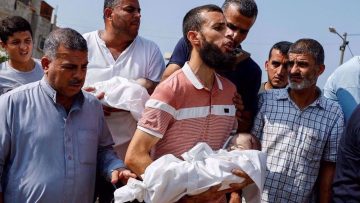 Israel has launched rounds of airstrikes on Gaza since Saturday, killing more than 560 people and injuring thousands more.
Russian Foreign Minister Sergei Lavrov said on Monday that the way out of the Palestinian conflict is for the Israeli regime and its backers to recognize Palestine’s right to create an independent state.
Speaking in a press conference in Moscow alongside the visiting head of the Arab League Ahmed Aboul Gheit on Monday, Lavrov said that Russia doubts the West’s policy on the Israeli regime would work at all.
“They say that (fighting) should be stopped immediately, that Israel should destroy the terrorists,” Lavrov said, referring to the way Israel and its backers describe Palestinian fighters.
“But this was done before… and never after the situation calmed down did they come to the fact that the main reason (for the conflict) needs to be eliminated … The Palestinian problem should not be delayed further,” he said.
Israeli settlers captured as Hamas and PIJ fighters overrun the Israeli army near the Gaza border
The Cradle | October 7, 2023
Palestinian resistance factions from the Gaza Strip have taken control of over a dozen illegal settlements in southern Israel as part of ‘Operation Al-Aqsa Floods,’ which has been raging since the early hours of 7 October.
Fighters from Hamas and the Palestinian Islamic Jihad (PIJ) say they hold at least 50 prisoners of war (POW) after overrunning many Israeli checkpoints and neighborhoods. Israeli media says the death toll from the operation has reached 100, with close 1,000 injured.
In describing the operation, Hamas deputy chief Saleh al-Arouri told Al Jazeera: “We managed to kill and capture many Israeli soldiers. The fighting is still on. As to our prisoners, I say, your freedom is looming large. What we have in hand will see you set free. The longer fighting continues, the higher the number of prisoners will become.”
Footage across social media has shown the extent of the resistance’s advance, as Israeli soldiers lay dead in many streets while settlers had to run for their lives or surrender to the armed groups.
https://twitter.com/TheCradleMedia/status/1710605327501017461
Among those captured is Israeli General Nimrod Aloni, the commander of the Depth Corps, a unit that coordinates the army’s long-range operations “deep in enemy territory.”
The spokesman for Hamas’ armed wing, Abu Hamza, confirmed that fighters from the Al-Quds Brigades and the Al-Qassam Brigades were at the front of today’s incursion, saying that the Gaza resistance recorded “a new chapter of victory” and “broke the prestige of the enemy entity,” with “a resounding historical shock.”
“Al-Aqsa Flood [revealed Israel] as an illusion made of dust and capable of being defeated and broken.”
In response, Tel Aviv has been conducting air raids inside the Gaza Strip, a coastal area considered the world’s largest open-air prison, leaving over 200 Palestinians dead and 1,600 injured. Survivors of the onslaught say they are “bracing” for the continued Israeli response as Hamas declared, “We are ready for an [Israeli] land invasion.”
Saturday’s operation caught the world by surprise, with even former Israeli security officials calling it a “colossal failure” of the intelligence apparatus, which failed to detect the launch of about 7,000 rockets from Gaza.
“All of Israel is asking itself: Where is the [army], where is the police, where is the security?” the former head of the Israeli Navy said during a TV interview. “It’s a colossal failure; the hierarchies have simply failed, with vast consequences.”
In response to the crisis, Israeli Prime Minister Benjamin Netanyahu declared his country at “war” to the support of his western allies. However, the offensive may throw a wrench at ongoing normalization talks with Saudi Arabia.
In a statement, kingdom officials said: “[Saudi Arabia] repeatedly warned of the consequences of [the deterioration] of the situation as a result of the occupation as well as of depriving the Palestinian people of their legitimate rights and [not halting] systematic provocations against their holy [sites].”
The UAE, which normalized ties with Israel in 2020, issued a statement “[expressing] its deep concern over the escalation of violence between Israelis and Palestinians,” also calling “for an immediate cessation of the escalation and protection of the lives of civilians.”
Support for the operation has poured in from the regional resistance, with Hezbollah Secretary General Hassan Nasrallah calling it a “triumphant operation [and] a decisive response to the ongoing crimes of the occupation.”
Nasrallah also said the Lebanese resistance is “closely following the significant developments [in Palestine]” and “looking at the field conditions with utmost interest.”
Similarly, Yemen’s Ansarallah said that “[Operation Al-Aqsa Flood] revealed the weakness, fragility, and impotence of the temporary zionist entity and showed the world the strength and effectiveness of the resistance in Palestine and its ability to strike the ‘Israeli’ depths, storm the settlements, kill the zionists, and capture their soldiers.”
For Israel, support has poured in from the west, with French President Emmanuel Macron saying via statement, “France stands in solidarity with Israel and the Israelis, committed to their security and their right to defend themselves.”
The White House issued a similar statement, describing Saturday’s resistance operation as “appalling terrorist attacks.”
Israel’s twisted logic makes the murder of Palestinian children a matter of state policy
By Ramzy Baroud | MEMO | September 5, 2023
Israel murders Palestinian children as a matter of state policy. This claim can be demonstrated easily and is supported by the latest findings of a Human Rights Watch report. The question is: why?
When the police or army shoot a child anywhere in the world, it can usually be argued, at least in theory, that the killing was an unfortunate and tragic mistake. But when thousands of children are killed and wounded in a systematic, “routine” and comparable method within a relatively short period of time, there has to be something very deliberate about it.
In a recent report — “West Bank: Spike in Israeli Killings of Palestinian Children” — HRW reaches a strong conclusion based on an exhaustive examination of medical data, eyewitness accounts, video footage and field research, the latter pertaining to four specific cases.
One is the case of Mahmoud Al-Sadi, a 17-year-old Palestinian boy from the Jenin Refugee Camp. He was killed last November, 320 metres away from fighting between invading Israeli forces and Jenin resistance fighters. Mahmoud was on his way to school and carried nothing that could be seen, from the soldiers’ point of view, as threatening or suspicious.
The story of the Jenin boy is typical and is repeated often throughout the occupied West Bank, sometimes daily. The predictable outcome, as HRW puts it, is that these killings are followed with “virtually no recourse for accountability”.
As of 22 August, 34 Palestinian children in the West Bank have been killed in 2023, adding yet more tragic numbers to a foreboding year that promises to be the most violent since 2005. This year “already surpasses 2022 annual figures, and the highest figure since 2005,” in terms of casualties, reported Tor Wennesland, the UN Special Coordinator for the Middle East, during a UN briefing on 21 August.
These statistics, among other factors — including the expansion of illegal Israeli Jewish settlements in the West Bank — “threatens to worsen the plight of the most vulnerable Palestinians,” according to Wennesland.
Those “most vulnerable Palestinians”, however, exist beyond the realm of statistics. When Israeli soldiers killed 2-year-old toddler Mohammed Tamimi on 5 June, the little boy’s name was added to an ever-expanding roll call of shame. The memory of the infant, however, like the memory of all other Palestinian children, is etched into the collective consciousness of all Palestinians. It deepens their pain, but also compels their struggle and their resistance.
For Palestinians, the killing of their children is not a random act of a military that lacks discipline and fears no repercussions. Palestinians know that the Israeli war on children is an intrinsic component of the larger Israeli war on every single one of them.
Of course, Israel does not declare officially that it is targeting Palestinian children on purpose. That would be a public relations disaster. Some Israeli officials in the past, however, have let their guard down, offering a strange and troubling logic.
Palestinian children are “little snakes”, wrote Israeli politician Ayelet Shaked in 2015. In a Facebook post, published in the Washington Post, Shaked called for the killing of “the mothers of the [Palestinian] martyrs.” In doing so, she declared war on all Palestinians. “They should follow their sons,” she wrote, “nothing could be more just.” Shortly afterwards, Shaked rather ironically became Israel’s justice minister.
But not all Israeli officials are candid about the killing of Palestinian children, and even their mothers. Data collected by international rights groups, however, leaves no doubt that the nature of the killings is part of a comprehensive strategy developed by the Israeli military. “In all cases,” recently investigated by HRW, “Israeli forces shot the children’s upper bodies.” This was done without the “issuing of warnings or using common, less lethal measures.”
Specifically, the killing of Palestinian children is a centralised and deliberate Israeli military strategy. The same twisted logic, now applied to the West Bank, has already been used in the besieged Gaza Strip. UN figures show that, in the Israeli war against the Palestinians in Gaza in 2008-9, 333 Palestinian children were killed; other estimates put the figure at 410. In the 2012 Israeli offensive against Gaza, 47 children were killed; in 2014, there were 578 killed; in 2021 it was 66; and in 2022 17 children were killed in the besieged territory by Israeli soldiers.
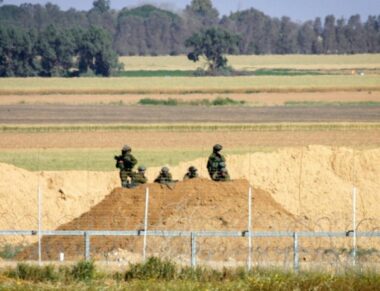
Between 2018 and 2020, 59 Palestinian children were killed in what was known as the “March of Return” protests that took place at the fence separating Israel from the Gaza Strip. All the children were killed from a distance by Israeli snipers.
When the numbers of dead and wounded children are tallied, they are in the thousands. According to the UN, there were precisely 8,700 Palestinian child casualties between 2015 and 2022.
Even the callous and often dehumanising term “collateral damage” cannot justify such statistics. And although the war on Palestinian children is clearly intentional, protracted and ongoing, not a single Israeli military or government official has ever been held accountable in an international court. Moreover, the UN “List of Shame for Killing Children” has never branded Israel, although other countries have been “named and shamed” for far fewer crimes against children.
As the killing of children is perceived — according to the twisted logic of the likes of Shaked — to be functional for Israel, given the absence of any accountability, the occupation state finds no reason or urgency to end its war on Palestinian children. And with the constant loosening of the rules of military engagement in Israel, and the terrifyingly genocidal language used by its extreme far-right ministers and their massive constituency, more Palestinian children are likely to lose their lives in the near future.
Despite this, the most that UN officials and rights groups seem to be able to do now is to count the alarming number of child casualties. Alas, no number is large enough to dissuade Israel from killing Palestinians, including children.
The problem for Palestinians is not just that of Israel’s violence, but also the lack of international will to hold Israel accountable. Accountability requires unity, decisiveness of will and action. This task should be a priority for all countries that genuinely care about Palestinians and universal human rights. Without such collective action, Palestinian children will continue to be killed in large numbers and in the most brutal ways, a tragedy that will continue to pain, in fact, shame, us all.
Gaslighting Gaza: Israel’s deceptive extraction approval prioritizes economics over politics
The Cradle | August 1, 2023
A significant breakthrough has emerged as the Hamas authorities in the Gaza Strip have expressed their willingness, in principle, to grant the Fatah-led Palestinian Authority (PA) access to a natural gas field off the Gaza coast.
This groundbreaking development comes as part of a US-brokered deal that involves the PA, an Egyptian gas company, and Israel. If the plans proceed, the potential benefits are far-reaching, holding the promise of bolstering the economy and improving living standards in the besieged Gaza Strip.
Moreover, this agreement opens up the possibility of indirect negotiations between Hamas and the Israeli occupation, following a path similar to the recent developments in neighboring Lebanon. Notably, Hezbollah has given its approval for the Lebanese government to engage in talks with Israel over maritime demarcation lines, while asserting the country’s rights to its natural resources and threatening the use of force to secure it. It appears that Hamas may now be inclined to adopt a pragmatic approach, mirroring Lebanon.
Israeli green light for Gaza gas field
In parallel with the Israeli government’s decision to delegate enhanced powers to pro-settler Finance Minister Bezalel Smotrich, aimed at expediting settlement procedures, Israeli Prime Minister Benjamin Netanyahu’s office announced on 18 June, preliminary approval for the development of the Gaza Marine gas field.
According to the prime minister’s office, the move will place emphasis “on Palestinian economic development and maintaining security stability in the region.”
The approval paves the way for the Egyptian EGAS company to assume responsibility for the administrative and technical aspects of gas exploration, with plans to transport the gas to the Damietta station for liquefaction and subsequent export to Europe and beyond.
Notably, the agreement between Egypt, the PA, and Israel was announced in October 2022, pending Israeli approval, which has now been granted. However, the announcement did not address the share of the Gaza Strip governed by Hamas, who have remained silent on the matter. Analysts attribute this silence to a potential understanding between Hamas leadership and Egypt regarding a positive approach to the agreement.
One policy for Gaza, another for West Bank
This development poses a challenge as the resistance factions in Gaza have previously warned against any agreement that deprives the Strip’s residents of their rightful gas revenues. One Palestinian official was quoted by Reuters as saying: “We are waiting to know what exactly the Israelis have agreed to in detail. We can’t make a position based on a statement to the media.”
Hamas official Ismail Rudwan was also quoted by the news agency as saying: “We reaffirm that our people in Gaza have the rights to their natural resources.” In a rally held last September under the slogan “Our Gas is Our Right,” the factions expressed their firm stance on the matter, raising concerns about the potential repercussions.
Suhail al-Hindi, a member of the political bureau of Hamas, commented on the matter on Arabi21, saying: “In no way can Gaza be absent from this natural wealth, and every Palestinian has the right to benefit from the country’s wealth, including this field, with emphasis that the Palestinian people have the right to obtain this gas.
Al-Hindi stressed that “the Israeli occupation cannot be allowed to steal Palestinian wealth, and besieged Gaza has the right to live like all cities in the world, and for our people to enjoy their natural wealth.”
Discovered in 1999, the Gaza Marine gas field holds significant reserves, estimated at 1.1 trillion cubic feet of natural gas. The British Gas Group and its partners, Consolidated Contractors Company (CCC), were granted a gas exploration license by the PA. Located 603 meters below sea level, approximately 22 miles west of Gaza, the field has a production capacity of 1.5 billion cubic meters annually over a span of 20 years.
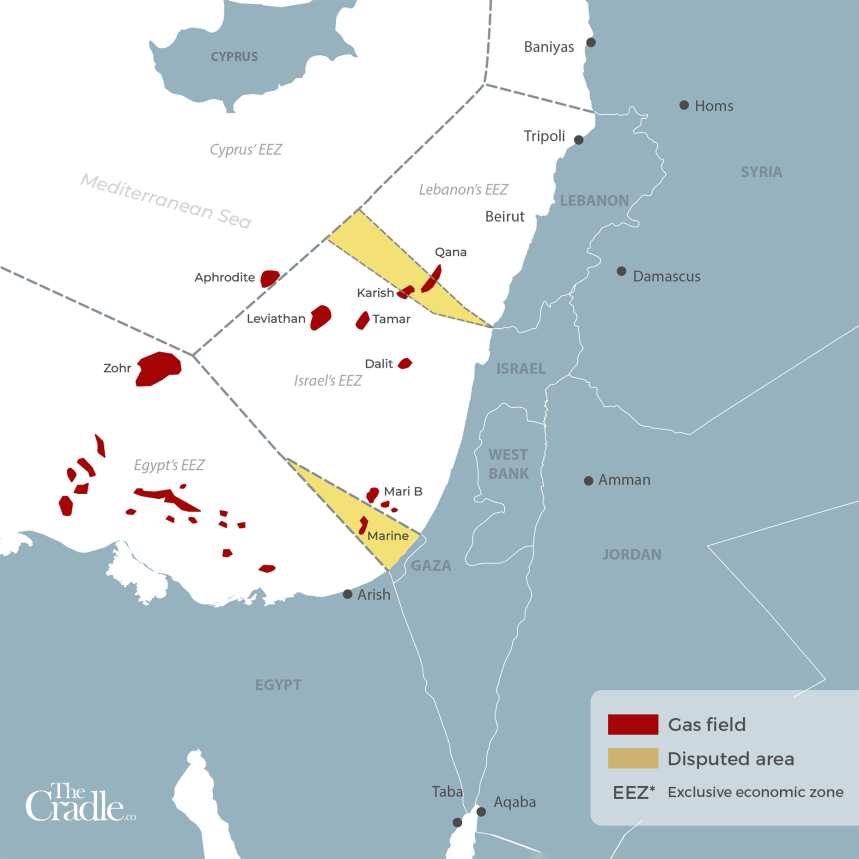
Map of gas fields east of the Mediterranean Sea
Economic analyst Muhammad Abu Jayab tells The Cradle that the US implicitly agreed to provide part of the revenues from the Gaza Marine field to Hamas, which explains why the latter did not comment on the recent agreement. According to Abu Jayab “Egypt is at the forefront as a guarantee that Hamas will deal positively with the agreement, due to Cairo’s influence on the Palestinian factions.”
Nevertheless, the Israeli approval of the Gaza Marine gas field agreement comes at a sensitive time, especially for the resistance factions, as it coincides with the establishment of over 5,000 new illegal settlement units in the face of escalating tensions in the occupied West Bank. Israeli security warnings about the potential consequences of right-wing policies and international opposition, including from the US, further compound the situation.
Plans like the E1 proposal, which connects the Ma’ale Adumim settlement with occupied Jerusalem, and effectively bifurcates the West Bank, have garnered significant criticism due to their potential to impede any future prospects for the so-called two-state solution.
Calm before the storm
Sources close to the decision-making circles of the resistance factions inform The Cradle that the Israeli approval serves as a bargaining chip to buy restraint and non-interference from Gaza Strip resistance groups in events unfolding in the West Bank and Jerusalem.
However, from the perspective of the resistance factions, the cost Israel demands exceeds the economic gains, as recent actions by Hamas underscore its commitment to prioritize resistance over financial incentives.
Mustafa al-Sawaf, a political analyst close to Hamas, tells The Cradle:
“The attack on Eli settlement, which was carried out by two members of the al-Qassam Brigades [armed wing of Hamas] on 20 June, came in response to all attempts to buy calm and silence. It was a clear message from Hamas to all regional and international parties not to dream of exchanging resistance for economic gains.”
Lessons from Lebanon
Meanwhile, political researcher Ismail Muhammad points out that all regional and international parties realize that there is no possibility of bypassing Hamas in the gas file. He explains to The Cradle that:
“The resistance in Gaza was inspired by Hezbollah’s experience in imposing its conditions and obtaining Lebanon’s rights in the Karish field. It sent clear messages, that whatever the pressures, it will not accept being an idle witness while the country’s wealth is stolen before its eyes. The most important conclusions of the Lebanese experience are that investment needs calm, and that none of the Arab or international companies will operate under the threat of fire. At least by disabling it. The resistance possesses the military capabilities that enable it not to bomb the gas fields, but rather to disrupt work in them at least.”
Gas deals: A tool for dividing Palestinians
Politically-speaking, Israel’s pursuit of gas agreements carries broader political implications beyond immediate security concerns. Political analyst Ziyad Abu Ziyad believes that Israel is leveraging these agreements to foster internal Palestinian divisions.
Egypt’s assumption of management responsibilities for Gaza Marine, in the absence of Palestinian reconciliation, and Israel’s refusal to demarcate the maritime borders with the PA, “reminds us of the solution that Israel previously proposed to the Palestinian leadership: a Palestinian state without borders.”
This approach focuses on improving the Palestinians’ economic situation by harnessing their own resources, essentially implementing an economic solution to the conflict without addressing its underlying political dimensions.
The occupation state’s approval of gas extraction from the Gaza Marine gas field has exposed the delicate balance between geopolitics, security, and economic interests in the region. As resistance factions draw inspiration from past experiences and assert their conditions, the path forward remains uncertain, casting doubt on the regional stability that Netanyahu’s office claimed would be maintained with the extraction approval.
Israeli ploy to divide PIJ and Hamas in Gaza a grave miscalculation
By Robert Inlakesh | Press TV | May 12, 2023
The Israeli regime’s new assassination campaign in the besieged Gaza Strip has essentially sought to isolate the Palestinian Islamic Jihad (PIJ) resistance movement from Hamas, in what Palestinian resistance leaders, across the board, believe is a miscalculation.
The Israeli occupation military carried out a barrage of deadly strikes on the residences of PIJ leaders in the Gaza Strip in the wee hours of Tuesday morning.
The strikes were carried out just after 2:00 AM local time and claimed the lives of Khalil Bahtini, Jihad Ghanem and Tariq Ezz Ad-Din, three senior leaders of the Gaza-based PIJ movement, along with their spouses and children.
The three resistance leaders were reportedly supposed to head to the Egyptian capital Cairo that day to discuss rising tension in the occupied territories and the regime’s relentless aggression, due to which PIJ had loosened its state of emergency a day earlier.
On Thursday, two more PIJ officials, part of the al-Quds brigades, were assassinated in Israeli drone strikes, prompting a massive barrage of rockets from Gaza towards Tel Aviv and other occupied areas in retaliation.
According to a PIJ military source, who spoke to the Press TV website on the condition of anonymity, Zionists launched the attack to “save their image” and to “isolate the resistance groups”.
“They wanted to see Islamic Jihad isolated from our brothers in Hamas. This has failed and we fight as one force, an attack on one is an attack on all,” he said.
Divide and conquer fails
This statement reflects the sentiment of the PIJ leadership too, who view this battle as a means to demonstrate unity among the resistance movements, which has been established through the Joint Room for the resistance factions in Gaza, which rose to prominence during the Battle of Saif al-Quds in May 2021.
Head of the Islamic Jihad’s political department, Muhammad al-Hindi asserted that there is political communication at the highest level between the two movements and “attempts to drive wedge will fail”.
Hamas has also explicitly said that it is part of the response and its armed wing, the Qassam brigades, is the most powerful force in the Palestinian Joint Room.
The Joint Room also released a statement affirming that the resistance “will remain on all fronts of the homeland as one unit, a sword and a shield for our people, our land, and our sanctities.”
The component of dividing the Palestinian resistance factions has been integral to the Zionist entity’s assassination campaign in Gaza, with the Israeli military warning Hamas to stay out of the confrontation after it carried out its initial strikes.
Yoav Gallant, the Israeli minister of war, stated after the first extrajudicial killings were carried out that “the goals of the operation have been achieved; the leadership of Islamic Jihad in Gaza has been eliminated”, without mentioning Hamas.
Calculated response
However, the resistance forces managed to flip the script on their enemy, waiting for over a day before retaliating, despite continued Israeli missile strikes.
The decision to make the Israelis wait for the response caused hysteria, keeping bomb shelters open for settlers throughout occupied Palestine, as they waited for the anticipated response to high-profile assassinations.
Notably, the response of the resistance forces was not anticipated in the way that it happened. Although there were preparations made for rocket fire toward Tel Aviv, many Israeli analysts believed that past strategies of slowly expanding the range of fire would be adopted.
The wait was perhaps the most important component of the initial retaliatory rocket fire, building anticipation and causing bickering amongst Israelis.
Another key component of the Israeli offensive has been the game of political point scoring, claiming imaginary victories and making tall and deceptive statements following the assassination strikes.
Israeli prime minister Benjamin Netanyahu’s far-right coalition partners – Likud and Otzma Yehudit – had been in dispute over what was labeled by Israel’s security minister Itamar Ben Gvir as a “feeble” response to the PIJ rocket fire last week.
Adnan’s murder
The rocket fire came as a response from the Joint Room to the custodial murder of Palestinian political icon and PIJ West Bank spokesperson, Khader Adnan, who was allowed to die a slow death inside his cell in an Israeli military prison, denied basic medical aid.
Adnan went on hunger strike for 86 consecutive days and according to the Palestinian Prisoners Society organization his custodial murder came as a result of deliberate medical negligence by prison authorities, therefore making it an assassination, or as one Palestinian group said, “cold-blooded execution”.
Before the killing of Adnan, another exchange of fire occurred between the occupation forces and Gaza’s resistance groups during the holy month of Ramadan.
After the Israeli forces stormed the al-Aqsa Mosque compound, attacked worshippers, desecrated the holy site, and arrested and injured over 400 Palestinians, rockets were fired from the Gaza Strip.
The following day, a barrage of rockets also came from southern Lebanon, followed by two batches of rockets fired from Syria into the occupied Golan Heights.
Israeli strikes in Gaza, Lebanon and Syria were lackluster against the backdrop of major threats from the Zionist entity at the time. In both Gaza and Lebanon, Israeli strikes hit open areas of no strategic value, which even made it to social media memes.
Wary of backlash
It is because of the two previous exchanges that the Zionist regime has gone through a process of repeated embarrassments. Its leadership is wary of the political backlash that would come with the outbreak of a real war with all sides, so it settled for a low-scale battle.
In the case of the latest aggression on the besieged Gaza Strip, the PIJ movement has been chosen as what Israel believes to be an easier target, however, as Hamas leader Ismail Haniyeh stated this Tuesday, the regime has “severely miscalculated” and instead of being able to isolate PIJ, they have been dragged into a battle with a unified resistance front this time.
On November 12, 2019, the Zionist regime carried out a brief military operation that targeted only the PIJ movement, assassinating the group commander Baha Abu Atta, which sparked days of fierce fighting.
At that time, Palestinian Islamic Jihad fought separately from Hamas even though the relations between both groups remained friendly, contrary to the hideous Israeli propaganda.
Last year, in August, under former Israeli prime minister, Yair Lapid, the Zionist military launched another military operation to assassinate leading members of PIJ, managing to kill Khaled Mansour and Tayseer Jabaari.
In response, the PIJ movement, as part of the Joint Room, launched “Operation Unity of Squares”, which involved heavy coordination with Hamas throughout.
The aim of dividing the groups failed, yet the Zionist regime managed to keep Hamas from getting involved with full force.
It was using this model that Israeli PM Benjamin Netanyahu launched an attack this time, however, what was planned to be a short assassination campaign failed to isolate the PIJ movement from the other resistance groups and rather unified the resistance front against the occupying entity.
Robert Inlakesh is a journalist, writer and political analyst, who has lived in and reported from the occupied West Bank.
Israel prevents foreign journalists from entering Gaza
MEMO | May 11, 2023
The Israeli occupation authorities have been preventing foreign journalists from entering Gaza since the start of its offensive on Tuesday night.
In a press release, Head of Government Media Office (GMO) in Gaza, Salameh Maarouf, said: “The Israeli occupation has been closing Beit Hanoon Crossing and preventing foreign media crews from entering the strip to cover its offensive.”
Maarouf called on the International Federation of Journalists (IFJ) and all other bodies concerned with the freedom of the press and freedom of speech to take practical measures against the Israeli occupation so that it lifts its restrictions on the entry of media crews.
He considered the Israeli ban on the entry of foreign media as a “violation of the freedom of journalists to practice their work, as well as a violation of their right to free movement.”
At the same time, he pointed out that the Israeli occupation bans foreign journalists from entering Gaza during every offensive it carries out against the besieged coastal enclave.
Maarouf stressed that the “silence of the international bodies concerned with media is the reason that encourages the Israeli occupation to repeat and continue its oppressive and suppressive violations.”
Russian citizen killed in Israeli raid
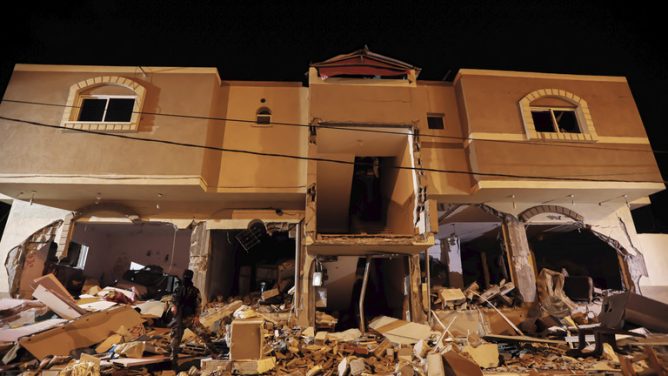
The aftermath of the Israeli strikes on Islamic Jihad targets in the Gaza Strip, May 9, 2023 © AP / Yousef Masoud
RT | May 9, 2023
The Israel Defense Forces launched operation ‘Shield and Arrow’ against the leaders of Palestinian Islamic Jihad in Gaza on Tuesday morning, allegedly killing several high-ranking militants – as well as their wives, children and other civilians nearby.
A spokesperson for the Palestinian Health Ministry, Ashraf al-Qedra, told RIA Novosti that one of the victims was a citizen of Russia, Jamal Abu Haswan, who “died in Gaza City as a result of shelling by the Israel Defense Forces.”
A neighbor and friend of the deceased told the agency that “a rocket hit the apartment where Abu Haswan lived, which led to his death along with his wife and son.” According to RIA, Abu Haswan worked at a medical facility that “specializes in physical therapy and medical rehabilitation.”
The air raid took place at around 2am local time and left at least 20 people injured in addition to the 12 killed, according to the latest estimates.
The IDF has issued a rare statement confirming its military operation against the PIJ, claiming to have neutralized three top members of the group.
The Palestinian Health ministry said the militants’ families and other civilians were killed in the strikes on an apartment building in Gaza City and a house in the southern city of Rafah.
Hamas criticises ‘biased’, ‘contradictory’ EU resolution on two-state solution
MEMO | December 29, 2022
The Palestinian resistance movement Hamas issued a statement yesterday criticising the EU over Resolution no. 2949/2022 (RSP), on the prospects for a two-state solution for Israel and Palestine.
In a political memorandum, Hamas said the resolution “contained several inaccuracies and contradictions about the Palestinian issue”, noting that it “is heavily biased against the Palestinians’ inherent and legitimate rights to freedom, return and self-determination.”
Among the issues raised with the resolution, the movement said it has sided with the Israeli occupation’s narrative, while ignoring the Palestinian people’s legitimate right to resistance and self-defence.
“Voting against this right is considered a great sin that Europeans have committed, once again. This vote also reflects the double standards with which the European Union deals with issues of peoples and freedoms around the world.”
“In recent months, we have seen the European position on the crisis in Ukraine, and how the Ukrainian resistance was considered legitimate and supported with money and weapons,” the statement said. The resolution, Hamas insists, has disregarded terrorism practised by the Israeli occupation on a daily basis.
The EU resolution was called out over its double standards in regards to its advocating “customised” democracy for the Palestinians and the issue of the participation of resistance factions in free and fair elections, “despite the fact that most of the candidates for the Israeli Knesset have criminal records and terrorist practices and are labeled on terrorist lists in many countries, including Israel itself.”
Hamas acknowledged the resolution’s demand to end the Israeli blockade, imposed on the people of Gaza since 2006 but concluded that the resolution is further proof of “the European bias towards the Israeli occupation and its racist policies” and the EU’s lack of seriousness in pursuing a just and fair solution to the Palestinian cause.
The movement urged the European Parliament to reconsider Resolution 2949 and to correct its position in order to achieve a just solution for the Palestinian people.
Earlier this month, a senior member of Hamas denounced the EU over its silence concerning the complicity of over 700 European financial institutions in supporting illegal Israeli settlements on Palestinian lands.
Social media’s history of suppressing Palestine content

By Kathryn Shihadah | Israel-Palestine News | December 12, 2022
For years, social media have been making it difficult for Palestinian and their allies’ voices to be heard – even as Israel’s stranglehold on Palestinians has grown stronger, and as increasing amounts of US tax money have been sent to Israel and to various countries for Israel’s direct benefit.
Social media users, especially Palestinian human rights advocates, have reported puzzling occurrences on the major platforms Twitter, Facebook, and Instagram – especially during times of Israeli crackdowns.
Users who shared information on the situation in the Palestinian territories described posts being deleted as “hate speech or symbols,” or “violence,” inexplicably losing followers and views of their content, or having entire accounts abruptly frozen or deleted.
One rights group documented over 700 instances of social media networks restricting or removing Palestinian content in May 2021 alone, during a time of especially heavy Israeli state violence.
Another group reported that nearly half of the Palestinian-themed content that disappeared off of Instagram during this time period
occurred without the company providing the user a prior warning or notice. In an additional 20 percent of the cases, Instagram notified the user but did not provide a specific justification for restricting the content.
When users appealed the censorship, often their content or account would be restored, with a message that it never should have been deleted to begin with. But by the time this resolution came, the opportunity to inform and influence readers was past.
For example, in May 2021, during a time of escalating Israeli violence, Twitter restricted the account of Palestinian-American journalist Mariam Barghouti, who had been posting photos and videos of the violence in Jerusalem. It later restored Barghouti’s account and apologized for the suspension, saying it was done “by mistake.”
A long report on social media actions regarding Israel-Palestine in the Columbia Journalism Review pointed out: “Some of those who have been covering such issues for years don’t think these kinds of things are a mistake; rather, they believe social networks are deliberately censoring Palestinian content.”
Barghouti explained the significance of Twitter to the Palestinian rights movement:
It’s our only avenue for speaking with the world from under a military occupation that controls all our entry and exit points. We’re left to share through soundbites of 280 characters. If even that is taken away, we’re looking at the slaughter of Palestinians in silence.
Social media suppression is particularly critical since mainstream media tend not to cover Israel and Palestine with the kind of accuracy and context that would enable Americans to understand the issue.
In essence, social media have been preventing the victims of Israeli violence from sharing their experiences or building support for their plight.
Excuses
Although owned by two different companies, the three platforms, Twitter and Facebook/Instagram, have offered duplicate “explanations” for what has happened, including glitches that just happened to affect posts and hashtags about Israel, and “widespread global technical issue not related to any particular topic.”
While these [glitches] have been fixed, they should never have happened in the first place. We’re so sorry to everyone who felt they couldn’t bring attention to important events, or who felt this was a deliberate suppression of their voice. This was never our intention – nor do we ever want to silence a particular community or point of view.
TRT World reported another case in which Twitter restricted information on Palestine:
Pro-Palestinian activist Hebh Jamal’s Twitter was targeted with complaints over a post detailing an emotional conversation between her husband and his little cousin in Gaza. The young cousin admitted to wanting to brush his hair before sleeping for fear that the Israeli fire may kill him in his sleep. He said he wanted to look good in case he died. Hebh’s post was flagged for deletion, and restricted by Twitter.
Since the German government has implemented legal measures to make social media companies accountable to users, Twitter later confessed to Hebh that the complaints against her post were baseless. Under German law, Twitter has to inform the user if their post or account is being investigated. This only applies because Hebh and her family reside in Germany. For most Palestinians hailing from Gaza City, there’s a different set of rules, and a radically different set of rights.
TRT reports: “Hebh now faces a video review for every post she makes. She’s also been reported on TikTok as well, with her account deleted before.”
Journalist Bayan Ishtaiwi explained: “For Palestinians sealed-off in open-air prisons like Gaza, social media is all they have. Whoever uses words like occupation or martyr, is penalized for three days at least, which happened to me, or face a ban on live videos for a month.”
Whistleblowing
A group of Instagram employees confirmed the human rights activists’ suspicions when they protested the platform’s blocking of pro-Palestinian content during Israel’s violence in May 2021 – even after the issue had already been reported.
Can we investigate the reasons why posts and stories pertaining to Palestine lately have had limited reach and engagement, especially when more people than ever from around the world are watching the situation unfold?
Other employees added comments, including,
I’d really like to understand what exactly is breaking down here and why. What is being done to fix it given that this is an issue that was brought up a week ago?
Soon after, nearly 200 Facebook employees signed on to an open letter demanding that Facebook address the allegations of censorship.
Israel calls the shots
Foreign Policy reports:
“Since 2015, the Israeli Justice Ministry has operated a Cyber Unit that has issued tens of thousands of content removal requests to Facebook, Twitter, and YouTube, mostly alleging violent incitement or support for terrorism.
Technically, these requests are voluntary. They are not legally binding and are therefore not tracked in the transparency reports that technology companies use to disclose formal government censorship orders.
Nonetheless, social media companies have complied with the Cyber Unit’s requests roughly 90 percent of the time.”
Israel’s infamous Cyber Unit patrols social media, searching for “incriminating” content, passing along thousands of requests to social media administrators to remove what the unit finds unacceptable.
In 2016, the Israeli government and Facebook agreed to collaborate on ways to combat what Israel considers “incitement to violence” on the platform.
Then-justice minister Ayelet Shaked noted that at the time, Facebook’s compliance with Israel’s requests to take down content was up to 95%, but expressed hopes that the plan would result in even more censorship.
Neither Israel nor the platforms have been transparent about this practice.
In 2020, Israel’s Ministry of Strategic Affairs issued a report on allegedly “phony” online profiles that put out content critical of Israel.
Within a day, Twitter “suspended dozens of Palestinian and pro-Palestine accounts,” claiming the information they circulated violated its terms of service.
It may be noteworthy that both Meta CEO Mark Zuckerberg and Twitter’s new owner, Elon Musk have had private audiences with top Israeli leaders.
Israelis abound in Silicon Valley, with about 60,000-100,000 in the Bay Area, and Israel partisans are also ever-present. A recent photo of Musk shared on Twitter was of him with his friend Ari Emanuel, son of a former Irgun terrorist and brother of Rahm Emanuel, who once volunteered with the IDF.
One Palestinian activist summed up the situation:
Rather than being some kind of enabler of democracy, social media has come to be the epitome of political silencing and repression as tech giants have collaborated with various oppressive governments, including the Israeli government, to censor and delete content that exposes their true oppressive character.
Facebook, Instagram report card
Facebook’s Oversight Board recommended that Meta (parent company of Facebook, Instagram, and WhatsApp) undergo an evaluation of its treatment of Palestinian content in May 2021. Meta hired the consulting company Business for Social Responsibility (BSR) for the work.
Jewish Currents summarized BSR’s final report in an article entitled “Human Rights Due Diligence of Meta’s Impacts in Israel and Palestine”:
The report underscored heavy-handed content moderation by Facebook and Instagram, which Palestinian social media users claim censors critics of Israeli repression.
These restrictions have undermined Palestinian users’ effort to use social media to document Israeli human rights abuses.
BSR contrasted Meta’s over-enforcement of Palestinian social media posts with its under-enforcement of Hebrew-language posts, which the report attributes to Meta installing an algorithmic “hostile speech classifier” for Arabic, but not for Hebrew.
The report concludes that Arabic language content is over-regulated because Hamas, the ruling, elected party in Gaza, is on Facebook’s blacklist, so it was standard to remove posts that appeared to “praise, support, or represent” that group or others on the list.
Other reasons for the interference lie in the fact that the Palestinian content was not reviewed by Palestinian dialect speakers of Arabic, nor was the algorithm developed with the proper “linguistic and cultural competence.”
Internet policy experts summed up the situation at Facebook and the other platforms:
Social media companies have] shown a willingness to silence Palestinian voices if it means avoiding potential political controversy and pressure from the Israeli government.
“Unintentional”? Really?
BSR’s report speculated that the impact of Facebook’s actions – Palestinian users’ loss of rights to expression – was unintentional. Rights groups disagreed.
Dozens of groups signed a public statement in response to BSR’s report, insisting that they had been
calling Meta’s attention to the disproportionately negative impact of its content moderation on Palestinians for years, [so] even if the bias started out as unintentional, after knowing about the issues for years and not taking appropriate action, the unintentional became intentional.
Looking ahead
The BSR report ends with 21 recommendations to Meta, some of which Meta has committed to, either fully or in part.
Marwa Fatafta, a policy manager for a digital rights group, had mixed feelings:
The report validates the lived experiences of Palestinians… They cannot tell us anymore that this is a system glitch. Now they know the root causes…
But regarding Israel’s interference in content restriction, he added,
We’ve wanted more clarity on this because Meta refuses to provide answers. Users deserve transparency on whether their piece of content has been removed as a result of the Israeli government’s request.
Bottom line
Social media have for years – and for various reasons – repressed content about Israel’s oppression of Palestinians.
In some particularly egregious situations, like Israel’s aggression in May 2021, the companies have offered excuses and apologies. But impartial analysis has proven these excuses false and the apologies hollow.
Not only are social media platforms inherently skewed to over-regulate Palestinian voices, but they are influenced by a powerful foreign government (and no doubt, its US lobby) to an extent we can only imagine.
And Palestinians continue dying.
A report in Foreign Policy by Emerson T. Brooking and Eliza Campbell described the situation with rare eloquence:
The 4.8 million residents of the occupied Palestinian territories live in two simultaneous and vastly different realities. In the physical world, Palestinians are captives, crammed into Gaza or West Bank enclaves and blockaded by Israeli military checkpoints…
But on the internet, the checkpoints disappear. Palestinians can converse with family from whom they are separated by barbed wire and machine gun emplacements. They can share their stories with observers and sympathizers around the world.
In doing so, Palestinians can call themselves citizens of a sovereign State of Palestine: one recognized by 138 countries and admitted in 2012 as a non-member observer state to the United Nations. This second, digital Palestine represents a fulfilment of the internet’s optimistic and largely forgotten promise to give voice to the voiceless and illuminate the darkest corners of the world.
It is also under threat of being extinguished. This is due to a confluence of three forces. The first is the expansive police and surveillance apparatus of the State of Israel, which is used to track, intimidate, and imprison Palestinians in the occupied territories for their online speech.
The second is a network of formal and informal institutions used by the Israeli government to target pro-Palestinian expression across the globe.
The third—and most surprising—force is that of American social media companies, which have shown a willingness to silence Palestinian voices if it means avoiding potential political controversy and pressure from the Israeli government.
Together, these forces demonstrate how it is possible for an ostensibly democratic government to suppress a popular online movement with the acquiescence of ostensibly liberal Silicon Valley executives. The playbook being pioneered against Palestinians will not stay in the Middle East forever. In time, it may be deployed against activist communities around the world.
New York Times sacks Gaza journalist for expressing support for Palestinian resistance
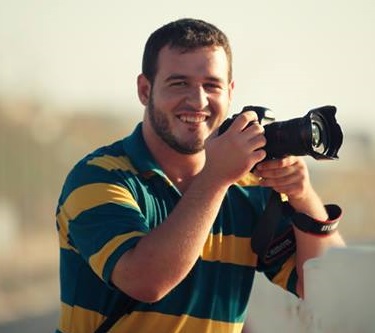
MEMO | October 6, 2022
Palestinian photojournalist, Hosam Salem, has been fired by the New York Times for expressing support for Resistance against Israeli occupation. The Gaza- based journalist has been working as a freelancer for the American outlet since 2018, but was dismissed after a dossier compiled by a pro-Israel group, accusing Salem of anti-Semitism, was presented to the Times.
Since joining the Times, Salem has been covering critical events in Gaza, such as the weekly protests at the border fence with Israel. He carried out an investigation into the Israeli killing of field nurse Razan Al-Najjar and, more recently, the May 2021 Israeli offensive on the Gaza strip, which killed at least 254 Palestinians, including 66 children, 39 women and 17 elderly people.
Details of his dismissal were revealed by Salem himself on Twitter. He said that the decision to fire him was made based on a report prepared by a Dutch editor – who obtained Israeli citizenship two years ago – for a website called “Honest Reporting”. The anti-Palestinian group is a staunch supporter of Israel and is often accused of peddling false narratives in Western media about Israel’s human rights violations.
Salem said that the dossier used by the Times to dismiss him used examples of social media posts in which he expressed support for Palestinian Resistance against Israeli occupation. “My aforementioned posts also spoke of the resilience of my people and those who were killed by the Israeli army – my cousin included – which “Honest Reporting” described as ‘Palestinian terrorists,'” said Salem on Twitter.
Salem claims that the editor of the dossier later wrote an article stating that he had succeeded in sacking three Palestinian journalists working for the Times in the Gaza Strip, based on allegations of anti-Semitism.
“Not only has “Honest Reporting” succeeded in terminating my contract with The New York Times, it has also actively discouraged other international news agencies from collaborating with me and my two colleagues,” Salem continued, while warning of the silencing of Palestinian voices.
“What is taking place is a systematic effort to distort the image of Palestinian journalists as being incapable of trustworthiness and integrity, simply because we cover the human rights violations that the Palestinian people undergo on a daily basis at hands of the Israeli army.”
Featured Video

Chinese jet fuel and the myth of energy independence
or go to
Aletho News Archives – Video-Images
From the Archives
The Dirty Little Secret behind the “Global Terrorism Index”
The Omission of Israeli Terrorism in the Occupied Palestinian Territories
By Karin Brothers | Global Research | December 6, 2014
… The Israeli settlements — all of which are illegal – have been identified as a major impediment to peace. The refusal of a major “global” terrorism report to name the Israeli settlers as one of the groups most responsible for terrorism not only misrepresents a major source of regional violence but exposes the Global Terrorism Index as a propaganda tool that supports a U.S. agenda.
In recent years, governments have been attempting to thwart terrorism by blocking supportive fund-raising. When it comes to Israeli settlements, however, the US and Canada actually encourage fund-raising by giving organizations (such as Christian Friends of Israeli Communities (CFOIC) and the Jewish National Fund) financial support in the form of donor tax-deductions.
Charities which provide funds for the Israeli settlements should be regarded as terror-financing organizations. They should not only lose their tax-deductible status, but they should be banned because they support the violation of international humanitarian law. The terror-financing laws that are being strictly enforced for Muslim charities should be applied to Christian and Jewish charities as well. … Read full article
Blog Roll
 Aletho News
- Chinese jet fuel and the myth of energy independence
- Ukraine Sea Drone Fired From Libya Hit Russian Tanker in Mediterranean
- IRGC: Iranian forces launched no attacks during ceasefire hours
- Trump Administration Moves To Automate U.S. Military Draft Registration
- Spain orders reopening of Tehran embassy, condemns Israel’s carpet bombing of Lebanon
- Israel faces ‘unsustainable’ strategic crisis following 40-day war against Iran: Analyst
- Iran restricts Hormuz access to 15 vessels per day under ceasefire terms: Report
- The ‘Opposition Party’ Has Done Nothing to Stop the Iran War and Much to Goad Trump Into Continuing It
- Moscow backs Tehran on status of Lebanon in US-Iran deal
- How UK Regulator Ofcom Quietly Bypassed International Law to Police American Speech
- If Americans Knew
- Amnesty: Urgent – Protect Lebanese civilians from brutal escalation in Israeli attacks
- Is The War Against Iran Over?
- Inside the Israeli army’s propaganda wing
- Hundreds of Gaza Amputees Stranded in Legal Limbo
- The gallows law: Israel moves toward executing Palestinian children
- Tucker Carlson: The Path to Peace requires ending ‘special alliance’ with Israel
- This is ceasefire? Israel’s biggest massacre yet in Lebanon, another journalist killed in Gaza – Daily Update
- Tucker Carlson on Israel: This Is the Behavior of an Ally? Really?
- Gazans face a triple crisis: severe shortages of water and bread, healthcare in tatters
- NY Times reports how Netanyahu took the US into Iran War
- No Tricks Zone
- An Inconvenient Tree: Uncovered In Alps… Europe Much Warmer Than Today 6000 Years Ago
- New Study Reports A 60% Slowdown In Greenland’s Ice Loss Rate In The Last Decade
- Low Intensity Tornado Wrecks Major Solar Farm, Creating A Potential Toxic Dump
- New Study Finds Warming Saves Lives…Cold Temperatures 12 Times More Deadly Than Excess Heat
- German Science Blog Accuses PIK Climate Institute Of Hallucinating Climate Tipping Points
- Devastating Assessment Of Comirnaty Vaccine By Former Senior Pfizer Europe Toxicologist
- New Study: CO2 Is ‘Effectively Negligible’ As An Explanatory Climate Change Factor Since 2000
- Former Pfizer Toxicologist Dr. Helmut Sterz Tells Bundestag Hearing Pfizer Vaccine Should Have Never Been Approved
- Energy Expert: Germany’s Nuclear Phaseout Was A “500 Billion Euro Mistake”
- New Research: South Australia’s Mid-Holocene Sea Surface Temperatures Were 4°C Warmer Than Today
 Aletho News