Whilst 18 Israelis are treated for anxiety, 22 Palestinians are taken to the mortuary

Smoke rises following an Israeli attack in Gaza city on 12 November 2019 [Ashraf Amra/Apaimages]
Dr Brendan Ciarán Browne | MEMO | November 13, 2019
The extrajudicial killing of Bahaa Abu Al-Ata of the Palestinian Islamic Jihad movement, the second largest faction in the Gaza Strip, has triggered a predictable spike in “conflict related incidents”. As always, it is the Palestinian civilian population residing in the much maligned Gaza Strip who are affected disproportionately.
On Wednesday morning, Israel’s supposedly “left wing” newspaper Haaretz reported that 18 Israeli civilians had been taken overnight to Ashkelon Hospital to be treated for “anxiety” following a spate of rocket fire emanating from Gaza. At the same time, a spokesperson for Gaza’s Health Ministry, Ashraf Al-Qudra, reported that the remains of 22 Palestinians were being transferred to the mortuary. A stark reminder, if ever one was needed, of the gross asymmetry of the “conflict” in Palestine/Israel.
For some, the “legitimacy” of Abu Al-Ata’s killing is a point of contention under international law. There is the usual binary rhetoric of “execution” versus “legitimate act of war” considered alongside debate over the appropriate designation of “combatant/non-combatant” status and the supposed protections therein. Regardless, and often set aside when debating the extrajudicial killing of “enemy (non)combatants”, it is worth remembering that Abu Al-Ata and his wife were killed in their bed in an Israeli rocket attack that destroyed his house in the Gaza City neighbourhood of Shuja’iyah, leaving his two children orphaned and undergoing emergency treatment at the local Al Shifa Hospital.
Similarly, there will be polarising views on the (il)legitimacy of the simultaneous attack on an Islamic Jihad political bureau member in Damascus, Akram Al-Ajouri, which resulted in the death of his son and a neighbour, and which also involved a flagrant breach of Syrian territorial sovereignty. Thus, what has been clear for some time, when it comes to the rules governing armed conflict and the application of principles of international law, it appears that “might is right” when Israel is involved.
Those with a strong commitment to realising the goals of a fair and, more importantly, a just resolution to the enduring conflict in Palestine/Israel will hardly be surprised by the bias and hypocrisy of Western politicians and the media taking to the airwaves to absolve Israel of any blame. Take, for example, the response of the spokesperson for EU Foreign Affairs and Security Policy, Maja Kocijančič, who tweeted in the aftermath of Abu Al-Ata’s killing that, “The firing of rockets on civilian populations is totally unacceptable and must immediately stop.” Or Joe Biden, in the running to be the next President of the United States, who tweeted, “It is intolerable that Israeli civilians live their lives under the constant fear of rocket attacks.” Not enough twitter characters, it seems, for either to make mention of the fact that it was the Israelis who kicked off this latest round of violence.
Arguably the greatest example of linguistic gymnastics is reserved for the headline writer in the Times of Israel, who led with, “Israel kills powerful Islamic Jihad commander”. Quite a stretch considering the modest arsenal at the disposal of Palestinian factions compared to a nuclear armed Middle East superpower with friends in high places. As leading Palestinian writer and activist Mariam Barghouti has noted, Palestinians, “aren’t leading a war. They have no official army, no official borders; they have no control over their resources and lands; and even their politicians are sometimes assassinated or incarcerated.”
The much-maligned Gaza Strip, considered to be unliveable by 2020 according to a UN report, continues to be the front line of resistance when it comes to Israel’s ongoing colonisation of Palestine. Weekly protests that call for an end to the illegal Israeli (and Egyptian) blockade imposed on the civilian population are often subject to extreme levels of Israeli violence, tantamount to “alleged war crimes” according to the UN and leading regional human rights organisations. Approximately 200 Palestinian civilians, including some 50 children, have been killed since the beginning of the protests in 2018, with many thousands left with life-changing injuries. Yet despite the tough talk from the UN Human Rights Council, when it comes to breaches of international law in Palestine, accountability and justice remain elusive.
It is hard to avoid the sense of déjà vu that surrounds this latest incident. As has been noted in other media outlets, the killing of Abu Al-Ata comes almost 7 years to the day that Israel assassinated Hamas leader Ahmed Jabari, the pretext to the 2012 ground invasion and eventual deadly military offensive against the Palestinians in Gaza. Back then, Israeli Prime Minister Benjamin Netanyahu was struggling to hold together his hotchpotch coalition government. In 2019, having gone through two General Election cycles this year without a clear winner, and with pressure mounting on political rivals to form a coalition, Israeli politics is in a similar state of flux. There is nothing better, apparently, than to carry out a choreographed, high profile assassination of a Palestinian to galvanise the nation.
With former Chief of Staff Benny Gantz — chief architect of Israel’s 2014 destruction of Gaza — waiting in the wings, the prospect of an Israeli coalition government comprising Netanyahu, Gantz and Israeli hawk Naftali Bennett as “Defence” Minister seems more likely than ever. It remains to be seen how the latest, cyclical round of violence will evolve, but no amount of false equivalency can mask the fact that this is a dangerously one-sided affair centred on Israeli political posturing.
Israel sniper who killed Palestinian child given month’s community service

14-year-old Othman Hilles was shot dead by an Israeli soldier during the Great March of Return on 13 July 2018
MEMO | October 30, 2019
An Israeli soldier was sentenced on Monday to a month’s labour for killing a Palestinian child during a Great Return March protest in the occupied Gaza Strip.
According to a report in the Times of Israel, the soldier – whose name has been banned from publication – was convicted by a military court in relation to the death of 14-year-old Othman Hilles, who was shot during a demonstration on 13 July 2018.
It is the first conviction in connection to the huge number of casualties among Great Return March demonstrators, with Israeli forces shooting more than 7,000 with live fire since March 2018.
Despite Hilles being shot while unarmed and posing no threat to Israeli soldiers, the soldier was only convicted of “disobeying an order leading to a threat to life or health”, as opposed to manslaughter. The military court sentenced the soldier to one month’s labour, as well as a demotion.
The shooting of Hilles was captured on film, likely a factor in the soldier being brought to trial at all.
According to the Times of Israel, the soldier – a sniper from the Givati Brigade – was not convicted of a more serious offense like manslaughter “as military prosecutors were unable to collect sufficient evidence connecting his gunshot to [the boy’s death]”.
The Israeli military spokesperson confirmed the conviction in a statement, saying that the soldier “fired at a Palestinian rioter who climbed the border fence… without obtaining permission from his commanders while not following the rules of engagement or the instructions given to him earlier”.
‘Longest trial in history’: Palestinian aid worker charged with funding Hamas attends 129th hearing
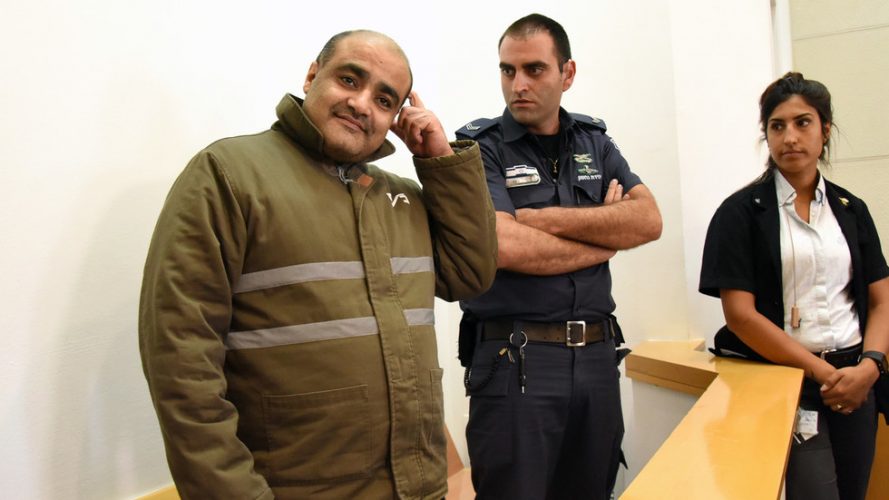
Former World Vision employee Muhammed al-Halabi (L) at a district court in Beersheva, Israel. © AFP / Dudu Grunshpan
RT | October 23, 2019
A former charity manager in the Gaza Strip accused of funding Hamas has attended court for the 129th time in what has become the longest trial of its kind in Israel’s history, dragging on as witnesses are blocked from testifying.
The 41-year-old aid worker, Muhammed al-Halabi, was arrested in June 2016 while working for World Vision, a Christian humanitarian group, charged with funnelling kickbacks to Hamas and its armed wing. For nearly four years, however, Halabi has been denied his proper day in court, instead forced to endure an endless series of stop-go proceedings in which key witnesses are barred from testifying.
His most recent hearing on Wednesday was no different, quickly hitting a dead end soon after it began.
“Today’s hearing was cancelled shortly after it started because the witnesses were not present,” Halabi’s brother, Hamed, told Middle East Eye. “The prosecution then threatened that any witnesses who come from Gaza to give their testimony will be detained.”
“They do not want anyone to prove them wrong. All the eyewitnesses and even the officials at World Vision gave proof that he was innocent. But this is not what the prosecution is looking for.”
The Israeli government has denied travel permits to crucial witnesses in the former charity worker’s case, preventing them from leaving Gaza to give testimony in Israeli courts. Halabi’s lawyer, Maher Hanna, says that guarantees he cannot receive a fair trial.
One of those witnesses – the owner of a company implicated in the alleged money transfer scheme – “could totally undermine the accusations they made against Muhammed,” Hanna told the Times of Israel. “He has begged Israel to allow him to go to the court and testify, but they have not permitted him to do so.”
A father of five from Gaza’s Jabalya refugee camp, Halabi has maintained his innocence since his 2016 arrest and refused to confess to the charges, according to his family, despite facing pressure and even threats from judges. His father said that at one his hearings, a judge promised “long term imprisonment” if Halabi did not admit to collaborating with terrorist groups.
“[The judge] threatened him and tried to force him to confirm the accusations in front of everyone,” Halabi’s father told Middle East Eye.
Halabi’s family also says he has suffered “horrific torture” at the hands of Israeli authorities during several interrogations, including beatings, humiliation and forced sleep deprivation.
A former employee at World Vision said Halabi’s case was part of an ongoing attack on the charity’s aid work in the Gaza Strip and other Palestinian territories.
“There was a political attack on the organisation given that one of its main offices is in the United States,” the employee, who wished to remain anonymous, told Middle East Eye. “The Israeli lobby in the US must have played a major role in impeding the work of the organisation.”
Halabi’s father seconded that take, adding “They know very well that he is innocent, but they cannot release him after four years of interrogation and torture and prove themselves wrong.”
Also on rt.com:
1,700 Gazans shot by IDF face amputation due to funding crisis, UN warns
Palestinians love living under occupation, ex-IDF chief declares, recycling apartheid talking point
On Racism and ‘Wild Beasts’: Why Israel besieges Palestinians
![A segment of the Israeli Seperation Wall sean near Abu Dis, in the occupied West Bank on 15th April 2016 [file photo]](https://i0.wp.com/www.middleeastmonitor.com/wp-content/uploads/images/article_images/middle-east/israel-apartheid-seperation-wall-dome-of-the-rock-background-abu-dis.jpg?resize=600%2C350&quality=75&strip=all&ssl=1)
A segment of the Israeli Seperation Wall near Abu Dis, in the occupied West Bank on 15th April 2016.
By Ramzy Baroud | MEMO | October 7, 2019
The Israeli Apartheid Wall, which is being built largely on occupied Palestinian land in the West Bank and East Jerusalem, once more underscores the ugliness of military occupation. As such, it truly epitomises the nature of Israeli apartheid and also delineates the siege-driven, isolationist mentality that dominates the ruling-class thinking in Israel.
Even years before the establishment of the state of Israel over the ruins of the Palestinian homeland in May 1948, Zionist communities in Palestine perfected the stratagem of besiegement, isolating themselves behind massive walls while blockading Palestinians, the native inhabitants of the land, in every way possible.
Throughout the Nakba – the catastrophic ethnic cleansing and destruction of Palestine in 1947-48 – Israel used this military theory in abundance. Neighbourhoods, villages and entire towns would be besieged for days, weeks or months, while being bombarded from all directions before their residents were finally pushed out. None of these ethnically-cleansed Palestinian communities, which numbered in the hundreds of thousands, were ever allowed to return to their homes.
In fact, besiegement and isolation remain at the core of the Israeli military strategy to date.
No other place, however endured the brutality of the seemingly never-ending siege like the Gaza Strip. Gaza, that small region of 365 square kilometres, has been under various stages of besiegement and blockade since 1948.
The most hermetic stages of this perpetual siege began some time in 2006 and intensified in the summer of the following year. Three factors make the latest siege on Gaza particularly horrific: its long duration, the lack of any serious respite for besieged Gazans and, most importantly, the fact that it has been interrupted by massive Israeli wars that killed and wounded thousands of Palestinians. With much of Gaza’s infrastructure destroyed or dilapidated, the Israeli blockade on the Strip has proved to be the most savage and deadliest of all sieges.
On 30 September, Israel’s Channel 12 reported that nearly 70 per cent of an underground barrier east of Gaza is now complete. An estimated 1,400 Israeli and foreign workers are reportedly taking part in building the barrier, which when finished, will extend to reach 60 kilometres in length.
Considering the layers of walls, fences, trenches and no-go military zones, the additional underground wall around Gaza seems frivolous. Is it possible that Israeli leaders truly believe that Gaza is not isolated enough?
In actuality, the latest wall will likely satisfy a psychological, not a practical objective, as it gives the Israeli army and southern settlements a temporary sense of safety, while once more hailing Israeli leaders as the protectors of a defenceless and exposed nation.
Oddly, while scores of young Gazans continue to be killed at the fence separating Gaza from Israel while protesting the Israeli siege on the Strip, it is the Israelis who claim to be targeted, unsafe and victimised.
The newest wall, once it is officially launched with massive fanfare, will still make no difference. It will not upgrade the status of the Gaza siege in any way, nor will it alter the collective fear that has been thoroughly instilled in ordinary Israelis.
For Gazans, wall or no wall, the siege will remain intact.
Israeli wall architects may argue that the latest wall will deter Palestinians from digging tunnels as well as preventing resistance fighters from circumventing the siege via the sea – since part of this underground barrier will also extend into the Mediterranean Sea.
However, there is no proof that walls or fences, over ground or underground barriers have prevented Palestinians from retaliating against Israeli attacks. If the Israeli logic holds any truth, Palestinian resistance would have dissipated or folded decades ago as the Israeli siege mentality was put into practice from the very start of the Israeli war on the Palestinian people.
Israel receives $3.8 billion in US funding every year, in addition to hundreds of millions in loans and other financial giveaways which are mostly used to fortify Israel’s so-called security. To no avail. Palestinians, impoverished and incarcerated in Bantustan-like structures and open-air prisons, continue with their resistance unhindered.
It is clear that the Israeli security model has failed. In fact, that model never had a chance of success in the first place. The additional Israeli wall around Gaza and the hundreds of other walls and fences that are yet to be built are only meant to feed the collective illusion among Israelis and their leaders that the answer to their problem does not lie in ending the apartheid regime, military occupation and siege, but in adding more layers of “security”.
“At the end of the day as I see it, there will be a fence like this one surrounding Israel in its entirety. We will surround the entire state of Israel with a fence, a barrier,” Israeli Prime Minister, Benjamin Netanyahu, said on 9 February 2016 during a visit of the construction site of the barrier around Gaza.
Netanyahu added: “In our neighborhood, we need to protect ourselves from wild beasts.”
While such language and behaviour reflect the deeply-rooted racist mentality at work in Israel, they also underscore the dehumanized way in which Israel sees Palestinians. Since “wild beasts” are not human, they can be killed en masse, besieged and ethnically cleansed in their millions without an iota of regret or remorse.
The problem then is not that of “security” or so-called “terrorism”. Not that of Hamas, or any other group, secular or Islamist. It is not that of Gaza’s March of Return or of children approaching the fences around Gaza. The problem is the entrenched Israeli racist mentality that perceives Palestinian natives as sub-humans and as “wild beasts” to be exterminated or forever besieged.
Dutch court starts hearing in war crime case against Israel’s Gantz
Press TV – September 17, 2019
A Dutch court has held a hearing on a war crime case against a former Israeli general challenging incumbent Israeli Prime Minister Benjamin Netanyahu in ongoing general elections.
The Hague District Court weighed on Tuesday whether it should hear a lawsuit brought by a Palestinian man seeking compensation from Benny Gantz for his role in the killing of six of his relatives during the Israeli war on the besieged Gaza Strip in 2014.
On July 20, 2014, Ismail Ziada lost his mother, three brothers, a sister-in-law, and a 12-year-old nephew when their family home was bombed by the Israeli air force.
A visitor was also killed in the Israeli bombardment.
“I was shot at a very close range with a rubber coated metal bullet in the head. I witnessed another boy being shot in the head next to me, dying on the spot,” said Ziada about his encounters with the Israeli army.
Ziada, who now lives in the Netherlands, filed a civil lawsuit in 2018 seeking damages from Gantz, who was the chief of staff of Israel’s military at the time of the bombing, and the then-air force commander Amir Eshel.
Ziada says the attack violated international humanitarian law because it deliberately targeted civilians.
The Tuesday session addressed a motion filed by Gantz and Eshel’s lawyers asking the court to dismiss the case. They argued the ex-commanders were immune because the Dutch court had no jurisdiction over the case.
Ahead of the hearing, Ziada’s lawyer, Liesbeth Zegveld, said Palestinians from Gaza could not receive fair treatment in Israeli courts.
Dutch courts can exercise universal jurisdiction over war crimes, provided the accuser cannot get a fair trial elsewhere.
Israel launched several wars on the Palestinian coastal sliver, the last of which began in early July 2014. The military aggression, which ended on August 26, 2014, killed nearly 2,200 Palestinians. Over 11,100 others were also wounded in the war.
The Gaza Strip has been under Israeli siege since June 2007. The blockade has caused a decline in the standards of living as well as unprecedented levels of unemployment and unrelenting poverty.
Why do so many spy agencies take so much interest in Gaza?
By Motasem A Dalloul | MEMO | September 16, 2019
The Gaza Strip is a part of Palestine with more than two million Palestinians living in around 365 square kilometres. It has been occupied by Israel since 1967, which has imposed a near-total 13-year land, air and sea blockade. It is regarded as one of the most densely populated areas on earth.
The coastal enclave has been subject to many Israeli military offensives, with three major attacks during the past decade alone. It has no natural resources and “less than four per cent of fresh water is drinkable and the surrounding sea is polluted by sewage.” Tragic humanitarian statistics — unemployment at 52 per cent; poverty 53 per cent; water pollution 95 per cent; and daily power outage 75 per cent — convey a bleak picture. A United Nations report warned in 2018 that it could soon become unfit for humans to live in by 2020.
However, Gaza has a presence in many corridors of power around the world, in both the East and the West. Last week, a security source in Gaza told me that they had so far discovered agents for 25 regional and international intelligence agencies operating in the territory.
Furthermore, every official or partisan Israeli election list has the issue of Gaza at the top of the agenda in their current campaigns. What are they promising to do with the Gaza Strip?
According to Ron Ben-Yishai, the military correspondent of Yedioth Ahronoth, for example, the Likud Party is planning a large-scale military ground operation in Gaza to deter the Palestinians’ “military power”, after which, he claimed, Israel will call for the world to disarm the security forces there and reconstruct the infrastructure and economy. The Blue and White party, said Ben-Yishai, is promising potential voters that it will do more or less the same thing as Likud.
The veteran journalist pointed out that the head of Israel’s Jewish Home party, Avigdor Lieberman, is promising its voters to carry out a similarly “strong” military operation in Gaza to “completely” remove its government before rebuilding the enclave “from zero”. Again, the intention is to have a disarmed population on Israel’s doorstep. The Yamina alliance led by the former Justice Minister Ayelet Shaked, meanwhile, is promising to carry out a massive air strike in Gaza and carry out assassinations (“targeted killings”) of Palestinian leaders.
It is no secret that Egypt is a major player in the situation in Gaza. It plays a role in the Israeli and internationally-backed blockade, and has a special unit in almost every security agency tasked with dealing with the Gaza Strip. In practice, Egypt, is the only state beside Israel which has a land border with the Gaza Strip, but regards it as a security issue and is dealing with it as such. As far as the Palestinians can see, though, since the time of ousted President Hosni Mubarak, Egypt’s deep state gives priority to Israel’s interests in Cairo’s relationship with Gaza.

End Gaza Siege! – Cartoon [Sabaaneh/MiddleEastMonitor]
The UAE has imposed severe restrictions on Gaza since the victory of the Palestinian Islamic Resistance Movement, Hamas, in the 2006 elections. Hamas has been the de facto government in Gaza ever since. The government in Abu Dhabi has since deported or asked hundreds of Palestinians from Gaza to leave the Emirates, and has been running active intelligence agencies in the Gaza Strip with the help of Palestinian MP Mohammed Dahlan who lives in the UAE with his family.
During the 2014 Israeli military offensive against Gaza, the security services discovered that an ostensibly medical aid convoy which entered the territory included intelligence staff instead of doctors and medical staff. To avoid clashes with the UAE, the Gaza security officials immediately deported the UAE nationals.
Jordan also has a hidden agenda in Gaza. A security source told me that a Jordanian MP who visited the territory during the 2014 Israeli offensive was discovered collecting and reporting intelligence on behalf of a certain country. He was immediately deported with the threat that he would be exposed to the media if he did not leave his hotel in the enclave at once.
Other known agents active in Gaza include those working on behalf of Saudi Arabia, Western powers, the US and Russia. Prior to 2008/9, an American citizen in her 20s entered Gaza posing as a journalist and claimed to me that she was a CIA agent. Israel, of course, has many Palestinian collaborators in the territory.
Why are the countries of the world paying so much attention to the sliver of land known as the Gaza Strip? Could it be because Gaza is the only place in the whole Arab world which is being ruled by the people who were chosen by democratic elections declared to be free and fair by international monitoring bodies, including the NGO run by former US President Jimmy Carter? Or is it because the Gaza Strip is a “superpower” that the whole world is afraid of? May be the latter is true precisely because of that electoral accountability.
Israel bombs Gaza position for an entire hour: Palestinian sources

Press TV – September 7, 2019
Israel has launched a lengthy bombardment of positions in the Gaza Strip, sources inside the besieged enclave say.
Palestinian news agencies said late on Saturday that Israeli airstrikes targeted positions allegedly held by the Palestinian resistance movement Hamas north of the Gaza and deep inside the enclave.
Health officials said there were no casualties from the attacks that lasted close to an hour.
Israeli regime sources said the attacks hit Hamas naval facilities on the Mediterranean and two military compounds run by the group in central Gaza.
There was no confirmation from Hamas and its affiliated groups.
The relentless Israeli bombardment came after Hamas launched a drone operation targeting an Israeli military equipment stationed along the border with the occupied Palestinian territories.
It also came a day after Israelis launched attacks on five positions inside Gaza.
Regime sources have claimed the attacks were in response to Hamas operations targeting Israeli settlers and military forces.
However, attacks by Hamas have come in response to regime’s killing of people marching along the border to protest the Israeli occupation.
Two Palestinian teenagers were killed in such attacks by Israeli troops earlier on Friday in clashes that erupted east of the Gaza City.
Some 66 other Palestinians were wounded in Israeli gunfire and other attacks during the anti-occupation protest held the same day.
Hamas has launched two rounds of retaliatory attacks on Israeli positions over the past 48 hours. The group fired five rockets into the occupied territories on Friday night, setting off sirens in Israeli settlements along the Gaza border as well as in the city of Sderot.
The group also responded to Israeli attacks by launching a successful drone operation earlier on Saturday.
The Israeli military confirmed the drone attack inflicted damage to equipment stationed along the border while claiming there were no casualties to its troops.
Israel Actively Pushing Palestinians to Leave Gaza Strip
Palestine Chronicle | August 20, 2019
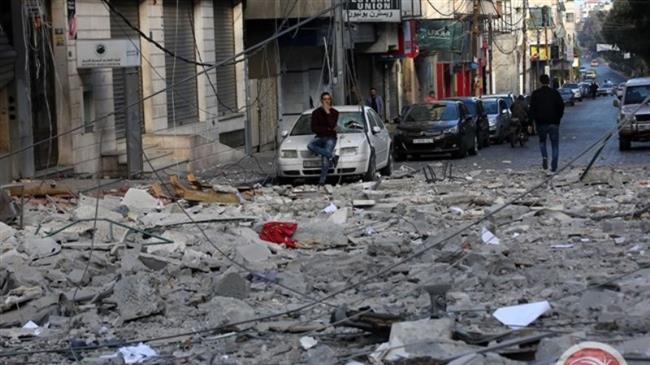
Israel is actively pushing Palestinians to leave the Gaza Strip, asking a number of European and Middle Eastern countries to absorb them and offering to arrange their flights if they agree to emigrate.
The policy was disclosed by a senior official accompanying Israeli Prime Minister Benjamin Netanyahu on a diplomatic visit to Ukraine this week.
Israel pushing Palestinians to leave Gaza https://t.co/LA7yO7Sxun pic.twitter.com/dCtDUJZ4Kk
— Electronic Intifada (@intifada) August 20, 2019
The unnamed official told reporters yesterday that Israel is in contact with third countries to see if they would be willing to absorb Palestinians from the besieged enclave, adding that:
“Israel is even willing to arrange transportation for them, at least to one of the airports in the Negev and arrange for them to travel out of the country”.
Israel’s National Security Council has been spearheading the initiative, with Netanyahu’s blessing, for about a year, the Times of Israel reported, citing the official.
Israel willing to let Gazans who want to emigrate to fly out via its territory, official says https://t.co/xPfKo3hZJJ
— Haaretz.com (@haaretzcom) August 19, 2019
The Israeli daily added that the program has also been discussed several times in Israel’s security cabinet.
The official conceded that, thus far, Israel has been unable to find any country willing to cooperate with its initiative, despite speaking to a number of Middle Eastern and European states.
He also claimed that thousands of Gazans are leaving of their own volition, pointing to 35,000 Palestinians who left the Strip in 2018. “That’s a pretty high number,” the official stated, even claiming that those who remain “are being held hostage in Gaza”.
#Israel actively pushing #Palestinian #emigration from #Gaza, official says. Senior official says Jerusalem looking for other countries to take in emigres, willing to let Gazans use Israeli airport to leave pic.twitter.com/27q0HN2262
— Eli Dror (@edrormba) August 19, 2019
The official, however, failed to mention Israel’s now 12-year-old siege of the Strip – which has devastated its infrastructure, economy, health sector and Palestinians’ livelihoods – or its three assaults on Gaza in the past decade. The UN has predicted that the Strip will be “unliveable” by 2020, calling the fate of Gaza’s some 1.9 million Palestinians into question.
Commentators have slammed the revelation, with Joint List Knesset Member (MK) Yousef Jabareen writing on Twitter: “The country that should welcome Palestinians from Gaza is Israel which, along with its obligation to remove the blockade on Gaza, should respect UN resolutions regarding Palestinian refugees as a part of a just and peaceful solution to the conflict.”
4 Palestinians Killed by Israeli Forces at Gaza Border
By Ali Salam | IMEMC | August 10, 2019
Four Palestinians were shot and killed by Israeli forces for allegedly coming too close to the border fence between Gaza and Israel, east of Dir al-Balah, in the central Gaza Strip, according to Israeli media sources.
Israeli forces stationed along Gaza borders to the east of Khan Younis reportedly opened fire on a group of Palestinians after they allegedly approached the Israeli-installed barbed-wire fence along Gaza’s border with Israel, shooting and killing four.
The identities of the Palestinians remain unknown.
Israeli sources claimed that the group of Palestinians had fired toward the military base at the border, and there was an exchange of fire.
The Israeli Ynetnews said that the Golani Brigades that opened fire on the Palestinians are the same Brigade that came under fire two days ago, when two soldiers were injured.
Following the shooting of the two Palestinians, the Israeli airforce dropped bombs on what they claimed were two observation posts for the Al-Qassam Brigades, the armed wing of the Hamas party.
Military vehicles also invaded the area east of Dir al-Balah and began combing the area.
Israel has imposed a buffer zone inside the Gaza Strip along the border between Gaza and Israel, preventing Palestinians from reaching their lands near the border fence. It regularly opens fire at anyone who enters that buffer zone.
In a fact sheet about Israeli attacks on border areas and their consequences, the Palestinian Center for Human Rights (PCHR) said, “preventing Palestinians from accessing their lands and fishing areas violates numerous provisions of international human rights law, including the right to work, the right to an adequate standard of living, and the right to the highest attainable standard of health.”
Why Netanyahu Needs a War on Gaza More Than Ever Before
By Ramzy Baroud | MEMO | July 21, 2019
Media reports of an impending Israeli war on the besieged Gaza Strip are now a regular occurrence. The frequency of these reports fluctuates based on Israel’s own political landscape.
Empirical experience has taught us that when Israeli leaders are in trouble, they wage a war on Gaza. Now that Israeli Prime Minister Benjamin Netanyahu is facing the greatest challenge in his political career, Gaza is bracing for another Israeli war.
The war rumors are no longer just that. Rightwing Israeli newspaper, The Jerusalem Post recently reported that Israel’s military chief of staff, Lieutenant-General Aviv Kochavi, “has already approved operational combat plans and recently set up an administrative unit to handle the formation of a list of potential targets in the coastal enclave for when the next war breaks out.”
The Post’s own military correspondent, Anna Ahronheim concurs, that, indeed, war on Gaza “is not far away.” But unlike previous wars, the upcoming war must “have a clear and decisive win” by Israel so that “the other side will think twice about going to war in the future.”
The fallacy in Ahronheim’s analysis is obvious. Israel always approaches its wars in Gaza with the aim of having a “clear and decisive win”, aims that are often thwarted by strong Palestinian resistance in the besieged and impoverished Strip.
Second, Gaza never initiates wars. The Strip has no army or military strategy beyond self-defense tactics carried out by organized resistance factions, including Hamas, the Islamic Jihad and various PLO groups. However, if Israel thinks that a ‘decisive win’ would eradicate Palestinian resistance, it will be greatly disappointed. Gaza’s resistance, in all of its forms, against Israel and Israeli occupation goes back to the late 1940s. No amount of firepower will ever end this kind of determined resistance.
However, it is likely that Israel measures the decisiveness of its ‘victory’ based on the amount of destruction it is able to inflict on Palestinians.
Marvel at these numbers from the last major Israeli war on Gaza, in 2014, to understand the real target of Israeli wars on the Strip:
According to United Nations figures, more than 2,300 Palestinians were killed in Israel’s so-called “Operation Protective Edge”. The causalities, most of whom were civilians, included 551 children. Moreover, 11,231 were also wounded, and more than 20,000 homes were destroyed. The massive destruction was also aimed at the already ailing infrastructure of impoverished Gaza, reaching schools, hospitals, mosques and even UN shelters.
How much more “decisive” must the next Israeli war be so that Israel’s warmongers may feel satisfied that their war achieved its intended objectives?
Israel wants Palestinians to accept their perpetual besiegement, embrace their fate as an occupied nation with no rights, subject to the whims of Israel and its racist, deadly policies.
However, Israeli leaders are now driven by a second objective: winning the upcoming elections.
There is much at stake for Netanyahu and his prospective coalition of rightwing ideologues and religious zealots. Israel has never held two national elections in one year, but this year is an exception.
The April 9 elections failed to achieve a decisive victory for either camp. After weeks of attempting to form a coalition government, Netanyahu accepted the inevitable: another election, which is set for September 17.
But Netanyahu is not only politically embattled. He, along with his family and close aides have been embroiled in a series of corruption charges that could potentially end his political career.
On June 6, Israel’s attorney general Avichai Mandelblit rejected Netanyahu’s bid to postpone for the second time the pre-indictment hearing in the several corruption cases concerning his misconduct while in office.
However, Netanyahu hopes to secure his position at the helm of Israeli politics a while longer, to evade corruption charges, and to eventually strike a deal to drop the charges altogether.
He is desperate to remain a prime minister. For that to happen, he will do whatever it takes to appeal to the most powerful constituency in Israel: the right wing and their religious allies.
For Israel’s right, a war is a normal state of affairs. They seem to acquire their sense of collective safety when Palestinians suffer. And, for months, Israeli rightwing voices calling for war against Gaza have massively amplified.
Even the supposedly sensible political center has joined the chorus, knowing that an anti-war stance in Israel is a losing strategy.
Head of Blue and White party, Benny Gantz, who remains Netanyahu’s strongest opponent said in an interview released last May with Channel 13: “We must strike hard, in an uncompromising manner … We must restore the deterrence that has been eroded catastrophically for more than a year.”
Of course, there will be a next war on Gaza. It will be as “decisive” and deadly as Israeli leaders need it to be, to serve their political calculations.
But they must also be aware that wars on Gaza are no longer the cakewalks of the past. The resistance in that small, but unbreakable region, is tougher than it has ever been in the past, a natural outcome of 12 years of a relentless siege, interrupted by massively destructive and lethal military onslaughts.
A war on Gaza will also come with a price for Israel. Are Netanyahu and his government willing to endure the political fallout of another failed war? It all depends on how truly desperate corrupt Netanyahu is to remain in power and out of prison, at least for a while longer.
US’ Greenblatt: ‘Israel is victim in conflict with Palestinians’
MEMO | July 18, 2019
The US Special Representative for International Negotiations, Jason Greenblatt, has said that Israel is the “victim” in its conflict with the Palestinians and that he “cannot think of single instances” when Israel made a mistake.
In an interview aired yesterday by US broadcaster PBS, Greenblatt was asked what responsibility Israel bears for its now 71-year-old conflict with the Palestinians. The US envoy replied:
I think that Israel is actually more the victim than the party that’s responsible. From the moment of its formation, they were attacked multiple times. They continue to be attacked with terrorism. So — I’m not sure I understand the premise of the question.
He added that he “cannot think of single instances” in which Israel made a mistake or overstepped its authority, saying: “I think that they’re trying their best to succeed. They have actually succeeded in many ways, especially economically, under very, very trying circumstances.”
Greenblatt also doubled down on previous comments in which he argued Israel’s illegal settlements should be referred to as “neighbourhoods and cities”, saying that the term “settlements” is “pejorative”.
On the occupied West Bank – where over 500 illegal settlements are located – and the besieged Gaza Strip, the envoy said: “I would argue that the land is disputed. It needs to be resolved in the context of direct negotiations between the parties. Calling it occupied territory does not help resolve the conflict.”
Under international law, both the West Bank and Gaza Strip remain classified as occupied territories.
Greenblatt’s comments are the latest in a series of controversial remarks that have drawn fierce criticism and rebuke of the US envoy.
Earlier this month, Greenblatt came under fire after criticising the Palestinian Authority (PA) for failing to provide adequate funds for a Palestinian child’s blood cancer medication. This came after Gaza-based Palestinian journalist Fathi Sabbah accused PA Prime Minister, Mohammad Shtayyeh, and Ahmed Abu Houli, a member of the executive committee of the Palestinian Liberation Organisation (PLO), of reneging on promises to assist with his daughter Rima’s treatment.
This prompted Greenblatt to write on Twitter: “Mr. Shtayyeh, how about keeping your word & paying for Rima’s treatment? The PA has the funds and it would be a wise and compassionate use of them. Mr. Sabbah, my thoughts are with you and your family. I pray Rima will have a full and speedy recovery.”
Twitter users – including Sabbah – were quick to point out the irony of Greenblatt blaming the PA for the family’s plight while ignoring Israel’s siege of the Gaza Strip, regular refusal to grant exit visas for medical treatment, and the US’ almost-unconditional support for Israel.
The US envoy – who is one of the chief architects of the US’ long-awaited “deal of the century” – has also made a number of provocative claims about Israel’s policy in the occupied West Bank.
In June, Greenblatt stood behind comments made by US Ambassador to Israel, David Friedman, in which the latter stated Israel has “the right” to annex parts of the occupied West Bank.
Friedman told the New York Times that “under certain circumstances, I think Israel has the right to retain some, but unlikely all, of the West Bank”, provoking international outcry and prompting the Palestinian Foreign Ministry to consider filing a complaint against the ambassador at the International Criminal Court (ICC).
Greenblatt backed Friedman’s stance, saying: “I will let David’s comments stand for themselves. I think he said them elegantly and I support his comments.” For his part, Friedman has also refused to back down, since claiming he does “not understand why this issue was faced with such criticism. There is no scenario in which Israel is leaving the whole West Bank.”
His comments have been interpreted as an effort to normalise discussion of Israel’s annexation of the West Bank, after Israeli Prime Minister Benjamin Netanyahu vowed ahead of the country’s April general election that he would annex the territory if he were re-elected.
Though the political elements of the “deal of the century” have not yet been unveiled, the plan is not expected to demand that Israel dismantle its West Bank settlements. Though the US has not yet changed its policy on annexation, the precedent set by President Donald Trump’s recognition of the occupied Syrian Golan Heights as Israeli could pave the way for a similar move in the West Bank.
Featured Video

Chinese jet fuel and the myth of energy independence
or go to
Aletho News Archives – Video-Images
Book Review
Former Insiders Criticize Iran Policy as U.S. Hegemony
By GARETH PORTER | CounterPunch | February 27, 2013
“Going to Tehran” arguably represents the most important work on the subject of U.S.-Iran relations to be published thus far.
Flynt Leverett and Hillary Mann Leverett tackle not only U.S. policy toward Iran but the broader context of Middle East policy with a systematic analytical perspective informed by personal experience, as well as very extensive documentation.
More importantly, however, their exposé required a degree of courage that may be unparalleled in the writing of former U.S. national security officials about issues on which they worked. They have chosen not just to criticise U.S. policy toward Iran but to analyse that policy as a problem of U.S. hegemony. … continue
Blog Roll
 Aletho News
- Chinese jet fuel and the myth of energy independence
- Ukraine Sea Drone Fired From Libya Hit Russian Tanker in Mediterranean
- IRGC: Iranian forces launched no attacks during ceasefire hours
- Trump Administration Moves To Automate U.S. Military Draft Registration
- Spain orders reopening of Tehran embassy, condemns Israel’s carpet bombing of Lebanon
- Israel faces ‘unsustainable’ strategic crisis following 40-day war against Iran: Analyst
- Iran restricts Hormuz access to 15 vessels per day under ceasefire terms: Report
- The ‘Opposition Party’ Has Done Nothing to Stop the Iran War and Much to Goad Trump Into Continuing It
- Moscow backs Tehran on status of Lebanon in US-Iran deal
- How UK Regulator Ofcom Quietly Bypassed International Law to Police American Speech
- If Americans Knew
- Amnesty: Urgent – Protect Lebanese civilians from brutal escalation in Israeli attacks
- Is The War Against Iran Over?
- Inside the Israeli army’s propaganda wing
- Hundreds of Gaza Amputees Stranded in Legal Limbo
- The gallows law: Israel moves toward executing Palestinian children
- Tucker Carlson: The Path to Peace requires ending ‘special alliance’ with Israel
- This is ceasefire? Israel’s biggest massacre yet in Lebanon, another journalist killed in Gaza – Daily Update
- Tucker Carlson on Israel: This Is the Behavior of an Ally? Really?
- Gazans face a triple crisis: severe shortages of water and bread, healthcare in tatters
- NY Times reports how Netanyahu took the US into Iran War
- No Tricks Zone
- An Inconvenient Tree: Uncovered In Alps… Europe Much Warmer Than Today 6000 Years Ago
- New Study Reports A 60% Slowdown In Greenland’s Ice Loss Rate In The Last Decade
- Low Intensity Tornado Wrecks Major Solar Farm, Creating A Potential Toxic Dump
- New Study Finds Warming Saves Lives…Cold Temperatures 12 Times More Deadly Than Excess Heat
- German Science Blog Accuses PIK Climate Institute Of Hallucinating Climate Tipping Points
- Devastating Assessment Of Comirnaty Vaccine By Former Senior Pfizer Europe Toxicologist
- New Study: CO2 Is ‘Effectively Negligible’ As An Explanatory Climate Change Factor Since 2000
- Former Pfizer Toxicologist Dr. Helmut Sterz Tells Bundestag Hearing Pfizer Vaccine Should Have Never Been Approved
- Energy Expert: Germany’s Nuclear Phaseout Was A “500 Billion Euro Mistake”
- New Research: South Australia’s Mid-Holocene Sea Surface Temperatures Were 4°C Warmer Than Today
 Aletho News