GAZA – During the past two days, the Israeli occupation forces (IOF) have escalated their attacks against the Palestinian fishermen off the Gaza shores.
The IOF chased and opened fire at Palestinian fishing boats sailing within the allowed fishing area in separate incidents. As a result, four boats were confiscated, and another was sunk, while a fifth was burned.
According to the Palestinian fishermen syndicate, the occupation forces burned a boat belonging to the fisherman Haitham Farwana after opening fire at it off Khan Yunis shores on Thursday.
The Israeli forces also confiscated on the same day the boat of the fisherman Abdel Moati Al-Habil.
Earlier on Wednesday, IOF confiscated a fishing boat where Ahmad Adel Mohammad Al-Bardawil was on board sailing within 3 nautical miles off western Rafah shore, southern Gaza Strip. There were also 2 generators and 30 searchlights on the boat.
The IOF also confiscated 2 fishing boats belonging to Muhannad Ra’fat Radwan Baker, and Tayseer Mohammad Abdulnouri, who are both residents of al-Shati refugee camp. They were sailing within 3 nautical miles off al-Waha shore, northwest of Beit Lahia in the northern Gaza Strip.
In a separate incident, a fisherman named Omar Mohammad Ism’ail Al-Bardawil said that IOF’s gunboats stationed off the Fishermen Seaport, western Rafah, pumped water at a fishing boat he owns and sank it. The boat was sailing within 6 nautical miles and had a generator and searchlights on board.
So far in 2022, the Palestinian Center for Human Rights (PCHR) documented the injury of 19 fishermen and the arrest of 44 others, including 6 children; 2 fishermen remain in IOF detention. Also, the Israeli authorities continue to keep 18 fishing boats and dozens of fishing tools and equipment in their custody.
In this regard, PCHR reiterated its call upon the international community, including the States Party to the Geneva Conventions of 1949, to compel the Israeli authorities to cease their attacks and pursuit of Palestinian fishermen in the Gaza waters, and to allow them to fish freely.
The Zionist regime’s unprovoked blitz on Gaza since Friday afternoon was, firstly, a direct message to Lebanon, that it is not interested in going into war over the maritime boarders, thereby conceding to line 23 and the Qana fields that Lebanon has demanded full sovereignty over. Secondly, the regime seeks to test the waters through this limited confrontation.
The limited scope of the confrontation between Palestinian Islamic Jihad (PIJ) and the Zionist regime implies the objective is not aimed at weakening the resistance, rather it is to measure the reactions of this confrontation on many levels and to send underlying messages in the process.
The Zionist regime considers the Palestinian resistance to be the easiest target within the resistance axis and has therefore sought calculated confrontation with this entity. Through its assaults on Gaza, the regime is interested in testing the extent of unification of the regional resistance factions in decision making, logistical support, the readiness of factions to get involved if the battle escalates, how willing they are to expand the war in addition to their stock of weapons, their capabilities, and capacities.
This is also happening at a time when the Zionist regime will hold its fifth election in four years this November, thereby seeking to rally the settler population over a point of unity – that is usually attacks on Gaza. The regime seeks to paint the image that it is unafraid to attack in any circumstance to ensure their ‘security’, with Israeli Prime Minister Yair Lapid stating on Friday that, “the country has ‘zero tolerance’ for attacks from Gaza”. However, he also made it clear in the same press conference that there is no interest in a ‘broader battle’.
More importantly, the Zionist regime is approaching a due position and that is drawing the maritime boarders with Lebanon, which if it does not end up playing in the interests of Lebanon, poses an imminent danger, and calls for an imminent war, as made clear by the Secretary General of the Islamic resistance party in Lebanon. The Zionist regime wishes to prevent a war at all costs and that means it has no choice but to compromise, which appears as a point of weakness for the settler population in the context of the elections, as they wish for a candidate that takes a strong stance on such issues. This smaller scale attack was therefore launched in order to avoid a larger war, and for the regime to grant itself some credit as well.
It is also important for the Zionist regime to reinforce the phobia of war within the minds of the settler population, such that the mass general opinion formed is one that aligns with the Zionist government’s decision to compromise on the maritime boarders, in order to prevent a wider scale war where the battle front is opened beyond one Palestinian resistance faction, the PIJ, and in the worst case extends to the Lebanese resistance that has over 100,000 rockets.
The reason that the Zionist regime seeks to compromise on the boarders are because it knows the resistance capabilities are very strong, such as when they sent three unmanned aircraft (UAV) targeting the gas rigs in July. The regime however also seeks to paint the image that they are strong through launching an offensive attack on the resistance, however the reality is that they don’t wish for a war and in fact know that other Palestinian resistance organizations such as Hamas, the Popular Front do not intend to get involved and the operation is of a limited nature. The head of Shin Bet reportedly told cabinet ministers overnight on Saturday that Tel Aviv, “met most of the objectives it set at the outset of the operation in Gaza.”
In this process, the Zionist regime has sought to send a message to the internal resistance in Palestine that the head of PIJ, Ziad Nakhala is in Tehran whilst key commanders of the group are being assassinated, thereby seeking a show of display for their supposed lack of fear and strength. However, the unmasked reality is that since the regime are seeking compromise, they want to grant themselves false credit regarding their strategic strength and seek to gain publicity without it affecting their elections. The reality is that the regime is deceiving its own population through putting forth titles that sound big but are empty, as they know the resistance won’t be dragged into the square they want, and their aim is to appeal to the public opinion of the Zionist settlers through deception.
Batool Subeiti is an Energy Engineer and political analyst based in London, UK.
An Israeli airstrike killed a 5-year-old Palestinian girl in Gaza City today as the Israeli military announced a new military offensive on the Gaza Strip.
Alaa Abdullah Riyad Qaddoum, 5, was killed around 4:30 p.m. on August 5 by an Israeli airstrike in the Shuja’iyya neighborhood of Gaza City, according to documentation collected by Defense for Children International – Palestine. The Israeli airstrike hit a group of people gathered outside Abu Samra mosque in the Wadi Al-Arayes area of Shuja’iyya neighborhood. Alaa’s six-year-old brother, Riyad, and father, Abdullah, were injured in the same attack.
“Israeli forces routinely use explosive weapons in densely populated civilian areas with complete disregard for the indiscriminate effects,” said Ayed Abu Eqtaish, accountability program director at DCIP. “There is no safe space in the Gaza Strip for Palestinian children and their families and they increasingly bear the brunt of Israel’s repeated military offensives.”
5-year-old Alaa with her kindergarten diploma. (Photo: Courtesy of the Qaddoum family)
Alaa was killed instantly and sustained injuries to her forehead, chest, and right leg from shrapnel, according to a doctor at Al-Shifa hospital.
At least two other Palestinians were killed in the same attack, including Alaa’s 24-year-old cousin Yousef Salman Mohammad Qaddoum, according to information collected by DCIP.
Alaa is the 19th Palestinian child killed by Israeli forces in 2022, according to documentation collected by DCIP.
The Israeli military launched airstrikes across the Gaza Strip on Friday, killing at least ten people and injuring at least 55, according to the Palestinian Ministry of Health in Gaza. The Israeli military offensive comes days after Israeli forces arrested a senior Islamic Jihad leader in Jenin and killed 16-year-old Dirar Riyad Lufti Al-Haj Saleh, also in Jenin, who was protesting the Israeli military’s incursion into Jenin refugee camp.
International humanitarian law prohibits indiscriminate and disproportionate attacks and requires all parties to an armed conflict to distinguish between military targets, civilians, and civilian objects. Israel as the occupying power in the Occupied Palestinian Territory, including the Gaza Strip, is required to protect the Palestinian civilian population from violence.
Israeli authorities have imposed a closure policy against the Gaza Strip since 2007 by strictly controlling and limiting the entry and exit of individuals; maintaining harsh restrictions on imports including food, construction materials, fuel, and other essential items; as well as prohibiting exports. Israel continues to maintain complete control over the Gaza Strip’s borders, airspace, and territorial waters.
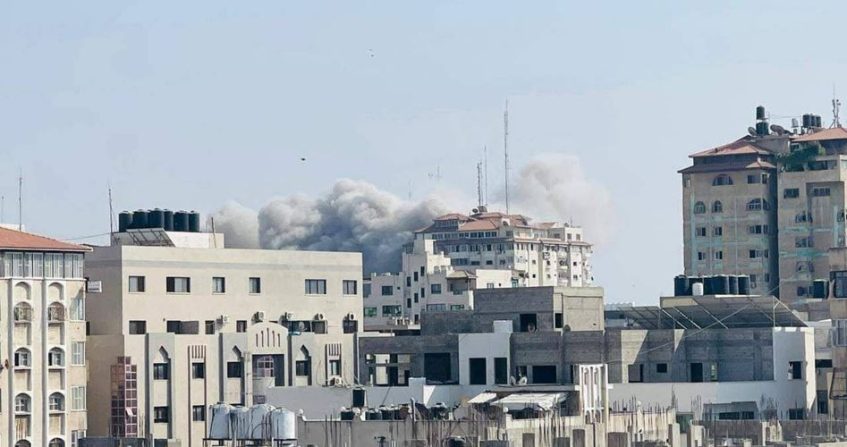
GAZA – At least eight people were killed – including an Islamic Jihad commander and a five-year-old child – and 44 were wounded in a series of Israeli aerial strikes on various areas of the Gaza Strip on Friday evening.
The Palestinian health ministry in Gaza said at least eight people were killed, including the Islamic Jihad commander Taysir al-Jabari and a five-year-old girl.
At least 44 people were wounded and are being treated at hospitals as a result of the Israeli raids, the ministry added.
Jabari, a commander of the Al-Quds Brigades, the armed wing of the Islamic Jihad, was killed in an air strike on an apartment in the Palestine Tower in the center of Gaza City, the Islamic Jihad group said in a statement.
Multiple blasts were heard and seen throughout Gaza, while Israeli reconnaissance drones were heard hovering over the besieged territory.
The Israeli attack follows days of tension after the arrest of a senior Jihad leader in the occupied West Bank.
“The IDF is currently striking in the Gaza Strip. A special situation has been declared on the Israeli home front,” the Israeli military said in a statement. It said further details would follow.
Israel has been imposing tight restrictions on the Gaza Strip for the fourth consecutive day, deepening the humanitarian crisis in the besieged enclave.
Earlier on Wednesday, Israeli prime minister Yair Lapid held a security consultation with Israeli officials to discuss the security situation in the south, Lapid’s office said.
Israel demanded on Sunday the disbanding of the UN committee investigating crimes committed during the occupation state’s military offensive against Gaza in May last year. It is alleged that remarks made by one member of the committee were “anti-Semitic”.
Israeli Prime Minister Yair Lapid made the demand in a letter to UN Secretary-General Antonio Guterres, in which he referred to the statements by Miloon Kothari, a member of the UN Human Rights Council’s Commission of Inquiry, in a media interview.
“We are very disheartened by the social media that is controlled largely by, whether it is the Jewish lobby or specific NGOs,” Kothari said on a Mondoweiss podcast on 25 July. “A lot of money is being thrown into trying to discredit us.”
Israel boycotted the investigation and prevented the commission’s investigators from entering the apartheid state. It claimed that the commission’s partial findings in June were “the latest in a series of biased reports.”
In his letter to Guterres, Lapid claimed that, “The fight against anti-Semitism cannot be waged with words alone, it requires action. This is the time for action; it is time to disband the Commission. This Commission does not just endorse antisemitism — it fuels it.”
The UN spokesman did not respond immediately to requests for comment, but Mondoweiss published a message from the committee’s chair, Navi Pillay, in which she said that Kothari’s comments were intentionally taken out of context.
The US and other Western countries, including Germany, Britain and Austria, denounced — very predictably — Kothari’s comments as “anti-Semitic”.
The US representative to the UN Human Rights Council, Ambassador Michele Taylor, tweeted, “We are outraged by recent anti-Semitic, anti-Israel comments made by a member of the Israel COI. These unacceptable remarks sadly exacerbate our deep concerns about the open-ended nature & overly broad scope of the COI and the HRC’s disproportionate & biased treatment of Israel.”
Although the commission was set up to investigate the Israeli attack on Gaza, which lasted 11 days in May last year, its mandate includes human rights violations before and after that, in addition to investigating the root causes of the tension.
At least 250 Palestinians as well as 13 people in Israel were killed during the Israeli aggression, which saw severe Israeli attacks and raids that exacerbated the destruction caused by the 2014 military offensive. Palestinian factions in the Gaza Strip fired several thousand rockets in response to Israel’s ongoing brutal military occupation and siege.
Hezbollah threatened Israel with war if Lebanon is not allowed to exploit its share in the Karish gas field. Palestinian resistance may do the same over the “stolen gas” off Gaza.
The maritime border dispute between Lebanon and Israel over the Karish gas field is reminiscent of the stolen gas fields in Palestine’s Gaza Strip. With the naked eye, Gazans can only stand by and watch the Occupation’s gas drilling platforms a few kilometers off their own coast.
This situation could change though, and may depend on the way in which the resistance in Lebanon handles the conflict over Karish.
That scenario may encourage the Palestinian resistance to follow their northern neighbor’s example in threatening to target Israeli platforms if Palestinians are denied their rights to the “Gaza Marine” field.
So long as Palestinians are deprived of basic living condition rights (electricity, fuel, food and medicine shortages) by their Israeli occupiers, they would be foolhardy to ignore the game-changing potential of gas extraction off their own coastline.
However, Lebanon’s current dispute is not the only issue that has led to the Palestinian claim resurfacing. Indeed, there are other factors related to the energy crisis, and it involves the Europeans.
Not Israel’s gas to export
On 15 June, it was announced in Cairo that a memorandum of understanding (MoU) had been signed to export Israeli (stolen Palestinian) gas to the European Union (EU) through Egypt.
The MoU, which Israel and the EU described as a “historic agreement,” extends over three years and is automatically renewable for two further years. It includes transporting gas from Israel to liquefaction stations in Egypt (Idku and Damietta in the north), then shipping it to Europe, which imported 155 billion cubic meters (bcm) of gas from Russia last year.
In light of the EU’s faltering standoff with Moscow over Ukraine, Europe is seeking – among other sources – “Israeli gas” to compensate for about 10 percent of this amount, while Israel for its part is eager to increase its production of natural gas to 40 bcm (billion cubic meters) annually.
Experts estimate that most of this quantity will come from Palestinian gas extracted from “Gaza Marine 1” which is adjacent to the Strip, and “Marine 2” which is located within the maritime border area between Gaza and Israel.
Not the PA’s right
Understandably, news of the MoU angered the Palestinian resistance, especially since the Palestinian Authority (PA) in Ramallah did not take any practical steps to demand Palestinian rights in this matter.
Informed, anonymous sources have told The Cradle that the EU has bought the silence of the PA by giving it a 4 percent share of the value of the extracted gas, while most of the agreements signed between Ramallah and the extraction companies, in the past two decades, stipulated a ratio ranging from 10 percent to 27.5 percent.
There are also accusations that the PA will only collect some taxes on monthly production, in addition to accelerating EU aid to the Palestinians.
On 12 June, the European Commission approved a new aid package for the Palestinians worth 224.8 million euros, as a ‘bribe’ for the PA, with a verbal pledge to support Palestinian rights and confront Israeli policies that undermine the two-state solution, particularly in Jerusalem.
The EU also pledged to press for the allocation of part of the extracted gas for Palestinians at preferential prices in order to operate the power plants in Gaza and Jenin.
In return for these gestures, the PA committed to the charter of the “Eastern Mediterranean Gas Countries,” and will not object to any steps in the region’s energy file, specifically with regard to the start of exploration and extraction of natural gas from the Gaza Marine field and the Rantis field west of Ramallah. The PA further agreed not to raise the issue of Palestinian rights to energy in the areas under its “control.”
In this context, Israel tried to indirectly buy the restraint of the resistance in the Gaza Strip by increasing work permits for Palestinians in the occupied territories to 20,000.
Gaza’s gas
Located in Palestinian territorial waters 36 km west of the Strip in the eastern Mediterranean Sea, the Gaza Marine gas field was first discovered around 1999 by British Gas who were contracted to develop it.
Despite its discovery, gas has not been extracted from the area despite the PA’s conclusion of several agreements with foreign companies, which were aborted because Israel refused to allow the operations to proceed.
Significantly, the Gaza Marine includes approximately 8 adjacent fields and is estimated to contain 12 trillion cubic meters of gas, at an attractive depth that makes the cost of extraction low.
Pirates of the Mediterranean
Israel controls the gas fields in Palestinian waters in the north of the Gaza Strip and in the eastern Mediterranean, including the so-called Yam Tethys fields, which were proven to be Palestinian property according to maps submitted by the state of Palestine to the United Nations.
In 2019, an investigation conducted by Al-Jazeera showed that Israel drained the “Mari B” gas field in the Gaza Sea (it contained enough gas for the Strip for 15 years). An investigation by Middle East Eye concluded that the Palestinians could claim 6,600 square kilometers of marine area, five times the area they now own.
Lebanon and the Gaza Strip face similar economic difficulties brought about through different foreign tools of economic besiegement. In the case of Gaza, the blockade is direct, as Israel controls the factors impacting their standard of living and welfare. As for Lebanon, it faces US sanctions and diktats that have contributed to the country’s economic meltdown.
The way in which Lebanon’s resistance movement Hezbollah manages the Karish field file will be interesting as it is likely to influence how the Palestinian resistance choose to go about protecting and reclaiming their rights.
With gas revenues estimated at $4.5 billion annually, Ramallah’s budget – which in 2021 was set at $5.6 billion, of which $3.9 billion was provided by internal revenues – could achieve self-sufficiency. Additionally, these resources could provide a radical solution to the fuel and electricity crises in the Strip.
A meeting of minds in Beirut
Informed sources have told The Cradle they have credible reason to believe the Palestinian resistance factions will take advantage of the battle that Hezbollah Secretary General Hassan Nasrallah has threatened to ignite if Israel continues to ignore Lebanon’s right to its gas fields. Nasrallah has set a deadline – the start of September – for this access to be provided.
The sources also say that Hamas’ Political Bureau Chief Ismail Haniyeh discussed the gas file with Nasrallah during their meeting in Beirut on 23 June, and suggested that the resistance in Gaza would likely participate in any future war, especially in the face of Israel’s continued theft and deprivation of natural resources.
Haniyeh spoke of “Lebanon’s right to extract gas from its maritime borders, and to stop Israeli piracy.”
However, there are calculations which must be taken into account before the Palestinian resistance gets involved in any war. This is related to the scale of the hypothetical war and the Israeli reaction to it, as well as to the logistical capabilities of the resistance at the naval level.
Yet it is the Palestinian silence on both the official and resistance level which has angered Lebanese authorities. The Director General of Lebanon’s General Security, Major General Abbas Ibrahim, demanded that Palestinians take a coherent political stance towards what “Lebanon is negotiating regarding the gas that is in the Palestinian waters occupied by Israel.”
A military response
However, well-informed sources in the Palestinian resistance tell The Cradle that their factions have now placed the military option relating to Gaza Marine on the table, triggered by the signing of the tripartite gas agreement (between Egypt, Israel and the EU) in June.
Political analyst Ismail Muhammad believes that the Haniyeh-Nasrallah meeting resulted in a preliminary agreement, which could be implemented at the military level if necessary.
Speaking to The Cradle, Muhammad explained that “the resistance cannot miss such regional circumstances to remind of its right to Palestinian gas which has been stolen before its eyes. Just as Lebanon’s economic future depends on the extraction and sale of gas, Palestine in general, and Gaza in particular, needs such income to end the economic dependence on occupation and to liberate its political decision-making.”
Muhammad refers to the expected strategic results of any victory in the battle over the Karish and Gaza Marine fields, not just the potential economic outcomes. Extracting the right to one’s energy resources, whether by military force or by an agreement, effectively ends the Israeli-US economic blockade in both Gaza and Lebanon.
This presents “a victory for the resistance, which increases its political influence and reduces the influence of external dictates,” he added.
“This is a major battle. Winning it against the Israeli-American-Arab alliance will change the future of the region.”
Expected scenarios
There is near unanimity that there is as much a chance of a gradual military escalation as there is of reaching a fair solution to the Karish field dilemma. There are three scenarios for the role of the Palestinian resistance in the event that Hezbollah is forced to resort to force:
First, that Hezbollah initiate a gradual escalation using a qualitative weapon to strike the British/Greek drilling ship in Karish. This will deprive all parties of benefiting from the field, and return the gas file to square one.
On the other hand, Israel absorbs the blow and responds in a limited manner that does not lead to an all-out war. In this case, it is expected that the resistance in Gaza will maintain its readiness without providing guarantees of non-interference, which means that Israel will have to occupy thousands of its soldiers, along with a few squadrons of its aircraft and at least a tank battalion, to contain any reaction in Gaza.
Second, that Israel ignore Nasrallah’s threats to strike the gas platforms in “Karish and beyond Karish,” which effectively means to paralyze the entire Israeli energy sector by expanding the range of targets to include the fields of Athens, Tanin, Dolphin, Leviathan, Dalit and Aphrodite.
These fields represent the cornerstone of the energy sector, on which Israel relies to secure its gas and oil needs and provide it with financial revenues. The fields located off the shores of occupied Ashkelon and Gaza, such as Kirin, Nawa and Marin Bay – about 190 km from Gaza – also fall within the scope of Nasrallah’s “beyond Karish” equation.
Sources in the Palestinian resistance who spoke to The Cradle suggest that this scenario means a comprehensive regional war. In this case, their decision would be to “directly participate” in such a war. Although their logistical capabilities do not allow for “accurate point” hits to the gas rigs, the fire intensity provided by the suicide drones and missiles will put these fields out of action.
One source points to the Palestinian resistance’s success in targeting the Tamar natural gas field off the shores of Ashkelon and the Eilat-Ashkelon gas pipeline, which was hit by about twenty missiles, during Operation Sayf Al-Quds (Sword of Jerusalem) in May 2021.
“Israel will not be able to launch a large-scale operation against the Strip. It will not venture into an irregular war on two fronts at the same time, especially since the priority is for the Lebanese front, where there is a huge stockpile of weapons and advanced capabilities. Most probably, it will be satisfied with conventional air strikes against civilian and military targets in Gaza,” he says.
Third, the resistance also takes into account the scenario of a comprehensive war in which all the components of the Resistance Axis can participate; in Lebanon, Syria, Iraq and Yemen.
In such a conflict, the Palestinian resistance will spare no effort in igniting all the fronts, in Gaza, the West Bank and Jerusalem, and even in the 1948 occupied territories, as it will be an opportunity to change the “map of the region” and hit a “historic blow to the entire Zionist project,” even though the current international circumstances make such scenario unlikely to happen.
Palestinian pragmatism
It is evident that the resistance in Gaza views the gas crisis between Lebanon and Israel as an opportunity that must be exploited to demand legitimate Palestinian rights. The continuation of difficult living conditions in the Gaza Strip in particular, hostage to conditional Israeli facilities, is something worth sacrificing to change.
Therefore, Gaza’s participation in a war between Lebanon’s Hezbollah and Israel stems from the existence of a common interest, and not just a mutual foe.
Fifteen years have passed since Israel imposed a total siege on the Gaza Strip, subjecting nearly two million Palestinians to one of the longest and most cruel politically-motivated blockades in history. Back then, the Israeli government justified its siege as the only way to protect Israel from Palestinian “terrorism and rocket attacks”. This is the occupation state’s official line to this day, and yet not many Israelis — certainly not in government, the media or even ordinary people — would argue that Israel today is safer than it was prior to June 2007.
It is widely understood that Israel imposed the siege as a response to the Hamas takeover of the Strip, following a brief, violent confrontation between the movement, which is the current de facto government in Gaza, and its main political rival Fatah, which dominates the Palestinian Authority in the occupied West Bank. However, the isolation of Gaza was planned years before the Hamas-Fatah clash, or even the legislative election victory of Hamas in January 2006.
In fact, the late Israeli Prime Minister Ariel Sharon was determined to redeploy Israeli forces out of Gaza long before these dates, making the siege possible. Culminating in the Israeli disengagement from Gaza in August-September 2005, the plan was proposed by Sharon in 2003, approved by his government in 2004 and finally adopted by the Knesset in February 2005.
The “disengagement” was an Israeli tactic intended to remove a few thousand illegal Jewish settlers from occupied Gaza — to go to other illegal Jewish settlements in the occupied West Bank — while redeploying the Israeli army from crowded population centres in the Gaza Strip to the nominal border areas. This was the actual start of the Gaza siege.
The above assertion was even clear to James Wolfensohn, who was appointed by the Middle East Quartet as the Special Envoy for Gaza Disengagement. In 2010, he reached a similar conclusion: “Gaza had been effectively sealed off from the outside world since the Israeli disengagement… and the humanitarian and economic consequences for the Palestinian population were profound.”
The ultimate motive behind the “disengagement” was not Israel’s security, or even to starve the Palestinians in Gaza as a form of collective punishment. The latter was a natural outcome of a much more sinister political plot, as communicated by Sharon’s own senior advisor at the time, Dov Weisglass. In an interview with the Israeli newspaper Haaretz in October 2004, Weisglass put it plainly: “The significance of the disengagement plan is the freezing of the peace process.” How? “When you freeze [the peace] process, you prevent the establishment of a Palestinian state, and you prevent a discussion on the refugees, the borders and Jerusalem.”
Not only was this Israel’s ultimate motive behind the disengagement and subsequent siege of Gaza, but also, according to the seasoned Israeli politician, it was all done “with a presidential blessing and the ratification of both houses of [the US] Congress.” The US president at the time was none other than George W. Bush.
All of this took place before Palestine’s legislative election, Hamas’s victory and the Hamas-Fatah clash. The latter merely served as a convenient justification for what had already been discussed, “ratified” by Washington and implemented.
For Israel, the siege was a political ploy which acquired additional meaning and value as time passed. In response to the accusation that Israel was starving Palestinians in Gaza, Weisglass was very quick to reply: “The idea is to put the Palestinians on a diet, but not to make them die of hunger.”
What was then understood as a facetious, albeit thoughtless statement, turned out to be actual Israeli policy, as revealed in a 2008 report which was made available in 2012. Thanks to the Israeli human rights organization Gisha, the “redlines [for] food consumption in the Gaza Strip” — composed by the Israeli Coordinator of Government Activities in the Territories — were made known. It emerged that Israel was calculating the minimum number of calories necessary to keep Gaza’s population alive, a number that is “adjusted to culture and experience” in the Strip.
The rest is history. Gaza’s suffering is absolute, with 98 per cent of the Strip’s water undrinkable; hospitals lacking essential supplies and life-saving medications; and movement in and out of the territory more or less prohibited, with relatively few minor exceptions.
Even so, Israel has failed miserably, with none of its objectives achieved. Tel Aviv hoped that the “disengagement” would compel the international community to redefine the legal status of the Israeli occupation of Gaza. Despite pressure from Washington, that never happened. Gaza remains part of the Occupied Palestinian Territories as defined in international law.
Furthermore, Israel’s September 2007 designation of Gaza as an “enemy entity” and a “hostile territory” changed little, apart from allowing the Israeli government to carry out several devastating wars against the Palestinians in the enclave, starting in late 2008.
None of these wars have served a long-term Israeli strategy successfully. Instead, Gaza continues to fight back on a much larger scale than ever before, frustrating the calculations of Israeli leaders, a fact which became clear in the befuddled, disturbing language to which they resorted. During one of the deadliest Israeli wars on Gaza, in July 2014, right-wing Knesset member Ayelet Shaked wrote on Facebook that the war was “not a war against terror, and not a war against extremists, and not even a war against the Palestinian Authority.” Instead, according to Shaked, who a year later became Israel’s Minister of Justice, this was “a war between two people. Who is the enemy? The Palestinian people.”
In the final analysis, the governments of Sharon, Tzipi Livni, Ehud Olmert, Benjamin Netanyahu and Naftali Bennett all failed to isolate Gaza from the greater Palestinian body; break the will of the Palestinians in the Strip; or ensure Israeli security at the expense of the Palestinians.
Moreover, Israel has fallen victim to its own hubris. While prolonging the siege will achieve no short or long-term strategic value, lifting the siege, from Israel’s viewpoint, would be tantamount to an admission of defeat, and could empower Palestinians in the West Bank to emulate the Gaza model. This lack of certainty further accentuates the political crisis and lack of strategic vision that has defined all Israeli governments for nearly two decades.
Israel’s political experiment in Gaza has backfired, inevitably so. The only way out is for the siege of Gaza to be lifted completely. Not eased; lifted. Completely. And this time, for good.
The Palestinian resistance managed to seize control of the Israeli surveillance balloon early on Friday after it was shot down in the town of Beit Hanoun in the northern Gaza Strip.
Palestinian sources confirmed to Quds Press that the Israeli surveillance balloon seized by the Palestinian resistance was not the first it had seized. It has previously seized several balloons, as well as advanced drones.
Israeli sources revealed fears of dangerous information leaks and the resistance obtaining high-quality imaging equipment.
Palestinian writer and political analyst Mustafa Al-Sawaf believes: “What is important is that the resistance was able to seize this surveillance balloon, regardless of what method is used to shoot it down,” describing the incident as “serious”.
Al-Sawaf told Quds Press: “The occupation believes that the resistance is unaware and does not monitor its movements, so it tried to penetrate the Gaza Strip from the north and present a special force, but the resistance men were on the lookout, confronting the occupation and preventing them from entering the Gaza Strip.”
He pointed out: “The matter almost reached the level of a clash, but a reconnaissance aircraft intervened by firing two missiles, thus preventing this and securing the withdrawal of the special force.”
He added: “The occurrence of three incidents in Jenin and Gaza gives quick and dangerous indications that confrontation between the resistance and the occupation is fast approaching, and we must monitor the situation with high accuracy because the coming hours will carry a lot.”
It is worth noting that the Israeli army radio station, Doron Kadosh, announced: “The army’s initial investigation revealed that the surveillance balloon that fell in Gaza had fallen due to technical difficulty and that the army said there is no fear of significant information leakage, although the army tried to open warning fire near it, Hamas still managed to seize the balloon.”
There are roughly 2.3 million people in the Gaza Strip and they consume 500 tons of flour a day. For years, they have relied on exports from Russia and Ukraine but the outbreak of Moscow’s special military operation has disrupted these supplies sending prices to unprecedented heights. Wheat has long been a staple of Palestinian cuisine.
The outbreak of hostilities between Russia and Ukraine, however, and the subsequent shortage of wheat has led to Gazans tightening their belts.
Adham Al-Basiouny, the official spokesman for the Hamas-run Ministry of Agriculture in Gaza, says the enclave’s small quantities of wheat will barely last weeks.
“What we are seeing now is a serious crisis. We are struggling to obtain wheat and its derivatives. And what we have at present does not exceed 30 percent of our citizens’ needs,” he says.
The Gaza Strip does produce its own wheat – the region has 12,000 dunams (approximately 3,000 acres) of fields producing 4,300 tons annually. But that only answers the needs of three to four percent of the 2.3 million inhabitants. Put another way, if the locals consume 500 tons a day, each year the region produces enough to last only nine days.
Unable to rely on their own production, Gazans have turned to Russia and Ukraine, both of which account for nearly a third of global grain production. The outbreak of hostilities in Ukraine have not only disrupted much-needed wheat supplies – it has also put a rocket under prices, squeezing the already impoverished Gazans, who have been living for years under dire economic conditions, further.
Reports suggest that in recent weeks the Gaza Strip has seen a price spike of 20 percent on wheat and its derivatives. In an area, where nearly 60 percent live below poverty line, that rise has not gone unnoticed.
Al-Basiouny says he doesn’t believe the crisis will reach the levels of unrest and clashes which existed in Egypt back in the Seventies. But he acknowledges the situation is acute and that his government needs to do “everything in its power” to cater for the needs of the population.
One of the measures Hamas – that has been running the enclave since 2007 – has already taken is to approach other wheat-producing countries, such as Canada and Australia, to make good the shortfall. Their prices, however, turned out to be higher than those demanded by Russia and Ukraine so the government, whose annual budget is normally no greater than $1 billion, is still struggling to find grain.
Hamas has also threatened local millers and bakery owners with fines and punishments if they are caught manipulating prices.
However, that move has run into certain obstacles, not least because those local merchants who have been importing wheat from the West at inflated prices are reluctant to operate at a loss. They, therefore, are angry with the government for forcing them to work for what they consider to be peanuts.
Once again, Hamas needs to find a solution, and Al-Basiouny says the organisation has no choice but to lobby support from rich donors.
“Right now, we are communicating with a number of donor countries such as Qatar, who would provide us with financial assistance to buy flour,” he says. “We also get flour from the United Nations Relief and Works Agency for Palestine Refugees in the Near East (UNRWA) that provides bread to Palestinian refugees in the enclave, who account for about 85 percent of all residents.”
So far, reliance on what UNRWA provides has kept things stable. But with more and more donors to the organisation cutting back on spending, a situation where Gazans are starving for bread could just be a matter of time.
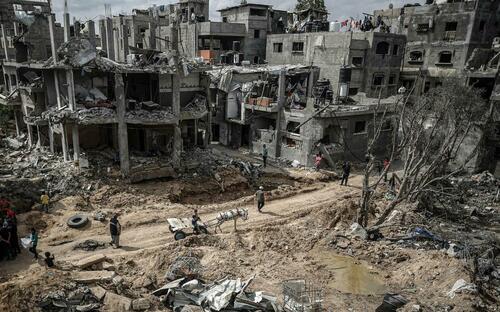
In its May 2021 war with Gaza militants, Israel used American weapons to destroy U.S. humanitarian projects and damage an American-owned Coca-Cola bottling plant, according to a report by The Intercept.
Damaged or destroyed facilities included:
Hospitals, water treatment and sanitation facilities funded by the U.S. Agency for International Development (USAID)
A dozen factories built with USAID money
Dozens of schools operated by the U.S. State Department-backed United Nations Relief and Works Agency for Palestine Refugees in the Near East (UNRWA)
More than a hundred UNRWA facilities were struck, causing more than a million dollars in damage.
The impact is far more than financial. As TheIntercept‘s Daniel Boguslaw elaborates:
In Khan Yunis, Rafa, and Beit Lahia, wastewater treatment infrastructure and water reservoirs funded by USAID, which the U.S. government spent millions to construct, were destroyed by aerial attacks that affected more than 300,000 civilians. Ninety-seven percent of the water in Gaza is contaminated, resulting in a widespread public health crisis, rendered even worse by the destruction of U.S.-funded water infrastructure.
The May 2021 war took a steep toll on Gaza, with more than 240 Palestinians killed and nearly 2,000 wounded. Four thousand rocket attacks from Gaza on Israel killed 12.
Israel’s periodic devastation of Gaza is often characterized as “mowing the grass.” Yoav Galant, a former Israeli military commander, embraced the philosophy in a radio interview: “This sort of maintenance needs to be carried out from time to time, perhaps even more often.”
Though Galant and others would suggest such “mowing” is focused on Palestinian military power, Israel’s routine destruction of hospitals, water treatment facilities and other civilian infrastructure suggests Israel strives to keep Gaza in a state of perpetual economic devastation.
A Coca-Cola factory also came under 2021 Israeli bombardment. Its owner, U.S. citizen Zahi Khouri, said, “We had thousands of pallets burned, and there was damage to the logistics area. There was damage in the industrial estate, but what was also damaged was the investment of Coca-Cola in a project through Mercy Corps where we built a water purification station for a refugee camp.”
In a dark twist, the destruction of U.S.-funded civilian infrastructure is accomplished with American-made and/or -funded weapons. The United States and Israel are currently operating within a memorandum of understanding by which Americans are on the hook for $38 billion in military aid over a 10-year period ending in 2028.
That’s just a minimum. Congress is free to throw more money at Israel along the way—such as the $1 billion for Iron Dome missile defense it approved in March by a 420-9 vote in the House.
Per The Intercept, there’s more to the “special relationship”:
The aid system also provides cash-flow financing, a system resembling layaway, that allows Israel to purchase weapons in the present using money from the future. And it contains an offshore procurement exemption—offered to no other country—that allows Israel to spend U.S. tax dollars on its own weapons industry without disclosing how it spent the money to Congress or the American public.
Israel’s bombardment of the biggest agrochemical warehouse in the besieged Gaza Strip by incendiary artillery shells last year amounts to chemical warfare, a rights group report finds.
On May 15, 2021, the Israeli military launched an artillery attack on the Khudair Pharmaceuticals and Agricultural Tools Company, considered as the largest agrochemical warehouse in the north of the blockaded enclave, setting fire to tons of pesticides, fertilizers, plastics and nylons.
The shelling attack occurred in the midst of the 11-day Israeli war against Gaza Strip, after weeks of violence against Palestinians in Al-Quds and a brutal crackdown on worshipers at the al-Aqsa Mosque, as well as attempts to steal their land in the Sheikh Jarrah neighborhood.
The results of a new investigation in the attack and its consequences by the West Bank-based Palestinian human rights NGO Al-Haq showed that Israel deliberately employed highly flammable munitions in the targeted attack, which burned tons of dangerous pesticides and set off an unfolding environmental disaster.
The FAI Unit built a 3D model of the warehouse after interviewing the locals, consulting international experts and analyzing data obtained from dozens of videos, including CCTV and drone footage, in a bid to establish the circumstances of the blaze, and determine the effects of the release of toxic chemicals.
“Our findings reveal that Israeli forces illegally employed highly flammable munitions in a targeted attack on the warehouse, whose location and contents are known to Israel, setting on fire over 50 tons of hazardous chemicals stored on the site,” said al-Haq.
The report is the first publication by Al-Haq’s newly-established Forensic Architecture Investigation Unit (FAI Unit), a first-of-its-kind collaboration in the Middle East with Forensic Architecture, a research agency based at Goldsmiths, University of London, which conducts spatial and media analysis for NGOs and in international human rights cases.
The shelling created a toxic plume, which engulfed an area of nearly six sq km, leaving local residents struggling with health problems.
“Within the first hour, the toxic plume had affected an area of approximately 5.7 square kilometers — spanning Beit Lahiya and its agricultural zones, as well as the densely populated Jabaliya refugee camp — placing approximately 3,000 homes in its shadow,” the report said, adding that the six-hour-long fire at the warehouse destroyed most of the facility and consuming the majority of its contents.
Al-Haq said that a toxic plume produced by the attack is tantamount to the indirect deploying of chemical weapons.
“Israeli occupation forces’ shelling of the Khudair Agrochemical Warehouse, with knowledge of the presence of toxic chemicals stored therein, is tantamount to chemical weapons through indirect means. Such acts are clearly prohibited… and prosecutable under the Rome Statute of the International Criminal Court,” the group said in a legal report based on the findings of the investigation.
The probe determined that the Israeli military used several M150 Smoke HC 155mm shells in its attack against the warehouse.
“The dimensions and the smoke tail match the M150 Smoke HC 155mm ammunition developed by the Israeli weapons manufacturer Elbit Systems: an ‘advanced smoke projectile’ and a new type of shell designed to splinter into five separate canisters, all of which emit high-density smoke,” the report said.
It also stressed that the attack on the Khudair agrochemical warehouse was the first in an apparent string of similar attacks by the Tel Aviv regime, intentionally hitting civilian economic infrastructure and the industrial sector.
“On 17 May, two days after the Khudair Warehouse was destroyed, the Fomco Sponge Factory near Jabaliya camp was attacked in a similar manner, causing a large-scale fire. On the same day, over half a dozen other factories and warehouses, located in the industrial zone east of Gaza’s Shejaiyyeh neighborhood, were also bombed,” it stated.
In the latest bombardment campaign of Gaza by Israel in May last year, at least 260 Palestinians, including over 60 children, were killed in a time span of 11 days that began on May 10. The Gaza-based resistance movements retaliated.
The regime was eventually forced to announce a ceasefire, brokered by Egypt, which came into force in the early hours of May 21.
The Gaza Strip, home to some two million people, has been under a blockade imposed by Israel since June 2007.
A European Parliament delegation cancelled a trip to the occupied Palestinian territories yesterday after the group’s chairperson, Manu Pineda, was denied entry to Israel, reported Wafa news agency.
The Spanish member of the European Parliament and chair of the parliament’s delegation for relations with Palestine was scheduled to travel to the occupied Palestinian territories with a group of European lawmakers to review the situation on the ground following the assassination of Palestinian Al Jazeera journalist, Shireen Abu Akleh.
However, at late notice the group was informed that the mission would not be able to go ahead as planned due to what has been described as a “unilateral decision” taken by Israeli authorities.
“Israel is blocking the work of the European Parliament,” said Pineda, adding that the delegation had also been denied access to the besieged Gaza Strip.
He shared the letter that the Israeli Foreign Ministry, which states occupation forces “cannot allow the visit to Gaza of delegations with political affiliation and legislators.”
In response, European Parliament President Roberta Metsola, who is currently in Israel to meet President Isaac Herzog and Prime Minister Naftali Bennett, said on Twitter, she regretted Israel’s decision to refuse entry to Pineda and would raise the decision directly with the Israeli authorities during her visit.
“Respect for MEPs and the European Parliament is essential for good relations,” she said.
Pineda thanked Metsola for her remarks and called on her to “apply reciprocity in our institution until the decision is reversed.”
“It is important that we are united to defend the European Parliament,” he said.
The European Parliament’s delegation for relations with Palestine has 18 members and informs the European Union legislature about political, economic and human rights developments in the occupied territories.
A detailed report published by the Guardian newspaper has shown how Britain is massively contributing to Saudi Arabia’s devastating war on Yemen as it suggests that London is not only supplying the bombs that fall on Yemenis, but it provides the personnel and expertise that keep the war going.
The comprehensive report by Arron Merat published on Tuesday showed that Britain was doing much of the killing in Yemen as the country continues to provide Saudi Arabia with everything it needs to turn its southern impoverished neighbor into a graveyard.
“Every day Yemen is hit by British bombs – dropped by British planes that are flown by British-trained pilots and maintained and prepared inside Saudi Arabia by thousands of British contractors,” said Merat in the report. … continue
This site is provided as a research and reference tool. Although we make every reasonable effort to ensure that the information and data provided at this site are useful, accurate, and current, we cannot guarantee that the information and data provided here will be error-free. By using this site, you assume all responsibility for and risk arising from your use of and reliance upon the contents of this site.
This site and the information available through it do not, and are not intended to constitute legal advice. Should you require legal advice, you should consult your own attorney.
Nothing within this site or linked to by this site constitutes investment advice or medical advice.
Materials accessible from or added to this site by third parties, such as comments posted, are strictly the responsibility of the third party who added such materials or made them accessible and we neither endorse nor undertake to control, monitor, edit or assume responsibility for any such third-party material.
The posting of stories, commentaries, reports, documents and links (embedded or otherwise) on this site does not in any way, shape or form, implied or otherwise, necessarily express or suggest endorsement or support of any of such posted material or parts therein.
The word “alleged” is deemed to occur before the word “fraud.” Since the rule of law still applies. To peasants, at least.
Fair Use
This site contains copyrighted material the use of which has not always been specifically authorized by the copyright owner. We are making such material available in our efforts to advance understanding of environmental, political, human rights, economic, democracy, scientific, and social justice issues, etc. We believe this constitutes a ‘fair use’ of any such copyrighted material as provided for in section 107 of the US Copyright Law. In accordance with Title 17 U.S.C. Section 107, the material on this site is distributed without profit to those who have expressed a prior interest in receiving the included information for research and educational purposes. For more info go to: http://www.law.cornell.edu/uscode/17/107.shtml. If you wish to use copyrighted material from this site for purposes of your own that go beyond ‘fair use’, you must obtain permission from the copyright owner.
DMCA Contact
This is information for anyone that wishes to challenge our “fair use” of copyrighted material.
If you are a legal copyright holder or a designated agent for such and you believe that content residing on or accessible through our website infringes a copyright and falls outside the boundaries of “Fair Use”, please send a notice of infringement by contacting atheonews@gmail.com.
We will respond and take necessary action immediately.
If notice is given of an alleged copyright violation we will act expeditiously to remove or disable access to the material(s) in question.
All 3rd party material posted on this website is copyright the respective owners / authors. Aletho News makes no claim of copyright on such material.