Russia-US Security Dialogue Looming: Time to Address a Broader Security Agenda
By Alex GORKA | Strategic Culture Foundation | 25.03.2018
A lot of people close to the US president wanted to prevent it at any cost but Donald Trump congratulated President Putin anyway and had a phone conversation with him. The US president said that the two would meet “in the not too distant future.” Preventing an arms race is one issue on the agenda. Donald Trump knew the move would bring forth a tempest but he did it anyway. The president considered the relationship with Moscow to be important enough to defy his numerous opponents. Serbia has already offered to host a summit.
Right after the two presidents’ conversation, the Russian and American chiefs of staff discussed Syria. What’s even more important is that they have agreed to more military-to-military contacts in the future. Why has it suddenly become so important for Washington to launch a dialog on defense issues? The answer was provided by General John E. Hyten, the Commander of US Strategic Command, who admitted in the Senate that the US is defenseless in the face of the threat from hypersonic weapons. This realization came right after Russian President Vladimir Putin revealed his recent information about the new systems capable of hypervelocity flight that are currently being tested and are soon to be operational.
The US is a great military power but it’s not strong enough to force everyone to dance to its tune. Its defense programs suffer from serious shortcomings. The current arms-control system is in crisis. New challenges keep cropping up. They should be incorporated into the international security agenda but that’s not happening.
The looming hypersonic race is a burning issue that still needs to be addressed. It’s a domain in which the US is lagging behind Russia. When the Russian president announced those breakthroughs in military technology, his revelations were met with some skepticism in the West. But the ensuing events proved him right. Vladimir Putin pulled it off, making hotheads come to their senses and realize the need for talks to address the security challenges. Washington needs this dialog more than Moscow does.
So, the Americans’ coveted leadership in military technology has turned out to be a pipe dream. But their furtive steps to bring NATO right to Russia’s doorstep are not. The most interesting things often fall off the radar.
Moldova is planning to phase out its draft in order to have a professional military. This month, Moldova, Georgia, and Ukraine formed an anti-Russia alliance. Moving to an all-volunteer force is in keeping with the political goals of this group and is seen as an important step on the path to NATO membership. That reform is scheduled to begin this fall. This is a very costly endeavor, especially when one is talking about the poorest country in Europe. Chisinau cannot afford it. It will be fully dependent on assistance from Romania and other NATO states.
Moldova’s process of embracing the bloc has accelerated recently. A joint Romanian-Moldovan task force equipped and trained in accordance with NATO standards is on its way. That step was agreed on in February. According to the military cooperation agreement signed by Chisinau and Bucharest in 2012 and ratified by the Moldovan parliament in 2013, Romanian troops and police forces enjoy freedom of movement on Moldovan territory. In other words, a NATO member has a free hand in Moldova, although the region of Transnistria, where Russian peacekeepers are stationed, is part of that country. This is a real hornet’s nest and the problem remains unaddressed.
The fact that Poland has shifted its best military forces, including its most modern tanks, eastward has not gone unnoticed in Russia. The country will receive 70 AGM-158B JASSM-ER long-range air-to-surface missiles from the US by 2020 or a bit earlier. With an operational range of roughly 1,000 km, this stealth weapon boasting a penetrating warhead can hit infrastructure deep inside Russia. One does not have to be a military expert to realize that the JASSM-ER’s prime mission is to knock out Russian Iskander short-range missiles deployed in the Kaliningrad region in a first strike.
The small Polish town of Powidz is to become a NATO hub for the Baltics and Northern Europe. Construction is underway to build a storage facility for a brigade’s worth of military hardware and personnel. The US Aegis Ashore BMD system will be operational in Poland this year. This is a highly destabilizing weapon that will become a target for a first strike by the Russian military.
Nor has Russia forgotten about the 300 US Marines stationed in Norway, or the construction of a sophisticated new radar system known as Globus 3 in the Norwegian Arctic archipelago of Svalbard. This is a violation of international law, as Svalbard was supposed to be demilitarized under a 1925 treaty. The facility there is an element of NATO’s ballistic missile defense (BMD) system. The joint US-Norwegian radar station is viewed by Moscow as a clear provocation. Norway is to be provided with over 50 US F-35 stealth fighters in 2019, enabling it to strike Russian territory. The F-35 is a nuclear-capable plane.
All these moves are being closely watched by the Russian military. Even if new weapons are incorporated into the bilateral arms-control agenda, the efforts to create the potential for a first strike near Russia’s borders are certainly not something Moscow can turn a blind eye toward. This does not create the right environment for a security dialog between Moscow and Washington. Everything is connected.
What Russia and the US really need is not just talks about curbing super weapons, but also negotiations addressing a much broader security agenda.
Azerbaijan to perform military drills with Turkey, Georgia
Press TV – May 15, 2016
The Republic of Azerbaijan has declared joint military drills with Turkey and Georgia, a move which is likely to increase tensions with neighboring Armenia prior to talks with Yerevan over the disputed region of Nagorno-Karabakh.
“To increase the combat capabilities and combat readiness of the Azerbaijan, Turkey and Georgia, we deemed it worthwhile to carry out joint military exercises,” Azerbaijan’s Defense Minister Zakir Hasanov said on Sunday, without specifying when the exercises would be carried out.
At least 46 people have been killed since April 1, when fighting broke out between Armenia and Azerbaijan over Karabakh.
On Friday, Azerbaijan’s Defense Ministry said an Azeri soldier had been killed by Armenian fire on Thursday.
On the Armenian side, a serviceman died of wounds on Saturday after reportedly being targeted by an Azeri sniper near southwestern Armenian border.
On April 3, Baku announced a “unilateral” ceasefire as a gesture of goodwill, warning, however, that it would strike back if its forces came under attack. Bouts of fighting were reported soon afterward.
The landlocked Karabakh region, which is located in the Azerbaijan Republic but is populated by Armenians, has been under the control of local ethnic Armenian militia and Armenian troops since a three-year war, which claimed over 30,000 lives, ended between the two republics in 1994 through mediation by Russia.
The presidents of the Republic of Azerbaijan and Armenia, as well as diplomats from Russia, the US and France, are to meet in the Austrian capital of Vienna on Monday to discuss the situation in the volatile Nagorno-Karabakh.
NATO pledges to boost military presence in Eastern Europe
Press TV – April 27, 2016
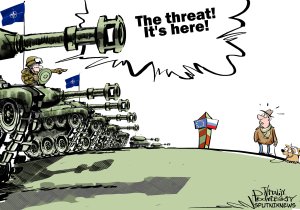 NATO has pledged to expand its military presence in Eastern Europe to protect its partners and allies from potential threats as the US sends two of the world’s most advanced warplanes to Romania.
In a speech at the University of Bucharest in Romania on Tuesday NATO Deputy Secretary-General Alexander Vershbow discussed the main issues the Western alliance is facing.
He said the alliance is struggling with many complex risks apart from the “destabilizing actions” of Russia and “the tide of instability which has swept across the Middle East and North Africa.”
“We are also wrestling with other complex risks and threats to our cyber security, to our energy supplies, and in the case of international terrorism to the safety of the people on our streets,” he said.
Vershbow said NATO is doing everything to respond to these challenges, adding that “the alliance takes a 360 degree approach to deterring threats, to protecting its member nations and if necessary to defending them.”
“That presence will be rotational, multinational, and combat capable. It will thereby send a clear message to any potential aggressor that if they violate NATO’s territory, they will face strong response from the whole alliance; Americans, Europeans and home defense forces,” he said.
The NATO secretary general also said that the organization has “set up a series of small headquarters, including here in Romania, to support planning, training and re-enforcement.”
“We are intensifying our maritime patrols, exploring the need for increased military and exercises, providing support to partners like Ukraine, Georgia and Moldova and encouraging efforts to strengthen energy security,” he said.
US sends F-22 Raptors to Romania
Vershbow’s comments came a day after the US sent two F-22 Raptor fighter jets to Romania as part of the commitment to NATO security.
The fighter jets, which travel at twice the speed of sound, touched down in Romania, close to the Black Sea and Ukraine, the Crimean Peninsula and Russia.
A US statement said the aircraft possess sophisticated sensors which would allow pilots to track, identify, shoot and destroy air-to-air threats without being detected.
The dispatch of the fighter jets, which can also attack surface targets, came two weeks after Russian fighter jets buzzed an American warship in the Baltic Sea.
The Western military alliance has been deploying troops and equipment close to Russia’s borders since it suspended all ties with Moscow in April 2014 after the Crimean Peninsula integrated into the Russian Federation following a referendum.
The United States and its European allies accuse Moscow of destabilizing Ukraine and have imposed a number of sanctions against Russian and pro-Russia figures. Moscow, however, rejects having a hand in the Ukrainian crisis.
This as Moscow has on many occasions slammed the Western military alliance’s expansion near its borders, saying such a move poses a threat to both regional and international peace.
Soros Disruption: American-Style
By Wayne MADSEN – Strategic Culture Foundation – 20.03.2016
Eastern Europeans and Arabs are all-too-familiar with the political street hooliganism sponsored by global «provocateur» George Soros and his minions. Lately, middle-class Americans have had a taste of the type of violent protest provocations during the current US presidential campaign that have previously been visited upon governments from Macedonia and Moldova to Syria and Libya.
Recently, Donald Trump campaign rallies have seen highly-coordinated and well-planned political demonstrations in Chicago, Cleveland, St. Louis, Dayton, and other cities. The rallies were disrupted by highly-coordinated and well-planned protesters waving freshly-printed protest signs before awaiting television cameras. Such «rent-a-mob» actions are trademark signs of the involvement of George Soros and the «godfather» of political street violence, Gene Sharp, in disrupting the normal political process.
One of the favored methods proposed by Sharp and embraced by Soros-financed groups is the taunting of individuals. Sharp’s advice to taunt speakers is being played out in the US presidential campaign: «instead of predominantly silent and dignified behavior… people may mock and insult officials, either at a certain place or by following them for a period». Sharp suggests that taunting individuals, such as presidential candidates, be combined with a refusal to disperse when either asked or ordered to do so. Sharp claims that these methods are «non-violent». However, when the US Secret Service, charged with protecting presidential candidates from assassination or bodily harm, order protesters to leave a campaign venue and there is a subsequent refusal to do so, violence is a certainty.
Soros and Sharp honed their street revolution tactics on the streets of Belgrade in the Bulldozer Revolution that overthrew Serbian president Slobodan Milosevic on October 5, 2000. Two Soros-financed and Sharp-inspired groups, OPTOR! and the Center for Applied Nonviolent Action and Strategies (CANVAS), as well as their leader Srdja Popovic, a so-called «pro-democracy» agitator, have all been unmasked as US intelligence assets. Popovic has received funding from the CIA-linked US Institute of Peace, a creation of neo-conservatives to advance the type of undemocratic political street disruptions first seen in Serbia and that soon expanded to Ukraine, Georgia, Egypt, Venezuela, Russia, Macedonia, and other countries. Today, Soros-inspired political violence has targeted Trump rallies across the United States.
Popovic first began to infiltrate American politics by ostensibly supporting the Occupy Wall Street movement. As his ties to the CIA and Goldman Sachs later showed, his intent and that of his financiers were to derail the anti-capitalist popular movement.
Several veteran «agents provocateurs» of the Occupy Wall Street movement who are now part of the Bernie Sanders presidential campaign have been enlisted by groups like Unbound Philanthropy, an immigrant rights group, to disrupt Trump rallies. Together with the Soros-financed group Black Lives Matter, these professional street hooligans have carefully, and in compliance with the Sharp model, staged their demonstrations to achieve maximum media coverage while achieving the maximum level of disruption to the primary election process.
Unbound Philanthropy is funded by Obama’s deep-pocketed friend and frequent vacation host in Hawaii, William Reeves, a former JP Morgan executive who now heads up BlueCrest Capital. In some cases, the political protesters masquerade as Trump supporters by wearing pro-Trump shirts and hats in order to gain access to Trump campaign venues. This methodology of disruption employs another Sharp tactic, that of using false identities. Coupled with the tactic of «non-violent harassment» of individuals, the use of employing false identities to gain admittance to Trump rallies, followed by coordinated protests in the form of placard-waving «stand-ins», are textbook examples of Sharp tactics being employed with the financial support of Soros and his gang, which includes Reeves and pro-immigration Hispanic groups and Black Lives Matter. Many of the anti-Trump street actions are coordinated by MoveOn.org, another group financed principally by Soros and the Hyatt Hotels’ Pritzker family of Chicago. One member of the Pritzker family, Penny Pritzker, serves as the Secretary of Commerce in the Obama administration.
MoveOn.org, which has endorsed Sanders, is actually using its protests at Trump rallies as a fundraising gimmick. It promises to disrupt future Trump campaign rallies and it will use every weapon in the Sharp/Soros handbook.
Another Sharp/Soros tactic employed against Trump is the «speak-in». During a Trump campaign appearance in Dayton, a pro-Bernie Sanders protester jumped a barrier and rushed the stage in an attempt to grab the microphone from Trump. The Secret Service tackled the protester who was arrested by police. The protester previously took part in a 2015 protest at Wright State University in Dayton where he dragged a US flag on the ground. Destruction of property, including US flags, is another hallmark disruption tactic proposed by Sharp.
The Sharp definition of a «speak-in» is a «special form of nonviolent intervention… when actionists interrupt a meeting… or other gathering for the purpose of expressing viewpoints on issues which may or may not be related directly to the occasion». Soros classifies the action as «social intervention», with «psychological and physical aspects». Regardless of Sharp’s definition of such actions as «nonviolent», the Secret Service does not take lightly anyone lunging at a presidential candidate, especially after the assassination of candidate Robert F. Kennedy in Los Angeles in 1968 and the shooting and attempted assassination of candidate George Wallace in 1972. Soros’s operatives are dangerously playing with fire by bringing such violence-tinged street protest tactics to the American presidential political scene.
The stench of Popovic and Soros in the street operations against Trump, who has railed against Wall Street’s «free trade agreements» and neo-conservative «wars of choice», can be seen in the links between the street protest groups and corporate giants like Goldman Sachs.
Popovic and his CANVAS non-governmental organization (NGO) has received funding from a former Goldman Sachs executive named Muneer Satter.
Satter happened to work at Goldman Sachs with fellow corporate executive Heidi Cruz, the wife of Trump’s opponent for the Republican presidential nomination, Senator Ted Cruz of Texas. Although Satter retired from Goldman Sachs in 2012 he continues to serve as vice chairman of the Goldman Sachs Foundation. In 2012, the year that Satter retired from Goldman Sachs, the firm loaned more than $1 million to Cruz’s Texas US Senate campaign.
Satter also happens to be close to both President Barack Obama and anti-Trump GOP operative Karl Rove. Satter has donated to both Obama and Rove’s Crossroads political action committee. Satter was also the national finance co-chair of Mitt Romney’s 2008 and 2012 presidential campaigns.
This year, Satter joined the Senator Marco Rubio campaign as Illinois Finance Committee co-chairman. Such background players, Heidi Cruz and her Goldman Sachs friend Satter, as well as Rove, Romney, Reeves, Soros, the Pritzkers, and Popovic – a Central Intelligence Agency-linked foreign interloper in the United States political system – are the actual movers and shakers behind America’s presidential election. Their jobs and those of other deep-pocketed political financiers like Paul Singer, Haim Saban, Sheldon Adelson, Michael Bloomberg, Sam Zell, and Norman Braman, are to ensure that no «unfiltered outsiders» ever become the President of the United States. These and other wealthy backroom political maestros owe their undemocratic but massive political influence to insider politicians residing at 1600 Pennsylvania Avenue in Washington. They will do everything in their power to prevent an «unfiltered» candidate from becoming the next American president.
Another Day, Another Billion for Color Revolutions Near Russia’s Borders
Sputnik – February 13, 2016
Last week, the Obama administration proposed its final, 2017 fiscal year budget proposal to Congress. Among the proposed outlays is a State Department request for nearly a billion dollars to counter “Russian aggression” and “promote democracy” in the former Soviet Union. In other words, Washington thinks the region needs more color revolutions.
On Tuesday, the State Department and USAID held a special joint briefing, laying out a $50.1 billion spending request for 2017, including $953 million in “critical support for Ukraine and surrounding countries in Europe, Eurasia and Central Asia to counter Russian aggression through foreign assistance and public diplomacy.” The funds, officials specified, would go toward “enhancing access to independent, unbiased information; eliminating corruption and supporting rule of law; strengthening civil society; enhancing energy security, supporting financial reforms, trade, and economic diversification; and increasing some defense capabilities” in countries including “Ukraine, Georgia, and Moldova [and] in Central Asia.”
The spending would be separate from the proposed $3.4 billion (up from $789 million in 2016), provided by the so-called “European Reassurance Initiative,” which aims for “a significant reinvestment in the US military presence in Europe after decades of gradual withdrawal” to counter “the growing threat Russia poses to long-term US national security interests in Europe and beyond.”
With most of the Western media basically ignoring the plans and focusing on other aspects of the budget’s whopping $4 trillion in proposed spending, Russian security analysts, naturally, couldn’t let this ‘minor detail’ simply slip by unnoticed, given that the spending proposal is openly oriented against Russia.
Analyzing the State Department’s proposed new spending spree, Svobodnaya Pressa columnist Andrei Ivanov says that the outlays raise as many questions as they answer.
“It’s not difficult to guess what is implied by [the proposed spending for] ‘democratization,'” the journalist noted. “However, several questions arise. Firstly, this year, the State Department has already allocated $117 million ‘to support democracy’ in Ukraine, and $51 million for Moldova and Georgia. But in these countries, so-called color revolutions have already taken place, and the Americans have already almost achieved what they set out to do.””Secondly, it’s unclear what kind of ‘countering of Russian aggression’ the State Department means in relation to Central Asia. Kazakhstan and Kyrgyzstan have long been oriented toward Moscow, and even joined with Russia in the common customs area of the Eurasian Economic Union. Kazakhstan, Kyrgyzstan, and Tajikistan are also part of the Collective Security Treaty Organization’s unified security system. Russia has also signed a series of bilateral cooperation agreements with Uzbekistan.”
The proposed spending, Ivanov notes, “assumes a serious US commitment to pursuing its [geopolitical] goals, which threatens Russia with obvious negative consequences. The question thus arises about the countermeasures our country might take in response.”
“According to experts, on the eve of the coup d’état in Ukraine in 2014, over two thousand non-governmental organizations were created, from training camps for militants to various clubs of political scientists and media workers.”
Unfortunately, the journalist recalls, “Moscow relied more on the agreements reached with Ukrainian elites; the result was disastrous. Today, the question again arises about the need to work actively with the civil society of neighboring states.”
Asked to comment on the State Department’s new spending proposal, Andrei Manoilo, a professor of political science at Moscow State University, expressed a commonly held view among Russian security professionals.
Namely, the professor told the newspaper, “when Washington talks about spreading democracy, and allocates money for this purpose, it is referring to ‘color revolutions’ – the overthrow of undesirable regimes and the drive to bring puppets who mimic democracy to power.”
“Factually, these countries find themselves under American control. Ukraine is a vivid example. Until recently, Georgia too served as a good example, with each department and ministry in the country featuring an advisor and curator from the State Department. In Ukraine, supervision is carried out through the US Embassy, and through officials loyal to Washington, charged with implementing its instructions.”
As for the earmarking funds for countries which have already undergone color revolutions, Manoilo explained that the money “is allocated for the purpose of maintaining the stability of the dependent regime.” This is especially true in Ukraine’s case, he said. It is also meant “to ensure the loyalty of local elites.”
In Georgia’s case, “after Mikheil Saakashvili resigned from his post and was forced to flee the country, the American position weakened somewhat, mainly due to the perceived negativity which the color revolution had brought the country. So here, the US [spends] in order to maintain its influence. It is also possible that the US is considering ensuring the loyalty of Georgian elites by ‘nourishing’ cyclical color revolutions, thus carrying out a rotation of the elite.”
As for Central Asia, the State Department announcement seems to indicate, according to Manoilo, “that color revolutions are planned there as well. The Americans need to see regime change in the countries which, for the most part, are oriented toward Russia. In Central Asia, Moscow has several projects geared toward integration, including the Shanghai Cooperation Organization and the CSTO. Today, the countries in the region face a difficult situation, with disintegratory processes growing among them.”
In Tajikistan, the professor warned, the State Department may attempt to reignite the embers of the country’s civil war, which took place between 1992-1997, taking advantage of disagreements between the country’s north and south. “US NGOs, which operated freely in the country until recently, are taking advantage [of discontent] among both northern and southern elites. It was not until about a year ago that President Emomali Rahmon began to restrict their activities.”In Kyrgyzstan, meanwhile, “the situation has changed little since the last color revolution. The protest mood remains strong. US NGOs and foundations have been working actively with the rural population, which is not very versed in politics, but is easy to agitate to participate in demonstrations against authorities, as the ‘melon’ revolution of 2010 demonstrated.”
In all the countries of Central Asia, Manoilo noted, “there is the strong factor of Islamist radicalism. By and large, only the presence of Russian military bases holds back an Islamist offensive in the region.”
Unfortunately, he says, “practice has shown that when it comes to overthrowing undesirable governments, the State Department easily finds a common language with even the most rabid fundamentalists. It’s sufficient to recall the color revolutions of the so-called Arab Spring. It would not be out of place to presume that the US is preparing their repetition, except this time in the post-Soviet space.”
“In addition to Central Asia, there is the southern Caucasus. Last summer, Armenia saw a rehearsal of a color revolution under non-political slogans – a new technology called the ‘Electro-Maidan’. Armenia is a Russian ally in the South Caucasus, and the US has plans for regime change, using their methods of the so-called ‘democratic transition’.”
Ultimately, Manoilo warns, “by dismantling the political order in Russia’s neighboring countries, the US wants to create a vacuum around our country. Simply put, this indicates a repeat of the Ukrainian scenario. After all, until very recently it was simply impossible to imagine Ukraine as a country which is hostile to Russia.” … Full article
‘NATO’s Ambitions’ Behind EU Visa-Free Regimes With Ukraine, Georgia
Sputnik – 20.12.2015
The introduction of visa-free travel for citizens of Ukraine, Georgia and Kosovo, is another part of NATO’s enlargement to the East, DWN wrote. Washington is trying to further encircle Russia and is, therefore, incorporating the countries into its orbit.
Having failed to resolve the immigration crisis, the EU is taking another controversial step, DWN reported.
On Friday, Brussels recommended abolishing visa restrictions for citizens of Ukraine, Georgia and Kosovo as stated by the President of the European Commission, Jean-Claude Juncker.
According to him, this gesture would signify the recognition of the countries’ efforts in implementing democratic reforms. In fact, this decision is a part of NATO’s strategy of expansion to the East and its attempts to encircle Russia, the newspaper reported.
Washington is willing to turn Ukraine into its outpost on the Russian border. This, however, will happen at the expense of the EU, as Kiev is being kept afloat only by European taxpayers, the article said.
The country has long been bankrupt and is totally dependent on the foreign financial support. Moreover, the money is not being spent for the needs of the population, but rather flows into the pockets of corrupt Ukrainian politicians.
Such a situation will inevitably lead to a crisis which could transform the country into another “supplier” of refugees to Europe, the article said.
The abolition of visa restrictions for Georgia and Kosovo pursues the same geopolitical purpose as in the case of Ukraine, the newspaper wrote. Kosovo has one of NATO’s major air bases against Russia, while Georgia is located on the Russian flank and is of strategic importance for Moscow.
NATO’s recent invitation to Montenegro to start the accession talks on joining the military alliance should also be considered in this context. This way, NATO is trying to enclose Russia from Southern Europe and contribute to its further isolation.
Georgia Joins NATO Rapid Response Force
Sputnik — 29.09.2015
TBILISI – Georgia has become the fourth nonmember state to be a member of the NATO Response Force (NRF), Georgian Prime Minister Irakli Garibashvili said Tuesday.
The NRF is a technologically-advanced high-readiness unit comprising land, air, and maritime forces within the alliance. The initiative was launched in 2002, and members created an operational group in 2014, as a response to changing security needs. Finland, Sweden and Ukraine also participate in the NRF program.
“We will be the fourth non-member country in the NFR, which indicates the high level of cooperation between the Georgian Armed Forces and the Alliance,” Garibashvili said as cited by the Georgian news portal Agenda.ge.
He added that the Georgian contribution to the NRF includes 130 soldiers.
Institutional cooperation between Georgia and NATO began in 1994, when Georgia became a member of NATO’s Partnership for Peace program. The country’s cooperation with the organization intensified in 2004 after a Rose Revolution which led to the forced resignation of President Eduard Shevardnadze.
‘Agile Spirit’: NATO military exercises kick off in Georgia
RT | July 8, 2015
A multinational NATO military training “Agile Spirit 2015” has officially started in Georgia, uniting military personnel from six countries. It comes amid Russia’s mounting concerns over NATO’s military buildup in the region.
The US, Bulgarian, Romanian, Lithuanian and Latvian military will accompany Georgia’s Battalion 42 in the two-week-long military exercises that officially started on Wednesday, RIA-Novosti reported.
The annual joint training, that first started in 2011, this year involves 220 US Marine Corps servicemen. It is to take place at the Vaziani military base, located some 25 kilometers away from Tbilisi. Vaziani is a former Soviet and Russian air force base until Russian forces withdrew in 2001 under a European conventional arms reduction agreement.
The exercise follows the line of the Wales summit in September 2014, where the alliance agreed upon founding a NATO-Georgia Joint Training and Evaluation Center within the framework of the Substantial NATO-Georgia Package, introduced back then by allied leaders.
In an opening speech on Wednesday, major-General Kapanadze said that “Georgian soldiers took part in many international operations and are continuing to contribute to global peace alongside our partners,” Agenda website reported.
“Our cooperation is more than just a partnership – it is brotherhood of arms,” Kapanadze added.
“These military exercises in Georgia – a country that launched an unprovoked attack on South Ossetia in 2008,which led to the death of 12 Russian peacekeepers and a brief military conflict between Georgia and Russia – are the latest in a series of alarming moves by NATO that underscore the organization’s threatening stance towards Russia,” journalist Robert Bridge told RT.
The Russian Foreign ministry has long been criticizing the military buildup in the neighboring states, which goes “under the false pretext of alleged ‘aggressive behavior’ by our country” and is accompanied by “unfriendly and malicious” rhetoric.
“We are not threatening anyone and we seek to resolve all conflict situations through political means, with respect towards the international law and other nations’ interests,” President Putin said in June, underlying though that Russia needs strong, modern and adequately armed military force to face the challenges “that we cannot ignore”.
Georgia, an active contributor to alliance’s operations, has long planned to join NATO. In 1994, the former Soviet republic joined the Partnership for Peace program. After the “Rose Revolution” in 2003, the bilateral cooperation only “deepened”, according to a NATO statement.
“I don’t think there is any realistic chance of Georgia joining NATO in the coming years. In fact, it is more likely that Georgia will increasingly thaw relations with Moscow, for economic reasons, as the penny drops in Tbilisi that the West was good at false promises, but not delivering actual help,” journalist Bryan MacDonald told RT.
In August 2008, a brief military conflict between Russia and Georgia broke out, after Tbilisi launched a large-scale military offensive against South Ossetia prompting Moscow’s peace enforcement operation. It ended up in Russian official recognition of the two former Georgian autonomous republics as independent states of Abkhazia and South Ossetia.
Featured Video

Rewriting the risk? Inside the government’s vaccine safety messaging
or go to
Aletho News Archives – Video-Images
Book Review
“Davos Can Really Replace the UN”
Inside the book that maps the architecture behind global governance — from the Epstein files to the Pact for the Future
Lies are Unbekoming | April 1, 2026
On June 13, 2019, the United Nations and the World Economic Forum signed a partnership deal to “accelerate the implementation of the 2030 Agenda for Sustainable Development.” That same evening, WEF president Börge Brende — Norway’s former Foreign Minister — had dinner with Jeffrey Epstein at Epstein’s Manhattan townhouse. The Epstein files, released January 2026, contain an exchange between the two from the previous year. Epstein to Brende: “Davos can really replace the UN. C21, cyber, crypto . genetics… intl coordination.” Brende back to Epstein: “Exactly — we need a new global architecture. World Economic Forum (Davos) is uniquely positioned — public private.”
The next day, the UN General Assembly adopted the framework for restructuring global governance.
That sequence — the partnership signing, the Epstein dinner, the candid admission about replacing the UN with a public-private architecture, and then the formal adoption — opens Jacob Nordangård’s The Digital World Brain. Pages two and three. Footnoted to the UN resolution number, the Epstein files, and the General Assembly record.
I keep coming back to it because it captures what this book does that almost nothing else in the independent research space manages. I’ve followed Jacob’s work for years now and interviewed him about his research. Each book peels back another layer of the same institutional architecture, and each time I think he’s reached the limit of what can be documented, the next one goes further. Nordangård doesn’t speculate. He doesn’t editorialize much. He lays institutional actions next to each other in chronological order and lets the pattern announce itself. … continue
Blog Roll
 Aletho News
- The End of NATO
- 37 days of war on Iran cost US staggering $42bln, tracker shows
- Baghdad tells Asian refiners, traders to begin loading Iraqi crude amid Iranian exemption
- Under fire, Moscow and Tehran close ranks
- Iran, US receive Pakistan-mediated plan for ceasefire then final deal
- Iran submits demands for end to war as mediators scramble ahead of Trump deadline
- Iran Threatens Retaliatory Strike on Stargate AI Project in UAE
- US sent ‘a lot’ of arms to Iranian protesters – Trump
- Barak Ravid Launders Deception To Allow Trump To Back Off Of His Power Plant Threat – Again
- REWRITING THE RISK? INSIDE THE GOVERNMENT’S VACCINE SAFETY MESSAGING
- If Americans Knew
- Trump poised to “blow everything up” (ie. commit war crimes) in Iran – Daily Update
- In Iran, Israel-US take aim at “reason, research, and freedom of thought” – Daily Update
- US loses planes over Iran, Israel downgrades Lebanon war goals – Daily Update
- Israel Is Blocking Palestinians from Easter at Church Where Jesus Resurrected
- Plot to assassinate Palestinian activist follows harassment campaign promoted by Zionist groups and elected officials
- Prominent New York synagogue hosts presentation on why U.S. Jews should support the ethnic cleansing of Gaza
- Tapper vs. Piker: Is the CNN Anchor Auditioning for David Ellison?
- Shouldn’t Democrats Be Able to Condemn Genocide?
- Israel-US kill negotiators, destroy civilian structures, but Iran’s military capabilities still largely intact – Daily Update
- ‘War crime’: Global condemnation as Israeli ministers celebrate death penalty law targeting Palestinian prisoners
- No Tricks Zone
- An Inconvenient Tree: Uncovered In Alps… Europe Much Warmer Than Today 6000 Years Ago
- New Study Reports A 60% Slowdown In Greenland’s Ice Loss Rate In The Last Decade
- Low Intensity Tornado Wrecks Major Solar Farm, Creating A Potential Toxic Dump
- New Study Finds Warming Saves Lives…Cold Temperatures 12 Times More Deadly Than Excess Heat
- German Science Blog Accuses PIK Climate Institute Of Hallucinating Climate Tipping Points
- Devastating Assessment Of Comirnaty Vaccine By Former Senior Pfizer Europe Toxicologist
- New Study: CO2 Is ‘Effectively Negligible’ As An Explanatory Climate Change Factor Since 2000
- Former Pfizer Toxicologist Dr. Helmut Sterz Tells Bundestag Hearing Pfizer Vaccine Should Have Never Been Approved
- Energy Expert: Germany’s Nuclear Phaseout Was A “500 Billion Euro Mistake”
- New Research: South Australia’s Mid-Holocene Sea Surface Temperatures Were 4°C Warmer Than Today
 Aletho News