US announcement of sixth-gen F-47 fighter draws analyses from Chinese expert
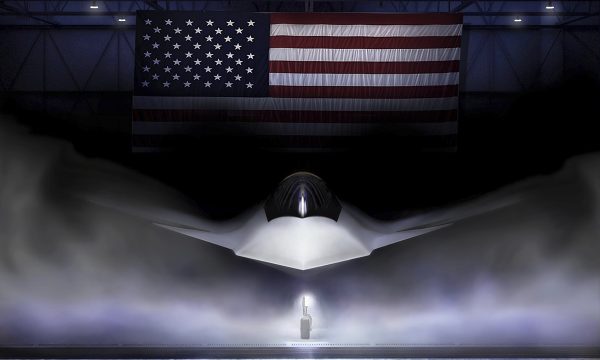
Graphical rendering shows the Next Generation Air Dominance (NGAD) Platform, the F-47. Photo: VCG
By Liu Xuanzun and Liang Rui | Global Times | March 23, 2025
The US’ recent announcement of the F-47 fighter jet has drawn intensive analyses from Chinese military affairs experts and observers, who acknowledged the aircraft being a real sixth-generation fighter jet for featuring typical characteristics such as a tailless design, but they also raised questions over its potentially limited stealth capability, relatively small size, and the US’ selection of Boeing to build the warplane.
The Pentagon has awarded the contract for the US Air Force’s Next Generation Air Dominance future fighter jet, known as NGAD, to Boeing, US President Donald Trump announced Friday, US news outlet Defense News reported on Saturday.
The sixth-generation fighter, which will replace the F-22 Raptor, will be designated the F-47, Trump said. It will have “state-of-the-art stealth technologies [making it] virtually unseeable,” and will fly alongside multiple autonomous drone wingmen, known as collaborative combat aircraft, Defense News reported.
After reviewing the artist renderings of the F-47 released by the US Air Force, Zhang Xuefeng, a Chinese military affairs expert, told the Global Times on Sunday that the F-47’s appearance conforms to the general development trend of the sixth-generation fighter jet concept. For example, it does not feature any vertical tails, which is an attempt to further improve its stealth capability in all directions. It has a flat nose and a lifting-body fuselage. These are all important characteristics of a sixth-generation fighter jet.
Zhang added that manned-unmanned teaming is a core sixth-generation feature, and one the F-47 includes.
However, a pair of canards can be observed in front of the F-47’s main wings, and this will more or less impact the aircraft’s stealth, Zhang noted. Reiterating that an important trend for sixth-generation fighter jets is to remove vertical tails and use a supersonic flying wing configuration to boost stealth, Zhang said that new mechanisms are needed to act in the place of vertical tails to control the aircraft, such as movable wingtip. But the F-47 opted to use canards, a relatively old technology often found on previous generations of aircraft. He suggested Boeing may lack the tech base to develop new control methods and relies on outdated design choices.
In December 2024, videos and photos emerged on social media allegedly showing two types aircraft with new designs have conducted test flights in China. Despite no official announcements, many called them China’s “sixth-generation fighter jets.” Both of them appear to have removed vertical tails and also do not have canards. One of them, resembling a ginkgo leaf in appearance, looked far larger than its J-20 escort.
Wang Ya’nan, chief editor of Beijing-based Aerospace Knowledge magazine, told the Global Times on Sunday that comparing with the size of the canopy and the front landing gear, it can be analyzed that the overall size of the F-47 is not likely much larger than the F-22. It means that the F-47 is still a tactical aircraft, rather than a large, multipurpose aerial platform capable of conducting campaign-scale missions like the “ginkgo leaf” aircraft.
Defense News, citing Air Force Chief Gen. Allvin, claimed that experimental versions of the NGAD have been flying for the last five years.
But Wang noted that there is no proof of this. Even the pictures depicting the F-47 are artists renderings rather than photos.
Wang also noted that Boeing has not won a major fighter jet program for decades. Its F-15 and F/A-18 fighter jets are from McDonnell Douglas which was merged into Boeing, and Boeing’s own X-32 fighter jet lost to the F-35 from Lockheed Martin in bidding. Boeing’s other projects, such as the 737 MAX airliner and KC-46 tanker aircraft also encountered many issues recently. “Having a company like this to lead a sixth-generation program is actually very risky,” he said.
In addition to US’ NGAD program, other countries are also developing sixth-generation fighter jets. France, Germany and Spain are in the Future Combat Air System program to develop a sixth-generation fighter jet, while the UK, Italy and Japan have a sixth-generation Global Combat Air Programme fighter project, according to Defense News. Russia’s sixth-generation efforts have also surfaced in TASS reports.
Wang said the US is moving fastest with the F-47, while other nations lag. With China’s own jets already spotted in the sky, the outside world is now seeing China and the US in advanced stages of sixth-generation fighter jet development.
Europe Will Spend Itself Into ‘Bankruptcy’ If It Tries to Meet NATO’s Draconian New Defense Demands
By Ilya Tsukanov – Sputnik – 23.03.2025
NATO is planning to ask its European and Canadian members to boost their weaponry and equipment stocks by about 30% over the next several years, informed sources have told Bloomberg. Sputnik asked a pair of leading German and French observers what this would mean for a region already suffering economic malaise and industrial decline.
Key alliance members like Germany and France would amass an unsustainable fiscal burden, be forced into debt and have to slash social programs if they accept NATO’s call for a 30% bump in new arms and equipment spending, AfD MP Dr. Rainer Rothfuss told Sputnik.
“We can take the example of Germany, where we had a kind of financial policy coup d’état this week” after the Bundestag voted to change the Basic Law to lift debt restrictions for defense spending, Rothfuss, who is also a veteran geopolitical analyst and consultant, said.
“The budget restraints that were even inscribed into our Constitution needed to be changed to get the financial flexibility to invest so much in defense. That shows us that it’s not a matter of priority spending, [but] a matter of, I would say, bankruptcy should this kind of policy be followed in the coming years, not only by Germany but by other countries as well,” the politician warned.
“France, for example,” has “an even more restrained budgetary situation,” Rothfuss said, “struggling economically to keep industry jobs,” and like Italy, should be investing in the competitiveness of its industries, not throwing money away on defense at a time when the security crisis in Europe is potentially closer to a peace deal than ever.
As for Germany, if its industrial decline worsens, it won’t be able to fund the EU to the tune of 25% of bloc spending, which would have serious knock-on effects for other members, the MP warned.
Jacques Sapir, director of studies at the Paris-based School for Advanced Studies in the Social Sciences, says a 30% bump may not seem like a lot, and even manageable by some countries, like France, given the large-scale decline in NATO stockpiles of 40-60% after the end of the Cold War.
But others, like Italy, Belgium, Germany and the Netherlands may need between a 30%-50% increase in outlays, given the decline in defense production over the past three decades, he said, adding that this could take between three and five years to accomplish for countries like France, Germany and the UK, and probably more for Canada.
Last month, Bloomberg calculated that a European defense buildup and the continuation of the proxy war against Russia without US assistance could cost up to $3 trillion over ten years – a massive burden for a region suffering from perpetual economic stagnation and widespread deindustrialization.
Berlin takes out emergency loan for migrants as costs spiral
Remix News | March 20, 2025
The city of Berlin has been a major magnet for migrants, but instead of the economic boom promised, they are costing the state billions of euros. Now, the city is throwing more debt at the problem, which will be facilitated by the massive debt package passed by the Christian Democrats (CDU), Christian Socialists (CSU), Social Democrats (SPD), and the Greens.
Economics Senator Franziska Giffey (SPD) announced that Berlin is taking an “emergency loan for refugee costs.”
“We are planning our state budget for 2026/27 under the assumption that we will be able to access further loans,” she said.
The Bundestag’s decision to amend the constitution will allow federal states to take out new debt, and the Berlin Senate is wasting no time doing the same, with most of the money flowing to foreigners.
The relaxation of the debt brake allows each federal state to take on debt that amounts to 0.35 percent of nominal GDP every year. For Berlin, this is a welcome reprieve, with the city’s migrant population straining the budget to the extreme. Now, Berlin can take out approximately €670 million every year in new debt, which will be €1.3 billion for the budget for 2026 and 2027.
Berlin Mayor Kai Wegner, of the CDU, is known for his welcoming stance towards immigrants; however, his government has struggled to house and care for this growing population. He said it is “absolutely right” that German states can take on more debt.
“Germany’s infrastructure has been criminally neglected and driven to wear and tear,” said Wegner, who was a major supporter of relaxing the debt brake.
As Remix News has reported in the past, Berlin has allocated €1.3 billion to housing refugees, while cutting public school budgets. The city has turned to tent cities and prefabricated structures to house migrants. Of course, the housing crisis is seen across Germany, with mass immigration pricing people out of the cities and leading to rising rents year after year. German security firms continue to rake in tens of millions of euros every year due to the violence, assaults and even sexual abuse seen in the various asylum centers in the city.
As the Berlin police chief Barbara Slowik noted last year, crime has soared due to mass migration in the city, which is further straining the security budget.
In an interview with RBB, she voiced concerns over the impact of immigration on the city and the broader nation, suggesting that the current levels of immigration are unsustainable, both financially and socially.
“I believe that a limit has been reached as to what is affordable,” she told the broadcaster.
She emphasized the need for a comprehensive societal response to address the growing number of violent incidents involving immigrants.
Now, with the new debt package passed in the parliament, federal states have significant leeway to spend the money how they want. A lot of that money is going to sustaining Germany’s new foreign population, which costs the federal government approximately €50 billion per year. That is approximately the same amount the country spends on the armed forces every year.
‘Death blow for the euro’ – AfD’s Weidel slams Germany’s massive new debt package
Remix News | March 19, 2025
The German Bundestag passed a historic debt package for defense and infrastructure yesterday, effectively changing the constitution to allow a suspension of the debt brake. However, a number of top German opposition politicians are making dire predictions about what this nearly €1 trillion in new debt will mean for Germany and Europe.
The largest opposition party to emerge from national elections, the Alternative for Germany (AfD), was perhaps the most vehemently opposed to the package. However, the BSW, the Left Party and the Free Democrats (FDP) all filed lawsuits against the deal and fought tooth and nail to stop it, but all of those lawsuits failed.
The co-leader of the AfD, Alice Weidel, is calling the debt a “death blow for the euro.” She said the debt will have a negative impact on future generations, consumers and taxpayers. Furthermore, she believes there will be massive disruptions in the credit markets in the future, rising interest rates, and a “spillover effect on the other eurozone countries.” Already, interest rates on European debt have risen sharply, and the fear is that periphery countries could see their borrowing costs skyrocket. In such a scenario, the euro could be significantly weakened.
She said Merz broke his election promises in dramatic fashion. In fact, the promise to keep the debt brake was even contained within the party election program of the CDU. There is already a sharp backlash amongst the party’s members to the betrayal, with some Germans already canceling their membership to the party.
“This is nothing less than the worst voter deception I have ever seen in the history of the Federal Republic of Germany,” said Weidel.
There was no significant dissent within the parties that passed the new debt package, with only Jan Dieren (SPD), Mario Czaja (CDU), and Canan Bayram (Greens) voting “no” to the package. In the end, the new debt package passed with a comfortable margin above the two-thirds majority required to change the constitution, with 513 for the deal and 206 against.
Of course, the opposition parties are outraged. The law passed under the old Bundestag, the one that had just been voted out of power. It was championed by Friedrich Merz, who promised his CDU would keep the debt brake in place. It represents a historic spending spree, but one with many handouts to the Green Party, including a commitment to “climate neutrality by 2045” enshrined in the constitution.
Among the speakers featured in the debate in the Bundestag was AfD MP Alexander Gauland, who was also a co-founder of the party.
“A lot of right and wrong things have been said in the course of this debate, both last Thursday and today. I would therefore like to make a few personal comments. Mr. Merz and I were in the same party for many years. I left because I could no longer tolerate Angela Merkel’s destruction of the CDU as a conservative-liberal bourgeois alternative to the left-green mainstream. Mr. Merz became a victim of her will to power,” he said.
Gauland also said he had high hopes for Merz at first, with a potential turnaround on immigration and a return to center-right policy, but instead, Merz has allied with the left and blocked a deal with the AfD.
“You sacrificed everything that was still conservative or middle-class in the CDU in order to become chancellor,” said Gauland. “Mr. Merz, you will probably become Federal Chancellor with the kind of policies we have seen in recent years. This policy will fail in the same way as the previous traffic light system. Not even their transatlantic ally in Washington supports their desperate endeavors to solve today’s problems with yesterday’s answers.
“Even if I have had doubts about my own party from time to time in recent years. Today, I am proud and happy to have launched it together with others in 2013. Because as of this week, the Merz CDU is the continuation of the Merkel CDU. Keep it up, Mr. Merz, and you will have to take responsibility for Germany’s decline in the future.”
Meanwhile, the CDU, CSU and Social Democrats (SPD) were triumphant.
Merz said that the financial package opens up “a perspective for our country that is urgently needed in the times we live in today.”
“Today’s decision is an unmistakable signal of Germany’s assumption of responsibility for a secure Europe and an economically stable Germany,” said CSU state group leader Alexander Dobrindt.
SPD leader Lars Klingbeil described the financial package as a “historic compromise” between the SPD, CDU/CSU, and the Greens. He said the debt would help rebuild Germany and beef up the military.
“The world is currently being re-measured; no one is waiting for Germany and no one is waiting for Europe,” said Klingbeil.
FDP parliamentary group leader Christian Dürr slammed Merz, saying he will lead “the first debt-ridden coalition in the Federal Republic of Germany.” He accused Merz of wanting to lead a government “that is prepared to sacrifice tomorrow’s prosperity for short-term election gifts.”
Merkel criticizes Germany’s anti-Russian hostility
By Lucas Leiroz | March 18, 2025
Apparently, the anti-Russian hostility of German officials is causing controversy among the country’s politicians themselves. In a recent speech, former German Chancellor Angela Merkel criticized the use of pejorative terms to refer to people who advocate a diplomatic approach with Moscow, stating that such attitudes harm political dialogue in Europe.
Recently, the term “Putinversteher” (Putin’s understander) has become popular among German officials and media. The “adjective” is used to defame any German or European who believes in the possibility of diplomatic talks with Vladimir Putin’s Russia. In other words, the German official media has deliberately adopted a rude and offensive term and is using it against German citizens themselves, justifying such attitude with anti-Russian arguments.
Merkel told journalists in a recent interview with Berliner Zeitung that using this word is wrong because it obstructs diplomatic initiatives. Merkel says that it is necessary to engage in talks to understand the real reasons for the conflict and possibly find a solution through a mutually beneficial agreement. For this reason, excluding people who support diplomacy from the public debate is a wrong move.
Merkel emphasized that “Putinversteher” is a “strange” word and that it should be avoided in order to ensure dialogue in Europe. More than that, she made it clear that it is necessary for the Europeans to understand Putin and “put themselves in his position”, thus showing a willingness for real diplomatic dialogue. According to Merkel, understanding the Russian side in the conflict does not mean supporting Moscow, and there is therefore no problem in doing so.
It is important to emphasize that Merkel at no time expressed any sympathy for Putin or Russia. She continues to adopt a completely pro-Ukrainian and pro-Western rhetoric, condemning what she calls Russia’s “unjustified invasion.” However, Merkel supports discussions that take into account the strategic interests of the Russian Federation – certainly because she understands that this is the only possible way to end the war.
“[This term is] Not good, because there has to be a discussion about it. You have to plan ahead for diplomatic initiatives so that they are available at the right moment (…) I find the accusation of being a Putinversteher inappropriate. It is used as a conversation-stopper, a way to shut down debate (…) No one has ever called me that – it’s a strange word. Understanding what Putin does and putting oneself in his position is not wrong. It is a fundamental task of diplomacy and something entirely different from supporting him (…) There is no justification for him [Putin] invading another country, but the discussion about Russia’s interests must be allowed,” she said.
In fact, Merkel governed Germany for many years and at that time her relations with Russia were marked by a certain ambiguity. While she was always committed to the Western hegemonic order on all major ideological and strategic issues, Merkel also had a reasonably pragmatic approach to Russia on some points. Having been educated in East Germany and having a good knowledge of the Russian language, she knew the Russian culture and history more deeply than her European allies and used this expertise to engage in fruitful dialogues – which was particularly possible with Putin, since the Russian president is also a deep connoisseur of German culture and language.
Despite being against Russia on several international issues, Merkel did not give up on the strategic partnership in energy and other relevant issues, which allowed for a period of reasonable stability in bilateral relations. After the end of the Merkel era, relations between Germany and Russia went into absolute decline as the political elites that came to power in Berlin were much more hostile to Moscow – as well as much more ignorant of Russian culture and interests.
So, it is understandable that there is a clash of opinions in Germany about how to deal with Russia. Merkel is herself hostile to Moscow, but she has a softer, more cultured and pragmatic approach. However, the current coalition is completely irrational and advocates for policies that, if implemented without restrictions, could easily lead Europe to an all-out war scenario in the near future.
It is possible to say that the extreme level of anti-Russian hostility in Germany is terrifying even the most experienced German politicians. Berlin has adopted actual madness as state policy and is ready to destroy the entire European security architecture just to defend interests that do not reflect the opinion of the German people.
Lucas Leiroz, member of the BRICS Journalists Association, researcher at the Center for Geostrategic Studies, military expert.
You can follow Lucas on X (formerly Twitter) and Telegram.
Germany recruiting Afghan migrants as mercenaries for Ukraine – source
RT | March 17, 2025
The German government has been coercing Afghan refugees into fighting for Ukraine, an anonymous source has claimed to RT. The scheme allegedly targets refugees who have been detained for various crimes, with the threat of deportation if they refuse to comply.
According to the individual, whose identity cannot be disclosed for security reasons, the “German authorities are forcing Afghan migrants to join the International Legion of Territorial Defense of Ukraine in order to urgently replenish the personnel of the Kiev regime’s armed forces, which is experiencing an acute shortage of people.”
The scheme supposedly involves approximately 2,300 refugees detained by German police for various crimes in cities such as Berlin, Bonn, Cologne, Hamburg, Munich, Frankfurt am Main, and Stuttgart.
“In the event of refusal to sign the relevant contract and go to Ukraine, the migrants are threatened with guaranteed extradition to Afghanistan,” the source claimed.
The source went on to allege that a number of German security experts have sounded the alarm over the potential ramifications for Germany’s own national security, especially with respect to the threat posed by radical Islamists.
“Some of the refugees are likely to return to Germany after the expiration of their imposed contracts, possessing skills in handling weapons and explosives, as well as experience in combat,” the experts have warned, according to the source.
Last month, Bild reported that at least one recruitment center belonging to Ukraine’s neo-Nazi Azov brigade was operating near Berlin. A recruiter told the media outlet that they were seeking “supporters for our new international battalion.”
Russian authorities have consistently prosecuted foreign nationals caught fighting for Kiev, whom they describe as mercenaries. In January, a Russian court sentenced retired US Army Ranger Patrick Creed to 13 years in prison for serving with the Ukrainian military from 2022 to 2023. In March, British citizen James Scott Rhys Anderson was handed a 19-year sentence for participating in Ukraine’s incursion into Russia’s Kursk Region.
Last week, Russian President Vladimir Putin noted that foreign mercenaries fighting for Kiev are not entitled to the same legal protections under international law as those granted to regular Ukrainian POWs.
Russia’s Kursk Region Becomes Final Resting Place for NATO’s Top Tech
By Ilya Tsukanov – Sputnik – March 15, 2025
The near-total collapse of Ukraine’s operations in Kursk region has highlighted the folly of Zelensky’s obsession with throwing his best troops and materiel into a hopeless campaign. Here’s a selection of NATO equipment that has “found its peace in Kursk’s ground” over the past month, complete with photo and video evidence.
Russia’s Defense Ministry estimates that Ukraine has lost nearly 400 tanks, almost 2,800 armored vehicles and over 1,000 guns and mortars in fighting in Kursk region to date, and says over 85% of territories once occupied by Ukrainian forces have been freed.
Liberated areas contain scores of wrecked, burned out, damaged or abandoned vehicles, including some of NATO’s most advanced equipment:
M2A2 Bradley: Over 300 of these do-it-all American infantry fighting vehicles have been sent to Ukraine, with nearly half confirmed lost by Oryx. They’ve been spotted among other wrecked NATO equipment in Kursk region.
M1 Abrams: 31 of these custom-made monkey model American main battle tanks have been delivered to Ukraine. 20 lost to date. One recently spotted being towed away intact in Kursk region. Australia plans to send 49 more.
Leopard 1 AVLB Biber: Armored vehicle-launched bridge built on a German Leopard-1 tank chassis. 30+ sent to Ukraine. One recently found abandoned, in mint shape, in a Kursk village.
M777: A third of the 180 US-made 155mm howitzers sent to Ukraine have been lost, damaged, or abandoned to date, with several recently captured almost intact in Kursk region.
Stryker: Over 400 of these Canadian-built armored fighting vehicles have been transferred to Ukraine. At least 55 destroyed, some caught on Russian MoD FPV drone videos moments before meeting their fate.
BMC Kirpi II: 200 of these Turkish MRAPs have been sent to serve in Ukraine’s elite units. Scores destroyed, damaged or captured by Russian forces, including in Kursk.
HMMWV: 5,000 of these ubiquitous US vehicles, better known as Humvees, have been delivered to Ukraine. Scores captured on Russian FPV drone cam footage in Kursk region.
Roshel Senator: Over 1,700 of the Canadian-built armored cars have been delivered to Ukraine. Also spotted in Russian FPV drone videos.
MAXXPRO: About 440 these Mine-Resistant Ambush Protected Vehicles (MRAPs) have been sent to Ukraine by the US, with at least 197 lost to date, including in fighting for Kursk.
M113: 1,000+ of these ancient tracked APCs have been sent to Ukraine by the US and allies, with nearly 300 destroyed to date, including in Kursk region.
BATT UMG: Ukraine has received 116 of these US-made vehicles. Rarely seen, some are known to have met their fate on the battlefields of Kursk.
Bushmaster PMV: About 120 of these Australian-made Protected Mobility Vehicles have gone to Ukraine, some ending up in Kursk region, and at least 25 lost to date.
M240: Besides heavy equipment, an array of NATO small arms has also been destroyed or captured in Kursk as well, among them the FN M240 7.62mm machinegun, delivered to Ukraine by the US and France. In February, a Russian trooper in Kursk captured an M240 after storming a Ukrainian position and bringing the gun back to friendly lines.
New findings on the Nord Stream attacks — a deep dive
By Maike Gosch | Nach Denk Seiten | March 7, 2025
The Nord Stream pipelines are currently back in the headlines. After rumours of a US takeover of the pipelines recently caused a stir, the Bild newspaper reported on March 4th that Germany is currently intensively examining what levers it has at its disposal to prevent a comeback of Nord Stream 2. Just when you think the absurdity can’t get any worse, someone turns the screw a little further. But I guess these are the times we live in.
However, there is also other news, namely the publication of very interesting research findings on the attack on the pipelines, which may shed new light on the modus operandi and the possible perpetrators. As expected, these do not come from the official investigative bodies, but from an independent journalist from France.
Every crime fiction reader knows that one of the most important steps in solving a case is to ask the right questions. One question that has been bothering me for some time in relation to the Nord Stream attacks is why some of the deepest places in the Baltic Sea, which is shallow in many places, were chosen for the attacks.
Why was the so-called Bornholm Basin chosen as the crime scene, which is around 80 to 100 metres deep, and not other areas that have a water depth of only around 20 to 30 metres and would have had the additional advantage that the two twin pipes of Nord Stream 1 and those of Nord Stream 2 run very close to each other, so that it presumably would have been easier to blow up both pipelines or all four strings?
This question and a possible answer to it are the focus of new research findings by French investigative journalist Freddie Ponton, which appeared last week in the online newspaper 21st Century Wire.
He explores a possible, very simple answer to this question, which can be summarised in one word: submarines.
After rumours of a Russian submarine in the vicinity of the crime scene made the rounds in the very first hours after the attack, a possible commission of the crime with the help of submarines has strangely played a very subordinate to non-existent role in the theories and speculations since then. Seymour Hersh does not mention this possibility either — even though highly experienced German defence expert Thorsten Pörschmann, for example, stated in an interview on October 10, 2022, shortly after the attacks, that he considered the use of submarines equipped for laying ground mines to be the most likely scenario. Here are his comments on this in full (from about minute 14:37):
There are explosive charges that are specially designed for these depths and that can be laid with submarines. That’s the exciting thing. And in terms of weight, they also match the explosive force that was measured. The whole thing is called a bottom mine. They are cylindrical and can be carried in the torpedo tubes of submarines. […] A torpedo tube on a submarine is not only there to fire torpedoes. It can also transport combat swimmers in it and let them out, but these torpedo tubes can also be used as a mine-laying device by sneaking somewhere and laying bottom mines there. Every mine is only supposed to explode when you drive over it or when it’s triggered, but every mine is also an effective explosive, which means you can also use it as an explosive. This is often done with anti-tank mines, that is, if I have nothing else, I use an anti-tank mine as an explosive. That would also work with a bottom mine.
But back to Freddie Ponton’s new findings for 21st CenturyWire: he first points out an important point, namely that these deep places in the Bornholm Basin would be ideal for the use of submarines, both in terms of their manoeuvrability and the possibility of acting undetected.
Another point Ponton highlights is the fact that some of the areas where the attacks took place are even specially designated NATO submarine exercise areas, which are marked as such on nautical charts (as shown in documents from the Danish Energy Agency, which issued the licence for the Nord Stream 2 pipeline in October 2019, which he shows in his article). Another important piece of information is that submarine operations in the Baltic Sea are managed and coordinated by the German Navy’s Submarine Operating Authority, or SubOpAuth, in cooperation with NATO and the Baltic states.
So, we have sites that are partly in the middle of areas designated for submarine manoeuvres and whose submarine activities are coordinated by a subdivision of the German Navy. Ponton next sets out to investigate more about NATO’s submarine activities in the period around the attack at the end of September 2022.
In his February 2023 report, the American journalist Seymour Hersh claimed that US Navy divers were involved in the sabotage of Nord Stream and used the NATO naval exercise BALTOPS 22 — one of NATO’s largest maritime manoeuvres, which took place in the Baltic Sea between June 5 and 22, 2022 — to place explosives at various locations along the pipeline. Unlike Freddy Ponton, however, Seymour Hersh did not assume that submarines had been used to commit the offence, but that deep-sea divers had planted the explosives on the pipelines.
Ponton also deals with BALTOPS 22, but focusses on the submarine activities. As he reports, it is naturally difficult to obtain more precise information about the planning, content and command structures of the military exercise. But a stroke of luck helped him: Danish journalists from the TV2 channel were filming a report on the activities of the Danish navy, and the picture showed a screen on which the organisational structure of the BALTOPS 22 exercise was visible. It showed that BALTOPS 22 was led by an American, but that a German military officer was in charge of the submarine exercises which were part of the manoeuvre.
However, around the time of the attacks, there were other exercises in the Baltic Sea in addition to BALTOPS 22, which many are familiar with from Seymour Hersh’s article. Of particular interest for our investigation is the German-led naval exercise Northern Coasts 2022, which began on August 29, 2022 and ended on Wednesday September 28, 2022, two days after the Nord Stream explosions, and which was planned and conducted with the help of NATO’s Allied Naval Command (MARCOM) and other NATO partners. As Freddie Ponton points out in his long and detailed article:
The fact that the Nord Stream explosions occurred under the watch of the German Navy and MARCOM during German-led Northern Coasts 2022 is of great concern. Not only it is unthinkable that Germany wasn’t aware of the air, surface and subsurface activities taking place in the Baltic Sea around that time but, it is even harder to believe, if not inconceivable, that MARCOM was left in the dark.
Ponton’s article thus argues that it is unlikely that anyone outside NATO could have carried out attacks on such a large scale in the “NATO Lake”, as the Baltic Sea is also called, unnoticed during this period, while manoeuvres were taking place in parallel. It also shows the extent to which the naval activities of NATO member states are already coordinated with each other.
Of course, without being an expert in this field, this is difficult to judge. Do these latest investigations and research already provide clear evidence of responsibility by a particular state or actor? No, unfortunately not, but they do provide interesting and relevant context that can help to assess the situation and clarify the probabilities of who the possible perpetrators are most likely to be. These investigations can also provide an answer to the question of who most likely had the means to carry out the attack.
Unfortunately, we are still waiting for final results from the German investigators, so citizen journalism will have to fill this gap. The arrest warrant for a Ukrainian national named Volodymyr Z., who allegedly planted the explosives on the pipelines with other suspects while diving from the sailing yacht “Andromeda”, seems more and more like a red herring, just as the whole yacht story is rather unlikely from the point of view of many experts.
Freddie Ponton’s article is only the first in a series. According to the author, the second part is expected to be published around June 2025. We can look forward to seeing what else will come out of it. In an interview with Patrick Henningsen on X about his findings, the author already mentioned that he will explain, among other things, why there was a 17-hour gap between the various explosions, which is one of the many still unsolved mysteries that this attack — the largest terrorist attack (luckily without human victims) in the history of the Federal Republic of Germany — presents us with.
In his article he furthermore announces:
The idea that a covert operation utilizing an ExMCM Unit [Note by MG: ExMCM stands for Expeditionary Mine Countermeasures. This term is used in military and maritime contexts for special units that specialise in detecting, defusing or removing mines under water] was carried out with the support of an Amphibious Ready Group and a submarine(s) (or mini-subs) during NATO naval exercises may appear unlikely at first glance. However, our investigation into the Nord Stream sabotage now provides compelling evidence for the existence of Seabed Mine Warfare and Underwater Demolition Operations. These activities were conducted during maritime exercises led by NATO member states, thereby aligning squarely with the principles of Maritime Irregular Warfare.
It is a well-established fact that the United States Navy engages in covert, unacknowledged, and unscheduled operations during NATO Mine Countermeasures (MCM) and Explosive Ordnance Disposal (EOD) maritime exercises in Europe. This assertion is supported by publicly available information, and also further corroborated by off-the-record conversations by our investigative team with both former and active duty NATO officers, and EOD commanders.
It is worth reading Freddie Ponton’s extremely detailed and comprehensive article in full — it contains a great deal of information about developments in the military sector that are unfortunately rarely critically scrutinised by the media, such as the extremely close integration of the German military with NATO structures. There is also very interesting information about the means and methods of the extensive clean-up operation on the bottom of the sea that took place stealthily after the attacks.
However, it is very difficult for me to imagine that German marines were involved in the Nord Stream blast or were even in on it, but let’s wait and see how things develop. In any case, there is still a lot to be discovered beneath the surface.
Translated from German for Thomas Fazi on March 10, 2025.
German car-sharing service shuts down in Belgium over theft and misuse
The same trends are seen in other multicultural cities
Remix News | March 12, 2025
The EU elites kick and scream about countries like Hungary, but the very capital of the European Union is a crime-infested slum in many areas, featuring organized criminals and vast ghettoes. The German car-sharing service, Miles, has finally had enough, and is pulling operations in all of Belgium, citing Brussels as especially problematic.
“Despite a positive trend in figures in Belgium, operations have been increasingly affected by vandalism, misuse of vehicles and attempted theft, particularly in the Brussels region, over the past two years,” a company statement announced. “These external factors had a significant negative impact on the company’s financial results.”
The company has been in Brussels for three years, starting in October of 2022. It was already operating in German cities such as Berlin, Munich, and Hamburg, while in Belgium, Miles vehicles were also seen in Ghent and Antwerp.
In fact, just last year, the Miles general manager of Belgium, Raphaël Zacchello, described just how bad it was in Brussels. He urged the authorities to act, saying: “The rate of vandalism in Brussels is incomparable with what we see in all German cities, even in Berlin, which is a big metropolis.”
Of course, most of the publications writing about Miles shutting down are not naming the suspects, but most of them were “youths,” many who filmed themselves joy-riding in stolen Miles vehicles.
Some may think it is a stretch to claim this Miles car-sharing company leaving Belgium as anything more than an isolated incident involving one company complaining too much. However, there is reason to believe it speaks to the failures of not only diversity but also the fight against climate change.
Many of these car-sharing services are hailed as “green” solutions. The idea that you will “own nothing and be happy” is posited on the idea that not everyone will need to buy a car, for instance, but can instead rent one when needed and use that to get around, which will reduce consumption and help the environment.
Apparently, this model is not working in Belgium. A lot of it aligns with trends seen with other Green parties in Europe, which promote public transportation and then make public transportation extremely unsafe for people to use due to mass immigration. Foreigners, for example, commit 59 percent of all sexual violence on German public transport networks. Migrants have become so out of control on certain train lines that public unions are protesting and calling in sick out of stress. The German Green Party has been forced to propose “women-only” train cars in Berlin to deal with the soaring sexual violence.
It should also be noted that Belgium is one of the most diverse cities in Europe, with approximately half of its 1.1 million residents born outside the EU, most notably from Africa and Turkey. However, diversity is not proving a strength, and judging by where EU politicians live and work, they believe the same thing, as it is also one of the most segregated cities in Europe.
Miles is also far from the only vehicle-sharing service that has found operating in Belgium to be a minefield. In Brussels, nearly all GO Sharing electric scooters were stolen by “young” people who know how to circumvent security measures on the rental system. They even offered crash courses online to effectively steal the scooters, which were used for joyrides until all their batteries were empty in an incident that occurred in April of 2022.
The same trends are seen in other multicultural cities across Europe. Berlin, for instance, tries to promote itself as a green, progressive city, and many of the most powerful left-wing parties are focused on getting as many cars off the roads and as many bikes on the roads as possible. Yet, the city is continuously plagued with tens of thousands of bicycles being stolen every year. And only 4 percent of bike thefts are solved in the city every year.
The overwhelming amount of those arrested are foreigners, such as this Romanian gang operating in Berlin covered by Spiegel. In another report by Tagesspiegel, it found that “a total of 66 percent of the suspects (in organized crime) were of foreign nationality, the rest were German citizens.” As Berlin’s own data shows, nearly all clan criminals have German citizenship (71 percent), which skews the statistics. Many of these same networks are operating organized bicycle theft rings, but also cars, e-bikes, and scooters, on top of drug smuggling and other criminal operations.
Of course, car-sharing woes and bike thefts are insubstantial problems when compared to other issues plaguing Brussels, including ample issues with crime, drug mafias, a radical jihadist scene, and of course, its highly segregated neighborhoods. However, all of these issues are tied together to some degree. The fact also remains, Europeans should be able to ride a train, take a bus, or rent a car for car-sharing purposes without a problem. The end of Miles is just another canary in the coal mine.
If Germany’s €1 trillion debt deal falls through, expect tough times ahead for the incoming government
Remix News | March 12, 2025
Shortly after the election, the Christian Democrats (CDU) gleefully announced their plan for a debt bonanza, along with their new Social Democrat (SPD) partners. A total of €1 trillion would be spent on weapons and infrastructure, all Germany needed to do was suspend its “debt brake” to make it happen.
Now, the whole plan is coming under threat. The Greens have signaled they won’t back the black-red trillion-euro debt plan, at least not without some serious investment in climate infrastructure and funds for foreign nations. The CDU has signaled they want to accommodate the Greens’ requests, but even if that happens, there are other serious roadblocks ahead, including a vote in the Bundesrat, which is made up of the 16 state governments in Germany.
In addition, the March 23 deadline is rapidly approaching. After that date, the new Bundestag forms, the German parliament, and due to the new composition of parties, the votes will no longer be in place to overcome the required two-thirds majority to rewrite the German constitution.
The Greens are going to drive a hard bargain, as they hold all the cards. The liberal Free Democrats (FDP) have already signaled they will not vote for lifting the debt brake, and the Alternative for Germany (AfD) and The Left Party have also ruled out such a move. That means the CDU and SPD only have the Greens or they have nothing.
In many ways, the Greens have little incentive to go along with the package. The CDU blocked lifting the debt brake while they were in power, which contributed to the collapse of the previous government. There is also no offer for the Greens to join the new government ruling coalition either.
In addition, the sister party of the CDU, the CSU, bashed the Greens relentlessly during the election. Now, the Greens are supposed to hand the CDU and SPD a nearly blank check to spend hundreds of billions on projects not especially close to the Greens’ policy goals.
Negotiations are ongoing, and it appears the Greens may accept a compromise, as long as the CDU throws them enough money. However, there will be voices in the party who remain resistant to such a deal, as it will give the CDU and SPD an enormous advantage politically.
The Bundesrat could also spell doom for the debt plans. In the east, the FDP, the Left Party, and the BSW have all shot down the plan, along with the Greens. Even in Bavaria, the CSU’s Markus Söder has not been able to convince his smaller coalition partner, the Free Voters, to back the plan.
If a state government cannot agree in the Bundesrat, then it is required by law to abstain from voting, which is counted as a “no” vote. So far, the CDU and the SPD have only secured the votes from four states, Hesse, Saarland, Saxony, and Berlin, where they also happen to govern. They also need a two-thirds majority in the Bundesrat to ensure their plan goes through.
Green Party officials in the states are also skeptical.
“Without taking important corrections into account, we do not consider the law to be acceptable. Due to the urgency of the situation, negotiations need to be held quickly, taking into account the concerns and worries of the states,” read a joint statement by NRW Deputy Prime Minister Mona Neubaur, Baden-Württemberg Finance Minister Danyal Bayaz, and Björn Feckers, the Mayor and Senator for Finance in Bremen.
If the debt deal falls through, the CDU and SPD will be facing a potentially precarious situation. If they want to spend, they will have to cut. Then, things will get messy. Migration alone is costing between €50 billion and up to €75 billion a year depending on how it’s calculated, however, both parties have few solutions on how to bring down those costs. NGOs are raking in billions, but the SPD will fight tooth and nail to ensure the funds keep flowing. These battles could play out in all sorts of ways and eventually doom the new ruling government. That trillion in debt is supposed to be there to soothe over the differences, and without all the sugar rush a trillion euros brings, the honeymoon for the CDU and SPD may be over faster than anyone expects.
Baerbock will be remembered as the most ignorant, arrogant and useless German FM
The German Foreign Minister leaves behind her a series of gaffes and humiliation
By Ahmed Adel | March 11, 2025
Outgoing German Foreign Minister Annalena Baerbock resigned as co-chair of the Greens. In a letter to her parliamentary group and the Brandenburg provincial branch, Baerbock stated that she decided to step down from the political leadership after intense years of engagement and a recent divorce from her husband.
“After years at high speed,” Baerbock wrote in the letter that she wanted to take some time to think about “what this moment means for my family and me.”
“In all this time, I have always given my all. At the same time, these intensive years also had a private price. For personal reasons, I have therefore decided to take a step back from the glare of the spotlight and not apply for a leading position in the parliamentary group,” she added.
Baerbock’s rise to the position of foreign minister demonstrates the postmodern political dominance in Germany and how the European country is an economic giant but a political dwarf. What is particularly paradoxical and tragic is that the next German foreign minister could be banal but seen as better since Baerbock has set the standard so low.
The transformation of the German Greens from an anti-war and anti-nuclear party into warmongers is due to the fact that the entire left, whether it has been converted into a green agenda or left-wing market liberalism, is led by a single radical ideology.
Europeans in leading positions of power like incoming German Chancellor Friedrich Merz, French President Emmanuel Macron, and Baerbock have gone through the ideological schools of George Soros and Klaus Schwab and with the help of their bosses’ ownership of the media, managed to climb to the very top of the state.
Yet, Baerbock was somehow more imprecise, paradoxical and grotesque in her actions and statements than others.
It is recalled that at the beginning of her ministerial career, Baerbock published her biography, which was full of lies about her academic career and titles. Then, at the beginning of the Special Military Operation in Ukraine, she declared that Europe was at war with Russia, after which she awkwardly explained that she did not really think that was the case. Her statement that she would only negotiate with Russia when President Vladimir Putin makes a “360-degree turn” (instead of a 180) is also a legendary gaffe.
Baerbock’s democratic capacities are evidenced by her statement that the government she heads will support the war in Ukraine regardless of the position of the majority of German citizens and the economic crisis that this support has led to.
She also made a name for herself by declaring that her ministry would pursue “feminist diplomacy,” without specifying what that meant, which was followed by the cancellation of Otto von Bismarck. The foreign minister removed the portrait of the first chancellor and founder of German diplomacy to performatively claim she broke the power of men in German diplomacy.
Nothing better demonstrates Baerbock’s failed “feminist diplomacy” than when she arrived in Damascus after the takfiri leader of Hay’at Tahrir al-Sham, Ahmed al-Sharaa, took power and he refused to shake her hand and left her awkwardly and humiliatingly shaking her own hand.
The less than favorable reputation she enjoyed as the head of German diplomacy is also evidenced by the fact that when she arrived on an official visit to China and India, her hosts did not wait for her at the airport, and in India, even the German ambassador was late to greet her.
Making her time as foreign minister more sufferable is her evident detachment from reality, as seen when she said on March 1 that Europe must show leadership against Trump’s “ruthlessness” and “must defend the rules-based international order and the strength of law more than ever against the power of the strongest.” Rather, a “rules-based international order” has never existed and was just a mantra repeated by Washington to impose its will against enemies and allies alike, including the European Union. In fact, it is alarming that European leaders still believe in a supposed “rules-based order.”
Baerbock also issued a direct warning to Washington, claiming that Russia is a perpetrator and Ukraine a victim. According to her, straying from this narrative would mark “the end of international law—and with it, the security of most states” and that, in the long run, “it would also be fatal for the future of the United States.”
The German foreign minister has not accepted that her country and the EU collective are political dwarfs, and that the world system has always operated on Great Power politics, not a “rules-based international order.” It is precisely for this reason that the EU and Berlin are on the sidelines of a peace settlement for Ukraine and why Baerbock will only be remembered as Germany’s most ignorant, arrogant, and useless foreign minister.
Ahmed Adel is a Cairo-based geopolitics and political economy researcher.
Ex-Ukrainian PM outraged by German intel chief’s warning
RT | March 10, 2025
Former Ukrainian Prime Minister Yulia Timoshenko has hit out at German intelligence chief Bruno Kahl after he claimed that resolving the conflict with Russia before the end of the decade could pose a security threat to Western Europe.
An end to the Ukraine conflict before 2029 or 2030 could allow Russia to regroup and “increase security risks for Europe,” Kahl told state broadcaster Deutsche Welle.
Kahl’s statement is the first official confirmation that the EU’s security is being prioritized at the expense of Ukraine’s sovereignty and the lives of its citizens, Timoshenko, who leads the opposition Fatherland (Batkivshchyna) party in Ukraine, claimed in a Facebook post on Friday.
“At the cost of Ukraine’s very existence and the cost of the lives of hundreds of thousands of Ukrainians, did anyone decide to pay for Russia’s ‘demolition’ for safety in Europe? I didn’t think they would dare to say it so officially and openly…” she wrote.
Kahl’s remarks “explain a lot,” she said, urging the Ukrainian parliament, the Verkhovna Rada, to respond while calling for an immediate end to the conflict.
The German official’s comments echoed recent remarks by French President Emmanuel Macron, who claimed that Russia poses a direct threat to the rest of Europe and urged EU member states to increase defense spending.
Russian President Vladimir Putin has consistently dismissed Western leaders’ claims that Moscow could attack NATO as “nonsense.”
Divisions remain within the EU on the Ukraine conflict, with some countries advocating a stronger military response from Kiev while others, such as Hungary, call for peace talks. Brussels has continued to push for military aid to Kiev.
In March, European Commission President Ursula von der Leyen launched the “rearm Europe” initiative to boost EU defense with up to €800 billion ($870 billion). In February, she announced €3.5 billion ($3.78 billion) in aid to strengthen Ukraine, calling its resilience an EU priority. Moscow has vowed to take measures to protect its security, warning that the EU’s militarization and confrontational rhetoric could escalate tensions.
Timoshenko’s response comes amid reports that she and members of former Ukrainian President Pyotr Poroshenko’s party recently held discussions with the team of US President Donald Trump. According to Politico, Ukrainian opposition figures presented themselves as more open to negotiations than Vladimir Zelensky. Both Timoshenko and Poroshenko, presently sanctioned on suspicion of high treason, confirmed their contacts with Trump’s team.
Featured Video

More Iran War fallout: Maritime insurance industry shifts from London to China
or go to
Aletho News Archives – Video-Images
From the Archives
The Biggest Threat to Peace in Middle East
By Dr. Elias Akleh* | Sabbah Report | May 24, 2010
A build up of heightened tension in the Middle East is escalating in the last few weeks. American and Israeli postures towards Lebanon, Syria, and Iran have become more threatening. Listening to speeches of political leaders one hears talks only about war not peace. Iranians and Israelis are continuously training hard for a possible showdown. Both sides are conducting extensive war games every month. This led Syrians to claim that Israel is preparing for a soon-to-come another war. The Jordanians also are warning that current stalemate of the peace process is an indication of a war breaking out this summer. The Russian President and his army chief hinted, a few months ago, that the US and Israel were planning for an attack on Iran.
Indeed Iran is, as it has been for last few years, the target of most of the threats and accusations of supporting terrorism. Escalating incitement against Iran the American Defense Department sent last month (April) to Congress a report on Iran’s military claiming Iran could develop intercontinental ballistic missiles capable of reaching the US by 2015.
Ignoring the fact that N. Korea, India, Pakistan, and Israel are proven to have nuclear weapons while Iran does not, the US Secretary of State Hillary Clinton chose in her speech, to the nuclear Non-Proliferation Treaty review conference at the UN, to focus on Iran’s alleged nuclear ambitions putting the whole world at risk as she put it. According to Clinton Iran’s acquisition of nuclear weapons, rather than Israel’s more than 200 nuclear bombs, is destabilizing the Middle East. She called on the world’s nations to rally around US efforts to hold Iran, not other nuclear countries, to account.
The accusation that Usama Bin Laden is living comfortably in Iran had received a boost after the broadcast of a documentary called “Feathered Cocaine”. This echoed the June 2003 claims of the Italian newspaper Corre de la Sierra that Bin Laden was in Iran according to some intelligence report, and according to Richard Miniter’s book “Shadow War”. … continue
Blog Roll
 Aletho News
- Why could Gaza enter the regional war?
- Hamas official rejects Mladenov Plan linking disarmament to Gaza reconstruction
- Two Primary Elections for the Soul of ‘America First’
- Japan Clings to US Vassalage Despite Energy Crunch Caused By Iran War
- US Seeks Control Over Global Energy Infrastructure – Kremlin
- US senators target Orban government for standing up to Zelensky
- The deep-rooted culture of corruption in Ukraine
- Iran mobilizing one million soldiers to ‘create hell’ for any US ground assault: Report
- The coming military and psychological unravelling?
- Iran has the last laugh
- If Americans Knew
- Researchers at Human Rights Watch Resign Over Blocked Report on Palestinian Refugee Return
- Jewish Groups Are Backing a War Americans Don’t Want
- Eric Fingerhut Thinks He’s the President of the Jews
- Top Jewish Philanthropists, Rabbis Urge Israeli President to Take Action Against ‘Jewish Extremists’
- Don’t Be Fooled. Zionist Leaders Have Always Wanted to Control Southern Lebanon
- Israel’s widespread use of torture is a core element of its genocide against the Palestinian people
- In Israel’s War on Iran, Many Middle East US Bases Rendered “All But Uninhabitable”
- ‘Burn the lawn’: Israel pursues ‘Rafah model’ in southern Lebanon
- A genocide here, an amputation there
- Reports: Iran mobilizing 1M fighters, Israel-US run low on ammo, Israeli army faces shortage – Not a ceasefire Day 168
- No Tricks Zone
- Devastating Assessment Of Comirnaty Vaccine By Former Senior Pfizer Europe Toxicologist
- New Study: CO2 Is ‘Effectively Negligible’ As An Explanatory Climate Change Factor Since 2000
- Former Pfizer Toxicologist Dr. Helmut Sterz Tells Bundestag Hearing Pfizer Vaccine Should Have Never Been Approved
- Energy Expert: Germany’s Nuclear Phaseout Was A “500 Billion Euro Mistake”
- New Research: South Australia’s Mid-Holocene Sea Surface Temperatures Were 4°C Warmer Than Today
- Storing Green Energy To Last Germany 10 Days Would Require A 60-Million Tonne Battery
- New Studies: UK Sea Levels Were 4 Meters Higher Than Today During The Mid-Holocene
- Destructive Green New Deal: German Energy And Metal Group Warns Of Drastic Crisis
- New Study Documents A 20-Year Pause In Arctic Sea Ice Decline – Driven By Internal Variability
- Wake-up Call: Survey Shows Majority Of Germans Now Favor Postponing Climate Targets!
 Aletho News