Over 2,000 academics demand resignation of German Education Minister over repression

German Minister of Education and Research Bettina Stark-Watzinger, April 21, 2024 [JULIAN STRATENSCHULTE/POOL/AFP via Getty Images]
MEMO | June 14, 2024
More than 2,000 academics have signed a letter demanding the resignation of Germany’s Education Minister over her attempt to sanction scholars who supported pro-Palestinian students’ right to protest, Anadolu Agency reports.
Minister Bettina Stark-Watzinger has come under growing criticism after media reports revealed that her Ministry initiated a legal review last month to examine the open letter released by these scholars, and the possibility of dropping funding for their studies.
“Academics in Germany are experiencing an unprecedented attack on their fundamental rights, on the 75th anniversary of the Basic Law,” the scholars said in a statement on Friday, and underlined that recent actions taken by the Ministry make Stark-Watzinger’s position as Minister untenable.
“The withdrawal of funding ad personam on the basis of political statements made by researchers is contrary to the Basic Law: teaching and research are free. The internal order to examine such political sanctions is a sign of constitutional ignorance and political abuse of power,” the scholars said.
“It illustrates an increasing rift between decision-makers in the Federal Ministry of Education and Research and those who support the academic system through their research and teaching. Through its intimidating effect alone, the Minister’s actions risk permanently damaging the hard-won right of academic freedom against political and state interference,” they added.
On 8 May, more than 300 academics from Berlin universities expressed their support for pro-Palestine protest camps on the campus of the Free University of Berlin, and defended the students’ right to demonstrate.
“Regardless of whether we agree with the specific demands of the protest camp, we stand up for our students, and defend their right to peaceful protest, which also includes the occupation of university grounds,” they said.
The academics accused the university’s management of subjecting the demonstrators to “police violence”.
Media reports have revealed that, a few days after this open letter, Minister Bettina Stark-Watzinger’s office initiated a legal review to examine the possibility of sanctions under civil service law and criminal law against these academics, including the option to revoke funding for their studies.
Ukraine Rejected Path to Peace on Western Orders, Putin Reveals
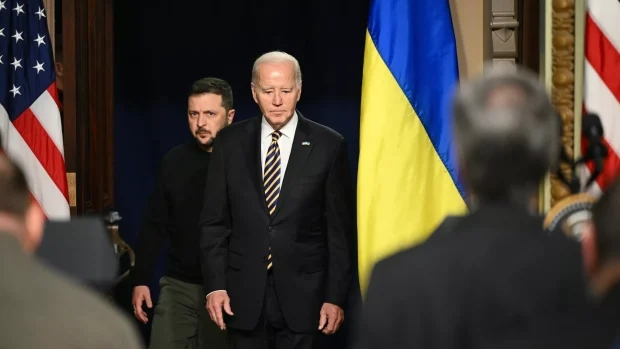
© MANDEL NGAN
Sputnik – 14.06.2024
NATO has sought to turn Ukraine into a staging ground and has done everything it could to pit nation against nation, Russian President Vladimir Putin said.
“There have been five, now six, rounds of NATO expansion. They tried to turn Ukraine into their staging ground, to make it anti-Russia. To achieve these goals, they invested money, resources, bought politicians and entire parties, rewrote history and educational programs, nurtured and cultivated neo-Nazi and radical groups. They did everything to undermine our state ties, to divide and pit our peoples against each other,” Putin said at a meeting at Russia’s Foreign Ministry in Moscow.
He emphasized that the Ukrainian crisis is not a conflict between two nations but a result of the West’s aggressive policy.
“Let me say this right off the bat, the crisis regarding Ukraine is not a conflict between two states, much less two peoples, caused by some problems between them… The matter is different, though. The roots of the conflict are not in bilateral relations. The events unfolding in Ukraine are a direct consequence of global and European developments at the end of the 20th and beginning of the 21st century. It’s the West’s aggressive, unscrupulous, and absolutely reckless policy that has been pursued for all these years, long before the start of the special operation,” he explained.
Putin pointed out that if the conflict had been solely about disputes between Russia and Ukraine, then the mutual history, culture, spiritual values, and the millions of familial ties that both peoples share would have facilitated a fair resolution.
Russia had initially sought a peaceful resolution to the Ukrainian crisis, but all proposals put forth were ultimately rejected.
“We took the Minsk agreements seriously, hoping to resolve the situation through a peaceful process and international law,” he said. Moscow expected this would address the legitimate interests and demands of Donbass and secure the constitutional status of these regions, along with the fundamental rights of the people living there. However, he added, “But everything was ultimately rejected.”
Russia, in spite of seeking to resolve the Ukrainian crisis, was, nonetheless, deceived and misled.
“The ex-German Chancellor and former French President, essentially co-authors and, as it were, the guarantors of the Minsk agreements, later admitted that they never intended to fulfill them. They just needed to buy time to build up the Ukrainian armed forces, and to supply them with weapons and equipment. They simply deceived us once again,” Putin remarked.
Putin highlighted that that Russia did not start the war in Ukraine, rather, it was Kiev that launched military assaults against its own citizens who declared independence.
The Russian leader declared that those who assisted Ukraine in its punitive operation against Donbass are the aggressors.
“Russia did not initiate the conflict [with Ukraine]. That was the Kiev regime. After the residents from a part of Ukraine, in line with international law, had declared their independence, they [the Kiev regime] launched military operations and have kept them going ever since. This is an act of aggression, given that the right of these territories to declare independence has been recognized. Those who have supported the Kiev regime’s military machine all these years are accomplices of the aggressor,” he clarified.
Scholz and Macron belong to ‘ash heap of history’ – Medvedev

German Chancellor Olaf Scholz and French President Emmanuel Macron should abandon politics after their respective parties suffered damaging setbacks in the European Parliament elections, former Russian President Dmitry Medvedev believes.
Scholz’s center-left Social Democratic Party (SPD) is projected to finish third in the key ballot, behind the center-right Christian Democrats and the right-wing Alternative for Germany (AfD).
Macron’s Besoin d’Europe coalition is expected to win less than half of the votes received by the right-wing National Rally party associated with Marine Le Pen, prompting the French president to call a snap parliamentary election after preliminary results emerged on Sunday.
In a social media post on Monday, Medvedev claimed the outcome proves that Scholz and Macron are “respected by no one.” The former Russian leader linked the poor performance at the ballot box with the “idiotic economic and migration policy” pursued by the two leaders and their support for Ukraine “at the cost of [their] own citizens.”
“Time to retire. To the ash heap of history!” said Medvedev, who currently serves as deputy chair of the Russian Security Council.
Vyacheslav Volodin, the speaker of the lower chamber of the Russian parliament, earlier called on Scholz and Macron to resign and to “stop victimizing the citizens of their states.”
Officials in Moscow have accused leaders of EU nations of betraying the interests of their populations in favor of US geopolitical goals. Responding to the Ukraine crisis in 2022, the bloc vowed to support Kiev militarily for “as long as it takes,” and imposed an array of economic sanctions against Russia. Most notably, Brussels has pushed EU countries to stop buying Russian natural gas.
Large consumers such as Germany have struggled to substitute cheap Russian pipeline fuel with other sources, including renewables and expensive liquified natural gas. American LNG producers have since taken over a large share of the European market. A hike in energy prices has forced many energy-intensive businesses to either move out of the EU or shut down entirely.
German politician flees to Russia

Olga Petersen © X / @OlgaPetersenAfD
RT | June 8, 2024
Hamburg MP Olga Petersen has sought refuge in Russia, telling Bild that she feared having her children taken by the German state over her perceived support for Russian President Vladimir Putin.
Petersen left Hamburg with her children last month, prompting widespread speculation about her whereabouts. Several weeks before her disappearance, her party – the right-wing Alternative for Germany (AfD) – expelled her from its Hamburg faction for traveling to Russia as an election observer in March and declaring the vote “open, democratic, and free.”
Alexander Brod, a member of the Russian Presidential Council for Civil Society and Human Rights, told TASS last week that Petersen had settled in Russia with three of her four kids.
Petersen broke her silence on Friday. “I have indeed taken my children out of the country,” she told Bild. “I want to know that my children are safe and that they remain in my care. Without my children, I would no longer see any meaning in life.”
According to Brod’s account, social workers had begun proceedings to take the three children – all of whom are in elementary school – into state care. Petersen offered no further details on the alleged efforts to take her children, and Bild questioned these claims, stating that the kids had been reported to youth welfare workers over behavioral problems.
Expressions of support for Russia’s military operation in Ukraine are illegal in Hamburg, with a court in the city sentencing a man to three years in prison last May for sharing “pro-Russian ideas” and using the ‘Z’ symbol – painted on some Russian military vehicles operating in the conflict – on his Telegram channel.
While there were no criminal proceedings being taken against Petersen, any kind of prison term would have resulted in her losing custody of her children. German courts can also strip a parent of their custody rights if they are deemed abusive, violent, or negligent.
Although Petersen has been expelled from the AfD’s faction in Hamburg, she remains a member of the region’s parliament and will appear on ballot papers as an independent in Hamburg’s district election on Sunday.
“I will remain a member of the Hamburg Parliament and will fulfill my obligations to the best of my knowledge and belief,” she told Bild, adding that she will ensure her children’s safety before deciding whether she is “fit for political action again.”
Germany approves plan for war
RT | June 7, 2024
The German government has finalized new plans for a potential war, including reinstatement of compulsory military service and deployment of NATO troops on its eastern flank, citing rising concerns over perceived threats from Russia.
The country’s new defense framework was approved by Chancellor Olaf Scholz’s cabinet on Wednesday, replacing guidelines that dated back to 1989. “As a result of Russian aggression, we have a completely changed security situation in Europe,” Interior Minister Nancy Faeser said in a statement.
The new defense plan spells out such details as mandatory conscription and forcing manufacturers to produce only war goods. Parts of the country could be evacuated, and subway stations, underground parking lots and other subterranean facilities would be used as temporary shelters.
Revisions to the framework also reflect NATO’s eastward expansion, which could mean coming to the aid of allies in the Baltic States. “Germany is no longer a frontline state, but serves the allied armed forces as a hub for the alliance in the heart of Europe,” the cabinet said.
The government reportedly has plans to control food distribution to deal with possible shortages in the event of a war. Those contingencies include stockpiling wheat and other grains in secret locations and creating an emergency reserve of rice and beans. The reserves would provide the German population with one hot meal a day, German media outlet Bild reported.
Beyond the military draft, citizens could be forced to work in certain civilian jobs, such as nursing or baking bread. Hospitals would have to be prepared for large influxes of patients.
Defense Minister Boris Pistorius said the new plans reflect increased security threats. “The overall defense of Germany is a task to which we all have to make our contribution, state and civil institutions, as well as each and every one of us,” he insisted. “We need a resilient society that can deal with the challenges.”
Pistorius warned German lawmakers on Wednesday that the country must be “ready for war” by 2029. He suggested that the Bundeswehr needs to be expanded, ideally by requiring military service that “cannot be completely free of obligations.”
Berlin abolished its draft in 2011, and the country’s military has faced equipment shortfalls. A parliamentary report last year said that at the current pace of military revitalization, it could take half a century to shore up German forces.
Germany and other NATO members have claimed that the bloc faces the threat of a Russian invasion if Moscow prevails in its conflict with Ukraine. Speaking at a briefing with foreign media outlets on Wednesday in St. Petersburg, Russian President Vladimir Putin said Western governments are stoking absurd fears to help maintain their global hegemony. “Someone has imagined that Russia wants to attack NATO,” he added. “Have you gone completely insane? Are you as thick as a plank? Who came up with this nonsense, this bulls**t?”
Senior German Lawmaker Demands Activation of 900,000 Reservists Amid Anti-Russia Hysteria

By Ilya Tsukanov – Sputnik – 01.06.2024
Germany went from doing its best to avoid getting dragged into the Ukraine quagmire to one of the NATO proxy war’s biggest cheerleaders, committing over 10 billion euros in military and economic support to Kiev, and suffering major economic losses due to spiking energy costs after cutting itself off from cheap and plentiful Russian pipeline gas.
Bundestag Defense Committee Chairwoman Marie-Agnes Strack-Zimmermann has urged the government and armed forces to activate 900,000 reservists in light of the so-called Russian threat.
“Putin is preparing his people for war and positioning them against the West. We must therefore become capable of defending ourselves as quickly as possible,” Strack-Zimmermann told the Funke Media Group on Saturday.
“Russia produces only weapons. School books are being printed that portray Germany as an aggressor,” the lawmaker claimed.
Therefore, she recommended, Germany needs to “activate the approximately 900,000 reservists,” first by making them register with the state. “If we could get half [of those with military experience] as reservists, that would be an incredible pool.”
Strack-Zimmermann, whose Free Democratic Party is part of Chancellor Olaf Scholz’s Traffic Light Coalition alongside the Social Democrats and the Greens, has been an avid proponent of a military solution to the Ukraine crisis from its outset, actively promoting the delivery of German heavy armor to Kiev.
Her remarks come just days after Defense Minister Boris Pistorius apparently dropped plans to reintroduce conscription under his campaign to make Germany a “war-ready” nation, and promised a new, “largely voluntary” recruitment scheme after months of internal debate in the government over the severely unpopular proposal ahead of upcoming elections for the European Parliament later this month.
The new government proposal does not mention “compulsory military service,” but could force Germans over 18 years old to fill out a physical fitness assessment questionnaire for reference. Other proposals include the waiver of administrative fees for driver’s licenses, discounts on student loan repayments, and other enticements.
The Bundeswehr has experienced a years-long slump in its recruitment numbers, with troop numbers shrinking (by 1,500 personnel to 181,500 total in 2023) despite plans to grow its ranks to at least 203,000 personnel by the early 2030s.
Germany indefinitely suspended conscription in 2011.
To deal with the dearth in recruitment and the political unpopularity of conscription, German Reservist Association Chairman Patrick Sensburg recently called on the military to systematically record the health status and availability of all former military personnel in order to create plans for their deployment for homeland security and national and alliance defense in case of a crisis. Germany counts “reservists” as all former military service members of the Bundeswehr, but does not count troops from the defunct National People’s Army of the German Democratic Republic – the pro-Soviet East Germany annexed by the Federal Republic in 1990 with Mikhail Gorbachev’s blessing on the condition that NATO does not expand the alliance to the east. Veterans of the defunct National People’s Army number in the hundreds of thousands, and faced widespread dismissal in the 1990s, miserly pension benefits, and difficulties finding work in the new Germany.
Berlin has allocated some 10 billion euros ($10.85 billion US) in military aid to Ukraine over the past two years, more than any other country in NATO besides the United States. This support has included an array of heavy weapons – from tanks and armored vehicles to air defense batteries and artillery, with Leopard 1s and 2s making up the backbone of Ukraine’s NATO main battle tanks, and destroyed by the dozens by Russia during last year’s Ukrainian counteroffensive.
Berlin joined lockstep with Washington on Friday by formally greenlighting Ukrainian strikes against targets deep inside Russia using long-range NATO strike systems, but has yet to deliver its Taurus missiles, which have a range of up to 500 km.
At home, German generals and politicians have complained of major problems with the Bundeswehr’s capabilities, including the inability to scrape together even a single 20,000-troop-strong combat-ready division after sending billions in equipment to Ukraine, and controversial plans to send “panzer battalions without panzers” to guard NATO’s eastern flanks in light of the Russian threat.”
Russian officials including President Vladimir Putin have said repeatedly that Moscow has no interest – “neither geopolitical, nor economic, nor political, nor military” – in getting into a conflict with NATO, while warning of the dangers of the Ukraine proxy war’s potential for escalation.
At the same time as Germany has ramped up defense spending and sought to increase the size and strength of its military, the country has suffered major economic difficulties throughout the course of the Ukraine crisis. Hundreds of major companies have relocated industrial production overseas amid unbearably high energy prices after the German government unilaterally rejected pipeline gas deliveries from Russia, and after US Navy divers allegedly destroyed the Nord Stream pipeline network. The traditional European industrial powerhouse’s recession has dipped in and out of recession, with Economy Minister Robert Habeck admitting in February that the country’s economy was in “troubled waters” and performing “dramatically bad.”
Ukraine: Russia won’t escalate, US will
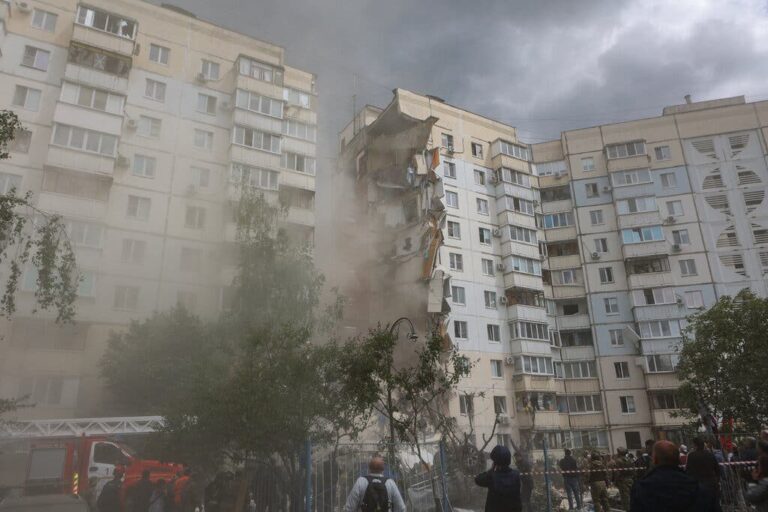
The aftermath of a Ukrainian attack on Belgorod, Russia, in May
BY M. K. BHADRAKUMAR | INDIAN PUNCHLINE | MAY 31, 2024
The United States’ proxy war with Russia is at another inflection point. The battleground is shifting dramatically to Russian territory — something without precedent even in the Cold War. How this pans out will be a momentous event in 21st century politics.
There are three defining issues here. One, the NATO strategy going forward, given the realisation in the West that there is no question of Russia being defeated in Ukraine; two, the constitutional crisis in Kiev with the presidential term of Vladimir Zelensky having run out on May 21; and, three, germane to all this, Russia’s intentions.
To be sure, the NATO and the EU are revamping their strategy while Russia hopes to remain “one foot ahead” of the West, as President Vladimir Putin put it.
Russia is not interested in an escalation as it is doing well in the war of attrition with Ukraine. Russia has effectively countered the US’ Mission Creep so far to push through all of its self-imposed limitations on aid to Ukraine and eventually breach those limits.
The big question today is how one could take the Biden Administration’s affirmation — stated by the White House National Security Council, the state department and the Pentagon — that it disfavours the use of western weaponry by Kiev to attack pre-war Russian territory.
An established pattern has set in whereby when Washington says some advanced weapon system is off limits for Ukraine, it actually turns out that Kiev just has to sit out for a few months so that Biden can cross the self-imposed red line.
Therefore, Russia will not take this as Washington’s final word. Curiously, the ground is being prepared to jettison the taboo, with both congressional Republicans and Secretary of State Blinken urging the White House to give the green light and both New York Times and Washington Post reporting that it is only a matter of time before the administration yields to formal American blessing to accelerate strikes on prewar Russia. (here and here)
The New York Times and Guardian reported on Thursday, in fact, a shift already in the US position that now allows Ukrainian US-supplied artillery to fire back at Russian batteries over the Russian border from Kharkov region and also to target concentrations of Russian forces massing on the border in Russia’s Belgorod region.
Meanwhile, a new phase is about to begin to conclude the Battle of Donbass, which, even after two years remains unfinished business. The entrenched Ukrainian military hubs in the region — Pokrovsk, Kramatorsk and Slovyansk — still threaten southern Donetsk Oblast.
Similarly, Volchansk on the Russian border facing Belgorod city and Kupyansk, also an important logistical point and railway node (almost 20 rail lines intersect in the town with about half track straight into Russia) are a thorn in the flesh for Russia’s border region.
Russians have openly stated that repeated raids into Belgorod city and its environs from the Kharkov Region needed to be countered with the creation of a “security zone”. Putin himself had spoken about this as early as in March.
From present indications, Russian operations are directed on two Ukrainian towns close to the border — Volchansk and Lypsti. Russia may stretch the front with a foray into Sumy oblast but any serious effort to capture either Sumy or Kharkov seems unlikely at this stage.
In an incisive analysis, the well-known Russia watcher Big Serge wrote last week, “The main purpose of these fronts will be to fix Ukrainian reserves in place and denude Ukraine’s ability to react on other fronts. This war will not be won or lost in Kharkov, but in the Donbas, which remains the decisive theatre.
“We currently appear to be solidly in the preparatory/shaping phase of a Russian summer offensive in the Donbas, which (likely among other things) will feature a Russian drive on the city of Konstyantinivka. This is the last major urban area shielding the advance towards Kramatorsk-Slovyansk from the south (remembering that these twin cities form the ultimate objective of Russia’s campaign in the Donbas.)”
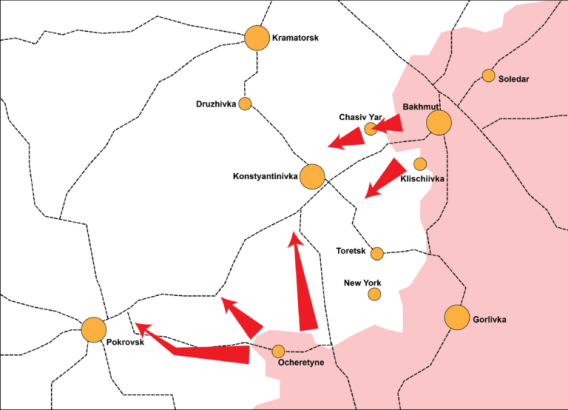
Expected Russian summer offensive
Putin has strongly reacted to the recent proxy attacks on Russia’s strategic assets with western weaponry inside its territory. Putin warned that “this unending escalation can lead to serious consequences.”
As he put it, “long-range precision weapons cannot be used without space-based reconnaissance… the final target selection and what is known as launch mission can only be made by highly skilled specialists who rely on this reconnaissance data, technical reconnaissance data.
“For some attack systems, such as Storm Shadow, these launch missions can be put in automatically, without the need to use Ukrainian military… Launching other systems, such as ATACMS, for example, also relies on space reconnaissance data, targets are identified and automatically communicated to the relevant crews that may not even realise what exactly they are putting in. A crew, maybe even a Ukrainian crew, then puts in the corresponding launch mission. However, the mission is put together by representatives of NATO countries, not the Ukrainian military.
“So, these officials from NATO countries, especially the ones based in Europe, particularly in small European countries, should… keep in mind that theirs are small and densely populated countries, which is a factor to reckon with before they start talking about striking deep into the Russian territory. It is a serious matter and, without a doubt, we are watching this very carefully.”
Importantly, Putin underscored, “If Europe were to face those serious consequences, what will the United States do, considering our strategic arms parity? It is hard to tell. Are they looking for a global conflict? I think they wanted to agree upon strategic arms…We will wait and see what happens next.”
However, there are growing signs that the Biden administration may have simply mothballed the idea of western long-range weaponry being used to destroy Russia’s strategic assets deep inside its territory until the NATO summit gets over in Washington (9-11 July) so as to keep the flock together.
Equally, Biden may calculate that it is expedient to drum up tensions with Russia rather than leave the foreign policy turf to Israeli Prime Minister Benjamin Netanyahu who may land in DC to address the lawmakers. The Israeli National Security Advisor Tzachi Hanegbi told Israel’s Kan public broadcaster on Wednesday, “we are expecting another seven months of fighting” in Gaza. The Republicans are already flagging Middle East as the single biggest foreign policy goof-up by Biden. This is where the real risk lies.
There is a remarkable consistency in the Russian words that the depth of its proposed buffer security zone along the western borders will entirely depend on security considerations. The deputy chairman of Russia’s security council Dmitry Medvedev had explicitly stated recently that the security zone may not only include Kiev but also extend as far as the Polish border if the West sends Kiev long-range weapons. Significantly, on Tuesday, Putin called into question the legitimacy of Zelensky remaining in power in Kiev after his presidential term ended on May 21.
The ball is in Biden’s court. But the signs are not good. Germany, which is the US’s closest European ally, is apparently switching tack and now says that Ukraine’s “defensive action is not limited to one’s own territory, but [can] also be expanded to the territory of the aggressor.”
The chancellor’s spokesman said Berlin’s previous stance that Ukraine wouldn’t use German weapons on Russian soil had been “a statement of facts” that was true at that moment but did not necessarily apply to the future. He refused to reveal Berlin’s precise agreements with Kiev on using German weapons.
Protests and demonstrations around the world condemn the Israeli massacres in Gaza
Palestinian Information Center – May 29, 2024
 European and Arab cities and capitals on Tuesday witnessed solidarity protests, marches, and vigils with the Gaza Strip, condemning the ongoing Israeli massacres against the displaced in Rafah in the south of the enclave.
The protesters demanded an end to the war and the punishment of the Israeli officials responsible for the genocide in Gaza, and also called for a halt to supplying Israel with the weapons it uses to kill women and children and destroy residential buildings in the enclave.
In Britain, thousands of supporters of Palestine demonstrated in the streets of the British capital London, condemning the continued Israeli massacres in the city of Rafah.
The protesters rallying in the vicinity of Downing Street, the official residence and office of the prime minister, called on the British government to condemn the Israeli aggression and stop arms exports to Tel Aviv. They raised banners condemning the continued aggression on Gaza and demanding an immediate ceasefire.
Dozens of protesters blocked the entrance to the Israeli arms factory belonging to the “Elbit” company in the British village of Chineham, in support of Gaza and condemning the crimes of genocide.
In Belgium, the Belgian police dispersed protesters in the capital Brussels with water cannons as they tried to reach the Israeli embassy as part of a protest against the bombardment of Rafah.
In Ireland, Palestinian, Arab and Irish activists supporting the Palestinian cause demonstrated in front of the Irish Parliament in Dublin, coinciding with the Irish government’s recognition of the State of Palestine.
The protesters raised the Palestinian flags and banners in support of Palestinian rights in front of the parliament garden, which witnessed the raising of the Palestinian flag for the first time.
In France, thousands of people demonstrated on Tuesday evening in Paris for the second day in a row, protesting the Israeli massacres in Rafah.
The place de la République in the center of the capital was crowded with people, and Palestinian flags were placed on the statue in the center, with a large banner reading “Stop the Genocide”.
In Norway, a demonstration was held in front of the Norwegian Parliament building to celebrate the government’s recognition of the State of Palestine, and to demand the withdrawal of Norwegian investments from Israel and pressure for an immediate and sustainable ceasefire.
The demonstrators raised Palestinian flags and banners calling for an immediate ceasefire, and banners accusing Israel of committing a war of extermination. The demonstrators called for the punishment of those responsible for the genocide in Gaza.
In the Netherlands, dozens of supporters of Palestine held a silent protest in front of the city hall in Utrecht, to condemn the burning of tents and the killing of civilian children and women in Tel Sultan, west of Rafah.
The protesters laid on the ground in front of the building to represent the scene of the victims’ deaths in Gaza, raising Palestinian flags and chanting slogans condemning the Dutch government’s support for Israel since the beginning of the aggression, and calling for the protection of Rafah.
In Canada, the city of Toronto witnessed a massive demonstration on Monday evening to condemn the massacre of the tents committed by the Israeli army in the Palestinian city of Rafah.
The activists marched through the streets of the city, chanting slogans condemning the ongoing Israeli crimes, and calling for an end to the ongoing genocide in Gaza and a ceasefire.
In Mexico, pro-Palestinian supporters held a protest demonstration in front of the Israeli embassy in Mexico City, condemning the Israeli massacre in Rafah and rejecting the continued aggression on Gaza.
Many of the demonstrators tried to storm the embassy building and pelted it with stones, amid clashes with the Mexican police.
In Jordan, hundreds of Jordanians demonstrated around the Israeli embassy west of the capital Amman, condemning the ongoing genocide in Gaza against the besieged civilian population.
The protesters chanted slogans supporting the Palestinian resistance, calling for the need to deliver humanitarian and medical aid.
They also condemned normalization with Israel and called on the Jordanian government and Arab governments to end all diplomatic and economic agreements with Israel.
In Yemen, protesters organized rallies and marches condemning the Israeli massacres in Rafah, according to the Saba news agency.
Hundreds of students participated in marches in the governorates of Sanaa, Amran and Hajjah, in support and solidarity with the resistance in Gaza and in solidarity with the oppressed Palestinian people.
In Morocco, hundreds of Moroccans, including human rights activists, organized a rally in front of the Parliament building in the capital Rabat, in solidarity with Gaza and condemning the recent massacres in Rafah.
Through banners calling to “Stop the Rafah Massacres”, the participating protesters expressed their rejection of Israel’s defiance of all international conventions and rulings of the International Court of Justice through its continued massacres in Rafah, calling on international institutions to activate their mechanisms to deter it.
Many Moroccan cities, including Tangier, are witnessing similar protest marches, at an almost daily pace, in solidarity with the Palestinian people and rejecting normalization.
German police crack down on pro-Palestinian encampment in Berlin
Press TV – May 25, 2024
German police have violently cracked down on pro-Palestinian student protesters at a university in the capital Berlin.
Students have gathered a Humboldt University’s Department of Socials to protest against Israel’s savage war against Palestinians in the Gaza Strip.
The demonstrations began on Wednesday.
Riot police entered the faculty building on Thursday evening and broke up the encampment.
A police spokeswoman said they briefly arrested 169 people and wrote down their identities.
She said that police also took further “measures restricting freedom” at a subsequent protest rally, and issued criminal summons to six more people.
Student organizers condemned violent police actions against protesters, saying the officers used unnecessary force against students.
“The violent eviction” of the student protesters, “marked by police brutality,” as well as “the failure of the university authorities to protect their students,” is a “grave injustice,” the group Student Coalition Berlin wrote in a post on Instagram.
However, the group called on students to continue protests in solidarity with Palestinians.
Encampment protests in Germany have stepped up in recent weeks after anti-Israel protests that have roiled campuses in the United States spread across Europe.
Students have been camping out and calling for their colleges to financially divest and dissociate from companies that profit from or engage in Israel’s brutal military campaign in Gaza.
The protests spread to university campuses in Berlin, Munich, Cologne and other cities across Germany.
Berlin authorities have taken a tough line against anti-Israeli protesters, labeling student demonstrators as “antisemites and terror sympathizers.”
Students say they are “witnessing a great endangerment of academic freedom” since the beginning of Israel’s war on Gaza.
In several cases, officers were seen carrying some students away, while punching their heads and repeatedly kicking them.
Despite repression and police interventions, students continue to mobilize in support of Palestine, leading demonstrations, and organizing lectures and sit-ins on university campuses across Germany and Europe as well.
Inter-EU Spat Over Air Defenses Scratches the Surface of Deep Divisions in Europe
By Ilya Tsukanov – Sputnik – 24.05.2024
Poland and Greece on one side and EU behemoth Germany on the other have presented competing visions of a common European air defense system. Sputnik asked respected Polish political observer Mateusz Piskorski about the hidden tectonic political, economic and geostrategic tensions that the rival plans have laid bare.
Warsaw and Athens on Thursday urged the European Union to join forces to create a common “air defense shield” for the bloc.
“Europe will be safe as long as the skies over it are safe,” Polish and Greek prime ministers Donald Tusk and Kyriakos Mitsotakis wrote in a joint letter to European Commission President Ursula Von der Leyen. “That is why the EU needs a new flagship program – a European air defense shield – a comprehensive air defense system to protect our common EU airspace against all incoming threats.”
The ‘shield’ “must be a program which addresses [the] major vulnerability in our security” resulting from an array of global crises, and one “which strengthens the EU’s overall defense capabilities and incentivizes European defense companies to develop cutting-edge technologies,” the letter stressed.
Von der Leyen, up for reelection in the quickly approaching elections to the European Parliament in June, quickly endorsed the Polish-Greek proposal at a debate Thursday night.
The new air defense proposals comes after –and apparently as a direct challenge to, a German-led initiative floated in 2022 to create a ‘European Sky Shield’, involving the joint European purchase of pricey air defense equipment. That project fell into obscurity after other major EU partners, including France, expressed opposition to purchasing weapons made outside the bloc.
France and Italy have been pushing their own sophisticated rival to the American Patriot missile system known as the SAMP/T – priced at roughly $500 million per battery and $2 million per interceptor missile (compared to about $1 billion per battery and $4 million per missile in the Patriot’s case). Both systems have been thrashed by Russian forces after being sent to Ukraine.
The competing EU air defense proposals and inability to agree on a bloc-wide policy to date is logical outcome of a union divided by internal political divisions, economic and strategic considerations, and the overbearing influence of Europe’s partners in Washington, says Mateusz Piskorski, a former Sjem lawmaker, independent political observer and columnist for the Mysl Polska (‘Polish Thought’) newspaper.
Piskorski reminded Sputnik that the second of the competing air defense proposals have been unveiled on the eve of elections to the European Parliament, and recalled that both the Polish and Greek prime ministers are members of the same European-level party – the center-right, pro-Europeanist European People’s Party.
“As representatives of this pan-European party, the ranks of which incidentally include Ursula von der Leyen, they are likely trying to demonstrate in the framework of pre-election activities that they have their own version and vision of a European air defense system. In other words, this is an election campaign issue,” Piskorski explained.
From that perspective, the observer stressed that there’s no question that the Polish-Greek ‘European Air Defense Shield’ is an alternative to the German European Sky Shield proposal, recalling that Chancellor Olaf Scholz’s Social Democrats are direct competitors to the European People’s Party at the EU level.
“Secondly, of course, there are certain political subtleties,” Piskorski said, pointing to lingering Greek animosities to Germany’s treatment of Athens a decade-and-a-half ago when Greece suffered economic collapse, and the strict austerity programs enforced on it at Berlin’s direction.
Poland too has “historical and political grounds” of its own to express skepticism of German initiatives, Piskorski said.
“Everyone understands that the creation of such a system – the development of this program would require the effort of all EU members,” and that a major European power – Germany or France, would have to take the lead, the observer noted.
One of the prime reasons Europe already doesn’t have its own common air defense system comes down to the influence of its “Anglo-Saxon friends, and, naturally, first and foremost the USA, who are protecting their own interests and see continental Europe as their protectorate,” Piskorski said.
The UK plays second fiddle in this arrangement, having left the EU through Brexit, closing the door to any pan-European integration projects, including defense policy.
With Central European countries like Poland owing their allegiance to the US, Piskorski rules out the creation a genuinely European mutual air defense arrangement at the current stage. “No one will say so directly, but such an initiative would not be received kindly by Washington and American authorities, just like attempts to create a common European defense policy,” he said.
“Attempts to create large, powerful structures in the military-industrial complex of continental Europe are projects which contradict the main economic and geopolitical interests of the United States,” Piskorski stressed.
That said, the observer doesn’t rule out a European move toward “strategic autonomy,” to quote President Macron of France, including as far as questions related to defense are concerned, after the presidential elections in the US, and in the event that Washington scales back its participation in and financing for various defense-related projects in Europe.
“This would make these projects more concrete and substantive. But this is a question for the future. It’s a slow process. I think that the process of gaining autonomy in this area may take at least several years, perhaps several decades,” Piskorski stressed.
Discord in Europe
Besides US intransigence, up to and including the possible use of agents of influence to resist EU air defense initiatives, there are issues of financing, as well as “technological barriers,” the observer believes.
“There are many factors here, but first and foremost of all is the question of financing. We know that, unfortunately, the European Commission’s sanctions policy and the so-called ‘green agenda’ on environmental issues, among other things, has resulted in European industry being curtailed. Europe is in a fairly deep economic crisis, at least for now,” Piskorski said.
As for technological barriers, “they are connected, first of all, with the fact that Europe has relied exclusively on the United States in this regard in the past, and did not have time to develop its own technologies to the same level… And of course, within Europe there is competition between the defense-industrial complexes of different nations. Naturally, any EU country will seek to support the interests of its own manufacturers, developers of technology, and so on,” the political observer summed up.
Germany upset by China’s embrace of Russia – envoy
RT | May 13, 2024
China’s stance on the Ukraine conflict and close ties with Russia call into question its relationship with Germany and Europe, Berlin’s ambassador to Beijing has said.
China has ramped up trade with Russia since the start of the conflict, while refusing to condemn Moscow’s actions, Patricia Flor said in an interview with the South China Morning Post on Monday.
”For Germans and Europeans, Russia’s aggression is an existential threat. This is a nuclear power next to us that just invaded its neighbour. It has really shaken up people,” Flor told the news outlet. “The situation casts doubt on China’s relations with Germany and Europe.”
German Chancellor Olaf Scholz paid a visit to China in April, and met with President Xi Jinping, who outlined four principles to prevent the conflict in Ukraine from escalating. Among them was for the West to stop “adding fuel to the fire,” which he said would lay the groundwork for peace.
Germany, a NATO member, has emerged as a top supplier of military equipment and weapons to Kiev, and has trained Ukrainian soldiers. In 2022 and 2023, Berlin spent around €6.6 billion ($7.13 billion) on military assistance to the country, according to government data.
Beijing has insisted it remains neutral in the Ukraine conflict, and repeatedly called for the crisis to be settled through negotiations.
Economic ties between China and Russia are also “of great concern” to Germany, Flor said, referring to the alleged supply of dual-use goods and components by China to Russia. Western countries claim that the goods can be used by the Russian military. The US said in April that it was ready to impose secondary sanctions against Beijing over its alleged support for the Russian defense industry.
China has denied selling weapons to Russia. In April, Foreign Ministry spokesperson Mao Ning insisted that China “regulates the export of dual-use articles in accordance with laws and regulations,” and urged “relevant countries” not to “smear or attack the normal relations between China and Russia.”
Following the introduction of sanctions against Russia by the US, the EU and their allies, Russia redirected its trade flows to the Asia-Pacific market, primarily to China. Trade between the nations hit an all-time high of $240 billion in 2023.
The Climate Cult Reacts As Its Political Position Begins To Slip
By Francis Menton | Manhattan Contrarian | May 05, 2024
For two decades and more, the political position of the climate alarm cult in the U.S. and Europe has only seemed to strengthen with time. In the U.S., the Obama and Biden Administrations have both pushed huge regulatory initiatives to restrict use of fossil fuels (with only some modest roll-backs during Trump’s four years); some of the most sweeping restrictions got pushed through just a week ago. Meanwhile, blue states like California and New York have enacted ever-more-extreme restrictions by statute. In Europe, there has been a near all-party political consensus in favor of the “net zero” agenda, notably including even the mainstream conservative parties in the largest countries like the UK and Germany.
I have long said that sooner or later a combination of physical reality and cost would stop the “net zero” juggernaut in its tracks. Indeed, that has begun to happen, particularly in Europe. Elections for the European Parliament are coming up in about a month, with climate skeptic candidates and parties looking to score substantial gains.
So how is the left reacting? So far, the official talking point seems to be to belittle the resistance to fossil fuel restrictions as some kind of scheme of the “far right.” The “far right,” we are told, are those nefarious people who dare to stand up for maintaining the living standards of the working stiffs against those who would impoverish us all in the quixotic drive to reduce carbon emissions. Somehow, seemingly independent news organizations put out articles using the exact same words and phrases. Here are a couple of recent examples.
In the Washington Post on May 1, the headline is “How car bans and heat pump rules drive voters to the far right.” Subheadline: “Studies show that as energy prices rise, so do right-wing movements against green policies.” Excerpt:
A . . . backlash is happening all over Europe, as far-right parties position themselves in opposition to green policies. In Germany, a law that would have required homeowners to install heat pumps galvanized the far-right Alternative for Germany party, or AfD, giving it a boost. Farmers have rolled tractors into Paris to protest E.U. agricultural rules, and drivers in Italy and Britain have protested attempts to ban gas-guzzling cars from city centers. . . .
Th[e] resurgence of the right could slow down the green transition in Europe, . . . as climate policies increasingly touch citizens’ lives. . . . “This has really expanded the coalition of the far right,” said Erik Voeten, a professor of geopolitics at Georgetown University and the author of the new study on the Netherlands.
The Post’s writer, Shannon Osaka, seems genuinely surprised that the common people of Europe would place any value on maintaining their standard of living:
[C]hanges to driving, home heating and farming are beginning to affect individual Europeans — sparking criticism and anger. “What’s happening as we accelerate the pace of the transition is we’re now starting to get into sectors that inevitably touch on people’s lives,” said Luke Shore, strategy director for Project Tempo, a nonprofit research organization that is assessing how climate policies affect voting patterns in Europe. “We’ve reached the point at which it’s becoming personal — and for that reason, it’s also becoming more political.” The problem, researchers say, occurs when individual consumers feel that the cost of the energy transition is being borne on their shoulders — rather than on governments and corporations.
Who could ever have guessed that this might happen? As an example of crazy “far right” lunacy, the Post cites this line from the manifesto of the Party for Freedom in the Netherlands:
“Energy is a basic need, but climate madness has turned it into a very expensive luxury item.”
I mean, how could you get any more extreme “far right” than that?
In a very similar vein, we have a piece from the Guardian on April 30, with the headline, “How climate policies are becoming focus for far-right attacks in Germany.” Again, the gist is that this is just coming from extremists that you don’t need to pay any attention to. Excerpt:
At the marches held in Görlitz, a stronghold of the far right on the Polish border, and other towns across Germany every Monday night, supporters of [the Alternative for Germany and Free Saxony] parties vent their fury at immigration, coronavirus restrictions and military aid to Ukraine. But one group bears the brunt of the blame. “The Greens are our main enemy,” said Jankus, describing the AfD as a party of freedom and the Greens as a party of bans. “We don’t want to tell people how to heat their homes. We don’t want to tell people what kind of engine should be in their car.”
Freedom — there’s a really lunatic “far right” idea. Rather than trying to explain to the readers why there is something wrong with support of “freedom,” the Guardian instead veers off into characterizing these “far right” demonstrators as really, really bad people:
[Green] party speaker Carolin Renner said she and her colleagues had had death threats screamed in their faces, white-pride stickers stuck to their door and a daily barrage of hateful comments posted on their social media channels. Shortly before Christmas, protesters dumped horse manure in front of the Greens’ office in nearby Zittau.
Despite the characterizations, the article contains no actual example of anything described as a “death threat” or a “hateful comment.” We’ll just have to take the word of the Green Party spokesperson.
Well, the European elections are just about a month away at this point. The climate skeptic parties are expected to make some noticeable gains. However, the actual mandatory requirements for most people to ditch the gas-powered car for an electric one, or to buy a heat pump to heat their home, have not yet kicked in. When that happens, perhaps we will see a real political tornado.
Featured Video

The Sordid History of the CIA – Part 2
or go to
Aletho News Archives – Video-Images
Book Review
Jeffrey Epstein: A Jewish Individual?
The Occidental Observer | February 5, 2023
One Nation Under Blackmail: The Sordid Union between Intelligence and Organized Crime that Gave Rise to Jeffrey Epstein (Volume 1 & 2) by Whitney Webb
“Far from being an anomaly, Epstein was one of several men who, over the past century, have engaged in sexual blackmail activities designed to obtain damaging information (i.e., “intelligence”) on powerful individuals with the goal of controlling their activities and securing their compliance.”[1]

Jeffrey Epstein is dead and Ghislaine Maxwell is locked away in prison, and the thought-makers of our world seem keen to let the more explosive parts of the scandal dissipate from the public consciousness. As far as the mainstream media is concerned, Epstein and Maxwell were little more than well-connected socialites who ran a sex-trafficking ring for the rich and the powerful, and the focus has shifted instead to the criminal and civil cases seeking to achieve redress for the victims of sexual abuse.
On occasion some newspaper articles will mention the hidden cameras littered across Epstein’s properties, others the reams of CDs and hard drives found within them during the FBI raids. Altogether missing from the Netflix documentaries (Jeffrey Epstein: Filthy Rich [2020] and Ghislaine Maxwell: Filthy Rich [2022]) or the articles that spend their time narrowly focusing on the links between Epstein and Bill Gates, is the acknowledgement of the true nature of Epstein himself and the ultimate purpose of this sex-trafficking of minors — a sexual blackmail operation.
Not everyone is cowardly enough to let these controversial aspects lie untouched, as the newly released two-volume book One Nation Under Blackmail by independent reporter Whitney Webb seeks to blow wide open this media-enforced blackout. Utilizing primarily open-source information (that is, publicly accessible information such as books, newspapers articles and government reports),[2] Webb’s book delves into the life and times of Jeffrey Epstein and his deep ties to Jewish billionaires and Israeli intelligence. … continue
Blog Roll
Recent Comments


 Aletho News
- Munich, 2007: The Day the West Was Told No
- At The Munich Security Conference, AOC Gets It Wrong On Foreign Policy
- Europe Decided to Go to War With Russia by 2030, Already Preparing – Orban
- Russia and China Are Expanding Their Cooperation to Counter US Efforts to Bully Iran and Cuba
- NATO plotting maritime blockade of Russia – Moscow
- Jeffrey Epstein’s sinister shadow over West Asia
- The Sordid History of the CIA – Part 2
- French FM under fire over ‘false’ claims about UN rapporteur
- Israel Wants ISIS-Linked Militias To Control Rafah Crossing — The New Order in Gaza
- ISIS never left Syria, it just changed uniforms
- If Americans Knew
- Israel battles Palestinian right of return, one Palestinian at a time – Not a ceasefire Day 127
- Noor’s short life of unimaginable suffering
- Israel Destroyed Gaza’s Hospitals. Now It’s Banning Doctors Without Borders.
- Is Spite of What Zionists Say, It’s a Good Thing to Criticize Governments
- Palestinian mother, daughter recount strip searches, harsh conditions in Israeli detention
- Israel used weapons in Gaza that made thousands of Palestinians evaporate
- ADL’s Stats Twist Israel’s Critics Into Antisemites
- Why Is the World Silent When the Gaza Genocide Is Not Over?
- In Gaza: 8,000 bodies under rubble, 3,000 missing – Not a ceasefire Day 126
- AZAPAC, the new PAC opposing Israeli domination of U.S policies
- No Tricks Zone
- Unfudging The Data: Dutch Meteorological Institute Reinstates Early 20th Centruy Heat Waves It Had Erased Earlier
- German Gas Crisis…Chancellor Merz Allegedly Bans Gas Debate Ahead of Elections!
- Pollen Reconstructions Show The Last Glacial’s Warming Events Were Global, 10x Greater Than Modern
- Germany’s Natural Gas Storage Level Dwindles To Just 28%… Increasingly Critical
- New Study Rebuts The Assumption That Anthropogenic CO2 Molecules Have ‘Special’ Properties
- Climate Scientist Who Predicted End Of “Heavy Frost And Snow” Now Refuses Media Inquiries
- Polar Bear Numbers Rising And Health Improving In Areas With The Most Rapid Sea Ice Decline
- One Reason Only For Germany’s Heating Gas Crisis: Its Hardcore-Dumbass Energy Policy
- 130 Years Later: The CO2 Greenhouse Effect Is Still Only An Imaginary-World Thought Experiment
- New Study Affirms Rising CO2’s Greening Impact Across India – A Region With No Net Warming In 75 Years
 Aletho News