Germany warns of global famine
Samizdat | May 9, 2022
The world is about to face an acute food crisis due to skyrocketing food prices, German Economic Cooperation and Development Minister Svenja Schulze told the Bild newspaper on Saturday, warning about a looming famine not seen since World War II. The minister has named the Covid-19 pandemic and Russia’s ongoing military operation in Ukraine as its causes.
“The situation is highly dramatic,” the minister told the German tabloid in a late Saturday interview, adding that, according to the UN World Food Program, “more than 300 million people” are already suffering from acute hunger and the UN has to “constantly revise” this data upwards.
Food prices around the world have grown by a third and have reached “record levels,” Schulze has warned, adding that the “bitter message is that we are facing the worst famine since World War II,” which could see “millions” die.
In its May 6 statement, the World Food Program has warned that “44 million people around the world are marching towards starvation” because Ukrainian grain cannot reach them, and called for the Black Sea ports to be opened so that this grain could be delivered to the needy.
Minister Schulze was quick to blame Moscow for the development by accusing Russian President Vladimir Putin of “waging a war through hunger.” She claimed that Russia had “stolen grain from Ukraine” and is now taking advantage of nations depending on Russian and Ukrainian agricultural products by supposedly offering food only to those, who are “unequivocally pro-Russian.”
The minister has also claimed that the fact that 40 nations that are “home to half of the world’s population” did not condemn Russia’s actions in Ukraine was supposedly a result of their “vulnerability to food blackmail.” She didn’t offer any specific evidence to support this statement, though.
At the same time, she did admit that some nations’ focus on green energy has contributed to the food shortage as well. Germany in particular should stop using food as fuel, she has suggested. Up to 4% of the so-called biofuel in Germany is made from food and animal feed, she said, adding that “it needs to be reduced to zero, and not just in Germany but potentially internationally.”
Germany “pours 2.7 billion liters of fuel [made] from vegetable oils into car tanks every year,” she pointed out, adding that this alone amounts to “almost a half of Ukraine’s sunflower oil production.”
The ongoing conflict in Ukraine has prompted fears of global grain shortages as wheat prices soared to multiple-year highs in March. Both Russia and Ukraine are major wheat suppliers, accounting for some 30% of global exports.
In mid-April, however, German Agriculture Minister Cem Ozdemir insisted that supplying Kiev with “more effective” weaponry was precisely what would have helped the world to avoid the supposedly looming “global famine.” Ozdemir, a member of the strongly pro-US/NATO Alliance 90/The Greens party, also accused Moscow of “starvation strategy” at that time.
His position appears to be quite different from at least two groups of German public figures, politicians and celebrities, who have called on Chancellor Olaf Scholz to stop arms supplies to Ukraine and to focus on a speedy diplomatic solution instead.
Continued arms deliveries would only prolong the suffering of Ukrainians as well as risk potentially devastating consequences, ranging from a possible global war to a “catastrophic” impact on global health and climate change, the co-authors of two open letters have warned. Berlin has not reacted to any of the letters so far.
Details emerge about ‘explosive device’ at Russian media site in Germany
Samizdat | May 7, 2022
An improvised explosive device (IED) discovered late on Friday on the grounds of a Berlin compound that houses journalists from Russia’s RIA Novosti and Sputnik Germany media outlets, had been stuffed into a remote basement ventilation shaft, Sergey Feoktistov, editor-in-chief of Sputnik Germany, has said.
According to the journalist, the device had been found by sheer accident when the Russian journalists and their family members had been clearing dirt and removing glass shards after a window at the compound had been smashed by a bottle in another suspected attack.
The center’s residents and Russian media office staff at first thought it was a mock-up device designed to just scare them, the editor-in-chief admitted, adding that the device even appeared to be somewhat “comic” at first.
“What put us on alert was that it was hidden,” Feoktistov explained. The IED was found at a relatively “remote” area not frequented by staff members, he said, adding that people at the compound usually do not check the basement ventilation shafts.
Now, after the police have confirmed to him it was a real IED, Feoktistov believes it could have caused some serious damage to the area. “Should it have gone off, there would have been a major blaze,” the editor-in-chief said, adding that it “was planted not to just intimidate us.”
The bomb, which appeared to be a jerry can wrapped in duct tape with visible wires protruding out of it and filled with a “mixture of petrol and oil,” had been placed in such a way that all that flammable liquid would get into the basement in case of an explosion, Feoktistov explained.
The police are also treating the incident seriously, he said, adding that large police forces, including sappers, regional and federal criminal police, had been deployed to the scene. According to Feoktistov, the officers called it an improvised “incendiary bomb” during a conversation with him. Police have not made any official statements relating to the incident so far.
According to Feoktistov, it is not the first instance in which the compound for Russian journalists and their families has been attacked. The residence has been pelted with bottles and eggs and its walls have been sprayed with offensive graffiti in Russian, the editor-in-chief has said, adding that the compound residents have filed between five and seven complaints with the police over such incidents.
No suspects have so far been identified in this case, Feoktistov has said, adding that, according to him, it could be almost “anyone.” The Berlin police has remained tight-lipped on the incident, only telling local media that the officers had carried out an “investigation” at the site.
India, Germany cogitate on Ukraine
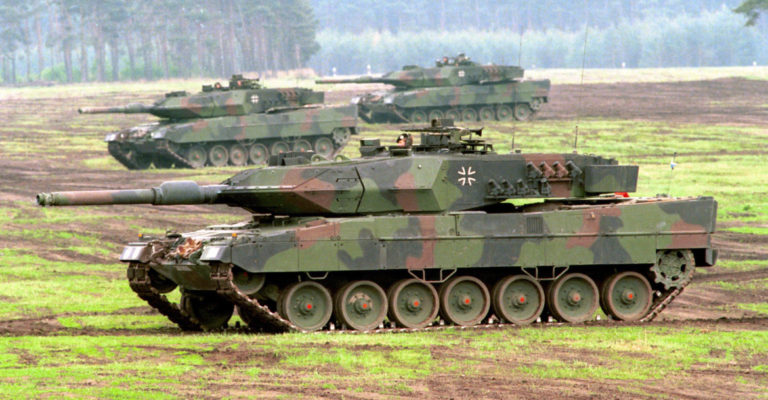
Germany to send fifty Leopard 1 tanks to Ukraine to fight Russia
BY M. K. BHADRAKUMAR | INDIAN PUNCHLINE | MAY 3, 2022
Prime Minister Narendra Modi’s short visit to Germany pegged on the Indian-German Intergovernmental Commission meeting in Berlin on Monday inevitably came to focus on the Ukraine crisis. The western media would have loved to grill Modi on India’s reluctance to criticise Russia’s special military operation in Ukraine. But German hosts thoughtfully skipped the customary Q&A after the joint appearance of Modi and Chancellor Olaf Scholz before the press.
India’s prudence is self-evident as much as Germany’s zealousness to flaunt its condemnation of Russia. Modi and Scholz are sailing in different boats. Modi draws flak for being a “strongman” who views the Ukraine crisis through the prism of India’s interests, while also taking a principled stance, whereas, Scholz carries the burden of vacuous moralising.
Scholz must prove constantly that he is indeed a loyal ally of President Biden and is by no means a “pacifist.” (To get a hang of Scholz’s predicament, read Spiegel’s maddening interview with him, here — alternatively annoying, infuriating, taunting, affronting and goading.)
Modi can afford to be nonchalant because he is clearheaded about where Indian interests lie — its strategic autonomy in a highly unpredictable international environment. But Scholz is nervous as a mouse because German interests are caught up betwixt the crosscurrents of European politics and the NATO’s epochal struggle to bring Russia down on its knees.
Modi is well ensconced in power while Scholz heads a precarious coalition of disparate partners. Modi could witness Scholz and his foreign minister Annalena Baerbock speaking in two different voices on Russia. Baerbock insisted that Russian forces should vacate Ukrainian soil before Western sanctions can be lifted, but Scholz toned down saying that the lifting of Western sanctions is linked to Russia and Ukraine reaching an agreement.
Germany is a divided house when it comes to Russia ties. On the contrary, aside the clutch of noisy American lobbyists operating in India, the Indian public at large recognises the centrality of India’s friendly relations with Russia.
India gets the space to manoeuvre, as Russia is excessively indulgent towards Delhi’ stance, which is, quintessentially, neither to support nor to oppose Moscow’s intervention — something like Professor Godbole in the EM Forster novel A Passage to India, a Brahman Hindu who is very spiritual and reluctant to become involved in human affairs.
 Scholz who is new to international diplomacy could have learnt a thing or two from UK prime minister Boris Johnson’s recent visit to India. Johnson put Ukraine on the back burner and focused on the agenda of “Global Britain” to create his country’s post-Brexit pathway in India’s vast market.
That said, Scholz has done remarkably well in getting the US off his back over sanctions against gas supplies from Russia. Germany’s dependence on Russian supplies of oil and gas (and coal) has been heavy and the Americans accept it as a reality. The point is, Germany and Russia have had a dense relationship and the Ukraine crisis comes in handy for Washington to try to redefine the parameters within which German-Russian relations will work in future.
In India’s case, if Washington dared to bully the Modi government, it was largely because in the post-Cold War era, under successive Congress governments, India’s relations with Russia got atrophied to such an extent that Americans convinced themselves that it was a conscious Indian policy direction dictated by the compulsions of the “Washington Consensus,” which has been a beacon light for India’s past leaderships. Unsurprisingly, the Biden Administration misjudged that Modi too must be fair game.
But the core difference between the German and Indian predicament is that while German industry is a stakeholder in the relationship with Russia, India’s corporate houses, for reasons best known to them, sidestep the Russian turf in deference to the US wish. Thus, Washington has powerful Indian lobbyists and, therefore, the Modi government’s audacity to pursue an independent policy toward Russia becomes commendable.
The chances are that Germany may pick up the threads of its relationship with Russia once the Ukraine conflict ends. In the chronicle of the “German Question” in European history, Russia had the role of a balancer, mostly. But there is a deep economic and political crisis waiting to erupt in Germany and how it pans out is crucial.
The rising inflation and the dramatic fall in living standards is souring the German mood, as the debris from Ukraine falls on it. So far, an estimated 5 million Ukrainian refugees have entered Europe. This figure is expected to double in a near future.
Meanwhile, the looming food crisis will also put tens of millions of people in Africa or the Middle East on the verge of starvation fuelling in turn large scale migration to Europe. Such migration will inevitably bring the dregs of Ukrainian society into Germany, which means that organised crime, human trafficking, illegal drug distribution and transnational crime, etc. will increase. Make no mistake that the Ukrainian mafia will introduce a new vicious culture of crime as it begins to dominate the European streets.
All in all, a fine balance has been struck during Modi’s visit. The joint statement conceded the host country’s prerogative to reiterate its “strong condemnation of the unlawful and unprovoked aggression against Ukraine by Russian Forces.” But it formed a “stand alone” statement of a solitary sentence, which helps signal India’s distancing from it. Germany joined India’s call for an “immediate cessation of hostilities,” although Berlin just announced a major transfer of offensive weaponry to Ukraine as part of the US-led “coalition of the willing” and implicitly acquiesces with the Biden administration’s aggressive agenda of “weakening Russia” militarily.
Significantly, the sombre mood in Germany got reflected in the joint statement. The Indo-German economic relations are far below potential and will remain so. CNN carried a grim report in the weekend that not only is German economy heading into a recession but it may suffer “structural damage” that will make recovery a drawn-out process.
Clearly, behind the German rhetoric today, the fact remains that Berlin’s intelligence apparatus played a dubious role in Ukraine by navigating the ascendancy of the neo-Nazi forces to usurp power in Kiev in the coup in February 2014. This controversial past is now further complicated by Berlin fuelling the conflict by despatching tanks into Ukraine, which was after all the invasion route of Nazi Germany.
When it comes to Ukraine, Germany doesn’t make good company for India. We have a transparent record and with great honesty and integrity, Modi could forewarn , with Scholz listening, that “there will be no winning party in this war, everyone will suffer.”
Following the Science is Impossible and Stupid
Institutional science follows politics; it will always endorse central regime policies

eugyppius | April 30, 2022
During the pandemic, Germany closed schools on a wider scale and for a longer duration than most other places in the civilised world. I was recently reminded of how our government came to embrace these extreme policies. The story is very revealing:
It began with the strange decision of state media to elevate Christian Drosten at Berlin Charité to national prominence, by granting him the Coronavirus Update podcast on 26 February 2020. The WHO had just endorsed lockdowns two days before, and various countries were acquiring new Corona tsars – random virus wizards who would become the face of containment policy to panicking domestic audiences. Every day, Drosten’s banal podcast interviews were reported breathlessly across the German media, as if they meant anything.
It’s important to remember that Drosten is a virologist. He’s not a statistician, and for what it’s worth, he’s not a public health expert either. He studies how very small proteins work and how they interact with human cells. Nevertheless, Drosten had (or claimed to have) a wide range of opinions on matters outside of his field, including the question of whether closing schools would slow down SARS-2.
At first, Drosten said that he didn’t think this would accomplish very much. Like everyone else of his ilk, he had an early history of saying basically correct and sensible things before he went crazy. On 11 March 2020, he went home and read this paper on Nonpharmaceutical Interventions Implemented by US Cities During the 1918–1919 Influenza Pandemic. It wasn’t his field; his assessment of its analysis is worth no more than mine or yours. But after reading it, he decided that actually closing schools would be a great idea, especially when used in combination with other interventions, such as banning mass gatherings. This was wind in the sails of hystericists like Markus Söder, minister president of Bavaria. And so we closed our schools, and our kids endured months of social isolation and mental anguish, because Drosten read a thing and had a brilliant idea.
But, that’s only the official story. It may be vastly worse than that. I really doubt, for example, that Drosten’s ridiculous podcast was a spontaneous programming idea by Norddeutscher Rundfunk. I suspect, instead, that there’s a reason lockdowns and Corona tsars went together in those early days. Primary was the political or bureaucratic decision to do all this crazy stuff, in the absence of any evidence aside from some dodgy numbers out of Wuhan. Thus the genius smart guys who run our institutions had to find celebrity virus astrologers, who could become the public face of novel policies and provide a simulacrum of science for the politicians to pretend they were following. It’s even odds, whether Drosten really did change his mind because of a paper he read one night; or whether it was rather the political or bureaucratic faction behind Drosten that changed their minds and gave him a paper or two to read.
Science isn’t some objective reasonable force outside of politics. Scientists spend most of their careers chasing government grant funding, and fighting for appointments and promotions in government-funded university systems. Science follows politics, and nobody knows this as much as the disingenuous politicians who claim that their policies are subordinate to scientific findings.
Germany to supply Ukraine with heavy weaponry
Samizdat | April 26, 2022
The German government has given the green light for the delivery of self-propelled anti-aircraft guns to Ukraine, the country’s Defense Minister Christine Lambrecht said on Tuesday.
Speaking at US-hosted defense talks at the American airbase Ramstein in Germany’s Rhineland-Palatinate state, Lambrecht said that the leadership in Berlin made the decision on Monday. She emphasized that Germany was “determined to help the Ukrainian people with unified resolve in this existential emergency.”
The minister explained that “Ukraine will order” hardware from German manufacturers and “Germany will pay.” Berlin would earmark some 2 billion euros to that end, Lambrecht added.
The armored vehicles in question are Gepard self-propelled anti-aircraft guns, which were decommissioned by the German military back in 2010. Designed to take out cruise missiles and aircraft, Gepards can also be used against targets on the ground. As many as 50 heavy vehicles could reportedly be delivered to Ukraine. Defense firm Krauss-Maffei Wegmann will now refurbish the equipment before transferring it on to Kiev, Germany’s dpa news agency reported. It is, however, not known when exactly Ukraine can expect delivery of the anti-aircraft systems.
Lambrecht also announced that Berlin “has initiated a swap scheme with our partners in eastern Europe” that is ensuring that “Ukraine is quickly obtaining heavy weaponry that doesn’t require lengthy training.” But, according to the minister, Germany could do a lot more in this respect.
On top of that, Berlin will be cooperating with the US and the Netherlands when it comes to providing training to Ukrainian troops on German soil in the use of various artillery systems.
Lambrecht made the announcements during a meeting of defense ministers from 40 countries hosted by US Defense Secretary Lloyd Austin on Tuesday.
Earlier this month, several German outlets reported that Germany’s Rheinmetall arms manufacturer was prepared to sell 88 decommissioned Leopard tanks, as well as ammunition, spare parts and tools to repair the hardware. Training on the equipment would also be provided to Ukrainian troops. The company was awaiting the German government’s approval, the media said at the time.
Moscow has repeatedly condemned NATO arms supplies to Kiev, saying they only destabilize the situation on the ground and hamper the prospect for peace. It also warned that any equipment deliveries will be considered a legitimate military target for the Russian forces once they cross into Ukrainian territory.
“NATO is essentially going to war with Russia through a proxy and arming that proxy. War means war,” Russia’s Foreign Minister said on Monday.
Christian Drosten, Karl Lauterbach try to block Health Ministry committee set to evaluate lockdowns and other containment measures

Health minister Karl Lauterbach caught maskless on a train
eugyppius | April 25, 2022
In March 2021, the German Bundestag ordered the Ministry of Health to set up an expert committee to evaluate the effectiveness of containment measures in Germany, from lockdowns to masks. They required this committee to complete their evaluation by 30 June 2022, and to publish a report before the end of September.
The committee finally convened on 22 April via video conference, delayed apparently because communicating with Karl Lauterbach’s ministry has been a huge problem. In the hours after that meeting, the committee chair notified its members that he had finally heard from Lauterbach. The health minister had raised the idea of extending the evaluation deadline to 31 December, and suggested that the committee mandate might end up being redefined.
As Welt explains, Christian Drosten had previously voiced staunch opposition to the project of investigating the efficacy of containment measures:
… [A]n internal virtual meeting in March, Charité virologist Christian Drosten argued against individually evaluating the containment measures. In a nine-minute speech, he said there was too little data, it was too early for such a study, and one could end up “in hot water,” according to WELT information. In view of this intervention from Drosten, who has been one of the most important advisers to political decision-makers since the start of the pandemic, the committee turned to the Ministry of Health for further instructions.
Nothing came of that meeting; the committee had a mandate from the Bundestag, the legal force of which does not rest upon Drosten’s feelings.
When Welt asked the health ministry to comment on the latest delays, a Lauterbach spokesman said the experts don’t have sufficient data, and that the ministry is in discussions with the Bundestag about how to handle this. He even denied that there would be any delay in the committee’s work, which is plainly a lie, because Welt has documents and off-the-record statements from committee members to the opposite effect. One such member even complained to their reporter that “It shows great disrespect to try to withdraw our mandate to evaluate containment measures after so many hours of work.”
We are asked to believe that containment measures have been super successful in the past, and that they remain an important tool for future waves. Lauterbach himself has promised the return of containment in the Fall, because he did not get his vaccine mandate. At the same time, nobody must be permitted to evaluate the efficacy of these allegedly crucial measures. We can’t be allowed to know which ones work and which ones don’t. That would be dangerous somehow, even for an expert committee. In fact it would be so dangerous, that Christian Drosten, the public face of mass containment in Germany, felt compelled to deliver a secret lecture warning against any such evaluative process.
What’s really galling about all this, isn’t that they’re lying, but that they’re terrible at it.
German businesses note impact of skyrocketing energy costs
Samizdat | April 25, 2022
About 40% of German companies have already felt the consequences of the rapid rise in energy prices over the past several weeks, a survey by the Ifo Institute for Economic Research in Munich published on Monday has found.
The survey covered 1,100 German enterprises, 950 of which were family owned. As many companies surveyed have long-term supply contracts, not all respondents said they felt hefty price increases so far. However, a quarter of the firms surveyed said they expect their energy costs to spike in the second half of this year, while another quarter believe it will happen in 2023. The survey also showed that almost 90% of businesses are likely to raise prices to counter the skyrocketing energy costs, and three-quarters of the companies intend to invest more in energy efficiency.
Some 11% of the firms are considering the possibility of completely abandoning energy-intensive business areas, and 14% are studying the possibility of cutting their staff. Still, only a small percentage of the surveyed companies want to move their offices abroad.
“We need a policy that corrects this distortion of competition and stops skyrocketing energy prices,” Professor Rainer Kirchdörfer, one of the experts behind the survey, said, referring to the fact that Germany had significantly lost its competitiveness in energy policy even before the current energy crisis, brought about by the events in Ukraine.
Energy prices soared last month, after Russia launched a military operation in Ukraine, which triggered a flood of Western economic sanctions against Moscow, though the measures stopped just short of an embargo on Russian crude oil and natural gas. Russia retaliated by introducing a new ruble-based payment mechanism for its natural gas, hinting at the possibility that other energy exports might follow.
According to the German news agency DPA, citing data from the Verivox online platform, the increase in energy prices will inevitably lead to a significant increase in electricity prices for private consumers in Germany this year. Electricity suppliers in the country, responsible for roughly 13 million households, have already announced an increase in tariffs in April, May and June by an average 19.5%. Growth in gas prices is expected to be even greater, at about 42.3%.
According to Verivox, if a household paid an average of €1,171 ($1,258) for electricity per year prior to the Ukraine crisis, with the current costs it will have to pay some €1,737 ($1,867). The situation is even worse with natural gas: a household that paid €1,184 ($1,272) for gas annually in April last year would pay €2,787 ($2,995) at current prices, which equals to an increase of 135%.
The EU pledged to end its dependence on Russian energy earlier this month, despite importing roughly 40% of its gas and 30% of its oil from the country. However, experts and politicians within the bloc have warned that banning Russian energy imports could only lead to further price spikes, as it would be impossible to find an alternative quickly enough.
Sending heavy weapons to Ukraine in German interests?
By Lucas Leiroz | April 22, 2022
Political polarization in Germany continues to increase. Currently, there is strong pressure for German Chancellor Olaf Scholz to take a more incisive stance on the Ukrainian issue. The opposition insists on the need to send weapons to support Zelensky, endorsing the speech spread by NATO and the EU. It is evident that by refusing to take such positions, Scholz is trying to look for the interests of his country, but it remains to be seen whether he will be really strong enough to deal with the pressure coming both externally, from Brussels and London, and internally in Berlin.
Recently, Scholz met in London with his British counterpart Boris Johnson to discuss the Ukrainian conflict. During the conversation, Johnson clearly pressed Scholz to go along with the UK and the rest of the West in their stance of absolute opposition to Russia in the conflict. The Chancellor, however, avoided giving clear answers and maintained his ambiguous position on the possibility of supporting Kiev militarily, preventing from doing more incisive statements and preferring silence.
What happened next was even more remarkable and symbolic: the British prime minister traveled to Kiev to meet with Zelensky while Scholz returned to Germany in order to promote electoral campaign. The international mainstream media took advantage of the fact to intensify its pro-NATO propaganda, claiming that Scholz is concerned only with his internal political condition, ignoring the current international situation, while the Western world is supposedly “concerned” and takes the Ukrainian issue as a “humanitarian” priority.
In Germany, Scholz’s opponents are also increasingly agitated to criticize the chancellor, taking benefit of international pressure to intensify polarization and generate a crisis of legitimacy against him. Obviously, this was a predictable attitude on the part of opposition groups, but the main problem currently is that Scholz is losing support within his own coalition. The Free Democratic Party (FDP) and the Green Party are deeply dissatisfied with Germany’s unwillingness to send weapons to Kiev and use the case as a pretext to point to Scholz as a “big problem” to be solved through an electoral overthrow. And, in this sense, his situation is really worsening day after day.
In general, Scholz’s enemies demand that he takes a more active stance on the German role in the conflict. The chancellor is characterized by an extremely passive posture, avoiding making decisions until they become inevitable. Marie-Agnes Strack-Zimmermann, a member of the FDP and head of the Defense Committee in parliament, for example, recently commented that Scholz needs to “take the baton in his hand and set the rhythm.” In other words, opponents are asking Scholz to guarantee Germany a leading role on the European stage, as might be expected from the continent’s greatest economic power.
The central problem in this topic is that Scholz already seems to have realized that the most strategic thing for Germany is to remain as neutral as possible and away from any involvement in activities that harm the partnership with Russia, which is a very important commercial pillar for Germany. Scholz did not want to adhere to large-scale economic sanctions, especially regarding the SWIFT ban and the energy boycott. But he was forced to slowly accept such measures as other Western countries implemented them. This has been his typical behavior: postponing but, in the end, passively adhering to all Western measures when he finds himself “isolated”.
In this sense, the opposition is right on one point: Scholz has to change his attitudes and assume a leadership position, since this is what is expected from a country like Germany, which for years has consolidated itself as one of the “leaders” of the European bloc. The oppositionists’ problem is that they are pressuring Scholz to assume a leadership stance that is as damaging to German interests as his current indecision and passivity.
It is naive to think that sending heavy weapons to Ukraine benefits German interests in any way. On the contrary, it only extends the abyss between Moscow and Berlin even further, and with practically no benefit in return for the Germans: neither Ukraine will be sufficiently strengthened to win the conflict by receiving such heavy weaponry, nor will Germany reassume a supposed role of “leadership” in Europe.
It is not by chance that the greatest pressure on the Germans so far has been exerted precisely by Boris Johnson. The UK is not part of the EU and therefore does not care about the German role in the bloc, but, on the other hand, it is one of the most important members of NATO and tries to elevate its status in the military alliance as a way of boosting its international image in this post-Brexit context. In fulfilling British requests, Scholz would only be pursuing non-German and non-European interests.
It is obvious that there is also pressure within Europe and within Germany itself, but this pressure belongs to an outdated view of what the role of Germans and Europeans in the Western world should be. Scholz’s opponents apparently still expect a totally submissive stance on NATO from Berlin. This is also a very active thought in Brussels, with a strong tendency to see the entire European continent as a mere annex of the American military umbrella, ignoring that Europe has its own interests, which can often collide with those of the Western military alliance. That is why, in trying to prevent Germany from getting actively involved in the Ukrainian case, Scholz proves to be a really pragmatic politician who prioritizes the interests of his own country, but without the political force necessary to guarantee them.
In addition, there is a topic that needs to be mentioned, which is the German military passiveness of the last seventy years. Although it is active within NATO and has been trying to reform its defense forces in recent years, Berlin remains a virtual-demilitarized country, with an army of low offensive potential, outdated weaponry and a low-investment war industry.
In order to send heavy weapons to Ukraine, Germany would have to start a broad military industrial investment, which would cost it not only millions of euros, but a change in its international image, returning to being a nation of effective participation in international conflicts. Of course, improving its military status is a German right, but it must be taken into account in the name of what Berlin intends to do so. Would it really be strategic to break with seventy years of pacifism to defend the interests of the Maidan Junta in a conflict where Russian victory is highly predictable?
Scholz needs to be strong and active in defending German interests. His posture of passivity and silence demonstrates weakness and damages the image of both him and his country. But his stance must not be to subject Germany even more to foreign interests: on the contrary, he must assert what is in Berlin’s interests and pragmatically defend it, even if he has to clash with the NATO’s plans to do so. If Germany is interested in neutrality and maintaining good relations with Russia, Scholz must not only refrain from adhering to the new Western sanctions but also revoke those taken so far.
Lucas Leiroz is a researcher in Social Sciences at the Rural Federal University of Rio de Janeiro and a geopolitical consultant.
Why Is Russia Still Collaborating With Countries That Are Actively Working to Destroy It?

By Edward Slavsquat | Anti-Empire | April 20, 2022
Close your eyes and imagine you’re Russia.
You’re scrambling to create an alternative financial system in order to bypass 100 gazillion sanctions.
At the same time, you’re formulating “global health” policies with the same countries that are actively trying to destroy your economy.
Something doesn’t quite add up here.
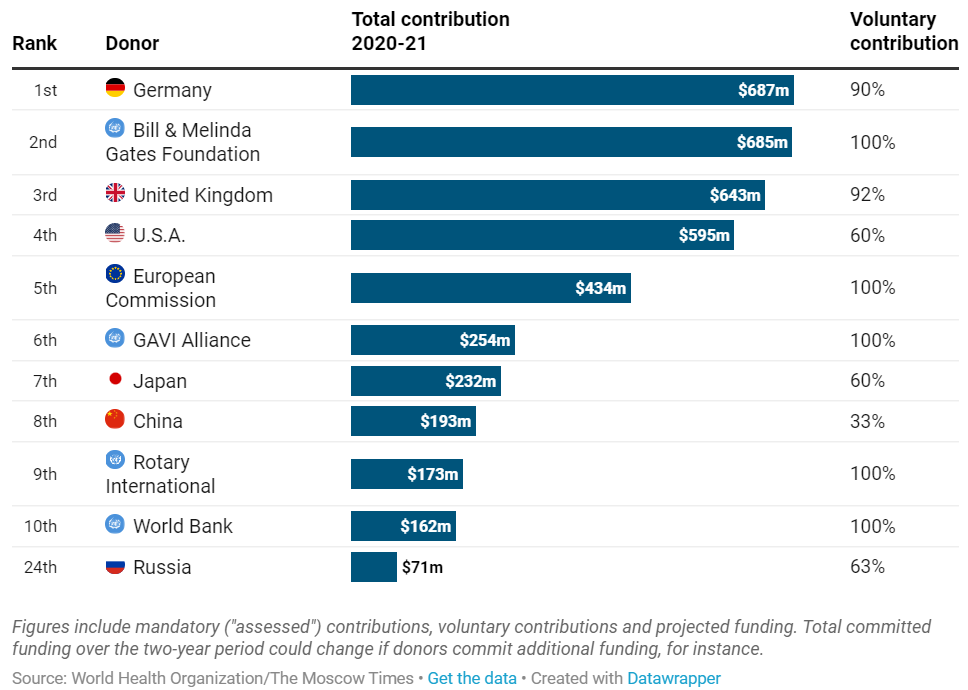
Imagine being Russia and implementing “health recommendations” from an organization funded by Germany, Bill Gates, the UK and the USA. And yet…
There is endless excitement about Russia’s imminent “economic sovereignty,” but what about Russia’s medical sovereignty? Does it matter if Russia adopts the golden petro-yuan (or whatever) if it continues to copy-paste “health measures” drafted by an organization that gets most of its funding from NATO states and Bill Gates?
It’s a serious question, especially because the WHO is forging ahead with its so-called “global pandemic treaty.” Slated for completion in 2024, the agreement will give the World Health Organization unprecedented powers to combat new outbreaks of positive PCR tests.
Does Russia really need this? After two years of the WHO’s non-stop virus scamming, maybe it’s time to pull the plug?
Thankfully, a grassroots campaign (aided by lawmakers) seeks Russia’s immediate withdrawal from the WHO. This is an excellent idea—but is it possible?
Russia’s unrepentant WHO-love
It’s fun to fantasize about loading Dr. Tedros into a Novichok cannon and launching him into outer space, but it’s not so simple. The World Health Organization has friends in high places. Some prominent WHO-lovers in the Russian government include:
Dmitry Medvedev, Deputy Chairman of the Security Council: This guy is completely smitten with global “health” tyranny. In November, Medvedev whined about how the WHO lacked “the leverage to force states to pursue a single, coordinated policy at all levels” during a declared worldwide health emergency. Thankfully he offered a solution to this terrible conundrum:
It is necessary to think about giving WHO the authority to make significant mobilization decisions in the interests of the entire world community in an emergency situation (for example, during a pandemic). It is likely that in order for the WHO to obtain such authority, it will be necessary for the UN members to adopt an international convention on cooperation in this area.
There you have it: Medvedev has fully endorsed the idea of a pandemic treaty and wants Russia to submit to the WHO whenever there are too many positive PCR tests or other existential threats to public health. (It’s charming how over the last two months, Medvedev has endeavored to rebrand himself as a mighty crusader against the depraved West. Yes, he’s a true patriot.)
Mikhail Murashko, Health Minister: Okay, maybe Medvedev is an insufferable WHO groupie, but so what? He’s not in charge of health policy. That’s Murashko’s job:
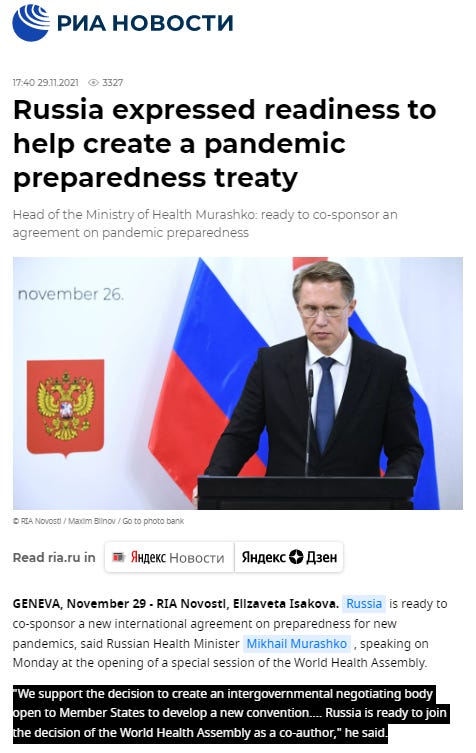
Yikes.
Russia has agreed to participate in the creation of a pandemic treaty, but with the stipulation that any new agreement should not “duplicate” previous accords.
What does this mean, exactly? It’s open to interpretation and gives Russia room to maneuver. [It sounds to me like it means the new agreement should go beyond existing agreements.] That being said, Murashko can hardly be described as hostile to the WHO; on the contrary, he’s worked tirelessly to make Russia WHO-friendly. Unsurprisingly, Murashko is also an unapologetic advocate for digital cattle tags.
Tatyana Golikova, Deputy Prime Minister: Russia’s former health minister (2007-2012) is True Believer who has been heaping praise on the WHO for more than a decade. Over the past two years she’s been instrumental in ensuring Russia’s adoption of WHO-endorsed anti-health measures.
But there’s also been some finger-wagging. In May 2021, Golikova told the WHO it needed to “speed up” its procedure for approving new vaccines. Because public health.
Sergey Sobyanin, Mayor of Moscow: In September 2020, Sobyanin thanked the WHO for inspiring him to impose a lockdown on Russia’s capital.
“I would like to express my gratitude to the World Health Organization, which from the first days of the pandemic has always informed the world community, both Russia and Moscow, about the processes that are taking place in different countries that were the first to be infected with COVID-19,” the mayor told Hans Kluge, the director of the WHO’s European Bureau.
Nine months later, Sobyanin became a trailblazer for compulsory vaccination and QR codes in Russia.
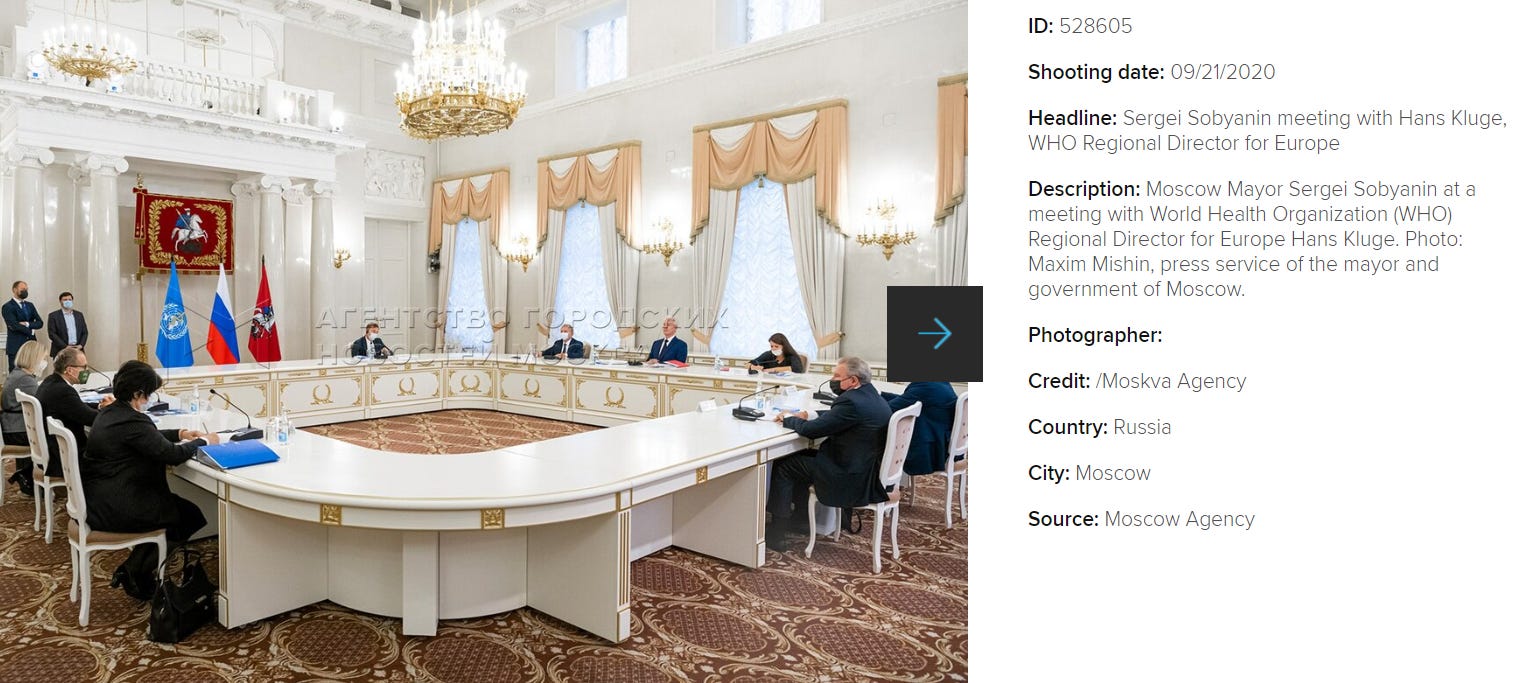
Cool WHO flag, bro.
Anna Popova, head of the Federal Service for Supervision of Consumer Rights Protection and Human Welfare (Rospotrebnadzor): As Russia’s chief sanitary doctor, Popova has taken on the role of National COVID Nanny. Her penchant for arbitrary and useless “epidemiological” measures can be attributed in part to her devotion to the WHO.
In October, Popova supervised a WHO exercise held in Kazan that simulated the outbreak of an infectious disease.
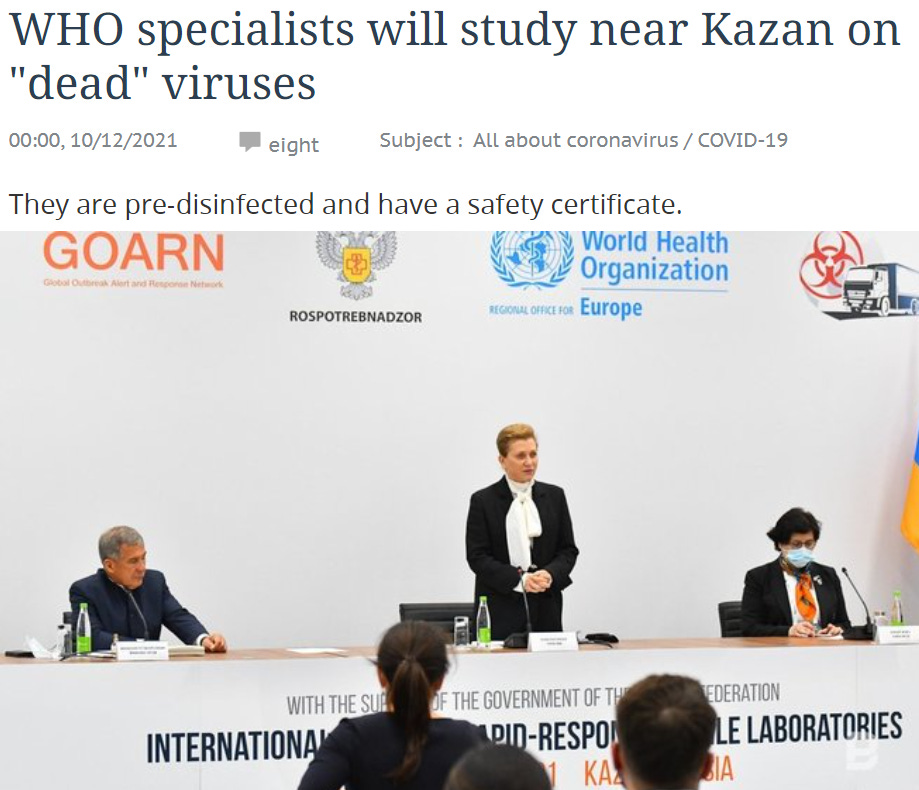
Popova oversaw WHO-sponsored Virus Games in Kazan (source)
The Rospotrebnadzor chief said the simulation would be used to develop international standards for rapid response to “epidemiological threats” around the world.
Ungrateful Kazan residents protested against the WHO-sponsored Virus Games, apparently because they felt they were being used as guinea pigs (ridiculous!).
Russia’s upper management is basically completely A-Okay with the WHO. So, uh, who doesn’t like the WHO? We’re glad you asked…
The fellowship of anti-WHO Duma deputies
Russia’s parliamentarians are starting to ask: “Hey, why are we part of an organization that is almost entirely funded by hostile NATO members/Bill Gates?” Good question.
Pyotr Tolstoy, Deputy Chairman of the State Duma: Tolstoy has called for Russia to withdraw from the WHO as well as the World Trade Organization and UNESCO. According to the senior lawmaker, it was idiotic of Russia to join these esteemed US-dominated global bodies in the first place.
Yana Lantratova, First Deputy Chairman of the State Duma Committee on Education: Lantratova believes Russia should suspend its cooperation with the WHO due to the organization’s links to biological laboratories in Ukraine.
“All of you know about the work of WHO around the world, it seems to me that interaction with this international organization in the current geopolitical situation does not meet the national interests of the Russian Federation,” she said last week. “Russia should suspend its membership in the WHO until the end of the parliamentary investigation. This will not affect on the health care system in Russia, but the fact that the organization has been collaborating for several years with biological laboratories created in Ukraine by American specialists cannot be ignored.”
Sergey Leonov, Deputy Chairman of the State Duma Committee on Health Protection: Although he opposes leaving the WHO, Leonov thinks Russia should stop paying membership fees.
“It is not entirely clear what benefit this organization brings to us,” the deputy said on March 30.
Sergei Mironov, parliamentary leader of A Just Russia — For Truth: Mironov and other members of his party recently introduced a draft resolution to the State Duma calling for Russia to suspend its membership with the WHO.
The proposed legislation would halt cooperation with the organization pending the results of a parliamentary investigation into the WHO’s dealings in Ukraine.
While lawmakers are focusing their rage on Ukraine-related WHO shenanigans, Russian activists have taken a more “big picture” stance: The World Health Organizations is actively destroying our health, and that’s bad.
“A direct threat to our national sovereignty”
What’s going on outside of the Duma chambers? Quite a bit.
A group of prominent Russian activists held a roundtable on April 14 to discuss how to safeguard Russia’s medical sovereignty. According to an excellent report from Katyusha.org, numerous participants called on Russia to withdraw from the WHO.
Anti-clot-shot crusader and conservative firebrand Alexandra Mashkova-Blagikh (whom your humble Moscow correspondent had the honor of meeting at the Doctors For Truth conference in December) gave a particularly rousing speech at last week’s event:
The WHO has been turned into an instrument of geopolitics. Whom it serves is clear if you look at its main sponsors: the USA, the Bill Gates Foundation, Germany, Britain… In the conditions of the war being waged against Russia, we cannot afford such a partnership. We are dealing with cultural, value, demographic and biological terrorism.
Now, under the pretext of the need to fight a “pandemic”, the WHO seeks to expand its power around the world through the Pandemic Agreement. This is a direct threat to our national sovereignty. It is obvious that this structure will never act in the interests of our country, and the time has come to withdraw from this organization. It is encouraging that serious politicians have started talking about this.
A coalition of activist groups has also issued an open letter calling for the removal of WHO-loving government officials (including many of the unsavory specimens we listed above).
What happens now?
A lot can happen in two years. What will the world look like in May 2024, when the pandemic treaty is scheduled for completion and ratification?
Probably we will all be eating bug-tacos in socially distanced quarantine camps as Triple-Ebola Swine Pox (a positive PCR test) ravishes the Earth.
If Russia wants to avoid this unpleasant future, it should probably not volunteer to be a “co-author” of any WHO-related treaty. Just to be on the safe side, Russia should exit this regrettable organization immediately. Today. Preferably right now.
The war against Corona cannot be won, and so for many it will never end

Three thousand retweets for the transparent panic mongering of everybody’s fake epidemiologist
eugyppius | April 18, 2022
Many of you are probably tired of hearing me write about Karl Lauterbach, but he is the health minister of a major European nation, and his increasingly crazed bearing is becoming an important story unto itself. Infections are collapsing in Germany and across Europe, despite the lifting of all restrictions, which is like garlic to Lauterbach’s peculiar brand of vampire. Thus he took to BILD on Easter Sunday, in a desperate effort to stir up some fresh fear. In the fall, he said,
“It’s quite possible we’ll end up with a highly contagious Omicron variant that is as deadly as Delta. That would be an absolute killer-variant.” … The intervals at which new variants emerge to replace old ones are getting shorter and shorter [he said], which is “cause for concern.”
He also said it’s very likely that we’ll have to bring back the mask mandate sooner or later, and advised everyone to continue muzzling themselves voluntarily. There is no longer even any pretence, of restrictions as temporary measures or of the pandemic as a transitory phenomenon.
‘Germany investigates Russia supporters’
Samizdat | April 18, 2022
Since February 24, authorities across multiple German regions have launched more than 140 investigations into acts seen as endorsements of Russia’s military campaign in Ukraine, Redaktionsnetzwerk Deutschland (RND) reported on Monday, citing regional internal and justice ministers.
In the majority of cases, those suspected had displayed the letter ‘Z’, the ubiquitous marking on Russian equipment in Ukraine that has become a sign of support for Moscow’s offensive. In Saxony-Anhalt, for instance, 17 out of 19 such cases revolve around the letter, while in the city-state of Hamburg, 16 out of 17 probes were launched for that reason.
In a number of German regions, the ‘Z’ symbol has been deemed off limits since late February. A spokesperson for Saxony-Anhalt’s interior ministry told RND that “display of this symbol in public in connection with the Russian aggressive war leads to the launch of an investigation,” if the authorities construe the letter as an endorsement of Moscow’s actions.
German authorities invoke Section 140 of the country’s criminal code, according to which people endorsing the criminal acts of others can face a fine or even up to three years behind bars.
The outlet notes that the total number of probes into Russian sympathizers launched across Germany since late February is likely higher than the cited 140, given that not all regions are keeping a tally of these specific instances. Bavaria is a case in point; however, its Justice Minister Georg Eisenreich hastened to assure the journalists that just because the region was not singling out such investigations did not mean that this kind of behavior was going unchecked by the authorities. He pointed out that while “freedom of expression is cherished in our constitution,” with everyone having the right to express their opinion in Germany, this “freedom of expression, however, ends where criminal law begins.” Eisenreich added that the Bavarian authorities would not brook it “when crimes against international law are endorsed.”
Earlier this month, rallies in support of Russia were held in several cities across Germany. The majority of participants were either immigrants from the former Soviet Union or their children, but there were also German supporters of the Kremlin’s military operation present at the events. The demonstrators denounced the perceived rise of Russophobia in Germany.
Russia attacked the neighboring state in late February, following Ukraine’s failure to implement the terms of the Minsk agreements, first signed in 2014, and Moscow’s eventual recognition of the Donbass republics of Donetsk and Lugansk. The German and French brokered protocols were designed to give the breakaway regions special status within the Ukrainian state. The Kremlin has since demanded that Ukraine officially declare itself a neutral country that will never join the US-led NATO military bloc. Kiev insists the Russian offensive was completely unprovoked and has denied claims it was planning to retake the two republics by force.
Germany seeks to spend billions on weapons for Ukraine – media
Samizdat | April 15, 2022
German Chancellor Olaf Scholz has announced plans to spend an additional €2 billion ($2.16 billion) on military needs, most of which is aimed at providing supplies to Ukraine, Reuters reported on Friday.
Citing a government source, the news agency said that approximately €400 million ($432.5 million) of the new money is being allocated to the European Peace Facility, a funding mechanism through which military aid is being procured for Ukraine. The remaining part of the additional funds will be deployed directly on supplies for Kiev, among other needs.
The decision of the German authorities to send weapons to Ukraine, which was announced two days after Moscow’s launch of its military operation, marked a major shift in Berlin’s policy of not providing Kiev with lethal weapons.
Soon thereafter, Scholz announced a plan to beef up the German military, which has been plagued by equipment shortages for years. He pledged €100 billion ($112.7 billion) of the 2022 budget for the armed forces and committed to reaching the target of 2% of GDP spending on defense that is requested by NATO. However, later on the chancellor took a rather cautious approach when it came to the conflict in Ukraine.
Earlier this week, Scholz said that Germany would continue military supplies to Kiev but would send only “correct and reasonable” weapons and only in close coordination with its partners. Berlin also made it clear that it was not planning to send “offensive” weapons, such as tanks and other armored vehicles, despite Ukraine’s numerous requests.
Such a policy, along with the government’s reluctance to support the plans for an EU ban on Russian oil and gas, has prompted criticism from the Green Party, which controls the foreign and economy ministries. On Monday, Foreign Minister Annalena Baerbock urged the West to provide Kiev with heavy weaponry and appeared to criticize Scholz, stressing that “now is not the time for excuses.”
A senior Green MP, Anton Hofreiter, called the chancellor’s approach “damaging” not only to Ukraine but also to Germany’s reputation in Europe and in the world.
Many of his compatriots seem to agree. According to a recent poll conducted by the outlets ARD and Welt, 55% of Germans support supplying heavy weapons to Ukraine, while 37% do not back such an idea.
Initially, Berlin provided Ukraine with 1,000 anti-tank weapons and 500 anti-aircraft Stinger missiles. In mid-March, Germany said that due to security risks it would not disclose further information about supplies of weapons to Ukraine
Featured Video

The Truth About the Trump Shootings with Ken Silva
or go to
Aletho News Archives – Video-Images
From the Archives
Trans ‘milk’ as good as the real thing – NHS
RT | February 18, 2024
The drug-induced nipple secretions of trans women are as good as mothers’ breast milk for babies, the University of Sussex Hospitals NHS Trust claimed in a letter to campaigners made public in a report by British think tank the Policy Exchange on Sunday.
The healthcare trust’s medical director, Rachel James, argued that the off-label prescription drug cocktail men transitioning to female take in order to produce milk was “similar to the natural hormones which encourage lactation to develop when the baby is newly born.”
“The evidence which is available demonstrates that the milk is comparable to that produced following the birth of a baby,” James wrote in the letter, sent to Children of Transitioners last August.
Biological men who wish to lactate must first take hormones to grow milk glands and then take high doses of either domperidone or metoclopramide to stimulate milk production. Neither drug is approved for this use, though they are occasionally prescribed off-label to biological women who have trouble lactating.
However, domperidone’s own manufacturer, Janssen, warns patients the drug “may cause unwanted side effects affecting the heart in a breastfed baby” and “should be used during breastfeeding only if your physician considers this clearly necessary.” … continue
Blog Roll
 Aletho News
- Seyed M. Marandi: U.S. Strike Imminent – Toward Total War in the Middle East
- Russia Voted Under Fire. Washington Is Loading the Tankers.
- 12 Things Your Oncologist Was Trained Not to Tell You
- Anthrax Attacks Paved Way for COVID-Era ‘Junk Drugs and Vaccines’
- How Real Is the Impact of Western Sanctions on Israel?
- France, You Are Guilty: How Paris Turned Western Sahara into the Maghreb’s Powder Keg
- 2025 Nature Paper Claiming Worsening Global Drought Gets RETRACTED …Heavily Flawed
- Your Milk Is Not the Problem
- The Truth About the Trump Shootings with Ken Silva
- ARE PATIENTS BEING PROPERLY INFORMED ABOUT OZEMPIC?
- If Americans Knew
- Salah Sarsour’s Legal Team Says DHS Has Not Met Its Burden to Prove He Is Deportable
- An analysis of tax forms by The Intercept show Kraft’s charity and LLC have donated to Friends of the IDF and AIPAC’s super PAC.
- Israeli attacks kill four Palestinians in Gaza – Daily Update
- Inside Gaza’s death trap of collapsing, bombed-out buildings
- The everyday items Israel bans from Gaza every day
- Inside the siege, the ruined buildings of Gaza – Daily Update
- Debunking The Claim That Macklemore Has A “History Of Antisemitism”
- CPJ demands release of arrested Palestinian-US journalist near Bethlehem
- Robert Kraft: The Billionaire Friend of Netanyahu Pulling The Strings Behind the Macklemore/Ed Sheeran Blow Up
- Columbia Administered Fund Gives Big Money to Pro-Israel Groups
- No Tricks Zone
- 2025 Nature Paper Claiming Worsening Global Drought Gets RETRACTED …Heavily Flawed
- New Study: ‘Global Drought Shows No Detectable Recent Acceleration Under Climate Warming’
- Economic Masterminds: German Socialists Suggest Taxing Productivity Gains Stemming From Using AI
- The South China Sea Has Not Been Cooperating With The Climate Change Narrative
- Energy Crisis: Germany Enters Heating Season With Historically Low Gas Reserve Fill Levels
- New Study: The Antarctic Ice Sheet Gained Mass From 2020-2024 Due To Staggering Snow And Ice Accumulation
- Study: Ocean Heating Rates From Thousands Of Years Ago ‘Dwarf’ Modern Ocean Heating Rates
- Climate Extremists Target, Attack Large-Scale Power Grid Infrastructure In Germany!
- New Study: Antarctic Ice Melt Has Contributed Less Than 1 Centimeter To Sea Level Rise In The Last 30 Years
- Fear Of Debate: Alarmist German Climate Scientist Calls On Mainstream Media To Discredit Skeptic Voices
 Aletho News