Anti-Palestinian repression in Germany: Palestinian writer Khaled Barakat banned from speaking
Samidoun Palestinian Prisoner Solidarity Network | June 23, 2019
The repression of Palestinian rights advocacy in Germany continued last night, Saturday, 22 June, as Palestinian writer Khaled Barakat was banned by the Berlin authorities from delivering a speech on the so-called “deal of the century” spearheaded by Donald Trump and the Arab and Palestinian response. He was also banned from engaging in all political activities and events in Germany until 31 July, whether directly (in-person) or “indirectly” (over video.) This outrageous attack on freedom of expression is only the latest assault on Palestinian rights carried out by the German government.
The event was originally scheduled to take place on Friday, 21 June, organized by an Arab community discussion group that regularly hosts speakers on important events in the Arab world. The city-owned venue reportedly received complaints about the event from pro-Zionist and pro-Israeli apartheid organizations, and informed the hosts that they could not hold the event. The event was instead relocated to a Sudanese community center on Saturday, 22 June. With the Bahrain conference to promote so-called “economic peace” at the expense of Palestinian rights expected in the coming days, the talk was of particular importance.
However, without notice or explanation, there were large numbers of police stretching from the closest U-Bahn station to the venue and blocking the street. When Barakat approached with Samidoun international coordinator Charlotte Kates, they were stopped by police and told the event would not take place tonight because it had been prohibited. They were then taken in a police van to a larger police station, where they were met by a German-Arabic translator, more police and two representatives of the Foreigners’ Office of Berlin.
Barakat was presented with an 8-page document and told that he was not allowed to give speeches in person or over video, participate in political meetings or events or even attend social gatherings of over 10 people; he was told that violations were punishable by up to a year in prison. Under German law, non-citizens can be barred from political activity if it could harm the “security or stability” of Germany. The accusations, which purport to show that his political activity is “dangerous,” do not do so; instead, there is mainly a list of speeches and events as well as a 2014 interview with Rote Fahne News, the publication of the MLPD (Marxist-Leninist Party of Germany.) Despite claiming that Barakat’s speech could increase tensions or “political conflict” between Jews and Palestinians and Arabs in Germany, the document points to absolutely no negative repercussions whatsoever of all of his previous speeches in the country.
The document also accuses Barakat of being a member of the Palestinian leftist party, the Popular Front for the Liberation of Palestine (PFLP). Despite noting that the PFLP is, in fact, not banned in Germany, it notes that it is listed on the EU terrorist list and thus presents a danger, even though none of the listed allegations indicate any danger at all. It could not be more clear that this is the latest attempt on Palestinian expression and advocacy and the further restriction of freedom of speech, expression and association in Germany.
Barakat and Kates were also told that their residency in Germany would not be renewed and would “come to an end,” although they were not presented with that decision.
This incident comes amid an ongoing campaign by the Israeli Ministry of Strategic Affairs, the so-called “anti-BDS ministry,” to attack Palestinian and solidarity organizations, especially leftists. Barakat has been singled out by this ministry on multiple occasions, as has Samidoun and its work. It also comes following a series of attacks on Palestinian rights and freedom of speech in Germany, including:
- the political ban and stripping of the Schengen visitor visa targeting Rasmea Odeh, former Palestinian political prisoner and community leader
- the anti-BDS resolution passed by the German Bundestag (parliament) denouncing BDS as “anti-Semitic”
- the criminal prosecution of activists for interrupting an Israeli official speaker involved in the war on Gaza at Humboldt University
- the cancellation of performance invitations to American rapper Talib Kweli and Scottish rappers Young Fathers for their support for the boycott, divestment and sanctions (BDS) movement
- the forced resignation of the director of the Jewish Museum in Berlin for tweeting a link to a statement against the Bundestag’s anti-BDS resolution written by Jewish scholars
It should be noted that this repression comes hand in hand with political attacks on the Arab and Muslim communities in Germany spearheaded by the far-right rhetoric of the AfD and other parties, but with the active complicity of the official “left,” which continues to support the suppression of Palestinian community organizing and Palestine solidarity in defense of a colonial, apartheid, racist system. It also comes amid ongoing criminalization of popular movements in Europe, including trials of trade union leaders and refugee solidarity organizers in various countries.
Samidoun Palestinian Prisoner Solidarity Network expresses our deepest outrage at the political ban against Khaled Barakat. We believe that it indicates a serious danger that outright bans, police repression and residency revocation are becoming a police state norm for suppressing unwanted Palestinian political speech that defends rights, justice and liberation.
On Friday, 28 June, a protest is being organized against the Bundestag’s anti-BDS resolution under the slogan Palästina Spricht (Palestine Speaks), and we urge all to attend and participate. Internationally, your statements and voices of solidarity are critical in helping to fight back against this intensified repression. These attacks will not silence Khaled Barakat or the Palestinian people – but it is critical that we build our international movement to defend Palestine, especially as it is targeted for liquidation.
Pentagon Pumps Millions Into German Universities for Research – Reports
Sputnik – June 23, 2019
German universities and research institutions have received $21.7 million in grants from the Pentagon since 2008, the German magazine Der Spiegel calculated after examining US budget data. According to the outlet, 260 such transfers have been registered with some of the universities repeatedly receiving financing from the US military. The support is mainly focused on technical and scientific disciplines.
Ludwig Maximilians University (LMU) in Munich is said to be the leading individual recipient, receiving nearly $3.7 million from the US Department of Defence since 2008 over 23 individual transfers. Additionally, it was the Bavarian university that was apparently paid the largest single grant when it received $1.72 million to finance a project, researching chemicals and possible replacements for an explosive called RDX, widely used in the military.
Other leading recipients are the Technichal University Darmstadt and RWTH Aachen, which has been given more than $1 million since 2008.
The outlet points to a contradiction with educational regulations, stating that universities should be committed to peaceful goals and fulfil their special responsibility for sustainable development, which some interpret as a clear requirement to reject military funding.
The corresponding clause was introduced in one German state, North Rhine-Westphalia, and remains in force despite discussions to abolish it. However, the data, studied by Der Spiegel, suggested that three universities there have been funded by the Pentagon since 2014: RWTH Aachen University, Ruhr University Bochum, and the University of Paderborn.
RWTH Aachen, when commenting on the matter expressed commitment to peaceful research and denied that it had conducted armaments research, saying its goal is to “be the academic foundation for sustainable solutions to respond to today’s and tomorrow’s civil challenges”.
As Der Spiegel concludes, the problem is that a lot of research can be used for both militarily and civilian purposes, ranging from communications technology to robots and software, so accepting the US Department of Defence’s funding is “a tightrope walk”.
The US military, in several project descriptions, notes unambiguously that it is interested in basic research, which is “related to the improvement of army programs and operations or has such a potential”. Other documents outline the objective of “maintaining technological superiority in the scientific fields relevant to the needs of the Air Force” as well as the goal of preventing “technological surprises for our nation”, meaning the US, and develop such surprises “for our opponents”.
Examples of such dual-purpose research include several projects at RWTH Aachen. The university, however, has defended its ventures, including a $530,000 grant for research called “A scalable and high-performance approach to the readout of silicon qubits” that explores important components of quantum computers. The university insisted in a statement that although it was initially driven by the ability to decrypt messages, economic usage is now in the foreground. Another project concerns stable power supply for ships, also funded by the Pentagon.
Despite receiving $300,000 from the US military, the university argues that it was “basic research that could be applied to any kind of ships”. One of RWTH’s projects developed textiles for military and commercial applications that are designed to repel insects using only physical agents without insecticides.
Non-university research institutes also were among US funding recipients with dual-use projects. The most generous grants have gone to the Max Planck Society, to the German Aerospace Centre, and to the Alfred Wegener Institute (AWI) for Polar and Marine Research in Bremerhaven. They included funding for an infrared-based automated whale detection project by AWI researchers, who received a total sum of $973,000. As the outlet points out, this could be used for hunting gigantic mammals as well as submarines.
Germany vs. Iran – Has Germany Sold Out to the Devil?
By Peter Koenig – New Eastern Outlook – 22.06.2019
Madame Angela Merkel – the head of Europe’s strongest economy, of the leader of the European Union, said that there was strong evidence that Iran attacked the two tankers in the Gulf of Oman. Ten days ago, German Foreign Minister, Heiko Maas, travelled to Tehran, officially to “save” the Nuclear Deal (Joint Comprehensive Plan of Action – JCPoA), but in reality, to ‘negotiate’ with Tehran ways so Germany and by association other EU members, might still do business with Iran, against some “concessions” by Iran, in order to appease Washington.
Iran’s President Rouhani reacted quickly. FM Maas got the cold shoulder and was dismissed. And rightly so. Maas was not really representing Germany – but the United States. Iran gave the EU an “ultimatum” of 60 days to stick to their commitments on trading with Iran according to the Nuclear Deal – despite the US reneging on it – or else, Iran may bypass some of the conditions under the JCPOA accord. The EU – not being independent and her member countries having lost all sovereignty by submitting to the dictate first from Brussels, second from the tyranny of Washington, didn’t like the ultimatum, and said so in a joint statement. They added a weak and meek phrase, “We call on countries not party to the JCPoA to refrain from taking any actions that impede the remaining parties’ ability to fully perform their commitments;” not even daring calling the country by name, for whom the statement was destined, i.e. the US of A.
Germany’s position is as absurd as it has ever been since Merkel and the entire Bundestag accepted the sanctions imposed by Washington on Russia in 2014 – and replicated them along with the rest of the EU – even to their own detriment and to the detriment of the entire EU. Chancellor Merkel and apparently the entire Bundestag, again, go along with Washington’s equally absurd and false accusation that Iran has attacked the two tankers, one Japanese owned, the other Norwegian. The latter belonging to a close friend of Iran’s, and the Japanese one, hardest hit – exactly at the time when Japan’s PM Shinzō Abe, was visiting the Ayatollah in Tehran to discuss how to maintain the Nuclear Deal – trading – despite the sanctions and threats of Washington, hence, a friendly visit.
—
A blind person can see that these were two false flags – so thinly masked, with badly fabricated US ‘video evidence’ that even according to CIA and US military brass did not deliver conclusive evidence. In fact, none at all. Madame Merkel – why do you not first ask the obvious question “Cui bono?”— Who benefits? Certainly not Iran – but the aggressor, the US which has been planning and preparing for war with Iran for decades, ever since the first Iraq war under Father Bush, in 1991. At the 2003 invasion of Iraq – Bolton openly expressed his dreams to demolish Iran. He and Pompeo are liars and war criminals, who run the White House and pretend to run the Pentagon – and who act in impunity. Their power seems limitless. Trump – seems to be a mere puppet.
Getting Merkel on board of the flagrant US lie that Iran was attacking two tankers in the Gulf of Oman, is a strategic hit, enhancing the lies’ credibility and, thus, making a US attack on Iran more palatable to the rest of the world. Yet, apparently this was not enough. The Pentagon sent an unmanned high-altitude Global Hawk drone into Iranian airspace, a provocation Iran could not resist and shot the drone down, but not before sending warning signals, about which today nobody talks. The world shouldn’t know that Iran had the noblesse to warn the US about the drone being in their airspace. As can be expected the White House gnomes deny that the drone was invading Iranian airspace, but pretend it was in international air space, when it was shot down.
This raised the ante for Washington to launch an attack on Iran. All was planned to be carried from Thursday to Friday (20 to 21 June), and at last minute Trump stopped it. Is it true? – It could be, because somebody a bit ‘higher up’ than Trump and his warrior minions, must have realized the danger that such an attack may pose to the rest of the world – or actually that it could trigger a nuclear conflict. However, that the attack plan was stopped doesn’t mean it was canceled. Maybe it was just postponed.
In the meantime, the US Federal Aviation Administration (FAA) has ordered all US airlines to avoid the Gulf of Oman and the Gulf of Hormuz. And, as could be expected, the airlines of Washington’s “true” puppet allies have followed suit, i.e. Australia’s Qantas Airways Ltd, Singapore Airlines Ltd, Germany’s Lufthansa, British Airways, Air France and its Dutch KLM affiliate, as well as Malaysia Airlines, said they were re-routing flights to avoid the area. Others may follow under direct or tacit pressure of the US. The Japanese airline ANA said they were considering alternative routings. Effectively, the US was able to declare a no-fly zone over a significant area of Iran.
Let’s make no mistake, all the visible key figures at the helm of the White House – are run in the back by Israel, by Netanyahu and the Chosen People he represents, those who also run Wall Street and the western world’s banking and financial system. Israel would like to see Iran in rubbles, or better, in eternal chaos, the goal that was set for Iraq, Afghanistan and that the US was and still is dreaming for Syria. This bunch of evil elite pulls the strings and hopes to soon pull just ONE string for global hegemony, under a ONE World Order.
—
Back to Germany. Instead of jumping off the sinking ship of Washington and its faithful entourage of the willing, as rats would do, and as the vast majority of the German people would prefer, let alone German and European business, Madame Merkel and apparently all her circles, including Berlin’s Parliament, follow the US flagrant lie propaganda. Why? – Well, this is the deal: There are many ways to “buy” top politicians, with threats or with money or by outright inflicting fear through ‘proxy-assassinations’.
Once Germany is on board – the rest of Europe will follow suit. In that case, Washington – Trump and consortia – think they have Iran totally strangled, by blocking all trade and all financial transactions, plus confiscating Iranian assets abroad – on top of imposing stiff tariffs, so that Iran can no longer afford importing vital goods for manufacturing – or for sheer survival from the west. Once a country is weak, it can be taken over easily. So, the western, AngloZionist thinking goes.
Iran – her Fifth-Columnists aside – is strong and has already proven that it is detaching from the west. Even trying to adhere and fight for the Nuclear Deal which the west, i.e. Europe is incapable of respecting for lack of backbone, is a waste of time. To demonstrate that Iran has alternatives, Mr. Rouhani was attending the Shanghai Cooperation Organization (SCO) summit in Bishkek, Kyrgyzstan, on 13 and 14 June 2019, by invitation of China, the leader of the 8-member “club”.
SCO stands for promoting peace, trade and a non-aggressive defense strategy (the antidote to the NATO-type military aggression). As of now, Mr. Rouhani is an observer for his country, Iran which is in an advanced stage in the process of entering the SCO as a full member. This could happen later this year or in 2020. Iran would recover her sovereignty, her economic potential and would – and will – be able to detach from the west, pretty much as did Russia and China, the two super-powers under constant assaults of sanctions, denigration and false accusations.
Turkey – is in a similar situation. If Turkey is admitted by the SCO – also very likely – their NATO exit will be imminent. What that will mean for the rest of NATO, at this point we can only guess and dream of, especially since there is an ever-stronger people’s movement throughout Europe to exit NATO. It is particularly strong in Italy and paradoxically also in Germany. The vast majority of Germans want to exit NATO, but the government doesn’t listen. “So far” doesn’t listen. The German anti-NATO movement has been gaining strength ever since the anti-nuclear energy protests in the early seventies which were followed and intensified in the late 1970’s early 1980s against nuclear arms stockpiled in Germany by the US, particularly those stored at the US Air Force base of Ramstein, near Kaiserslautern.
The “so-far” is a precursor to a break with NATO, as the pressure against the USAF base Ramstein, against NATO, is mounting, and that, when Madame Merkel decides firmly to go with the sinking ship – risking to pull Germany and her people down the drain for sheer senseless and outdated obedience to the succumbing tyrant. How absurd!
While Iran is making smart moves, gradually away from western economics, from trading with the west – and moving eastwards – where the future is – Germany backtracks, literally into the orbit of a dying beast, into what is ever-more detectible – a decaying empire.
When will Germany wake up? When the first bombs fall on her cities – a WWI and WWII redux? Except this time, it may not be just the falling of conventional bombs. It may be nuclear meeting nuclear at Ramstein. Madame Merkel, your obligation to the people who apparently elected you is larger than you think and larger than yourself – and much larger than whatever goes on in your mind to follow a defeated warrior and rogue nation into hell.
Peter Koenig is an economist and geopolitical analyst. After working for over 30 years with the World Bank he penned Implosion, an economic thriller, based on his first-hand experience.
The Quds Day Panic of 2019
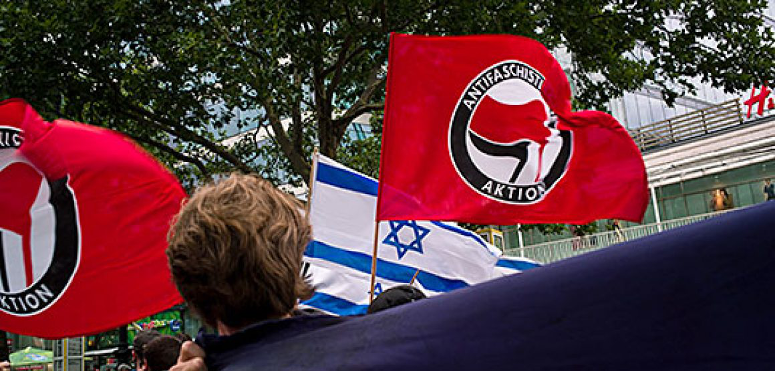
Photo: Jüdische Allgemeine
By CJ Hopkins | Consent Factory | June 5, 2019
So it appears we managed to survive another terrifying Quds Day in Berlin. It was certainly touch and go there for a while, what with the media issuing hysterical warnings about the hordes of “Hamas and Hezbollah supporters, neo-Nazis, and conspiracy theorists” that were going to materialize out of the ether, goose-step down the Kurfürstendamm, and reenact Kristallnacht, or something. The city was braced for an all-out Perso-Palestinian Quds Day Pogrom, which is always a threat on Quds Day in Berlin, but the hysteria level this year was elevated, due to the Anti-Semitism Pandemic that mysteriously erupted in 2019 for no apparent reason whatsoever.
OK, what, you’re probably asking, is Quds Day? It’s an annual event initiated by Iran to show support for the Palestinians and opposition to Zionism. It takes place on the last Friday of Ramadan, in opposition to Israel’s Jerusalem Day, the national holiday commemorating Israel’s annexation of East Jerusalem in the aftermath of the Six-Day War. In Berlin, there’s an annual Quds Day march, which the German media typically respond to by whipping up anti-Semitism hysteria and fanatical, guilt-ridden support for Israel. This year was no exception … on the contrary.
A week or so before the event, Felix Klein, Germany’s “Commissioner for Jewish Life and the Fight Against Anti-Semitism,” warned Jews not to wear kippahs in public, on account of the unprecedented explosion of anti-Semitism throughout the country. According to the interior ministry, there were 62 violent anti-Semitic attacks in Germany during 2018, compared to 37 in 2017, which, in a nation of 83 million people, and with a history of real-life, goose-stepping Nazis, and of perpetrating the Holocaust, and so on … well, you can understand the Commissioner’s alarm.
The international corporate media began spreading the news that Anti-Semitism was once again on the march in Germany. The BBC reported that official figures showed that 1,646 hate crimes had been committed against Jews in 2018, up 10% from 2017! CNN reported that anti-Semitic hate crimes had increased by almost 20%! According to The Jerusalem Post, there were 1,800 anti-Semitic incidents committed against Jews in 2018! It was almost as if the Anti-Semitism Pandemic was retroactively metastasizing right before our eyes.
But whatever. The statistics don’t really matter. The point was, “Jews are not safe in Germany!” The Putin-Nazis had teamed up with the Iranian Nazis and the Syrian Nazis, who were backing the Palestinian Nazis, whose irrational hatred of the State of Israel the German Nazis had somehow weaponized (probably with a bunch of fake Facebook ads), and they were all going to storm the historic high-end shopping boulevard of West Berlin!
Then, on Friday, the day before Quds Day, in a desperate, last-minute, tactical maneuver, German politicians and cultural figures exhorted Jews and gentiles alike to defiantly wear their kippahs on Quds Day. BILD, the leading German tabloid, even printed little cut-out “BILD kippas” (complete with meticulous assembly instructions), and called on Germans to wear them on Quds Day to show their solidarity with State of Israel … uh, sorry, I meant with the Jewish people.
The BILD kippa tactic was a huge success! On Quds Day, fewer than a thousand people, many of them women and children, peacefully strolled along the Kurfürstendamm chanting slogans like “free, free Palestine,” and asking the world to stop the Israelis from penning people up in de facto ghettos, shooting their legs off with dum dum bullets, demolishing their houses, hospitals, and schools, stealing their land, randomly murdering them, and otherwise behaving like sadistic fascists. The hordes of “Hamas and Hezbollah supporters, neo-Nazis, and conspiracy theorists” that the corporate media had warned us were coming, oddly, never showed their faces … clearly, the “BILD kippas” scared them off.
Or maybe it was the counter-demonstrators. Hundreds of anti-anti-Semites, including prominent German government officials, Israeli diplomats, Antifa factions, members of the local Jewish community, and BILD susbscribers confronted the march, wearing kippahs, waving Israeli flags, displaying giant “MAGA” banners, shouting “long live Israel” and “free Gaza from Hamas,” and giving the marchers the finger, and so on (which, OK, I found a little confusing, as, the last time I checked, Trump was still Hitler, and Antifa were supposedly a bunch of anarchists).
In any event, the hysteria has subsided. Berlin and Israel appear to have survived. The Jews can come back out of hiding, although it isn’t quite clear whether Germany wants them to wear their kippahs in public or not now. Hopefully, we’ll be receiving some sort of official directive from Commissioner Klein (or possibly Axel Springer) about that.
But, seriously, you can’t really blame the Germans for a going a little overboard with their anti-anti-Semitism hysteria or for being reluctant to criticize Israel. It wasn’t all that long ago that their parents and grandparents were heiling Hitler and systematically murdering millions of Jews, or looking the other way while it happened. Most of the Germans I’m acquainted with still feel kind of awful about that. Which isn’t terribly surprising, is it?
I mean, imagine, if you’re one of my American readers, if some other country conquered the USA, and put our political and military leaders on trial for all the war crimes they’ve committed, and for the millions of people they’ve systematically murdered, and taught our children the truth about our history … that might give you some idea of how most Germans feel about the Nazis and the Holocaust.
So, yes, Germans are a bit hypersensitive about anything resembling anti-Semitism, and they tend to conflate opposition to Israel with hatred of the Jewish people (despite the fact that Israel is doing a pretty convincing impression of the Nazis, what with its ethnic cleansing, walls, ghettos, sadistic goons, propaganda, and so on). Many Germans also overcompensate for their feelings of shame about the Holocaust by displaying an awkward fascination and enthusiasm for anything “Jewish” (you know, like many liberal Americans fetishize Native and African Americans), so that might explain the “BILD kippa” nonsense.
No, I’m not mocking or scolding the Germans … they’re still trying to work their history out. I’m just trying to track the propaganda and cynical emotional manipulation that we are increasingly being subjected to as the global capitalist ruling classes wage their War on Populism. The Quds Day Panic of 2019 is just one example. There are many more, both manufactured and all-too-real. The Charlottesville Nazis. Charlottesville II. The MAGA bomber. The Tree of Life shooting. The Christchurch attack. Jussie Smollett. MAGA hat Smirk Boy. And the list goes on … pretty much as it always has.
I’m sorry if this comes as a shock to anyone, but the world has always contained a minority of racist and anti-Semitic whack jobs. They didn’t suddenly start murdering people when Brexit passed and Trump got elected. They’ve been doing that for quite some time. And of course there is still anti-Semitism in Germany. Saxony is crawling with neo-Nazis. And Iran really would like to wipe out Israel, just as Israel would like to wipe out Iran. None of this is in any way new or shocking to anyone who has been paying attention.
The only thing that has significantly changed since November 8, 2016, is the official narrative we are being fed, in which anyone opposing global capitalism and the hegemony of neoliberal ideology is either a Russian or some kind of Nazi, and a new “anti-Semitism” or “fascism” panic is whipped up for us on a monthly basis.
The Quds Day Panic of 2019 (like the Charlottesville Kristallnacht of 2017) is going to be rerun, over and over, in endless variations, until 2020, or whenever the global capitalist ruling classes manage to restore Normality. By that time Israeli sports teams will probably be wearing little Palestinians on their caps, Julian Assange will be locked away in Supermax, and satirists like me … well, I think you know.
The UN is a mouthpiece for Israeli propaganda, not a threat to the colonial state
By Ramona Wadi | MEMO | May 14, 2019
Only a few days before the Palestinian commemoration of the 1948 Nakba, in which the indigenous people of Palestine were massacred, displaced and ethnically cleansed to pave the way for the European Zionist colonial project, Germany issued a statement declaring its intention to oppose “any unfair treatment” allegedly exhibited at the UN towards Israel. “Germany’s historic responsibility for the Jewish and democratic State of Israel and its security is part of our raison d’être,” the German government declared. “Germany will always work, including in the UN, to ensure that Israel’s right to exist is never called into question.”
Germany deliberately chose to issue its statement on the 70th anniversary of Israel becoming a full UN member state. On this day, despite purportedly championing human rights, the UN abdicated its responsibilities in order to embrace a new colonial power and celebrate its own role in the process of normalising colonialism. The UN has also conveniently and consistently overlooked the fact that Israel’s membership of the organisation was conditional upon it allowing Palestinian refugees to return to their land.
At the UN, Israel faces no threats whatsoever. Its recent bombing of Gaza and official statements from the international community testify to this fact. Yet Germany has jumped on the bandwagon, claiming that Israel is treated unfairly in the international arena and citing its allegiance to the settler-colonial state as a “historic responsibility”. Does Germany also extend the same sentiment and diplomatic commitment to other minorities murdered during the Holocaust?
Israel was a planned political project mooted in the late nineteenth century, as historical documents and research show very clearly. The Holocaust facilitated its implementation but did not create the demand for a “Jewish State”. However, historic responsibility and Israel’s settler-colonial apartheid state are incompatible. Furthermore, such responsibility which Germany has towards all of the minorities murdered in the Nazi era does not cancel out the collective historic responsibility towards Palestinians, from which the entire world has absconded.
Meanwhile, Germany has also attributed its stance to the “firm belief that the UN lies at the heart of the multilateral, rules-based order” for achieving peace and security. It is a fact that the UN has excelled in neither, not least in terms of the impunity with which Israel is allowed to act. The German government, therefore, is merely affirming its commitment to the propagation of ongoing human rights violations which, of course, suits Israel’s interests.
At a time when the least that the international community can do is shift its attention to the Nakba commemoration, Germany is determined to score diplomatic points for Israel which have more to do with the ongoing colonisation of Palestine than Nazi horrors during the Second World War.
“Israeli interests” constitute nothing more than wanting an international commitment against the decolonisation of Palestine. In its statement, Germany is refusing the possibility of questioning Israel’s right to exist, in line with Israel’s purported security and “self-defence” narrative and justification for its violence against Palestinians.
Why not turn the narrative around? Surely, just as Israel demands unconditional support for its existence, Palestinians have a greater claim and legitimacy in asking why the people and their land were ethnically cleansed. If justice truly existed, the UN — and Germany — would not hesitate to call Israel’s creation and existence in such a manner into question. As things stand, however, the UN continues to be a mouthpiece for Israel and its allies, while Palestinians are butchered by the colonial entity that does not hesitate to profit from terms such as “historic responsibility”.
‘Security risk & lawbreaker’: German MP says 70yo NATO should retire
RT | April 5, 2019
German lawmaker Alexander Neu lambasted NATO for conducting aggressive wars and raking up defense spending, suggesting Germany should quit its military command, and the bloc be dissolved altogether.
NATO’s 70th birthday is “not a reason to celebrate, but rather an occasion to finally rethink it, before it’s too late,” Neu wrote in Die Freiheitsliebe blog on Thursday.
The lawmaker from the opposition Left Party slammed the US-led military bloc as an organization that poses “significant security risk to the world” and “systematically violates international law.”
NATO revealed its true colors when it waged an “aggressive war” against Yugoslavia without the UN’s approval, and carried out numerous interventions, which claimed the lives of “countless victims,” Neu argued.
He pointed out that last year NATO’s member states spent more than $1 trillion on defense, which is far more than the defense budgets of its rivals, China and Russia, combined.
“The imperialist competition and the fear of losing economic and ideological supremacy drive NATO towards more rearmament and confrontation.”
In order to avoid global escalation, the lawmaker proposed that Germany should leave the alliance’s “military structures,” and then NATO itself should be dissolved and replaced by a new “collective security system,” which would include Russia.
Berlin’s contribution to NATO has caused a rift with Washington in recent years, as President Donald Trump repeatedly accused Germany, along with other EU nations, of not spending its “fair share” on the bloc’s collective security. German officials rebuked the criticism, but admitted the country won’t reach NATO’s spending target until 2024.
Founded in 1949, NATO was primarily seen as a bulwark against the Soviet Bloc during the Cold War. The alliance continued its existence after the Soviet Union collapsed, and expanded eastwards, despite vehement protests from Moscow.
German Government Refuses to Recognise Guaido’s Envoy as Ambassador

Sputnik – March 29, 2019
Although Berlin has sided with the US and recognised self-proclaimed interim president Juan Guaido, it is keeping Otto Gebauer, whom he picked to represent Venezuela in Germany, in limbo and has not granted the representative key diplomatic status. Spain, above all, has reportedly urged fellow EU member states not to recognise him.
Although Otto Gebauer, sent to Germany by self-proclaimed interim president of Venezuela Juan Guaido as his emissary, was received in Berlin, the German government does not plan to accredit him, as the newspaper Neue Osnabrücker Zeitung reports, citing the Foreign Ministry’s response to a request by the left-wing party Die Linke.
According to it, the German government first received Gebauer as “personal representative of Interim President Guaido” on 13 March 2019 to hold talks with him, but “further steps are not planned”. The outlet also reports that, above all, Spain has called on other EU member states not to grant Guaido’s representatives any diplomatic status or corresponding privileges.
Since a political crisis broke out in Venezuela in late January, when parliamentary opposition leader Guaido, backed by the US, declared himself the interim president of Venezuela after disputing President Nicolas Maduro’s re-election last May, Germany recognised him as a transitional head of state. Around 50 states, encouraged by the US, did the same. However, the constitutionally elected head of state Nicolas Maduro, supported by Russia, China, Cuba, Bolivia, Turkey and a number of other countries, continues to hold power and refuses to step down, accusing Washington of trying to orchestrate a coup in order to install Guaido as a puppet leader.
This has led to a paradoxical situation in Germany, leaving it with two Venezuelan emissaries in Berlin but not being able to hold official talks with both of them.
Die Linke praised the decision to restrain from recognising Gebauer as ambassador. Lawmaker from the German parliamentary foreign affairs committee Heike Haensel pointed out that “dispatching of new representatives for Venezuela is based on the recognition of self-appointed President Juan Guaido in violation of international law”, according to the conclusion of the Bundestag’s probe.
“This proves the absurdity of Germany’s Venezuela policy. Recognising Guaido was manoeuvered outside the bounds of international law and this rows it back again”, she said.
Apart from this diplomatic collision, Otto Gebauer has a debatable profile for a diplomat as he was involved in a 2002 coup attempt against President Hugo Chavez, who passed away several years ago. He was a member of the commando unit that held Chavez prisoner and served six years in prison for it.
The legitimacy of interim president Guiado himself is being challenged now as under Venezuelan law his maximum term is limited to a 30-day period. It expired in February while new elections have not yet been announced.
Germany’s Über Hypocrisy over Venezuela
By Finian CUNNINGHAM | Strategic Culture Foundation | 12.03.2019
Germany has taken the lead among European Union member states to back Washington’s regime-change agenda for Venezuela. Berlin’s hypocrisy and double-think is quite astounding.
Only a few weeks ago, German politicians and media were up in arms protesting to the Trump administration for interfering in Berlin’s internal affairs. There were even outraged complaints that Washington was seeking “regime change” against Chancellor Angela Merkel’s government.
Those protests were sparked when Richard Grenell, the US ambassador to Germany, warned German companies involved in the Nord Stream 2 gas pipeline with Russia that they could be hit with American economic sanctions if they go ahead with the Baltic seabed project.
Earlier, Grenell provoked fury among Berlin’s political establishment when he openly gave his backing to opposition party Alternative for Germany. That led to consternation and denunciations of Washington’s perceived backing for regime change in Berlin. They were public calls for Grenell to be expelled over his apparent breach of diplomatic protocols.
Now, however, Germany is shamelessly kowtowing to an even more outrageous American regime-change plot against Venezuela.
Last week, the government of President Nicolas Maduro ordered the expulsion of German ambassador Daniel Kriener after he greeted the US-backed opposition figure Juan Guaido on a high-profile occasion. Guaido had just returned from a tour of Latin American countries during which he had openly called for the overthrow of the Maduro government. Arguably a legal case could be made for the arrest of Guaido by the Venezuelan authorities on charges of sedition.
When Guaido returned to Venezuela on March 4 he was greeted at the airport by several foreign diplomats. Among the receiving dignitaries was Germany’s envoy Daniel Kriener.
The opposition figure had declared himself “interim president” of Venezuela on January 23 and was immediately recognized by Washington and several European Union states. The EU has so far not issued an official endorsement of Guaido over incumbent President Maduro. Italy’s objection blocked the EU from adopting a unanimous position.
Nevertheless, as the strongest economy in the 28-member bloc, Germany can be seen as de facto leader of the EU. Its position on Venezuela therefore gives virtual EU gravitas to the geopolitical maneuvering led by Washington towards the South American country.
What’s more, the explicit backing of Juan Guaido by Germany’s envoy was carried out on the “express order” of Foreign Minister Heiko Maas, according to Deutsche Welle.
“It was my express wish and request that Ambassador Kriener turn out with representatives of other European nations and Latin American ones to meet acting President Guaido at the airport,” said Maas. “We had information that he was supposed to be arrested there. I believe that the presence of various ambassadors helped prevent such an arrest.”
It’s staggering to comprehend the double-think involved here.
Guaido was hardly known among the vast majority of Venezuelans until he catapulted on to the global stage by declaring himself “interim president”. That move was clearly executed in a concerted plan with the Trump White House. European governments and Western media have complacently adopted the White House line that Guaido is the legitimate leader while socialist President Maduro is a “usurper”.
That is in spite of the fact that Maduro was re-elected last year in free and fair elections by a huge majority of votes. Guaido’s rightwing, pro-business party boycotted the elections. Yet he is anointed by Washington, Berlin and some 50 other states as the legitimate leader.
Russia, China, Turkey, Cuba and most other members of the United Nations have refused to adopt Washington’s decree of recognizing Guaido. Those nations (comprising 75 per cent of the UN assembly) continue to recognize President Maduro as the sovereign authority. Indeed, Russia has been highly critical of Washington’s blatant interference for regime change in oil-rich Venezuela. Moscow has warned it will not tolerate US military intervention.
Russia’s envoy to the UN Vasily Nebenzia, at a Security Council session last month, excoriated the US for its gross violation of international law with regard to Venezuela. Moscow’s diplomat also directed a sharp rebuke at other nations “complicit” in Washington’s aggression, saying that one day “you will be next” for similar American subversion in their own affairs.
Germany’s hypocrisy and double-think is, to paraphrase that country’s national anthem, “über alles” (above all else).
German politicians, diplomats and media were apoplectic in their anger at perceived interference by the US ambassador in Berlin’s internal affairs. Yet the German political establishment has no qualms whatsoever about ganging up – only weeks later – with Washington to subvert the politics and constitution of Venezuela.
How can Germany be so utterly über servile to Washington and the latter’s brazen criminal aggression towards Venezuela?
It seems obvious that Berlin is trying to ingratiate itself with the Trump administration. But what for?
Trump has been pillorying Germany with allegations of “unfair trade” practices. In particular, Washington is recently stepping up its threats to slap punitive tariffs on German auto exports. Given that this is a key sector in the German export-driven economy, it may be gleaned that Berlin is keen to appease Trump. By backing his aggression towards Venezuela?
Perhaps this policy of appeasement is also motivated by Berlin’s concern to spare the Nord Stream 2 project from American sanctions. When NS2 is completed later this year, it is reckoned to double the capacity of natural gas consumption by Germany from Russia. That will be crucial for Germany’s economic growth.
Another factor is possible blackmail of Berlin by Washington. Recall the earth-shattering revelations made by American whistleblower Edward Snowden a few years back when he disclosed that US intelligence agencies were tapping the personal phone communications of Chancellor Merkel and other senior Berlin politicians. Recall, too, how the German state remarkably acquiesced over what should have been seen as a devastating infringement by Washington.
The weird lack of action by Berlin over that huge violation of its sovereignty by the Americans makes one wonder if the US spies uncovered a treasure trove of blackmail material on German politicians.
Berlin’s pathetic kowtowing to Washington’s interference in Venezuela begs an ulterior explanation. No self-respecting government could be so hypocritical and duplicitous.
Whatever Berlin may calculate to gain from its unscrupulous bending over for Washington, one thing seems clear, as Russian envoy Nebenzia warned: “One day you are next” for American hegemonic shafting.
US military truck carrying missiles crashes in Idaho

Press TV – March 10, 2019
Police in the US state of Idaho were forced to close down a highway after a semi-truck carrying missiles for the military crashed.
According to state police, the truck veered off the main road at a rest stop along I-90 in northern Idaho on Friday night as the driver attempted to use the interstate on-ramp.
The 50-year-old man at the wheel lost control of the truck and accidentally drove into a hazardous materials containment area and disabled his vehicle by driving over a snowbank at the end of the hazmat area.
No one was hurt in crash but police had to completely shut down the road for four miles as a precaution, because the truck was transporting 16 missiles, each one weighing 900kg (2,000lbs).
The driver was cited for inattentive driving.
The US military has a long history of botched transportation of dangerous weapons and military equipment.
In November 2015, an astonishing video surfaced showing an armored escort vehicle colliding into a nuclear warhead loaded into a truck near Malmstrom Air Force Base in Montana.
The escort vehicle was speeding behind the truck but the driver failed to react in time and ended up driving into it.
More recently, in February this year, a truck hauling a shipment of US Navy-owned military munitions crashed into two commercial trucks on US Highway 212 in southeastern Montana.
The US Air Force sent a six-member disposal unit to the scene, who then used 58kg of explosives to detonate 60 hazardous munitions that were damaged. The unit recovered 420 other projectiles.
In late January, two US military vehicles crashed in New Mexico, injuring all 9 personnel onboard, two of them critically.
The US military has been blamed for similar incidents abroad, notably in Germany and Japan.
Guaido returns to Venezuela to the welcome of foreign ‘bodyguard’ envoys
RT | March 4, 2019
Self-declared “interim president” of Venezuela, Juan Guaido, returned from his South American tour on Monday, arriving into the loving (and protective) arms of ambassadors from the foreign governments backing him.
Despite Venezuelan authorities making it clear he could face 30 years in prison for attempting to overthrow the government and violating a travel ban, Guaido chose to arrive directly to an airport in Caracas.
The risk of arrest was notably mitigated by the presence of ambassadors from Germany, France, Spain, the Netherlands and several other countries which gathered at the arrival gate to huddle around him like a high-profile human shield. While Guaido was all smiles, his Western-world entourage seemed a bit on edge.
While the media fretted that Maduro might make good on threats to arrest Guaido, the opposition leader passed through customs without incident and headed straight to a rally in central Caracas.
Meanwhile, Vice President Mike Pence warned the Venezuelan government that Washington protects its investments, stressing how important Guaido is to them, and threatening a “swift response” if anyone tries to bully him.
Shortly after moving unhindered through the airport, Guaido arrived at a demonstration he called for on Twitter the week before. Addressing crowds in the country’s capital city, he called on his supporters to take to the streets for continued demonstrations next Saturday.
While Guaido toured South America and met with his most critical support base – foreign governments – the US ramped up pressure on Maduro’s government, imposing intensified sanctions and revoking visas for state actors.
Nothing stopping Russian-German trade turnover’s rapid growth
RT | February 13, 2019
Trade turnover between Russia and its second largest trade partner, Germany, increased 8.4 percent and reached nearly €62 billion ($70 billion) in 2018 compared to previous year, according to the German trade lobby.
Year-on-year imports from Russia to Germany expanded 14.7 percent, amounting to €36 billion ($40 billion). Export to Russia rose by 0.6 percent to €25.9 billion ($29 billion), the German-Russian Chamber of Commerce, which represents over 800 German firms, reported on Monday citing the Federal Statistical Office.
This is despite sanctions against Moscow and threats from the US to penalize German companies involved in the Russia-led Nord Stream 2 pipeline project.
“German business has successfully increased exports to Russia despite the market difficulties, sanctions and counter-sanctions. This has also improved our expectations for 2019,” the chairman of the German-Russian Chamber of Commerce, Matthias Schepp, said in a statement.
At the end of last year, Schepp said German firms boosted their investment in the Russian economy in spite of economic sanctions, adding such an investment volume has rarely been seen since the collapse of the Soviet Union. Speaking to RT at the St. Petersburg Economic Forum in May, the head of the German trade lobby said that it’s not only car manufacturers investing heavily in Russia but medium-sized businesses as well.
Germany is Russia’s second largest trade partner, behind China. The trade turnover between Beijing and Moscow also surged last year by 24.5 percent to $108.3 billion, with $56.1 billion of it amounting to Russian exports to China. This is the first time since 2006 that Russia has had a trade surplus with its Eastern partner.
Germany Pulls Rank on Macron and American Energy Blackmail
By Finian CUNNINGHAM | Strategic Culture Foundation | 13.02.2019
It was billed politely as a Franco-German “compromise” when the EU balked at adopting a Gas Directive which would have undermined the Nord Stream 2 project with Russia.
Nevertheless, diplomatic rhetoric aside, Berlin’s blocking last week of a bid by French President Emmanuel Macron to impose tougher regulations on the Nord Stream 2 gas project was without doubt a firm rebuff to Paris.
Macron wanted to give the EU administration in Brussels greater control over the new pipeline running from Russia to Germany. But in the end the so-called “compromise” was a rejection of Macron’s proposal, reaffirming Germany in the lead role of implementing the Nord Stream 2 route, along with Russia.
The $11-billion, 1,200 kilometer pipeline is due to become operational at the end of this year. Stretching from Russian mainland under the Baltic Sea, it will double the natural gas supply from Russia to Germany. The Berlin government and German industry view the project as a vital boost to the country’s ever-robust economy. Gas supplies will also be distributed from Germany to other European states. Consumers stand to gain from lower prices for heating homes and businesses.
Thus Macron’s belated bizarre meddling was rebuffed by Berlin. A rebuff was given too to the stepped-up pressure from Washington for the Nord Stream 2 project to be cancelled. Last week, US ambassador to Germany Richard Grenell and two other American envoys wrote an op-ed for Deutsche Welle in which they accused Russia of trying to use “energy blackmail” over Europe’s geopolitics.
Why France’s Macron, at the last minute, attempted to undermine the project by placing stiffer regulations is a curious question. Those extra regulations if they had been imposed would have potentially made the Russian gas supply more expensive. As it turns out, the project will now go-ahead without onerous restrictions.
In short, Macron and the spoiling tactics of Washington, along with EU states hostile to Russia, Poland and the Baltic countries, have been put in their place by Germany and its assertion of national interests of securing economical and abundant gas supply from Russia. Other EU member states that backed Berlin over Nord Stream 2 were Austria, Belgium, Cyprus, Greece and the Netherlands.
Washington’s claims that Nord Stream 2 would give Russia leverage of Europe’s security have been echoed by Poland and the Baltic states. Poland, and non-EU Ukraine, stand to lose out billions of dollars-worth of transit fees. Such a move, however, is the prerogative of Germany and Russia to find a more economical mode of supply. Besides, what right has Ukraine to make demands on a bilateral matter that is none of its business? Kiev’s previous bad faith over not paying gas bills to Russia disbars it from reasonable opinion.
Another factor is the inherent Russophobia of Polish and Baltic politicians who view everything concerning Russia through a prism of paranoia.
For the Americans, it is obviously a blatant case of seeking to sell their own much more expensive natural gas to Europe’s giant energy market – in place of Russia’s product. Based on objective market figures, Russia is the most competitive supplier to Europe. The Americans are therefore trying to snatch a strategic business through foul means of propaganda and political pressure. Ironically, the US German ambassador Richard Grenell and the other American envoys wrote in their recent oped: “Europe must retain control of its energy security.”
Last month, Grenell threatened German and European firms involved in the construction of Nord Stream 2 that they could face punitive American sanctions in the future. Evidently, it is the US side that is using “blackmail” to coerce others into submission, not Russia.
Back to Macron. What was he up to in his belated spoiling tactics over Nord Stream 2 and in particular the attempted problems being leveled for Germany if the extra regulations had been imposed?
It seems implausible that Macron was suddenly finding a concern for Poland and the Baltic states in their paranoia over alleged Russian invasion.
Was Macron trying to garner favors from the Trump administration? His initial obsequious rapport with Trump has since faded from the early days of Macron’s presidency in 2017. By doing Washington’s bidding to undermine the Nord Stream 2 project was Macron trying to ingratiate himself again?
The contradictions regarding Macron are replete. He is supposed to be a champion of “ecological causes”. A major factor in Germany’s desire for the Nord Stream 2 project is that the increased gas supply will reduce the European powerhouse’s dependence on dirty fuels of coal, oil and nuclear power. By throwing up regulatory barriers, Macron is making it harder for Germany and Europe to move to cleaner sources of energy that the Russian natural gas represents.
Also, if Macron had succeeded in imposing tougher regulations on the Nord Stream 2 project it would have inevitably increased the costs to consumers for gas bills. This is at a time when his government is being assailed by nationwide Yellow Vest protests over soaring living costs, in particular fuel-price hikes.
A possible factor in Macron’s sabotage bid in Germany’s Nord Stream 2 plans was his chagrin over Berlin’s rejection of his much-vaunted reform agenda for the Eurozone bloc within the EU. Despite Macron’s very public amity with Chancellor Angela Merkel, Berlin has continually knocked back the French leader’s ambitions for reform.
It’s hard to discern what are the real objectives of Macron’s reforms. But they seem to constitute a “banker’s charter”. Many eminent German economists have lambasted his plans, which they say will give more taxpayer-funded bailouts to insolvent banks. They say Macron is trying to move the EU further away from the social-market economy than the bloc already has moved.
What Macron, an ex-Rothschild banker, appears to be striving for is a replication of his pro-rich, anti-worker policies that he is imposing on France, and for these policies to be extended across the Eurozone. Berlin is not buying it, realizing such policies will further erode the social fabric. This could be the main reason why Macron tried to use the Nord Stream 2 project as leverage over Berlin.
In the end, Macron and Washington – albeit working for different objectives – were defeated in their attempts to sabotage the emerging energy trade between Germany, Europe and Russia. Nord Stream 2, as with Russia’s Turk Stream to the south of Europe, seems inevitable by sheer force of natural partnership.
On this note, the Hungarian government’s comments this week were apt. Budapest accused some European leaders and the US of “huge hypocrisy” in decrying association with Russia over energy trade. Macron has previously attended an economics forum in St Petersburg, and yet lately has sought to “blackmail” and disrupt Germany over its trade plans with Russia.
As for the Americans, their arrant hypocrisy is beyond words. As well as trying to dictate to Europe about “market principles” and “energy security”, it was reported this week that Washington is similarly demanding Iraq to end its import of natural gas from neighboring Iran.
Iraq is crippled by electricity and power shortages because of the criminal war that the US waged on that country from 2003-2011 which destroyed much of the country’s infrastructure. Iraq critically needs Iranian gas supplies to keep the lights and fans running. Yet, here we have the US now dictating to Iraq to end its lifeline import of Iranian fuel in order to comply with the Trump administration’s sanctions against Tehran. Iraq is furious at the latest bullying interference by Washington in its sovereign affairs.
The hypocrisy of Washington and elitist politicians like Emmanuel Macron has become too much to stomach. Maybe Germany and others are finally realizing who the charlatans are.
Featured Video

Rewriting the risk? Inside the government’s vaccine safety messaging
or go to
Aletho News Archives – Video-Images
Book Review
“Davos Can Really Replace the UN”
Inside the book that maps the architecture behind global governance — from the Epstein files to the Pact for the Future
Lies are Unbekoming | April 1, 2026
On June 13, 2019, the United Nations and the World Economic Forum signed a partnership deal to “accelerate the implementation of the 2030 Agenda for Sustainable Development.” That same evening, WEF president Börge Brende — Norway’s former Foreign Minister — had dinner with Jeffrey Epstein at Epstein’s Manhattan townhouse. The Epstein files, released January 2026, contain an exchange between the two from the previous year. Epstein to Brende: “Davos can really replace the UN. C21, cyber, crypto . genetics… intl coordination.” Brende back to Epstein: “Exactly — we need a new global architecture. World Economic Forum (Davos) is uniquely positioned — public private.”
The next day, the UN General Assembly adopted the framework for restructuring global governance.
That sequence — the partnership signing, the Epstein dinner, the candid admission about replacing the UN with a public-private architecture, and then the formal adoption — opens Jacob Nordangård’s The Digital World Brain. Pages two and three. Footnoted to the UN resolution number, the Epstein files, and the General Assembly record.
I keep coming back to it because it captures what this book does that almost nothing else in the independent research space manages. I’ve followed Jacob’s work for years now and interviewed him about his research. Each book peels back another layer of the same institutional architecture, and each time I think he’s reached the limit of what can be documented, the next one goes further. Nordangård doesn’t speculate. He doesn’t editorialize much. He lays institutional actions next to each other in chronological order and lets the pattern announce itself. … continue
Blog Roll
 Aletho News
- How I fell foul of the BBC thought police
- The End of NATO
- 37 days of war on Iran cost US staggering $42bln, tracker shows
- Baghdad tells Asian refiners, traders to begin loading Iraqi crude amid Iranian exemption
- Under fire, Moscow and Tehran close ranks
- Iran, US receive Pakistan-mediated plan for ceasefire then final deal
- Iran submits demands for end to war as mediators scramble ahead of Trump deadline
- Iran Threatens Retaliatory Strike on Stargate AI Project in UAE
- US sent ‘a lot’ of arms to Iranian protesters – Trump
- Barak Ravid Launders Deception To Allow Trump To Back Off Of His Power Plant Threat – Again
- If Americans Knew
- U.N. experts demand Israel release prominent Gaza doctor after reports of ‘severe torture’
- Israel’s Latest Genocide Is Against the Shias of Lebanon. Why Is the World Silent?
- How Eliot Cohen’s influence over U.S. war-making paved the way for Trump’s war crimes in Iran
- Israelis don’t pay for the weapons we ‘sell’ to them — US taxpayers do
- While Distancing from AIPAC, Most 2028 Democratic Hopefuls Are Still Embracing Israel
- A brief history of the Israeli nuclear program, the open secret at the heart of the Iran war
- Israeli Settlers Killed a Palestinian Farmer on His Own Land, in Front of His Father. Yes, Again
- The US-Israeli War on Science is an Assault on our Future
- 100+ International Law Experts Say US Strikes on Iran Violate UN Charter, Could Be War Crimes
- ‘Vile, Horrifying, Evil’: Trump Threatens to Bomb Nation of 90 Million People ‘Back to the Stone Ages’
- No Tricks Zone
- An Inconvenient Tree: Uncovered In Alps… Europe Much Warmer Than Today 6000 Years Ago
- New Study Reports A 60% Slowdown In Greenland’s Ice Loss Rate In The Last Decade
- Low Intensity Tornado Wrecks Major Solar Farm, Creating A Potential Toxic Dump
- New Study Finds Warming Saves Lives…Cold Temperatures 12 Times More Deadly Than Excess Heat
- German Science Blog Accuses PIK Climate Institute Of Hallucinating Climate Tipping Points
- Devastating Assessment Of Comirnaty Vaccine By Former Senior Pfizer Europe Toxicologist
- New Study: CO2 Is ‘Effectively Negligible’ As An Explanatory Climate Change Factor Since 2000
- Former Pfizer Toxicologist Dr. Helmut Sterz Tells Bundestag Hearing Pfizer Vaccine Should Have Never Been Approved
- Energy Expert: Germany’s Nuclear Phaseout Was A “500 Billion Euro Mistake”
- New Research: South Australia’s Mid-Holocene Sea Surface Temperatures Were 4°C Warmer Than Today
 Aletho News