Plan to establish US Marine regiment in Guam ‘to escalate camp confrontation, stir up regional tensions’
Global Times | June 23, 2024
The US Marines plan to deploy to Guam a littoral regiment capable of a flexible and rapid response in a “few years,” media revealed on Saturday, which Chinese observers said is aimed at preparing for great power competition, blatantly exposing the US’s combat intentions against China.
On Saturday, Japanese media outlet Kyodo News reported that General Eric Smith, commandant of the US Marine Corps, told a press conference in Washington that the Marine Littoral Regiment is “designed as a counter to PRC aggression,” to protect Japan, South Korea and the Philippines.
Smith said the regiment, due to be based on Guam, “will have responsibility to rapidly deploy inside the first island chain into the Philippines in order to spread the battlespace out and to protect those strategic lines of communication that emanate from Japan, back to the Philippines, back to Hawaii.”
The island chain refers to an area that includes Japan as well as the island of Taiwan and the northwest Philippines.
In the event of potential conflicts with China, such as China advancing its cause of national reunification, or conflicts erupting between China and the Philippines or Japan over territorial disputes, the US may use these deployments to strike against China, Chinese observers noted.
“This demonstrates the US’ relentless preparation to compete with China, with a clear Cold War mentality,” Zhang Junshe, a Chinese military expert, told the Global Times on Sunday.
The plan to establish a littoral regiment in Guam again demonstrated that the US is engaging in camp confrontation, seeking to rally countries like Japan and the Philippines, as well as to strengthen its control over these allies through military deployments and cooperation, enticing them to join the US’ chariot and making these countries work for its anti-China strategy, Zhang said.
This will undoubtedly add fuel to the fire and stir up regional tensions, Zhang warned, noting that the US wants to benefit from the chaos, such as selling more military equipment.
Kyodo reported that the new regiment in Guam will be the third of its kind that is capable of long-range detection and engagement using mobile missile batteries, as well as deploying small groups of marines to remote islands. The first unit was activated in March 2022 on Marine Corps Base Hawaii and the second was set up in Okinawa in November last year.
This exposed the US attempt to adopt a strategy of dispersion of its military forces, as the commandant of the US Marine Corps confirmed that the relocation of US Marines from Okinawa to Guam will begin in December.
Some observers believe that the US military forces’ shift from Okinawa to Guam is a strategic retreat, indicating a lack of security in Okinawa.
But Zhang sees it differently.
“Strategically, the US military is not retreating from Okinawa; it may withdraw its forces, but some weapons and firepower will remain in place. On the one hand, the US is instigating conflicts, while on the other hand, it does not want its forces to suffer losses. Therefore, it is pushing countries like the Philippines and Japan to be firmly tied to its warship as cannon fodder,” Zhang remarked.
Zhang also revealed the ongoing competition between the US Army and the Marine Corps for roles, funds and functions. He noted that the deployment of these assets is not actually the Marine Corps’ expertise, but should instead be a focus of the US Army.
The US Marine Corps primarily focuses on amphibious operations, but now there is a need for the corps to undergo a tactical transformation toward littoral operations, emphasizing land-sea integration. This in itself will bring about significant changes to the Marine Corps’ functions, which presents a considerable challenge, said another Chinese military expert, who requested anonymity.
If the Marine Corps insists on transformation, these disputes with the US Army will intensify, making the regiment’s implementation more challenging, some military experts warned. They believe that in reality, it is impractical for the regiment to target China.
Greenwashing Wars and the US Military
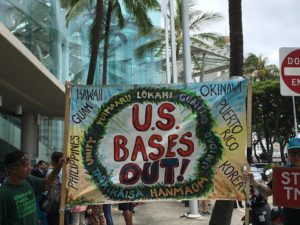
Protest sign urging global conservation meeting to address the environmental damage from U.S. military bases. (Photo by Ann Wright)
By Ann Wright | Consortium News | September 9, 2016
The International Union for the Conservation of Nature (IUCN) has come in for criticism due to its lack of attention to the detrimental effects of wars and military operations on nature. Considering the degree of harm to the environment coming from these human activities, one would think that the organization might have set aside some time at its World Conservation Congress this past week in Hawaii to specifically address these concerns.
Yet, of the more than 1,300 workshops crammed into the six-day marathon environmental meeting in Honolulu, followed by four days of discussion about internal resolutions, nothing specifically addressed the destruction of the environment by military operations and wars.
The heavy funding the IUCN gets from governments is undoubtedly the rationale for not addressing this “elephant in the room” at a conference for the protection of the endangered planet – a tragic commentary on a powerful organization that should acknowledge all anti-environmental pressures.
At a presentation at the USA Pavilion during the conference, senior representatives of the U.S. Army, U.S. Air Force and U.S. Navy regaled the IUCN audience of conservationists with tales about caring for the environment, including protecting endangered species, on hundreds of U.S. military bases in the United States.
The presenters did not mention what is done on the over 800 U.S. military bases outside of the United States. In the one-hour military style briefing, the speakers failed to mention the incredible amounts of fossil fuels used by military aircraft, ships and land vehicles that leave mammoth carbon footprints around the world. Also not mentioned were wars that kill humans, animals and plants; military exercise bombing of entire islands and large swaths of land; and the harmful effects of the burn pits which have incinerated the debris of war in Afghanistan and Iraq.
Each military service representative focused on the need for training areas to prepare the U.S. military to “keep peace in the world.” Of course, no mention was made of “keeping the peace” through wars of choice that have killed hundreds of thousands of persons, animals and plants, and the bombing of the cultural heritage in many areas around the world including Afghanistan, Iraq, Syria, Pakistan, Libya, Yemen and Somalia.
Miranda Ballentine, Air Force Assistant Secretary for Installations, the Environment and Energy, said the U.S. Air Force has over 5,000 aircraft, more than all the airlines in the United States — yet she never mentioned how many gallons of jet fuel are used by these aircraft, nor how many people, animals and cultural sites the aircraft have bombed.
To give one some idea of the scale of the footprint of U.S. military bases, Ballentine said Air Force has over 160 installations, including 70 major installation covering over 9 million square miles of land, larger than the country of Switzerland, plus 200 miles of coastland.
Incredibly, Ballentine said that due to commercial development around military bases, military bases have become “islands of conservation” — conservation takes place inside the protected base while there are larger conservation issues outside the fence lines of the bases.
Adding to the mammoth size of the military base footprint, Dr. Christine Altendorf, the regional director of the U.S. Army’s Installation Management Command of the Pacific, said U.S. Army bases have 12.4 million acres of land, including 1.3 million acres of wetlands, 82,605 archeological sites, 58,887 National Historical Landmarks and 223 endangered species on 118 installations.
The U.S. Navy’s briefer, a Navy Commander, added to the inventory of military equipment, saying the Navy has 3,700 aircraft; 276 ships, including 10 aircraft carriers; 72 submarines. Seventy naval installations in the United States have 4 million acres of land and 500 miles of coastline. The Navy presenter said the Navy has never heard of a marine mammal that has been harmed by U.S. Naval vessels or acoustic experiments in the past ten years.
Only One Question
At the end of the three presentations, there was time for only one question — and luckily, my intense hand waving paid off and I got to ask: “How can you conserve nature when you are bombing nature in wars of choice around the world, practicing military operations in areas that have endangered species like on the islands of Oahu, Big Island of Hawaii, Pagan, Tinian, Okinawa and bombing islands into wastelands like the Hawaiian island of Koho’olawe and the Puerto Rican island of Vieques and now you want to use the North Marianas ‘Pagan’ Island as a bombing target. And how does the construction of the new South Korean naval base in pristine marine areas of Jeju Island that will be used by the U.S. Navy and the proposed construction at Henoko of the runways into the pristine Oura Bay in Okinawa fit into conservation of nature?”
Interestingly, in the large audience of approximately 100 people, not one of them applauded the question indicating that either audience was composed primarily of Department of Defense employees, or that the conservationists are uneasy about confronting the U.S. government and particularly the U.S. military about its responsibility for its large role in the destruction of much of the planet’s environment.
The Navy representative was the only person to respond to my question. He reiterated the national security necessity for military exercises to practice to “defend peace around the world.” To his credit, he acknowledged the role the public has in commenting on the possible impact of military exercises. He said that over 32,000 comments from the public have been made on the Environmental Impact Assessment (EIA) of the possibility of artillery firing and aircraft bombing of the Northern Marianas island of Tinian — that has only 2,300 inhabitants.
Despite all odds, someone in Hawaii was able to get an exhibit of photographs of the cleanup of Koho’olawe placed on the third floor of the Hawaii Convention Center. There was no sign announcing the exhibition, just a series of photos with some explanation. In five days of attending the conference, I observed that 95 percent of the conference attendees who walked past the exhibition did not stop to look at it – until I stopped them and explained what it was about. Then, they were very interested.
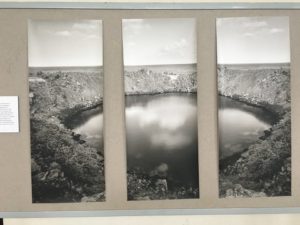
A crater that was created on the Hawaiian island of Koho’olawe from massive explosions of TNT in 1965. (Photo from Hawaii Archive)
From 1941 to 1990, the island of Koho’olawe was used as a bombing range for U.S. military aircraft and naval vessels. One photograph in the exhibition showed the crater called “Sailor’s Hat” which was made by several massive explosions of TNT in 1965 to recreate and study the effects of large explosions on nearby ships and personnel to simulate in some manner the effects of a nuclear explosion. The crater affected the island’s fresh water aquifer and now no artesian water remains on the island.
After Hawaiians stopped the bombing through their protests and by staying on the island during bombings from the 1970s, the U.S. Navy returned Koho’olawe to the State of Hawaii in 2004 after a 10-year clean-up process. But only 66 percent of the surface has been cleared of unexploded ordnance (UXO), and only 10 percent cleared to a depth of 4 feet. Twenty-three percent of the surface remains uncleared and 100 percent of the waters surrounding the island have not been cleared of UXO, putting divers and ships at risk.
Okinawan Environmental Activists
Environmental activists from Okinawa had a booth at the IUCN at which they told about the attempt of the U.S. military and the national Japanese government to construct a runway complex into Oura Bay, a pristine marine area that that is the home of the protected species of marine mammal, the dugong.
The Deputy Governor of Okinawa and the Mayor of Nago city, Okinawa, both of whom have been key figures in the grassroots campaign to stop the construction of the runways and the lawsuits filed by the provincial government of Okinawa against the federal Japanese government, gave presentations about the citizens’ struggle against the construction of the runways.
However, there was no mention of the environmental effects on the marine environment from the construction of a huge new naval base on Jeju Island, South Korea, the site of the previous IUCN conference four years ago. At that conference, IUCN, no doubt at the request of the South Korean government, refused to allow citizen activists to have a booth inside the convention or make presentations like the Okinawans did this year. As a result, the Jeju Island campaigners were forced to stay outside the conference site.
Four years later in the 2016 WCC conference in Hawaii, the Government of Japan and the Province of Jeju Island sponsored a large multi-media pavilion about Jeju island which did not mention the construction of the new naval base and the destruction of the cultural heritage of the site nor the displacement of women divers who had dived at the location for generations.
On Sept. 3, local groups in Honolulu came to the Hawaii Convention Center with signs to remind the IUCN of the U.S. militarization of Asia and the Pacific. Signs and posters from local environmentalists cited the environmental impact from the huge 108,863-acre Pohakuloa bombing range on the Big Island of Hawaii, the largest U.S. military installation in the Pacific; the Aegis missile test center on the island of Kauai; and the four large U.S. Army, Navy, Air Force and Marine bases on the island of Oahu.
Other signs referenced the extensive number of U.S. military bases in Japan, Okinawa, South Korea, Guam and new U.S. military installations in the Philippines and Australia.
Ann Wright served 29 years in the US Army/Army Reserves and retired as a Colonel. She also served 16 years as a US diplomat in US Embassies in Nicaragua, Grenada, Somalia, Uzbekistan, Kyrgyzstan, Sierra Leone, Micronesia and Mongolia. She was on the small team that reopened the US Embassy in Kabul, Afghanistan in December 2001. She resigned from the US Department of State in March 2003 in opposition to the war on Iraq.
Obama’s Final ‘Jihad’ in Asia
By Wayne MADSEN | Strategic Culture Foundation | 06.09.2016
President Barack Obama has opted to ratchet up military tensions in Asia as one of his last foreign policy acts as president of the United States. Using climate change and free trade backdrops at the G20 Summit in Hangzhou, China and the U.S.-ASEAN and East Asia Summits in Vientiane, Laos as mirages intended to mask his aggressive military posture in the Asia-Pacific region, Obama seeks to cement his «pivot to Asia». It is Obama’s sincere hope that his anticipated successor, his former Secretary of State, Hillary Clinton, will expand on the expansionistic and aggressive regional showdown with China and Russia that his administration launched with his Asia «pivot».
The ultra-protocol conscious Chinese threw diplomacy and decorum to the wind when Obama touched down at Hangzhou International Airport and his national security adviser Susan Rice and deputy national security adviser became embroiled in an argument with Chinese security personnel. When White House officials traveling with Obama began issuing orders to the Chinese personnel, one Chinese official yelled at them, «This is our country. This is our airport». It was as if the Chinese, realizing that this would be their last encounter with Obama as president, were letting him and his war hawk national security team know who was the boss as long as they were on Chinese soil. At least on the tarmac at Hangzhou International Airport, the Chinese swung Obama’s Asia «pivot» back to China.
It was an ignominious final «haj» for Obama’s anti-Chinese jihad. Obama began his presidency in 2009 with being awarded, incredibly prematurely as it turned out, the Nobel Peace Prize. For the Asia-Pacific region, Obama’s presidency would end with angry words between his aides and Chinese officials at a Chinese airport.
Obama began his journey as the host for Pacific Island leaders at the Central Intelligence Agency front, the East-West Center, which is located at his mother’s alma mater, the University of Hawai’i. Obama was the official host at the 2016 Pacific Islands Conference (PIC) of Leaders at the CIA-linked center. Obama’s speech before the leaders, many from small Pacific island states, focused primarily on global climate change. Obama also addressed the World Conservation Congress at their meeting in Hawai’i.
Obama was schooled in anti-Chinese bigotry and Cold War fear tactics by his CIA mother and right-wing fascist Indonesian army stepfather while a child in post-1965 coup Indonesia. Obama, who is fully aware that the blood of 800,000 to one million Indonesians, Communists and ethnic Chinese Indonesian nationals, flowed in the streets, canals, and rivers of Indonesia from 1965 to 1967, the year he and his mother arrived in the country, believes it his birthright and duty to continue his familial “jihads” against «Communist» China that were instilled in him as a child, teen, and college student by his CIA-connected parents.
Papua New Guinea’s Prime Minister, Peter O’Neill, tipped off the press about the real purpose of the PIC before he departed Port Moresby for Hawai’i. O’Neill, who is in charge of one of Papua New Guinea’s most corrupt governments since independence in 1975, said that “regional security” shared the bill with climate change at the Hawai’i conference. In addition to independent Pacific Island states, the PIC includes the U.S. territories of American Samoa, Guam, Northern Marianas, and the state of Hawai’i.
U.S. Army Assistant Chief of Staff Colonel Tom Hanson, a relatively low-level official to be issuing policy statements, gave an ultimatum to Australia just prior to Obama’s departure for Hawai’i and Asia. Hanson told the Australian Broadcasting Corporation, “I think the Australians need to make a choice … it’s very difficult to walk this fine line between balancing the alliance with the United States and the economic engagement with China.” The statement chilled U.S.-Australian relations prior to Obama’s meeting with Australian Prime Minister Malcom Turnbull at the G20 summit.
Also on Obama’s agenda was pressuring certain PIC leaders who have shown signs of resisting the political status quo imposed by Washington. Northern Marianas Governor Ralph Torres, a Republican, recently signed into law the Second Marianas Political Status Commission that seeks to re-evaluate the islands’ current neo-colonial status imposed by the agreement that transformed the Northern Marianas into a colony where Asian sweat shops predominate and where those of Northern Marianas descent have little say over their domestic affairs. The Pentagon wants to turn the island of Tinian into a live-fire range, a decision that imperils the 3,000 residents of the island.
Another U.S. colony, Guam, has seen the growth of a Commission on Decolonization and an Independence for Guahan Task Force. Guahan is the proper Chuukese name for Guam.
Obama, a product of U.S. imperialist control over Hawai’i, the importance of which for Washington is solely military, has done everything possible to subvert and suppress the anti-colonial aspirations of the Pacific islands under U.S. domination and political influence.
The Obama administration has also been exercising subtle pressure on the Federation of Micronesia, a quasi-independent former U.S. Trust Territory, to deter movements for independence from the island groups of Chuuk and Yap. Under the Compact of Free Association, the U.S. effectively controls Micronesia and reserves the right o build military bases, through the federal government of Micronesia located in Pohnpei. Chuuk and Yap accuse Pohnpei of ignoring their own interests. Similar neo-colonialist “compacts” are in effect with the other former U.S. trust territories of the Marshall Islands, where the U.S. maintains a missile test range, and Palau, where the U.S. would like to build a naval base.
After departing Hawai’i for Asia, Obama stopped at the U.S.-controlled Midway Island, where he expanded the Papahānaumokuākea National Monument, a major marine wildlife sanctuary. However, the national monument, in addition to being the world’s largest marine sanctuary, also extends the protected wildlife area to the limits of America’s exclusive economic zone (EEZ). Ironically, it was China’s extension of its EEZ around disputed islands in the South China Sea, that resulted in Obama ratcheting up regional military confrontation with China.
Obama’s visit to another monument on Midway Island, the one honoring America’s decisive defeat of Japan in the Battle of Midway of 1942, had little to do with protecting sea turtles, albatrosses, and tiger sharks and everything to do with proclaiming America’s resolve to maintain the Pacific Ocean as an «American lake». The message to China and Russia could not have been more stark regardless of the masking of Obama’s military message with climate change and environmental optics.
Obama’s marine conservation visit to Midway is also suspicious. Under Obama’s neo-Cold War tactics, the United States is reopening abandoned or expanding previously scaled-down military bases in Iceland, Greenland, the Aleutian Islands of Shemya and Attu, Guam, American Samoa, and the Philippines. Midway, a former U.S. base, may also be see a renewed active military presence as part of Obama’s jihads against China and Russia. Midway Atoll is literally owned by the U.S. Interior Department. However, Midway’s Henderson Field is maintained as an active airport — which was capable of landing Obama’s Air Force One Boeing 747 — by a private company, American Airports Corporation. The company operates a number of airports in the western United States that were used to film some of the most jingoistic U.S. television shows, including the CIA propaganda series «24» and the U.S. Navy puffery series «JAG».
Obama, whose presidency has been buoyed by money and sycophancy from Hollywood, perhaps sees himself as not only waging a personal jihad against China and Russia but as a future action film star. It is a preferable option since as a movie star, Obama will only be able to wage fictional wars on movie sets.
‘Militarized Wasteland’: US Navy, Defense Department Sued Over Marianas Training
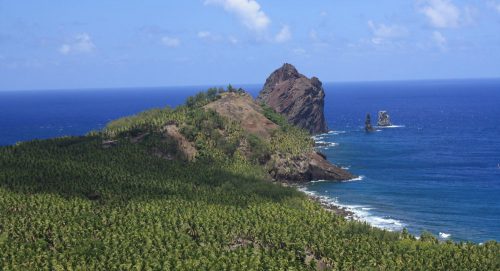
© Flickr/ Michael Lusk
Sputnik – 05.08.2016
Several Northern Mariana Islands conservation groups have sued the US Department of Defense and the Navy over live-fire exercises planned for the Pagan and Tinian islands, as part of a military buildup planned for Guam.
Seen as a part of the US’ “pivot to the Pacific,” about 5,000 US Marines in Okinawa are slated to relocate to the Mariana Islands and train using mortars, rockets, artillery, attack helicopters and warplanes, as well as ship-to-shore naval bombardment and amphibious assaults.
The plaintiff organizations, Guardians of Gani, Paganwatch, Center for Biological Diversity and the Tinian Island Women’s Association, are claiming that the Navy violated the National Environmental Policy Act when it failed to evaluate the environmental effects of military tests in an initial environmental impact statement.
The plans to move the Marines to Guam created the need for a training area, and this should have also been included in an impact statement. The plaintiffs say the Navy relied on a separate, and inadequate, statement.
David Henkin, an Earthjustice attorney representing the groups, along with Tinian-based lawyer Kimberlyn King-Hinds, said,”The die is cast, the Navy has made a decision to move 5,000 Marines and their families to Guam without considering all the alternatives or whether Guam can absorb that many people in such a short time…We can’t defer consideration of other places.”
The complaint says that two impact statements, made in 2010 and 2015, should be set aside, claiming the Navy acknowledged that constructing training facilities and conducting tests would destroy coral reefs and rainforests, and kill native wildlife on Pagan and Tinian, including the endangered Mariana fruit bat.
The groups also note that Tinian will suffer the destruction of historic and cultural sites, be subject to severe restrictions to beaches and fishing grounds, and the population will be subject to high-decibel noise and the loss of 15% of farmlands.
The 18-square-mile island was evacuated due to a volcano eruption in 1981, and another issue claims that families seeking to return “would be forever banished from returning to their home island, which would be turned into a militarized wasteland,” according to the filing.
A Scientific American article titled “Dreading the Dredging: Military Buildup on Guam and Implications for Marine Biodiversity in Apra Harbor,” claims that dredging the harbor would destroy up to 70 acres of coral reef.
Joint Region Marianas deputy public affairs officer Greg Kuntz said that the Navy is committed to revising its environmental impact and working within the guidelines of the National Environmental Policy Act.
Members of the Tinian Women’s Association, a nonprofit dedicated to preserving Chamorro culture and advocating for Tinian women and children, have submitted comments to the Navy’s environmental review and passed out informational flyers. Member Florine Hofschneider said in a media statement, “We refuse to accept the Navy’s plan to subject our children to nearly constant bombardment.”
The Guardians of Gani say that this military training poses an “existential threat” to people who want to lead “a more traditional, productive and fulfilling lifestyle,” adding that, “the Guardians and their members view Gani [islands north of Saipan] as the last frontier to revive their traditions and culture.”
Guam, Marianas brace for massive US military redeployment
RT | November 23, 2015
Thousands of American military personnel are expected to arrive in the Mariana Islands over the next several years, as part of the US strategic “pivot” to East Asia. Many will come from Okinawa, Japan, where many local residents want US bases closed.
Military facilities in Guam, the archipelago’s largest island and a US possession since 1898, have been reinforced and updated in anticipation of almost 5,000 Marines, as well as new aircraft, submarines and patrol boats. The infrastructure upgrades will “elevate the tiny Pacific island into a maritime strategic hub, a key element laid out by the Pentagon in the Asia-Pacific Maritime Security Strategy,” according to the US military newspaper Stars and Stripes.
“We have two 11,000-foot concrete runways, both rebuilt within the last 10 years,” Steven Wolborsky, director of plans, program and readiness at the Andersen Air Force Base told Stars and Stripes, adding that roughly 19 million pounds of explosives are now stored across the facility’s 4,400 acres.
“We have enough parking for more than 155 aircraft, with a robust in-ground refueling infrastructure,” Wolborsky added. “We have the largest capacity of jet fuel in the Air Force at 66 million gallons ‒ coupled with an equal amount down south with the Navy.”
The construction has been driven primarily by the plan to move thousands of Marines to Guam from Okinawa, Captain Alfred Anderson, the base commander, said. The redeployment is expected by 2023 or so.
More than a third of the estimated $8.7 billion cost of building the new facilities for the Marines is being funded by Japan, according to McClatchy reporter Adam Ashton. The Japanese residents of Okinawa have complained for years about the impact of US military presence, ranging from drugs, alcoholism, and sexual abuse to environmental damage.
Originally the Pentagon envisioned a shift of 8,600 Marines and some 9,000 dependents from Okinawa, raising alarm among some residents of Guam that their island, with an area of only 212 square miles (549 km sq.) and a population of 160,000, would be overwhelmed.
Pressure from the activists representing the native Chamorro people, organized in a group called We Are Guahan, compelled the Pentagon to trim that number down to 4,800. Two thirds of that number would be there on rotation, without their families, reducing the pressure on the island even further.
The activists are not resting on their laurels, however, and are pressing on against the Pentagon’s plans to install firing ranges on the islands of Tinian and Pagan. The new facilities are supposed to integrate with the US Navy’s underwater training range in the nearby Mariana Trench.
While Guam is an unincorporated US territory, Pagan and Tinian belong to the Northern Mariana Islands Commonwealth, a US possession with the same status as Puerto Rico.
The island of Pagan is uninhabited at the moment, although the island’s inhabitants still make claims to the land after they were forced to evacuate due to volcanic eruptions in 1981. Tinian has an area of 39 square miles (101 km sq.) and just over 3,000 residents. US Marines seized the island from a Japanese garrison after a weeklong battle in July 1944. A year later, the massive airbase built on the island was used to launch the nuclear attacks on Hiroshima and Nagasaki.
Joining the residents in opposition to the Marine firing range plan is Alter City Group, a Chinese company based in Macau that wanted to invest $500 million to build a casino complex on Tinian. The firing range would “significantly alter the island as we know it in dramatically irreparable ways,” and impose burdens on the island both “significant and unsustainable,” the ACG said in a statement, as quoted by McClatchy.
Some political and business leaders in Guam, however, fear the military may drop its plans altogether if the Marines are barred from using Tinian and Pagan for live-fire exercises. They have established the Guam-US Security Alliance to push for the military buildup.
“This is so big that people are going to have to learn to get along,” John Thomas Brown, director of the Alliance, told McClatchy. “It can be done. It should be done. Time is wasting.”
Most of Guam’s income comes from Japanese tourism, followed by US military spending.
Featured Video

America Racing to Strategic Defeat in Iran
or go to
Aletho News Archives – Video-Images
From the Archives
Should Europeans ‘Thank’ the Americans for Destroying Nord Stream?
By Robert Bridge | Strategic Culture Foundation | September 29, 2022
With an investigation continuing into the destruction of the Nord Stream gas pipeline that provided energy supplies to Europe from Russia, there appears to be just one prime suspect, and that should surprise nobody.
Following the sabotage of the Nord Stream 1 and 2 gas pipelines, former Polish Foreign Minister Radoslaw Sikorski already seemed to know the identity of the perpetrator when he tweeted out: “Thank you, USA.”
At first glance, it seemed that Sikorski was speaking sarcastically, berating Washington for carrying out an attack that will have severe repercussions for the people of Europe. After all, how could anyone see any good coming from the termination of Europe’s primary source of gas reserves with winter just around the corner? It was Sikorski’s homeland of Poland, after all, that urged its citizens to collect firewood in the face of dwindling gas reserves.
In fact, the Polish diplomat was speaking one-hundred percent literally… continue
Blog Roll
 Aletho News
- Growing insecurity, soaring prices fuel protests in north as regime bans evacuation: Sources
- Iran denies responsibility for ‘depraved’ attack on Kuwait desalination plant
- Bring The Troops Back. End This War Now!
- Can we please stop calling Israel the ‘only democracy in the Middle East’ now?
- US should start removing its troops for Germany, proposes AfD co-leader Chrupalla
- Iran Red Crescent: 600 educational centers attacked in US-Israeli ‘war crimes’
- Russian Oil Tanker Arrives in Cuba Amid U.S. Blockade
- America Racing to Strategic Defeat in Iran: Lt Col Daniel Davis
- FTC Warns Visa, Mastercard, PayPal, Stripe Over Political Debanking
- Russian tanker approaches Cuba despite US oil blockade
- If Americans Knew
- Israeli police block Catholic cardinal from entering Church of the Holy Sepulchre on Palm Sunday
- Israel is assassinating journalists again, more than any other nation, anywhere, ever – Not a ceasefire Day 170
- Over 300 US service members wounded, majority have brain injuries – Not a ceasefire Day 169
- Researchers at Human Rights Watch Resign Over Blocked Report on Palestinian Refugee Return
- Jewish Groups Are Backing a War Americans Don’t Want
- Eric Fingerhut Thinks He’s the President of the Jews
- Top Jewish Philanthropists, Rabbis Urge Israeli President to Take Action Against ‘Jewish Extremists’
- Don’t Be Fooled. Zionist Leaders Have Always Wanted to Control Southern Lebanon
- Israel’s widespread use of torture is a core element of its genocide against the Palestinian people
- In Israel’s War on Iran, Many Middle East US Bases Rendered “All But Uninhabitable”
- No Tricks Zone
- New Study Finds Warming Saves Lives…Cold Temperatures 12 Times More Deadly Than Excess Heat
- German Science Blog Accuses PIK Climate Institute Of Hallucinating Climate Tipping Points
- Devastating Assessment Of Comirnaty Vaccine By Former Senior Pfizer Europe Toxicologist
- New Study: CO2 Is ‘Effectively Negligible’ As An Explanatory Climate Change Factor Since 2000
- Former Pfizer Toxicologist Dr. Helmut Sterz Tells Bundestag Hearing Pfizer Vaccine Should Have Never Been Approved
- Energy Expert: Germany’s Nuclear Phaseout Was A “500 Billion Euro Mistake”
- New Research: South Australia’s Mid-Holocene Sea Surface Temperatures Were 4°C Warmer Than Today
- Storing Green Energy To Last Germany 10 Days Would Require A 60-Million Tonne Battery
- New Studies: UK Sea Levels Were 4 Meters Higher Than Today During The Mid-Holocene
- Destructive Green New Deal: German Energy And Metal Group Warns Of Drastic Crisis
 Aletho News