Rulings against Palestinian inmates show Saudi desire to normalize relations with Israel: Yemen’s Ansarullah
Press TV – August 9, 2021
Yemen’s Ansarullah resistance movement has condemned Saudi Arabia for handing down harsh verdicts against dozens of Palestinian inmates in the kingdom, some of whom were given jail terms of up to 22 years, over alleged support for the Palestinian Hamas movement, saying the verdicts clearly reflect the Riyadh regime’s desire to normalize relations with Israel.
“We strongly condemn Saudi rulings against Palestinians living in the country. We consider such verdicts a poisonous stab in the back of the Palestinian cause, and a message of friendship and obedience to Israel,” Ansarullah’s political bureau said in a statement.
It added, “Given our knowledge about the Saudi regime’s nature and its eagerness to normalize ties with the Zionist enemy, we call upon Muslim nations to show solidarity with the Palestinian prisoners, and to press for their immediate release.”
“Sana’a is ready to release Saudi prisoners in exchange for the freedom of Palestinians being kept behind bars in the Riyadh regime’s detention,” Ansarullah said.
A Saudi court on Sunday issued various sentences against 69 Palestinians and Jordanians.
The group was detained in March 2018 during a wave of arrests by Saudi authorities on a group of long-term Palestinian and Jordanian residents in the kingdom on alleged links to Hamas.
Sources in the besieged Gaza Strip have previously said that they believed the crackdown was linked to warming ties between Israel and Riyadh.
An official Hamas source said last year that the majority of the detainees were Hamas members, who had resided in the Persian Gulf country for decades, accusing Saudi Arabia of “targeting everyone who is linked with resistance” against the Israeli occupation.
Several Palestinians have been detained since February 2019 and are facing trial before a Saudi terrorism court.
The Saudi court sentenced Hamas representative in Saudi Arabia Mohammed al-Khudairi to 15 years in prison. His son, Hani, was sentenced to three years, Turkey’s official Anadolu news agency reported.
Khudairi’s brother, Abd al-Majeed, said the sentence includes “clemency for half the term.”
Khudairi, 82, was a veteran Hamas leader responsible for managing the relationship with Saudi Arabia for two decades.
Hamas, meanwhile, condemned the sentences handed out on Sunday, calling them “unjust” and saying those sentenced had done nothing to harm Saudi Arabia.
“We were shocked … by the rulings issued by the Saudi judiciary against a large number of Palestinians and Jordanians residing in the kingdom,” Hamas said in a statement.
“We deplore the harsh and undeserved sentences against most of them. All they did was support their cause and their people, to which they belong, without any offence to the kingdom and its people,” it added.
The Palestinian Islamic Jihad movement also condemned the rulings.
Over the past three years, the Saudi authorities have also deported more than 100 Palestinians from the kingdom, mostly on charges of supporting Hamas financially, politically or through social networking sites.
The Riyadh regime has imposed strict control over Palestinian funds in Saudi Arabia since the end of 2017.
Germany bans Hamas flag, citing rise in anti-Semitism
MEMO | June 21, 2021
Germany has agreed to ban the flag of the Palestinian resistance movement Hamas, citing a sharp rise in anti-Semitic incidents following Israel’s recent assault on the Gaza Strip.
According to a report by the German newspaper Welt am Sonntag, the plan to ban the flag of the group which was voted into government in free elections in 2006, was initially proposed by German Chancellor Angela Merkel’s ruling Christian Democratic Union party (CDU).
After first opposing the ban due to constitutional concerns, its coalition partner – the centre-left Social Democratic Party – finally gave its backing to the decision.
Thorsten Frei, the deputy parliamentary spokesman for the CDU, is reported to have stated: “We do not want the flags of terrorist organizations to be waved on German soil.” He called the ban a “clear signal to our Jewish citizens.”
The move comes after Germany’s Central Council of Jews called for increased protection of the country’s Jewish community and the cracking down on pro-Palestinian protestors last month, particularly following pro-Palestinian protests across Europe which many said were anti-Semitic.
The ban on Hamas’ flag comes over a year after Berlin banned the political wing of the Lebanon-based Hezbollah and its activities. Months after that ban, it was revealed that the United States pressured the German government into enacting it.
Blinken’s statements encourage Israel to continue its crimes: Hamas
Palestine Information Center – June 8, 2021
GAZA – The Hamas Movement denounced the recent statement of US Secretary Antony Blinken on Israel’s right to self-defense, saying that it gives the green light to the “Zionist enemy” to continue its aggression against the Palestinian people.
Hamas in a press statement on Tuesday said, “Is the killing of women and children, demolishing homes on the heads of their residents, expelling citizens from their homes in Jerusalem, attacking Al-Aqsa Mosque, assaulting journalists and breaking their hands, self-defense?”
It stressed that the occupier does not have the right to self-defense but its duty according to international law is to end the occupation and stop the aggression against the occupied people.
Hamas also condemned the continued US military support to Israel and providing it with all kinds of advanced weapons which makes the United States an accomplice in the violence against Palestinians.
“Hamas is a democratically elected Palestinian national resistance movement that exercises its legitimate right under international law to resist the occupation by all available means, including armed resistance”, it added.
The Movement demanded that Blinken and his administration abide by international law and implement international resolutions that affirm Palestinians’ right to freedom and independence and to return to their homes from which they were forcibly displaced.
Biden Regime Support for Palestinian Unity and Conflict Resolution with Israel?
By Stephen Lendman | May 27, 2021
Since Hamas won the last democratically held Palestinian legislative elections in January 2006, the US and Israel pursued a divide and control strategy.
In January 2005, Israel installed Mahmoud Abbas as puppet Palestinian Authority (PA) president.
A figure with no legitimacy, he serves Israeli/Western interests and his own at the expense of millions of Palestinians he long ago betrayed for special benefits afforded him.
Despite his term of office expiring in 2009, he remains in office, refusing to hold new elections for one invented reason after another, none legitimate.
Throughout at least most of his illegitimate tenure, he’s been hostile toward Hamas and indifferent toward millions of Palestinians he doesn’t give a damn about and it shows.
He’s a quisling leader hostile to what democratic rule is all about.
A former aide once called him the “sultan of Ramallah” — thin-skinned and vengeful, tolerating no opposition, remaining in power as long as Israel considers him useful.
In 1993, he was part of the Oslo team that negotiated unilateral Palestinian surrender to Israeli interests, his signature on the capitulation.
In office over 16 years, he did nothing to interfere with Israeli theft of Palestinian land — nothing to contest their dispossession, nothing to support their rights beyond meaningless lip service.
Collaborating with the enemy is treason — the highest of high political crimes.
Abbas has been guilty at least since abandoning Palestinian liberation efforts in September 1993.
In service to Israeli interests, he prevented Palestinian unity by supporting Israeli opposition to what’s important in pursuing their liberating struggle.
On Monday, Haaretz dubiously reported that “a new US approach to Hamas could be in the making (sic).”
It cited a 2018 report by the Washington-based Center for a New American Security (CNAS) in cahoots with the Brookings Institution. See below.
According to former Congressman Ron Paul, CNAS is the “neocon wing of the” undemocratic Dem party, adding:
It “argu(es) against US troops ever leaving Iraq and has endorsed the…doctrine of preventative warfare” — aka naked aggression against invented enemies.
“The Center is perhaps best known for pushing the failed counterinsurgency (COIN) doctrine in Iraq and Afghanistan.”
It supports US global dominance by brute force — no matter the cost — if less extreme methods don’t work.
The CNAS/Brookings report expressed support for “pursu(ing) the political and physical reintegration of Gaza and the West Bank, in a manner that promotes a two-state solution and avoids the permanent separation of the two territories,” adding:
It also called for “stabiliz(ation) (of) Gaza, address(ing) the dire humanitarian and economic conditions, and prevent(ing), or if necessary shorten(ing), any future conflicts between Hamas and Israel.”
CNAS and Brookings one-sidedly support all things Israel, what’s always been at the expense of long-suffering Palestinians.
CNAS supported Hillary’s presidential ambitions because of her rage for military solutions in pursuit of Washington’s hegemonic aims
In October 1997, the Clinton co-presidency falsely designated Hamas and Lebanon’s Hezbollah as foreign terrorist organizations in deference to Israeli interests.
Hamas is historic Palestine’s legitimate government.
In 2018 legislative elections, Hezbollah candidates and allies won a 67-seat majority.
They’re not terrorist organizations, not earlier or now.
It’s inconceivable that Israel would go along with supporting or at least permitting Palestinian unity to include an end to its Gaza blockade — in place since 2007.
Given US/Israeli rage for endless wars and instability to advance their hegemonic agendas, it’s also inconceivable that they’d go another way on what relates to over half a century of Occupied Palestine.
The Jewish state has longstanding rock-solid bipartisan support in Washington that’s highly unlikely to change for the foreseeable future.
The CNAS report also expressed concerns about Palestinian unity. Contradicting what it appeared to endorse, it said:
Unity “could partially legitimize Hamas or, worse, give it an opening to gain power in, or even seize control of, the West Bank.”
“Reintegration could also lead to a model like that of Lebanese Hezbollah, in which Hamas remains a heavily armed militia, free from the burdens of civilian governance but wielding veto power in government.”
Hamas and Hezbollah maintain military wings for self-defense, their UN Charter right — what the CNAS report left unexplained.
Both Israel and the US have always opposed a legitimate peace process and Palestinian self-determination — while pretending otherwise.
It’s why over half a century of Israeli/Palestinian negotiations on these issues always failed.
With dominant hardline US/Israeli regimes in power, a sea-change from longstanding support by both nations for divide, control, and perpetual war by hot and/or other means to endorsing Palestinian unity, self-determination and conflict resolution sounds more like Hollywood fiction than reality.
A Final Comment
During 11 days of Israeli terror-bombing and shelling of Gazan residential areas — causing large-scale mass slaughter and destruction — the Biden regime blocked four Security Council statements that expressed mild criticism of Israel.
One-sided US support for the Jewish state and indifference toward Palestinian rights reflect longstanding bipartisan policy in Washington.
It remains unchanged.
Palestine: Hamas Defeats Israel

Just like in 2006, when both Ehud Olmert and George Bush declared that the “invincible IDF” had, yet again, achieved a “glorious victory” and the entire Middle-East almost died laughing hearing this ridiculous claim, today both the US and Israeli propaganda machine have declared another “glorious” victory for the “Jewish state of Israel” cum “sole democracy in the Middle-East”. And, just like in 2006, everybody in the region (and in Zone B) knows that the truth is that the Zionist entity suffered a huge, humiliated, defeat. Let’s try to unpack this.
First, a few numbers. The combat operations lasted two weeks. All other missile numbers are in dispute. Rather than trust this or that source, I will simply say that Hamas fired many thousands of missiles into Israel. Some, probably less than 50%, were truly intercepted by the Israeli air defenses, others hit in no man’s land, and some actually landed and caused plenty of destruction and at least 12 deaths. The Israelis executed hundreds of artillery and airstrikes causing massive destruction in the Gaza strip and killing about 250 Palestinians. Again, these numbers are guesstimates and they don’t really tell the full story. To understand the story, we need to forget about these numbers and look at what each side was hoping for and what each side achieved. Let’s begin with the Israelis:
The Israeli scorecard
To understand Israel’s goals in this war, we first need to place this latest war in its context, and that context is that Israel was comprehensively defeated in Syria. To substantiate this thesis, let’s remember the goals of the Zionists when they unleashed a major international war against Syria. These objectives, as listed in my July 2019 article “Debunking the Rumors About Russia Caving in to Israel” were:
The initial AngloZionist plan was to overthrow Assad and replace him with the Takfiri crazies (Daesh, al-Qaeda, al-Nusra, ISIS – call them whatever you want). Doing this would achieve the following goals:
- Bring down a strong secular Arab state along with its political structure, armed forces, and security services.
- Create total chaos and horror in Syria justifying the creation of a “security zone” by Israel not only in the Golan but further north.
- Trigger a civil war in Lebanon by unleashing the Takfiri crazies against Hezbollah.
- Let the Takfiris and Hezbollah bleed each other to death, then create a “security zone,” but this time in Lebanon.
- Prevent the creation of a Shia axis Iran-Iraq-Syria-Lebanon.
- Break up Syria along ethnic and religious lines.
- Create a Kurdistan which could then be used against Turkey, Syria, Iraq, and Iran.
- Make it possible for Israel to become the uncontested power broker in the Middle-East and force the KSA, Qatar, Oman, Kuwait, and all others to have to go to Israel for any gas or oil pipeline project.
- Gradually isolate, threaten, subvert, and eventually attack Iran with a broad regional coalition of forces.
- Eliminate all centers of Shia power in the Middle-East.
As we all know, this is what actually happened:
- The Syrian state has survived, and its armed and security forces are now far more capable than they were before the war started (remember how they almost lost the war initially? The Syrians bounced back while learning some very hard lessons. By all reports, they improved tremendously, while at critical moments Iran and Hezbollah were literally “plugging holes” in the Syrian frontlines and “extinguishing fires” on local flashpoints. Now the Syrians are doing a very good job of liberating large chunks of their country, including every single city in Syria).
- Not only is Syria stronger, but the Iranians and Hezbollah are all over the country now, which is driving the Israelis into a state of panic and rage.
- Lebanon is rock solid; even the latest Saudi attempt to kidnap Hariri is backfiring. (2021 update: in spite of the explosion in Beirut, Hezbollah is still in charge)
- Syria will remain unitary, and Kurdistan is not happening. Millions of displaced refugees are returning home.
- Israel and the US look like total idiots and, even worse, as losers with no credibility left.
Seeing their defeat in Syria, the Zionists did what they always do: they used their propaganda machine to list an apparently never-ending victorious strikes on supposed “Iranian targets” in Syria. While a few civilian simpletons with zero military experience did buy into this nonsense, the truth about Israeli operations in Syria is simple: the Syrian air defenses have successfully prevented the Israelis from striking at important, sensitive, targets, and the Israelis have been forced to declare as major victories the destruction of empty barns as “destruction of important IRGC headquarters” thereby “proving” to a few naive folks in Zone A and to themselves (!) that the IDF is still as “invincible” as it “always was”. As for the Neocons, they doubled-up on that and declared that 1) Russian air defenses are useless 2) that Russia and Israel work hand in hand and 3) that the Israelis are still invincible. Yet if any of that was true, why has Israel failed to achieve a single one of its goals? And why are both the Russians and the Iranians still in Syria where the Russians just finished a 2nd runway at Khmeimim and they have just deployed a group of Tu-22M3 at that air base from where they can now threaten any ship sailing in the Mediterranean, the Red Sea, the Persian Gulf, the Arabian Sea and the Indian Ocean. In their otherwise “free time” they can drop tons of bombs and missiles on the remaining Takfiri forces in Syria.
As I have been saying for many years now, the truth is that the IDF is a poor fighting force. Why? First, they have the exact same problem as the USA (and the KSA, for that matter): they rely on expensive technology, but don’t have good combat-capable “boots on the ground”. That is now how modern wars are won (see here for a list of popular misconceptions about modern wars).
In its recent history, the entire gamut of Israeli “elite” forces (including the air force, the navy, the artillery and even the Golani Brigade) got its collective butt handed to them by about 1000 and only lightly armed regular Hezbollah fighters in 2006: keep in mind that the elite Hezbollah forces were deployed only north of the Litani river to protect Beirut against a possible land invasion by Israel. Instead of taking Beirut or “disarming Hezbollah” (that was an official goal!), the Israelis could not even control the small town of Bint Jbeil located right across the official Israeli border! So much for being “invincible”!
What the IDF is very experienced at is terrorising Palestinian civilians and executing what could be called a slow-motion genocide of the Palestinian people. The problem with Gaza now is the same that the failed invasion of Lebanon in 2006 has revealed: just like the Lebanese in 2006, the Palestinians of 2021 are not afraid of the Zionists anymore. Furthermore, with a great deal of help from Iran and others, Hamas in Gaza is now much, much better armed than in the past. True, some of its missiles are decidedly low tech and not very effective (low accuracy, small warheads, simple trajectory, limited range), but Hamas also has shown some pretty decent UAVs too. Most importantly, from now on for Hamas it is only one way: up the “quality ladder” (just like the Houthis did in Yemen, starting with modest drones but eventually getting very capable ones).
The other major goal of the Israelis in this war was to prove to the world (and, even more importantly for the always narcissistic self-worshipping Israeli cowards, to themselves!) that their “Iron Dome” air defense network was the “super-dooper most bestest” in the world (no doubt, due to the famed “Jewish genius”!). It now appears that at best, the Israelis intercepted somewhere around 30-40% of the Hamas missiles. The way the Israeli hid this is by claiming that their fancy shmancy Iron Drone did not even try to engage missiles which were not deemed dangerous. But in the age of the ubiquitous smartphone, that kind of silly nonsense can easily be debunked (including by showing the total chaos in the Israeli skies or, for that matter, the missile strikes on Israeli military objectives). While the full Iron Dome air defense system probably works marginally better than the quasi-useless US Patriot, the Israeli air defenses are clearly at least a generation behind the Russian ones, including the S-300s the Russians sold to Syria (again, in the age of of the ubiquitous smartphone, this is not hard to prove).
It is crucial to remember that Hamas’ missiles are much inferior to those of the Houthis and the Syrians, and even more inferior when compared to Hezbollah or Iranian drones and missiles! In other words, the “invincible” IDF can’t deal with even its weakest, least sophisticated enemies (Hamas and the Palestinian Islamic Jihad) and the grotesquely expensive Iron Done cannot protect the Zionists from any determined missile attacks by the Resistance coalition (Palestine, Yemen, Syria, Hezbollah, Iran and Russia).
In their utter despair, the Zionist entity did what the AngloZionists always do when they fail to defeat a military force: they will turn their wrath on the civilian infrastructure and murder as many as they can. They will also strike highly symbolic targets such as the International Press Center in Gaza or a Red Crescent hospital (under the pretext that Hamas, which is the democratically elected local government) has offices there (this is clearly a F-you to those who condemn Israel for violating international law). To a normal human being, this sounds both obscene and ridiculous. But remember, the Israelis are first and foremost narcissists and they have no means of imagining how normal human beings think or feel. All these guys can feel is self-worship and hatred for all “others”.
We could say that in this war, the Palestinians defeated both military high tech and truly medieval type of genocidal hatred.
In other words, far from showing how “invincible” the Zionist entity is, this latest war against the Palestinians has shown beyond reasonable doubt that the IDF cannot deal with any of its enemies.
Besides missiles and bombs, the Israelis love to use terror, as their ideology has convinced them of two things: the Arabs only understand force and we, the Israelis, are invincible. But this begs the question of why the Israelis did not dare to move into Gaza, not even symbolically. Yeah, I know, the official doxa of Zone A is that “Biden called Netanyahu and told him to stop”. As if “Biden” could give orders to the Israelis!
The truth is that even with a casualty rate of 10:1 in the IDF’s advantage and no armor or artillery, the Palestinians are much more willing to engage in street battles than the IDF. Would the IDF eventually win a ground battle against Hamas and the Palestinian Islamic Jihad? Maybe, probably, the objective advantages in everything (except courage!) for the Israelis is so huge that no amount of skills and courage can forever negate the immense superiority in means of the Israelis.
However, as most people in the West tend to forget, wars are but means towards a political goal. If the IDF decided to basically flatten Gaza and kill many thousands of Palestinians at the cost of casualties probably in the hundereds, then this would be politically suicidal for the Zionist regime. This is why I offer this very basic conclusion:
During the latest Gaza war, deterrence did work. But only in the sense that the Palestinians successfully deterred the Israelis from launching a ground attack against Gaza.
There is another crucial political development which should also be noted: while both Iran and Hezbollah did give their full political support to Hamas+Palestinian Islamic Jihad, the latter did not request any assistance. In other words, not only did the Palestinians defeat the Israelis, but they did so absolutely alone, with no help from the other Resistance members.
Again, those Zone A civilians who believe that Israel is scoring huge victories in Syria on a quasi daily basis won’t get it, which is par for the course. But you can be darn sure that at least most of the IDF top commanders know the true score and for them it is yet another huge disaster.
There is also a political factor to consider. While there have been coordination resistance actions by the Palestinians in Israel (proper, as defined by the UN), this is the first time when the Palestinians from Gaza, those from the Occupied Territories and those in “Israel” truly fought, if not side by side (yet!), then at least at the same time and in a common cause. This is a major political victory for Hamas+Palestinian Islamic Jihad and a major problem for Fatah and the Zionists. Now let’s look at the rest of the Palestinian scorecard:
The Palestinian scorecard:
Let’s start by the obvious one: the Palestinians were not defeated. This victory can be further subdivided in the following:
- The Palestinian leadership has mostly physically survived, it still exists as a local authority. Plenty of Palestinians were murdered, but that did not affect the operational capabilities of the Palestinian forces (any more than the IDF succeeded in affecting Iranian operational capabilities in Syria).
- The Palestinian leadership has also survived politically. It was not blamed by the “Palestinian street” for starting the war, nor was it blamed for how it executed it. As for Fatah, it is now, by all accounts, lost somewhere in a political no man’s land which, admittedly, it richly deserves for its incompetence, corruption and subservience to Israel and the USA.
- Militarily speaking, the Palestinian missile strikes were not nearly as effective as, say, Hezbollah (nevermind Iranian!) strikes would have been, but, hey, they made huge progress and we can all rest assured that the Palestinians of Gaza will, sooner or later, catch up with the Houthis and, further down the road, maybe even Hezbollah.
- By many accounts, Hamas and Palestinian Islamic Jihad have made major political inroads into the Palestinian political scene outside Gaza. Even in spite of a truly immense hasbara effort by the Israelis, the international public opinion was blaming Israel for the orgy of violence.
It is interesting to note here that the famous Israeli journalist Gideon Levy has written an article for Ha’aretz entitled “Israeli Propaganda Isn’t Fooling Anyone – Except Israelis” which was further subtitled “’Hasbara’ is the Israeli euphemism for propaganda, and there are some things, said the late ambassador Yohanan Meroz, that are not ‘hasbarable.’ One of them is Israel’s treatment of the Palestinians.” This is how Levy’s article began:
And propaganda shall cover for everything. We’ll say terrorism, we’ll shout anti-Semitism, we’ll scream delegitimation, we’ll cite the Holocaust; we’ll say Jewish state, gay-friendly, drip irrigation, cherry tomatoes, aid to Nepal, Nobel Prizes for Jews, look what’s happening in Syria, the only democracy, the greatest army. We’ll say the Palestinians are making unilateral moves, we’ll propose negotiations on the “settlement bloc borders,” we’ll demand recognition of a Jewish state and we’ll complain that “there’s no one to talk to.” We’ll wail that the whole world is against us and wants to destroy us, no less.
Now comes the best part: Levy wrote this on Jun. 4, 2015 and updated it on Apr. 10, 2018 – years before the current disaster! Since then, things have only gone south for the IDF and the Israelis in general. Just the blowback from the war in Syria is, for the IDF, a true disaster.
Of course, “Israel” is still worshipped and faithfully served by many ruling classes worldwide (that is one of the functions of the Empire, to enforce this), but that officially lauded Israel is viewed with disgust and revulsion on most of the planet. Hence the inevitable failure of the truly galactic PR effort to brainwash the regular people into believing that Israeli is a polyyanish country, a “place without people for a people without country”, etc. etc. etc. This “Ziolatry”, if you wish, was effective when the PLO was blowing up Jewish grade schools in Western Europe, but today it has lost almost all of its traction, especially amongst thinking people.
The sad and disgusting reality about the Zionist entity is truly coming out, seeping under the propaganda walls of the Empire, and slowly but inevitably resulting in a common reaction of outrage and utter disgust for what is nothing else but the last officially racist country on the planet, the only country with an open air concentration camp it surrounds on all sides, the only country which truly, openly and sincerely does not give a damn about international law or about the lives of non-Jews (while calling their own lives sacred, of course!). This is a state which constantly repeats the mantra about the supposedly “sacred” blood of Jews while, at the same time, committing a slow motion (but very real) genocide of the Palestinian people while using non-stop terrorist attacks against any country daring to defy the order of the latest, and hopefully last, wannabe “superior race” in human history. This is also why the “crime of crimes” for politically correct and successfully brainwashed people is to declare that Israel has no right to exist. This is such a major crimethink that I want to conclude by committing it right now and asking others to join me in this “crimethink”!
Israel has no right to exist whatsoever first and foremost because it is an artificial creation of West European imperialist powers. Second, it is a country which has always engaged in atrocities and massive violations of international laws and norms. Instead, Israel is based on a racist ideology which is, for all practical purpose, indistinguishable from Hitler’s Nazi ideology (both National Socialism and Zionism have the same roots in both time, space and culture, both being products of European secularism and nationalism). For these reasons, Israel, and the Zionist ideology which supports it, are both a clear and present danger for international peace and stability (for details on Zionism as an ideology and its toxicity, please see here). Furthermore, the only possible way for the Palestinian people to ever recover their land and their rights under international law is that the Zionist “regime occupying Jerusalem must vanish from the page of time” (to quote the often mistranslated sentence by Ayatollah Komenei). By the way, this awareness also presupposes a clear understanding that the so-called “Two State Solution” (2SS) is an impossibility. Yes, I know, the 2SS is currently the only one under international law, but that is hardly surprising since the state of Israel was created with not only many of the trappings of “being an internationally recognized state” but also with the shameful complicity of the country which won WWII. There is one thing which Israel has in common with the so-called “Republic of Kosovo”: they will be the very first to be liberated as soon as the AngloZionist Empire finally crashes visibly (of course, it has already crashed, hence the many disastrous outcomes for the USA and Israel on the international scene, but that is still denied officially in Zone A and, of course, by the AngloZionist propaganda and those who pay attention to it.
In truth, there is only one true “solution” to this war: the so-called “One State Solution”, meaning that those who live in this land will get to choose their leaders and lifestyles according to the old “one person, one vote” principle. All other “solutions” simply perpetuate the current genocide!
As for those Jews who still want an ethnically pure state of Israel, they can either grow up and get real, or they can choose to colonize some other planet. As long as they don’t persecute local lifeforms, that might work. But if they do this will all happen again, over and over.
Conclusion: “Gaza” and the future of the Zionist entity
I want to end here with what I believe is a glance at the future (or lack thereof!) of Israel. The website Islamic World News Analysis Group (which I highly recommend!) recently posted what it claims to be a video of a new Iranian combat drone named “Gaza” described as so: “The Gaza drone, capable of carrying 13 bombs and 500 kilograms of equipment, as well as 35 hours of flight up to a radius of 2,000 kilometers, is capable of carrying out a variety of combat and intelligence operations. According to the published images, it seems that the Gaza drone uses the Rotary Bomb Launcher mechanism under its fuselage, which can carry up to 5 bombs. This is the first Iranian drone to use this mechanism. 8 bombs are also installed under the wings and in total this drone is capable of carrying 13 bombs”. Here is the footage of this new drone. Take a look for yourself and imagine what the next round of this campaign to liberate Palestine might look like.
Countering the American Way of War – Proof of Concept
By Patrick Armstrong | Strategic Culture Foundation | May 23, 2021
The American Way of War is founded on three assumptions. Ever since 1945 the USA has assumed that it would have air superiority: it knew that it would have to fight for it against the Soviets but assumed that it would be able to gain it, at least in the areas where needed (local air superiority). In Korea there was some resistance but the USAF was able to bomb pretty freely. Wikipedia informs us that it dropped more bombs on Korea than it did in the entire Pacific Theatre and about half as many as it did in the European Theatre in 1941-1945. North Korea was obliterated: “We went over there and fought the war and eventually burned down every town in North Korea anyway, some way or another, and some in South Korea, too.” Which, of course, is the principal reason why North Korea has nuclear weapons today.
Bombing became the American Way of War par excellence with ever greater tonnages dropped: Cambodia received about the same amount as Korea, Laos about three times as much, Vietnam about six times as much. And the bombing continues today throughout Washington’s forever wars. Officially it is precise, surgical, carefully selected: “The targets I’m assigned to destroy have been vetted through the most professional members of our armed services, and (I know) that others are taking their jobs as seriously as I am“. But U.S. Precision Bombing is a “Persistent Myth” and the reality is quite different:
Since World War II, the U.S. Air Force has loosened its definition of “accuracy” from 25 feet to 10 meters (39 feet), but that is still less than the blast radius of even its smallest 500 lb. bombs. [Here’s one.] So the impression that these weapons can be used to surgically “zap” a single house or small building in an urban area without inflicting casualties and deaths throughout the surrounding area is certainly contrived.
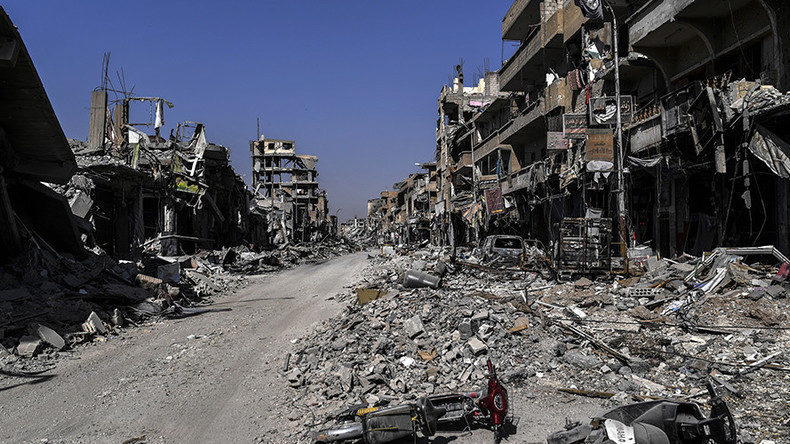
In the end, there is no difference from random carpet bombing: “precision strike” after “precision strike” after “precision strike” – even assuming the intelligence that guides the “precision” is accurate, which it isn’t – leaves nothing but rubble:
If you want a single word to summarize American war-making in this last decade and a half, I would suggest rubble. It’s been a painfully apt term since Sept. 11, 2001. In addition, to catch the essence of such war in this century, two new words might be useful — rubblize and rubblization.
Here are pictures from Raqqa in Syria. Amnesty International calculates that 30,000 artillery rounds were fired and the New Yorker estimates 10,000 bombs dropped; given an assumed population of 300,000 that’s one for every seven or eight people; “precision” or not, what would your neighbourhood look like after that?
Doing war from the air is pretty cost-free especially if your targets have weak air defence. The 1998 NATO operation in Kosovo had two accidental NATO deaths and two aircraft shot down. The 2011 NATO operation in Libya cost one soldier and two aircraft from accidents and one helicopter captured. It’s engagingly technical and allows much talk of precision. To say nothing of the opportunity to smugly accuse others of just tossing bombs around: “Putin’s modern Air Force choosing devastating dumb bombs over precision strikes“. (In this puff piece the authors do not understand that the Russians actually have figured out a cheap way to make “dumb” bombs “precise”. The process is explained here. Also note the familiar American boast “We’re able to do very precise weaponeering in order to strike and then also minimize civilian casualty”.)
The second assumption of the American Way of War is a prerequisite of the first – assured communications. The American way of precision bombing requires that the bomb or missile “talk” continually to its guide, whether that be a laser designator, a signal to the target and back or GPS satellites. This “talking” must be free, unrestricted and continuous – if it is stopped, the “smart” missile or bomb immediately becomes “stupid”. (Another advantage of the Russian way, incidentally, is that the “talking” is unnecessary once the bomb is dropped.)
U.S. warfighting doctrine depends on air power operating and communicating freely.
The countries on Washington’s target list are well aware of this and that is why they are continually improving their air defence and electronic warfare capabilities. Conversely, the reason why NATO members have feeble air defence and limited EW capability is that they’ve never thought they needed to have them. Years of beating up countries with trivial air defence and EW has left them complacent. (Even a wake-up call like the shooting down of the F-117 is soon sent down the Memory Hole.)
Great strategists have always known that victory is found in avoiding the enemy’s strength and attacking his weakness and that one should “fight the enemy with the weapons he lacks.” Russia, China and Iran cannot expect to win a naval battle in the South Pacific against the U.S. Navy: there will be no second Battles of Leyte Gulf, Midway or Coral Sea. That would be to attack U.S. strengths. Missiles to take out aircraft carriers are the answer: do not attack the enemy’s strength, fight him with the weapons he lacks. Neither would they attempt to invade and conquer the USA itself. Defence is what they want and these are the principles that guide them.
But there is a third assumption of the American Way of War and that is simply this:
the air raid sirens will sound somewhere else.
Everything that I have said above applies to Israel. Just like the USA, Israel has grown accustomed to using air power, “precision strikes” and all the rest of it. In 1973 it had a hard ground fight but since its 2006 repulse by Hezbollah in Lebanon it has relied ever more on air strikes. Like the U.S., it is confident that it has air superiority and secure communications. Being so much closer to its enemies, it is not as confident that the air raid sirens will always scream somewhere else, but confident that it can inflict, via its air power, unacceptable damage on its enemy, Israel proceeds. Hezbollah and Hamas would be fools to try – even if they could – to build an air force to fight Israel, neither can they expect to have air defence and electronic warfare assets to seriously challenge Israel’s air superiority. Because they cannot attack the two assumptions of air superiority and communications, they must therefore attack the third assumption of invulnerability. Not the enemy’s strength but his weakness.
The last big U.S. ground operations, the Iraq wars of 1990 and 2003, were preceded by months of unimpeded transportation of immense quantities of supplies across the Atlantic. Baghdad never interfered and the complacent supposition that the air raid sirens would sound only in the enemy’s skies was further strengthened. But, should NATO be so suicidal as to provoke Russia to war, this will not be the case: the Iskanders will come calling and there will be no uninterrupted buildup. NATO bases will not be safe sanctuaries and the convoys will have to fight their way through.
We see, today, the proof of concept. In May Gaza fired hundreds of simple, cheap rockets at Israel. The Israeli air defence system, Iron Dome, was reasonably effective but it will run out of missiles long before Gaza, to say nothing of Hezbollah, will. Iron Dome suffers from the weakness that it is far more expensive than the simple rockets Hamas is using. Debris rained down on Israeli cities, the odd rocket got through (probably more than we were told). The air raid sirens were continuous and Israelis were in bomb shelters. It’s true that Israel’s air force obliterated buildings in Gaza but that’s not the point: everyone knew they could do that, it’s the continuous rockets that are new. This went on for eleven days with no diminution of fire from Gaza. A piece in the NYT, not a noticeably Israel-hostile outlet, quotes an estimate of 30,000 rockets in Gaza; only about ten percent were fired. Hezbollah has at least four times as many. The myth of Israel’s invincibility has been broken: gravely diminished in 2006 on land, its skies are no longer safe. Fight the enemy’s weakness (its home morale – how many dual citizens are already packing their suitcases?) and use weapons it does not have.
A ceasefire was announced after eleven days; we’ll see if it holds: Israeli police have again stormed the al-Aqsa Mosque which was the trigger in the first place. The Jerusalem Post attempts a summing up; and a very pro-Israeli one it is: so many commanders, headquarters, launching sites claimed destroyed. Most important though is its recognition that Hamas “increased its volume and range” of rocket launches. And “Hamas took credit for redrawing the equation of power in the region in its battle with Israel, asserting that Israel is now in a state of decline”. A claim to be sure. But one with some reality. Hamas struck with greater numbers and deeper into Israel than ever before and there were also disturbances in the Arab population in Israel proper. Hamas is claiming a victory and it is not wrong to do so.
Air superiority, assured immediate communications and security of the home front. Gaza and Hezbollah present the poor man’s solution to the problem – lots of cheap rockets to challenge the assumption of a secure home front: Israel’s “illusion of normality” is gone.
Richer and more industrially-based entities can counter the first two assumptions and challenge the third with more sophisticated answers. Perhaps the greatest challenge to the complacency that other countries will be the amphitheatres for American wars is the Russian Poseidon; this weapon, a sort of giant autonomous underwater cruise missile, is designed to create a tsunami to wipe out U.S. ports and coastal areas. Iran, in its retaliatory attack on the U.S. base in Iraq last year, showed that U.S. forces were not safe in their bases. China and Russia are both creating weapons systems to attack the USA where it is weak using weapons it does not have. U.S. aircraft carrier battle groups, rather than projections of mighty power, are mere targets to hypersonic missiles. Russian EW capability has been described by at least one U.S. general as “eye-watering“, able to turn off U.S. systems; and one may be sure that the Russians are saving their best for later. (Can they blind an entire warship? Not at all! Disinformation! Nonsense! Information Warfare! A little too much protesting?) Russia and China can do this because they are not lost to fantasies of “power projection” or “full spectrum superiority“; they defend themselves with weapons the aggressor does not have that are directed at his weakness. Enough and not too much is their guide.
Gaza vs Israel represents the proof of the concept.
Israel’s War Cabinet Approves Escalated Aggression on Gaza
By Stephen Lendman | May 13, 2021
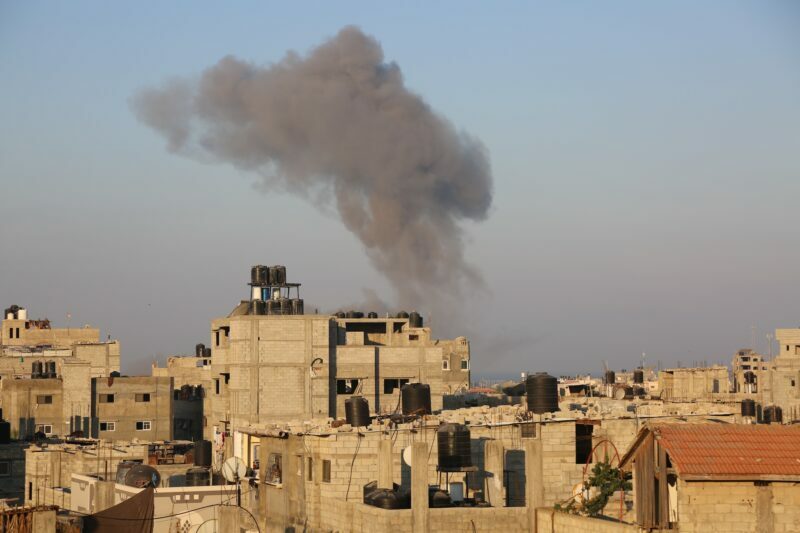
Late Wednesday, cabinet members unanimously agreed to intensify IDF terror-bombing of Gaza — including strikes on civilian targets.
War minister Gantz said “Gaza will burn” — meaning an intent to commit greater crimes of war and against humanity than already.
He lied accusing Hamas of using civilians as human shields.
Israeli warplanes continue terror-bombing civilian neighborhoods as it’s done before during preemptive wars on the Strip.
Residential and government buildings, schools, medical facilities, at least one mosque, agricultural lands, farmers in their fields, children in harm’s way, and Strip infrastructure was struck to make conditions for Gazans more untenable than already.
Mass slaughter and destruction keeps increasing by the hour.
Cold-blooded murder of Arabs is longstanding Israeli policy.
According to Defense for Children International – Palestine on Wednesday:
“Israeli forces continue to exhibit…complete disregard for international law, deploying explosive weapons and attacking densely-populated civilian areas in Gaza,” adding:
“As Palestinian children and families seek shelter from Israeli attacks, there is no safe space in the Gaza Strip.”
“Palestinian children in Gaza increasingly bear the brunt of Israel’s repeated military offensives and a human-made humanitarian crisis as a result of Israel’s closure policy toward the Gaza Strip.”
Deputy mayor of Lod, Ami Kaufman, said “hundreds of armed settlers from the West Bank are on their way to the city.”
“I suggest to every Arab resident not to leave their homes.”
“This has potential to be a bloodbath.”
Palestinian students in Israeli universities are being attacked, including in their dorms.
The Al Mezan Center for Human Rights condemned “intentional and disproportionate targeting of civilians and civilian properties” by Israeli terror-bombing and cross-border shelling,” adding:
The organization sharply criticized “inaction of the international community, as Gaza is pushed into perpetually worse security and humanitarian conditions.”
On Thursday, Al Jazeera reported that “residents and shop owners in Gaza City walked among the rubble and what is left of their homes and businesses following the heavy Israeli bombardment,” adding:
Shop owner Zakria Al-Halees struggled for words to explain damage affecting “the whole area.”
Images show widespread debris from days of ruthless IDF terror-bombing, defenseless civilians bearing the brunt of it — while the world community yawns and does nothing to hold Israel accountable for the highest of high crimes.
Iranian President Hassan Rouhani called for Muslim countries to unite against Israel, saying:
“The tragic incidents of the last few days and the crimes of the Zionist regime, more than ever, remind us of the need for unity and cooperation of Islamic countries to confront the Zionist coercion and occupation.”
“It is necessary for the Islamic countries to work together to defend the Palestinian people, and to confront the aggression and hostile and racist actions of the Zionist regime that we have witnessed in recent days and during the holy month of Ramadan.”
“The attacks and aggressions of the Zionist regime against the people of Palestine and Gaza Strip should stop immediately and we must not allow the Palestinian people to be oppressed anymore.”
In Damascus for discussions on “bilateral, regional and international issues,” Iran’s Foreign Minister Zarif condemned the “Israeli regime’s brutal aggression against Palestinians,” separately tweeting:
“It wasn’t enough for the Israeli regime to
-Steal people’s land & homes;
-Create an Apartheid regime;
It had to shoot innocent worshippers inside Islam’s 3rd Holiest Mosque upon Islam’s Holiest Eid.”
On Thursday, the Syrian People’s Assembly (PA) “condemned in the strongest terms the barbaric Zionist racist practices against the defenseless Palestinian Arab people, stressing that these practices are a flagrant violation of all international pacts, resolutions and norms, and a violation of the most basic rules of the international humanitarian law” — the Syrian Arab News Agency (SANA) reported, adding:
The PA “affirmed its stand by the Palestinians in Occupied Jerusalem and in every part of the land of Palestine, indicating that the Syrians, who have faced for years and are still facing the forces of evil and terrorism, will continue to support their Palestinian brothers, as their enemy is one, and their fate and victory are the same.”
In vain, it urged the world community to intervene against Israeli aggression on their behalf.
It hasn’t happened since Israeli forces stole historic Palestine for exclusive Jewish use and development.
Nor is Israel ever held accountable for the highest of high crimes of war, against humanity, and other atrocities against Palestinians and other Arabs.
Separately on Thursday, Hamas political leader Ismail Haniyeh said “(r)esistance responds to the crimes of the occupying regime in Quds, the Gaza Strip and everywhere.”
“If the occupying regime wants to continue its attacks, we will also continue more attacks.”
According to the Hamas Al-Qassam Brigades’ Abu Obeida:
Its forces fired a cruise “missile… at (Israel’s) Ramon airport, about 220km from Gaza.”
Reuters reported that the facility continues to operate, saying it wasn’t struck.
According to Palestinian/American writer/activist Yousef Munayyer:
“Israeli lynch mobs (are) attacking Palestinians” unobstructed while IDF warplanes terror-bomb Gaza.
Armed and dangerous, extremist settlers are assaulting Palestinians in public, storming their homes, beating and terrorizing them — including women and children — while nearby Israeli security forces do nothing to stop them.
They’ve been roaming East Jerusalem streets, shouting “Death to Arabs.”
In Occupied Palestine, the safety and welfare of non-Jews is never secure at all times.
Today in apartheid Israel, Arabs are in mortal danger — from Netanyahu regime security forces and extremist settlers out for blood.
A Final Comment
Instead of condemning Israeli ruthlessness and demanding accountability, spokesman for UN secretary general Guterres, Stephane Dujarric, merely called on the Netanyahu regime to “exercise maximum restraint and respect the right to freedom of peaceful assembly,” according to a UN statement.
“The secretary general reiterates his commitment, including through the Middle East Quartet, to supporting Palestinians and Israelis to resolve the conflict on the basis of relevant United Nations resolutions, international law and bilateral agreements,” Dujarric added.
Time and again, Guterres disgraced himself and the office he holds by failing to denounce US/NATO/Israeli aggression and demand accountability for high crimes too serious to ignore.
Meaningless weak-kneed statements — directly or through his spokesman — are issued time and again instead of doing the right thing he consistently avoids.
Israel rains down bombs on Gaza, resistance responds with 1000-plus rockets
Press TV – May 12, 2021
Palestinian resistance groups have fired a barrage of rockets at the Israeli-occupied cities in response to the regime’s continued bombardments of civilian targets in the Gaza Strip, as the death toll from the latest flare-up rises on both sides.
The Islamic Jihad resistance movement’s military wing, the al-Quds Brigades, announced that 100 rockets had been fired at the cities of Tel Aviv, Ashkelon, Be’er Sheva and Sderot early on Wednesday, Palestine Today reported.
Hamas’s military arm also announced that it launched 210 rockets toward the occupied territories early in the morning.
The Izz ad-Din al-Qassam Brigades said in a statement that it was “in the process of firing 110 rockets toward the city of Tel Aviv” and 100 others toward the town of Be’er Sheva, “as reprisal for the restarting of strikes against civilian homes.”
The Israeli army announced on Wednesday morning that Palestinian resistance groups in Gaza have launched more than 1,000 rockets toward different cities in the occupied territories since Monday evening.
Since then, the army said, 850 rockets have landed in Israel or been intercepted by the Iron Dome missile system.
Israeli authorities have so far confirmed five deaths as a result of the rockets fired from Gaza on several cities, including Tel Aviv.
The Israeli army also announced it had intercepted a Hamas drone early Wednesday.
Two Hamas commanders killed
The Israeli military has conducted hundreds of airstrikes on the blockade Gaza Strip, resulting in scores of fatalities.
Palestinian media reported that the Israeli regime continued its bombardment of the Gaza Strip on Wednesday, killing two Hamas commanders and three children.
Palestinian sources identified the two commanders as Hassan al-Kaogi (Abu Ali) and Wail Issa (Abu Ahmad).
Israel targeted Gaza’s police and security headquarters and the Islamic University of Gaza for the third consecutive day, which saw 30 simultaneous attacks on the Gaza Strip.
The Israeli army said in a tweet that the victims were Hamas intelligence officials.
It also said the Israeli attacks were a response to “hundreds of rockets” launched from Gaza in the last 24 hours, adding that they marked “our largest strike since 2014.”
Three Palestinian children were also killed during an Israeli air raid on Tel al-Hawa neighborhood in Gaza, Shehab News reported.
Pregnant Palestinian woman, 5-year-old son killed
Meanwhile, a pregnant Palestinian woman and her 5-year-old son were also killed during the Israeli airstrike that targeted their house in the Gaza Strip.
The woman, identified as Reem, and her son, Zaid, were reported killed after the strike hit their house in Tel al-Hawa, a neighborhood in the southern part of Gaza.
Reem’s brother, Ahmed Saad, reported their deaths on social media. She was four months pregnant.
Meanwhile, Gaza’s Health Ministry announced on Wednesday afternoon that as many as 48 Palestinians, including 14 children and three women, had lost their lives in Gaza in the latest Israeli strikes, with a total of 296 civilians — most of them women and children — wounded since Monday.
Palestinian rocket hits Israeli pipeline
As a result of rockets fired from Gaza on Wednesday, an Israeli pipeline near Ashkelon was hit causing fire.
The rockets also killed two Israeli settlers and injured at least 100 Israelis.
Hamas leader Ismail Haniyeh said Israel is responsible for the consequences of its atrocities in Jerusalem al-Quds and al-Aqsa Mosque, whose flames “extended to Gaza.”
He said Qatar, Egypt and the UN had been in contact with Hamas urging calm, but he told the regime in Israel that “If they want to escalate, the resistance is ready, if they want to stop, the resistance is ready.”
Earlier, Israeli minister for military affairs Benny Gantz warned that “this is just the beginning” of Israel’s assaults.
‘I saw my cousins set alight’, survivor recalls
One of the survivors of Israel’s attack in northern Gaza on Tuesday recalled the horror of watching five members of his family, including young brothers Ibrahim and Marwan, die during the strike.
“We were laughing and having fun, when suddenly they began to bomb us, everything around us caught fire,” their cousin, also called Ibrahim, told AFP.
“I saw my cousins set alight, and torn into pieces,” said the 14-year-old, breaking down in tears. “Why did they leave me? I would have wanted to die as a martyr like them.”
Israeli bombardments of Gaza continued on Wednesday, shaking Gazans’ homes and lighting up the besieged city’s sky just after dawn, with at least 30 explosions reported by residents within a matter of minutes.
Israel declares ‘state of emergency’ in Lod
The occupied territories were hit with protests as well, which, in the city of Lod, prompted the Israeli government to declare a “state of emergency” following the killing of a Palestinian by a Jewish settler in the city.
“Everything necessary is done to restore law and order in Lod” and throughout the occupied territories, Israeli public security minister Amir Ohana said.
He announced that the Israeli regime has decided to deploy 16 Border Police reserve units to Lod from the occupied West Bank.
Minor confrontations were also reported following Fajr (dawn) prayers at al-Aqsa Mosque on Wednesday morning, with Palestinians chanting protest and resistance songs, while Israeli forces were deployed around the complex.
Unrest erupted across Israeli-occupied territories on Tuesday night and into Wednesday, as social media posts showed protests in the city of Rahat as well as in Qalansawe.
The al-Aqsa Mosque and Bab al-Amoud (Damascus) Gate in Jerusalem al-Quds’ Old City as well as the Sheikh Jarrah neighborhood have witnessed a spike in Israeli atrocities since the beginning of the Muslim holy month of Ramadan.
Featured Video

Rewriting the risk? Inside the government’s vaccine safety messaging
or go to
Aletho News Archives – Video-Images
Book Review
“Davos Can Really Replace the UN”
Inside the book that maps the architecture behind global governance — from the Epstein files to the Pact for the Future
Lies are Unbekoming | April 1, 2026
On June 13, 2019, the United Nations and the World Economic Forum signed a partnership deal to “accelerate the implementation of the 2030 Agenda for Sustainable Development.” That same evening, WEF president Börge Brende — Norway’s former Foreign Minister — had dinner with Jeffrey Epstein at Epstein’s Manhattan townhouse. The Epstein files, released January 2026, contain an exchange between the two from the previous year. Epstein to Brende: “Davos can really replace the UN. C21, cyber, crypto . genetics… intl coordination.” Brende back to Epstein: “Exactly — we need a new global architecture. World Economic Forum (Davos) is uniquely positioned — public private.”
The next day, the UN General Assembly adopted the framework for restructuring global governance.
That sequence — the partnership signing, the Epstein dinner, the candid admission about replacing the UN with a public-private architecture, and then the formal adoption — opens Jacob Nordangård’s The Digital World Brain. Pages two and three. Footnoted to the UN resolution number, the Epstein files, and the General Assembly record.
I keep coming back to it because it captures what this book does that almost nothing else in the independent research space manages. I’ve followed Jacob’s work for years now and interviewed him about his research. Each book peels back another layer of the same institutional architecture, and each time I think he’s reached the limit of what can be documented, the next one goes further. Nordangård doesn’t speculate. He doesn’t editorialize much. He lays institutional actions next to each other in chronological order and lets the pattern announce itself. … continue
Blog Roll
 Aletho News
- How I fell foul of the BBC thought police
- The End of NATO
- 37 days of war on Iran cost US staggering $42bln, tracker shows
- Baghdad tells Asian refiners, traders to begin loading Iraqi crude amid Iranian exemption
- Under fire, Moscow and Tehran close ranks
- Iran, US receive Pakistan-mediated plan for ceasefire then final deal
- Iran submits demands for end to war as mediators scramble ahead of Trump deadline
- Iran Threatens Retaliatory Strike on Stargate AI Project in UAE
- US sent ‘a lot’ of arms to Iranian protesters – Trump
- Barak Ravid Launders Deception To Allow Trump To Back Off Of His Power Plant Threat – Again
- If Americans Knew
- U.N. experts demand Israel release prominent Gaza doctor after reports of ‘severe torture’
- Israel’s Latest Genocide Is Against the Shias of Lebanon. Why Is the World Silent?
- How Eliot Cohen’s influence over U.S. war-making paved the way for Trump’s war crimes in Iran
- Israelis don’t pay for the weapons we ‘sell’ to them — US taxpayers do
- While Distancing from AIPAC, Most 2028 Democratic Hopefuls Are Still Embracing Israel
- A brief history of the Israeli nuclear program, the open secret at the heart of the Iran war
- Israeli Settlers Killed a Palestinian Farmer on His Own Land, in Front of His Father. Yes, Again
- The US-Israeli War on Science is an Assault on our Future
- 100+ International Law Experts Say US Strikes on Iran Violate UN Charter, Could Be War Crimes
- ‘Vile, Horrifying, Evil’: Trump Threatens to Bomb Nation of 90 Million People ‘Back to the Stone Ages’
- No Tricks Zone
- An Inconvenient Tree: Uncovered In Alps… Europe Much Warmer Than Today 6000 Years Ago
- New Study Reports A 60% Slowdown In Greenland’s Ice Loss Rate In The Last Decade
- Low Intensity Tornado Wrecks Major Solar Farm, Creating A Potential Toxic Dump
- New Study Finds Warming Saves Lives…Cold Temperatures 12 Times More Deadly Than Excess Heat
- German Science Blog Accuses PIK Climate Institute Of Hallucinating Climate Tipping Points
- Devastating Assessment Of Comirnaty Vaccine By Former Senior Pfizer Europe Toxicologist
- New Study: CO2 Is ‘Effectively Negligible’ As An Explanatory Climate Change Factor Since 2000
- Former Pfizer Toxicologist Dr. Helmut Sterz Tells Bundestag Hearing Pfizer Vaccine Should Have Never Been Approved
- Energy Expert: Germany’s Nuclear Phaseout Was A “500 Billion Euro Mistake”
- New Research: South Australia’s Mid-Holocene Sea Surface Temperatures Were 4°C Warmer Than Today
 Aletho News