Hamas warns against postponing Palestine elections
MEMO | April 23, 2021
Deputy head of Hamas’ political bureau, Khalil Al-Hayya yesterday warned against postponing the Palestinian legislative elections scheduled for 22 May, saying it would push the Palestinian people into the unknown.
Al-Hayya, who heads the movement’s list in the elections, said the postponement “will generate great frustration among the masses and youth”, warning that “the postponement will complicate the situation and perpetuate division”.
In January, Palestinian Authority President Mahmoud Abbas announced that the elections will be held in May followed by Presidential elections in July.
Earlier this week, the Jerusalem Media and Communication Centre published the results of a poll which showed that 79 per cent of Palestinians consider holding these elections important.
On Tuesday, Abbas’ senior adviser, Nabil Shaath, said the upcoming Palestinian national elections are “very likely” to be postponed if Israel does not allow voting in occupied East Jerusalem.
He told An-Nahar newspaper that if Israel continues to ignore the PA’s request to hold the elections in East Jerusalem, “the electoral process will be postponed.”
Israel has carried out an arrest campaign against those taking part in elections activities in occupied Jerusalem. Analysts believe occupation forces will not allow balloting to take place in the area as Israel claims all of Jerusalem as its capital and does not allow PA activities in the city.
However, many believe the PA is using this as an excuse because recent polls show that Hamas would, once again, win the election leaving President Abbas, who heads the Fatah movement, in a difficult predicament.
Abbas refused to step down following Palestine’s last election in 2006 when Hamas was elected to power. The move caused disunity among Palestinians and led to Fatah heading the government in the occupied West Bank and Hamas governing the besieged Gaza Strip.
US, Israel set to punish Palestinians for holding a democratic election, again
By Robert Inlakesh | Press TV | April 11, 2021
Robert Inlakesh is a journalist, writer and political analyst, who has lived in and reported from the occupied West Bank. He has written for publications such as Mint Press, Mondoweiss, MEMO, and various other outlets. He specializes in analysis of the Middle East, in particular Palestine-Israel. He also works for Press TV as a European correspondent.
Israeli and US officials are citing concerns over the potential outcome of the upcoming May 22 Palestinian legislative elections, and if their reactions mirror the past example, the conflict in the Palestinian Occupied Territories could severely escalate.
The people of the West Bank, East Jerusalem al-Quds and Gaza are set to vote in their first set of elections in 15 years. Much to the dismay of Israel and the United States, who claim they will not interfere in Palestinian democratic processes, it looks like their most despised group Hamas is on the way to a potential landslide victory.
In 2006, Hamas historically won the legislative elections, seizing control of the Gaza Strip. Their Fatah Party rivals, the United States and Israel, however, did not accept the election results and decided to take action to punish the people of Palestine for having their own say at the ballot box.
What ensued was dubbed as the ‘Palestinian civil war,’ which officially ended in 2007, with Hamas having successfully stopped an attempted Fatah-led coup – backed by the United States and Israel. Israel, as a result of the removal of Fatah power from the Gaza Strip, saw the perfect opportunity to impose a full and tightened blockade over the territory – thus collectively punishing its civilian population for their choice in the elections. Upon the Hamas victory, the US and EU also imposed overwhelming sanctions on Gaza meant to undermine the elected Hamas government.
As a result of the rivalry between the Fatah Party, currently heading the Palestinian Authority (PA) – which maintains limited control over small portions of the West Bank – and Hamas, there have been no elections since. Time and time again Palestinian Authority President Mahmoud Abbas, whose term in office expired in 2009, has postponed the elections, until early this year, when Abbas announced that legislative and presidential elections were finally to take place.
For Palestinians, their elections are set up to fail from the get-go. Pretty much the only political party they have to choose from, without being punished by the West and Israel, is the Fatah Party. All other major political Parties are registered terrorist organizations by most Western countries and Israel itself. Due to Western political immaturity, no organization that refuses to sell out the Palestinian cause for national liberation is to be considered as a legitimate political force and so instead it must be punished, attacked, sanctioned and humiliated. Thus, any Palestinian voting for a change to the status quo, meaning voting outside of lists belonging to Fatah, are to be punished for their choice to change to political scene.
We know from statements published by Fatah and Hamas that both intend to set up a unity government, meaning that Hamas will be in on decisions to lead the Palestinians of the occupied Palestinian territories. Yet, if this occurs, Israel is very open about their rejection of any collaboration with a government formed of Hamas members. This means that all of the cooperation between the Palestinian Authority and Israel, such as “security cooperation,” would cease and the two would be at conflict.
Early this year, Israeli Shin Bet chief Nadav Argaman had repeatedly warned President Mahmoud Abbas about the consequences of holding elections and made it clear that Hamas would not be tolerated. The Shin Bet chief also stressed that Abbas not go ahead with the elections.
Now it has been reported that, in a meeting between the two, both Israeli Foreign Minister Gabi Ashkenazi and US Secretary of State Antony Blinken are “concerned” about a Hamas win and urge a postponement of the elections. The hilarious part of the meeting, reported by Israel’s Walla news outlet, was that both figures also stressed that they didn’t intend to interfere in Palestinian democratic processes. But if you are urging a postponement of elections, after 15 years of no elections and are set to reject the party most likely to win at this point, then what else other than interference is that?
Israel has already gone on a tirade of arresting Palestinian political activists and prominent members of Hamas, in the West Bank and threatens ending cooperation with the PA, which will result in an escalation of violence. The US also does not indicate it will accept a Hamas win and is already expressing concern. So, if Hamas were to win in the West Bank, then we can only assume that their sanctions against Gaza may be transferred somewhat onto the West Bank too. This is essentially the US and Israel offering the Palestinian people an ultimatum; choose the status quo and still have the limited money you have, or choose who you like and we will crush you.
Due to the internal divisions now seen in the Fatah Party – which seems most likely to pave the way for a Hamas win – there is no indication that this will be respected by the West and Israel.
So, what do Palestinians do, vote for the status quo and continue to suffer as usual, watching the settlements expand upon the rest of their lands in the West Bank and East Jerusalem (al-Quds), or vote for the alternative which will likely mean an all-out conflict with the West and Israel?
As much as the West and Israel attempt to publicly distance themselves from the Palestinian elections, they are as much a part of it as are all the Palestinian political parties themselves. This is just the reality of the ongoing illegal occupation, there is no official autonomous Palestinian State, only oppressed peoples fighting for that State. So, any attempt to act as if a fair election, without Israeli-US influence is possible, is a product of great imagination.
Hamas welcomes Turkish-Egyptian detente
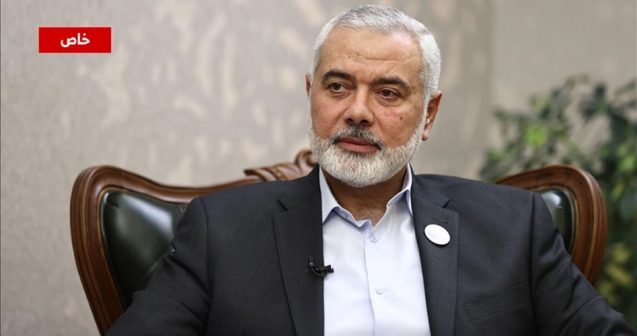
Ismail Haneyya
Palestine Information Center – April 1, 2021
ISTANBUL – Head of Hamas’s political bureau Ismail Haneyya has welcomed the Turkish-Egyptian rapprochement, expressing confidence that any cooperation between Ankara and Cairo will be in the interest of the Palestinian people and their national cause.
Haneyya made the remarks in an interview conducted by Anadolu Agency after he visited its headquarters in Istanbul.
“We welcome the Turkish-Egyptian rapprochement, and we believe that more understandings between them and between Arab and Islamic countries will have a positive impact on us in Palestine as well as on the Arab countries,” the Hamas political chief said.
“There are historically known central states in the region that play strategic roles, such as Egypt, Turkey, Iran and Saudi Arabia, so any understanding and rapprochement between them will be in the interests of the peoples in the region and the Palestinian cause,” he added.
As for the upcoming Palestinian elections, Haneyya affirmed that his Movement is committed to forming a national consensus government even if it scored a victory in the legislative elections slated for next May.
“Hamas is participating in the elections on the basis of partnership and not with the aim of defeating others. It does not want to dominate the Palestinian political system,” he underlined.
He described the upcoming elections as an important opportunity to improve the current Palestinian conditions and end 15 years of national division.
Israel detains 3 prominent Hamas leaders in West Bank
MEMO | March 26, 2021
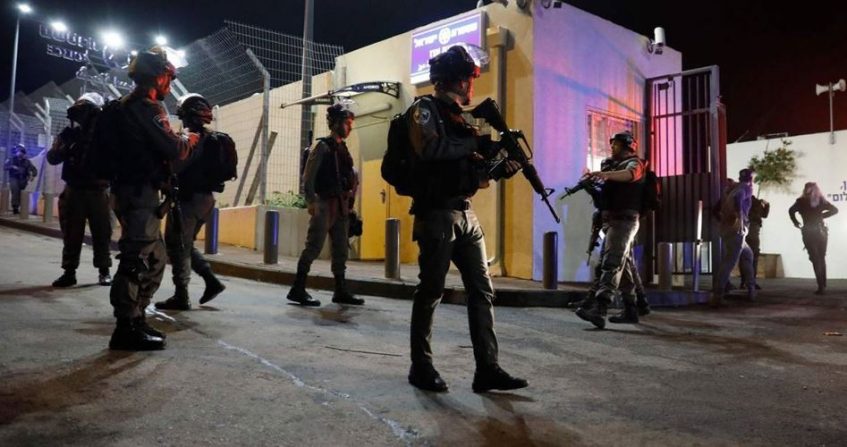
The Israeli army detained three prominent Hamas leaders the occupied West Bank city of Hebron.
Eyewitnesses told Anadolu Agency that an Israeli soldier detained Hatem Qaffeisha, 58, a top Hamas leader in Hebron and a Palestinian lawmaker.
Former Local Governance Minister Isa Al-Jabari, 55, and top Hamas figure Mazen Al-Natsha, 49, were also detained.
The three figures have been jailed several times by the Israeli army.
Hamas has warned of Israeli plans to stage a mass arrest campaign against its members ahead of the Palestinian elections slated for May.
In February, key Hamas members were detained including Mustafa Al-Shannar, Adnan Asfour, Yaser Mansour, Khalid El-Haj, Abdel-Basit El-Haj, Omar Al-Hanbali and Faze’ Sawafteh.
Hamas says the Israeli authorities aim to disrupt the Palestinian elections and affect the results.
Hamas also accused the Israeli authorities of threatening its members with imprisonment if they run in the upcoming elections.
Palestinians are scheduled to vote in the legislative elections on 22 May, presidential polls are to be held on 31 July and the National Council elections on 31 August.
The last legislative elections were held in 2006, with Hamas coming out on top.
Hamas: Israel detention campaigns aim to alter election results
MEMO | March 3, 2021
Hamas said yesterday that detention campaigns carried out by Israeli occupation against Islamic Bloc activists aim to affect the results of the Palestinian election.
Recently, Israeli occupation forces escalated detention campaigns targeting Hamas leaders, members, and activists in the occupied West Bank.
Hamas MP Sheikh Nayef Al-Rajoub said that the Israeli occupation detains Hamas members and holds them under administrative detention.
These detention campaigns aimed at “targeting the will of Palestinian youth, who are at the core of the upcoming elections,” Hamas said in a statement.
“We stress that achieving national consensus and partnership is a national priority,” Hamas added, reiterated that it “will continue its efforts to rearrange the Palestinian national home on the basis of achieving partnership, ending divisions and setting up a comprehensive, national programme to face off the Israeli occupation and settlement activities.”
Hamas called on all free people of the world and parliaments to impose sanctions on the Israeli occupation, which has been targeting Palestinian democracy for years.
“The detention campaigns come as part of a policy adopted by the Israeli occupation since 2006 to undermine the Palestinian political system and exclude any influential Palestinian party that gained legitimacy through the ballot boxes,” Hamas concluded.
Israel said to warn Hamas leader not to run in polls
MEMO | February 23, 2021
Hamas leader Nayef al-Rajoub said Tuesday he was warned by Israeli intelligence agents against running in the Palestinian elections later this year, Anadolu Agency reported.
Speaking to Anadolu Agency, al-Rajoub, 63, said he was searched during an Israeli raid on his home in the town of Dura, west of Hebron.
“An intelligence officer then threatened me not to run in the upcoming polls,” al-Rajoub said, adding that he was only allowed to cast a ballot in the elections.
Al-Rujoub, a brother of prominent Fatah leader Jibril al-Rujoub, received the most votes during the 2006 parliamentary elections won by Hamas.
In the Hamas-led government that emerged from those elections, Al-Rujoub served as minister of religious endowments. He had previously been detained by Israeli forces and served more than eight years in prison.
Earlier Tuesday, Israeli forces arrested 13 Palestinians, including Hamas leader Faze’ Sawafta, in overnight raids in the occupied West Bank.
Hamas, which rules the Gaza Strip, had earlier warned of Israeli plans to stage a mass arrest campaign against the resistance group ahead of Palestinian elections later this year.
Over the past month, several Hamas members were detained in Israeli raids, with the Palestinian group warning that the Israeli arrests aim to disrupt the Palestinian elections and affect its results.
Palestinians are scheduled to vote in legislative elections on May 22, presidential polls on July 31, and National Council polls on Aug. 31.
The last legislative elections, in which Hamas won a majority, were held in 2006.
Leaders, members ‘angry’ at Hamas’ participation in elections
MEMO | February 9, 2021
Leaders and members of Hamas in the occupied West Bank, besieged Gaza Strip and the diaspora are angry at the movement’s decision to participate in the general elections called for by the Palestinian Authority, Arabi21 reported.
The site quoted multiple sources within the movement as saying that the organisation’s leaders and members in the West Bank have informed the leadership that there was widespread dissatisfaction with the decision to participate, which they said had been taken in a “hurry”.
Those who spoke to Arabi21 said the Hamas members’ general dissatisfaction with the decision stems from their view that Hamas’ condition in the West Bank has not changed and its members continue to suffer from the restrictions imposed by the Palestinian Authority and Israel and it still cannot participate in any public meetings.
They also believe “the elections aim to create a new team with new legitimacy, which will strip Hamas of legitimacy and allow the new team to sign any agreement or do whatever it wants on the grounds that it is elected.”
Sources believe Hamas members in the Gaza Strip and in the diaspora consider the decision to take part in the elections to be “unwise and unbalanced”.
Israel Warns Hamas Leaders Not to Run in Elections in West Bank
MEMO | January 28, 2021
Israeli intelligence services have started to warn Hamas officials in the occupied West Bank not to participate in the upcoming Palestinian elections, sources within the movement revealed on Wednesday.
According to the sources, the Israelis first summoned senior Hamas official Sheikh Omar Al-Barghouti to speak with intelligence officers at Ofer Detention Centre. While he was there, Al-Barghouti, who lives in the Ramallah neighborhood of Coper, was “asked” not to take part in the presidential, legislative and National Council elections. The Hamas leader was only released from prison a few weeks ago.
Several other Hamas officials and senior members have also been “asked” the same thing by the Israelis. The sources said that some were asked on the telephone and others were also summoned to detention centers or military bases to be interrogated on this issue.
Al-Barghouti has spent a total of 30 years in Israeli prisons. He is the brother of Nael Al-Barghouti, who has been held by Israel for more than 40 years.
In 2018, the Israeli occupation forces arrested Al-Barghouti and his wife. During the same raid, they not only killed his son but also demolished his house.
Previous warnings from Israeli intelligence to Hamas have included telling officials not to get involved in reconciliation talks with Fatah.
In 2006, Hamas won the parliamentary and municipal elections in the occupied Palestinian territories. Israel, Fatah, Arab states and the West, including the US, refused to accept the victory before going on to help Fatah oust Hamas in the West Bank and impose a strict siege on Gaza.
Hamas condemns PA announcement on restoration of ties with Israel
Palestine Information Center – November 18, 2020
GAZA – The Islamic Resistance Movement, Hamas, has strongly condemned the decision of the Palestinian Authority (PA) to resume its relations with the “criminal Zionist occupation”.
Hamas said in a statement on Tuesday evening that the PA is flouting all the national values and principles and the outcomes of the historic meeting of the Secretaries-General of the Palestinian factions.
The Movement added that this decision represents a betrayal of the national efforts towards building a national partnership and a struggle strategy to confront the occupation, annexation, normalization and the deal of the century. It highlighted that this decision was made after the announcement of thousands of Israeli housing units in Occupied Jerusalem.
The PA by this decision justifies the Arab normalization with Israel which it has consistently condemned and rejected, Hamas noted.
It demanded the PA to immediately reverse its decision.
“A real national unity based on a comprehensive national program that stems from the strategy of confrontation with the criminal occupation will only liberate the land, protect rights and expel the occupation”, Hamas stressed.
Hamas: the US has told Arab states to stop supporting the PA
MEMO | October 19, 2020
A senior Hamas official has claimed that the US has told a number of Arab states to stop giving financial support to the Palestinian Authority, Al-Aqsa TV reported on Sunday. According to Saleh Al-Arouri, a number of states have been asked to put pressure on Fatah, which controls the PA, in order to pull out of any reconciliation with Hamas.
The Deputy Head of the Hamas Political Bureau added that these countries are those which sponsored the US deal of the century. He stressed, however, that Hamas is committed to the Palestinian understandings reached in Istanbul and would never backtrack on them.
Al-Arouri also revealed that the US had offered to talk with Hamas over the so-called “deal”, but Hamas refused because Washington’s intention was to split the national Palestinian stance and threaten the PLO leadership.
In July, the former Hamas leader Khaled Meshaal said that the best way to undermine the Israeli annexation plans “is to change the function of the PA” from serving the Israeli occupation to confronting it. He stressed that if such a change was not made, the PA should be dissolved after discussions with the different Palestinian factions and reaching an agreement on a replacement in order not to end up in chaos.
Israel sets its sights on the Red Sea and Bab El-Mandeb
Dr Adnan Abu Amer | MEMO | October 6, 2020
Day after day, the magnitude of the Israeli benefits from normalisation with the Gulf become clearer, especially on the military and strategic levels. The latest benefit is talk about establishing Israeli military bases in the Gulf, the Red Sea and Bab El-Mandab, or benefiting from the Emirati bases scattered in these areas, and the military benefits for Israel brought about by controlling these international seaports.
The Emirati-Israeli agreement included many clauses with security and military aspects, which stipulate bilateral cooperation in these areas, and their commitment to take important measures to prevent the use of their territories to carry out a hostile or “terrorist” attack targeting the other party, and that each side will not support any hostile operations in the territory of the other party. It also stipulates bilateral security coordination and strengthening the military security relationship.
These carefully worded texts have increased the assumptions regarding the possibility of Israel benefitting from the Emirati military bases in the region, whether in the Gulf, Bab El-Mandab, or the Red Sea. This may lead to the establishment of Israeli military base in the Emirates, as well as its use of Emirati waters, and the possibility that it will continue down this path to increase its foothold in Socotra, the Bab El-Mandab Strait and Djibouti.
It is worth noting that the possibility of establishing Israeli military bases in the Gulf, or Israel benefiting from the Emirati military bases, is not easy, but very dangerous. This is because as much as it may give hope to the Gulf states, and the UAE in particular, to defend itself against the threat of any imagined attack from Iran, it, at the same time, exposes it to danger. This is because the fulfilment of this premise means that Israel can strike Iranian targets in the Gulf waters, or in the heart of Iran itself, which will be matched by Iran targeting these Israeli bases in the Gulf.
The agreement allows Israel to get geographically closer to Iran and allows it to improve ties with the Gulf which is a strategic area in terms of trade and oil.
Iran will not stand idly by and remain silent regarding the Emirati-Israeli move, which means the situation in the Gulf region is likely to grow tense and suffer. Iran is present everywhere through the Revolutionary Guard and its sleeping armed cells.
Security of maritime navigation in the Gulf is a purely Israeli interest within the strategy of “curbing the Iranian threat” and strengthening the relationship with the Gulf states, former Israeli Foreign Minister, Yisrael Katz, has said.
Israel aims to gain control over the most important sea straits in the region, which belong to the Emirati and Saudi bases, which enhances the expansion of Israel’s military and strategic influence.
A document by the Israeli Ministry of Intelligence revealed that the agreement with Abu Dhabi paves the way for intensifying military cooperation between them in the Red Sea. This is because it is interested in expanding security cooperation in the region, leading to strengthening the military alliance between them. This includes intensive Israeli military movement, especially through the countries of the Horn of Africa, most notably Ethiopia, at a time when Israeli arms companies are seeking to increase their exports to the Emirates.
US Secretary of State, Mike Pompeo, announced that the UAE and Israel had agreed to build a security and military alliance against Iran to protect American interests and the Middle East, and to increase security and intelligence cooperation to confront what he referred to as “terrorism”.
But Israel has not left Yemen out of its view, the country offers a gateway to the Bab El-Mandab Strait. Tel Aviv aims to crack down on the Palestinian resistance to prevent it from receiving the weapons that reach it from Iran through the Red Sea, reaching the Sinai, and then the Gaza Strip.
As long as the most important provisions of the Emirati-Israeli agreement are related to security and military relations, Israel will work to exploit the agreement to increase its influence in the Gulf. Meanwhile, the UAE is looking for control in the Gulf with the support of the US and Israel, so there is joint Israeli and Emirati work in Yemen to establish joint military bases and areas of influence, specifically on the island of Socotra, which would allow it to completely control the path that passes from India to the West, and penetrates into Africa, which is a strategic location for Israel.
Arrest of Hamas co-founder by Israeli security forces denounced as attempt to undermine Palestinian reconciliation
RT | October 2, 2020
Israeli security forces have arrested senior Hamas leader Hassan Youssef. The two rival Palestinian groups, Hamas and Fatah, have both condemned the move as being politically-charged and a bid to ruin their reconciliation talks.
Youssef was taken at his home in Ramallah in the occupied West Bank on Friday morning. While Israeli authorities have not provided any official information about the move, local media reported that the Hamas co-founder was detained over alleged “renewed” activity by the group.
After helping to found Hamas in the late 1980s, Youssef was repeatedly arrested by the Israeli authorities and spent years behind bars. Hamas has always maintained he was only involved in its political activities, and not associated with its military wing.His arrest was condemned by both Hamas and its rival, Fatah. Hamas claimed the arrest was a politically-motivated move, designed to destabilize the ongoing reconciliation process between the two groups.
“We hereby affirm that the arrest of Sheikh Hassan Youssef by the occupation will not stop the path of unity for which he worked for the past two months,” Hamas said in a statement.
Fatah has voiced a similar opinion on Youssef’s arrest, with the group’s Secretary-General Jibril Rajoub accusing Tel Aviv of “tampering” with the reconciliation talks and attempting to “influence the achievement of national unity.”
“This arrest is a continuation of the occupation’s approach to arresting dozens of our Palestinian people every day, and a continuation of the continuous aggression against our people for decades,” Rajoub stated.
Featured Video

Rewriting the risk? Inside the government’s vaccine safety messaging
or go to
Aletho News Archives – Video-Images
Book Review
“Davos Can Really Replace the UN”
Inside the book that maps the architecture behind global governance — from the Epstein files to the Pact for the Future
Lies are Unbekoming | April 1, 2026
On June 13, 2019, the United Nations and the World Economic Forum signed a partnership deal to “accelerate the implementation of the 2030 Agenda for Sustainable Development.” That same evening, WEF president Börge Brende — Norway’s former Foreign Minister — had dinner with Jeffrey Epstein at Epstein’s Manhattan townhouse. The Epstein files, released January 2026, contain an exchange between the two from the previous year. Epstein to Brende: “Davos can really replace the UN. C21, cyber, crypto . genetics… intl coordination.” Brende back to Epstein: “Exactly — we need a new global architecture. World Economic Forum (Davos) is uniquely positioned — public private.”
The next day, the UN General Assembly adopted the framework for restructuring global governance.
That sequence — the partnership signing, the Epstein dinner, the candid admission about replacing the UN with a public-private architecture, and then the formal adoption — opens Jacob Nordangård’s The Digital World Brain. Pages two and three. Footnoted to the UN resolution number, the Epstein files, and the General Assembly record.
I keep coming back to it because it captures what this book does that almost nothing else in the independent research space manages. I’ve followed Jacob’s work for years now and interviewed him about his research. Each book peels back another layer of the same institutional architecture, and each time I think he’s reached the limit of what can be documented, the next one goes further. Nordangård doesn’t speculate. He doesn’t editorialize much. He lays institutional actions next to each other in chronological order and lets the pattern announce itself. … continue
Blog Roll
 Aletho News
- How I fell foul of the BBC thought police
- The End of NATO
- 37 days of war on Iran cost US staggering $42bln, tracker shows
- Baghdad tells Asian refiners, traders to begin loading Iraqi crude amid Iranian exemption
- Under fire, Moscow and Tehran close ranks
- Iran, US receive Pakistan-mediated plan for ceasefire then final deal
- Iran submits demands for end to war as mediators scramble ahead of Trump deadline
- Iran Threatens Retaliatory Strike on Stargate AI Project in UAE
- US sent ‘a lot’ of arms to Iranian protesters – Trump
- Barak Ravid Launders Deception To Allow Trump To Back Off Of His Power Plant Threat – Again
- If Americans Knew
- U.N. experts demand Israel release prominent Gaza doctor after reports of ‘severe torture’
- Israel’s Latest Genocide Is Against the Shias of Lebanon. Why Is the World Silent?
- How Eliot Cohen’s influence over U.S. war-making paved the way for Trump’s war crimes in Iran
- Israelis don’t pay for the weapons we ‘sell’ to them — US taxpayers do
- While Distancing from AIPAC, Most 2028 Democratic Hopefuls Are Still Embracing Israel
- A brief history of the Israeli nuclear program, the open secret at the heart of the Iran war
- Israeli Settlers Killed a Palestinian Farmer on His Own Land, in Front of His Father. Yes, Again
- The US-Israeli War on Science is an Assault on our Future
- 100+ International Law Experts Say US Strikes on Iran Violate UN Charter, Could Be War Crimes
- ‘Vile, Horrifying, Evil’: Trump Threatens to Bomb Nation of 90 Million People ‘Back to the Stone Ages’
- No Tricks Zone
- An Inconvenient Tree: Uncovered In Alps… Europe Much Warmer Than Today 6000 Years Ago
- New Study Reports A 60% Slowdown In Greenland’s Ice Loss Rate In The Last Decade
- Low Intensity Tornado Wrecks Major Solar Farm, Creating A Potential Toxic Dump
- New Study Finds Warming Saves Lives…Cold Temperatures 12 Times More Deadly Than Excess Heat
- German Science Blog Accuses PIK Climate Institute Of Hallucinating Climate Tipping Points
- Devastating Assessment Of Comirnaty Vaccine By Former Senior Pfizer Europe Toxicologist
- New Study: CO2 Is ‘Effectively Negligible’ As An Explanatory Climate Change Factor Since 2000
- Former Pfizer Toxicologist Dr. Helmut Sterz Tells Bundestag Hearing Pfizer Vaccine Should Have Never Been Approved
- Energy Expert: Germany’s Nuclear Phaseout Was A “500 Billion Euro Mistake”
- New Research: South Australia’s Mid-Holocene Sea Surface Temperatures Were 4°C Warmer Than Today
 Aletho News