Hamas asks PA government to fulfill its duties or resign
Palestine Information Center – December 2, 2107
GAZA – Islamic Resistance Movement, Hamas, on Saturday urged the Palestinian Authority (PA) government to fully assume its responsibilities, including lifting the unjust sanctions on the Gazan people, or resign and form a national salvation government.
The Movement said in a press statement that the PA government, led by Rami Hamdallah, was handed over all Gaza ministries yet it has not exerted any single effort to alleviate the suffering of the Palestinians people in Gaza and miserably failed in implementing the agreements reached in Cairo.
Hamas accused the PA government of fighting against the resistance and stressed that it has not made any serious step to confront the Israeli Judaization and settlement schemes and defend the Palestinian people in Occupied Jerusalem and the West Bank.
This is the first time that Hamas has openly asked Hamdallah’s government to resign. The request came in response to the government’s procrastination in lifting the sanctions imposed on the Gaza Strip despite having taken over all government institutions in the enclave under Egyptian and international supervision.
PA officials demand that the PA government be fully “empowered” as a condition for lifting sanctions. Palestinian factions and observers see this term as unrealistic, especially that lifting the sanctions was earlier linked to dissolving the administrative committee and handing over Gaza ministries and crossings.
The sanctions imposed on Gaza, which include reducing power and medical supplies and cutting the salaries of PA employees, are still in place despite the reconciliation talks. The humanitarian situation in the territory, meanwhile, keeps worsening in view of the 11-year Israeli blockade.
Lebanon has right to resist, foil Israeli plans: Aoun

Lebanese President Michel Aoun
Press TV – November 20, 2017
Lebanese President Michel Aoun says his nation has the absolute “right to resist and foil” Israel’s aggressive plans by “all available means” as Tel Aviv continues “targeting” the Mediterranean country.
President Aoun made the remarks via his official Twitter account on Monday, a day after Arab League Secretary-General Ahmad Aboul Gheit announced at a press conference in the Egyptian capital of Cairo that Arab states had agreed to designate Lebanon’s Hezbollah resistance movement a “terrorist organization.”
Being a member of Lebanon’s coalition government, the popular Hezbollah movement, which currently holds 14 of the 128 seats at the parliament of Lebanon, has been a strong aid to the Lebanese army in thwarting any Israeli aggression against the country. Back in 2000, the resistance movement successfully forced Israel to withdraw from southern Lebanon.
Hezbollah is also playing a major role in fighting against foreign-backed Takfiri terrorist groups, which have been wreaking havoc in neighboring Syria for the last six years.
The Arab League’s extraordinary general meeting on Sunday was held at the request of Saudi Arabia, which has assumed an aggressive stance against Hezbollah for its alleged links to Iran, Riyadh’s powerful rival in the region. Riyadh associates Hezbollah with Iran and has been trying to weaken the resistance movement, which is Lebanon’s de facto deterrent force against Tel Aviv.
In its concluding resolution, the Arab League announced that Arab foreign ministers, excluding those of Lebanon and Iraq, would hold Hezbollah responsible for supporting “terrorist groups” across the region.
Furthermore, it also blamed the Lebanese government for aiding and supporting the resistance group, accusing Beirut of being an accomplice to what Hezbollah is doing.
However, in a separate tweet on Monday, Aoun strongly defended Hezbollah, saying he “cannot accept suggestions that Lebanon’s government is a partner in acts of terrorism.”
Foreign Minister Gebran Bassil says he refused to list Hezbollah as a terror group as it is a “fundamental component of the Lebanese state.”
The accusations leveled by Saudi-dominated Arab League against Hezbollah echoes exactly what Israel alleges against the resistance movement, strongly suggesting Riyadh is trying hard to help the Israeli entity by weakening Hezbollah.
The developments came some two weeks after Lebanese Prime Minister Saad Hariri announced his shock resignation in a televised address aired from the Saudi capital, shortly after he arrived there for a visit, repeating the same accusations against Hezbollah. After resigning, Hariri spent two more weeks in Saudi Arabia amid rumors he was under house arrest there, before traveling to Paris on Saturday.
After meeting with French President Emmanuel Macron, Hariri promised to be in Lebanon in time to mark its independence day on Wednesday. His awkward decision, however, has already plunged the country into political turmoil.
Meanwhile, the Arab League’s head said that Lebanon should be “spared” from spiraling regional tensions after arriving in Beirut to meet with Aoun.
“Arab countries understand and take into account the situation in Lebanon and want to spare it … from any dispute,” said Aboul Gheit.
Hamas slams Arab League for terrorist labeling of Hezbollah
Later on Monday, Palestinian Hamas movement slammed Arab League for labeling Lebanon’s Hezbollah as a terrorist organization.
A statement released by the Gaza-based Hamas said it “rejects the description of the Lebanese Hezbollah resistance movement as terrorist.”
The Palestinian movement added that instead of Hezbollah, Israel’s actions against Palestinians should be labeled “terrorism.”
Hamas also called on Arab states to “support the legitimate struggle of the Palestinian people,” urging them to work together to solve their differences through dialogue.
Palestine: Saudi Arabia, Egypt using Rafah crossing to pressure us
MEMO | November 17, 2017
The Rafah crossing between the besieged Gaza Strip and Egypt is being used a tool to pressure Palestinian President Mahmoud Abbas to enter into US-backed peace talks with Israel, a Palestinian Authority official has said.
“The Rafah crossing has become a tool that Egypt and Saudi Arabia use to pressure Palestinian President Mahmoud Abbas to accept the entry into a new round of US-backed negotiations with Israel,” the PA official said, warning that “the negotiations could reach results that may affect the rights of the Palestinians.”
According to the Cairo agreement which was signed on 12 October, Egypt agreed with Fatah and Hamas to reopen the Rafah border crossing last Tuesday, but the official said that “Saudi Arabia seemed to have pressured Egypt to retreat until the PA approves the two-state solution deal.”
The official described the exploiting of the only humanitarian crossing for Gaza’s residents as “suspicious”.
“They [Arab countries] are using the crossing to strengthen their ties with the US and Israel” he added.
Israel has maintained a blockade on Gaza for a decade, with tight restrictions in place on the movement of people and goods at its crossings, citing the need to control Hamas and stop Islamic groups from obtaining weapons or materials that could be used against Tel Aviv. Egypt has supported the blockade by closing the Rafah crossing, leaving Palestinian in Gaza no access to the outside world.
Gaza’s two million residents suffer from worsening humanitarian conditions, with only a few hours of power a day and a lack of clean water. Control of the Rafah crossing at Gaza’s southern border has long been a sticking point between the two Palestinian factions, and between Egypt and the Palestinians in Gaza for whom the crossing represents a vital gateway to the outside world.
The resumption of PA security coordination with Israel is no surprise
By Ramona Wadi | MEMO | November 14, 2017
Palestinian Authority leader Mahmoud Abbas is not one to miss an opportunity to collaborate with Israel. At sporadic intervals, the suspension of security coordination with Israel was implemented temporarily only when Palestinians were protesting over Israeli violence or, for example, surveillance at Al-Aqsa Mosque. Despite congratulatory statements regarding Abbas’s decision to suspend what he has called “sacred” coordination with the occupation authorities, there was still doubt over its implementation; there were even occasional comments that security coordination had resumed even as the PA was still congratulating itself over the “suspension”.
Last week, all doubts were dissipated as the PA confirmed that it had resumed security coordination with Israel two weeks earlier. In terms of accuracy, the time frame can be contested, given that reports as early as August had already confirmed such collaboration. In light of the reconciliation agreement between the PA and Hamas, it is thus ever more pertinent to question the underlying motives behind such a deal, which has the potential to open up Gaza to Israel.
According to comments on Press TV, Hamas spokesman Fawzi Barhoum declared the movement’s “surprise” at the announcement. Security coordination “is the equivalent of the greatest danger to the Palestinian people, its unity and its legitimate rights, including the right to resist the occupation,” he said. Barhoum also described the move as distorting “the reputation” of the Palestinian people, their struggles and history.
While Barhoum’s comments show an understanding of the implications, claiming to be surprised was surely an exaggeration. Had Gaza not been forced to seek a compromise with Fatah, it is possible that the current political scenario would not be defined by a reconciliation agreement, particularly one which so far is seeking to overturn the resistance with which Hamas has been identified and which sets the movement apart from other political factions due to being forced into situations necessitating defence in the enclave.
Within the same time frame of the security coordination announcement, senior Hamas official Mousa Abu Marzook also stated that responsibility for Palestinians in Gaza now rests entirely with the PA as a sign of credibility to eliminate internal division. The problem is that the emphasis on internal division is being isolated from the repercussions upon Palestinians. If the current trend continues, Palestinian leaders will be making the same mistakes as the international community by separating the political from the humanitarian, thus creating different levels of responsibility, visibility and accountability.
If the PA determines the course of the reconciliation agreement, security coordination will ultimately provide Israel with access to the Gaza Strip unless Hamas decides on an alternative course of action, which is to refute the entire facade of “unity” that has been shaped by Mahmoud Abbas. Coercion has been a primary factor influencing the reconciliation agreement, compounded with the international isolation of Gaza, its people and Hamas. Security coordination is another form of coercion which will determine additional levels of oppression for Palestinians, including those in Gaza.
For many years, Abbas has sought to maintain different forms of violence in Gaza and the occupied West Bank, using deprivation and security coordination respectively. Under such circumstances, Hamas will be in dire need of further evaluation and a different strategy.
Read Also: What prisoners mean to the Palestinian Authority
PA’s security coordination with Israel greatest threat to unity
Hamas delegation meets with the Lebanese president
Palestine Information Center – November 8, 2017
 BEIRUT – Member of the Hamas Political Bureau, Ezzat al-Resheq, on Wednesday led a Hamas delegation on a visit to Lebanon to meet with the Lebanese president, Michel Aoun, and a number of Lebanese officials.
Hamas’s representative in Lebanon, Ali Baraka, said in an interview with Quds Press that the delegation will discuss with the Lebanese officials the latest developments in the Palestinian arena and the reconciliation file.
Baraka affirmed that the delegation is interested in conveying a message to the Lebanese leadership that Hamas cares about Lebanon’s security and civil peace and rejects using the Palestinian refugee camps in the country to spark internal conflicts.
He added that the Hamas delegation had earlier today met with the head of the internal security service, major-general Ibrahim Basbous, Lebanon’s Mufti, Abdullatif Derian, and the secretary-general of the Islamic Group in Lebanon, Azzam al-Ayyoubi, and briefed them on the latest developments in the Palestinian issue in general and the reconciliation in particular.
The Hamas official noted that Hamas has asked for a meeting with the Lebanese Prime Minister, Saad al-Hariri, before his resignation but the recent developments prevented the meeting from taking place.
Baraka stressed that Hamas’s visit to Lebanon comes within the framework of the Movement’s efforts to inform the Arab and Muslim leaders about the latest developments in the Palestinian scene, including the reconciliation agreement signed in Cairo in October, and has nothing to do with any other agendas.
Hamas slams PA for insistence on EU mission at Rafah crossing
Palestine Information Center – November 4, 2017
 GAZA – Member of Hamas Political Bureau, Mousa Abu Marzouk, condemned in a tweet on Saturday the Palestinian Authority’s (PA) insistence on the existence of the EU mission at Rafah border crossing. This means the return of the Israeli control over the crossing, he highlighted.
“Why is the PA keen on the Israeli existence at the crossing when it has become managed by a national administration?” Abu Marzouk wondered.
Last Wednesday, the Palestinian consensus government took over the control of Gaza Strip crossings in accordance with the latest Cairo reconciliation agreement.
Handing control of crossings to the PA ‘removes Israeli pretext for siege on Gaza’
MEMO | November 4, 2017
The Popular Committee against the Israeli Siege on Gaza said on Friday that handing over control of the Gaza border crossings to the Palestinian Authority removes the Israeli pretext for maintaining its siege on the territory, Anadolu has reported.
“It is obligatory on Israel to lift its siege and restrictions on the crossings,” said the Committee, “and to ease the movement of goods and people and cancel the list of goods banned from entering Gaza.”
According to the group’s statement, 80 per cent of the factories in the Gaza Strip have either stopped production or implemented severe cuts due to the siege. Unemployment now stands at 50 per cent and 80 per cent of the population are in poverty. “These are scary statistics,” it said.
The head of the Committee is independent Palestinian MP Jamal Al-Khodari, who described the 10-year siege on Gaza as “illegal and amounting to collective punishment.” He called for a Palestinian campaign to get the international community to take up its role in obliging the Israeli occupation to lift the siege on the enclave.
The Israeli occupation authorities closed the Gaza border crossings in the wake of the Hamas victory in the 2006 Palestinian elections and the ousting of Fatah from the territory a year later. Last month, Hamas and Fatah signed a reconciliation agreement brokered by Egypt, and handed over the crossings on 1 November to the Ramallah-based PA as part of the deal.
READ MORE:
Ramona Wadi: Despite his talk of ‘reconciliation’, Abbas continues to act in Israel’s interests
Anything Hamas requests will be given, says Iranian FM
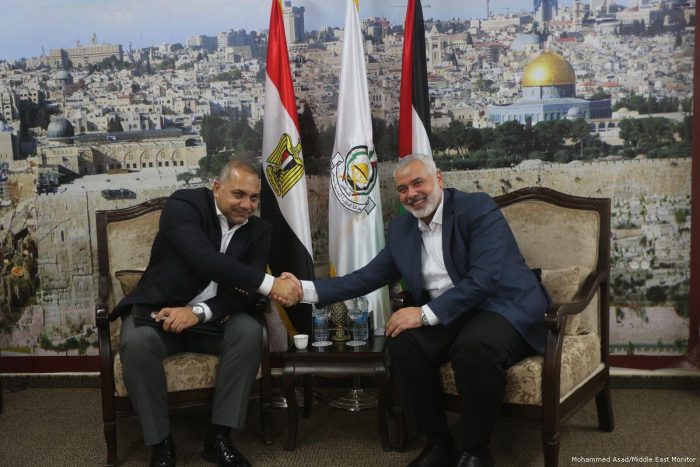
Senior Hamas members prepare for PA delegations to arrive in Gaza on 2 October 2017 [Mohammed Asad/Middle East Monitor]
MEMO | October 25, 2017
The advisor to the Iranian foreign minister, Sheikh Hussein Al-Islam, has said the relationship between the Islamic Republic of Iran and Hamas is excellent and has become stronger and more solid.
“Anything Hamas requests from Iran will be given. This is our duty,” Sheikh Al-Islam said in an exclusive interview with Shehab News Agency.
“All of Iran’s doors are open to Hamas which represents the first line of defence for the Palestinian resistance,” he said.
Commenting on Israel’s demand that Hamas sever ties with Iran as a precondition to accept Palestinian reconciliation, Sheikh Al-Islam said that “Israel wants to destroy Hamas because it is a resistance movement, not because of its relationship with Iran”.
“Hamas’s relationship with Iran is not important, the important thing is that Hamas is a resistance movement, and therefore Israel wants to wipe it out,” he said, adding that the movement makes its own decisions and that Iran does not tell Hamas what to do or not do.
The Iranian official praised the Palestinian national reconciliation, stressing that the agreement serves the Palestinian people’s interests.
Recently a Hamas delegation led by deputy political chief Saleh Al-Arouri visited Iran and met with a number of Iranian officials.
“The Agreement of the Century”
By Paul Larudee | Dissident Voice | October 18, 2017
According to a report circulating unofficially in Arabic, the latest in a sixty-nine year history of proposals to resolve the western Zionist invasion of Palestine (AKA the Israeli-Palestinian “conflict”) is about to see the light of day. It claims Israeli Prime Minister Benjamin Netanyahu originated the proposal and that secret deliberations have been underway for more than five months.
Netanyahu has now presented the proposal to the US, which made some changes and agreed to promote it. Palestinian President Mahmoud Abbas will carry the plan, called “the Agreement of the Century” to Egypt, Jordan, Saudi Arabia, the United Arab Emirates and Kuwait for review and discussion.
The provisions
The proposal has 21 points, but the main provisions are that the West Bank will be federated (or re-federated) with Jordan, and the Gaza Strip with Egypt. Together, they will be known as the Palestinian Confederation, ostensibly converting the Palestinian “Authority” into a national government, although it is already widely recognized as such and although it will not have any of the authority or sovereignty that nation states are deemed to have under international law.
Israel will govern Jewish settlements directly and Jerusalem is excluded from the proposal, for resolution at a later time. The primary function of Jordan, Egypt and the Palestinian Authority, therefore, will be to take over the security functions currently administered by the Israeli armed forces; i.e., to protect Israel and repress Palestinians. As they say in Israel, “When you have a dirty job, give it to an Arab.”
Other provisions concern development of infrastructure, international guarantees, and conversion of Hamas into a purely political party while integrating its military wing into the Palestinian security forces. The borders will be based on the armistice lines as of June 4th, 1967, with some territorial swaps. Refugees will be permitted to “return” to the West Bank and Gaza, even if it is not the home from which they were displaced. This is not going to be accepted by expatriate refugees in Lebanon, Syria and other countries, but they have always been disenfranchised in all proposals, and this one is no exception.
Unanswered questions
The biggest unanswered question is the status of Jerusalem. Will the Arab leaders accept an agreement that has no assurances at all with respect to Jerusalem? This is hard to imagine, and it was, in fact, the major stumbling block to an agreement at the Camp David Summit in 2000.
Another major unknown is what happens to the West Bank areas designated A, B and C in the Oslo agreement. Area A is the only one of the three where Oslo grants full administrative and security control to the Palestinian Authority, and it comprises less than 15% of the total area of the West Bank, itself only 18% of historic Palestine. Israel is unlikely to hand B and C over to Palestinian authority and limit the settlements to their current footprints, without prospect of outward expansion or new settlements. More likely, they will insist upon continuing the current arrangement, allowing Israel to continue expanding the settlements indefinitely. This is also unlikely to be acceptable to the Arabs and to the Palestinian people.
Analysis
What do the parties to the agreement expect to gain from it?
Israel wants to rid itself of the Palestinians. It wants the land but not the people. It also wants to stop being considered an occupier of someone else’s land. In 1948 it achieved this by massive ethnic cleansing and genocide. In 1967 it used the same methods but was somewhat less successful except on the Golan Heights, where it expelled 94% of the population. Since then, expulsions have been gradual and slower, except for the 2006 expulsion of a million people in south Lebanon, which was subsequently reversed by the victory of the Hezbollah resistance.
If the above assumptions about areas A, B and C are correct, a signed agreement means that Israel concedes nothing at all and will be able to continue with its territorial ambitions. However, it will rid itself of the Palestinians by farming out the occupation to Jordan, Egypt and the Palestinian Authority. The agreement also removes the teeth (such as they are) of Hamas, and makes Israel appear to be a “peacemaker” with a “generous proposal”.
Mahmoud Abbas’s interest is to become the president of a “real” (though not sovereign) country, recognized universally, even by Israel. He also gets Gaza in the bargain, as well as some handsome development funds that will improve the economy, at least in the short run. The recently announced “unity government” between Hamas and Fatah can be seen as a prelude to such an agreement, and a means of strengthening Abbas’s hand in the negotiations (which is why Israel is not very happy about it).
Hamas gains the least of any of the parties, but Israel’s decade-long siege on Gaza is now so debilitating that they are possibly loathe to dash the hopes of their people for relieving their isolation. They are under tremendous pressure to improve the intolerable living conditions, and may not wish to be seen as spoilers.
The Arab monarchies and Egypt want to be rid of the problem and to get on with other concerns, chiefly their rivalry and potential conflict with Iran. In this case they would like to be able to collaborate and ally themselves more openly with a powerful Israel, which the agreement will legitimate. Iraq and Syria, who are friendly to Iran, are not currently on Abbas’s itinerary, which underscores that their views are not likely to be given consideration.
The US also gets a Middle East peace agreement that has eluded eleven administrations since 1948, and which Trump desperately needs to bolster his flagging image on the domestic front. The agreement would also strengthen the hand of both the US and Israel to undertake aggressive action against Iran and destroy it as a regional power, which is an ambition of both countries and the conservative Arab regimes.
All of this assumes that the agreement will be approved. That is still a very big “if”. But Israel is also prepared for failure, which also works to their advantage. In that case Israel will do what it has always done: blame the Palestinians for refusing to be complicit in their own demise. They will then give their military a free hand to commit another pogrom, known in Israel as “mowing the grass”.
In fact, Israel may pull another plan off the shelf, one using a more direct means of ridding themselves of the Palestinians. They learned in Lebanon that they could create a million refugees in ten days, and thereby clear the land of its inhabitants. Instead of “mowing the grass”, this would be more akin to “scorching the earth”, which is also a definition of the term “holocaust”.
Paul Larudee is one of the founders of the Free Gaza and Free Palestine Movements and an organizer in the International Solidarity Movement.
Featured Video
Laith Marouf: Hezbollah’s position on US-Iran ceasefire
or go to
Aletho News Archives – Video-Images
From the Archives
The Dirty Little Secret behind the “Global Terrorism Index”
The Omission of Israeli Terrorism in the Occupied Palestinian Territories
By Karin Brothers | Global Research | December 6, 2014
… The Israeli settlements — all of which are illegal – have been identified as a major impediment to peace. The refusal of a major “global” terrorism report to name the Israeli settlers as one of the groups most responsible for terrorism not only misrepresents a major source of regional violence but exposes the Global Terrorism Index as a propaganda tool that supports a U.S. agenda.
In recent years, governments have been attempting to thwart terrorism by blocking supportive fund-raising. When it comes to Israeli settlements, however, the US and Canada actually encourage fund-raising by giving organizations (such as Christian Friends of Israeli Communities (CFOIC) and the Jewish National Fund) financial support in the form of donor tax-deductions.
Charities which provide funds for the Israeli settlements should be regarded as terror-financing organizations. They should not only lose their tax-deductible status, but they should be banned because they support the violation of international humanitarian law. The terror-financing laws that are being strictly enforced for Muslim charities should be applied to Christian and Jewish charities as well. … Read full article
Blog Roll
 Aletho News
- The ‘Opposition Party’ Has Done Nothing to Stop the Iran War and Much to Goad Trump Into Continuing It
- Moscow backs Tehran on status of Lebanon in US-Iran deal
- How UK Regulator Ofcom Quietly Bypassed International Law to Police American Speech
- The Black Cube Files: How Former Mossad Operatives Flipped a Nation
- Laith Marouf: Hezbollah’s position on US-Iran ceasefire: What you’re not being told
- Israel’s priority lies in destroying chances of peace between Iran, US: Ex-UN nuclear chief
- Ceasefire for all or for none: Iran shuts Hormuz over Lebanon attacks
- Strait of Hormuz is Iran’s ‘nuclear weapon’ that forced US retreat: Medvedev
- Energy crisis will last for months – Kremlin envoy
- Europe’s quiet role in the war on Iran
- If Americans Knew
- This is ceasefire? Israel’s biggest massacre yet in Lebanon, another journalist killed in Gaza – Daily Update
- Tucker Carlson on Israel: This Is the Behavior of an Ally? Really?
- Gazans face a triple crisis: severe shortages of water and bread, healthcare in tatters
- NY Times reports how Netanyahu took the US into Iran War
- A sigh of relief over Iran, but Gaza and Lebanon in dire straits – Daily Update
- Thousands dead and neighborhoods razed to the ground: Aid agencies fear southern Lebanon is becoming the new Gaza
- The war the US is fighting for Israel could cost trillions
- ‘Cigarette Burns, Nail Wounds’: Toddler Tortured in Gaza to Coerce Father
- Trump Says US Sent ‘a Lot of Guns’ to Protesters in Iran
- Israeli forces destroy 17 UN peacekeeper cameras in south Lebanon
- No Tricks Zone
- An Inconvenient Tree: Uncovered In Alps… Europe Much Warmer Than Today 6000 Years Ago
- New Study Reports A 60% Slowdown In Greenland’s Ice Loss Rate In The Last Decade
- Low Intensity Tornado Wrecks Major Solar Farm, Creating A Potential Toxic Dump
- New Study Finds Warming Saves Lives…Cold Temperatures 12 Times More Deadly Than Excess Heat
- German Science Blog Accuses PIK Climate Institute Of Hallucinating Climate Tipping Points
- Devastating Assessment Of Comirnaty Vaccine By Former Senior Pfizer Europe Toxicologist
- New Study: CO2 Is ‘Effectively Negligible’ As An Explanatory Climate Change Factor Since 2000
- Former Pfizer Toxicologist Dr. Helmut Sterz Tells Bundestag Hearing Pfizer Vaccine Should Have Never Been Approved
- Energy Expert: Germany’s Nuclear Phaseout Was A “500 Billion Euro Mistake”
- New Research: South Australia’s Mid-Holocene Sea Surface Temperatures Were 4°C Warmer Than Today
 Aletho News