Israeli occupation forces Carry out Raids on Palestinian Media Firms
© idf.il
Al-Manar | October 18, 2017
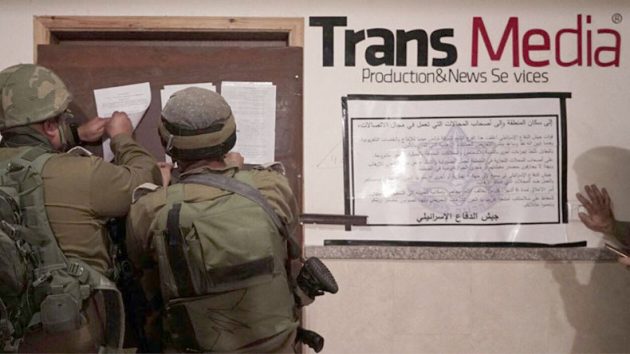
Israeli occupation forces raided Palestinian media offices across the occupied West Bank overnight in what a military spokeswoman on Wednesday called a “large-scale operation” against “incitement.”
The raids on eight companies came hours after the Israeli government declared that it would not deal with an emerging Palestinian unity government that includes Hamas unless the resistance movement made radical changes.
Israeli officials said the raids targeted companies that provide services to Hamas television stations. Notices were posted saying the companies were to be closed for six months.
“Israeli army forces last night raided eight Palestinian production and media companies that provide services to Al-Aqsa and Al-Quds TV channels,” the head of an Israeli defense ministry unit known as COGAT, Yoav Mordechai, wrote on Facebook, referring to Hamas channels.
“These two channels broadcast constant incitement against the state of Israel. It is no secret that these two channels inspired, several times, terrorists to go out and commit terrorist attacks against innocents.”
Israeli officials provided no specific examples of the alleged incitement. At least one of the companies targeted provides various services to a range of local and international news media.
The Palestinian Authority said it condemned the raids “in the strongest terms”.
“Occupation forces committed a blatant aggression and gross violation of all international laws when they stormed Palestinian cities and raided media offices,” PA government spokesman Yusef al-Mahmoud said in a statement.
He said the measures were a “clear challenge to the international efforts, especially the American efforts, to seek an opportunity for compromise and lay the foundations for peace and security with the agreement of all sides.”
The backdrop of Palestinian reconciliation
By Ramona Wadi | MEMO | October 13, 2017
With a deal for political reconciliation having been reached by Hamas and the Palestinian Authority, attention should shift to the humanitarian impact of Mahmoud Abbas’s collective punishment of the people in the Gaza Strip. The punitive measures, blatantly visible, were primarily an exercise in deprivation for political gain.
On Wednesday, Wafa and Alray reported that re-establishing adequate electricity supply to Gaza is dependent on whether “the Palestinian Government of National Consensus can assume its duties and responsibilities in the Strip.” The statement is open to several interpretations, the most dangerous for Palestinian civilians being additional delays beyond the signing of the reconciliation agreement.
According to the Palestinian Energy Authority’s acting director, Thafer Milhem, electricity was one of the issues discussed during the reconciliation talks in Cairo. While describing the process through which electricity supply for Gaza would be restored gradually, Milhem asserted that there is no timeframe for implementation, thus once again demanding that the civilians should remain as pawns in the political game designed by Abbas. It should be recalled that the precondition imposed upon Hamas by Abbas in return for lifting the collective punishment was the dissolution of the administrative committee of Gaza; this was duly done by the Islamic Resistance Movement.
However, the initial requirement turned out to be the first step in bringing about a situation whereby Hamas would agree to relinquish control of Gaza in the name of political unity. It remains to be seen how much this gesture, which entails a considerable measure of compromise, will reflect upon both Hamas and the civilian population of the enclave.
It could be argued that necessity, on several levels, constituted a form of political, social and ecoomic coercion. Gaza has navigated a fine line in attempting to retain the connection between the three sectors. Although different, each struggle reflected anti-colonial resistance. Necessity diluted this framework, and resistance was thwarted into survival, courtesy of collaborative efforts by Israel, the PA and the international community under various guises. For the people, it became a matter of successfully staying alive despite the harsh conditions.
Hamas, on the other hand, has fluctuated between resistance and diplomacy, the latter mired in a lack of clarity, particularly as the movement’s political statements appeared to be in conflict with its aims of liberation. This is not to say that the PA and Hamas have identical aims. However, it is the latter that has been required to compromise, despite the former’s irregular governance.
While the focus is now on the reconciliation agreement, there is a backdrop against which this is taking place; people who have suffered the humanitarian consequences of political contempt. For the PA to continue playing the bureaucratic game is unacceptable. By not providing a timeline for the resumption of adequate services with regard to electricity, or establishing access as a priority, Palestinians are once again expected to sacrifice health, education and life for a political gamble concocted by the PA. The least that could have been done was the immediate lifting of Abbas’s punitive measures, unless the plan is to expand authority in the name of reconciliation, with the aim of having better access to the exploitation of a precarious humanitarian situation.
Israel opposed to any Palestinian reconciliation with Hamas ‘mass murderers’ – Netanyahu
RT | October 13, 2017
Israeli Prime Minister Benjamin Netanyahu has lashed out against the reconciliation deal reached between rival Palestinian factions, Hamas and Fatah, claiming that peace between Israelis and Palestinians will now be “much harder to achieve.”
“There is nothing we want more than peace with all our neighbors, but reconciliation between Fatah and Hamas makes this peace much more difficult to achieve,” Netanyahu said in a statement published on his official Hebrew and English Facebook accounts.
Palestine’s civil discord started in 2007 when Hamas won the elections and obtained power in Gaza while the West Bank territories fell under Fatah’s control. Since then, all attempts to reconcile the two groups and form a Palestinian power-sharing government have stalled.
In 2014, the rival faction managed to briefly negotiate a deal, which also angered Tel Aviv. Israel swiftly suspended US-sponsored peace talks with the Palestinians, refusing to deal with Hamas, which Tel Aviv considers a terrorist organization with the sole aim of destroying the State of Israel.
On Thursday, after intense negotiations, Hamas and Fatah reached a new reconciliation deal, which Israel once again immediately rejected.
“Israel is opposed to any form of reconciliation in which the terrorist organization of Hamas does not disarm and does not stop fighting for the destruction of Israel,” Netanyahu said.
Tel Aviv, the Israeli PM said, will never accept Hamas’ strive to destroy Israel and will not deal with an organization that “advocates genocide” and launches “thousands” of rockets and tunnel incursions into Israel.
Netanyahu also accused Hamas of murdering children, oppressing the LGBT community and holding Israelis hostage. He believes Hamas is also guilty of “mourning” the death of former Al-Qaeda leader Osama Bin Laden, as well as “torturing” the opposition.
“Reconciliation with mass murderers makes you part of the problem and not the solution,” Netanyahu wrote. “Say yes to peace and not to collaboration with Hamas.”
While the Palestinian factions Fatah and Hamas reached a preliminary reconciliation agreement that the parties hope to implement in stages, they still seek to work out differences.
According to the agreement, the Palestinian Authority (PA) is to assume all governing rolls in Gaza no later than December 1. The PA will also take over the responsibility for Gaza’s border crossings no later than November 1. Yet the key issues such as the fate of Hamas’ military wing and wider political strategies are to be discussed at a later date, Haaretz reported.
Palestinian unity is necessary in order to have meaningful discussions with Israel on a two-state solution. Yet Israel refuses to have militant Hamas be part of the government. Before any two-state solution negotiations can resume, Tel Aviv advised the Palestinians to disarm Hamas and force the organization to honor international law.
“Any reconciliation between [Hamas and Fatah] must include honoring [international] agreements [and] Quartet conditions, firstly [by] recognizing Israel [and] disarming Hamas,” spokesperson to the Arab media in the Israel Prime Minister’s Office, Ofir Gendelman, tweeted. He added that digging tunnels, manufacturing missiles and initiating terror attacks are “incompatible” Quartet conditions and US efforts to renew the Middle East peace process.
The Israeli spokesman called on Fatah to assume responsibility for any militant action in Gaza, after a PA takeover of the region in December.
“The PA mustn’t allow any base whatsoever for Hamas terrorist actions from PA areas or from Gaza,” Ofir tweeted. “As long as Hamas does not disarm [and] continues to call for our destruction, Israel holds it responsible for all terrorism originating in Gaza.”
Hamas’ original charter in 1988 called for the reclaiming of all of Mandatory Palestine, which includes present-day Israel. The PA instead has been trying to negotiate the creation of a Palestinian state within the 1967 borders.
Reconciliation efforts between Palestinians and the Israelis have been supervised by the so-called Middle East Quartet – comprising the UN, Russia, the United States and the European Union – which advocates a two-state solution along the 1967 divide.
As long as the reconciliation process between the rival Palestinian faction proceeds, Israel will do all in its power to sabotage the process, political commentator Doctor Asa’ad Abusharekh from Gaza has told RT.
“Israel wants to see the Palestinian people all the time divided. I think Israel will try to torpedo and sabotage this reconciliation,” Abusharekh said. “We do not expect Israel to lift the siege of Gaza. Israel will probably put more obstacles simply because Israel is wary about this agreement.”
Hamas elects Saleh Al-Arouri deputy head of its political bureau
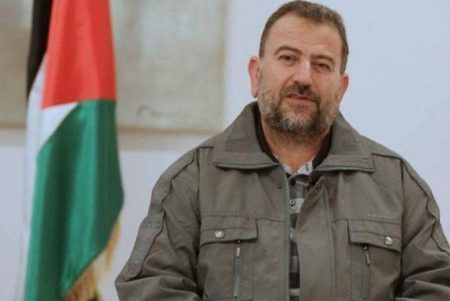
Exiled Hamas leader Saleh Al-Arouri [Quds Press]
MEMO | October 5, 2017
Sources in the movement said that Hamas elected 51-year-old Saleh Al-Arouri as deputy head of its political bureau.
In an interview with Quds Press, the sources, who refused to be named, said: “Al-Arouri was elected by the political bureau of the movement and according to the Hamas covenant.”
Elections began two days ago and ended today. The Shura Council of the Hamas movement, which includes representatives from three regions: the West Bank, the Gaza Strip and outside the Palestinian territories, participated in the elections.
Al-Arouri, who is the founder of the Al-Qassam Brigades, the military wing of Hamas in the West Bank, is from the town of Arura, north of the city of Ramallah.
He holds a Bachelor’s Degree in Islamic Law from Hebron University, south of occupied Jerusalem, is married and has two daughters.
He joined the Islamic Movement at an early age and led Islamic students’ activities at university from 1985 until his arrest in 1992.
He joined the Hamas movement in 1987 and participated in various forms of resistance against the occupation since the movement’s creation.
Al-Arouri was held under administrative detention by Israel between 1990-1992.
He then began to form a military apparatus for Hamas in the West Bank during the period 1991-1992, which contributed to the launch of the Al-Qassam Brigades in the occupied West Bank in 1992.
Israeli occupation forces arrested him in 1992 and he was held until 2007 after being charged with forming the first cells of the Brigades in the West Bank. He was arrested again three months after his release for a period of three years until 2010. Then, the Israeli Supreme Court decided to release him and deport him. It has been reported that he now lives in Malaysia.
He has been a member of the movement’s political bureau since 2010 and is a member of the negotiating team in the Wafa Al-Ahrar deal. He was also a Hamas leader who participated in the recent Cairo dialogues and the movement’s visit to Russia.
Netanyahu: Three conditions to accept Palestinian reconciliation
Palestinian unity talks dismissed
Palestine Information Center – October 3, 2107
NAZARETH – Israeli Prime Minister Benjamin Netanyahu vetoed the Palestinian reconciliation, putting three conditions to accept it including recognition of Israel, dissolving the armed wing of Hamas Movement and halting its relation with Iran.
“The Palestinian Authority cannot reconcile with Hamas at Israel’s expense,” Netanyahu said on Tuesday, in his first reaction to the latest unity deal between the Hamas and Fatah factions, according to a statement by Netanyahu’s office.
“As part of its reconciliation, the Palestinian Authority must insist that Hamas recognizes Israel, dismantles its military wing and breaks off ties with Iran. We cannot accept fake reconciliation on the Palestinian side that comes at the expense of our existence,” he added.
Netanyahu made the statement in coincidence with the Palestinian consensus government, led by Rami al-Hamdallah, taking over its responsibilities in Gaza Strip in light of the Palestinian reconciliation supervised by Cairo.
Israeli and American pressures on the Palestinian Authority had affected previous reconciliation efforts and led to the continuation of the internal division.
Abbas Is No Arafat. He Must Go.

By Stuart Littlewood | American Herald Tribune | September 27, 2017
I’ve been writing about the plight of the amiable Palestinian people under Israel’s jackboot for the same length of time that Mahmoud Abbas has been Palestinian president. And that’s far too long. Abbas has also been chairman of the PLO (Palestine Liberation Organisation, which describes itself as the sole representative of the Palestinian people) for even longer.
A recent poll by the Palestinian Centre for Policy and Survey Research showed that the Palestinians have had enough. Two-thirds want Abbas out.
A majority are also dissatisfied with the decision at Fatah’s latest Convention to keep Abbas as head of Fatah for another 5 years. The poll found that most view the Palestinian Authority, which is also headed by Abbas, as a burden to the Palestinian people rather than an asset. An even larger majority feel they cannot criticise the PA without fear. Perception of corruption in the PA now stands at 76%.
What’s more, two-thirds of Palestinians believe a two-state solution is no longer possible due to Israel’s relentless expansion of illegal settlement and 53% support a return to an armed intifada.
And if presidential elections were held now, Hamas’s Ismail Haniyeh would probably win.
“As naked as the day that he was born”
Abbas has been a big noise in Palestinian affairs for decades. In 2003 Arafat appointed him prime minister of the Palestinian National Authority. Some say the West foisted Abbas on Arafat. A power struggle ensued, and after Arafat’s suspicious death in 2004 Abbas was seen as a natural successor. Hamas boycotted the presidential election of January 2005 and Israel arrested or restricted the movement of other candidates. So Abbas won easily in dubious circumstances.
Abbas’s term as President officially ended more than 8 years ago. It is long past clear-your-desk time. The Basic Law allowed him an extension of one year but he still clings to power. Increasingly he’s seen as the king with no clothes and, in the words of the Danny Kaye song, “altogether as naked as the day that he was born”.
The trouble with Abbas is that he’s always ‘behind the curve’. Illegal settlement building under the Allon Plan, effectively annexing Palestinian territory, began in 1967 and the Israelis’ dash to create as many irreversible ‘facts on the ground’ as possible in order to make their occupation permanent was clear from the start.
Abbas claims to be one of the architects of the Oslo Interim Agreement, which was supposed to ensure a start to negotiations on permanent status by 1996 and lead to the implementation of Security Council Resolutions 242 and 338 and the settling of all main issues. But ever since the beginning of the Oslo process back in 1993 the rights of the Palestinian people have been sacrificed on the altar of so-called political progress, the glittering prize being ‘peace and security’.
That was all smoke ‘n’ mirrors, of course. What we’ve seen is a continuous slide downhill for the Palestinians while the Israeli colonisation and expansion programme goes from strength to strength. Justice has never been allowed to play a part. Furthermore Abbas has repeatedly given the Israelis time to cement their ill-gotten gains, readily agreeing to more bogus negotiations arranged by the same dishonest brokers.
And he inexplicably dragged his feet over joining the International Criminal Court.
During his over-long tenure Abbas has failed to unite the Palestinians under a single purposeful voice with a clear mission. He has driven the factions further apart by letting rip the old Fatah-Hamas rivalry. His regime fails to keep the world informed or make proper use of media opportunities and behaves as if gagged.
He is not noted for tactical brilliance and his embassies in the West are lazy, uncommunicative and uncooperative towards journalists and writers, and probably under orders not to ‘make waves’. I myself have been branded an enemy of Palestine by Abbas’s London embassy, an insult I wear as a badge of honour.
The Palestinian Authority under Abbas is frequently accused of collaborating with Israel in its brutal oppression. Abbas seems to be the darling of the West and of Israel, and the Israelis are said to regard him as a strategic asset. They’d hate to lose him.
Hamas is usually blamed for any whiff of corruption but the PA is bursting with it. In 2015 a report by The Coalition for Accountability and Integrity (AMAN) titled Absolute Power, Total Corruption hit the headlines. AMAN was established by a number of Palestinian civil society organizations to combat corruption and enhance integrity, transparency and accountability in Palestinian society.
According to the Commissioner-General, Azmi Shuaibi, “the cancellation of elections and the absence of the Legislative Council led to the president’s monopolizing the three powers — legislative, judicial, executive — which has served as fertile soil for some cases of corruption.” Certain non-ministerial government institutions were still outside the scope of official accountability and had awarded salaries and privileges to officials that were inconsistent with financial reality.
But even this catalogue of misbehaviour didn’t hammer the final nail into Abbas’s political coffin. Today he’s increasingly busy cracking down on dissenters within his own Fatah party and outside organisations.
Peace process “a deceptive farce”
The confidential Palestinian Papers, leaked by Al-Jazeera in 2011, revealed the shambolic conduct of the so-called peace process and how the Palestinian team allowed the Israelis to walk all over them, with US help.
One of the leak’s sources, a French-Palestinian lawyer and former adviser to the PLO, Ziyad Clot, said in an article in The Guardian that the peace process was “an inequitable and destructive political process which had been based on the assumption that the Palestinians could in effect negotiate their rights and achieve self-determination while enduring the hardship of the Israeli occupation”. They were “a deceptive farce whereby biased terms were unilaterally imposed by Israel and systematically endorsed by the US and EU”. They “excluded for the most part the great majority of the Palestinian people: the seven million Palestinian refugees”. And, he said, “the PLO, given its structure, was not in a position to represent all Palestinian rights and interests”.
So why did the Palestinians’ chief negotiator since 1995, Saeb Erekat, still engage in it? Erekat was educated in political science in the US and conflict studies in England, so should have been savvy enough to see through it. Will no-one steer the Palestinians into a sane justice process and away from the ‘kangaroo’ peace negotiations that Erekat and Abbas seem addicted to?
Not long ago, in an interview, I asked law professor and former UN special rapporteur Richard Falk: “How acceptable is it for a weak, demoralized and captive people like the Palestinians to be forced into negotiating with their brutal occupier under the auspices of a US administration seen by many people as too dishonest to play the part of peace broker?
He replied: “Even if the United States was acting in good faith, for which there is no evidence, its dual role as Israel’s unconditional ally and as intermediary would subvert the credibility of a negotiating process. In fact, the US Government signals its partisanship by White House appointments of individuals overtly associated with the AIPAC lobbying group as Special Envoys to oversee the negotiations such as Dennis Ross and Martin Indyk… The unsatisfactory nature of the current framework of negotiations is further flawed by weighting the process in favor of Israel, which enjoys a position of hard power dominance.”
That the UK Government will shortly be celebrating 100 years of the infamous Balfour Declaration, and continuing to endorse its cruel legacy while refusing to support Palestinian statehood, is an indictment of Abbas’s dismal performance.
Face it, the guy is no Arafat. On Abbas’s watch the high hopes of ordinary Palestinians have turned to dust. As Oliver Cromwell told the English Parliament in 1653: “You have sat too long for any good you have been doing lately… Depart, I say; and let us have done with you. In the name of God, go!” Those same words are applicable also to Abbas, and indeed the entire PLO and Palestinian Authority.
What Palestinians need, but probably will never get, is leadership with style, wisdom and the will to make friends with the West. Their case is still not widely understood and any new leader must have the ability to outwit Israel’s absurdly successful propaganda. Yes, the Zionists may have a stranglehold on Western opinion, but the Palestinians possess a superior two-edged weapon which they have never used effectively: truth and a just cause.
*(Mahmoud Abbas. Image credit: Kremkin.ru)
Hamas to hold free elections as Israel waits to pull the trigger
By Robert Inlakesh – Al-Masdar – 17/09/2017
Hamas have released in an official statement that they are ready to hold free elections – for the first time since 2006 – and are going to dissolve their administrative committee.
After a series of talks held in Cairo – in a bid to start repairing the relationship between rivalling Palestinian governmental factions Hamas and Fatah – Hamas has made the decision in order to forward “reconciliation” with the Palestinian Authority.
President of the Palestinian Authority (PA), Mahmoud Abbas has been demanding throughout the year that Hamas end its administrative committee, hold free elections and hand the Gaza Strip over to the PA.
Abbas has recently been punishing the population of Gaza in order to get Hamas to hand over power of Gaza and this year has made such moves towards this goal mainly by; dropping the salaries of Gazans who work for the PA by 30-70 percent (sending many below the poverty line), calling on Israel to turn off their electrical supply to Gaza and by refusing to pay for Gaza’s deisel fuel to run their one semi-operational power plant.
The last time Hamas vowed to dissolve its administrative committee and looked as if it was on the way to forming a unity government with Fatah – signing reconciliation deal with the PLO on April of 2014 – Israel ended the possibility with a 50-day onslaught on Gaza, killing over 2 thousand civilians.
The Israeli regime’s government announced on the 10th of August, that it was readying a ground invasion of Gaza, the head of the Israeli Shin Bet, ‘Nadav Argaman’ also recently told the ‘Jerusalem post’ that Hamas are readying for war.
The Likud Party have been losing their popularity in Israel to far-right parties and with Prime Minister Benjamin Netanyahu (and his wife) under investigation on the grounds of corruption, the political party is looking for a way to re-gain its popularity. If Netanyahu was to wage war upon Gaza in a bid to prevent a possible Palestinian unity government, the international condemnation of the Israeli onslaught could be scape goated on him, whilst his party are celebrated by Israeli society (as polls show popularity of the party rises during war time), this could be strategically on the table for the Israeli government.
Hamas seek to allow Abbas and the PA the return to Gaza immediately and to start official meetings with the PA in order to form unity between both parties and discuss elections in the West Bank and Gaza.
Time for All Palestinians and Their Supporters to Join the Resistance against Israel’s Cultural Offensives

By David Macilwain | American Herald Tribune | September 14, 2017
Before the launching of the war on Syria in 2011 by agents of the US and its Middle Eastern allies, the focus of my political activism was almost exclusively Palestine. “Self-radicalised” is a suitable descriptor for the slow awakening of my awareness of the way things were in the Israeli-occupied territory and the Arab and Islamic world around it.
As with many of my contemporaries, the 2003 attack on Iraq was a springboard in this radicalisation, not out of sympathy and understanding of Iraq but rather from antagonism to the US neo-con regime with its UK and Australian allies. Israel’s central role in orchestrating the attack on Iraq, as well as the pretext for it eighteen months earlier didn’t become clear – to me at least – until sometime later, when my antagonism began to concentrate on the Zionist State.
“Antagonism” doesn’t begin to describe the feelings that developed during Israel’s 26-day massacre of innocents of Gaza in 2009 however, nor the absolute disdain and disgust at Western leaders’ failure to condemn it. Notably too, the failure of Western media organisations to report the daily atrocities being committed by the IDF in Gaza revealed the extent of networks of propaganda support for the Zionist entity.
In the controversy that followed “Operation Cast Lead”, which finally came to an end just after Obama’s inauguration, it also became clear who was prepared to stand up for the people of Gaza and for Palestine and who was not. Many organisations we may have thought to be “impartial” turned out to be compromised when it came to Palestine, including the UN and NGOs like Amnesty International and Human Rights Watch. Their failure to react and respond appropriately to the terrible injustices and atrocities inflicted on the civilian population of Gaza, in the false name of fighting “Hamas terrorism”, gave huge impetus to the BDS movement. In the absence of any real condemnation of Israel’s barbarity, leave alone sanctions, or enforcement of outstanding UN resolutions, boycott and divestment became the only means to support Palestinians’ rights.
One could never say that the BDS campaign against Israel’s occupation was a success, though there were successes. In countries with a strong Israel lobby like the US, UK, Australia and France, the lobby’s fightback with both propaganda and legal instruments began almost before any real action could be taken, while Zionist infiltration and influence on government members made sure Israeli interests were protected. The associated academic and cultural boycott – PACBI – had more success in influencing public opinion, with the help of some great artists like Roger Waters and Ken Loach, but the fightback against them was even more intense, and continues to this day.
In an attempt to convince ourselves that something has been achieved over the last ten years, we may consider this reaction to the boycott campaigns as a recognition of their effectiveness – or at least potential effectiveness; the opinion of one influential celebrity can sometimes change the minds of millions.
But doesn’t Israel know this!
The truth is that the state of Israel is founded on something like the antithesis of a boycott campaign – as a state of mind cultivated with centuries of sectarian propaganda. How else could you create a whole society in which individuals believe themselves to be “exceptional” and racially superior to the native inhabitants of the land they are occupying by force? A society for which militant racism is the sine qua non of its nationhood and identity.
Not only have Israel’s leaders and educators achieved this “state of denial” amongst the Jewish citizens and the diaspora – with some important exceptions – but they have managed to maintain credibility as a “democratic” state with Western nations against all odds. It doesn’t seem to matter how many times one points out that a state defined as “Jewish” cannot also be democratic if some of its citizens are not Jewish.
The immediate and current context of this discussion is the fiesta of Zionist propaganda that just took place in London’s Roundhouse centre, called “TLV in LDN”, and the protest campaign against it by a group of artists, including those venerable veterans named above. But the context is rather different from that of ten years ago when the siege of Gaza began, following Hamas’ victory in Palestinian elections.
In fact it begins to look a little desperate, and the defence of this opinion-twisting offensive a bit hysterical. The “facts on the ground” created in what was once Palestine by the Zionist regime in those ten years now mean that Israel’s legitimacy can only be defended with increasingly shrill accusations and violence against Palestinians and their true supporters in the West.
But there may be another reason for the creators and defenders of “The Israel Project” to have a feeling of panic – such as that shown by Netanyahu on his recent visit to Sochi. As Sharmine Narwani has described, things are changing rapidly on Israel’s borders, with Jordan and Lebanon moving to restore relations with Damascus, and other sometime allies like Turkey and Egypt, and even the US seeking to cooperate with Russia and Iran.
There is also something happening within Palestine, as the new Hamas leadership seeks reconciliation with Syria and Iran – effectively returning to the position of ten years earlier, when Hamas leader Khalid Meshaal lived in Damascus, and Iran was a key mediator for the democratically elected Hamas government.
Most ironic however is the situation for so many supporters of the Palestinian struggle, who tragically had followed Hamas’ lead and deserted Syria in 2011. One can hardly understate the devastating effect on the Syrian conflict, and on Western perceptions of it from this historic rift in the Resistance. That section of Western society that showed most concern for Palestinians, including many solidarity groups as well as human rights NGOs was effectively duped into siding with Israel against Syria.
While this “kidnapping” of the most influential anti-war and anti-Zionist activist populations was achieved primarily thanks to propaganda from Al Jazeera and its Western media partners like the Guardian, the contribution from groups like Avaaz and Amnesty suggests another partner in the propaganda war on Syria.
Given the IDF’s vital support role for Al Qaeda groups in Southern Syria, we might safely assume that Israel’s misinformation industry has also been working overtime in pursuit of the state’s cynical and criminal objectives. One key event in the propaganda war on Syria supports that assumption – the “siege” of the Palestinian refugee camp of Yarmouk – whose reality was so twisted by “humanitarian” NGOs and even by the UNRWA as to portray Al Qaeda as defending innocent civilians against the Syrian Army. The object of that propaganda campaign was creating a pretext for “humanitarian intervention” to save starving Palestinians from the Syrian Government, when it was actually protecting them.
As Palestinians in the occupied territories and in Gaza increasingly now look to Syria and its allies for defence against the malevolence and lies of their oppressive occupier, it’s past time for their many genuine supporters and allies in the West to get on the right side of history and join the Resistance! And that resistance includes fighting off Israel’s ingeniously engineered “cultural offensives”.
Mossad accused of assassinating Palestinian in Sweden
MEMO | August 23, 2017
 The Israeli intelligence service Mossad has been accused of assassinating a Palestinian man living in Sweden, according to Israeli daily Haaretz.
Mohammad Tahsin Al-Bazam, a former Gaza resident, was found shot in the head in the Swedish town of Limmared on Saturday. His family is believed to have ties to Hamas, prompting Palestinian sources to suspect Israeli involvement in his death.
A statement released on Sunday by the Swedish police confirmed that as yet they could not ascertain a motive for the intrusion.
“Reports said several people wearing masks entered the apartment through a balcony and shot the man inside. They disappeared after the shooting as quickly as they arrived.”
After the shooting Al-Bazam was taken to a local hospital, and then flown to a larger facility in Gothenburg, but died of his injuries.
Al-Bazam’s brother served in Hamas’ military wing and as a bodyguard to the group’s Prime Minister Ismail Haniyeh. His father is currently the spokesman for Hamas’ Homeland Security Office in Gaza, but stated in an interview that his son had been living in Sweden for over a decade and was not involved in political activity.
Hamas believes Mossad to be responsible for the deaths of numerous of its members over the years, including the assassination of a senior member, Mazen Fuqaha in March. Israel has never confirmed or denied reports but states that it reserves the right to fight alleged terrorists even beyond its borders.
US Zionists say McMaster is hostile to Israel and pro Hamas
MEMO | August 23, 2017
Conservatives in America are leading a campaign to convince US President Donald Trump to fire his National Security Adviser, Israel Today reported on Tuesday. They accuse H R McMaster of being hostile to Israel and pro-Hamas, Hezbollah and the Iranian nuclear deal.
One of the leading figures of the campaign is Morton Klein, the head of the Zionist Organisation of America (ZOA), as well as the billionaire Zionist Sheldon Adelson. The ZOA and supporters of Israel in the White House are afraid that McMaster will use his position to disrupt Trump’s pro-Israel policies.
Adelson, the Israeli newspaper pointed out, was a major donor for Trump’s presidential campaign. While it said that he has denied that he was involved in a campaign criticising McMaster, it added that he had acknowledged in an email to Klein that he did not know much about the National Security Adviser but now supports efforts to remove him from the White House.
Islamic Jihad, Hamas and PFLP reject PNC meeting in Ramallah
Palestine Information Center – August 16, 2017
GAZA – The Islamic Jihad Movement on Tuesday announced its rejection of the Palestinian National Council (PNC) meeting set to be held in Ramallah and considered it a prelude to the exclusion of Palestinian resistance factions from any future national project.
In a statement on Tuesday, the Movement said that the statements made about the current arrangements for holding a PNC meeting will entrench the internal division.
According to statements by a number of Fatah representatives lately, the Palestinian Authority (PA) president, Mahmoud Abbas, decided unilaterally to hold a PNC meeting in Ramallah in September.
Islamic Jihad called on Fatah Movement and the PA to abide by the understandings reached in Cairo and in the PNC preparatory committee meetings in Beirut.
Hamas Movement as well as the Popular and Democratic Fronts for the Liberation of Palestine expressed earlier their rejection of Fatah’s call for a PNC meeting in Ramallah.
Russian envoy: Hamas national movement
Palestine Information Center – August 1, 2017
TEHRAN – Hamas is a national liberation movement and Moscow does not consider it a terrorist organization, Russian Ambassador to Tehran Levan Dzhagaryan said Tuesday.
Reporting from Tehran, a PIC news correspondent said Dzhagaryan told Hamas representative in Iran, Khaled al-Kaddoumi, that Hamas is a national resistance movement and one of the Palestinians’ main legitimate representatives.
The Russian ambassador reiterated his country’s support for the Palestinian cause and people.
Al-Kaddoumi briefed the Russian envoy on the Israeli violations in Occupied Jerusalem and the crimes committed against the Palestinian people and holy sites.
Featured Video

Chinese jet fuel and the myth of energy independence
or go to
Aletho News Archives – Video-Images
From the Archives
The Dirty Little Secret behind the “Global Terrorism Index”
The Omission of Israeli Terrorism in the Occupied Palestinian Territories
By Karin Brothers | Global Research | December 6, 2014
… The Israeli settlements — all of which are illegal – have been identified as a major impediment to peace. The refusal of a major “global” terrorism report to name the Israeli settlers as one of the groups most responsible for terrorism not only misrepresents a major source of regional violence but exposes the Global Terrorism Index as a propaganda tool that supports a U.S. agenda.
In recent years, governments have been attempting to thwart terrorism by blocking supportive fund-raising. When it comes to Israeli settlements, however, the US and Canada actually encourage fund-raising by giving organizations (such as Christian Friends of Israeli Communities (CFOIC) and the Jewish National Fund) financial support in the form of donor tax-deductions.
Charities which provide funds for the Israeli settlements should be regarded as terror-financing organizations. They should not only lose their tax-deductible status, but they should be banned because they support the violation of international humanitarian law. The terror-financing laws that are being strictly enforced for Muslim charities should be applied to Christian and Jewish charities as well. … Read full article
Blog Roll
 Aletho News
- Chinese jet fuel and the myth of energy independence
- Ukraine Sea Drone Fired From Libya Hit Russian Tanker in Mediterranean
- IRGC: Iranian forces launched no attacks during ceasefire hours
- Trump Administration Moves To Automate U.S. Military Draft Registration
- Spain orders reopening of Tehran embassy, condemns Israel’s carpet bombing of Lebanon
- Israel faces ‘unsustainable’ strategic crisis following 40-day war against Iran: Analyst
- Iran restricts Hormuz access to 15 vessels per day under ceasefire terms: Report
- The ‘Opposition Party’ Has Done Nothing to Stop the Iran War and Much to Goad Trump Into Continuing It
- Moscow backs Tehran on status of Lebanon in US-Iran deal
- How UK Regulator Ofcom Quietly Bypassed International Law to Police American Speech
- If Americans Knew
- Amnesty: Urgent – Protect Lebanese civilians from brutal escalation in Israeli attacks
- Is The War Against Iran Over?
- Inside the Israeli army’s propaganda wing
- Hundreds of Gaza Amputees Stranded in Legal Limbo
- The gallows law: Israel moves toward executing Palestinian children
- Tucker Carlson: The Path to Peace requires ending ‘special alliance’ with Israel
- This is ceasefire? Israel’s biggest massacre yet in Lebanon, another journalist killed in Gaza – Daily Update
- Tucker Carlson on Israel: This Is the Behavior of an Ally? Really?
- Gazans face a triple crisis: severe shortages of water and bread, healthcare in tatters
- NY Times reports how Netanyahu took the US into Iran War
- No Tricks Zone
- An Inconvenient Tree: Uncovered In Alps… Europe Much Warmer Than Today 6000 Years Ago
- New Study Reports A 60% Slowdown In Greenland’s Ice Loss Rate In The Last Decade
- Low Intensity Tornado Wrecks Major Solar Farm, Creating A Potential Toxic Dump
- New Study Finds Warming Saves Lives…Cold Temperatures 12 Times More Deadly Than Excess Heat
- German Science Blog Accuses PIK Climate Institute Of Hallucinating Climate Tipping Points
- Devastating Assessment Of Comirnaty Vaccine By Former Senior Pfizer Europe Toxicologist
- New Study: CO2 Is ‘Effectively Negligible’ As An Explanatory Climate Change Factor Since 2000
- Former Pfizer Toxicologist Dr. Helmut Sterz Tells Bundestag Hearing Pfizer Vaccine Should Have Never Been Approved
- Energy Expert: Germany’s Nuclear Phaseout Was A “500 Billion Euro Mistake”
- New Research: South Australia’s Mid-Holocene Sea Surface Temperatures Were 4°C Warmer Than Today
 Aletho News