Hamas: Our people will bury US plans under their feet
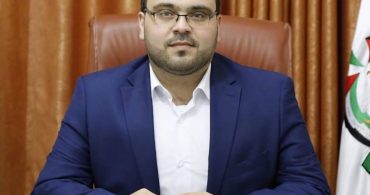
Hazem Qasem
Palestine Information Center – June 23, 2018
GAZA – The Hamas Movement has said that the massive presence of citizens in the March of Return rallies on Friday, June 22, has reflected that the popular struggle in Gaza will continue until all goals are achieved.
In a press release, Hamas spokesman Hazem Qasem said the ongoing popular uprising on the Gaza border aims to entrench the Palestinian people’s right to return to every part of their land, including Jerusalem, and their right to live in dignity and with no blockade.
“Such ongoing rallies prove that the [Israeli] occupation’s attempts to terrorize our people into not participating in them have failed,” Qasem affirmed, pointing to the exposure of protesters to aerial attacks during the past week.
“These marches have sent a message to the US administration, which is trying to impose plans or projects aimed at liquidating the Palestinian cause, that our revolutionary people on the border will bury such schemes under their feet and will not allow any party to detract from their rights,” he underlined.
The West & Gulf Couldn’t Sway These Lebanese Elections
By As`ad AbuKhalil | Consortium News | May 31, 2018
The recent Lebanese parliamentary election generated a lot of publicity in Western media. To be sure, free elections are rare in the Middle East, and Western media get excited over the prospects of success for what they dub as “pro-Western” candidates or coalitions anywhere. Also because foes of Israel and the U.S. were in the running, Western media become automatically invested in the outcome. This time, Western media decided that Hizbullah won “a majority of seats” in the election—as the headline of The Financial Times had it. The results were certainly a blow to Western and Gulf regimes who invest—politically and financially–heavily in Lebanese elections.
We can’t really talk about free elections in the Middle East—or anywhere else in the developing world for that matter. Not because people there don’t want them but essentially because Western governments and Gulf regimes won’t allow it. To be fair, the U.S. is clearly in favor of free elections, but only when the results guarantee a victory for its puppets. Thus, when Hamas won the legislative elections of 2006 (which the U.S. had been insisting on), the U.S. not only refused to recognize the free expressions of the Palestinian people but the U.S. worked on a covert operation to undermine the results and to overthrow Hamas in Gaza.
Historically, the U.S. (among other outside parties, chiefly Gulf regimes) intervened heavily in Lebanese elections through the provision of cash payments to its favored right-wing, anti-communist candidates. For instance, the 1947 election lives on as one of the most corrupt in Lebanese history, and former CIA agent, Wilbur Eveland, wrote about his adventures of driving to the residence of then president, Kamil Sham`un, with a load of cash to ensure that the right-candidates win. But the cash wasn’t really necessary because Sham`un forged the election anyway and arranged for the defeat of his opponents.
In 1968, the U.S. was most likely behind the rise of the far-right coalition of “the tripartite alliance,” which included the Phalanges, who swept through the election and, in few years, would—with U.S. help—trigger the Lebanese civil war. (New U.S. archival materials show the extremely close relations between those parties and U.S. and Israel).
But the U.S. and Saudi Arabia surpassed all previous foreign intervention in Lebanon in the 2009 election, when they threw close to a $1 billion to sway the vote on the side of the March 14 coalition, which included the Muslim Brotherhood and right-wing groups—all dubbed “pro-Western” by U.S. media. The victor was arranged although the election was very close: no one side was able to rule without veto power by the other side.
In this election, the Saudis didn’t spend as much as previously probably because they thought it wouldn’t make much difference since a new electoral system had changed the rules. But Western and Gulf governments convened a special economic conference in Paris to prop up the leadership of Sa`d Hariri, who claimed in the wake of the conference that he would be create no less than 900,000 jobs.
Elections in ‘Democracies’
Elections in democratic political systems are merely some of the people selecting representatives who speak on behalf of “all the people.” The propaganda about the virtue of elections is highly exaggerated in order to provide the political system with much more political legitimacy than warranted.
In the U.S., there is still a clear agenda to suppress wide political participation. The U.S. is one of the few countries in the world which holds the vote on a working day—and in the winter where much of the East coast is buried under rain and snow. Furthermore, the U.S. requires voter registration, when most democracies don’t. The low voter turnout in the U.S. is by design, and not by default. If the U.S. were to adopt a proportional representation system—which both parties won’t allow because they enjoy holding the exclusive monopoly over political representation—voter turnout would increase. Most world democracies have—at least partially or at some level—adopted proportional representation.
The leftist coalition during the Lebanese civil war years, the Lebanese National Movement, proposed political reforms in 1975. They included—among other things—the adoption of proportional representation at the national level, with Lebanon designated as one electoral district. The political class rejected that because they preferred the single-member district (at a small local level) since it facilitates the utilization of cash in swaying voters. Also, Lebanese national proportional representation wouldn’t fit well with regional sectarian leaderships.
The May 6 Lebanese election took place nine years after the previous one. Regional conflicts and Lebanese internal turmoil gave sectarian leaders the excuse to postpone the elections repeatedly. Sectarian leaders also had a hard time agreeing on a new electoral law. But the election of Gen. Michel Aoun to the presidency in 2016 expedited the process of finally holding a ballot. His parliamentary bloc had been vociferous in calling for new elections. After long months of acrimonious negotiations, the sectarian leaders agreed on a new electoral law.

Aoun: Pressed hard for a vote.
Hizbullah and the progressives in Lebanon called for a proportional representation system, while Hariri and his allies fought against it. Hizbullah was willing to risk losing a few seats in return for the election of some of its allies from different sects, while Hariri knew that his broad coalition in parliament would lose substantially because most of his Christian MPs were elected in specially-designed districts where the majority Muslims vote for Christian and Muslim MPs.
The design of electoral districts is not a simple matter in Lebanon because the system has to balance different political interests with a sectarian arithmetic formulae (which is incorporated into the political system of the country). For example, the top posts of government (presidency, speakership, and prime ministership) are distributed among Maronites, Shi`ites, and Sunnis respectively.
Elections to the 128-seat Lebanese parliament must split seats evenly between Christians and Muslims though Muslims surpassed Christians demographically long before the 1975 civil war. It is estimated that Christians are now no more than a third of the population. There is a quota for Christians in the Lebanese parliament that keeps up the pretense that they are half the population no matter how different the demographic reality. In fact, the Lebanese state refuses to conduct a census for fear of upsetting Christians. The last census was conducted in 1932.
So Lebanese leaders agreed on a new electoral law that would mix the proportional representation system with the single-member district. They arrived at a law which divided Lebanese governorates as electoral districts but then gave the voter the choice to rank one candidate on the electoral list as his/her “favored” candidate, which basically prioritized sectarian preferences of voters. The whole purpose of proportional representation was defeated.
The law was quite complicated and the low voter turnout (around 49 %, less than the 2009 election) seems to confirm that many voters and even Interior Ministry experts did not fully understand the rules. The low turnout can also be explained by the low level of enthusiasm among voters and the diminished sense of expectations for change. Furthermore, sectarian leaders in Lebanon suppress the vote by not allowing 18-year-olds to vote. If they did it’s estimated that it would substantially increase the Muslim voters—especially Shi`ites.
Part Two will look closely at the election’s winners and losers and what it means.
As’ad AbuKhalil is a Lebanese-American professor of political science at California State University, Stanislaus. He is the author of the Historical Dictionary of Lebanon (1998), Bin Laden, Islam & America’s New ‘War on Terrorism’ (2002), and The Battle for Saudi Arabia (2004). He also runs the popular blog The Angry Arab News Service.
Hamas: Israel’s rejection of UN probe “evidence against it”
Palestine Information Center – May 21, 2018
GAZA – The Hamas Movement on Sunday said that Israel’s rejection of an investigation ordered by the UN Human Rights Council into the recent mass murders of unarmed protesters in the Gaza Strip was evidence that its forces committed war crimes against innocent civilians.
“The Israeli occupation’s rejection of the UN inquiry commission emphasizes its brutality, and insistence on terrorizing and killing our people, disrespecting UN and international institutions and flouting their resolutions,” Hamas spokesman Abdul-Latif al-Qanoua said in a brief press release.
Israel’s foreign ministry railed against the UN Human Rights Council last Friday after it voted to set up a probe into recent killings in Gaza and accused Israel of excessive use of force.
The ministry said it would not allow or cooperate with such inquiry, calling the UN body as “made up of a built-in anti-Israel majority, and guided by hypocrisy and absurdity.”
Hamas condemns Swiss minister’s comment about right to return

Ignazio Cassis, the Foreign Minister of Switzerland [screengrab / Youtube]
MEMO | May 19, 2018
The Islamic Palestinian Resistance Movement, Hamas, has condemned a comment by Swiss Foreign Minister Ignazio Cassis about the Palestinians’ right to return. The movement said that it was “shocked” to hear Cassis describe the legitimate return of all Palestinian refugees as an “unrealistic dream” in a comment about the UN Relief and Works Agency (UNRWA).
According to the minister, “UNRWA poses a problem by holding an unrealistic dream about the return of all refugees.” The question, he said, is whether UNRWA is part of the solution or the problem. “It has long worked as a solution but now it is part of the problem, it is securing the ammunition needed for the continuation of the conflict. As long as Palestinians live in refugee camps, they will remain wanting to return to their homeland.”
Hamas denounced what it called the Swiss minister’s “disgraceful remarks” and demanded that the government of Switzerland should issue an apology to the people of Palestine.
“We reiterate our support for UNRWA and the need to enable it to continue its work mandated by the international community for the relief and employment of Palestinian refugees,” the movement said. “We affirm to all that the adherence of our people to their rights, foremost of which is the return to their land, is not linked to the existence of the camps or the continuation of the Agency’s work.”
The right to return to their homeland, Hamas pointed out, is one to be upheld for all refugees, regardless of where they are or their country of origin. Palestinian refugees are no different, it insisted, and their right to return has been reaffirmed in numerous UN Resolutions over the decades since the 1948 ethnic cleansing of their land. “Furthermore,” added Hamas, “it is an individual and collective right.”
Hamas: Prince Charles intent to join Israel 70th anniversary shameful

Palestine Information Center – May 10, 2018
GAZA – The Islamic Resistance Movement Hamas condemned in the strongest terms the British Crown Prince’s projected participation in an Israeli celebration marking the 70th anniversary of the establishment of Israeli occupation entity.
Hamas spokesman Fawzi Barhoum said: “By taking part in the Israeli event, Prince Charles turns a blind eye to the displacement and deportation of the Palestinian people, along with the heinous massacres perpetrated by Zionist gangs in 1948 and which were primarily green-lighted by the British government.”
“His participation will be a sign of Britain’s continuous complicity with the Israeli occupation against the Palestinian people”, the statement read. “The participation will certainly give the Israelis green light to continue its crimes and massacres against the Palestinian people, land, and holy sites.”
Hamas called on the Crown Prince to cancel his participation in order not to cause more pain to the people of Palestine and backtrack on the notorious Balfour Declaration, which led to the Nakba.
The movement also called upon the people of Britain to reject the visit, pressure the Prince to rescind his decision, and to speak up for the oppressed Palestinian people.
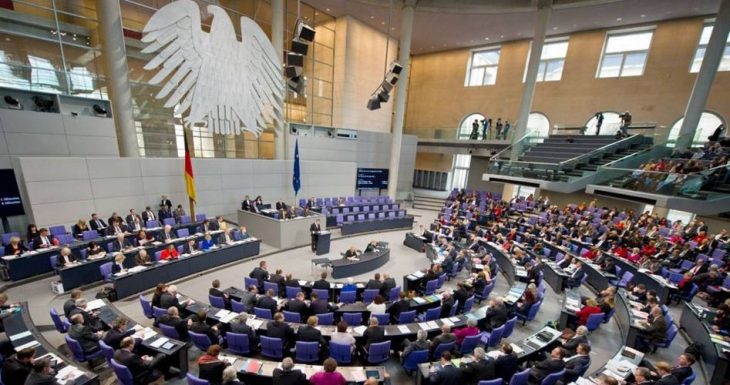
Hamas condemns Bundestag’s support for ‘Israel’ to be a Jewish state
Palestine Information Center – April 29, 2018
GAZA – Hamas strongly condemned the German Bundestag’s call for the German government to support recognizing the Israeli occupation as a Jewish state over the land of historic Palestine.
In a statement on Sunday, Hamas said “At the time the Palestinians expected a strong support from the Federal Republic of Germany on the 70th anniversary of the Nakba, the Bundestag did not mention the seven-decade long aggression of the Israeli occupation on our people, and it did not denounce the Israeli racist and fascist policies”.
Today, the Israeli occupation as an occupying power, continues usurping Palestinian land in favor of illegal settlements, arrests thousands without trial, many of them are children, women and patients, Judaizes Jerusalem and forcefully deports Jerusalemites from their homes and imposes an unjust siege on more than two million Palestinians in Gaza.
The siege on Gaza is considered by all international institutions and international laws as a collective punishment that amounts to a crime against humanity.
You, the Bundestag, described the Israeli occupation as a “state that embraces western European values.” Do these values accept, for example, the killing of dozens and wounding of thousands of peaceful demonstrators, most of them children, who demand their right to a decent life and return to their homes?
This decision destabilizes the region and the world, as well as it gives the occupation a green light to continue its aggression against our people, violation of international law and encourages the displacement of the rest of our people.
Hamas is wondering whether accepting a Jewish state is in line with the democratic values on which Germany was founded after WWII, which basically do not consider differences between citizens on the basis of race, color or religion.
Therefore, we demand that the Bundestag cancel this decision and take positions that achieve justice for our people after decades of suffering, which Europe, and foremost Germany, is a major cause of it.
Hamas: Haley’s remarks encourages Israel to commit more crimes
Palestine Information Center – April 27, 2018
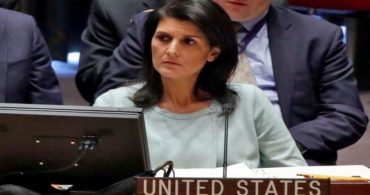 GAZA – Hamas Movement on Friday perceived the statements of Nikki Haley, the United States Ambassador to the United Nations, in which she claimed that Hamas uses civilians as human shields in Gaza Strip, as untrue offensive remarks.
The Hamas’s spokesman Sami Abu Zuhri said, on Twitter, that Haley’s statements encourage Israeli occupation authorities to commit more crimes against the Palestinian people including the killing of children.
Earlier on Thursday, Haley reiterated her allegations against Hamas Movement before the UN Security Council without even mentioning Israeli ceaseless violations against Palestinians including the killing of the participants of the march of return.
Some 41 Palestinians have been killed and over 5000 others have been injured by Israeli forces since March 30, 2018.
Hasbara memo: “When Israelis murder Palestinians, it’s a tragedy — for Israelis.”

© Ibraheem Abu Mustafa / Reuters
By Richard Hugus | April 19, 2018
Since the start of the latest massacre in Gaza — the killing with live fire of almost 40 and wounding of almost 3,000 unarmed Palestinian protestors during the March of Return — propaganda in service of Israel has been mobilized to cover up the blatant crime. Three days after the March began, the Jewish Community Relations Council of Greater Boston issued an unbelievably twisted statement on the attacks. What follows is their statement, with comments inserted in italics:
Jewish Community Relations Council Statement on Events Along Gaza Border
April 2, 2018
“We see the events along the Gaza-Israel border this weekend as the continuation of one of the great tragedies of our time.”
— This implies that Gaza is a sovereign country bordering Israel, not the prison for Palestinian refugees that Israel established decades ago in the south of Palestine.
“This is a situation where many are at fault, leaving individuals in impossible situations with impossible choices.”
— When someone is morally at fault, the situation is always “complicated.” As we shall see, the “many at fault” are always Palestinians, not Israelis.
“It is a tragedy for the people of Gaza that, 12 years after the complete withdrawal of Israel from the Gaza Strip, they live under such difficult conditions.”
— “Tragedy” in Greek theater held that events are written by our fate and could not have been otherwise. If Zionism had not chosen Palestine in the late 1800’s and then proceeded to steal land from Palestinians from then on, it could very much have been otherwise. There was an actor here; there was a cause, and an effect. The cause of the “tragedy” was Zionism. Ask the settlers to return to their own countries, and the “tragedy” would end.
The sentence also implies that Israel made a noble gesture when it withdrew from Gaza, and that it is the fault of the Palestinians that they did not make the best of this generous gift. In fact, Israel left Gaza because it was more expedient for Israel to administer Gaza as a prison than to occupy it. The “difficult conditions” faced by the people of Gaza are the result of Israeli control over everything and everyone that goes into and out of it. The “difficult conditions” are the result of repeated Israeli bombings of critical infrastructure, and Israel’s clear plan for the complete immiseration of Gaza’s two million people.
“It is a tragedy for the Palestinians that Gaza was taken over by Hamas, an internationally designated terrorist organization that rules in a brutal dictatorship.”
— Hamas was democratically elected by its people because it distinguished itself from the collaborationist leadership of the Palestinian Authority. Israel defines Hamas as terrorist because Hamas is determined to resist the Zionist entity. Israel’s minions in legislative bodies in other countries have been used to create the “designated terrorist” label.
“Brutal dictatorship” is a buzzword applied to all political movements asserting independence from imperialist control.
“It is a tragedy that Hamas has chosen to direct its resources to the building of tunnels and rockets, rather than building hospitals, schools, housing, and factories that would create prosperity and opportunity for the Palestinian people.”
— Are these the same hospitals, schools, housing and factories that Israel has been bombing since 2006? Are these the same tunnels that Gazans used to bring in vital humanitarian goods not allowed through Israeli checkpoints? Doesn’t Hamas have the right to its primitive rockets when Gazans are being periodically bombarded by Israel and its highly sophisticated fighter jets?
“It is a tragedy that, by squandering the opportunity to build a better future for the Palestinian people, Hamas has forced Israel and Egypt to secure their own borders with a blockade to prevent the further weaponization of Gaza.”
— For choosing resistance against the Zionist occupier, the Palestinian people were punished by the Zionist occupier and his servants in Egypt. The blockade is not just against weapons, it’s against any freedom of movement, and any importation of needed goods. Even people in need of urgent medical care are refused. The main purpose of the Israeli blockade is to starve Gaza, to “put them on a diet”, as one Israeli official said. To its everlasting shame, the West-installed political class in Egypt – not the Egyptian people – has chosen to collaborate.
“It is a tragedy that the Palestinian people of Gaza have no recourse against their leaders, living without elections or even the ability to protest those in power openly on pain of death.”
— Again, Hamas was democratically elected in 2006. One would think “the only democracy in the Middle East” would appreciate this. Stories of Hamas killing protesters have appeared only in the Israeli press – e.g., the Jerusalem Post, the Times of Israel. However, there are stories every day in the worldwide press of Israeli soldiers shooting Palestinian protestors all over the West Bank. Let’s also remember that the March of Return in Gaza is made up of protestors, and that Israel sent snipers there for the explicit purpose of killing and wounding them. This is not to mention the “recourse against” Hamas leaders employed over the years by Israel – namely, open assassination.
“It is a tragedy that they are deceived by their own leaders with the unrealistic promise of a destructive victory over the State of Israel – a victory that will never come. It is a tragedy that their own government chooses to use them as human shields, perpetuating their suffering for nefarious self-interest.”
— As the Borg said, “Resistance is futile.” Isn’t the promotion of the idea of an unconquerable Israel the worst kind of war propaganda? The “human shields” argument has been used by Israel as an excuse for intentionally killing hundreds of civilians during its repeated bombing campaigns. What is the “nefarious self-interest” of Gaza’s leadership? — liberation from Israeli torture.
“It is a tragedy that the Israeli people look at Gaza and see the end of a dream; to live in peace with their neighbors.”
— The “dream” of the majority of the Israeli people today is to remove Palestinians from all of historic Palestine, and completely erase Palestinian history. Israelis do not “live in peace with their neighbors.” They have repeatedly attacked Lebanon, Iraq, and Syria and they are the main instigators today of conflict and war with Iran.
“It is a tragedy that Israelis living near the border are terrorized by threats coming from tunnels under their homes and rockets over their schools.”
–The main tactic of this propaganda piece is to blame the victim. Thus, nothing was done through the agency of the Jewish state and its obvious goals; everything was done as a reaction to injustices committed by Palestinians. It also turns reality on its head. Homes and schools have indeed been destroyed, but by Israel.
“It is a tragedy that when Israelis do what any other nation in the world would do – protect their border from being overrun – that they endure a condemnation that no other nation would receive.”
— This is the “why pick on us?” argument. Why? Because Israel has the ugliest, most long-standing system of open colonization and oppression visible in the world today. The vast majority of the people of the world are disgusted. What Israel claims as its “borders” is stolen land.
“It is a tragedy that Israelis experience this singling out as a further example of an isolation, their status as “the Jew amongst the nations,” with only themselves to protect their inalienable rights to live in security.”
— This is the “Jew as victim” argument, made possible by unrelenting Holocaust instruction since World War II, which provides a guaranteed pass for any and all crimes committed by Jews. Since 2001, Israel, the poor victim nation, has gotten the United States to attack a long list of countries in the Middle East which Israel feels threatened by, now including Russia because Russia has thrown a wrench into Israeli plans to destroy Syria. Israel also receives massive direct funding and political cover from the United Sates.
If Israel resents its status as “the Jew amongst the nations” why does it call itself “the Jewish state”? Why does it display the Star of David on all its national symbols and armaments? This is an identity which Israelis promote – how can they now turn around and blame us for it?
“It is a tragedy because this weekend, young men and women of the Israel Defense Forces stared down the sights of their rifles and learned violence at a time when they should have been at home with their families celebrating freedom at the Passover table.”
— The idea that it is the Israeli Occupation Forces who have suffered because they have had to kill and maim defenseless Palestinians is a perfect example of what Zionist supremacy and racism is. It is a form of self-worship and psychopathy in which one is never responsible for committing any wrong — it is always the fault of the other. This sentence is reminiscent of Israeli Prime Minister Golda Meir saying: “We can forgive the Arabs for killing our children. We cannot forgive them for forcing us to kill their children.” In other words, the real crime has been committed against Jews, whose purity has been sullied by having to kill innocent people (as they were invading their land and homes).
This belief of Jewish superiority above others is at the bottom of everything Palestinians have suffered for the past 70 years.
“It is a tragedy because Palestinians need some way to express their frustrations – at Israel and at their own government after years of wasted opportunities to build a better life for the people of Gaza. Instead they experienced more manipulation, and more loss.”
–No, the ” frustration” Palestinians feel is from being consistently and sadistically blocked from life and liberty by the Israeli prison-keeper. The real manipulators are those who would have us believe the oppressive tactics of Israel are of the Palestinians’ own making, as this sentence implies.
“We see this weekend as the continuation of a tragedy that has not brought the people of Israel and Gaza any closer to a future of peace and hope for all of their children. As the Boston Jewish community continues to celebrate the Passover holiday this week, we are mindful of the lessons learned at our seders, that we do not rejoice over the tragedy of others and we are ever hopeful for peace and stability for all people.”
— Again, no recognition that this “tragedy” might be in any way the fault of Israel. Israel is supported, not by “the Boston Jewish community” but by a cynically propagandistic Washington-based lobby for Israel, the Jewish Council for Public Affairs, which provides the political line for 125 supposedly local Jewish Community Relations Councils in the US. In other words, a political lobby for a country 6,000 miles away says they speak for all Jews in Boston.
In 2016 the Jewish Community Relations Council of Boston sponsored a deceptive anti-boycott bill in the Massachusetts legislature. They were successfully opposed by a large number of Jewish activists in the state, and many others. The Council now claims to represent the Jewish community of Boston in mobilizing opposition to a motion in the Cambridge city council to boycott Hewlett-Packard. When was the vote in which “the Boston Jewish community” elected this Council? Who is the real manipulator in this scenario? Doesn’t the Jewish Community Relations Council actually represent a foreign political movement — not Cambridge, not Boston, not Massachusetts?
Israel, you can’t have it both ways. You can’t repeatedly murder people in Gaza in broad daylight and then piously claim you’re for “ peace and stability for all people.”
Haneyya: Return March battle of awareness
Palestine Information Center – April 7, 2018
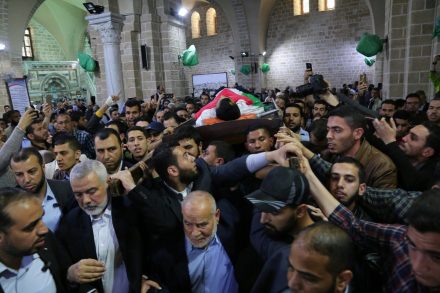 GAZA – Head of Hamas’s Political Bureau Ismail Haneyya on Saturday said that the Palestinian people are capable of challenging the Israeli occupation even under the most difficult circumstances.
Speaking at the funeral of the Palestinian photojournalist Yaser Murtaja in Gaza, Haneyya said that the Great March of Return represents a battle of awareness to emphasize on national constants, most importantly the right of return.
Haneyya praised the courage of journalist Murtaja who sacrificed his life for the sake of conveying truth to the world.
Murtaja died earlier Saturday after he succumbed to a serious injury he sustained after being deliberately shot in the abdomen by an Israeli sniper while covering peaceful protests near the border fence east of Khuza’a town in the southern Gaza Strip.
Hundreds of Palestinian citizens and dozens of journalists took part in Murtaja’s funeral chanting slogans calling for prosecuting Israel’s leaders over their crimes against the Palestinian people.
NPR Runs IDF Playbook, Spinning Killing of 17 Palestinians
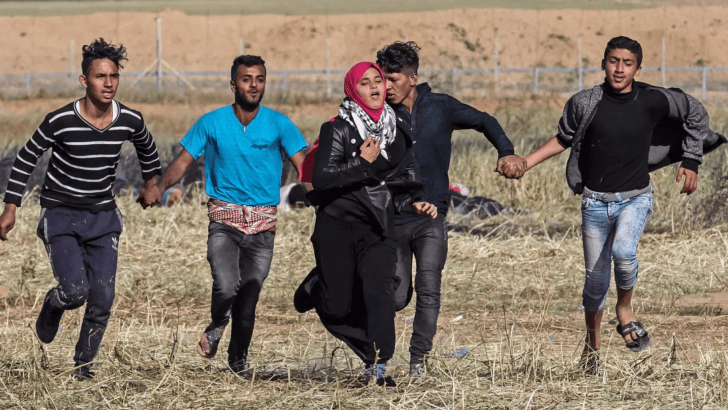
Photo credit – Said Khatib, AFP
By Adam Johnson | FAIR | April 2, 2018
NPR, as FAIR has noted throughout the years (e.g., 8/14/01, 11/01, 2/5/02, 11/15/12, 10/10/14), takes a default pro-Israel line when reporting on the affairs of Israel/Palestine. Its correspondents almost always live in West Jerusalem or in Israel proper, are rarely Palestinian or Arab, and they work consistently to deflect blame for Israeli violence—either shifting blame onto Palestinian victims or dispersing it through false parity.
A segment from Friday (All Things Considered, 3/30/18) on Israel’s killing of Gaza protesters provides a case study in this process. NPR host Ari Shapiro set up the segment, an interview with reporter Daniel Estrin, by blaming the 17 dead and hundreds of injured Palestinians on “the militant group Hamas,” framing Israel as totally defensive. From the very first line, blame is deflected from the Israeli military:
Today saw some of the most violent clashes in years between Palestinian demonstrators and Israeli troops.
We do not have one party’s snipers opening fire on another, unarmed party; we have “violent clashes”—a term, as FAIR (8/12/17) has noted before, that implies symmetry of forces and is often used to launder responsibility. The whitewashing got worse from there:
Tens of thousands of people in Gaza answered the militant group Hamas’ call to protest.
Palestinians have no organic reasons for wanting to protest the occupation of their homes; the whole thing was a top-down decree from “the militant group” Hamas.
They threw rocks and firebombs near the border fence with Israel. On the other side, Israeli troops assembled.
This conveys the impression the Israeli military was just sitting around, minding its own business, when it was aggressively attacked by hundreds of Palestinians, then responded to this assault.
The “firebombs” claim is repeated later in the piece by Estrin himself: “Israel responded to Palestinians throwing rocks, firebombs, burning tires.” This isn’t qualified with “according to the IDF” or “the Israeli government”—even though as of now, there’s no independent evidence firebombs were used, much less used before any sniper fire from Israel.
The issue isn’t trivial: The matter of first blood when it comes to the Palestinian/Israeli “conflict” is a crucial one (FAIR.org, 12/8/17); framing Israel as always responding to threats, rather than inflicting aggressive violence on an occupied people, is a critical difference. And subtle framing devices like “clashes,” distorting timelines of who did what, or morphing IDF claims of “firebombs” into fact are how media keep this myth alive, and further delegitimize Palestinian resistance. (It should be borne in mind that opposition to occupation, even armed opposition, is a right guaranteed by international law.)
When FAIR pointed out to Estrin on Twitter that he had reported the “firebombs” as fact and not a claim by the IDF, he responded, “I reported the firebombs as an Israeli claim.” When FAIR showed evidence he and host Shapiro had done the opposite, Estrin deflected: “Be kind; it’s live radio.”
“Explain why this violence broke out today,” host Shapiro asked. It’s not a massacre or an attack or “firing on protesters,” as it is when official US enemies do it; it’s simply “violence breaking out.”
Estrin again took care to re-establish Hamas as the “driving force” and guilty party:
And it was billed as an independent Palestinian protest campaign. But actually Hamas, which controls Gaza, was a driving force.
This effectively militarized the whole of the protest, treating it not as an outpouring of popular grievances but as an operation quarterbacked by “a militant group.” This is where Estrin asserted the protesters used “firebombs” without attributing the claim to the Israeli attackers. Instead, he cited the IDF as a source on crowd size:
And according to the Israeli army, there were more than 30,000 Palestinians at six different spots along the border. Israel responded to Palestinians throwing rocks, firebombs, burning tires. Israel fired tear gas and live fire. It was the most violence in Gaza since the Gaza War in 2014.
A brief mention of the dire humanitarian situation in Gaza was thrown in, but it is blamed on an “ongoing internal Palestinian political fight” that has made the situation “even worse.” Estrin then erroneously told listeners “Hamas took control of Gaza by force a decade ago,” when Hamas actually gained power in Gaza in 2006 through an internationally recognized election. In 2007, Hamas won a civil war with US-backed Fatah, the faction it had defeated in the election, but to say Hamas “took control of Gaza by force” falsely paints it as an usurping force with no legitimate authority.
Asked what will happen next, Estrin shrugged and says more of the same, and that is it.
It’s a brief report, but a highly revealing one: Hamas is at fault, the Palestinians threw “firebombs” first, then the Israeli army “assembled.” The illegitimate Hamas astroturfed the protest, the people are being exploited. Israel just killed those 17 protesters in self-defense.
You can contact NPR ombud Elizabeth Jensen via NPR’s contact form or via Twitter: @EJensenNYC. Please remember that respectful communication is the most effective.
Hamas: No alternative to right of return

Ismail Haneyya
Palestine Information Center – March 30, 2018
GAZA – Head of Hamas’s Political Bureau Ismail Haneyya affirmed on Friday that Palestinians will continue to demand their right of return in all possible ways.
In a statement on Palestinian Land Day, Haneyya said that the Palestinians will no longer accept that the right of return remains a slogan chanted in every occasion here or there; rather, they will work to make it a tangible and achievable goal.
While taking part in the activities of the Great March of Return in Gaza, Haneyya hailed the Palestinian martyrs who fell while defending their lands on 30th March 1976.
He continued to say that the crowds taking part in the Great March of Return represent the real Palestinian unity.
Haneyya added that the Great March of Return came as the attack on the Palestinian cause has reached its peak following the US recognition of Jerusalem as Israel’s capital and in light of increasing talks about the deal of the century.
The marching Palestinians wanted to say that there is no alternative to Palestine and the right of return, he stressed.
Featured Video
Trita Parsi: Israel Set a Trap for Total War in the Region
or go to
Aletho News Archives – Video-Images
From the Archive
Zionism’s Violent Legacy
By Donald Neff | Washington Report On Middle East Affairs | January 1996
On January 4, 1948, Jewish terrorists drove a truck loaded with explosives into the center of the all Arab city of Jaffa and detonated it, killing 26 and wounding around 100 Palestinian men, women and children.[1] The attack was the work of the Irgun Zvai Leumi – the “National Military Organization,” also known by the Hebrew letters Etzel – the largest Jewish terrorist group in Palestine. The Irgun was headed by Revisionist Zionist Menachem Begin and had been killing and maiming Arabs, Britons and even Jews for the previous ten years in its efforts to establish a Jewish state.
This terror campaign meant that at the core of Revisionist Zionism there existed a philosophical embrace of violence. … continue
Blog Roll
 Aletho News
- Trita Parsi: Israel Set a Trap for Total War in the Region
- Trump’s Iran war is on an Israeli leash
- Saudi oil boss issues global supply warning
- Riyadh Says Its Oil System Is Intact. The Numbers Say Otherwise.
- Trump and Netanyahu Want to “Finish the Job” on Iran
- US ‘one-sided dictation’ not Iran’s beliefs makes rational talks impossible: Baghaei
- Iran’s Next Strike May Not Explode. It Could Shut You Down /Col Doug Macgregor
- Iran: US political targets legitimate if assassinations return
- Iraq shuts key border crossing with Iran under US pressure: Report
- Undersea Internet cables could be targeted in retaliation for attacks on Iran: IRGC deputy chief
- If Americans Knew
- The Israel Lobby’s Changing Fortunes
- AIPAC has become such a political liability that it’s shifting to a more “nimble” approach to buying politicians
- At least 160 Israeli settler attacks in 2 weeks
- Will Gaza’s Ancient Christian Community Disappear Forever?
- Israel’s vision of regional security rests on keeping Arab states weak
- Heidi Levine recounts how Palestinian youths helped save her in settler attack
- DAILY UPDATE: Latest essential news on Palestine, Israel, & region
- Trump’s Intensifying Sabotage of the ICC, for Israel’s Sake
- Israeli military detain US and UK volunteers in West Bank including Democratic NY politician Brad Lander
- Americans at National Conservatism Conference held in Israel this year criticize Israel
- No Tricks Zone
- E-Cars Reduce CO2 Emissions By Only 41% Compared To Internal Combustion Engine Vehicles
- Predictions Made By Renowned Climate Professor Over Past Decades Have Been Proven To Be Poor
- New Study Suggests Large Regions Of The Pacific Ocean Have Been Cooling For The Last 80 Years
- Germany’s Green Energy Debacle: High Energy Costs Force Kahla Porzellan to Close After 182 Years!
- New Study: 50 Years Of The Most Aggressive ‘Net Zero’ Policies Can Only Affect The Global Climate By 0.03°C
- US September “Heat” Was No Record…Many Records Set Decades Ago
- Latest European Green Energy Debacle; Portugal’s Largest Flagship Solar Park Insolvent!
- Green Energy Debacle: German Expert Professor Fritz Vahrenholt Warns Of Severe Economic And Social Consequences
- Two More Paleo Reconstructions Affirm Meters-Higher Sea Levels Across Ireland, Brazil 7000-6000 Years Ago
- New Study: Earth And Venus Surface Warmth Largely Explained By Convection And Lapse Rate, Not CO2 Or Radiation


