The Queen of Climate Crackpottery

By Tony Thomas | Quadrant | April 15, 2024
Trigger warning: if your household companions include a cat, dog, canary, goldfish or turtle, this article is not a safe space. I’m writing about Harvard’s distinguished agnatologist Professor Naomi Oreskes (above) and her 2014 warning that global warming would kill your pets in 2023. The warning is in her acclaimed but glum book The Collapse of Western Civilization: A View from the Future. Given margins of error in climate science, the pet die-off might be this year instead. Oreskes wrote,
The loss of pet cats and dogs garnered particular attention among wealthy Westerners, but what was anomalous in 2023 soon became the new normal . … A shadow of ignorance and denial had fallen over people who considered themselves children of the Enlightenment (p9).
Smarter climate alarmists don’t make short-term predictions. They choose a date like 2050 for when the oceans will boil. They’ll be senile or dead by then and can’t be humiliated if the oceans stay chilly.
Top environmentalist Paul Ehrlich forecast in 1971 that by 2000 the UK “will be simply a small group of impoverished islands, inhabited by some 70 million hungry people … If I were a gambler, I would take even money that England will not exist in the year 2000.”[1] His 1968 book, Population Bomb, predicted starvation would shrink the US population to 23 million by 1999. Strangely, Oreskes in her book hails Ehrlich as a vindicated futurist. (p3-4 and 56).
The only good news from Naomi is that the IPCC becomes [more] discredited and is disbanded. She replaces it with such alphabet soups as the UNCCEP’s ICCEP which launches IAICEP, which she says is pronounced “ay-yi-yi-sep” (p27).The mission of ay-yi-yi-sep is to sprinkle enough fairy dust aka sulphates in the air to make an anti-sun umbrella and save the planet by 2079.
In September 2014 she was interviewed on the ABC’s Science Show by Dr (honoris causa) Robyn Williams, a Fellow of the Australian Academy of Science, about the pet-deaths. One reader, she explained,
… started crying when the pets die, so I didn’t mean to upset people too much … I was just trying to come up with something that I thought people wouldn’t forget about, and I thought, ‘Well, Americans spend billions of dollars every year taking care of their pets’, and I thought if people’s dogs started dying, maybe then they would sit up and take notice.
Interviewer Dr Williams[2] was delighted with Oreskes’ pet-panic strategy. He chimed in,
Yes, not only because it’s an animal but it’s local. You see, one criticism of the scientists is they’re always talking about global things…And so if you are looking at your village, your animals, your fields, your park, your kids, and the scientists are talking about a small world that you know, then it makes a greater impact, doesn’t it.
Oreskes: Well, exactly. It was about bringing it literally home, literally into your home, your family, your pet, the dog or cat that you love who is your faithful and trusted companion.
As I type this, I look down fondly at Natasha, our doomed spaniel, although she is neither faithful nor trustworthy.
Oreskes began her Science Show appearance by reading from her book in sepulchrul tones:
Then, in the northern hemisphere summer of 2041, unprecedented heatwaves scorched the planet [and] led to widespread outbreaks of typhus, cholera, dengue fever, yellow fever, and viral and retroviral agents never seen before.
Naomi’s actually playing down her future horrors, she omits to tell him about the arrival of the Black Death:
Dislocation contributed to the Second Black Death, as a new strain of the bacterium Yersinia pestis emerged in Europe and spread to Asia and North America. In the Middle Ages, the Black Death killed as much as half the population of some parts of Europe; this second Black Death had similar effects. (p30).
Australians will wonder: does Medicare charge extra premiums to cover bubonic plague?
Williams, instead of asking Oreskes what she’s smoking, merely observed that all of the above is “fairly shocking”. He further wondered why it is only Western civilization that collapses, leaving the Chinese in charge. One reason, says Oreskes, is that Chinese civilisation is more durable, and two, that authoritarian regimes are better able to deal with hypothesised climate apocalypses.
Looking back from the future, Oreskes viewed China in the early 2000s as a beacon of carbon enlightenment. China, she said,
… took steps to control its population and convert its economy to non – carbon – based energy sources. These efforts were little noticed and less emulated in the West, in part because Westerners viewed Chinese population control efforts as immoral, and in part because the country’s exceptionally fast economic expansion led to a dramatic increase in greenhouse gas emissions, masking the impact of renewable energy. By 2050 , this impact became clear as China’s emissions began to fall rapidly. Had other nations followed China’s lead, the [grim future] history recounted here might have been very different. (p6).[3]
Another interviewer — a friendly one, actually — played the devil’s advocate:
Interviewer: Just how much do you hate the American way of life? What gives you the intellectual chutzpah to make these kinds of projections?
Oreskes: Our story is a call to protect the American way of life before it’s too late.
I identify with Oreskes, who grew up in New York, because as a lass she was a geologist working on Western Mining Corp’s Olympic project in central Australia. I phoned WMC’s retired boss Hugh Morgan but he couldn’t give me any piquant anecdotes about young Naomi.
Her sojourn Down Under must have been unhappy because she’s forecast that the climate emergency will kill off every Australian man woman and child (all 26 million of us). “The human populations of Australia and Africa, of course, were wiped out.” (p33). As a resident of Australia’s pagan state of Victoria, I don’t believe in the afterlife, although I am bringing a change of underwear. (Witticism courtesy Woody Allen).
Oreskes dropped geology to co-write that Merchants of Doubt book, painting “climate deniers” as the evil twins of those denying that smoking causes cancer. The book in 2021 was set to music by composer Yvette Jackson, who sees climate doubt as having the
… low, somber insistence of the bass clarinet, skittering flute that cranks up anxiety, sonorous cello to hold things together, and the deep, doubting rumble of double bass.
Listen to that anxious, sonorous cello and more here (fourth video down).
At 65, Naomi’s job title is Harvard Professor of the History of Science — but don’t call, she’s on leave. She co-wrote her civilisational-collapse book with fellow alarmist Erik Conway. Her other collaborators include Pope Francis: she did the intro for his Laudato si’ encyclical in 2015.
Wikipedia lists only 30 of her honours, including the Stephen H. Schneider Award in 2016 for communicating “extraordinary scientific contributions” to a broad public in a clear and compelling fashion. Schneider (1945-2010) was a top IPCC climate scientist. He urged colleagues there to strike a balance between scaring the pants off the public and being honest about how weak the CO2 evidence really is. Oreskes also scored the 2019 Mary Rabbit Award from the US Geological Society. Her lifetime of bashing denialists is surely worth a million-dollar Nobel.
The Collapse book is about Western civilisation’s ruin while China saves the planet with its enlightened anti-CO2 measures. She is writing from the future in 2393 when she will be aged 435. Oreskes (as at 2393) is cross because we have refused to build enough windmills to stop at 11degC warming (p32) and eight-metre sea rises (p30). We should not have eaten so many fillet steaks[4] and, personally, I should not have tooled around in my reasonably priced, petrol-powered Hyundai i30 when Teslas were available at $80,000.
Oreskes was talking about Collapse at a Sydney Writers’ Festival when someone in the audience piped up, “Will you write fiction next?” She doesn’t of course view Collapse as fiction: “Speculative? Of course, but the book is extremely fact-based” (p79). And she elaborated to the ABC’s Dr Williams, “Well, it’s all based on solid science. Everything in this book is based on the scientific projections from the Intergovernmental Panel on Climate Change. All we did was to add to the social and human aspects to it and to ask the question; what does this really mean in terms of what its potential impacts would be on people and its potential impacts on our institutions of governance?”
Her “science based” technical projection involved an angry summer in 2023 continuing year-round, “taking 500,000 lives worldwide and costing nearly $ 500 billion in losses due to fires , crop failure , and the deaths of livestock and companion animals” (p8) In 2014, how was Naomi (no-one’s perfect) to know that current agricultural output and yields continue smashing records?
The book’s “fact-based” projections have drought and desert ravaging the US in the 2050s:
The US government declared martial law to prevent food riots and looting [similar to 2020s’ mostly-peaceful burning and robbing]. A few years later, the United States announced plans with Canada for the two nations to begin negotiations … to develop an orderly plan for resource-sharing and northward population relocation (p26).
The talks led to the combined United States of North America. I imagine Texans started adding “eh” to their sentences, as in Why do Canadians say “eh?”? It’s so silly right? Because we want to, eh.
Even at the age of 435 in 2393, Oreskes remains really sore about the Climategate email scandal of 2009 (IPCC climate scientists conspiring to fudge data). She blames Climategate on a “massive campaign” that was “funded primarily by fossil fuel corporations” (p8) — this alleged largesse must have by-passed sceptic bloggers, who still rely on their tip jars. Oreskes remains vigilant to smite deniers:
It will also be crucial not to allow new forms of denial to take hold. We are already seeing examples, such as the false claim that off-shore wind kills whales and that restrictions on gas stoves are the latest excuse by liberals to control our lives and deny our freedom. Scientists will have to work with climate activists to block the spread of such misleading narratives.
She finished her interview with the ABC’s Dr Williams by claiming, improbably, that some readers of Collapse wished her 80-page book to be longer. She explained,
We didn’t want it to be too depressing, we didn’t want to go on and on and on, like 300 pages of misery, that really wouldn’t be any fun. So we are sort of hoping that the book, despite the fact that it’s a depressing topic, it’s actually we think kind of a fun read.
Apart from our dead kittens, that is.
[1] Speech at British Institute For Biology, September 1971. Link broken.
[2] The ABC Ombudsman told me it’s fine for people with honorary doctorates to be called “Dr” in any context.
“The ABC style guide does not form part of the editorial standards and we consider there is nothing materially inaccurate in referring to Ms O’Donoghue as Dr O’Donoghue.” Email from James, Investigations Officer, ABC Ombudsman’s Office, Feb 14, 2024. (The late Ms Donoghue’s Doctorates are honorary).
[3] On the ABC iview’s posting of the Oreskes/Williams interview, the ABC claimed the planet was warming at the top of the IPCC models’ forecasting. I wrote to my friend Kirsten McLiesh, who runs Audience & Consumer Affairs (i.e. the complaints department) pointing out that actual warming was at the bottom of the IPCC models’ range. In those days (2014) the ABC had some integrity and Kirsten wrote back,
“Having been alerted to your complaint, the program acknowledges that the sentence read on the website as an incontrovertible fact and have undertaken to remove it. An Editor’s Note has been added to the page.”
[4] Oreskes, Twitter May 4, 2023: “I’m often asked “What can I do to stop climate change.” That’s a hard question because so much of the change we need is structural, but this new study proves one thing: EAT LESS BEEF. (And now, drum roll, here come the beef industry trolls.)”
Tony Thomas’s latest book from Connor Court is Anthem of the Unwoke – Yep! The other lot’s gone bonkers. $34.95 from Connor Court here
Harvard Howler: Study claims PM2.5 increases risk of death from COVID19
By Steve Milloy | Junk Science | April 7, 2020
Never waste a crisis. A new study from Harvard claims that 1 microgram per cubic meter increase in PM2.5 is associated with a 15% increase in deaths from COVID19. This is totally absurd.
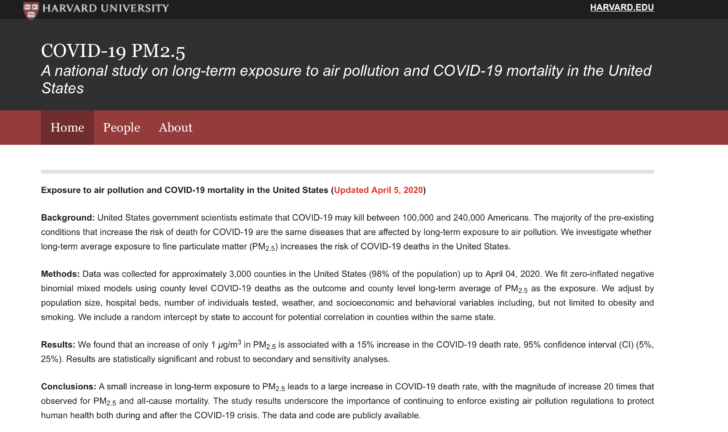
Here are the links you’ll need:
Here’s why this is a totally bogus claim.
- There is no biological plausibility to the notion that PM2.5 causes death.
- A change in exposure to PM2.5 of 1 microgram per cubic meter is not significant, discernible or detectable.
- If this claim were true, the death toll in Wuhan, China would be astronomical since, for example, the PM2.5 level in Wuhan is 158 micrograms/m3 — about 10 times higher than average US air.
But now that the Harvard fraudsters have made this data available, perhaps they’d be wailing to share their Harvard Six City study data?
SYRIA: The Egregious Western Media ‘Chemical Weapon’ Fraud in Eastern Ghouta

One of the many unsubstantiated claims of “Napalm attack” made by the UK/US created propaganda construct, the White Helmets in Eastern Ghouta.
By Vanessa Beeley | 21st Century Wire | April 8, 2018
Napalm was a US invention. Napalm “was invented in a top-secret 1942 war research collaboration between Harvard University and the U.S. government”. In 1952 the U.S. Patent Office issued certificate 2,606,107 for “Incendiary Gels” and made napalm’s precise formula available worldwide.
“U.S. troops used a substance known as napalm from about 1965 to 1972 in the Vietnam War; napalm is a mixture of plastic polystyrene, hydrocarbon benzene, and gasoline. This mixture creates a jelly-like substance that, when ignited, sticks to practically anything and burns up to ten minutes. The effects of napalm on the human body are unbearably painful and almost always cause death among its victims.” ~ The Vietnam War
The accusation of “napalm attack” conjures up terrible images designed to shock. In 1945 the US B29 bombers dropped their payload of 69,000 pounds of Napalm over Tokyo, Japan in one hour. An estimated 100,000 Japanese men, women and children perished in the resulting fire storm. Washington considered the 10 days of Napalm bombing raids across all Japan’s major cities, a huge success. The US also used Napalm in North Korea with devastating consequences for its people in the 1950s. Washington dropped 32,557 tonnes of Napalm on Vietnam.
The US’ most recent use of Napalm was during the Iraq war in 2003 when “dozens of napalm bombs were dropped near bridges over the Saddam Canal and the Tigris River, south of Baghdad” according to an article in the Independent. In the same article a US commander of Marin Air Group 11 states:
“We napalmed both those [bridge] approaches,” said Colonel James Alles, commander of Marine Air Group 11. “Unfortunately there were people there … you could see them in the [cockpit] video. They were Iraqi soldiers. It’s no great way to die. The generals love napalm. It has a big psychological effect.”
According to Robert M Neer, author of Napalm: An American Biography, the countries who have used Napalm are:
“Countries that have used napalm, in addition to the United States, include: Greece (the first use after World War II), France, Britain, Portugal, United Nations forces in Korea, the Philippines, South Vietnam and North Vietnam (in flamethrowers), Cuba, Peru, Bolivia, Israel, Egypt, Turkey, India, Iraq, Nigeria, and Brazil.”
Syria is not mentioned.
Neer goes on to explain that the UN had banned the use of Napalm against “concentrations of civilians” under Protocol III of the 1980 UN Convention on Certain Conventional Weapons. The US signed the protocol almost thirty years after it had been adopted by the General Assembly, on January 21 2009. It was President Obama’s first full day in office. The caveat being “the US can disregard the treaty at its discretion if doing so would save civilian lives.” Considering just how many civilian lives had been destroyed by the US deployment of Napalm, it is hard to imagine a scenario where Napalm might be beneficial to civilians… but the inference is “we should trust the US to make that decision on our behalf and on behalf of the civilians in any given situation.”
The Syrian Napalm Narrative
The ‘Chemical Weapon’ narrative has sustained the conflict in Syria with alleged attacks being attributed almost entirely to the Syrian government, the Syrian Arab Army and Russia. The seven year information war has been ferocious with NATO-aligned media, think tanks and self appointed experts such as Eliot Higgins and Bellingcat doing all in their power to reinforce the “Syria did it” narrative.
If we were to map the chemical weapon claims in each terrorist held area undergoing liberation by the Syrian Arab Army, we would clearly see that the claims are commensurate with the pressure felt by the terrorist factions as the SAA closes in on their stronghold. … continue
As Harvard academics prove, the truth doesn’t matter when you are bashing Russia
RT | July 27, 2017
Two Harvard University academics have seen dreadfully incorrect Russia-related tweets recently go viral. The fact neither has deleted their falsehoods sums up the low standards when it comes to the Western assessment of all things Russian.
In the information space, a lot of stuff goes out the window when it comes to Russia. Like ethics, decency, fairness, and facts. It’s hard to recall a single incidence of a journalist, official or academic losing a position for being hopelessly wrong about the country.
That’s why you end up with TV networks offering people who’ve never set foot in Moscow as “Russia experts,” magazines presenting opposition figures on two percent in the polls as serious contenders for the presidency and outlets alleging Vladimir Putin is dating Wendy Deng.
It also explains how pundits can claim Russia is about to collapse and then a few months later, insist the Kremlin is about to invade another country. And why analysts who set exact time frames for these incursions, and are proven wrong, fall upwards rather than downwards subsequently. Because anything goes when it comes to Russia and fueling the hysteria is more important than telling the truth.
That said, at least in the “respectable media” you might get the odd correction. Such as when The Washington Post was forced to backtrack on spurious reports Moscow had hacked Vermont’s electrical grid, or when the same paper was compelled to issue a correction after falsely accusing RT of using automated bots to circulate articles.
However, on social media, not only do “experts” not apologize, they rarely even delete their erroneous posts. Probably because of the huge exposure they can receive from the thousands of shares and retweets to be gained from crookedly smearing Russia. And to hell with the consequences of the animosity, enmity, and venom they generate.
Tribal Instinct
A classic case in point emerged this Thursday morning (Moscow Time) when a Harvard University professor named Laurence Tribe, tweeted the following: “DOJ (Department of Justice) is pursuing Dmitri Firtash, Russian mobster linked to . . wait for it: (former Trump campaign aide, Paul) Manafort. But T (Trump) named lawyer for Russian bank to head Crim(inal) Div(ision)!”
DOJ is pursuing Dmitri Firtash, Russian mobster linked to . . wait for it: Manafort. But T named lawyer for Russian bank to head Crim Div!
— Laurence Tribe (@tribelaw) July 27, 2017
And at the time of writing, this brainfart had earned over 4,000 retweets, which have surely multiplied since.
But, you guessed it, the tweet is deceptive, deceitful and specious, whether by accident or design. Because the “Russian mobster” mentioned, Dmitry Firtash is actually a Ukrainian oligarch. A man who amassed much of his fortune during the Presidency of Viktor Yushchenko, the pro-Western leader installed after the 2004 “Orange Revolution.” In addition, Firtash served in a number of government positions during the administration, including as Chair of the National Tripartite Social and Economic Council.
Firtash was born in Ukraine and holds Ukrainian citizenship. And, while he may very well be a “mobster,” he’s not Russian. And, as the Western media never tires of emphasizing, Ukraine and Russia are not the same country and haven’t been joined since 1991.
Dozens of people have pointed out Tribe’s mistake. And the writer has surely noticed because he’s posted since, but this falsehood still sits on his page, proud as a peacock. All the while being shared all around the Twittersphere, as its author betrays no sense of remorse or embarrassment.
Nothing Is Real
Nevertheless, to be fair to Tribe, he’s only a baby faker compared to his Harvard colleague Yascha Mounk. A man who professes to “defend liberal democracy against the illiberal international.” And also makes up the odd bogus online statement about Russia.
A couple of weeks ago Mounk reported on Twitter: “Need a reminder of the human cost of dictatorship? All these are journalists who criticized Putin–and died under mysterious circumstances.” But the problem with his statement was quickly evident to anyone with a basic knowledge of Russia.
Need a reminder of the human cost of dictatorship? All these are journalists who criticized Putin–and died under mysterious circumstances pic.twitter.com/RaOluVumxi
— Yascha Mounk (@Yascha_Mounk) July 15, 2017
Because the image used to illustrate the tweet of ‘journalists killed by Putin’ was actually one of all Russian journalists killed, anywhere, since 1991. And, what’s more, most of them passed away under the West-endorsed presidency of Boris Yeltsin. With many of those featured having been war correspondents, who sadly met their ends in conflict zones. Indeed, while journalism often remains perilous in today’s Russia, the fact is things were far more dangerous during the “liberal democratic” Yeltsin years. The pattern is being repeated right now in Ukraine, where violence against journalists has risen dramatically since the 2014 Maidan installed a US-backed regime.
Again, despite numerous folk informing Mounk of his tweet’s inaccuracy, he hasn’t deleted it. So, It continues to strut across Twitter, with 55,000 retweets and counting. Each one of them spreading the disinformation to a new audience.
Harvard University’s 2016-17 fees amount to “$43,280 for tuition and $63,025 for tuition, room, board, and fees combined,” according to its website. Now, for that kind of cash you’d expect teachers and researchers of the highest caliber, dedicated to rigorous fact-checking and earnestly devoted to accuracy.
But Mounk and Tribe, at least when it comes to Russia, don’t seem to care about such basic standards. Don’t expect either to suffer sanction. Because, after all, anything goes these days once the subject matter is Russian.
Bryan MacDonald is an Irish journalist, who is based in Russia
Read more:
The Rise of the Jewish Policy Elite: Meritocracy, Myth and Power
By James Petras :: 03.26.2016
Introduction:
Obama’s nomination of Merrick Garland to the Supreme Court marks a continuation and deepening of the lopsided ethno-religious representation in the US judicial system. If Garland is appointed, Jewish justices will comprise 45% of the Court, even though they represent less than 2% of the overall population.
Roman Catholics comprise the other 55% of the Court – even though they represent approximately 30% of the population. Protestants (historically the authors and signers of the country’s foundational documents, and the major confessional group) are totally absent from this august body of jurists.
Equally important the increasing power of Jewish justices on the Supreme Court is accelerating: Counting Garland, two of the last three appointments (67%) have been Jews.
In the first half of the 20th century in the US, progressive Jews and civil libertarians decried what they termed WASP (white Anglo-Saxon Protestant) exclusivity, privilege and discrimination, citing their domination of the Supreme Court and their ‘over-representation’ throughout the elite centers of power. Having totally displaced and replaced the dreaded WASPS, there is nary a word from the plethora of civil rights groups and Jewish organizations claiming to be concerned with issues of discrimination and exclusion. Perhaps the marginalized WASP population lacks any qualified jurists among their scores of millions, an ethno-cultural degeneration unique in US history or perhaps the last few WASPs appointed to the Supreme Court turned out to be among the most ardent and independent defenders of citizen rights, to the chagrin of numerous Administrations.
Nevertheless, if a rare individual should dare to raise the issue of nepotism and the exercise of narrow political considerations in the choice of Supreme Court nominees, the factious response is that ‘it’s all about merit’. Meaning, among the thousands of WASP graduates of the top law schools with academic awards and publications in prestigious journals, no qualified candidate can be found to address this lack of representation.
But scholarship and originality may not be of much merit: A brief perusal of the legal publications of Elena Kagan and Merrick Garland reveals meager, mediocre and pedestrian articles and monographs. In the case of Kagan, her rise to power was facilitated by her relationship with the former (and heartily voted out of office) Harvard President ‘Larry’ Summers, who appointed her Dean of the Law School despite her lack of quality publications. Summers, as Harvard President, led a raucous and bullying campaign against any academic critics Israeli policies during his abruptly abbreviated tenure in office.
Clearly the problem of ethno-religious nepotism is not confined to Jews, it was an abuse practiced by WASP elites and others before them. Nor does such nepotism benefit the average wage and salaried Jews, who have to struggle side-by-side with their Gentile compatriots to make a living and exercise their rights.
However, nepotism or ethno-religious favoritism has become an acute problem now when exclusive control of the Supreme Court compounds the growing problems of abuse in other spheres of the power structure – political, economic and mass communications. This imbalance has profound repercussions on everything from US overseas wars of aggression to the everyday struggle of Americans faced with deepening inequalities and the shredding of the social contract.
Historically, and particularly among progressive and leftist critics, what was referred to as the “Jewish Problem” was a multifaceted issue that revolved around the persecution of resident Jews by anti-Semitic regimes and within Christian majority cultures. Various solutions included the granting of citizenship rights following the French Revolution, socio-cultural assimilation, the development of socialism or separation and re-settlement in Palestine through the Zionist movement. Today the major issue has turned into an ‘American Problem’: how a powerful ethno-religious elite can use its multi-faceted power to secure (and create) strategic positions in the state while excluding contenders, repressing critics and actively promoting policies in the interest of a foreign state, Israel.
Not all Jewish appointees and elected officials explicitly follow the extremist position of the most aggressive Zionist organizations, especially the self-styled ‘Presidents of the Major American (sic) Jewish Organizations’… but… nor do they openly object to Israeli-First activities or try to block them – for fear of ostracism and retribution – with the calumny of ’self-hating Jew’ unlikely to promote one’s career or social life.
Chosen People: The Myth of Meritocracy and the Practice of Mediocrity
To deal with the rise of Israel-First individuals to positions of power in the US, it is essential to analyze the all-pervasive claims of meritocracy, the argument that their influence is based on their ‘universally acclaimed’ achievements, intelligence and superiority far beyond their elite rivals. The argument of ‘unique merit’ blends smoothly with traditional Talmudic and contemporary Israeli-chauvinist belief that Jews are ‘the Chosen People of God’, destined to prevail over the inferior ‘others’.
The meritocratic argument is partly based on circular arguments contending that the disproportionate number of Jewish billionaires means they are more brilliant in business; that pro-Israel dominance within the US corporate mass media proves that Jewish media moguls are smarter and Israel is a righteous state . . . and the rise of Israel-Firsters in government, academia and finance reflects their higher intelligence, greater work ethic and accomplishments.
It is with the latter that we have to deal, because the significance of higher grades, diplomas from prestigious universities and piles of academic awards has to be proven on the ground. It is not simply the achievement of high individual positions and great wealth that matter, but how the policies formulated and practices pursued by these elite individual have affected the lives of 330 million Americans, the nation, its prestige, welfare and moral authority.
If we use these alternative ‘evidence-based’ criteria, we find a huge disparity between high levels of academic achievement and disastrous performance when in public office.
We can cite the Federal Reserve chairman, Alan Greenspan’s deregulatory policies, which led to the greatest financial crash since the Great Depression and his successor, Benjamin Bernanke, who presided over the trillion-dollar bailout of Wall Street banks while millions of American’s lost their homes. Both attended elite institutions, both secured numerous prestigious awards . . . and both imposed disastrous policies on the American nation and people – with complete impunity for their monumental mistakes, while American workers continue to suffer.
Treasury Department
Stuart Levey was the first Undersecretary for Terrorism and Financial Intelligence within the US Treasury Department (a position created by AIPAC and tailored specifically for Levey). He graduated from Harvard College summa cum laude and magna cum laude. While Stu Levey was racing around the US and the rest of the world enforcing the economic sanctions against Iran (which he authored in line with Israeli directives), narco-terrorists from Mexico, Central America, Colombia and Peru were freely washing hundreds of billions of dollars a year in US banks. Meanwhile, Saudi Arabian officials who funded jihadi terrorists were never prosecuted or sanctioned – even after attacks within the US.
Levey’s successor, David Cohen (who else!) followed the same policy. Multi-national banks and corporations, which had corrupted officials, swindled investors, evaded taxes and laundered illicit funds were never investigated, let alone charged. Cohen devoted his time and effort, at Israel’s behest, enforcing sanctions against Iran and endeavoring to sabotage any US-Iran nuclear negotiations.
Foreign Policy
From the Clinton era through the George W. Bush and Obama regimes, the US engaged in a series of wars against predominantly secular governments in Muslim countries, which had been opposed to Israel’s brutal occupation of Palestine.
Key policymakers in the design and execution of US war policy were prominent Jews bristling with diplomas from the most prestigious universities.
These ’scholars’, the ‘cream’ of US academe, blatantly falsified the pretexts for the US’ disastrous thirteen-year war (and counting) in Iraq, the lost (15-plus year) war in Afghanistan, the invasion and destruction of Libya and Syria. Their brilliant plans have led directly to the rise of ISIS throughout the region and the displacement of tens of millions of civilians in the Middle East, West Asia and North Africa.
Due credit must be given to the midwives of the 21st Century wars of foreign conquest and domestic decay: Standing out among the principle architects of these foreign policy disasters is Elliott Abrams, BA and Doctor of Jurisprudence, Harvard University. Abrams had been officially censored for lying directly to the US Congress about his role in the Iran-Contra scandal under President Ronald Reagan in the 1980s. During that administration, Elliot directed US official support for the dictatorial regimes in Nicaragua, Guatemala, El Salvador and Honduras where over 250,000 Central American civilians were massacred. The new millennium wiped clean his tawdry slate of crimes against humanity and he was appointed a leading National Security Advisor under President George W. Bush 2002-2009. In this role, he fabricated ‘evidence’ linking the secular government of Iraq to the fundamentalist Al Qaeda and he served as a transmission belt channeling false Israeli ‘intelligence’ that Iraq possessed banned weapons of mass destruction. No weapons were ever found – a ‘mere detail of history’, according to his partner, Paul Wolfowitz. These blatant lies pushed to Bush Administration to invade and destroy Iraq.
While Elliot Abrams was strategically placed in the Bush/Cheney White House, his partners in deception, Paul Wolfowitz and Douglas Feith controlled Middle East policy at the Pentagon. This dream team of Abrams, Wolfowitz and Feith formed the powerful Israel-First Troika responsible for the military policies which systematically destroyed Iraq’s state apparatus, decimating its civil society, fragmenting the country and precipitating gruesome ethno-religious wars and the rise of ISIS. This ‘Troika’ has never been held responsible for the deaths of over one million Iraqis – but credit should be given to the ‘meritorious’.
Dr. Paul Wolfowitz received his BA from Cornell and PhD from the University of Chicago. In the 1980’s, early in his government career he temporarily lost security clearance for having passed confidential documents to Israeli agents. Despite this ‘youthful indiscretion’ (or act of treason), Wolfowitz became Deputy Defense Secretary under President George W. Bush (2001-2005). In this position, he was one of the earliest and most forceful advocates for military interventions against Iraq, Syria, Iran, Lebanon and Libya. He persuaded the American Congress and the Bush Administration that the invasions of Afghanistan and Iraq would be short and self-financing. He glowingly predicted that the wars would ‘pay for themselves’ in terms of looted natural resources and ‘re-construction’ contracts. In fact, the wars in Iraq and Afghanistan have cost tens of thousands of US military casualties, over a trillion dollars in military expenditures and they continue over 13 years (Iraq), and 15 years (Afghanistan) with no end in sight but completely devastated societies spewing millions of refugees and thousands of terrorists.
Equally luminous in academic credentials, the third of the ‘Israel-First Troika’, Douglas Feith received his BA from Harvard (magna cum laude), and JD (magna cum laude). He worked closely with Israeli intelligence officials fabricating out of whole cloth the myth of Saddam’s quest for ‘yellow cake’ uranium to construct Iraqi nuclear weapons of mass destruction pushing the US into war against Iraq.
Feith set up a cozy nest at the Pentagon, the ‘Office of Special Plans’ (OSP), which served as a base of operations for Israeli operatives. One thoroughly disgusted former Pentagon official described the flow of Israeli officials in and out of OSP as resembling ‘a brothel on Saturday night’.
One of Feith’s crowning achievements was the destruction of the Iraqi Baath Party and administrative apparatus, which included the entire police force, the army and public administration, education, and even the huge public health system. Virtually all qualified Iraqi officials were either fired or ‘disappeared’. The result was the total breakdown of essential services, the pillage of the national and historic patrimony and decimation of civil and secular Iraqi society. Even the most fabulous archeological treasures of Mesopotamia were destroyed or looted for American and European collectors. Feith’s level of meddling and disastrous policies led the colorful US General Tommy Franks to describe the Harvard ‘JD’ as “the dumbest fucking guy on the planet”.
Hovering on the periphery of the ‘Troika’ was the ‘mysterious’, veteran manipulator, Richard Perle. With his BA from the University of Southern California and MA from Princeton (and no military experience), Perle was qualified to push for serial US wars on Israel’s behalf, starting with Iraq and moving on to all other countries which had traditionally supported the rights of the Palestinian people. He was a key member of the US Defense Policy Board under the Bush Administration and the front ideologue for invading Iraq. His second ‘job’ was strategic adviser to Israeli Prime Ministers Ariel Sharon and Benyamin Netanyahu. Perle pushed for US military intervention to effect ‘regime change’ in Syria and Iran as well as Libya.
Beyond the warrior ‘troika’ and shadowy Mr. Perle, there is Dr. Dennis Ross who received his BA and PhD from UCLA and taught at Harvard’s Kennedy School of Government. Ross and fellow uber-Zionist, Martin Indyk, founded the American Israel Public Affairs Committee (AIPAC) the most influential lobby on Middle East policy and a virtual ‘king-maker’ in Washington. He was President Bill Clinton’s ‘Middle East Coordinator’, ensuring that Israel’s land grabs in the occupied territories were unimpeded, and indeed justified and funded by the US taxpayer. His notoriety in promoting the brutal and illegal confiscation of Palestinian property earned him the title as ‘Israel’s lawyer’ even among his most pro-Israel colleagues.
Ross made sure that Israel would not be bound to the Camp David agreements even as President Clinton claimed the negotiations as his landmark achievement in diplomacy. AIPAC, under Ross and Indyk, lobbied long and hard for the US invasion of Iraq; it backed Israel’s invasion of Lebanon and justified the expansion of apartheid style ‘Jews only’ colonial settlements in the occupied Palestinian West Bank.
During the Obama Presidency, Ross served as Special Adviser for the Persian Gulf and Southwest Asia to Secretary of State Hilary Clinton. In this capacity, he actively opposed diplomatic negotiations with the government of Iran or the Taliban in Afghanistan.
Ross’ partner, Martin Indyk received his PhD from the Australian National University and served as Deputy Research Director and co-founder of AIPAC (1982-85). This, the most powerful lobby in Washington, serves exclusively as a political fifth column for the Israeli Foreign Office. Indyk was founding Director of the Washington Institute of Near East Policy (WINEP), a barnyard of ideological propagandists for Israel. When President Clinton appointed (the Australian, Israeli, US citizen) ‘Marty’ Indyk as US Ambassador to Israel, serious questions came up about his transfers of confidential documents to Israel. He thus became the first Ambassador stripped of security clearance. Israel Lobby pressures led to reinstated security clearance for Indyk who was subsequently named Assistant Secretary of State for Near Eastern Affairs. As a mouthpiece for Israel’s interests, Indyk has pushed to ‘contain’ Iraq (through bombing) and Iran (through economic sanctions).
Throughout his career, Indyk sabotaged peace negotiation between Israel and Palestine and he undermined any early diplomatic resolution of the Iraq-US conflict, which might have prevented the disastrous war. His meddling on Israel’s behalf has cost the US treasury hundreds of billions of dollars in lost trade with Iran. Despite his clear record of ’service to Israel’ and ‘disservice to the US’, President Obama appointed Indyk as US (sic) Special Envoy for Israel-Palestine Negotiations (2013-2014). In this supposedly ‘diplomatic’ role he failed to protect even one acre of Palestinian farmland among the hundreds seized by Israel for the illegal establishment of many ‘Jews Only’ enclaves the occupied West Bank.
Economic Policy – More Mediocrity, Less Meritocracy
Jack Lew, Secretary of the Treasury (2013-2016) heads an ethno-Chauvinist quintet dictating US foreign and domestic economic policy (with Michael Froman, Chief Trade Negotiator; ‘Penny’ Pritzer, Secretary of Commerce; Lawrence Summers, Director of National Economic Council and Janet Yellen, head of the Federal Reserve Bank). Lew pushed policies favoring the wealthiest 1% along with his co-religionist Michael Froman, while millions of Americans were plunged into poverty and stagnation. Their policies include Free Trade Agreements in Europe, Asia and Latin America which have led to the relocation of US MNC overseas, massive job losses at home, further deepening inequalities and degrading work conditions and wages. Recently, in his stellar public career, Jack Lew was investigated for lying to the US Congress about the national debt, the size and growth of which he deliberately understated. Thanks to his ‘backers’, he was never charged . . . Of course, Lew has his BA from Harvard and JD from Georgetown, which accounts for his success on behalf of the leisure class.
Penny Pritzer, Obama’s Secretary of Commerce (2013-2016) received her BA from Harvard and JD and MBA from Stanford. She is a Chicago billionaire, who served as National Financial Chairperson of for Barack Obama’s 2008 Presidential campaign, and was National Chair of his 2012 campaign. Pritzer has been major player among prominent Chicago Jews ensuring that ‘their candidate’ Obama ‘got it right’ on US-Israel relations. Despite having been fined $460 million by the US Treasury Department for predatory banking (Pritzker’s, Superior Bank of Chicago had fleeced millions of poor and middle class household mortgage holders and investors of billions of dollars of their assets), a grateful Obama named Penny Pritzker as his Secretary of Commerce. She quickly teamed up with Froman and Lew in promoting the ‘free trade’ agreements that have thoroughly undermined US regulations protecting labor and the environment. Billionaire Pritzker and her partners have been fabulously successful in globalizing profits for the elite while ’socializing’ the cost of corporate flight abroad onto the backs of the US working and middle classes.
Dr. Michael Froman, Obama’s Chief Trade Negotiator, has a BA from Princeton, a JD from Harvard and PhD from Oxford. Prior to heading up Trade, Froman served under ‘Bill’ Clinton in Treasury and was a National Security adviser to President Obama. He actively pushed for Obama’s program of expansive domestic police state surveillance. He is also the principal author and promoter of the Trans-Pacific Partnership, which includes eleven Pacific nations and is designed to marginalize and encircle China . . . This is a ‘trade’ partnership, which may jeopardize the profits of over 500 major US MNC with investments in China and the US multi-hundred-billion-dollar trade relation. Froman is one of the major architects of Obama’s ‘pivot to Asia’, which has heightened military tensions and threatens the entire West Coast economies heavily dependent on China trade.
Not to be outdone by other luminaries in the ‘economic quintet’, Lawrence Summers had been President at Harvard University until he was booted out by a resounding “no confidence vote” by the faculty – despite the efforts of Zionist academics and trustees who stuck by their ‘golden boy’. Summers, along with co-religionist Alan Greenspan (it has been so hard to find any competent Gentiles to steer the US economy), was one of the prime authors of the deregulatory financial policies leading to the 2008-09 financial-economic crash. This crushing success caused double-digit unemployment, three million household foreclosures and forced a trillion dollar bank bailout down the gagging throats of the US taxpayers.
Summers led the charge on the successful repeal of the New Deal, Glass-Steagall Act, a venerable depression era legislation designed to prevent banks from speculating with their depositors’ savings – which the banks promptly did after the repeal.
As Under-Secretary of Treasury in 1993, Deputy-Secretary in 1995 and Treasury Secretary in 1999, the Harvard and MIT-diploma-laden Summers advised the vodka-soaked ‘experts’ around Boris Yeltsin to ‘privatize the Russian economy’ – resulting in the pillage by gangster-oligarchs of over $500 billion dollars in public properties, banks and natural resources and providing significant profits for a score of Harvard-based ‘advisers’.
As President of Harvard, he attributed the absence of women scholars in science, mathematics and engineering to their lack of ‘high-end’ intellectual capacity (ignoring centuries of ingrained discrimination) and he trivialized the academic work of Afro-American scholar, Cornel West, causing him to leave and join Princeton. His denigration of a major African-American scholar was in line with his views on Africa while at the World Bank where he advocated shipping toxic waste because, ‘I’ve always thought that the under-populated countries in Africa were vastly under-polluted.”
After alienating women and African Americans, Summers spearheaded a vitriolic attack on any and all campus critics of the state of Israel. He targeted student leaders of the peaceful Boycott, Divestment and Sanctions movement as ‘anti-Semites’ or ’self-hating Jews’, using the University Presidential bully platform to silence opponents of his pro-Israel politics. Eventually, he was ousted from office by an overwhelming faculty vote ostensibly for his financial ‘conflict of interests’ related to his Yeltsin-era dealings with mega-swindler Andrei Shleifer whose shady deals in Russia’s privatization orgy made some Harvard officials very wealthy.
Self-promoted, academic spokesman for the American worker, Robert Reich received his JD at Yale Law School and taught at Harvard. He served as Labor Secretary under Clinton (1993-97). During Reich’s tenure, labor union membership steeply declined, laws prohibiting worker organizing were tightened and the minimum wage became a minimum survival wage. Reich hung on to his Cabinet position even after the North American Free Trade for the Americas (NAFTA} was approved destroying over two million once secure American manufacturing jobs. He hung on as President Clinton carpet bombed the renowned worker self-managed factories of Yugoslavia. He kept his luxurious office in Washington after Clinton bombed Sudan’s principle factory for the production of vaccines and antibiotics leaving millions of children and adults without basic vaccines and medicines. Reich kept ‘mum’ even as Haiti was invaded and a harsh neo-liberal anti-worker agenda was imposed to permit the democratically elected President Aristide to return to office.
While domestic inequalities deepened and economic deregulation extended, Reich remained in office. Reich ignored Israeli violence against Palestinian labor unions and workers, backing Clinton’s “carnal relation” with Tel Aviv.
After years of devastation against workers at home and abroad, Reich left Washington for a cushy $243,000-a-year appointment at UC Berkeley where he ‘teaches’ two hours a week assigning his own op-ed columns in the mass media as ‘reading material’. When not engaged in such strenuous scholarship, Reich has managed to churn out books ‘critical of neo-liberalism, inequality and social justice’. ‘Crying all the way to the bank’, this intellectual for the oppressed worker has to manage the $40,000 he is paid for each 45 minute speech on the lecture circuit. On an hourly basis, Reich earns 6 times more than the average US corporate CEOs he denounces.
Conclusion
From our discussion it is clear that there is a profound disparity between the stellar academic achievements of Israel-First officials in the US government and the disastrous consequences of their public policies in office.
The ethno-chauvinist claim of unique ‘merit’ to explain the overwhelming success of American Jews in public office and in other influential spheres is based on a superficial reputational analysis, bolstered on degrees from prestigious universities. But this reliance on reputation has not held up in terms of performance – the successful resolution of concrete problems and issues. Failures and disasters are not just ‘overlooked’; they are rewarded.
After examining the performance of top officials in foreign policy, we find that their ‘assumptions’ (often blatant manipulations and misrepresentations) about Iraq were completely wrong; their pursuit of war was disastrous and criminal; their ‘occupation blueprint’ led to prolonged conflict and the rise of terrorism; their pretext for war was a fabrication derived from their close ties to Israeli intelligence in opposition to the findings US intelligence. Their sanctions policy toward Iran has cost the US economy many billions while their pro-Israel policy cost the US Treasury (and taxpayers) over $110 billion over the last 30 years. Their one-sided ‘Israel-First’ policy has sabotaged any a ‘two-state’ resolution of the Palestinian-Israeli conflict and has left millions of Palestinians in abject misery. Meanwhile, the disproportionate number of high officials who have been accused of giving secret US documents to Israel (Wolfowitz, Feith, Indyke and Pollard etc.) exposes what really constitutes the badge of “merit” in this critical area of US security policy.
The gulf between academic credentials and actual performance extends to economic policy. Neo-liberal policies favoring Wall Street speculators were adopted by such strategic policymakers as Alan Greenspan, Ben Bernanke and Lawrence Summers. Their ‘leadership’ rendered the country vulnerable to the biggest economic crash since the Great Depression with millions of Americans losing employment and homes. Despite their role in creating the conditions for the crisis, their ’solution’ compounded the disaster by transferring over a trillion dollars from the US Treasury to the investment banks, as a taxpayer-funded bailout of Wall Street. Under their economic leadership, class inequalities have deepened; the financial elite has grown many times richer. Meanwhile, wars in the Middle East have drained the US Treasury of funds, which should have been used to serve the social needs of Americans and finance an economic recovery program through massive domestic investments and repair of our collapsing infrastructure.
The trade policies under the leadership of this ‘meritocratic’ elite – formerly called the ‘Chosen People’ – have been an unmitigated disaster for the majority of industrial workers, resulting in huge trade deficits and the deskilling of low paid service employment – with profound implications for future generations of American workers. It is no longer a secret that an entire generation of working class Americans has descended into poverty with no prospects of escape – except through narcotics and other degradation. On the ‘flip side’ of the ‘winners and losers’, US finance capital has expanded overseas with acquisition and merger fees enriching the 0.1% and the meritocratic officials happily rotating from their Washington offices to Wall Street and back again.
If economic performance were to be measured in terms of the sustained growth, balanced budgets, reductions in inequalities and the creation of stable, well-paying jobs, the economic elite (despite their self-promoted merits) have been absolute failures.
However, if we adopt the alternative criteria for success, their performance looks pretty impressive: they bailed out their banking colleagues, implemented destructive ‘free’ trade agreements, and opened up overseas investment opportunities with higher rates of profits than might be made from investing in the domestic economy.
If we evaluate foreign policy ‘performance’ in terms of US political, economic and military interests, their policies have been costly in lives, financial losses and military defeats for the nation as a whole. They rate ’summa cum lousy’.
However if we consider their foreign policies in the alternative terms of Israel’s political, economic and military interests, they regain their ’summa cum laudes’! They have been well rewarded for their services: The war against Iraq destroyed an opponent of Israel’s ethnic cleansing of Palestine. The systematic destruction of the Iraqi civil society and state has eliminated any possibility of Iraq recovering as a modern secular, multi-ethnic, multi-confessional state. Here, Israel made a major advance toward unopposed regional military dominance without losing a soldier or spending a shekel! The Iran sanctions authored and pushed by Levey and Cohen served to undermine another regional foe of Israeli land grabs in the West Bank even if it cost the US hundreds of billions in lost profits, markets and oil investments.
By re-setting the criteria for these officials, it is clear that their true academic ‘merit’ correlates with their success policies on behalf of the state Israel, regardless of how mediocre their performances have been for the United States as a state, nation and people. All this might raise questions about the nature of higher education and how performance is evaluated in terms of the larger spheres of the US economy, state and military.
What we suggest is that degrees from prestigious universities and the highest awards have prepared academic high achievers to serve the elites but not the workers; to empower the financiers but not the producers. These years of training and achievement have certainly not prevented destructive foreign loyalties from undermining the greater society, nor have they taught basic civic virtues and egalitarian values. Prestigious universities recruit and train graduates in the mold of the dominant elites and increasingly narrow ethno-classes. They purge, intimidate and marginalize effective critics of Wall Street and of the State of Israel – the two major success markers that derive from an increasingly insulated ethno-chauvinist power configuration. I would rather question if the disproportionate rise to the top of academia, government and finance hierarchies by pro-Israel Jews has less to do with their effective practical knowledge and democratic values and more to do with their affiliation with the political and economic power that revolves around ‘the 1%’ and is played out, first in academia and then in the larger political and economic spheres to the detriment of the vast majority.
Whatever intrinsic intelligence may exist can be blinded and distorted by an irrational doctrine of racial-ethnic superiority: the results have been stupid and destructive policies imposed by self-congratulatory, self-contained collectivities – with absolutely no accountability for their failures.
Epilogue
The prestigious degrees and awards may account for the appointments – but they don’t explain the complete absence of any evaluations, or firings or even punishment for failed policies. There have been no consequences for the authors of broken economies, impoverished workers, prolonged losing wars, lies and fabrications of data leading to war and the passing of confidential state documents. Why have they continued to receive promotions in the face of policy failures? Why the revolving doors of appointments to the World Bank, positions in the ‘best’ universities (to the exclusion of real independent scholars) and the lucrative seats in investment banks after their policies have shredded the domestic economy?
Don’t the deaths and maiming of millions of Iraqis, Palestinians, Syrians and, Libyans and the tens of millions of desperate refugees, resulting from their foreign policies, warrant a pause in their continued hold on power and prestige, if not outright condemnation for crimes against humanity?


Roman Catholics comprise the other 55% of the Court – even though they represent approximately 30% of the population. Protestants (historically the authors and signers of the country’s foundational documents, and the major confessional group) are totally absent from this august body of jurists.
Equally important the increasing power of Jewish justices on the Supreme Court is accelerating: Counting Garland, two of the last three appointments (67%) have been Jews.
In the first half of the 20th century in the US, progressive Jews and civil libertarians decried what they termed WASP (white Anglo-Saxon Protestant) exclusivity, privilege and discrimination, citing their domination of the Supreme Court and their ‘over-representation’ throughout the elite centers of power. Having totally displaced and replaced the dreaded WASPS, there is nary a word from the plethora of civil rights groups and Jewish organizations claiming to be concerned with issues of discrimination and exclusion. Perhaps the marginalized WASP population lacks any qualified jurists among their scores of millions, an ethno-cultural degeneration unique in US history or perhaps the last few WASPs appointed to the Supreme Court turned out to be among the most ardent and independent defenders of citizen rights, to the chagrin of numerous Administrations.
Nevertheless, if a rare individual should dare to raise the issue of nepotism and the exercise of narrow political considerations in the choice of Supreme Court nominees, the factious response is that ‘it’s all about merit’. Meaning, among the thousands of WASP graduates of the top law schools with academic awards and publications in prestigious journals, no qualified candidate can be found to address this lack of representation.
But scholarship and originality may not be of much merit: A brief perusal of the legal publications of Elena Kagan and Merrick Garland reveals meager, mediocre and pedestrian articles and monographs. In the case of Kagan, her rise to power was facilitated by her relationship with the former (and heartily voted out of office) Harvard President ‘Larry’ Summers, who appointed her Dean of the Law School despite her lack of quality publications. Summers, as Harvard President, led a raucous and bullying campaign against any academic critics Israeli policies during his abruptly abbreviated tenure in office.
Clearly the problem of ethno-religious nepotism is not confined to Jews, it was an abuse practiced by WASP elites and others before them. Nor does such nepotism benefit the average wage and salaried Jews, who have to struggle side-by-side with their Gentile compatriots to make a living and exercise their rights.
However, nepotism or ethno-religious favoritism has become an acute problem now when exclusive control of the Supreme Court compounds the growing problems of abuse in other spheres of the power structure – political, economic and mass communications. This imbalance has profound repercussions on everything from US overseas wars of aggression to the everyday struggle of Americans faced with deepening inequalities and the shredding of the social contract.
Historically, and particularly among progressive and leftist critics, what was referred to as the “Jewish Problem” was a multifaceted issue that revolved around the persecution of resident Jews by anti-Semitic regimes and within Christian majority cultures. Various solutions included the granting of citizenship rights following the French Revolution, socio-cultural assimilation, the development of socialism or separation and re-settlement in Palestine through the Zionist movement. Today the major issue has turned into an ‘American Problem’: how a powerful ethno-religious elite can use its multi-faceted power to secure (and create) strategic positions in the state while excluding contenders, repressing critics and actively promoting policies in the interest of a foreign state, Israel.
Not all Jewish appointees and elected officials explicitly follow the extremist position of the most aggressive Zionist organizations, especially the self-styled ‘Presidents of the Major American (sic) Jewish Organizations’ . . . but… nor do they openly object to Israeli-First activities or try to block them – for fear of ostracism and retribution – with the calumny of ’self-hating Jew’ unlikely to promote one’s career or social life.
Chosen People: The Myth of Meritocracy and the Practice of Mediocracy
To deal with the rise of Israel-First individuals to positions of power in the US, it is essential to analyze the all-pervasive claims of meritocracy, the argument that their influence is based on their ‘universally acclaimed’ achievements, intelligence and superiority far beyond their elite rivals. The argument of ‘unique merit’ blends smoothly with traditional Talmudic and contemporary Israeli-chauvinist belief that Jews are ‘the Chosen People of God’, destined to prevail over the inferior ‘others’.
The meritocratic argument is partly based on circular arguments contending that the disproportionate number of Jewish billionaires means they are more brilliant in business; that pro-Israel dominance within the US corporate mass media proves that Jewish media moguls are smarter and Israel is a righteous state . . . and the rise of Israel-Firsters in government, academia and finance reflects their higher intelligence, greater work ethic and accomplishments.
It is with the latter that we have to deal, because the significance of higher grades, diplomas from prestigious universities and piles of academic awards has to be proven on the ground. It is not simply the achievement of high individual positions and great wealth that matter, but how the policies formulated and practices pursued by these elite individual have affected the lives of 330 million Americans, the nation, its prestige, welfare and moral authority.
If we use these alternative ‘evidence-based’ criteria, we find a huge disparity between high levels of academic achievement and disastrous performance when in public office.
We can cite the Federal Reserve chairman, Alan Greenspan’s deregulatory policies, which led to the greatest financial crash since the Great Depression and his successor, Benjamin Bernanke, who presided over the trillion-dollar bailout of Wall Street banks while millions of American’s lost their homes. Both attended elite institutions, both secured numerous prestigious awards . . . and both imposed disastrous policies on the American nation and people – with complete impunity for their monumental mistakes, while American workers continue to suffer.
Treasury Department
Stuart Levey was the first Undersecretary for Terrorism and Financial Intelligence within the US Treasury Department (a position created by AIPAC and tailored specifically for Levey). He graduated from Harvard College summa cum laude and magna cum laude. While Stu Levey was racing around the US and the rest of the world enforcing the economic sanctions against Iran (which he authored in line with Israeli directives), narco-terrorists from Mexico, Central America, Colombia and Peru were freely washing hundreds of billions of dollars a year in US banks. Meanwhile, Saudi Arabian officials who funded jihadi terrorists were never prosecuted or sanctioned – even after attacks within the US.
Levey’s successor, David Cohen (who else!) followed the same policy. Multi-national banks and corporations, which had corrupted officials, swindled investors, evaded taxes and laundered illicit funds were never investigated, let alone charged. Cohen devoted his time and effort, at Israel’s behest, enforcing sanctions against Iran and endeavoring to sabotage any US-Iran nuclear negotiations.
Foreign Policy
From the Clinton era through the George W. Bush and Obama regimes, the US engaged in a series of wars against predominantly secular governments in Muslim countries, which had been opposed to Israel’s brutal occupation of Palestine.
Key policymakers in the design and execution of US war policy were prominent Jews bristling with diplomas from the most prestigious universities.
These ’scholars’, the ‘cream’ of US academe, blatantly falsified the pretexts for the US’ disastrous thirteen-year war (and counting) in Iraq, the lost (15-plus year) war in Afghanistan, the invasion and destruction of Libya and Syria. Their brilliant plans have led directly to the rise of ISIS throughout the region and the displacement of tens of millions of civilians in the Middle East, West Asia and North Africa.
Due credit must be given to the midwives of the 21st Century wars of foreign conquest and domestic decay: Standing out among the principle architects of these foreign policy disasters is Elliott Abrams, BA and Doctor of Jurisprudence, Harvard University. Abrams had been officially censored for lying directly to the US Congress about his role in the Iran-Contra scandal under President Ronald Reagan in the 1980s. During that administration, Elliot directed US official support for the dictatorial regimes in Nicaragua, Guatemala, El Salvador and Honduras where over 250,000 Central American civilians were massacred. The new millennium wiped clean his tawdry slate of crimes against humanity and he was appointed a leading National Security Advisor under President George W. Bush 2002-2009. In this role, he fabricated ‘evidence’ linking the secular government of Iraq to the fundamentalist Al Qaeda and he served as a transmission belt channeling false Israeli ‘intelligence’ that Iraq possessed banned weapons of mass destruction. No weapons were ever found – a ‘mere detail of history’, according to his partner, Paul Wolfowitz. These blatant lies pushed to Bush Administration to invade and destroy Iraq.
While Elliot Abrams was strategically placed in the Bush/Cheney White House, his partners in deception, Paul Wolfowitz and Douglas Feith controlled Middle East policy at the Pentagon. This dream team of Abrams, Wolfowitz and Feith formed the powerful Israel-First Troika responsible for the military policies which systematically destroyed Iraq’s state apparatus, decimating its civil society, fragmenting the country and precipitating gruesome ethno-religious wars and the rise of ISIS. This ‘Troika’ has never been held responsible for the deaths of over one million Iraqis – but credit should be given to the ‘meritorious’.
Dr. Paul Wolfowitz received his BA from Cornell and PhD from the University of Chicago. In the 1980’s, early in his government career he temporarily lost security clearance for having passed confidential documents to Israeli agents. Despite this ‘youthful indiscretion’ (or act of treason), Wolfowitz became Deputy Defense Secretary under President George W. Bush (2001-2005). In this position, he was one of the earliest and most forceful advocates for military interventions against Iraq, Syria, Iran, Lebanon and Libya. He persuaded the American Congress and the Bush Administration that the invasions of Afghanistan and Iraq would be short and self-financing. He glowingly predicted that the wars would ‘pay for themselves’ in terms of looted natural resources and ‘re-construction’ contracts. In fact, the wars in Iraq and Afghanistan have cost tens of thousands of US military casualties, over a trillion dollars in military expenditures and they continue over 13 years (Iraq), and 15 years (Afghanistan) with no end in sight but completely devastated societies spewing millions of refugees and thousands of terrorists.
Equally luminous in academic credentials, the third of the ‘Israel-First Troika’, Douglas Feith received his BA from Harvard (magna cum laude), and JD (magna cum laude). He worked closely with Israeli intelligence officials fabricating out of whole cloth the myth of Saddam’s quest for ‘yellow cake’ uranium to construct Iraqi nuclear weapons of mass destruction pushing the US into war against Iraq.
Feith set up a cozy nest at the Pentagon, the ‘Office of Special Plans’ (OSP), which served as a base of operations for Israeli operatives. One thoroughly disgusted former Pentagon official described the flow of Israeli officials in and out of OSP as resembling ‘a brothel on Saturday night’.
One of Feith’s crowning achievements was the destruction of the Iraqi Baath Party and administrative apparatus, which included the entire police force, the army and public administration, education, and even the huge public health system. Virtually all qualified Iraqi officials were either fired or ‘disappeared’. The result was the total breakdown of essential services, the pillage of the national and historic patrimony and decimation of civil and secular Iraqi society. Even the most fabulous archeological treasures of Mesopotamia were destroyed or looted for American and European collectors. Feith’s level of meddling and disastrous policies led the colorful US General Tommy Franks to describe the Harvard ‘JD’ as “the dumbest fucking guy on the planet”.
Hovering on the periphery of the ‘Troika’ was the ‘mysterious’, veteran manipulator, Richard Perle. With his BA from the University of Southern California and MA from Princeton (and no military experience), Perle was qualified to push for serial US wars on Israel’s behalf, starting with Iraq and moving on to all other countries which had traditionally supported the rights of the Palestinian people. He was a key member of the US Defense Policy Board under the Bush Administration and the front ideologue for invading Iraq. His second ‘job’ was strategic adviser to Israeli Prime Ministers Ariel Sharon and Benyamin Netanyahu. Perle pushed for US military intervention to effect ‘regime change’ in Syria and Iran as well as Libya.
Beyond the warrior ‘troika’ and shadowy Mr. Perle, there is Dr. Dennis Ross who received his BA and PhD from UCLA and taught at Harvard’s Kennedy School of Government. Ross and fellow uber-Zionist, Martin Indyk, founded the American Israel Public Affairs Committee (AIPAC) the most influential lobby on Middle East policy and a virtual ‘king-maker’ in Washington. He was President Bill Clinton’s ‘Middle East Coordinator’, ensuring that Israel’s land grabs in the occupied territories were unimpeded, and indeed justified and funded by the US taxpayer. His notoriety in promoting the brutal and illegal confiscation of Palestinian property earned him the title as ‘Israel’s lawyer’ even among his most pro-Israel colleagues.
Ross made sure that Israel would not be bound to the Camp David agreements even as President Clinton claimed the negotiations as his landmark achievement in diplomacy. AIPAC, under Ross and Indyk, lobbied long and hard for the US invasion of Iraq; it backed Israel’s invasion of Lebanon and justified the expansion of apartheid style ‘Jews only’ colonial settlements in the occupied Palestinian West Bank.
During the Obama Presidency, Ross served as Special Adviser for the Persian Gulf and Southwest Asia to Secretary of State Hilary Clinton. In this capacity, he actively opposed diplomatic negotiations with the government of Iran or the Taliban in Afghanistan.
Ross’ partner, Martin Indyk received his PhD from the Australian National University and served as Deputy Research Director and co-founder of AIPAC (1982-85). This, the most powerful lobby in Washington, serves exclusively as a political fifth column for the Israeli Foreign Office. Indyk was founding Director of the Washington Institute of Near East Policy (WINEP), a barnyard of ideological propagandists for Israel. When President Clinton appointed (the Australian, Israeli, US citizen) ‘Marty’ Indyk as US Ambassador to Israel, serious questions came up about his transfers of confidential documents to Israel. He thus became the first Ambassador stripped of security clearance. Israel Lobby pressures led to reinstated security clearance for Indyk who was subsequently named Assistant Secretary of State for Near Eastern Affairs. As a mouthpiece for Israel’s interests, Indyk has pushed to ‘contain’ Iraq (through bombing) and Iran (through economic sanctions).
Throughout his career, Indyk sabotaged peace negotiation between Israel and Palestine and he undermined any early diplomatic resolution of the Iraq-US conflict, which might have prevented the disastrous war. His meddling on Israel’s behalf has cost the US treasury hundreds of billions of dollars in lost trade with Iran. Despite his clear record of ’service to Israel’ and ‘disservice to the US’, President Obama appointed Indyk as US (sic) Special Envoy for Israel-Palestine Negotiations (2013-2014). In this supposedly ‘diplomatic’ role he failed to protect even one acre of Palestinian farmland among the hundreds seized by Israel for the illegal establishment of many ‘Jews Only’ enclaves the occupied West Bank.
Economic Policy – More Mediocrity, Less Meritocracy
Jack Lew, Secretary of the Treasury (2013-2016) heads an ethno-Chauvinist quintet dictating US foreign and domestic economic policy (with Michael Froman, Chief Trade Negotiator; ‘Penny’ Pritzer, Secretary of Commerce; Lawrence Summers, Director of National Economic Council and Janet Yellen, head of the Federal Reserve Bank). Lew pushed policies favoring the wealthiest 1% along with his co-religionist Michael Froman, while millions of Americans were plunged into poverty and stagnation. Their policies include Free Trade Agreements in Europe, Asia and Latin America which have led to the relocation of US MNC overseas, massive job losses at home, further deepening inequalities and degrading work conditions and wages. Recently, in his stellar public career, Jack Lew was investigated for lying to the US Congress about the national debt, the size and growth of which he deliberately understated. Thanks to his ‘backers’, he was never charged . . . Of course, Lew has his BA from Harvard and JD from Georgetown, which accounts for his success on behalf of the leisure class.
Penny Pritzer, Obama’s Secretary of Commerce (2013-2016) received her BA from Harvard and JD and MBA from Stanford. She is a Chicago billionaire, who served as National Financial Chairperson of for Barack Obama’s 2008 Presidential campaign, and was National Chair of his 2012 campaign. Pritzer has been major player among prominent Chicago Jews ensuring that ‘their candidate’ Obama ‘got it right’ on US-Israel relations. Despite having been fined $460 million by the US Treasury Department for predatory banking (Pritzker’s, Superior Bank of Chicago had fleeced millions of poor and middle class household mortgage holders and investors of billions of dollars of their assets), a grateful Obama named Penny Pritzker as his Secretary of Commerce. She quickly teamed up with Froman and Lew in promoting the ‘free trade’ agreements that have thoroughly undermined US regulations protecting labor and the environment. Billionaire Pritzker and her partners have been fabulously successful in globalizing profits for the elite while ’socializing’ the cost of corporate flight abroad onto the backs of the US working and middle classes.
Dr. Michael Froman, Obama’s Chief Trade Negotiator, has a BA from Princeton, a JD from Harvard and PhD from Oxford. Prior to heading up Trade, Froman served under ‘Bill’ Clinton in Treasury and was a National Security adviser to President Obama. He actively pushed for the Obama’s program of expansive domestic police state surveillance. He is also the principal author and promoter of the Trans-Pacific Partnership, which includes eleven Pacific nations and is designed to marginalize and encircle China . . . This is a ‘trade’ partnership, which may jeopardize the profits of over 500 major US MNC with investments in China and the US multi-hundred-billion-dollar trade relation. Froman is one of the major architects of Obama’s ‘pivot to Asia’, which has heightened military tensions and threatens the entire West Coast economies heavily dependent on China trade.
Not to be outdone by other luminaries in the ‘economic quintet’, Lawrence Summers had been President at Harvard University until he was booted out by a resounding “no confidence vote” by the faculty – despite the efforts of Zionist academics and trustees who stuck by their ‘golden boy’. Summers, along with co-religionist Alan Greenspan (it has been so hard to find any competent Gentiles to steer the US economy), was one of the prime authors of the deregulatory financial policies leading to the 2008-09 financial-economic crash. This crushing success caused double-digit unemployment, three million household foreclosures and forced a trillion dollar bank bailout down the gagging throats of the US taxpayers.
Summers led the charge on the successful repeal of the New Deal, Glass-Steagall Act, a venerable depression era legislation designed to prevent banks from speculating with their depositors’ savings – which the banks promptly did after the repeal.
As Under-Secretary of Treasury in 1993, Deputy-Secretary in 1995 and Treasury Secretary in 1999, the Harvard and MIT-diploma-laden Summers advised the vodka-soaked ‘experts’ around Boris Yeltsin to ‘privatize the Russian economy’ – resulting in the pillage by gangster-oligarchs of over $500 billion dollars in public properties, banks and natural resources and providing significant profits for a score of Harvard-based ‘advisers’.
As President of Harvard, he attributed the absence of women scholars in science, mathematics and engineering to their lack of ‘high-end’ intellectual capacity (ignoring centuries of ingrained discrimination) and he trivialized the academic work of Afro-American scholar, Cornel West, causing him to leave and join Princeton. His denigration of a major African-American scholar was in line with his views on Africa while at the World Bank where he advocated shipping toxic waste because, ‘I’ve always thought that the under-populated countries in Africa were vastly under-polluted.”
After alienating women and African Americans, Summers spearheaded a vitriolic attack on any and all campus critics of the state of Israel. He targeted student leaders of the peaceful Boycott, Divestment and Sanctions movement as ‘anti-Semites’ or ’self-hating Jews’, using the University Presidential bully platform to silence opponents of his pro-Israel politics. Eventually, he was ousted from office by an overwhelming faculty vote ostensibly for his financial ‘conflict of interests’ related to his Yeltsin-era dealings with mega-swindler Andrei Shleifer whose shady deals in Russia’s privatization orgy made some Harvard officials very wealthy.
Self-promoted, academic spokesman for the American worker, Robert Reich received his JD at Yale Law School and taught at Harvard. He served as Labor Secretary under Clinton (1993-97). During Reich’s tenure, labor union membership steeply declined, laws prohibiting worker organizing were tightened and the minimum wage became a minimum survival wage. Reich hung on to his Cabinet position even after the North American Free Trade for the Americas (NAFTA} was approved destroying over two million once secure American manufacturing jobs. He hung on as President Clinton carpet bombed the renowned worker self-managed factories of Yugoslavia. He kept his luxurious office in Washington after Clinton bombed Sudan’s principle factory for the production of vaccines and antibiotics leaving million of children and adults without basic vaccines and medicines. Reich kept ‘mum’ even as Haiti was invaded and a harsh neo-liberal anti-worker agenda was imposed to permit the democratically elected President Aristide to return to office.
While domestic inequalities deepened and economic deregulation extended, Reich remained in office. Reich ignored Israeli violence against Palestinian labor unions and workers, backing Clinton’s “carnal relation” with Tel Aviv.
After years of devastation against workers at home and abroad, Reich left Washington for a cushy $243,000-a-year appointment at UC Berkeley where he ‘teaches’ two hours a week assigning his own op-ed columns in the mass media as ‘reading material’. When not engaged in such strenuous scholarship, Reich has managed to churn out books ‘critical of neo-liberalism, inequality and social justice’. ‘Crying all the way to the bank’, this intellectual for the oppressed worker has to manage the $40,000 he is paid for each 45 minute speech on the lecture circuit. On an hourly basis, Reich earns 6 times more than the average US corporate CEOs he denounces.
Conclusion
From our discussion it is clear that there is a profound disparity between the stellar academic achievements of Israel-First officials in the US government and the disastrous consequences of their public policies in office.
The ethno-chauvinist claim of unique ‘merit’ to explain the overwhelming success of American Jews in public office and in other influential spheres is based on a superficial reputational analysis, bolstered on degrees from prestigious universities. But this reliance on reputation has not held up in terms of performance – the successful resolution of concrete problems and issues. Failures and disasters are not just ‘overlooked’; they are rewarded.
After examining the performance of top officials in foreign policy, we find that their ‘assumptions’ (often blatant manipulations and misrepresentations) about Iraq were completely wrong; their pursuit of war was disastrous and criminal; their ‘occupation blueprint’ led to prolonged conflict and the rise of terrorism; their pretext for war was a fabrication derived from their close ties to Israeli intelligence in opposition to the findings US intelligence. Their sanctions policy toward Iran has cost the US economy many billions while their pro-Israel policy cost the US Treasury (and taxpayers) over $110 billion over the last 30 years. Their one-sided ‘Israel-First’ policy has sabotaged any a ‘two-state’ resolution of the Palestinian-Israeli conflict and has left millions of Palestinians in abject misery. Meanwhile, the disproportionate number of high officials who have been accused of giving secret US documents to Israel (Wolfowitz, Feith, Indyke and Polland etc.) exposes what really constitutes the badge of “merit” in this critical area of US security policy.
The gulf between academic credentials and actual performance extends to economic policy. Neo-liberal policies favoring Wall Street speculators were adopted by such strategic policymakers as Alan Greenspan, Ben Bernanke and Lawrence Summers. Their ‘leadership’ rendered the country vulnerable to the biggest economic crash since the Great Depression with millions of Americans losing employment and homes. Despite their role in creating the conditions for the crisis, their ’solution’ compounded the disaster by transferring over a trillion dollars from the US Treasury to the investment banks, as a taxpayer-funded bailout of Wall Street. Under their economic leadership, class inequalities have deepened; the financial elite has grown many times richer. Meanwhile, wars in the Middle East have drained the US Treasury of funds, which should have been used to serve the social needs of Americans and finance an economic recovery program through massive domestic investments and repair of our collapsing infrastructure.
The trade policies under the leadership of this ‘meritocratic’ elite – formerly called the ‘Chosen People’ – have been an unmitigated disaster for the majority of industrial workers, resulting in huge trade deficits and the deskilling of low paid service employment – with profound implications for future generations of American workers. It is no longer a secret that an entire generation of working class Americans has descended into poverty with no prospects of escape – except through narcotics and other degradation. On the ‘flip side’ of the ‘winners and losers’, US finance capital has expanded overseas with acquisition and merger fees enriching the 0.1% and the meritocratic officials happily rotating from their Washington offices to Wall Street and back again.
If economic performance were to be measured in terms of the sustained growth, balanced budgets, reductions in inequalities and the creation of stable, well-paying jobs, the economic elite (despite their self-promoted merits) have been absolute failures.
However, if we adopt the alternative criteria for success, their performance looks pretty impressive: they bailed out their banking colleagues, implemented destructive ‘free’ trade agreements, and opened up overseas investments opportunities with higher rates of profits than might be made from investing in the domestic economy.
If we evaluate foreign policy ‘performance’ in terms of US political, economic and military interests, their policies have been costly in lives, financial losses and military defeats for the nation as a whole. They rate ’summa cum lousy’.
However if we consider their foreign policies in the alternative terms of Israel’s political, economic and military interests, they regain their ’summa cum laudes’! They have been well rewarded for their services: The war against Iraq destroyed an opponent of Israel’s ethnic cleansing of Palestine. The systematic destruction of the Iraqi civil society and state has eliminated any possibility of Iraq recovering as a modern secular, multi-ethnic, multi-confessional state. Here, Israel made a major advance toward unopposed regional military dominance without losing a soldier or spending a shekel! The Iran sanctions authored and pushed by Levey and Cohen served to undermine another regional foe of Israeli land grabs in the West Bank even if it cost the US hundreds of billions in lost profits, markets and oil investments.
By re-setting the criteria for these officials, it is clear that their true academic ‘merit’ correlates with their success policies on behalf of the state Israel, regardless of how mediocre their performances have been for the United States as a state, nation and people. All this might raise questions about the nature of higher education and how performance is evaluated in terms of the larger spheres of the US economy, state and military.
What we suggest is that degrees from prestigious universities and the highest awards have prepared academic high achievers to serve the elites but not the workers; to empower the financiers but not the producers. These years of training and achievement have certainly not prevented destructive foreign loyalties from undermining the greater society, nor have they taught basic civic virtues and egalitarian values. Prestigious universities recruit and train graduates in the mold of the dominant elites and increasingly narrow ethno-classes. They purge, intimidate and marginalize effective critics of Wall Street and of the State of Israel – the two major success markers that derive from an increasingly insulated ethno-chauvinist power configuration. I would rather question if the disproportionate rise to the top of academia, government and finance hierarchies by pro-Israel Jews has less to do with their effective practical knowledge and democratic values and more to do with their affiliation with the political and economic power that revolves around ‘the1%’ and is played out, first in academia and then in the larger political and economic spheres to the detriment of the vast majority.
Whatever intrinsic intelligence may exist can be blinded and distorted by an irrational doctrine of racial-ethnic superiority: the results have been stupid and destructive policies imposed by self-congratulatory, self-contained collectivities – with absolutely no accountability for their failures.
Epilogue
The prestigious degrees and awards may account for the appointments – but they don’t explain the complete absence of any evaluations, or firings or even punishment for failed policies. There have been no consequences for the authors of broken economies, impoverished workers, prolonged losing wars, lies and fabrications of data leading to war and the passing of confidential state documents. Why have they continued to receive promotions in the face of policy failures? Why the revolving doors of appointments to the World Bank, positions in the ‘best’ universities (to the exclusion of real independent scholars) and the lucrative seats in investment banks after their policies have shredded the domestic economy?
Don’t the deaths and maiming of millions of Iraqis, Palestinians, Syrians and, Libyans and the tens of millions of desperate refugees, resulting from their foreign policies, warrant a pause in their continued hold on power and prestige, if not outright condemnation for crimes against humanity?
Israeli police escort Harvard tour from Bethlehem village
Ma’an – 13/03/2012
BETHLEHEM – Israeli forces stopped a group of 55 Harvard University students touring Bethlehem village al-Walaja on Tuesday, witnesses told Ma’an.
Security guards manning bulldozers that are building Israel’s separation wall surrounding the village stopped the bus of students as they drove along the planned route of the wall, al-Walaja popular committee member Shireen Al-Araj said.
“The students came to learn about the wall and the settlements around al-Walaja … to see the facts of the ground,” she said.
Police arrived to escort the bus to the Israeli military checkpoint outside the village, while briefly detaining Al-Araj in Atarot police station, she told Ma’an. Forces warned her she will be fine 5,000 shekels if she fails to follow orders again, she added.
Featured Video
America Racing to Strategic Defeat in Iran
or go to
Aletho News Archives – Video-Images
From the Archives
An Expert Military Analysis of War with China
Actually, None is Necessary
By Fred Reed • Unz Review • December 13, 2020
The Correlation of Armed Forces: U.S. goods and services trade with China totaled an estimated $634.8 billion in 2019. Exports were $163.0 billion; imports were $471.8 billion. The U.S. goods and services trade deficit with China was $308.8 billion in 2019. Trade in services with China (exports and imports) totaled an estimated $76.7 billion in 2019. Services exports were $56.5 billion; services imports were $20.1 billion. The U.S. services trade surplus with China was $36.4 billion in 2019.
There is talk within the Washingtoniat of a possible war with China. Steve Bannon, who apparently was dropped on his head as a child, actually favors such a war. We hear the usual shoo-the-boobs alarm about how the Chinese are doing something terrible and we must gird our loins and American values and show them what for, bow wow, woof. The danger is that the current game of who-blinks-first in Asian waters might actually provoke a shooting war. You know the kind of thing: One warship refuses to get out of the way of another, a collision ensues, some retard lieutenant who signed up on waivers opens fire, and we’re off and running. It is not a good idea to let children play with matches.
The said war is discussed either in emotional terms by idiots or in purely naval terms by those familiar with such things, so we hear of the First Island Chain and the Second Island Chain and whose missiles against the other’s missiles and so on. This would be appropriate if we were fighting World War Two again. Which we aren’t. Let’s take a quick-and-dirty look at how such a war might go.
To begin the war, America would overestimate itself and underestimate China. This is doctrine in the Pentagon. … continue
Blog Roll
 Aletho News
- Suicide Should Not Be a Government Service
- Rethinking America’s greatest threat: Iran vs. Israel-Firsters
- Iran accuses adversaries of false flags to strain Turkey ties
- Poland rules out sending Patriot missiles to US/Israel amid war on Iran
- Tehran approves new Hormuz plan with major restrictions
- No Threat Can Force Iran’s Surrender /Trita Parsi & Lt Cl Daniel Davis
- UK’s New Pandemic Plan Would Turn Big Tech Into a Mass Location Tracking Network
- Growing insecurity, soaring prices fuel protests in north as regime bans evacuation: Sources
- Iran denies responsibility for ‘depraved’ attack on Kuwait desalination plant
- Bring The Troops Back. End This War Now!
- If Americans Knew
- Carrying life under fire: Israeli invasion of Lebanon leaves pregnant women facing deadly risks
- Champagne all around for the new death penalty (for Palestinians) law – Not a ceasefire Day 172
- Why are Palestinian books struggling to be seen on Amazon?
- The Line Between Affinity and Conspiracy
- As Iran targets US military bases, will they be relocated to Israel? Not a ceasefire Day 171
- Will Trump Go Kamikaze?
- Is the University of Florida Shutting Down College Republicans over Israel Criticism?
- Jewish extremist arrested over alleged plot to firebomb Palestinian activist Nerdeen Kiswani’s home
- More than half of Palestinian child detainees have no charges
- The More Murderous Israel Gets, The More We Hear About “Antisemitism”
- No Tricks Zone
- New Study Finds Warming Saves Lives…Cold Temperatures 12 Times More Deadly Than Excess Heat
- German Science Blog Accuses PIK Climate Institute Of Hallucinating Climate Tipping Points
- Devastating Assessment Of Comirnaty Vaccine By Former Senior Pfizer Europe Toxicologist
- New Study: CO2 Is ‘Effectively Negligible’ As An Explanatory Climate Change Factor Since 2000
- Former Pfizer Toxicologist Dr. Helmut Sterz Tells Bundestag Hearing Pfizer Vaccine Should Have Never Been Approved
- Energy Expert: Germany’s Nuclear Phaseout Was A “500 Billion Euro Mistake”
- New Research: South Australia’s Mid-Holocene Sea Surface Temperatures Were 4°C Warmer Than Today
- Storing Green Energy To Last Germany 10 Days Would Require A 60-Million Tonne Battery
- New Studies: UK Sea Levels Were 4 Meters Higher Than Today During The Mid-Holocene
- Destructive Green New Deal: German Energy And Metal Group Warns Of Drastic Crisis
 Aletho News