On Israel, White House Lives in ‘Parallel Reality’
By Ian DeMartino – Sputnik – 19.06.2024
On Tuesday, US special envoy Amos Hochstein met with Lebanese officials, including Parliament Speaker Nabih Berri, a day after visiting with Israeli officials. The trips were made in an attempt to prevent a full-on war between the two countries after exchanges escalated in the region.
Hezbollah and Israel have been exchanging fire since Israel launched its siege on Gaza following Hamas’ surprise attack on October 7. Hezbollah said it launched its campaign in response to Israel’s actions in Gaza and that it will stop once a ceasefire is implemented in the area.
Hochstein stated that Hamas needs to “just say yes and accept” the ceasefire deal outlined by US President Joe Biden nearly three weeks ago. Those comments are part of a trend among high-ranking US officials that Israel has accepted the ceasefire deal and only Hamas is preventing a pause in fighting.
“[With] the statements from the White House officials, they seem to live in a parallel reality from everyone, including Israeli officials,” Esteban Carrillo, a Beirut-based journalist and the editor of The Cradle, told Sputnik’s Fault Lines.
While Hamas has reportedly made some amendments to the deal, it has responded positively while Israel has refused to say if it will accept it and promised to keep fighting until Hamas is defeated. Israeli officials have also refused to confirm if the ceasefire deal presented by Biden was their creation, as US officials claim.
“Just today, a top Israeli negotiator told the Israeli media that there would be absolutely no room to negotiate any of the amendments that Hamas asked for in response to the ceasefire proposal,” Carrillo explained, adding that the negotiator said the war will continue after the Israeli assault on the southern city of Rafah is completed. “These are their words. This is not anybody putting words in their mouth.”
While the US continues to provide political cover for the Israelis by insisting that Israel has accepted a deal, its officials have been clear that they expect their actions in Gaza to continue for the foreseeable future. The day after Biden gave his speech outlining the ceasefire deal, Israeli Prime Minister Benjamin Netanyahu insisted that their conditions for ending the war “have not changed.” Days earlier, Israeli national security adviser, Tzachi Hanegbi said Israel expects at least “another seven months of fighting,” extending the killing until 2025.
An estimate by the Israeli Defense Force (IDF) said that they expect the war to continue until 2026 and that a full-scale war with Lebanon will begin in September.
“[US Secretary of State Antony] Blinken and [US Defense Department spokesperson Matthew] Miller [are] saying that Hamas is the one being intransigent. No, it’s Israel that is being completely intransigent and they have been so for the past several decades,” Carrillo argued.
In 2006, Israel and Hezbollah fought to what is generally described as a tie, with more than 1,200 IDF soldiers wounded and another 120 dead, including the two soldiers who were captured at the Zar’it-Shtula incident, Israel failed to meet its objectives in that conflict and in the meantime Hezbollah has become increasingly sophisticated and powerful.
“This is what the US has also been warning them,” Carrillo said. “It’s time to de-escalate the North because you’re going to get your asses kicked.”
On Tuesday, Hezbollah released drone footage of Haifa and other parts of northern Israel, highlighting critical Israeli military and civilian infrastructure, including weapon depots, military bases and sea and airports.
Netanyahu said earlier this month that his country is “prepared for a very intense operation” against Lebanon.
Haifa, about 17 miles (27km) from the closest Lebanese border, is Israel’s most active port. Its importance has increased since the Ansar Allah (Houthi) movement in Yemen successfully shut down the Port of Eilat through its blockade of Israel in the Red Sea.
More than 60,000 Israelis have been ordered to evacuate from communities near the border with Lebanon, and many of the towns have been virtually abandoned since October.
Hezbollah’s Undetected Drones: All Israeli Installations Within Sight, Reach
Hezbollah releases aerial footage of northern occupied Palestine
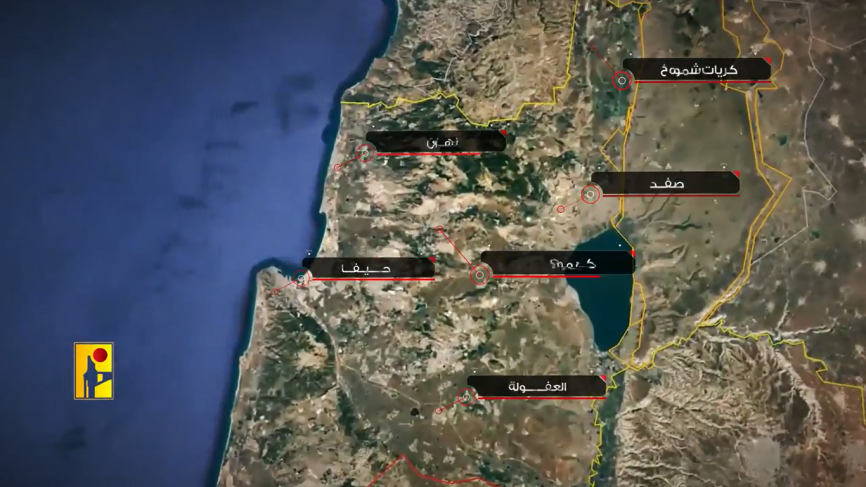
Hezbollah Military Media | June 18, 2024
The compelling 9-minute video prominently reveals aerial footage of the city of Haifa, showing the Rafael Military Industries Complex and the Haifa Port area, which includes the Haifa Military Base (the main naval base of the Israeli occupation forces), the Haifa Civil Port, the Haifa Power Station, the Haifa Airport, oil tanks, and petrochemical facilities.
The video also highlights key military assets, including the submarine unit’s command building, the Sa’ar 4.5 logistical support corvette, and the Sa’ar 5 corvette.
Earlier on Tuesday, the group’s military media promoted this episode under the title “Stay tuned… for what the hoopoe has brought back” as the American presidential envoy Amos Hochstein visits Lebanon, holding Israeli threats to the country.
Hebrew Media Panic
Israeli media commented on the footage, with the Yedioth Ahronoth Hebrew newspaper stating that “Hezbollah published an exceptional drone recording that filmed northern ‘Israel’, including Haifa Bay.”
Other Israeli media outlets raised the question: “The Air Force must provide an answer to the following query: How did X manage to reach and fly over the Israeli army’s battleships in Haifa Bay?”
The military correspondent for Israeli Channel 14 reported that “Hezbollah has released extraordinary footage from deep within “Israeli territory,” showcasing Israeli targets, including those at the Haifa port and naval base.”
“The capabilities demonstrated by Hezbollah have left a significant gap among military and security personnel,” he added.
In addition, the Israeli occupation army has requested that the defense industries develop a technological solution to better intercept Hezbollah’s drones, according to the Hebrew Yedioth Ahronoth newspaper on Monday.
The footage released by Hezbollah has dominated social media discussions, with users describing the video as “a clear message to the entire Zionist entity.” They highlighted that “hundreds of targets within occupied Palestinian lands are now under Hezbollah’s surveillance, and any reckless action by the Zionists against Lebanon will come at a high price.”
War on Gaza failed, war with Hezbollah ‘catastrophic’: Ex-Israeli Gen
Al Mayadeen | June 16, 2024
The war on Gaza has “lost its purpose” and its continuation for the past months has caused “Israel” losses on multiple fronts, Reserve Major General Yitzhak Brik underlined.
Brik has become a prominent critic of both the Israeli government and the military command’s performances, pointing to their failure in several sectors.
During an interview for 103 FM Radio, an affiliate of Israeli news outlet Maariv, Brik emphasized that the war on Gaza continues solely for the benefit of the occupation’s prime minister, Benjamin Netanyahu.
As for the ongoing operation in the southernmost city of the Gaza Strip, Rafah, the former commander said that “Israeli objectives have not been achieved in the city, as in all of Gaza.”
He noted that the Israeli military is yet to reach or discover many of the Palestinian Resistance’s strategic tunnels. Moreover, Brik described the current proceedings in Rafah as “shameful”, explaining that Israeli occupation forces are not actually fighting Palestinian Resistance fighters, rather “they [Resistance fighters] are booby-trapping the roads and we [Israeli occupation forces] are being killed.”
“We have reduced the army’s capability over 20 years to the point where it cannot defeat Hamas,” he said in reference to the Palestinian Resistance.
War with Hezbollah to be catastrophic
As for the northern front with Lebanon, Brik stressed that any decision by the current Israeli government under the leadership of Netanyahu “will bring catastrophe to Israel.”
He said that the Israeli military cannot currently intercept Hezbollah’s missiles and drones. He then went on to question what would happen in occupied territories if thousands rather than dozens of rockets, drones, and missiles were fired at Israeli positions.
The Israeli occupation is currently suffering the ails of losses on multiple fronts, as its Brigades fail to contain Hezbollah’s responses and attacks in support of Palestine. At the same time, the Israeli occupation continues to admit to increasing losses across the Gaza Strip, where it was revealed that 10 officers and soldiers were killed in the Strip on Saturday.
With no plans for the day after the war being discussed within the coalition government, Israeli military defeat, inept attempts to replace the Resistance in the Gaza Strip, and the uncertainty of success on the Northern Front Israelis have once again slipped into anti-government protests.
On the other hand, the Palestinian Resistance and supporting factions across West Asia seem more united than ever in their fight against the Israeli occupiers.
Biden’s Gaza ceasefire push is a road to fatal escalation
By Robert Inlakesh | RT | June 14, 2024
US President Joe Biden’s ceasefire push has so far led to further violence in Gaza and threatens to spill over into a war with Lebanon. Washington is either asleep at the wheel or is willing to push the entire region off a cliff in order to avoid ditching its “unconditional support” for Israel.
The speech delivered by Joe Biden on May 31, in which he presented an Israeli ceasefire proposal, urging both Hamas and the Israeli government to accept it, provided a glimpse of hope that finally the US was putting its foot down. The US President gave what seemed to be a reasonable roadmap to secure a lasting cessation of hostilities in Gaza and a prisoner exchange.
The immediate Hamas response was to view the speech “positively,” while still maintaining that it required an Israeli withdrawal of its forces from Gaza and a complete end to the war, in order to agree to any proposal. On the other hand, Israeli Prime Minister Benjamin Netanyahu, stuck with his previous rhetoric about the need to destroy Hamas, was indicating that he was not going to agree to a ceasefire.
Netanyahu took things even further by asserting that Joe Biden’s description of the Israeli ceasefire proposal was ”not accurate,” also making it clear that there would be no ceasefire until his war goals were achieved. Giving legitimacy to the Israeli PM’s assertions was an article published in The Economist that revealed details of the proposal, in which it became clear that the three-phase ceasefire would be more difficult to conclude, beyond its first phase, than Biden had let on.
Although a series of articles have been released in the Western media, including a Reuters interview with an anonymous Biden administration official, portraying the president’s actions as a bold attempt to pressure Israel to agree to its own proposal, it appears that this move is failing. As the daily death toll rises in besieged Gaza, the Israeli government continues to declare its intention to destroy Hamas, the Palestinian Party that it is supposedly about to conclude a deal with. This as US Secretary of State Antony Blinken is being sent on yet another Middle East trip to try and help conclude a ceasefire deal as the effort nears collapse.
Israel, meanwhile, continues to escalate its assault on the southernmost Gazan city of Rafah, while renewing incursions and aerial assaults throughout the strip. All of this flies in the face of the International Court of Justice (ICJ)’s recent ruling that ordered Israel to halt its military operation in Rafah. On top of this, the tit-for-tat battles that have been going on since October between Hezbollah and the Israeli military along the Lebanese border, have also escalated to what many consider to be a point of no return; making a new Israel-Lebanon war nearly inevitable.
All of this is very reminiscent of what happened before, when Hamas announced, on May 6, that it had agreed to a ceasefire proposal. The proposal was admitted to be almost identical to the one that was repeatedly lauded by Antony Blinken as a ”strong” deal during his last visit to the region.
On that same day, the Israeli military immediately launched its long-threatened offensive in southern Gaza, seizing the Rafah Crossing between the Palestinian territory and Egypt. At that time, the Israeli PM reiterated what he had been consistently saying beforehand about pursuing the destruction of Hamas and his government decided to signal their refusal to agree to the ceasefire.
Again, with the US now bringing forward Israel’s own ceasefire proposal, the predicament does not seem to have changed much. Benjamin Netanyahu is in a difficult position domestically, after failing to achieve any of his war goals in Gaza, he faces the prospect of his governing coalition collapsing if he accepts a ceasefire agreement with nothing to show for eight months of war. The Israeli people also heavily favor re-occupying the strip, with 0% of Israeli Jews polled saying they would like to see Hamas continuing to govern the besieged coastal enclave after the war.
Therefore, Netanyahu knows the political repercussions for him and others in the Israeli ruling class if he accepts a ceasefire agreement with Hamas. However, he also knows that, despite US pressure on his government to bring the war in Gaza to an end, the American government has no teeth behind its forceful statements and will indefinitely continue its “unconditional support” for Israel.
Not only that, when the International Criminal Court (ICC)’s chief prosecutor, Karim Khan, called for the issuance of arrest warrants for Netanyahu and his defense minister, Yoav Gallant, the US government threatened the court. US lawmakers immediately began to draft legislation to sanction the ICC. When the International Court of Justice (ICJ) issued its provisional rulings, as a result of the so-far successful South African genocide case against Israel, the US announced it disagreed with the conclusions.
Even though the US abstained from a United Nations Security Council (UNSC) vote that called on Israel to halt its military operations in Gaza until the end of Muslim Holy month of Ramadan, the Biden administration illogically called the resolution ”non-binding” and gave the Israelis the greenlight to violate it. American lawmakers have even just drafted legislation to condition aid to the Maldives, after that nation made an independent decision to stop Israeli citizens from entering their country due to war crimes committed in Gaza. Now the UN has added Israel to its infamous blacklist for killing Palestinian children, and the US has implemented another double-standard in continuing to provide weapons to a nation added to this list.
Despite the mountains of reports of war crimes from international human rights groups, the decisions made by the UNSC, UN general assembly, the ICC and ICJ, the United States government works to protect the Israeli government at all costs. This has to be kept in mind when we look at the American approach to implementing “red lines” with their Israeli allies, which the Biden administration still cannot find the words to actually define. Even when it comes to the invasion of Rafah, which Washington openly said would be a “disaster,” it was simultaneously preparing another military aid package worth 14 billion dollars.
Understanding all of this, Benjamin Netanyahu was still invited to Washington to address the US Congress and faced with some pressure to conclude a deal. He can rest assured that the Americans will stand by his side no matter what he chooses to do. So, if you are Netanyahu, what incentive is there to stop the war at this point? The Biden administration is filled to the brim with empty and vacuous strategies, which have led to public calls for ending the war, while privately refusing to ever hold Israel accountable.
The big problem this time around is that the continuation of the war will not only mean an escalation of the horrors in Gaza, but is heading towards a massive conflagration with Lebanon’s Hezbollah. Unlike Hamas, Hezbollah possesses the missile capabilities to respond to Israeli airstrikes with devastating effect that could lead to the deaths of hundreds, even thousands, of Israelis. Under great domestic pressure to launch an assault on Lebanese territory, Benjamin Netanyahu appears to be closer to opening a catastrophic conflict with Lebanon, instead of concluding a ceasefire and prisoner exchange with Gaza. In his eyes, a war with Lebanon could even provide the perfect lethal distraction that would enable him to negotiate a ceasefire in Gaza, but at the expense of triggering a much larger and deadlier war.
Has Israel considered a loss to Hezbollah?
By Ali Rizk | The Cradle | June 11, 2024
As the war in Gaza lags on, cross-border exchanges on the Lebanese–Israeli front have intensified. Fighting between Hezbollah and the Israeli military has taken a heavy toll on both sides. The Lebanese resistance movement has lost over 300 fighters, with Israeli shelling resulting in the displacement of tens of thousands of Lebanese residents of the country’s southern villages.
Israel has not fared much better, with at least sixty thousand northern settlers forced to flee their homes. While the occupation army has confirmed the death of around a dozen of its soldiers in the exchanges with Hezbollah, the real number is estimated to be much higher.
In March, The Cradle gained intel that over 230 Israeli troops had been killed in combat since 8 October 2023.
The rising threat of a large-scale war
While the northern conflict currently remains within the boundaries of ‘controlled escalation,’ the prospects of a full-blown war between Hezbollah and Israel may be steadily increasing. Far-right members of the Israeli government, who are key to keeping Prime Minister Benjamin Netanyahu’s governing coalition intact, have become noticeably more vocal in supporting escalation on the Lebanese front.
Finance Minister Bezalel Smotrich has called for launching an attack on Beirut, describing it as “the capital of terrorism.” Given these stances, it cannot be entirely dismissed that Netanyahu may opt to escalate against Lebanon.
Indeed, recent statements by the Israeli prime minister suggest that some form of wider escalation on the northern front may be in the making.
Speaking during a visit to the headquarters of the Israeli military’s Northern Command, Netanyahu referred to “surprising plans” being devised to deal with Hezbollah, aiming to “restore security to the north and to restore residents safely to their homes” without going into further detail.
Amid these developments, the Israeli military recently completed a drill that simulated a ground incursion into Lebanon.
A large-scale Israeli offensive on Lebanon in the near future would also be consistent with earlier assessments made by US officials, who, in late February, predicted a possible ground incursion into Lebanon by the late spring or early summer.
Hezbollah’s increasing capabilities
Hezbollah’s challenge to Israel appears to be on the rise, reflecting a failure of Tel Aviv’s current strategy of relying on precision surgical strikes. According to the Israeli institute Alma, which monitors developments on the Lebanese–Israeli front, 325 cross-border attacks were carried out by Hezbollah in May, the highest number of monthly attacks on this front since 7 October.
The resistance movement’s operations have also become more sophisticated, revealing capabilities it has introduced for the first time. Hezbollah managed to destroy an advanced surveillance balloon used to detect incoming attacks in an operation conducted via a kamikaze drone.
It has also upgraded its drone capabilities, recently launching a twin-kamikaze drone attack on the northern town of Hurfeish and conducting its first-ever air raid through an armed UAV equipped with S5 rockets. The operation targeted Israeli soldiers in the settlement of Metula and was the first time in which an Arab force had launched an airstrike on Israel.
Most recently, Hezbollah released footage on 6 June showing a guided missile attack on an Iron Dome platform in Israel’s Ramot Naftali barracks in the Galilee.
What to expect in a full-scale war
The increased sophistication of Hezbollah’s operations can also be seen as fueling Tel Aviv’s urgency to take decisive action against the resistance group. This was expressed by former Israeli war cabinet minister Benny Gantz, who described the Lebanese front as the most significant and pressing operative front in the current conflict, warning that the “moment of truth” was now close.
However, what the Lebanese movement has demonstrated since 7 October also serves as a warning of what awaits the occupation state if an all-out war were to erupt.
The Israeli military is expected to employ methods similar to 2006 in that it would carry out destructive air raids on ‘Hezbollah strongholds’ in southern Lebanon, Beirut, and the Bekaa region.
Speaking to The Cradle, retired Lebanese Brigadier General Elias Farhat explains:
There is no such thing as a limited full-scale war. A full-scale war will have to include all of Hezbollah’s strongholds.
However, any Israeli onslaught on par or exceeding what happened in 2006 is almost certainly going to be met, this time, with a much harsher response from Hezbollah.
The Lebanese movement has amassed a far larger rocket and missile arsenal, with estimates pointing to over 150,000 of these weapons now in its possession. Given this military build-up, Hezbollah is widely recognized today as the world’s heaviest armed non-state actor.
Perhaps even more importantly, its arsenal includes precision missiles such as the Fateh 110, enabling it to aim at strategic Israeli installations that could cause immense damage. Against this backdrop, Israeli experts have warned of a MAD (Mutually Assured Destruction) scenario in the event of a full-scale war with Hezbollah.
It is also possible the Lebanese movement possesses military capabilities that could undermine Israel’s air power advantage. The group has already demonstrated its air defense capability against Israeli drones, having succeeded in shooting down several ‘Hermes’ UAVs in the current round of hostilities.
The bigger danger to Israel, however, would be Hezbollah’s possession of air defenses capable of shooting down not only drones but Israeli warplanes. Given the strengthening of military ties between Russia and Iran, the possibility of Hezbollah accessing Moscow’s enhanced anti-aircraft technology is increased.
The resistance movement has already announced that it launched surface-to-air missiles at Israeli warplanes that had broken the sound barrier and had hence forced the aircraft to retreat.
This marks the first development of its kind in the history of warfare between Hezbollah and Israel and could merely be a warning shot for what could transpire in the event of an all-out war.
That Hezbollah would unveil such weapons in a full-scale conflict is consistent with its strategy of saving its best for such confrontations. In 2006, it surprised the Israeli military by striking a warship in a missile attack.
Israel would also likely face superior offensive ground operations in a full-scale war with Hezbollah. The Lebanese movement gained valuable experience in such operations while fighting extremist groups in Syria.
As Hussein Ibish of the Arab Gulf States Institute recounts to The Cradle:
“The combination of Hezbollah ground fighters and Russian air and signals intelligence dominance was the ‘A-Team’ on behalf of the Assad [government] in the Syrian war.”
Given this experience and its ability to launch airstrikes via UAVs, Hezbollah likely retains the capacity to launch offensive infantry operations – importantly, with air cover.
Manpower and tactical advantages
Hezbollah will also likely enjoy an advantage in terms of reliable, tested, and highly motivated manpower. Due to its close ties with allied resistance factions in Iraq and Yemen, fighters from these countries are likely to come to Hezbollah’s aid in a full-scale conflict with Israel.
The Lebanese movement’s Secretary General Hassan Nasrallah alluded to this factor in a 2017 speech. Israel, by contrast, appears to be suffering from a shortage of manpower in its military ranks, not to mention tanking troop and commander morale, highlighted on Sunday by yet another high-level military resignation, this time Gaza Division Commander Brigadier-General Avi Rosenfeld.
Israeli defenses are also unlikely to succeed when facing large barrages of Hezbollah missiles and drones. Unlike Iran’s retaliatory attack on 13 April, where the US and allies shot down a large fraction of the incoming drones and missiles, similar-style attacks launched by Hezbollah would be far more difficult to deal with.
The closer geographical distance means much less time to intercept and shoot down such attacks. Hezbollah, which relies heavily on the element of surprise in its military tactics, will also certainly not telegraph its attacks beforehand as Iran did. As a result, Israel would likely remain exposed to immense attacks through surface-to-surface missiles, kamikaze drones, and airstrikes via UAVs.
Moreover, the Lebanese resistance has spent many months tirelessly disabling Israel’s “eyes and ears” in the north, reportedly destroying over 1,650 pieces of intelligence, surveillance, and target acquisition (ISR) equipment since the conflict’s onset.
Israel is increasingly operating blindly in that vital northern theater, allowing Hezbollah to repeatedly and successfully strike at qualitative targets, penetrate more deeply into the occupation state, and employ more advanced weaponry.
The US response
While it is likely that the US will rush to defend its Israeli ally, the bigger question is how far it is willing to go. As indicated above, defensive measures are unlikely to significantly undermine the severity of Hezbollah’s cross-border missile and drone operations.
Judging from its approach following the Iranian attack on Israel, Washington is unlikely to go beyond defensive support. Following Operation True Promise, the White House reportedly informed Tel Aviv that it would have no part in any offensive action against Tehran, effectively leaving its Israeli ally with little choice but to settle for a far less proportionate response to Iran’s significant military operation.
Given how that situation unfolded, it would be a risky gamble for Israel to pin its hopes on its US security guarantor assuming an offensive role in a major war with Hezbollah. Tensions are also rising between the US and rival superpowers, reinforcing this dynamic.
Speaking to The Cradle, Steven Simon, Senior Director for the Middle East and North Africa in the US National Security Council during the Obama administration, emphasizes that “a direct combat role beyond air defenses (in a full-scale war between Hezbollah and Israel) is highly unlikely.” This is especially the case, he adds, “given tensions with Russia and China.”
Nawaf al-Musawi, Hezbollah’s Resource and Border Affairs official and one of the movement’s strategic thinkers, offers this prediction:
The Israeli occupation needs weapons from Washington for any war it wishes to wage against Lebanon. After any war with Lebanon, the region will not be the same as it was before. The next war with Israel will be the final war.
Hezbollah’s drones pose ‘real challenge’ to Israel air defences

Military drones at the Hezbollah memorial landmark in the hilltop bastion of Mleeta on May 22, 2020 [JOSEPH EID/AFP via Getty Images]
MEMO | June 11, 2024
Suicide drones launched by Lebanon’s Hezbollah group represent a daily threat for the Israeli air defence system, which has failed to intercept a majority of them since 8 October.
The Israeli army admitted yesterday that the drones used by Hezbollah constitute “a threat that has no magic solutions”, adding that “the response to this threat is far from being precise,” meaning the success rates of intercepting Hezbollah’s drones are far from “high”, according to a report by Israeli Army Radio.
Intercepting Hezbollah drones is more difficult than intercepting rockets and missiles, the army explained.
On Monday the Israeli army failed to intercept four drones launched by Hezbollah, which successfully reached their targets in northern Israel, exploded and caused fires.
Army Radio reported that the difficulty of intercepting Hezbollah drones is affected by several factors, most notably: the drones’ size, its travel time before reaching its target, and the terrain of the targeted sites.
The army has been working to draw lessons from drone attacks carried out in Ukraine and Saudi Arabia in order to develop additional technological means, it added.
Blind and deaf: how Israel lost the north

By Indrajit Samarajiva | indi.ca | June 5, 2024
It’s fascinatingly boring how Hezbollah has decimated Israel’s “eyes and ears.” For months, the Lebanese resistance’s videos have been methodically mundane, blowing up this communication tower, that building, that listening station.
It seemed like a bunch of nothing, but it adds up. Hezbollah had a list of Israel’s intelligence gathering posts in the north and has spent months methodically eye poking them, like Odysseus and the Cyclops. Now – however big the Israeli military might be – they’re effectively blinded.
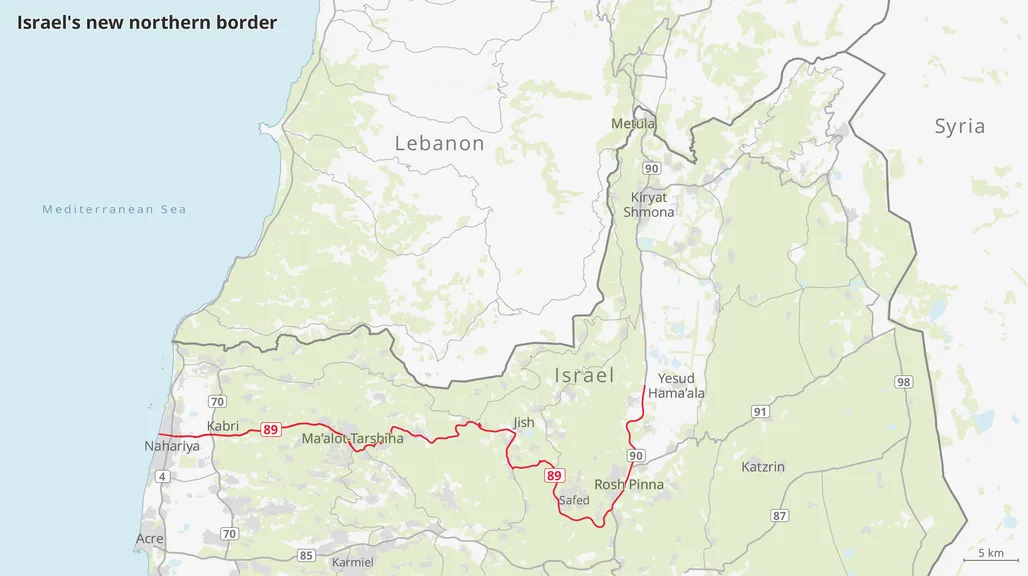
Map shows the new buffer zone in the north, as reported by Haaretz
As Hezbollah opens bigger and bigger gaps in the occupation state’s air defenses, they can fire larger missiles with more frequency into Israel, with better and deeper penetration. For Israel, this attrition is a compounding problem. Their air defenses are a connected system and the network is increasingly returning 404. Take for example, the destruction of the $230 million dollar SKYDEW blimp/spy balloon.
This balloon is designed to detect low-flying drones and missiles, especially important as this is the vector most used by the Resistance. SKYDEW can stay up much longer – and is relatively cheaper – than planes, and can ‘see’ much further than ground-based systems. It was also placed in a highly strategic area that allowed them to cover attacks from Syria, Iraq and, to a lesser degree, from Hezbollah, specifically on the port of Haifa. But now the party’s over. Look at the balloon now:

SKYDEW is now shriveled and useless – a big loss, which also signals a big breakdown. As the SKYDEW ‘Target Card‘ (from Hezbollah intelligence) says, it was “protected by an electronic monitoring and jamming system against drones and UAVs,” and “secured by three layers of missile interception systems: Iron Dome, David’s Sling, and Hetz [Arrow].” That all got sliced through like the layers of an onion, leaving Israeli defenses naked.
The northern front is porous now, as Israeli settlers know better than anybody. To quote Moshe Davidovitz, head of the Asher regional council:
“Ten rockets fell in the center of the country and the media is in an uproar — the country is in turmoil,” he wrote. “But every day dozens of rockets are fired towards the confrontation line settlements and the Galilee, including anti-tank missiles and suicide drones, and the country remains silent. Once again, it’s proof that the north is not being counted.”
Hezbollah of course, has counted the north. They have a list of Israeli military targets and they go through them one by one. Take, for example, the Mount Meron Air Surveillance Base, one of the two main bases in the occupation state. This is what a senior Israeli air force official says about the base, in a 2016 article by Maariv:
“The air control system is crucial for the operational capability of the Air Force. Its main duty is to protect the occupied airspace. Through the control system, we activate all capabilities to protect the sky, including helicopters, aircraft, missiles, and other classified systems.”
And this is what Hezbollah intelligence released, as they were bombing it:
Firstly, the Meron Air Surveillance Base is located on the summit of Mount Jarmaq [“Mount Meron”] in northern occupied Palestine, the highest peak in occupied Palestine. Meron Base is the sole center for administration, surveillance, and air control in the northern part of the usurping entity and there is no major alternative to it. It is one of two main bases in the entire usurping entity: “Meron” in the north, and the second being “Mitzpe Ramon” in the south.
The Meron Base is responsible for organizing, coordinating, and managing all air operations towards Syria, Lebanon, Turkey, Cyprus, and the northern part of the eastern basin of the Mediterranean Sea. Additionally, this base is a main center for electronic jamming operations in the aforementioned directions and is staffed by a large number of elite officers and soldiers of the zionist forces.
Secondly, the fighters of the Islamic Resistance at 07:50 AM on Saturday, January 6, 2024, as a part of the preliminary response to the crime of assassinating the great leader Sheikh Saleh Al-Arouri and his martyr brothers in the southern suburb [Dahiyeh] of Beirut, targeted the Meron Air Surveillance Base with 62 missiles of various types, inflicting direct and confirmed hits.
Hezbollah has aired its attacks on Meron Air Base in countless videos now, and they have been relentless. It can get boring because the whole thing never fireballs, but each small hit adds up. Every time a hole in Israeli air defenses opens, the hole widens, because Hezbollah is damaging complex, interconnected systems.
Today, the Meron base can barely defend itself, let alone the region. Tel Aviv has responded by assassinating Hezbollah and allied leaders, but the resistance just name missiles after those martyrs and send more.
This is a battle of attrition and Hezbollah is paying attention while Israel is mindlessly lashing out. Completely distracted by its brutal military assault on civilians in Gaza, in the south, Israel has lost the battle for the north.
After months of this boring de-administrative work, Hezbollah has finally arrived at the good stuff. The occupation state’s northern air defenses today are like a ragged old mosquito net that the dog chased the cat through. It’s full of holes, and big ones. Hezbollah can increasingly fire at will, with increasingly accurate weapons. For example, here is Hezbollah taking down a SKYSTAR 330 by drone-striking its Battalion 869 operator.

In this case, Hezbollah targeted not the spy balloon itself, but the balloon controllers, in three locations at the same time. With the operators eliminated, the balloon drifted out of control, landing in Lebanon where some kids recovered it. This is the state of Israel’s eyes and ears in the north. They’re on the ground.
Iron ‘Done’
Israel has nothing worth calling an air-defense in the north anymore. The Iron Dome is done. Hezbollah can fire at will, and has for every single day for seven months now. Iraqi Resistance missiles are flying right over them, towards Haifa. Iran can overwhelm the entire national system whenever it wants. Israel can still offend the conscience, but they’re missile defenseless now. Even Hamas is hitting them, from within traumatized Gaza. It’s open season, and the settlers know it.
Israeli settlers openly bemoan their unsettled state all over the Hebrew press. Some were so pyrrhicly incensed they threatened to secede from the entire state and form the new State of Galilee. As The Jerusalem Post has said:
The straw that broke the camel’s back was the prime minister’s answer at the cabinet meeting to a question by Benny Gantz, as reported by N12. Gantz wondered if the residents would return to their homes on September 1, for the start of the school year, and Netanyahu replied, “What’s the worst that will happen if they return a few months after September 1?”
This is of course the worst that can happen. The entire premise of Israel’s decades of grooming international actors to accept and expect bad behavior from Tel Aviv is that they can do whatever they want. If the Iron Dome doesn’t work, Israel doesn’t work, and now the Iron Dome doesn’t work. It’s the Iron Sieve now. Holy warriors have poked it full of holes.

An Iron Dome battery targeted by Hezbollah
This is a huge problem because the Iron Dome is not just Israel’s physical defense mechanism, it’s their psychological defense mechanism. It’s what makes the whole colonial project believable, that they can bully everyone in the region and suffer no consequences. Belief in the ‘Iron Dome’ is belief in ‘Israel’ and neither is believable anymore. Thus the northern Jewish settlements have emptied out and they’re not coming back anytime soon. As the Resistance News Network (RNN) said (on May 29th):
930 settler houses in northern occupied Palestine have been damaged by Hezbollah rockets in 86 settlements since October 7th, according to the zionist Ministry of War.
In Al-Manara for example, 130 out of 155 houses were destroyed. Metulla has just 34 residents left in the settlement, at most. Kiryat Shmona, one of the largest (northern) settlements, has seen its population plummet from 24,000 to under 4,000, and 124 houses have been damaged within it.
This comes as over 200,000 settlers in the north are displaced by the resistance, having built their own refugee camp. Some want to secede from “Israel” and build their own state, while others, such as the settlement of “Margaliot” have severed their ties with the entity as of yesterday.
Perplexingly, the IOF reportedly plans to significantly cut down the number of soldiers it has on the northern border and nearby settlements, citing funding reasons, or perhaps to lessen the number of targets available to Hezbollah.
Let’s look at one example of Hezbollah eliminating one target, an Iron Dome battery. They systematically do this over and over. This report describes how Hezbollah first gets the battery to reveal itself by firing rubbish at it, then hits it with drones.
The exclusive footage reveals the monitoring and reconnaissance operations that enabled Hezbollah to uncover the positions of “Iron Dome” batteries stations near the settlement of “Kfar Blum” using a tactic called “fire luring.”
The footage shows Hezbollah launching munitions toward the sites and documenting the interception process carried out by the Iron Dome, which enabled Hezbollah to execute a high-precision qualitative operation.
The scenes at 4:25 show a successful targeting of the Iron Dome batteries, without them being able to detect, track, or thwart the attack. Published photos also reveal Hezbollah’s intelligence penetration of the Israeli soldiers in these newly established sites, and their ability to document the geographical details and size of the fortifications used.
Hezbollah has done this over and over, methodically hunting and seeking Iron Dome batteries one by one. Given that the rest of their surveillance equipment is decimated and they can’t see what’s coming, Israel is forced to then draw its military assets even further from the border. Otherwise this is what happens:

This is the moment Hezbollah hits the garrison unit of Barkat Risha with an Iranian Almas top-attack ATGM [Anti-Tank Guided Missile]. ‘Unlike Hezbollah and Hamas, Israel has not spent the past 20 years tunneling underground, so their troops are all exposed without the Iron Dome. Take also, for example, the IOF’s 769th Brigade Headquarters, or what’s left of it.
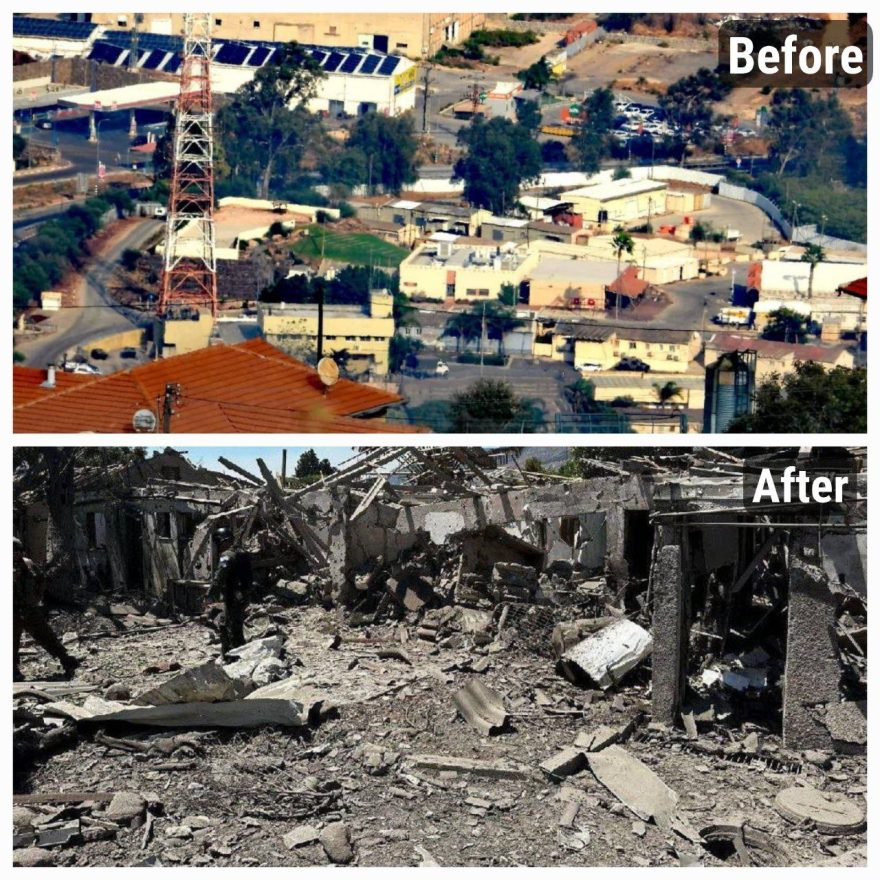
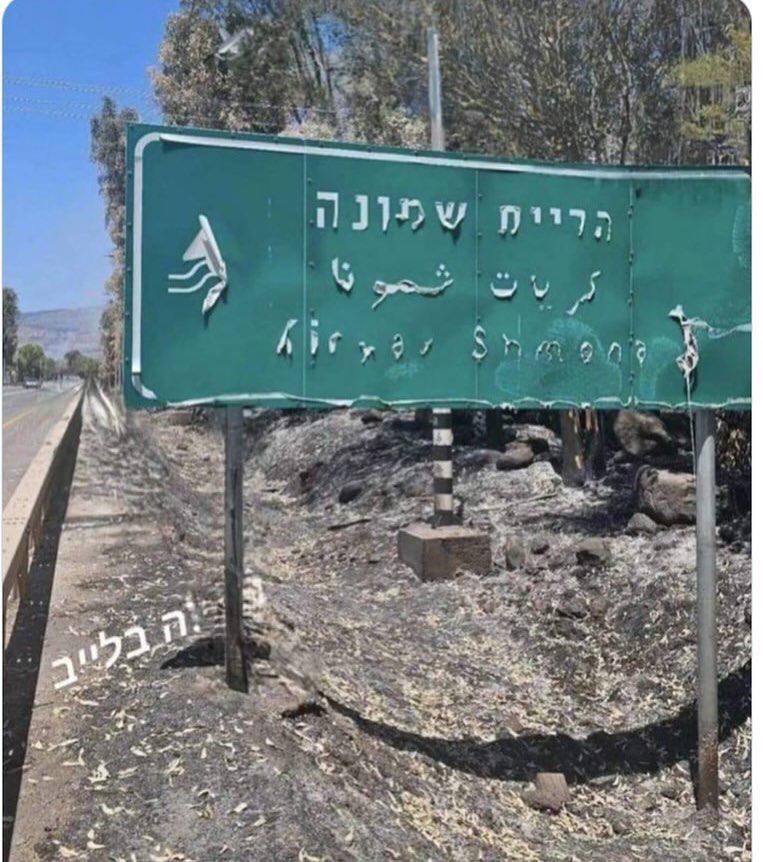
The colonial project will shrink rapidly without air defenses. When the soldiers leave, the settlers have to leave. This is not a strategic retreat, it’s strategic defeat. This is not a solution, just dissolution. But it’s all Israel can do. It hasn’t simply lost control of the north, it has lost control of the tempo of this war. Hezbollah can keep turning the heat up until Israel is cooked. Behold Kiryat Shmona (occupied al-Khalisa), which was literally in flames a few days ago:

This is directly because the Iron Dome is not intercepting drones and Hezbollah has fire control of the whole region. Hence it burns. Settlers now see a “welcome” board that has literally melted.
As Israel retreats further and further from its border with Lebanon, the collapse of the northern front also opens up the occupation state to attacks from Syria and Iraq, which can fly straight through. This is all causing massive psychological damage to Israel because the Iron Dome was their primary safety blanket.
Hezbollah has reported destroying over 1,650 pieces of intelligence, surveillance and target acquisition (ISR) equipment since 8 October, 2023. The Lebanese resistance had an actual strategy while Israel was wildly bombing ambulances and homes with no military value. Now Israel has lost northern Palestine and it’s not coming back.
Israel Can’t Win All Out War Against Lebanon’s Hezbollah: Here’s Why
By Ilya Tsukanov – Sputnik – 08.06.2024
Israel’s embattled prime minister has dropped hints that he doesn’t feel he has enough on his plate with the faltering war in Gaza and protests inside his own country demanding his resignation, threatening to expand the Gaza conflict into Lebanon against Hezbollah. A leading Lebanese political observer tells Sputnik why that’s a very bad idea.
Israel is “prepared for an extremely powerful action in the north” against Hezbollah, Prime Minister Benjamin Netanyahu warned Wednesday, citing the recent dramatic escalation of cross-border skirmishes, which have included Hezbollah drone attacks inside Israel and the shootdown of a heavy Israeli drone over Lebanese airspace last week.
“Anyone who thinks that they can harm us and that we will sit on our hands is sorely mistaken,” Netanyahu warned, speaking to media in the northern Israeli city of Kiryat Shmona, which has been evacuated of most of its civilian population amid the fighting.
“Iran is trying to choke us and encircle us and we are fighting back directly and with its proxies. We can’t accept the continuation of the situation in the north, it won’t continue. We will return the residents to their homes and bring back security,” Netanyahu assured, referencing the Iran-led Axis of Resistance alliance, which includes Hezbollah in Lebanon, Syria, Iraqi Shia militias, and Yemen’s Houthi fighters.
Israeli Army Radio reported this week that the government had approved the call-up of an additional 50,000 reservists in preparation of a possible escalation with Hezbollah. US and Middle Eastern media have braced for a full-scale all-out conflict between Israel and the Lebanese militia.
But whatever superficial similarities may appear to exist between Hezbollah and Palestinian militant group Hamas, which has managed to bog down Israel’s army using a Spartan combination of rifles, man-portable anti-tank missiles and simple rockets assembled in underground garages, political and military observers the world over agree that the Lebanese group is far, far stronger.
Hardened by years of running battles against the Israeli military and with US-sponsored terrorist proxies in Syria beginning in 2012, Hezbollah, unlike Hamas, also has access to an array of sophisticated missiles and rockets, which observers in Washington estimate to number up to 200,000 – enough to overwhelm Israel’s powerful air and missile defense network.
“Israel has threatened to start a military operation on the border with Lebanon because Hezbollah has been demonstrating growing sophistication and surprising capacities, driving Israel increasingly at unease and confusion about expectations on the northern front,” Dr. Imad Salamey, an associate professor of political science and international affairs at the Lebanese American University, told Sputnik, commenting on the rising tensions between Israel and the militia.
Israel can attack many Hezbollah targets at once and cause significant damage, but cannot remove or even dramatically reduce the militia’s capabilities, “which are widespread and mobile,” the observer noted.
“If Israel aims to seriously undermine Hezbollah, it would involve many years of operations to destroy infrastructure and weapons, push fighters out of the south, and cut off supply routes from Syria. Israel will not be able to achieve this fully,” Salamey stressed.
On top of that, the academic warned that “the threat of spillover is quite high, potentially implicating much of the Quds Brigade in Syria and Iraq, resulting in Israel fighting on multiple and wide fronts.”
That’s not the outcome Tel Aviv would hope for, according to Salamey, with Israeli officials and military leaders typically looking “for a quick military achievement with ambitious goals,” which, if that fails, prompts the IDF to resort to “collective punishment targeting civilians, which is the most likely scenario in this case.”
“The potential conflict will result in major losses on both sides without a decisive victory. However, Iran will likely emerge as a major winner, asserting its regional role in any future political settlements,” Dr. Salamey believes.
Hezbollah and Israel fought their last major war in July-August 2006, during which the IDF leveled much of Beirut’s infrastructure and caused up to $5 billion in direct war damage and lost output and income. Hezbollah emerged largely unscathed, however, with about 1,000 of its fighters facing off against between 10,000-30,000 Israeli troops in southern Lebanon, losing about 250 men while killing 121 Israeli servicemen and injuring over 1,200 others.
That conflict has been described even by Western mainstream observers as a loss for Israel, with Israel’s armed forces said to have been given a “bloody nose” and suffering reputational costs which Tel Aviv has proven unable to recover from to this day.
Hezbollah air defenses force Israeli jets to turn tail
The Cradle | June 7, 2024
Hezbollah announced in a statement on 6 June that it targeted Israeli warplanes over the south of Lebanon, forcing them to withdraw to their airspace.
The statement marked the Lebanese resistance group’s first acknowledgment that it possesses the ability to confront Israeli fighter jets, something which observers have speculated about for years.
“In support of our steadfast Palestinian people in the Gaza Strip and in support of their brave and honorable resistance, the Mujahideen of the Islamic Resistance fired air defense missiles at enemy warplanes that were attacking our skies and broke the sound barrier [sonic boom] in an attempt to terrify children, forcing them to retreat to behind the borders,” Hezbollah’s statement read.
It did not elaborate further on the air defense weaponry.
The resistance group carried out several more attacks that day, including a Burkan missile attack on Israel’s Al-Baghdadi site.
Throughout the course of this war, Hezbollah has demonstrated its ability to down advanced Israeli drones flying over the south of Lebanon to carry out attacks. Several Hermes drones, made by Israeli weapons manufacturer Elbit Systems and worth several million a piece, have been shot down by Hezbollah in recent months.
“We still do not know much about the air defense missile itself, but it will restrain the ability of Israel to fly freely over Lebanon,” retired Lebanese General Amine Hoteit told The New Arab, referring to Thursday’s Hezbollah statement.
It is likely that Hezbollah has more advanced air defense weaponry than the missile launched towards Israeli warplanes on Thursday, Hoteit added.
US media reports from early November last year claimed that Washington has intelligence that Syria agreed to send Hezbollah a Russian-made missile defense system.
Hezbollah has turned up the heat on its operations against Israeli military sites in recent days, coinciding with the continued indiscriminate bombardment of south Lebanon and increasing Israeli threats of a wide-scale war against the country. A drone attack on Wednesday killed at least one soldier and injured around ten.
It has said that while it does not want a wider war, it is prepared to fight one if it is imposed on Lebanon.
Hundreds killed by Israel in south Lebanon since 8 October
The Cradle | June 6, 2024
According to statistics published by the Lebanese Ministry of Public Health, Israeli attacks on south Lebanon have resulted in a total of 1,603 casualties, including 401 deaths, since 8 October.
The data published on the ministry’s website indicates that 87 percent of casualties were men, 96 percent were Lebanese nationals, and 57 percent were aged between 25 and 44 years.
The primary causes of these injuries are evident, with 44 percent resulting from blunt trauma, 35 percent from the blast radius of bombings, and 16 percent from chemical exposure – in many cases, white phosphorus.
The data additionally underscores a daily average of 18 casualties, five of them requiring urgent medical treatment at local hospitals, and one fatality.
According to Hezbollah’s military media, around 330 of its fighters have been killed by Israel on the battlefield. Going by the numbers reported by the Lebanese Ministry of Health, the remaining 71 deaths are those of civilians and journalists.
Additionally, the Lebanese Health Ministry reported that 94,126 residents of southern Lebanon have since been displaced.
Israeli aggression has caused significant damage to Lebanon’s forests and agricultural land.
Earlier this week, Hezbollah rockets ignited massive wildfires in the Israeli north, resulting in extensive damage to forest reserves and several hospitalizations due to smoke inhalation.
Hezbollah has been gradually escalating its daily operations against Israeli military sites and settlements since October. The movement opened a front against Israel on 8 October, one day after the start of the Hamas-led Operation Al-Aqsa Flood, in support of the Palestinian resistance factions.
Secretary-General Hassan Nasrallah and Deputy Secretary-General Naim Qassem have made it clear that Hezbollah’s operations will not stop until Israel stops its genocidal war on the Gaza Strip.
Hezbollah using Israeli Occupation Forces as testing ground for weapons: Israeli media
Al Mayadeen | June 2, 2024
Israeli media reported today, Sunday, on developments in the ongoing war on the northern front, stating that it is gradually becoming the “main front” at the moment. The reports addressed Hezbollah’s military capabilities and its handling of field developments.
The North is gradually becoming the “main front” as Hezbollah increases the scope and intensity of operations while utilizing only a fraction of its capabilities, Israeli media reported on Sunday.
The Resistance in Lebanon “has used only 5% of its weapons arsenal during these months of battle as a testing ground against the Israeli army, in preparation for a real and extensive battle,” Ynet reported, citing the occupation army.
The news website added that Hezbollah “tries every day to bypass air defense systems and derive lessons,” and that “this has become evident with the different launch angles [the Resistance] uses, the concentration of launches, and the varying amounts of explosives in each weapon fired, among other factors.”
Thus, despite the “relatively limited volume of fire compared to the quantities” Hezbollah possesses, the Resistance “is registering accurate and successful hits,” the outlet added, pointing out to the operation using the Burkan heavy rockets on Saturday targeting the 769th Brigade HQ, “Camp Gibor,” causing severe damage to the military base.
The report added that “the use of Burkan rockets has proven effective in terms of material and psychological damage,” citing its “impact due to the unusual levels of destruction caused by each of these rockets, which are known as heavy rockets and can carry up to half a ton of explosives.”
The website also noted that “in recent months, similar to updates introduced to the anti-tank Almas missile, Hezbollah has developed a new family of Burkan rockets with warheads that exceed a ton of explosives” compared to earlier versions with a maximum capacity of 500kg of explosives.
‘To be or not to be’
Israeli Reserve Major General Gershon Hacohen warned on Saturday that “Israel” is currently facing an “existential threat” from Hezbollah, with its motto being “to be or not to be,” emphasizing that the occupation entity lacks the military capability to eliminate the threat posed by the Lebanese Resistance group.
Hacohen told the Israeli Channel 14 that “Israel’s” system of concepts and lifestyles must change, warning that “tomorrow we may not be here if we do not prepare ourselves for a situation we have not witnessed before.”
The Israeli Major General explained that the Israeli military does not currently possess “the size of forces capable of decisive action against Hezbollah…”
“Lebanon is a large country and Hezbollah is spread across all its territory, even in the depths of Lebanon,” he added.
“You must understand that the Israeli army is small, and not only Haredim (ultra-Orthodox Jews) but hundreds of thousands of those exempted from service from the age of 20 to 50 must be recruited to build three or four divisions, and then we can talk,” Hacohen told the Israeli Channel 14.
His statements coincide with a new study conducted by Tel Hai Academic College in “Israel” which revealed that around 40% of Israelis who fled from the settlements in northern occupied Palestine are contemplating not returning even after the war ends.
Terror in Syria: a US distraction from Gaza
The Resistance Axis has effectively thwarted US distraction tactics in Syria meant to support Israeli interests as the war on Gaza rages on
By Khalil Nasrallah | The Cradle | May 30, 2024
Western-backed terrorist strongholds in Syria have not remained untouched by the Israeli military assault on Gaza. With the broad activation of the Axis of Resistance in support of Gaza, particularly in Lebanon, it didn’t take too long before Washington began to mobilize its extremist foot soldiers in Syria’s north.
Soon after the 7 October Al-Aqsa Flood Palestinian resistance operation – and even before the war’s trajectory became clear and Hezbollah’s intentions were understood – terrorists in Syria began to escalate their operations. Terror attacks were recorded in northern Latakia and the western Aleppo region, where Hezbollah, Iranian advisors, and the Syrian army are concentrated, as well as along the demarcation line between areas controlled by the state and those controlled by the militants.
This escalation was almost certainly not a coincidence, given the history of similar mobilizations triggered during crucial political and military events in Syria. It is well established that Washington supports terrorist armed groups in northwest Syria to keep the Syrian army and its allies in a state of attrition, serving US and Israeli interests – most notably in the eastern part of the country where the US maintains an illegal military presence.
Moreover, there are clear indications that the uptick in terrorist attacks after 7 October was linked to the war on Gaza. This strategy seems designed to distract resistance forces, particularly Hezbollah, and sends a message that escalation by resistance factions would activate other fronts to alleviate pressure on Tel Aviv.
Idlib, the main northern sanctuary for the terror militias, presents a complex front, not only militarily but also due to its political entanglements and involvement in various regional dynamics. The conditions for launching a major operation there were unfavorable before 7 October and remain unfavorable in the ongoing war.
US support for subversive activities in Syria before 7 October
Before the Hamas-led resistance operation, US efforts were focused on supporting subversive activities in Syria, explicitly backing Al-Qaeda offshoot Hayat Tahrir al-Sham (HTS) led by Abu Mohammad al-Julani.
With British intelligence assistance, Washington sought to strengthen ties with Julani following a series of operations by the Syrian government and its allies in 2020. These military offensives culminated in the recapture of the Aleppo–Damascus M5 motorway and significant territory south of Idlib.
The hostilities concluded with the 5 March ceasefire agreement between Russian President Vladimir Putin and Turkish President Recep Tayyip Erdogan during the latter’s visit to Moscow, marking a new phase in the regional conflict.
On several occasions, the US attempted to rekindle hostilities to influence Turkish–Syrian negotiations, which were sponsored by Moscow and Tehran, aiming to restore relations and reduce tensions between Ankara and Damascus.
However, these talks faced several obstacles, including Erdogan’s domestic political considerations and the challenges posed by US policies regarding the Syrian crisis.
Between 2020 and 2023, the Syrian army and its allies imposed military conditions that restricted the militants’ capabilities, preventing them from launching large-scale operations. Reports indicate that during this period, the militants focused on enhancing their drone warfare capabilities, allegedly with support from French, British, and US intelligence.
These drones were used in several attacks, most notably the 5 October 2023 assault on a graduation ceremony at a military academy in Homs, central Syria, which resulted in over 150 military personnel and civilian casualties.
Post-7 October: Shifting focus and new frontline dynamics
The impact of the terrorist attack in Homs quickly faded as the world turned its attention two days later to the Qassam Brigades storming military sites and settlements around the Gaza Strip, capturing dozens of soldiers and settlers, prompting Israel to declare a state of war. As regional powers shifted their focus to the Gaza Strip, the situation in Idlib subsequently took a different turn.
In late December, terrorists launched a large-scale attack in the western Aleppo area, reaching the 76th Regiment near Urm al-Kubra. Hezbollah and the Syrian army managed to repel the assault, inflicting heavy casualties on the terrorists, many of whom were Uyghurs from China’s Xinjiang region.
Following, several other attacks tried to exploit the broader regional conflict, particularly the tensions in southern Lebanon. These attacks were influenced by external forces and extended beyond Julani’s leadership.
The attacks continued sporadically until the beginning of February, when the Syrian army, supported by Russian forces, introduced FPV (first-person view) suicide drones into the battle. These drones, which had demonstrated high effectiveness in Ukraine, significantly hindered the terrorists’ movements along the front lines to logistical points behind them.
The ability to curb the front lines suggested that disruptive tactics Washington might employ at any stage, especially in Idlib, could be neutralized. This came after the US had agreed to a truce in eastern Syria, accepted the status quo, and made concessions to prevent its bases from being targeted. These developments indicated the Resistance Axis’ capability to manage and prepare for new challenges, maintaining regional stability despite external pressures.
The steadfastness of resistance forces in Syria
Several indicators show that despite US attempts to create distraction fronts for resistance factions, Hezbollah remains steadfast in its fight against terrorism in Syria.
Hezbollah, along with other resistance forces such as Iraqi factions and Iranian advisors, has maintained a presence that supports the ongoing confrontation. Ultimately, the Syrian army and its allies have been successful in countering US distraction tactics through significant terrorist organizations, especially in Idlib.
This success offers several insights for the future. The Resistance Axis forces had anticipated such tactics and responded effectively, adapting to the circumstances of each stage. The American–Israeli reliance on terrorism to alter realities on support fronts has proven to be an unrealistic and losing strategy.
The outcomes of the current conflict may create political conditions favorable for a wide-scale military operation in Idlib in the future. Additionally, resistance forces are not isolated in their efforts to counter terrorist fronts, with Russian involvement playing a significant role that cannot be overlooked.
Featured Video

Alon Mizrahi: ‘Israel Must Be Dismantled’
or go to
Aletho News Archives – Video-Images
From the Archives
Allies Don’t Need Lobbies
By Jay Knott | Dissident Voice | September 24, 2013
In a recent article on Counterpunch, Rob Urie defended the traditional Marxist analysis of US policy in the Middle East. He argues that support for Israel is driven primarily by economic interest, not the Jewish lobby.
He starts by paying tribute to the idea that Western societies are uniquely racist. He says that the “Western narrative” claims there is an “Arab character”, and that this is “antique racist blather”. He gives no definition of these terms. Further, he establishes his credentials as part of the dominant current in the American left by claiming that “over a million people in Iraq died so ‘we’ in the West can drive SUVs.”1
When he tries to criticize bourgeois economics, he makes it clear he doesn’t understand the developments it has made since Marx’s day, using the mathematical discipline known as “game theory”. He dismisses the basic abstraction of economic theory, the idea of the rational individual, on the grounds that it is “devoid of history, culture and political context”. But abstractions are always devoid of something.
He defends a more concrete economic theory, mostly Marxist, with some input from another theorist of capitalist crisis, Hyman Minsky. This concrete theory leads him to the view that US activity in the Middle East is primarily driven by rational capitalist motives, the need to secure a supply of oil.
“Taking the totality of circumstance — former oil company executives launching war on an oil rich nation on a pretext they publicly proclaimed they didn’t believe shortly before taking office — and that upon launching their war proved to be non-existent, requires a willingness to overlook the obvious — that the war on Iraq was for oil, that is difficult to support.”1
Perhaps I’ve misunderstood him, but based on what he says in the rest of the article, this convoluted sentence seems to argue that, because president Bush and vice-president Cheney attacked Iraq on false premises, and they also said it was all about oil, and they are former oil executives, and Iraq has a lot of oil, it’s difficult to deny US attacks on Iraq are all about oil.
In fact, it’s not hard at all. As Urie points out, at times Bush and co. said that attacking Iraq was “protecting the world’s supply of oil.”1 But, as he also points out, they are congenital liars. Why should we believe them when they say they are trying to “protect” the oil supply? Protect it against what? When politicians “admit” attacks on Middle Eastern countries are wars for oil, they are parroting the neo-con party line, feeding the public, both left and right, with a plausible-sounding pretext. For right-wingers, “it’s a war for oil” is a reason to support war, and for leftists, it’s a way to feel better by complaining impotently about corporate greed. Both approaches help the war drive. … continue
Blog Roll
 Aletho News
- Turkish tanker blacklisted by Ukraine hit in drone attack – media
- Canada, the U.S., and NATO: the inescapable trap
- Villains of Judea: Leonid Radvinsky
- Alon Mizrahi: ‘Israel Must Be Dismantled’
- Former Head Of MI6 Admits That The U.S. And Israel Are Losing The Iran War
- Scattered Thoughts on War and Peace
- Iran Threatens to Close Red Sea to Shipping in Response to Invasion
- Iran in excellent position to prevail in war with US, Israel: John Mearsheimer
- Iran warns US: Do not call your retreat an agreement
- Neighbors first – Moscow signals shift in energy strategy
- If Americans Knew
- In the West Bank, life is a constant battle – 3 articles
- Jacob Reses, one of the most powerful pro-Israel operatives in Trump’s Washington
- Israeli-US assaults kill or injure 87 children a day – Not a ceasefire Day 166
- ‘Forever live by the sword’: Understanding Israelis’ massive support for Iran war
- UN’s special rapporteur on human rights says Israel is systematically torturing Palestinians
- Trump White House plagiarized Iran war manifesto from Israel-aligned think tank
- Gaza says 6–10 patients die daily waiting for treatment abroad as Israel blocks medical evacuations
- ‘Substantial evidence’ of double-tap strike in killing of Gaza’s Hind Rajab
- ‘Do Not Want To Die For Israel’: Doubts About Trump’s Iran Strategy Spread Among Troops
- Instead of taking Joe Kent’s claims seriously, the media is disregarding him as an antisemite
- No Tricks Zone
- Devastating Assessment Of Comirnaty Vaccine By Former Senior Pfizer Europe Toxicologist
- New Study: CO2 Is ‘Effectively Negligible’ As An Explanatory Climate Change Factor Since 2000
- Former Pfizer Toxicologist Dr. Helmut Sterz Tells Bundestag Hearing Pfizer Vaccine Should Have Never Been Approved
- Energy Expert: Germany’s Nuclear Phaseout Was A “500 Billion Euro Mistake”
- New Research: South Australia’s Mid-Holocene Sea Surface Temperatures Were 4°C Warmer Than Today
- Storing Green Energy To Last Germany 10 Days Would Require A 60-Million Tonne Battery
- New Studies: UK Sea Levels Were 4 Meters Higher Than Today During The Mid-Holocene
- Destructive Green New Deal: German Energy And Metal Group Warns Of Drastic Crisis
- New Study Documents A 20-Year Pause In Arctic Sea Ice Decline – Driven By Internal Variability
- Wake-up Call: Survey Shows Majority Of Germans Now Favor Postponing Climate Targets!
 Aletho News