Hezbollah Media Refutes Netanyahu’s Claims about Missile Depot, Opens Site Shortly after His Remarks
Al-Manar | September 29, 2020
Hezbollah Media Relations Department has issued a statement in which it invited media outlets to inspect the Beirut site falsely claimed by Zionist PM Benjamin Netanyahu as a missile Depot.
A large number of cameramen and reporters gathered near the alleged site around two hours after Netanyahu’s remarks in the context of the step organized by Hezbollah to refute the Zionist claims in light of the critical political conditions in Lebanon.
Head of Hezbollah Media Relations Department, Hajj Mohammad Afif, stressed that today’s tour aims at proving that Netanyahu’s story is wrong, adding that the Resistance is not concerned with exposing every site claimed by the Zionist enemy as a missile depot.
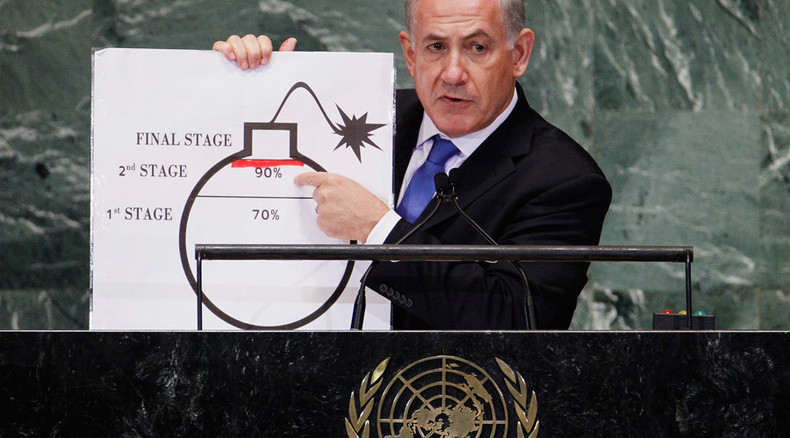
Netanyahu had alleged that Hezbollah stores missiles at a depot in a residential area in Jinah, adding that it lies near a gas facility and that its explosion will be similar to that of Beirut port.
The Israeli intelligence command has prepared a plan to provoke the Lebanese against Hezbollah by weaponry by unveiling maps of its locations in Lebanon and launching a propaganda that promotes its threat in light of the Beirut Port explosion, Al-Manar English Website reported on August 25, 2020.
Hezbollah Secretary General Sayyed Hasan Nasrallah announced the invitation during his televised speech, highlighting that it would be shortly after Netanyahu’s remarks so that the inspection will be very credible.
The following video shows the iron factory full of the media reporters shortly after Netanyahu’s remarks… continue to Al-Manar for video tour
Lebanon hits back at Israel, defends Hezbollah at UN Human Rights Council session
Press TV | September 29, 2020
Beirut has strongly reacted to the Israeli envoy’s interventionist remarks against Hezbollah at a UN Human Rights Council session, describing the resistance movement as an “inseparable part” of Lebanon and slamming the regime’s history of rights violations in Lebanon and other Arab states.
The Lebanese Ministry of Foreign Affairs and Emigrants issued a statement on Monday in condemnation of the comments by Merav Marks, the legal counselor to the Israeli mission to the UN and international organizations in Geneva, who had attacked the Hezbollah resistance movement for its role in Lebanon during a general debate at the 45th session of the UN Human Rights Council.
The Israeli envoy accused the UN Human Rights Council of not dealing with what she called Hezbollah’s efforts to hamper the mandate of the United Nations Interim Force in Lebanon (UNIFIL) and attempts to manipulate the Lebanese government.
In its statement, the ministry said Lebanon’s Permanent Mission to the UN and other International Organizations in Geneva exercised its “right to respond to the Israeli enemy’s envoy, as has been the case whenever there is an attack on Lebanon and its right to resistance.”
The ministry then described Israel as “an occupation force armed with sophisticated weapons and in possession of a nuclear arsenal, with which it threatens its neighbors.”
Israel” has a history of flagrant human rights violations and international crimes in Lebanon and in other Arab lands that it has occupied. The international community should one day fulfill its duty to prosecute the perpetrators… Today we are marking the 38th anniversary of the Sabra and Shatila massacre, one of the ugliest crimes against humanity in modern history,” the statement pointed out.
“Lebanon stresses its right to resistance to liberate its land and defend its sovereignty,” the ministry said, underlining that Hezbollah resistance movement is “an inseparable part” of Lebanon.
The ministry also lashed out at the Israeli envoy over her remarks regarding last month’s deadly Beirut port explosion, which killed some 200 people, wounded thousands more and ravaged buildings in surrounding residential neighborhoods.
The Israeli envoy had tried to link Hezbollah to the blast, claiming the movement was putting the interests of Iran before that of its own nation, and that the explosion “is a clear demonstration of that.”
The Lebanese Foreign Ministry said in response that “the Occupation (Israeli) force has sought to put itself in the position of the Lebanese judicial authority in the issue of the port blast, in which investigations have not yet been completed.”
“The hypothesis of a foreign plot should not be ruled out, and in this case, this (Israeli) force will be the main suspect,” it added.
The explosion has been followed by other upheavals in the country, including thousands-strong rallies and the resignation of the entire government of former prime minister Hasan Diab.
Hezbollah has called for accountability for the explosion, while strongly urging countrywide unity and integrity.
Wary of Hezbollah’s power in defending Lebanon, the Israeli regime and its allies have been doing all in their power — from sanctions to targeted killings — to undermine the movement’s political and military influence in the Arab country.
The regime has, in recent months, stepped up its violations of Lebanese airspace in spying missions on southern Lebanon, where Hezbollah is mainly based, drawing condemnations from Beirut, Hezbollah and the UN Interim Force in Lebanon (UNIFIL).
The resistance movement was established following the 1982 Israeli invasion and occupation of southern Lebanon. Since then, the movement has grown into a powerful military force, dealing repeated blows to the Israeli military, including during a 33-day war in July 2006.
Lebanese PM-designate steps down amid political turmoil
Press TV – September 26, 2020
Lebanon’s Prime Minister-designate Mustapha Adib has announced his resignation amid a deadlock over government formation in the crisis-hit country.
In a televised address on Saturday, Adib said he was stepping down from “the task of forming the government” following a meeting with Lebanese President Michel Aoun.
He also noted that the kind of cabinet that he wanted to establish “was bound to fail” and that he was keen on protecting national unity.
“I apologize to the Lebanese people,” he added.
The announcement came almost a month after Adib, former Lebanese ambassador to Berlin, was appointed by the president to form a new government.
Lebanon is currently mired in the country’s worst economic and financial crisis in its modern history.
It has been waiting for a new administration since outgoing Prime Minister Hassan Diab resigned on August 10, a few days after a powerful explosion in the capital killed more than nearly 200 people, injured thousands and caused losses worth billions of dollars.
The blast took place in Beirut port warehouses storing highly explosive material, specifically ammonium nitrate, commonly used in both fertilizer and bombs.
The explosion — one of the biggest non-nuclear explosions the world has ever seen — flattened much of the strategic port and left buildings in ruin.
Following the blast, the US and European countries have been mounting pressure on Lebanese officials to form a government that secures the West’s interests.
The United States on September 8 slapped sanctions on two former cabinet ministers in Lebanon over support for Hezbollah as it vowed to isolate the resistance movement.
French President Emmanuel Macron paid two visits to Lebanon, where he called for a “new political pact” among Lebanese political factions and said he had proposed a roadmap to authorities to unlock billions of dollars in funds from the international community.
In a meeting with Aoun, Macron threatened Lebanese leaders with sanctions if they do not submit to reforms and a “political change,” Lebanon’s Arabic-language al-Mayadeen television news network reported.
The French president’s colonial-style sojourn sparked a swift backlash among the Lebanese nation.
Many Twitter users denounced what they deemed as interference in the internal affairs of Lebanon, which gained independence from the French colonial rule more than seven decades ago.
France says no ‘tangible’ evidence supporting US allegation of secret Hezbollah explosive stores
RT | September 19, 2020
France has pushed back against Washington’s assertion that Hezbollah has stockpiles of ammonium nitrate stashed around Europe, stating there’s no indication of such stores existing in its own country.
“To our knowledge, there is nothing tangible to confirm such an allegation in France today,” French Foreign Ministry spokeswoman Agnes von der Muhll said in response to the US State Department’s alarming claim.
The spokeswoman stressed that France would not allow such “illegal activity” on its territory and that it would respond to such actions with “the greatest firmness.”
On Thursday, Nathan Sales, the US State Department’s coordinator for counterterrorism, alleged that Lebanon’s Hezbollah had caches of dangerous chemicals in France, Spain, Italy, and other European states. He said that the chemicals had been smuggled into the country hidden in first-aid kits, but did not provide evidence backing his incendiary accusation.
Hezbollah is creating stockpiles of chemicals so that “it can conduct major terrorist attacks” at the bidding of Tehran, which backs the group, Sales claimed. He alleged that the stores include ammonium nitrate, an industrial chemical linked to the massive explosion that destroyed much of Beirut, Lebanon last month. It’s believed that the blast was triggered by the unsafe storage of the substance.
The United States has designated Hezbollah as a terrorist organization, but its elected arm is considered a legitimate political organization by France.
Washington recently announced sanctions on two Lebanon-based companies, accusing the companies of being “owned, controlled, or directed by Hezbollah.”
US Fails to Control Lebanon Because Hezbollah, Amal ‘Represent the Majority’ – Journalist
Sputnik – 10.09.2020
While US officials claim that their recent sanctioning of former Lebanese government ministers was designed to expose the corruption of the country’s politicians, one expert tells Sputnik that Washington’s recent action is nothing more than a continuation of a longstanding, but unsuccessful, Western campaign to control Lebanon.
US Assistant Secretary of State for Near Eastern Affairs David Schenke declared on Tuesday that political allies of Hezbollah will have to “choose between bullets and ballots,” as they stand to be held “accountable for any enabling of [Hezbollah’s] terrorist and illicit activities,” Arab News reported.
This came amid the two-day Lebanon leg of Schenke’s tour of the Middle East, which also included stops in Qatar and Kuwait.
That same day, the US Department of the Treasury’s Office of Foreign Assets Control sanctioned former Lebanese Minister of Transportation and Public Works Yusuf Finyanus and former Lebanese Minister of Finance Ali Hassan Khalil, who Washington claims “provided material support to [Hezbollah] and engaged in corruption.”
Laith Marouf, an award-winning multimedia producer as well as a media policy and law consultant with the Community Media Advocacy Center, joined Radio Sputnik’s By Any Means Necessary on Wednesday and told hosts Sean Blackmon and Jacquie Luqman that what is occurring right now is a continuation of “twenty-some” years of attempts by Washington and “imperial forces” to control Lebanon’s government.
Marouf explained that Khalil is a member of the Amal Movement, which is “allied with Hezbollah,” and Finyanus is aligned with the Christian Marada party of Suleiman Frangieh. These parties are “allied with the sovereigntist movements in Lebanon,” which virtually means they “represent the majority of the [country’s] population.”
Because of this, he asserted, the US’ attempts to gain control have been unsuccessful. “The majority of the Lebanese have lived [through] the crises,” he said, referring to a “cycle” of Western military aggression and sanctions that has occurred in the years following the Lebanese Civil War.
“There’s not going to be a change in the population demographics without a major, major war,” he argued.
Hezbollah vs Israel 2006: Who has upper hand 14 years on?
Middle East Observer | August 14, 2020
Senior Lebanese political analyst Nasser Qandil explores what has changed between Hezbollah and Israel over the last 14 years since the ‘July War’ or ‘The Second Lebanon War’ in 2006.
After tracing the major changes and transformations in the military balance of power between the two sides over the last 14 years, Qandil then explores the current challenges facing Hezbollah inside Lebanon, particularly regarding the deepening economic and political crises in the country.
Note: we have added our own sub-headings in the below transcript to make for easier reading
Source: Al Mayadeen News
Date: July 12, 2020
Transcript:
Hezbollah 14 years on from the July War
Nasser Qandil:
Actually, regarding (Hezbollah’s) achievement of liberation (in the year 2000) free from any conditions or negotiations, any analyst can figure out that after the year 2000, the region was involved in a race between the Resistance and (Israeli) Army of occupation in which both (sides) tried to reinforce the reality that they wanted to reflect on May 24, 2000 (i.e. just before the liberation).
Israel wanted to say that it has positioned itself on the borders with the purpose of protecting the interior (of Israel); that the era of (the war of) attrition has ended; and that it is moving into a stage where it is able to direct (its) deterrent capacity at will. In contrast, the Resistance wanted to say that Israel has humiliatingly and forcefully withdrawn (from Lebanon); and that this withdrawal is not only the beginning of a countdown of the (Israeli) entity’s capacity to hold onto (occupied) land, but also (its capacity) to go to any (new) war again as well.
Israel’s withdrawal from Gaza in 2005 and the Al Aqsa Uprising (“Al Aqsa Intifada”) certified what the Resistance was saying. (Israel’s) 2006 war on Lebanon was the contest that had to settle the previous contests and the (side) who wins this round, cements what it has said. Israel has worked on a plan, theory, mechanisms and appraisals, that is, it didn’t go haphazardly to war (in 2006). In short, Israel counted on “air warfare” theory and put it into practice in the (2006) war. However, the Resistance was aware of that, so it opted to strengthen its power on land, in order to cancel out the theory of air warfare, and to bring the enemy to the land to fight, engage in (battles) of attrition, and (ultimately) defeat it.
The Resistance was the victor. This was the outcome (of the war), because when we talk about ‘victory’ we are not referring to the historic and final defeat. Rather, we are just discussing this war (in 2006) in which the Resistance achieved victory and Israel was defeated again. As in the Lebanon war of the year 2000, or (more accurately) as reflected by the liberation in the (year) 2000, Israel lost its first pillar, that is, its ability to occupy (Lebanon) and remain in it. It also lost its second pillar in the 2006 war, which is its ability to wage war and achieve the goals (that it sets) as it wills.
After the 2006 war, the issue (between both sides) persisted. They entered a totally new and different race. The entity of the (Israeli) occupation is fighting to restore its honor and rehabilitate its image, whereas the Resistance is fighting the battle of becoming a regional power able to make the deterrence weapon (itself as) the policymaker. Since the year 2006, America put its weight behind (Israel’s goals) since Israel is not able to survive any longer without American protection and support. America went to Iraq after realizing that Israel superiority is (gradually) being eroded, and that it is important to rehabilitate its power and control through the American military presence to compensate for the deficiency in Israel’s ability that came about after Lebanon’s liberation in the year 2000 and the Al Aqsa intifada.
Host:
We all remember Condoleezza Rice and the ‘New Middle East Project’.
Nasser Qandil:
Exactly, and this was at the heart of the 2006 war. However, before this (war), America went to Iraq in order to redress the imbalance occurred after Lebanon’s liberation in 2000 and the Al Aqsa intifada, but they failed. The “July War” (2006) came as a second rehabilitation supported by American pressure, calculations and backing. It was a new failure that was added to the accumulated record of failures.
The only available alternative (choice) then was going to a great war, i.e. to topple Syria. This was like Armageddon. Nevertheless, other different battles, the Yemen war and the battle over the future of Iraq, occurred alongside the war (in Syria). They were no less important than the (war in Syria). Today, 14 years after the July War (in 2006), we can talk about facts and not about general trends only. The resistance (movements) transformed from being a resistance force into an Axis of Resistance. This becomes a fact; it is not just words. Today, when his eminence Sayyed (Hassan Nasrallah) speaks and says “I will kill you” – we’ll discuss this later – this (statement) reflects the (powerful reality) of the Axis of Resistance, from Beirut, to Palestine, to Iraq, to Yemen, to Iran and to Syria. This is the first major transformation that occurred between the years 2006 to 2020 during the heat of the several wars that raged over the map of the region.
The second (major transformation during these years): the ‘missile belt’ is now able to strike – from any point (within the Axis of Resistance) – any target in occupied Palestine (i.e. Israel). This means that as the resistance in Palestine is able to target all (areas of Israel) north of Gaza, the resistance in south Lebanon can target the entire (area of Israel) south (of Lebanon); the resistance from Iraq is even able to reach the (Mediterranean) sea; the resistance in Yemen can cover the whole territory of Palestine; and that’s besides (the missiles capabilities of) Syria and Iran.
The Host:
The entire Israeli intelligence efforts have lately been centered on the missile capabilities of the resistance.
Nasser Qandil:
This ‘(missile) belt’ has been completed; it is not a subject of discussion anymore.
The third (major) development is the entrance of the drones (UAVs). The use of this weapon is not restricted to the Lebanese front line. Israel has evidence that confirms that. How many times were drones sent by the resistance from Lebanon? How many times were the Israelis lost because they failed to track the drones sent from Gaza? (Further evidence lies in) the drones in Yemen, and the achievement of the Aramco attack (in Saudi Arabia) that the godfather of the Dimona (Israeli nuclear program) and Thomas Friedman wrote about it an important article in the New York Times. The article states that what happened in Aramco (can be) repeated on all American military bases in the Middle East, and can be repeated (in a strike) on Dimona. Moreover, one of the Israeli generals quoted by Thomas Friedman during a telephone conversation says that it seems that we must now relinquish the status of being the number one technicians in the Middle East, (and cede that status) to Hezbollah and its allies, and (we ought to) call upon our people to carry hand rifles in any coming wars in which drones are used. Henceforth, the third factor is the drones.
The fourth (major) new factor is the precision-guided missiles which formed the center of the struggle during the last two or three years of the Syrian war. The Israeli (air) raids which initially aimed at stopping the supply of weapons to the resistance (from Syria to Lebanon) turned into a specific goal (during these years) which became ‘preventing the resistance from the possibility of transforming their missiles into precision-guided ones’. Today, the Israelis speak about precision-guided missile factories and this signifies that they have surrendered to this fact.
The last issue we are ignorant of was revealed by the video published (recently) by (Hezbollah’s) military media which says “Mission accomplished”. Certainly, it is not referring to the precision-guided missiles because his eminence Sayyed (Hassan Nasrallah) has already announced clearly and publicly that ‘yes, we have enough precision-guided missiles to hit any vital Israeli military installation in occupied Palestine’. But we still don’t know what is meant by “Mission accomplished”. This will stay one of the resistance’s surprises in the coming wars.
Israel 14 years on from the July War
Nasser Qandil:
What have Israel and America achieved in return? Their situation now is similar to that in the July War (2006); they go to war today on one foot only. It was the air force in (the) July (War) that they relied upon, and it is the financial sanctions (that they rely upon) today. Did the Resistance succeed in breaking this foot? I say “Yes, and we will expand on this discussion later.
Host:
We will continue discussing why the resistance succeeded…
Nasser Qandil:
In the first section we talked about the progress achieved by the resistance (Hezbollah) from 2006 to 2020. Israel also worked (on building its power) during these 14 years. Let us see what it did.
Host: … and of course (Israel) was given a green light by the US.
Nasser Qandil:
First of all, Israel focused on the home front. Its main aim was not to draw up a plan to seize the initiative, but to face the fallout of the July War. The resistance (Hezbollah) has risen higher and higher in its level of readiness, its networking capabilities (i.e. greater integration of the Resistance Axis across the region), and its ability to wage war. Meanwhile, what did the (Israeli) entity do?
(First), the Iron Dome that (Israel) was preparing (in order to intercept) Katyusha missiles is now threatened by precision-guided missiles and drones. (The Israelis) went back to saying that they will shoot down missiles with hunting rifles!
(Second), the (Israeli) home front has further collapsed, and now in the time of Corona, it is even worse.
Third, political fragmentation, which is one of the repercussions of the July War. Since the July War, the (Israeli) entity has been mired in its inability to reestablish a historical (political) bloc capable of leading the entity politically. This fragmentation reached its peak with three (consecutive) repeats of the election.
The last point that (Israel) has discovered (over the last 14 years) is that there is no solution to is broken spirit, because we are not only talking about equipment, armies, weapons and logistical plans, we are talking about human beings, about their mental condition. The resistance (Hezbollah) is now becoming more and more confident that it can bring down the (Israeli) entity. When his eminence Sayyed (Nasrallah) comes out and says in one of his recent appearances that there is a real possibility that the (Israeli) entity will collapse without war, and that this generation is going to witness the liberation of Jerusalem… On the other hand, we find the (Israeli) entity in a state of frustration. No matter how many (Israeli) generals say “We will win. Victory is ours in the coming war. We are waiting for the right opportunity to wage war”… what are you (Israelis) waiting for? You and the Americans said: “Time is not in our favor. Yesterday’s war is better than a war today, and a war today is better than a war tomorrow.”
Host:
Who is going to achieve Israel’s goals today? Who is the principal agent? The US? Because, as you said in one of your articles, Sayyed Nasrallah’s recent speech on 7/7/2020, presents the most vivid example of the (resistance’s) ability to defeat the Israeli occupation and American hegemony. But how is he (Nasrallah) able today to combine this (military) resistance with economic resistance?
Nasser Qandil:
What I want to get to is that in one of his appearances, his eminence Sayyed Nasrallah cut to the chase and said: “The resistance (Hezbollah) has already overtaken Israel. Israel is still standing thanks to US protection.” In 1996, the Resistance discovered – and this was the secret behind the liberation in the year 2000 – that the Israelis remained (in Lebanon) because they were under the illusion that the border buffer zone (that Israel established within Lebanese territory) protects the (Israeli) entity from the missiles of the resistance. So if (Israel) realizes that the border (buffer zone) is pointless and that the entity will be targeted no matter what, it will withdraw. And this is what happened (in the year 2000).
Today, his eminence Sayyed (Nasrallah) tells us that the resistance is certain that the (Israeli) entity continues to survive only because of the American presence (in the region), and that the decisive battle with the entity is a battle to expel the Americans from the region.
Whoever analyses the (American) sanctions and the logic behind them will discover that they are not aimed at escalating the situation such that it provokes a full-scale confrontation. This is nothing but propaganda. In fact, these sanctions have direct political goals. I mean, (Lebanese) parties affiliated to the US (in Lebanon) are proposing (very high demands such as) the disarmament (of Hezbollah) and the implementation of Resolution 1559 because this is the American approach. Just as they (Americans) did in 1983 with (Lebanese) President Amine Gemayel when they told him that they were (about to attack) Syria at the same time in which they were engaged in negotiations with (Syria). Two months later, McFarlane) the special US envoy to the Middle East) was asked: “why did you back out (of the attack)? You would have put (Gemayel) in big trouble.” McFarlane answered: “if we told (Gemayel) that we were (negotiating) with Damascus, he would have beat us to it. We trick our allies to make them think that we are escalating for the sake of imposing stronger terms in the negotiations.”
What do Americans want from the Caesar Act? Why are the Americans putting pressure on Lebanon, blocking access to US dollars in the (Lebanese) market, preventing the transfer of dollars to the country, and closing lines of credit – via the Central Bank of Lebanon’s accounts -for the purchase of fuel? What do they want? The Americans are not hiding (their intentions). They told us what they want. James Jeffrey (US Special Representative for Syria Engagement) told us. Why the Caesar Act? He said in the live appearance he made in which he spoke about the Act. He said ‘we wish to go back to (the balance of power) that existed before 2011. What does he mean by “before 2011”? He means the time when “we (Americans) will acknowledge the victory of President Assad. We were not present (in Syria before 2011), but Hezbollah and Iran were not there either. We leave (Syria), but (Hezbollah and Iran must) leave too.”
So he (Jeffrey) wants to ensure the security of the (Israeli) occupying entity in southern Syria by hinting at sanctions against Russia as the main target of the Caesar Act. Syria will be hit by sanctions anyway and Iran is drowning in a sea of sanctions. Therefore, these sanctions are actually against Russia. The Caesar Act was introduced originally at the beginning of 2016 in order to reach a compromise with Russia in relation to the battle in Aleppo. However, (the Caesar Act) now aims at reaching an agreement with Russia over the terms of the withdrawal of US forces from Syria and is not aimed at (prolonging) their stay.
Second, regarding Lebanon, David Schenker (US Assistant Secretary of State for Near Eastern Affairs) publicly appeared on TV and said that Hezbollah is involved in ‘corruption, smuggling, money laundering, causing devastation, and that it is the cause of the crisis (in Lebanon)’ etc. Give it to me directly (Schenker), what do you want? He (Schenker) told us directly that “you are suffering greatly (due to the economic crisis). You have promising gas reserves in the (Mediterranean) sea, but they are in a region that is the subject of a dispute with Israel. We (the US) presented you with a plan, so accept it! So the US wants an exit strategy that provides the (Israeli) occupying entity with a security belt on the Syrian and the Lebanese fronts, and (the US seeks to achieve this) by exerting “maximum pressure on the resistance”.
———
Nasser Qandil:
This is the third pillar of the power of the Resistance. The first pillar is military capability. The second pillar is the political front, meaning the Axis of Resistance. The third pillar is economic reconstruction. Without a resistance economy, the resistance cannot speak of an ability to maintain a level of cohesion within its support base and environment. What I want to say here is that the measures and steps taken by the resistance are not new. It is not true that the resistance, being under pressure at the moment, is now discovering or searching (for solutions). This was in fact its original program. Its original program was and is ‘Openness to the East’, that (Lebanon) have multiple sources (for economic, financial, and political relations). Its original program is aimed at breaking the borders (created by) Sykes-Picot between the countries of the region to form a single (economic) market. Its original program is aimed at relying on industry, agriculture and the national currency for exchange with neighboring countries and where possible. This is the original plan of the resistance. But this plan is now being put into action. It is not a negotiating weapon to lure Americans into easing conditions. If the Americans want to cooperate they are welcome, but if they don’t we will proceed (with this plan). Either way, this plan is not subject to review. Industry and agriculture are objective needs (of Lebanon).
In terms of industry and agriculture, Lebanon … Lebanon, by the way – in the year 1960, the Iraqi market was running 60% of the Port of Beirut and 30% of Lebanese industrial production. Today, Lebanon, which used to export milk, cheese, juice, clothing and shoes to the Gulf, imports 200 million dollars worth of milk and cheese only! Thus, the revival of the agricultural and manufacturing sectors, which were destroyed by the rentier economy, was and is the original plan. We are not talking about a knee-jerk reaction.
Host:
Has the goal (behind the sanctions) become counter-productive? Because the Lebanese internal consensus over the economic resistance that Sayyed Nasrallah called for was remarkable. I want you to comment briefly because we exceeded the time allocated for this file. The Patriarch (Bechara Boutros) al-Rahi said today: “The Lebanese people today do not want any majority (group in Lebanon) to tamper with the constitution and to keep them away from (Lebanon’s) brothers and friends.” This is noteworthy as well Mr. Nasser, is it not?
Nasser Qandil:
The truth is, the speech of his Beatitude (al- Rahi), at certain points, was vague and unclear. It seemed like he was targeting the resistance by talking about neutrality and keeping Lebanon out of conflicts. However, today there may be another direction. I think the Lebanese people know that when we talk about buying oil products in Lebanese pounds… if you don’t want to buy them from Iran, then buy them from Saudi Arabia. Aren’t you friends with Saudi Arabia and the UAE? Let these countries sell us oil products in Lebanese pounds. Half of the demand for dollars in the Lebanese market is because of oil imports. We are depleting the reserves of the Central Bank of Lebanon. They will last us for five years instead of ten if we keep using them for oil imports.
His eminence Sayyed Nasrallah announced that Iran is ready to help, and since oil imports are consuming half of the budget, the resistance is proposing to remove half of the pressure on the US dollar, meaning (that the exchange rate) would return to 3000 or 4000 (Lebanese pounds per dollar) if we buy these oil products in Lebanese pounds. We are not bound to (importing) from Iran exclusively. Bring any offer from any other country.
Host:
True… for the Americans, the (economic) war was aimed at Hezbollah. However, the entirety of Lebanon is suffering the consequences of this war.
Nasser Qandil:
Here, I want to say something so we can put things in the right perspective. When the uprising began in October (2019), Pompeo and his team went beyond warnings. (Jeffery) Feltman (Former Assistant Secretary of State for Near Eastern Affairs) said before the American Congress: “Do not overestimate the influence of this uprising. Let’s not allow Lebanon to become prey for China and Russia.” He said frankly that China wants Lebanon to be a base for its 5G (technology) in the Middle East.
The Americans are backtracking from this (maximum economic pressure) approach not only because of economic (considerations). Do not be mistaken. This is because a highly powerful security message was delivered to the Americans about what the resistance might do if the situation (in Lebanon) deteriorated further.
—————
Nasser Qandil:
When someone with the great prominence, status, and figure of Sayyed Nasrallah comes out and says: “I will kill you, I will kill you, I will kill you” … These words were written down (on paper). He did not say them out of anger during his speech. He was establishing a (new) equation. He said: “You are making me choose between hunger or death. My answer is: I will kill you, I will kill you, I will kill you.” Mediators received questions asking them “what is going on? (what does Nasrallah mean here by ‘I will kill you’)” Then they got the answer. The answer might be – I do not know the answer, only the resistance knows it – but it might be in the form of strong military strike that the US and Israel would never expect. Is it the announcement of the zero hour for the expulsion of US forces from Iraq and Syria? Maybe. Is it a precision guided missile attack on the Dimona (nuclear reactor in Israel), for example? Maybe. Is it a (codeword) for opening up the (military) front in the south of Lebanon, and the Golan Heights front (from Syria) under the title of liberating the Shebaa Farms and the Golan Heights in one go? Maybe. This is the level and size (of the warning that Nasrallah directed).
The resistance will not stand idly by while its people suffer (from the deteriorating economic crisis). It will fight hunger by establishing the foundations of economic reconstruction because this is its project. This (economic reconstruction) has nothing to do with merely fighting (US) sanctions. (The resistance) found an opportunity to launch this project. Other (Lebanese parties) did not accept these proposals (before). Now it is the chance (to put them forward).
Do we want to change Lebanon’s identity by (economically) cooperating with China and giving rise eastern totalitarianism and who knows what, as some (in Lebanon) claimed? No. But does it make sense that the NATO (member) Turkey dares to go to Russia and buy S400 (missile systems), while we (Lebanese) don’t dare to buy Kalashnikov bullets that former Prime Minister Saad Hariri pledged to buy but did not dare to allocate funds for? We have 10 billion dollars’ worth of offers from China to build power plants, factories and tunnels under BOT (Build–operate–transfer) contracts, but we don’t have the courage to accept these offers because we are afraid that the US might be upset with us!
Host:
Saudi Arabia itself is now negotiating with China over avenues of cooperation…
Nasser Qandil:
Everyone is turning to China. (Check) the Boston Harbor now, all the equipment for loading, operating, and unloading are Chinese!
Host:
This all goes back to the American-Israeli concerns, Mr. Nasser.
Nasser Qandil:
This is the economic vision of the resistance. The (military) dimension (of this whole picture) is something else. The (military) dimension is the following: when they raise the bar of the financial threat, we raise the bar of the military-security threat.
Please help us keep producing independent translations for you by contributing as little as $1/month here
After Beirut blast, Israel revives tales of Hezbollah ammonium nitrate terror plots
By Gareth Porter | The Grayzone | August 26, 2020
Israeli officials have exploited the massive explosion at the Port of Beirut this August to revive a dormant propaganda campaign that had accused the Lebanese militia and political party Hezbollah of storing ammonium nitrate in several countries to wage terror attacks on Israelis.
The Israeli intelligence apparatus had planted a series of stories from 2012 to 2019 claiming Hezbollah sought out ammonium nitrate as the explosive of choice for terrorist operations. According to the narrative, Hezbollah planned to covertly store the explosive substance in locations from Southeast Asia to Europe and the US — only to be foiled repeatedly by Mossad. In each one of those cases, however, the factual record either contradicted the Israeli claims or revealed a complete dearth of evidence.
The narrative first debuted in the Israeli press after a June 2019 story in the British pro-Israel daily The Telegraph on alleged Hezbollah storage of the explosive around London. The Times of Israel introduced for the first time the much broader theme that Hezbollah planned to use the explosive for “huge, game-changing attacks on Israeli targets globally.”
Next, “new details” appeared in the Hebrew daily Yedioth Ahronoth from “unnamed Israeli intelligence officials,” disclosing how Israel had supposedly stymied ammonium nitrate-based terror plots by Hezbollah in London, Cyprus and Thailand.
Following the calamity of the Beirut explosion, the narrative story was opportunistically revived in the Israeli media, with The Times of Israel summarizing an Israeli Channel 13 report citing an “unsourced assessment” that Hezbollah “apparently planned to use the ammonium nitrate stockpile that caused a massive blast at Beirut’s port this week against Israel in a ‘Third Lebanon War’.”
A review of the supposedly open-and-shut cases in both Thailand and Cyprus, however, reveals serious questions about the evidence used to accuse Hezbollah suspects and the role of the Mossad in those cases. It also shows that an alleged Hezbollah plot involving ammonium nitrate in New York City was contrived by the FBI and Justice Department without any real evidence.
Thailand: Muddling the Issue, Bending the Law
The arrest of Hussein Atris, a dual Swedish-Lebanese citizen, in Bangkok on January 13, 2012 occurred after the Mossad received a report that a terrorist attack was due to occur in the middle of that month. The Israeli intelligence agency had given the Thai police a list of 14 or 15 suspects — all Iranian or Lebanese — to be placed under surveillance, including Atris.
But it was Atris who received the bulk of attention. After his arrest, he told police about goods he had stored in a commercial building in Bangkok. Shortly after his arrest, he was taken out of his cell to a house where he was interrogated by three Mossad agents, as was typical of Mossad operations in countries where Israel cultivated close relations with law enforcement. On January 17, Thai police visited the commercial building near Bangkok and reportedly found 4.8 tons of urea fertilizer and 40 liters (100 pounds) of ammonium nitrate.
Atris was immediately charged by the police with “possession of prohibited substances.” But in fact, the ammonium nitrate that Atris had stored in the building was not illegal; it was merely a component of frozen gel packs for sore muscles commonly bought and sold wholesale and retail all over the world.
The boxes of gel packs were stored along with electric fans, slippers and copy paper on the second floor of the building. And as Atris explained to his interrogators and to a reporter from the Swedish dailyAftonbladet who interviewed him in jail, he had been purchasing various goods in Asia and exporting them to other countries like Liberia. He had already arranged for a freighter to ship the goods he had stored there, as the chief of Bangkok metropolitan police confirmed in an interview with the New York Times.
The Mossad interrogators refused to accept the explanation by Atris and accused him of lying about his business. Further clouding the picture, police found two tons of urea fertilizer in bags labeled as cat litter on the same floor as the cold packs. But Atris told an interviewer he had never dealt with fertilizer in his business, and that he believed “it must have been placed in our storage facility by someone, probably Mossad.”
Mossad and its Thai allies were committed to the idea that Atris was a Hezbollah operative from the beginning, even though they apparently had no actual hard evidence to back it up. The claim of Hezbollah membership was nevertheless sold successfully to cooperative local and national news media. A Reuters story headlined “Thailand: Hezbollah man arrested in terror scare.” When he was brought to trial in 2013, Atris firmly denied any links to Hezbollah, and the court ultimately found that there was no evidence to support the contention by the police and Mossad that he was in any way involved with the Lebanese movement.
International press coverage of the case blurred details in a way that incorrectly suggested terrorist intent. When Atris’s case went to trial in July 2013, Agence-France Presse falsely reported that he and “unidentified accomplices” had “packed more than six tons of ammonium nitrate into bags,” thus confusing the already commercially-packaged cold packs with the urea fertilizer, which was not an illegal substance under Thai law and which he specifically denied owning. Time magazine distorted the case more seriously by referring to the bags of urea fertilizer as “chemicals being assembled into explosives… in bags labeled as kitty litter.”
In the end, Atris was convicted of “illegal possession” of ammonium nitrate, which was a banned substance under Thai law. However, the country had not intended for the provision to apply to frozen gel packs for pain relief, which are commonly traded in bulk internationally.
Despite the absence of any evidence that Atris was either a Hezbollah agent or a terrorist, the US State Department bowed to its Israeli allies and declared him to be “a member of Hezbollah’s overseas terrorist unit.”
Cyprus: The mysterious appearance of ammonium nitrate
In 2015, the Cypriot government’s prosecuted Canadian-Lebanese Hussein Bassam Abdallah for allegedly being part of a Hezbollah ammonium nitrate terrorist plot after police found 420 boxes of the fertilizer in the house where he was staying. Yet virtually no details about the case were ever released because the entire legal process took place behind closed doors. What’s more, Abdallah’s defense was never made public.
Furthermore, information from the Kuwaiti daily Al-Jarida, which Israelis have often used to disseminate propaganda into the Arab Middle East, raises serious questions about the origin of the ammonium nitrate found in the house where Abdallah was staying. The newspaper published a story citing a “private source” who said that Mossad agents had been tracking Abdallah, following his every movement and intercepting all his phone calls from Cyprus. The Mossad surveillance continued, according to the story, “until he obtained the materials and fertilizer, after which Cypriot authorities were informed [and] raided his place of residence and arrested him and seized two tons of [ammonium nitrate].…”
By reporting an apparent Mossad account that the ammonium nitrate was not at the house until just before Mossad tipped off the police, the Al-Jarida account obviously suggested that the timing of its appearance was not merely coincidental.
This was not the first time that Mossad-related evidence against one of its targets turned out to be highly suspect. Two Iranian men who were visiting Mombasa, Kenya in 2012 were charged with having buried 15 kg of the explosive RDX on a golf course. However, they had been interrogated — and one of them allegedly drugged — by three Mossad agents. Though Kenyan police had supposedly been carrying out constant surveillance on them for the entire length of their stay, no direct evidence of the Iranians ever possessing RDX came to light. That anomaly resulted in the case against the Iranians being thrown out by Kenya’s Court of Appeal , and suggested that Mossad itself had planted the explosive on the golf course.
In Abdallah’s case, the evidence also indicated the use of a classical prosecution tactic was employed to force him to admit to a Hezbollah ammonium nitrate terrorism plot: forcing a plea bargain on him by the threat of a much longer sentence if he refused to plead guilty.
After the first week of interrogation, a Cypriot security official told a journalist that Abdallah denied all charges against him and was not “cooperating” — meaning he was not admitting what both Israel and Cyprus wanted him to. Weeks later, however, following a trial closed to the public, Abdallah admitted to all eight charges against him. The semi-official Cyprus News Agency reported he had given the police a statement that the ammonium nitrate was to have been used for terrorist attacks against Jewish or Israeli interests in Cyprus. In return he was given a six-year sentence instead of the 14 years he would have received without the deal.
Abdallah’s defense lawyer, Savvas A. Angelides, pressed his client to accept the plea bargain, advancing the political interests of Cyprus as a close ally of Israel. For his part, Angelides had his eyes on a high-level national security posting in his country’s government. Sure enough, in early 2018, the lawyer was appointed Defense Minister of Cyprus.
The idea that Hezbollah obtained ammonium nitrate for use in New York City – another Israeli contention – was not supported by any evidence whatsoever. In this case, a Lebanese-American named Ali Kourani stood accused of hatching a Hezbollah terror plot. But the closest the US Justice Department could come to linking to ammonium nitrate was a statement in its criminal complaint against him.
It claimed that in May 2009, Kourani “entered China at an airport in Guangzhou, the location of Guangzhou Company-1, i.e., the manufacturer of the ammonium nitrate-based First Aid ice packs sized in connection with thwarted IJO attacks in Thailand and Cyprus.” The suggestion that a trip to Quangzhou somehow counted as evidence of an effort to procure ammonium nitrate for Hezbollah terrorism was patently absurd.
London and Germany: Mossad’s phantom Hezbollah explosives
The next apparent Israeli intel dump arrived in the form of a June 2019 story in the Telegraph UK, a right-wing Murdoch-owned daily which loyally follows Israeli propaganda lines. According to the report, in 2015, the UK MI5 intelligence service and London’s Metropolitan Police were tipped off by the Mossad about thousands of ice packs containing three tons of ammonium nitrate in warehouses in Northwest London. The Telegraph revealed that London police had arrested one man “on suspicion of plotting terrorism” but had eventually released him without charges. That detail was the giveaway that the British had come to realize that they had no evidence linking cold packs or their owner to any Hezbollah terrorist plot — contrary to the Israel narrative.
The Telegraph’s suggestion that MI5 decided not to prosecute to disrupt the threat isn’t credible, because no one was ever prosecuted. And its implication that the British government kept quiet about the episode because it was protecting the Iran nuclear deal did not apply once Trump tore up the agreement in 2018. The British government, which banned Hezbollah in February 2020, has never suggested that the Lebanese militia had been plotting to use ammonium nitrate from warehouses in the UK to carry out terrorist attacks.
According to a report this May by Israel’s Channel 12, days before Germany announced its banning of Hezbollah from the country, Mossad had gathered information on alleged Hezbollah terrorism-related activities in Germany. The supposed plotting consisted of the identification of warehouses in southern Germany where the Mossad said Hezbollah was storing ‘hundreds of kilograms” of ammonium nitrate.
After the information was presented to German intelligence and law enforcement agencies, according to the report, the German Interior Ministry announced in April 2020 that it was banning Hezbollah. It simultaneously raided four mosque associations accused of being close to Hezbollah. But German law enforcement never announced any action regarding warehouses supposedly holding ammonium nitrate, indicating that the German government found nothing that backed up the claims by Mossad.
Hoping to seize the Beirut explosion as a historic propaganda opportunity, the Israelis clearly believe they can fashion a new and more powerful narrative by knitting together false claims related to these episodes. Their objective is to achieve their longtime objective of forcing Hezbollah out of the Lebanese government by implicating it in the calamitous blast. So far, Western corporate media appears inclined to accept the baseless Israeli claims on face value. The day after the blast in Beirut, the Washington Post reported that Hezbollah “has long shown an interest in acquiring [ammonium nitrate] for use in a variety of terrorist plots.”
Hezbollah shoots down intruding Israeli drone
Press TV – August 23, 2020
The Lebanese resistance group Hezbollah says it has shot down an Israeli drone that had violated the country’s airspace.
The drone was downed near the border town of Aita al-Shaab, Hezbollah said in a statement.
It also said that the drone is currently in the possession of the resistance group.
The Israeli military later confirmed that the drone fell in the Lebanese territory, but added that there was no concern of information being leaked.
The shoot-down of the Israeli drone came one day after Hezbollah Deputy Secretary General Sheikh Naim Qassem said the Lebanese resistance movement will neither allow Israel nor its sponsors the chance to launch an aggression against Lebanon, warning the Tel Aviv regime and its allies of a heavy price.
“We will neither give Israel nor anyone who recognizes it the opportunity to launch an attack without paying the price. We will not capitulate to those who wish to rob us of our honor and victory… We want to protect Lebanon, its sovereignty and independence, whereas they [those who recognize Israel] do not care if Israel is still occupying our lands,” Sheikh Qassem said during a ceremony in the Lebanese capital Beirut late on Friday.
Lebanon’s government, Hezbollah and the UN Interim Force in Lebanon (UNIFIL) have repeatedly condemned Israel’s overflights, saying they are in clear violation of UN Security Council Resolution 1701 and the country’s sovereignty.
UN Security Council Resolution 1701, which brokered a ceasefire in the war of aggression Israel launched against Lebanon in 2006, calls on Tel Aviv to respect Beirut’s sovereignty and territorial integrity.
In 2009, Lebanon filed a complaint with the UN, presenting over 7,000 documents pertaining to Israeli violations of Lebanese territory.
The Hariri Assassination Verdict: A Billion Dollar Trial Ended after 15 Years
By Soraya Sepahpour-Ulrich | American Herald Tribune | August 19, 2020
On February 14, 2005, an explosion rocked Beirut killing and injuring hundreds of people chief among them the former Prime Minister of Lebanon, Rafik al-Hariri. The West was quick to blame Hezbollah and Syria. In 2006, Israel and its tanks rolled into Lebanon.
15 years later, on August 4th, another explosion rocked Lebanon. This time, the fingers were again pointed at Hezbollah and its ‘Iran backers’. And once again, Israeli tanks crossed into Lebanon.
After years of investigating the first incident, on Tuesday, August 18, 2020, Syria and Hezbollah were evicted of involvement in the 2005 explosion. Judges at a U.N.-backed tribunal said Tuesday that there was no evidence the leadership of the Hezbollah militant group and Syria were involved in the 2005 suicide truck bomb assassination of former Lebanese Prime Minister Rafik Hariri.”
Yet reading the Western media headlines, one would think that the judge had found Hezbollah guilty. Just as the most recent explosion was blamed on Hezbollah. But what would Hezbollah gain from such horrific acts? If not Hezbollah, ‘cui bono’? The answer is simple. Proving it is not.
The 1967 war resulted in the exponential expansion of Israeli water sources including the control of the Golan “Heights” (also referred to as the Syrian Golan). For decades, Syrian Golan and the return of its control to Syria had posed a major obstacle to the Israeli-Syrian peace negotiations. Israel’s water demands make it virtually impossible to accommodate this process. In fact, even with full control of the Golan, Israel’s water crisis in 2000 was so acute that it prompted Israel to turn to Turkey for water purchase.
Importantly, Syria’s presence in Lebanon since the outbreak of the Lebanese civil war in 1975 played a crucial role in hindering Israel’s never-ending water demands. Although the 1955 Johnston Plan (under the auspices of the Eisenhower administration) proposed diverting water from Lebanon’s Litani River into Lake Kinneret, it was not officially formulated, though it remained an attractive prospect. In 1982, Israeli forces established the frontline of their security zone in Lebanon along the Litani. Numerous reports alleged that Israel was diverting large quantities of Litani water.
On June 6, 1982, Israel advanced into Lebanon. However, the Syrian army halted the Israeli army advance in the battle of Sultan Yakub and the battle of Ain Zahalta. Sharon’s plan to conquer all of Lebanon and destroy Syria as a military power was thwarted. In reviewing the book and the battles, the famous scholar and activist, Israel Shahak, opined that “the principal purpose of the Israeli invasion of Lebanon was destruction of the Syrian Army” [1].
A 1987 book by Col. Emmanuel Wald of the Israeli General Staff entitled “The Ruse of the Broken Vessels: The Twilight of Israeli Military Might (1967-1982) reveals the aims of the 1982 invasion of Lebanon and the month of pre-planning that had gone into it. Wald writes that Ariel Sharon’s master plan codenamed “Oranim” was to defeat the Syrian troops deployed in the Bekaa Valley all the way to the district of Baalbek in North of Lebanon. According to Wald, “during the first days, it was quietly approved by the U.S.”.
Sharon’s plans were put in the backburner. Though the urgency of the successful implantation of the plan was not lost on Israelis; perhaps made even more urgent in the face of the 1991 Lebanese-Syrian Treaty of Brotherhood, Cooperation and Coordination. The treaty was a challenge to Israel and its diversion of water and annexation. When Syria replaced Israel as the dominant power in southern Lebanon in May 2000, Israeli fears grew that Syrian success in controlling the Golan and by extension, Lake Kinneret, would have a devastating effect on Israel.
Washington, always ready to serve Israel, passed the Syrian Accountability Act and the Lebanon Sovereignty Restoration Act. Without any hesitation to investigate the explosion, Washington and the West did not hesitate to place the blame on Syria and Hezbollah. Much to the delight of The Washington Institute, the pro-Israel think tank, the United States implemented the Act which in addition to sanctions, called for the withdrawal of Syrian troops from Lebanon. In 2006, the deck was cleared for Israel to attack Lebanon.
Although the Tribunal found no ties to Syria or Hezbollah leadership, it did convict Salim Ayyash – a Hezbollah member. The question is, was Ayyash a rogue member acting on his own or was he a member of Israel’s “Arab Platoon” (Ronen Bergman, 2018) [2].
The Arab Platoon a clandestine commando unit whose members operated disguised as Arabs, were trained fighters who could operate inside ‘enemy’ lines, gather information, and carry out sabotage and targeted killings. Their training included commando tactics and explosives, but also intensive study of Islam and Arab customs. Nicknamed the “Mistaravim” (the name by which the Jews went in some Arab countries), they practiced Judaism but in all other aspects were Arabs.
It is not clear to this writer if Ayyash was a Hezbollah member or a Mistaravim. However, it is evident that neither Syria, Lebanon, nor Hezbollah benefited from the attack.
Curiously, the initial tribunal date coincided with the Lebanon port explosion which devasted the country, even making it appear as if the explosion and the delay in the hearing would benefit Hezbollah. Undoubtedly, the findings of the Tribunal must have been very disappointing for Israel and its backers who had placed the blame on Hezbollah and Syrian leadership. It may be reassuring for some and worrying for others that the FBI is in Beirut investigating. The FBI has managed to build quite a reputation for cover ups.
Beirut has been devastated. And as with 2006, every foe is out to grab a part of this beautiful country. During the 2006 war, while Israel bombed Lebanon, Carlyle profited greatly – as did the Saudis, the U.S., and of course, Israelis. The systematic destruction of Lebanon translated into a significant opportunity for the Carlyle Group and with the ‘crisis, they announced a $1.3 billion fund for investment in the region. They were not alone. The rush was on. The big investment banks — Morgan Stanley, Goldman Sachs, and Lehman Brothers – all increased their presence in the region. Israel, the perpetrator as the benefactor, received an increase of USD 500 million additional in aid package from the U.S. in September of the same year (Ynet News).
With millions of funds from CIA/NED spent in Lebanon over the past few years (NED 2018, etc.), the country is ripe for its enemies to bend it to their will. Clearly, this would not benefit Hezbollah, Iran, or Lebanon. Fingers have also been pointed at Israel for being the culprit. It may take several years for the truth to come out – and be proven. At the end of the day though, cui bono?
Endnotes
[1] Sahak, Israel. Israel Considers War With Syria as It Ponders 1982 Invasion of Lebanon, The Washington Report on Middle East Affairs (September 30, 1992).
[12] Ronen Bergman. Rise And Kill First; The Secret History of Israel’s Targeted Assassinations. P. 24. Random House 2018
Hariri tribunal: Hezbollah, Syria had no link with 2005 blast
Press TV – August 18, 2020
A UN-backed tribunal says it has not been able to establish any link between a 2005 blast in Beirut that killed Lebanon’s former prime minister Rafiq Hariri and the Hezbollah resistance movement or the Syrian government.
The so-called Special Tribunal for Lebanon (SDL) read out a summary of the 2,600-page verdict at The Hague on Tuesday after trying for 15 years and spending some $1 billion to prove allegations of association between the explosion and the Lebanese resistance movement or Damascus.
“There is no evidence that the Hezbollah leadership had any involvement in Mr. Hariri’s murder and there is no direct evidence of Syrian involvement,” said Judge David Re.
Lebanon’s an-Nahar daily ran the headline, “International Justice Defeats Intimidation” even before the decision was announced, referring to extensive attempts by certain parties within and outside the country to implicate the resistance group in the crime.
Hezbollah’s Secretary-General Seyyed Hassan Nasrallah had also said on Friday that he was not concerned about the proceedings, and that if any members of the resistance movement were claimed to be guilty, Hezbollah would stand by their innocence.
The tribunal, however, did not stop short of echoing those who have been trying to make the unfounded allegations against the resistance group and Damascus.
“The trial chamber is of the view that Syria and Hezbollah may have had motives to eliminate Mr. Hariri and his political allies,” the judge said.
Observers said the latter part of the verdict showed that the countries that forced the United Nations Security Council into forming the tribunal in the first place — based on unproven hypotheses, without any legal basis, and in violation of Lebanon’s sovereignty — were still influencing the verdicts that it issues.
Hezbollah — which has rejected the jurisdiction and independence of the court — has denied any link to or interest in the atrocity.
The group has invariably proven itself as a unifying factor in the country, including by forcing Israel into retreat in the occupying regime’s 2000 and 2006 wars on the country.
Israel’s Channel 1 once alleged an association between four people with alleged links to Hezbollah and the 2005 explosion.
The tribunal considered the allegations worthy of its consideration and convicted one of the four, whom it identified as “the main defendant.”
Even with regard to the four, lawyers appointed by the tribunal itself said there was no physical evidence linking them to the crime and that they had to be acquitted.
Hezbollah has condemned the tribunal for serving as an opportunity for Tel Aviv to achieve its “unachieved” goals in Lebanon.
Lebanon: The Paradise from Hell
By Jeremy Salt | American Herald Tribune | August 11, 2020
In the old days there was no more charming city in the eastern Mediterranean than Beirut. Set on a maritime plain with the mountains rising dramatically behind it, the scenery was magnificent, the culture charming, the people hospitable and the city rich in history.
Unfortunately, however, Lebanon’s prime geographical position sucked the country and its capital into the vortex of regional and international politics from the 19th century onwards. Sectarianism and the inability of the people to put the interests of their country ahead of their faith dragged it further down. There was no more potent weapon in the armory of scheming outside powers than this massive fault line running through Lebanese society.
Seizing Syria after the First World War, Britain and France chopped it up. Britain gave Palestine – southern Syria – to the Zionists. France kept the rest. In 1918 it occupied Beirut, with the support of the Maronite Christians and against the opposition of the Muslims. Moving across the mountains, it occupied Damascus after defeating a Syrian national force at Khan Maysalun, in the anti-Lebanon mountains about 25 kilometers from Damascus, in July 1920.
In October 1920 France separated Mt Lebanon and the maritime plain from the Syrian hinterland to create the republic of Grand Liban. Its strategic object was to cut a large segment of Syria’s Christians, the Maronites, off from the Syrian hinterland (which it then proceeded to divide even further along sectarian lines). Historically aligned culturally with France and the ‘west,’ the Maronites were hostile to what they saw as a Sunni Muslim-inflected Arab nationalism. In what they perceived as their own interests, they could be counted on to further French interests in the Near East.
Their sympathy for zionism reached the point in May, 1946, when the Maronite Patriarch, Antoine Arida, signed a ‘treaty’ with the Jewish Agency in which he acknowledged all core zionist claims, including the allegedly historical link with Palestine, the ‘right’ to open immigration “and independence” in a Jewish state. This ‘treaty’ was no more than the patriarch’s personal initiative, but it did represent broad Maronite identification with Zionism as an equally vulnerable minority presence in the Middle East.
As established under French supervision, the 1926 constitution describes Lebanon as “Arab in its identity and affiliation.” Elections to the Chamber of Deputies were to be held on a “national non-confessional basis” but at the same time – more than somewhat contradictorily – there was to be equal representation of Muslims and Christians in Parliament and proportional representation of the confessional groups within the two broader Muslim and Christian communities. The president was to be elected on the basis of two-thirds majority support in the Chamber.
In 1943 with Vichy France defeated in Syria and with Lebanon looking ahead to the end of the mandate, its Muslim (Sunni and Shia) and Christian leaders met to discuss what next. President Bishara al Khuri and Prime Minister Riad al Sulh fashioned the ‘national pact’ which has underpinned Lebanon’s ‘confessional democracy’ ever since. Broadly, Lebanon would remain only “affiliated” to the Arab world (rather than part of it) in return for a Christian pledge not to seek support from the ‘west.’
In its executive and parliamentary makeup, the president of the republic would always be a Maronite, the Prime Minister a Sunni Muslim, the speaker of the Chamber of Deputies a Shia Muslim, the deputy Prime Minister and deputy speaker of the Chamber a Greek Orthodox and the army chief of staff a Druze. Parliament would be elected on the basis of a 6-5 Christian-Muslim majority, this sectarian allocation of power applying across all state institutions.
Even by the 1930s it was doubtful that Lebanon had a Christian majority. It is for this reason that a census had not been held since. The Maronites would certainly not want to be confronted with the statistical proof of their shrunken minority status. On the available evidence now a census would show that the population is about 60 per cent Muslim, about evenly divided between Sunni and Shia. Of the 36 per cent of the Christian population, the Maronites account for perhaps 21 per cent. Talk of ‘Christian Lebanon’ is obviously misleading when the buk of the population is Muslim. Not only that, there is no consolidated Christian view, politically or religiously. Each confessional group has its own liturgies and political interests. The Maronites also have a long history of fighting savagely among themselves.
No Lebanese wanting to live in a proper democracy could possibly support the ‘confessional’ formula but with some modifications it has prevailed to the present day. It is the seedbed of all Lebanon’s problems. It has engendered corruption, endless feudal bargaining between the zaims – the sectarian political leaders – and it has kept Lebanon permanently open to meddling from outside.
Under British pressure the French finally withdrew from Lebanon in 1946. Lebanon’s first civil war had been fought in 1860s and the second was soon to come. In 1958 President Camille Chamoun abrogated the national pact by calling for western intervention to suppress the rising tide of support in Lebanon for Egypt’s President Gamal abd al Nasir. US marines landed on Beirut’s beaches from the Sixth Fleet but on this occasion the zaims managed to settle their differences themselves.
The third civil war followed in 1975 and lasted until 1989. Although sectarian affiliations would decide who died and who lived, the trigger for this conflict was the Palestine question. Driven out of their country in 1948, Palestinians flooded into Jordan, Syria and Lebanon, whose rickety social and political fabric could not withstand the pressure of this extra burden and finally collapsed.
Outside intervention in 1976 by Syria (at the request of the Arab League) and interference by the US and Israel turned Lebanon yet again into the epicentre of a regional and international power struggle. Tens of thousands of Lebanese died, with Israel’s invasion of 1982 alone ending the lives of about 20,000 people.
Succeeding in driving out the PLO, the Israeli invasion was the catalyst for the rise of a far more dangerous enemy, Hizbullah. By 2000 it had driven Israel out of southern Lebanon by standing firm in the war of 2006, so that zionist ground forces were unable to capture villages even a few kilometres from the armistice line, it again imposed humiliation on the enemy. Since then many of Israel’s senior political and military figures have warned that in the next round they will destroy Lebanon entirely, driving it back to the Stone Age or the Middle Ages, as they say. This is their ‘Dahiyya strategy,’ named after their widespread aerial destruction in 2006 of a largely Shia southern Beirut suburb of that name.
Spying for Israel
There is a chilling parallel between the port explosion and an event not nearly so destructive in damage and loss of life but the equivalent in its impact on Lebanon’s Lebanese social and political structure. This of course is the assassination of former Prime Minister Rafiq Hariri in February, 2005. Because of his sometimes difficult relationship with the Syrian government, it was Syria that was immediately blamed by Hariri’s son Saad, by Maronite Christian political factions and by ‘western’ governments. Syria was driven into a corner and forced to withdraw its remaining troops from Lebanon. They were few in number and stationed well away from the capital but the government in Damascus was humiliated internationally.
Four ‘pro-Syrian’ Lebanese army generals were arrested on August 30, 2005, and held in custody by the government for four years without being charged before being handed over to the UN-appointed Special Tribunal for Lebanon, which immediately released them for lack of evidence. The tribunal was established in 2009 on the basis of an agreement between the UN and the government of Lebanon but was never ratified by Lebanon’s Chamber of Deputies
In 2010 Hariri’s son, Saad, Prime Minister since November, 2009, admitted that he was wrong in accusing Syria: the charge had been “politically motivated” and the tribunal misled by false testimony against the four generals. Without apologizing or explaining how it came to be deceived, the tribunal proceeded in 2011 to lay charges of conspiracy to murder against four men linked with Hizbullah, Mustafa Amine Badreddine, Salim Jamil Ayyash, Hussein Hassan Oneissi and Assad Hasan Sabra.

*(Mustafa Amine Badreddine)
Badreddine was a cousin of Imad Mughniyah, a senior Hizbullah figure assassinated by Israel in Damascus in 2008. Badreddine himself was killed by an explosion near Damascus airport in 2016 but by that time another name had been added to the Special Tribunal’s list of accused, Hassan Habib Merhi, charged in 2012. These suspects are all being tried in absentia. Hasan Nasrallah says the charges are a politically motivated fabrication and that wherever they are, the men will never be handed over by Hizbullah.
The first important point to be made about the Special Tribunal is that it never canvassed the range of possible suspects. Against their record of extreme violence in Lebanon, the US and Israel would have to be high on the list of suspects but they were not even considered. The tribunal went straight for Syria and when that collapsed it went straight for Hizbullah.
On October 27, 2010, three of its agents went to Dr Iman Charara’s obstetrics clinic in Dahiyya, apparently with her prior approval but not with Hizbullah’s. Given the destruction of Dahiyya by Israel in 2006, this was understandable: Hizbullah had to be watchful about who was coming and going in the suburb. At the clinic the agents demanded the phone numbers and addresses of 17 patients dating back to 2003. They would all be the female relatives of Hizbullah members, but whoever they were, Dr Charara would have been violating doctor-patient confidentiality by surrendering this personal information.
Inside the clinic women waiting for their consultation physically attacked the three agents, calling them Israelis and Americans and seizing a computer, notebooks, a cell phone and other material, all later returned. (According to one account, largely based on the sight of a large hand, some of the women were actually men.)
The Special Tribunal made other extreme demands. It demanded and was apparently given access to the data base of all students at private universities from 2003-2006 but was blocked when it sought the fingerprints and passport details of all Lebanese along with all telephone and DNA records.
The second important point to be made about the tribunal is that its evidence is circumstantial and heavily based on totally compromised mobile phone calls. By the time of Hariri’s assassination, Israel had long since penetrated Lebanon’s two main telecommunications providers, with agents inside providing it with data that allowed it not just to monitor phone calls but to fabricate them.
In 2010, 50 employes of the Alfa state telecommunications company were arrested and charged with spying for Israel. They included two senior technical figures, Charbel Qazzi and Tariq Raba’a. In his confession Qazzi said he had first been contacted by Mossad in the 1990s. He had access to all passwords needed to enter mobile network computer systems remotely or online. These he had handed to Israel.
Raba’a was recruited by Mossad in 2001. He gave Israel full details of Lebanon’s mobile network plus the names of all Alfa employes. Israel’s infiltration included the tampering with BTS (base transceiver station) towers either physically or remotely and the use of a firewall manufactured by Israeli companies allowing Israel to install backdoors and give it access for remote logins.
A retired general who had spied for Israel from 1994-2009 provided Israel with Lebanese sim cards. In 2009 Hizbullah and Lebanese security exposed three Hizbullah members who had been spying for Israel. Their phones has been installed with a software program allowing a second line to be linked to their phones and a third person to access all their data. This ‘twinning’ on one sim card turned on when the phone was on and off when the phone was turned off.
Israel’s infiltration of the Lebanese telecommunications sector was so extensive that none of the calls allegedly connecting suspects to Hariri’s assassation can be regarded as authentic without the absolutely incontrovertible proof that the tribunal is unlikely to have. According to Hasan Nasrallah, Israel had gained complete control over Lebanon’s telecommunications network.
In August 2010, not long after the arrest of the Alfa spies, Nasrallah made an announcement he said he did not want to make because it would reveal how extensively Hizbullah had penetrated Israel’s electronic communications and drone surveillance. He said that for three months before his assassination (February 14, 2005), an Israeli drone had been shadowing Hariri, from his home in Beirut to the government offices, and from his home in the city to his home in the mountains. It had followed him along the corniche road on the day of his assassination.
According to Nasrallah, an Israeli AWACS plane was overhead and an Israeli agent on the ground when Hariri’s convoy was destroyed and the former Prime Minister and 21 others killed and hundreds injured. This evidence of possible Israeli involvement in the assassination was handed to the Special Tribunal by HIzbullah but apparently taken no further.
‘Hizbullah, Hizbullah, Hizbullah ..’
The trail to the destruction of Beirut’s port began in Batumi, Georgia, in September, 2013 when a Russian-owned ship, the MV Rhosus, set off for Mozambique loaded with 2750 tonnes of ammonium nitrate. The boat was owned by Igor Grechuskin, a ‘businessman’ in his early 40s, now living in Cyprus and last seen when photographed straddling a gleaming motorbike.

The Rhosus made it to Tuzla in Turkey and then Volos in Greece for refueling. After the crew could not be paid because the owner had run out of money the boat headed to Beirut to pick up additional cargo that could be sold in Aqaba. However, the excavators and road-making machinery stacked on deck were so heavy that the doors to the cargo hold buckled. In addition, there was no money to pay port fees and the Russian and Ukrainian crew had filed legal complaints over conditions and non-payment of salary. The ship also had a leak in the hull when it reached Beirut. The crew had been regularly pumping water out to keep it afloat.
Judged unsafe to sail and in breach of port and maritime regulations the Rhosus was allowed to go no further. By November 2014 the ammonium nitrate had been unloaded and stored in hangar 12. The crew was confined to the boat for 11 months before being released. Abandoned by its owner, the Rhosus sank close to the port’s breakwater in February, 2018.
There have been several spectacular explosions of ammonium nitrate in the 20th century. In 1921, at Oppau in Germany, a 4500-tonne mixture of ammonium sulfate and ammonium nitrate fertilizer exploded, killing 500-600 people. In 1947, fire on board a French freighter in the port of Texas City, Galveston Bay, ignited 2300 tonnes of ammonium nitrate, the explosion killing nearly 600 people.
The Beirut port explosion was one of the biggest in history outside the detonation of a nuclear bomb. The immediate port district was leveled, with the shock wave surging into the fashionable Gemmayzeh district and destroying or damaging apartment blocks and shops, restaurants and the clubs that were the centre of night life. The damage included the silos adjacent to the port where 80 per cent of Lebanon’s grain supplies were stored, leaving it with only enough to last a few weeks.
Negligence was obviously involved. The port customs authorities were aware of the danger and had made six requests between 2014-2017 for the ammonium nitrate to be be shifted but nothing was done.
The political finger-pointing started immediately. The Maronite Patriarch, Bechara Boutros al Rai, seized the opportunity to berate Hizbullah. Baha Hariri, one of Rafiq Hariri’s sons, claimed that “everyone in the city knows” that Hizbullah controlled the port. It was said to be storing arms and ammunitions which somehow triggered off the devastation on August 4. In fact, Hizbullah does not control the port and had no weaponry or ammunition stockpiled there.
In his reaction to the bombing, Nasrallah referred to Lebanese and Arab media commentators whose position had been decided in advance. In their view “the cause of the explosion in hangar number so-and-so at the port of Beirut was a Hizbullah missile warehouse that exploded and caused this unprecedented terror and cataclysm. Or, they said, it was stockpiles of Hizbullah ammunition, explosives or weapons. The bottom line is that it must have belonged to Hizbullah, whether it was missiles, ammunition, or explosives … and even when the authorities announced that it was not missiles, weapons, ammunition, explosives or anything like that but (ammonium) nitrate used as a fertilizer or an explosive, these people said that this nitrate belonged to Hizbullah, that it was Hizbullah that brought it, that it was Hizbullah that stored it for six years and again, Hizbullah, Hizbullah, Hizbullah …”
Fury swept the streets in the aftermath of the explosion. Demonstrators broke into government ministries in various parts of the city, cabinet ministers and members of parliament until the government of Prime Minister Hasan Diab finally fell, Diab saying that corruption was systemic and larger than the state.
The ‘west’ had already plunged into the crisis. President Macron immediately flew to Beirut, offering aid. Speaking like a French High Commissioner during the 1930s, he took it upon himself to call for a new political order and demand that Hizbullah stop serving the interests of another government. The US called for ‘peaceful’ regime change. At the same time, both Trump and Defence Secretary Mark Esper raised the possibility that the explosion had been the result of a deliberate attack.
President Michel Aoun called for some clear answers within a few days but like the Hariri assassination, clear answers to what exactly happened at the port of Beirut on August 4 may never be forthcoming.
Apparently (or clearly) photoshopped images of a missile about to strike the port soon filled the social media. Other material was more persuasive, with one video showing men walking along the street and pointing at something in the sky seconds before the shock wave hit them. Another clip shows a group of young women stopping to look up at the sky after apparently hearing something. Nasser Yassin, a professor at the American University of Beirut, described hearing a sound like a jet aircraft or a missile flying overhead a few seconds before the explosion … “we’re like 35 or 40 kilometers from Beirut, overlooking Beirut, and we heard this very clear.”
The general context is not complete without referring to the pending decision of the Special Tribunal. Due on August 7 it will be issued on the morning of August 18. Furthermore, in the week before the explosion tension had also been rising on the Israel-Lebanon 1949 armistice line, with Hizbullah denying an Israeli claim that it had launched an attack in the occupied Shaba’a farm zone following the killing of a Hizbullah fighter in Syria.
The ‘floating bomb’
The clear answer as to who benefits from the Beirut port explosion is Israel and the instability which has followed. Israel has periodically devastated Lebanon, killing tens of thousands of people. Its aircraft and drones routinely violate Lebanese air space, frequently launching missiles into Syria from Lebanon. It has run rings of spies in Lebanon for decades and has the entire country under surveillance from satellites, from human intelligence and from spying devices seeded from north to south. It badly wants Hizbullah destroyed and its political and military figures have repeatedly threatened Lebanon with an attack that will dwarf the destruction wrought in 2006. The port explosion has broken the government and put Hizbullah under extreme pressure domestically and from the outside.
A further consideration is that Beirut was always seen in Israel as a rival financial and business centre to Tel Aviv in the eastern Mediterranean. Decades of instability created by civil war, Israel’s repeated attacks and interference in its political and financial affairs by outside governments have wrecked the position the city held in the 1960s as a financial hub for the entire Middle East. Economic crisis – partly brought on by ‘western’ sanctions directed against Hizbullah – followed by the explosion in the port leave behind only the shards of this reputation.
Could Israel have arranged the destruction of the port? Given its long experience of causing chaos across the Middle East, the answer is obviously ‘yes.’ The ammonium nitrate was a floating bomb taken to Beirut and stored in a warehouse for six years. It only needed someone to light the fuse. Compared to the intricacy of other Israeli operations, this would surely be a comparatively simple matter.
So Israel could have done it, but would it have done it? Certainly, on the basis of its merciless destruction of Lebanon in the past, not to speak of its frequent devastation of Gaza, it would not have been impeded by moral considerations. Was it in any way responsible, or was the explosion wholly the outcome of utterly criminal negligence? An inquiry, international or Lebanese, may never be able to satisfactorily answer these questions.
Lebanon remains trapped in the mire of 1943. It is not a change of government that is needed but a change of the system and a change in the mentality of the Lebanese people so that they uniformly put their country ahead of sectarian loyalties. The old system needs to be torn up by the roots. Otherwise this blood-soaked cycle is never going to end. Lebanon will remain forever exposed to sectarian division stoked by regional and global powers in their own interests.
This cycle of disasters has been going on in Lebanon since the 19th century. It is part of ‘the game of nations’ as described by CIA agent Miles Copeland in his 1969 book of the same name, a ‘game’ in which the kings, presidents, prime ministers, army chiefs, entire countries and ordinary citizens across the Middle East are ultimately no more than expendable pawns on the board.
Jeremy Salt has taught at the University of Melbourne, Bosporus University (Istanbul) and Bilkent University (Ankara), specialising in the modern history of the Middle East. His publications include “The Unmaking of the Middle East. A History of Western Disorder in Arab Lands” (Berkeley: University of California Press, 2008.) His latest book is “The Last Ottoman Wars. The Human Cost 1877-1923” (Salt Lake City: University of Utah Press, 2019).
Lebanese government resigns: ‘Corruption is stronger than the State’

Statement by Lebanese Prime Minister Hassan Diab announcing the resignation of his government, August 10, 2020.
This technocratic government formed in January 2020 was the first ever in which Hezbollah’s strongest opponents didn’t hold positions.
Transcript:
We are still in the throes of the tragedy that struck Lebanon. This disaster that struck the Lebanese people to the core occurred as a result of chronic corruption in politics, administration and the State.
I said previously that the system of corruption is rooted in all articulations of the State, but I have found that the system of corruption is bigger than the State, and the State is constrained by this system and can’t face it or get rid of it.
One of the examples of this endemic corruption has exploded in the port of Beirut, and this calamity has struck Lebanon, but such examples of corruption are widespread in the political and administrative geography of the country, and the danger is very great that other hidden woes (still threaten the people), very present in many minds and stored in other warehouses, with the protection of the class which controls the fate of the country and threatens the lives of the people, falsifies the facts and lives off the sedition, trading in the blood of the Lebanese people as soon as the opportunity arises, depending on fluctuating interests, whims, calculations and allegiances.
Today, we are facing a great tragedy, and all the forces concerned with preserving the country and the interests of the people were supposed to cooperate to overcome this ordeal, by imposing on themselves silence for several days, mourning for the souls of the martyrs, respecting the pain of the bereaved, parents, siblings and orphans, striving to help people, heal their wounds, and provide them with housing, and helping those who have lost their livelihood.
The scale of the tragedy is too great to describe, but some live in another era. They are not interested in everything that has happened except to the extent that it can allow them to score political points, launch populist electoral speeches and demolish what remains of the State.
They should have been ashamed of themselves, for their corruption has produced this calamity hidden for seven years, and God knows how many calamities they hide under the cloak of their corruption.
But these people have the habit of changing their position according to the circumstances, to falsify the facts, when what is needed is to change them (get rid of them permanently), because they are the real tragedy of Lebanese people. Yes, they are the real tragedy of the Lebanese people.
They have changed and evolved a lot in the past, (to neutralize) every opportunity to get rid of their corruption.
They did not correctly interpret the Lebanese revolution of October 17, 2019. This revolution was against them, but they did not understand it well. They continued with their practices and calculations, believing they could dilute the Lebanese people’s demands for change, for a just and strong State, for an independent judiciary, to end corruption, waste and theft, and the policies that have emptied the State treasury, squandered the savings of the people and placed the country under enormous debt burdens, causing this financial, economic and social collapse.
But the greatest paradox is that a few weeks (only) after the formation of this government, they tried to make it bear the responsibility for their infamies, and to hold it responsible for the collapse, the waste and the public debt.
Really, they should die of shame.
This government has gone to great lengths to chart a road map to save the country.
Each minister in this government has given his maximum because we are concerned about the country, and we care about its future and that of our children.
We have no personal interests, and all that matters to us is saving the country. Because we have taken on this mission, we have suffered many attacks and false accusations. But we refused to let ourselves be drawn into futile polemics, because we wanted to work. Nevertheless, the enraged trumpets did not stop their attempts to falsify the facts, to protect themselves and cover up their crimes.
We carried the Lebanese demand for change. But between us and change lies a very thick and very thorny wall, protected by a class which resists by all dirty methods, in order to preserve its privileges, its positions and its ability to control the state.
We fought fiercely and with honor, but this battle could not be won. We were alone and they were united against us. They have used all their weapons, distorted the truths, falsified the facts, spread rumors, lied to people, committed all mortal and venal sins. They knew that we were a threat to them, and that the success of this government would mean real change in this class which has always reigned until the country was suffocated by the smells of its corruption.
Today we have come to this, with the earthquake that struck the country, with all its humanitarian, social, economic and national repercussions. Our first concern is to deal with these repercussions, along with a swift investigation that defines responsibility and does not let the disaster be forgotten over time.
Today we appeal to the people, to their demand that those responsible for this hidden disaster for seven years be held to account, to their genuine desire to move from a state of corruption, waste, bribes and thefts to a rule of law, justice and transparency. To a State that respects its children.
Faced with this reality, we are taking a step backwards, in order to stand alongside the people, to lead the battle for change with them. We want to open the door to a national salvation that the Lebanese will help shape.
Therefore, today I am announcing the resignation of this government.
May God protect Lebanon. May God protect Lebanon. May God protect Lebanon.
Long live the Lebanese people. Long live Lebanon.
Source: http://www.pcm.gov.lb/arabic/subpg.aspx?pageid=18047
Translation: resistancenews.org
***
Hassan Nasrallah: our opponents have demonstrated their moral bankruptcy and lack of lucidity
Echoing extracts from the speech of Hezbollah Secretary General on August 7, 2020.
[…] In general, it is said that dignified peoples, who have a certain level of culture and ethics, a certain sense of responsibility and humanity, a sense of national interest, even when there are struggles and disputes among themselves, when a great national tragedy occurs, or a terrible event occurs, everyone temporarily freezes their struggles and disputes, as well as their personal calculations, to rise above all these (partisan) considerations, and to behave on a nobler ethical and human basis, and everyone helps each other to overcome this tragedy or this catastrophe. Once the crisis is over, things can resume their usual course. Things are like this (in general) all over the world.
Sometimes we have even seen that in the midst of war, when a tragic event such as a massacre occurs, the enemies conclude a truce, a ceasefire, even in the midst of war! It does happen and it is well known (even against Israel), but I will not waste time citing examples. But outside of war, within the same country, where there is a government, an opposition, rival political forces, when a catastrophe affects everyone, all regions, all families. What happened was not a tragedy that only targeted certain categories of the population, no. In general, in such situations (of national disaster), differences are temporarily put aside, and everyone helps and cooperates (even with their political opponents), and adopts more dignified language, with different sentiments, and different statements and political speeches. Likewise, the media behave differently, with humanity and ethics, each granting a respite (to their adversaries), if only for a few days, at least a few days (of truce)! I’m not talking about months or years, no, a few days, (one or) two weeks! To give people time to recover the remains of their martyrs, to heal their wounds, to visit the wounded, to assert the fate of the missing people, to put out the fires, to clear the debris, to find a way to relocate the displaced, etc. After that, we can reopen the accounts (and rekindle the rivalries), no problem.
But unfortunately what happened in Lebanon with this incident is that from the first hours of this tragedy and this cataclysm, and even from the first hour, not the first hours, when no one yet knew what was going on or had happened [our adversaries flooded the media with lies accusing Hezbollah of the explosion]. […] Even before anyone knew the answer to these questions, the Lebanese and Arab media, and certain political forces expressed through their official social networks, and even through some public statements by officials… These are not from obscure people running (Twitter or Facebook) accounts, but statements on television and in the media, made as soon as the explosion was known to the public, and while the fires in the port were not yet extinguished, and the destruction and amazement was the lot of all the Lebanese and the whole world. But these people spoke out in the media and announced their position before they knew anything. Their position was decided in advance: the cause of the explosion in hangar number so-and-so at the port of Beirut was a Hezbollah missile warehouse that exploded and caused this unprecedented terror and cataclysm. Or, they said it was stockpiles of Hezbollah ammunition, explosives, or weapons. The bottom line is that it must have belonged to Hezbollah, whether it was missiles, ammunition, explosives. […] Even before an investigation was launched, before anyone knew what happened, some media, some Lebanese and Arab TV channels, since the incident began and until now —they haven’t changed their tune— asserted that the hangar belonged to Hezbollah, that what exploded was Hezbollah missiles, Hezbollah explosives, Hezbollah nitrate, Hezbollah, Hezbollah, Hezbollah, Hezbollah… We heard nothing else from them, because there is no other (hypothesis) for them. It is a great crime committed against us. And their method has been to lie, lie, lie and lie and lie again, until people believe it. […]
I have seen yesterday and today that the majority of international media and journalists have abandoned the hypothesis (of a stockpile of Hezbollah weapons), except for a few voices in Lebanon and the Arab world. Thus, those who launched (this slander) are now all alone (to support it), because all the media and all the voices in the world are anxious to keep a minimum of credibility, even if they are our enemies engaged in a political war against us; but when it turns out that the accusation is clearly a lie as shiny as the sun at its zenith, they (have enough good sense to) back off and conjure up other possibilities.
Either way, investigations are ongoing, and the truths will emerge quickly, as this is not a question that will take time. I believe that the criminal, security, military and technical investigation will be able to quickly establish (with certainty) what was in the hangar, what was the nature of the explosives and how it was triggered, because at the technical level, this does not require much time, and the truths can be expected to come to light quickly.
When the truths come to light, I hope that the Lebanese public opinion, in all regions of Lebanon, because in our country there is a problem in terms of punishments and responsibilities, and in the name of freedom of opinion and expression, some (media and politicians) accuse, insult, abuse, oppress and lead the country to the brink of civil war, and (despite all this), ultimately, the Criminal Court imposes them a (mere) fine of 10 to 50 million Lebanese pounds (6,000 to 35,000 dollars), and it stops there. What I want to ask the Lebanese people is that they should themselves judge these media (and politicians) and condemn them. In what way? By ceasing to give them the least credit, the least importance, and by ceasing to consult them or to look at them. Because when we know that such media has no credibility, and that it is based on lies, manipulation and falsification, and that it participates in the battle that targets our country (to destroy it), then we must condemn them and turn our backs on them for good. And it is in my opinion the most important punishment (that can befall) these false and falsifying television stations which push to the civil war. This should not be taken lightly! This is not a (simple) political accusation. When somebody comes and tells hundreds of thousands of people that it is Hezbollah who is responsible for this carnage, all these deaths and injuries, all this destruction and all this displacement, what is it (if not pushing the country towards civil war)?
On the other hand, still concerning the political scene, on the other hand we saw the political instrumentalisation of the incident, and all those who had a problem with so and so reopened this problem (in this tragic context), whether it is the Lebanese National Pact, the government or other political forces, and of course those who have a problem with us. Today, I do not want to open an argument with anyone, and we are putting off (the settling of accounts) for later because we remain attached to avoid settling political or personal disputes, out of ethical, humanitarian and national considerations. This is the time for solidarity, compassion, mutual aid, to heal wounds, to clear debris, to determine the fate of the missing, to treat the wounded, to help people return home, which is a vital priority. The country needs this kind of attitude and calm for several days in order to overcome the crisis. Then we can talk politics and settle accounts. Our position will be firm. And as for certain analyses which compare the current situation with previous experiences (assassination of Hariri in 2005, etc.) or build hopes (on capitalizing on this tragedy for political gains) like so many of their past illusions, (remember that) for a long time, some people (Hezbollah adversaries) chased after mirages, only to realize that they were all mirages, but I will talk about that later. At this point, I don’t want to get into these considerations, and I don’t want to attack anyone. I’ll put it off until later. The priority is compassion, cooperation and mutual aid, to overcome these days of pain, suffering and humanitarian crisis. Let’s put all the differences aside and get back to political (disputes) later.
My last point, which is most important, is investigation and retribution. A huge, terrible and dangerous event has happened. First, there must be an investigation. His Excellency the President of the Republic and the Prime Minister declared from the outset that there will be an impartial, resolute, firm, definitive and strong investigation, and that whoever will be identified as having a responsibility in this incident, by his actions or by negligence, corruption or insufficiency, will be held to account, whoever he is, big or small. Very well. It’s a good start. The Lebanese are now asking for action and effort (in this direction). I consider that faced with the shock of the event, there is national, popular and governmental unanimity, of all political parties and all deputies, etc., demanding that an exhaustive, frank, transparent, precise, fair and impartial investigation be carried out on this event, and that whoever bears any share of responsibility be judged and condemned in the most severe and exemplary manner —a fair punishment, of course (not a lynching). We are also among the voices that demand this loud and clear. We must not allow anyone to be covered or protected during the investigation, and truths to be withheld about anyone. It is not tolerable that the investigation and then the trial should be done in the “Lebanese fashion”, that is to say in this well-known way where one takes into account religious and sectarian calculations and balances. Anyone who was inadequate or negligent, instigated (this event) or engaged in corruption, has no religion or sect, as is the case with collaborators (of the Israeli enemy). They should be judged on the basis of what they have done, not on the basis of their sectarian, religious or political affiliation. Neither the investigation nor the trial should be conducted on a sectarian basis (requiring a precise ratio of Sunnis, Shiites or Christians). Whoever is in charge, whether they belong to several sects or are all from the same sect, whatever their political affiliation and group, whatever their family clan, truth and justice must prevail and determine the position, the investigation and the punishment. […]
In this regard, I would also like to add something very important. Just as the event is exceptional, today the attitude of the Lebanese State towards this event will be in our eyes decisive and fateful. This will determine the future of Lebanon. In what way? Today it is not about the President of the Republic, the National Pact or the government (which can come and go at the whim of elections and crises). It is about (the safeguard of) the Lebanese State, (which will depend) on the way in which the authorities will behave in this regard, be it the judicial body, the army, the security services, and even the Chamber of Deputies. It is about (the sustainability) of the (Lebanese) State and its institutions. Everyone has some responsibility for the trial and the punishment. The way to act in the face of such a catastrophe, which has affected all sects, all neighborhoods and all regions, and must in no way be tinged with sectarianism, religion or politicization, a national and humanitarian tragedy par excellence, the way State institutions will behave about it, as well as political leaders and the various political forces in the country, will have a fateful consequence for the whole country. What will this fateful consequence be? How this tragedy is dealt with will determine in the eyes of the Lebanese people —and in my eyes the verdict will be irrevocable— whether there is a (genuine) State in Lebanon or not. The second question (which will find an irrevocable answer) is about the hope of building a State (in Lebanon). Because I tell you quite frankly: if the Lebanese State and the Lebanese political forces —whether in power or in the opposition—, in such a case and such a cause, do not achieve a result in the investigation, and fail to punish (all those responsible), it means that the Lebanese people, political forces, State institutions (are bankrupt), and that there is no hope to build an (authentic) State. I don’t want anybody to despair, but I accurately describe the reality.
But we must (all) work so that this despair does not happen, in order to confirm, create and sow hope (to see a real State) among the Lebanese. Today, all the calls to fight against corruption that may have denounced a biased judge, a cowardly judge, a force that buried court files for such or such consideration, (are eclipsed by the magnitude of this case). We have to see a heavy punishment, because even if the investigation reveals that it was an intentional act or an aerial bombardment, the fact that this nitrate was stored in this way for 6 or 7 years clearly implies that there was a (criminal) negligence, inadequacy and corruption on the part of judges. This is where the war on corruption must (be a priority)! If in this case all those who call for a war on corruption, and we are part of it, if we are unable to do anything (to identify and punish all the culprits), it means that we are unable to do anything (forever). Game over. We will frankly declare to the Lebanese people that it is impossible to fight corruption, to fight neglect and insufficiency, and we will say, “O Lebanese people, you have no State and there is no hope of building an (authentic) State, so it’s up to you to see what you can do with yourselves”. To me, such is the magnitude of the question. So that people do not say later that it was a tragedy (without culprits) and forget about the matter, we make it clear that as far as we are concerned, it is impossible to forget this disaster, to move on and to allow let it be neglected. The whole truth must be revealed about this tragedy, and those responsible must be tried without any protection, whether political, sectarian or partisan. If that doesn’t happen, yes, I will consider that there is a crisis of the regime, a crisis of the State, maybe even a crisis of the (Lebanese) entity, some will be entitled to go this far. And some people try to ignore it, one way or another.
Therefore, I call on State officials, at all levels and in all authorities, to show the utmost seriousness and determination, whether to complete the investigation or to judge and blame, and chastise all those responsible for this tragedy. This is required so that the leaders and the political forces can give hope to the Lebanese people that there are authorities, a State and institutions, or at least that there is hope that a State be erected on the basis of truth, justice, transparency and the protection of the Lebanese, because sometimes the consequences of corruption, negligence and incompetence accumulate and become apparent after several years, and can be destructive, like what happened in this terrible event where in seconds, in a matter of seconds, tens of people were killed or missing, thousands were injured, hundreds of thousands of families were affected and had to leave their homes… And some people say that God prevented an even greater tragedy, and that if this hangar had not been so close to the sea, and without such and such peculiarities of the site, if this same amount of nitrate had exploded in a different geographic configuration, perhaps the whole city (of Beirut) would have been destroyed. All this in an instant, in a matter of seconds, because of corruption, neglect and incompetence, and no one should say it is simply because of the intricacies of the bureaucracy. Never. We are talking about stocks that could completely destroy the capital and certain suburbs (in an instant). The blame cannot be blamed on the intricacies of bureaucracy. […]
I declare to all those who, from the first moment, launched a campaign against us, against the Resistance and against the Axis of Resistance, trying to take advantage of this tragedy, you will get nowhere, and I tell you that frankly and sincerely. I also declare to the masses (who support) the Resistance, and some of whom are perhaps worried, scared, wonder what is the (underlying) atmosphere, if this is a big regional or international plot , (I reassure them by reminding them) that the regional situation is very different (from what it was before), as is the international situation (much more favorable to us than ever). We are very different from what we were, and so is the (Axis of) the Resistance (we are stronger than ever), so there is really nothing to worry about (for us). These people (our adversaries) run after mirages, as they have always run after mirages. All of their choices have always been doomed to failure and defeat.
And I say this to our adversaries: just as you have been disappointed and defeated (in all your past undertakings: Special Tribunal for Lebanon, 2006 war, war in Syria, etc.), you will once again be disappointed and defeated. You will not achieve anything. This Resistance, by its credibility, its sincerity, by the confidence of the Lebanese people in it, by its (victorious) battles, by its positions, by its attitude and its behavior, and by its strength, its place in the country and in the region, is too large, too strong and too noble for it to be tainted by (the slanders) of certain oppressors, liars and falsifiers of the truth, who (constantly) incite sectarian rivalry, and who encourage civil war. They have always worked at this and have always failed, and they will fail again. […]
Featured Video

More Iran War fallout: Maritime insurance industry shifts from London to China
or go to
Aletho News Archives – Video-Images
From the Archives
Allies Don’t Need Lobbies
By Jay Knott | Dissident Voice | September 24, 2013
In a recent article on Counterpunch, Rob Urie defended the traditional Marxist analysis of US policy in the Middle East. He argues that support for Israel is driven primarily by economic interest, not the Jewish lobby.
He starts by paying tribute to the idea that Western societies are uniquely racist. He says that the “Western narrative” claims there is an “Arab character”, and that this is “antique racist blather”. He gives no definition of these terms. Further, he establishes his credentials as part of the dominant current in the American left by claiming that “over a million people in Iraq died so ‘we’ in the West can drive SUVs.”1
When he tries to criticize bourgeois economics, he makes it clear he doesn’t understand the developments it has made since Marx’s day, using the mathematical discipline known as “game theory”. He dismisses the basic abstraction of economic theory, the idea of the rational individual, on the grounds that it is “devoid of history, culture and political context”. But abstractions are always devoid of something.
He defends a more concrete economic theory, mostly Marxist, with some input from another theorist of capitalist crisis, Hyman Minsky. This concrete theory leads him to the view that US activity in the Middle East is primarily driven by rational capitalist motives, the need to secure a supply of oil.
“Taking the totality of circumstance — former oil company executives launching war on an oil rich nation on a pretext they publicly proclaimed they didn’t believe shortly before taking office — and that upon launching their war proved to be non-existent, requires a willingness to overlook the obvious — that the war on Iraq was for oil, that is difficult to support.”1
Perhaps I’ve misunderstood him, but based on what he says in the rest of the article, this convoluted sentence seems to argue that, because president Bush and vice-president Cheney attacked Iraq on false premises, and they also said it was all about oil, and they are former oil executives, and Iraq has a lot of oil, it’s difficult to deny US attacks on Iraq are all about oil.
In fact, it’s not hard at all. As Urie points out, at times Bush and co. said that attacking Iraq was “protecting the world’s supply of oil.”1 But, as he also points out, they are congenital liars. Why should we believe them when they say they are trying to “protect” the oil supply? Protect it against what? When politicians “admit” attacks on Middle Eastern countries are wars for oil, they are parroting the neo-con party line, feeding the public, both left and right, with a plausible-sounding pretext. For right-wingers, “it’s a war for oil” is a reason to support war, and for leftists, it’s a way to feel better by complaining impotently about corporate greed. Both approaches help the war drive. … continue
Blog Roll
 Aletho News
- More Iran War fallout: Maritime insurance industry shifts from London to China
- US-Israeli aggression on Iran triggers review of GCC countries’ investment pledges to Washington
- Russia slams UK plan to seize tankers suspected of carrying its oil
- Pakistan ramps up food exports to Persian Gulf nations as war deepens food insecurity
- Iran submits response to US plan, sets terms for war’s end: Tasnim
- US vs Iran: Kharg Island Talk — Bluff or Escalation? Ex-Military Officer Weighs In
- Zelensky unnecessarily involves Ukraine in the Middle East crisis
- Turkish tanker blacklisted by Ukraine hit in drone attack – media
- Canada, the U.S., and NATO: the inescapable trap
- Villains of Judea: Leonid Radvinsky
- If Americans Knew
- Israel may be committing war crimes in Lebanon – Not a ceasefire Day 167
- In the West Bank, life is a constant battle – 3 articles
- Jacob Reses, one of the most powerful pro-Israel operatives in Trump’s Washington
- Israeli-US assaults kill or injure 87 children a day – Not a ceasefire Day 166
- ‘Forever live by the sword’: Understanding Israelis’ massive support for Iran war
- UN’s special rapporteur on human rights says Israel is systematically torturing Palestinians
- Trump White House plagiarized Iran war manifesto from Israel-aligned think tank
- Gaza says 6–10 patients die daily waiting for treatment abroad as Israel blocks medical evacuations
- ‘Substantial evidence’ of double-tap strike in killing of Gaza’s Hind Rajab
- ‘Do Not Want To Die For Israel’: Doubts About Trump’s Iran Strategy Spread Among Troops
- No Tricks Zone
- Devastating Assessment Of Comirnaty Vaccine By Former Senior Pfizer Europe Toxicologist
- New Study: CO2 Is ‘Effectively Negligible’ As An Explanatory Climate Change Factor Since 2000
- Former Pfizer Toxicologist Dr. Helmut Sterz Tells Bundestag Hearing Pfizer Vaccine Should Have Never Been Approved
- Energy Expert: Germany’s Nuclear Phaseout Was A “500 Billion Euro Mistake”
- New Research: South Australia’s Mid-Holocene Sea Surface Temperatures Were 4°C Warmer Than Today
- Storing Green Energy To Last Germany 10 Days Would Require A 60-Million Tonne Battery
- New Studies: UK Sea Levels Were 4 Meters Higher Than Today During The Mid-Holocene
- Destructive Green New Deal: German Energy And Metal Group Warns Of Drastic Crisis
- New Study Documents A 20-Year Pause In Arctic Sea Ice Decline – Driven By Internal Variability
- Wake-up Call: Survey Shows Majority Of Germans Now Favor Postponing Climate Targets!
 Aletho News