Israel having difficulties and suffering losses both on land and sea
By Lucas Leiroz | November 20, 2023
It seems increasingly clear that the conflict in Palestine is not an easy task for Israel. In addition to the difficulties of advancing on the battlefield and the heavy losses that the IDF has suffered during clashes with Palestinian troops, defeats at sea are beginning to occur. Yemeni forces, who previously declared full support for Palestine, captured an important Israeli merchant ship, taking new hostages and improving the Palestinians’ bargaining power in the prisoner exchange negotiation process.
Undoubtedly, Israel is stronger than its adversaries in the current Palestinian war. Tel Aviv is a state with a complex and organized structure, having a regular national army and sufficient strength to defeat armed militias such as Hamas and many other Palestinian armed groups. The problem is that the fighting is not happening symmetrically, and, despite territorial advances, Israel is clearly suffering significant damages, which could generate great difficulties in the near future.
The Al-Qassam Brigades, the military wing of Hamas, frequently announce the neutralization of Israeli soldiers and tanks. Several videos have been published on social media showing Hamas fighters using rockets and grenades against Israeli tanks and instantly disabling them. Confirming what had been predicted by analysts, Israel is having difficulty using its combat vehicles in an urban area full of debris. IDF’s bombings destroyed civilian buildings, making the ground in Gaza difficult terrain for tanks, which end up becoming an easy target for Hamas.
In the same sense, it is important to remember that Israel has not yet managed to enter the Hamas’ tunnels. The IDF claimed that the Palestinian Resistance was using Al Shifa Hospital and other civilian facilities as a human shield. With these excuses, several bombings were carried out against hospitals, but no bunkers were found. In practice, the IDF is unable to find the correct way to reach the enemy’s underground system. So, the bombings against civilians have really no strategic value.
However, the situation is complicated not only on the land battlefield. At sea, things are getting worse for the Zionist state, which is starting to suffer not only military but also commercial losses. On November 19, Yemen’s Houthi armed forces captured a major Israeli merchant ship in the Red Sea. The ship belongs to an Israeli businessman and was being operated by employees of German and Japanese companies on a voyage from Turkey to India.
Commenting on the topic on social media, Houthi military spokesperson Yahya Saree said that the seizure was a response to the “heinous acts against our Palestinian brothers in Gaza and the West Bank”, adding that “if the international community is concerned about regional security and stability, rather than expanding the conflict, it should put an end to Israel’s aggression against Gaza”.
A number of 25 people were reported taken prisoner by the Houthis. None of the crew are believed to be Israeli citizens, which makes the case even more complicated. By capturing an Israeli vessel with foreign crew, the Houthis create a situation of diplomatic instability for Tel Aviv. Countries whose citizens have been captured will demand a quick and safe rescue operation, but this is almost impossible to be achieved by military means. Therefore, the bargaining power of the Palestinians is increased. To avoid a diplomatic crisis with the possible death of foreigners in a naval operation, Israel will have to agree to release Palestinian prisoners, withdraw militarily or meet any other request from the Yemenis.
All these factors lead Israel to diplomatically and militarily difficult circumstances. The IDF has to face long military attrition, heavy losses and, in parallel, Tel Aviv has great diplomatic and political instability. The Netanyahu government is the most harmed by this crisis as any of its actions turn against it. If Netanyahu increases attacks, he is criticized for human rights violations and fomenting war. If he reduces the intensity of the fighting, opponents call him a weak leader and incapable of achieving Israel’s objectives.
In parallel to all this, the chances of the conflict reaching an international level raise day by day. Recently, Hezbollah published a video on its social media with the message “We are coming”. This has generated expectations that the Lebanese militia’s troops will begin a full-scale attack soon. The group has been a de facto participant in the conflict since the beginning, using artillery and drones to destroy Israeli military and intelligence infrastructure on the border with Lebanon. Considering the massive military power of Hezbollah – apparently the largest non-state armed group in the world – the beginning of a land incursion would greatly harm Israeli plans.
Lucas Leiroz, journalist, researcher at the Center for Geostrategic Studies, geopolitical consultant.
23 percent of 383 Israeli armored vehicles were destroyed in 5 days
By Boyko Nikolov | Bulgarian Military | November 13, 2023
Based on recent satellite images from northwest Gaza, it appears that the Israeli Army has sustained substantial losses, with 88 armored vehicles reportedly missing over five days. This accounts for approximately 23 percent of the 383 vehicles that could be seen in the area via satellite imagery.
Israeli forces have made notable progress, successfully dividing Gaza into two parts – north and south. However, through multiple video evidence, it’s clear that Hamas, along with other Palestinian militant groups, have managed to effectively incapacitate Israeli tanks and armored personnel carriers on several occasions.
Militias have employed a range of sophisticated techniques, among them are the use of explosives strategically placed on vehicles with the aim of neutralizing tanks’ active protection systems. This is typically followed by a storm of rocket-propelled grenades. Since the beginning of October, there have been verified reports of successful drone strikes on Israeli armored units operating outside the Gaza Strip.
Additional damage
The impact of the losses in Gaza is further underscored by the additional damage incurred by the Israeli armor on the Lebanon border in the North. As part of the ongoing tensions, Hezbollah’s anti-tank units have been particularly focusing on these vehicles. They are using anti-tank weapons that are far more sophisticated than those available to Palestinian militias.
Reports from regional media channels have revealed a concurrent rise in the attrition rates of Israeli armored vehicles. This correlates with the unfortunate news of the death of a tank brigade commander, Colonel Sheldag Zior. His loss signifies the most senior casualty within the Israeli force to date.
The rise in attrition rates correlates directly with the more frequent sightings of older tanks such as the Merkava IIIs, during the conflict in Gaza. Especially notable was the second week of October, when the number of Israeli armored losses surged.
Merkava tanks to Hamas hands
This was attributable to Hamas making significant progress, successfully seizing numerous military facilities and arms storage outside of Gaza. As a result, a considerable amount of new Merkava tanks and countless other armored vehicles fell into their hands.
Reports have been surfacing about substantial numbers of these vehicles undergoing destruction. As early as 2005, Israel embarked on the process to gradually retire the Merkava III from their primary service. The aim is to substitute the majority of the remaining Merkava III units with the upgraded Merkava V, commencing towards the end of 2023. Given the significant number of Merkava IIIs in use, analysts predict a possible shortage of the newer models.
However, obtaining accurate assessments of the casualties on both sides has become challenging due to the continued instability in the area.
War in Gaza: Decoding Nasrallah’s speeches
by lecridespeuples | Resistance News | November 13, 2023
Since he was elected Hezbollah Secretary General in 1992, following Israel’s assassination of his predecessor and mentor Sayed Abbas Mousawi, Sayed Hassan Nasrallah has achieved a very special status in the history of Arab & Muslim leaders. As Norman Finkelstein put it, “Nasrallah is the only political leader in the world from whom you learn in the speeches. He is a teacher. He is among the shrewdest and most serious political observers in the world today. Israeli leaders carefully scrutinize Nasrallah’s every word.” And denouncing the relentless censorship suffered by my translation of Nasrallah’s speeches on the Internet and social networks, he added: “Why are the rest of us denied this right? One cannot help but wonder whether Nasrallah’s speeches are censored because he doesn’t fit the stereotype of the degenerate, ignorant, blowhard Arab leader. It appears that Western social media aren’t yet ready for an Arab leader of dignified mind and person.”
Why is Nasrallah so feared, and paradoxically so listened to, by friends and foes alike? Why did the majority of Israeli citizens themselves, in the midst of war, trust his statements more than those of their own leaders? The reason is that Hezbollah’s credibility rests not only on two humiliating defeats inflicted on Israel in 2000 and 2006, the first in its entire history; but above all, it is because Nasrallah is a man of his word, who, if he doesn’t say everything he does or intends to do, scrupulously does everything he says. Counter-intuitive as it may seem, Nasrallah never lies, or at most by omission. In over 30 years, there has never been a false statement, a lie or an exaggeration from him, not even in the framework of his ongoing psychological warfare against Israel, where lies wouldn’t be a sin (“War is deception”, says a famous hadith of the Prophet). To quote Professor Finkelstein again, “Gamal Abdel Nasser was not serious. He gave all of these big speeches, this bombast, but there was nothing behind it. Every time he went to war, he said ‘We’re going to do this and that’, but he was defeated. I’m sorry, it’s just a fact. The first time you have a leader who’s serious, it’s Nasrallah. He says ‘We’ll do A’, we do A; ‘We’ll do B’, we do B. There’s no empty talk. That’s serious and I have to respect that.”
With Nasrallah’s credibility established, let’s ask ourselves what he really said during his speeches on November 3 and 11, and what this portends for the future.
Of the hundreds of speeches he has given over the past 30 years, the one on November 3 was undoubtedly the most eagerly awaited. The whole world hung on his every word, waiting to hear what Hezbollah would do to help the people of Gaza. Since Hamas’s spectacular operation on October 7, which caused an enormous earthquake felt not only in Israel but throughout the world, particularly in the largely pro-Zionist centers of Western power, the Palestinian population of the enclave has been subjected to a methodical war of extermination. And Hezbollah has always vowed solidarity with the Palestinian cause. So what was Nasrallah going to say during his first intervention, almost a month after the war began? Was he going to issue an ultimatum to stop the genocidal aggression against Gaza? Would he declare war on Israel and open a new front? Would he, as spokesman for the Axis of Resistance, announce the launch of the long-heralded “Great War of Liberation”, with, echoing the Palestinian “Al-Aqsa Flood”, a deluge of missiles on Haifa and Tel Aviv from Lebanon, Syria, Iraq, Iran and Yemen? These expectations were not reasonable, nor even rational. While Putin did announce the “Special operation” in Ukraine, which had been denied right up to the last second by his government, starting a war is not something that is usually announced, especially by Resistance movements based on guerrilla tactics. And Hezbollah, in such contexts, is used to acting before speaking, as demonstrated by the launch of operations against Israel on the Lebanese border in support of Gaza as soon as October 8.
When expectations are exaggerated, even on the part of the most reputable journalists and commentators, disappointment is inevitable. “Nasrallah barks but doesn’t bite”, ran the headline in an Italian newspaper, expressing the frustration of many, including his admirers. But a careful analysis of his words shows that there was no reason for disappointment. Quite the contrary, in fact.
A clear commitment
First of all, it was clear from the third minute of the speech that Nasrallah was not going to announce anything truly historic: referring to his forthcoming annual speech on November 11, Hezbollah’s Martyr’s Day, during which he would talk more about the martyrs, those of Hezbollah, the Palestinian Resistance and the people of Gaza, it was already clear that no major upheavals were planned. But what he announced was enough to reassure those hoping for a “miracle”: Nasrallah made it clear that even if Israel’s objectives in Gaza are illusory (to annihilate Hamas), and that yet another military failure was very likely and foreseeable, he assured us in no uncertain terms that if Hezbollah remained in the background for the time being and contented itself with forming a support front, if need be, Hezbollah would do everything necessary to ensure victory for Gaza, and for Hamas in particular. This included waging open, all-out war against Israel, which he insisted on, in order to deter Israel and reassure the Palestinian people & Resistance, and also to psychologically prepare the Lebanese population (and, beyond that, the populations of Middle Eastern countries and indeed the whole world) for the eventuality of Armageddon. Here are a few significant extracts of his speech:
“In 1948, when the world abandoned the Palestinian people, this entity was founded, and the Palestinian people and all the countries and peoples of the region paid the price. The Palestinians paid the highest price, but other peoples also suffered the tragic consequences: the Jordanians, the Egyptians, the Syrians, the Lebanese. And it may well be that Lebanon is the country that has suffered most from the consequences of the existence of this bellicose, usurping entity whose appetites (territorial & bloodlust) are insatiable. This is an undeniable historical truth. And today, the same thing is happening.
What is happening today in Gaza is not a war like other wars in the past. It’s not an event like any other. This is a pivotal, decisive, historic battle. What comes after will be nothing like what came before. And that means we all have to assume our duties. When we talk about assuming our duty, we have to determine the short-term objectives we all have to work towards. And as far as we’re concerned, there are two objectives: the first is to put an end to the aggression against the Gaza Strip. And the second objective is for Gaza to be victorious, for the Palestinian resistance in Gaza to be victorious, and in particular for Hamas itself to be victorious. These goals must be ours, resolutely, and we must work tirelessly to achieve them.
The first objective, to put an end to the war, has clear and indisputable reasons: they are humanitarian, moral, religious and legal. As for the second objective, o brothers and sisters, o listeners, it is in everyone’s interest. Certainly, victory in Gaza is first and foremost in the interest of the Palestinian people, of all the Palestinian people: victory in Gaza would mean victory for the Palestinian people, victory for the prisoners in Palestine, victory for the West Bank, the Gaza Strip, Al-Quds (Jerusalem), Al-Aqsa Mosque and the Church of the Holy Sepulchre. But it would also be the victory of the countries and peoples of the region, and above all of the neighboring countries. Victory in Gaza today is Egypt’s national interest. Victory in Gaza today is Jordan’s national interest. Victory in Gaza today is Syria’s national interest. And first and foremost, victory in Gaza today is Lebanon’s national interest. For what would an Israeli victory in Gaza mean, if the Resistance were defeated in Gaza? What would be the consequences for Palestine, for the Palestinian cause? And above all, what would be the consequences of an Israeli victory for Lebanon, in security, political, popular and demographic terms? […]
What happens on our front is very important, and has a great influence. Some people, who expect or demand that Hezbollah should quickly enter into a comprehensive and all-out war with the enemy, may think that what we’re doing is modest, but if we look objectively at what’s happening on the Lebanese border, we’ll see that it’s very important and meaningful. Of course, whatever happens, we won’t be satisfied with that. We won’t be satisfied with what we’re already doing, and we’ll do more. […]
If our position were simply one of political support, speeches and daily demonstrations, Israel would be reassured on its northern border, and would have sent all its forces to Gaza, and some to the West Bank. But this is what the Lebanese front has accomplished. Today, Hezbollah has been able to mobilize (and thus neutralize):a third of the Israeli army is blocked at the Lebanese border against our mujahideen who are fighting it at the border; and a large part of these forces are elite troops and essential units of the Israeli army that could have been sent to Gaza;
-
half of Israel’s naval forces are present in the Mediterranean, opposite us and opposite Haifa;
-
a quarter of the air force is mobilized in the direction of Lebanon;
-
almost half of Israel’s missile defenses (Iron Dome, Patriot batteries, etc.) are turned towards Lebanon;
-
almost a third of its logistical forces are directed towards Lebanon.
This is one of the direct results of our action on the border. These figures are precise and verified. So much for the first point.
Secondly, tens of thousands of settlers have been evacuated by the army or have fled the north of occupied Palestine on their own. 43 settlements have been evacuated. And the majority of those still there are soldiers, not civilians. In the south, around Gaza, 58 settlements have been evacuated. And all these settlers evacuated from the north and south represent a very strong psychological, moral, financial and economic pressure on Israel, to the point that the Israeli Finance Minister raised the alarm in this regard, and this is very important to apply pressure and play for time.
Thirdly, and perhaps most importantly, the operations we are launching on the border and in the Shebaa farms have created a state of anxiety, expectation, fear and even panic among the enemy’s political and military leaders, as well as the United States. They fear that this front will escalate into a full-scale war, or even spread into a regional war. And this is a realistic fear: it can happen, and the enemy must take it into account in his calculations. And this is what he is doing with the utmost seriousness, constantly expressing this fear and talking about it, and giving it great importance in his decisions. […]
On the Lebanese front, things are going to develop and even escalate in any direction depending on two things, one of two fundamental things: firstly, the development and outcome of events in Gaza. Our front is a front of support and solidarity with Gaza, and therefore it develops and escalates in the light of events there, and according to what the nature of events, threats and developments on the ground in Gaza really demands. And the second thing that will decide what happens on our Lebanese front is the behavior of the Zionist enemy vis-à-vis Lebanon.”
In the light of these statements, it seems clear that all those who have attributed to Hezbollah a position of neutrality, withdrawal or even cowardice and treachery, likening his promises to vain Nasser-style bombast, have not been paying close enough attention. If Hezbollah is content to be a supporting front, it’s because it believes that Gaza is capable of prevailing, and that a victory for Gaza alone would serve the cause of the Liberation of Palestine far better.
And as for thunderous announcements, Nasrallah’s first speech did contain one quite remarkable one: the threat to go to war directly against the United States itself, or even to neutralize its aircraft carriers in the Mediterranean Sea, which is far more consequential than any kind of threats against Israel:
“I declare with all sincerity, frankness and clarity, while maintaining strategic uncertainty: all scenarios on the Lebanese front are possible, and all options are on the table. We can make the choice (of all-out war) at any time. And we must all be ready and prepared for any scenario. And I say to the Americans: threats and intimidation are useless with us and with the Resistance movements in the region. They are of no use either against the Resistance movements or against the countries of the Axis of Resistance. Threats and intimidation against the Resistance will lead you nowhere.
Your aircraft carriers in the Mediterranean Sea don’t scare us, and never will. And I’m telling you in all honesty, those aircraft carriers you’re threatening us with, we’ve prepared everything we need to deal with them! O Americans, remember your defeats in Lebanon, Iraq and Afghanistan, and your humiliating retreat from Afghanistan. O Americans, those who defeated you in Lebanon in the early 1980s [on October 23, 1983, a suicide attack on the Marines’ headquarters in Beirut killed 241 US soldiers and officers who were taking part in the Lebanon war on the Israeli side, and drove them out of Lebanon; this attack is widely attributed to Hezbollah] are still alive, and at their side today are their children and grandchildren, and all are waiting for you with bated breath.“
As sensational statements go, this one is hard to beat.
Doublespeak?
The preceding analysis seems to me indisputable enough. The one I’m about to propose is more questionable – and more likely to please those who hope we’re witnessing the Final Liberation War.
As I said in my previous article, even if certain forces of the Axis of Resistance, whether Hezbollah or others, had already decided to go to full-blown war, it would be in their interest to make Israel believe the contrary, so as to let it engage meaningfully and get bogged down in Gaza, then attack it by surprise when, as happens in every war (because Israel never learns from its mistakes and keeps at it), finally understanding the imminence of a military, economic and moral disaster, it would call its US godfather to the rescue and ask him to vote for a ceasefire in order to save face. In this scenario, Hezbollah and its allies would only have to divide the enemy’s forces and paralyze part of them to ensure the failure of the troops in Gaza, while sending signals to the Israeli army (and the Americans) that they would go no further. And perhaps these signals were what so disappointed all those who had hoped to see Hezbollah unleash an all-out war against Israel, for at the end of his speech – a crucial moment – Nasrallah seemed to assert that the moment of Liberation was still a long way off:
“Concerning our horizon, I declare to our Palestinian people, to our brothers and sisters in Gaza, to all Resistance fighters and dignified men in Palestine and in our region, that since the Resistance movements were founded after the creation of the Zionist entity, we have been waging the battle of endurance, resilience and patience. Our battle has not yet reached the stage of dealing the fatal blow. We still need time before we can deliver the final blow to Israel. Let’s be realistic. We win step by step, we win by a succession of small victories. That’s how we won in Lebanon in 1985 [expulsion of Israel from ¾ of occupied Lebanese territory], then in 2000 [expulsion of Israel from southern Lebanon], then in 2006 [release of all Lebanese prisoners held in Israel]. That’s how the Resistance won in Gaza, how the Resistance achieved things in the West Bank. That’s how the Resistance won in Iraq. That’s how Afghanistan won. Through endurance, resilience, the ability to endure the sacrifices inflicted by the enemy. Here lies our main strength.”
Did Nasrallah need to spell it out so clearly, so bluntly, so explicitly, instead of leaving further doubt? Isn’t this a kind of “green light” to Israel and the US? Or was it something else? What if, in reality, he skilfully measured his words throughout the whole speech, so as to say enough, on the one hand, to reassure the Palestinians, Lebanese and Arab peoples who were eagerly waiting for him and direly needed moral support, and dissuade Israel and its allies from going too far, while reassuring, on the other hand, the American-Zionist enemy by making it believe that in reality, Nasrallah is only doing what’s necessary to maintain his credibility (saving face is paramount for imperialist forces, who are incapable of understanding that this concern may be indifferent to their adversaries), and isn’t prepared to risk a regional conflagration? This would be a real balancing act, which he would appear to have pulled off with flying colors, since after his speech, Israel and the United States seem to have received what they interpreted as Hezbollah’s subliminal “green light” and have stepped up their campaign. By the way, Hezbollah and the Axis of Resistance have done likewise, and continue to erode and exhaust the enemy: as Nasrallah announced in his speech on November 11, Hezbollah strikes are slowly but surely becoming more frequent and more severe, hitting Israel further and further away, using kamikaze drones and “Volcano” missiles with an explosive charge of up to 500 kilograms for the first time, and even retaliatory strikes targeting and killing settlers, as a retaliation for murdered Lebanese civilians: Israeli deaths and injuries on the Lebanese front number in the hundreds (Nasrallah mentioned 350 wounded, including many critical cases, in one hospital alone) and may already have paralleled those of 2006. Despite all this, the Axis of Resistance is still careful to maintain a measured escalation, to climb its ladder “step by step” indeed, and not to go beyond the stage that will trigger a loss of control of the situation and a regional war: for while the Resistance movements have the advantage when it comes to the war of attrition, aimed at provoking a gradual collapse of the enemy until the moment comes to deliver the “fatal blow”, the most devastating firepower is on the American-Israeli side. And it’s worth pointing out that, had Hezbollah and the other factions of the Resistance struck Israel and the US bases on October 8 as hard as they are doing now, the great war would already have broken out: but the more time passes, the more Israel’s hopes, capabilities and resources are drained, the more the US diplomatic cover is exhausted, and the less likely it is that a new front will be opened.
Indeed, it’s quite possible that the time for the “coup de grâce” is imminent: not only against the Israeli entity, but perhaps even against the United States itself, whose bases in Syria and Iraq are being struck daily and with increasing intensity, with the avowed aim of expelling their forces. A few passages from Nasrallah’s first speech directly suggest this:
“After the October 7 operation, the panic in Israel was such that from the very first day, the United States opened its strategic arms depots to the Israeli army. In the very first days, Israel asked for new weapons, new missiles, 10 billion dollars… While the Axis of Resistance had not even begun anything serious! Is this Israeli entity a powerful country? It can barely stand upright! The fact that all the European and Western presidents, prime ministers, ministers, generals, politicians rushed to revive this moribund country demonstrates its extraordinary fragility. […]
We must realize that the United States are the real cause of this war, and that Israel is merely its instrument. The United States is preventing the Security Council from condemning Israel, preventing a ceasefire, preventing an end to the aggression in Gaza. They are indeed the ‘Great Satan’, as described by Imam Khomeini. They are primarily responsible for all the massacres of the past and present century, from Hiroshima to Vietnam, Iraq, Afghanistan, Lebanon, Palestine and the whole region. And they must be held accountable for their crimes and massacres, and punished for everything they have perpetrated against the peoples of our region. And within this framework, the Islamic Resistance in Iraq has decided to attack the military bases of the American occupier in Iraq and Syria to drive him out, considering that it is the United States that is leading the battle in Gaza, and that it must pay the price for its aggression and support for Israel, its occupation and crimes in Iraq, Syria and Palestine.”
Has the time come for the extirpation of the Israeli “cancerous tumor” AND the expulsion of US forces from the Middle East, the promised “just retribution” for the murder of Qassem Soleimani? Many objective elements suggest that the time is more propitious than ever, from the earthquake of October 7 to the terminal disintegration of Israeli society even before these events (let’s not forget that Netanyahu was already disgraced and that the whole country was on the brink of civil war because of the judicial reform project), the draining of Western financial and military resources in Ukraine, the economic and energy crisis, and, above all, the unprecedented orgy of bloodshed unleashed in Gaza, which has massed populations all over the world against Israel. More than ever, public opinion is ready to accept the necessity of Israel’s demise, as the two-state solution is clearly nothing more than a joke. Nasrallah emphasized this point in his November 11 speech:
“Through its aggression and massacres, Israel aims to make Gaza bend and obtain surrender not through military victory but through mass terror, and also to regain its deterrence capacity towards the entire Axis of Resistance, but it will not achieve this objective: on the contrary, the choice of Resistance will be more and more massive, as has happened since 1948. And in so doing, Israel is inflicting many defeats on itself: for example, its monstrous and barbaric nature is becoming increasingly clear to the world’s peoples and governments alike. For over 20 years, the international media, and unfortunately even some Arab media, have worked tirelessly to portray Israel, its leaders and its settlers, illegitimately called “a people”, as good and decent fellows who aspire only to peace and peaceful coexistence. But all that is falling apart today. Israel is dealing a fatal blow to the project of normalizing its relations with Arab-Muslim countries, which was so dear to its heart, and which all the Arab & Muslim peoples had already rejected. But more important than this is the change in world public opinion, which has seen Israel’s true face behind the cloak of lies: Israel claims to protect children, but kills them by the thousands; the same goes for women. This current transformation is in the interests of the Resistance, its project and its peoples, as well as Gaza. The daily demonstrations being organized in our Arab and Islamic world are very important, but they are also happening in Washington, New York, London, Paris and other European and Western countries, whose people are putting massive pressure on their governments to end the aggression against Gaza. Even leaders who initially expressed unconditional support for Israel and opposed the ceasefire as a gift to Hamas are now calling for an immediate cessation of hostilities, with the exception of the USA and its UK servants. But the bloody aggression against Gaza, the massacres, the shredded bodies of women and children, deliberately and openly targeting hospitals, are making this war unbearable for the whole world, and putting pressure on the aggressors. Time is against the enemy and those who support him.”
Between their disgust at the ongoing genocide in Gaza, which will eventually convince them that Israel, since its genesis, has been a Judaic equivalent of ISIS, and the economic backlash of American and European sanctions against Russia following its intervention in Ukraine, Western peoples, who are demanding an end to the aggression from their governments in unprecedented demonstrations, will also weigh in to prevent their leaders from embarking on a military operation to rescue Israel that could trigger World War III, and a planetary economic and financial collapse. And as the idea of deporting 2 million Gazans to the Sinai desert has left Western leaders cold, the “remigration” of 6 million Jews to the most beautiful cities in Europe and America will seem like a much easier pill to swallow.
Finally, let’s remember that while Nasrallah has indeed repeatedly envisaged Israel’s demise following the collapse of the United States on the Soviet model, with no risk of triggering World War III (because without the protection of their US sponsor, the Zionist settlers would feel powerless and leave on their own in their millions), he did envisage another, far more dramatic scenario in a October 1, 2017 speech, which clearly contradicts his “small gradual victories” theory:
“I want to send a clear message to Israelis and Jews in Occupied Palestine and (all over) the world: from the beginning, within the Resistance, we have emphasized that our battle is directed against the Zionist invaders who occupy the land of Palestine and our Arab territories. Our battle is not against the Jews as followers of the heavenly Jewish religion (recognized by Islam) or as people of the Book [the Torah]. It was the Zionist movement that used Judaism and Jews to carry out a project of colonialist occupation in Palestine and the region, in the service of the British a hundred years ago, then later in the service of US policies.
Jews who have been brought from all corners of the world must know that they are but cannon fodder in a Western colonialist war against the Arab and Islamic peoples in this region. And today they are fuel for US projects and policies that target the people of the region. And when our people defend their existence, their land and their honor against Zionist gangs, they are unfairly accused of anti-Semitism. This accusation is found in every corner of the world.
I say today to the Jewish scholars, to their eminent personalities, to their thinkers: those who brought you from all corners of the world to Palestine for their own interests are ultimately working towards your destruction. You must know this, because it is written in your religious books.
The current Israeli government, led by Netanyahu, is leading your people to annihilation and destruction. For he only plans for war, and keeps seeking it. He worked in the past to prevent the signing of the nuclear deal with Iran, and he failed. And he is currently working with Trump to tear up that agreement and push the region into a new war. If Trump and Netanyahu push the region into another war, it will come at your expense, and it is you Israelis who will pay a very high price for these stupid policies of your head of government.
And Netanyahu is also pushing the region towards war against Lebanon, Syria, Gaza and the Resistance movements, under false titles and defensive pretexts, and a preventive war as he claims. And here, I hope that all Israelis will listen carefully to what I am going to say: Netanyahu, his government and his military leadership do not have a correct assessment of the magnitude this war will have if they manage to kindle its flames. How big will it be, what will be its battlefields, who will participate in it, who will enter it… Netanyahu, his government and his military leaders do not know how this war will end if they start it.
And I also confirm to you on this subject that they do not have a fair image of what awaits them if they undertake an act as stupid as this war. They have neither clarity (of vision), nor precise evaluation, nor fair picture of what awaits them. If they light the blaze of the next war, (they have no idea) how far it will reach, what areas it will embrace, and who will participate in it.
This is why today I call first and foremost on all Jews except Zionists to detach their considerations from Zionist calculations which themselves lead to final destruction.
And I call on all those who came to occupied Palestine believing in the promises that they would find the land of milk and honey to leave it. I call on them to leave Palestine and return to the countries from which they came so as not to be fuel in any war that the government of the fool Netanyahu leads them into. Because if Netanyahu launches a war in this region, there may not be time for them to leave Palestine, and there will be no safe place for them in occupied Palestine.
The enemy government must know that times have changed, just as it must know that those with whom it hopes for an alliance will be a burden to them, because they are themselves in need of protectors (and cannot help anyone). And the scale of the massacres committed by Israel against the Palestinian people and the peoples of the region, its partnership with ISIS and its open complicity in the project of partition of the region through its open and eager support for the secession of Kurdistan, all of this will cause the peoples of the region to render a momentous verdict against them.
And I conclude by saying to the Israelis, to the grassroots Israeli people in this usurping entity: you know that what your political and military leaders tell you about Israel’s ability to achieve victory in any upcoming war is largely made up of lies and illusions. What you have been told is largely made up of lies and illusions. And you know the extent of the flaws and breaches that exist within your army and your society.
And that is why you must not allow stupid and arrogant leaders to lead you into an adventure in which there may be the end of all things and this whole entity.”
While this scenario may have seemed a ludicrous fantasy in 2017, it is undeniable since October 7th, with Israel being humiliated and hit from all sides (Gaza, West Bank, Lebanon, Syria, Iraq, Yemen). Israel didn’t listen to Hamas’ warnings and got October 7. If they don’t heed Nasrallah’s much more ominous warning, they may well be on their last breath.
What happens next?
While neither imperialism nor Zionism cares about human lives, not even those of their own soldiers and citizens, who are effectively nothing more than fuel for their plans for domination (the “Hannibal procedure” in Israel, applied massively on civilians since October 7th, is a clear proof of this), the Axis of Resistance wants to preserve human lives at all costs, first and foremost its own, but also those of others, Zionists included: they want to kick out the invaders, not to kill them. This is why they have been repeatedly urging them to leave on their own before it’s too late. According to Islamic morality, which has nothing to do with the genocidal Talmudic teachings, an innocent life is worth an innocent life. And the cadres of the Axis of Resistance, who act on the basis of rational calculations, empirical analysis and a long-term vision, not on the spur of the moment, will know better than anyone how to wait and seize the best moment to deliver the “final blow” to the “temporary usurping entity”. There’s no point in trying to predict this fateful moment by focusing on speeches: at the end of his speech on November 11th, Nasrallah made it clear that for Hezbollah, it’s the ground and the weapons that speak first. Speeches and comments only come afterwards:
“In Lebanon, it’s the battlefield that speaks. Because the battle we are waging is unique. I don’t announce things in advance, only for the fighters to carry them out. Our policy in battle is that it’s the field that acts, it’s the field that speaks. And only then do we explain and comment on the actions in the field. That’s why eyes must remain riveted on the battlefield, and neither on our statements nor on my lips.”
It is therefore to the battlefield that we must turn our eyes, and despite the atrocious martyrdom of the people of Gaza, we must above all consider their indomitable character, their legendary courage and the heroic struggles of the Hamas & Islamic Jihad Resistance, backed by forces in Lebanon, Irak and Yemen. This is a sight for sore eyes, and it should reassure us about the outcome of this battle. Time is clearly on the Resistance’s side. Whether the final War of Liberation is near or far, if the “Sword of Al-Quds” in 2021, which was the first battle between Gaza and Israel deliberately instigated by the Palestinian Resistance, had already given us a glimpse of it with its unforgettable images of settlers hastily packing their bags and fleeing by the hundreds, the “Al-Aqsa Flood” has brought us closer than ever.
Whatever happens, Israel has lost the initiative, and will probably never regain it. On May 25, 2000, in his Liberation speech in Bint Jbeil, Nasrallah famously declared that “Israel is weaker than a spider’s web”, provoking bewilderment and mockery, but as he pointed out quoting Israeli media, today, many Israelis are more convinced of this truth than he is. In the same speech, Nasrallah also said that “The time of defeats is over, and we have well and truly entered the era of victories”. This prediction has been confirmed over and over, in ever more spectacular fashion, and can infallibly serve as our compass to predict the future.
Hezbollah’s actions showcase their perseverance to secure victory
Al Mayadeen | November 6, 2023
Benjamin Netanyahu desperately seeks to get the United States involved in a multi-front war, Scott Ritter, a former United States Marine Corps intelligence officer, told Al Mayadeen.
During a panel discussion, Ritter explained that Netanyahu is the only person who wants the Northern Front to open with Lebanon, in order to draw the US into the war his government is leading on Gaza because he realizes that his forces are “not up to the task; they can’t defeat Hamas and Hezbollah at the same time.”
Ritter also pointed to the crucial role that Sayyed Hassan Nasrallah, Hezbollah’s Secretary-General, is executing regarding the unfolding events. “The key player here is Hassan Nasrallah what he will do and he’s made it clear that he is in the business of escalation management; that he is not willing to precipitously escalate the violence with Israel unless provoked.”
For Ritter, Hezbollah’s actions showcase their perseverance to secure victory against the Israeli occupation.
‘Israel’ has lost the propaganda war
“There was a horrific attack against civilians in Lebanon, a sovereign state, carried out by Israel. Nothing we can say can change that reality But this is not the first time this has taken place nor will it be the last time it takes place. This is the standard Israeli operating procedure, Ritter said.
The former Marine Corps officer highlighted Hezbollah’s awareness and perseverance in responding to such situations, which has exacerbated contradictions between the Israeli and American governments.
“The people of Lebanon, the people of Syria, the people of Iraq, [and] the people of Palestine have suffered under this kind of Israeli behavior for decades now,” Ritter told Al Mayadeen.
He later underlined the key factor that will affect “Israel’s” ability to commit brutal and careless crimes in the region, which is the “unquestioned backing of the United States.”
Ritter underscored “that is no longer as guaranteed as it used to be in the past,” as disparency between the United States and “Israel” grows.
This has been accelerated by “a paradigm shift taking place” where “hundreds of thousands of people were in the streets, demonstrating in support of the Palestinian cause, demonstrating in many in support in Hamas,” Ritter underscored.
The political analyst shed light on the vast protests happening in core US cities, such as New York and Washington, as well as popular protests all across the world as factors that have pushed the Palestinian narrative to the forefront of discussions.
“This has never happened before. This is a historical moment, as President [Joe] Biden likes to say, it is an inflection point on American relations with the Arab world, on American relations with Israel today.”
Sayyed Hassan’s foresight cracks Israeli-US ties
Ritter reiterated that Hezbollah’s approach to the war on Gaza has pushed the Palestinian narrative to the forefront globally. In a scenario where Hezbollah instigates a wider escalation, Ritter believes that “people will stop talking about Palestine. People will stop talking about Israel’s aggression, and they will now focus on a new front that will probably include Iran.”
“This is again why Hassan Nasrallah speaks of perseverance. Perseverance means that you have to struggle through the difficult times to ensure that you are not distracted from the strategic vision,” Ritter explained.
He reiterated that “Hamas is winning this fight. Israel cannot prevail. Israel cannot defeat Hamas on the ground. Israel has lost the propaganda battle globally; they have lost in the United States.”
US, Israel to open second front in Lebanon
BY M. K. BHADRAKUMAR | INDIAN PUNCHLINE | NOVEMBER 6, 2023
The announcement late Sunday night by the US Central Command [CENTCOM] headquartered in Doha about the arrival of an Ohio-class American nuclear submarine in its “area of responsibility” presages a significant escalation of the situation around the Palestine-Israel conflict.
It is very rare that the use of these submarines is publicised. CENTCOM provided no additional details but it posted an image that showed an Ohio-class submarine in Egypt’s Suez Canal. Interestingly, CENTCOM also separately shared an image of a nuclear-capable B-1 bomber operating in the Middle East.
Taken together, these US deployments, coming on top of the formidable presence of two aircraft carriers and warships hundreds of advanced jet fighters, are with an eye on “the other side of the equation,” as Secretary of State Antony Blinken quaintly described Hamas, Hezbullah, and Iran during his latest visit to Tel Aviv on Friday.
In a related development, perhaps, the CIA director, William Burns arrived in Israel on Sunday for urgent consultations. The New York Times reported that the US is “looking to expand its intelligence sharing with Israel.”
Arguably, the most charitable explanation for the deployment of a US nuclear submarine, which form part of the Pentagon’s “nuclear triad”, near the war zone is that the Biden Administration is preparing for an Israeli escalation into Lebanon to draw out Hezbollah, which may in turn trigger an Iranian reaction.
In his speech on Friday, Hezbollah chief Hassan Nasrullah seemed to anticipate precisely such a turn of events when he warned the US explicitly of consequences that couldn’t be any different from the catastrophic American involvement in Lebanon’s civil war in the early 1980s. Ironically, this is also the 40th anniversary year of the suicide bombing of the barracks housing US forces in Beirut International Airport in October 1983 in which 220 Marines, 18 sailors and three soldiers were killed forcing a US withdrawal from Lebanon.
Clearly, the locus of the US strategy in the present Middle situation may be shifting from diplomacy, which has lost traction. Blinken’s desperate attempts to address the mounting international criticism of Israel’s horrific war crimes by diverting attention to a “humanitarian pause” in the fighting has been unceremoniously shot down by Netanyahu.
The point is, after bombarding Gaza and its people with artillery and bombs, the Israeli army moved in on Friday. So far, it has reportedly advanced to the outskirts of Gaza City but not entered the Hamas stronghold. Fierce urban fighting is expected when it does.
Equally, the Biden administration’s clumsy attempt to promote a vague outline for a post-war Gaza that might include a combination of a revitalised Palestinian Authority, a peacekeeping force, etc. has been met with a distinct lack of enthusiasm at Blinken’s meeting in the weekend in Amman with the Arab foreign ministers – from Jordan, Egypt, Saudi Arabia, Qatar, and the United Arab Emirates – who instead demanded an immediate ceasefire, while Blinken said the US would not push for one.
Blinken travelled to Ramallah from Amman where the head of the Palestine Authority Mahmoud Abbas apparently gave him short shrift saying that the PA would only be ready to shoulder full responsibility for the Gaza Strip in the framework of a “comprehensive political solution” that would include the West Bank, East Jerusalem and Gaza — and, furthermore, that security and peace can only be achieved by ending the occupation of the territories of the “State of Palestine,” and by recognising East Jerusalem as its capital. The meeting lasted for less than an hour and ended without public statements.
Meanwhile, China and the UAE (by the way, Israel’s Abraham Accords partner) have since called for a closed-door meeting of the UN Security Council in another attempt to seek an immediate ceasefire, which the Biden Administration will certainly oppose. Suffice to say, the Biden Administration feels boxed in and the only way out is for something to give way through the exercise of coercive means.
The US is watching with frustration as new regional equations are appearing among Muslim nations. The foreign ministers of Iran and Saudi Arabia held another phone conversation today. The OIC later announced that an extraordinary summit will be held in Riyadh on November 12 at the request of the current chairman, Saudi Arabia, to discuss Israel’s attacks on the Palestinian people.
As the death toll in Gaza crosses 10,000, feelings are indeed running high in the Muslim world. Iran’s Supreme Leader Ali Khamenei said today that “all the evidence and indications show the direct involvement of the Americans in running the war” in Gaza. Khamenei added that as the war goes on, the reasons behind the US’s direct role would become more explicit.
The Fars News Agency, which is close to the Islamic Revolutionary Guard Corps, also disclosed that Khamenei held a “recent meeting in Tehran” with the Head of Hamas political bureau Ismail Haniyeh where he told the latter that Tehran’s support for the resistance groups is its “permanent policy.”
Evidently, Tehran no longer sees a problem in acknowledging its dealings with the resistance groups. This is a paradigm shift indicative of the shift in the power dynamic, which the US and Israel seem to have decided to counter through use of force where diplomacy failed to make headway to isolate Iran.
The Chief of the Israeli General Staff, Herzi Halevi, said on Sunday during a meeting in the Northern Command, “We are ready to strike in the north at any moment. We understand that it can happen… We have a clear goal of restoring a significantly better security situation at the borders [with Lebanon], not only in the Gaza Strip.”
No power on earth can stop Israel in its tracks now. Its existence is inextricably linked to this war which will ensure abiding US commitment to its security as a key template of American global strategies for the foreseeable future. Therefore, Israel’s best chance of survival lies in expanding the scope of the war in Gaza into Lebanon — and possibly even into Syria — shoulder to shoulder with the Americans.
There is no question that the location of the US nuclear submarine to the east of Suez is an attempt to intimidate Iran from intervening, as Israel, with US backing, proceed to open a second front. The Israeli authorities have announced evacuation of people from settlements located in a zone up to five kms from the border with Lebanon.
A prolonged war of indeterminate timeline is set to begin in the Middle East. The Middle East that emerged after World War II is breaking loose and drifting away into the chronicles of history. As the call of the jihad begins, there is no knowing how the 80-year old American president will respond.
No, this won’t turn into a world war. It will be fought in the Middle East itself, but its outcome will decisively impact the making of a new world order.
Israeli attack on south Lebanon kills three children, Hezbollah hits back
The Cradle | November 6, 2023
An Israeli drone strike on a civilian car in the village of Ainata in southern Lebanon on the evening of 5 November left four civilians dead – three of them children.
The precision munition strike was launched from a drone towards the car, reported Al-Mayadeen’s correspondent.
A woman and her three grandchildren were killed in the attack, and the mother of the children was seriously injured and is currently in critical condition.
The three girls, aged 10, 12, and 14, were killed instantly.
Earlier the same day, Israeli forces targeted two ambulances in Wadi al-Dabaa, resulting in the injury of four paramedics.
A spokesman for the Israeli army claimed in a statement that the targeted vehicle was “identified as a suspicious vehicle containing several terrorists” and that the event is currently “under review.”
In response to the targeting of civilians, Hezbollah launched grad rockets (Katyusha rockets) at the northern Israeli town of Kiryat Shmona, dealing direct damage in several areas and setting a car ablaze.
In a statement, the Lebanese resistance movement said that it “will never tolerate harm and assault on civilians, and its response will be firm and strong.”
Hezbollah lawmaker and parliament member Hassan Fadlallah clarified that “the enemy will pay for its crimes against civilians.”
According to the Kiryat Shmona spokesperson, the first wave launched from Lebanon consisted of 6 rockets, one of which caused damage to property.
The second wave also saw six rockets launched, all falling inside Kiryat Shmona. Three impacted houses, and the other three fell in the surrounding areas, also causing damage.
He added that electricity lines were also damaged.
This exchange comes two days after Hezbollah Secretary-General Hassan Nasrallah’s speech addressing Operation Al-Aqsa Flood, during which he warned that if Israel targets civilians on Lebanese soil, the resistance movement will reciprocate the attacks against Israeli civilians.
Hezbollah and the Israeli army have been engaged in an ongoing exchange of fire on their shared border since 8 October – one day after the Palestinian resistance, led by Hamas, launched its offensive on the Israeli settlements of the Gaza Envelope.
These clashes have gradually increased in intensity as the Israeli army continues with its ground incursion into the Gaza Strip as well as its incessant bombing of the besieged enclave – which has killed nearly 10,000 Palestinians.
Gaza: Where is Hezbollah?

lecridespeuples | Resistance News | November 2, 2023
Following the spectacular “Al-Aqsa Flood” operation launched by the Palestinian resistance in Gaza, the army of occupation has inflicted an unprecedented level of massacre and destruction on its defenseless civilian population, trapped in the world’s largest concentration camp. While Israel’s official stated aim is the annihilation of the Palestinian resistance, its unofficial objective seems to be the ethnic cleansing of the entire Gaza Strip, where everything is being done to make life impossible, paving the way for the definitive liquidation of the Palestinian cause.
Since the beginning of this crucial phase in the Arab-Israeli struggle, where the stakes seem existential on both sides, all eyes have been turned towards the northern border of occupied Palestine, with concern, hope and/or frustration: while NATO provides Israel with all its political and military support, will the Lebanese Hezbollah, which has always vowed to stand firmly by the Palestinians and fight the occupier relentlessly until the total Liberation of Palestine, intervene at the hour of truth?
Why are all eyes on Hezbollah?
“France is ready for the international coalition against ISIS, to which we are committed for our operation in Iraq and Syria, to also fight against Hamas. […] We must also conduct this fight in such a way as to avoid setting the whole region ablaze. I warn Hezbollah, the Iranian regime, the Houthis in Yemen and all the factions in the region that threaten Israel not to take the ill-considered risk of opening up new fronts. To do so would be to open the door to a regional conflagration from which everyone would lose. This is a necessity for all the peoples of the region: let’s do everything we can to avoid adding tears to tears and blood to blood.“
These were the words spoken by French President Emmanuel Macron in Tel Aviv on October 24, 2023, at a press conference with Israeli Prime Minister Benyamin Netanyahu, whom he had come to assure of his unconditional support, going so far as to make the ignoble and grotesque proposal of involving French and NATO armed forces in the fight against Palestinian resistance. If he was the first (and only) to suggest this idea, he was not the first to threaten the Lebanese Hezbollah not to open a new front against Israel. The arrival of a large American war fleet in the Mediterranean has been widely interpreted as an attempt to intimidate the entire “Resistance Axis” in general (an informal alliance comprising, in addition to Palestinian Resistance factions, the Lebanese Hezbollah, Iran, Iraq, Syria and Yemen) and Hezbollah in particular. When he announced the deployment of aircraft carriers in a speech on October 10, US President Joe Biden made it clear what he was talking about:
The United States has also enhanced our military force posture in the region to strengthen our deterrence. The Department of Defense has moved the USS Gerald R. Ford Carrier Strike Group to the Eastern Mediterranean and bolstered our fighter aircraft presence. And we stand ready to move in additional assets as needed.
Let me say again — to any country, any organization, anyone thinking of taking advantage of this situation, I have one word: Don’t. Don’t. Our hearts may be broken, but our resolve is clear.
Yesterday, I also spoke with the leaders of France, Germany, Italy, and the UK to discuss the latest developments with our European allies and coordinate our united response.
This macabre ballet of Western leaders renewing their unconditional allegiance and support to the State of Israel clearly indicates, in addition to their abject and irreversible moral decay, the seriousness of the threat hanging over the occupier, and underlines Israel’s fragility far more than its strength: if Hamas, the weakest link in the Resistance Axis, can break all the defensive lines around Gaza in the space of a few hours, shattering forever any illusions about the superiority of the Israeli army, the devastating consequences of a regional war against Israel suddenly appeared in people’s minds more forcefully than ever. Israel would face total annihilation. Hezbollah alone, with more than 100,000 men and an even greater number of rockets and precision missiles, would be capable of inflicting casualties on Israel considerably greater than those of October 7, seizing and holding to vast territories in occupied northern Palestine and destroying the country’s vital infrastructure. And what if States like Syria and Iran intervened? The Supreme Leader of the Islamic Republic, Ali Khamenei, was in no way exaggerating when he declared that, by visiting Israel, Joe Biden, Ursula von der Leyen, Olaf Scholz, Rishi Sunak, Emmanuel Macron and others had come to the bedside of a dying friend:
The evil powers in the world can see that the Zionist regime is falling apart and on the verge of destruction due to the very strong, decisive blow of the Palestinian fighters. Thus, by making these trips, by expressing solidarity with the Zionist regime and providing it with criminal tools such as bombs and other weaponry, they are struggling to keep the wounded, crippled entity on its feet.
Russian President Vladimir Putin was even more explicit about the presence of US naval air forces off the coast of Israel, saying that they were specifically directed against Hezbollah:
“I do not understand why the United States is sending aircraft carriers to the Mediterranean. It has sent one group and has announced the intention of sending another one. I do not see any sense in it. What are they planning to bomb there? Lebanon? What are they planning to do there? Or are they doing this for intimidation? But there are people there who are no longer afraid of anything. The problem should not be addressed in this way. Instead, we should look for compromise solutions. This is what we should do. These actions are certainly whipping up tension. If the conflict spreads beyond the Palestinian territories, things will get out of control.”
Indeed, neither Hezbollah nor its allies are afraid, on the contrary: in fact, it’s fair to say that both in occupied Palestine and on the international scene, fear has changed sides. Moreover, if Joe Biden began by threatening Hezbollah and then the Axis of Resistance not to intervene in the conflict between Israel and Gaza, he quickly denied the allegation (spread by the Netanyahu government) that the United States would intervene alongside Israel if Hezbollah attacked (“It’s not true. I never said that”, Biden replied curtly), and his administration is now quietly advising Israel not to do anything that might bring Hezbollah into the picture.
Finally, let’s not forget that the Resistance Axis itself has issued the most explicit warnings to US forces: any open intervention alongside Israel will result in massive intervention by Palestine’s allies, with direct strikes not only against the Zionist entity (Yemen has already struck it four times with drones and missiles), but also against US forces in the Mediterranean and throughout the Middle East. And these are not empty threats: US bases in Iraq and Syria have been struck daily by Resistance factions since October 8 (so far, 23 attacks were acknowledged by the US command, and only two “retaliations” from the occupying US forces have taken place, which clearly demonstrates who is emboldened and who is intimidated). It’s clear that it’s not just Gaza that’s on the offensive, but all the forces of the Resistance Axis, whose enthusiasm and morale are at an all-time high since the spectacular success of the “Al-Aqsa Flood”, which was certainly no surprise for Hezbollah and its allies.
How does Hezbollah view the situation?
Far from adopting the defeatist and catastrophist view prevalent in the West due to the pervasiveness of racism, imperialism and Hollywood mythology, promoted by the most formidable media propaganda machine in history and extolling the invincibility of White armies — be they those of NATO or Israel, largely assimilated to the dominant civilization— the Resistance Axis does not consider Gaza to be on the brink of annihilation, but on the threshold of its greatest victory. Gaza is not in a defensive position, but one of initiative and conquest. Gaza is not fighting for survival, but leading the greatest liberation battle in the history of the Arab-Israeli conflict. And the Palestinian Resistance has launched its most audacious attack to date at a time of its choosing, when its forces and those of its allies are at their peak, and those of the enemy are more fragile than ever.
The immediate objectives of the Resistance in Gaza are the release of thousands of Palestinian prisoners held by Israel, an end to the desecration of the Al-Aqsa mosque and to ethnic cleansing in the West Bank and especially in East Jerusalem, and the lifting of the blockade. These three goals will most certainly be achieved, even if it takes several years. Experience showed this in 2006: whether it’s the capture of Gilad Shalit by Hamas in June 25 or the capture of Ehud Goldwasser and Eldad Regev by Hezbollah in July 12, Israel always starts out in a rage, launching campaigns of destruction in the hope of achieving military success or turning the civilian population against the Resistance, then realizes that none of these objectives can be achieved and that its army is heading for a debacle, and saves face by asking its US sponsor to stop vetoing ceasefire resolutions at the UN Security Council. The occupying power finally resolves to engage in negotiations and yields to the demands of the Resistance: Hezbollah freed all its prisoners in 2008, and Hamas freed over 1,000 in 2011. This is a recurring pattern, and there’s every chance of it happening again this time.
Admittedly, the destruction inflicted by Israel on Gaza, the scale of the massacres and the humanitarian stranglehold are unprecedented. But they are by no means a military achievement. The command, strength and capabilities of Hamas and the other Resistance factions in Gaza remain intact, as demonstrated by their ability to maintain rocket and missile fire against Israel on a daily basis, to prevent his groud invasion by daily attacks and to strike the Israeli territory more and more deeply. The 2006 war in Lebanon definitively proved that a simple air campaign, however violent, was incapable of liquidating, or even significantly weakening, a popular Resistance that has adopted guerrilla tactics. And the prospect of a ground offensive, whether in Lebanon or Gaza, has always remained wishful thinking on the Israeli side, as the fighters of Hezbollah, Hamas and Islamic Jihad only dream of this opportunity to inflict considerable losses on Israeli forces. Decades of low-cost occupation against civilians in the West Bank have rendered the IDF absolutely incapable of carrying out a real offensive against armed forces worthy of the name, and this prospect literally terrorizes all echelons of command, who even fear mass mutinies and desertion on the part of their soldiers, the most cowardly in the world. The proof is that for 25 days, Israel has been promising an imminent ground offensive, but has only made timid incursions on the edge of Gaza, in largely deserted areas, still suffering heavy losses that only strict military censorship and the black-out imposed on Gaza allows hiding for the moment: is such an army ready to confront an urban guerrilla, or will it be decimated? All the massacres of civilians only reflect the impotent rage of the occupying army and unmask its cowardice, barbarity and insatiable thirst for innocent blood. The atrocious images that are broadcast every day constitute an unfathomable disgrace and arouse the indignation of the entire world, which has clearly understood that the IDF is not an army of fighters, but of murderers of women and children. And the prestige of the Israeli army is not only shattered internationally, but in the eyes of the Israeli government, military command and population, which are more divided than ever.
Hezbollah, like the other forces of the Resistance Axis, is certainly not indifferent to the humanitarian aspect of the situation in Gaza, and will most certainly intervene in force if a red line is crossed. But the Islamic Resistance in Lebanon remains focused on the military aspect, in which, however difficult it may be to accept amid the daily scenes of carnage and plight of Gaza’s civilian population, the Palestinian Resistance holds the upper hand, just as the Lebanese Resistance never lost the upper hand throughout the 33 days of massacre and destruction in 2006. Destroying civilian infrastructure, massacring and starving populations and imposing a medieval siege on them, depriving more than two million people of water, electricity, fuel and medicine can only win a war against a weak political leadership, and a people incapable of enduring such suffering: but the Palestinians have long demonstrated that their resilience is, quite literally, unrivalled and foolproof. They would be slaughtered to the last man, woman, child and baby rather than give in to Israeli mass terrorism or become refugees for the third time, after the forced exoduses of 1948 (Nakba) and 1967 (Naksa), of which they are the direct descendants. But there is no doubt that if the Resistance in Gaza is seriously threatened in its integrity or even its existence, or if the entire Palestinian population is threatened with imminent forced displacement or humanitarian catastrophe, then Hezbollah and all the forces of the Resistance Axis will intervene with all their firepower, and this will be the end of the temporary usurping entity, even if the price to pay is enormous. If Hezbollah was ready for all-out war against Israel over Lebanon’s maritime borders, how could it hesitate when the Palestinian cause faced an existential threat? It is even possible that certain forces of the Resistance Axis have already taken the decision to intervene massively against Israel, but they will do so at the opportune moment, probably when the Israeli occupant is bogged down in Gaza and has suffered another military disaster, which the Resistance might even have an interest in “encouraging” as much as possible, by letting Israel believe that it has no intention of intervening massively. Leaving the enemy in doubt and uncertainty, exerting the necessary pressure to dissuade it from crossing certain limits, and reserving surprises for it, is an art in which Hezbollah and its allies excel, and they must wish for a major Israeli ground incursion into Gaza as ardently as Hamas and Islamic Jihad, who have promised to make it the invaders’ graveyard.
The speeches of Abu Obeida, spokesman for Hamas’ Al-Qassam Brigades, are by no means empty, bombastic language, but reveal the shared vision of the entire Resistance Axis with regard to the military situation in Gaza, and the unshakeable certainty of an upcoming triumphant victory, which will be multiplied tenfold in the event of a large-scale ground operation. Here are extracts from his speeches on October 30 and 31:
“In the continuity of the heroic battle of the Al-Aqsa Flood that the Palestinian Resistance, led by the Al-Qassam Brigades and the Al-Quds Brigades, launched, we stand firm against the aggression, and continue to write chapters of honor and pride and achieve success after success on the road to the inevitable victory, God willing.
Before your very eyes, the Resistance stands proud, its fighters still have their fingers on the trigger and are facing up to the situation on the ground, and the blessed rocket barrages have not stopped, continuing to hit Tel Aviv, Ashdod, Asqelon, Beersheva and the whole area around Gaza, in retaliation for the continuing perpetuation of massacres and the deliberate targeting of our innocent civilians.
Our forces, alongside other Resistance factions, continue their heroic deeds on the battlefield, confronting the futile ground incursion maneuvers carried out by the enemy army under a deluge of fire, in a vain effort to give an illusion of achievement and restore confidence in the Gaza Brigade, which was the main target of the Al-Aqsa Flood.
The enemy is doing its utmost to paint a deceptive image of success, and to boast a mirage of progress and achievement on the ground, but we know full well what its real objectives are. We have maneuvered in the field time and again to deny the enemy opportunities to advance, in accordance with our understanding of the battle.
O army of successive defeats, O caravan of vile rats coming to sully the soil of our worthy and proud Gaza, inform Yoav Gallant [Israeli Defense Minister] and Herzi Halevi [Chief of Staff of the Israeli forces] of what happened to you West of Bayt Lahia, East of Khan Younis and Beit Hanoun, and today in the Zaitoun neighborhood. Tell them how you let yourselves be lured like fools into an ambush of death and into fields of horror. And once again, come forward, for I swear by God, we’re waiting for you with bated breath.
O our Palestinian people, O Arab and Islamic nations, O free men of the world, we continue our battle, the battle of the Al-Aqsa Flood. And at our side is our resilient people, ready for any sacrifice, who continue to chant, despite the bloodshed, his immutable attachment to his cause with the noblest marks of devotion and loyalty, as every Palestinian is ready to give everything on the path to freedom for our people.
With our stance and achievements, we reaffirm, with the support of our people, the value and dignity of our lives. Our people, in all their components and factions, pledge their loyalty to the call to Resistance and stand tall, rising from beneath the rubble, whether as martyrs, draped in the shroud of victory heralded by their sacrifice, or as survivors, shouting with all their might their support for the Resistance, in a scene that dismays the Zionist cowards, who have worked hard to turn the people against us but have failed to separate the Resistance from its popular base. […]
Recently, the Zionist enemy began ground maneuvers on several fronts. The first front is in the north-west of the Gaza Strip, while the second stretches from the eastern center of the Strip to its south-east. They are also present around the Beit Hanoun crossing and in the vicinity of Beit Hanoun.
The criminal enemy approached these fronts after more than 20 days of bombardment using all types of weapons, attempting to displace our population and causing extensive destruction, presumably to restore the image of their defeated army that we shattered on October 7. As soon as these Zionist ground forces reached our defense lines and contact zones, our forces began harassing them and continue to defend themselves against the enemy’s planned attacks on all frontlines.
Our fighters are and have been engaged in fierce confrontations and direct clashes. Despite the enemy’s advance, our fighters have succeeded in engaging enemy forces and destroying 22 Zionist vehicles so far, using the highly penetrating Al-Yassin 105 shells and our devastating explosive guerrilla bombs that have been deployed in this battle.
Our fighters attacked the Zionist forces using various types of explosives and missiles, and they carried out infiltration operations from behind enemy lines in gatherings and advance areas, managing to kill many soldiers of the occupation. We continue to bombard ground forces with mortar shells and short-range missile barrages, while continuing to strike deep into enemy territory with rockets of varying ranges. Our naval forces successfully carried out multiple attacks on several naval targets, using the Al-Asif torpedo which entered service during this battle.
Our defensive operations continue and are only just beginning. By God’s grace and strength, we still have much in store. As we promised the enemy, Gaza will be its graveyard and a nightmare for its soldiers. […]
We affirm that the strategic results of this battle will consist of transformation at all levels and in all directions for the benefit of the Resistance and the project of Liberation of Palestine, all of Palestine, with the grace of God.”
This is on this assessment of the ground that Hezbollah plans its actions. And as Abu Obeida says in conclusion, let us recall that the ultimate goal of the Palestinian Resistance, Hezbollah and the Resistance Axis is not simply to lift the blockade or release the prisoners, to end the ethnic cleansing in the West Bank and the desecration of Al-Aqsa, nor even to impose a resolution of the conflict with the establishment of two States, a solution dead and buried for a long time due to Israeli colonization, in no way. The strategic goal of the Resistance Axis is to completely wipe out the State of Israel from the map, to expel all settlers and to establish a single Palestinian state from the Mediterranean Sea to the Jordan River. Additionally, following the assassination of Qassem Soleimani, the head of the Quds Force of Iran’s Islamic Revolutionary Guard Corps, the Resistance Axis forces announced that their goal was to drive out all U.S. forces from the Middle East. This long-term objective must be accomplished with as little loss of life as possible. It would be the inevitable result of a total regional war (which could have been triggered when Iran struck the US base of Al-Assad in Iraq, a first since Pearl Harbor), but it could cost the lives of hundreds of thousands of Lebanese, Syrians, Iraqis, Iranians and Yemenis if it were carried out today, the US empire being in clear decline but not yet in its terminal phase of collapse (even if Covid, the debacle in Afghanistan then in Ukraine and the economic and energy crisis allow us to expect this moment more acutely than ever). Strategic patience requires waiting for the opportune moment, when a war may not even be necessary (or will at least be much less deadly and would not involve NATO forces), for example if the collapse of the United States follows the model of the Soviet Union. Hezbollah Secretary General Hassan Nasrallah himself raised the hypothesis during an interview dating from 2019:
“The power of Israel depends essentially on that of the United States. Therefore, if something happens to the United States – like what happened to the USSR, for example a collapse of its economy, internal problems and discord, natural disasters or any other incident that could cause the United States to unite in focusing on their internal problems and reducing their presence and influence in the region – I assure you that the Israelis will pack up on their own and evacuate as soon as possible. Therefore, the destruction of Israel does not necessarily require war.”
Nasrallah stressed it again after the assassination of Qassem Soleimani in January 2020:
“Within the Axis of Resistance, our will and our objective must be the following: the answer to the murder of Qassem Soleimani and Abu Mahdi is to expel American forces from our entire region! If we achieve this goal, and we will achieve it God willing, the Liberation of Al-Quds, of the Palestinian people, the full return of all Palestine and all the holy places of Palestine to the Arab-Muslim Nation will be very close, a stone’s throw away. When the United States leaves our region, these Zionists will pack up and leave (hastily). It may not even require a battle against Israel.”
As difficult as it may be to say and accept, it would not make sense for Hezbollah to start a war that would sacrifice Lebanese civilians by the thousands and destroy the country’s infrastructure in order to save 5,000 or even 10,000 Palestinians. Especially if Hamas can achieve this victory alone, albeit at the cost of enormous sacrifices, as neither Hezbollah nor its allies want to compete with it to take the laurels. If the Resistance in Gaza makes it out by itself, the humiliation will only be greater for the Zionist entity, and will accelerate its inevitable demise: it would be a much greater shock for Israel to be defeated by Gaza alone than by an international coalition of forces, and it would shatter any sense of security for the settlers around Gaza, who might never come back. But if, at any point, the Palestinian cause itself is at stake, if Gaza or the Resistance are on the verge of annihilation, if it is a question of saving Al-Quds (Jerusalem) and the Al-Aqsa mosque, Hezbollah and the Resistance Axis will enter the war in full force and will not shy away from any sacrifice, absolutely none, even if it had biblical proportions. Indeed, the ideal would be a Liberation of Al-Quds on the model of the Prophet’s entry into Mecca, that happened without any major combat (because then the superiority of the Muslim armies was so overwhelming that no one dared to oppose it), but if they have no other choice to save Palestine, Hezbollah and the entire Resistance Axis will not back down from Armageddon itself.
Is Hezbollah standing idle?
Last but not least, it should be remembered that since October 7, Hezbollah has not been sitting idle: it has continued to confront Israel on south Lebanon, and to inflict serious losses on its forces. Hezbollah’s policy is simple: initially, it lets the different factions of the Palestinian Resistance in Lebanon hit Israel with rocket attacks, or attempted incursions, which it unofficially covers and facilitates but without officially participating; secondly, when the occupier retaliates, Hezbollah declares that it cannot tolerate this aggression against Lebanon, and that it will respond (by the way, this is in no way impudent: according to international law, an occupied people has the right to use force to liberate their lands; an occupier only has the right to pack up, and cannot ever invoke self-defense): thus Hezbollah can support the Palestinian Resistance without departing from the defined rules of engagement against Israel, and carry out daily attacks against Israeli bases, troops and settlements along the whole border (all the videos of Hezbollah operations are displayed on this Telegram channel) without the situation escalating into a total war.
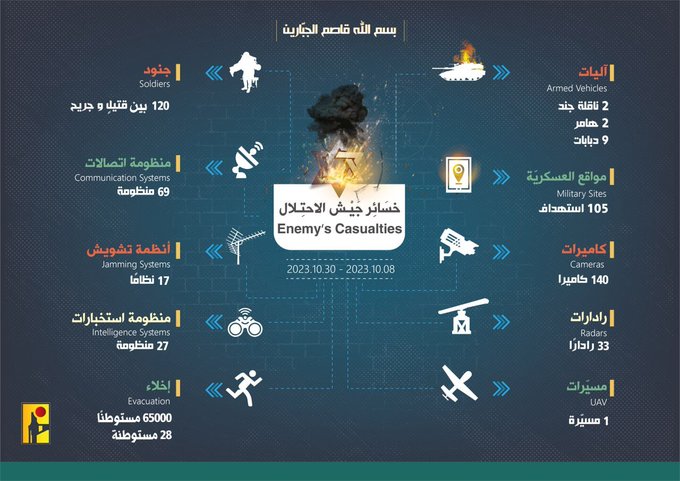
The Lebanese Resistance has just published this graph which indicates the losses inflicted on the occupier between October 8 and 30 “as part of operations on the road to the liberation of Al-Quds”: 120 Israeli soldiers were killed or injured, 65,000 settlers were evacuated from 28 settlements, 13 armed vehicles were destroyed (2 armored personnel carriers, 2 Humvees and 9 tanks) and 105 military sites were targeted. In addition, 69 communications systems, 17 jamming systems and 27 intelligence systems, 140 cameras, 33 radars and 1 drone were destroyed, so that Israel is almost completely blinded to what is happening on the Lebanese border, which would facilitate a major ground offensive from Lebanon. For its part, Hezbollah announced 49 martyrs so far: these are indeed low-intensity clashes, but on both sides, the losses in soldiers already represent almost a third of those of the entire July 2006 war, which is far from insignificant. Especially since this daily pressure on the occupier does not only represent moral support, but indeed military support. As Sheikh Naïm Qassem, Deputy Secretary General of Hezbollah, declared, Israel has amassed 5 brigades around Gaza, and 3 brigades on the Lebanese border: without the threat that Hezbollah poses to Israel, 8 brigades would be amassed around Gaza. It is therefore above all a matter of dividing the enemy’s forces, and of leaving its command in uncertainty, in order to paralyze its decisions and its willingness to massively commit its forces against the Palestinian Resistance. In this regard, the success is undeniable: to be convinced of this, one only needs to listen to the confused and contradictory declarations of Netanyahu, his ministers and the Israeli general staff on the launch of the ground operation, its timing, its scale, its objectives, etc.
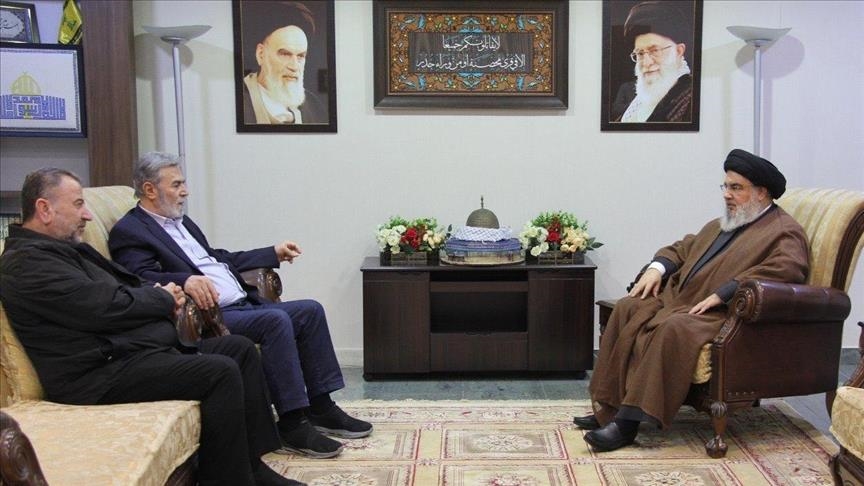
Lebanon: Hassan Nasrallah discusses developments with Ziyad Al-Nakhalah (Islamic Jihad) and Salah Al-Arouri (Hamas)
Additionally, Hezbollah is directly involved in the daily operations of the Resistance in Gaza, working closely with Hamas and Islamic Jihad cadres based in Lebanon in a common command room. Following Nasrallah’s high-profile meeting with Hamas and Islamic Jihad leaders on October 25, Hamas political leader Salah al-Arouri said:
“We are witnessing a heroic epic of Resistance in Lebanon against the occupier along the southern borders, where daily clashes break out and where martyrs fall daily among Hezbollah, the Al-Quds Brigades and the Al-Qassam Brigades. Hezbollah operates at all military and political levels, and our battle is also their battle. We share one goal and one destiny. Our struggle is united, our destiny is shared towards Al-Quds. We are in constant coordination in this battle.
Not all of our meetings with Hezbollah are public. We met Sayed Hassan Nasrallah on the first day of the battle. We are in constant meetings and maintain deep and precise communication with all the Resistance forces and our Hezbollah brothers, with Sayed Nasrallah on the front line.
If the enemy invades by land, it will mark a new and glorious chapter for our people and an unprecedented defeat for the occupation in the history of the Israeli-Arab struggle. Punishment for the crimes of the occupation is inevitable. We assure our people that the Resistance is doing well despite the crimes of the enemy and will ease your hearts regarding the extent of your suffering in the event of a brutal ground attack.
To the occupation, I declare this: be ready, because the battle has not yet begun.”
It is more than likely that Hezbollah was not surprised by the October 7 operation nor by its spectacular success, Nasrallah having constantly warned Israel not to underestimate the Palestinian Resistance, and to fear a massive reaction if they did not stop their ethnic cleansing in the West Bank and their provocations at the Al-Aqsa mosque: “Don’t miscalculate”, he kept warning the Israeli occupier and his new fascist government. We can even say that the Lebanese Resistance, which, thanks to its experience of liberating territories occupied by ISIS and Al-Nusra in Syria, has been planning an operation to invade Israel and liberate the Galilee for years, has transmitted its expertise to the Palestinian Resistance in Gaza, which took the Israeli army completely by surprise by launching an operation it expected on its northern border. Hezbollah is therefore directly linked to all aspects of the terrain and the situation, and assists the Resistance factions in all possible ways, similar to what the United States is doing for Israel.
What now?
Hezbollah’s decisions are influenced neither by the threats of enemies, nor by the reproaches (or even bitter insults) of friends who allow themselves to be carried away by emotion and see in Hezbollah’s attitude cowardice or a betrayal of the Palestinian cause. Hezbollah has never cared about “saving face” and is only driven by its long-term strategic vision, which is entirely focused on the total liberation of Palestine and the ways to achieve this strategic objective while minimizing sacrifices, if possible. Those who consider the eradication of Israel an unrealizable illusion are the same people who, in 1982, would have considered the desire of the nascent Hezbollah to expel by force the Israeli army which occupied half of Lebanon, or who, before October 7, would have found it inconceivable that the Resistance in Gaza could break the siege and inflict such losses and humiliation on the enemy. The red lines which, if crossed, would bring in Hezbollah and the Resistance Axis with all its firepower are probably clearly drawn, but it would not be wise to divulge them: it would be telling Israel that he can go this far without risking an all-out war. Leaving the enemy in confusion and exerting controlled pressure on the Lebanese border is the best strategy for this phase of the battle: Hezbollah demonstrates that he is present, that he is not afraid of confrontation or of escalation, and that he is ready for open war.
Whatever happens, October 7 will go down in history as a resounding victory for the Palestinian Resistance, and an earthquake for Israel. No massacre, no destruction, no genocide can ever erase it. As Sheikh Naïm Qassem pointed out, Israel has little choice today but between being content with the crushing defeat it has already suffered, or persisting in blind revenge and suffering discredit and defeat on a much bigger scale. Each of these two scenarios is satisfactory for the Palestinian Resistance and its allies, who will not abandon it, whatever the price to pay. And already, the confidence of Israeli society in its army and in itself, which has only become more fragile over the last two decades, is irremediably broken, and the process of remigration of Israeli settlers to Europe and America will only accelerate.
Hassan Nasrallah’s speech announced for November 3, in tribute to the martyrs of the Lebanese Islamic Resistance who fell in recent days, will finally break the silence of the Hezbollah Secretary General, an expert in psychological warfare, whose silence as well as his speeches are feared and deciphered by Israel. He will not necessarily make thunderous announcements, though many people expect him to do so, but he will clarify the very tense situation on the Lebanese border, which is getting worse every day, and could degenerate into open conflict at any time. Of all the speeches Nasrallah has given, this is probably the one that will be the most eagerly awaited and followed by both friends and enemies of the Party of God and Palestine.
‘Israel’s plan is to crush you and your people,’ Hezbollah warns Arab states
Press TV – October 29, 2023
Hezbollah Deputy Secretary General Sheikh Naim Qassem has lauded the steadfastness of the resistance front in the face of the Israeli occupation.
Sheikh Qassem warned certain Arab states in the region that they will not be spared from Israeli brutality if they do not throw their weight behind the Palestinians in Gaza.
The high-ranking official with the Lebanese resistance movement made the remarks in a statement on his X social media account on Sunday, the 23 day of Israel’s constant bombardment of Gaza.
“Let the Arab rulers know the resistance is strong, steadfast and victorious, God Almighty willing, and the days will prove that,” Sheikh Qassem said.
“You should know that Israel’s plan is to crush you and your people. What is happening in Gaza is a model for you and your role after it unless you are slaves and subject to it. And remember that the Israeli slogan is ‘From the Euphrates to the Nile.”
“Get together and threaten, do what will deter them, boycott, make way for your people to express freely, declare your support for Palestine and al-Quds; this is an opportunity to break the brutality,” Sheikh Qassem said.
“The Palestinian people and their resistance are paying the price for the pride of the nation and future generations, so be with them so that you can be with yourselves and your peoples, and victory comes only from God.”
Sheikh Qassem also censured the unflinching support the United States and Western governments provided to the Israeli onslaught.
“The brutality of the US, France, Britain and Germany in their absolute support of Israeli criminality and genocide against civilians in Gaza has exceeded the lowest levels of humanity.”
Israel has been waging a barbaric war on Gaza since October 7, when Hamas-led Palestinian resistance groups launched their biggest operation against Israel in years. The sneak Operation Al-Aqsa Storm came in response to the regime’s intensified crimes against the Palestinian people.
The Israeli war has so far claimed the lives of over 8,000 innocent Palestinians, including more than 3,000 children, and left upwards of 20,500 others wounded.
The United Nations General Assembly overwhelmingly passed a resolution on Friday, calling for the implementation of an immediate “humanitarian truce” in Gaza. The vote came after the United Nations Security Council failed four times in the past two weeks to take action due to Washington’s veto against relevant resolutions.
The assembly stressed the “importance of preventing further destabilization and escalation of violence in the region,” urging “all parties to exercise maximum restraint and upon all those with influence on them to work toward this objective.”
Israel has rejected all calls for a ceasefire, claiming it would benefit Hamas.
Putin offers solution to stop further bloodshed in Israel-Gaza conflict while Zelensky fears losing US support
By Drago Bosnic | October 17, 2023
As hostilities in the latest Israel-Gaza conflict escalate, the threat of a wider confrontation in the Middle East is getting likelier by the day. It’s safe to assume that the Israeli Defense Forces (IDF) haven’t launched a ground operation in Gaza yet due to possible direct Iranian involvement, as well as the greater engagement of Hezbollah in the north of the country. According to the Jerusalem Post, the main reason for the postponing of the offensive is precisely the latter. The Northern Command is forced to keep the best IDF troops in the area to ensure combat readiness on the Lebanese border in case Hezbollah gets more directly involved. The Lebanon-based Shia movement has tens of thousands of soldiers and a massive stockpile of various rockets and missiles that could do significant damage to the IDF. Israel simply cannot afford to ignore Hezbollah, as the group already defeated it once in 2006, the only such occurrence in the history of IDF.
The Jerusalem Post itself cited sources saying that “while a number of factors seem to have caused a delay, one factor has been a growing concern that Hezbollah is waiting for the moment that most IDF ground forces are committed to Gaza to open a full front with the IDF in the north”. This fact alone is forcing Israel to keep most of its military assets in the relative vicinity of the border with Lebanon. It could be said that Hezbollah is already providing significant support to Hamas just by being able to tie up so many IDF troops. Iranian involvement in this is implicit, as Tehran has been one of the main backers of Hezbollah since the group’s very inception. This is forcing the Israeli leadership to exercise caution and restraint, as a direct Iranian intervention remains a possibility. Such speculation is not without merit, as Iranian Foreign Minister Hossein Amir-Abdollahian already implied that Tehran might get involved:
“Conferred with my counterparts from Tunisia, Malaysia and Pakistan. Underlined the need to immediately stop Zionist crimes & murder in Gaza & to dispatch humanitarian aid. I stressed that time is running out for political solutions; probable spread of war on other fronts is approaching unavoidable stage.”
On the other hand, most high-ranking Israeli officials are adamant that the Gaza operation must be launched. For instance, Israeli ambassador to the United Kingdom Tzipi Hotovely even compared the current airstrikes with the bombing of Dresden during WWII, when Western Allies leveled the German city, killing tens of thousands of civilians in the process. Israeli F-16I “Sufa” fighter jets have already dropped thousands of bombs on Gaza (primarily the US-made JDAMs – Joint Direct Attack Munitions), resulting in thousands of deaths and serious injuries among civilians there. According to the Palestinian Central Bureau of Statistics, the death toll among Palestinians now stands at over 3,000. For its part, Israel reported that over 1,400 Israeli civilians died so far, with at least 4,100 wounded. The figures are certainly even worse as of this writing.
Such casualties are disastrous, especially given that the conflict started just ten days ago. Since then, the world has effectively split into three groups. Apart from those that express open support for either side, the largest part of the globe has opted for neutrality. This also includes superpowers such as Russia. Namely, Moscow was among the first to call for the end of hostilities before they escalate to include all regional and perhaps even global actors. In a phone call with Russian President Vladimir Putin (the first since the conflict started), Israeli Prime Minister Benjamin Netanyahu stated that Israel would proceed with the Gaza offensive despite Moscow’s warning that it would lead to massive casualties and possibly cause a strong reaction of the Muslim world, particularly Iran and its allies. Putin urged Netanyahu to engage in talks on the peaceful settlement of the conflict.
On the other hand, the United States is looking to use the crisis to escalate against Iran, as Washington DC warhawks were quick to blame Tehran for the surprise attack launched by Hamas. US President Joe Biden will visit Israel this week, coming mere days after State Secretary Antony Blinken. Biden recently denied reports about a possible deployment of American troops, calling it “unnecessary, as Israel has one of the finest fighting forces”. And while he stated that “it would be a mistake [for Israel] to occupy Gaza”, he supported the notion that Hamas must be eliminated entirely and warned Iran not to get involved. By directly supporting the upcoming ground operation by the IDF, Washington DC is risking (almost certainly intentionally) a wider conflict that might include several Arab states and Iran. In fact, Israeli forces already hit targets in Syria and Lebanon.
In the meantime, the Kiev regime is in panic mode as the global spotlight has moved away from Ukraine. Namely, the Neo-Nazi junta frontman Volodymyr Zelensky tried to get the attention of Western audiences to himself by pompously announcing a “solidarity visit”. However, Israel flatly refused, as the “time is not right”. Zelensky is likely terrified of the prospect that he will have to share hundreds of billions in so-called US “aid” with Israel. It’s no secret that the latter is a priority for Washington DC, while the Kiev regime and the Ukrainian people as a whole are routinely seen as “cheap cannon fodder” that should only be “dying for a NATO mission.” The words of the infamous warhawk Lindsey Graham that “the best money the US ever spent because the Russians are dying” show this only works for America if its actual allies are under attack.
Drago Bosnic is an independent geopolitical and military analyst.
US warmonger Senator threatens Iran
By Lucas Leiroz | October 17, 2023
Once again, the pro-war sectors of American politics seem to want to foment a conflict situation with US involvement. A prominent public figure in the US Senate has made very serious threats to Iran, promising that Washington “will not hesitate” to take actions against Tehran if the conflict in the region continues to escalate.
The threats were made by the highly known Senator Lindsey Graham, who is notorious for his bellicose and irresponsible positions regarding American foreign policy. Graham issued a warning to Iranian authorities, stating that if there is any military action by Hezbollah against Israel, Washington will act to protect its ally, which could have serious consequences for Iran, both in military and economic terms.
“Here’s my message. If Hezbollah, which is a proxy of Iran, launches a massive attack on Israel, I would consider that a threat to the — to the State of Israel, existential in nature. I will introduce a resolution in the United States Senate to allow military action by the United States in conjunction with Israel to knock Iran out of the oil business,” Graham said.
Hezbollah was not the only topic in the Senator’s speech. Graham also stated that he does not believe in the Iranian government’s official narrative that the Hamas operation was carried out autonomously. For him, believing this is “laughable”, with total confidence on his part that Hamas’ actions were previously discussed with Iran.
“The idea that Iran read about this operation in the paper, or on television is laughable. 93% of Hezbollah and Hamas’ money comes from Iran (…) They’re the source of the problem. They’re the great evil. So, if Hezbollah escalates against Israel, it will be because Iran told them to. Then Iran, you’re in the crosshairs of the United States and Israel,” Graham added.
Graham’s stance is extremely complicated, as the current tense situation in the Middle East favors risks of escalation and internationalization, and there is therefore a considerable possibility of Iran becoming involved in hostilities. This involvement can be direct or indirect, with Tehran sending regular troops or mobilizing its allied groups – which are not limited to Hezbollah. In either scenario, the risks would be enormous for Israel, which, despite its large military strength, is a small and vulnerable country in situations of war of attrition.
Furthermore, it must be emphasized that Iran is doing everything possible not to enter the war. By warning Israel not to continue collectively punishing Gaza, Tehran is offering alternatives to armed confrontation. But Tel Aviv, despite being afraid of invading on the ground, continues to bomb Gaza and kill thousands of civilians, causing Iran’s patience to progressively run out.
It has also been informed by the Persian country’s authorities that the so-called “Axis of Resistance” – a Theran-led coalition of anti-Zionist armed movements – could act at any time in defense of the Palestinians. Iranian politicians clarified that, despite Tehran leading the coalition, the member groups have high decision-making autonomy, and there is no full Iranian control over how these movements will react to Israel. In other words, the risks of escalation are great, and Iran is not capable of preventing it alone.
The only way to truly de-escalate is through a commitment on the part of Israel to stop the attacks. Without this, the situation will go out of control and there will inevitably be intervention – if not direct from Iran, at least from some Iranian-allied group. Furthermore, it is necessary to remember that Hezbollah is already de facto involved in hostilities, with bombings being exchanged between the IDF and the Shiite militia every day. Obviously, if nothing is done to stop these hostilities, at some point Hezbollah will choose to launch a more effective incursion.
With all these factors, Graham’s words sound like a “self-fulfilling prophecy”. He points to an imminent scenario as a “red line” and issues direct threats, making real de-escalation actions virtually impossible. However, this type of behavior is in fact expected from Graham, who is a known “hawk” of American foreign policy. Months ago, the Senator became embroiled in a controversy after saying that the US was investing money in “killing Russians” in Ukraine – praising such an “investment”. In the same vein, on another occasion, he also suggested that Kiev should kill Russian President Vladimir Putin.
It remains to be seen whether these pro-war tendencies will prevail in the American public debate. For now, the US stance has been extremely bellicose, with the country sending aircraft carriers to “help” Israel. However, it is necessary to remember that the American military-industrial complex is not able to work on two different fronts at the same time – in addition to the possibility of escalation in the Pacific in the near future. Washington needs to act rationally and discourage war in the Middle East.
Lucas Leiroz, journalist, researcher at the Center for Geostrategic Studies, geopolitical consultant.
Iran warns Israel of regional ‘earthquake’
RT | October 15, 2023
Iranian Foreign Minister Hossein Amir-Abdollahian has urged Israel to end its airstrikes on Gaza, warning that the conflict with Hamas could spread across the region if Israel sends ground forces into the enclave, and the Lebanese militant group Hezbollah enters the fray.
“I know about the scenarios that Hezbollah has put in place,” Amir-Abdollahian said in a briefing with reporters in Beirut on Saturday. “Any step the resistance will take will cause a huge earthquake for Israel.”
According to two diplomatic sources cited by Axios, Iran is trying to prevent the war from spreading, and seeking to help Israeli civilian hostages being held in Gaza – but if the military operation continues and Israel goes ahead with a ground offensive, Iran will have to respond.
“There is still a political opportunity to prevent a widespread crisis in the region,” the minister noted, but “maybe, in the next few hours, it will be too late.”
This week, the top Iranian diplomat visited Iraq, Syria and Lebanon, where he met with Hezbollah leader Sayyed Hassan Nasrallah, as well as senior Lebanese officials, to discuss the “potential outcome” and the “positions that must be taken” in light of the war.
In a meeting with Lebanese Foreign Minister, Abdallah Bou Habib, Amir-Abdollahian accused Israel of “war crimes” against the people of Gaza and repeated his warning that if Israel does not stop, “any possibility is conceivable.” Bou Habib backed his counterpart, saying that Lebanon “has never wanted or sought war” and warning that further escalation “will ignite the region and threaten security and peace in it”.
“We are in solidarity with our Palestinian brothers and call for the end of the siege and the delivery of aid to Gaza,” Bou Habib stressed.
Hezbollah fighters are on full alert along the Lebanon border, and have been exchanging sporadic fire with Israel since last Saturday’s Hamas incursion that left at least 1,300 Israeli civilians and soldiers dead.
The Iran-backed group is considered a major threat to Israel, as it possesses some 150,000 rockets and missiles, including precision-guided missiles that can reach anywhere in Israel, as well as thousands of battle-hardened fighters and various types of military drones.
The top Iranian diplomat also met with a senior political leader of Hamas, Ismail Haniyeh, in Qatar on Saturday evening, but details of the meeting have yet to be disclosed.
Featured Video
Trita Parsi: Israel Set a Trap for Total War in the Region
or go to
Aletho News Archives – Video-Images
From the Archive
Zionism’s Violent Legacy
By Donald Neff | Washington Report On Middle East Affairs | January 1996
On January 4, 1948, Jewish terrorists drove a truck loaded with explosives into the center of the all Arab city of Jaffa and detonated it, killing 26 and wounding around 100 Palestinian men, women and children.[1] The attack was the work of the Irgun Zvai Leumi – the “National Military Organization,” also known by the Hebrew letters Etzel – the largest Jewish terrorist group in Palestine. The Irgun was headed by Revisionist Zionist Menachem Begin and had been killing and maiming Arabs, Britons and even Jews for the previous ten years in its efforts to establish a Jewish state.
This terror campaign meant that at the core of Revisionist Zionism there existed a philosophical embrace of violence. … continue
Blog Roll
 Aletho News
- Trita Parsi: Israel Set a Trap for Total War in the Region
- Trump’s Iran war is on an Israeli leash
- Saudi oil boss issues global supply warning
- Riyadh Says Its Oil System Is Intact. The Numbers Say Otherwise.
- Trump and Netanyahu Want to “Finish the Job” on Iran
- US ‘one-sided dictation’ not Iran’s beliefs makes rational talks impossible: Baghaei
- Iran’s Next Strike May Not Explode. It Could Shut You Down /Col Doug Macgregor
- Iran: US political targets legitimate if assassinations return
- Iraq shuts key border crossing with Iran under US pressure: Report
- Undersea Internet cables could be targeted in retaliation for attacks on Iran: IRGC deputy chief
- If Americans Knew
- The Israel Lobby’s Changing Fortunes
- AIPAC has become such a political liability that it’s shifting to a more “nimble” approach to buying politicians
- At least 160 Israeli settler attacks in 2 weeks
- Will Gaza’s Ancient Christian Community Disappear Forever?
- Israel’s vision of regional security rests on keeping Arab states weak
- Heidi Levine recounts how Palestinian youths helped save her in settler attack
- DAILY UPDATE: Latest essential news on Palestine, Israel, & region
- Trump’s Intensifying Sabotage of the ICC, for Israel’s Sake
- Israeli military detain US and UK volunteers in West Bank including Democratic NY politician Brad Lander
- Americans at National Conservatism Conference held in Israel this year criticize Israel
- No Tricks Zone
- E-Cars Reduce CO2 Emissions By Only 41% Compared To Internal Combustion Engine Vehicles
- Predictions Made By Renowned Climate Professor Over Past Decades Have Been Proven To Be Poor
- New Study Suggests Large Regions Of The Pacific Ocean Have Been Cooling For The Last 80 Years
- Germany’s Green Energy Debacle: High Energy Costs Force Kahla Porzellan to Close After 182 Years!
- New Study: 50 Years Of The Most Aggressive ‘Net Zero’ Policies Can Only Affect The Global Climate By 0.03°C
- US September “Heat” Was No Record…Many Records Set Decades Ago
- Latest European Green Energy Debacle; Portugal’s Largest Flagship Solar Park Insolvent!
- Green Energy Debacle: German Expert Professor Fritz Vahrenholt Warns Of Severe Economic And Social Consequences
- Two More Paleo Reconstructions Affirm Meters-Higher Sea Levels Across Ireland, Brazil 7000-6000 Years Ago
- New Study: Earth And Venus Surface Warmth Largely Explained By Convection And Lapse Rate, Not CO2 Or Radiation

