Hezbollah: Israel poses strategic threat to region and beyond
Press TV – July 3, 2025
Sheikh Naim Qassem, the leader of Hezbollah, declared Israel not only an occupier of Palestine but a strategic threat to Lebanon, Egypt, Syria, Jordan, the broader region, and global stability.
In a televised address on Wednesday, Qassem emphasized that Israel’s ideology, actions, and ambitions endanger Muslims, Christians, and Jews alike, destabilizing both regional and global peace.
He noted that the regime’s ideology, behavior, and vision endanger both regional stability and global peace.
Qassem said that since the ceasefire agreement between Lebanon and Israel took effect, the regime has not stopped its aggression and has violated the agreement more than 3700 times.
He stressed that the regime must adhere to the terms it agreed upon with Lebanon and stop its acts of aggression.
The Hezbollah leader said the movement will not be swayed by threats, nor will it accept surrendering its weapons to Israel.
Qassem firmly rejected calls for Hezbollah to disarm, asserting that Lebanon’s defense and sovereignty are internal matters, immune to external pressures.
“We will not submit to humiliation, abandon our land, or compromise under threats,” he stated, stressing that discussions about Hezbollah’s weapons are a domestic issue, with no role for Israel in dictating terms.
Qassem said Hezbollah’s resistance is a defense against a strategic threat impacting multiple nations, including Palestine, Lebanon, Egypt, Syria, and Jordan.
Describing Israel as an existential danger, Qassem noted, “Israel’s threat is not limited to Muslims; it endangers Christians and Jews as well.”
He criticized the regime’s ideology and actions as a risk to global peace and called on those who avoid confronting Israel to resist on humanitarian grounds.
“Coexisting with an expanding, invasive danger is impossible,” he warned, emphasizing Hezbollah’s resistance as rooted in human, Islamic, and national values for future generations.
Lebanese state must address ongoing violations
In late June, Qassem stated that Israel’s continued aggression, including attacks on Nabatieh, the targeting of civilians in southern Lebanon, and strikes on the money exchange sector, is now the Lebanese state’s responsibility to address.
“The state must apply pressure and fulfill its duties,” he urged, rejecting claims that Hezbollah provides pretexts for Israeli attacks.
He cited Israel’s occupation of 600 km² of Syrian territory, destruction of capabilities, and attacks on Iran as evidence of unprovoked aggression.
“You must understand this cannot continue,” Qassem told the public. “Do you imagine we will remain silent forever? All of this has limits.”
Israel’s war on Iran is not about nuclear weapons
It is, and has always been, about regime change and breaking the Axis of Resistance
By Robert Inlakesh | RT | June 19, 2025
The claim that has been adopted by the United States, Israel and its European partners, that the attack on Iran was a “pre-emptive” attempt to stop Tehran from acquiring nuclear weapons, is demonstrably false. It holds about as much weight as the allegations against Iraq’s Saddam Hussein in 2003 and this war of aggression is just as illegal.
For the best part of four decades, Israeli Prime Minister Benjamin Netanyahu has been claiming that Iran is on the verge of acquiring a nuclear weapon. Yet, every single attempt to strike a deal which would bring more monitoring and restrictions to Iran’s nuclear program has been systematically dismantled by Israel and its powerful lobbying groups in Western capitals.
In order to properly assess Israel’s attack on Iran, we have to establish the facts in this case. The Israeli leadership claim to have launched a pre-emptive strike, but have presented no evidence to support their allegations that Iran was on the verge of acquiring a nuclear weapon. Simply stating this does not serve as proof, it is a claim, similar to how the US told the world Saddam Hussein possessed weapons of mass destruction.
Back in March, the US Director of National Intelligence, Tulsi Gabbard testified before a Senate Intelligence Committee that the intelligence community “continues to assess that Iran is not building a nuclear weapon and Supreme Leader Ayatollah Ali Khamenei has not authorized the nuclear weapons program he suspended in 2003.”
On top of this, Iran was actively participating in indirect negotiations with the US to reach a new version of the 2015 Nuclear Deal. Donald Trump announced Washington would unilaterally withdraw from the agreement in 2018, instead pursuing a “maximum pressure” sanctions campaign at the behest of Israel.
Despite the claims of Netanyahu and Trump that Iran was violating the Nuclear Deal, the International Atomic Energy Agency (IAEA) released a report which stated Iran was in full compliance with the deal at the time.
If you trace back every conversation with neo-conservatives, Israeli war hawks and Washington-based think tanks, their opposition to the Obama-era Nuclear Deal always ends up spiraling into the issues of Iran’s ballistic missile program and its support for regional non-State actors.
Israeli officials frequently make claims about Iran producing a nuclear weapon in “years”, “months” or even “weeks,” this has become almost second nature. Yet their main issue has always been with Iran’s support for groups like Hamas and Hezbollah, who strive for the creation of a Palestinian State.
Proof of all this is simple. Israel, by itself, cannot destroy Iran’s vast nuclear program. It is not clear the US can destroy it either, even if it enters the war. An example of the US’ ineffectiveness at penetrating Iranian-style bunkers, built into mountainous ranges, as many of Iran’s nuclear facilities are, was demonstrated through the American failure to destroy missile storage bases in Yemen with its bunker-buster munitions, which were dropped from B-2 bombers.
Almost immediately after launching his war on Iran, Netanyahu sent out a message in English to the Iranian people, urging them to overthrow their government in an attempt to trigger civil unrest. The Israeli prime minister has since all but announced that regime change is his true intention, claiming that the operation “may lead” to regime change.
Israel’s own intelligence community and military elites have also expressed their view that their air force alone is not capable of destroying the Iranian nuclear program. So why then launch this war, if it is not possible to achieve the supposed reason it was “pre-emptively” launched?
There are two possible explanations:
The first is that the Israeli prime minister has launched this assault on Iran as a final showdown in his “seven front war,” with which he hopes to conclude the regional conflict through a deadly exchange that will ultimately inflict damage on both sides.
In this scenario, the desired outcome would be to conclude the war with the claim that Netanyahu has succeeded at destroying or has significantly degraded Iran’s nuclear program. He would also throw in claims, like we already see him making, that huge numbers of Iranian missiles and drones were eliminated. This would also make the opening Israeli strike, which killed senior Islamic Revolutionary Guard Corps (IRGC) commanders and nuclear scientists, make sense. It would all be the perfect blend of propaganda to sell a victory narrative.
On the other hand, the assumption would be that Tehran would also claim victory. Then both sides are able to show the results to their people and tensions cool down for a while. If you are to read what the Washington-based think-tanks are saying about this, most notably The Heritage Foundation, they speak about the ability to contain the war.
The second explanation, which could be an added bonus that the Israelis and US are hoping could come as a result of their efforts, is that this is a full-scale regime change war that is designed to rope in the US.
Israel’s military prestige was greatly damaged in the Hamas-led attack on October 7, 2023, and since that time there has been no victory achieved over any enemy. Hamas is still operating in Gaza and is said to have just as many fighters as when the war began, Hezbollah was dealt significant blows but is still very much alive, while Yemen’s Ansarallah has only increased its strength. This is an all round stunning defeat of the Israeli military and an embarrassment to the US.
As is well known, Iran is the regional power that backs all of what is called the Axis of Resistance. Without it, groups like Hezbollah and Hamas would be significantly degraded. Evidently, armed resistance to Israeli occupation will never end as long as occupied people exist and live under oppressive rule, but destroying Iran would be devastating for the regional alliance against Israel.
The big question however, is whether regime change is even possible. There is a serious question mark here and it seems much more likely that this will end up on a slippery slope to nuclear war instead.
What makes the Israeli-US claim that this war is somehow pre-emptive, for which there is no proof at all, all the more ridiculous of a notion, is that if anything, Iran may now actually rush to acquire a nuclear weapon for defensive purposes. If they can’t even trust the Israelis not to bomb them with US backing, while negotiations were supposed to be happening, then how can a deal ever be negotiated?
Even in the event that the US joins and deals a major blow to the Iranian nuclear program, it doesn’t mean that Iran will simply abandon the program altogether. Instead, Tehran could simply end up rebuilding and acquiring the bomb years later. Another outcome of this war could end up being Israeli regime change, which also appears as if it could now be on the table.
Robert Inlakesh is a political analyst, journalist and documentary filmmaker currently based in London, UK. He has reported from and lived in the Palestinian territories and currently works with Quds News. Director of ‘Steal of the Century: Trump’s Palestine-Israel Catastrophe’.
US, Israel agree to end UNIFIL mandate in south Lebanon: Report
The Cradle | June 9, 2025
The US and Israel have agreed that the United Nations Interim Force in Lebanon (UNIFIL) must cease its operations in the country’s south, according to Hebrew media outlets.
Washington has decided not to renew UNIFIL’s mandate, and Israel “did not try to convince them otherwise,” the report said.
A vote on the UNIFIL mandate is expected to take place at the UN Security Council within the next few months, likely in August.
Another report in Israel Hayom said the US is considering pulling support for UNIFIL. Sources told Times of Israel that the “option is on the table.”
“The US has not yet made up its mind regarding its future support for UNIFIL, but it wants to see major reforms, which could mean pulling support,” the sources added.
No officials from the US, Israel, or the UN have publicly commented on the matter yet.
UNIFIL, which was established in 1978 and expanded after Israel’s war on Lebanon in 2006, currently includes more than 13,000 uniformed personnel tasked with monitoring hostilities along the Blue Line and ensuring humanitarian access.
Israeli Prime Minister Benjamin Netanyahu has been pushing for UNIFIL’s removal from Lebanon since as far back as October 2024.
Analysts have said that the move is intended to eliminate international observers who could monitor or document Israeli military activity in southern Lebanon. During the latest war, UNIFIL forces came under Israeli fire several times.
“The exclusion of outside observers, whether it is journalists or UN peacekeepers, seems a deliberate strategy to limit the scrutiny of Israeli forces at a time when they are most needed,” Shane Darcy, professor at the Irish Centre for Human Rights, said last year during Israel’s ground operation in Lebanon.
Other reports and analyses have said that Washington is looking to pressure Beirut into accepting a new mandate for UNIFIL, including changes that would see the interim force actively work against Hezbollah’s presence in the south and destroy infrastructure without needing to coordinate with the Lebanese army.
Such changes to the UNIFIL mandate are advocated for by Israeli reservist and former head of the Israeli army’s Strategic Planning Division, Assaf Orion, in a 29 May piece for the Washington Institute. “The time has come for UNIFIL to either adapt or disband,” Orion says.
The Israeli media reports about UNIFIL’s future in Lebanon come days after Tel Aviv launched its largest attacks on the Lebanese capital since the start of the ceasefire.
Since the truce was reached in November 2024, Israel has violated the deal over 3,000 times with constant attacks. Israeli forces also maintain an occupation of five locations inside Lebanon, which they established themselves in after the ceasefire, in violation of the agreement.
Hezbollah and the Lebanese state have abided by the agreement. The resistance has handed over weapons and military positions to the Lebanese army south of the Litani River.
Yet it rejects US and Israeli pressure for full disarmament.
On 6 June, Israel’s Defense Minister, Israel Katz, threatened Lebanon with an escalation of attacks if Hezbollah is not disarmed.
“There will be no calm in Beirut, and no order or stability in Lebanon, without security for Israel,” he said.
US deputy envoy behind Hezbollah disarmament campaign to be replaced: Report
The Cradle | June 1, 2025
US Deputy Special Envoy to the region Morgan Ortagus, who has been in charge of Washington’s Lebanon policy, is soon to be removed from her position and reassigned to another role, according to US and Israeli reports.
Ortagus “will be leaving her position as Deputy Envoy in the Trump administration,” right-wing US journalist Laura Loomer reported on X on 1 June, citing White House sources.
“I’m told she will be cordially reassigned to another role in the Trump administration. She wanted to be the Special Envoy to Syria, but the position was instead given to Tom Barrack. Morgan’s replacement will be announced this week by Steve Witkoff,” she added.
Ortagus has been at the head of the US government’s campaign to pressure the Lebanese government into disarming Hezbollah and Palestinian resistance groups. In an interview with Al-Arabiya in April, Ortagus referred to the Lebanese resistance as a “cancer” that needs to be “cut out.”
During her first visit to Lebanon, she publicly thanked Israel for “defeating” Hezbollah at the presidential palace in Baabda.
Ortagus was scheduled to visit Beirut in the coming days to advance proposals regarding reforms, border demarcation, reconstruction, disarmament of Hezbollah, and normalization with Israel, according to Lebanese news outlet Al-Jadeed. “The US proposals will be presented with a firm tone, with a specific deadline for Lebanon to implement what gets agreed on or be held responsible” for the consequences, the report said.
Hezbollah has outright rejected disarmament, but says it is eventually willing to hold dialogue with the Lebanese government on a national defensive strategy that sees its weapons incorporated into the state for use in protecting the country from Israel.
According to a report by Israel’s Channel 14, National Security Council (NSC) officials Merav Ceren and Eric Trager have also been recently removed from their positions. Trager was overseeing Middle East and North Africa affairs at the NSC, while Ceren was the director for Iran.
Ceren previously worked at the Israeli Ministry of Defense and is affiliated with the Foundation for Defense of Democracies (FDD), a pro-Israel think tank based in Washington DC which has been described as “hawkish” and has been heavily pushing for the dismantlement of Iran’s uranium enrichment capabilities as US President Donald Trump’s government holds nuclear talks with Tehran.
Channel 14 notes that the decision is part of an effort to restructure the NSC, reduce its influence, and transfer foreign policy to a limited group of “trusted officials.”
The outcome of these changes, including Ortagus’s departure from her current position, was described in the report as “not good for Israel.”
Heavy Israeli strikes hit south Lebanon ahead of final vote in municipal elections
The Cradle | May 23, 2025
The Israeli army unleashed a violent wave of airstrikes across southern and eastern Lebanon on the evening of 22 May, striking what it claimed were Hezbollah weapons sites.
The attacks were preceded by an evacuation order for a building in the town of Toul, in the Nabatieh district of southern Lebanon north of the Litani River, citing the presence of Hezbollah facilities.
Following a “warning strike,” Israel bombed and destroyed the building – which had already been struck during the war last year, according to Al-Manar.
Israel then proceeded to carry out airstrikes in several southern regions, including the Iqlim al-Tuffah region, Mahmoudia, Jabal al-Rafi, and Jabal Safi. The vicinity of a school in the town of Tulin were among the areas bombarded.
Additionally, Israeli ground troops opened fire at the southern town of Aitaroun as the strikes were happening.
An airstrike also hit the town of Boudai in the eastern Baalbek region of Lebanon. The Israeli army said in a statement that it “attacked a military site containing rocket launchers and weapons in the Bekaa Valley with fighter jets,” as well as “terrorist infrastructure, rocket launchers, and missiles” in the south, accusing the resistance of violating the ceasefire and attempting to reconstitute its forces.
According to Lebanese media, these were some of the heaviest strikes on the country since the war ended last year.
Lebanese Prime Minister Nawaf Salam condemned the attacks and said they came at a “dangerous” time. They occurred just two days before the final round of municipal elections in south Lebanon – the first to be held since the ceasefire agreement was reached in November 2024.
“Prime Minister Salam stresses that these violations will not thwart the state’s commitment to holding the elections and protecting Lebanon and the Lebanese,” Salam’s office said in a statement.
Despite the devastating war that ravaged southern and eastern Lebanon and the southern suburb of Beirut last year, Hezbollah has retained significant popular support.
During the first rounds of voting two weeks ago, Hezbollah-backed lists won in the Shia-inhabited towns of Ain al-Ghuwaybah, Hajoula, Ras Asta, Bashtlida, Fidar, Mishan, Almat al-Sawaneh, Lassa, Afqa, al-Maghiri, and al-Husun.
The final round of voting will be held on 24 May in Nabatieh and other southern governorates, which have endured brutal Israeli strikes during the war and even after the ceasefire.
“This year’s municipal and elective elections come as a challenge of resilience, steadfastness, and commitment to the land – rebuilding it with its people, orchards, houses, and all elements of life,” Hezbollah Secretary-General Naim Qassem said on Thursday.
Qassem also stressed that “the continued Israeli occupation of any inch of our land and homeland will not be accepted.”
Tel Aviv’s violations of the ceasefire agreement reached in November last year have continued unabated.
Over 200 people have been killed in the more than 3,000 Israeli violations of the US-sponsored deal since the end of 2024.
Israeli troops also occupy five locations along the border in the south, where they established themselves following the ceasefire deal in violation of the agreement. This is aside from the Lebanese land that Israel has already been illegally occupying for decades, including the Kfar Shuba hills and Shebaa Farms.
From loans to crypto, the US financial siege of Hezbollah
The Cradle | May 2, 2025
In its relentless campaign to weaken the Lebanese resistance, Washington has launched a comprehensive financial and economic offensive against Hezbollah, aimed at isolating the group and eroding its post-war influence.
This effort is part of a wider US regional agenda to neutralize Israel’s enemies and ensure that Hezbollah plays no role in Lebanon’s recovery, in order to weaken its standing among both supporters and the broader population.
The US playbook draws from its standard regime-change toolkit – blockades, sanctions, institutional sabotage – but now with furious intensity, bolstered by the regional fallout of Syria’s unraveling and Washington’s increasing grip on Lebanese institutions.
A major component of this pressure campaign is the US’s direct and increased involvement in the day-to-day operations of Lebanese state agencies, particularly around ports, airports, and financial networks.
Despite this, Hezbollah has managed to mobilize close to $1 billion in aid since the ineffective ceasefire agreement five months ago – supporting displaced civilians and initiating early-phase reconstruction in the country’s south, Bekaa region, and southern suburbs of Beirut.
Sealing off Lebanon: Borders, skies, and ports
The late, martyred Hezbollah secretary-general Hassan Nasrallah never shied away from publicly acknowledging Iran as the group’s primary financial backer. In response, the US and Israel have worked aggressively to sever that link – most notably by targeting direct flights between Beirut and Tehran.
Following direct Israeli threats against Beirut-Rafic Hariri International Airport and intense US diplomatic and security pressure, Lebanon’s government under western-backed President Joseph Aoun moved to block Iranian aircraft from landing or taking off in Beirut. The goal: severing physical currency flows and cutting off high-value transfers via air.
These measures were followed by a sweeping overhaul of airport security. Electronic surveillance initiated under the Najib Mikati government and Transportation Minister Ali Hamieh – viewed as close to Hezbollah – was expanded.
Inspections were tightened, and dozens of staff were removed or reassigned based on religious, familial, or political affiliations. Control over airport security was consolidated under Brigadier General Kfoury, with American officials closely monitoring implementation.
The aim is clear: Eliminate cash transfers through travelers. In one case back in February, authorities seized $2.5 million from a passenger arriving from Turkiye, which the Higher Islamic Shia Council claimed as its own – though opponents alleged the funds belonged to Hezbollah.
Surveillance now targets passengers arriving from Turkiye, the UAE, Iraq, and African states, especially frequent fliers with little or no luggage, suspected of being couriers.
The US has also ramped up pressure on Turkiye, Iraq, and Qatar to monitor Lebanon-bound financial flows, leveraging their ties with the Islamic Republic. Border inspections across West Asian airports have intensified dramatically.
At Beirut Port, similar efforts are underway. Inspection protocols have been revamped, and staff purged to prevent Hezbollah from using shipping containers for cash smuggling. Israeli officials and Lebanese political adversaries have spotlighted the port – still reeling from the devastating 2020 blast – as a supposed smuggling hub, pushing for stricter measures.
On Lebanon’s eastern border with Syria, pressure is being reinforced militarily. Syrian army operations near the Qusayr region – adjacent to Lebanon’s Hermel – appear coordinated with US and Israeli demands to close off land routes Hezbollah once used to move funds and arms.
Syria’s President and former Al-Qaeda leader, Ahmad al-Sharaa, has reportedly informed US and European interlocutors that his government is actively disrupting Hezbollah supply channels. Meanwhile, Israeli drones conduct routine surveillance of the border, striking suspected transfers at will.
Financial asphyxiation through the banks
With smuggling routes under siege, Washington is escalating efforts to choke Hezbollah via the banking and commercial sectors. All financial activity – from remittances to basic commerce – is now under microscopic scrutiny to ensure the group is cut off at every node.
The recent appointment of Lebanon’s Central Bank Governor Karim Saeed has further solidified US influence over Lebanon’s financial system. While his predecessor Wassim Mansouri (aligned with the Amal Movement) took initial steps that constrained Hezbollah’s financial networks, Saeed has expanded on this approach further, taking an increasingly hostile stance toward Hezbollah – helping enforce Washington’s dictates within Lebanon’s banking institutions.
Measures include arbitrary account closures, frozen transfers, and heightened scrutiny of routine transactions suspected of even peripheral links to Hezbollah. While designed to stifle the group, these policies have ensnared countless ordinary Lebanese – especially Shia populations and those from opposition-aligned backgrounds – trapping them in a banking system that now functions as a US-enforced surveillance and punishment mechanism.
Currency exchange offices are also under fire. Hefty fines have been levied under both Mansouri and Saeed for dealing with individuals flagged by Washington – often baselessly – as Hezbollah affiliates. Ostensibly part of a campaign to dry up Lebanon’s cash-based economy, the deeper objective is political: Make Hezbollah’s support base pay the price of resistance, and sow dissent among Shia communities.
Even cryptocurrency has not escaped notice. Though harder to track inside blockchain systems, US authorities are targeting the fiat-to-crypto entry point, focusing on how individuals acquire digital currency before it moves beyond the reach of formal oversight.
The assault on Al-Qard al-Hassan
In addition to economic warfare, Israel has militarily targeted Hezbollah-linked institutions – chief among them, the Al-Qard al-Hassan Association. During the war, several of the loan institution’s branches were bombed. But the campaign against this financial cooperative extends far beyond airstrikes.
Washington and Tel Aviv are determined to dismantle Al-Qard al-Hassan, viewing it as a pillar of Hezbollah’s socioeconomic infrastructure and a symbol of grassroots resistance. The US is pressuring Lebanon’s central bank to shut the institution down altogether. Although Governor Saeed has publicly denied plans to do so, political insiders widely believe dismantling the cooperative is one of his key tasks.
Unlike traditional banks, Al-Qard al-Hassan operates as a solidarity-based financial institution. Its mission is to provide accessible services to underserved communities – many of whom have lost trust in Lebanon’s scandal-ridden private banking sector. This alternative model undermines the profit-driven logic of western financial institutions, making it a strategic target for elimination.
The campaign to vilify the cooperative has gained momentum in recent years. Claims have surfaced of a past hacking incident that allegedly exposed highly sensitive client data – names, transactions, and account details.
If true, it would hand Washington a sanctions hit list and serve as a deterrent to anyone considering using the institution. The goal is to isolate Al-Qard al-Hassan, destroy public trust in it, and neutralize its utility to the resistance.
Strategic sabotage by another name
Washington is banking on these combined tactics – air, land, financial, and digital – to bear fruit ahead of Lebanon’s next parliamentary elections.
The underlying calculation is blunt: Cut off Hezbollah’s resources, weaken its institutions, and its base will either abstain or swing toward rival factions. Such an outcome could shift the balance of power in the Lebanese parliament, eroding both Hezbollah’s share and that of its primary ally, the Amal Movement.
It is a strategy not of persuasion, but of attrition – waged not on the battlefield, but through bureaucracies, banks, and surveillance networks. The US hopes that a starved resistance will become a subdued resistance – and, eventually, no resistance at all.
Israel ‘backs down’ from Gaza truce talks, demands to occupy strip until year’s end
The Cradle | May 2, 2025
Egyptian sources told Al Arabiya on 2 May that Israel has backed down from terms for a truce in Gaza agreed upon in recent days, insists on expanding the military operation in the strip, and wants its forces to remain there until the end of the year.
The news comes as the Israeli military claimed it sees the return of the 59 captives still held by Hamas in the Gaza Strip as the most important goal of the war, contrary to the position of Israeli Prime Minister Benjamin Netanyahu, who said on Thursday that “victory” over the Palestinian resistance movement, not the return of the captives, was the supreme objective.
“The supreme mission that the IDF is dealing with is our moral duty to return the hostages. The second mission is defeating Hamas. We are working to advance both goals, with the return of the hostages being at the top [of the list of priorities],” said a military official who briefed reporters earlier this week.
The occupation forces have been gearing up for an intensified offensive that would see the call-up of a large number of reservists and troops operating in new areas of Gaza, according to the military.
Netanyahu’s remarks on Thursday came as families of the captives held in Gaza accused the premier of sabotaging a potential truce deal and withholding information about the remaining 59 captives.
“There are another up to 24 alive, 59 total, and we want to return the living and the dead,” said Netanyahu, whose wife on Monday said the number of living captives was lower than the official figure cited by her husband.
“It’s a very important goal,” Netanyahu continued, but then added, “The war has a supreme goal, and the supreme goal is victory over our enemies, and this we will achieve.”
The deal’s 42-day first phase expired on 2 March amid Netanyahu’s refusal to negotiate the potential second phase, which would have required a full Israeli withdrawal from Gaza.
Israel imposed a new blockade on the strip on 2 March and renewed its attacks on it on 18 March.
The deal’s second phase would have seen Hamas release 24 captives still thought to be alive – all of them current or former Israeli soldiers abducted by Hamas on 7 October 2023.
On 29 April, Israeli Finance Minister Bezalel Smotrich declared that Israel would only stop fighting following the partition of Syria and the forced displacement of “hundreds of thousands” of Palestinians from Gaza.
“With God’s help and the valor of your comrades-in-arms who continue to fight even now, we will end this campaign when Syria is dismantled, Hezbollah is severely beaten, Iran is stripped of its nuclear threat, Gaza is cleansed of Hamas and hundreds of thousands of Gazans are on their way out of it to other countries, our hostages are returned, some to their homes and some to the graves of Israel, and the State of Israel is stronger and more prosperous,” the far-right minister told a gathering at the Eli Yeshiva.
Al Jazeera reported that, according to medical sources, at least 22 people have been killed in Israeli strikes on the strip on Friday alone, with one strike on Bureij in central Gaza killing nine members of the same family.
Also on Friday, humanitarian coordinator Amjad Shawa in Gaza warned that more children are likely to die from malnutrition as “the whole strip is starving” due to Israel’s blockade of aid, which began 60 days ago.
Israel’s war on Gaza has killed at least 52,418 Palestinians and wounded 118,091, according to the enclave’s Health Ministry. The Gaza Government Media Office updated the death toll to more than 61,700, saying thousands of people missing under the rubble are presumed dead.
Sayyed Houthi: Yemeni Armed Forces to Fight Along with Hezbollah against Any Israeli War on Lebanon
Al-Manar | May 1, 2025
Head of Yemen’s Ansarullah Movement Sayyed Abdul Malik Badreddine Al-Houthi stressed on Thursday that Hezbollah power is still the deterrence that prevents the Israeli enemy from invading and controlling Lebanon.
In a televised speech, Sayyed Houthi indicated that the feeble stance of the Lebanese authorities necessitates the only guarantor of Lebanon’s security is the Resistance.
Sayyed Houthi affirmed that the enemy’s move of constructing new posts in South Lebanon consecrates its occupation, highlighting the Zionist attacks and violations of Lebanon’s sovereignty.
The Yemeni leader extended greetings to Hezbollah and its command, praising the latest speech of Secretary General Sheikh Naim Qassem. “We will fight along with Hezbollah against any Israeli comprehensive escalation and aggression on Lebanon,” Sayyed Houthi affrimed.
On Gaza, Ansarullah leader hailed the latest military operations of the Palestinian resistance, expecting more Zionist losses if the enemy invades the residential neighborhoods of the Strip.
Sayyed Houthi emphasized that Palestinian resistance has surprised the enemy which is persisting in its crimes of killing, starving and displacing the Palestinians in Gaza and the West Bank.
Finally, Sayyed Houthi warned of the consequences of the US-Israeli conspiracies against the entire Umma, noting that the Israeli enemy is seizing lands in Syria in order to use it to attack the civilians there.
Lebanon front: Why the US-Israeli war isn’t over
The Cradle | April 7, 2025
The Israeli war on Lebanon is far from over. Southern Lebanon, the Beqaa Valley, and Beirut’s southern suburbs remain open territory for Tel Aviv’s assassination operations targeting Hezbollah cadres. Barely a day goes by without an Israeli drone carrying out a targeted killing or detonation.
Israeli drones rarely leave the skies over the south or the Beqaa – whether engaged in intelligence gathering or circling for a kill. Alongside this, western diplomats warn the Lebanese government that Israel is preparing for another round of violence to pressure Hezbollah into disarmament – unless a specific timetable is set for handing its weapons to the Lebanese Armed Forces (LAF).
Disarmament by drone
As Tel Aviv’s key supporter on the global stage, Washington calculates that reigniting war will force Hezbollah’s support base to turn against it, pushing for disarmament once its weapons are seen as ineffective in deterring Israeli aggression.
This narrative is promoted through media outlets and social media influencers seeking to normalize this outcome. Even some Lebanese politicians have begun echoing these talking points in interviews.
In contrast, a counter-reading among security officials suggests the occupation state stands to gain little more than what it already has in the war. It can assassinate Hezbollah personnel at will, without prompting retaliation on settlements, given Hezbollah’s declared commitment to the ceasefire and its alignment with the Lebanese state.
Why, then, would Israel risk disrupting the truce and endangering its own population – especially when its stated goal of Hezbollah’s disarmament is far from guaranteed and the cost remains unknown?
A strategy without teeth
Two scenarios are being floated for the handover of arms. The first sees Hezbollah voluntarily relinquishing its weapons – something party officials call impossible. In fact, Hezbollah’s base has become even more entrenched in its support for the resistance’s weapons, particularly after the massacres they saw in Syria’s Alawite coastal villages.
There, extremist factions tied to Hayat Tahrir al-Sham (HTS) and the new Syrian intelligence forces slaughtered thousands of civilians based solely on their sectarian identity. Many now see existential threats emanating both from Israel and the extremist Islamist government in Syria.
The second scenario hinges on adopting a national defense strategy under Lebanese army leadership. This is a concept Lebanese President Joseph Aoun often brings up, with talk of Hezbollah transferring its arsenal to the army and integrating its fighters into the military institution to form a unified national defense force.
Yet here, a critical fact is omitted: the Lebanese army consistently destroys all missiles it seizes from Hezbollah positions south of the Litani River – particularly Almas and Kornet systems. Sources speaking to The Cradle reveal that international observers attend and sometimes film these destruction processes.
Ceasefire in name only
According to the sources, the army follows explicit US directives in destroying these capabilities. The aim is clear: keep Lebanon’s army weak and incapable of forming any real deterrent against its aggressive southern neighbor.
Washington has no intention of allowing Hezbollah’s military assets to be transferred to the national army. Lebanon’s compliance with this plan spells the death of any genuine defense strategy – and the country’s new US-backed president, fresh from his post as commander of the LAF, well knows this.
US dictates go further than just weapons destruction. Beirut also refuses to condemn Israel’s repeated breaches of the ceasefire. Since the truce was signed on 27 November 2024, Israel has racked up over a thousand violations and killed more than 100 Lebanese civilians and soldiers.
Diplomacy has failed to halt these aggressions or compel Tel Aviv to withdraw from five occupied sites inside Lebanese territory, nor has Israel complied with UN Secretary-General Antonio Guterres’s request to halt the use of warplanes and drones over Lebanon.
In response to these thousand-plus violations, only three incidents of rocket or missile fire have been recorded from Lebanese territory into Israel – yet Tel Aviv’s retaliation has been ferocious.
Following the latest rocket fire, Israel bombed Beirut’s southern suburbs. Israeli Prime Minister Benjamin Netanyahu is keen to impose a clear, new military equation on its northern neighbor: any rocket launched toward Israel will carry an exorbitant cost for Lebanon. Tel Aviv is using disproportionate violence to deter further attacks.
The US, meanwhile, has pinned responsibility on Lebanon for preventing rocket launches from its territory. In response, Lebanese security services carried out a series of arrests. Ten suspects were detained in total – seven by army intelligence (three Lebanese, two Syrians, and two Palestinians) and three by General Security (two Lebanese and one Syrian).
However, none of the 10 have any proven connection to the rocket launches – they were arrested solely for being near the launch sites, according to technical evidence. In other words, the detainees are all likely innocent of the so-called “crime” of rocket fire.
A manufactured pretext?
With Lebanese agencies unable to apprehend any of the actual perpetrators, two scenarios remain. One is that Israel, through its local collaborators, is staging these rocket attacks to create a pretext for military escalation – especially given its near-total aerial control over the south, which makes undetected launches virtually impossible.
Proponents of this theory argue that Tel Aviv sees an opportunity – perhaps its last – to eliminate Hezbollah once and for all, buoyed by the international climate’s indifference to mass violence, as seen in Gaza. The severing of Hezbollah’s supply lines after the fall of former president Bashar al-Assad’s government in Syria only reinforces this belief.
The second scenario is that Hezbollah or a Palestinian faction is indeed behind the launches. Some even suggest rogue elements acting without organizational approval. Given the known launch zones, only three actors are considered possible: Israel, Hezbollah, or a third group operating with Hezbollah’s awareness.
A war without end
If Israel’s complicity is ruled out, it means the southern front is unlikely to quiet down, regardless of how much violence Tel Aviv uses as deterrence. Any future war, no matter how destructive to Hezbollah’s arsenal, will not prevent southern Lebanon from becoming an open arena for all factions, organizations, and lone actors.
After all, despite the near-total destruction of Gaza following Operation Al-Aqsa Flood on 7 October 2023, Israel has failed to stop rocket fire from Palestinians continuing to resist the carnage. This very dynamic threatens the northern front, leaving Israeli settlers vulnerable and placing massive pressure on the Israeli government – now in its third year of a war, with no tangible victory in sight.
Tel Aviv has neither eliminated the threat nor secured its settlers close to the border areas – and it knows it cannot stop the rockets. Meanwhile, Hezbollah’s patience with Israeli violations is wearing thin. The resistance is steadily rebuilding its military capacity.
When it is ready – once diplomacy is dead, and the Lebanese resistance’s legitimacy is renewed by continued Israeli occupation and daily atrocities – Hezbollah will not hesitate to respond. That will happen once the US-backed Lebanese government and army show they have zero ability to counter aggression – ironically, an outcome created entirely by the US-backed Israeli attacks on Lebanon.
Trump and Putin begin addressing cumulated geo-strategic debris… amidst Trump’s ultimatum to Iran
By Alastair Crooke | Strategic Culture Foundation | March 24, 2025
The phone call on 18 March between Presidents Trump and Putin has happened. It was a success, insofar as it allowed both sides to label the result as ‘positive’. And it did not lead to a breakdown (by virtue of the smallest of concessions from Putin – an energy infrastructure truce) – something easily it could have done (i.e. devolve into impasse – with Trump excoriating Putin, as he has done to Zelensky), given the fantastical and unrealistic expectations being woven in the West that this would be the ‘decider meeting’ for a final division of Ukraine.
It may have been a success too, insofar as it has laid the groundwork for the absent homework, now to be handled by two teams of experts on the detailed mechanics of the ceasefire. It was always a puzzle why this had not been earlier tackled by the U.S. team in Riyadh (lack of experience?). It was, after all, because the ceasefire was treated as a self-creating entity, by virtue of an American signature, that western expectations took flight in the belief that details did not matter; All that remained to do – in this (flawed) estimation – was to ‘divvy out the cake’.
Until the mechanics of a ceasefire – which must be comprehensive since ceasefires almost always break down – there was little to discuss on that topic on Tuesday. Predictably, then, discussion (reportedly) seemed to have turned to other issues: mainly economic ones and Iran, underlining again that the negotiation process between the U.S. and Russia does not boil down to just Ukraine.
So, how to move to ceasefire implementation? Simple. Begin to unravel the ‘cats cradle’ of impedimenta blocking normalised relations. Putin, plucking out just one strand to this problem, observed that:
“Sanctions [alone] are neither temporary nor targeted measures. They constitute [rather], a mechanism of systemic, strategic pressure against our nation. Our competitors perpetually seek to constrain Russia and diminish its economic and technological capacities … they churn out these packages incessantly”.
There is thus much cumulated geo-strategic debris to be addressed, and corrected, dating back many years, before a Big Picture normalisation can start in earnest.
What is apparent is that whilst Trump seems to be in a tearing hurry, Putin, by contrast, is not. And he will not be rushed. His own constituency will not countenance a hastily fudged accord with the U.S. that later implodes amidst recriminations of deceit – and of Moscow again having been fooled by the West. Russian blood is invested in this strategic normalisation process. It needs to work.
What is behind Trump’s evident hurry? Is it the need for breakneck speed on the domestic front to push ahead, before the cumulated forces of the opposition in the U.S. (plus their brethren in Europe) have the time to re-group and to torpedo normalisation with Russia?
Or does Trump fear that a long gap before ceasefire implementation will enable opposition forces to push for the recommencement of arms supplies and intelligence sharing – as the Russian military steamroller continues its advance? Is the fear, as Steve Bannon has warned, that by rearming Ukraine, Trump effectively will ‘own’ the war, and shoulder the blame for a massive western and NATO defeat?
Or, perhaps Trump anticipates that Kiev might unexpectedly cascade into a systemic collapse (as occurred to the Karzai government in Afghanistan). Trump is acutely aware of the political disaster that befell Biden from the images of Afghans clinging to the tyres of departing U.S. transport planes (à la Vietnam), as the U.S. evacuated the country.
Yet again, it might be something different. I learned from my time facilitating ceasefires in Palestine/Israel that it is not possible to make a ceasefire in one place (say Bethlehem), whilst Israeli forces were concurrently setting Nablus or Jenin ablaze. The emotional contagion and anger from one conflict cannot be contained to one locality; it would overflow to the other. It was tried. The one contaminated the implied sincere intentions behind the other.
Is the reason for the Trump haste mainly that he suspects his unconstrained support for Israel eventually will lead him to embrace major war in the Middle East? The world of today (thanks to the internet) is much smaller than before: Is it possible to be a ‘peacemaker’ and a ‘warmaker’ simultaneously – and have the first taken seriously?
Trump and those U.S. politicians ‘owned’ by the pro-Israeli lobby, know that Netanyahu et al. want the U.S. to help eliminate Israel’s regional rival – Iran. Trump cannot both retrench the U.S. as a western hemisphere ‘Sphere of Influence’, yet continue to throw the U.S.’ weight around as world Hegemon, causing the U.S. government to go broke. Can Trump successfully retrench the U.S. to Fortress America, or will foreign entanglements – i.e. an unstable Israel – lead to war and derail Trump’s administration, as all is intertwined?
What is Trump’s vision for the Middle East? Certainly, he has one – it is one that is rooted in his unstinting allegiance to the Israeli interest. The plan is either to destroy Iran financially, or to decapitate it and empower a Greater Israel. Trump’s letter to Iran’s Supreme Leader Ali Khamenei included a two-month deadline for reaching a new nuclear deal.
A day after his missive, Trump said the U.S. is “down to the final moments” with Iran:
“We can’t let them have a nuclear weapon. Something is going to happen very soon. I would rather have a peace deal than the other option, but the other option will solve the problem”.
U.S. journalist Ken Klippenstein has noted that on 28 February, two B-52 bombers flying from Qatar dropped bombs on an “undisclosed location” – Iraq. These nuclear-capable bombers were carrying a message whose recipient “was clear as day; The Islamic Republic of Iran”. Why B-52s and not F-35s which also can carry bombs? (Because ‘bunker-buster’ bombs are too heavy for F-35s? Israel has F-35s, but does not have B-52 heavy bombers).
Then on 9 March, Klippenstein writes, a second demonstration was made: A B-52s flew alongside Israeli fighter jets on long-range missions, practicing aerial refuelling operations. The Israeli press correctly reported the real purpose of the operation – “readying the Israeli military for a potential joint strike with the U.S. on Iran”.
Then, last Sunday, National Security Adviser Mike Waltz boasted that multiple Anglo-U.S. airstrikes “took out” top Houthi officials, making it very clear that this is all about Iran:
“This was an overwhelming response that actually targeted multiple Houthi leaders and took them out. And the difference here is, one, going after the Houthi leadership, and two, holding Iran responsible”.
Marco Rubio elaborated on CBS: “We’re doing the entire world a favour by getting rid of these guys”.
Trump then followed up with the same theme:
“Every shot fired by the Houthis will be looked upon, from this point forward, as being a shot fired from the weapons and leadership of IRAN, and IRAN will be held responsible, and suffer the consequences, and those consequences will be dire!”
In a further piece, Klippenstein writes:
“Trump’s menu of options for dealing with Tehran now includes one he didn’t have in his first term: full-scale war – with “nuclear weapons on the table” (the Trident II low-yield option) Pentagon and company contracting documents I’ve obtained describe “a unique joint staff planning” effort underway in Washington and in the Middle East to refine the next generation of “a major regional conflict” with Iran. The plans are the result of a reassessment of Iran’s military capabilities, as well as a fundamental shift in how America conducts war”.
What is new is that the “multilateral” component includes Israel working in unison with Arab Gulf partners for the first time, either indirectly or directly. The plan also includes many different contingencies and levels of war, according to the documents cited by Klippenstein, from “crisis action” (meaning response to events and attacks), to “deliberate” planning (which refers to set scenarios that flow from crises that escalate out of control). One document warns of the “distinct possibility” of the war “escalating outside of the United States Government’s intention” and impacting the rest of the region, demanding a multifaceted approach.
War preparations for Iran are so closely restricted, that even contracting companies involved in war planning are prohibited from even mentioning unclassified portions, notes Klippenstein:
“While a range of military options are often provided to presidents in an attempt on the part of the Pentagon to steer the President to the one favoured by the Pentagon, Trump already has shown his proclivity to select the most provocative option”.
“Equally, Trump’s green light for the Israeli air-strikes on Gaza, killing hundreds, [last] Monday, but ostensibly targetted on the Hamas leadership can be seen as consonant with the pattern of taking the belligerent option”.
Following his successful assassination of Iran’s top general Qassim Suleimani in 2020, Trump seems to have taken the lesson that aggressive action is relatively cost-free, Klippenstein notes.
As Waltz noted in his press interview:
“The difference is these [Yemen attacks] were not pinpricks, back and forth, what ultimately proved to be feckless attacks. This was an overwhelming response that actually targeted multiple Houthi leaders and took them out”.
Klippenstein cautions that, “2024 may be behind us but its lessons aren’t. Israel’s assassination of top Hezbollah officials in Lebanon was largely perceived by Washington to be a resounding success with few downsides. Trump likely took back the same message, leading to his strike on [the] Houthi leadership this week”.
If western observers are seeing all of what’s going on as some repeat of Biden’s tit-for-tat or limited attacks by Israel on Iran’s early warning and air defences, they may be misunderstanding what’s going on behind the scenes. What Trump might now do, which is right out of the Israeli playbook, would be to attack Iran’s command and control, including Iran’s leadership.
This – very certainly – would have a profound effect on Trump’s relations with Russia – and China. It would eviscerate any sense in Moscow and Beijing that Trump is agreement capable. What price then his ‘peacemaker’ ‘Big Picture’ reset were he, in the wake of wars in Lebanon, Syria and Yemen, to start a war with Iran? Does Trump see Iran through some disturbed optic – that in destroying Iran, he is bringing about peace through strength?
Heavy Israeli airstrikes hit southern, eastern Lebanon
The Cradle | March 21, 2025
The Israeli army carried out heavy airstrikes on southern and eastern Lebanon on 20 March, claiming it targeted “terrorist infrastructure” and a “military site” belonging to Hezbollah.
Massive explosions were seen in video footage of an Israeli attack on the outskirts of the southern Lebanese town of Jbaa on Thursday evening.
Airstrikes also hit the town of Taraya west of Baalbek and the Shaara area near the town of Janta in the Bekaa Valley, in eastern Lebanon.
“A short while ago, the IDF struck a military site containing an underground terrorist infrastructure site in the Bekaa area in Lebanon, as well as a military site containing rocket launchers in southern Lebanon in which Hezbollah activity has been identified,” the Israeli army said in a statement.
“The IDF will continue to operate to remove any threat to the State of Israel and will operate to prevent any attempt by the Hezbollah terrorist organization to rebuild its forces,” it added.
Israeli forces recently expanded their occupation of southern Lebanon in violation of the ceasefire agreement, which was supposed to see Tel Aviv fully withdraw its forces from the country.
Israel has also relentlessly bombarded south and east Lebanon since the ceasefire was reached in November last year.
Tel Aviv claims to be acting on its rights within the deal by preventing Hezbollah from rearming itself. However, the agreement signed by Beirut does not include anything about Israeli forces having the right to attack the country or occupy its land, instead stipulating that the resistance’s presence and military infrastructure must be dismantled by the Lebanese army south of the Litani River in south Lebanon.
Israel accuses Hezbollah of having not fully withdrawn to the north of the Litani River, as per the agreement. It also accuses the Lebanese resistance of trying to reconstitute its forces.
“We maintain five points on the Lebanese side of the border to protect our territory. We will not relinquish control [of the five sites],” Israeli Prime Minister Benjamin Netanyahu said last week.
Remove Hamas and the other Resistance groups from the Home Office list of proscribed organisations
By David Miller | Al Mayadeen | March 14, 2025
The British government should de-proscribe all of the Palestinian and Lebanese Resistance groups currently listed on the anachronistic list maintained by the Home Office. The first and most obvious reason for this is that banning these groups does not in any way prevent or disrupt political violence in the UK. This sounds like a dramatic claim. So, let’s take a close look.
After a year and a half of genocide by the illegitimate Zionist entity, voices are beginning to be raised calling for the removal of Palestinian resistance groups from the government list of proscribed organisations. But what is the list and what offences are attached to it?
When I was detained by officers of SO15 or the Counter Terrorism Command (formerly the Special Branch) under Schedule 7 the other day, I was given a piece of paper with the legal basis of the detention which I was required to sign and was given a copy to keep. It states that the detention is to enable whether I appeared ‘to be a person who is or has been concerned in the commission of instigation of acts of terrorism.’
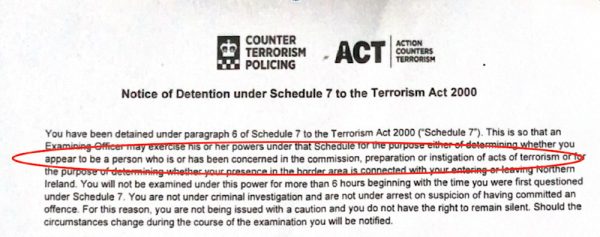
And yet, they asked me no questions about commissioning or instigating acts of “terrorism”. Not a single one.
Instead, they asked about extremism, the Western way of life, and asked me to characterise specific views on political violence. If the Trades Description Act applied to the Terrorism Act 2000 and to the activities of SO15, I would be making a complaint to the Heathrow Trading Standards Officer.
But the reason for this is that Schedule 7 is not really intended to disrupt actual terrorism, but to surveill and repress political views and political speech which is critical of UK foreign policy, including of course support for the Palestinians’ legitimate right to resist the Zionist occupation. Don’t believe me? Let’s look closely at the Home Office list of offences related to proscribed organisations.
As one can see from the offences below, none of them have anything to do with actual acts of violence. Let’s take each in turn.
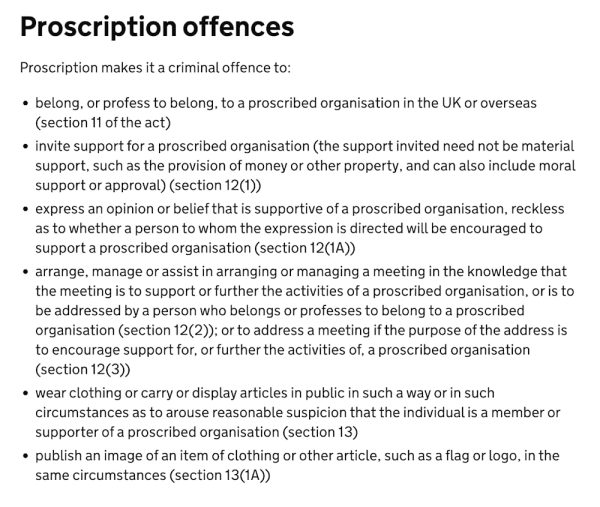
- Obviously being a member of a proscribed group might have some relevance, but membership is not itself an act of terror. And certainly, professing to be a member of Hezbollah is not, in itself, an act of terror.
- Inviting support for a proscribed group is an offence. How does one ‘invite’ support for a ‘terrorist’ organisation? The language is of course similar to the ‘notice’ issued to UK broadcasters on 19 October 1988. Otherwise known as the Broadcasting Ban, this was an attempt to suppress support for the Irish Republican movement and in particular its political wing Sinn Fein, which throughout the period remained a legal political party with many elected councillors in the north of Ireland. It made, as I argued at the time, no appreciable difference to the Irish Republican Army, the wing of the movement engaged in armed struggle. But what does it mean to ‘invite’ support? It’s not altogether clear and it is pretty plain that this particular provision has been of little use to the British state, resulting, as it has, in precious few convictions. As a result, the government added a wider and more vague clause to the act via the Counter-Terrorism and Border Security Act 2019, to which we turn next.
- Express an ‘opinion’ or ‘belief’ that is supportive of a proscribed organisation. What does that mean? It obviously has the potential to be stretched quite far into opinions and beliefs that are shared by most people, even in the UK. Is saying that Seyed Hassan Nasrallah, the assassinated leader of Hezbollah, was widely respected and admired an opinion which is ‘supportive’ of a banned group? Notice the language is ‘will be’ encouraged not ‘is’ encouraged. So, at best this is a conjectural crime which does not require that anyone is actually encouraged, only that the hypothetical ‘reasonable person’ might think that. Again, nothing here that relates to involvement in planning any ‘act’ of violence.
- Arranging or managing a meeting is, manifestly, not an act of violence, whether or not it involves giving ‘support’ for a proscribed organisation and whether or not a representative of the organisation speaks, or whether the purpose of the address is to encourage support. In fact, the more we hear the voices of those (in proscribed organisations and legal ones alike) who are involved in resisting the menace of Zionism and genocide, the better it will be for the possibility of ending the genocide.
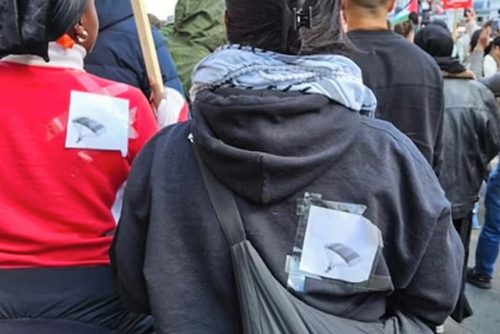
- Next is Clothing: It is an offence to ‘wear clothing or carry or display articles in public in such a way or in such circumstances as to arouse reasonable suspicion that the individual is a member or supporter of a proscribed organisation’. Articles of clothing are also not in themselves acts of terror, no matter how they are displayed. Obviously, what they have in mind here is branding relating to specific organisations, such as a Hezbollah flag, a Qassam Brigades head band, or other perhaps less directly connected imagery or items. Obviously, given the attemtps of the Zionists and their craven allies in the British security state, there is a push to widen the parameters so they can scoop up more and more supporters of the Palestinians. Thus the case of the young women found guilty under these powers of sporting parachute patches (below).
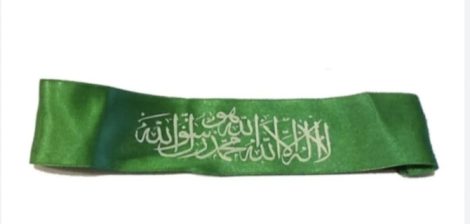
Or, the case of the young man found guilty of supporting Hamas for wearing a green headband with the Shahada (the Muslim profession of faith) on it (first below). This is of course not a ‘Hamas headband’. Al-Qassam Brigades, the military wing of Hamas, do have a specific headband with a gun on it! As can be seen, it is not at all similar (right below).

6. It is an offence to “publish an image of an item of clothing or other article, such as a flag or logo, in the same circumstances.” This is obviously intended to cover social media posts, which are manifestly not ‘acts’ or terrorism. This provision was inserted (12.4.2019) by Counter-Terrorism and Border Security Act 2019.
Overall, then, as we see these ‘proscription’ powers have nothing at all to do with interfering with material acts of political violence or armed struggle.
The proscription offences are not terrorism offences. It is an absurd nonsense, not to mention a colossal waste of resources, that SO15 are required to attempt to police thoughts, beliefs and speech as the vast majority of their activities at ports.
When the leading journalist Asa Winstanley was recently raided (but not arrested), he was told that it related to his alleged support for proscribed groups. A letter addressed to him ‘from the “Counter Terrorism Command” … indicates that the authorities are “aware of your profession” as a journalist but that “notwithstanding, police are investigating possible offenses” under sections 1 and 2 of the Terrorism Act (2006). These provisions set out the purported offense of “encouragement of terrorism.”’
And yet, if you look at the passage at the beginning of this article about commission or instigation of acts of terror, the implication is that to be of interest one would have to be involved in setting up a branch of Qassam Brigades in North London, or a version of Hezbllah’s Radwan Force in Reading. There is nobody in the entire counter-terrorism apparatus who believes that that is what Asa, me, or anybody else, is doing.
And when you put it like that, it’s also manifestly the case that neither Hamas, Hezbollah, the PFLP-GC or Palestinian Islamic Jihad are planning to set up branches in the UK, or – indeed – to carry out attacks here. Given the UK’s role in directly participating in the genocide, that is generous of them, but it appears to be a fact.
But more than that, free speech about armed groups fighting an almost universally acknowledged genocide should not be criminalised and proscribed.
And the case for proscribing their welfare, health, education and other manifest functions of Hezbollah and Hamas is even weaker.
They should be de-proscribed now.
Featured Video

or go to
Aletho News Archives – Video-Images
From the Archives
Israel Would Have No Qualms About USS Liberty-Style FALSE FLAG If Iran Campaign Falters – Analysts
By Ilya Tsukanov – Sputnik – 18.06.2025
Donald Trump is mulling whether or not to join Israel’s aggression against Iran as Tel Aviv faces problems sustaining its defenses against growing counterstrikes, and apparently lacks a realistic game plan for an end to hostilities after failing to achieve its goals. Analysts told Sputnik how the US could be ‘nudged’ into the conflict.
“The US is already assisting Israel with supplies, intel, refueling support, etc. One of the many US posts in the region could be attacked for a casus belli,” former Pentagon analyst Karen Kwiatkowski explained.
“If Trump doesn’t comply with Israel’s demand” and join its aggression voluntarily, “a false flag may be needed” to drag the US in, Kwiatkowski, retired US Air Force Lt. Col.-turned Iraq War whistleblower, fears.
Netanyahu has a diverse array of options at his disposal, according to the observer, including:
- a false flag against US assets abroad blamed on Iran or one of its Axis of Resistance allies, like the Houthis
- a US domestic attack or assassination blamed on Iran
- Iranian air defenses ‘accidentally’ hitting a civilian jetliner carrying Americans
- use of a dirty bomb or nuclear contamination somewhere in the region blamed on Iran
- even blackmailing by threatening to use nukes against Iran if the US doesn’t join the fight
Kwiatkowski estimates that Israel probably has “enough blackmail power” against President Trump and Congress to avoid the necessity of a false flag operation, but a “USS Liberty-style” attack, targeting the soon-to-be-retired USS Nimitz supercarrier that’s heading to the Middle East, for example, nevertheless cannot be ruled out entirely, she says. … continue
Blog Roll
 Aletho News
- Top PMU commander, over a dozen fighters killed in new US strikes on Iraq
- Is Netanyahu’s war gamble threatening the future of ‘Israel’?: FT
- Smotrich calls for annexation of South Lebanon to Litani River
- Echos of Gallipoli? Hormuz and the Geography of Hubris
- Pakistan PM backs Iran’s right to self-defense amid tensions
- Hungary blasts ‘fake’ EU accusation
- SAFE Debt Trap: Poland’s €43.7 Billion Bet on Unipolar Illusion
- War on Iran threatens global Gulf capital flows: FT analysis
- Mossad De Facto Admits To Inciting Riots In Iran
- Tehran: World grown thoroughly exhausted with US-Israeli ‘false flag storylines’
- If Americans Knew
- From Sde Teiman, the truth about Israel’s military justice system has been set free
- Child denied life-saving bone marrow transplant by Israel ‘because he is from Gaza’
- Raffi Berg: BBC Middle East Editor Exposed as CIA, Mossad Collaborator
- Jerusalem Archbishop Rebukes Netanyahu’s Statements on Christianity
- US to embed Palantir AI across entire military: Report
- Israeli-US war on Iran to drag on “a few more weeks” – Not a ceasefire Day 164
- Lebanon deaths top 1,200; Palantir AI to be embedded across US military – Not a ceasefire Day 163
- Israel’s assassination game: Take all pragmatists off the board
- Food shortages return to Gaza as Israel tightens aid restrictions under the cover of its war on Iran
- Trump demands trillions in payments from Gulf countries, billions from Harvard – Not a ceasefire Day 162
- No Tricks Zone
- Devastating Assessment Of Comirnaty Vaccine By Former Senior Pfizer Europe Toxicologist
- New Study: CO2 Is ‘Effectively Negligible’ As An Explanatory Climate Change Factor Since 2000
- Former Pfizer Toxicologist Dr. Helmut Sterz Tells Bundestag Hearing Pfizer Vaccine Should Have Never Been Approved
- Energy Expert: Germany’s Nuclear Phaseout Was A “500 Billion Euro Mistake”
- New Research: South Australia’s Mid-Holocene Sea Surface Temperatures Were 4°C Warmer Than Today
- Storing Green Energy To Last Germany 10 Days Would Require A 60-Million Tonne Battery
- New Studies: UK Sea Levels Were 4 Meters Higher Than Today During The Mid-Holocene
- Destructive Green New Deal: German Energy And Metal Group Warns Of Drastic Crisis
- New Study Documents A 20-Year Pause In Arctic Sea Ice Decline – Driven By Internal Variability
- Wake-up Call: Survey Shows Majority Of Germans Now Favor Postponing Climate Targets!
 Aletho News