Israel Considers Ceasefire a Betrayal
Iran opens the Strait of Hormuz during 10-day ceasefire
By Kurt Nimmo | Another Day in the Empire | April 17, 2026
The Prime Minister of Lebanon, Nawaf Salam, thanked President Trump for a ten-day ceasefire announced on Truth Social that took effect at 5PM on Thursday, April 16. Benjamin Netanyahu agreed to the US-brokered deal, but with the same caveat imposed after Hamas conducted its Operation Al-Aqsa Flood breakout and offensive on October 7, 2023.
Israel reserves the right, the US State Department said, to carry out strikes in Lebanon “at any time” under Article 3 of the agreement. Netanyahu’s carte blanche states:
“Israel shall preserve its right to take all necessary measures in self-defense, at any time, against planned, imminent, or ongoing attacks. This shall not be impeded by the cessation of hostilities. Besides this, it will not carry out any offensive military operations against Lebanese targets, including civilian, military, and other state targets, in the territory of Lebanon by land, air, and sea.”
A similar double standard permitted Israel to violate the Gaza ceasefire agreement at least 2,400 times from October 10, 2025 to April 14, 2026, killing more than 700 Palestinians in the process.
“Israel has made a mockery of the supposed ceasefire agreements in both Lebanon and Palestine,” writes Maryam Jameela for The Canary. “They’re able to keep killing people, and to keep restricting the necessary conditions for life because international governments continue to allow them to.”
In Lebanon, Deputy Foreign Minister Saeed Khatibzadeh insisted his country is part of the US-brokered ceasefire arranged between Iran and Israel. Ibrahim al-Moussawi, a Hezbollah lawmaker, said the group would respect the deal if Israel did not target Hezbollah.
Trump said Hezbollah is party to the ceasefire and added that the government of Joseph Aoun will work to disarm the resistance group. “They’re going to be having a ceasefire and that will include Hezbollah,” the president told reporters. He added that he hopes “Hezbollah will behave.”
The paramilitary group, formed in the early 1980s during the Lebanese Civil War in response to an Israeli invasion and occupation of south Lebanon, insists it will not disarm. “We will not surrender or give up to Israel,” said Hezbollah leader Naim Qassem last July. “Israel will not take our weapons away from us.” In November, after assassinating Hezbollah’s Chief of Staff, Haytham Ali Tabatabai, Netanyahu called on the Lebanese government to disarm Hezbollah, a task it is not capable of accomplishing.
Israeli Media: Ceasefire is a “Double Submission”
In Israel, response to the ten-day ceasefire was met with anger and hostility by officials, journalists, and analysts. According to Israeli Channel 14, Netanyahu’s cabinet members reacted angrily at learning of the deal through social media. Israeli media framed the ceasefire as a betrayal and sellout to Hezbollah.
Marwa Osman, a journalist and television show host in Beirut, summarized the reactions on her X account.
Tamir Morag of Channel 14: “The way President Trump announced the ceasefire was embarrassing for Israel. It was clear that Israel’s interest was to continue fighting against Hezbollah.”
The nationalist opposition leader of Yisrael Beiteinu (“Israel is Our Home”), Avigdor Lieberman, complained, “The ceasefire in Lebanon is a betrayal of the residents of the north. The war must not end without a decisive outcome and the elimination of Hezbollah; this October 7 government has learned nothing.”
Ariel Kahane, a senior Israeli journalist and diplomatic correspondent for Israel Hayom daily, declared, “Donald Trump’s move reflects a double submission to Iran: Trump is aligning with Iran’s linking of the war in its territory to Lebanon. He is leaving one of Iran’s arms alive, active, and dangerous.”
Benny Ben Muvchar, head of the Mevoot Hermon Regional Council in northern Israel: “Hezbollah is still strong and waiting for us… the [Arab dominant] Galilee is being emptied of its residents, and we are being led by Trump’s whims.”
Israel’s i24 News characterized the ceasefire as a gift to Iran. “A more alarming development is that Iran itself informed the Americans that it wants to see a ceasefire in Lebanon, in order to advance negotiations between Tehran and Washington. What is happening amounts to a gift to Tehran at the expense of the northern settlements,” while Channel 13 complained the “ceasefire in Lebanon was imposed on Israel.”
“Residents of the north feel once again that they have been betrayed,” Channel 13 also reported. “We felt it during the ‘Iron Swords’ war [response to al-Asqa Flood], and we feel it again today. The fact that the U.S. President announced the ceasefire only highlights the distance between the Israeli Prime Minister and the people in the north and their reality.”
Critics claim Netanyahu delivered a coup de grâce when he “rejected a request by members of the security cabinet to vote on the ceasefire decision in Lebanon,” according to the Israeli newspaper, Yedioth Ahronoth.
On April 15, before the ceasefire in Lebanon, Netanyahu asserted that Israel was not obligated to adhere to Trump’s ceasefire agreement with Iran. Consequently, the Israeli military continued its attacks on Lebanon, despite the original agreement explicitly including Lebanon in the ceasefire.
Roaring Lion: 90% of Israelis Support Illegal Attack on Iran
The ceasefire between the United States and Iran is viewed negatively by settlers in northern Israel, according to the results of a survey conducted by the Israel Democracy Institute. In regard to Israel’s Operation Roaring Lion, concurrent with Trump’s Operation Epic Fury, the survey showed that “more than 90% gave the IDF a positive performance rating,” although the poll did not investigate Israeli responses to the concerns of international law experts, human rights organizations, and UN officials.
Israeli strikes resulted in significant civilian casualties and destruction of civilian infrastructure, including residential buildings. On February 28, 2026, a joint US-Israel attack struck a primary school in Minab, southern Iran, killing over 170 people, most of whom were children. Israeli strikes on Iranian oil depots on March 7, 2026, were also flagged for potentially causing long-term health and environmental damage to civilians.
In response to the attacks on Iran, over 100 international law experts signed a letter condemning them as violations of the UN Charter and potentially war crimes. Additionally, UN experts condemned the aggression against Iran and Lebanon, warning of the catastrophic impact on civilians and urging an immediate ceasefire.
Conversely, Iran’s retaliation, including the use of cluster munitions, has been condemned by Amnesty International. Civilian deaths in Ramat Gan, Tel Aviv, Yehud, and Bat Yam have come under investigation. A missile that struck Beit Shemesh that killed nine civilians is being investigated as a war crime.
Strait of Hormuz Open to Commercial Traffic
Following the ceasefire agreement, Israel Defense Minister Katz said the ongoing campaign against Hezbollah is far from over. According to Katz, the IDF has achieved several significant victories. However, certain areas in southern Lebanon have not yet been fully cleared. Weapons and combatants may still be present in these zones, and their removal is deemed crucial, he said.
According to the Lebanese army, there had been “a number of violations of the agreement, with several Israeli attacks recorded, in addition to intermittent shelling targeting a number of villages.” French President Emmanuel Macron expressed concern that the ceasefire has been compromised by ongoing military operations, as reported by AFP.
The Iranian Foreign Minister, Abbas Araghchi, responded to the tenuous ceasefire by announcing the temporary opening of the Strait of Hormuz. “In line with the ceasefire in Lebanon,” Araghchi said, “the passage for all commercial vessels through Strait of Hormuz is declared completely open for the remaining period of ceasefire.”
The price of Brent oil fell below $84 on the announcement and West Texas Intermediate futures, the US benchmark, dropped by 10% on the news of Araghchi’s announcement. Additionally, the Dow rose 640 points, around 1.2%, the S&P 500 gained 0.7%, and the Nasdaq rose 1%. “The stock market is good,” Trump declared, “the oil prices are coming down, and it’s looking very good that we are going to make a deal with Iran.”
However, considering Israel’s history of ceasefire violations, and the response by Hezbollah and Iran, it is entirely possible hostilities will resume and the strait will once again be closed to tanker and carrier traffic, thus dashing hope the war is now winding down and there is a peace deal on the horizon. As noted above, Israel has indicated it will continue military operations at its discretion.
‘Normalization Talks’: Lebanon No Longer Has A Government
By Robert Inlakesh | Palestine Chronicle | April 15, 2026
The Lebanese state no longer has even the semblance of sovereignty, stooping lower than any previous administration. Immediately after Israel committed one of the most violent civilian massacres in Beirut’s history, the government’s top officials begged to normalize ties with the killers and implement a plan that could drag their country to civil war.
Former Lebanese President, Bachir Gemayel, once sought to achieve a silent agreement with Israel, while many speculated that a full normalization agreement was his end goal. In the end, he only lasted 21 days in office before a fellow Maronite Christian assassinated him with a remotely detonated bomb.
Despite Gemayel clearly maintaining close ties to the Israelis and having been a leader of the fascist Kataeb militia, upon taking office, he adopted a “no vassal” policy to at least make it appear as if he wasn’t working on behalf of Tel Aviv. Conscious of the fact that in 1982 the Israelis were launching a war of aggression against Lebanon and were on their way to slaughtering 20,000 people, he understood the need to try and present the image of independence, not that of a traitor as many were accusing him of being.
Fast forward to 2026, the Lebanese Prime Minister Nawaf Salam and President Joseph Aoun are openly begging for direct government meetings with Israel. At a time when Israel has murdered over 2,100 people in Lebanon – targeting journalists, hospitals, emergency workers, and countless other civilian targets – the government is entering normalization talks.
While protesters quickly took to the streets, in opposition to the scheduled talks, labeling the government as traitors and stressing the need to reject normalization, the administration attempted to mislead the people into believing that a ceasefire was set to be discussed. Then came a bombshell article from Axios News, followed by a series of statements from Israeli officials, confirming the suspicions of the Lebanese population.
Israel has explicitly stated that it will not even discuss a ceasefire, but is entering into talks to reach a “peace deal”, while Axios reported that, during a phone call last Friday, the Lebanese government requested “that the Israelis go back to the understandings of the Nov. 2024 ceasefire and conduct strikes only against imminent threats from Hezbollah.”
This means that the Lebanese government has desperately pleaded for direct talks, without even setting a demand that Israel stop bombing their country first or even sit down to discuss that possibility. The maximum request was that Tel Aviv agree to return to the “ceasefire” predicament prior to the current war, where it committed 15,400 violations and concentrated most of its firepower on the south.
Prime Minister Nawaf Salam even summoned the commander of the Lebanese Army, Rudolphe Heikal, during the war, because he was not willing to stand against Hezbollah and implement the US-Israeli demand to disarm the one group protecting the country.
President Aoun gave a speech earlier this month, in which he told the people that he was waiting for Israeli approval so that the State would be able to repair a water pipe in the south of the country, almost as if he was willingly participating in a humiliation ritual.
Last Friday, scenes were filmed as protesters in Beirut stood across from disarmed members of the Lebanese Armed Forces, who were deployed with riot shields to the area. A man screamed at the soldiers, urging them to join the resistance in the south and asking them how they could continue to serve an army that doesn’t even pay their salaries. One of the soldiers even broke down in tears, sobbing uncontrollably as the demonstrator spoke.
Israel has killed dozens of Lebanese security force members and army personnel, yet the government in Beirut refuses to allow them to fire a single bullet back. Instead, they flee any area Israel orders them to, as if they are receiving their commands from Tel Aviv and not their own Capital city.
Meanwhile, the Lebanese Hezbollah fighters are waging fierce ground battles to defend the country from invading Israeli soldiers, who are attempting to place south Lebanon under an illegal occupation, returning the situation to the pre-2000 predicament.
Israel Katz, Tel Aviv’s defense minister, openly asserts that the displaced civilians from southern Lebanon will not be allowed to return and that the land will be seized by the Israeli military. Meanwhile, the Israeli government demands that Lebanon order the violent disarmament of Hezbollah, a move that would lead to certain civil war.
Not even a week after Israel launched over 100 attacks in only 10 minutes, killing around 300 people and demolishing entire high-rise buildings in the Lebanese Capital, Nawaf Salam and Joseph Aoun are seeking normalization. A move that breaks from the Lebanese government’s long-held position of requiring a Palestinian State prior to engaging in such negotiations.
Although the Lebanese government has a long history of abandoning the people of south Lebanon, pretending as if a whole segment of their country doesn’t even belong to them, this is perhaps the most shameful chapter yet.
Neither the President nor the Prime Minister was actually directly elected by the Lebanese people. Instead, they seized their positions with US backing, riding on the political predicament that Israel’s war against the country in 2024 had created to obtain power. Now they take a position that not only breaks from the Arab Peace Initiative, but they also seek to talk “peace” with an Israeli government that won’t even consider pausing dropping bombs on their country.
All of this begs the question: What legitimacy does such an administration have with its people? And if little to none, then how is it even considered a Lebanese government? The behavior of its officials appears more in line with that of the Lahad Army than of a Lebanese national administration.
– Robert Inlakesh is a journalist, writer, and documentary filmmaker. He focuses on the Middle East, specializing in Palestine.
Pressure builds on Iran to ‘drop’ Lebanon ceasefire demand as Islamabad talks hang in balance
The Cradle | April 11, 2026
Pakistani officials are pressuring the Iranian delegation in Islamabad to enter talks with their US counterparts by “dropping” demands for a ceasefire in Lebanon, according to information obtained by Lebanese journalist and The Cradle columnist Dr. Mohamad Hassan Sweidan.
“The authorities in Lebanon have agreed to postpone the ceasefire and to discuss it directly with Tel Aviv; therefore, you cannot exert pressure in a direction that contradicts what the Lebanese themselves have accepted,” the Iranian delegation was informed on 11 April, according to Sweidan’s sources.
Nevertheless, Iranian officials have expressed that their position on a region-wide ceasefire remains firm, revealing that a final resolution to halt the attacks is a “condition for the success of the negotiations — not merely a request.”
“If the Iranian delegation reaches the conviction that the US side is not serious and that the negotiations will not lead to the desired results, it will withdraw and return to Tehran,” Sweidan stressed.
According to his sources, coordination exists between the Iranian delegation and the leadership of Hezbollah in Lebanon.
Officials from Iran and the US arrived in the Pakistani capital on Saturday for the first round of indirect negotiations toward a possible ceasefire.
The Iranian delegation is led by Foreign Minister Abbas Araghchi and Parliament Speaker Mohammad Bagher Ghalibaf.
US Vice President JD Vance is leading the delegation for his country. He is accompanied by Donald Trump’s son-in-law, Jared Kushner, and special envoy Steve Witkoff.
According to reports on Iranian TV, Tehran has set clear red lines for Saturday’s talks: control of the Strait of Hormuz, war reparations, the release of frozen assets, and a permanent ceasefire on all fronts in the region.
Soon after Iran and the US agreed to a brittle ceasefire earlier this week, Lebanese Prime Minister Nawaf Salam demanded his country not be included in the process.
Since then, the Lebanese government has agreed to hold direct talks with Israeli officials in Washington, which many in the country view as an attempt to normalize relations with Israel and “weaken” the Lebanese resistance by prolonging the war.
The push to be excluded from the regional ceasefire came despite a wave of Israeli terror attacks across Lebanon this week that killed over 300 Lebanese and injured over 1,000, including several members of the state security forces.
According to Lebanese journalist Hassan Illaik, in recent days, Arab and European diplomats were told by a close adviser to Lebanese President Joseph Aoun, “The war must continue until Hezbollah is eliminated.”
Senior Hezbollah official and member of Lebanese parliament, Hassan Fadlallah, on Saturday condemned the push by Beirut as a “blatant violation of the national pact, constitution, and laws.”
“The move by those controlling the government deepens internal divisions at a time Lebanon needs unity to face ongoing Israeli attacks, preserve civil peace, and protect coexistence,” Fadlallah said, adding that authorities “should have prioritized national interests” by benefiting from the international opportunity created by Iran’s support for Lebanon.
Laith Marouf: Hezbollah’s position on US-Iran ceasefire: What you’re not being told
Dialogue Works | April 8, 2026
Netanyahu unilaterally declares Lebanon outside of ceasefire deal
Al Mayadeen | April 8, 2026
Just a couple of hours after a ceasefire deal was reached, “Israel’s” Prime Minister Benjamin Netanyahu announced Wednesday that his government supports the US decision to suspend strikes on Iran for two weeks, but immediately breached the agreement by declaring it does not extend to Lebanon.
In a statement posted on the Israeli Prime Minister’s Office X account, Netanyahu said the Israeli regime backs Washington’s efforts to ensure Iran “no longer poses a nuclear, missile and terror threat,” and acknowledged that the United States had communicated its commitment to achieving these goals in upcoming negotiations.
However, buried at the end of the statement was a unilateral carve-out: “The two-week ceasefire does not include Lebanon.”
The Israeli regime has already violated the ceasefire before the ink had dried, targeting an ambulance in southern Lebanon alongside bombing several towns in the South.
Israel bombs ambulance, kills 4
All of the following attacks took place shortly after the ceasefire came into effect.
Israeli forces opened their post-ceasefire assault by targeting an ambulance in the town of al-Qleileh in the Tyre district, South Lebanon, killing four people, per Al Mayadeen’s correspondent.
In the Ras al-Ain area, our correspondent reported that an Israeli airstrike hit another vehicle, wounding a number of people. An Israeli drone also struck a motorcycle in Qana, causing injuries.
The IOF carried out airstrikes across al-Rayhan and Nabatieh al-Fawqa in the South, while Israeli artillery shelled a string of towns across the Bint Jbeil district, like Touline, Jmeijmeh, Baraachit, Majdal Selm, and Shaqra. Meanwhile, the town of Hadatha was attacked twice in the early hours of the morning.
In the Bekaa, an airstrike targeted the town of Yohmor.
Direct contradiction of Pakistani mediator
The declaration stands in direct contradiction to the announcement made by Pakistani Prime Minister Shehbaz Sharif, who brokered the agreement.
Sharif stated that “the Islamic Republic of Iran and the United States of America, along with their allies, have agreed to an immediate ceasefire everywhere, including Lebanon and elsewhere, EFFECTIVE IMMEDIATELY.”
Israeli media outlets, including Ynet and Maariv, had reported that the ceasefire encompassed Lebanon. Israeli Channel 12 further cited a security source confirming that the Iranians “insisted that the ceasefire also includes Lebanon.”
Iran’s demands throughout negotiations had explicitly included an end to aggression on all fronts, Lebanon among them.
Israeli public reacts with fury
The ceasefire announcement triggered a wave of frustration across Israeli media. Israeli broadcaster Channel 11 reported that settlers remained in shelters even as the truce was declared. Other outlets described the agreement as “the largest failure in Israel’s history since October 7.”
Maariv was particularly critical, writing that the United States and “Israel” had abandoned most of their war objectives, creating a new regional reality. The outlet said Iran had succeeded in dragging both into an agreement that amounted to surrender from both sides, and that after 41 days of fighting and 5,000 buildings destroyed, the outcome was a decisive Iranian victory, with Hezbollah expected to return stronger than before. Iran and its allies, Maariv concluded, appeared to be the only party emerging victorious from the confrontation.
Commentators questioned the logic of the deal, with one platform sarcastically asking, “Forty days and an entire nation staying home for a ceasefire?”
Trump was not spared either, with several outlets calling him “a global joke” and “a weak man unable to withstand pressure.”
Hezbollah hits Israeli warship off Lebanon’s coast, sets it aflame
Press TV – April 5, 2026
Fighters from the Lebanese Hezbollah resistance movement have carried out an operation in retaliation for the Israeli acts of aggression against Lebanon, targeting a military vessel off the coast of the Arab nation before it could launch any hostile action.
According to a statement issued by the group on Sunday, Hezbollah members targeted an Israeli military ship 68 nautical miles off the Lebanese coast, stressing that the vessel was preparing to carry out its aggressions against Lebanese territory.
“The targeting operation was carried out with a naval cruise missile after monitoring the target for hours, and it was confirmed to have been directly hit,” the statement noted.
Hezbollah emphasized that the strike falls within the framework of Operation Devoured Straw, and in defense of Lebanon and its nation.
This came a day after the Lebanese resistance fighters conducted a total of 42 top-tier operations against Israeli positions, including military bases and illegal settlements.
Hezbollah said 20 operations out of those conducted struck enemy positions within the occupied territories, while 21 were carried out on Lebanese soil.
“The most distant operation reached a target located 15 kilometers beyond the Palestinian-Lebanese border,” the statement read.
Three more military operations were carried out during the early hours of Sunday, which included separate attacks on Israeli forces inside Lebanese territories or along the border settlements.
Israeli Channel 12 television channel has revealed that Northern Command chief Major General Ravil Milo admitted in a leaked closed-door meeting with settlers in Misgav Am that the regime’s military apparatus was “surprised” by Hezbollah’s ability to rebuild its strength.
According to the report, post-war assessments following the 2024 aggression on Lebanon that claimed Hezbollah had been neutralized were “overly optimistic.
Milo highlighted a widening gap between what the Tel Aviv regime believed after the war and the current situation on the ground, acknowledging that Hezbollah continues to maintain both presence and operational capabilities.
“They suddenly found that Hezbollah still exists,” he said, underscoring the persistence of the resistance despite previous Israeli assertions.
Forced to backtrack: ‘Israel’ drops Hezbollah disarmament goal
Al Mayadeen | April 3, 2026
The Israeli occupation army has acknowledged that disarming Hezbollah is not among the objectives of the current war, marking a significant reversal from positions held just two weeks prior, and a tacit admission of the limits of its military options in Lebanon.
“Israel’s” Channel 12 first reported the shift, with Israel Hayom military correspondent Lilach Shoval confirming that dismantling Hezbollah’s weapons is “not on the agenda.”
Yedioth Ahronoth described it as a formal change in the army’s direction, especially as the reversal came only two weeks after the army had publicly insisted it would pursue the full dismantling of Hezbollah’s arsenal.
The army now defines its primary objectives against Hezbollah as significantly weakening the group, establishing “a deep defensive line”, and demolishing dozens of homes along the frontline villages, mirroring the “yellow line” model applied in Gaza.
On disarmament, Israeli army officials admitted that “we must be modest on this issue.”
A sharp reversal
The course reversal stands in stark contrast to the maximalist rhetoric that defined the aggression’s opening weeks. Israeli War Minister Israel Katz had vowed to “separate Lebanon from the Iranian arena and strip Hezbollah of its ability to threaten, changing once and for all the situation in Lebanon,” explicitly invoking the Gaza model.
Meanwhile, IOF Chief of Staff Eyal Zamir declared the campaign would end with “Hezbollah suffering a devastating blow,” while Finance Minister Bezalel Smotrich went further, calling for the Litani River to become the entity’s “new border with the Lebanese state.”
Katz had also announced on March 24 that the IOF would establish a permanent security zone inside Lebanon up to the Litani River. He stated that all homes in border-adjacent villages would be demolished and that the return of displaced Lebanese civilians would be “completely prevented.”
Where officials once spoke of transforming Lebanon’s strategic landscape, the occupation army now concedes that full disarmament would require “a full occupation of Lebanon and the systematic dismantling of military infrastructure in every village,” conditions it realizes are unrealistic.
Notably, Israeli officials maintained that only the IOF, not the Lebanese state or any other party, could disarm Hezbollah, while simultaneously acknowledging that the conditions to do so do not exist.
‘A complex arena’
Earlier in the week, Israeli Channel 11, citing former army and Mossad officials, reported that “the Lebanese arena differs entirely from any other in terms of its complexity and military entanglement.”
Retired Major General and former Mossad chief Danny Yatom said Hezbollah fighters in southern Lebanon “hold a relative advantage over the Israeli army due to their deep familiarity with the terrain,” adding that “every tree trunk and every small hill can serve as an ambush position.”
He cautioned that even controlling territory up to the Litani River “would not solve the problem of rockets and shells,” and stressed that the real challenge lies in adapting at the tactical level, not merely the strategic one.
Lieutenant Colonel (res.) Oren Leshem, a former senior Israeli Air Force officer, was equally candid, saying there is “no magic solution to the Lebanon issue” and that the army has tried every available approach over the past 18 years, including during the Second Lebanon War, yet the situation “remains complex and highly challenging.”
Channel 14 added that “the problem in Lebanon is that military forces are constantly on the move and exposed, while Hezbollah exploits the terrain to target them.”
Britain’s Lebanon surveillance network: A digital map for war
By Kit Klarenberg | The Cradle | April 3, 2026
On 7 March, the British government contractor Siren Associates unveiled Monitor Lebanon, a “real-time situational awareness platform” framed as a public safety tool “designed to help individuals and organizations understand and navigate Lebanon’s rapidly evolving security environment.”
The tool sifts vast swaths of “open-source information” from “news agencies, verified social media accounts, Telegram channels, conflict monitoring initiatives, and traffic data systems.”
Presented as a lifeline for journalists, humanitarian workers, businesses, and civilians during Israel’s ongoing war on Lebanon, the platform carries a far more operational intelligence function. Behind the humanitarian branding lies a sophisticated surveillance infrastructure embedded deep within the Lebanese state.
At the core of Monitor Lebanon is a live interactive incident map tracking “reported security events and key operational information.” The data is highly detailed, including information on “affected areas, road conditions, hospital locations, and other indicators that help users understand how developments may affect movement and access.”
A press release announcing the platform’s launch asserts Monitor Lebanon was initially constructed to provide Siren Associates staff with “a clearer view” of local events, before being rolled out for general public use.
“Already, team members displaced by the ongoing hostilities have been using it to check for reported strikes near their homes and to track evacuation orders. But many more people are navigating the same uncertainty, so we want to make this tool available to anyone who may benefit from clearer, real-time information.”
How did a British contractor produce such a detailed, nationwide surveillance platform instantly as the occupation state escalated its assault on Lebanon?
The answer lies in nearly two decades of British-backed penetration.
As The Cradle revealed in September 2021, Siren has received tens of millions of pounds from London to “professionalize” Lebanon’s Internal Security Forces (ISF). Staffed by former British military, intelligence, and policing officials, the company operates in Lebanon’s security sector in plain sight, yet largely beyond scrutiny.
Embedding control through ‘reform’
Siren’s footprint inside Lebanon’s state apparatus is extensive. The company maintains close ties with senior ISF officers, political figures, ministries, and intelligence branches. It has also cultivated future leadership within the ISF through training and recruitment programs.
In May 2019, Siren established Lebanon’s Command and Control Center with British funding. The installation provides the ISF with “state-of-the-art equipment, information and communication technology systems, [and] an analysis and planning room,” purportedly to strengthen the security forces’ intelligence capabilities.
In practice, it embedded a direct channel for British intelligence into Lebanon’s internal security infrastructure.
Such access grants London visibility over investigations, operations, and internal data flows. Over time, this has enabled the systematic accumulation of sensitive information on Lebanese citizens.
The scale of this data collection expanded dramatically during the COVID-19 pandemic. Siren quietly built COVAX, the digital backbone of the Lebanese government’s COVID19 vaccine rollout. Users could register, schedule appointments, and receive vaccine certificates. Over four million people used the service, logging extraordinary amounts of personal information in the process.
What appeared as public health infrastructure operated as a mass data capture system.
From welfare to surveillance architecture
COVAX became the foundation for broader digital penetration. In 2021, the World Bank allocated $246 million to Lebanon for social assistance. Siren used its existing infrastructure to launch DAEM, whereby citizens could apply for social assistance “in record time.”
Carole Alsharabati, Siren’s longtime research chief, has explained that “the idea [was] to deploy a system that was fully digitized from A to Z, just like we did for the vaccine.”
“The registration, the selection, then the payment, the cash transfer, the verification, the dashboard, etcetera. Everything was digitized. And we used the same framework, the same ecosystem, the same machines, the same security protection, the same data governance approach we used in the vaccine.”
Alsharabati described Lebanon at the time as a “very difficult environment,” with the experience of building DAEM “a wild journey.” After all, the country lacked a unique ID system, digital identification, or any established data governance rules, procedures, or even cybersecurity.
However, “nothing stood in the way of Siren’s determination to tackle these and many other challenges.” Evidently, the British and Lebanese governments were happy with the results. It was just the beginning of Siren’s new role in Beirut, constructing deeply intrusive databases on citizens.
This work has been replicated in multiple fields over the years, culminating in Monitor Lebanon’s recent launch. Much of this activity passed entirely under the public radar. It was not until December 2024 that Siren’s central COVAX role was openly admitted on the company’s official website, for example. That same month, Siren announced it had built a bespoke resource for the ISF, collating “operational data to inform decision making around mission planning, resourcing and management.”
Under the project’s auspices, British intelligence created a network of six separate Command and Control Centers across the country, linked digitally to 22 regional operation rooms. A “digital platform that enables the capture and analysis of crime and operational data” was also developed.
In December 2024, too, Siren disclosed how it had introduced “e-governance tools connecting more than 20 ministries, 1,000 municipalities and 1,500 mukhtars [local governments].” Unmentioned was a major scandal that erupted over this effort upon its rollout two years prior.
According to Lebanese daily Al-Akhbar, the platforms produced by Siren were not secure, and permitted the firm to harvest the data of millions of users. Dubbed IMPACT, the resource allowed citizens to access a variety of government services, including applying for welfare payments.
The British embassy in Beirut, which funded the platform to the tune of $3 million, denied any wrongdoing, as did Siren. Nonetheless, local digital rights group SMEX expressed grave concerns over the security of private information stored by IMPACT, which was highly sensitive in nature.
Mapping a society for war
That Siren hoards an enormous amount of invasive information as a result of its work for and with the ISF is underlined by an April 2025 study, funded by Britain’s International Development wing. It probed “irregular maritime migration from Lebanon over the past three years,” placing the phenomenon in the context of Beirut’s “ongoing political, socio-economic, and security crises.”
The research sought to ascertain “who is migrating, why they are choosing to leave by sea, and what risks they face – particularly across gender lines.”
In September 2025, London renewed Siren’s ISF contract, allocating £46.3 million (around $61.3 million) – a significant increase. The timing raises serious questions about how much of that funding went into building Monitor Lebanon ahead of renewed Israeli escalation.
Since Operation Al-Aqsa Flood in October 2023, British activity in West Asia has pointed toward deeper involvement in a wider war effort targeting Iran and its allies.
In November that year, London attempted to secure unrestricted military access to Lebanese territory under the pretext of “emergency missions.” The proposal would have allowed British forces to operate freely, armed and immune from prosecution.
Public backlash forced Beirut to reject the plan. But the infrastructure remained.
Through Siren, Britain has built a digital panopticon spanning Lebanon’s institutions and population. This system provides real-time intelligence with clear military applications.
From Tel Aviv’s perspective, the benefits are obvious. Such data can be used to identify, track, and target members of Hezbollah and their support networks. It can also map civilian environments in ways that facilitate precision strikes.
The parallel to Palantir’s predictive surveillance platforms is clear.
Targeting the Axis of Resistance
Siren’s projects consistently overlap with services provided by Hezbollah. This is not accidental.
For years, British intelligence has worked to undermine the resistance movement’s social base by constructing parallel state structures.
For example, under the terms of a Foreign Office-funded youth radicalization effort, London sought to create an alternative to Beirut’s Hezbollah-run Ministry of Youth and Sport. It was hoped that “young, talented students and graduates” would thus reject the group.
There is little sign of these initiatives having borne fruit. A promptly deleted 23 March Daily Telegraph report documented how Lebanese Christians wholeheartedly embrace Hezbollah, and are determined to resist western-inspired efforts by Beirut’s army to disarm the resistance faction. “How can we as Christians in this area not be with Hezbollah?” a local citizen asked the newspaper perplexedly.
“They protect our churches. They helped us fight ISIS. During COVID, they gave us free care in their hospitals. When there was no electricity, they gave us generators. They even put up a Christmas tree at Christmas. How can we not be with them now?”
Despite the practical impossibility of disarming Hezbollah, it is a fantasy long harbored by western powers, which has gained in ever-mounting urgency since Israel’s genocide of Palestinians in Gaza commenced.
A British parliamentary briefing in September 2025 expressed optimism that the election of former Lebanese Armed Forces (LAF) commander Joseph Aoun as president would weaken Hezbollah’s military wing.
That same month, US special envoy to Syria Tom Barrack openly proposed equipping the LAF “so they can fight their own people.”
He acknowledged that Israel’s aggression since October 2023 had only increased Hezbollah’s popularity, while offering “zero” incentive for disarmament.
Aoun’s presidency has not dismantled Hezbollah. Israeli military escalation continues, with mounting losses on the battlefield and rising civilian casualties across Lebanon.
While its catastrophic military losses accumulate daily, innocent Lebanese civilians are being killed in significant numbers. The line of responsibility for their deaths may lead directly back to London, courtesy of Siren Associates.
A New Resistance Front: How Does Syria Factor into the Regional War?
By Robert Inlakesh | The Palestine Chronicle | April 2, 2026
A new Syrian resistance group has emerged and is the only organization in the country currently carrying out offensive actions against both Israeli and US targets. This development comes as Israel uses the newly occupied territories in its ground assault on Lebanon, a move that could easily rope Tel Aviv into a new quagmire.
While a US allied leader now technically controls Damascus, the reality on the ground in Syria is that there is no functional State. This being the case, the outbreak of chaos is simply one miscalculation away.
In stark contrast to the regimented and tightly controlled Syria that existed under the rule of Bashar Al-Assad and his father Hafez al-Assad, the country today is divided between countless powers throughout the country, with the President functioning as less of a strongman and more of a symbolic figure that covers the explosive charges ready to detonate. Nowhere was this on clearer display than in the July 2025 clashes in southern Syria’s Sweida Province.
President Ahmed al-Shara’a, also known as Abu Mohammed al-Jolani, has allied himself with his Western backers and even gone as far as signing onto a normalization mechanism with Israel. Short of full normalization of ties with Tel Aviv, the “joint fusion mechanism” that was agreed upon by Syrian and Israeli officials seeks to “facilitate immediate and ongoing coordination on their intelligence sharing, military de-escalation, diplomatic engagement, and commercial opportunities under the supervision of the United States.”
Knowing this, it would therefore appear strange that the Israelis still persist with not only bombing Syrian civilian infrastructure across the country, but also Syria’s new military forces. Understanding why will help in unlocking what appears on the surface to be a difficult puzzle to solve.
The Syrian leadership is Hayat Tahrir al-Sham (HTS), infamous for being a rebrand of al-Nusra Front (Al-Qaeda in Syria). Although it is presented as if it were a real government, the group never had any experience in governance. Instead, they knew only how to rule over smaller militia factions and worked as the de facto leadership in Idlib, despite there having been a “Syrian Salvation Government” (SSG) who were technically in control of the territory.
Prior to the fall of Bashar al-Assad’s leadership in December of 2024, HTS had consented to the SSG’s existence in order to give the veneer of a professionally organized opposition. In reality, HTS held all the power cards, even running its own secret prisons, while leaving the administrative details to be hashed out by the professionals.
All of this is of great importance because Bashar al-Assad’s entire system was not overthrown in some kind of war of liberation; instead, it collapsed without any real fight. Therefore, when Ahmed al-Shara’a entered Damascus and declared himself leader, he was in a very difficult position.
Under the supervision of his foreign backers, chiefly the United States, the new Syrian leadership focused on symbolism rather than fundamentally changing the way the country functioned. Therefore, Damascus opened itself up to Washington and became a playground for Western and Israeli intelligence agents, as the new President attempted to impress Washington.
Meanwhile, many of the most corrupt elements belonging to the former regime, were permitted to continue on as if it was business as usual, all as the Syrian Arab Army (SAA) and former intelligence and police services were disbanded. What replaced the former security apparatus were simply militants belonging to the alphabet soup of Al-Qaeda affiliates that had been operating previously out of Idlib.
This being the case, the words of Ahmed al-Shara’a often have little to no bearing on what actually transpires on the ground. Meaning that corruption is rampant, every corner of the nation is filled with different armed forces who have their own territory when push comes to shove. In essence, all of Syria became a big Idlib.
Syria is no longer subjected to sanctions, has gained access to its most fertile agricultural lands, is no longer internationally isolated, while ruling over its own oil and gas fields. Despite all of this, the country’s economy is still in the toilet, and the long-promised prosperity has been reduced to vague future visions. This isn’t to say it’s impossible for things to change, but as it stands, this is Syria today.
Because of the state of Syria’s affairs, cross-border smuggling has exploded and this has evidently benefited Lebanese Hezbollah next door. Two sources familiar with the matter informed Palestine Chronicle that the quantity of weapons flowing through the Syrian-Lebanese border had even increased since the fall of Bashar al-Assad.
According to reports, the US has been applying pressure on Damascus to attack Lebanon in order to help Israel weaken Hezbollah in the Bekaa Valley region. In response, President al-Shara’a broke his silence this Tuesday and declared that Syria will not attack Lebanon, an announcement that came following a threat earlier that day from an Iraqi Popular Mobilization Units (PMU) spokesperson, threatening to attack if Damascus orders such a move.
This affirmed previous suspicions that such an equation could arise, whereby a Syrian invasion of Lebanon would trigger an Iraqi invasion. The PMU, when fully mobilized, can muster a force of around 250,000 fighters, a much more formidable force than what currently constitutes the Syrian Army.
Another possible equation that could be set is a Syria-Israel clash. Not only could armed resistance groups, aligned with the Iranian-led Axis of Resistance, end up creating such a reality, but others could also be roped in.
Israel’s recent bombing of Syrian military positions, coupled with Israeli Security Minister Itamar Ben Gvir’s calls to assassinate the Syrian President, both occurred following an alleged military buildup near the Sweida Province.
It is likely that Damascus was eyeing the opportunity presenting itself to finally deal with the Druze Separatist movement in the southern province. Led by one of the Druze minority group’s spiritual leaders, Hikmat al-Hijri, a unified command calling itself the “National Guard” formed in order to operate a semi-autonomous zone in Sweida.
The National Guard began receiving direct military, financial and logistical support from Israel, who have long sought to establish a Druze rump State in southern Syria, a goal that enables an even greater land grab, as well as opening up “David’s Corridor” [shown in blue below] spanning over to the Iraqi-Syrian border.
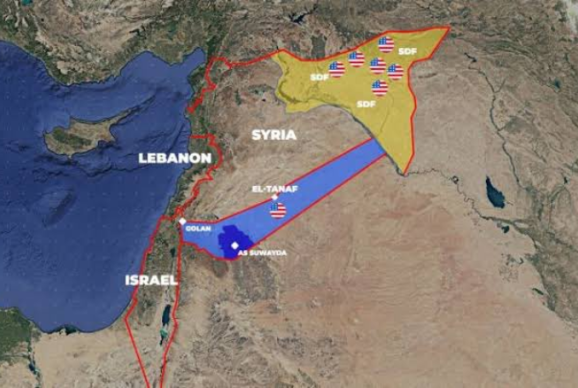
In the eyes of Syria’s leadership, the Druze issue is of great importance to solve for a range of reasons. One of which is that there is an enormous amount of sectarian tension, which various groups who form the new Syrian security apparatus, along with the Bedouin tribal forces, seek to punish following the bloodshed that began last July. It will also mean that technically, Syria will be one step closer to having one central government rule the entire country, which is a symbolic victory for Ahmed al-Shara’a.
However, the Israelis appear to have pre-empted such an offensive and committed a number of airstrikes as a warning to the Syrian leadership. There is clear anxiety over such a battle unfolding, because if it occurs, the Israeli military will be forced to intervene in order to save its Druze separatist allies.
As mentioned above, if things spiral out of control, the President himself cannot necessarily do much about it. That means that Syrian forces will likely begin to directly come into contact with the Israelis on the ground, something that could easily spiral.
Most of the fighters who have, for now, aligned themselves with the Syrian government are no fans of Israel, to say the least. This was on full display last December during the military parades conducted by Syria’s new armed forces, who openly chanted for Gaza, threatened Tel Aviv, and some even burned Israeli flags.
The alternative scenario for the Israelis in Syria may end up being worse, meaning that if they were to assassinate al-Shara’a, a power struggle would likely end up playing out on the streets of the Capital and throughout the country. So many different actors will seek to claim power.
Syria’s predicament has turned out to be less favourable to Tel Aviv, not because it poses an immediate strategic threat, but because almost anything is possible there. During the regional war between the Israeli-US alliance and the Iranian-led Axis of Resistance, one wrong misstep could prove fatal and open up yet another front, which will not only drain their resources but also weaken their ability to fight Hezbollah.
– Robert Inlakesh is a journalist, writer, and documentary filmmaker. He focuses on the Middle East, specializing in Palestine.
Iran’s friends are about to make life much more difficult for Israel and the US
By Murad Sadygzade | RT | April 1, 2026
The war’s second ‘ring of fire’ is no longer forming around Iran. It is already there. What we are witnessing is not a limited clash between a state under pressure and its immediate enemies, but the gradual emergence of a wider regional confrontation in which Tehran’s allied forces are moving from symbolic solidarity to practical engagement.
In Lebanon, Iraq, and now once again in Yemen, groups aligned with Iran are opening new fronts and making any American or Israeli campaign far more difficult to execute. If Iran cannot stop pressure by matching superior military power plane for plane or missile for missile, it can still answer by stretching the battlefield across time and space.
That is the real significance of the current escalation. Wars are easiest to sell and easiest to sustain when they look concentrated, technically manageable, and politically clean. They become much harder to continue when every strike produces another zone of instability, when every advance prompts retaliation, and when every promise of decisive success runs into a new and costly complication.
Iran and the forces loyal to it understand this perfectly well. Their goal is not necessarily to win a spectacular conventional victory over Israel or the US. They are trying to deprive their adversaries of a quick result, to turn military superiority into strategic over-extension, and to make the price of escalation rise with every passing week.
Israel is getting mired in Lebanon
Lebanon has become the clearest example of this dynamic. Israel entered the confrontation with Hezbollah expecting that greater firepower, harsher pressure, and deeper incursions would eventually impose a new reality in the south of the country. But so far the campaign has not produced the kind of result Israeli leaders would need in order to claim genuine success. Israeli officials are still speaking openly about expanding operations and about the need for a broad security zone in southern Lebanon. That does not sound like a completed military mission. It sounds like a campaign still searching for a workable outcome.
Israel remains capable of inflicting enormous damage on Lebanon. It can devastate border villages and infrastructure, and force large numbers of people from their homes. But the ability to destroy is not the same as the ability to impose control. A military campaign can appear overwhelming on television and still fail to neutralize the armed force it was meant to break. Hezbollah remains capable of hitting Israeli territory, and that single fact tells us that the war in Lebanon has not been resolved in Israel’s favor.
Israel is also suffering losses, not only in military terms but in political and psychological terms. Reports of fallen soldiers and continuing battlefield casualties show that Hezbollah is still able to turn southern Lebanon into a dangerous combat zone for the Israeli army. This is important because Israel’s military doctrine relies heavily on speed, on offensive initiative, and on the demonstration of dominance. A campaign that drags on, consumes manpower, exposes soldiers to attrition, and leaves northern Israel under continuing threat is not simply unfinished. It becomes strategically corrosive. It undermines the image of effortless superiority on which deterrence partly depends.
There is also the issue of equipment and operational pressure. Public claims about destroyed Israeli vehicles are often difficult to verify independently, and any serious analysis should avoid repeating battlefield propaganda as fact. But even without dramatic and unverifiable numbers, the broader reality is evident.
Hezbollah continues to create an environment in which Israeli ground operations are costly, risky, and politically burdensome. Israel may seize or enter territory, but it still has not demonstrated that it can transform that presence into a stable and secure military arrangement. As long as Hezbollah keeps imposing losses on Israel, the campaign remains strategically incomplete.
Hezbollah is demonstrating to the entire pro-Iranian regional camp that Israel can be denied a clean military outcome. That message matters in Iraq, in Yemen, and in every arena where forces aligned with Tehran are watching closely. Every week in which Hezbollah continues to strike back weakens the notion that Israel and the US can simply pummel the region into submission through superior firepower. That perception encourages allied groups to escalate because it suggests that resistance is not futile and that prolonged confrontation can produce strategic leverage, even against a stronger opponent.
Iraqi fighters activate
Iraq is the second arena where this logic is becoming visible. For years, Washington tried to handle pro-Iranian armed groups in Iraq through a familiar formula of pressure, selective strikes, deterrent warnings, and political bargaining. That formula is now under severe strain. The Iraqi factions loyal to Iran are again attacking Western interests and American-linked facilities, and their posture is hardening as the regional crisis grows. Any American move toward direct ground involvement against Iran would not remain confined to Iranian territory. It would immediately activate the Iraqi theatre in a much more serious way.
That possibility is now being discussed with increasing seriousness because Iraqi armed groups are presenting themselves as a reserve force that could mobilize in Iran’s favor if the war enters a more dangerous phase. This is not yet a mass transnational deployment on a scale that would determine the outcome of a large war by itself. But that is not the most important issue. The key point is that the Iraqi arena is being prepared politically, organizationally, and psychologically as an extension of the Iranian front. If Washington were to attempt a ground operation against Iran, it would face not one battlefield but several at once.
Washington appears to have assumed that by concentrating military pressure on Iran, it could either isolate Tehran or intimidate its regional allies into caution. But the opposite dynamic is taking shape. Pressure on the center is activating the periphery. Iran’s allies do not need to defeat the US or Israel in direct set-piece battles – only to ensure that no front can be fully closed, no rear area can be treated as safe, and no military plan can be presented as limited and controllable. That alone is enough to alter the political mathematics of war.
The Iraqi dimension is especially dangerous because it sits at the intersection of military operations, internal state weakness, and competing sovereignties. Iraq is not a sealed theatre. It is a country in which militias, parties, foreign forces, and state institutions coexist uneasily. Any renewed cycle of attacks on Western targets can therefore produce consequences far beyond the immediate strike. It can reignite internal tensions, weaken already fragile governance, increase pressure on the Iraqi government, and deepen the long-running struggle over whether Iraq is a sovereign balancing state or a contested zone inside a larger regional conflict. Once that process begins to accelerate, it becomes very difficult to contain.
Yemeni Houthis can shock the global economy
Yet the most strategically explosive development may be the renewed role of Ansar Allah (the Houthis) in Yemen. For nearly a month, the movement was relatively restrained in this specific phase of escalation. That relative quiet led some observers to believe that Yemen might remain a secondary theatre while events centered on Iran, Lebanon, and the Gulf. But this reading now looks premature. Ansar Allah has signaled a return to direct action against Israel, and even more importantly, it has once again raised the specter of pressure on maritime traffic through the Bab el-Mandeb strait.
That threat cannot be dismissed as rhetorical theater. Bab el-Mandeb is one of the great chokepoints of the global economy. It connects the Red Sea with the Gulf of Aden and the Indian Ocean, which means it is part of the shortest maritime route between Europe and Asia through the Suez Canal. If this corridor becomes unsafe on a sustained basis, the consequences extend far beyond the region. Shipping companies reroute. Insurance premiums surge. Delivery times lengthen. Fuel costs rise. Supply chains absorb new friction. The shock travels outward through freight markets, commodity prices, and industrial planning. In the modern world, a narrow stretch of water can become a multiplier of global instability.
This is why even the threat of closure is almost as bad as closure itself. Markets do not wait patiently for a waterway to be blocked in definite terms before reacting. They respond to risk. If Ansar Allah signals that ships tied to Israel or to its supporters may face attack, and if the movement demonstrates that this threat is credible, then the commercial effect begins long before a formal blockade exists. Some carriers will avoid the route. Others will demand sharply higher rates. Naval escorts may become more common. A military problem turns into a commercial one, and a commercial problem soon becomes a macroeconomic one.
A serious disruption in Bab el-Mandeb would also hit the Gulf states in complicated ways. On the surface, high oil prices often appear beneficial for energy exporters. But in wartime the picture is much less straightforward. Gulf monarchies depend not only on price levels but also on predictable flows, secure shipping, investor confidence, infrastructure safety, and the broader perception that the region remains a viable center for trade and finance. A war that pushes up energy prices while simultaneously making maritime transit less secure can produce gains on one side and losses on the other. It can raise revenue while also raising risk. It can improve the price per barrel while damaging the political and logistical environment needed to move that barrel efficiently.
Saudi Arabia and the United Arab Emirates in particular would face a difficult balancing act. Both states have tried to reduce their exposure to open-ended regional wars while preserving close security relationships with Washington. But a wider confrontation involving Iran, Iraq, Yemen, Lebanon, and Israel would undermine that balancing strategy. Even if they avoid direct military participation, they remain physically embedded in the conflict zone. Their ports, export routes, desalination infrastructure, airports, and industrial facilities exist within missile and drone range of hostile actors. In other words, geography limits neutrality. The Gulf states can try to hedge politically, but they cannot fully hedge physically.
A regional war goes global
The effects on the global economy could be severe if this pattern continues. The most obvious risk is a combined shock to energy and logistics. If pressure on the Strait of Hormuz coincides with renewed disruption in Bab el-Mandeb, the world economy would face stress on two of its most sensitive arteries at once. Oil prices would rise not simply because of lost supply, but because of fear, insurance costs, and the scarcity premium that always appears when multiple chokepoints are threatened simultaneously. Gas markets would become more nervous. Shipping costs would climb. Import-dependent economies would feel the squeeze first, especially poorer countries already vulnerable to debt, inflation, and food insecurity.
This is how regional wars become global economic events. They do not need to shut every route completely or destroy every refinery to trigger wider consequences. They only need to make enough critical routes uncertain at the same time. Once uncertainty spreads across energy and transport, it feeds into everything else: Freight becomes more expensive, manufacturing inputs arrive later, food prices rise through transport and fertilizer costs, central banks face renewed inflation pressure and governments face budget strain. Political instability follows economic stress, especially in countries where societies are already exhausted by previous shocks.
Have the US and Israel miscalculated?
All of this points to a broader conclusion. The conflict is expanding because the forces aligned with Iran are deliberately making it expand. Their strategy is not based on rapid decision or spectacular breakthrough. It is based on the controlled multiplication of pressure points. Hezbollah keeps the northern Israeli front unstable. Iraqi factions raise the cost of any deeper American military involvement. Ansar Allah threatens one of the world’s most important maritime corridors. Iran itself remains the central actor, but it does not need to act alone in a linear and isolated fashion. Its allies provide strategic depth, geographical spread, and the ability to transform one war into several interconnected confrontations.
From this perspective, American planners appear to have miscalculated. They may have believed that forceful pressure would narrow Iran’s options and restore deterrence. Instead, it risks producing the opposite result. Rather than isolating Iran, escalation is drawing its allied forces more tightly into the conflict. Rather than shortening the crisis, it is lengthening it. Rather than concentrating the battlefield, it is fragmenting it across the region. That is a dangerous trajectory, because a dispersed war is often harder to win than a concentrated one. It taxes logistics, political patience, alliance cohesion, and public confidence all at once.
What happens next will depend on whether the US and Israel continue to believe that greater military pressure can still produce strategic clarity. That belief now looks increasingly questionable. The longer the war continues without a decisive and stable outcome in Lebanon, the more confidence Hezbollah and its allies will gain. The more American assets are threatened in Iraq, the more difficult it becomes to present deeper intervention as manageable. The more Ansar Allah raises the cost of shipping through Bab el-Mandeb, the more the conflict escapes the boundaries of local war and enters the realm of global economic disruption.
The likely consequence is not a clean victory for any side, but a long phase of attritional regional instability. Israel may continue to intensify its campaign in Lebanon because it has not yet achieved the result it wants. Iraqi militias may continue attacking Western targets while preparing politically for a wider war. Ansar Allah may increase the use of maritime pressure because it understands that chokepoints can generate strategic effect far beyond Yemen itself. Iran, for its part, will keep trying to turn every enemy move into a trigger for wider overextension. It does not need to win in one dramatic moment. It only needs to ensure that its adversaries cannot close the conflict on their terms.
That is the central lesson of the present moment. Military superiority does not automatically translate into political success, especially in a region where allied non-state actors can open multiple fronts with relative flexibility. The US and Israel retain enormous destructive capacity. But destruction is not the same thing as control, and control is not the same thing as victory.
In that sense, the strategic initiative is no longer defined only by who can strike harder. It is increasingly defined by who can force the other side to fight on too many maps at once. Iran and the forces loyal to it appear determined to do exactly that. They are trying to stretch the conflict in time, to stretch it across geography, and to erode the ability of their adversaries to maintain focus. For now, that strategy is working far better than many in the US and Israel.
Murad Sadygzade is President of the Middle East Studies Center, Visiting Lecturer, HSE University (Moscow).
Growing insecurity, soaring prices fuel protests in north as regime bans evacuation: Sources
Press TV – March 30, 2026
The worsening situation on the internal front of the Israeli regime, particularly in the northern occupied territories, has driven up food and transportation prices, fueling settler discontent.
According to informed security sources, regime authorities have refused to permit the evacuation of settlers from northern areas, despite deteriorating security conditions amid Hezbollah’s unstoppable retaliatory strikes.
Rising costs of essential goods, including food and transportation, have intensified pressure on settlers, contributing to a growing wave of anti-regime protests.
Discussions across Israeli social media platforms reflect increasing skepticism toward official narratives regarding developments in the north.
Users have questioned regime claims on the extent of damage and casualties, asserting that actual losses far exceed what is being reported.
Some posts also emphasize that the regime’s defensive capabilities in the region have significantly degraded, while Hezbollah has effectively rendered life unsustainable for settlers in northern areas.
Meanwhile, emerging reports suggest that regime authorities are deliberately avoiding a full evacuation of settlers from the north, even as security conditions worsen amid intense exchanges of fire.
Analysts attribute this decision to deep concerns that, once evacuated, settlers may refuse to return – a scenario that would deliver a severe blow to the regime’s long-term strategic position in the area.
According to sources, military forces have been deployed to forcibly prevent settlers from leaving, underscoring the regime’s determination to project an appearance of normalcy even as conditions on the ground tell a different story.
Hezbollah has carried out a record number of retaliatory operations against the occupied territories, sowing fear among the settler population in the north.
Yet the regime remains intent on portraying normalcy across the occupied territories while concealing the true scale of casualties and damage sustained from retaliatory strikes, both from Hezbollah and the Iranian armed forces.
Iran: Trump wanted regime change, now just begging for Hormuz to open
Al Mayadeen | March 29, 2026
Iran’s Parliament Speaker Mohammad Bagher Ghalibaf said on Sunday, marking the 30th day of Iranian national defense against the US-Israeli aggression, that the US president’s objectives have dramatically shifted since the start of the war on Iran.
“The enemy who claimed to have destroyed our air, naval, and missile forces, and had a plan for the collapse of the Islamic Republic, has now set his goal on reopening the Strait of Hormuz,” Ghalibaf said.
“Reopening a strait that was open before the war has become Trump’s operational dream,” he said mockingly.
Ghalibaf stated that the war on Iran, which has come to be known as the Ramadan War, is now at its most critical moment. He noted that Trump is unable to secure the support of European countries, that energy markets are out of control, and that food inflation is approaching.
The war bites the belligerent
The Parliament Speaker detailed the damage inflicted on US military assets throughout the conflict. “The manifestations of American arrogance, from the F-35 to the aircraft carrier and US regional bases, have suffered major blows,” he said. “Strikes on the Israeli regime have been effective, precise, and foundation-shaking.”
Ghalibaf also highlighted the growing strength of the Resistance Axis across the region.
“Hezbollah in Lebanon, which was constantly threatened with disarmament, is today an important and effective part of the Resistance and has trapped the malignant Israeli regime,” he said.
“The Resistance in Iraq is fighting heroically and has astonished the enemy. Ansarallah in Yemen has breathed new life into the Resistance front and is ready to achieve spectacular surprises.”
“This is the honor and greatness of the Resistance front against the world’s arrogant powers,” Ghalibaf stated. “Trump has been accused worldwide of waging a pointless war and has no answer for his public opinion. The evil of initiating the war has returned to its initiator.”
Here is a background section summarizing the current situation with the Strait of Hormuz, based on the Al Mayadeen article:
The battle for the Strait of Hormuz
Since the US-Israeli war on Iran began on February 28, the Strait of Hormuz, through which approximately one-fifth of the world’s oil and natural gas shipments pass, has become a central front in the war on Iran. Iranian authorities have restricted the movement of vessels linked to the US and “Israel” or those supporting, requiring ships to obtain approval before transiting the strategic waterway.
Tehran has made clear that “nonhostile” ships may pass safely if authorized, while the strait remains “closed only to enemies carrying out cowardly aggression against Iran,” as Foreign Minister Abbas Araghchi put it. The Islamic Revolution Guard Corps has turned back multiple container ships attempting to transit without authorization.
Iran’s Parliament is now advancing legislation to impose formal tolls on vessels passing through the strait, a move lawmakers say is designed to assert Tehran’s “sovereignty, control and oversight” over the passage, much like the model applied by Turkey in the Bosphorus and Dardanelles straits. The toll system would build on temporary fees applied since late February.
US President Donald Trump has threatened an escalation in the aggression against Iran’s power infrastructure if the strait remains closed, while US attempts to organize international naval escorts to bypass Iran’s control over the strait have so far failed.
The new framework signals Tehran’s intent to use its control over its waterway to regulate access systematically, rather than relying on ad hoc measures, while simultaneously sending a message to the US and “Israel” about the country’s ability to control this key energy corridor.
Featured Video

Iran’s Next Strike May Not Explode. It Could Shut You Down
or go to
Aletho News Archives – Video-Images
From the Archive
Zionism’s Violent Legacy
By Donald Neff | Washington Report On Middle East Affairs | January 1996
On January 4, 1948, Jewish terrorists drove a truck loaded with explosives into the center of the all Arab city of Jaffa and detonated it, killing 26 and wounding around 100 Palestinian men, women and children.[1] The attack was the work of the Irgun Zvai Leumi – the “National Military Organization,” also known by the Hebrew letters Etzel – the largest Jewish terrorist group in Palestine. The Irgun was headed by Revisionist Zionist Menachem Begin and had been killing and maiming Arabs, Britons and even Jews for the previous ten years in its efforts to establish a Jewish state.
This terror campaign meant that at the core of Revisionist Zionism there existed a philosophical embrace of violence. … continue
Blog Roll
 Aletho News
- Trump’s Iran war is on an Israeli leash
- Saudi oil boss issues global supply warning
- Riyadh Says Its Oil System Is Intact. The Numbers Say Otherwise.
- Trump and Netanyahu Want to “Finish the Job” on Iran
- US ‘one-sided dictation’ not Iran’s beliefs makes rational talks impossible: Baghaei
- Iran’s Next Strike May Not Explode. It Could Shut You Down /Col Doug Macgregor
- Iran: US political targets legitimate if assassinations return
- Iraq shuts key border crossing with Iran under US pressure: Report
- Undersea Internet cables could be targeted in retaliation for attacks on Iran: IRGC deputy chief
- EU sending ‘biased’ observers to interfere in Serbian election – president
- If Americans Knew
- The Israel Lobby’s Changing Fortunes
- AIPAC has become such a political liability that it’s shifting to a more “nimble” approach to buying politicians
- At least 160 Israeli settler attacks in 2 weeks
- Will Gaza’s Ancient Christian Community Disappear Forever?
- Israel’s vision of regional security rests on keeping Arab states weak
- Heidi Levine recounts how Palestinian youths helped save her in settler attack
- DAILY UPDATE: Latest essential news on Palestine, Israel, & region
- Trump’s Intensifying Sabotage of the ICC, for Israel’s Sake
- Israeli military detain US and UK volunteers in West Bank including Democratic NY politician Brad Lander
- Americans at National Conservatism Conference held in Israel this year criticize Israel
- No Tricks Zone
- E-Cars Reduce CO2 Emissions By Only 41% Compared To Internal Combustion Engine Vehicles
- Predictions Made By Renowned Climate Professor Over Past Decades Have Been Proven To Be Poor
- New Study Suggests Large Regions Of The Pacific Ocean Have Been Cooling For The Last 80 Years
- Germany’s Green Energy Debacle: High Energy Costs Force Kahla Porzellan to Close After 182 Years!
- New Study: 50 Years Of The Most Aggressive ‘Net Zero’ Policies Can Only Affect The Global Climate By 0.03°C
- US September “Heat” Was No Record…Many Records Set Decades Ago
- Latest European Green Energy Debacle; Portugal’s Largest Flagship Solar Park Insolvent!
- Green Energy Debacle: German Expert Professor Fritz Vahrenholt Warns Of Severe Economic And Social Consequences
- Two More Paleo Reconstructions Affirm Meters-Higher Sea Levels Across Ireland, Brazil 7000-6000 Years Ago
- New Study: Earth And Venus Surface Warmth Largely Explained By Convection And Lapse Rate, Not CO2 Or Radiation

