Failing to Defeat Hezbollah, Israel & US Pressure Syria’s Ahmed al-Sharaa to Join War
By Robert Inlakesh | MintPress News | March 27, 2026
Openly declaring its intent to illegally occupy southern Lebanon, Israel finds itself in a costly ground battle with Hezbollah, from which there are indications Syria may soon be roped in. This is born from the understanding that in order to successfully weaken the Lebanese resistance, the Israeli military must penetrate the Bekaa Valley area.
Understanding the costly price of attempting to physically take all of south Lebanon militarily, both Washington and Tel Aviv have been attempting to devise strategies that would help achieve Israel’s war goals of weakening Hezbollah.
One possible option that has been placed on the table is the use of Syria’s military to invade Lebanon’s border and attack Hezbollah, aiming to go after what is labelled critical infrastructure belonging to the Lebanese group. According to reports, the US Trump administration has directly put pressure on Syrian leader Ahmed al-Shara’a to do just that.
In the event of such an assault, the Beka’a Valley would be the target territory. The Beka’a is what Israel’s Alma Research and Education think-tank calls “Hezbollah’s strategic depth”, which it argues is the group’s “operational and logistical center of gravity”. If Tel Aviv truly seeks to degrade Hezbollah’s capabilities, a ground incursion into this region is the only way to truly achieve such a goal.
Another plausible option is that Israel itself will use Syrian territory in order to invade Lebanon’s eastern border. This would appear possible, as the current Hayat Tahrir al-Sham administration in Damascus has allowed Israel to use Lebanese territory on two occasions so far.
Although al-Shara’a doesn’t grant direct permission, he refuses to deploy his forces to prevent the Israelis from violating Syria’s sovereignty. Earlier this year, the leadership in Damascus agreed to setting up a soft normalisation understanding with the Israelis. According to US State Department press release, the following was agreed upon:
“Both Sides have decided to establish a joint fusion mechanism—a dedicated communication cell—to facilitate immediate and ongoing coordination on their intelligence sharing, military de-escalation, diplomatic engagement, and commercial opportunities under the supervision of the United States.”
It suffices to say that Syria’s current leader, who once spoke of conquering occupied Jerusalem, has clearly aligned himself with the United States and now openly states he will pose no threat to Israel. Instead of fighting back against Israel’s ever growing occupation of more Syrian lands, or responding to civilian massacres inside his territory, he has instead sought to disarm those Syrians who are threatened by the belligerent occupying force in the south.
Despite this, Israel has continually attacked Syrian territory, including bombing the ministry of defence in Damascus. Recently, it also attacked Syrian military positions in the Damascus countryside, citing renewed sectarian clashes between Israeli-aligned Druze separatists and HTS allied forces.
In December of last year, parades were held in Damascus and other Syrian cities, where armed factions making up the country’s new armed forces held marches in the streets to mark the fall of Bashar al-Assad. Notably, these soldiers chanted in solidarity with Gaza and issued threats to Israel.
Some groups belonging to the new Syrian security forces, also burned Israeli flags and expressed solidarity with the village of Beit Jinn, where a group of locals had organised an ambush against Israeli invading forces. Israel then bombarded the village, which is home to both Palestinians and Syrians, murdering at least 13 civilians.
A series of Syrian Resistance groups have also popped up in the country’s south, occasionally carrying out rocket attacks or opening fire on Israeli soldiers with light weapons. The most prominent group has been ‘Jabhat al-Moqowameh al-Islammiya Fe Souriya’ [The Islamic Resistance Front In Syria].
The newest group to emerge is called ‘Kataeb Jund al-Karrar Fe Balad as-Sham’ [Soldiers of the Karrar Brigades in the Levant] also emerged on March 8, publishing a video of themselves firing rockets at US military positions in Syria’s Palmyra. The group has additionally claimed attacks on Israel.
If Syrian President Ahmed al-Shara’a orders an attack on Lebanon, this could immediately trigger an incursion into Syria by the powerful Iraqi groups aligned with Hezbollah. An official statement issued by The Islamic Resistance Coordination Committee in Iraq explicitly threatened that:
“We see the treachery of the new authority in Syria and are monitoring its coordination with the enemy. We say clearly: if you dare violate the sovereignty of Lebanon and its patient, resisting people, we will turn your land into an open arena of fire. He who warns has given fair notice.”
On the other hand, due to the fragile security situation inside Syria, if the Israeli military does attempt to launch an offensive from inside Syrian territory, there is always a chance that they will come under attack from a whole myriad of forces. It is possible that what currently constitutes the Syrian Army, may even break ranks and refuse to listen to the leadership in Damascus.
On March 6, a botched Israeli special forces raid targeted the Lebanese village of Nabi Cheet, located east of Beirut. In order to conduct this infiltration operation – which was successfully repelled due to a joint effort from Hezbollah, local militias and the Lebanese Army – it used Syrian territory. Notably, it launched its assault from an area located north-west of Damascus.
Israel has so far displaced over a million people in Lebanon, openly declaring its intent to expand what it calls a military “buffer zone”. Israeli defence minister Israel Katz doesn’t mince his words however, openly declaring that he is seeking to occupy southern Lebanon up to the Litani River.
To this effect, the Israeli military has not only ordered the entire population of southern Lebanon to evacuate the territory, but also bombed five primary bridges connecting the south to the rest of the country. And yet, on the ground, the Israeli army is having a difficult time simply passing the border villages, where Hezbollah has damaged or destroyed around 70 Merkava tanks so far.
If the Israelis come under attack from forces inside Syria itself, they could be dragged into a painful quagmire there. This could also come about in the event that Syria’s al-Shara’a decides to seize the opportunity of Israel being distracted in Lebanon, to launch an offensive against the Druze separatist militias in Sweida. In order to save their Druze militia allies from suffering a major defeat, the Israeli army itself could get roped into direct clashes with Syrian forces.
Therefore, if the Israeli leadership makes the decision to escalate the Lebanon conflict by making a move towards the Bekaa Valley, they could very easily find themselves dealing with a totally new reality inside Syria too.
Hezbollah’s Surprise Weapons Redefine Ground Battle with Israel
By Robert Inlakesh | The Palestine Chronicle | March 28, 2026
An Israeli “tank massacre”, reminiscent of the Lebanon war of 2006, has been taking place in southern Lebanon, as Hezbollah surprises the invading army with the use of a range of anti-tank weapons and drones.
On March 25, Hezbollah unleashed a fury on Israel’s Merkava tanks, announcing that they had struck a total of 21, in addition to striking 3 D-9 Bulldozers and 2 militarized Humvees. The following day, the Lebanese group released a series of videos depicting some of their operations.
In order to carry out so many strikes against Israeli armored vehicles, Hezbollah has traditionally used a variety of guided anti-tank guided munitions (ATGM). Prominently made use of have been weapons ranging from varying kinds of the Russian-made Kornet anti-tank systems, to the Almas (diamond) system that is an Iranian reverse-engineered version of the Israeli-made Spike AGTM, a top attack missile that is particularly effective.
During the Lebanon-Israel war of 2024, Hezbollah announced that it had destroyed a total of 59 Israeli tanks between the end of September and November 27. This time around, Hezbollah has already claimed to have struck around 70. It is unclear how many of these hits damaged or destroyed the tanks, but it suffices to say that this is a significant development.
Between October of 2023 and October of 2024, the Qassam Brigades, the armed wing of Hamas, claimed to have carried out 480 operations targeting Israeli tanks. A later report by Israeli news outlet Maariv cited data arguing that at least 500 military vehicles of varying kinds had sustained damage in Gaza. How many were totally destroyed is unknown, due to Israeli military censorship.
However, even a damaged tank is a major issue as they take a long time to repair, and the process is often costly. The reason why the figures from Gaza matter is that, in the case of the Palestinian resistance groups, they primarily used weapons like the Yassin-105 tandem warhead RPG, and then later, they were forced to use less sophisticated kinds of RPGs. Hezbollah, by comparison, has a much more sophisticated arsenal of anti-tank weapons.
A Game Changer?
During this war, which Hezbollah entered on March 2, citing Israel’s 15,400 ceasefire violations against the country and refusal to withdraw from occupied territory, a new weapon appears to be shaping the group’s ground confrontation with the Israeli invading army. That is the FPV (first-person-view) drone, equipped with heavy explosive charges.
The video published on March 26 by the Lebanese group’s military media featured one of these FPV drones directly striking a weak spot on an Israeli Merkava tank. Since March 25, when these weapons started to be used to combat invading Israeli military vehicles, they have been deployed routinely to target their tanks.
FPV drones using a fiber-optic capability are notably immune to electromagnetic jamming, making them extremely difficult to bring down and have been used extensively in the Ukraine-Russia war. Although no statistic is presented to back up this claim, the Wall Street Journal recently reported that FPV drones account for most battlefield casualties in Ukraine.
Regardless of the precise numbers of casualties inflicted in the Ukraine-Russia war by this drone, it is broadly accepted that it has been a game-changer, with it being the weapon of choice against various kinds of tanks and armored vehicles.
Another bonus to the FPV drone, beyond its use to target weak points on military vehicles, is the fact that the recordings can also be recovered as proof of what it struck. In Baghdad, just over a week ago, the Islamic Resistance in Iraq used two FPV drones to target a US military base, with one drone filming the other striking its target.
When fighting a war against Israel, which is perhaps the most well-known military on earth for hiding its soldiers’ deaths, this can come in handy for Hezbollah, which could potentially use the footage to embarrass the Israeli military.
If Israel proceeds with its ground invasion of Lebanon, launching a full-scale invasion, it may at some point run out of tanks, or at the very least have to begin rationing its use of them.
– Robert Inlakesh is a journalist, writer, and documentary filmmaker. He focuses on the Middle East, specializing in Palestine. He contributed this article to The Palestine Chronicle.
Why could Gaza enter the regional war?

By Robert Inlakesh | Al Mayadeen | March 27, 2026
As the Israeli-US war on the Islamic Republic of Iran continues, so too does its seemingly never-ending assault on the people of Gaza. Which may end up resulting in one of the most extreme forms of blowback that the Zionist regime has ever faced.
The so-called Gaza ceasefire agreement that came into effect on October 10, 2025, has proven to be precisely the opposite of a cessation of hostilities. Instead, just like with the way in which the Israelis dealt with the Lebanon ceasefire, they decided that the deal only applies to one side and that because they have the military edge, they can simply bomb wherever at will.
In the case of the Lebanese ceasefire, over 15,400 total violations were tallied by the time that Hezbollah chose to respond. Gaza’s official violation count is steadily on the way to the 3,000 mark, with the Zionist entity having murdered around 700 people during the “ceasefire” period.
Just as this strategy of arrogance backfired with Hezbollah, of believing that they can simply assert dominance and commit atrocities whenever they choose without any response, so too is it likely to blow up in their faces with the Palestinian Resistance in Gaza. In fact, it was this kind of mentality and arrogance that led to the humiliating defeat of their southern command on October 7, 2023.
Gaza had already been declared unlivable by 2020, as per calculations provided by United Nations experts, with a water supply that was 97% unfit for human consumption, one of the highest unemployment rates on earth, and who could forget the frequent series of massacres visited on the population there? Now, the situation on the ground is beyond comprehension.
Month after month, the sadistic Zionist administration of US President Donald Trump toyed with the Palestinian civilian population by claiming that a “Phase 2” to the ceasefire agreement was within reach. This evidently never materialised, the people were left in around 40% of the Gaza Strip with little shelter and supplies, living amongst the sewage and bombed out buildings surrounding them.
Meanwhile, the five Israeli created ISIS-linked collaborator gangs in Gaza, composed of Wahhabis and common criminals, have been granted round the clock protection and limitless supplies in order to further the goals of destroying the Palestinian people.
The “International Community?” and “International Legal System?” Nowhere to be seen, or totally ineffective where any efforts are made. The United Nations Security Council (UNSC) even passed resolution 2803, birthing Donald Trump’s “Board of Peace” (BoP) last November. All the Arab regimes came grovelling at the US President’s feet, as they congratulated the resolution that burned down decades of international law and precedents.
In the end, what was the BoP? Well, its charter didn’t mention Gaza, or even Palestine, once. It was instead an attempt to create a UN replacement, filled with the most repellent of spineless creatures, like Tony Blair, and billionaire friends of the US President.
Under the current conditions being faced by the Palestinian people in the Gaza Strip, with their civilians who are continuing to be murdered, kidnapped and injured, there will eventually come a time that the opportunity will present itself for the Palestinian national resistance to take action.
If the Israeli military continues to commit to its ground offensive inside Lebanon, forcing it to get bogged down, while the Iranian missile and drone waves continue to take out strategic targets, there may be an opportunity for the Palestinians to finally take matters into their own hands.
It is not likely that any major moves will be made at this stage of the regional war, yet if this reaches a phase where the Israeli military is being severely battered and it no longer possesses many capabilities it entered the war with, it may be in for dealing with the final flood. The Al-Aqsa Flood operation proved what happens when the Zionist entity refuses to compromise and allow the people of Gaza to breathe.
As long as the Israelis refuse to admit defeat in this war, things will certainly continue to get worse and worse for them as the months go on. The reason for this is simple, they are so hell bent on conquering more territory and spilling the blood of the region’s peoples, that there is only one solution available, to force them to face a total strategic military defeat.
Although these are all broadly considered to be low likelihood possibilities, their regional aggression could easily trigger various fronts in ways that may spin out of control. Take for example the occupied West Bank and Al-Quds, although they have so far refrained from standing up for themselves in any large-scale uprising, if they were to simply revolt, they would cause an earthquake for the Israeli military and society at large.
The Israelis know well the potential consequences of a West Bank uprising, but instead of taking measures to minimize this possibility, they choose to increase the pressure on the population there. Since October 7, 2023, they have indeed fallen silent – with the exception of the Resistance groups primarily situated in the north’s refugee camps – but in no way is it certain they will continue to take this kind of punishment.
Even the way the Zionist entity handles its predicament inside Syria, it uses nothing but brute force and refuses to behave in a strategic manner. It may be an unlikely scenario, seeing that the current President of Syria is only one step away from a normalization agreement, yet how could the Israeli military deal with being roped into a quagmire inside Syrian territory, where an abundance of groups could end up attacking them?
Which brings us back to the question of Gaza. Considering that the opportunity presents itself, the Resistance could certainly act down the line in this conflict. If it does happen, it will be out of necessity and because the Zionist entity refused to end its genocide. In anticipation of any such action, it should be noted on record that it will be entirely the fault of the Israelis and the regime in Washington.
Smotrich calls for annexation of South Lebanon to Litani River
Al Mayadeen | March 24, 2026
Israeli Finance Minister Bezalel Smotrich has called for the annexation of territory from Lebanon up to the Litani River, saying “Israel” should seize vast swathes of land in southern Lebanon,
“The new Israeli border must be the Litani,” Smotrich said on Israeli radio on Monday. “The campaign needs to end with a different reality entirely, both with the Hezbollah decision but also with the change of Israel’s borders.”
The Litani River is located nearly 40 kilometers inside Lebanese territory from the South.
Since early March, “Israel” has ordered all residents of southern Lebanon to leave areas south of the Litani, citing what it called “limited and targeted ground operations against key Hezbollah strongholds.”
Expanding operations
On Sunday, the Israeli military announced plans to expand both ground and air operations in southern Lebanon. War Minister Israel Katz has also previously threatened that “Israel” would occupy Lebanese territory if the government does not disarm the Resistance.
Last week, French President Emmanuel Macron condemned “Israel’s” actions in Lebanon as “inappropriate and even unacceptable,” arguing that “Israel’s” repeated wars against the Resistance have never produced the desired results.
“Israel” has repeatedly launched military campaigns against Lebanon since 1978 and occupied most southern Lebanon between 1982 and 2000, maintaining a self-declared “security zone” until resistance operations forced a withdrawal. It is still in occupation of Lebanese territory
Israeli aggression on Lebanon kills 1,024 civilians since March 2
The number of martyrs resulting from the ongoing Israeli aggression on Lebanon since March 2 has risen to 1,024, with at least 2,740 others wounded, Lebanon’s Ministry of Health announced on Saturday.
The figures reflect the intensifying human toll of the continued aggression, which has escalated across multiple regions in South Lebanon and beyond.
Israeli airstrikes and artillery attacks continued to target Lebanon overnight Monday.
Israeli warplanes targeted a residential apartment in the town of Bshamoun in Mount Lebanon, marking a continued expansion of strikes into populated areas.
Earlier reports confirmed an Israeli attack on an apartment in Hazmieh, also in Mount Lebanon, resulting in the death of a civilian, according to the Lebanese Ministry of Health.
Multiple airstrikes were also recorded on the Southern Suburb of Beirut, with at least seven raids recorded in the area.
The attacks come amid ongoing escalation targeting densely populated neighborhoods.
Israeli strikes also hit several areas in southern Lebanon, including:
- Zifta
- Al-Burghliya
- A gas station near the Rashidieh camp in Tyre
Strikes were reported in al-Bayyada, the al-Ashrafiyat area on the outskirts of al-Abbasiyah, as well as in Ayta al-Shaab, Arnoun, Qabrikha, and areas between Burj al-Shamali and al-Bazourieh.
Artillery shelling also targeted the outskirts of Kfar Kila, indicating a continued pattern of bombardment across border areas.
Earlier in the day, four martyrs were reported following a dawn strike on a residential building in Majdal Selem.
This morning, Lebanese citizen was martyred and another injured after Israeli occupation forces (IOF) stormed the town of Halta in the Arqoub region of the Hasbaya district in southern Lebanon, Al Mayadeen’s correspondent in southern Lebanon reported.
According to our correspondent, Israeli forces raided several homes in the al-Hara al-Fawqa neighborhood, opening fire on civilians before withdrawing from the town after abducting one resident.
Barak blasts Netanyahu: ‘Stop lying – you can’t destroy Iran’s nuclear, missile capabilities’
Press TV – March 23, 2026
Former Israeli prime minister Ehud Barak on Monday launched a blistering attack at the regime’s incumbent political and military leadership, slamming them for peddling “blatant” lies over the war against Iran and noting that the regime has no strategy to end the war.
In an interview with Channel 13, Barak, who also previously acted as the regime’s military chief and military affairs minister, delivered a stark assessment of the Israeli wars on Gaza, Lebanon and the Islamic Republic of Iran.
“We cannot open the Strait of Hormuz, nor destroy Iran’s nuclear and missile capabilities, so don’t lie to us too much,” Barak said, directly challenging the regime’s claims regarding its capacity to confront the Islamic Republic.
His remarks came as the Israeli-American war against Iran entered its 24th day with no end in sight. The war, which started with the assassination of the Leader of the Islamic Revolution, Ayatollah Seyyed Ali Khamenei, and some top-ranking officials and military commanders, has failed to achieve the “regime change” agenda or to decapitate the Iranian government.
On the contrary, as experts acknowledge, Iranian armed forces have decimated Israeli military and intelligence infrastructure across the occupied territories as well as US military bases in some Persian Gulf countries as part of Operation True Promise 4.
So far, 74 waves of missile and drone operations have been successfully carried out against enemy targets, which have effectively destroyed the air defense systems.
Barak, who acted as the regime’s premier from 1999 to 2001, launched a stinging attack at the regime’s war cabinet, stressing that the political echelon lacks both the knowledge and the will to end the fighting that has failed to achieve any objectives.
“Israel at the political level doesn’t know – doesn’t know or doesn’t want – to bring the war to an end,” he said. “They don’t know how to end wars.”
He also pointed to unfulfilled promises made repeatedly by the Benjamin Netanyahu regime vis-à-vis the genocidal wars against Gaza and Lebanon.
“We are two and a half years in; Hamas is still there after they promised us six times that we were a step away from ‘total victory.’ Hezbollah is still there after they told us we threw them back decades,” he stated.
Barak also took aim at Netanyahu’s long-standing emphasis on the so-called “Iranian threat,” noting that the regime’s claims of neutralizing the danger do not align with reality.
“Iranian nuclear program and missiles are still there after they clarified to us that he [Netanyahu] removed the existential threat,” he said, shaken by the direct Iranian missile impacts across the occupied territories in the ongoing war.
The former prime minister described a systemic breakdown in trust between the regime and settlers, exacerbated by what he called deliberate withholding of information.
“Now, what is the problem? When there is no truth and no trust. We also don’t know all the details, including those of us who were deep inside these matters,” Barak said. “We don’t know what the truth is. But they shouldn’t tell us ‘the truth’ – they just shouldn’t lie to our faces in such a blatant way so that we can participate in the discussion more seriously.”
CIA Assessment: The Resistance Cannot Be Crushed
By Kit Klarenberg | Global Delinquents | March 15, 2026
The Judaeo-American war on Iran was intended to be a lightning strike routing, fought exclusively from the air, lasting only a few days. Instead, Washington and its Zionist proxy have blundered into a major multi-front conflict, which could well threaten the Empire’s very existence. The initial US aerial bombardment’s centrepiece was Supreme Leader Ali Khamenei’s February 28th murder. Initially hailed by Western media as “the assassination of the century,” the vile act has resulted in catastrophe for the perpetrators.
The Islamic Republic’s relentless battering of Zionist entity civilian centres and military and intelligence infrastructure, and US bases throughout West Asia, hasn’t been deterred one iota. Vast crowds took to the streets of Tehran in vengeful mourning. Their righteous anger has pullulated throughout the Arab and Muslim world. Ever since, incensed Shiites have violently clashed with security forces in multiple major Pakistani cities. Meanwhile, Bahrain teeters on the brink of all-out revolution. Now, Mojtaba Khamenei, the slain Supreme Leader’s son, has taken his place.
Iranian citizens of every ethnic and religious extraction braved US-Israeli airstrikes to celebrate his ascension. Commonly perceived as a hardliner with strong ties to the Iranian Revolutionary Guards Corps, the expectation that the new Supreme Leader will adopt a considerably less conciliatory, patient approach than his father is widespread. Western sources forecast Mojtaba may decide the Islamic Republic “must move quickly to obtain nuclear weapons in order to forestall future US and Israeli attacks,” overturning Ali Khamenei’s longstanding fatwa against their development by Tehran.
US President Donald Trump has declared he is “not happy” with Mojtaba taking power, and Israeli apparatchiks are likewise perturbed by the development. Nonetheless, this was an inevitable upshot of assassinating the former Supreme Leader. There was also no reason to believe doing so would precipitate the Islamic Republic’s collapse, or lead to Tehran’s military submission. It begs the obvious question of why Washington and Tel Aviv electively helped install a ruler more committed than ever to expelling the Empire from West Asia.
Similarly, Hezbollah’s extraordinary broadsides of the Zionist entity since Khameinei’s assassination should dispel any notion – as perpetuated by Israeli political and military chiefs – the group was obliterated by Tel Aviv’s criminal October 2024 invasion of Lebanon. That incursion was prefaced by an operation in which thousands of pagers used by senior Hezbollah operatives were detonated simultaneously, having been wired with explosives by Mossad pre-purchase, killing and injuring many. A week-and-a-half later, the group’s Secretary General Hassan Nasrallah was lethally targeted in a Zionist entity airstrike.
Evidently, the Resistance cannot be crushed via high-level assassinations. In fact, such actions actively strengthen its members. This inconvenient reality has been well-known to the CIA since at least 2009. In July that year, the Agency produced a top secret assessment laying out the pros and cons of liquidating “high value targets” (HVTs). It was prepared in advance of Barack Obama’s CIA chief Leon Panetta shifting US “counter-terror” operations from capturing and torturing high-level suspects, to outright executing them.
The assessment concluded HVT operations “can play a useful role when they are part of a broader counterinsurgency strategy,” and sought to “assist policymakers and military officers involved in authorizing or planning” such strikes. However, it listed many “potential negative effects” of “high value” assassinations. Israel’s past killing of Hamas and Hezbollah leaders were specifically cited as examples of how the strategy can spectacularly backfire. We have witnessed the CIA’s unheeded cautions play out in real-time since February 28th.
Foremost among prospective blowback from HVT operations is that the risk high-level assassinations can increase an “insurgent” group’s support. This occurs when killing a target “[strengthens] an armed group’s bond with the population, radicalizing an insurgent group’s remaining leaders, creating a vacuum into which more radical groups can enter, and escalating or deescalating a conflict in ways that favor the insurgents.” Such actions can also “[erode] the ‘rules of the game’ between the government and insurgents,” thus exacerbating “the level of violence in a conflict”:
“HVT strikes, however, may increase support for the insurgents, particularly if these strikes enhance insurgent leaders’ lore, if noncombatants are killed in the attacks, if legitimate or semi-legitimate politicians aligned with the insurgents are targeted… An insurgent group’s unifying cause, deep ties to its constituency, or a broad support base can lessen the impact of leadership losses by ensuring a steady flow of replacement recruits.”
The CIA assessment noted several historical instances of supposed HVT successes. When high-level targets have “prominent public profiles”, assassinations can in specific instances shatter a target group. However, this was not the case with Hamas or Hezbollah. The pair “carry out state-like functions, such as providing healthcare services,” so group leaders are well-known to citizens of Gaza and Lebanon. Yet, their “highly disciplined nature, social service network, and reserve of respected leaders” mean they can easily “reorganize” in the wake of assassinations.
The Zionist entity had by this point been engaged in “targeted-killings” against Hamas, Hezbollah, and other Resistance groups since the mid-1990s. However, their “decentralized command structures, compartmented leadership, strong succession planning, and deep ties to their communities” made them “highly resilient to leadership losses.” Undeterred, Tel Aviv’s high-level assassinations continued apace. In the early 2000s, Hamas founder Sheikh Yassin and the group’s leader in Gaza Abdel Aziz al-Rantisi were murdered. However, the killings “strengthened solidarity” between Resistance factions, while “[bolstering] support for hardline militant leaders.”
The obvious lessons of this wanton bloodletting remained unlearned by the Zionist entity, once the Gaza Holocaust erupted. In June 2024, elite imperial journal Foreign Affairs published a report unequivocally headlined Hamas Is Winning. It boldly concluded “Israel’s failing strategy makes its enemy stronger.” The outlet also recorded how “according to the measures that matter,” Hamas was considerably bigger and more powerful than on October 7th 2023. Israel had thus stumbled into a deeply ruinous attritional war, with a “tenacious and deadly guerrilla force.”
Hamas’ surging popularity with Palestinians throughout the Gaza genocide was found to have significantly enhanced the group’s “ability to recruit… [and] attract new generations of fighters and operatives.” This granted Hamas the ability to launch “lethal operations” in areas previously “cleared” by the IOF “easily”. Foreign Affairs charged the Zionist entity, to its “great detriment”, failed to comprehend how “the carnage and devastation it has unleashed in Gaza has only made its enemy stronger.”
It is not merely Hamas that has been galvanised by the Gaza genocide. Israel’s “carnage and devastation” has greatly expanded the ranks and resolve of the entire Resistance, while its constituent members have won hearts and minds globally in ever-mounting numbers. Tel Aviv and its Anglo-American puppet[master]s have no good choices left to make, in a criminal war of choice waged against an indefatigable adversary committed to total victory, the likes of which they have never faced off against before.
The calamitous outcomes of Judaeo-American conflict with Iran were amply spelled out in a June 2025 report by the Israel-based Institute for National Security Studies. Among other things, it cautioned against assassinating Ali Khamenei, as the Islamic Republic “would likely have little difficulty selecting a successor, who could prove to be more extreme or more capable,” while uniting the Iranian public and government more than ever behind all-out victory. The consequences of disregarding this prophetic curse will reverberate throughout West Asia for centuries.
Hezbollah Returns: It Didn’t Start a War, It Is Ending One
By Robert Inlakesh | The Palestine Chronicle | March 12, 2026
Hezbollah’s intervention in the war with Israel followed months of Israeli ceasefire violations in Lebanon, challenging Western media narratives about responsibility.
Key Takeaways
- UNIFIL recorded more than 15,400 Israeli ceasefire violations in Lebanon between November 2024 and February 2026.
- Hundreds were killed inside Lebanon during the ceasefire period, including around 150 civilians, while Israeli strikes repeatedly hit Beirut.
- Hezbollah largely maintained the ceasefire for 15 months, cooperating with the Lebanese Armed Forces despite continued Israeli attacks.
- Western media narratives claiming Hezbollah “dragged Lebanon into war” overlook the ongoing Israeli military actions and territorial violations.
- Hezbollah’s battlefield performance suggests the group retained significant military capacity, contradicting claims that it had been decisively weakened.
Media Narrative vs. Reality
When Lebanese Hezbollah chose to fire on Israel, effectively transforming the US-Israeli assault on Iran into a regional war, it did so in retaliation for aggression against Lebanon. Contrary to what Western corporate media has reported, the group is not responsible for initiating the war, and its role in it is crucial to the region’s future.
At the beginning of this month, the BBC ran a story entitled “Battered and isolated, Hezbollah drags Lebanon into another war”. Written by the British State-funded media’s correspondent in Tel Aviv, the piece not only presents a biased and false depiction of events, cheap propaganda that you would expect from the Sun or other tabloids, but fails to even mention Israel in its title.
CNN and others throughout the Western corporate media landscape also published pieces with similarly worded headlines. Therefore, the first point of entry into this topic is to establish the facts, which reveal just how atrocious the BBC and others have been in their framing of the Lebanon-Israel war.
On February 25, 2026, UNIFIL, the United Nations peacekeeping mission in Lebanon, had recorded over 15,400 Israeli violations of the ceasefire agreement that technically went into effect at the end of November 2024. This included the killing of hundreds of people inside Lebanon, mostly Lebanese, but also Syrians and Palestinians, including around 150 civilians in total.
Thousands of civilians, over the 15-month ceasefire period, were forced to flee their homes due to bombings, while Israel attacked the capital, Beirut, a number of times. Additionally, Israel was caught spraying cancer-causing chemical substances across southern Lebanon, also illegally occupying seven points there and refusing to leave the nation’s territory.
That entire time, Hezbollah held its fire and cooperated with the Lebanese Armed Forces, even when Lebanon’s pro-US Prime Minister, Nawaf Salam, pursued a campaign against the group. He aggressively pursued Israeli-US demands, forcing the Lebanese army to disarm Hezbollah, while announcing his intentions to eventually normalize ties with Tel Aviv, a blatant stab in the back to his own people, who were experiencing daily bombing raids by Israel.
Israel committed more ceasefire violations of the Lebanon truce than any military has ever committed against any ceasefire in human history.
In other words, the idea that Hezbollah dragged Lebanon into a war is categorically false. Israel never implemented its side of the deal, and for the residents of southern Lebanon, the war was ongoing throughout those 15 months. The only reason we continued to call it a ceasefire is that Hezbollah chose to uphold it.
The Myth of Hezbollah’s Weakness
Following the cessation of hostilities — at least from the Lebanese side — in November of 2024, US and Israeli officials publicly bragged that they had defeated Hezbollah. In February of 2024, then US envoy to Lebanon, Morgan Ortagus, asserted publicly that Hezbollah had been “defeated” and that its “reign of terror” was over.
This theory of Hezbollah’s apparent weakness was widely accepted among Western leaderships. Evidently, the Lebanese leadership under Nawaf Salam had also gotten this impression. They believed Israel’s unsubstantiated statistics about how it had taken out the majority of the group’s weapons, believing that the terrorist pager attacks and assassinations of key leaders had, in effect, destroyed the organization. At the very least, Hezbollah was believed to have been badly degraded and hanging on by a thread.
Here for the Palestine Chronicle, I have been writing over the past 15 months against this notion, arguing that the merits of this argument do not hold up to scrutiny. The reasons for this are rather simple: the group has a ground force of around 100,000 fighters — larger than the Lebanese Army — as it also demonstrated all the way up until the last days of the 2024 war that it still possessed strategic weapons.
Hezbollah was so confident in its stockpile of drones, for example, that there were accounts of them using dozens of them in singular operations against invading Israeli soldiers toward the end of November 2024. In addition to this, at the end of the conflict, is when the group began to reveal its most deadly capabilities, which clearly still existed after the ceasefire was declared.
The fall of former Syrian leader Bashar al-Assad was initially interpreted as being a major impediment to the transfer of weapons to Hezbollah, yet this eventually turned out to be only partially true. There were even some sources that argued that larger quantities of weapons were being transferred than in the last years of Assad’s reign in power. Other sources alleged that weapons belonging to the former Syrian Arab Army (SAA) may have fallen into Hezbollah’s hands during the collapse of the state.
A key reason why the weapons continued to flow into Lebanon was that the new Syrian state had no real security apparatus. It is, in essence, a collection of armed groups that operate in an environment inside the country where gangsters, local militias, and groups all maintain their own arms.
As has been on display since Ahmed al-Shara’a came to power, he is unable to control many of the militias inside the country, despite his best efforts alongside his US allies to do so. The conflict in Sweida and the coastal massacres were great examples of this.
Therefore, when Hezbollah chose to retaliate against Israel after 15 months of non-stop fire against Lebanon, they did so not from a position of weakness, but with the understanding that it was waging a war effort with the most favorable circumstances for achieving victory.
A War Israel Provoked
Although there are many within the Lebanese Army that seek to resist and protect Lebanon, including its current commander — after all, it is the nation’s official armed forces — it is held back by the government and under constant pressure from the United States. The US does not allow it to possess strategic weapons and won’t allow Hezbollah to integrate into it.
This means that Hezbollah is the only force capable of defending the country against Israeli aggression. That being said, if the pro-US regime in Syria — which has already reached a security understanding with the Israelis — attempts to attack Lebanon, the Lebanese Armed Forces will likely prove capable of defending their borders.
Although the Lebanese Army is not capable of fighting Israel, the Syrian militia forces that constitute its army are clearly less well prepared. Hezbollah will also likely assist the Lebanese Army in such a defense, as it did against Daesh and Al-Qaeda militants during the Syrian War.
Hezbollah, since entering the conflict against the Israeli occupiers, has managed to inflict countless deadly ambushes, thwarted two landing attempts in the Bekaa Valley, and taken out dozens of Israeli military vehicles with guided anti-tank weapons along the border area. In addition to this, it has fired precision missiles at strategic locations south of Tel Aviv and around Haifa, accurately striking their targets with pinpoint precision.
The strength of Hezbollah this time around has shocked Israeli analysts, who are scrambling to explain the sudden revival of the group that they believed to have been weakened south of the Litani River (southern Lebanon).
It is likely that Hezbollah are seeking to drag the Israeli army as deep into Lebanese territory as possible, making them commit to a costly invasion, one in which they can then engage in all-out ground warfare. While Israel has air superiority and more advanced weapons, Hezbollah is a much more formidable ground force than the Israeli army.
In order to force the Israelis into committing to such a large-scale invasion, where their troops will be led into countless ambushes — especially if they try to invade the Bekaa Valley through Syria — we may even see some cross-border operations in the future.
All of this could have been avoided by the Israelis and their arrogant backers in the White House, yet they chose to illegally occupy Lebanese lands and to violate the ceasefire at least 15,400 times. Just as is the case in Gaza, where Israel has committed around 2,000 ceasefire violations so far, it is they who are at fault.
Despite the fact that Hezbollah’s true strength is on full display and that Israel clearly started this conflict, the corporate media will continue to lie about the situation in Lebanon. This should come as no surprise, considering their atrocious and racist reporting throughout the Gaza genocide.
– Robert Inlakesh is a journalist, writer, and documentary filmmaker. He focuses on the Middle East, specializing in Palestine. He contributed this article to The Palestine Chronicle.
Ukrainian Embassy in Beirut sheltering top Mossad agent
The Cradle – March 13, 2026
The Ukrainian Embassy in Beirut is currently harboring a high-profile Israeli intelligence asset wanted by Lebanese authorities, journalist and The Cradle contributor Radwan Mortada has revealed.
Khaled al-Aida, a Palestinian-Syrian with Ukrainian citizenship, has been implicated in bombings and assassinations across Lebanon between 2024 and 2025.
Security investigations have proved his involvement in an assassination attempt at Beirut’s Rafiq Hariri International Airport, as well as the capital’s southern suburb.
Aida was also on the ground during the assassination of former Hezbollah secretary-general, Hassan Nasrallah, according to Mortada, who also reported that Aida had helped Lebanese intelligence dismantle a Mossad cell.
He was eventually caught with an explosive device hidden on a motorcycle intended for later use in southern Beirut.
“Aida managed to escape after the Israeli bombing of the building where he was being held in Beirut’s southern suburbs. The bombing provided him with an opportunity to flee, and he eventually sought refuge in the Ukrainian Embassy, which is now attempting to smuggle him out with the help of the US Embassy,” according to the information obtained by Mortada.
The embassy is reportedly seeking to secure Aida’s exit, requesting a laissez-passer from Lebanese security, while US operatives, including CIA station chief Sherry Baker, are pressuring for his evacuation.
“We will not accept being told that he left in a diplomatic vehicle, or through an illegal crossing, or under the protection of the American Embassy in Lebanon,” Mortada went on to write.
In recent history, Lebanese authorities have repeatedly been coerced by Washington to release agents who have been detained.
“Prime Minister Nawaf Salam, and the General Security Directorate, specifically Major General Hassan Shqeir, are all accountable to the Lebanese people. If they are truly concerned about the interests of Lebanon and the Lebanese, they must arrest Khaled al-Aida and hand him over to the judiciary. This wanted man is a valuable asset for Lebanon, one that should be negotiated for, not given away for free,” Mortada said.
Around two dozen Lebanese prisoners are currently being held in Israeli prisons, some of whom were abducted during the ceasefire.
Mortada’s report comes as Lebanon is under heavy Israeli bombardment. Around 700 have been killed by Israel since 2 March, when Hezbollah responded to over a year of Israeli ceasefire violations.
Israel has stepped up attacks on Beirut’s suburbs as well as the heart of the city, while continuing brutal and deadly attacks across southern and eastern Lebanon.
Israeli planes dropped leaflets over the capital on Friday, threatening that Hezbollah must be disarmed for “everybody’s interest.”
The Lebanese army warned citizens not to open the QR Code on the leaflets, which “link to a WhatsApp contact and another to a Facebook page to communicate with Unit 504 of the Israeli army, which is responsible for recruiting agents.”
Syrian president vows ‘absolute support’ to disarm Hezbollah
The Cradle | March 11, 2026
Lebanese President Joseph Aoun received a phone call on 10 March from his Syrian counterpart, ex-Al-Qaeda chief Ahmad al-Sharaa, who expressed his support for Beirut’s efforts in disarming Hezbollah.
The Lebanese Presidency said Aoun and Sharaa discussed regional developments and stressed that “the current delicate situation requires activating coordination and consultation between the two countries, especially with regard to the need to control the borders and prevent any security breaches from any side.”
The Syrian Presidency also released its own statement on the call with Aoun. “President Sharaa expressed his explicit and absolute support for the efforts led by President Joseph Aoun to disarm ‘Hezbollah.’ He affirmed that this step is essential for solidifying Lebanese state sovereignty and shielding the region from the repercussions of ongoing regional armed conflicts,” the statement said.
It also called for “joint action” between Lebanon and Syria, “to ensure the safety of the Syrian and Lebanese peoples and to protect the gains of stability achieved recently.”
The phone call comes hours after Damascus claimed that it came under attack by Hezbollah on the Syrian–Lebanese border.
The Syrian army said “Hezbollah militias” fired shells toward its positions near Serghaya, adding that reinforcements from the Lebanese resistance group had been observed arriving along the Syrian–Lebanese border.
Syrian officials said they were monitoring the situation, coordinating with the Lebanese army, and studying possible responses, warning that the Syrian army “will not tolerate any attack targeting Syria.”
Hezbollah, which is busy fighting an Israeli invasion in the south, has not released any statements commenting on the matter.
The Lebanese resistance fought in Syria for years alongside the former government, and took part in the recapture of several parts of the country from groups including Al-Qaeda’s Nusra Front, Ahrar al-Sham, and other extremist organizations who were at the time considered the Syrian opposition.
The Nusra Front was later rebranded into Hayat Tahrir al-Sham (HTS), the group that toppled former Syrian president Bashar al-Assad’s government in 2024 and now dominates Syria’s Defense Ministry.
Nusra occupied large swathes of the northern and eastern Lebanese border region for years at the start of the Syrian war, and was eventually expelled by Hezbollah and the Lebanese army.
Clashes broke out between the Lebanese army and Syrian troops earlier this year, after Damascus’s forces advanced against the border under the pretext of dealing with smuggling.
Heavy clashes also erupted between the Syrian army and Lebanese tribes on the border in 2025. Damascus falsely claimed at the time that it was fighting Hezbollah.
Since the start of the war in Iran and the entry of Hezbollah into the conflict, the Syrian military has been building up its presence along the Lebanese border, claiming the measures are aimed at “combating smuggling.”
The new authorities in Damascus have allied themselves with Washington. Damascus has been working, at the request of the US, to prevent any Hezbollah-bound weapons from entering Lebanon.
It has also been cracking down on Palestinian resistance factions.
US envoy Tom Barrack threatened Lebanon last year with a Syrian incursion, and said Damascus would “actively assist us in confronting and dismantling the remnants of ISIS, the IRGC [Iran’s Islamic Revolutionary Guard Corps], Hamas, Hezbollah, and other terrorist networks.”
Calls for the reconfiguration of military arrangements in the Gulf region
By Thembisa Fakude | MEMO | March 8, 2026
The former Qatari Prime Minister Sheikh Hamad bin Jassim bin Jaber Al Thani called for the formation of a strategic defence alliance bringing together Egypt, Saudi Arabia, Turkiye and Pakistan. Al Thani has described it as an “urgent need” in light of developments and changing regional and international dynamics. He made this call weeks before the attack on Iran by Israel and the US on 28th February 2026. It is not the first time Israel attacked Iran whilst in negotiations.
In June 2025 Israel attacked Iran whilst it was it was negotiating its nuclear program with the US. Iran retaliated with hundreds of missiles and drones targeting Israeli cities and the US military base in Al Udeid in Doha, Qatar. Al Udeid is the largest US military base in the Gulf region. In September 2025 Hamas leadership was attacked in Qatar by Israel whilst meeting to consider a ceasefire proposal from the US on the war on Gaza.
Qatar has spent billions of US dollars on US’s weapons and military hardware including a huge investment at the Al Udeid military base. It is estimated that Qatar has spent over 19 billion USD over time in Al Udeid. Notwithstanding, Qatar has remained vulnerable from external military attacks and its sovereignty has been compromised over the past months.
On 28 February 2026, the US and Israel started launching unprovoked attacks on Iran. They killed the Supreme leader of Iran, Ayatollah Khamenei and over 180 school girls at the Tayyebeh girls’ elementary school in the city of Minab in the early stages of the attack. Iran retaliated to the attacks by firing hundreds of drones to Israeli cities and US military installations in the Gulf.
The US and Israel have called for a regime change in Iran. Speaking to the media on 5th March 2026, Donald Trump said “he wants to be involved in picking up the next leadership in Iran”. Iran has vowed not to allow foreign interference in their politics including how its leadership is elected. Such rhetoric from the president of the US presents a threat to the political process in Iran. Moreover, Trump’s hope and ambition that the US can come into Iran, impose its political will and preference and still have a stable Iran is farfetched and dangerous. It could lead to political instability in Iran and indeed the region. Iran has suffered tremendous infrastructural and leadership devastation already in this conflict. However, its government has vowed to continue fighting and judging by how it has resisted over the past couple of days since the start of this war, it is unlikely to collapse.
Secondly, the Prime Minister of Israel Benjamin Netanyahu has said repeatedly that he wants to eliminate all threats to Israel in the region including obliterating Hamas in Gaza and Hezbollah in Lebanon. Hamas and Hezbollah have refused to disarm and are both showing signs of recovering from the devastating war on Gaza. The recent attacks of Israel by Hezbollah in retaliation to the killing of Ayatollah Khamenei, caught Israel and many in the world by surprise. After heavy bombardment and killing of its leadership by Israel over the past 24 months, they are still capable of sending missiles and drones hitting their targets in Israel. Likewise, Hamas – who got praised by Trump – for their great work in helping to allocate the dead bodies of the Israeli captives in Gaza – are still governing Gaza.
Notwithstanding the devastation of Iran and the killing of its leadership, its political infrastructure is likely to endure. However, as long as the government of Iran continues to function, with all its current political infrastructural framework, it will continue to be targeted by Israel. Moreover, Hamas, Hezbollah have not disarmed. The Houthis in Yemen continue to attack US and Israeli interests in the Red Sea. Basically, notwithstanding the military attacks on these organisations and Iran, they are still standing albeit weaker. This means the “threats” to Israel remain, it also means that future conflicts between Israel and the US on one hand and Iran will continue as long as both Israel and the US refuse to accept the status quo. This reality brings us back to what the former prime minister of Qatar raised i.e., the strategic defence alliance in the region. Second, a need for the reconfiguration of the military arrangement in the region. The recent unprovoked attacks on Iran and its subsequent retaliation have added a momentum to these discussions. The attacks have also raised questions about the significance of the presence of US’s military bases in the region. Particularly, whether countries in the region should continue having strategic military partnerships with the US? Iran has insisted that US military bases in the region are legitimate targets and it will continue targeting them in retaliation and in defense of their people and sovereignty.
The conclusion therefore is that unless there is a reconfiguration of the security arrangements in the region, the US and Israel are likely to attack Iran again. Iran is likely to retaliate in the manner it is currently doing, targeting both Israel and US’s bases and infrastructure in the region. Iran has repeatedly said “it is not targeting its friendly neighbors rather the interests and assets of the US and Israel in the region”. Consequently, Gulf countries hosting these bases will continue to be targeted by Iran.
Hezbollah Foils Israeli Landing in Lebanon’s Bekaa
Al-Manar | March 7, 2026
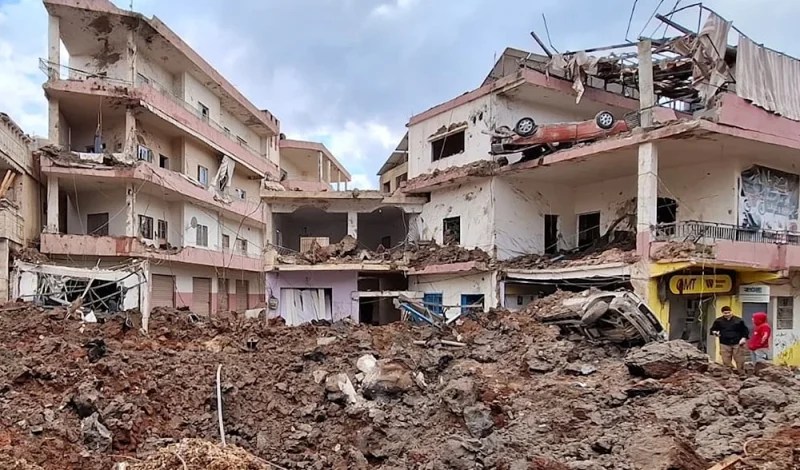
Hezbollah foiled an Israeli landing in the town of Nabi Sheet in the eastern Lebanese region of Bekaa before dawn overnight on Friday-Saturday.
Hezbollah’s Military Media said Islamic Resistance fighters observed four Israeli enemy helicopters infiltrating from the Syrian direction and landing an Israeli infantry force at the mountainous triangle linking the towns of Yahfoufa, Khraibeh, and Maaraboun.
“The enemy unit then advanced toward the eastern neighborhood of Nabi Sheet, (Al-Shukr). At 11:30 AM, upon reaching the cemetery area, the Israeli force was engaged by a group of resistance fighters using light and medium weapons, triggering a fierce clash after the infiltrating force was exposed,” the Military Media’s first statement for Saturday read.
As the confrontation intensified, the Israeli enemy unleashed heavy firepower, launching around forty airstrikes by warplanes and helicopters, to cover the withdrawal of its troops from the engagement zone, according to the statement.
Meanwhile, Hezbollah resistance artillery delivered concentrated fire with appropriate weapons on the perimeter of the battlefield and along the enemy’s withdrawal route, while residents of nearby villages joined in providing supporting fire, the first statement added.
The video shows exchange of fire between resistance fighters and Israeli enemy forces in Nabi Sheet.
In another statement, the third one on Saturday, Hezbollah’s Military Media said: “In response to the enemy’s landing in the Bekaa region, the Islamic Resistance fighters targeted the evacuation area in the outskirts of Nabi Sheet with rocket barrages at 04:15 on Saturday.”
Hebrew media reported that Israeli forces attempted to withdraw after resistance forces revealed the military activity in eastern Lebanon, and that Israeli warplanes and helicopters eventually retreated from the area after the failed airborne landing attempt.
Another video shows heavy destruction in the town of Nabi Sheet after the Israeli landing.
Lebanese Heaslth Ministry announced that the Israeli assault on Nabi Sheet led to martyrdom of 16 people and the injury of 53 others.
Lebanon: Between sovereignty and the mirage of normalization
By Ali Abou Jbara | The Cradle | February 26, 2026
The smoke had barely lifted from the latest Israeli bombardment of south Lebanon when another conversation began circulating in Beirut. While border villages buried their dead and families searched through rubble, a parallel discourse surfaced in studios and on digital platforms: normalization with Israel presented as a viable political path.
The ongoing war on Lebanon, marked by unprecedented Israeli escalation, daily raids, and widespread destruction, exposed more than military vulnerability. It revealed that certain voices inside the country no longer conceal their position toward Tel Aviv.
They now speak openly of public normalization as the cure for Lebanon’s crises – even as Israeli warplanes violate Lebanese skies, despite the so-called ceasefire. What is marketed as pragmatism begins to resemble political surrender.
Prominent personalities have amplified this shift. Journalist Marcel Ghanem declared live on his program “Sar al-Waqt” on MTV that he was considering speaking directly with Israeli Prime Minister Benjamin Netanyahu and suggested repealing Lebanese laws that criminalize dealings with Israel.
Digital platforms followed the same trajectory. “Hona Beirut” circulated videos of Israelis sending populist messages to Lebanese audiences – “We want peace with Lebanon. We want to visit Beirut and enjoy fattoush and shawarma” – carefully packaged to soften the image of a state whose aircraft continue to strike Lebanese territory.
Political figures moved even further. MP Paula Yacoubian stated publicly: “If salvation comes through Israel, let it come but save us.” Charles Jabbour, head of the Lebanese Forces (LF) party media apparatus, argued that Israel does not occupy Lebanon and does not attack the Lebanese, claiming instead that it monitors Hezbollah to ensure implementation of past agreements. He concluded: “If Hezbollah wins, Lebanon loses. If Israel wins, Lebanon wins.”
Such statements are deliberate. They substitute national consensus with partisan calculus and recast normalization as responsible governance.
Expansion as governing doctrine
Advocates of a “quick peace” treat Israel as a state seeking stability. The political current in Tel Aviv suggests something else entirely.
Under Netanyahu and his alliance with ultra-religious and nationalist forces, the “Greater Israel” vision operates as a strategic direction.
On 22 September 2023, Netanyahu stood before the UN General Assembly (UNGA) and presented a map that includes Gaza and the occupied West Bank as part of Israel, using the biblical name “Judea and Samaria” instead of the West Bank – in a symbolic dedication to the annexation project.
His coalition partner, Finance Minister and leader of “Religious Zionism” Bezalel Smotrich, had stated in 2016 that Israel’s borders “must extend to Damascus,” and appeared in Paris in March 2023 in front of a map that considers Jordan part of the “Land of Israel.”
Since Menachem Begin and the Likud party came to power in 1977, the concept of “Greater Israel” has morphed into a political program based on settlement expansion and changing demographic realities. This current is based on interpretations from the Book of Genesis that consider the “Promised Land” to extend from the Nile to the Euphrates. Even Israel’s first prime minister, David Ben Gurion, wrote in the 1930s that establishing a state on part of the land would serve as a first stage, not an endpoint.
Following Operation Al-Aqsa Flood, expansionist language hardened. Military operations broadened in Gaza and the occupied West Bank while strikes intensified in Syria and Lebanon. “Security depth” expanded to encompass regional theaters.
On 21 February 2026, US Ambassador to Israel Mike Huckabee said in an interview with Tucker Carlson that, under a biblical interpretation of land promised in Genesis, it “would be fine if [Israel] took it all,” implicitly extending Israel’s reach across much of West Asia – remarks that sparked sharp regional condemnation.
Maps circulated by proponents of this project extend beyond historic Palestine. They incorporate Lebanon, Jordan, most of Syria, half of Iraq, and territories in Saudi Arabia, Egypt, and even Kuwait.
Against that strategic horizon, Lebanese normalization rhetoric begins to feel profoundly detached from the lived reality of the country. Border villages remain scarred, Lebanese airspace is violated without consequence, and sovereignty is subjected to daily erosion, yet normalization is presented as transactional diplomacy, detached from geography and history.
It is precisely here that the Lebanese debate turns unsettling. What does it mean to pursue “peace” with a project whose declared maps stretch beyond its recognized borders? How does a state whose skies, waters, and land are routinely breached convince itself to trust assurances from a government that treats expansion as a generational mission?
The occupied West Bank as precedent
The occupied West Bank offers a concrete case study. Since the 1993 Oslo Accords, the settler population has grown from roughly 250,000 to more than 700,000. Hundreds of settlements and outposts now fragment the territory. Israeli Energy Minister Eli Cohen has described this as imposing “de facto sovereignty” – gradual annexation without formal declaration.
Land confiscations, bypass roads, settlement blocs, and armed settler protection have eroded the territorial basis for Palestinian statehood. Smotrich openly advocates annexation and rejects Palestinian sovereignty. Netanyahu presides over what observers describe as the most right-wing government in Israel’s history, with settlement expansion central to its agenda.
Three decades of negotiations unfolded alongside continuous territorial transformation. Diplomatic processes advanced in parallel with irreversible changes on the ground. This is how “peace” is managed when it is a tool to strengthen control, not to end it.
Despite this record, similar assumptions appear in Lebanese discourse. MP Camille Chamoun of the Free Patriots Party says he does not believe Israel has an interest in violating international agreements and Lebanese borders.
MP Sami Gemayel, head of the Kataeb Party, suggests that relations with Israel and western countries may protect Lebanon. Even Lebanese actress and writer Carine Rizkallah said on the TV program Al-Masar that she hoped there would be no new war with Israel and that “it’s time to end these problems between the two countries.”
The irony is that Lebanese rhetoric promoting normalization leans on an assumption of good faith from the other side, even though the occupied West Bank continues to show how such assumptions unfold in practice. There, decades of agreements, conferences, and international sponsorship did not halt expansion; they unfolded alongside it, as settlements multiplied, land was fragmented, and entire areas were quietly absorbed into a new reality.
If this is where the occupied West Bank has arrived after years of accords and external guarantees, on what basis is Lebanon encouraged to trust similar assurances? The experience is not abstract or distant. It is ongoing, visible, and instructive for anyone willing to look.
Regional patterns of influence
The broader region reinforces this reading. After the fall of the previous Syrian government on 8 December 2024, Israeli influence expanded in southern and central Syria, capitalizing on security vacuums and fragmentation. Strategic corridors between northern Syria and Israeli ports strengthened. Control over the occupied Golan Heights and adjacent water resources deepened.
Turkiye adopted a confrontational stance toward Israeli expansion, warning that the absence of clear red lines destabilizes Syria and opens space for broader intervention. Ankara expanded its diplomatic engagement on Palestine, strengthened regional alliances, and emphasized deterrence, demonstrating that even governments with formal ties to Israel are wary of unchecked expansion.
Across neighboring states, internal divisions have created entry points for influence. Settlement expansion in the occupied West Bank, strikes in Syria, and sustained violations in Lebanon reflect an interconnected strategy.
Normalization premised on unilateral concession narrows strategic space. In regional practice, asymmetrical engagement tends to consolidate the stronger party’s position.
Lebanon operates within that same environment. Any official normalization would unfold against Israel’s strategic framework and military advantage. Expectations of reciprocal restraint lack precedent in current regional dynamics.
Lebanon’s historical record
Lebanon’s experience with Israeli aggression remains documented. In April 1996, Israeli forces bombed a UN base in Qana, killing more than 100 civilians who had sought shelter. In September 1982, the Sabra and Shatila massacre occurred under the watch of the Israeli army. The 1982 Israeli invasion reached Beirut, and south Lebanon remained under occupation until 2000, liberated only through sustained resistance.
The July 2006 war resulted in more than 1,200 Lebanese deaths, extensive infrastructure destruction, and the displacement of nearly one million people. Airspace violations continued long after hostilities subsided.
Following Operation Al-Aqsa Flood and Hezbollah’s decision to open a northern support front, strikes on southern villages resumed, placing Lebanon within a wider expansionist frame.
In this context, normalization proposals detach policy from cumulative experience. They assume recalibration without structural change. Historical precedent suggests otherwise.
Legal foundations
Lebanon’s stance toward Israel is codified in law. Since 1955, the Boycott of Israel Law has prohibited commercial, cultural, and political dealings with the Israeli enemy. The law remains in force and constitutes a foundational element of Lebanese state policy.
The penal code criminalizes espionage and communication with the enemy, including cooperation that provides political, media, or moral benefit. In contemporary circumstances, public statements or digital content that promote normalization may fall within this framework if deemed to confer advantage. Penalties can include imprisonment and fines.
Given ongoing Israeli violations of Lebanese sovereignty, normalization carries national security implications under existing legislation. Judicial and security institutions retain authority to investigate potential breaches.
This legal architecture reflects accumulated historical experience rather than abstract doctrine.
Sovereignty under pressure
The present debate concerns strategic direction under sustained pressure. An expansionist project operates openly in the region. Lebanon’s historical memory remains recent.
Calls for normalization at a moment of ongoing aggression raise structural questions about sovereignty, deterrence, and long-term stability. Strategic environments shaped by military asymmetry rarely reward unilateral accommodation.
Lebanon faces a clear dilemma. Defending sovereignty requires political coherence and deterrent capacity. Pursuing normalization without reciprocal structural change invites further testing of borders and institutions.
The chosen trajectory will shape more than just diplomatic posture. It will define how the state positions itself within a region undergoing forced transformation.
Featured Video

Iran’s Next Strike May Not Explode. It Could Shut You Down
or go to
Aletho News Archives – Video-Images
From the Archive
Zionism’s Violent Legacy
By Donald Neff | Washington Report On Middle East Affairs | January 1996
On January 4, 1948, Jewish terrorists drove a truck loaded with explosives into the center of the all Arab city of Jaffa and detonated it, killing 26 and wounding around 100 Palestinian men, women and children.[1] The attack was the work of the Irgun Zvai Leumi – the “National Military Organization,” also known by the Hebrew letters Etzel – the largest Jewish terrorist group in Palestine. The Irgun was headed by Revisionist Zionist Menachem Begin and had been killing and maiming Arabs, Britons and even Jews for the previous ten years in its efforts to establish a Jewish state.
This terror campaign meant that at the core of Revisionist Zionism there existed a philosophical embrace of violence. … continue
Blog Roll
 Aletho News
- Trump’s Iran war is on an Israeli leash
- Saudi oil boss issues global supply warning
- Riyadh Says Its Oil System Is Intact. The Numbers Say Otherwise.
- Trump and Netanyahu Want to “Finish the Job” on Iran
- US ‘one-sided dictation’ not Iran’s beliefs makes rational talks impossible: Baghaei
- Iran’s Next Strike May Not Explode. It Could Shut You Down /Col Doug Macgregor
- Iran: US political targets legitimate if assassinations return
- Iraq shuts key border crossing with Iran under US pressure: Report
- Undersea Internet cables could be targeted in retaliation for attacks on Iran: IRGC deputy chief
- EU sending ‘biased’ observers to interfere in Serbian election – president
- If Americans Knew
- The Israel Lobby’s Changing Fortunes
- AIPAC has become such a political liability that it’s shifting to a more “nimble” approach to buying politicians
- At least 160 Israeli settler attacks in 2 weeks
- Will Gaza’s Ancient Christian Community Disappear Forever?
- Israel’s vision of regional security rests on keeping Arab states weak
- Heidi Levine recounts how Palestinian youths helped save her in settler attack
- DAILY UPDATE: Latest essential news on Palestine, Israel, & region
- Trump’s Intensifying Sabotage of the ICC, for Israel’s Sake
- Israeli military detain US and UK volunteers in West Bank including Democratic NY politician Brad Lander
- Americans at National Conservatism Conference held in Israel this year criticize Israel
- No Tricks Zone
- E-Cars Reduce CO2 Emissions By Only 41% Compared To Internal Combustion Engine Vehicles
- Predictions Made By Renowned Climate Professor Over Past Decades Have Been Proven To Be Poor
- New Study Suggests Large Regions Of The Pacific Ocean Have Been Cooling For The Last 80 Years
- Germany’s Green Energy Debacle: High Energy Costs Force Kahla Porzellan to Close After 182 Years!
- New Study: 50 Years Of The Most Aggressive ‘Net Zero’ Policies Can Only Affect The Global Climate By 0.03°C
- US September “Heat” Was No Record…Many Records Set Decades Ago
- Latest European Green Energy Debacle; Portugal’s Largest Flagship Solar Park Insolvent!
- Green Energy Debacle: German Expert Professor Fritz Vahrenholt Warns Of Severe Economic And Social Consequences
- Two More Paleo Reconstructions Affirm Meters-Higher Sea Levels Across Ireland, Brazil 7000-6000 Years Ago
- New Study: Earth And Venus Surface Warmth Largely Explained By Convection And Lapse Rate, Not CO2 Or Radiation

