Deep Dive Intel Briefing: What We Learned This Week /Lt Col Daniel Davis
Daniel Davis / Deep Dive
The Cradle | May 7, 2026
An Israeli “double tap” strike targeted paramedics in the southern Lebanese town of Toul on 7 May, coinciding with brutal attacks across southern Lebanon and just hours after Tel Aviv’s first attack on Beirut since the start of the so-called “ceasefire.”
“An enemy drone struck the Toul area. After the attack, the Islamic Health Authority’s Civil Defense team went to inspect the site, before enemy warplanes launched another raid on the area, which resulted in the injury of two members of the rescue team and significant damage to the ambulance,” Lebanon’s National News Agency (NNA) reported.
Video footage captured the exact moment the Islamic Health Authority’s vehicle was bombed by the occupation army. Over 100 Lebanese medics have been killed by Israel since the war began.
Footage on social media also showed large explosions as a result of violent Israeli strikes on the town of Yater on Thursday. The town has been bombed 27 times over the past 24 hours.
Earlier, an Israeli attack hit the vicinity of the Evangelical School in Nabatieh, killing a delivery driver who was on duty.
Additionally, strikes hit Zefta, Qaqaait al-Jisr, Adchit, and several other Lebanese towns.
The violent attacks came as Hezbollah continues to confront Israeli troops occupying southern Lebanon.
“The Mujahideen of the Islamic Resistance targeted a D9 bulldozer belonging to the Israeli enemy army at Khalleh al-Raj in the town of Deir Siryan at 08:45 AM on Thursday, 07-05-2026, with an attack drone, and achieved a confirmed hit,” the Lebanese resistance announced.
Al-Jarmaq News, citing Hebrew sources, reported that 10 Israeli soldiers were wounded in an explosive drone attack in southern Lebanon and transferred to Rambam Hospital in Haifa on Thursday morning.
Seventeen soldiers are currently being treated at the hospital, including four in serious condition, the report added.
On Wednesday night, Israel carried out its first strikes in Beirut since Iran imposed a truce on the capital last month. The attack targeted a building in Haret Hreik.
The Israeli military claimed this was a targeted assassination of the chief of Hezbollah’s elite Radwan Unit, identifying him as Ahmad Ghaleb Ballout.
Hezbollah has yet to comment on the deadly violation, which resulted in one death and multiple injuries.
Israel’s Channel 14 said Tel Aviv will continue assassinations and “act anywhere” against Hezbollah figures if the opportunity arises.
Other Hebrew reports said Israel does not consider this a ceasefire violation but rather a “preemptive” attack aimed at “thwarting threats.”
Since Tel Aviv’s war and ground assault against Lebanon began in early March, the Israeli army has occupied dozens of Lebanese villages, establishing a Gaza-style buffer zone area which has been labeled the “Forward Defense Line.”
Hezbollah fighters remain present across this line, carrying out daily FPV drone attacks which have become a major challenge to Israeli forces.
Al Mayadeen | May 5, 2026
Hezbollah’s Media Relations categorically denied the false accusations issued by the Syrian Interior Ministry, which claimed to have dismantled a “Hezbollah-affiliated cell” that was planning to carry out security operations inside Syrian territory.
In a statement issued on Tuesday, Hezbollah noted the repeated accusations issued by the Syrian government despite the resistance’s consistent assertions that it maintains no activity in Syria.
It further said that the repetition of such allegations “raises serious questions and confirms that there are those seeking to ignite tension and discord between the Syrian and Lebanese peoples.”
Consequently, Hezbollah said it wishes only well for Syria and its people, and that any threat to Syria’s security would also constitute a threat to Lebanon’s security. It also reiterated that it never sought and would never seek to destabilize the security of any state, stressing that its confrontation remains against the Israeli entity and its expansionist project.
“Hezbollah has been and will remain in a defensive position in confronting the Zionist enemy and its expansionist projects, an enemy of Lebanon and Syria that occupies their lands and covets their resources and the wealth of their peoples,” the statement concluded.
Hezbollah urges vigilance
Several statements have been issued by Syria’s transitional leadership accusing Hezbollah of operating inside its territories, which have been consistently rejected. This is also a trend that stretches beyond Syria, with recent fabricated allegations coming out of Bahrain and Kuwait.
Hezbollah has warned against such narratives, urging the countries to remain vigilant in the face of what appears to be a foreign plot to ignite tensions between Arab nations and the Axis of Resistance.
Al Mayadeen | May 2, 2026
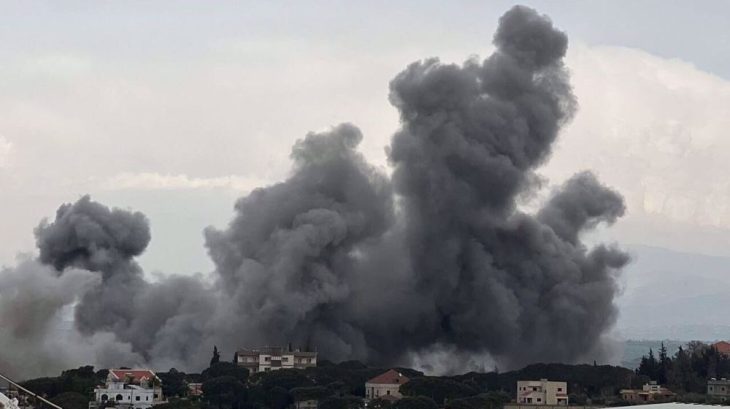
The Israeli occupation has intensified its attacks on villages and towns in southern Lebanon, with fresh airstrikes and artillery shelling reported across several districts, according to field reports from the south.
Al Mayadeen’s correspondent in southern Lebanon reported that three people were killed after an Israeli raid struck a house in the town of al-Louaizeh in the Jezzine district at dawn on Friday, with the escalation extending beyond the area as Israeli airstrikes also hit the towns of Harouf and Shoukin, as well as the al-Tuffah heights region.
The National News Agency (NNA) reported that an earlier strike on Shoukin resulted in the killing of civilians and the injury of several others, including the town’s mayor, Hussein Ali Ahmad.
Further raids targeted multiple towns in the Nabatieh district, including Zawtar al-Sharqiyah, A’dshit, Mayfadoun, Kfar Joz, and Ebba. An additional strike hit a vehicle on the Kfar Dajjal road in the same district.
Strikes across Tyre, Bint Jbeil, and Hasbaya
Southern Lebanon also came under intensified attacks across a wider area, with strikes hitting Majdal Zoun in the Tyre district and Burj Qalaway in the Bint Jbeil district.
The town of Qounine was targeted in an aerial attack, while heavy artillery shelling struck Touline and Qabrikha in the Marjeyoun district. Another airstrike hit Kfarshouba in the Hasbaya district.
Israeli artillery also struck residential areas and outskirts, including al-Mansouri in the Tyre district, while military aircraft maintained intensive overflights across southern Lebanese airspace.
The aggression has continued despite the so-called temporary ceasefire agreement, which took effect on April 17 for 10 days and was later extended for a further three weeks on April 24. However, since the agreement came into force, the Israeli occupation has maintained its attacks, while also facing continued retaliatory attacks from the Islamic Resistance in Lebanon, Hezbollah.
Since March 2, the cumulative toll has reportedly exceeded 2,618 martyrs and more than 8,094 injured, according to the Lebanese Ministry of Health. Officials say the ceasefire framework involving Lebanon has not prevented continued strikes, with repeated attacks reported across multiple regions.
By Robert Inlakesh | The Palestine Chronicle | May 1, 2026
Left in disbelief, an already drained Israeli military is left without any viable solutions to the ever-growing threat of first-person view (FPV) drones, now used by Hezbollah to overwhelm their newly assumed positions in southern Lebanon.
On April 16, Tel Aviv and Beirut agreed to a temporary ceasefire imposed by US President Donald Trump. Within the first hour of the ceasefire’s imposition, Israel had already violated the agreement 10 times, including an attack on an ambulance. What they sought to achieve was a return to the pre-war status quo, whereby the Israeli military attacked Lebanon at will, without any return fire.
It soon became clear that the 15-month ceasefire period, following November 27, 2024, during which the Israeli military violated the agreement 15,400 times according to UNIFIL, was not going to be replicated. The first wave of retaliation against Israeli violations began with Hezbollah detonating improvised explosive devices (IEDs) and destroying convoys of Israeli tanks and armored personnel carriers (APCs), after carrying out reconnaissance and anticipating the movement of armed convoys.
Initially, the Israeli military passed three successive IED attacks off as incidents occurring due to explosives previously left behind by Hezbollah fighters. Later, the Lebanese Party officially announced it had taken out four Israeli Merkava tanks in a single IED attack, forcing the Israelis to issue a statement acknowledging it.
Before long, Hezbollah was issuing statements claiming responsibility for a number of retaliatory attacks each day, including rocket fire on Israeli army positions across the Lebanon Blue Line (Lebanese border).
Then came the prominence of Hezbollah’s usage of the cheap, but highly effective FPV drones, inflicting considerable numbers of casualties amongst Israeli soldiers in retaliation for ceasefire violations and the attempt to illegally occupy a strip of territory in southern Lebanon.
Contrary to Israel’s initial claims to have established a considerable “buffer zone” and that only a small number of Hezbollah fighters had remained in the area, it would become clear that nothing of the sort had truly taken place. There was never any “full operational control” of the “buffer zone”, instead, the Israelis were practicing the Gaza strategy of deploying forces in their heavily armoured vehicles to towns and villages, where they would then be tasked with blowing up civilian infrastructure.
Hezbollah fighters remain positioned throughout this newly declared zone, a terrain that favors a defending force using guerrilla warfare tactics. Perhaps the most menacing is the usage of the FPV drones for both reconnaissance and attacks alike.
In a new article, written for Yediot Aharanot in Hebrew, correspondent Elisha Ben Kimon wrote the following:
“For years, the IDF has invested billions in sophisticated interception systems, precision missiles, and the intelligence capabilities of superpowers. But when Hezbollah, with simple and deadly ingenuity, decided to lower its flight altitude and switch to drones, with fiber optics that make it difficult to detect and intercept, Israel found itself in a situation of dealing with a “low-tech” threat that disrupted all work plans.”
The FPV UAVs can be cheaply acquired for only hundreds of dollars per unit, yet when assembled domestically, they can be put together for as little as 50 dollars in some instances. Successful FPV drone deployment for war was pioneered by the Ukrainians and Russians during the Ukraine War. According to some sources, the majority of battlefield casualties in that war have been a result of this drone, which Kyiv can mass-produce at around 300 dollars per unit.
Equipped with a fiber-optic cable, the drones are completely immune to electronic warfare jamming, negating the high-tech advantages that the Israelis have previously enjoyed. Hezbollah does have access to a range of different attack drones, including various Iranian models, which have proven highly effective also. Yet, they are not available in as high quantities, and their most sophisticated technology is used to target high-value targets.
This development has meant that Hezbollah drone operator teams can safely fly these drones from up to and over 10 kilometers away, without being detected. The process of detecting these drones is the same as it is for Hezbollah’s arsenal of more sophisticated radio frequency (RF) drones, relying on acoustic sensors, radars and thermal imaging, yet FPV drones fly at such low altitudes and use the terrain of southern Lebanon to make them more difficult to detect until it is too late.
A recent article published by the Israeli daily Haaretz noted that back in 2024, the Israeli political and military leadership claimed to be on top of deploying solutions to the Hezbollah drone threat, stressing that a range of Israeli defense companies were engineering solutions.
However, an anonymous source “involved in the field” told Haaretz that “There is a need for a systemic response – not to acquire a little of this and a little of that, but a broad plan to address all unmanned threats along our borders. DDR&D (Directorate of Defense Research & Development) has known about this threat for many years but has not mobilized to address it.”
In a nightmare situation for the Israeli military, Hezbollah recently launched a retaliatory attack using FPV drones, inflicting 6 soldier casualties near the Lebanese town of Taybeh. Israel announced that one of its sergeants, Ithan Fukes, was killed in the attack. What happened next was perhaps even more damning.
Hezbollah followed up their attack with an FPV drone strike targeting the medivac helicopter. The incident caused such a stir because the Israeli military leaked videos of the incident. Despite the Israeli soldiers wearing body cams or GoPros on their helmets, this was the first time such footage has been released, due to Israel’s strict military censor laws.
The first video released was from a distance, showing the FPV drone impacting the site where the evacuation of soldiers was happening, causing them to fall back and the helicopter to abruptly take off. From the footage, it was unclear whether the drone hit any target or not, triggering criticism from the Israeli media over why it was released.
Then, a second video was released, from a soldier’s helmet camera, revealing that the drone fell just short, either due to the wind force of the helicopter or due to the soldier’s gunfire. Any release of footage of this kind is deliberate; in this case, it was to jolt the Israeli leadership into action.
An enormous amount of criticism has been leveled at the Israeli political leadership over its failure to achieve its announced goals in Lebanon, and the army itself is even joining that parade. What this demonstrates is that the psychological impact of the FPVs is greatly burdening soldiers on the ground, while the army is left to sit in southern Lebanon twiddling its thumbs.
Hezbollah’s asymmetric warfare is already causing enormous strain on the some 6 Israeli divisions deployed to fight against Lebanon. Just as they were in Gaza, the Israelis are not doing much beyond demolishing civilian infrastructure, proving so risk-averse as to fear entering a fight in which they actually seek to degrade Hezbollah in any significant way. They may have gotten away with this in Gaza, but in South Lebanon, they are dealing with a much more powerful opponent and a more difficult terrain.
Israeli Merkava tanks, worth between 3.5 to 6 million dollars each, are being taken out day after day by FPV drones, carrying explosive charges, worth a maximum of a few hundred dollars each. Hezbollah is taking out mobile telecommunications equipment, command and control vehicles, APCs, D-9 bulldozers, and excavation equipment, with cheap drones that they continue to mass produce with ease. They also do this while their fighters are kept out of harm’s way.
Israel has attempted to consult Ukrainian advisors in order to learn new tactics to deal with the threat and has purchased its own FPV drones, yet none of this has borne fruit. Instead, individual soldiers have tried experimenting with netting to place over vehicles and the use of shotguns, while relying on soldiers to watch the skies for incoming drones.
Despite some of this being effective, out of fear, the Israelis do not normally deploy infantry next to their tanks while on the move. In Gaza, this tactic of hiding inside heavily armored vehicles and tanks did manage to reduce soldier deaths and injuries, but in Lebanon, it could actually be causing the opposite effect, at least when it comes to FPV drone attacks.
– Robert Inlakesh is a journalist, writer, and documentary filmmaker. He focuses on the Middle East, specializing in Palestine.
Press TV – April 29, 2026
At least ten people, including three rescue workers, have been killed in Israeli airstrikes against residential neighborhoods in southern Lebanon, marking the latest violations of a ceasefire that began on April 16 after weeks of fighting between the Tel Aviv regime and Hezbollah.
Lebanon’s official National News Agency (NNA) reported that an Israeli aerial raid destroyed a four-storey building in the village of Jabchit in the Nabatieh district on Tuesday night, killing Mohammad Jawad Bahja, his wife Lotfiya, as well as Amani Jaber and her daughters.
Lebanon’s Ministry of Public Health announced in a statement that at least 13 people also sustained injuries in the attack.
Separately, two successive Israeli strikes on a building in the town of Majdal Zoun on Tuesday killed five people, including three rescue workers who went to help those injured in the initial Israeli attack on the targeted building.
The three Lebanese civil defense rescue workers were later identified as Hussein Ghadbouri, Hussein Sati and Hadi Daher.
Prime Minister Nawaf Salam strongly condemned the deadly Israeli strike.“Targeting elements of the Civil Defense in Majdal Zoun, and their killing while carrying out their humanitarian duty, constitutes a new and described war crime perpetrated by Israel,” he wrote in a post on social media.
“It represents a flagrant violation of the principles and rules of international humanitarian law,” Salam said.
“The government will spare no effort to condemn this heinous crime in international forums and to mobilize all efforts to compel Israel to cease its ongoing violations of the ceasefire agreement.”
Israeli forces also shelled the towns of Mansouri, Chehabiyeh, Tiri, Jouaiyya, Touline and Khirbet Selm. There were no immediate reports about possible casualties and the extent of damage caused.
The occupation troops also dropped white phosphorus shells on Yohmor al-Shaqif village.
Elsewhere in Naqoura region, Israeli forces pressed ahead with their demolition activities. Residents of adjacent municipalities felt a strong tremor as the occupation troops set off a considerable amount of explosives to flatten designated buildings.
On Wednesday, kamikaze drones launched by Hezbollah resistance fighters targeted and destroyed two Israeli Merkava battle tanks in Naqoura.
Hezbollah said in a brief statement that the operation was carried out in defense of Lebanon as well as its nation, and in response to the Israeli aggression against villages in southern Lebanon.
The Cradle | April 28, 2026
A poll published by Israel’s Public Broadcaster (KAN) on 28 April found that a majority of Israelis believe the state has failed to secure victory in any war since October 2023.
According to the survey, 57 percent of respondents said no victory had been achieved, while 28 percent believed success had been reached in at least one arena, and a further 15 percent said they were unsure.
The findings come after more than two years of Israel’s genocide in Gaza – which Israel threatens to reignite – during which Tel Aviv waged multiple offensive military campaigns against Gaza, Lebanon, and Iran, alongside attacks in Yemen and Syria and a campaign of destruction and displacement in the occupied West Bank.
Confidence levels across all the fronts remain low, with only 17 percent viewing operations in Syria as successful and 16 percent saying the same for Gaza and Iran.
Perceptions dropped further on the Lebanese front at 14 percent, followed by Yemen at 12 percent and the occupied West Bank at 11 percent.
The poll also points to persistent security concerns, with a total of 73 percent of respondents saying the continued armed presence of Hamas and Hezbollah poses a direct threat of a repeat of a 7 October-style event.
Only 10 percent dismissed that possibility, while 17 percent remained uncertain.
On the ground, Israel has reportedly begun withdrawing troops from southern Lebanon. Israeli outlet Maariv described the campaign as ending in “failure” and “bitterness,” as forces pull back under continued Hezbollah attacks, including drone strikes that exposed major gaps in Israeli preparedness.
The poll also showed divisions over Netanyahu’s legal status, with a majority – 56 percent – supporting a pardon for his corruption charges, while 26 percent opposed the move and 18 percent remained undecided.
Netanyahu had requested a presidential pardon on 30 November without admitting guilt or stepping down from office, despite Israeli law requiring an admission of guilt for such a measure.
He is currently facing trial in three separate corruption cases involving fraud, bribery, and abuse of power, with court proceedings ongoing since 2020 after charges were filed in 2019.
Netanyahu’s court testimony was delayed once again on 27 April over a “serious” security incident in southern Lebanon, as the prime minister seeks to prolong the wars to keep his corruption trial from moving forward.
At the same time, the International Criminal Court (ICC) has listed Netanyahu as wanted since 2024, issuing arrest warrants for him and former defense minister Yoav Gallant over their direct involvement and orchestration of the genocide in Gaza, as well as war crimes and crimes against humanity, including the use of starvation as a weapon.
Dialogue Works | April 25, 2026
Substack: https://substack.com/@dialogueworks?u…
X (Twitter): https://x.com/Dialogue_NRA
By Robert Inlakesh | Palestine Chronicle | April 22, 2026
Hezbollah has shifted to waging a guerrilla war against the Israeli occupiers in southern Lebanon, reminding Tel Aviv why it decided to withdraw from the country in the year 2000. Instead of allowing Israel to violate the ceasefire unchecked, the responses have been immediate and painful.
On April 16, the White House declared that a 10-Day temporary ceasefire had been reached between Lebanon and Israel. Only the day prior, both Israeli Prime Minister Benjamin Netanyahu and his Defense Minister Israel Katz had delivered speeches claiming that their operations in the south of Lebanon would continue to expand.
This caused immense frustration amongst the Israeli public and sparked backlash in the Hebrew-language media.
Sure enough, when the ceasefire went into effect, the Israelis decided to violate the agreement at least 10 times within an hour, mainly through artillery fire on Lebanese villages in the south. This was followed by two drone strikes targeting vehicles in southern Lebanon, in addition to an attack on an ambulance.
Israeli Arabic spokesperson Avrechay Adraee, who was supposed to have retired, yet has made a recent return, openly released a video message ordering displaced Lebanese civilians not to return south of the Litani River area. The occupation forces even bombed the area where efforts were being made to reconstruct a temporary bridge that had been deliberately destroyed during the war to prevent civilian passage into the south.
For a period of time, it had been feared that a return to the pre-March “ceasefire” in Lebanon had just been secured in favor of Tel Aviv once again, where the Israelis carried out frequent operations without any response. All of this as Israel was now occupying more territory illegally, as the Lebanese government negotiated for a normalisation agreement.
Hezbollah Secretary General, Sheikh Naim Qassem, then delivered an address, during which he made it clear that the Lebanese leadership was behaving unacceptably and betraying their duties through their normalizing efforts. He also insisted that the previous status quo would not return and that instead his organization would respond to the Israeli violations, fighting until the occupation of South Lebanon was totally abandoned.
Little more than a day into the ceasefire agreement, despite no announcements of retaliatory actions from Hezbollah, a series of “security incidents” were announced by the Israeli Army. The first few were said to have been tanks running over previously planted explosives, making it appear as if the incidents had occurred by accident.
However, three major “security events” occurred, inflicting at least 37 Israeli casualties, 2 of whom the Israelis admitted were deaths. At this point, it had become clear that something else was going on.
Then came an official Hezbollah statement, claiming responsibility for a single incident, where 4 Israeli Merkava tanks were said to have been completely destroyed by pre-planted IEDs, detonating them on an enemy convoy, after Lebanese fighters had been monitoring their movements. After this, the Israeli military decided not to publish any details on the IED attacks.
Yet, Israeli media commentary explained that soldiers, stationed in what is being called a “buffer zone” in southern Lebanon, have reported their frustrations over Hezbollah drones monitoring their movements.
In other words, Hezbollah has cells throughout the territory that Israel claims to be in control of, who do reconnaissance, then calculate the movements of Israeli forces, anticipating their common routes, before planting IEDs that they then detonate on convoys.
Not only is this a transition to asymmetric warfare, which the Iraqi resistance became well known for when fighting an insurgency against US occupying forces, but it is also beginning to usher in flashbacks to the days of the occupation in South Lebanon.
As an example, in 1997, Hezbollah had managed to pull off what was known as the Ansariyeh Ambush, killing 12 Israeli special forces soldiers from its elite Shayetet 13 Unit. This had been carried out through reconnaissance and intelligence work, to anticipate the arrival of the Israeli unit, a total disaster for the Israeli military at the time.
Today, Hezbollah has advanced from what it was in the 1990s and possesses much more sophisticated and powerful weapons. What it means for Israeli forces on the ground is that they must constantly keep moving, as they remain under surveillance and could be subjected to an ambush at any time.
When Israeli tanks travel down roads they have taken a number of times previously, they could suddenly face a series of EIDs. The more these attacks happen, the more terrified the Israeli conscript army’s soldiers become, fearing the possibility that they could at any moment lose an arm, leg, or their life.
Hezbollah, having shifted to such tactics, could also seek to capture Israeli soldiers at one point, something that would represent a catastrophe for the Israeli political leadership.
If such a capture operation succeeds, then Netanyahu’s campaign of triumph will be suddenly transformed into yet another costly operation that will inevitably accelerate on the ground, while eventually forcing him to commit to a prisoner exchange.
All along, this was precisely the scenario that Hezbollah had hoped for, to rope the Israelis in on the ground, in order to eventually inflict enormous losses on them and fulfill the pledge of its former leader, Seyyed Hassan Nasrallah that the south will become a graveyard for the invading army and that they will eventually have no tanks left.
– Robert Inlakesh is a journalist, writer, and documentary filmmaker. He focuses on the Middle East, specializing in Palestine.
Al Mayadeen | April 19, 2026
A former Israeli Military Intelligence officer has questioned the Israeli occupation’s strategy in southern Lebanon, pointing to mounting losses since the ceasefire took effect.
Retired Lieutenant Colonel Jacques Neriah told i24 News that Hezbollah has emerged stronger from the war despite extensive Israeli bombing and attacks, noting that the group “represents the resistance against Israel, and this is its primary source of strength.”
“If we are sustaining daily losses in Lebanon, how long can we endure this situation?” he asked.
2 killed, dozen injured since ceasefire
The Israeli military command had announced that an Israeli reservist soldier was killed and nine others were wounded in an improvised explosive device incident in southern Lebanon on Saturday. Reports indicate that the incident occurred in the border village of Kfar Kila, opposite of Metulla, which has seen extensive periods of Israeli military occupation and incursions since the 66-day war on Lebanon in 2024.
On Sunday, Israeli media reported that an Israeli soldier was killed and nine others were wounded, including one seriously, after an explosive device detonated in an area it occupies in southern Lebanon. The soldier served in the 769th “Hiram” Regional Brigade’s 7106th Battalion.
According to an initial military probe, the incident occurred during operations in Israeli-occupied territory, where an engineering vehicle was struck by an IED planted in the area. Troops securing the machinery were caught in the blast, resulting in multiple casualties. The wounded were airlifted to hospitals, while the Israeli regime says its forces launched their own attacks near the area following the explosion.
A day earlier, Israeli media reported that another reservist, a warrant officer, was killed and three soldiers were wounded in a similar explosion in the southern Lebanese village of Jebbayn. The troops were reportedly scanning a building for weapons when the device detonated.
Continued attacks, occupation in southern Lebanon
The Israeli military command had announced that its forces would operate in a so-called “advanced defense zone” within southern occupied Lebanon, extending from Ras al-Bayyada on the coast to Shebaa in the east. The zone is seen as a prelude to a prolonged Israeli occupation and an attempt to push settlers within Lebanese territory.
The announcement comes as part of a push by the Israeli regime to impose a new status quo in areas located in a region 8-10 km from Israeli sites in occupied Lebanese, Palestinian, and Syrian territories.
However, the Islamic Resistance in Lebanon has emphasized that a ceasefire must include a complete halt to Israeli violations, including incursions and destruction of property.
Hezbollah Secretary-General Sheikh Naim Qassem stated that the Resistance remains prepared to respond to any aggression, stressing that the ceasefire cannot be one-sided and must be respected by both parties. He outlined key priorities for the next phase, including a full Israeli withdrawal from occupied Lebanese territory, the return of displaced residents to their villages, and the launch of reconstruction efforts supported at both the national and international levels.
Sheikh Qassem also stressed the importance of strengthening Lebanese sovereignty, maintaining internal unity, and preventing foreign interference.
By Robert Inlakesh | Al Mayadeen | April 19, 2026
Promising annihilation, dominance, and total victory, the Israeli leadership has found itself in a predicament no closer to victory on any front. Tactical victories sold as strategic ones have been exposed; instead of meticulously planned operations, Tel Aviv engages in aggression without any discernible long-term strategy to achieve its stated aims.
Since October 7, 2023, the Israeli regime of old is no more. Instead of implementing methodical planning, public deception, and fighting the long game, its thinking has been replaced by a ruthlessly violent vengeance scheme that seeks to try and achieve in months what it was previously aiming for over decades.
The beginning of the war on Iran was not February 28, 2026; instead, it was October 7, 2023. This was the moment when everything changed in the strategic thinking of the Israeli leadership. For them, the illusion of absolute control and superiority was crushed under the boots of a few thousand Palestinian fighters, who single-handedly dealt the most severe blow to the Zionist regime in its history.
As an event, the collapse of the Israeli southern command at the hands of a guerrilla force possessing homemade light weapons, Operation Al-Aqsa Flood, represented the moment of a great shift. It wasn’t long before the decision was made to launch a genocide against the people of Gaza.
Inflicting the genocide was the whole strategy, not dealing a military defeat to Hamas or any other Palestinian organizations. Israeli PM Benjamin Netanyahu foolishly believed that the genocide would restore the Zionist entity’s prized “deterrence capacity”, while the side effects of the genocide would mean the de facto defeat of the Resistance, destroying Palestinian will to resist that could lead to a mass ethnic cleansing event that would end up inflicting a predicament on Hamas that replicates the PLO’s defeat in 1982.
When it became clear that this strategy was not working inside Gaza itself, the Israeli military continued without any clear goals and launched operation after operation in desperate attempts to achieve their desired outcomes. The majority of the tasks performed inside Gaza by the invading ground forces were simply round-the-clock demolition work; so much that they even recruited private businesses and settler employees to aid in these efforts.
Ultimately, they ran into a major problem; after two years, they had still failed and presented a plan to try to implement a West Bank-style occupation over Gaza City, a task that experts predicted could take them a decade. This is why they accepted a ceasefire, one in which the war was simply frozen and meant they were able to engage in a prisoner exchange.
In Lebanon, they were also put into a difficult predicament. The stance of former Hezbollah leader Sayyed Hassan Nasrallah had been that Lebanon would remain a support front for Gaza until the very end. “Hamas will win,” stated Nasrallah in a 2023 speech, after which he asserted that “no matter where the region is taken,” Hezbollah will stand with Gaza.
The daily operations by Hezbollah were a thorn in its side, which is why the Israelis began planning to escalate in an unprecedented way. Through their terrorist indiscriminate pager attacks, followed by the assassination of Sayyed Hassan Nasrallah and most of Hezbollah’s senior leadership, the Israelis believed they had dealt a death blow to Hezbollah.
Selling this lie to the public, the Israeli leadership claimed a major victory and alleged to have taken out around 80% of Hezbollah’s weapons arsenal.
In March, when Hezbollah began responding to the some 15,400 ceasefire violations committed by the Zionists, suddenly the Israeli public was jolted back by the power and coordination with which Hezbollah managed to attack, especially as these operations were carried out alongside Iran’s missile and drone strikes.
Eventually, failing to score victories in key towns like Bint Jbeil and Khiam, the Israelis begrudgingly accepted a temporary ceasefire, one that they immediately violated.
If it were true that the Israelis were close to, or even believed that a victory over Hezbollah was possible, they would not take any ceasefire agreement of any description. Instead, they were forced to go back to the drawing board.
Similarly, they launched the 12-day war on Iran and came out empty-handed. They also used their US allies to launch an air assault on Yemen and failed to achieve any of their goals. Then came the February 28 attack on Iran, where the largest blows were landed during the first 24 hours, yet even with the US on their side, their aspirations for regime change quickly faded into a distant memory.
When Yemen’s Ansar Allah joined the war in support of Iran and Hezbollah, the Israelis didn’t even launch strikes on Yemen, likely due to it being a useless endeavour.
So as it stands, the Lebanon front is again open, the Iran front was fought to a standstill with no goals achieved, Yemen is open whenever there is aggression on their allies, and Gaza is a temporarily frozen arena that they still have no plan for. Even in Syria, the constant aggression is like playing with fire.
Meanwhile, the delusional Zionist leadership is still chasing its aspirations of a “Greater Israel”, threatening even Turkey with retaliation for simply criticizing them. What this behaviour and all of their decision-making since October 7 point to is an irrational inability to close any conflict, lacking any coherent plans to win.
Therefore, the Israelis will use any and all ceasefire agreements in order to go back to the drawing board, in order to conjure up new plans for further aggression. Whether it’s a Lebanon, Gaza, or Iran ceasefire, they are not about to give up on attacking everyone mercilessly.
This means that despite all of its efforts and attacks over the past two and a half years, the predicament they find themselves in has not changed. A ceasefire kicks the can down the road, simply delaying the inevitable resumption of war. Either the Israelis are totally defeated in battle, or they will continue to attack again and again. This will go around in circles until they are eventually defeated.
Al-Mayadeen | April 18, 2026
Hezbollah has denied any involvement in an incident targeting United Nations observers in southern Lebanon earlier today.
In a statement, the group said it “calls for caution in issuing judgments and responsibilities regarding the incident,” urging restraint until facts are fully established.
The movement specifically rejected any responsibility for the incident involving UNIFIL forces in the al-Ghandourieh–Bint Jbeil area, stressing that blame should not be assigned before the Lebanese Army completes its investigation and clarifies the circumstances.
Emphasis on coordination and stability
Hezbollah also highlighted the importance of maintaining cooperation between local residents, UNIFIL, and the Lebanese Army. It emphasized the need for coordination between the army and UN peacekeepers, particularly given the current sensitive conditions.
The group further “expressed surprise at the [parties] that rushed to throw accusations arbitrarily, while remaining silent when Israeli forces target UNIFIL personnel.”
Earlier today, UNIFIL said a patrol clearing explosive ordnance along a road in the village of Ghandourieh came under small-arms fire “from non-state actors”, leaving one observer dead and three others wounded, including two in serious condition.
UNIFIL warns IOF movement limits threaten mission logistics flow
The United Nations Interim Force in Lebanon (UNIFIL) has reported that a routine convoy carrying military and civilian peacekeepers, along with essential contractors, was stopped by Israeli forces a few kilometres from its destination in Naqoura on Tuesday afternoon.
UNIFIL said the incident is not isolated, adding that similar restrictions, whether through physical roadblocks or the reversal of prior clearances, have affected both peacekeepers and essential supporting personnel.
The incidents are part of a broader pattern of Israeli aggression targeting the UNIFIL’s presence on the ground.
Late last month, a UNIFIL patrol was subjected to an Israeli attack on the Bani Hayyan-Tallouseh road, resulting in two peacekeepers killed and two others injured, with a helicopter from the Naqoura area intervening to evacuate the wounded.

or go to
Aletho News Archives – Video-Images
By Donald Neff | Washington Report On Middle East Affairs | January 1996
On January 4, 1948, Jewish terrorists drove a truck loaded with explosives into the center of the all Arab city of Jaffa and detonated it, killing 26 and wounding around 100 Palestinian men, women and children.[1] The attack was the work of the Irgun Zvai Leumi – the “National Military Organization,” also known by the Hebrew letters Etzel – the largest Jewish terrorist group in Palestine. The Irgun was headed by Revisionist Zionist Menachem Begin and had been killing and maiming Arabs, Britons and even Jews for the previous ten years in its efforts to establish a Jewish state.
This terror campaign meant that at the core of Revisionist Zionism there existed a philosophical embrace of violence. … continue
 Aletho News If Americans Knew No Tricks Zone
