HRW conducted a biased investigation for the school “bombing” in Idlib
By Mehmet Ersoy | OffGuardian | November 16, 2016
On November 6, Human Rights Watch published a report in which the Syrian government and its allies were accused of carrying out an airstrike on a school in Idlib province in late October, 2016.
According to the report, on October 26, the school was hit by two Su-24 jets used by the Syrian and Russian AFs. Citing some witnesses, the organization claims the jets dropped from 7 to 9 parachute bombs on the school and nearby road. It says no military facilities were in school or by it and all the casualties were among civilians.
It should be noted that, basing on HRW’s report, the Western media went off blaming Assad and his allies for murdering civilians. The artificial information hysteria even forced UN Secretary-General Ban Ki-moon make a hasty loud statement on military crimes in Idlib.
In its turn, the next day only the Russian side could provide sound evidence of the fact that the Syrian aviation and its allies had nothing to do with the attack on the school in Hassa.
Inside Syria Media Center would like to look into the matter. In its report, HRW quotes some phone interviews with the witnesses. We attempted to contact the organization’s press desk but the human rights activists refused to provide details on the persons involved in the report.

A conversation between Inside Syria and Human Rights Watch
In the conversation, HRW claimed the video in their report could be used as the real evidence. However, it’s quite arguable.
Doubtful video footage
The footage of an anti-governmental channel Revolutionary Forces of Syria Media Office published in the HRW report shows an airstrike but it’s hard to distinguish the exact place of the accident. The analysis of this video makes it clear that the international human rights organization takes into consideration only one side of the Syrian conflict i.e. the armed opposition’s militants. At the same time, it almost ignored the arguments of the other side of the conflict and marked them as untenable.
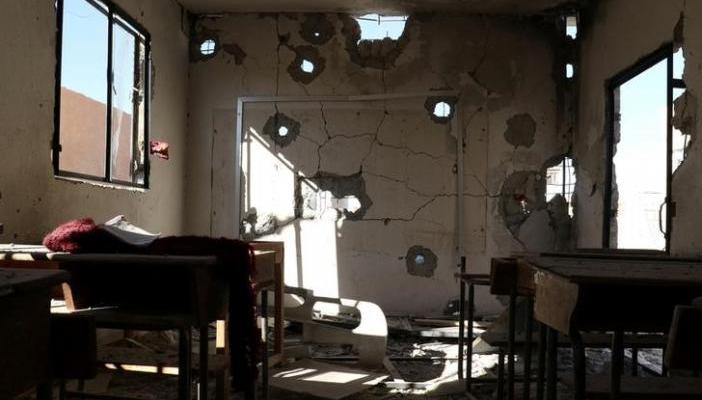
A damaged classroom is pictured after shelling in the rebel held town of Hass, south of Idlib province, Syria October 26, 2016. REUTERS/Ammar Abdullah

Photos of the school in Idlib allegedly destroyed by an airstrikePhotos of the school in Idlib allegedly destroyed by an airstrike
In addition, the photos published in the media clearly show that just one wall is damaged and all the tables stand still. Moreover, not a single picture has any sign of people killed.
Besides, in its report, the organization provided no evidence of the presence of children both in the school and in Hassa village. It’s not a secret that since Jabhat Fateh al-Sham (former Jabhat al-Nusra) came to Idlib province, local schools stopped functioning.
Thus, HRW’s report mostly includes ungrounded evidence of bogus “airstrikes’ witnesses” and doubtful photos & video footage. Human Rights watch seems to have taken a biased approach towards the investigation instead of performing its direct duty – to protect the rights of civilians in Syria. HRW is obviously carrying out an information campaign on behalf of the Syrian opposition as the infamous White Helmets do.
South Africa announces decision to quit International Criminal Court
Press TV – October 21, 2016
South Africa has joined Burundi in officially announcing its withdrawal from the International Criminal Court (ICC), saying its laws are incompatible with obligations under the ICC.
The South African government gave a formal notice of its intention to pull out of the ICC on Friday.
South Africa “found that its obligations with respect to the peaceful resolution of conflicts at times are incompatible with the interpretation given by the International Criminal Court,” the document, signed by International Relations Minister Maite Nkoana-Mashabane, read.
Meanwhile, Justice Minister Michael Masutha told a media conference in the administrative capital, Pretoria, that the ICC’s obligations are inconsistent with laws giving sitting leaders diplomatic immunity.
“The Implementation of the Rome Statute of the International Criminal Court Act, 2002, is in conflict and inconsistent with the provisions of the Diplomatic Immunities and Privileges Act, 2001,” Masutha said.
South Africa says a bill over the matter, i.e. the withdrawal from ICC, will soon go to the country’s parliament.
The decision comes amid a dispute over last year’s visit by Sudanese President Omar Hassan al-Bashir to attend an African Union summit in Johannesburg. Bashir is wanted by the ICC over alleged war crimes. South Africa, however, said he had immunity as the head of a member state.
Nevertheless, the ICC criticized the South African government for its failure to arrest Bashir.
The announcement of the decision by South Africa to withdraw from the ICC sparked rapid criticism from the New York-based Human Rights Watch (HRW).
South Africa’s proposed withdrawal “shows startling disregard for justice from a country long seen as a global leader on accountability for victims of the gravest crimes,” HRW said in a statement. “It’s important both for South Africa and the region that this runaway train be slowed down and South Africa’s hard-won legacy of standing with victims of mass atrocities be restored.”
South Africa is the second African country to declare its withdrawal from the ICC. Earlier this week, Burundi’s President Pierre Nkurunziza signed a decree to quit the court’s jurisdiction.
Namibia and Kenya have also raised the possibility of withdrawal from the ICC.
Some African governments say the ICC has shown a post-colonial bias against the continent’s leaders.
How Propaganda Feeds War on Syria
By Rick Sterling | Consortium News | March 17, 2016
There has been a pattern of sensational but untrue reports that lead to public acceptance of U.S. and Western military intervention in countries around the world.
For instance, in Gulf War 1 (1990-91), there were reports of Iraqi troops stealing incubators from Kuwait, leaving babies to die on the cold floor. Relying on the testimony of a Red Crescent doctor, Amnesty Interenational ‘verified’ the false claims.
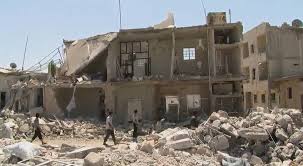
Scene of destruction after aerial bombing in Azaz, Syria, Aug. 16, 2012.
(U.S. government photo)
Ten years later, there were reports of yellow cake uranium going to Iraq for development of weapons of mass destruction.
One decade later, there were reports of Libyan soldiers drugged on viagra and raping women as they advanced.
In 2012, NBC broadcaster Richard Engel was supposedly kidnapped by a pro-Assad Syrian militia but luckily freed by Syrian opposition fighters, the “Free Syrian Army.”
All these reports were later confirmed to be fabrications and lies. They all had the goal of manipulating public opinion and they all succeeded in one way or another. Despite the consequences, which were often disastrous, none of the perpetrators were punished or paid any price.
It has been famously said, “Those who do not learn from the past are doomed to repeat it.” This report is a critical review of the so-called “Caesar Torture Photos” story. As will be shown, there is strong evidence the accusations are entirely or substantially false.
Overview of ‘Caesar Torture Photos’
On Jan. 20, 2014, two days before negotiations about the Syrian conflict were scheduled to begin in Switzerland, a sensational report burst onto television and front pages around the world. The story was that a former Syrian army photographer had 55,000 photographs documenting the torture and killing of 11,000 detainees by the Syrian security establishment.
The Syrian photographer was given the code-name “Caesar.” The story became known as the “Caesar Torture Photos.” A team of lawyers plus digital and forensic experts were hired by the Carter-Ruck law firm, on contract to Qatar, to go to the Middle East and check the veracity of “Caesar” and his story. They concluded that “Caesar” was truthful and the photographs indicated “industrial scale killing.”
CNN, London’s Guardian and LeMonde broke the story which was subsequently broadcast in news reports around the world. The Caesar photo accusations were announced as negotiations began in Switzerland. With the opposition demanding the resignation of the Syrian government, negotiations quickly broke down.
For the past two years the story has been preserved with occasional bursts of publicity and supposedly corroborating reports. Most recently, in December 2015 Human Rights Watch (HRW) released a report titled “If the Dead Could Speak” with significant focus on the Caesar accusations.
Following are 12 significant problems with the “Caesar torture photos” story:
- Almost half the photos show the opposite of the allegations.
The Carter Ruck Inquiry Team claimed there were about 55,000 photos total with about half of them taken by “Caesar” and the other half by other photographers. The Carter Ruck team claimed the photos were all “similar.” Together they are all known as “Caesar’s Torture Photos.”
The photographs are in the custody of an opposition organization called the Syrian Association for Missing and Conscience Detainees (SAFMCD). In 2015, they allowed Human Rights Watch (HRW) to study all the photographs which have otherwise been secret. In December 2015, HRW released their report titled “If the Dead Could Speak.”
The biggest revelation is that over 46 percent of the photographs (24,568) do not show people “tortured to death” by the Syrian government. On the contrary, they show dead Syrian soldiers and victims of car bombs and other violence (HRW pp 2-3). Thus, nearly half the photos show the opposite of what was alleged. These photos, never revealed to the public, confirm that the opposition is violent and has killed large numbers of Syrian security forces and civilians.
- The claim that other photos only show “tortured detainees” is exaggerated or false.
The Carter Ruck report says “Caesar” only photographed bodies brought from Syrian government detention centers. In its December 2015 report, HRW said, “ The largest category of photographs, 28,707 images, are photographs Human Rights Watch understands to have died in government custody, either in one of several detention facilities or after being transferred to a military hospital.” They estimate 6,786 dead individuals in the set.
The photos and the deceased are real, but how they died and the circumstances are unclear. There is strong evidence some died in conflict. Others died in the hospital. Others died and their bodies were decomposing before they were picked up. These photographs seem to document a war-time situation where many combatants and civilians are killed.
It seems the military hospital was doing what it had always done: maintaining a photographic and documentary record of the deceased. Bodies were picked up by different military or intelligence branches. While some may have died in detention; the big majority probably died in the conflict zones. The accusations by “Caesar.” the Carter Ruck report and HRW that these are all victims of “death in detention” or “death by torture” or death in “government custody” are almost certainly false.
- The true identity of “Caesar” is probably not as claimed.
The Carter Ruck Report says “This witness who defected from Syria and who had been working for the Syrian government was given the code-name ‘Caesar’ by the inquiry team to protect the witness and members of his family.” (CRR p12)
However if his story is true, it would be easy for the Syrian government to determine who he really is. After all, how many military photographers took photos at Tishreen and Military 601 Hospitals during those years and then disappeared? According to the Carter Ruck report, Caesar’s family left Syria around the same time. Considering this, why is “Caesar” keeping his identity secret from the Western audience? Why does “Caesar” refuse to meet even with highly sympathetic journalists or researchers?
The fact that 46 percent of the total photographic set is substantially the opposite of what was claimed indicates two possibilities: Caesar and his promoters knew the contents but lied about them expecting nobody to look. Or, Caesar and his promoters did not know the contents and falsely assumed they were like the others. The latter seems more likely which supports the theory that Caesar is not who he claims to be.
- The Carter Ruck Inquiry was faulty, rushed and politically biased.
The credibility of the “Caesar” story has been substantially based on the Carter-Ruck Inquiry Team which “verified” the defecting photographer and his photographs. The following facts suggest the team was biased with a political motive:
–The investigation was financed by the government of Qatar which is a major supporter of the armed opposition.
–The contracted law firm, Carter Ruck and Co, has previously represented Turkey’s President Recep Tayyip Erdogan, also known for his avid support of the armed opposition.
–The American on the legal inquiry team, Professor David M. Crane, has a long history working for the U.S. Defense Department and Defense Intelligence Agency. The U.S. government has been deeply involved in the attempt at “regime change” with demands that President Bashar “Assad must go” beginning in summer 2011 and continuing until recently.
–Crane is personally partisan in the conflict. He has campaigned for a Syrian War Crimes Tribunal and testified before Congress in October 2013, three months before the Caesar revelations.
–By their own admission, the inquiry team was under “time constraints” (CRR, p11).
–By their own admission, the inquiry team did not even survey most of the photographs
–The inquiry team was either ignorant of the content or intentionally lied about the 46 percent showing dead Syrian soldiers and attack victims.
–The inquiry team did its last interview with “Caesar” on Jan. 18, 2014, quickly finalized a report and rushed it into the media on Jan. 20, two days prior to the start of United Nations-sponsored negotiations.
The self-proclaimed “rigor” of the Carter Ruck investigation is without foundation. The claims to a “scientific” investigation are similarly without substance and verging on the ludicrous.
- The U.S. Central Intelligence Agency (CIA) is involved.
In an interview on France24, David Crane of the inquiry team describes how “Caesar” was brought to meet them by “his handler, his case officer.” The expression “case officer” usually refers to the CIA. This would be a common expression for Professor Crane who previously worked in the Defense Intelligence Agency. The involvement of the CIA additionally makes sense since there was a CIA budget of $1 billion for Syria operations in 2013. Crane’s “Syria Accountability Project” is based at Syracuse University where the CIA actively recruits new officers despite student resistance.
Why does it matter if the CIA is connected to the “Caesar” story? Because the CIA has a long history of disinformation campaigns. In 2011, false reports of viagra fueled rape by Libyan soldiers were widely broadcast in Western media as the U.S. pushed for a military mandate. Decades earlier, the world was shocked to hear about Cuban troops fighting in Angola raping Angolan women. The CIA chief of station for Angola, John Stockwell, later described how they invented the false report and spread it around the world. The CIA was very proud of that disinformation achievement. Stockwell’s book, In Search of Enemies, is still relevant.
- The accusers portray simple administrative procedures as mysterious and sinister.
The Carter Ruck inquiry team falsely claimed there were about 11,000 tortured and killed detainees. They then posed the question: Why would the Syrian government photograph and document the people they just killed? The Carter Ruck Report speculates that the military hospital photographed the dead to prove that the “orders to kill” had been followed. The “orders to kill” are assumed.
A more logical explanation is that dead bodies were photographed as part of normal hospital / morgue procedure to maintain a file of the deceased who were received or treated at the hospital. The same applies to the body labeling / numbering system. The Carter Ruck report suggests there is something mysterious and possibly sinister in the coded tagging system. But all morgues need to have a tagging and identification system.
- The photos have been manipulated.
Many of the photos at the SAFMCD website have been manipulated. The information card and tape identity are covered over and sections of documents are obscured. It must have been very time-consuming to do this for thousands of photos. The explanation that they are doing this to “protect identity” is not credible since the faces of victims are visible. What are they hiding?
- The Photo Catalog has duplicates and other errors.
There are numerous errors and anomalies in the photo catalog as presented at the SAFMCD website. For example, some deceased persons are shown twice with different case numbers and dates. There are other errors where different individuals are given the same identity number.
Researcher Adam Larson at A Closer Look at Syria website has done detailed investigation which reveals more errors and curious error patterns in the SAFMCD photo catalog.
9. With few exceptions, Western media uncritically accepted and promoted the story.
The Carter Ruck report was labeled “Confidential” but distributed to CNN, the Guardian and LeMonde. CNN’s Christiane Amanpour gushed over the story as she interviewed three of the inquiry team under the headline “EXCLUSIVE: Gruesome Syria photos may prove torture by Assad regime.” Critical journalism was replaced by leading questions and affirmation. David Crane said “This is a smoking gun.” Desmond de Silva “likened the images to those of holocaust survivors.”
The Guardian report was titled “Syrian regime document trove shows evidence of ‘industrial scale’ killing of detainees” with the subtitle, “Senior war crimes prosecutors say photographs and documents provide ‘clear evidence’ of systematic killing of 11,000 detainees”
One of the very few skeptical reports was by Dan Murphy in the Christian Science Monitor. Murphy echoed standard accusations about Syria but went on to say incisively, “the report itself is nowhere near as credible as it makes out and should be viewed for what it is: A well-timed propaganda exercise funded by Qatar, a regime opponent who has funded rebels fighting Assad who have committed war crimes of their own.”
Unfortunately that was one of very few critical reports in the mainstream media. In 2012, foreign affairs journalist Jonathan Steele wrote an article describing the overall media bias on Syria. His article was titled “Most Syrians back Assad but you’d never know from western media.” The media campaign and propaganda has continued without stop. It was in this context that the Carter Ruck Report was delivered and widely accepted without question.
- Politicians have used the Caesar story to push for more US/NATO aggression.
Politicians seeking direct U.S. intervention for “regime change” in Syria were quick to accept and broadcast the “Caesar” story. They used it to demonize the Assad government and argue that the U.S. must act so as to prevent “another holocaust,” “another Rwanda,” “another Cambodia.”
When Caesar’s photos were displayed at the House Foreign Affairs Committee in Congress, Chairman Ed Royce said “It is far past time that the world act…. It is far past time for the United States to say there is going to be a safe zone across this area in northern Syria.”
The top-ranking Democrat on the House Foreign Affairs Committee is Eliot Engel. In November 2015 he said, “We’re reminded of the photographer, known as Caesar, who sat in this room a year ago, showing us in searing, graphic detail what Assad has done to his own people.” Engel went on to advocate for a new authorization for the use of military force.
Rep. Adam Kinzinger is another advocate for aggression against Syria. At an event at the Holocaust Memorial Museum in July 2015, he said, “If we want to destroy ISIS we have to destroy the incubator of ISIS, Bashar al-Assad.”
The irony and hypocrisy is doubly profound since Rep. Kinzinger has met and coordinated with opposition leader Okaidi who is a confirmed ally of ISIS. In contrast with Kinzinger’s false claims, it is widely known that ISIS ideology and initial funding came from Saudi Arabia and much of its recent wealth from oil sales via Turkey. The Syrian Army has fought huge battles against ISIS, winning some but losing others with horrific scenes of mass beheading carried out by ISIS.
- The Human Rights Watch assessment is biased.
HRW has been very active around Syria. After the chemical attacks in greater Damascus on Aug. 21, 2013, HRW rushed a report which concluded that, based on a vector analysis of incoming projectiles, the source of the sarin carrying rockets must have been Syrian government territory. This analysis was later debunked as a “junk heap of bad evidence” by highly respected investigative journalist Robert Parry.
HRW’s assumption about the chemical weapon rocket flight distance was faulty. Additionally it was unrealistic to think you could determine rocket trajectory with 1 percent accuracy from a canister on the ground, especially from a canister on the ground that had deflected off a building wall.
In spite of this, HRW stuck by its analysis which blamed the Assad government. HRW Director Ken Roth publicly indicated dissatisfaction when an agreement to remove Syrian chemical weapons was reached. Roth wanted more than a “symbolic” attack on Syrian government forces.
Regarding the claims of “Caesar,” HRW seems to be the only non-governmental organization to receive the full set of photo files from the custodian. To its credit, HRW acknowledged that nearly half the photos do not show what has been claimed for two years: they show dead Syrian soldiers and militia along with scenes from crime scenes, car bombings, etc.
But HRW’s bias is clearly shown in how it handles this huge contradiction. Amazingly, HRW suggests the incorrectly identified photographs support the overall claim. They say, “This report focuses on deaths in detention. However other types of photographs are also important. From an evidentiary perspective, they reinforce the credibility of the claims of Caesar about his role as a forensic photographer of the Syrian security forces or at least with someone who has access to their photographs.” (HRW, p31) This seems like saying if someone lies to you half the time that proves they are truthful.
The files disprove the assertion that the files all show people who were tortured and killed. The photographs show a wide range of deceased persons, from Syrian soldiers to Syrian militia members to opposition fighters to civilians trapped in conflict zones to regular deaths in the military hospital. There may be some photos of detainees who died in custody after being tortured, or who were simply executed. We know that this happened in Iraqi detention centers under U.S. occupation. Ugly and brutal things happen in war times. But the facts strongly suggest that the “Caesar” account is basically untrue or a gross exaggeration.
It is striking that the HRW report has no acknowledgment of the war conditions and circumstances in Syria. There is no acknowledgment that the government and Syrian Arab Army have been under attack by tens of thousands of weaponized fighters openly funded and supported by many of the wealthiest countries in the world.
There is no hint at the huge loss of life suffered by the Syrian army and supporters defending their country. The current estimates indicate from 80,000 to 120,000 Syrian soldiers, militia and allies having died in the conflict. During the three years 2011-2013, including the period covered by the “Caesar” photos, it is estimated that over 52,000 Syrian soldiers and civilian militia died versus 29,000 anti-government forces.
HRW had access to the full set of photographs including the Syrian army and civilian militia members killed in the conflict. Why did they not list the number of Syrian soldiers and security forces they identified? Why did they not show a single image of those victims?
HRW goes beyond endorsing the falsehoods in the “Caesar story”; HRW suggests the cataloguing is only a partial listing. On page 5, the report says, “Therefore, the number of bodies from detention facilities that appear in the Caesar photographs represent only a part of those who died in detention in Damascus.”
On the contrary, the Caesar photographs seem to mostly show victims who died in a variety of ways in the armed conflict. The HRW assertions seem to be biased and inaccurate.
- The legal accusations are biased and ignore the supreme crime of aggression.
The Christian Science Monitor journalist Dan Murphy gave an apt warning in his article on the Carter Ruck report about “Caesar.” While many journalists treated the prosecutors with uncritical deference, he said, “Association with war crime prosecutions is no guarantor of credibility – far from it. Just consider Luis Moreno Ocampo’s absurd claims about Viagra and mass rape in Muammar Qaddafi’s Libya in 2011. War crimes prosecutors have, unsurprisingly, a bias towards wanting to bolster cases against people they consider war criminals (like Assad or Qaddafi) and so should be treated with caution. They also frequently favor, as a class, humanitarian interventions.”
The Carter Ruck legal team demonstrated how accurate Murphy’s cautions could be. The legal team was eager to accuse the Syrian government of “crimes against humanity” but the evidence of “industrial killing,” “mass killing,” “torturing to kill” is dubious and much of the hard evidence shows something else.
In contrast, there is clear and solid evidence that a “Crime against Peace” is being committed against Syria. It is public knowledge that the “armed opposition” in Syria has been funded, supplied and supported in myriad ways by various outside governments. Most of the fighters, both Syrian and foreign, receive salaries from one or another outside power. Their supplies, weapons and necessary equipment are all supplied to them. Like the “Contras” in Nicaragua in the 1980’s, the use of such proxy armies is a violation of customary international law.
It is also a violation of the UN Charter which says “All Members shall refrain in their international relations from the threat or use of force against the territorial integrity or political independence of any state, or in any other matter inconsistent with the Purposes of the United Nations”.
The government of Qatar has been a major supporter of the mercenaries and fanatics attacking the sovereign state of Syria. Given that fact, isn’t it hugely ironic to hear the legal contractors for Qatar accusing the Syrian government of “crimes against humanity”?
Isn’t it time for the United Nations to make reforms so that it can start living up to its purposes? That will require demanding and enforcing compliance with the UN Charter and International Law.
Rick Sterling is an independent research/writer and member of Syria Solidarity Movement. He can be contacted at rsterling1@gmail.com
Ecuador Rejects HRW Report as “Manipulative”
teleSUR – November 12, 2015
In a statement released Wednesday, Ecuador’s governing party, Alianza PAIS, rejected the “latest political intervention against the government of Ecuador by the U.S.-based organization Human Rights Watch (HRW) in its report released on 10 November 2015.”
The report made unsubstantiated claims that “the administration of President Rafael Correa has expanded state control over media and civil society” and argued that security forces used “excessive force” against “peaceful” protests this year. It left out important context, such as the calls by the leaders of those protests to get rid of the democratically elected and very popular left wing government. The report criticized Ecuador because the well known US political tool, USAID shut their offices this year, and claimed the government has “broad powers to limit free speech.” Finally, the report took a political position on Ecuador’s internal legislative decisions.
“This organization repeatedly ignores the unprecedented advances in human rights that have occurred in Ecuador while manipulating human rights discourse to unjustly attack the nation’s elected government. It is not the first time HRW releases partisan reports against Latin America’s progressive governments,” Alianza PAIS stated.
Allianza PAIS accused HRW of misrepresenting the sizes of demonstrations, minimizing opposition violence, and of misrepresenting the state of emergency declared with the eruption of the Cotopaxi volanco – portraying that measure as a repressive tool.
“The sources of HRW’s funding, including corporate funding, contribute to its political bias while its board members and advisers have links with the financial, military and political sectors, the latter criticized by significant figures including Nobel laureates,” Alianza stated.
Mythology, Barrel Bombs, and Human Rights Watch
By Paul Larudee | CounterPunch | July 21, 2015
To read Human Rights Watch and the western mainstream media, the Syrian government army is inflicting massive casualties upon the Syrian civilian population, most especially through the use of “barrel bombs”. Thousands of bombs have been dropped, inflicting thousands of casualties.
But wait a minute. Doesn’t that imply one casualty per bomb?
Credible and reliable facts and figures are notoriously hard to come by, but Human Rights Watch intrepidly goes where angels fear to tread. They are the only ones that provide both casualty and bomb counts for a given period of time, from February, 2014 through January, 2015. According to them, more than 1,450 bombs – mostly “barrel” bombs – were dropped on the areas of Daraa and Aleppo covered by the report. HRW also reports 3,185 civilian casualties from aerial attacks for the same time period and in the same places. So roughly two casualties per bomb, even if you accept that a lot of “civilians” are actually fighters and that HRW and its sources are hardly unbiased.
That’s a lot of bombs and a lot of casualties, but no indication that “barrel” bombs are more deadly or indiscriminate than the usual gravity bombs in most air force arsenals around the world. Fighter-bomber aircraft may have sophisticated sighting equipment, but they move at hundreds of miles per hour. Helicopters that drop “barrel” bombs have the advantage of delivering them from a stationary position. “Barrel” bombs may be crude devices, but there is no evidence that they cause more casualties than conventional gravity bombs.
So what about the huge number of deaths in Syria? Doesn’t that show reckless disregard for human life by the Syrian army?
The UN estimates 220,000 deaths thus far in the Syrian war. But almost half are Syrian army soldiers or allied local militia fighters, and two thirds are combatants if we count opposition fighters. Either way, the ratio of civilian to military casualties is roughly 1:2, given that the opposition is also inflicting civilian casualties. Compare that to the roughly 3:1 ratio in the US war in Iraq and 4:1 in the Israeli attack on Gaza in 2008-9. (The rate of Palestinian to Israeli casualties was an astronomical 100:1.)
The Israelis also used Dense Inert Metal Explosive (DIME) munitions that strip the flesh off the bone and cause microscopic metal particles to penetrate the victim’s body. In addition, they used white phosphorous, which burns hot enough to eat through metal or flesh and is almost impossible to extinguish, even inside the body. And let’s not forget the four million cluster bombs that Israel spread throughout south Lebanon during the last 72 hours of the 2006 war, knowing that the fighting was ending. These parting gifts assured that Lebanese farmers and children would be killed or maimed for years to come.
Syria has used none of these disgusting weapons, while being condemned for using locally-made weapons that are in fact no worse than conventional munitions in the arsenals of every air force. Of course, even gravity bombs can create appalling casualties when used on a dense population center. The point is that such incidents are rare enough to be tabulated and recognized (on Wikipedia, for example). To the contrary, the Syrian army has been accused of the opposite: laying siege to an area and starving out the residents, and then using “barrel bombs” to clear the remaining armed elements.
In order to vilify the Syrian armed forces it was necessary to frame Syria for the use of sarin gas, a transparent fraud given that the army gained no strategic advantage and that their use had never been recorded or reported prior to U.S. President Obama’s threat to intervene, only afterward. Really, who would take such a risk for no apparent gain?
The Syrian army relies on loyal soldiers defending their country and their homes from a heavily subsidized, markedly foreign incursion, including many mercenaries paid by the Gulf monarchies and trained by the US. And the army is loyal because they know that although great sacrifices will be asked of them, they will be defending, not sacrificing, their families and loved ones. The rest of the world that supposedly cares about Syria can start by making it unnecessary for them to make such sacrifices.
Paul Larudee is on the steering committee of the Syria Solidarity Movement.
Daraa 2011: Syria’s Islamist Insurrection in Disguise

By Prof. Tim Anderson | Global Research | July 5, 2015
“I have seen from the beginning armed protesters in those demonstrations … they were the first to fire on the police. Very often the violence of the security forces comes in response to the brutal violence of the armed insurgents” – Jesuit priest Father Frans Van der Lugt, January 2012, Homs Syria
“The claim that armed opposition to the government has begun only recently is a complete lie. The killings of soldiers, police and civilians, often in the most brutal circumstances, have been going on virtually since the beginning.” – Professor Jeremy Salt, October 2011, Ankara Turkey
“The protest movement in Syria was overwhelmingly peaceful until September 2011” – Human Rights Watch, March 2012, Washington
A double story began on the Syrian conflict, at the very beginning of the armed violence in 2011, in the southern border town of Daraa. The first story comes from independent witnesses in Syria, such as the late Father Frans Van der Lugt in Homs. They say that armed men infiltrated the early political reform demonstrations to shoot at both police and civilians. This violence came from sectarian Islamists. The second comes from the Islamist groups (‘rebels’) and their western backers, including the Washington-based Human Rights Watch. They claim there was ‘indiscriminate’ violence from Syrian security forces to repress political rallies and that the ‘rebels’ grew out of a secular political reform movement.
Careful study of the independent evidence, however, shows that the Washington-backed ‘rebel’ story, while widespread, was part of a strategy to delegitimise the Syrian Government, with the aim of fomenting ‘regime change’. To understand this it is necessary to study the outbreak of the violence in Daraa, in March 2011. Central to that insurrection were shipments of arms from Saudi Arabia to Islamists at the al Omari mosque.
In early 2011 Syrians were well aware of a piece of history few western observers would remember: a strikingly similar Islamist insurrection took place in the town of Hama, back in 1982. Yet this was crushed within weeks by the Syrian Arab Army. Reviewing this conflict is useful because of the myths that have grown up around both insurrections.
US intelligence (DIA 1982) and the late British author Patrick Seale (1988) give independent accounts of what happened at Hama. After years of violent, sectarian attacks by Syria’s Muslim Brotherhood, by mid-1980 President Hafez al Assad had ‘broken the back’ of their sectarian rebellion, which aimed to impose a Salafi-Islamic state. One final coup plot was exposed and the Brotherhood ‘felt pressured into initiating’ an uprising in their stronghold of Hama. Seale describes the start of that violence in this way:
‘At 2am on the night of 2-3 February 1982 an army unit combing the old city fell into an ambush. Roof top snipers killed perhaps a score of soldiers … [Brotherhood leader] Abu Bakr [Umar Jawwad] gave the order for a general uprising … hundreds of Islamist fighters rose … by the morning some seventy leading Ba’athists had been slaughtered and the triumphant guerrillas declared the city ‘liberated’ (Seale 1988: 332).
However the Army responded with a huge force of about 12,000 and the battle raged for three weeks. It was a foreign-backed civil war, with some defections from the army. Seale continues:
‘As the tide turned slowly in the government’s favour, the guerrillas fell back into the old quarters … after heavy shelling, commandos and party irregulars supported by tanks moved in … many civilians were slaughtered in the prolonged mopping up, whole districts razed’ (Seale 1988: 333).
Two months later a US intelligence report said: ‘The total casualties for the Hama incident probably number about 2,000. This includes an estimated 300 to 400 members of the Muslim Brotherhood’s elite ‘Secret Apparatus’ (DIA 1982: 7). Seale recognises that the Army also suffered heavy losses. At the same time, ‘large numbers died in the hunt for the gunmen … government sympathizers estimating a mere 3,000 and critics as many as 20,000 … a figure of 5,000 to 10,000 could be close to the truth’ He adds:
‘The guerrillas were formidable opponents. They had a fortune in foreign money … [and] no fewer than 15,000 machine guns’ (Seale 1988: 335). Subsequent Muslim Brotherhood accounts have inflated the casualties, reaching up to ‘40,000 civilians’, and attempting to hide the vicious insurrection by claiming that Hafez al Assad had simply carried out a ‘civilian massacre’ (e.g. Nassar 2014). The then Syrian President blamed a large scale foreign conspiracy for the Hama insurrection. Seale observes that Hafez was ‘not paranoical’, as many US weapons were captured and foreign backing had come from several US collaborators: King Hussayn of Jordan, Lebanese Christian militias (the Israeli-aligned ‘Guardians of the Cedar’) and Saddam Hussein in Iraq (Seale 1988: 336-337).
The Hama insurrection helps us understand the Daraa violence because, once again in 2011, we saw armed Islamists using rooftop sniping against police and government officials, drawing in the armed forces, only to cry ‘civilian massacre’ when they and their collaborators came under attack from the Army. Although the US, through its allies, played an important part in the Hama insurrection, when it was all over US intelligence dryly observed that: ‘the Syrians are pragmatists who do not want a Muslim Brotherhood government’ (DIA 1982: vii).
In the case of Daraa, and the attacks that moved to Homs and surrounding areas in April 2011, the clearly stated aim was once again to topple the secular or ‘infidel-Alawi’ regime. The front-line US collaborators were Saudi Arabia, Qatar and Turkey. The head of the Syrian Brotherhood, Muhammad Riyad Al-Shaqfa, issued a statement on 28 March which left no doubt that the group’s aim was sectarian. The enemy was ‘the secular regime’ and Brotherhood members ‘have to make sure that the revolution will be pure Islamic, and with that no other sect would have a share of the credit after its success’ (Al-Shaqfa 2011). While playing down the initial role of the Brotherhood, Sheikho confirms that it ‘went on to punch above its actual weight on the ground during the uprising … [due] to Turkish-Qatari support’, and to its general organisational capacity (Sheikho 2013). By the time there was a ‘Free Syrian Army Supreme Military Council’ in 2012 (more a weapons conduit than any sort of army command), it was two-thirds dominated by the Muslim Brotherhood (Draitser 2012). Other foreign Salafi-Islamist groups quickly joined this ‘Syrian Revolution’. A US intelligence report in August 2012, contrary to Washington’s public statements about ‘moderate rebels’, said:
‘The Salafist, the Muslim Brotherhood and AQI [Al Qaeda in Iraq, later ISIS] are the major forces driving the insurgency in Syria … AQI supported the Syrian Opposition from the beginning, both ideologically and through the media’ (DIA 2012).
In February 2011 there was popular agitation in Syria, to some extent influenced by the events in Egypt and Tunisia. There were anti-government and pro-government demonstrations, and a genuine political reform movement that for several years had agitated against corruption and the Ba’ath Party monopoly. A 2005 report referred to ‘an array of reform movements slowly organizing beneath the surface’ (Ghadry 2005), and indeed the ‘many faces’ of a Syrian opposition, much of it non-Islamist, had been agitating since about that same time (Sayyid Rasas 2013). These political opposition groups deserve attention, in another discussion. However only one section of that opposition was linked to the violence that erupted in Daraa. Large anti-government demonstrations began, to be met with huge pro-government demonstrations. In early March some teenagers in Daraa were arrested for graffiti that had been copied from North Africa ‘the people want to overthrow the regime’. It was reported that they were abused by local police, President Bashar al Assad intervened, the local governor was sacked and the teenagers were released (Abouzeid 2011).
Yet the Islamist insurrection was underway, taking cover under the street demonstrations. On 11 March, several days before the violence broke out in Daraa, there were reports that Syrian forces had seized ‘a large shipment of weapons and explosives and night-vision goggles … in a truck coming from Iraq’. The truck was stopped at the southern Tanaf crossing, close to Jordan. The Syrian Government news agency SANA said the weapons were intended ‘for use in actions that affect Syria’s internal security and spread unrest and chaos.’ Pictures showed ‘dozens of grenades and pistols as well as rifles and ammunition belts’. The driver said the weapons had been loaded in Baghdad and he had been paid $5,000 to deliver them to Syria (Reuters 2011). Despite this interception, arms did reach Daraa, a border town of about 150,000 people. This is where the ‘western-rebel’ and the independent stories diverge, and diverge dramatically. The western media consensus was that protestors burned and trashed government offices, and then ‘provincial security forces opened fire on marchers, killing several’ (Abouzeid 2011). After that, ‘protestors’ staged demonstrations in front of the al-Omari mosque, but were in turn attacked.
The Syrian government, on the other hand, said that armed attacks had begun on security forces, killing police and civilians, along with the burning of government offices. There was foreign corroboration of this account. While its headline blamed security forces for killing ‘protesters’, the British Daily Mail (2011) showed pictures of guns, AK47 rifles and hand grenades that security forces had recovered after storming the al-Omari mosque. The paper noted reports that ‘an armed gang’ had opened fire on an ambulance, killing ‘a doctor, a paramedic and a policeman’. Media channels in neighbouring countries did report on the killing of Syrian police, on 17-18 March. On 21 March a Lebanese news report observed that ‘Seven policemen were killed during clashes between the security forces and protesters in Syria’ (YaLibnan 2011), while an Israel National News report said ‘Seven police officers and at least four demonstrators in Syria have been killed … and the Baath party headquarters and courthouse were torched’ (Queenan 2011). These police had been targeted by rooftop snipers.
Even in these circumstances the Government was urging restraint and attempting to respond to the political reform movement. President Assad’s adviser, Dr Bouthaina Shaaban, told a news conference that the President had ordered ‘that live ammunition should not be fired, even if the police, security forces or officers of the state were being killed’. Assad proposed to address the political demands, such as the registration of political parties, removing emergency rules and allowing greater media freedoms (al-Khalidi 2011). None of that seemed to either interest or deter the Islamist insurrection.
Several reports, including video reports, observed rooftop snipers firing at crowds and police, during funerals of those already killed. It was said to be ‘unclear who was firing at whom’ (Al Jazeera 2011a), as ‘an unknown armed group on rooftops shot at protesters and security forces’ (Maktabi 2011). Yet Al Jazeera (2011b) owned by the Qatari monarchy, soon strongly suggested that that the snipers were pro-government. ‘President Bashar al Assad has sent thousands of Syrian soldiers and their heavy weaponry into Derra for an operation the regime wants nobody in the word to see’. However the Al Jazeera suggestion that secret pro-government snipers were killing ‘soldiers and protestors alike’ was illogical and out of sequence. The armed forces came to Daraa precisely because police had been shot and killed.
Saudi Arabia, a key US regional ally, had armed and funded extremist Salafist Sunni sects to move against the secular government. Saudi official Anwar Al-Eshki later confirmed to BBC television that his country had sent arms to Daraa and to the al-Omari mosque (Truth Syria 2012). From exile in Saudi Arabia, Salafi Sheikh Adnan Arour called for a holy war against the liberal Alawi Muslims, who were said to dominate the Syrian government. The Salafist aim was a theocratic state or caliphate. The genocidal slogan ‘Christians to Beirut, Alawites to the grave’ became widespread, a fact reported by the North American media as early as May 2011 (e.g. Blanford 2011). Islamists from the FSA Farouq brigade would soon act on these threats (Crimi 2012). Canadian analyst Michel Chossudovsky (2011) concluded:
‘The deployment of armed forces including tanks in Daraa [was] directed against an organised armed insurrection, which has been active in the border city since March 17-18.’
After those first few days in Daraa the killing of Syrian security forces continued, but went largely unreported outside Syria. Nevertheless, independent analyst Sharmine Narwani wrote about the scale of this killing in early 2012 and again in mid-2014. An ambush and massacre of soldiers took place near Daraa in late March or early April. An army convoy was stopped by an oil slick on a valley road between Daraa al-Mahata and Daraa al-Balad and the trucks were machine gunned. Estimates of soldier deaths, from government and opposition sources ranged from 18 to 60. A Daraa resident said these killings were not reported because: ‘At that time, the government did not want to show they are weak and the opposition did not want to show they are armed’. Anti-Syrian blogger, Nizar Nayouf, records this massacre as taking place in the last week of March. Another anti-Government writer, Rami Abdul Rahman (based in England, and calling himself the ‘Syrian Observatory of Human Rights’) says:
‘It was on the first of April and about 18 or 19 security forces … were killed’ (Narwani 2014). Deputy Foreign Minister Faisal Mikdad, himself a resident of Daraa, confirmed that: ‘this incident was hidden by the government … as an attempt not to antagonize or not to raise emotions and to calm things down – not to encourage any attempt to inflame emotions which may lead to escalation of the situation’ (Narwani 2014).
Yet the significance of denying armed anti-Government killings was that, in the western media, all deaths were reported as (a) victims of the Army and (b) civilians. For well over six months, when a body count was mentioned in the international media, it was usually considered acceptable to suggest these were all ‘protestors’ killed by the Syrian Army. For example, a Reuters report on 24 March said Daraa’s main hospital had received ‘the bodies of at least 37 protestors killed on Wednesday’ (Khalidi 2011). Notice that all the dead had become ‘protestors’, despite earlier reports on the killing of a number of police and health workers.
Another nineteen soldiers were gunned down on 25 April, also near Daraa. Narwani obtained their names and details from Syria’s Defence Ministry, and corroborated these details from another document from a non-government source. Throughout April 2011 she calculates that eighty-eight Syrian soldiers were killed ‘by unknown shooters in different areas across Syria’ (Narwani 2014). She went on to refute claims that the soldiers killed were ‘defectors’, shot by the Syrian army for refusing to fire on civilians. The Washington based group Human Rights Watch, referring to interviews with 50 unnamed ‘activists’, claimed that soldiers killed at this time were all ‘defectors’, murdered by the Army (HRW 2011b). Yet the funerals of loyal officers, shown on the internet at that time, were distinct. Even Rami Abdul Rahman, keen to blame the Army for killing civilians, said ‘this game of saying the Army is killing defectors for leaving – I never accepted this’ (Narwani 2014). Nevertheless the highly charged reports were confusing, in Syria as well as outside.
The violence spread north, with the assistance of Islamist fighters from Lebanon, reaching Baniyas and areas around Homs. On 10 April nine soldiers were shot in a bus ambush in Baniyas. In Homs, on April 17, General Abdo Khodr al-Tallawi was killed with his two sons and a nephew, and Syrian commander Iyad Kamel Harfoush was gunned down near his home. Two days later, off-duty Colonel Mohammad Abdo Khadour was killed in his car (Narwani 2014). North American commentator Joshua Landis (2011a) reported the death of his wife’s cousin, one of the soldiers in Baniyas.
Al Jazeera, the principal Middle East media channel backing the Muslim Brotherhood, blacked out these attacks, as also the reinforcement provided by armed foreigners. Former Al Jazeera journalist Ali Hashem was one of many who resigned from the Qatar-owned station (RT 2012), complaining of deep bias over their presentation of the violence in Syria. Hashem had footage of armed men arriving from Lebanon, but this was censored by his Qatari managers. ‘In a resignation letter I was telling the executive … it was like nothing was happening in Syria.’ He thought the ‘Libyan revolution’ was the turning point for Al Jazeera, the end of its standing as a credible media group (Hashem 2012).
Provocateurs were at work. Tunisian jihadist ‘Abu Qusay’ later admitted he had been a prominent ‘Syrian rebel’ charged with ‘destroying and desecrating Sunni mosques’, including by scrawling the graffiti ‘There is no God but Bashar’, a blasphemy to devout Muslims. This was then blamed on the Syrian Army, with the aim of creating Sunni defections from the Army. ‘Abu Qusay’ had been interviewed by foreign journalists who did not notice he was not Syrian (Eretz Zen 2014).
Journalist Nir Rosen, whose reports were generally against the Syrian Government, also criticised the western consensus over the early violence:
‘The issue of defectors is a distraction. Armed resistance began long before defections started … Every day the opposition gives a death toll, usually without any explanation … Many of those reported killed are in fact dead opposition fighters but … described in reports as innocent civilians killed by security forces … and every day members of the Syrian Army, security agencies … are also killed by anti-regime fighters’ (Rosen 2012).
A numbers game was being played to delegitimise the Syrian Government (‘The Regime’) and the Syrian Army (‘Assad loyalists’), suggesting they were responsible for all the violence. Just as NATO forces were about to bomb Libya and overthrow the Libyan Government, US voices began to demand that President Assad step down. The Brookings Institution (Shaikh 2011) claimed the President had ‘lost the legitimacy to remain in power in Syria’. US Senators John McCain, Lindsay Graham and Joe Lieberman said it was time ‘to align ourselves unequivocally with the Syrian people in their peaceful demand for a democratic government’ (FOX News 2011). The big powers began to demand yet another ‘regime change’.
In June, US Secretary of State Hilary Clinton dismissed the idea that ‘foreign instigators’ had been at work, saying that ‘the vast majority of casualties have been unarmed civilians’ (Clinton 2011). In fact, as Clinton knew very well, her Saudi Arabian allies had armed extremists from the very beginning. Her casualty assertion was also wrong. The United Nations (which would later abandon its body count) estimated from several sources that, by early 2012, there were more than 5,000 casualties, and that deaths in the first year of conflict included 478 police and 2,091 from the military and security forces (OHCHR 2012: 2; Narwani 2014). That is, more than half the casualties in the first year were those of the Syrian security forces. That independent calculation was not reflected in western media reports. ‘Watchdog’ NGOs such as Human Rights Watch, along with US columnists (e.g. Allaf 2012), continued to claim, well into 2012, that Syrian security forces had been massacring ‘unarmed protestors’, that the Syrian people ‘had no choice’ but to take up arms, and that this ‘protest movement’ had been ‘overwhelmingly peaceful until September 2011’ (HRW 2011a, HRW 2012). In fact, the political reform movement had been driven off the streets by Salafi-Islamist gunmen, over the course of March and April.
In June reporter Hala Jaber (2011) observed that about five thousand people turned up for a demonstration at Ma’arrat al-Numan, a small town in north-west Syria, between Aleppo and Hama. She says several ‘protestors’ had been shot the week before, while trying to block the road between Damascus and Aleppo. After some negotiations which reduced the security forces in the town, ‘men with heavy beards in cars and pick-ups with no registration plates’ with ‘rifles and rocket-propelled grenades’ began shooting at the reduced numbers of security forces. A military helicopter was sent to support the security forces. After this clash ‘four policemen and 12 of their attackers were dead or dying. Another 20 policemen were wounded’. Officers who escaped the fight were hidden by some of the tribal elders who had participated in the original demonstration. When the next ‘demonstration for democracy’ took place, the following Friday, ‘only 350 people turned up’, mostly young men and some bearded militants (Jaber 2011). Five thousand protestors had been reduced to 350, after the Salafist attacks.
After months of media manipulations, disguising the Islamist insurrection, Syrians such as Samer al Akhras, a young man from a Sunni family, who used to watch Al Jazeera because he preferred it to state TV, became convinced to back the Syrian government. He saw first-hand the fabrication of reports on Al Jazeera and wrote, in late June 2011:
‘I am a Syrian citizen and I am a human. After 4 months of your fake freedom … You say peaceful demonstration and you shoot our citizen. From today … I am [now] a Sergeant in the Reserve Army. If I catch anyone … in any terrorist organization working on the field in Syria I am gonna shoot you as you are shooting us. This is our land not yours, the slaves of American fake freedom’ (al Akhras 2011).
Notes:
Abouzeid, Rania (2011) ‘Syria’s Revolt, how graffiti stirred an uprising’,Time, 22 March
Al Akhras, Samer (2011) ‘Syrian Citizen’, Facebook, 25 June, online:https://www.facebook.com/notes/sam-al-akhras/syrian-citizen/241770845834062?pnref=story
Al Jazeera (2011a) ‘Nine killed at Syria funeral processions’, 23 April, online:http://www.aljazeera.com/news/middleeast/2011/04/20114231169587270.html
Al Jazeera (2011b) ‘Deraa: A city under a dark siege’, 28 April, online:http://www.aljazeera.com/indepth/features/2011/04/2011427215943692865.html
Al-Shaqfa, Muhammad Riyad (2011) ‘Muslim Brotherhood Statement about the so-called ‘Syrian Revolution’’, General supervisor for the Syrian Muslim Brotherhood, statement of 28 March, online at: http://truthsyria.wordpress.com/2012/02/12/muslim-brotherhood-statement-about-the-so-called-syrian-revolution/
Allaf, Rime (2012) ‘This Time, Assad Has Overreached’, NYT, 5 Dec, online:http://www.nytimes.com/roomfordebate/2012/02/06/is-assads-time-running-out/this-time-assad-has-overreached
Blanford, Nicholas (2011) ‘Assad regime may be gaining upper hand in Syria’, Christina Science Monitor, 13 may, online:http://www.csmonitor.com/World/Middle-East/2011/0513/Assad-regime-may-be-gaining-upper-hand-in-Syria
Chossudovsky, Michel (2011) ‘Syria: who is behind the protest movement? Fabricating a pretext for US-NATO ‘Humanitarian Intervention’’, Global Research, 3 May, online: http://www.globalresearch.ca/syria-who-is-behind-the-protest-movement-fabricating-a-pretext-for-a-us-nato-humanitarian-intervention/24591
Clinton, Hilary (2011) ‘There is No Going Back in Syria’, US Department of State, 17 June, online: http://www.state.gov/secretary/20092013clinton/rm/2011/06/166495.htm
Maktabi, Rima (2011) ‘Reports of funeral, police shootings raise tensions in Syria’, CNN, 5 April, online: http://edition.cnn.com/2011/WORLD/meast/04/05/syria.unrest/
Crimi, Frank (2012) ‘Ethnic Cleansing of Syrian Christians’, Frontpagemag,29 March, online: http://www.frontpagemag.com/2012/frank-crimi/ethnic-cleansing-of-syrian-christians/
Daily Mail (2011) ‘Nine protesters killed after security forces open fire by Syrian mosque’, 24 March
DIA (1982) ‘Syria: Muslim Brotherhood Pressure Intensifies’, Defence Intelligence Agency (USA), May, online: https://syria360.files.wordpress.com/2013/11/dia-syria-muslimbrotherhoodpressureintensifies-2.pdf
DIA (2012) ‘Department of Defence Information Report, Not Finally Evaluated Intelligence, Country: Iraq’, Defence Intelligence Agency, August, 14-L-0552/DIA/297-293, Levant report, online at:http://levantreport.com/2015/05/19/2012-defense-intelligence-agency-document-west-will-facilitate-rise-of-islamic-state-in-order-to-isolate-the-syrian-regime/
Draitser, Eric (2012) ‘Unmasking the Muslim Brotherhood: Syria, Egypt and beyond’, Global Research, 12 December, online:http://www.globalresearch.ca/unmasking-the-muslim-brotherhood-syria-egypt-and-beyond/5315406
Eretz Zen (2014) ‘Tunisian Jihadist Admits: We Destroyed & Desecrated Mosques in Syria to Cause Defections in Army’, Youtube Interview, 16 March, online: https://www.youtube.com/watch?v=fQ8awN8GLAk
FOX News (2011) ‘Obama Under Pressure to Call for Syrian Leader’s Ouster’,29 April, online: http://www.foxnews.com/politics/2011/04/29/obama-pressure-syrian-leaders-ouster/
Ghadry, Farid N. (2005) ‘Syrian Reform: What Lies Beneath’, Middle East Quarterly, Vol 12 No 1, Winter, online: http://www.meforum.org/683/syrian-reform-what-lies-beneath
Haidar, Ali (2013) interview with this writer, Damascus 28 December. Ali Haidar was President of the Syrian Social National Party (SS NP), a secular rival to the Ba’ath Party. In 2012 President Bashar al Assad incorporated him into the Syrian government as Minister for Reconciliation.
Hashem, Ali (2012) ‘Al Jazeera Journalist Explains Resignation over Syria and Bahrain Coverage’, The Real News, 20 March, online:http://therealnews.com/t2/index.php?option=com_content&task=view&id=31&Itemid=74&jumival=8106
HRW (2011a) ‘We’ve never seen such horror: crimes against humanity by Syrian Security Forces’, Human Rights Watch, June, online:http://www.hrw.org/reports/2011/06/01/we-ve-never-seen-such-horror-0
HRW (2011b) Syria: Defectors Describe Orders to Shoot Unarmed Protesters’, Human Rights watch, Washington, 9 July, online:http://www.hrw.org/news/2011/07/09/syria-defectors-describe-orders-shoot-unarmed-protesters
HRW (2012) ‘Open Letter to the Leaders of the Syrian Opposition, Human Rights Watch, Washington, 20 March, online:http://www.hrw.org/news/2012/03/20/open-letter-leaders-syrian-opposition
Jaber, Hala (2011) ‘Syria caught in crossfire of extremists’, Sunday Times, 26 June, online: http://www.thesundaytimes.co.uk/sto/news/world_news/Middle_East/article657138.ece
Khalidi, Suleiman (2011) ‘Thousands chant ‘freedom’ despite Assad reform offer’, Reuters, 24 March, online: http://www.reuters.com/article/2011/03/24/us-syria-idUSTRE72N2MC20110324
Landis, Joshua (2011a) ‘The Revolution Strikes Home: Yasir Qash`ur, my wife’s cousin, killed in Banyas’, Syria Comment, 11 April, online:http://www.joshualandis.com/blog/the-revolution-strikes-home-yasir-qashur-my-wifes-cousin-killed-in-banyas/
Landis, Joshua (2011b) ‘Syria’s Opposition Faces an Uncertain Future’, Syria Comment, 26 June, online: http://www.joshualandis.com/blog/syrias-opposition-faces-an-uncertain-future/
MEMRITV (2011) ‘Syrian Sunni Cleric Threatens: “We Shall Mince [The Alawites] in Meat Grinders”’, YouTube, 13 July, online:https://www.youtube.com/watch?v=Bwz8i3osHww
Nassar, Jessy (2014) ‘Hama: A rebirth from the ashes?’ Middle East Monitor,11 July, online: https://www.middleeastmonitor.com/articles/middle-east/12703-hama-a-rebirth-from-the-ashes
Narwani, Sharmine (2012) ‘Questioning the Syrian “Casualty List”, 28 Feb, online: http://english.al-akhbar.com/content/questioning-syrian-%E2%80%9Ccasualty-list%E2%80%9D
Narwani, Sharmine (2014) Syria: The hidden massacre, RT, 7 May, online:http://rt.com/op-edge/157412-syria-hidden-massacre-2011/
OHCHR (2012) ‘Periodic Update’, Independent International Commission of Inquiry established pursuant to resolution A/HRC/S – 17/1 and extended through resolution A/HRC/Res/19/22, 24 may, online:
http://www.ohchr.org/Documents/HRBodies/HRCouncil/CoISyria/PeriodicUpdate24May2012.pdf
Queenan, Gavriel (2011) ‘Syria: Seven Police Killed, Buildings torched in protests’, Israel National News, Arutz Sheva, March 21
Reuters (2011) ‘Syria says seizes weapons smuggled from Iraq’, 11 March, online: http://www.reuters.com/article/2011/03/11/us-syria-iraq-idUSTRE72A3MI20110311?hc_location=ufi
Rosen, Nir (2012) ‘Q&A: Nir Rosen on Syria’s armed opposition’, Al Jazeera,13 Feb, online: http://www.aljazeera.com/indepth/features/2012/02/201221315020166516.html
RT (2012) ‘Al Jazeera exodus: Channel losing staff over ‘bias’’, 12 March, online: http://rt.com/news/al-jazeera-loses-staff-335/
Salt, Jeremy (2011) Truth and Falsehood in Syria, The Palestine Chronicle, 5 October, online: http://palestinechronicle.com/view_article_details.php?id=17159
Sayyid Rasas, Mohammed (2013) ‘From 2005 to 2013: The Syrian Opposition’s Many Faces’, Al Akhbar, 19 March, online: http://english.al-akhbar.com/node/15287
Shaikh, Salman (2011) ‘In Syria, Assad Must Exit the Stage’, Brookings Institution, 27 April, online: http://www.brookings.edu/research/opinions/2011/04/27-syria-shaikh
Sheikho, Youssef (2013) ‘The Syrian Opposition’s Muslim Brotherhood Problem’, Al Akhbar English, April 10, online: http://english.al-akhbar.com/node/15492
Truth Syria (2012) ‘Syria – Daraa revolution was armed to the teeth from the very beginning’, BBC interview with Anwar Al-Eshki, YouTube interview, video originally uploaded 10 April, latest version 7 November, online:https://www.youtube.com/watch?v=FoGmrWWJ77w
Seale, Patrick (1988) Asad: the struggle for the Middle East, University of California Press, Berkeley CA
van der Lugt, Frans (2012) ‘Bij defaitisme is niemand gebaat’, from Homs,13 January, online: https://mediawerkgroepsyrie.wordpress.com/2012/01/13/bij-defaitisme-is-niemand-gebaat/
Wikstrom, Cajsa (2011) Syria: ‘A kingdom of silence’, Al Jazeera, 9 Feb, online: http://www.aljazeera.com/indepth/features/2011/02/201129103121562395.html
YaLibnan (2011) ‘7 Syrian policemen killed in Sunday clashes’, 21 March, online: http://yalibnan.com/2011/03/21/7-syrian-policemen-killed-in-sunday-clashes-report/
Biased Reporting on Syria in the Service of War
By Rick Sterling | CounterPunch | April 20, 2015
It has been confirmed that TV journalist Richard Engel’s kidnapping/rescue in norther Syria in late 2012 was a hoax. NBC management knew the story was probably false but proceeded to broadcast it anyway.
There are at least two good things about “Engelgate”.
* It is clear evidence of mainstream media bias in their reporting and characterization of the conflict in Syria. The kidnapping was meant to show that “bad” Assad supporters had kidnapped Richard Engel only to be rescued by the Western/Turkey/Gulf supported “good” rebels. NBC management knew the scenario was dubious but promoted it anyway.
* Engelgate is also proof that Syrian anti-government rebels consciously manipulated western media for political gain. An elaborate ruse was performed to demonize the Syrian government &supporters and to encourage more support for the anti-government rebels.
Some analysts have noted that the Engel/NBC deception is more serious than that of Brian Williams. In the Williams case a TV journalist was puffing himself up; in the Engel deception, public policy involving war and bloodshed was being influenced.
Will this confirmation of deception lead to any more skepticism about reports from and about Syria? Will there be any more critical or skeptical look at stories that demonize the Syrian government and favor the western narrative? We have a test case right now.
HRW report on “Chlorine Gas Attacks”
On April 13, Human Rights Watch (HRW) issued a report “Syria: Chemicals Used in Idlib Attacks”. It begins: “Evidence strongly suggests that Syrian government forces used toxic chemicals in several barrel bomb attacks in Idlib”. HRW Deputy Director Nadim Houry accuses the Syrian government of “thumbing its nose at the (UN) Security Council and international law yet again”.
We note that the reported chlorine gas attacks took place in the exact same area where Richard Engel was kidnapped. As shown in the map below, the Engel hoax took place near Maarat Misrin. The alleged Chlorine attacks took place in the adjacent towns of Binnish, Qmenas and Sarmin. The rebel/terrorists were aware of the political ramifications of the kidnapping and rescue hoax in 2012. And now, in 2015, they are very aware of the political implications of the use of chlorine gas.
Certainly, opposition fighters have the motive and the incentive to implicate or “frame” the Syrian government in the use of chlorine gas. Do they have the means? This area is very close to the border with Turkey. Just as opposition brought in Richard Engel and many other western journalists via Turkey, so could they bring in chlorine gas or just about any other weapon.
Eight Significant Problems with the Report
Let us now look at specific problems with the HRW report.
1. The HRW report relies heavily on testimony and video/photo evidence from a biased source known as “Syria Civil Defence”. This organization is not what one might assume. Syria Civil Defence was funded and created by UK and USA. Initial training was provided in Turkey by former British military officer and current contractor based in Dubai. In the past year Syria Civil Defence has been rebranded as “White Helmets” by “The Syria Campaign” which itself is the creation of corporate PR firm. Syrian Civil Defence (aka White Helmets) is heavily into social media and actively campaigning for a No Fly Zone. The HRW report does not include any of the preceding information on Syria Civil Defence, its origins and obvious bias. Shouldn’t “evidence” received from them be considered with a skeptical eye?
2. The photos and videos referenced in the HRW report are unconvincing. Many of the video links in the HRW report do not work. However, many of the videos can be viewed at the Syrian research wiki A Closer Look at Syria. (See the discussion page of the Alleged March 16 Chlorine Attack for video links and comments regarding anomalies in the videos.)
Video of the three dead children is tragic but it’s questionable how they actually died. Scenes from the medical clinic indicate illness but not the cause. Scenes showing the “proof” of a “barrel bomb” containing “chlorine cylinders” is highly dubious. Some of the scenes are almost comical with one person in full hazmat gear, another with mask and another casually with hands in pocket and no mask at all. Then we have someone talking to camera with a bulldozer and some scrap metal on the ground. Then there is the figure holding what they report as a container with a “red liquid”. See sample photos at bottom.
3. The HRW report includes assertions without reference or evidence. For example, “Syrian forces have previously dropped barrel bombs embedded with cylinders of chlorine gas.” and “Syrian government’s previous use of chlorine, suggest this chemical.” What is the source and evidence to support these debatable assertions?
4. The HRW report includes false assertions. For example, the report says “First responders saw and filmed remains of barrel bombs, which can only be delivered by aircraft.” This is not true. Bombs can be exploded on the ground and rebel/terrorists routinely fire gas cylinders from launchers on the ground. See photo below. The implication that chlorine gas attacks can only be done from the air is, of course, nonsense. Chemical warfare and chlorine gas attacks, as excecuted in World War 1, were entirely done from ground based projectiles.
5. The HRW report ignores the issue of motivation and incentive. Normally an investigation will consider the issue of motivation and who benefits from an event or crime. In this case, the Syrian government has nothing to gain and everything to lose by using chlorine gas. Especially after the UN Security Council made a specific resolution regarding use of this industrial gas, why would they arouse world ire and hostility against themselves by using this weapon? Why would they do that when they have conventional explosive weapons which are more deadly? On the other hand, the ones to benefit from such an accusation against the Assad government are the armed opposition and other proponents of a No Fly Zone in northern Syria. How better to frame an adversary in the arena of public opinion? These considerations are curiously lacking in the HRW report. Perhaps that is because the conclusions of the report are at odds with common sense and objective inquiry.
6. The HRW report attempts to buttress new accusations by referring to old and discredited accusations. After the highly publicized events in Ghouta in August 2013, “Human Rights Watch concluded that the evidence strongly suggested that Syrian government authorities used the nerve agent Sarin in attacks on two Damascus suburbs”. Since that time, the HRW analysis has been effectively discredited. Seymour Hersh wrote a two part series of articles which concluded that the chemical attack in Ghouta was by anti-government rebels assisted by Turkey. Another investigative reporter with a proven track record, Robert Parry, directly addressed and discounted HRW’s analysis. Parry concisely summed up the HRW analysis as a “junk heap of bad evidence”. Even the head of the UN Inspection Team, Ake Sellstrom, has acknowledged that the early predictions of missile distance were mistaken. Why has HRW not reviewed and updated its analysis, which they rushed out ahead of the UN report? Instead, it seems they are relying on an old faulty report to justify a new faulty report.
7. The HRW report ignores history of Nusra/Al Queda usage of chemical weapons. The HRW report ignores the evidence that Nusra rebels previously used chemical weapons. For example, UN investigator Carla del Ponte reported there was “strong, concrete evidence” pointing to Nusra rebels having used sarin. There were numerous credible reports of Nusra and other rebel/terrorist organizations possessing sarin.
8. The HRW report ignores the fact that Nusra rebels had control of the major chlorine gas producing factory and stockpile in northern Syria. As reported in a Time magazine article, the major chlorine gas producing factory in northern Syria was over-run and seized by Nusra rebels/terrorists in late 2012. The owner of the factory said “if it turns out chlorine gas was used in the attack, then the first possibility is that it was mine. There is no other factory in Syria that can make this gas, and now it is under opposition control.” The factory owner reported there were about 400 steel cylinders of chlorine gas, one Ton each, captured by Nusra/Al Queda along with the factory.
The article included the following prescient comments, delivered when chlorine gas usage was first reported: “To Faris al-Shehabi, head of the Aleppo Chamber of Industry and a strong government supporter, it was obvious from Day One that the rebels had their eyes on the gas. “Why else would they capture a factory in the middle of nowhere? For the sniper positions?” he asks sarcastically while meeting TIME in Beirut, where he is traveling for business. “We warned back then that chemical components were in the hands of terrorists, but no one listened.”
Was HRW not aware of these important facts or did they think them not relevant?
Conclusion
Hopefully the Engel/NBC hoax will increase public skepticism and critical examination of claims by Syrian “rebels” and their advocates. It should also lead to more scrutiny of media stories, human rights group reports and the words and actions of U.S.government officials.
Unfortunately, since the exposure of the Engel/NBC hoax, Western media and US diplomatic staff have not reduced their bias. A forthcoming article will expose lies and blatant bias on Syria by Robert Siegel of NPR and Ambassador Samantha Power, head of the U.S. Mission to the United Nations.
As for Human Rights Watch, their previous bias and “revolving door” with U.S. Government was criticized in a devastating letter to HRW from numerous Nobel Peace Laureates.
It would be a positive sign for HRW to change their staff policy as proposed by the Nobel Laurate group. It would mark another dramatic and positive sign for HRW to reconsider their report on Chlorine Gas Attacks in Syria taking into account the serious shortcomings identified in this article.
As it stands, the biased and faulty conclusions of the HRW report are much more serious than either Engelgate or the Brian William pretense. The HRW report is receiving wide coverage and is being used to justify actions which might move the region closer to even greater war and bloodshed.
PHOTOS REFERENCED IN ARTICLE

Engel Hoax (Maarat Misrin) and “Chlorine Attack” (Binnish, Sarmin)

Nusra Video of “Syria Civil Defence.”

Syria Civil Defence Evidence in HRW Report.

Nusra Video – Tragic but what really happened?

Syria Civil Defence: Masked, Unmasked and Hazmat viewing “Barrel Bomb Fragments”

Syrian opposition loading modified gas canisters into “Hell Cannon.”
Rick Sterling is a founding member of Syria Solidarity Movement. He can be reached at rsterling1@gmail.com
Were US Arms to Egypt Ever Really Frozen?
By PAUL GOTTINGER | CounterPunch | April 12, 2015
On February 31, Obama announced the lifting of what the New York Times called “an arms freeze on Egypt”.
The US arms export restrictions the Times is referring to had been put in place following a 2013 coup, which removed Egypt’s democratically elected president Mohamed Morsi.
This Times piece titled, “Obama Removes Weapons Freeze Against Egypt” states:
“President Obama on Tuesday lifted an arms freeze against Egypt that he had first imposed after the military overthrow of the country’s democratically elected government nearly two years ago.”
The piece states that the “freeze” was imposed after the coup. Given this, readers will naturally assume the Obama administration enacted a significant policy shift towards the Egyptian government as a result of this affront to democracy.
But the Times quickly qualifies the extent of this arms freeze by listing the very small number of “big ticket” items which had been restricted.
The piece states:
“Mr. Obama cleared the way for the delivery of F-16 aircraft, Harpoon missiles and M1A1 Abrams tanks, weapons prized by Egyptian leaders, who have smoldered at the suspension.”
NPR handled this same issue in a more confused way. An NPR story called “US Ends Freeze on Military Aid to Egypt” stated:
“Certain types of training and military equipment never stopped flowing. But in 2013, the flow of weapons deliveries was halted after Egypt’s military takeover.”
These seemingly contradictory sentences seem to both admit US arms deliveries never really ended, but then also imply that they in fact had stopped.
Both the Times and NPR do correctly point out that F-16s, Harpoons, and M1A1 Tanks were held up by the Obama administration, and that now these items—along with the full allotment of the $1.3 billion in this year’s military assistance—will again flow to Egypt.
However, what the Times and NPR didn’t mention is that in essence US military aid to Egypt was never really frozen. The ‘freeze”, it turns out, was little more than a light frost.
Export data from the US Census Department shows that in 2014 alone the US shipped Egypt almost $44 million in parts for military aircraft, over $36 million in parts for armored fighting vehicles, and over $68 million in guided missiles.
In addition, both the NPR and Times piece fail to mention the 10 Apache helicopters, which the US delievered to Egypt in October of 2014 (worth $171 million), and which were previously included in the so called “arms freeze”.
What both the Times and NPR do mention is that these weapons are going to an Egyptian government which may be a titch less than perfect. However, they both completely fail to explain the depth of the abuses.
The Times piece mentions that Egyptian authorities have arrested over 40,000 people since the coup, and the NPR story states there are at least 20,000 political prisoners.
Both reports brush over how Abdel Fattah el-Sisi, the now president of Egypt, seized control of Egypt following the coup and immediately instituted a serious crackdown on human rights, which continues to this day.
Neither NPR nor the Times mention the 1,300 protesters killed, the mass death sentences, that a major political party has been deemed a terrorist organization, that media outlets have been closed, that activists and journalists remain detained, that protest is essentially outlawed, and that there have been no serious steps towards democracy taken.
Despite these very serious human rights abuses, the US continued shipping, not only parts for advanced weapons systems like jets, helicopters, and tanks, but also smaller arms, which could be used against the Egyptian population.
In 2014, the US shipped a small number of military machine guns, military rifles, as well as over $600,000 worth of parts for military rifles.
These exports are especially troubling given that in August of 2013 the Egyptian security forces opened fire on a protest camp killing at least 1,000 people and injuring almost 4,000. This is a massacre similar in scale to the one in Tiananmen Square in 1989.
Perhaps it’s not surprising that the Times and NPR faithfully played their servile role by peddling the myth that the US froze arms to Egypt. But surely human rights groups got the story right? Well, no.
Human Rights Watch have documented rights abuses perpetrated by the Egyptian government, however they haven’t documented much on the US responsibility for these abuses. This is especially true when it comes to US military support and US arms exports.
Egypt receives the second largest amount of US military aid, and the US and Egypt have a decades long history of military cooperation. Given this, the US could exert a significant amount of influence in Egypt. However, this context is absent in both the Times and NPR articles.
The Times, NPR, and HRW also all fail to mention that the end of US arms restrictions to Egypt means that the last remaining aid and weapons to Egypt, which had been held-up, have now been released.
This means that after a military coup, a massacre, systematic human rights abuses, and even continued detention of Americans, Egypt didn’t lose a single dollar of US taxpayer funded aid, or a single weapons shipment.
Shamefully, NPR, the Times, and HRW all lead readers to falsely believe that the US significantly changed its policy towards Egypt to respond to concerns for democracy and human rights. Unfortunately, the data says otherwise.
Paul Gottinger is a journalist based in Madison, WI whose work focuses on the Middle East. He can be reached via Twitter @paulgottinger or email: paul.gottinger@gmail.com
Featured Video
No Threat Can Force Iran’s Surrender /Trita Parsi & Lt Cl Daniel Davis
or go to
Aletho News Archives – Video-Images
From the Archives
What is the Israeli Lobby in Australia Doing in Interfaith Dialogue?
By Ali Kazak | Dissident Voice | October 11, 2015
For years Israel and its lobby around the world have been trying to normalise their relations with Arabs and Muslims without solving the Palestine Question.
One of the methods they resorted to in the last few years is using human rights and community organizations such as interfaith dialogue and Multiculturalism to achieve this objective and to: isolate the Palestinians, marginalise the Palestine question, end Israel’s isolation, and prevent criticism of Israel, knowing that these organisations will be the first to stand against Israel’s violations, racial and religious discrimination.
The group responsible for this task in Australia is The Australia/Israel & Jewish Affairs Council (AIJAC); its Director of International & Community Affairs, Jeremy Jones is in charge of lobbying religious community organizations, specifically Muslims and Christians. Consequently he convened the Faith Communities for Reconciliation, founding participant in the Australian Partnership of Religious Organisations and the Australian National Dialogue of Christians, Muslims & Jews.
AIJAC is a private political propaganda group. It is recognised as the main Israeli lobby in Australia. It coordinates its activities and works intimately with the Israeli embassy in Canberra and different institutions in Israel. It is privately funded by some Jewish businessmen. It monitors closely Australian politicians, the media, ethnic and religious groups, (especially Arabs and Muslims), unions and academics on their stands towards Israel and the Palestine question. … continue
Blog Roll
 Aletho News
- The war of liberation of the Arab and Islamic peoples expands across the Gulf
- Envoy warns UN on Trump’s threat to ‘obliterate’ Iran’s civilian infrastructure
- The Larak Corridor: Iran’s Rial Gate With No US, No Israel, and No Way Around
- ‘Economic terrorism’: Steel facilities hit again in US-Israeli strike
- ‘War Crime’: Iran condemns attacks on Arak, Ardakan nuclear sites
- Two-thirds of Americans want quick end to Iran war even if goals unmet
- Trump to Give “Important Update on Iran” Wednesday in Prime-Time Speech
- Theodore Postol: Iran’s Missiles & Drones Were Underestimated
- Iran To Target Military Industrial-Tech Complex That Facilitated Gaza Genocide
- Collapsing Empire: The Resistance Disarms ‘Israel’
- If Americans Knew
- Israel wants US to bomb more of Iran’s civilian structures (113,000 is not enough) – Not a ceasefire Day 173
- Ann Coulter Rips Into Fox News for Iran War Coverage
- Joe Kent Urges Americans To Call White House and Congress To Object To Sending Troops Into Iran
- DNC Resolution to Reject AIPAC Funding Puts Democratic Leaders in the Hot Seat
- Swedish foundation to build 400 schools as over 650,000 Gaza children remain without education for 2 years
- Israeli army admits photshopping image of slain Lebanese journalist
- This is how Israel is systematically killing health workers under the cover of war in Lebanon
- Carrying life under fire: Israeli invasion of Lebanon leaves pregnant women facing deadly risks
- Champagne all around for the new death penalty (for Palestinians) law – Not a ceasefire Day 172
- Why are Palestinian books struggling to be seen on Amazon?
- No Tricks Zone
- New Study Finds Warming Saves Lives…Cold Temperatures 12 Times More Deadly Than Excess Heat
- German Science Blog Accuses PIK Climate Institute Of Hallucinating Climate Tipping Points
- Devastating Assessment Of Comirnaty Vaccine By Former Senior Pfizer Europe Toxicologist
- New Study: CO2 Is ‘Effectively Negligible’ As An Explanatory Climate Change Factor Since 2000
- Former Pfizer Toxicologist Dr. Helmut Sterz Tells Bundestag Hearing Pfizer Vaccine Should Have Never Been Approved
- Energy Expert: Germany’s Nuclear Phaseout Was A “500 Billion Euro Mistake”
- New Research: South Australia’s Mid-Holocene Sea Surface Temperatures Were 4°C Warmer Than Today
- Storing Green Energy To Last Germany 10 Days Would Require A 60-Million Tonne Battery
- New Studies: UK Sea Levels Were 4 Meters Higher Than Today During The Mid-Holocene
- Destructive Green New Deal: German Energy And Metal Group Warns Of Drastic Crisis
 Aletho News