General strike across Italy in solidarity with Gaza and in protest against the attack on Sumud Flotilla
Palestinian Information Center – May 18, 2026
ROME – Italy witnessed a nationwide general strike on Monday, affecting transportation, education, and logistics sectors, following calls by labor unions protesting military rearmament programs, rejecting Israel’s ongoing genocide in Gaza, and expressing solidarity with the “Global Sumud Flotilla” attempting to break the blockade on the Gaza Strip.
The strike coincided with demonstrations in several Italian cities under the slogan “Stop Everything,” organized by labor unions and civil society groups to protest rising living costs, military policies, and increased spending on weapons at the expense of healthcare and education, while also demanding an end to what protesters described as the genocide against Palestinians and supporting the flotilla heading to Gaza.
In the capital, Rome, protesters gathered in one of the city’s main squares, carrying banners urging the Italian government not to continue what they called “complicity in crimes” alongside Israel.
Demonstrators also waved Palestinian flags and chanted slogans, including “Free Palestine,” expressing outrage over the Israeli attack on the Global Sumud Flotilla.
The strikes disrupted several metro lines, including Rome’s Line C and Naples’ Line 1, while some suburban train services in Milan were suspended. Port workers in the city of Livorno also staged similar protests.
Among the participants in Rome was Spanish-Palestinian activist Saif Abu Kishk, one of the activists detained by Israel during the April 29 attack on the flotilla in international waters near the island of Crete.
Speaking to Anadolu Agency, Abu Kishk said some of the boats had been seized during the latest attack, but participants remain determined to continue toward Gaza while solidarity movements for the flotilla continue across European cities.
He described the Israeli attack as another violation of international law and maritime law, saying it forms part of a broader pattern of ongoing abuses against Gaza.
Abu Kishk also argued that the continuation of such operations is tied to the complicity of Western governments, including the Italian government, which continues to allow arms trade through ports and airports. He called for sustained public pressure to end that complicity and stop the war on Gaza.
He added that participants were fully aware of the risks before setting sail but said morale remains high, noting that many people responded to the call to support Palestine through the flotilla.
Italian protester Andrea Ziccaro said he joined the strike to express support for the Global Sumud Flotilla and opposition to militarization policies.
He added that the latest Israeli attack on the flotilla represents a dangerous escalation, criticizing governments for prioritizing military spending over healthcare and education in what he described as a “war economy.”
Meanwhile, protester Natalia Mancini said the attack on the flotilla was “another humiliation,” arguing that repeated incidents of this kind expose contradictions within Western democratic discourse.
Earlier Monday, Israeli naval forces began seizing boats from the “Global Sumud Flotilla” in international waters in the Mediterranean Sea and detaining activists onboard.
With the participation of 54 boats, the flotilla had sailed Thursday from the Turkish city of Marmaris in a renewed attempt to break the Israeli blockade imposed on Gaza since 2007.
On April 29, Israeli forces attacked flotilla boats in international waters near Crete. The flotilla included 345 participants from 39 countries, including Turkish citizens.
Israeli authorities then seized 21 boats carrying around 175 activists, while the remaining boats continued toward Greek territorial waters.
Palestinian families forced to demolish homes for Israeli theme park
Al Mayadeen | May 16, 2026
Residents of the al-Bustan neighbourhood in Silwan, located in occupied al-Quds just below the walls of the Old City, are being forced to demolish their own homes to make way for “Israel’s” expansionist project in the area, The Guardian reports.
Palestinians have been forced to demolish their own homes for decades as a form of “collective punishment” in an effort for the Israeli entity to continue its settlement expansion.
The coercive mechanism that “Israel” is employing in Silwan is not only meant to dehumanise the families, but is laced with financial threats as well. The Guardian reports that residents are being told that if municipal workers demolish the homes, the cost would reach approximately 280,000 shekels.
One resident, Jalal al-Tawil, described to The Guardian the feeling of watching a hired tractor dismantle the home built by his father, which itself stood on the foundations of his grandparents’ house. “This is something really hard. This is something bitter,” he said, noting that it meant erasing multiple generations of family history in a single act.
He also left the remains of a 35-year-old grapevine until the end, recalling that it once produced fruit for the entire neighbourhood. The vine, like the house, was ultimately destroyed as part of the demolition.
The Guardian reports that residents described the situation as both physically destructive and psychologically draining, as entire family histories are reduced to rubble in front of them.
‘Kings Garden’ as tool of occupation
The demolitions are taking place in preparation for the planned “King’s Garden” project, a biblical-themed development intended to be built on cleared land in al-Bustan.
The project is promoted as a heritage and archaeological initiative, which Israelis claim links to the historical narrative of King Solomon. It is also presented as part of a wider archaeological-tourism network centered on the nearby “City of David” site.
However, the project is not merely cultural or recreational as the Israeli occupation claims, but forms part of a broader strategy of spatial reconfiguration in occupied al-Quds, where archaeological interpretation is used to reshape the urban landscape and occupy land inhabited by Palestinian families.
That said, the transformation of residential neighbourhoods into curated heritage zones is a mechanism for displacing existing communities while embedding a singular historical narrative over a multi-layered living city.
Systematic targeting of al-Bustan homes
More than 57 homes in al-Bustan have been demolished over the past two years, with at least eight additional structures designated for demolition in the coming weeks.
Municipal Israeli bodies allege that the homes were built without permits and that the area was never zoned for residential use. But residents rejected this false claim, arguing that many homes were built decades ago, including structures that predate the occupation of Palestine.
They also point to a broader pattern of unequal planning enforcement in occupied al-Quds, where Palestinian construction is frequently targeted while other forms of unauthorized building elsewhere by settlers in the city are treated differently.
Life under demolition orders and economic strain
The demolition campaign is also increasing severe financial pressure on residents.
Fakhri Abu Diab, the al-Bustan community leader, had his home demolished in 2024. He is still paying a municipal fine of approximately 43,000 shekels, which is being repaid in monthly instalments of around 4,000 shekels.
Abu Diab also reported being charged an additional 9,000 shekels for costs that are associated with police operations during the demolition process.
Following the destruction of his home, he and his wife now live in a portable cabin placed amid the rubble of the original structure. Only a portion of the former kitchen remains standing.
Contesting narrative of ‘public development’
Israeli authorities, in attempts to hide the brutality of their project, told the media that the “Kings Garden” project is intended to serve all city residents and address a shortage of public green space. However, the reality is that it serves as another expansionist project of the Israeli regime to push Palestinians out of their ancestral homes.
Residents and community representatives of Silwan dispute the claims made by the Israelis, stating that they themselves proposed a comprehensive master plan for the neighbourhood that included green space and regulated development, but that it was rejected at the political level.
They argue that enforcement is inconsistent, pointing to the expansion of unauthorised settlement structures in other parts of occupied al-Quds and the West Bank that do not face the same level of demolition enforcement.
UAE launches Muslim Shia crackdown under cover of ‘Iran-linked terror’ claims
By Robert INLAKESH | MintPress News | April 22, 2026
The United Arab Emirates says it has dismantled an Iran-linked “terrorist organisation” targeting the Muslim Shia community of the UAE. But the evidence made public so far tells a different story — one that raises serious questions about whether these arrests are part of a widening crackdown on dissent against the US-Israeli backed war against Iran which the UAE is involved in, masked as counterterrorism.
Despite presenting itself on the international stage as a victim, the UAE is quietly participating and aiding the US and Israel in its war against Iran. Yet, Abu Dhabi has enforced draconian censorship laws that carry lengthy prison sentences for those posting or even privately forwarding videos of Iranians munitions impacting targets in the UAE.
This week, the UAE’s State Security Department announced the arrest of 27 individuals, described by state-run WAM media as members of a “Shia terrorist group” allegedly linked to Tehran. Yet despite the severity of those accusations, none of the detainees appear to be facing formal terrorism charges.
Instead, those arrested are accused of spreading “misleading ideas,” maintaining “foreign allegiances,” and forming a secret organization — vague allegations that critics say are often used to justify political repression. Iran’s Foreign Ministry spokesman, Esmaeil Baghaei, rejected the arrests outright, calling them “baseless and unfounded.”
Even Emirati state media reporting reveals inconsistencies. While headlines such as “UAE dismantles terrorist cell and arrests members” suggest a major security operation, the details within those same reports make no mention of terrorism-related charges, focusing instead on loosely defined political and ideological offenses.
However, within the article itself, there is no mention of any terror related charges, only that they were detained for spreading “misleading ideas”, have “foreign allegiances”, in addition to being accused of establishing a secret organisation and managing its activities.
The case has also raised concerns of a sectarian dimension. Among the 27 detained are prominent members of the UAE’s Muslim Shia community, including cleric Ghadeer Mirza Al-Rustam of the Jaafari Endowments in Dubai and as well as Seyed Sadiq Lari who had served as the Imam of the Grand Mosque in the Zayed area of Abu Dhabi, fueling suspicions that the crackdown may be targeting religious identity.
Furthermore, those arrested were all Emiratis, Saudis or Bahraini, none were Iranians. The alleged link made to the Islamic Republic of Iran is through Velayat-e Faqih (Guardianship of the Islamic Jurist), a concept within Shia Islam of adherence to a qualified Islamic leader. Emirati Shia publicly follow Ayatollah Sistani as their religious authority, for whom the concept of Velayat-e Faqih does not apply.
There is yet to be evidence presented to prove the detainees are agents of Iran, opposed to them simply expressing popular political views amongst Shia Muslims including opposing the war against Iran.
The UAE is the only Arab State that has directly participated in the US-Israeli war of aggression against Iran. This was exposed after two Emirati Wing Loong II UAVs were downed over Iranian airspace. Following the US President’s announcement of a two-week temporary ceasefire, Abu Dhabi allegedly lobbied Washington to continue its assault, even going as far as bombing Iran’s Lavan Oil Refinery.
In the past, Abu Dhabi has launched politicised arrests while engaging in war.
For example, in 2016, two US citizens of Libyan origin were acquitted after spending two years in prison, on charges of funding two groups fighting in Libya. They were originally arrested in Dubai as part of wider crackdown on Libyan nationals, as the UAE began launching airstrikes in the North African country in 2024. According to the UN and their family members, the two wrongfully detained American citizens were severely tortured.
Between March and April, the UAE was struck by more Iranian missiles and drones than any other nation, during which it arrested at least 375 for violating its strict “cybercrime laws”. The mass arrests, assumed to be much more than officially announced, were launched as reprisals against those sharing and even forwarding videos they had filmed of Iranian munitions striking locations in Dubai and Abu Dhabi. It got so bad, that even British media had picked up on how many UK citizens were being rounded up.
According to Radha Stirling, the CEO of Detained in Dubai, “Under national security frameworks, individuals may face: 5 to 15 years imprisonment, or potentially life sentences. Fines reaching approximately USD 500,000. Prolonged or indefinite pre-trial detention. Restricted access to lawyers, embassies, and evidence. Human rights violations and torture.”
“People are increasingly afraid to communicate, send messages, document events or share information or a news article, even privately. Many are choosing to remain silent, unsure whether even routine communication could expose them to criminal liability and unsure to what extent authorities are surveilling the population”, Stirling added.
The mass arrest campaigns came as a part of an ongoing information war waged between the UAE and Iran. An investigation into Emirati censorship, by Bellingcat, “identified several high-profile incidents where authorities in the United Arab Emirates have downplayed damage, mischaracterised interceptions and in some instances not acknowledged successful Iranian drone strikes on the country.”
Meanwhile, the UAE has not been the only Gulf country to have launched mass detention campaigns over alleged “cyber crimes” and charges related to publishing “misleading ideas” or having “foreign allegiances”. Kuwait even arrested well known US-Kuwaiti journalist Ahmed Shihab-Eldin on March 2, on cyber crime offenses related to posts shared during the war with Iran.
Arrest campaigns carried out against Shia Muslims across the region are also not a new feature to the US-Israel led war on Iran. The UAE’s media itself claimed without evidence that the Emirati authorities had dismantled another “terrorist network” last month, accusing both Iran and Lebanese Hezbollah of being behind it. In mid-March, Kuwait also claimed to have arrested members of a “Hezbollah network”, also failing to provide any evidence. Earlier this month, Saudi Arabia had even executed two Shia detainees, accusing them of “terrorism”, one of whom was charged for protesting and arrested while he was only 17 years old.
CIA Waging Covert War Against Drug Cartels in Mexico – Reports
Sputnik – 13.05.2026
The US Central Intelligence Agency (CIA) is waging a covert war against drug cartels in Mexico and is now directly involved in the assassinations of their members, media reported, citing sources.
The previously unreported CIA campaign in Mexico, overseen by the elite and top-secret Ground Branch, is aimed at the complete dismantling of drug cartels, the report said on Tuesday. Since last year, CIA officers have been personally involved in assassination attempts against cartel members, primarily mid-level ones, the report added.
One of the US intelligence operations in the country was the car bombing of Francisco Beltran, a suspected member of the Sinaloa Cartel, on a highway near Mexico City in March, the report read. According to the report, CIA officers planted a bomb directly in Beltran’s car.
Such operations may be illegal in Mexico, the broadcaster reported, adding that not all missions were coordinated with the Mexican government, creating the risk of retaliatory action by cartels in the United States.
In March, US President Donald Trump announced that the US and Latin American countries were creating a military coalition to combat drug cartels in the region.
When Mandates and Shaming Are Ethical
At least if you’re an NYU bioethicist…
By Aaron Siri | Injecting Freedom | May 6, 2026
Through an ICAN FOIA request, my firm recently acquired a 2019 presentation given to HHS’s National Vaccine Advisory Committee (NVAC) from an NYU “bioethicist” named Dr. Arthur Caplan.
Caplan indicates that parents who decline vaccines for their kids have “bogus values” and suggests methods such as guilting “hesitators and resistors” and calling them “selfish, bad neighbors, indifferent to the vulnerable.” He also recommends that all states follow the sterling example of California and remove all non-medical vaccine exemptions.
His presentation is an excellent example of how vaccine zealotry has infiltrated every level of academia. You can feel the outrage in his presentation as you read it. Caplan seemingly can’t imagine why any reasonable person would decline this manna from pharmaceutical heaven—so much so that he feels it is ethical to enforce vaccine mandates and shame people into taking a medical product they don’t want! All in the name of “bioethics.”
At one point, Caplan even implies that parents should be held liable for any harms that come to their children as a result of not vaccinating. And who is liable if they do choose to vaccinate and the vaccine harms their children? Of course, in that case, the answer is basically no one—not the manufacturer, not the government, certainly not the pediatrician who shamed the parent into vaccinating, nor the school that mandated the product for attendance.
This kind of autocratic illiberal thinking—where evidence-free, righteous, indignant “greater good” arguments are pushed to crush individual and civil rights—is one reason I felt compelled to write Vaccines, Amen. What makes this example so egregious is that these ideas and tactics are being pushed under the guise of “bioethics.” Sadly, Caplan himself and his kin, as reflected by his presentation, lack the objectivity, emotional stability, or ethics to opine on this topic.
I offered Caplan the opportunity to come on my podcast to defend his views. He declined. That offer remains open and if he had the courage of his convictions, and truly believed in them, I would imagine he would welcome the opportunity to defend them in an open forum. But alas…
Harrowing testimonies expose Israeli torture of Gaza hospital director
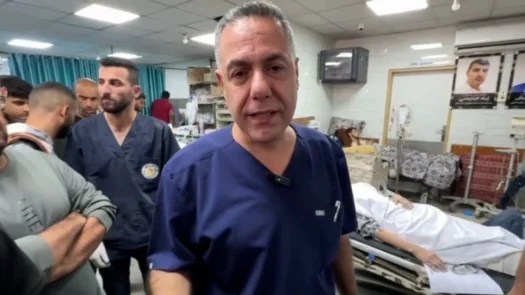
Press TV – May 8, 2026
Former Palestinian detainees have come forward with disturbing firsthand accounts of the systematic torture inflicted on Dr. Hussam Abu Safia, director of Gaza’s Kamal Adwan Hospital, during his detention in an Israeli prison.
Rami Abu Amira, a former prisoner, described how interrogators stripped Dr. Abu Safia naked and set police dogs on his frail body, leaving deep wounds and scratches.
Ahmad Qaddas recounted that the prison cells echoed with the doctor’s screams as he endured severe beatings.
He said he could no longer recognize Abu Safia due to extreme weight loss and his dazed, barely conscious state.
“He was physically shattered,” Qaddas added. Another former detainee, Hamza Abu Amira, spoke of the “relentless humiliation” and combined physical and psychological torture carried out by specialized Israeli prison units.
Guards reportedly forced Dr. Abu Safia to repeat degrading phrases while inflicting extreme pain in an apparent effort to break him.
Prisoners also described repeated night raids on their cell using sound grenades and tear gas canisters. Other detainees were strictly forbidden from approaching his cell or inquiring about his condition.
Dr. Abu Safia has been held since 27 December 2024, when Israeli forces abducted him during their assault on Kamal Adwan Hospital — the last functioning hospital in northern Gaza at the time. Even after an Israeli airstrike killed his own son, he had refused to abandon his post and his patients.
In March, UN Special Rapporteurs Tlaleng Mofokeng and Ben Saul confirmed receiving credible reports of his torture and the systematic denial of medical care.
They warned that his life was in grave danger and urged countries with influence over Israel to intervene.
Yet the US and its Western allies have taken no meaningful action to halt Tel Aviv’s brutality.
A UK-based human rights organization described his arrest as part of Israel’s broader policy of systematically targeting Palestinian health workers and destroying Gaza’s healthcare system — actions it said were intended to create conditions calculated to bring about the physical destruction of the Palestinian people.
Dr. Abu Safia is one of at least 737 Palestinian medical workers arbitrarily detained by Israeli forces since October 2023.
During the same period, at least 1,722 medical personnel have been killed — an average of more than two per day.
The World Health Organization has documented over 930 attacks on Gaza’s healthcare system, with all 36 hospitals damaged or destroyed and only half partially functional.
These assaults form part of a deliberate campaign to annihilate Gaza’s healthcare infrastructure as an integral component of Israel’s genocidal war on the Strip, which has so far claimed more than 72,500 Palestinian lives since October 2023.
Occupation Bulldozes Farmland, Uproots Vineyards
IMEMC | May 7, 2026
On Wednesday, Israeli occupation forces invaded the Al‑Baq’a area east of Hebron, in the occupied West Bank’s southern region, and carried out a large‑scale destruction of Palestinian agricultural land, uprooting thousands of grape vines and bulldozing more than 200 dunams of privately owned farmland over the past three days, in one of the largest agricultural demolitions reported in the district this year.
Eyewitnesses said multiple military units accompanied Israeli bulldozers as they invaded the area at dawn, sealed all access roads, and prevented Palestinian farmers from reaching their land while the machinery destroyed entire vineyards, vegetable fields, and irrigation networks.
The bulldozing and uprooting of the privately owned Palestinian land was carried out under the pretext of expanding the colonial bypass road known as “Route 60.”
According to the Hebron Directorate of Agriculture, the targeted zone is part of one of the most important agricultural areas in the governorate, known for its high‑quality grape production.
Officials confirmed that more than 200 dunams were bulldozed and that 40,000 productive grape vines—many of them decades old—were completely uprooted. The destruction remained ongoing throughout the day.
Farmers from Al‑Baq’a said the occupation is bulldozing land on both sides of the bypass road at a depth of up to 20 meters, destroying vineyards, seasonal crops, and greenhouses.
Soldiers threatened anyone who attempted to approach their land and refused to allow families to salvage tools, irrigation pipes, or agricultural equipment.
Residents stressed that the area produces over 13,000 tons of grapes annually, in addition to 1,000 tons of grape leaves, forming the primary source of income for hundreds of Palestinian families.
The Al‑Baq’a area has long been targeted by the occupation and by illegal paramilitary Israeli colonizers from nearby colonies, who have repeatedly attempted to seize agricultural land, attack farmers, and block access to fields.
Local human rights groups say the current destruction is part of a broader campaign to forcibly remove Palestinian communities from fertile agricultural zones surrounding Hebron.
What has Guterres supported in Gaza?
By Ramona Wadi | MEMO | May 7, 2026
In March this year, UN Secretary General Antonio Guterres had stated that the UN is “cooperating actively with structures created by the Board of Peace.” By the time Guterres made his statement, US Board of Peace High Representative for Gaza Nickolay Mladenov had already warned, in February this year, that Hamas bears the burden of Israel’s full resumption of genocide in Gaza if it fails to disarm.
In a letter that was quoted yesterday in Israeli media, Mladenov and senior US official Aryeh Lightstone warned the Palestinian technocratic government, “Failure by Hamas to accept the framework within a reasonable timeframe, as determined by the Board of Peace and after consultation with the parties, shall render such commitments null and void.”
Two days before Mladenov’s warning was made public, a senior military official said that it was inevitable that Israel would resume “fighting” in Gaza if Hamas refuses to disarm. Israel has in fact not stopped colonising Gaza through violence – what we are seeing now is a slower form of genocide in the aftermath of a very visible genocide which world leaders and diplomats preferred to watch rather than stop.
Mladenov is aware that Israel kept killing Palestinians in Gaza after the ceasefire came into effect, that more buildings were detonated, that the Yellow Line keeps expanding in Gaza besides already occupying more than half of its shrinking territory.
Therefore, the pretence of a before and after the ceasefire does not hold. It is merely a convenient veneer for the Board of Peace’s next rhetorical step that asserts its agreement with genocide.
Israel violated the October 2025 ceasefire multiple times, so in a way the letter is not a warning of novelty. However, the text of the October ceasefire does not stipulate that Hamas should disarm for the ceasefire to hold; that was a clause for the second phase of the ceasefire. The US Board of Peace is therefore saying that Israel is exempt from upholding its obligations stipulated in Phase One if Hamas does not agree to a clause from Phase Two.
In the entire Western narrative of Israel’s genocide in Gaza, Mladenov is not employing a new tactic when blaming Hamas for refusing to disarm. However, exploiting the ceasefire text, which was based on the resumption of humanitarian aid and the return of Israeli hostages, is insightful in terms of how institutions hold the power to manipulate the parameters of international law, accountability and impunity. The October 2025 ceasefire text, which was not dependent on Hamas disarming, can now be discarded simply because the focus is on Phase Two and diplomacy will not check the specific stipulations of Phase One.
Mladenov and Lightstone, therefore, are legitimising institutional complicity with genocide.
This is one clear admission in which a body supposedly tasked with rebuilding Gaza and its governance will not hold Israel accountable for continuing to commit genocide.
By stepping back, the spectator tactic has now been fully employed by Mladenov and the so-called Board of Peace.
When has genocide even been advocated for so smoothly among diplomats? Guterres should take note of what he and the UN have supported.
The FCC Wants Your ID Before You Get a Phone Number
By Ken Macon | Reclaim The Net | May 6, 2026
The era of the anonymous phone number could be ending. On April 30, the Federal Communications Commission unanimously approved a proposal requiring telecom providers to verify customers’ identities before activating service.
Government-issued ID, physical address, legal name, and existing phone numbers would all be included. The stated goal is stopping robocalls. The result would be an identity-verification regime covering one of the last semi-anonymous communication tools available to ordinary Americans.
The proposal applies to nearly every voice provider in the country, from traditional carriers and mobile operators to VoIP services. The FCC is seeking public comment on specifics, but the direction is clear.
FCC Chairman Brendan Carr framed it around negligent carriers. “As we have continued to investigate the problem of illegal robocalls over the last year, it has become clear that some originating providers are not doing enough to vet their customers, allowing bad actors to infiltrate our U.S. phone networks,” he said. Some providers, he added, “do the bare minimum (or worse) and have become complicit in illegal robocalling schemes.”
That language targets telecom companies and the surveillance targets everyone else.
The framework borrows from banking’s anti-money-laundering rules. The FCC is also asking whether carriers should retain identity documentation for at least four years after a customer leaves and whether they should check customers against law enforcement watchlists. Penalties would shift to a per-call basis, meaning fines of $1,000 to $15,000 for every illegal call a poorly verified customer places.
The real privacy stakes sit in the proposal’s section on prepaid service. Right now, you can pay cash for a prepaid phone and SIM card without showing identification. Journalists use prepaid phones to protect sources, domestic violence survivors use them to avoid being traced, and whistleblowers, activists, or anyone with a reason to separate phone activity from legal identity relies on this.
Israel threatens Gaza flotilla activists with death after abduction

Press TV – May 5, 2026
Israeli forces have threatened two Gaza-bound humanitarian flotilla activists, seized in international waters last week, with death or long prison terms, according to a rights group representing them.
The two pro-Palestinian activists, Saif Abu Keshek and Thiago Avila, were among dozens detained during an Israeli raid on the Gaza-bound Global Sumud Flotilla in international waters off Greece on April 30.
On Tuesday, an Israeli court extended their detention until Sunday, May 10.
The legal rights centre Adalah, which represents the pair, said they have been subjected to psychological abuse and held in solitary confinement. According to the group, Israeli officers threatened to kill them or imprison them “for 100 years.”
Both men remain in “total isolation,” subjected to 24/7 high-intensity lighting in their cells and kept blindfolded whenever they are moved, including during medical examinations. They are also being held in very low temperatures, the group added.
Adalah said the court’s decision to prolong the detention “amounts to judicial validation of the regime’s lawlessness.” No charges have been filed, but the two face accusations including affiliation with a “terrorist organisation” and contact with “foreign agents,” which the legal centre described as “baseless.”
According to the group, the activists are continuing their hunger strike, consuming only water since their abduction.
Meanwhile, the flotilla’s organisers demanded their release in a post on X, urging the international community to intervene.
They said the activists were “forcefully brought against their will to occupied Palestine, where they have been subjected to interrogations, death threats, sleep deprivation and medical neglect.”
The governments of Spain and Brazil issued a joint statement on Friday describing the detention of Avila and Abu Keshek as illegal.
During the raid on the Global Sumud Flotilla, Israeli forces attacked 22 of the 58 aid boats heading toward the besieged Gaza Strip and detained 175 activists.
Testimonies indicate that the activists were tortured while in Israeli custody following their abduction.
Featured Video

AIDS Inc. by Gary Null (2007)
or go to
Aletho News Archives – Video-Images
From the Archives
Clash of Civilization, Iran Part II
By Jamal Kanj – Intifada-Palestine.com – January 14, 2011
Israel’s survival kit is: perpetuate conflict, insecurity to rationalize collective hate and finally playing victim.
Devoid of conflict, Israel implodes internally; without hate, Zionism loses its justification; and playing eternal victim to continue blackmailing the West. Absence of this holy trinity, Israel ceases to exist.
From its inception, the house of Zion has mastered exploiting adversarial powers to advance Israel’s cause. For instance, their influence over the Democratic Party in the US began with President Truman’s bid for 2nd term election in 1948.
Responding to strong opposition from Secretary of State General George Marshall and Department experts urging against recognition of Israel, President Truman replied: “I’m sorry gentlemen but I have to answer to hundreds of thousands [Jewish voters] who are anxious for the success of Zionism. I do not have hundreds of thousands of [voting] Arabs among my constituents”
Zionists influence over liberal American politics was matched with the doctrinal school of Conservative theoreticians aligning the Republican Party’s platform with Israel’s objectives. The Neoconservative Zionists, coined Zioncons, invented the “Clash of Civilization” concept to fight Israel’s wars. … continue
Blog Roll
 Aletho News
- Merck Virologists Admitted to Falsely Certifying Vaccine Efficacy
- Mandatory Folic Acid for every man, woman & child
- Pro-Palestine protesters arrested outside UK’s ruling Labour Conference in Liverpool
- Mauritius denies landing permit to flight from Israel, forcing cancellation: Tour operator
- Israeli finance minister calls for genocidal war on West Bank, annexation of south Lebanon
- 12 Things Your Psychiatrist Was Trained Not to Tell You
- From Unipolar Universalism to Multipolar Civilizational Distinctiveness
- RSF military group defects, joins Sudanese army: State media
- Ireland goalkeeper refuses to play ‘Israel’ as squad weighs boycott
- China pushes back against US on Cuba, Iran
- If Americans Knew
- Israel forces Gazans to live in constant peril – Daily Update
- Deconstructing Netanyahu’s pants-on-fire UN rant – Daily Update
- Trump betrayed voters with his campaign lies and prioritized a foreign country once he took office
- Netanyahu calls Israel’s war in Gaza ‘opposite of genocide’ in UN speech to near-empty hall
- Settler Kidnappings: Torture, Sexual Abuse and Terrorisation of Palestinian Abductees as Israel Deepens Annexation of West Bank
- Gaza winter nears as 162,000 tents become unusable, raising fears of humanitarian crisis
- Netanyahu says, “It’s the opposite of genocide”; UN says Gaza economy is world’s ‘most severe crisis on record’ – Daily Update
- Israel’s US-Backed Assault on Gaza Has Created the ‘World’s Most Severe Economic Crisis on Record’: UN
- ‘Protecting U.S. Citizens’… From Israel
- ‘This is where I live now, the back of a truck’: a day in the life of a grandmother in Gaza
- No Tricks Zone
- New Study: Earth And Venus Surface Warmth Largely Explained By Convection And Lapse Rate, Not CO2 Or Radiation
- 2025 Nature Paper Claiming Worsening Global Drought Gets RETRACTED …Heavily Flawed
- New Study: ‘Global Drought Shows No Detectable Recent Acceleration Under Climate Warming’
- Economic Masterminds: German Socialists Suggest Taxing Productivity Gains Stemming From Using AI
- The South China Sea Has Not Been Cooperating With The Climate Change Narrative
- Energy Crisis: Germany Enters Heating Season With Historically Low Gas Reserve Fill Levels
- New Study: The Antarctic Ice Sheet Gained Mass From 2020-2024 Due To Staggering Snow And Ice Accumulation
- Study: Ocean Heating Rates From Thousands Of Years Ago ‘Dwarf’ Modern Ocean Heating Rates
- Climate Extremists Target, Attack Large-Scale Power Grid Infrastructure In Germany!
- New Study: Antarctic Ice Melt Has Contributed Less Than 1 Centimeter To Sea Level Rise In The Last 30 Years

