US Officers Cannot Explain Why So Much Military Needed for Strikes in Caribbean – Reports
Sputnik – 11.11.2025
WASHINGTON – US senior Special Operations officers in a briefing last month did not provide a comprehensive explanation why the Trump administration needed a massive military presence in the Caribbean for strikes on a few small boats allegedly used by drug cartels, CNN reported on Tuesday, citing sources with the knowledge.
At the moment, there is no public information from the Pentagon on what the military is using to conduct the strikes, but the sources told CNN that MQ-9 Reaper drones are used for US attacks on alleged drug boats, as well as AC-130J gunships and fighter jets.
The sources told CNN that the Pentagon officials also could not provide an exact amount of taxpayers’ dollars spent on the counternarcotics campaign. However, administration officials have stated that each strike costs up to hundreds of thousands of dollars, the report said.
A significant part of all deployed US naval assets worldwide have been located in US Southern Command since last month, and even more US military assets are about to be placed in the Caribbean, the report added.
Earlier this week, US Secretary of War Pete Hegseth said that the United States conducted strikes on two drug trafficking vessel in the Eastern Pacific, killing six people.
To date, the US military has conducted 19 strikes, destroyed 20 boats, and killed 76 people as part of a counternarcotics campaign, CNN reported.
In late October, the Trump administration held a briefing in the US Congress to lay out its legal justification for the strikes on Venezuelan ships. However, only Republicans were invited to the briefing, causing negative responses and vast criticism among Democrats.
United Nations Secretary General Antonio Guterres believes that US attacks in the Caribbean contradict international law, and so does UN High Commissioner for Human Rights Volker Turk.
Universities in West are “occupied by Zionist/Jewish supremacist lobby groups,” repress speech against genocide
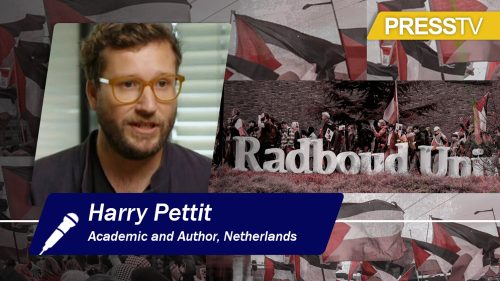
By Syed Zafar Mehdi | Press TV | November 11, 2025
Over the last two years, universities across the West have gone out of their way to repress speech against the ongoing genocide in Gaza and against Zionism, says a university lecturer who was forced to leave his university due to a Zionist witch-hunt.
In an interview with the Press TV website, Harry Pettit, the former Assistant Professor of Human Geography at Radboud University, the Netherlands, said any speech in support of the Palestinian resistance has been criminalized in Western academic circles.
Pettit, who holds a PhD from the London School of Economics and Political Science and is the author of The Labor of Hope: Meritocracy and Precarity in Egypt (2023), has been hounded at his university over his strong advocacy for Palestinian rights.
His social media posts, in which he unequivocally condemned the genocide in Gaza and the complicity of Western governments, sparked controversy as Zionist lobby groups in the Netherlands campaigned for his ouster from Radboud University.
In a statement on Monday, Pettit said the university had monitored his X account and he was pressured to retract his statements on Palestine.
He was even warned by the university administration and threatened with dismissal at the behest of influential Zionist lobby groups such as the Center for Information and Documentation on Israel (CIDI), the Netherlands Committee for Israel and the Jewish People (NCAB), as well as media outlets like De Telegraaf and Education Minister Gouke Moes.
“Over the last two years, universities across the West have gone out of their way to repress speech against the genocide, against Zionism, and in support of the Palestinian resistance,” Pettit told the Press TV website only hours after announcing he was leaving the university.
“They have done this because they are occupied by Zionist/Jewish supremacist lobby groups that want to shut down any critique of ‘Israel’. We have no choice but to fight back against this.”
He said the pro-Israel lobby is powerful in the Netherlands, which is evidenced by the data.
“If you look at data, the Netherlands has by far the biggest economic relationship with Israel in the whole of Europe. Therefore, there is a big incentive to squash critique,” he noted.
“CIDI is the main lobby group and it acts in similar ways to other countries, targeting individuals who speak out and trying to destroy their livelihoods. It also has links to political parties, the media, and student groups like Standwithus, and together they apply pressure on universities.”
Pettit, however, was not alone in this fight. He received tremendous support from his colleagues and students, who defended his freedom of speech.
“I have received a lot of support from colleagues and students who have also been taking risks to speak out against the genocide and Zionism, and the students have been incredible at engaging in disruptive protest over the last two years that has forced the university to cut ties with Israeli universities,” he told the Press TV website.
Unfazed by the threats, he vowed to continue speaking for the Palestinian cause and against the ongoing genocide in the Gaza Strip.
“I have every intention of continuing to use my platform to advocate for Palestinian liberation. That is why I left Radboud to go to a more supportive environment that enables me to keep doing that,” he asserted.
Pettit had been vocal not only on his own social media handles but also had been giving media interviews to raise awareness about the plight of Palestinians.
In one of his interviews in October, he told Volkskrant that he wants to raise awareness in the Netherlands that Palestinians “as an oppressed people have the right to armed resistance.”
“Calling October 7th a legitimate resistance operation doesn’t mean I condone everything that happened that day. But Israel wants us to see Hamas as barbarians who hate Jews. That’s a racist frame that serves to legitimize the genocide. It also obscures decades of oppression,” he said at the time.
His defense of the Palestinian resistance and the historic Operation Al-Aqsa Storm on October 7, 2023, irked Zionist lobby groups that aggressively pushed for his ouster.
Amid the genocide in Gaza, students in many universities across Europe and the US have been suspended and even arrested at the behest of Zionist lobby groups.
Out of 270 journalists, ‘Israel’ killed 44 in Gaza displacement tents
Al Mayadeen | November 10, 2025
44 Palestinian journalists were killed inside displacement tents in the Gaza Strip, out of more than 270 media workers slain by Israeli occupation forces since October 2023.
According to a new report by the Freedoms Committee of the Palestinian Journalists Syndicate, many of the journalists were sheltering near hospitals and United Nations-run facilities when occupation forces launched airstrikes or opened sniper fire directly at displacement tents.
The report pointed to the systematic campaign targeting Gaza’s media infrastructure, citing the destruction of news offices and the deliberate killing of journalists in their homes, workplaces, and temporary shelters.
Deliberate targeting and legal violations
The Syndicate stressed that targeting journalists constitutes a war crime under Article 79 of the First Additional Protocol to the Geneva Conventions, which guarantees civilian protection to media workers. It further noted that attacks on displacement tents near hospitals and schools represent a serious breach of the protections granted to humanitarian zones.
Investigators confirmed that no military activity was detected in or around the targeted tents, refuting Israeli claims of accidental strikes. The group argued that the use of precision weaponry in densely populated civilian zones “reflects a calculated intent not only to cause death, but to silence witnesses and obstruct documentation of events.”
Call for international accountability
The Palestinian Journalists’ Syndicate urged the formation of an independent international commission to investigate the targeting of journalists and called for the activation of International Criminal Court mechanisms to pursue accountability for war crimes.
It also appealed for cooperation with UNESCO and the International Federation of Journalists to establish safe corridors and protected zones for displaced media workers, while maintaining a comprehensive legal archive to support future judicial proceedings.
Previous incidents
Earlier in August, six journalists, including Al Jazeera’s correspondent Anas al-Sharif, were killed when an Israeli airstrike targeted a tent sheltering reporters outside the main gate of Gaza City’s al-Shifa Hospital. The deliberate attack, which targeted al-Sharif, drew international condemnation and renewed calls for investigations into “Israel’s” criminal action.
The Syndicate’s latest report adds to growing evidence from press freedom organizations, including the Committee to Protect Journalists (CPJ) and Reporters Without Borders (RWB), that “Israel’s” war on Gaza has become the deadliest conflict for journalists in modern history, raising urgent alarms about systematic violations of international humanitarian law.
Israeli soldiers recount indiscriminate killing of Palestinian civilians in Gaza
The Cradle | November 10, 2025
In a new documentary film, Israeli soldiers have described a “free-for-all” in Gaza, in which they killed civilians “without restraint” with the encouragement of politicians and rabbis, The Guardian reported on 10 November.
“If you want to shoot without restraint, you can,” stated Daniel, the commander of an Israeli tank unit.
He and other soldiers gave testimony about killings they perpetrated during combat tours in Gaza for the film ‘Breaking Ranks: Inside Israel’s War,’ which will be broadcast in the UK on ITV on Monday night.
The soldiers who agreed to talk confirmed they routinely used Palestinians as human shields and opened fire unprovoked on civilians seeking aid at militarized distribution points set up by the US-Israeli-backed Gaza Humanitarian Foundation (GHF).
Captain Yotam Vilk, an Israeli armored corps officer, said that in basic training, they were taught to only fire at a target that has the means, shows intent, and has the ability to cause harm.
But in Gaza, “there’s no such thing as ‘means, intent and ability,’” Vilk stated in the film.
“No soldier ever mentions ‘means, intent, and ability.’ It’s just a suspicion of walking where it’s not allowed. A man aged between 20 and 40,” he explained.
Another soldier, identified in the film as Eli, says individual commanders had the freedom to determine who was killed and who was allowed to remain alive.
“Life and death aren’t determined by procedures or opening fire regulations. It’s the conscience of the commander on the ground that decides,” Eli said.
“If they’re walking too fast, they’re suspicious. If they’re walking too slow, they’re suspicious. They’re plotting something. If three men are walking and one of them lags behind, it’s a two-to-one infantry formation – it’s a military formation,” he added.
Eli describes an incident in which a senior officer ordered a tank to destroy a residential building, crushing civilians to death inside, because a man was hanging laundry on the roof.
“The officer decided that he was a spotter. He’s not a spotter. He’s hanging his laundry. You can see that he’s hanging laundry,” he said.
“Now, it’s not as if this man had binoculars or weapons. The closest military force was 600–700 meters away. So, unless he had eagle eyes, how could he possibly be a spotter? And the tank fired a shell. The building half collapsed. And the result was many dead and wounded.”
The Guardian notes that according to the Israeli military’s own intelligence data, 83 percent of those killed in Gaza were civilians, a historic high for modern conflicts. More than 69,000 Palestinians have been killed since the war started, according to the Gaza Health Ministry, with tens of thousands more likely not counted as they remain buried under the rubble of destroyed buildings.
The Israeli military publicly claims its forces seek to protect civilians. However, some of the soldiers interviewed for the film said they were influenced by genocidal language used by Israeli politicians and religious leaders who claimed that no Palestinians in Gaza were innocent after the Hamas attack of 7 October 2023.
For example, a UN commission pointed to comments made by Israeli President Isaac Herzog, who claimed after 7 October that, “It is an entire nation out there that is responsible. It is not true, this rhetoric about civilians not aware, not involved, it’s absolutely not true.”
Roughly 1,200 Israelis and foreign nationals were killed in the Hamas attack. Israel blamed all these deaths on Hamas; however, the military itself killed hundreds with attack helicopters, drones, and tanks, per a special order known as the Hannibal Directive.
The order was given for Israeli pilots to fire on their own civilians to prevent them from being taken to Gaza as captives that Hamas could use to liberate Palestinians in a prisoner exchange.
Israeli Prime Minister Benjamin Netanyahu publicly referred to Palestinians in Gaza as “Amalek,” citing a story from Jewish scripture in which the Hebrews were ordered to exterminate the entire Amalekite nation, killing every man, woman, and child – even babies.
Daniel, the tank unit commander, said that this type of rhetoric influenced the behavior of soldiers in his unit. “You hear that all the time, so you start to believe it,” he stated.
Jewish rabbis in the Israeli army also advised soldiers to exterminate Palestinians in Gaza.
“One time, the brigade rabbi sat down next to me and spent half an hour explaining why we must be just like they were on 7 October. That we must take revenge on all of them, including civilians. That we shouldn’t discriminate, and that this is the only way,” said Major Neta Caspin.
Rabbi Avraham Zarbiv, who participated with his unit in the genocide in Gaza, stated in the film that, “Everything there is one big terrorist infrastructure.”
Zarbiv personally drove military bulldozers and boasted about destroying Gaza, stating that the army spent “hundreds of thousands of shekels to destroy the Gaza Strip. We changed the conduct of an entire army.”
The soldiers speaking in Breaking Ranks also confirmed their use of Palestinians as human shields, known as “Mosquitos,” to clear tunnels and homes where booby traps may be present. That way, a Palestinian would be killed rather than an Israeli soldier.
“You send the human shield underground. As he walks down the tunnel, he maps it all for you. He has an iPhone in his vest, and as he walks, it sends back GPS information,” said Daniel, the tank commander.
“The commanders saw how it works. And the practice spread like wildfire. After about a week, every company was operating its own mosquito.”
A private contractor, identified as Sam, confirmed that Israeli soldiers opened fire on and killed unarmed civilians seeking food at GHF distribution sites.
He described witnessing Israeli soldiers murder two Palestinian men.
“You could just see two soldiers run after them. They drop onto their knees, and they just take two shots, and you could just see … two heads snap backwards and just drop,” Sam explained.
In another case, he saw a tank destroy “a normal car … just four normal people sat inside it.”
At least 1,889 Palestinian civilians were killed by Israeli soldiers while seeking food in Gaza between 27 May and 18 August 2025, according to UN figures.
The West discovers Zelensky is not really a good guy
In a fleeting glimpse of lucidity, the mainstream media has noticed a tiny fraction of the corruption and authoritarianism in Kiev
By Tarik Cyril Amar | RT | November 7, 2025
It’s that time of the great proxy war crusade against Russia again. Someone in the mainstream West has woken up to, if not the facts about the politics of Ukraine, then at least a quantum of disquiet.
The last major wave of the likes of the Financial Times, The Economist, and the Spectator suddenly noticing – all at the same time, as if on cue – that Ukraine has an authoritarianism and corruption problem (and then some) took place less than half a year ago.
Now it’s Politico – usually a steadfast party organ of Russophobia, Zionism-come-what-genocide-may, and servility to NATO – that feels vaguely troubled by the realities of the Kiev regime or, as the publication puts it, the “dark side” of Vladimir “I don’t like elections” Zelensky’s rule.
Not all of those realities, of course. That would be asking too much. Instead, Politico is homing in on one great scandal (out of countless ones) concerning one man and the anguish of a few “civil-society”-NGO types, both with good connections to the West. This time, the scandal concerns the obvious, shameless political prosecution of Vladimir Kudritsky, formerly a high-ranking and effective energy infrastructure executive and de facto civil servant.
Yet what about noticing the murder in Ukrainian detention of critical blogger – and US citizen – Gonzalo Lira? Or the vicious persecution of leftist war critic Bogdan Syrotiuk? Or the mean, indecent harassing of Christian clergy and believers for not saying their prayers in quite the right Ukrainian-nationalist-approved manner? Perish the thought!
In a similar spirit of extreme selectiveness, some Western outlets are now registering – a little and very slowly – the brutal realities of Ukrainian forced mobilization that feed the Western proxy war: Recently, a war – pardon, “defense” – editor of the ultra-gung-ho British tabloid The Sun has returned shell-shocked from NATO’s de facto eastern front, not because of the bloody and wasteful fighting but because the uncouth Ukrainians press-ganged his fixer.
In a similarly traumatic experience, Hollywood’s Angelina Jolie had her local driver snatched away at a Ukrainian military roadblock. Yet violent forced mobilization has been an everyday occurrence in Ukraine for years already. So much so that Ukrainians have chosen the term “busification” (from minibus, a popular vehicle for mobilization manhunts) as word of the year for 2025.
For quite a few of its victims, it ends up even worse than for those privileged enough to work for Western movie stars and British propagandists. Roman Sopin, for instance, who did not even resist, has just been beaten to death in a mobilization precinct in central Kiev, as an official medical assessment of his cause of death implies as clearly as anyone may dare under Zelensky’s regime.
But let’s get back to the few things Western media deign to notice occasionally: Already dismissed last year, Kudritsky is now facing the courts under transparently trumped-up charges. The reason is obvious to everyone. He has been too popular and far too vocal about corruption at the highest levels and the authoritarian power grabs of Zelensky’s presidential office in particular.
Kudritsky’s case – comparatively harmless, really – does raise many disturbing questions: why is it that the Zelensky regime has such a nasty record of abusing arbitrary financial sanctions and politically perverted legal processes, or lawfare? And haven’t we been told that this regime under its “Churchillian” leader is fighting for Western values of democracy and legality?
Are Zelensky, his sinister fixer-in-chief Andrey Yermak and their team preparing the ground for elections after a possible end of the war – that is, after losing it – by preemptively crippling domestic critics and rivals? Does this mean Zelensky, Ukraine’s most catastrophic leader since independence in 1991 (and that’s a high bar) is seriously considering not slinking away into exile but imposing himself even longer on his unfortunate country?
Or is all of this part of decimating whatever is left of Ukraine’s mangled society to continue the meatgrinder war for as long as the NATO-EU Europeans are willing to pay? If things go the way the bloodthirsty fantasists at The Economist want, then the West will shell out another cool $390 billion over the next four years. Apparently, they believe that waves of forced conscription in Ukraine will provide the human cannon fodder to go along with the Western funding.
Yet if Zelensky’s fresh authoritarian moves are really aiming at preparing for a postwar election next year, then that is a terrible sign, too. It would indicate not only that he is planning to damage Ukraine even further by his presence, but also that those postwar elections will be anything but fair and equal. In other words, in that scenario, Zelensky will try to stay around, and so will the authoritarian regime he has built.
To be fair to Zelensky, his authoritarianism has never been a response to the war, as his Western fans still believe, even when they are finally deigning to notice a little of his “dark side.” Zelensky was building an authoritarian regime – widely known and criticized in Ukraine back then already as “mono-vlada” – long before the escalation of February 2022.
Zelensky is not a benevolent leader who has been forced to adopt dictatorial habits by an emergency. In reality, if anything, he has exploited the emergency for all it was worth to indulge his lust for unlimited power and extreme corruption. So, trying to take his misrule into the postwar period is at least not inconsistent: it has never been tied to wartime.
But behind all of this, there is one great irony and one bigger question: The question is simple. If Politico really believes that going after Kudritsky with lawfare and frustrating the “civil-society”-NGO crowd is “the dark side” of Zelensky’s rule, what, if we may ask, is the bright side supposed to be?
Indeed, where is the better side of real-existing Zelensky-ism? Is it the humungous corruption? The Bakhmut-style military fiascos, the Kursk Kamikaze incursion, and now Pokrovsk? The fact that the media have been mercilessly streamlined? The raging nepotism that makes sure that the poor fight and the sons and daughters of Ukraine’s gangsterish “elite” go on holidays and party? The personality cult?
Or is it – and this brings us to the great irony – that Zelensky-Ukraine is allegedly in sync with “Western values”? And do you know what? It really is! But not the way that the propagandists of both Ukraine and the NATO-EU West want us to believe. What the Zelensky regime and its supporters in the EU really have in common is that neither care about either democracy or the rule of law.
Zelensky going after critics with individual financial sanctions to evade normal legal procedures and leave his victims not even a slim chance to defend themselves, for instance? That is exactly what Germany and the EU are now doing to the journalist Hüseyin Dogru, and not only to him. Zelensky using a perverted reading of the law to harass whoever does not submit or is a political danger to him? Bingo again. That as well is now EU practice, too. Ask, for instance, Marine Le Pen in France. Finally, widespread abuse of political office for self-enrichment and influence peddling? Bingo again: Less than a month ago, the Financial Times ran a detailed article on “scores” of EU parliament members who “earn income from second jobs in areas that overlap with their lawmaking,” raising “questions about disclosure of potential conflicts of interest.” How delicately put. And it sounds just like Ukraine’s Rada.
Here’s the real news: The “dark side” of Zelensky’s rule is all of Zelensky’s rule. And it is also what has become the new normal in an increasingly authoritarian and corrupt EU. Who has learned from whom? Kiev from NATO-EU Europe or vice versa? Either way, this is not a bug but a feature. And it must stop. Everywhere.
Tarik Cyril Amar, is a historian from Germany working at Koç University, Istanbul, on Russia, Ukraine, and Eastern Europe, the history of World War II, the cultural Cold War, and the politics of memory.
German court upholds ruling in favour of Ghassan Abu Sitta over ban from Berlin conference
MEMO | November 7, 2025
A German court has ruled that authorities in Berlin acted unlawfully when they barred British-Palestinian surgeon Dr Ghassan Abu Sitta from participating in a conference on Palestine held in the German capital in April 2024.
The Berlin Administrative Court’s decision, reaffirmed this week, declared that the immigration authorities’ actions were illegal, upholding a lower court ruling issued in July. The Higher Administrative Court rejected an appeal by the Berlin state government, stating that it did not meet the legal criteria required for a retrial.
According to the court’s findings, immigration authorities had no legal grounds to prohibit Dr Abu Sitta from attending the conference, giving media interviews, or making public statements. The ruling emphasized that the restrictions imposed lacked adequate justification related to national security or the protection of public order.
Authorities had originally justified the ban by suggesting that Abu Sitta might express support for the 7 October 2023 Hamas-led Al-Aqsa Flood operation against Israel, or make statements perceived as threatening to the existence of the Israeli state. However, the court concluded that there was no evidence that his participation or remarks posed any danger to Germany’s democratic order.
Dr Abu Sitta, who has treated victims of the Israeli genocide in Gaza and other war zones, has become a prominent advocate for Palestinian medical and human rights. The latest ruling is seen as a significant legal victory for freedom of expression in Germany amid growing debates over restrictions on pro-Palestinian speech.
Tata Group’s ties with Israel: How Indian capital fuels occupation and genocide
By Ranjan Solomon | MEMO | November 6, 2025
The mask of modernity
For over a century, the Tata Group has been celebrated as the conscience of Indian capitalism — a family of companies that fused profit with philanthropy, progress with ethics. To millions of Indians, “Tata” evokes trust: a brand woven into the very narrative of modern India. Yet behind this carefully cultivated image of virtue lies a darker reality – one that now links Tata directly to the Israeli war machine devastating Gaza.
A new report released by the U.S.-based South Asian collective Salam, titled “Architects of Occupation: The Tata Group, Indian Capital, and the India–Israel Alliance,” alleges that Tata is “at the heart” of the India–Israel military partnership and is “fundamentally embedded in the architecture of occupation, surveillance, and dispossession.” TRT World’s coverage of the report further details how the conglomerate’s various subsidiaries feed directly into Israel’s military-industrial complex.
The findings: A web of complicity
The report identifies several subsidiaries of the Tata Group as active participants in Israel’s defence and security ecosystem.
Tata Advanced Systems Limited (TASL), one of India’s largest private defence manufacturers, has long-standing partnerships with Israel Aerospace Industries (IAI). Together, they manufacture key components for the Barak-8 surface-to-air missile system, which forms the backbone of Israel’s naval defence and is used in strikes on Gaza. TASL also produces aerostructures for F-16 fighter jets and fuselages for Apache attack helicopters, both extensively deployed by the Israeli Air Force.
Jaguar Land Rover (JLR), another Tata subsidiary, is alleged to provide the chassis for MDT David light armoured vehicles used by Israeli forces in West Bank patrols and urban crowd-suppression.
Tata Consultancy Services (TCS), the IT giant, is reportedly involved in building digital infrastructure for Israel’s governmental and financial sectors, including participation in Project Nimbus — the controversial cloud-computing contract co-run by Google and Amazon that facilitates Israeli state surveillance.
The Salam report argues that these are not isolated commercial arrangements but part of a systemic integration of Indian capital within Israel’s “occupation economy.”
Tata’s public sponsorship of global events, such as the New York City Marathon, is described as “sports-washing” — a means of masking its participation in war profiteering behind gestures of global modernity and social responsibility. Despite repeated inquiries, Tata Group has not issued a public response to the allegations.
From state to corporation: The India–Israel nexus
Tata’s complicity does not exist in a vacuum. It is the corporate mirror of a larger state transformation in India’s foreign and defence policy.
Since the 1990s, and more assertively under Narendra Modi, India has shifted from quiet engagement with Israel to a full-blown strategic partnership. India is now the largest buyer of Israeli arms, accounting for roughly 40–45 per cent of Israel’s defence exports.
Joint ventures proliferate:
- The Barak-8 missile project, co-developed by DRDO and IAI, is assembled in part at Tata facilities.
- India’s purchase of Heron drones, Phalcon AWACS systems, and Spike anti-tank missiles are products of the same industrial network that sustains Israel’s occupation of Palestine.
- Several of these systems are used by India in Kashmir, linking one occupation to another — and revealing a disturbing symmetry between the surveillance of Palestinians and Kashmiris.
In this geopolitical alignment, Hindutva nationalism and Zionism converge on the ideological front. Both justify domination through a rhetoric of “security” and “counter-terrorism.” Both normalise militarism as a form of patriotism. And both have turned their societies into laboratories of digital surveillance and ethno-religious control.
Thus, the Tata Group’s partnerships are not merely commercial. They are the economic expression of a shared political project — where corporate capital, state power, and ideology intertwine.
Corporate complicity and ethical evasion
Tata is hardly alone. Global corporations have long buttressed the Israeli state’s apparatus of control. Hewlett-Packard, Caterpillar, and now Google and Amazon have all been accused of enabling occupation and surveillance. What makes Tata’s case particularly striking is its moral posture.
A company that invokes Gandhi and philanthropy in its advertising now profits from an economy of death. Its own code of conduct commits it to the UN Guiding Principles on Business and Human Rights, which prohibit participation in human-rights violations. Yet there is no visible accountability mechanism — no disclosure of its defence revenues, no public audit of ethical compliance, and no internal oversight on the human impact of its contracts.
The Salam report calls this “ethical evasion through corporate nationalism”: the idea that Indian companies can deflect scrutiny by invoking patriotism and “Make in India” rhetoric. This is a convenient cover for profiteering from war.
Silence and complicity in India
Mainstream Indian media have barely reported on the Tata revelations. Nor has the Indian government shown any interest in investigating them. On the contrary, officials continue to trumpet the India–Israel “strategic embrace” as a model of technological progress.
Civil society, too, has grown hesitant. Decades ago, India was a vocal defender of the Palestinian cause. Today, solidarity has been replaced by silence, fear, and a dangerous normalization of genocide. Universities that once hosted discussions on occupation now avoid the subject. Protesters risk arrest under draconian laws.
The corporate capture of conscience mirrors a broader moral collapse in public life.
What accountability looks like
International law is clear: any company knowingly supplying equipment or services that enable war crimes may be complicit in those crimes. The Rome Statute of the International Criminal Court and the UN Guiding Principles both outline corporate responsibilities in situations of armed conflict.
Tata’s alleged manufacturing of components for weapons used in Gaza should therefore be subject to independent investigation. Investors, trade unions, and consumers have the right — and duty — to demand transparency.
There are precedents: in the 1980s, global campaigns pressured companies to divest from apartheid South Africa. A similar moral movement must emerge against those profiteering from Israeli apartheid. The boycott, divestment, and sanctions (BDS) campaign is one such call, and Indian civil society should not remain absent from it.
When conscience is outsourced
Tata’s silence in the face of genocide is not just a corporate failure; it reflects the hollowness of India’s moral claim to be the land of Gandhi. What remains of that heritage when its flagship corporation contributes to the machinery of ethnic cleansing?
As Gaza’s children starve and entire families are buried under rubble, the Tata empire continues to sell technology to the state that kills them — while its advertisements preach compassion and “building a better tomorrow.”
No nation can claim moral leadership while its corporations build profit from the blood of the oppressed. The time for polite silence is over. India must confront what it has become — and reclaim the humanity it once pledged to the world.
Israel in peace and war: How society rejects peace and endorses genocide
By Dr Mustafa Fetouri | MEMO | November 6, 2025
Israel’s vaunted commitment to justice—and its long-held brag of having “the most ethical army in the world”—collapsed spectacularly this week. The scandal traces back to July 2024, when surveillance footage from the Sde Teiman detention centre captured Israeli soldiers raping a Palestinian detainee, who later suffered severe injuries. Earlier this month—more than a year after the incident—the IDF’s top legal officer, Yifat Tomer-Yerushalmi, was arrested after admitting, perhaps in a belated awakening of conscience, that she had authorised the release of the footage
When the criminal soldiers were arrested back in 2024, Israelis took to the streets—not to condemn the crime, but to support the soldiers. Among the demonstrators were politicians, including Finance Minister Bezalel Smotrich, an illegal settler in the West Bank, who declared that the soldiers should be treated as heroes.
When it was Prime Minister Benjamin Netanyahu’s turn to comment on the scandal, he said that the leaking of the video—not its content—was “perhaps the most serious public relations attack that the State of Israel has experienced since its establishment.” Clearly, the ICC-indicted Netanyahu is more concerned about Israel’s reputation and the army’s legal standing than about the fact that an atrocious crime has taken place. How low can the Prime Minister of “democratic and peaceful” Israel go?
Israel’s response to the Sde Teiman scandal reflects a broader pattern: in both peace and war, it treats compromise, scrutiny, and accountability as threats. Every call or attempt at reconciliation or international oversight is immediately framed as an attack on national security or the army’s reputation. In practice, this mindset turns peace itself into a liability. Even international scrutiny or demands for accountability are routinely branded as anti-Semitism or “Jew-hatred,” rarely acknowledged as genuine concerns about preventing crimes or upholding justice—including those voiced by staunch allies such as Donald Trump.
The Israeli military and political elite operate under a logic in which restraint is suspect and moral exceptionalism is weaponised. Soldiers are celebrated for loyalty, brutality, and toughness, while ethical violations are either minimised or justified. Public and political reactions—cheering arrested soldiers, politicians lauding them as heroes, and leaders prioritizing reputation over accountability—reinforce a culture in which the pursuit of peace, justice, or transparency is regarded as weakness.
On the international stage, when faced with widespread public condemnation, Israel first resorts to its usual defense: anyone criticizing its inhumane treatment of Palestinians is labelled anti-Semitic. As that label loses its force and fails to intimidate critics, Israel reverts to its favourite defence in times of emergency: accusing anyone who dares to oppose its genocide of being pro-Hamas or, at least, supportive of its agenda—from the recently elected Mayor of New York, Zohran Mamdani, to US Congresswoman Rashida Tlaib. This systemic defence mechanism ensures that atrocities are treated as public relations crises rather than legal or moral failures. It also cements a cycle in which both conflict and the appearance of peace are subordinated to a narrow conception of survival and honour. The lesson is clear: in Israel, war and peace are judged not by justice or reconciliation, but by the army’s image, the state’s narrative, and the perceived threat to its moral and political supremacy.
Many wrongly believe that it is the State of Israel—and, more precisely, its extremist government—that drives Israeli society, which, such pundits argue, is peaceful in nature and humanly accommodating. The reality, however, is the opposite: it is the very nature of Israeli society that underpins these policies by supporting politicians like Itamar Ben-Gvir and Benjamin Netanyahu.
A poll in May this year revealed how rotten Israeli society is. The Penn State / Geocartography survey asked Israelis a blunt question: when the IDF conquers a city, should it kill all its inhabitants? A plurality — 47 per cent — said yes. The same poll reported that 82 percent of Israelis believe Gaza should be ethnically cleansed and all Gazans transferred outside historical Palestine — in other words, expelled to nowhere. And, in case there is any doubt, the same majority agreed that the expulsions should also include Arab citizens of Israel.
Another poll, conducted by Hebrew University in June 2025, asked: are there any innocent people in Gaza? Not surprisingly, the majority — 64 per cent — said there are no innocent people in Gaza. According to this view, everyone in Gaza, including babies, newborns, the elderly, and the disabled, is considered a criminal of some sort. This belief has been further reinforced by the IDF’s propaganda machine, which almost daily claims that every structure it destroys contains a tunnel or a tunnel shaft underneath. The message has been so consistent that it has been applied even to hospitals, schools, and kindergartens. The same narrative was conveyed to BBC World News when reporter Lucy Williamson was given a highly restricted, IDF-controlled access to Gaza. She asked the IDF spokesperson about the level of destruction she observed, and the answer was: “almost every house had a tunnel shaft” — though, of course, the spokesperson failed to show a single one.
Back in 2016, research by Pew Research Center found that six in ten Israeli Jews (61 per cent) believe that the whole of historic Palestine—not just part of it—is land promised to them by God Himself. They also believe that Israel should never give up an inch of Palestine, even if such a concession could bring long-term peace and an end to the century-old conflict.
To further show how deeply rotten Israeli society is, it may be enough to recall that the genocide in Gaza has been repackaged as a tourist attraction. From observation hills overlooking Gaza, visitors pay as little as five shekels to mount binoculars and watch live bombing raids, including flying debris and, in some reports, fragments of human bodies among the victims.
Overall majorities of Israeli Jews also strongly reject the idea of two state solutions which is supported by almost all United Nations member states—with the exception of few like United States and Israel itself of course. In a Gallup poll, published in December 2023, a majority of 65 per cent of Israeli Jews said they are opposed to the idea of two state solution.
Israeli children are taught from an early age to look down on Palestinians and the very idea of Palestinian identity. Studies show that many state school textbooks either omit the Palestinian narrative or present it in marginalised and demeaning terms, while reinforcing Jewish‑Israeli territorial claims. For example, the IMPACT‑SE Special Report 2022‑23 found that the majority of maps in Israeli textbooks did not indicate Palestinian territories or the Green Line, and that Palestinian history and culture are often erased or reduced to stereotypes.
The evidence is clear: from early education to public policy, Israeli society and its institutions treat Palestinians not as a people with rights, but as obstacles to be erased—showing that in Israel, peace is never an option, only control and domination.
Torture and Rape Are All in A Day’s Work for Israel’s Defenders
By Philip Giraldi • Unz Review • November 6, 2025
A couple of recent stories relating to the utter bestiality of Israel’s treatment of the Palestinians have exposed the criminality of successive US governments in supporting the Jewish state no matter what it does. Observers of the lopsided relationship understand very clearly that Israel’s lobby in the United States, backed up by Jewish billionaires who are willing to spend whatever it takes to corrupt the political system and buy up the media, has succeeded in making Washington a totally controlled client state manipulated by extreme war criminals like Prime Minister Benjamin Netanyahu, who is rewarded by the near complete loyalty of Congress and the White House. The one sided relationship dominates both Republicans and Democrats and has been most evident in the Presidencies of Joe Biden and Donald Trump, who have chosen to ignore the reality of the Israeli slaughter of some hundreds of thousands of Palestinians using US weapons and Washington’s political protection in international fora.
The irony of it all is that Washington’s subjugation by Israel, far from being politically neutral, does terrible damage to the United States, both in terms of actual costs and the fact that the US is now reviled by much of the world as it continues to protect and enable Israel as it continues it program to turn the Middle East into a region that it dominates by dint of perpetual slaughter of the original inhabitants. Beyond that, one of the costs of loving Israel so much is the lack of any consequences when it comes to protection of American citizens who find themselves on the wrong end of the Israeli police state. Citizens like Palestinian-American journalist Shireen Abu Akleh was killed by an Israeli Army sniper in May 2022, but the US Embassy did nothing to establish responsibility for the murder, leaving it up the Israeli judiciary, which did nothing and may even have rewarded the soldier. Abu Akleh was one of 276 journalists targeted deliberately and murdered by Israeli forces in the past two years.
Going back a bit, the most egregious case of the US abandoning its own to Israeli connivance was the attack on the USS Liberty intelligence ship in international waters in June 1967. Thirty-four crewmen were killed and 174 more wounded and the clear intention was to sink the ship using planes and torpedo boats with their identifications covered to blame the incident on the Egyptians. A cover-up engineered by President Lyndon B Johnson and Secretary of Defense Robert McNamara followed and repeated attempts by surviving crewmen to open an investigation have been blocked in Congress, most notably by Senator John McCain, whose father was the Admiral that chaired the inquiry held in Malta that decided that it was all a case of mistaken identity, which was a lie. LBJ called back planes that were sent to aid the stricken Liberty and was heard to explain that he would be satisfied if all those “sailor-boys were to go to the bottom of the sea” rather than offend “our good friend” Israel.
Last week, there surfaced a bizarre tale involving the Chief Legal Officer of the Israeli Army, a Major General named Yifat Tomer-Yeralshami. Yeralshami is a woman who was highly respected by her peers though it should be assumed that she was constrained by the policies towards the Israel Defense Force (IDF) as dictated by the Netanyahu regime and its extreme right winger chief National Security officer Itamar Ben-Gvir. Tomer-Yeralshami had been involved in the case of a Palestinian prisoner who had been serially raped in the notorious Sde Terman prison.
Terman was the best known IDF torture center. In October 2024, the UN Independent International Commission of Inquiry on the Occupied Palestinian Territory, including East Jerusalem, and Israel issued a report examining the treatment of thousands of Palestinian detainees after October 7th, 2023. In the report, the commission determined that detainees from Gaza held in Israeli military prisons, including children, were “subjected to widespread and systematic abuse, physical and psychological violence, and sexual and gender-based violence amounting to the war crime and crime against humanity of torture and the war crime of rape and other forms of sexual violence.”
Israeli soldiers were reportedly creative in their rape techniques. Dr. Mark Perlmutter, a Jewish-American orthopedic surgeon who was a volunteer medic in Gaza last year, reported how one Palestinian prisoner was treated. “He was raped by female IDF soldiers with a zucchini placed up his rectum and the zucchini was soaked in pork blood” the pork used specifically because pork is forbidden to Muslims, as it is to Jews.
The rape in question being investigated by Tomer-Yeralshami had been carried out by five Israeli soldiers. The incident occurred in July 2024 and the soldiers had been detained after the Palestinian proved to be so seriously injured that he had to be hospitalized. The IDF soldiers raped the man so violently, using in one instance a knife in his rectum, that his intestines exploded and his rectum was ruptured. He has undergone 20 surgeries since what happened to him. The facility where the soldiers were detained was subsequently stormed by a group consisting mostly of Israeli armed settlers led by Ben-Gvir and the men were later released and have reportedly been waiting on a military hearing to determine their possible guilt. They not only claim to be innocent, they believe that they should be rewarded and have even appeared before the press wearing black uniforms and head covers to make their case that comes down to soldiers not being held accountable if they torture or kill Palestinian prisoners.
Recent stories relating to the utter bestiality of Israel’s treatment of the Palestinians have exposed the criminality of successive US governments in supporting the Jewish state no matter what it does. Observers of the lopsided relationship understand very clearly that Israel’s lobby in the United States, backed up by Jewish billionaires who are willing to spend whatever it takes to corrupt the political system and buy up the media, has succeeded in making Washington a totally controlled client state manipulated by extreme war criminals like Prime Minister Benjamin Netanyahu, who is rewarded by the near complete loyalty of Congress and the White House. The one sided relationship dominates both Republicans and Democrats and has been most evident in the Presidencies of Joe Biden and Donald Trump, who have chosen to ignore the reality of the Israeli slaughter of some hundreds of thousands of Palestinians using US weapons and political protection in international fora. For what it is worth, neither Biden nor Trump has spoken out effectively on the murder and torture of the Palestinians by Israel.
The irony of it all is that Washington’s subjugation by Israel, far from being politically neutral, does terrible damage to the United States, both in terms of actual costs and the fact that the US is now reviled by much of the world as it continues to protect and enable Israel as it pursues its program to turn the Middle East into a region that it dominates by dint of perpetual slaughter of the original inhabitants.
Inevitably, stories about Israeli inhumanity are either completely suppressed or substantially modified to make the Jews involved appear to be victims of whatever takes place, what one might refer to as the “holocaust syndrome,” but sometimes the reality is just so horrific that it manages to leak through the damage control and censorship. In this case, the story of the savage rape in the prison would have died in an Israel court but for the fact that the rape was videoed and was leaked to Israeli news network Channel 12, apparently by the General and possibly others in her office, and the story subsequently developed that she had resigned her commission and disappeared. In her resignation letter, she apparently admitted that she had approved the release of a video revealing institutionalized acts of torture committed by the IDF against Palestinian prisoners of war that took place in the Sde Teiman detention camp in July 2024.
Shortly after the footage was aired, Tomer-Yerushalmi was placed on forced leave by the Israeli Defense Ministry after a criminal probe was launched to investigate the origins of the leak. In the months that followed her being placed on leave, Israeli Defense Minister Israel Katz announced that Tomer-Yerushalmi would not be permitted to return to her post, forcing her resignation. In her resignation letter, Tomer-Yerushalmi stated that “To my regret, this basic understanding—that there are acts to which even the most vile of detainees must not be subjected—is no longer convincing to all,” a tacit admission of the institutionalized abuse sanctioned by Israeli officials within the IDF and Netanyahu government.
Tomer-Yerushalmi disappeared from sight and it was subsequently rumored that she might have killed herself, but she was found and subsequently arrested. The Netanyahu government and its right-wing supporters have tried to benefit from the developing story, claiming that the general’s arrest confirms that the soldiers were “innocent” and that the leaked videos were “fake.” However, the trial of the soldiers is reportedly proceeding, and the videos have been confirmed as genuine. General Tomer-Yerushalmi is now being accused of “treason” for her role in the leak.
This affair could have been a classic case of silencing the messenger who was bearing bad news but it has become clear that the General was not operating alone. The Israeli police claim to possess WhatsApp group communications involving other high-ranking officers connected to the leaked information. The Israeli press has cited eight top officers within the IDF prosecution command headed by Tomer-Yerushalmi. The video and related documents were reportedly actually physically leaked by a junior officer within the military prosecutor’s command, who also confessed to his behavior before the Israeli General Security Organization (Shabak). Some believe that it is unconceivable that General Tomer-Yerushalmi would have made the decision to expose the IDF’s conduct without a green light from up above. Who could give such a green light? Her direct commander, the Israeli chief of staff (Herzi Halevi), or even the defense minister (Yoav Gallant), which would place them at odds with Netanyahu.
Some suspect that the actual objective by the army high command may have been to prove that Israel “has the legal means to prosecute its war criminals”—a message to the International Criminal Court (ICC) at The Hague that it should stay away from the case. If this theory is correct, General Tomer-Yerushalmi and those who authorized her were driven by “patriotic sentiments” to protect the behavior of the army soldiers. It may have been an attempt to defuse possible court cases by presenting a false image of ethical accountability. In short, the image of “ethical behavior” replaces any actual concern for ethical conduct, something that is absent from the nation that calls itself the Jewish State with an army that calls itself the world’s “most moral.”
Predictably, as a response to Tomer-Yerushalmi’s admitting she was behind the release of the video from Sde Teiman, Prime Minister Benjamin Netanyahu sought to shift the blame. He characterized the leak as the worst public relations disaster that Israel has ever faced saying “It is perhaps the most serious public relations attack Israel has experienced since its founding—I cannot recall one so concentrated and intense. This requires an independent and impartial inquiry, and I expect that such an investigation will indeed take place.” What Netanyahu was really demanding was a cover-up of what crimes have become systematic in Israel’s torture and killing of Palestinian prisoners.
Another story, equally hideous, concerns the activity of the so-called Israeli settlers, who have been armed by the Israeli government and have been systematically attacking the Palestinians remaining on the West Bank by beating and even killing the Arabs and destroying their livelihoods. It was again a case of a video having surfaced that showed a raid on a Palestinian farm, revealing how the settlers raided a barn containing the farmer’s sheep and lambs. Australian journalist Caitlin Johnstone describes the scene and what it means: “Israeli settlers were filmed torturing lambs which belonged to Palestinians in the West Bank. Gouged their eyes out. Smashed them with cinder blocks. Beat them to death in front of their mothers. Lambs. It’s not the most evil thing the Israelis have done. Not by a long shot. Hell, all of human civilization subjects animals to cruel abuses every minute of every day through the horrors of factory farming. But this particular incident shines a special sort of light into exactly what’s going on behind Israeli eyes over there in that sadistic society. Think about the hatred and savagery you’d need to summon up within yourself to gouge the eyes out of a living baby sheep. Think about the kind of person you’d have to become to do something like that to an innocent creature. Those lambs didn’t know they were Palestinian. They didn’t know anything about Hamas or October 7 or the Nazi Holocaust, or any of the other reasons Israelis generally cite for their abuses of human beings. They were just sitting there, doing absolutely nothing that could possibly be construed as harmful by even the most talented hasbarist. And those settlers went in there and inflicted completely gratuitous suffering upon them. This, to me anyway, just says so much about the level of vitriolic hatred by which the state of Israel is sustained. It’s baked in to the way the whole state.”
I rest my case about what is wrong with Israel to include its criminal relationship with the United States. So Mr. Trump, I already know you hate animals just as you hate and seek revenge on anyone who does not agree with you, but what is your response to the murders of children and rapes of prisoners as well as the torture of baby creatures who have done no wrong? Just what is your justification for making the United States a partner and even enabler in the crimes?
Philip M. Giraldi, Ph.D., is Executive Director of the Council for the National Interest, a 501(c)3 tax deductible educational foundation (Federal ID Number #52-1739023) that seeks a more interests-based U.S. foreign policy in the Middle East. Website is councilforthenationalinterest.org, address is P.O. Box 2157, Purcellville VA 20134 and its email is inform@cnionline.org.
Paramount blacklist pro-Palestine voices under new pro-Israel leadership
MEMO | November 6, 2025
A growing number of Hollywood actors and filmmakers who have voiced solidarity with Palestinians are reportedly being blacklisted by Paramount, following its takeover by pro-Israel billionaire David Ellison, according to Variety. The move has raised fears of a systematic campaign to suppress dissenting voices in the entertainment industry under the guise of combating anti-Semitism.
The blacklist follows Paramount’s $7.7 billion merger with Skydance Media, led by Ellison—the son of Oracle co-founder Larry Ellison, one of the largest donors to Israel’s occupation forces. The leadership overhaul has included the appointment of Bari Weiss, a self-described Zionist and vocal defender of Israel’s assault on Gaza, as editor-in-chief of CBS News, one of Paramount’s flagship assets.
Industry sources suggest that artists who have expressed solidarity with Palestinians or criticised Israel’s ongoing genocide in Gaza and its apartheid regime in the occupied West Bank may now face reprisals. According to Variety, Paramount “maintains a list of talent it will not work with because they are deemed to be ‘overtly antisemitic’ as well as ‘xenophobic’ and ‘homophobic.’ Whether the boycott signatories are on that list is unclear.”
This labelling follows Paramount’s decision in September to publicly denounce a celebrity-signed letter calling for a boycott of Israeli cultural institutions involved in what signatories described as “genocide and apartheid.” Over 300 figures, including Oscar winners Emma Stone, Mark Ruffalo, Rooney Mara, Tilda Swinton and Yorgos Lanthimos, had signed the statement, demanding accountability from Israel for its documented war crimes and structural violence against Palestinians.
Paramount’s swift condemnation of the letter—branding it anti-Semitic—has been interpreted as part of a broader ideological purge within the industry. It echoes earlier incidents such as the sacking of actress Melissa Barrera for condemning Israeli attacks on Gaza, and Susan Sarandon’s revelation that she was dropped by her agency and blacklisted after criticising Israel’s occupation.
The blacklist forms part of a growing pattern across the United States, where support for Palestinian rights is increasingly conflated with hate speech. University students have lost scholarships, faculty members have been suspended or dismissed, and entire student organisations have been deregistered for protesting visits by Israeli officials accused of supporting ethnic cleansing policies.
Featured Video

Death Spikes & Rising Cancer In Our Youth Explained
or go to
Aletho News Archives – Video-Images
From the Archives
Politicians lie
By Mazin Qumsiyeh | Popular Resistance | August 18, 2013
There is no way to say this truth nicely: Politicians lie. That includes Japanese, American, Egyptian, Israeli, and Palestinian politicians! Is there something more common sense than that? Yet, so many citizens around the world believe their own politicians or wistfully acknowledge lies but think it is part of the job needed to run things. They believe even when politicians contradict themselves blatantly. This phenomenon is rather remarkable. It is a dissonance and disconnect from reality that many seem oblivious to. It is very dangerous because it can lead to accepting rationales for going to war. These can be deadly wars that lead to millions of lives lost as happened in what was called World War 1 and WW2. Even when incredible and declassified evidence abound, politicians continue to lie and old mythologies refuse to die. Here are just a few of the countless lies told to us over the past few decades… continue
Blog Roll
 Aletho News
- From Unipolar Universalism to Multipolar Civilizational Distinctiveness
- RSF military group defects, joins Sudanese army: State media
- Ireland goalkeeper refuses to play ‘Israel’ as squad weighs boycott
- China pushes back against US on Cuba, Iran
- Ukrainian Soldiers, Potential Mercenaries: Have Gun, Will Travel!
- Burnham’s UN debut… A masterclass in British disinformation
- Iran flights continue despite US aviation sanctions
- Global Tipping Points Lead the World Into a State of Entropy
- The day-after at the White House: USA and Xi Jinping
- The Geopolitical Balance in the Red Sea: The UAE Being Displaced by New Players
- If Americans Knew
- Deconstructing Netanyahu’s pants-on-fire UN rant – Daily Update
- Trump betrayed voters with his campaign lies and prioritized a foreign country once he took office
- Netanyahu calls Israel’s war in Gaza ‘opposite of genocide’ in UN speech to near-empty hall
- Settler Kidnappings: Torture, Sexual Abuse and Terrorisation of Palestinian Abductees as Israel Deepens Annexation of West Bank
- Gaza winter nears as 162,000 tents become unusable, raising fears of humanitarian crisis
- Netanyahu says, “It’s the opposite of genocide”; UN says Gaza economy is world’s ‘most severe crisis on record’ – Daily Update
- Israel’s US-Backed Assault on Gaza Has Created the ‘World’s Most Severe Economic Crisis on Record’: UN
- ‘Protecting U.S. Citizens’… From Israel
- ‘This is where I live now, the back of a truck’: a day in the life of a grandmother in Gaza
- In UN Speech, Iran’s President Displays Pictures of Children Killed by US, Brings Attention to Israel’s Nuclear Arsenal
- No Tricks Zone
- New Study: Earth And Venus Surface Warmth Largely Explained By Convection And Lapse Rate, Not CO2 Or Radiation
- 2025 Nature Paper Claiming Worsening Global Drought Gets RETRACTED …Heavily Flawed
- New Study: ‘Global Drought Shows No Detectable Recent Acceleration Under Climate Warming’
- Economic Masterminds: German Socialists Suggest Taxing Productivity Gains Stemming From Using AI
- The South China Sea Has Not Been Cooperating With The Climate Change Narrative
- Energy Crisis: Germany Enters Heating Season With Historically Low Gas Reserve Fill Levels
- New Study: The Antarctic Ice Sheet Gained Mass From 2020-2024 Due To Staggering Snow And Ice Accumulation
- Study: Ocean Heating Rates From Thousands Of Years Ago ‘Dwarf’ Modern Ocean Heating Rates
- Climate Extremists Target, Attack Large-Scale Power Grid Infrastructure In Germany!
- New Study: Antarctic Ice Melt Has Contributed Less Than 1 Centimeter To Sea Level Rise In The Last 30 Years

