The world must halt Israel’s annexation and reverse its colonisation of Palestine
By Ramona Wadi | MEMO | May 5, 2020
UN Special Rapporteur Michael Lynk’s criticism of the forthcoming US-Israeli annexation of more Palestinian land offers a good start to collective political action against Israel, if only the international community would show that it is willing. “The plan would crystallise a 21st century apartheid, leaving in its wake the demise of the Palestinian’s right to self-determination. Legally, morally, politically, this is entirely unacceptable,” declared Lynk.
The UN official described the repercussions of annexation as creating “a cascade of bad human rights consequences” and insisted that the international community can no longer play its acquiescent role to Israeli violations. “The looming annexation is a political litmus test for the international community. This annexation will not be reversed through rebukes, nor will the 53-year-old occupation die of old age,” he warned.
This is not the first time that Lynk has offered a harsher criticism of Israel than the appeasing commentary which is typical of UN officials and institutions. In the past, he recommended international sanctions against Israel and supported the International Criminal Court (ICC) in its investigation of Israeli war crimes against the Palestinian people.
Lynk’s words draw attention to the UN’s political flaws and the endorsement of human rights violations committed by its member states. As Israel moves towards annexation, the international community is unlikely to assess its own complicity. The US-Israeli annexation plans are built upon decades of international endorsement of Zionist colonisation. To oppose annexation – one of the last steps that Israel is embarking upon to complete its colonial project – is not enough. Diluting settler-colonisation to “53 years of occupation” is also inconsistent and a misrepresentation of the causes of Palestinian displacement.
The US may currently be playing a more prominent role, but the international community has magnified the US-Israeli relationship to deflect attention from the historical process leading to the current dynamic. The international community’s endorsement of the Israeli colonisation project is a major violation that remains overlooked. What the US and Israel have achieved under the Trump administration is a reflection of an ongoing cycle of intentional political oblivion at a global level.
Having shone the spotlight on the US-Israeli collusion, the international community has availed itself of a temporary lull in scrutiny of its action, particularly its inaction when it comes to the Palestinian people’s political rights. In truth, the international community’s action can be summed up in the 1947 Partition Plan, after which reliance on statements and condemnations became the diplomatically-accepted means of purportedly championing Palestinian rights. Lynk’s statements, albeit devoid of direct references to Israeli colonisation, point towards international culpability.
In recent years, the two-state compromise remains the most blatant evidence of international culpability in preventing Palestinian reclamation of their land and rights. Just as annexation has been declared in violation of international law, the two-state diplomacy must also be held accountable for paving the way to annexation. This necessitates a complete reversal of the politics that have sustained the UN so far. There cannot be a unified political front against Israel if two-state politics is not abandoned. Stopping annexation requires a reversal of Israeli colonisation; anything less is an affirmation of treason against the Palestinian people.
Coronavirus Gives a Dangerous Boost to DARPA’s Darkest Agenda
By Whitney Webb | The Last American Vagabond | May 4, 2020
In January, well before the coronavirus (Covid-19) crisis would result in lockdowns, quarantines and economic devastation in the United States and beyond, the U.S. intelligence community and the Pentagon were working with the National Security Council to create still-classified plans to respond to an imminent pandemic. It has since been alleged that the intelligence and military intelligence communities knew about a likely pandemic in the United States as early as last November, and potentially even before then.
Given this foreknowledge and the numerous simulations conducted in the United States last year regarding global viral pandemic outbreaks, at least six of varying scope and size, it has often been asked – Why did the government not act or prepare if an imminent global pandemic and the shortcomings of any response to such an event were known? Though the answer to this question has frequently been written off as mere “incompetence” in mainstream media circles, it is worth entertaining the possibility that a crisis was allowed to unfold.
Why would the intelligence community or another faction of the U.S. government knowingly allow a crisis such as this to occur? The answer is clear if one looks at history, as times of crisis have often been used by the U.S. government to implement policies that would normally be rejected by the American public, ranging from censorship of the press to mass surveillance networks. Though the government response to the September 11 attacks, like the Patriot Act, may be the most accessible example to many Americans, U.S. government efforts to limit the flow of “dangerous” journalism and surveil the population go back to as early as the First World War. Many of these policies, whether the Patriot Act after 9/11 or WWI-era civilian “spy” networks, did little if anything to protect the homeland, but instead led to increased surveillance and control that persisted long after the crisis that spurred them had ended.
Using this history as a lens, it is possible to look at the current coronavirus crisis to see how the long-standing agendas of ever-expanding mass surveillance and media censorship are again getting a dramatic boost thanks to the chaos unleashed by the coronavirus pandemic. Yet, this crisis is unique because it also has given a boost to a newer yet complimentary agenda that — if fulfilled – would render most, if not all, other government efforts at controlling and subduing their populations obsolete.
DARPA Dystopia
For years, the Pentagon’s Defense Advanced Research Projects Agency (DARPA) has remained largely out of sight and out of mind for most Americans, as their research projects are rarely covered by the mainstream media and, when they are, their projects are often praised as “bringing science fiction movies to life.” However, there have been recent events that have marred DARPA’s often positive portrayal by media outlets, which paint the agency as a beacon of scientific “progress” that has “changed the world” for the better.
For instance, in 2018, a group of European scientists accused the DARPA’s “Insect Allies” program of actually being a dystopian bioweapons program that would see insects introduce genetically modified viruses into plants to attack and devastate a targeted nation’s food supply. DARPA, of course, maintained that its intent to use these insects to genetically modify plants was instead about “protecting” the food supply. Regardless of DARPA’s assertions that it is merely a “defensive” program, it should be clear to readers that such a technology could easily be used either way, depending on the wielder.
Though DARPA’s futuristic weapons of war often get the most attention from media, the agency has long standing interests in tinkering with, not just the biology of plants, but of humans. DARPA, which is funded to the tune of approximately $3 billion a year, has various avenues through which it pursues these ambitions, with many of those now under the purview of the agency’s “Biological Technologies Office” (BTO), created in 2014. As of late, some of DARPA’s human biology and biotech projects at its BTO have been getting a massive PR boost thanks to the current coronavirus crisis, with recent reports even claiming that the agency “might have created the best hopes for stopping Covid-19.”
Most of these technologies garnering positive media coverage thanks to Covid-19 were developed several years ago. They include the DARPA-funded platforms used to produce DNA and RNA vaccines, classes of vaccine that have never been approved for human use in the U.S. and involve injecting foreign genetic material into the human body. Notably, it is this very class of vaccine, now being produced by DARPA-partnered companies, that billionaire and global health “philanthropist” Bill Gates recently asserted has him “most excited” relative to other Covid-19 vaccine candidates. Yet, key aspects regarding these vaccines and other DARPA “healthcare” initiatives have been left out of these recent positive reports, likely because they provide a window into what is arguably the agency’s darkest agenda.
“In Vivo Nanoplatforms”

In 2006, DARPA announced its Predicting Health and Disease (PHD) program, which sought to determine “whether an individual will develop an infectious disease prior to the onset of symptoms.” The PHD program planned to accomplish this by “identifying changes in the baseline state of human health through frequent surveillance” with a specific focus on “viral, upper respiratory pathogens.”
Three years later, in 2010, DARPA-funded researchers at Duke University created the foundation for this tool, which would use the genetic analysis of blood samples to determine if someone is infected with a virus before they show symptoms. Reports at the time claimed that these “preemptive diagnoses” would be transmitted to “a national, web-based influenza map” available via smartphone.
Following the creation of DARPA’s BTO in 2014, this particular program gave rise to the “In Vivo Nanoplatforms (IVN)” program. The diagnostics branch of that program, abbreviated as IVN:Dx, “investigates technologies that incorporate implantable nanoplatforms composed of bio-compatible, nontoxic materials; in vivo sensing of small and large molecules of biological interest; multiplexed detection of analytes at clinically relevant concentrations; and external interrogation of the nanoplatforms without using implanted electronics for communication.” Past reports on the program describe it as developing “classes of nanoparticles to sense and treat illness, disease, and infection on the inside. The tech involves implantable nanoparticles which sense specific molecules of biological interest.”
DARPA’s IVN program has since helped to finance and produce “soft, flexible hydrogels that are injected just beneath the skin to perform [health] monitoring and that sync to a smartphone app to give the use immediate health insights,” a product currently marketed and created by the DARPA-funded and National Institutes of Health (NIH)-funded company Profusa. Profusa, which has received millions upon millions from DARPA in recent years, asserts that the information generated by their injectable biosensor would be “securely shared” and accessible to “individuals, physicians and public health practitioners.” However, the current push for a national “contact tracing” system based on citizens’ private health data is likely to expand that data sharing, conveniently fitting with DARPA’s years-old goal of creating a national, web-based database of preemptive diagnoses.
Profusa is also backed by Google, which is intimately involved in these new mass surveillance “contact tracing” initiatives, and counts former Senate majority leader William Frist among its board members. They are also partnered with the National Institutes of Health (NIH). The company also has considerable overlap with the diagnostic company Cepheid, which recently won FDA approval for its rapid coronavirus test and was previously awarded lucrative government contracts to detect anthrax in the U.S. postal system. As of this past March, Profusa again won DARPA funding to determine if their injectable biosensors can predict future pandemics, including the now widely predicted “second wave” of Covid-19, and detect those infected up to three weeks before they would otherwise show symptoms. The company expects to have its biosensors FDA licensed for this purpose by early next year, about the same time a coronavirus vaccine is expected to be available to the general public.
“Living Foundries”
Another long-standing DARPA program, now overseen by BTO, is known as “Living Foundries.” According to DARPA’s website, Living Foundries “aims to enable adaptable, scalable, and on-demand production of [synthetic] molecules by programming the fundamental metabolic processes of biological systems to generate a vast number of complex molecules that are not otherwise accessible. Through Living Foundries, DARPA is transforming synthetic biomanufacturing into a predictable engineering practice supportive of a broad range of national security objectives.”
The types of research this “Living Foundries” program supports involves the creation of “artificial life” including the creation of artificial genetic material, including artificial chromosomes, the creation of “entirely new organisms,” and using artificial genetic material to “add new capacities” to human beings (i.e. genetically modifying humans through the insertion of synthetically-created genetic material).
The latter is of particular concern (though all are honestly concerning), as DARPA also has a project called “Advanced Tools for Mammalian Genome Engineering,” which – despite having “mammalian” in the name – is focused specifically on improving “the utility of Human Artificial Chromosomes (HACs),” which DARPA describes as a “fundamental tool in the development of advanced therapeutics, vaccines, and cellular diagnostics.” Though research papers often focus on HACs as a revolutionary medical advancement, they are also frequently promoted as a means of “enhancing” humans by imbuing them with non-natural characteristics, including halting aging or improving cognition.
DARPA is known to be involved in research where these methods are used to create “super soldiers” that no longer require sleep or regular meals, among other augmented “features,” and has another program about creating “metabolically dominant” fighters. Reports on these programs also discuss the other, very disconcerting use of these same technologies, “genetic weapons” that would “subvert DNA” and “undermine people’s minds and bodies.”
Another potential application being actively investigated by DARPA is its BioDesign program, which is examining the creation of synthetic organisms that are created to be immortal and programmed with a “kill switch” allowing a synthetic, yet organic organism to be “turned off” at any time. This has led some to speculate such research could open the doors to the creation of “human replicants” used for fighting wars and other tasks, such as those that appear in the science fiction film Bladerunner.
However, these genetic “kill switches” could also be inserted into actual humans through artificial chromosomes, which – just as they have the potential to extend life – also have the potential to cut it short. Notably, it was revealed in 2017 that DARPA had invested $100 million in “gene drive” research, which is involves the use of genetic modification to wipe out entire populations, explaining why it it often referred to as a “genetic extinction” technology.
In addition, other DARPA experiments involve the use of genetically modified viruses that insert genetic material into human cells, specifically neurons in the brain, in order to “tweak” human brain chemistry. In one example, DARPA-funded research has altered human brain cells to produce two new proteins, the first allowing neural activity to be easily detected by external devices and the second allowing “magnetic nanoparticles” to “induce an image or sound in the patient’s mind.”
“Next-Generation Nonsurgical Neurotechnology”

Changing human brain chemistry and functionality at the cellular level is only one of numerous DARPA initiatives aimed at changing how human beings think and perceive reality. Since 2002, DARPA has acknowledged its efforts to create a “Brain-Machine Interface (BMI).” Though first aimed at creating “a wireless brain modem for a freely moving rat,” which would allow the animal’s movements to be remotely controlled, DARPA wasn’t shy about the eventual goal of applying such brain “enhancement” to humans in order to enable soldiers to “communicate by thought alone” or remotely control human beings (on the enemy side only, so they say) for the purposes of war.
The project, which has advanced greatly in recent years, has long raised major concerns among prominent defense scientists, some of whom warned in a 2008 report that “remote guidance or control of a human being” could quickly backfire were an adversary to gain access to the implanted technology (opening up the possibility of “hacking” a person’s brain), and they also raised concerns about the general ethical perils of such technologies. Work began in 2011 on developing “brain implants” for use in human soldiers, officially with the goal of treating neurological damage in veterans, and such implants have been tested on human volunteers in DARPA-funded experiments since at least 2015.
Concerns, like those raised by those defense scientists in 2008, have been regularly dismissed by DARPA, which has consistently claimed that its controversial research projects are tempered by their in-house “ethical experts.” However, it worth noting how DARPA’s leadership views these ethical conundrums, since they ultimately have the last word. For example, in 2015, Michael Goldblatt, then-director of DARPA’s Defense Sciences Office (DSO), which oversees most aspects of the agency’s “super soldier” program, told journalist Annie Jacobsen that he saw no difference between “having a chip in your brain that could help control your thoughts” and “a cochlear implant that helps the deaf hear.” When pressed about the unintended consequences of such technology, Goldblatt stated that “there are unintended consequences for everything.”
Thus, it is worth pointing out that, while DARPA-developed technologies – from human genetic engineering to the brain-machine interfaces – are often first promoted as something that will revolutionize and improve human health, DARPA sees the use of these technologies for such ends as being on the same footing as other dystopian and frankly nightmarish applications, like thought control. BMIs are no exception, having first been promoted as a way to “boost bodily functions of veterans with neural damage or post-traumatic stress disorder” and to allow amputees to control advanced prosthetics. While these do indeed represent major medical advances, DARPA’s leadership has made it clear that they see no distinction between the medical use of BMIs and using them to exert near total control over a human being by “guiding” their thoughts and even their movements.
Such stark admission from DARPA’s leadership makes it worth exploring the state of these current “brain-machine” interface programs as well as their explicit goals. For instance, one of the goals of DARPA’s Next-Generation Nonsurgical Neurotechnology (N3) program involves using “noninvasive or minimally invasive brain-computer interfaces” to “read and write” directly onto the brain.
According to one recent report on DARPA’s N3 program, one example of “minimally invasive” technologies would involve:
“an injection of a virus carrying light-sensitive sensors, or other chemical, biotech, or self-assembled nanobots that can reach individual neurons and control their activity independently without damaging sensitive tissue. The proposed use for these technologies isn’t yet well-specified, but as animal experiments have shown, controlling the activity of single neurons at multiple points is sufficient to program artificial memories of fear, desire, and experiences directly into the brain.”
Though the purported goal of N3 is related to creating “thought-controlled” weapons that react and fire based on a soldier’s thoughts, the fact that the technology is also bidirectional, opens up the disturbing possibility that efforts will be made to control and program a soldier’s thoughts and perceptions as opposed to the other way around. This may be more of the plan than DARPA has publicly let on, since official military documents have openly stated that the Pentagon’s ultimate goal is to essentially replace human fighters with “self-aware” interconnected robots “who” will both design and conduct operations against targets chosen by artificial-intelligence systems. This weapons system of the not-so-distant future seems to have little room for human beings, even those capable of “controlling” weapons with their minds, suggesting that futurist military planners see soldiers with BMIs as a “weapon” that would also become connected to this same AI-driven system. It is also worth pointing out that DARPA has been attempting to create an “artificial human brain” since 2013.
In addition, reports on DARPA’s BMI efforts have suggested that this bidirectional technology will be used to “cloud the perception of soldiers” by “distancing them from the emotional guilt of warfare,” a move that would set a dangerous precedent and one that would surely result in a marked jump in war crimes.
Of course, these are just the admitted, potential “military” applications of such technology. Once this technology moves from the military to the civilian sphere, as several DARPA inventions have in the past, their use for “remote guidance”, “thought control” and/or the programming of thoughts and experiences is more than likely to be misused by governments, corporations and other power-brokers in the U.S. and beyond for the purposes of control.
The entrance of BMIs into the civilian sphere isn’t very far away, as DARPA executives and researchers who have worked on the N3 and other DARPA-backed BMI programs have since been “scooped up” by Verily (a Google-GlaxoSmithKline partnership), Elon Musk’s Neuralink and Facebook’s Building 8 – all of which have been working to bring “neuro-modulation” devices and BMIs to market.
“Human Bio-reactors”, “Nanotherapeutics” and DARPA-funded gene vaccines
As detailed above, DARPA often frames the controversial technologies it develops as being developed to mainly advance medicine and healthcare. Aside from the technologies already discussed, it is important to note that DARPA has been very interested in healthcare, specifically vaccines, for sometime.
For instance, in 2010, DARPA began developing a class of vaccine that could “inoculate against unknown pathogens,” a component of its Accelerated Manufacture of Pharmaceuticals program. The vaccine would inject thousands of synthetic antibodies, such as those developed through DARPA’s “Living Foundries” program, into the human body. These synthetic antibodies or “synbodies” would then “create an immunity toolkit that can be combined in myriad ways to tackle virtually any pathogen.”
That same year, DARPA began funding efforts to create “multiagent synthetic DNA vaccines” that would be delivered into the human body via “noninvasive electroporation” and was quickly promoted in media reports as a way to quickly produce vaccines compared to traditional vaccine production methods. This category of vaccine would involve the same type of synthetic DNA that DARPA was also simultaneously researching for the purposes of both “enhancing” and “subverting” human beings at the genetic level. It was also this year, 2010, that the Bill and Melinda Gates Foundation also began heavily funding DNA and RNA vaccines.
DNA vaccines, which were first created in 2005, have never been approved for human use in the United States and past studies have warned that they “possess significant unpredictability and a number of inherent harmful potential hazards” and that “there is inadequate knowledge to define either the probability of unintended events or the consequences of genetic modifications.” Another long-standing issue with such vaccines is mitigating “unwanted immune reactions” that result from natural immune response to the foreign genetic material they contain.
In 2011, DARPA announced its “Rapidly Adaptable Nanotherapeutics” program, which seeks to create a “platform capable of rapidly synthesizing therapeutic nanoparticles” aimed at combatting “evolving and even genetically engineered bioweapons.” DARPA’s plan for these nanoparticles, which media reports described merely as “tiny, autonomous drug delivery systems,” was to combine them with “small interfering RNA (siRNA),” which are snippets of RNA that can target and shut down specific genes. As Wired wrote at the time: “siRNA could be reprogrammed ‘on-the-fly’ and applied to different pathogens,” allowing nanoparticles to “be loaded up with the right siRNA molecules and sent directly to cells responsible for the infection.”
The creation of this program was shortly followed by DARPA’s decision in 2013 to fund Moderna Therapeutics to the tune of $25 million to develop their synthetic RNA vaccine production platform. DARPA funded the project to “develop platform technologies that can be deployed safely and rapidly to provide the U.S. population with near-immediate protection against emerging infectious diseases and engineered biological weapons.”
Then, in 2015, DARPA’s research into vaccines involving synthetic antibodies and synthetic genetic material expanded, with them giving $45 million to the DNA vaccine company, Inovio Pharmaceuticals. This same year, DARPA-funded RNA and DNA vaccines began to be framed differently by both DARPA researchers and the media – who described the technology as transforming the human body into a “bio-reactor.”
In the years since, DARPA-backed DNA and RNA vaccine companies, including Moderna, Inovio as well as Germany’s CureVac, have been unable to get their products licensed for human use, largely due to the fact that their vaccines have failed to provide sufficient immunity in human trials. Examples of these ineffective vaccines include CureVac’s attempt at a rabies vaccine and Moderna’s efforts to create a vaccine for the Zika virus (which was funded by the U.S. government).
Several workarounds for this issue have been proposed, including vaccines where the genetic material (RNA or DNA) “self-amplifies.” However, the workaround of choice to this lack of immune response and other obstacles for DNA/RNA vaccines is the incorporation of nanotechnology into these vaccines. As a result, the use of nanoparticles as the carriers for the genetic material in these vaccines has been widely promoted and studied, as well as touted as the best way to improve their stability, increase their targeted delivery ability and enhance the immune response they provoke.
The combination of DNA or RNA vaccines with nanotechnology has already become reality thanks to the companies leading that field. For instance, the DARPA-backed DNA vaccine company Inovio Pharmaceuticals utilizes what reports refer to as “DNA nanotechnology” in their line of synthetic vaccines branded as “SynCon” by the company, which uses an undisclosed computer algorithm to design its vaccines. It is an interesting coincidence, then, that the Inovio “SynCon” vaccine for Covid-19 now appears to be ahead of the rest of the pack, with backing from Bill Gates, DARPA, the National Institute of Allergy and Infectious Diseases (NIAID) and other government agencies.
DARPA – Saving us from Covid-19?

In January, the Coalition for Epidemic Preparedness Innovations (CEPI) announced it would begin funding vaccine candidates for the coronavirus outbreak, long before it became a major global issue. CEPI describes itself as “a partnership of public, private, philanthropic and civil organizations that will finance and co-ordinate the development of vaccines against high priority public health threats” and was founded in 2017 by the governments of Norway and India along with the World Economic Forum (WEF) and the Bill and Melinda Gates Foundation. That month, CEPI only chose two pharmaceutical companies to receive funding for their efforts to develop a vaccine for Covid-19 – Moderna and Inovio Pharmaceuticals.
As previously mentioned, these two companies are DARPA-backed firms that frequently tout their “strategic alliance” with DARPA in press releases and on their websites. DARPA has also provided these companies with significant amounts of funding. For instance, the top funders behind Inovio Pharmaceuticals include both DARPA and the Pentagon’s Defense Threat Reduction Agency (DTRA) and the company has received millions in dollars in grants from DARPA, including a $45 million grant to develop a vaccine for Ebola. They were also recently awarded over $8 million from the U.S. military to develop a small, portable intradermal device for delivering DNA vaccines, which was jointly developed by Inovio and the U.S. Army Medical Research Institute of Infectious Diseases (USAMRIID), which also manages the “biodefense” lab at Fort Detrick.
In addition, the German company CureVac, which is also developing a CEPI-backed RNA vaccine for Covid-19, is another long-time recipient of DARPA funding. They were one of DARPA’s earliest investments in the technology, winning a $33.1 million DARPA contract to develop their “RNActive” vaccine platform in 2011.
In Moderna’s case, DARPA financed the production and development of their RNA vaccine production platform and their RNA therapy candidate for Chikungunya virus (their first for an infectious disease) was developed in direct collaboration with the agency. Since 2016, Moderna’s RNA vaccine program has received $100 million in funding from the Bill and Melinda Gates Foundation. The Gates Foundation has since poured millions directly into both Moderna’s and Inovio’s Covid-19 vaccine efforts.
Gates’ backing of DNA and RNA vaccines is significant, given that Gates – a billionaire with unparalleled influence and control over global healthcare policy – recently asserted that the best options for a Covid-19 vaccine are these same vaccines, despite the fact that they have never before been approved for use in humans. Yet, thanks to the emergency authorizations activated due to the current crisis, both Moderna’s and Inovio’s testing for these vaccines has skipped animal trials and gone straight to human testing. They are also set to be fast-tracked for widespread use in a matter of months. Moderna’s clinical trial in humans began in mid-March, followed by Inovio’s in the beginning of April. Thus, they are not only Gates’ favorites to be the new vaccine, but are also slated to be the first to complete clinical trials and garner emergency U.S. government approval, especially Moderna’s vaccine which is being jointly developed with the government’s NIH.
The rapid rise to prominence of Moderna’s and Inovio’s Covid-19 vaccines has resulted in several media articles praising DARPA as having provided our “best hope” for thwarting the coronavirus crisis. In addition to its backing of Moderna’s and Inovio’s own efforts, DARPA itself, specifically DARPA’s BTO, is set to have a “temporary” vaccine for Covid-19 available in a matter of weeks that will involve the production of synthetic antibodies that would ostensibly provide immunity for a few months until a longer-lasting vaccine (such as those produced by Moderna and Inovio) is available.
DARPA’s antibody treatment for Covid-19 is pursuing two routes, including the “human body as bio-reactor” approach that would involve synthetic DNA or RNA being injected in order to prompt the body to produce the necessary antibodies. Defense One notes that DARPA’s Covid-19 treatment would utilize techniques that had resulted from the agency’s investments in microfluidics (the manipulation of liquids at the sub-millimeter range), nanotechnology fabrication and “new approaches to gene sequencing.”
Persistent Concerns
While most media reports have painted these DARPA-led efforts as entirely positive, it is worth noting that concerns have been raised, though these concerns have hardly gotten the coverage they warrant. For instance, Nature recently noted some key points regarding safety issues related to the race for a Covid-19 vaccine, including the fact that all “previous coronavirus vaccines have not all proven appropriate or even safe,” with some past attempts at coronavirus vaccines having resulted in antibody dependent enhancement (ADE). ADE results in cells more rapidly taking up the virus and speeding up the virus’ replication, increasing its infectiousness and virulence.
Nature also noted that the two coronavirus vaccines for SARS that managed to pass phase 1 trials ended up, in subsequent studies, causing immune hypersensitivity in mice “resulting in severe immunopathology,” i.e. permanent defects or malfunctions in the immune system. In addition, Nature also pointed out that it is unknown how strong an immune response is needed to confer immunity for Covid-19 and coronaviruses in general, making it incredibly difficult to gauge if a vaccine is even effective.
Another issue worth noting involves concerns raised about Inovio Pharmaceuticals by investment research firm Citron Research, which compared Inovio to Theranos, the disgraced medical technology company that had initially promised to offer diagnoses for numerous diseases via a simple blood test, but was later revealed to be a sham. Citron asserted that “It’s been over 40 years since Inovio was founded, yet the company has NEVER [sic] brought a product to market, and all the while insiders have enriched themselves with hefty salaries and large stock sales.”
Citron Research went on to say that the company’s claim to have designed their Covid-19 vaccine in only 3 hours based on a computer algorithm was hard to believe, stating that “Inovio has a ‘computer algorithm’ that no one else in the world has and is arguably one of the greatest breakthroughs in vaccine discovery in the past 100 years, and yet this ‘computer algorithm’ is not mentioned once in any of its 10-K’s or 10-Q’s? Sounds like Theranos to us.” It also noted that Inovio’s partnerships with pharmaceutical companies Roche and AstraZeneca ended up failing with those two companies canceling the partnership despite claims from Inovio’s CEO that whey would “continue to thrive.”
A Not-So-Hidden Agenda
Of course, these are just concerns focused on corporate behavior and obstacles towards making a Covid-19 vaccine in general. As this report has already shown in detail, DARPA’s other experiments with the same technologies (particularly genetic engineering, synthetic chromosomes, and nanotechnology) that are being used to produce RNA and DNA vaccines for Covid-19 are arguably more concerning. This is especially true given that DARPA-backed companies that describe themselves as “strategic partners” of the agency are those manufacturing these vaccines. In addition, thanks to backing from the U.S. government and Bill Gate, among others, they are are also slated to be among the first vaccines (if not the first) approved for widespread use.
It is certainly troubling that media coverage of DARPA’s efforts and the efforts of Moderna and Inovio have thus far not included critical reporting regarding the different branches of DARPA’s research that has produced the technology involved in creating these vaccines, leaving little room for public scrutiny of their safety, efficacy and their potential for unintended effects on human genetics.
This is particularly alarming given that, over the past several weeks, efforts have been taking shape in many countries to enforce mandatory vaccinations once a Covid-19 vaccine becomes available. In some countries, it appears likely that the Covid-19 vaccine will not be made mandatory per say, but will be required for those who wish to return to any semblance of “normalcy” in terms of public gatherings, working certain jobs, leaving one’s home for longer periods of time and so on.
Would those involved in creating such a mandatory vaccine, e.g. DARPA, pass up the opportunity to utilize the same technologies involved in producing the vaccine for some of their other admitted goals? This question, of course, has no obvious answer, but the fact that the arc of DARPA’s research is aimed at the weaponization of human biology and genetics in a way that is ripe for misuse, suggests very worrying possibilities that warrant scrutiny. Indeed, if one merely looks at how the crisis has been a boon for the Orwellian plans of the National Security Commission on Artificial Intelligence (NSCAI) and the federal government’s current efforts to dramatically increase its powers amid the current crisis, it becomes increasingly difficult to give government agencies like DARPA and their corporate partners like Moderna and Inovio the benefit of the doubt.
This is especially true given that – without a major crisis such as that currently dominating world events – people would likely be unreceptive to the widespread introduction of many of the technologies DARPA has been developing, whether their push to create cyborg “super soldiers” or injectable BMIs with the capability to control one’s thoughts. Yet, amid the current crisis, many of these same technologies are being sold to the public as “healthcare,” a tactic DARPA often uses. As the panic and fear regarding the virus continues to build and as people become increasingly desperate to return to any semblance of normalcy, millions will willingly take a vaccine, regardless of any government-mandated vaccination program. Those who are fearful and desperate will not care that the vaccine may include nanotechnology or have the potential to genetically modify and re-program their very being, as they will only want the current crisis that has upended the world to stop.
In this context, the current coronavirus crisis appears to be the perfect storm that will allow DARPA’s dystopian vision to take hold and burst forth from the darkest recesses of the Pentagon into full public view. However, DARPA’s transhumanist vision for the military and for humanity presents an unprecedented threat, not just to human freedom, but an existential threat to human existence and the building blocks of biology itself.
Question Everything, Come To Your Own Conclusions.
Techno-Tyranny: How The US National Security State Is Using Coronavirus To Fulfill An Orwellian Vision
By Whitney Webb | The Last American Vagabond | May 4, 2020
Last year, a U.S. government body dedicated to examining how artificial intelligence can “address the national security and defense needs of the United States” discussed in detail the “structural” changes that the American economy and society must undergo in order to ensure a technological advantage over China, according to a recent document acquired through a FOIA request. This document suggests that the U.S. follow China’s lead and even surpass them in many aspects related to AI-driven technologies, particularly their use of mass surveillance. This perspective clearly clashes with the public rhetoric of prominent U.S. government officials and politicians on China, who have labeled the Chinese government’s technology investments and export of its surveillance systems and other technologies as a major “threat” to Americans’ “way of life.”
In addition, many of the steps for the implementation of such a program in the U.S., as laid out in this newly available document, are currently being promoted and implemented as part of the government’s response to the current coronavirus (Covid-19) crisis. This likely due to the fact that many members of this same body have considerable overlap with the taskforces and advisors currently guiding the government’s plans to “re-open the economy” and efforts to use technology to respond to the current crisis.
The FOIA document, obtained by the Electronic Privacy Information Center (EPIC), was produced by a little-known U.S. government organization called the National Security Commission on Artificial Intelligence (NSCAI). It was created by the 2018 National Defense Authorization Act (NDAA) and its official purpose is “to consider the methods and means necessary to advance the development of artificial intelligence (AI), machine learning, and associated technologies to comprehensively address the national security and defense needs of the United States.”
The NSCAI is a key part of the government’s response to what is often referred to as the coming “fourth industrial revolution,” which has been described as “a revolution characterized by discontinuous technological development in areas like artificial intelligence (AI), big data, fifth-generation telecommunications networking (5G), nanotechnology and biotechnology, robotics, the Internet of Things (IoT), and quantum computing.”
However, their main focus is ensuring that “the United States … maintain a technological advantage in artificial intelligence, machine learning, and other associated technologies related to national security and defense.” The vice-chair of NSCAI, Robert Work – former Deputy Secretary of Defense and senior fellow at the hawkish Center for a New American Security (CNAS), described the commission’s purpose as determining “how the U.S. national security apparatus should approach artificial intelligence, including a focus on how the government can work with industry to compete with China’s ‘civil-military fusion’ concept.”
The recently released NSCAI document is a May 2019 presentation entitled “Chinese Tech Landscape Overview.” Throughout the presentation, the NSCAI promotes the overhaul of the U.S. economy and way of life as necessary for allowing the U.S. to ensure it holds a considerable technological advantage over China, as losing this advantage is currently deemed a major “national security” issue by the U.S. national security apparatus. This concern about maintaining a technological advantage can be seen in several other U.S. military documents and think tank reports, several of which have warned that the U.S.’ technological advantage is quickly eroding.
The U.S. government and establishment media outlets often blame alleged Chinese espionage or the Chinese government’s more explicit partnerships with private technology companies in support of their claim that the U.S. is losing this advantage over China. For instance, Chris Darby, the current CEO of the CIA’s In-Q-Tel, who is also on the NSCAI, told CBS News last year that China is the U.S.’ main competitor in terms of technology and that U.S. privacy laws were hampering the U.S.’ capacity to counter China in this regard, stating that:
“[D]ata is the new oil. And China is just awash with data. And they don’t have the same restraints that we do around collecting it and using it, because of the privacy difference between our countries. This notion that they have the largest labeled data set in the world is going to be a huge strength for them.”
In another example, Michael Dempsey, former acting Director of National Intelligence and currently a government-funded fellow at the Council on Foreign Relations, argued in The Hill that:
“It’s quite clear, though, that China is determined to erase our technological advantage, and is committing hundreds of billions of dollars to this effort. In particular, China is determined to be a world leader in such areas as artificial intelligence, high performance computing, and synthetic biology. These are the industries that will shape life on the planet and the military balance of power for the next several decades.”
In fact, the national security apparatus of the United States is so concerned about losing a technological edge over China that the Pentagon recently decided to join forces directly with the U.S. intelligence community in order “to get in front of Chinese advances in artificial intelligence.” This union resulted in the creation of the Joint Artificial Intelligence Center (JAIC), which ties together “the military’s efforts with those of the Intelligence Community, allowing them to combine efforts in a breakneck push to move government’s AI initiatives forward.” It also coordinates with other government agencies, industry, academics, and U.S. allies. Robert Work, who subsequently became the NSCAI vice-chair, said at the time that JAIC’s creation was a “welcome first step in response to Chinese, and to a lesser extent, Russian, plans to dominate these technologies.”
Similar concerns about “losing” technological advantage to China have also been voiced by the NSCAI chairman, Eric Schmidt, the former head of Alphabet – Google’s parent company, who argued in February in the New York Times that Silicon Valley could soon lose “the technology wars” to China if the U.S. government doesn’t take action. Thus, the three main groups represented within the NSCAI – the intelligence community, the Pentagon and Silicon Valley – all view China’s advancements in AI as a major national security threat (and in Silicon Valley’s case, threat to their bottom lines and market shares) that must be tackled quickly.
Targeting China’s “adoption advantage”
In the May 2019 “Chinese Tech Landscape Overview” presentation, the NSCAI discusses that, while the U.S. still leads in the “creation” stage of AI and related technologies, it lags behind China in the “adoption” stage due to “structural factors.” It says that “creation”, followed by “adoption” and “iteration” are the three phases of the “life cycle of new tech” and asserts that failing to dominate in the “adoption” stage will allow China to “leapfrog” the U.S. and dominate AI for the foreseeable future.
The presentation also argues that, in order to “leapfrog” competitors in emerging markets, what is needed is not “individual brilliance” but instead specific “structural conditions that exist within certain markets.” It cites several case studies where China is considered to be “leapfrogging” the U.S. due to major differences in these “structural factors.” Thus, the insinuation of the document (though not directly stated) is that the U.S. must alter the “structural factors” that are currently responsible for its lagging behind China in the “adoption” phase of AI-driven technologies.
Chief among the troublesome “structural factors” highlighted in this presentation are so-called “legacy systems” that are common in the U.S. but much less so in China. The NSCAI document states that examples of “legacy systems” include a financial system that still utilizes cash and card payments, individual car ownership and even receiving medical attention from a human doctor. It states that, while these “legacy systems” in the US are “good enough,” too many “good enough” systems “hinder the adoption of new things,” specifically AI-driven systems.
Another structural factor deemed by the NSCAI to be an obstacle to the U.S.’ ability to maintain a technological advantage over China is the “scale of the consumer market,” arguing that “extreme urban density = on-demand service adoption.” In other words, extreme urbanization results in more people using online or mobile-based “on-demand” services, ranging from ride-sharing to online shopping. It also cites the use of mass surveillance on China’s “huge population base” is an example of how China’s “scale of consumer market” advantage allowing “China to leap ahead” in the fields of related technologies, like facial recognition.

In addition to the alleged shortcomings of the U.S.’ “legacy systems” and lack of “extreme urban density,” the NSCAI also calls for more “explicit government support and involvement” as a means to speed up the adoption of these systems in the U.S. This includes the government lending its stores of data on civilians to train AI, specifically citing facial recognition databases, and mandating that cities be “re-architected around AVs [autonomous vehicles],” among others. Other examples given include the government investing large amounts of money in AI start-ups and adding tech behemoths to a national, public-private AI taskforce focused on smart city-implementation (among other things).
With regards to the latter, the document says “this level of public-private cooperation” in China is “outwardly embraced” by the parties involved, with this “serving as a stark contrast to the controversy around Silicon Valley selling to the U.S. government.” Examples of such controversy, from the NSCAI’s perspective, likely include Google employees petitioning to end the Google-Pentagon “Project Maven,” which uses Google’s AI software to analyze footage captured by drones. Google eventually chose not to renew its Maven contract as a result of the controversy, even though top Google executives viewed the project as a “golden opportunity” to collaborate more closely with the military and intelligence communities.
The document also defines another aspect of government support as the “clearing of regulatory barriers.” This term is used in the document specifically with respect to U.S. privacy laws, despite the fact that the U.S. national security state has long violated these laws with near complete impunity. However, the document seems to suggest that privacy laws in the U.S. should be altered so that what the U.S. government has done “in secret” with private citizen data can be done more openly and more extensively. The NSCAI document also discusses the removal of “regulatory barriers” in order to speed up the adoption of self-driving cars, even though autonomous driving technology has resulted in several deadly and horrific car accidents and presents other safety concerns.

Also discussed is how China’s “adoption advantage” will “allow it to leapfrog the U.S.” in several new fields, including “AI medical diagnosis” and “smart cities.” It then asserts that “the future will be decided at the intersection of private enterprise and policy leaders between China and the U.S.” If this coordination over the global AI market does not occur, the document warns that “we [the U.S.] risk being left out of the discussions where norms around AI are set for the rest of our lifetimes.”
The presentation also dwells considerably on how “the main battleground [in technology] are not the domestic Chinese and US markets,” but what it refers to as the NBU (next billion users) markets, where it states that “Chinese players will aggressively challenge Silicon Valley.” In order to challenge them more successfully, the presentation argues that, “just like we [view] the market of teenagers as a harbinger for new trends, we should look at China.”
The document also expresses concerns about China exporting AI more extensively and intensively than the U.S., saying that China is “already crossing borders” by helping to build facial databases in Zimbabwe and selling image recognition and smart city systems to Malaysia. If allowed to become “the unambiguous leader in AI,” it says that “China could end up writing much of the rulebook of international norms around the deployment of AI” and that it would “broaden China’s sphere of influence amongst an international community that increasingly looks to the pragmatic authoritarianism of China and Singapore as an alternative to Western liberal democracy.”
What will replace the US’ “legacy systems”?
Given that the document makes it quite clear that “legacy systems” in the U.S. are impeding its ability to prevent China from “leapfrogging” ahead in AI and then dominating it for the foreseeable future, it is also important to examine what the document suggests should replace these “legacy systems” in the U.S.
As previously mentioned, one “legacy system” cited early on in the presentation is the main means of payment for most Americans, cash and credit/debit cards. The presentation asserts, in contrast to these “legacy systems” that the best and most advanced system is moving entirely to smartphone-based digital wallets.
It notes specifically the main mobile wallet provider in India, PayTM, is majority owned by Chinese companies. It quotes an article, which states that “a big break came [in 2016] when India canceled 86% of currency in circulation in an effort to cut corruption and bring more people into the tax net by forcing them to use less cash.” At the time, claims that India’s 2016 “currency reform” would be used as a stepping stone towards a cashless society were dismissed by some as “conspiracy theory.” However, last year, a committee convened by India’s central bank (and led by an Indian tech oligarch who also created India’s massive civilian biometric database) resulted in the Indian government’s “Cashless India” program.
Regarding India’s 2016 “currency reform,” the NSCAI document then asserts that “this would be unfathomable in the West. And unsurprisingly, when 86% of the cash got cancelled and nobody had a credit card, mobile wallets in India exploded, laying the groundwork for a far more advanced payments ecosystem in India than the US.” However, it has become increasingly less unfathomable in light of the current coronavirus crisis, which has seen efforts to reduce the amount of cash used because paper bills may carry the virus as well as efforts to introduce a Federal Reserve-backed “digital dollar.”
In addition, the NSCAI document from last May calls for the end of in-person shopping and promotes moving towards all shopping being performed online. It argues that “American companies have a lot to gain by adopting ideas from Chinese companies” by shifting towards exclusive e-commerce purchasing options. It states that only shopping online provides a “great experience” and also adds that “when buying online is literally the only way to get what you want, consumers go online.”

Another “legacy system” that the NSCAI seeks to overhaul is car ownership, as it promotes autonomous, or self-driving vehicles and further asserts that “fleet ownership > individual ownership.” It specifically points to a need for “a centralized ride-sharing network,” which it says “is needed to coordinate cars to achieve near 100% utilization rates.” However, it warns against ride-sharing networks that “need a human operator paired with each vehicle” and also asserts that “fleet ownership makes more sense” than individual car ownership. It also specifically calls for these fleets to not only be composed of self-driving cars, but electric cars and cites reports that China “has the world’s most aggressive electric vehicle goals…. and seek[s] the lead in an emerging industry.”
The document states that China leads in ride-sharing today even though ride-sharing was pioneered first in the U.S. It asserts once again that the U.S. “legacy system” of individual car ownership and lack of “extreme urban density” are responsible for China’s dominance in this area. It also predicts that China will “achieve mass autonomous [vehicle] adoption before the U.S.,” largely because “the lack of mass car ownership [in China] leads to far more consumer receptiveness to AVs [autonomous vehicles].” It then notes that “earlier mass adoption leads to a virtuous cycle that allows Chinese core self-driving tech to accelerate beyond [its] Western counterparts.”
In addition to their vision for a future financial system and future self-driving transport system, the NSCAI has a similarly dystopian vision for surveillance. The document calls mass surveillance “one of the ‘first-and-best customers’ for AI” and “a killer application for deep learning.” It also states that “having streets carpeted with cameras is good infrastructure.”

It then discusses how “an entire generation of AI unicorn” companies are “collecting the bulk of their early revenue from government security contracts” and praises the use of AI in facilitating policing activities. For instance, it lauds reports that “police are making convictions based on phone calls monitored with iFlyTek’s voice-recognition technology” and that “police departments are using [AI] facial recognition tech to assist in everything from catching traffic law violators to resolving murder cases.”
On the point of facial recognition technology specifically, the NSCAI document asserts that China has “leapt ahead” of the US on facial recognition, even though “breakthroughs in using machine learning for image recognition initially occurred in the US.” It claims that China’s advantage in this instance is because they have government-implemented mass surveillance (“clearing of regulatory barriers”), enormous government-provided stores of data (“explicit government support”) combined with private sector databases on a huge population base (“scale of consumer market”). As a consequence of this, the NSCAI argues, China is also set to leap ahead of the U.S. in both image/facial recognition and biometrics.
The document also points to another glaring difference between the U.S. and its rival, stating that: “In the press and politics of America and Europe, Al is painted as something to be feared that is eroding privacy and stealing jobs. Conversely, China views it as both a tool for solving major macroeconomic challenges in order to sustain their economic miracle, and an opportunity to take technological leadership on the global stage.”
The NSCAI document also touches on the area of healthcare, calling for the implementation of a system that seems to be becoming reality thanks to the current coronavirus crisis. In discussing the use of AI in healthcare (almost a year before the current crisis began), it states that “China could lead the world in this sector” and “this could lead to them exporting their tech and setting international norms.” One reason for this is also that China has “far too few doctors for the population” and calls having enough doctors for in-person visits a “legacy system.” It also cited U.S. regulatory measures such as “HIPPA compliance and FDA approval” as obstacles that don’t constrain Chinese authorities.
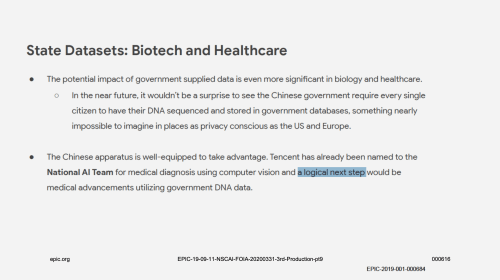
More troubling, it argues that “the potential impact of government supplied data is even more significant in biology and healthcare,” and says it is likely that “the Chinese government [will] require every single citizen to have their DNA sequenced and stored in government databases, something nearly impossible to imagine in places as privacy conscious as the U.S. and Europe.” It continues by saying that “the Chinese apparatus is well-equipped to take advantage” and calls these civilian DNA databases a “logical next step.”
Who are the NSCAI?
Given the sweeping changes to the U.S. that the NSCAI promoted in this presentation last May, it becomes important to examine who makes up the commission and to consider their influence over U.S. policy on these matters, particularly during the current crisis. As previously mentioned, the chairman of the NSCAI is Eric Schmidt, the former head of Alphabet (Google’s parent company) who has also invested heavily in Israeli intelligence-linked tech companies including the controversial start-up “incubator” Team8. In addition, the committee’s vice-chair is Robert Work, is not only a former top Pentagon official, but is currently working with the think tank CNAS, which is run by John McCain’s long-time foreign policy adviser and Joe Biden’s former national security adviser.
Other members of the NSCAI are as follows:
- Safra Catz, CEO of Oracle, with close ties to Trump’s top donor Sheldon Adelson
- Steve Chien, supervisor of the Artificial Intelligence Group at Caltech’s Jet Propulsion Lab
- Mignon Clyburn, Open Society Foundation fellow and former FCC commissioner
- Chris Darby, CEO of In-Q-Tel (CIA’s venture capital arm)
- Ken Ford, CEO of the Florida Institute for Human and Machine Cognition
- Jose-Marie Griffiths, president of Dakota State University and former National Science Board member
- Eric Horvitz, director of Microsoft Research Labs
- Andy Jassy, CEO of Amazon Web Services (CIA contractor)
- Gilman Louie, partner at Alsop Louie Partners and former CEO of In-Q-Tel
- William Mark, director of SRI International and former Lockheed Martin director
- Jason Matheny, director of the Center for Security and Emerging Technology, former Assistant director of National Intelligence and former director of IARPA (Intelligence Advanced Research Project Agency)
- Katharina McFarland, consultant at Cypress International and former Assistant Secretary of Defense for Acquisition
- Andrew Moore, head of Google Cloud AI
As can be seen in the list above, there is a considerable amount of overlap between the NSCAI and the companies currently advising the White House on “re-opening” the economy (Microsoft, Amazon, Google, Lockheed Martin, Oracle) and one NSCAI member, Oracle’s Safra Katz, is on the White House’s “economic revival” taskforce. Also, there is also overlap between the NSCAI and the companies that are intimately involved in the implementation of the “contact tracing” “coronavirus surveillance system,” a mass surveillance system promoted by the Jared Kushner-led, private-sector coronavirus task force. That surveillance system is set to be constructed by companies with deep ties to Google and the U.S. national security state, and both Google and Apple, who create the operating systems for the vast majority of smartphones used in the U.S., have said they will now build that surveillance system directly into their smartphone operating systems.
Also notable is the fact that In-Q-Tel and the U.S. intelligence community has considerable representation on the NSCAI and that they also boast close ties with Google, Palantir and other Silicon Valley giants, having been early investors in those companies. Both Google and Palantir, as well as Amazon (also on the NSCAI) are also major contractors for U.S. intelligence agencies. In-Q-Tel’s involvement on the NSCAI is also significant because they have been heavily promoting mass surveillance of consumer electronic devices for use in pandemics for the past several years. Much of that push has come from In-Q-Tel’s current Executive Vice President Tara O’Toole, who was previously the director of the Johns Hopkins Center for Health Security and also co-authored several controversial biowarfare/pandemic simulations, such as Dark Winter.
In addition, since at least January, the U.S. intelligence community and the Pentagon have been at the forefront of developing the U.S. government’s still-classified “9/11-style” response plans for the coronavirus crisis, alongside the National Security Council. Few news organizations have noted that these classified response plans, which are set to be triggered if and when the U.S. reaches a certain number of coronavirus cases, has been created largely by elements of the national security state (i.e. the NSC, Pentagon, and intelligence), as opposed to civilian agencies or those focused on public health issues.
Furthermore, it has been reported that the U.S. intelligence community as well as U.S. military intelligence knew by at least January (though recent reports have said as early as last November) that the coronavirus crisis would reach “pandemic proportions” by March. The American public were not warned, but elite members of the business and political classes were apparently informed, given the record numbers of CEO resignations in January and several high-profile insider trading allegations that preceded the current crisis by a matter of weeks.
Perhaps even more disconcerting is the added fact that the U.S. government not only participated in the eerily prescient pandemic simulation last October known as Event 201, it also led a series of pandemic response simulations last year. Crimson Contagion was a series of four simulations that involved 19 U.S. federal agencies, including intelligence and the military, as well as 12 different states and a host of private sector companies that simulated a devastating pandemic influenza outbreak that had originated in China. It was led by the current HHS Assistant Secretary for Preparedness and Response, Robert Kadlec, who is a former lobbyist for military and intelligence contractors and a Bush-era homeland security “bioterrorism” advisor.

In addition, both Kadlec and the Johns Hopkins Center for Health Security, which was intimately involved in Event 201, have direct ties to the controversial June 2001 biowarfare exercise “Dark Winter,” which predicted the 2001 anthrax attacks that transpired just months later in disturbing ways. Though efforts by media and government were made to blame the anthrax attacks on a foreign source, the anthrax was later found to have originated at a U.S. bioweapons lab and the FBI investigation into the case has been widely regarded as a cover-up, including by the FBI’s once-lead investigator on that case.
Given the above, it is worth asking if those who share the NSCAI’s vision saw the coronavirus pandemic early on as an opportunity to make the “structural changes” it had deemed essential to countering China’s lead in the mass adoption of AI-driven technologies, especially considering that many of the changes in the May 2019 document are now quickly taking place under the guise of combatting the coronavirus crisis.
The NSCAI’s vision takes shape
Though the May 2019 NSCAI document was authored nearly a year ago, the coronavirus crisis has resulted in the implementation of many of the changes and the removal of many of the “structural” obstacles that the commission argued needed to be drastically altered in order to ensure a technological advantage over China in the field of AI. The aforementioned move away from cash, which is taking place not just in the U.S. but internationally, is just one example of many.
For instance, earlier this week CNN reported that grocery stores are now considering banning in-person shopping and that the U.S. Department of Labor has recommended that retailers nationwide start “‘using a drive-through window or offering curbside pick-up’ to protect workers for exposure to coronavirus.” In addition, last week, the state of Florida approved an online-purchase plan for low income families using the Supplemental Nutrition Assistance Program (SNAP). Other reports have argued that social distancing inside grocery stores is ineffective and endangering people’s lives. As previously mentioned, the May 2019 NSCAI document argues that moving away from in-person shopping is necessary to mitigate China’s “adoption advantage” and also argued that “when buying online is literally the only way to get what you want, consumers go online.”
Reports have also argued that these changes in shopping will last far beyond coronavirus, such as an article by Business Insider entitled “The coronavirus pandemic is pushing more people online and will forever change how Americans shop for groceries, experts say.” Those cited in the piece argue that this shift away from in-person shopping will be “permanent” and also states that “More people are trying these services than otherwise would have without this catalyst and gives online players a greater chance to acquire and keep a new customer base.” A similar article in Yahoo! News argues that, thanks to the current crisis, “our dependence on online shopping will only rise because no one wants to catch a virus at a shop.”
In addition, the push towards the mass use of self-driving cars has also gotten a boost thanks to coronavirus, with driverless cars now making on-demand deliveries in California. Two companies, one Chinese-owned and the other backed by Japan’s SoftBank, have since been approved to have their self-driving cars used on California roads and that approval was expedited due to the coronavirus crisis. The CPO of Nuro Inc., the SoftBank-backed company, was quoted in Bloomberg as saying that “The Covid-19 pandemic has expedited the public need for contactless delivery services. Our R2 fleet is custom-designed to change the very nature of driving and the movement of goods by allowing people to remain safely at home while their groceries, medicines, and packages are brought to them.” Notably, the May 2019 NSCAI document references the inter-connected web of SoftBank-backed companies, particularly those backed by its largely Saudi-funded “Vision Fund,” as forming “the connective tissue for a global federation of tech companies” set to dominate AI.
California isn’t the only state to start using self-driving cars, as the Mayo Clinic of Florida is now also using them. “Using artificial intelligence enables us to protect staff from exposure to this contagious virus by using cutting-edge autonomous vehicle technology and frees up staff time that can be dedicated to direct treatment and care for patients,” Kent Thielen, M.D., CEO of Mayo Clinic in Florida stated in a recent press release cited by Mic.
Like the changes to in-person shopping in the age of coronavirus, other reports assert that self-driving vehicles are here to stay. One report published by Mashable is entitled “It took a coronavirus outbreak for self-driving cars to become more appealing,” and opens by stating “Suddenly, a future full of self-driving cars isn’t just a sci-fi pipe dream. What used to be considered a scary, uncertain technology for many Americans looks more like an effective tool to protect ourselves from a fast-spreading, infectious disease.” It further argues that this is hardly a “fleeting shift” in driving habits and one tech CEO cited in the piece, Anuja Sonalker of Steer Tech, claims that “There has been a distinct warming up to human-less, contactless technology. Humans are biohazards, machines are not.”
Another focus of the NSCAI presentation, AI medicine, has also seen its star rise in recent weeks. For instance, several reports have touted how AI-driven drug discovery platforms have been able to identify potential treatments for coronavirus. Microsoft, whose research lab director is on the NSCAI, recently put $20 million into its “AI for health” program to speed up the use of AI in analyzing coronavirus data. In addition, “telemedicine”– a form of remote medical care – has also become widely adopted due to the coronavirus crisis.
Several other AI-driven technologies have similarly become more widely adopted thanks to coronavirus, including the use of mass surveillance for “contact tracing” as well as facial recognition technology and biometrics. A recent Wall Street Journal report stated that the government is seriously considering both contact tracing via phone geolocation data and facial recognition technology in order to track those who might have coronavirus. In addition, private businesses – like grocery stores and restaurants – are using sensors and facial recognition to see how many people and which people are entering their stores.
As far as biometrics go, university researchers are now working to determine if “smartphones and biometric wearables already contain the data we need to know if we have become infected with the novel coronavirus.” Those efforts seek to detect coronavirus infections early by analyzing “sleep schedules, oxygen levels, activity levels and heart rate” based on smartphone apps like FitBit and smartwatches. In countries outside the U.S., biometric IDs are being touted as a way to track those who have and lack immunity to coronavirus.
In addition, one report in The Edge argued that the current crisis is changing what types of biometrics should be used, asserting that a shift towards thermal scanning and facial recognition is necessary:
“At this critical juncture of the crisis, any integrated facial recognition and thermal scanning solution must be implemented easily, rapidly and in a cost-effective manner. Workers returning to offices or factories must not have to scramble to learn a new process or fumble with declaration forms. They must feel safe and healthy for them to work productively. They just have to look at the camera and smile. Cameras and thermal scanners, supported by a cloud-based solution and the appropriate software protocols, will do the rest.”
Also benefiting from the coronavirus crisis is the concept of “smart cities,” with Forbes recently writing that “Smart cities can help us combat the coronavirus pandemic.” That article states that “Governments and local authorities are using smart city technology, sensors and data to trace the contacts of people infected with the coronavirus. At the same time, smart cities are also helping in efforts to determine whether social distancing rules are being followed.”
That article in Forbes also contains the following passage:
“… [T]he use of masses of connected sensors makes it clear that the coronavirus pandemic is–intentionally or not–being used as a testbed for new surveillance technologies that may threaten privacy and civil liberties. So aside from being a global health crisis, the coronavirus has effectively become an experiment in how to monitor and control people at scale.”
Another report in The Guardian states that “If one of the government takeaways from coronavirus is that ‘smart cities’ including Songdo or Shenzhen are safer cities from a public health perspective, then we can expect greater efforts to digitally capture and record our behaviour in urban areas – and fiercer debates over the power such surveillance hands to corporations and states.” There have also been reports that assert that typical cities are “woefully unprepared” to face pandemics compared to “smart cities.”
Yet, beyond many of the NSCAI’s specific concerns regarding mass AI adoption being conveniently resolved by the current crisis, there has also been a concerted effort to change the public’s perception of AI in general. As previously mentioned, the NSCAI had pointed out last year that:
“In the press and politics of America and Europe, Al is painted as something to be feared that is eroding privacy and stealing jobs. Conversely, China views it as both a tool for solving major macroeconomic challenges in order to sustain their economic miracle, and an opportunity to take technological leadership on the global stage.”
Now, less than a year later, the coronavirus crisis has helped spawn a slew of headlines in just the last few weeks that paint AI very differently, including “How Artificial Intelligence Can Help Fight Coronavirus,” “How AI May Prevent the Next Coronavirus Outbreak,” “AI Becomes an Ally in the Fight Against COVID-19,” “Coronavirus: AI steps up in battle against COVID-19,” and “Here’s How AI Can Help Africa Fight the Coronavirus,” among numerous others.
It is indeed striking how the coronavirus crisis has seemingly fulfilled the NSCAI’s entire wishlist and removed many of the obstacles to the mass adoption of AI technologies in the United States. Like major crises of the past, the national security state appears to be using the chaos and fear to promote and implement initiatives that would be normally rejected by Americans and, if history is any indicator, these new changes will remain long after the coronavirus crisis fades from the news cycle. It is essential that these so-called “solutions” be recognized for what they are and that we consider what type of world they will end up creating – an authoritarian technocracy. We ignore the rapid advance of these NSCAI-promoted initiatives and the phasing out of so-called “legacy systems” (and with them, many long-cherished freedoms) at our own peril.
Iran Under Siege from Humanitarian Imperialism amid Pandemic

NDI’s former President Kenneth Wollack and Chairman Madeleine K. Albright pose with Nazanin Boniadi. Credit: Margot Schulman/ Facebook)
By Danny Haiphong | American Herald Tribune | May 3, 2020
Iran is once again under siege from humanitarian imperialism. The United Nations (UN) has released multiple reports in recent weeks criticizing the Iranian government for supposed human rights violations in relation to the treatment of prisoners and its lockdown procedures during the COVID-19 pandemic. Nazanin Boniadi, a board of director at the Center for Human Rights in Iran, authored a piece in The Washington Post that exploits the pandemic to paint Iran as a human rights catastrophe. An examination of just one of Boniadi’s claims exposes how far the U.S. and its imperialist allies will go to build the case for regime change in Iran.
Boniadi claims that Iran’s failure to maintain a humane release policy of prisoners within the country has contributed to undue suffering from COVID-19. Yet the individual she chooses to defend all but reduces her credibility to zero. Boniadi claims that several prisoners have been returned to prison prematurely, and names Samaneh Norouz Moradi as a victim of this policy. Sameneh Norouz Moradi is a leading activist in the campaign to return Prince Reza Pehlavi to Iran. Prince Reza Pehlavi is the eldest son of Mohammad Reza Pehlavi, otherwise known as the Shah of Iran. This is indeed the same monarch that butchered Iranians in the tens of thousands to ensure the country’s assets remained the property of the West. In just one sentence, Nazanin Boniadi reveals that the purpose of her article and her struggle for human rights is to reinstall the U.S. and Western friendly puppet regime that once reigned over Iran.
The discovery of what is thought to be the mummified body of #RezaShah could be seen as somewhat of an omen for Iranians who were chanting “Reza Shah Rest In Peace” in the recent #IranProtests https://t.co/zIyaMGUmTd https://t.co/kXyffRR3l5
— Nazanin Boniadi (@NazaninBoniadi) April 24, 2018
The human rights industry offers lucrative careers for the likes of Boniadi. Boniadi is a Hollywood star and an Iranian exile with extensive experience in the human rights industry. She served as a spokesperson for Amnesty International for six years from 2009 to 2015. Her service to Amnesty International coincides with the organization’s outright support for U.S.-led regime change wars. The so-called “human rights” organization defended the overthrow of Libya in 2011 and the ongoing invasion of Syria led by the U.S. and its Israeli, Gulf, and Western allies.
It is no surprise, then, that Boniadi now serves on the board of the Center for Human Rights in Iran (CHRI), a dubious human rights organization which fails to disclose its funding sources. A cursory look at Boniadi’s colleagues reveals how deeply the CHRI is embedded in the humanitarian imperialist agenda led by the United States. Chairwoman of the board Minky Worden is also the Director of Global Initiatives at Human Rights Watch. Throughout the 1990s, Worden served as an adviser to Hong Kong’s Martin Lee, a staunch anti-China proxy who has called for the British to recolonize Hong Kong. Lee has given deep support to the rightwing movement currently waging a violent campaign to separate Hong Kong from China under the guise of “human rights.” The rest of the CHRI’s staff is a who’s who of former NED-funded functionaries such as executive director Hadi Ghaemi or advisers to U.S. government and private sector posts such as Michael Eisner.
Humanitarian imperialist think-tanks and NGOs such as CHRI are not interested in human rights in Iran or anywhere else. Their selective focus on nations under siege from the U.S. and its imperial allies reveal that so-called “human rights” organizations are nothing but proxies of regime change. The U.S. military state has viewed the spread of COVID-19 in Iran as an opportunity to build upon this long-standing geopolitical objective. CHRI’s clamor for Iran to correct its alleged human rights abuses comes as the U.S. has escalated its forty-plus year war on Iran. Since mid-March, the U.S. has intensified sanctions on Iran, threatened outright U.S. naval aggression, and reinforced an arms embargo outlined in the nuclear agreement that the U.S. exited in 2018. For the architects of regime change, COVID-19 represents nothing more than opportunity to strike when their target is weakest.
What humanitarian imperialists fail to mention is that Iran has waged a largely successful campaign to reduce the spread of COVID-19 despite the presence of crippling sanctions and the threat of a U.S.-led war. Iran temporarily released seventy-thousand prisoners to prevent the virus’ spread behind prison walls. The World Health Organization’s envoy to Iran praised the country’s initiatives for bringing down the number of COVID-19 cases and deaths in a relatively short period. Such initiatives include mandatory social distancing, the redirection of production toward masks and testing kits, and detailed contact tracing to isolate infected individuals. COVID-19 deaths have declined by around seventy percent since it was announced in mid-March that one Iranian every ten minutes was dying from the virus.
If humanitarian imperialists cared about the Iranian people, then they wouldn’t attempt to use the spread of a deadly pandemic to achieve the U.S.’ geopolitical objective of overthrowing the Iranian government. Furthermore, targeting Iran at this vulnerable time only exposes the truly hypocritical “human rights” framework employed by NGOS such as the Center for Human Rights in Iran. The United States has failed to institute any significant release program for its 2.3 million prisoners. This has led to a countless number of deaths in prisons across the country. Furthermore, the U.S. currently leads the world in the number of deaths from COVID-19 and has allowed the virus to genocidally murder Black Americans at rates upward of three times their percentage of the general population in states such as Michigan and Wisconsin.
COVID-19 has exposed the United States as a human rights train wreck which has no right to tell nations such as Iran how to conduct its domestic affairs. The U.S. is an expert at mass murder for the sake of private profit and found itself unprepared when COVID-19 began to spread within its borders. Instead of fostering cooperation with China, Iran, and the rest of the world in the fight against COVID-19, the U.S. has pirated medical supplies, threatened Iran and Venezuela with outright war, and refused to heed the call of the United Nations for a global ceasefire. That there is no NGO to address the ongoing war crimes of the United States is a lesson into the function of the “human rights” industry. NGOs represent the public relations arm of humanitarian imperialism, which is why their work is most prominently featured in the corporate media when Washington is escalating wars of regime change abroad.
Police brutality, incarceration, and state repression are serious human rights issues. Many people are rightfully concerned about human rights as they witness the horrifying and needless consequences of the COVID-19 pandemic worldwide. The U.S. and West have demonstrated in their response to COVID-19 that their societies are organized to stifle human rights in order to maximize the profits of a tiny capitalist class and the hegemony of the military state that protects this class. Activists and journalists must reject the humanitarian imperialists currently politicizing trendy social justice issues to undermine the self-determination of nations such as Iran. Iran is under siege as it battles a pandemic, and peace and social justice-loving people in the U.S. should demand that their government stops making the situation worse.
ICC Delivers a Blow to Israel’s Lobbying Efforts, Declares Jurisdiction over State of Palestine
Palestine Chronicle – May 1, 2020
Palestine is a state, and therefore the International Criminal Court (ICC) has legal jurisdiction to rule on alleged war crimes committed there, the ICC chief prosecutor Fatou Bensouda reiterated on Thursday, April 30.
The statement was a firm response to intense lobbying efforts by Israel and its supporters, especially Germany, to delegitimize the proceeding altogether.
The 60-page document was entitled: A Response to the ‘Observations of Amici Curiae, Legal Representatives of Victims, and States’. (It can be read in full here).
“Once a state becomes a party to the Statute, the Court is automatically entitled to exercise jurisdiction over article 5 crimes committed on its territory” without any further “separate assessment” by organs of the Court as to the Statehood of the State Party,” the statement reads in part.
“Palestine’s viability as a State—and the exercise of the Palestinian people’s right to self determination—has been obstructed by the expansion of settlements and the construction of the barrier and its associated regime in the West Bank, including East Jerusalem, which have been found to violate international law,” the document also stated.
The ICC pre-trial chamber will now decide how to move forward with the investigation.
“The Prosecutor advanced quite compelling arguments and properly addressed those submissions which aimed at persuading the court not to move forward,” Dr. Triestino Mariniello, member of the Legal Team Representing Gaza Victims before the ICC, told The Palestine Chronicle.
Mariniello also told the Chronicle that although Bensouda’s “observations were compelling,” her decision to call on the pre-trial chamber was not a mandated legal procedure and “it only causes unnecessary delays.”
“Since Palestine submitted a referral to the court, the ICC had the power to open an investigation without asking the pre-trial chamber to rule on the matter,” he said.
“The victims we represent are worried about further delays. The victims are also worried about the so-called ‘narrow scope of investigation’, which is a de facto exclusion of crimes that were committed since 2015 against Palestinian civilians.”
Censorship Continues. Facebook Permanently Deleted SouthFront’s Page
SouthFront | April 30, 2020
SouthFront once again has become a target of corporate censorship. On April 30, Facebook permanently deleted our page (LINK) with about 100,000 followers.

This is not the first time that SouthFront has become a target of a technical and propaganda pressure campaign. On April 9, Facebook placed limits on SouthFront’s page claiming that its activities “don’t comply with Facebook’s policies.” (LINK)
On July 21, 2015, Facebook deleted our previous page used to inform people about the conflict in eastern Ukraine, Syria and other key developments around the world. (LINK)

The motivation in 2015 of US intelligence, and Facebook as a tool of US special services, when the situation in eastern Ukraine was especially tense, is clear. However, the current move raises many more questions.
It is likely Facebook was triggered by SouthFront’s video released on April 29. Entitled “SpaceX: Camel’s Nose under the Tent of Space Militarization”, it covers key aspects of the international situation and the US security strategy. With facts and examples, the video highlights the point of view that supposedly “private” global corporations based in the US are first of all the tools of, likely, the ‘neo-liberal’ part of the US establishment.
Another article that may have scared Facebook censors is “Leaked Video Reveals Pentagon Briefing On Development Of Vaccine To Modify Human Behavior”. This article was released on April 28 and objectively covered the background of the circulating video and questions the authenticity of claims that it shows Bill Gates. If this post became the reason of SouthFront’s ban on Facebook, this will mean that the leaked video poses an exceptional threat to a part of the US establishment.
In the meantime, SouthFront is facing an increasing media pressure. Recently, Deutsche Welle and several other mainstream media outlets released articles alleging that SouthFront is spreading disinformation about the COVID-19 outbreak. An interesting fact is that Deutsche Welle appeared to be unable to answer to SouthFront’s official email regarding its accusations against our organization. (LINK)
The Unz Review Suddenly Banned by Facebook!
By Ron Unz • Unz Review • May 1, 2020
My morning newspapers had recently mentioned Facebook’s plans to crack down on misinformation related to our ongoing Covid-19 epidemic, and probably like most other readers I just nodded my head. After all, many Americans might die if cranks or pranksters began promoting highly dubious cures to the deadly disease, perhaps even suggesting that people should inject themselves with Lysol to ward off an infection.
However, those bland public statements took on an entirely different meaning yesterday afternoon when I discovered that all material from The Unz Review had suddenly been banned for alleged violations of “community standards” and our own Facebook page eliminated.
I don’t use Social Media much myself, but others obviously do, and blocking all our website content from access to the 1.7 billion Facebook users seems a pretty drastic step. So it’s quite reasonable to wonder why, and especially why now?
From the very first, the motto of our publication has been A Collection of Interesting, Important, and Controversial Perspectives Largely Excluded from the American Mainstream Media, and I think we have fulfilled that pledge, publishing many thousands of articles and posts on an enormous range of extraordinarily controversial and even forbidden topics, notably including my own American Pravda series.
Under such circumstances, being banned by Facebook might hardly seem surprising. However, many of our most extremely controversial pieces were published years ago, drawing angry denunciations from various quarters, but received with apparent equanimity from the Lords of the Social Network. Nearly all of the “touchy” pieces we published in the last couple of weeks seem no more “touchy” than the ones from a year or two years or even three years ago. So what suddenly sparked this unprecedented action?
Although I can’t be sure, I strongly suspect that the triggering event was my own most recent American Pravda article, dealing as it did with the Coronavirus epidemic, the supposed focus of Facebook’s current crackdown. And this piece not only accumulated more early readership than any of my previous articles here, but also two or three times as many Facebook Likes, which might have raised serious concerns in certain quarters.
My previous American Pravda articles have hardly been bland, but disputing the established narrative of the JFK Assassination or World War II might be regarded as mere intellectual exercises, having little practical impact. By contrast, tens of thousands of Americans have already died from the Coronavirus outbreak while our economy has been wrecked. So raising troubling questions about the origins of this gigantic national disaster might be regarded as just too problematical to be allowed distribution on Facebook.
American Pravda: Our Coronavirus Catastrophe as Biowarfare Blowback? was the title of my 7,400 word essay, and I answered that explosive query in the closing section:
Last month, a team of five WSJ reporters produced a very detailed and thorough 4,400 word analysis of the same period, and the NYT has published a helpful timeline of those early events as well. Although there may be some differences of emphasis or minor disagreements, all these American media sources agree that Chinese officials first became aware of the serious viral outbreak in Wuhan in early to mid-January, with the first known death occurring on Jan. 11th, and finally implemented major new public health measures later that same month. No one has apparently disputed these basic facts.
But with the horrific consequences of our own later governmental inaction being obvious, elements within our intelligence agencies have sought to demonstrate that they were not the ones asleep at the switch. Earlier this month, an ABC News story cited four separate government sources to reveal that as far back as late November, a special medical intelligence unit within our Defense Intelligence Agency had produced a report warning that an out-of-control disease epidemic was occurring in the Wuhan area of China, and widely distributed that document throughout the top ranks of our government, warning that steps should be taken to protect US forces based in Asia. After the story aired, a Pentagon spokesman officially denied the existence of that November report, while various other top level government and intelligence officials refused to comment. But a few days later, Israeli television mentioned that in November American intelligence had indeed shared such a report on the Wuhan disease outbreak with its NATO and Israeli allies, thus seeming to independently confirm the complete accuracy of the original ABC News story and its several government sources.
It therefore appears that elements of the Defense Intelligence Agency were aware of the deadly viral outbreak in Wuhan more than a month before any officials in the Chinese government itself. Unless our intelligence agencies have pioneered the technology of precognition, I think this may have happened for the same reason that arsonists have the earliest knowledge of future fires.
Back in February, before a single American had died from the disease, I wrote my own overview of the possible course of events, and I would still stand by it today:
Consider a particularly ironic outcome of this situation, not particularly likely but certainly possible…
Everyone knows that America’s ruling elites are criminal, crazy, and also extremely incompetent.
So perhaps the coronavirus outbreak was indeed a deliberate biowarfare attack against China, hitting that nation just before Lunar New Year, the worst possible time to produce a permanent nationwide pandemic. However, the PRC responded with remarkable speed and efficiency, implementing by far the largest quarantine in human history, and the deadly disease now seems to be in decline there.
Meanwhile, the disease naturally leaks back into the US, and despite all the advance warning, our totally incompetent government mismanages the situation, producing a huge national health disaster, and the collapse of our economy and decrepit political system.
As I said, not particularly likely, but certainly a very fitting end to the American Empire…
The spread of these simple ideas on Social Media might have dramatic political consequences, so I can easily understand why certain elements would take strong steps to prevent this.
Greater Manchester Police ask residents to call police if someone repeats conspiracy theories
By Cindy Harper | Reclaim The Net | April 28, 2020
The erosion of civil liberties is being fast-tracked.
Asking people to call the police on family engaging in “conspiracy theories” is an idea that sounds like it comes out of China’s social credit system.
But it’s not. It’s happening in the United Kingdom.
Police in Manchester, England, are engaging in a social media campaign, requesting local residents to call police if any of their friends and family are engaging in “conspiracy theories.”
“Online platforms can be a fun world. Unfortunately, they can also be used to exploit vulnerable people. If you are worried that one of your friends or family is showing signs of radicalisation seek advice or call police on 101,” Greater Manchester Police said on Facebook. (Archive)
101 is the non-emergency number to contact local police in the UK.

In a time when civil liberties are becoming strained and social platforms are taking an extreme approach to stamping out “conspiracy theories,” public skepticism is rapidly increasing – and Greater Manchester Police’s statements are only appearing to exacerbate that.
If you ever had any doubt that the public isn’t aware of the Orwellian direction things are going in, you’d only have to look to the comments:
“How ironic that it was people accused of being ‘Conspiracy Theorists’ in the past that actually warned us a totalitarian police state would come and here it is,” replied Paul Nolan Jones.
“Do not think for yourself, do not question what you are told, trust nothing but what the government tell you and under NO CIRCUMSTANCES discuss alternative theories that concern YOUR life and that of YOUR loved ones. If anyone was in any doubt about the totalitarian police state path we are being led down atm, I suggest that you have a really good think about the above police statement,” said Emma Wells.
“Did you guys actually do any proper police training when you signed up or were you handed a copy of George Orwell’s 1984 to memorise instead? – THE THOUGHT POLICE are alive and well in 2020. Do you realise what you’re doing to society if you’re implementing action taken on the above?!,” said Charlotte Binns.
Update – April 30: In light of the Greater Manchester Police deleting the post to avoid criticism, this post has been updated with the screenshots of the comments that were featured in this article, and an archived version has been added for historical purposes.
WhatsApp Blasts Israeli Firm for ‘Being Deeply Involved’ in Hacking 1,400 Users, Court Files Say
By Lilia Dergacheva – Sputnik – 29.04.2020
The now unveiled court documents reveal how an Israeli firm could technically have conducted the hacking of strings of individuals, including human rights activists and journalists, alleging that it was carried out through its special software called Pegasus.
In newly publicised court filings cited by The Guardian, WhatsApp has taken a dig at the Israeli spyware company NSO Group, accusing it of exploiting US-based servers, as it was “deeply involved” in carrying out the mobile phone hacks of 1,400 users – with senior government officials and human rights activists among them.
The social media company took the matter to court last year, indicting NSO of severe human rights violations, including the hacking of more than a dozen Indian journalists and Rwandan dissidents.
The documents shed light on a number of technical details about how the hacking software, Pegasus, is allegedly deployed against targets.
WhatsApp alleges that the victims of the hack had received phone calls using its messaging app and were “infected” with Pegasus, which NSO reportedly updated using a network of computers for monitoring. “These NSO-controlled computers served as the nerve centre through which NSO controlled its customers’ operation and use of Pegasus”, the court files suggest.
WhatsApp insists that NSO gained “unauthorised access” to its servers by reverse-engineering the messaging app and then going around the company’s security settings that prevent misuse of the company’s call features.
One WhatsApp engineer who looked into the hacks charged in a sworn statement that in 720 instances, the IP address of a remote server was included in the malicious code used in the attacks. The remote server was allegedly based in Los Angeles and owned by a company whose data centre was used by NSO, which is said to have logs, including targeted users’ IP addresses, at its disposal.
NSO said in legal filings that it has no idea how government clients use its hacking tools, and therefore does not know who exactly they are targeting.
In comments to The Guardian, NSO defended its earlier statement praising its digital brainchildren: “Our products are used to stop terrorism, curb violent crime, and save lives. NSO Group does not operate the Pegasus software for its clients”, the company said, stressing that their “past statements about our business, and the extent of our interaction with our government intelligence and law enforcement agency customers, are accurate”. It added that the company’s management is preparing a formal response to the court files in the near future.
NSO is meanwhile in the public crosshairs over it latest product – a reportedly US-marketed tracking program specially meant for those infected with COVID-19. The new program, called Fleming, uses mobile phone data and public health information to identify the whereabouts of corona patients and whom they have come into contact with.
‘Tough Luck’ for US Prisoners During COVID-19
By John Kiriakou – Consortium News – April 28, 2020
A federal judge last week denied NSA whistleblower Reality Winner’s request for release rom federal prison, saying that her possible exposure to the coronavirus was not serious enough to warrant relief because she is incarcerated in a prison hospital for other health issues. The judge also said that each prison’s warden and the federal Bureau of Prisons (BOP) have jurisdiction over compassionate release. Federal judges do not.

Reality Winner (@bjwinnerdavis, Twitter)
The problem is that prison wardens and the BOP almost never release anybody under their compassionate release authorities, even though Congress recently made it easier for them to do so. Reality Winner is not the only person, then, suffering through this pandemic, worried about sick people living practically on top of each other, and without hope of relief.
I’m in regular touch with several prisoners in the federal system and they have reported a rapidly worsening situation because of the spread of coronavirus. Not only is the disease spreading among prisoners and staff alike because of overcrowding, but poor nutrition and inadequate hygiene also play an important role.
At least 27 federal prisoners have died of coronavirus so far and untold thousands have been infected. And, although there have been some high-profile releases, like celebrity attorney Michael Avenatti and former New York Senate Majority Leader Dean Skelos, most federal prisoners who have applied for compassionate release have been told to go fly a kite.
Years of Talk
One of those prisoners, Clint Goswick, is a friend of mine. He was convicted of being a part of a methamphetamine ring and was given two decades in prison. The truth of the matter is that there were 30 people involved in his “conspiracy.” And although his role in the conspiracy was that he allowed the use of methamphetamine at his house during a party, he was given a draconian sentence because one of the attendees at the party had a gun. Clint didn’t know there was a gun. He never saw a gun. He never touched a gun. But that gun quadrupled his sentence. And because his crime is now called a “gun crime,” he is ineligible for compassionate release, whether there’s a coronavirus pandemic or not.
Now multiply Clint times thousands of other prisoners. They’re all out of luck. They have to remain in prison. I always ask myself, “Is society really better off — are we really safer as a country — keeping a guy in his mid-60s in prison for a first-time non-violent drug offense?” Our politicians like to talk about prison reform and sentencing reform, but after years of talk and even passage of legislation, we have very little to show for it. Clint will have to remain in prison for another six years. He’ll be nearly 70 years old. And that’s only if he survives the coronavirus.

Marty Gottesfeld (Twitter)
I am also in touch with whistleblower Marty Gottesfeld. Marty is incarcerated in the notorious Communications Management Unit (CMU) at the Federal Correctional Institution at Terre Haute, Indiana. Until just a few weeks ago, Marty was held incommunicado because he had been reporting on conditions inside the prison for The Intercept, the HuffPo, and other outlets, and that reporting had embarrassed the BOP. The restrictions were lifted inexplicably and he immediately began blowing the whistle on conditions again.
Marty tells me that the BOP only locked down the prison for coronavirus on April 14. Prisoners have not been permitted to bathe since then. They are confined to their cells and are not permitted to have any outside exercise. Marty says that a nurse takes every prisoner’s temperature every few days and, if a prisoner has a fever, he is taken to solitary confinement — not to the medical unit. Solitary has a simple steel bunk, a toilet, and a sink. What it doesn’t have is a doctor or any comfort whatsoever for a sick prisoner.
Prisoners also are given one disposable mask every Wednesday morning, which they must wear at all times. For reasons not made clear to prisoners, there are new restrictions that have accompanied the lockdown. Prisoners, for example, are now allowed to spend only $50 per month in the commissary, rather than the normal $320 monthly (unless they are informants for the guards, in which case they can still spend $320.) At the same time, the commissary has no detergent, no disinfectant wipes and no hand sanitizer.
Prison authorities have also decided, in their infinite wisdom, that prisoners may only make one phone call per week. They did not explain how this is supposed to help control the coronavirus. The more likely scenario is that they hope prisoners will use their one phone call to speak with family members, rather than with journalists, who may be hungry for information from “the inside.”
No Clue
The bottom line is that the Bureau of Prisons leadership has no plan, no policy, to control the coronavirus inside its prisons. It’s winging it. If you have a fever or test positive, you go to solitary.
But how do you remain healthy when there’s no real medical care and no way to keep yourself clean? What do you do when the White House and the Congress say that many of you should be released to home confinement because of the pandemic and the warden and judges say “tough luck?”
I suppose we can write to our elected officials, but that clearly hasn’t worked. In the meantime, we can keep calling out the BOP and its wrong-headed, incompetent, and sadistic leadership. Maybe one of these days somebody will listen.
John Kiriakou is a former CIA counterterrorism officer and a former senior investigator with the Senate Foreign Relations Committee. John became the sixth whistleblower indicted by the Obama administration under the Espionage Act—a law designed to punish spies. He served 23 months in prison as a result of his attempts to oppose the Bush administration’s torture program.
His warnings unheeded, Iranian scientist contracts coronavirus in US jail

Undated picture provided by ISNA of US-held Iranian scientist, Sirous Asgari
Press TV – April 29, 2020
An Iranian scientist — who remains behind bars in the US despite having been exonerated in a sanctions trial — has contracted the new coronavirus after he repeatedly drew attention to his fragile health and called for his release from the “dirty” and “overcrowded” jail facility.
The Guardian reported the lawyers representing Sirous Asgari, a professor of material sciences at Sharif University of Technology, had confirmed his infection on Tuesday.
He has repeatedly pleaded for release since March, complaining about unsanitary detention conditions and overcrowding at the Louisiana facility, where he is being kept.
Coughing violently and suffering from a fever, Asgari told the paper in a phone call that the detention center was even taking in more inmates rather than releasing some as a precaution to stop further spread of the outbreak.
He also said the US Immigration and Customs Enforcement (Ice) had refused to notify him about his positive test results, adding that he only learned about his infection from his lawyers and family members on Tuesday.
“It makes sense to send me to the hospital as soon as possible. I don’t trust them at all,” the 59-year-old said. “If something happens, they are not fast responders … I prefer to leave this dirty place.”
The detainees are responsible for all the cleaning at the detention facility,” where there is a single shower and only two toilets for all 44 of them to share,” the daily reported.
Ice, however, has told Asgari’s lawyers he would only be released to a hospital if he was struggling to breathe.
Asgari was arrested in the United States in mid-2017. Back then, the FBI alleged the scientist had shared information about a project he had conducted on a sabbatical in the US five years before with his students.
His wife, though, said in an interview in late March that the findings of the project had been published and made available on the Internet afterwards, which means there was nothing secret about the project. US legal authorities then charged him with withholding information in the process of visa application, circumventing the sanctions, and transferring technology to Iran.
Washington then delayed the holding of a trial for him several times, “all the while knowing they had no evidence to bring against him,” she said.
The Iranian professor was cleared of the charges at a court session that was ultimately scheduled after about two and a half years. Nevertheless, US Citizenship and Immigration Services then took the matters out of the hands of the country’s legal system, once again detaining Asgari for “lacking a valid visa and illegal presence on US soil.”
Mr. Asgari has reminded US officials that they themselves had seized his passport and were, hence, responsible for his prolonged presence in America.
His spouse said Washington was intentionally prolonging Asgari’s detention so that it could eventually swap him with an American prisoner held in Iran.
Your Freedoms Don’t Have to Be Muzzled Just Because You’re Wearing a Mask
By John W. Whitehead | The Rutherford Institute | April 28, 2020
Despite all appearances to the contrary, martial law has not been declared in America.
We still have rights.
Technically, at least.
The government may act as if its police state powers suppress individual liberties during this COVID-19 pandemic, but for all intents and purposes, the Constitution—especially the battered, besieged Bill of Rights—still stands in theory, if not in practice.
Indeed, while federal and state governments have adopted specific restrictive measures in an effort to lockdown the nation and decelerate the spread of the COVID-19 virus, the current public health situation has not resulted in the suspension of fundamental constitutional rights such as freedom of speech and the right of assembly.
Mind you, that’s not to say that the government has not tried its best to weaponize this crisis as it has weaponized so many other crises in order to expand its powers and silence its critics.
All over the country, government officials are using COVID-19 restrictions to muzzle protesters.
It doesn’t matter what the protest is about (church assemblies, the right to work, the timing for re-opening the country, discontent over police brutality, etc.): this is activity the First Amendment protects vociferously with only one qualification—that it be peaceful.
Yet even peaceful protesters mindful of the need to adhere to social distancing guidelines because of this COVID-19 are being muzzled, arrested and fined.
For example, a Maryland family was reportedly threatened with up to a year in jail and a $5000 fine if they dared to publicly protest the injustice of their son’s execution by a SWAT team.
If anyone had a legitimate reason to get out in the streets and protest, it’s the Lemp family, whose 21-year-old son Duncan was gunned down in his bedroom during an early morning, no-knock SWAT team raid on his family’s home.
Imagine it.
It was 4:30 a.m. on March 12, 2020, in the midst of a COVID-19 pandemic that has most of the country under a partial lockdown and sheltering at home, when this masked SWAT team—deployed to execute a “high risk” search warrant for unauthorized firearms—stormed the suburban house where 21-year-old Duncan, a software engineer and Second Amendment advocate, lived with his parents and 19-year-old brother.
The entire household, including Lemp and his girlfriend, was reportedly asleep when the SWAT team directed flash bang grenades and gunfire through Lemp’s bedroom window.
Lemp was killed and his girlfriend injured.
No one in the house that morning, including Lemp, had a criminal record.
No one in the house that morning, including Lemp, was considered an “imminent threat” to law enforcement or the public, at least not according to the search warrant.
Now what was so urgent that militarized police felt compelled to employ battlefield tactics in the pre-dawn hours of a day when most people are asleep in bed, not to mention stuck at home as part of a nationwide lockdown?
According to police, they were tipped off that Lemp was in possession of “firearms.”
So instead of approaching the house by the front door at a reasonable hour in order to investigate this complaint—which is what the Fourth Amendment requires—police instead strapped on their guns, loaded up their flash bang grenades and acted like battle-crazed warriors.
This is the blowback from all that military weaponry flowing to domestic police departments.
This is what happens when you use SWAT teams to carry out routine search warrants.
This is what happens when you adopt red flag gun laws, which Maryland did in 2018, painting anyone who might be in possession of a gun—legal or otherwise—as a threat that must be neutralized.
These red flag gun laws allow the police to remove guns from people merely suspected of being threats. While in theory it appears perfectly reasonable to want to “stop dangerous people before they act,” where the problem arises is when you put the power to determine who is a potential danger in the hands of government agencies, the courts and the police.
Now Lemp is dead and his family is devastated, outraged and desperate to make sense of what appears to be an insensible act of violence resulting in an inexcusable loss of life.
As usual in these kinds of shootings, government officials have not been forthcoming with details about the shooting: police have refused to meet with family members, the contents of the warrant supporting the raid have not been revealed, and bodycam footage of the raid has not been disclosed.
So in order to voice their objections to police violence and demand answers about the shooting, Lemp’s family and friends planned to conduct an outdoor public demonstration—adhering to social distancing guidelines—only to be threatened with arrest, a year in jail and a $5000 fine for violating Maryland’s stay at home orders.
Yet here’s the thing: we don’t have to be muzzled and remain silent about government corruption, violence and misconduct just because we’re wearing masks and social distancing.
That’s not the point of this whole COVID-19 exercise, or is it?
While there is a moral responsibility to not endanger other lives with our actions, that does not mean relinquishing all of our freedoms.
Be responsible in how you exercise your freedoms, but don’t allow yourselves to be muzzled or your individual freedoms to be undermined.
The decisions we make right now—about freedom, commerce, free will, how we care for the least of these in our communities, what it means to provide individuals and businesses with a safety net, how far we allow the government to go in “protecting” us against this virus, etc.—will haunt us for a long time to come.
As I make clear in my book Battlefield America: The War on the American People, there is always a balancing test between individual freedoms and the communal good.
What we must figure out is how to strike a balance that allows us to protect those who need protecting without leaving us chained and in bondage to the police state.
We must find ways to mitigate against this contagion needlessly claiming any more lives and crippling any more communities, but let’s not lose our heads: blindly following the path of least resistance—acquiescing without question to whatever the government dictates—can only lead to more misery, suffering and the erection of a totalitarian regime in which there is no balance.
Constitutional attorney and author John W. Whitehead is founder and president of The Rutherford Institute.
Featured Video

Houthis Don’t Have to Conquer Saudi Arabia to Make It Pay
or go to
Aletho News Archives – Video-Images
From the Archives
Newly Released FBI Docs Shed Light on Apparent Mossad Foreknowledge of 9/11 Attacks
By Whitney Webb | MintPress News | May 17, 2019
NEW YORK — For nearly two decades, one of the most overlooked and little known arrests made in the aftermath of the September 11 attacks was that of the so-called “High Fivers,” or the “Dancing Israelis.” However, new information released by the FBI on May 7 has brought fresh scrutiny to the possibility that the “Dancing Israelis,” at least two of whom were known Mossad operatives, had prior knowledge of the attacks on the World Trade Center. … continue
Blog Roll
 Aletho News
- UK whines about losing billions to ‘Putin tax’
- Baghaei to Rubio: Distorted narratives cannot erase US record of broken commitments
- Houthis Don’t Have to Conquer Saudi Arabia to Make It Pay
- MOE: Nearly 22,000 Students and Education Workers Killed
- Guterres in Islamabad: Genocide, cowardice, and the cage of Imran Khan
- Johnson, Marandi say Yemen holds upper hand over Saudi Arabia
- False flags won’t save aggressors, Iran FM spokesman says
- The Makkah Pact Enters Into Force: The End of American Dominance or Its New Form?
- NATO’s top generals gather in Kiev
- EU’s continuing expansion – greater threat to Russia
- If Americans Knew
- 5 Palestinians Die from Israeli Strikes in Gaza as Relentless Attacks Continue
- Report: Ceasefire Slows Killing but Leaves Devastation Intact
- Country Music Singer Zach Bryan Breaks Attendance Record at Robert Kraft’s Gillette Stadium While Wearing ‘Free Palestine’ Shirt for Second Night in a Row
- Three years of death and devastation: Israel’s war on Gaza in pictures
- Why Hamas believed the status quo was more dangerous than its 7 October gamble
- Debunking Israel’s latest list of ‘terrorist’ journalists in Gaza
- In Gaza, focus is on survival, “every step is a struggle” – Daily Update
- Three Years of Genocide: How America’s Israel-First Media Filtered Out the Truth
- Israeli war chief briefs ministers on potential war against Palestinian Authority
- New Report: Israel Killed nearly 21,000 Palestinian Students and Education Workers in Past Three Years
- No Tricks Zone
- New Study: 50 Years Of The Most Aggressive ‘Net Zero’ Policies Can Only Affect The Global Climate By 0.03°C
- US September “Heat” Was No Record…Many Records Set Decades Ago
- Latest European Green Energy Debacle; Portugal’s Largest Flagship Solar Park Insolvent!
- Green Energy Debacle: German Expert Professor Fritz Vahrenholt Warns Of Severe Economic And Social Consequences
- Two More Paleo Reconstructions Affirm Meters-Higher Sea Levels Across Ireland, Brazil 7000-6000 Years Ago
- New Study: Earth And Venus Surface Warmth Largely Explained By Convection And Lapse Rate, Not CO2 Or Radiation
- 2025 Nature Paper Claiming Worsening Global Drought Gets RETRACTED …Heavily Flawed
- New Study: ‘Global Drought Shows No Detectable Recent Acceleration Under Climate Warming’
- Economic Masterminds: German Socialists Suggest Taxing Productivity Gains Stemming From Using AI
- The South China Sea Has Not Been Cooperating With The Climate Change Narrative

