Profiting from Loss: How Business in Illegal Israeli Settlements Continues Unchecked
UN efforts to protect Palestinian land from economic exploitation are failing, and exposing the hypocrisy of western states
By Jonathan Cook – The National – February 18, 2020
After lengthy delays, the United Nations finally published a database last week of businesses that have been profiting from Israel’s illegal annexation and settlement activity in the West Bank.
The UN High Commissioner for Human Rights, Michelle Bachelet, announced that 112 major companies had been identified as operating in Israeli settlements in ways that violate human rights.
Aside from major Israeli banks, transport services, cafes, supermarkets, and energy, building and telecoms firms, prominent international businesses include Airbnb, booking.com, Motorola, Trip Advisor, JCB, Expedia and General Mills.
Human Rights Watch, a global watchdog, noted in response to the list’s publication that the settlements violate the Fourth Geneva Convention. It argued that the firms’ activities mean they have aided “in the commission of war crimes”.
The companies’ presence in the settlements has helped to blur the distinction between Israel and the occupied Palestinian territories. That in turn has normalised the erosion of international law and subverted a long-held international consensus on establishing a viable Palestinian state alongside Israel.
Work on compiling the database began four years ago. But both Israel and the United States put strong pressure on the UN in the hope of preventing the list from ever seeing the light of day.
The UN body’s belated assertiveness looks suspiciously like a rebuke to the Trump administration for releasing this month its Middle East “peace” plan. It green-lights Israel’s annexation of the settlements and the most fertile and water-rich areas of the West Bank.
In response to the database, Israeli Prime Minister Benjamin Netanyahu threatened to intensify his country’s interference in US politics. He noted that his officials had already “promoted laws in most US states, which determine that strong action is to be taken against whoever tries to boycott Israel.”
He was backed by all Israel’s main Jewish parties. Amir Peretz, leader of the centre-left Labour party, vowed to “work in every forum to repeal this decision”. And Yair Lapid, a leader of Blue and White, the main rival to Netanyahu, called Bachelet the “commissioner for terrorists’ rights”.
Meanwhile, Mike Pompeo, the US secretary of state, accused the UN of “unrelenting anti-Israel bias” and of aiding the international boycott, divestment and sanctions (BDS) movement.
In fact, the UN is not taking any meaningful action against the 112 companies, nor is it encouraging others to do so. The list is intended as a shaming tool – highlighting that these firms have condoned, through their commercial activities, Israel’s land and resource theft from Palestinians.
The UN has even taken an extremely narrow view of what constitutes involvement with the settlements. For example, it excluded organisations like FIFA, the international football association, whose Israeli subsidiary includes six settlement teams.
One of the identified companies, Airbnb, announced in late 2018 that it would remove from its accommodation bookings website all settlement properties – presumably to avoid being publicly embarrassed.
But a short time later Airbnb backed down. It is hard to imagine the decision was taken on strictly commercial grounds: the firm has only 200 settlement properties on its site.
A more realistic conclusion is that Airbnb feared the backlash from Washington and was intimidated by a barrage of accusations from pro-Israel groups that its new policy was anti-semitic.
In fact, the UN’s timing could not be more tragic. The list looks more like the last gasp of those who – through their negligence over nearly three decades – have enabled the two-state solution to wither to nothing.
Trump’s so-called peace plan could afford to be so one-sided only because western powers had already allowed Israel to void any hope of Palestinian statehood through decades of unremitting settlement expansion. Today, nearly 700,000 Israeli Jews are housed on occupied Palestinian territory.
On Monday European Union foreign ministers were due to meet to discuss their response to the plan. Tepid criticism was the most that could be expected.
The actions of several European states continue to speak much louder than any words.
On Friday, Germany followed the Czech Republic in filing a petition to the International Criminal Court at The Hague siding with Israel as the court deliberates whether to prosecute Israeli officials for war crimes, including over the establishment of settlements.
Germany does not appear to deny that the settlements are war crimes. Instead, it hopes to block the case on dubious technical grounds: that despite Palestine signing up to the Rome Statute, which established the Hague court, it is not yet a fully fledged state.
So far Austria, Hungary, Australia and Brazil appear to be following suit.
But if Palestine lacks the proper attributes of statehood, it is because the US and Europe, including Germany, have consistently broken promises to the Palestinians.
They not only refused to intervene to save the two-state solution, but rewarded Israel with trade deals and diplomatic and financial incentives, even as Israel eroded the institutional and territorial integrity necessary for Palestinian self-rule.
Germany’s stance, like that of the rest of Europe, is hypocritical. They have claimed opposition to Israel’s endless settlement expansion, and now to Trump’s plan, but their actions have paved the way to the annexation of the West Bank the plan condones.
Back in November the European Court of Justice finally ruled that products made in West Bank settlements – using illegally seized Palestinian resources on illegally seized Palestinian land – should not be labelled deceptively as “Made in Israel”.
And yet European countries are still postponing implementation of the decision. Instead, some of them are legislating against their citizens’ right to express support for a settlement boycott.
Similarly, Europe and North America continue to afford the Jewish National Fund, an entity that finances settlement-building, “charitable status”, giving it tax breaks as it raises funds inside their jurisdictions.
The Israeli media is full of stories of how the JNF actively assists extremist settler groups in evicting Palestinians from homes in East Jerusalem. But Britain and other states are blocking legal efforts to challenge the JNF’s special status.
Soon, it seems, Europe will no longer have to worry about its hypocrisy being so visible. Once the settlements have been annexed, as the Trump administration intends, the EU can set aside its ineffectual agonising and treat the settlements as irrevocably Israeli – just as it has done in practice with the Israeli “neighbourhoods” of occupied East Jerusalem.
Then, the UN’s list of shame can join decades’ worth of condemnatory resolutions that have been quietly gathering dust.
The Death Of Free Speech: Zuckerberg Asks Governments For Instructions On “What Discourse Should Be Allowed”
By Jonathon Turley | February 17, 2020
I have written for years on the effort of European countries to expand their crackdown on free speech globally through restrictions on social media and Internet speech. It appears that Facebook chief executive Mark Zuckerberg has relented in what may prove the death knell for free speech in the West. Zuckerberg seems to relent in asking governments for regulations stipulating what speech will be permitted on Facebook and other platforms. It is the ultimate victory of France, Germany, and England in their continuing attack on free expression though hate speech laws and speech regulation.
Zuckerberg told an assembly of Western leaders Saturday at the Munich Security Conference that “There should be more guidance and regulation from the states on basically — take political advertising as an example — what discourse should be allowed?” He did add: “Or, on the balance of free expression and some things that people call harmful expression, where do you draw the line?” The problem is that his comments were received as accepting that government will now dictate the range of free speech. What is missing is the bright line rule long maintained by the free speech community.
As tragically demonstrated in France, Germany, and the United Kingdom, speech regulations inevitably expand with time. The desire to silence one’s critics becomes insatiable for both governments and individuals.
Zuckerberg is facing great pressure, including from Democratic leaders in the United States, to regulate political speech and he seems to be moving away from the bright-line position against such regulation as a principle. Instead, he is accepting the fluid concept of “balanced” regulations that has always preceded expanding speech codes and criminalization:
“There are a lot of decisions in these areas that are really just balances between different social values. It’s about coming up with an answer that society feels is legitimate and that they can get behind and understand that you drew the line here on the balance of free expression and safety. It’s not just that there’s one right answer. People need to feel like, ‘OK, enough people weighed in, and that’s why the answer should be this, and we can get behind that.’”
American Citizens Killed and Tortured by Israel?
No one is ever held accountable

Palestinian-American Mahmoud Shaalan was shot five times by Israeli soldiers at a West Bank checkpoint
By Philip Giraldi | American Herald Tribune | February 15, 2020
One of the principal functions of a United States Embassy overseas is to provide citizen services, which includes coming to the assistance of Americans who are treated badly by the local government. It is a responsibility that most embassies take seriously, with the exception of the facility currently located in Jerusalem. One has to understand that that is so because the United States Embassy in Israel is like no other. In other countries, the American Embassy exists to support American travelers, businesses and a broad range of national interests. In Jerusalem the Embassy exists to support Israeli interests and to serve as an apologist every time the government of Prime Minister Benjamin Netanyahu goes on a killing spree or does something else that is similarly outrageous, to include bombing neighboring Syria every other day.
America’s current ambassador, former Trump bankruptcy lawyer David Friedman, has funded Israel’s illegal settlements, which did not in any way complicate his confirmation as nearly everyone in Congress and the White House does not believe that the Palestinians actually are human beings. Since taking up his position, Friedman has defended Israel when its army sharpshooters have shot down scores of unarmed Gazans, including children, and has both praised and endorsed out-and-out theft by the Israeli government in Jerusalem, on the West Bank and the Golan Heights.
What the U.S. Embassy under Friedman will not do is put any real pressure on the Israeli government if its security forces or rampaging settlers kill, beat, maim or torture an American citizen, especially if said citizen happens to be of Palestinian descent. Indeed, Friedman is only the latest manifestation of Israel-first-itis among U.S. Ambassadors, the rot having started inevitably with Bill Clinton, who appointed Australian citizen Martin Indyk as the first Jewish ambassador to Tel Aviv. The two most recent ambassadors, Friedman and Daniel Shapiro, both political appointees, have also been Jewish. Shapiro so enjoyed being an Israeli that he decided to remain in the country after his appointment as ambassador was completed. He now works for an Israeli government funded think tank.
The Israeli army and police have in fact killed a number of American citizens without any real pushback from the Department of State or White House. The unwillingness to confront Israel on any level stems from the formidable Jewish power in the United States, which uses money and media control to corrupt the political system at national, state and local levels. The media and the chattering political class worry about Russian interference while ignoring the implications of a Haaretz article that appeared on February 12th entitled “AIPAC Must Stop Bernie Sanders – At All Costs!” AIPAC is, of course, the American Israel Public Affairs Committee, widely regarded as the chief U.S. lobbying arm of the Jewish state.
And witness the fate of Congresswoman Betty McCollum from Minnesota, who fell afoul of the Israel Lobby when she introduced H.R.2407, legislation that prohibits American taxpayer money from being used by Israel to arrest and detain Palestinian children. She stated that “Israel’s system of military juvenile detention is state-sponsored child abuse designed to intimidate and terrorize Palestinian children and their families. It must be condemned, but it is equally outrageous that U.S. tax dollars in the form of military aid to Israel are permitted to sustain what is clearly a gross human rights violation against children.” She might have added that the estimated 10,000 Arab children who have been detained since 2000 are frequently tortured by the Israeli authorities. The bill currently has 23 cosponsors and is unlikely to attract more due to fear of the Lobby. It will never reach the House floor for a vote and will never become law.
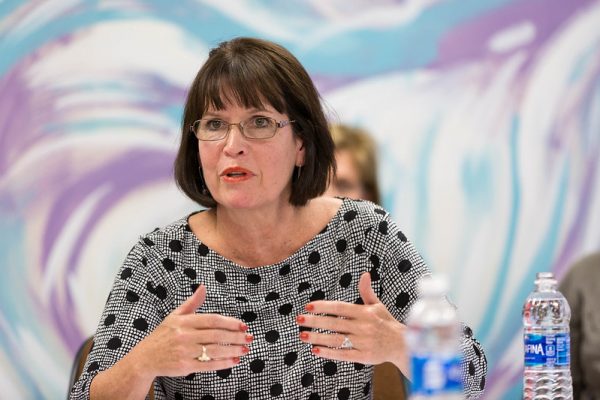
Betty McCollum U.S. Representative for Minnesota’s 4th congressional district at a women’s roundtable at Hillary for Minnesota Headquarters in St Paul, MN. Credit: Lorie Shaull/ Flickr
McCollum’s courage was on display when she was viciously attacked by AIPAC, which posted Facebook ads that referenced “radicals in the Democratic party,” including a photo of McCollum, with the text stating that “It’s critical that we protect our Israeli allies especially as they face threats from Iran, Hamas, Hezbollah ISIS and — maybe more sinister — right here in the U.S. Congress.” McCollum stood her ground against being called “more sinister” than ISIS and released a statement that describes AIPAC as a “hate group,” which of course it is, but she will find few in the Democratic party brave enough to defend her.
Israel’s willingness to kill Americans in support of what it perceives as its own interests goes back nearly to the founding of the state in 1948. The Lavon Affair of 1954 was an Israeli plot to bomb the U.S. Embassy Information Agency libraries in Alexandria and Cairo Egypt, blaming the attacks on the Egyptians to draw the United States closer to Israel. The bombs were placed by Egyptian Jews acting for Israeli intelligence. They exploded, but fortunately no one was killed.
In June 1967 Israel was at it again, attacking the intelligence gathering U.S. naval vessel the U.S.S. Liberty in international waters, killing thirty-four American sailors, Marines and civilians in a deliberate air and sea onslaught that sought to sink the intelligence gathering ship and kill all its crew. It was the worst attack ever carried out on a U.S. Naval vessel in peace time. In addition to the death toll, 171 more of the crew were wounded in the two-hour assault. The Israelis, whose planes had their Star of David markings covered up so Egypt could be blamed, attacked the ship repeatedly from the air and with gunboats from the sea. When one Israeli pilot hesitated, refusing to attack what was clearly an American ship, he was instructed to proceed anyway.
The most disgusting part of the tale relates to how U.S. warplanes sent to the Liberty’s aid from an aircraft carrier in the Mediterranean were called back by Defense Secretary Robert McNamara acting under orders from President Lyndon Baines Johnson, who declared that he would rather see the ship go to the bottom of the sea than embarrass his good friend Israel. Ironically, the first ship to reach the Liberty and offer assistance was from the Soviet Union, an offer that was declined.
More recently there have been a number of killings of Americans. In a bizarre incident in August 1988, an elderly Palestinian-American with a heart condition died after being forced to climb stairs to paint over anti-Israeli graffiti on a school wall. Rebhi Barakat Kaid, 67, of Columbus, Ohio, was on the West Bank visiting relatives. He died of a heart attack after three Israeli soldiers ordered him and his 14-year-old Chicago-born grandson at gunpoint to climb the 22 steep steps that led from the house to the street above without his being allowed to take his heart medicine first.
Much better known is the March 2003 killing of Washington State’s Rachel Corrie, who was deliberately run over by an Israeli military bulldozer when she was protesting the destruction of a Palestinian village. A month later there was an incident in which Brian Avery, a 24-year-old from Albuquerque, New Mexico, was shot in the face in the occupied West Bank city of Jenin by Israeli soldiers in an armored personnel carrier firing machine guns at protesters.

Rachel Corrie lies on the ground fatally injured by an Israeli bulldozer driver. Rachel’s fellow activists are trying to keep her neck straight due to spinal injury. Photo by Joseph Smith. Credit: ISM
In March 2009 Tristan Anderson, a 37-year-old from Oakland, California, suffered permanent brain damage when Israeli soldiers shot him in the face with a tear gas canister as he watched a protest in the West Bank village of Nilin.
Another American citizen, Furkan Doğan, an 18-year-old born in Troy, New York, was killed aboard the Turkish flagged Mavi Marmara in the Mediterranean Sea in May 2010 as a flotilla of international activists attempted to break Israel’s illegal blockade of the Gaza Strip to deliver humanitarian supplies. The United Nations’ General Assembly Human Rights Council determined that Doğan had been killed by Israeli naval commandos through an “extra-legal, arbitrary and summary execution.” He was shot five times, including once in the face from “point blank range.”

Furkan Doğan
The same day that Israel murdered Furkan Doğan, 21-year-old Emily Henochowicz of Potomac, Maryland, was protesting the attack on the flotilla at the Qalandiya checkpoint near Jerusalem, when an Israeli soldier shot her in the face with a teargas cannister, resulting in the loss of an eye.
And then there was in October 2014 the shooting by Israeli soldiers of Orwa Hammad, a 14-year-old Palestinian-American from Louisiana. The Israeli army claimed that Hammad was throwing a Molotov cocktail at the time of his death, but witnesses stated that he was among a group of children throwing rocks at the heavily armed and armored soldiers.
And most recently, there is the case of Florida-born 16-year-old Palestinian-American Mahmoud Shaalan who was shot repeatedly at an Israeli check point on the West Bank on February 26, 2016 while he was walking to a nearby village to visit his aunt. He was still alive after the shooting, but Israeli soldiers denied him any medical treatment for three hours and he died before an ambulance was allowed to approach him.
Arrest of Palestinians and others without probable cause under “administration detention” guidelines followed by torture has also become a hallmark of Israel’s occupation of Arab land. Torture methods used by Israel include stress positions, severe beatings, sleep deprivation, emotional blackmail, threats of torture of family members and the transfer of detainees to secret prisons where torture is constant. In one case reported to a Human Rights Association “The harsh beating was committed with the intention to kill the detainee.”
In another reported case of torture, nineteen-year-old Mahmoud Zakarner’s testicles were smashed by soldiers in front of his uncle to force the man to provide the names of Palestinian resistance members. Mahmoud is now paralyzed and unable to speak as a result.
Israeli expertise in torture is in demand from authoritarian regimes worldwide, creating a growth industry for the specialized “advisers and technicians.” Many are currently working with right wing regimes in South and Central America. Several even showed up at Abu Ghraib as trainers for U.S. interrogators and were able to suggest refinements like the “Palestinian chair.”
Inside Israel torture of Palestinians is routine on the grounds of “necessity” and absurd “ticking-bomb” scenarios. The courts and the medical profession aid and abet the practice. Over 1,200 complaints regarding the torture of Palestinians in Israeli prisons have not resulted in even a single indictment of the torturers.
So, killing Americans as well as many others and torturing prisoners are all in a day’s work for the Jewish state. What is disgraceful, of course, is the fact that the United States government, which has the power to do something about it, instead chooses to do nothing to stop the bleeding or even to demand inquiries to find out who is to blame. Instead, Washington lavishes money and praise on Israel, reportedly America’s best friend and closest ally, while it also avoids looking at the horrors that are evident to most of the rest of the world.
Philip M. Giraldi is a former CIA counter-terrorism specialist and military intelligence officer who served nineteen years overseas in Turkey, Italy, Germany, and Spain. He was the CIA Chief of Base for the Barcelona Olympics in 1992 and was one of the first Americans to enter Afghanistan in December 2001. Phil is Executive Director of the Council for the National Interest, a Washington-based advocacy group that seeks to encourage and promote a U.S. foreign policy in the Middle East that is consistent with American values and interests.
Conservative Friends of Israel urge UK to oppose ICC’s war crimes investigation

CFI’s August 2015 delegation to Israel: Eric Pickles MP, Guto Bebb MP, Bob Blackman MP, John Howell MP, Matthew Offord MP, Andrew Percy MP, Chloe Smith MP and Heather Wheeler MP
MEMO | February 14, 2020
The Conservative Friends of Israel (CFI) has urged the UK government to directly oppose the International Criminal Court (ICC)’s decision to open an investigation into war crimes committed in the occupied Palestinian territory.
Writing to Prime Minister Boris Johnson and Foreign Secretary Dominic Raab, senior CFI officials MP Stephen Crabb, Lord Pickles and Lord Polak, argue that “as a non-state actor the Palestinians do not meet the legal requirements of the Rome Statute”, according to a CFI press release.
In the letter, the Westminster lobby group acknowledges that “the ICC is an important institution that the UK should continue to support”, but then goes on to claim that “the Court does not have jurisdiction over the territories”.
“We would urge the UK Government to join our close allies the United States, Australia and Germany in publicly cautioning against the politization of the ICC,” CFI continued.
“The Palestinian request for ICC intervention seeks to exploit the Court, involving it in alleged crimes that do not meet the legal requirements of the Rome Statute,” the CFI stated. “This undermines the Israeli-Palestinian peace process by incentivising the demonisation and vilification of each side.”
Another argument used by CFI is to suggest that the ICC probe into war crimes in the occupied Palestinian territory could have implications for UK armed forces.
“An inquiry of this nature would also set a dangerous precedent that could lead to prosecutions against the brave men and women of our armed forces who served in Iraq and Afghanistan, initiated in the ICC by non-state actors,” the CFI letter states.
Today marks the deadline for the UK, and other governments, “to request leave to file a written observation to the ICC”, CFI notes, urging the UK to do so, and “raise important concerns about the ICC’s lack of jurisdiction over this matter and the dangerous precedent it would set”.
“The UK [should] stand with Israel against this dangerous probe.”
Saudi Arabia launches new campaign of arrests against Palestinian expats
MEMO | February 14, 2020
Saudi Arabia has launched a new campaign of arbitrary arrests against several Palestinian expatriates living in the kingdom for supporting the Islamic resistance movement, Hamas.
The Prisoners of Conscience Twitter account which monitors the conditions of prisoners in Saudi Arabia said it has received “confirmed information” that the Saudi authorities have launched a new campaign of arbitrary arrests against Palestinian ex-pats. It adds that a number of the Palestinians targeted in the new campaign are relatives or sons of Palestinians who had been arrested during the first campaign in April, last year for the same reason.
In April, last year the Saudi authorities launched a campaign of arrests against Palestinian ex-pats including a senior leader in Hamas movement, Muhammad al-Khudari, 81, and his eldest son Hani.
The Twitter account defended the Palestinian detainees saying that supporting the (Palestinian) resistance is not a crime that requires arrests and demanded the Saudi authorities “to immediately release all detainees from the last campaign, and stop the trials of those detained last year which will begin early next month”.
Earlier this month, the Twitter account said the Saudi prosecution accuses the Palestinian detainees of illegally transferring funds (to the Palestinian resistance factions) and establishing unlicensed organisations to defend Palestinian and Jordanian detainees in the kingdom.
The Palestinian detainees will be tried before the Saudi Specialized Criminal Court on March 8.
On September 6, 2019, the Euro-Mediterranean Human Rights Monitor said that Saudi Arabia is forcibly hiding 60 Palestinians.
Palestinian Minor Reveals Harrowing Details in Israeli Custody

Palestine Chronicle | February 13, 2020
In a testimony made through his lawyer to the Committee of Prisoners and Former Prisoners Affairs, Palestinian teenage prisoner Mahmoud Thawabteh revealed details about the difficult conditions inside Israeli prisons.
Thawabteh, 17, was arrested from his house in Beit Fajjar in eastern Bethlehem when Israeli occupation soldiers stormed the neighborhood at dawn, the boy’s lawyer told the Committee.
According to the testimony, Thawabteh was harshly interrogated in the street, before army dogs were unleashed at him.
The boy revealed that he was brutally beaten and he had several dog bites on his legs.
“They beat me up on my head and back using their rifles and sticks”, Thawabteh said, as reported in Quds News Network.
After a harrowing journey in an Israeli army jeep, the teenage boy was taken to the notorious Etzion interrogation center, where dozens of Palestinian minors were held and reportedly tortured over the years.
Conveying Thawabteh’s testimony, his lawyer went on to say that the teenager was allowed to see a doctor just before his interrogation commenced. However, the Israeli doctor did little to stop the bleeding or to treat the bruises and bite marks, aside from taking Thawabteh’s blood pressure.
Thawabteh was held in the Etzion facility for three days, during which he was interrogated, assaulted, and beaten repeatedly, before being moved to the Ofer military jail, near Ramallah, in the occupied West Bank.
On January 13, Thawabteh was one of 34 Palestinian minors who were relocated from the Ofer prison to the Damon prison, inside Israel, without being accompanied by their adult overseers, according to the Palestinian Prisoner’s Society (PPS).
Commenting on that experience, Thawabteh told his lawyer that the children were placed in a squalid section of the prison that was infested with insects. They were left largely alone, as the Israeli prison guards refused to provide them with basic services or needs.
The Palestinian Prisoner Solidarity Network Samidoun had reported earlier that “every year, around 700 Palestinian children are brought before Israeli military courts after being arrested, detained and interrogated.”
“The vast majority report some form of torture and abuse, including kicking and beating in military jeeps as well as psychological torture during interrogation, including threats to arrest family members.”
Israel prosecutes leaders from Golan for opposing wind turbines
MEMO | February 13, 2020
The Israeli Magistrates Court in Nazareth held trial Tuesday evening of well-respected leaders from the occupied Golan, who opposed the Israeli project to install wind turbines to produce energy over large areas, estimated at thousands of dunums of the Golan lands.
Hundreds of people from the villages of the occupied Golan headed to the Israeli Magistrate Court to support the prosecuted leaders.
Sheikh Fouad Qassem Al-Shaer, from Majdal Shams village, said: “There are foul intentions behind the trial of the Sheikhs and leaders, who opposed a project that is going to affect more than 300 farmers in the villages of Golan. The project is going seize about 4,500 dunums of agricultural land.”
Al-Shaer stressed that “countering the project will be possible through raising awareness of the risks of this settlement project, which claims the implementation of green energy production, and its impact on the lives of people.”
In this context, Emil Masoud, coordinator of the solidarity campaign with Sheikh Salman Ahmed Awad and Tawfiq Kinj Abu Saleh, said that they were brought to trial without committing any violation, except for opposing to the wind power project.
Masoud, from Masade village, asserted: “The aim of this trial is to intimidate and scare people, so that the company can implement 25 turbines, to be built on an area of 4,316 dunums as a first stage.”
After hearing the allegations of the parties, the court asked them to sit together to reach a settlement or an agreement.
UK Will Make Facebook Responsible for Harmful Content as Ofcom is Set to Have More Powers – Report
Sputnik – February 12, 2020
Facebook and some other social media companies have recently come under fire for failing to remove allegedly misleading and harmful content from their platforms. Now, British regulatory authority Ofcom is reportedly set to be given a role in policing social media companies.
Britain’s media watchdog Ofcom will have more power in regulating social media companies in the UK, such as Facebook, Twitter, YouTube or Snapchat, and will make them accountable for harmful content, the BBC reported citing Digital Secretary Baroness Nicky Morgan.
Social media companies have long defended their rights to control unacceptable content on their platforms related to violence, terrorism or child abuse, but according to reports, this is now going to change in the UK.
“There are many platforms who ideally would not have wanted regulation, but I think that’s changing”, Nicky Morgan, Baroness Morgan of Cotes, was quoted as saying. “I think they understand now that actually regulation is coming”.
The information has not been confirmed by the UK’s Department for Digital, Culture, Media and Sport but it was reported that on Wednesday the government will present a draft of the new legislation related to online harm and will announce Ofcom’s new powers. So far, the authority has only been entitled to regulate British media, not social media platforms or internet safety. The news could cause some concerns among the public about potential censorship over online content.
Facebook has long been criticised for failing to take responsibility for content on its platform, including its refusal to remove political ads that may contain misinformation, citing its monitoring, rather than regulatory role.
Mark Zuckerberg, Facebook’s CEO, has maintained that the company was still accountable for removing harmful content related to child exploitation, terrorism, or violence from the its platform. However, in relation to political ads, he cited the policy of free speech and insisted that social media users were still able to make up their own minds about the political agenda.
Trudeau is buddies with murderous African dictator
By Yves Engler · February 12, 2020
 Justin Trudeau wants us to know he’s buddies with Africa’s most ruthless dictator.
At the recent African Union Summit in Ethiopia Trudeau met Paul Kagame. The Prime Minister’s press people released a photo of him laughing with the Rwandan President and announced that the two discussed the upcoming Commonwealth summit Trudeau is set to attend in Kigali.
On at least five occasions since 2018 Trudeau has been photographed with Kagame during one-on-one meetings on the sidelines of different international summits. At one of those meetings the PM “affirmed the importance of strong and growing bilateral relations” between Canada and Rwanda.
Canadian-based Rwandan dissident David Himbara has criticized the PM’s embrace of Kagame. In April 2018 he wrote, “the romance between Canada’s Prime Minister Justin Trudeau and Rwanda’s strongman Paul Kagame is difficult to fathom. For the past several months, the romance between the two and among their respective ministers has blossomed beyond belief.”
After amending the constitution to be able to run indefinitely Paul Kagame won 98.63 per cent of votes in Rwanda’s August 2017 presidential election. In response, Canada’s High Commissioner Sara Hradecky tweeted, “congratulations to Rwandans for voting in peaceful presidential election” and “Canada congratulates Paul Kagame on his inauguration today as President of Rwanda.” The latter tweet was picked up by the state propaganda organ New Times in a story titled “Heads of State, diplomats laud Kagame’s ‘visionary leadership’.”
If garnering 99 per cent of the vote wasn’t a clue that Kagame is a dictator, the High Commissioner could have taken a look at Canada’s ‘paper of record,’ whose Africa bureau chief had recently shined a critical light on Rwanda. At the start of 2016 the Globe and Mail reported on two new books describing the totalitarian nature of the regime.
“Village informers,” wrote South Africa-based Geoffrey York. “Re-education camps. Networks of spies on the streets. Routine surveillance of the entire population. The crushing of the independent media and all political opposition. A ruler who changes the constitution to extend his power after ruling for two decades. It sounds like North Korea, or the totalitarian days of China under Mao. But this is the African nation of Rwanda — a long-time favourite of Western governments and a major beneficiary of millions of dollars in Canadian government support.”
In 2014 York wrote an investigation headlined “Inside the plots to kill Rwanda’s dissidents,” which provided compelling evidence that the regime had extended its assassination program outside of east Africa, killing (or attempting to) a number of its former top officials who were living in South Africa. After the initial investigation York reported on Rwandan dissidents who had to flee Belgium for their safety while the Toronto Star revealed five individuals in Canada who were fearful of the regime’s killers.
On top of international assassinations and domestic repression, Kagame unleashed mayhem in the Congo. In 1996 Rwandan forces marched 1,500 km to topple the regime in Kinshasa and then re-invaded after the Congolese government it installed expelled Rwandan troops. This led to an eight-country war between 1998 and 2003, which left millions dead. Rwandan proxies repeatedly re-invaded the mineral rich eastern Congo. In 2012 the Globe and Mail described how “Rwandan sponsored” M23 rebels “hold power by terror and violence” there.
Despite the regime’s violence, Governor General Julie Payette traveled to Kigali to meet Kagame in August. She lauded “the long-standing partnership between Canada and Rwanda.”
In November 2017 Rwanda’s Environment Minister visited Ottawa to meet her Canadian counterpart, Catherine McKenna, who lauded “our close friendship.” Later that year defence minister Harjit Sajjan hosted his Rwandan counterpart General James Kabarebe.
In 2015 Kabarebe was arrested in London under a Spanish indictment for war crimes committed between 1990 and 2002 in Rwanda, including the murder of two Quebec priests. Previously, Kabarebe had been the subject of an arrest warrant by a French judge for his role in shooting down President Juvénal Habyarimana’s plane, which unleashed the genocidal violence in Spring 1994. A 2012 UN report claimed Kabarebe organized and armed deadly M23 rebels in eastern Congo, labeling Kabarebe “a central player in recruiting on behalf of M23” and noted that “he has often been in direct contact with M23 members on the ground to coordinate military activities.” After former Rwandan spy chief, turned Kagame critic Patrick Karegeya, was strangled to death in a South African hotel in January 2014 Kabarebe said, “when you choose to be a dog, you die like a dog, and the cleaners will wipe away the trash.”
The Rwandan government’s domestic repression, international assassinations and violence in the Congo are well documented. Yet I couldn’t find any criticism of Kagame by the Trudeau government. Instead, Ottawa provides about $25 million annually in assistance to Rwanda.
US Ambassador sends strong message to Netanyahu: patience, young grasshopper, you’ll annex the West Bank soon
By Sarah Abed | February 11, 2020
On January 28th, United States President Donald Trump accompanied by Israeli Prime Minister Benjamin Netanyahu and top advisor/son-in-law Jared Kushner unveiled the much anticipated so-called “Deal of the Century” also referred to as the “Mideast Peace Plan”. The deal greenlighted the annexation of Palestinian land, subjugation of Palestinians, and apartheid in Israel. Israeli politicians couldn’t wait to pounce on the opportunity to steal vast areas of occupied land along the Jordan valley. They did little to hide their enthusiasm as they announced that a vote on annexation would take place a few days later.
What became clear even before the ink had dried is that behind the scam of the century was the normalization of Israel’s apartheid in Palestine. The deal was praised by Israel as the opportunity of a lifetime and outright rejected by Palestinian politicians including President Mahmoud Abbas.
Just days after the deal was announced, plans were made to vote on annexing parts of the West Bank, which are sites of Israeli settlements, and seen by a number of countries as illegal Israeli occupation that defies international law and United Nations Charters, but then that vote was postponed. Almost two weeks later as word spread that another vote might be on the horizon ahead of the March 2nd election, Washington decided to halt Netanyahu’s progress just temporarily causing him to backtrack on his plan for immediate annexation of the West bank. Netanyahu mentioned on Saturday that mapping of the region was underway.
David Friedman, the Trump administration’s Ambassador to Israel is not only one of the masterminds behind the annexation plan but has historically supported illegal colonial settlements. On Sunday, he tweeted warning Israeli politicians against taking any unilateral steps which could endanger the Plan and American recognition. Of course, Israeli Prime Minister took the cue very seriously and knowing that the US’s blessing is of utmost importance stressed to both his fans and critics that they have waited for this opportunity since 1967 and won’t jeopardize things by being impatient.
Friedman tweeted the following on Sunday February 9th, “President Trump’s Vision for Peace is the product of more than three years of close consultations among the President, PM Netanyahu and their respective senior staff. As we have stated, the application of Israeli law to the territory which the Plan provides to be part of Israel is subject to the completion of a mapping process by a joint Israeli-American committee.” He added “Any unilateral action in advance of the completion of the committee process endangers the Plan & American recognition.”
As if it wasn’t already crystal-clear that the steal of the century was never ever a legitimate deal between Israeli’s and Palestinians nor a deal that Palestinians would ever be able to consider let alone agree to, Friedman’s tweet drives home the message loud and clear. Palestinians were neither consulted, nor will they be part of the mapping process.
Amidst widespread condemnation and what many countries consider a violation of international law, steps are being taken to pave the way for the annexation of Israeli settlements on Palestinian land captured during the 1967 war. Netanyahu’s focus right now is on winning a fourth consecutive term in office and taking drastic measures could help win him the election. It’s probably also a good distraction from the series of corruption charges he is facing.
Palestinian authorities have adamantly rejected Washington’s supposed peace plan and are against any unilateral steps being taken whether it’s now or after the election that violate the 1967 Palestinian map borders. Israel tries to appeal to the masses by citing security, biblical, and historic ties to the land on which their settlements are built and Palestinians refuse to accept the theft of more of their ancestral lands.
Many Israeli’s on Twitter didn’t appreciate Friedman’s tweets; some were saying that the United States shouldn’t interfere in Israel’s internal affairs. The irony of how Israel has hijacked US Middle Eastern policies seems to go over their heads. They certainly appreciate how Trump and Kushner’s biased pro-Israeli “Deal of the Century” greenlights the subjugation of Palestinians and the illegal annexation of Palestinian-claimed land but they don’t want Washington involved in implementation or to set any guidelines on how quickly they can expand their reign of terror over Palestinians and their land.
The only reason why Israel is able to continue to override international law and make unilateral declarations of statehood and persist with its terror campaigns at the hands of its Jewish militias, all while ethnically cleansing and massacring countless Palestinians is because of its relationship with Washington and many nations around the world turning a blind eye. Due to a lack of defined borders and the absence of accountability, Israel plans to annex East Jerusalem, the Golan Heights of Syria, and soon swathes of land in the West Bank.
The bottom line is peace cannot be achieved without justice and the recognition of Palestinian human and political rights, solely by Israeli authorities and political figures. Mutual recognition, Palestinian freedom of movement and Palestinian right of return, borders, security, water rights, control of Jerusalem are all part of the decades long conflict. A democratic state can only exist in historical Palestine if Muslims, Jews, Christians, etc. live in harmony with equal rights.
Exposed: The “Con of The Century” Will Not Bring Peace
State of Palestine, PLO Negotiations Affairs Department | February 9, 2020
Everything you need to know about Trump’s “apartheid” deal :
1. Does the plan, presented by U.S. President Trump, support an independent and sovereign State of Palestine, with East Jerusalem as its capital, or a Greater Israel between the river Jordan and the Mediterranean?
The plan outrageously dismisses the right of Palestine to exist as an independent, sovereign, and contiguous State. By sponsoring the legalization of Israeli illegal settlements and dictating that none will be dismantled, the plan simply represents the annexation of territory, rendering a free Palestine impossible. Under this plan, Israel would retain its overriding security control over vast areas of occupied Palestine, including its capital East Jerusalem and the Jordan Valley. It suggests a fictional State of Palestine, whereby it substitutes territorial contiguity with “transportation contiguity” thus undermining the very viability of Palestinian statehood. This fictional state will be divided into a series of enclaves, scattered around like an archipelago to be connected by tunnels and bridges, allowing Israel to maintain security control over Palestinian terrestrial and maritime borders, airspace, and natural resources. As such, the plan cancels all possibilities for the State of Palestine to exercise any meaningful sovereignty and the very security of the state. On the other hand, the plan outlines total support for a Greater Israel between the river Jordan and the Mediterranean.
While fully serving the interests of the State of Israel alone, the plan constitutes a continuation of the Balfour Declaration of 1917 and Israel’s Jewish-Nation State law of 2018. It aims to formalize the Greater Israel colonial project over the land of historic Palestine, which denies the national rights of the Palestinian people and only allows them to live in self-governing Bantustans with barely a handful of civil and religious rights. It relieves Israel of the burden of paying the cost of its occupation and assuming its responsibilities as an occupying power.
2. Does the plan constitute a “peace” plan or an “apartheid” plan?
By legalizing the annexation of occupied Palestinian territory to the Israeli state, and limiting Palestinians to dis-contiguous enclaves on their own land, the plan consolidates an already existing system where two sets of laws apply in the occupied Palestinian territory: one for Israeli settlers and another one for the occupied Palestinian people. While Israeli law is applicable to illegal Israeli settlers in the occupied West Bank of Palestine, Palestinians are subject to Israeli military laws and courts. Not only does the plan propose a Palestinian state with no sovereignty, but it spells out a one-state reality with two systems, whereby Palestinians continue to be denied the political, economic, cultural and social rights that are enjoyed by Israeli Jews. Indeed, with the number of Palestinians, in the State of Palestine and Palestinian citizens of Israel already surpassing the number of Israeli Jews in the land between the river Jordan and Mediterranean, Israel is one step away of becoming a full-fledged apartheid state. In all, this plan demands that the Palestinian leadership and people submit to total subjugation in Israel’s apartheid state.
3. Is the plan in line with the two-state solution on the 1967 border?
At the outset of this plan, its authors introduce the conflict as one between “the State of Israel and the Palestinians,” effectively destroying the two-state solution and deceptively erases the 1967 border, known as the Green Line. The defined borders of the internationally recognized State of Palestine by 139 nations worldwide in accordance with UN resolution 67/19 of 2012 are located within the 1967 borders, comprising the West Bank, including the capital East Jerusalem, and the Gaza Strip. On the other hand, Israel has not yet defined its borders. Not only does the map endorsed by President Trump eliminate the 1967 border, but it also recognizes Israel’s illegal facts on the ground and its de-facto ‘one state with two systems’. Unmistakably, the plan supports the realization of a Greater Israel that erodes the concept of the internationally endorsed two-state solution and replaces it with apartheid.
4. Does the plan respect international law and United Nations resolutions?
The plan brazenly violates international law and consensus, and all United Nations Resolutions concerning the question of Palestine. This includes resolutions endorsing the two-state solution, others considering Israeli settlements as illegal, resolutions recognizing East Jerusalem as the capital of the State Palestine, and deeming any alterations to Jerusalem by Israel as null and void, and resolutions recognizing the rights of Palestine refugees to return and compensation. The plan normalizes (i) the colonization of Palestine, in violation of international law and UN resolutions (ii) annexation of occupied Palestinian territory, manifestly illegal under international law and deemed a crime of aggression under Rome Statute and (iii) apartheid, recognized as a crime against humanity under the Rome Statute.
Both the US and Israel are thus defying and threatening international law and order to replace them with a racist, hegemonic and exploitative new world order. As stated by Michael Lynk, the UN Special Rapporteur on the situation of human rights in the Palestinian territory occupied since 1967: “This plan would turn the rules-based international order on its head and would permanently entrench the tragic subjugation of the Palestinians that is already existing on the ground,”. He added that: “The abandonment of these legal principles threatens to unravel the long-standing international consensus on the conflict, favouring realpolitik over rights, power over justice and conflict management over conflict resolution.”
5. Which party is rejecting the internationally-endorsed references to achieve peace?
Based on international law and relevant UN resolutions, the Palestinian Peace Initiative of 1988 marked a historic and painful compromise by accepting Israel’s right to exist on 78 percent of the land of historic Palestine, with the State of Palestine on the remaining 22 percent, comprised of the West Bank, including East Jerusalem, and the Gaza Strip. Unlike Israel, which continues to create illegal facts on the ground and to violate both international law and signed agreements, the Palestine Liberation Organization (PLO) continues to honor all its international obligations, including under signed agreements with Israel, and to seize every opportunity to achieve peace and the right of the people of Palestine to self-determination. During the past thirty-two years, the PLO has been genuinely engaged in the peace process that started with the Madrid Peace Conference of 1991 and concluded with the last round of negotiations led by the former U.S. Secretary of State John Kerry in 2014, which failed as a result of Israel’s continued use of negotiations as a smokescreen to violate Palestinian rights and international law.
On the other hand, since the signing of the Oslo Interim Agreement in 1993, Israel has been heavily engaged in a colonial process of settlement building on Palestinian territory, while continuing to violate nearly all Palestinian rights, at the expense of the peace process. Israel has been systematically destroying the very foundations of the peace process as it continues to appropriate Palestinian land and transfer of its own civilian population into the occupied Palestinian territory, in clear violation of international law.
According to the Israeli NGO Peace Now, until 1994, there was over 280,000 Jewish Israeli settlers living in occupied Palestine. In contrast, the current available statistics show that this number has almost tripled to more than 640,000 settlers living in over 200 settlements, including 42 in and around occupied Jerusalem. In fact, during the past decade alone, according to a recently published report by an Israeli settler organization, the number of Israeli settlers increased by 48 percent. In 2019 alone, there was an increase of 3.4%, which is more than double the rate of population growth in Israel proper that reached 1.9% at the beginning of 2020.
6. How does the plan prejudge core issues reserved for permanent status negotiations?
Through a series of unilateral decisions, and since its recognition of Jerusalem as Israel’s capital in late 2017, the Trump administration has methodically been undermining the permanent status negotiations mainly concerning the core issues: borders, Jerusalem, and the question of Palestine refugees. A careful reading of the Trump plan shows how all its details embody the racist vision of the most ideologically extreme Israeli settlers, who have been gradually empowered since the assassination of the former Israeli Prime Minister Yitzhak Rabin in 1995 and in fact have been leading the State of Israel for over a decade now.
Overall, the plan denies Palestinians’ sovereign statehood, recognizes Jerusalem as the capital of Israel, violates the historic status quo at Al-Aqsa Mosque Compound, by imposing time and location divisions inside the compound for different faiths, legalizes the annexation of all Israeli settlements, and categorically dismisses the rights of Palestine refugees. By allowing Israel to expand and perpetuate its colonial-settlement enterprise, the plan negates the Palestinian right to self-determination and proposes an alternative to the international terms of reference for negotiations between Israel and Palestine, all in violation of international law, UN resolutions, international consensus, and previously signed agreements. Engaging with this plan means a legitimization of Israel’s acquisition of territory by force and a perpetuation of its superiority and domination over the land and lives of the people of Palestine. In other words, it legitimizes “might over right.”
7. Can the economic part of the plan be a substitute or an alternative to a comprehensive, just and lasting peace?
The State of Palestine has the right to exercise its sovereignty with independent financial and monetary plans, control over its imports and export policies, as well as with access to its borders and natural resources, including water, minerals, natural gas, and oil resources. It is only through a just and lasting peace that Palestine can ensure the independence, prosperity, and sustainability of its economy, beginning with an end to Israel’s occupation and the fulfillment of Palestinian statehood and inalienable rights. According to various economic studies, Palestine has great economic potential and the number one obstacle to achieving that potential is the Israeli occupation. For example, in 2013, a World Bank report estimated that if Israeli restrictions on Area C of the West Bank were lifted it “could bring about significant expansion of many sectors of the Palestinian economy,” which will be able to generate $2.2 billion a year in value added terms. According to the report: “The bulk of this would come from agriculture and Dead Sea minerals exploitation.” The Dead Sea, a strategic area for Palestine, is promised to Israel in the Trump plan.
In all, the economic portion of the plan is a failed attempt to cover up for the prolongation of Israel’s belligerent occupation and the theft of Palestinian land and resources.
8. What is the position of the State of Palestine?
The State of Palestine considers the U.S. apartheid plan as blatant aggression against the inalienable rights of the people of Palestine, which were endorsed by the United Nations to enable our nation to exercise its right to self-determination, national independence and sovereignty, and the right of our refugees to return. The plan undermines international law and the role United Nations, and hence constitutes a direct threat to the people of Palestine and their just cause, and on the entire international rules-based system as we know it. It considers all Israeli settlements as legal, including those in East Jerusalem – Palestine’s internationally recognized capital, which is comprised of the Old City and the surrounding area of 6 km2.
The State of Palestine has endorsed all relevant UN resolutions and international law as the basis of any solution towards the achievement of peace. It considers the Arab Peace Initiative (API) as the foundation formula that can achieve the diplomatic and economic integration of Israel into the region in exchange for ending its occupation of all Arab territories, including the Lebanese Shebaa Farms, Arab Syrian Golan and the occupied State of Palestine, as well as achieving a just and agreed-upon solution to the question of Palestine refugees.
9. What are the positions of the international community and the Arab world?
While a number of countries “welcomed” the U.S announcement, none have endorsed the plan. But the majority of the responses were positive in insisting on the importance of the two-state solution, international law, and relevant UN resolutions as the way forward to achieve peace. This includes the European Union, through a statement issued by the High Representative/Vice-President Josep Borrell, which affirmed the EU’s position that “does not recognise Israel’s sovereignty over the territories occupied since 1967”, and considered that “Steps towards annexation, if implemented, could not pass unchallenged.” Also, the Arab League decided “to reject the American – Israeli ‘Deal of the Century’, which does not meet the minimum of the Palestinian people’s aspirations and rights, and violates all of the references of the peace process that are based on international law and the pertinent international resolutions.” Additionally, the Organization of Islamic Cooperation (OIC) reaffirmed “its rejection of any plan, deal, or initiative submitted by any party whatsoever, which is inconsistent with the legitimate and inalienable rights of the Palestinian people as enshrined in agreed international legitimacy resolutions, or not in conformity with internationally recognized terms of reference of the Middle East peace process, foremost of which is international law, UN resolutions, and the Arab Peace Initiative.”
10. What is the way forward to achieve peace?
Our vision to achieve peace is fundamentally based on the end of Israel’s colonial occupation of Palestine. An independent and viable State of Palestine can only be based on complete sovereignty over our territory and our resources; control over our borders, airspace, and maritime boundaries; and, most importantly, self-determination: the ability to freely determine the shape of our political, civil, economic, cultural and social lives. Henceforth, the way forward should be in line with international law, and the system of justice and accountability that the international legal order is designed to preserve. Any plan that flouts international law and United Nations resolutions, and instead legitimizes illegal land theft and annexation is no peace plan at all. This is why, the recent Palestinian Peace Initiative of 2018, as proposed by President Mahmoud Abbas at the United Nations Security Council, can achieve such an objective.
The Palestinian Peace Initiative calls for the implementation of the principle of the two-state solution on the 1967 borders. While proposing the convening of an international peace conference that is firmly based on international law, the plan specifies that unilateral actions that may undermine final status negotiations should not be taken. The overall vision of this plan is clear: it is based on the respect of international legitimacy and relevant UN resolutions, including with the fulfillment of a just and agreed-upon solution for Palestine refugees based on UN resolution 194 that stipulates their right to return to their homes and to just compensation. The plan calls for “East Jerusalem as the capital of the State of Palestine and an open city for the faithful of the three monotheistic religions.” It as well demands ensuring the security of both Palestine and Israel “without undermining the independence and sovereignty of either of them.” Ultimately, our vision for peace requires justice and an ability to exercise our rights freely in our homeland. We remain confident that with the support of peace-loving nations that seek to preserve the threatened international order, we will succeed in our pursuit of this just and long-lasting peace.
Israel hands Sheikh Raed Salah 28-month jail term
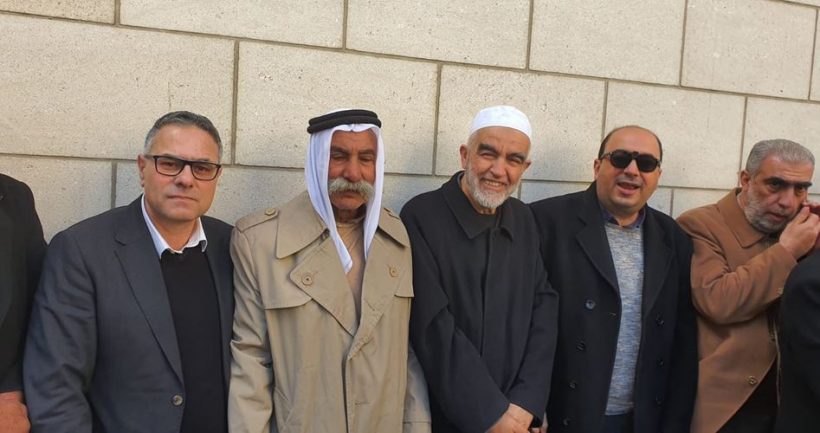
MEMO | February 10, 2020
An Israeli court today sentenced Palestinian resistance icon Sheikh Raed Salah to 28 months in prison, stoking strong condemnation of the country’s legal system and the suppression of free speech.
Salah received a 28-month prison sentence from the Haifa Magistrate’s Court for remarks he had made at a funeral in 2017. The 61-year-old has already served 11 months in detention as part of his sentence and is therefore expected to remain in prison for 17 months.
Israeli police arrested Salah nearly three years ago, accusing the former mayor of Umm Al-Fahm of praising three Arab Israelis who shot dead two police officers in a July 2017 attack. In November, he was convicted of “incitement” and engaging in “anti-Israel activities” for remarks he had made during the funeral of the three assailants.
According to the indictment, Salah praised the attackers saying: “At these moments [we need to stand together] as one house, as one family. We take leave of our martyrs … and express the wish that they join the prophets, the righteous ones and the martyrs. At these moments, may we pray that God increases their value in the heavens in paradise.”
In his defence Salah argued that his views were religious opinions rooted in the Quran, and did not constitute a direct call to violence. Salah’s lawyer also explained that the remarks were made within the context of a religious sermon and urged Israel “to not prosecute him for his faith and beliefs”.
Haifa Magistrate’s Court Judge Shlomo Benjo conceded that some of Salah’s remarks at the funeral had been mistranslated but still ruled that the translation errors did not alter the general meaning of his comments.
“Despite the attempts to give the defendant’s statements a religious character, the conclusion is that the accused expressed praise, sympathy and support for the attacks,” the judge said in delivering his verdict.
Joint List MK Yousef Jabareen criticised the decision by pointing to the normalisation of incitement to hate and violence in Israeli society.
“In a country where the prime minister, senior ministers and main religious figures incite against the Arab public and its leaders from morning till night, Raed Salah’s conviction marks another step in the political persecution of the Arab,” Jabareen wrote on Twitter. He explained that the verdict marked “a dangerous erosion of freedom of expression for the leadership and delegitimisation of political and religious activity”.
Muhammad Baraka, the head of the Higher Follow-up Committee for Arab Citizens in Israel, also dismissed the verdict. The “ruling was prepared in advance, and was based on racist foundations and incitement against Arabs,” Baraka was quoted as saying in a Turkish news source.
In an interview, Salah’s lawyer, Khaled Zabarqa, said that Israel’s endless efforts to silence the Palestinian leader was intended to pave the way for the controversial peace plan known as the “deal of the century”.
According to Zabarqa, Israel has been planning for the past two years to ban any appearance by Sheikh Salah due to his ability to mobilise Palestinians to reject any Israeli plan intending to terminate Palestinian rights in Jerusalem.
See also:
Palestinians in Israel are the next target for the deal of the century
Featured Video

When Israel Is Mighty
or go to
Aletho News Archives – Video-Images
From the Archives
US murdering 1 million Iraqis is democracy, Iran giving yogurt to Iraq is “domination”
By Ali Salaam | American Herald Tribune | July 31, 2017
The New York Times, owned by the Zionist Jewish supremacist Ochs-Sulzberger family, has no problem with Iraqi suffering as long as Iran is not the one behind it.
The Iraq War was a genocide of the Iraqi people by Zionist supremacists in the Bush administration. Over 1 million innocent people were killed based on a lie. American soldiers died in an Israeli war and now an average of 22 soldiers commit suicide every day because their consciences cannot cope with the fact they committed crimes in an illegal war that served no purpose other than to benefit Israel, not America.
Benjamin Netanyahu, Prime Minister of the Zionist regime, once said “We are benefiting from one thing, and that is the attack on the Twin Towers and Pentagon, and the American struggle in Iraq.”
Paul Wolfowitz had his sights on Iraq since his time in the first Bush administration. Former Israeli official and Bush administration official Richard Perle had his eyes on Iraq since at least his authorship of the Clean Break white paper. The Zionist regime had their eyes on Iraq since the 1980s when strategist Oded Yinon wrote his white paper in support of dividing the Arab-Muslim world along ethnic and sectarian lines. The global Zionist lobby has had their eyes on Iraq since Theodor Herzl stated that Eretz Israel’s true borders go from the Nile River in Egypt to the Euphrates River in Iraq. … continue
Blog Roll
 Aletho News
- MEP blasts ‘Euro-Gestapo’ for lecturing Russia on democracy
- Syria May Send Troops to Saudi Arabia Amid War with Ansar Allah
- UK whines about losing billions to ‘Putin tax’
- Baghaei to Rubio: Distorted narratives cannot erase US record of broken commitments
- Houthis Don’t Have to Conquer Saudi Arabia to Make It Pay
- MOE: Nearly 22,000 Students and Education Workers Killed
- Guterres in Islamabad: Genocide, cowardice, and the cage of Imran Khan
- Johnson, Marandi say Yemen holds upper hand over Saudi Arabia
- False flags won’t save aggressors, Iran FM spokesman says
- The Makkah Pact Enters Into Force: The End of American Dominance or Its New Form?
- If Americans Knew
- Report claimed Mark Levin used by Israeli government to influence Trump
- Over 2,000 Gazans have died awaiting medical evacuation amid Israel’s continued siege
- How a U.S. Diplomat Suppressed and Altered Reports Critical of Israel
- 5 Palestinians Die from Israeli Strikes in Gaza as Relentless Attacks Continue
- Report: Ceasefire Slows Killing but Leaves Devastation Intact
- Country Music Singer Zach Bryan Breaks Attendance Record at Robert Kraft’s Gillette Stadium While Wearing ‘Free Palestine’ Shirt for Second Night in a Row
- Three years of death and devastation: Israel’s war on Gaza in pictures
- Why Hamas believed the status quo was more dangerous than its 7 October gamble
- Debunking Israel’s latest list of ‘terrorist’ journalists in Gaza
- In Gaza, focus is on survival, “every step is a struggle” – Daily Update
- No Tricks Zone
- New Study: 50 Years Of The Most Aggressive ‘Net Zero’ Policies Can Only Affect The Global Climate By 0.03°C
- US September “Heat” Was No Record…Many Records Set Decades Ago
- Latest European Green Energy Debacle; Portugal’s Largest Flagship Solar Park Insolvent!
- Green Energy Debacle: German Expert Professor Fritz Vahrenholt Warns Of Severe Economic And Social Consequences
- Two More Paleo Reconstructions Affirm Meters-Higher Sea Levels Across Ireland, Brazil 7000-6000 Years Ago
- New Study: Earth And Venus Surface Warmth Largely Explained By Convection And Lapse Rate, Not CO2 Or Radiation
- 2025 Nature Paper Claiming Worsening Global Drought Gets RETRACTED …Heavily Flawed
- New Study: ‘Global Drought Shows No Detectable Recent Acceleration Under Climate Warming’
- Economic Masterminds: German Socialists Suggest Taxing Productivity Gains Stemming From Using AI
- The South China Sea Has Not Been Cooperating With The Climate Change Narrative

