Rights groups slam Bahrain for torturing 9 female activists in detention
Press TV – October 30, 2019
Rights groups have slammed the Bahraini regime over the detention and mistreatment of nine female activists, saying that the United States and Britain are complicit in Manama’s human rights abuses.
The report, prepared by the London-based Bahrain Institute for Rights and Democracy (BIRD) and Americans for Democracy & Human Rights in Bahrain (ADHRB) last month, was presented during a congressional panel event in Washington, DC, on Tuesday.
The 138-page report examines the cases of nine female political prisoners all arrested, interrogated, and convicted between February 2017 and January 2019.
Speaking during the panel, ADHRB Legal Officer Bridget Quitter said the women had been targeted as part of Bahrain’s “systematic” crackdown on free speech.
“The ill-treatment and torture, coercive interrogation tactics, unfair trial, substandard conditions of detention are not merely coincidental, but part of a systematic repression of the Bahraini population,” she said. “These women were targeted for their opinions or those of their relatives.”
The study revealed that the women had been arrested without search warrants, some of which took place during “highly militarized police raids.” The women faced physical, psychological and sexual abuse during their interrogation, according to the report.
Of the nine women, three are still held in prison in dire conditions, such as being denied access to medical care. The other six have been released after serving their prison terms.
Speaking on Tuesday, Quitter explained that the female activists had been convicted based on forced confessions, and even threatened with rape and death if they refused to comply.
“They were subjected to rights violations from the moment of their arrest, through their interrogation and torture, unfair trials and detention in conditions which fail to meet international standards,” Quitter said.
The report also highlighted how Manama had been using “broad interpretations of counter-terror laws” to facilitate the conviction of the female activists, going as far as revoking citizenship in a number of cases.
“Bahrain has created a system which whitewashes and conceals human rights abuses,” Quitter said.
The Al Khalifah regime has been mounting a heavy-handed security crackdown since a popular uprising began in the country in mid-February 2011.
The protest campaign is demanding that a just system representing all Bahrainis replace the Al Khalifah ruling dynasty.
Enjoying extensive assistance from the Saudi kingdom and the backing of London and Washington, however, the Manama regime has sought to crush any perceived threat to its authoritarian rule.
The report, which was presented on Capitol Hill on Tuesday, also revealed that UK-funded and trained “oversight bodies” have “consistently whitewashed” Bahrain’s human rights abuses. London actively ignores that “taxpayer money” is being used to support such initiatives, it added.
The report also said that the US government provides “funding, training, and assistance to Bahraini government bodies implicated in human rights abuses.”
The rights groups have called on Bahrain to release the three remaining female prisoners and urged the US and UK to cooperate in improving human rights conditions in the country.
Airbnb complicit in ‘plunder of Palestinian refugee properties’ says new report
MEMO | October 29, 2019
Online accommodation and tourism giant Airbnb has been accused of “complicity in the plunder of Palestinian refugee properties”, in a new report published last week.
According to Who Profits, an independent research centre focused on exposing corporate involvement in the “ongoing Israeli occupation of Palestinian and Syrian lands”, their new update sheds light on a “largely overlooked” dimension of Airbnb’s “complicity”.
Taking the Old City of Yafa (Jaffa) as a case study, the new report “aims to highlight the ways in which Israel confiscated and controlled Palestinian properties, leading to their privatisation”.
“Israel has transformed properties into economic assets that benefit both the state and private actors, thus undermining Palestinians’ legally enshrined Right of Return,” stated the research centre.
“Serving as a platform for showcasing the homes that once belonged to Palestinians, Airbnb plays a role in strengthening the Israeli hold over Palestinian refugee properties,” Who Profits added.
During the Nakba of 1948, more than 750,000 Palestinians were expelled from their homes and lands – property that was subsequently appropriated by the Israeli state “through legal mechanisms that formalise their confiscation and turn them into economic assets”, Who Profits explained.
According to the centre, this “privatisation” of refugee properties has benefitted market actors and Jewish Israelis, “whilst further threatening the possibility of Palestinians reclaiming ownership of their properties in the future”.
In the case of Jaffa, what was once the largest Palestinian city was almost entirely ethnically cleansed during the Nakba (five per cent of its Palestinian residents remained post-1948). Today, the Old City is one of the most popular sites in Israel for tourists, where Airbnb lists more than 40 properties.
In its new report, Who Profit notes that “while the issue of listing settlement properties [in the occupied West Bank and East Jerusalem] has gained worldwide attention, the issue of listing refugee properties ‘abandoned’ in 1948 remains largely overlooked.”
“The act of plundering and privatizing refugee properties by the Israeli state, which started during the Nakba and continues to this day, has transformed the refugee properties in Yafa into commodities that can now be listed by hosts on platforms such as Airbnb,” the report concluded.
“In serving as a platform for these properties, as well as those in settlements in the West Bank and in East Jerusalem, Airbnb is profiting from the ongoing dispossession of Palestinians.”
READ ALSO:
Microsoft funds Israel firm that spies on West Bank Palestinians – Report
MEMO | October 29, 2019
Microsoft has invested in an Israeli startup that uses facial recognition to spy on Palestinians throughout the occupied West Bank, “in spite of the tech giant’s public pledge to avoid using the technology if it encroaches on democratic freedoms”, NBC News has reported.
AnyVision, headquartered in Israel but with offices in the United States, the United Kingdom and Singapore, sells an “advanced tactical surveillance” software system, Better Tomorrow.
“It lets customers identify individuals and objects in any live camera feed, such as a security camera or a smartphone, and then track targets as they move between different feeds,” said the report.
NBC News’ investigative report concluded that “AnyVision’s technology powers a secret military surveillance project throughout the West Bank” – a project “so successful that AnyVision won the country’s [Israel’s] top defence prize in 2018”.
As noted by NBC News, “Palestinians living in the West Bank do not have Israeli citizenship or voting rights but are subject to movement restrictions and surveillance by the Israeli government.”
Israeli forces have “installed thousands of cameras and other monitoring devices across the West Bank”, while authorities “also scan social media posts and use algorithms in an effort to predict the likelihood that someone will carry out a lone-wolf attack and arrest them before they do.”
“The addition of facial recognition technology transforms passive camera surveillance combined with the list of suspects into a much more powerful tool,” the report stated.
When NBC News first approached AnyVision for an interview, CEO Eylon Etshtein denied any knowledge of the West Bank project, threatened to sue, disputed that the West Bank was occupied, and suggested the reporter “must have been funded by a Palestinian activist group”.
AnyVision then later “apologised for the outburst and revised its position”, claiming that “as a private company we are not in a position to speak on behalf of any country, company or institution”.
NBC News also confirmed how AnyVision’s technology has also been used by Israeli police to track suspects through the Israeli-occupied East Jerusalem.
AnyVision launched in 2015 and enjoys “close ties to Israel’s military and intelligence services”, NBC News stated, with former head of Mossad Tamir Pardo among its board of advisers.
Microsoft told NBC News that the company “takes these mass surveillance allegations seriously because they would violate our facial recognition principles.”
“If we discover any violation of our principles, we will end our relationship,” a spokesperson said.
Earlier this month Palestinians in the occupied West Bank city of Ramallah discovered a surveillance device planted in concrete at a village cemetery. According to Ma’an News Agency, the monitoring tool was manufactured by AnyVision.
READ ALSO:
Israel has been caught spying on the US, again
Israel tech ‘facilitating press freedom abuses around the world’
The Ethnic Cleansing of Palestinian Christians that nobody is talking about

Side view of the Church of the Holy Sepulcher which is opened to worship after the restoration in Jerusalem on 24 March 2017
MEMO | October 29, 2019
Palestine’s Christian population is dwindling at an alarming rate. The world’s most ancient Christian community is moving elsewhere. And the reason for this is Israel.
Christian leaders from Palestine and South Africa sounded the alarm at a conference in Johannesburg on October 15. Their gathering was titled: “The Holy Land: A Palestinian Christian Perspective”.
One major issue that highlighted itself at the meetings is the rapidly declining number of Palestinian Christians in Palestine.
There are various estimates on how many Palestinian Christians are still living in Palestine today, compared with the period before 1948 when the state of Israel was established atop Palestinian towns and villages. Regardless of the source of the various studies, there is a near consensus that the number of Christian inhabitants of Palestine has dropped by nearly ten-fold in the last 70 years.
A population census carried out by the Palestinian Central Bureau of Statistics in 2017 concluded that 47,000 Palestinian Christians are living in Palestine – with reference to the Occupied West Bank, East Jerusalem and the Gaza Strip. Ninety-eight per cent of Palestine’s Christians live in the West Bank – concentrated mostly in the cities of Ramallah, Bethlehem and Jerusalem – while the remainder, a tiny Christian community of merely 1,100 people, lives in the besieged Gaza Strip.
The demographic crisis that had afflicted the Christian community decades ago is now brewing.
For example, 70 years ago, Bethlehem, the birthplace of Jesus Christ, was 86 per cent Christian. The demographics of the city, however, have fundamentally shifted, especially after the Israeli occupation of the West Bank in June 1967, and the construction of the illegal Israeli apartheid wall, starting in 2002. Parts of the wall were meant to cut off Bethlehem from Jerusalem and to isolate the former from the rest of the West Bank.
“The Wall encircles Bethlehem by continuing south of East Jerusalem in both the east and west,” the ‘Open Bethlehem’ organisation said, describing the devastating impact of the wall on the Palestinian city. “With the land isolated by the Wall, annexed for settlements, and closed under various pretexts, only 13% of the Bethlehem district is available for Palestinian use.”
Increasingly beleaguered, Palestinian Christians in Bethlehem have been driven out from their historic city in large numbers. According to the city’s mayor, Vera Baboun, as of 2016, the Christian population of Bethlehem has dropped to 12 per cent, merely 11,000 people.
The most optimistic estimates place the overall number of Palestinian Christians in the whole of Occupied Palestine at less than two per cent.
The correlation between the shrinking Christian population in Palestine, and the Israeli occupation and apartheid should be unmistakable, as it is evident to Palestine’s Christian and Muslim community alike.
A study conducted by Dar al-Kalima University in the West Bank town of Beit Jala and published in December 2017, interviewed nearly 1,000 Palestinians, half of them Christian and the other half Muslim. One of the main goals of the research was to understand the reason behind the depleting Christian population in Palestine.
The study concluded that “the pressure of Israeli occupation, ongoing constraints, discriminatory policies, arbitrary arrests, confiscation of lands added to the general sense of hopelessness among Palestinian Christians,” who are finding themselves in “a despairing situation where they can no longer perceive a future for their offspring or for themselves”.
Unfounded claims that Palestinian Christians are leaving because of religious tensions between them and their Muslim brethren are, therefore, irrelevant.
Gaza is another case in point. Only 2 per cent of Palestine’s Christians live in the impoverished and besieged Gaza Strip. When Israel occupied Gaza along with the rest of historic Palestine in 1967, an estimated 2,300 Christians lived in the Strip. However, merely 1,100 Christians still live in Gaza today. Years of occupation, horrific wars and an unforgiving siege can do that to a community, whose historical roots date back to two millennia.
Like Gaza’s Muslims, these Christians are cut off from the rest of the world, including the holy sites in the West Bank. Every year, Gaza’s Christians apply for permits from the Israeli military to join Easter services in Jerusalem and Bethlehem. Last April, only 200 Christians were granted permits, but on the condition that they must be 55 years of age or older and that they are not allowed to visit Jerusalem.
The Israeli rights group, Gisha, described the Israeli army decision as “a further violation of Palestinians’ fundamental rights to freedom of movement, religious freedom and family life”, and, rightly, accused Israel of attempting to “deepen the separation” between Gaza and the West Bank.
Israel aims at doing more than that. Separating Palestinian Christians from one another, and from their holy sites (as is the case for Muslims, as well), the Israeli government hopes to weaken the socio-cultural and spiritual connections that give Palestinians their collective identity.
Israel’s strategy is predicated on the idea that a combination of factors – immense economic hardships, permanent siege and apartheid, the severing of communal and spiritual bonds – will eventually drive all Christians out of their Palestinian homeland.
Read: Morocco insists that Palestine is one of its core principles
Israel is keen to present the ‘conflict’ in Palestine as a religious one so that it could, in turn, brand itself as a beleaguered Jewish state amid a massive Muslim population in the Middle East. The continued existence of Palestinian Christians does not factor nicely into this Israeli agenda.
Sadly, however, Israel has succeeded in misrepresenting the struggle in Palestine – from that of political and human rights struggle against settler colonialism – into a religious one. Equally disturbing, Israel’s most ardent supporters in the United States and elsewhere are devout Christians.
It must be understood that Palestinian Christians are neither aliens nor bystanders in Palestine. They have been victimised equally as their Muslim brethren. They have also played a significant role in defining the modern Palestinian identity, through their resistance, spirituality, deep connection to the land, artistic contributions and burgeoning scholarship.
Israel must not be allowed to ostracise the world’s most ancient Christian community from their ancestral land so that it may score a few points in its fierce drive for racial supremacy.
Equally important, our understanding of the legendary Palestinian ‘soumoud’ – steadfastness – and solidarity cannot be complete without fully appreciating the centrality of Palestinian Christians to the modern Palestinian narrative and identity.
Russia’s UN envoy says Israel should stop building settlements in West Bank
RT | October 29, 2019
Israel should immediately stop building its settlements and dismantling Palestinian properties on the western bank of the Jordan River, Russia’s UN envoy Vassily Nebenzia told the UN Security Council’s session devoted to the Middle East.
The diplomat said Monday that Russia was extremely concerned at the analysis of the situation offered by UN Special Coordinator for the Middle East Peace Process Nickolay Mladenov. Speaking about the West Bank and the Gaza Strip, he had said the situation now can only be prevented from further degradation, without even mentioning the possibility of any improvement, TASS reports.
Nebenzia said that solutions are evident. “First of all, Israel’s settlement activities and the policy of dismantling the Palestinian property in the West Bank must be stopped.” Both Palestinians and Israelis “must refrain from violence or aggressive and provocative rhetoric,” he added.
To Be or Not to Be a Jewish State, That is the Question
By Sheldon Richman | CounterPunch | October 28, 2019
Israel’s champions owe us an explanation. First, they insist that Israel is and always must be a Jewish state, by which most of them mean not religiously Jewish but of the “Jewish People” everywhere, including Jews who are citizens of other states and not looking for a new country. To be Jewish, according to the prevailing view, it is enough to have a Jewish mother (or to have been converted by an approved Orthodox rabbi). Belief in one supreme creator of the universe, in the Torah as the word of God, and in Jewish ritual need have nothing whatever to do with Jewishness. (We ignore here the many problems with this conception, such as: how can there be a secular Judaism?)
The definition of Jew has been bitterly controversial inside and outside of Israel since its founding. The point is, as anthropologist Roselle Tekiner wrote, “When the central task of a state is to import persons of a select religious/ethnic group — and to develop the country for their benefit alone — it is crucially important to be officially recognized as a bona fide member of that group.” (This is from the anthology Anti-Zionism: Analytical Reflections, which is not online and is apparently out of print. But see Tekiner’s article, “Israel’s Two-Tiered Citizenship Law Bars Non-Jews From 93 Percent of Its Lands.”)
Second, Israel’s champions insist that Israel is a democracy — indeed, the only democracy in the Middle East. They vehemently object whenever someone demonstrates how Israel-as-the-state-of-the-Jewish-People must harm the 25 percent of Israeli citizens who are not Jewish, most of whom are Arabs.
Israeli law uniquely distinguishes citizenship from nationality. The nationality of an Israeli Arab citizen is “Arab” not Israeli, while the nationality of a Jewish citizen is “Jewish” not Israeli. Are citizens of any other country distinguished in law like that? The prohibition on marriage between Jews and non-Jews is not the result of political bargaining with religious parties but of a desire to protect the Jewish people from impurity. These contortions are required by Israel’s self-declared status as something other than the land of all its citizens. Early Zionists said they wanted Palestine to be as Jewish as Britain is British and France is French — a flagrant category mistake that has had horrific consequences for the Palestinians.
The insistence by Israel’s supporters — that Israel can be both Jewish and democratic — thus is puzzling. What does it mean for Israel to be a Jewish state if that status has no real consequences for non-Jews? If all it meant was that the Star of David was on the flag, we might hear far fewer objections to Israel. But of course it means much more.
To see what it means, one has to look beyond Israel’s Declaration of Independence, Basic Law (its de facto constitution), and specific statutes, which contain language that on its face forbids discrimination against non-Jews. We should know better than to take official documents at face value. What matters in any society is the “real constitution,” the principles that underlie commonly accepted behavior. The old Soviet Union’s constitution listed freedom of the press among the “rights” of Soviet citizens, and the U.S. Constitution says that only Congress may declare war and that “the right of the people to keep and bear arms shall not be infringed.”
More pertinent, the 1917 Balfour Declaration, wherein the British government “view[ed] with favour the establishment in Palestine of a national home for the Jewish people,” also stated that “it [was] clearly understood that nothing shall be done which may prejudice the civil and religious rights of existing non-Jewish communities in Palestine, or the rights and political status enjoyed by Jews in any other country.” We know how that worked out.
So what’s the story inside Israel? (I’m not talking about the West Bank and Gaza Strip, which Israel has occupied for 52 years and where Palestinians have no rights whatever.)
After doing an interview recently about my new book, Coming to Palestine, I was challenged by a listener over my statements that the Israeli government treats Arab and Jewish criminals differently depending on whether they shed “Jewish blood” or “Arab blood” (no such distinction actually exists) and that political parties can’t call for changing Israel from a Jewish state to a state of all its citizens.
Who is right?
Regarding criminal justice, Ha’aretz columnist Gideon Levy shows anecdotally that Arab Israeli citizens who kill Jews can spend more time in prison than Israeli Jewish citizens who kill Arabs. “Arab blood is cheaper in Israel,” Levy wrote in 2014, “and Jewish blood is thicker.” He says things are the same today. Over the years, many articles have been published documenting this de facto, though not de jure, disparity. Indeed, Ha’aretz reported in 2011 that
Arab Israelis who have been charged with certain types of crime are more likely than their Jewish counterparts to be convicted, and once convicted they are more likely to be sent to prison, and for a longer time. These disparities were found in a recent statistical study commissioned by Israels Courts Administration and the Israel Bar Association…. The [unpublished preliminary] study is unique in that it is the first of its kind to be commissioned and funded in part by the courts administration, and in that it sought to examine claims by attorneys that Israeli judges deal more harshly with Arab criminals than with Jews.
Note that government discrimination against non-Jews across the spectrum of issues is not usually written into the law, although it may be. Mostly flagrantly, discrimination is legally applied to the “right of return.” People defined as Jews, no matter where they were born or live, can become Israeli citizens/nationals virtually on arrival, while Arabs driven from their ancestral homes in 1947-48 and 1967 may not go back, much less become full-rights citizens/nationals. Put concretely, I, an atheist born in Philadelphia to Jewish parents born in Philadelphia (with roots likely in the vicinity of the Black Sea), can “return” [sic] to Israel and become an Israeli citizen at once, while my friend Raouf Halaby, a naturalized American citizen born to Arab Christian parents in west Jerusalem three years before Israel was founded, may not. The only difference is that my mother was Jewish, making me, a Spinozist, a Jewish national in Israel’s eyes, and Raouf’s mother was not.
Regarding restrictions on political parties, the Basic Law: The Knesset states:
A candidates’ list [party] shall not participate in elections to the Knesset, and a person shall not be a candidate for election to the Knesset, if the objects or actions of the list or the actions of the person, expressly or by implication, include…:
1. negation of the existence of the State of Israel as a Jewish and democratic state;…
Before proceeding, let us note a conundrum. The issue I’m raising here is whether a state be both Jewish and democratic. The root of the word democracy is demos, people. So if the raison d’être of Israel is the welfare of only some of its citizens and millions of certain others who are citizens and residents of other countries, how can Israel be a real democracy? Strictly speaking, considering that word and, the law’s language legitimizes a party that “negat[es] the existence of the State of Israel as a Jewish … state” but not as a democratic state. Would the Israeli election authorities accept that distinction? I don’t think so.
In the past the Israeli Supreme Court has reversed government bans on a party’s or candidate’s inclusion in an election. Particular cases will revolve around the exact wording of a party’s mission statement or candidate’s platform, and legal language is subject to endless, unpredictable, and political interpretation. But, regardless, the government has the power to ban at its disposal, and future Supreme Courts may not be so liberal. So the threat of a ban always looms. Incidentally, a party or candidate that engages in “incitement to racism” is also ineligible to participate in elections, yet this provision has yet to be applied to Jewish parties and politicians, such as Likud and Benjamin Netanyahu, that routinely spout racist rhetoric.
Israel’s champions also deny that Arab Israelis — citizens, mind you — have grossly inferior access to land, most of which is owned by a “public” authority and the Jewish National Fund (very little is privately owned); building and village permits; public utilities; education; roads; and other government-controlled services and resources. The Israeli government has carried out programs in the Galilee and Negev, known as Judaization, from which Arab Israelis, especially Bedouins, have been cleared to make way for Jewish Israelis. Such restrictions inside Israel have the stink of apartheid.
In his book Palestinians in Israel: Segregation, Discrimination, and Democracy, Ben White documents that the Israeli government allocates resources — unsurprisingly — just as one would expect, considering that Israel by its founding doctrine is not the land of all of its citizens but only of some. This doctrine was reinforced last year in the Nation-State Law, which declares that “The right to exercise national self-determination in the State of Israel is unique to the Jewish people.”
So, as Israel’s champions say, all Israeli citizens are indeed equal. It’s just that some — those whose nationality is “Jewish” — are more equal than others — those whose nationality is “Arab” or anything else but “Jewish.”

U.S. Universities Bow to Pressure
President Trump’s Education Department now says that protesting Israel is a “hate crime.” Incredibly many colleges and universities are bowing to pressure to limit activities of the BDS movement.
By Philip Giraldi | American Free Press | October 24, 2019
The Israel lobby in the United States and its counterparts in Europe have been paying particular attention to curtailing the activities of the Boycott, Divestment, and Sanctions movement (BDS). This is because BDS, which is non-violent and based on established human rights principles, is extremely appealing to college students, who will be tomorrow’s leaders. Israel, which promotes its own largely fictional narrative about itself, is reluctant to allow any competing stories about its foundation and current activities, so it has worked hard to exclude any and all criticism of its practices on college campuses and even among students in public high schools.
Unfortunately, many colleges and universities are all too ready to compromise their principles, such as they are, whenever a representative of Israel or of Jewish groups comes calling. A popular line that has proven to be particularly effective is that Jews on campus feel threatened whenever anyone advocates for the Palestinians or Iranians, intended to convey that their civil rights are being violated.
Even if that type of allegation is actually relevant to whether or not one allows free speech and association, one wonders how violated the Palestinians and Iranians must feel when confronted by the endless stream of hostility emanating from the U.S. media and Hollywood as well as from select politicians representing both parties and the White House.
In the most recent manifestation of suppression of views critical of Israel, the federal government’s Department of Education has ordered Duke University and the University of North Carolina at Chapel Hill to reorganize the Consortium for Middle East Studies program run jointly by the two colleges based on their failure to include enough “positive” content relating to Christianity and Judaism. The demand came with a threat to suspend federal funding of Title VI Higher Education Act international studies and foreign language grants to the two schools if the curriculum is not changed.
Of course, the demands have nothing to do with Christian groups demanding inclusion and everything to do with organized Jewish pressure to present Israel in a positive light while also casting aspersions on the Jewish state’s perceived enemies in the region and also on university campuses. Anyone who has even cursory knowledge about the Middle East knows that Christians and Jews constitute only a tiny minority in the region, so the emphasis on teaching about Islam, the Arabs, and the Persians makes sense if the instruction is to have any actual relevance.
One particular event that apparently led to an earlier investigation in June launched by the Education Department consisted of a conference in March called “Conflict Over Gaza: People, Politics, and Possibilities.” A Republican congressman was outraged by the development and asked Education Secretary Betsy DeVos to investigate because the gathering was full of “radical anti-Israel bias.”
Even The New York Times acknowledged in their coverage of the story that “Betsy DeVos, the education secretary, has become increasingly aggressive in going after perceived anti-Israel bias in higher education.” Her deputy—who has served as a focal point for the effort to root out anti-Israel sentiment—is Assistant Secretary of Civil Rights Kenneth L. Marcus, who might reasonably be described as “a career pro-Israel advocate.”
Marcus is the founder and president of the Louis D. Brandeis Center for Human Rights Under Law, a foundation that he has used to exclusively defend the rights of Jewish groups and individuals against BDS and other manifestations of Palestinian pushback against the Israeli occupation of their country. He has not hesitated to call opponents anti- Semites and has worked with Jewish students to file civil rights complaints against college administrations, including schools in Wisconsin and California. In an op-ed that appeared, not surprisingly, in The Jerusalem Post, he observed that even when student complaints were rejected, they created major problems for the institutions involved. “If a university shows a failure to treat initial complaints seriously, it hurts them with donors, faculty, political leaders, and prospective students.”
Last year Marcus reopened an investigation into alleged anti-Jewish bias at Rutgers University that the Obama administration had closed after finding that the charges were baseless. Marcus indicated that the re-examination was called for, as his office in the Education Department would henceforth be using the State Department definition of anti-Semitism that includes “denying the Jewish people their right to self-determination,” making much criticism of Israel a hate crime.
In the current North Carolina-Duke case, DeVos and Marcus expressed concern over course content that had “a considerable emphasis placed on understanding the positive aspects of Islam, while there is an absolute absence of any similar focus on the positive aspects of Christianity, Judaism, or any other religion or belief system in the Middle East.” The complaint called for balancing content relating to “the historic discrimination faced by, and current circumstances of, religious minorities in the Middle East, including Christians, Jews, Baha’is, Yazidis, Kurds, Druze, and others.”
Zoha Khalili, a staff lawyer at Palestine Legal, explained how the message coming from Washington is actually quite simple and has nothing to do with balance: “They really want to send the message that if you want to criticize Israel, then the federal government is going to look very closely at your entire program and micromanage it to death. . . . [It] sends a message to Middle Eastern studies programs that their continued existence depends on their willingness to toe the government line on Israel.”
The possible consequences are very clear. If you are an educational institution that criticizes Israel in any way, shape or form, you will lose any funding you receive from the federal government. The move has nothing to do with budgetary demands or the national security of the United States or even with the efficacy of the programs that are being funded. It has everything to do with promoting Israeli interests. That a demonstrated and outspoken Israeli advocate like Marcus should be placed in a key position to decide who gets what based on his own biases is a travesty, but it is something that we should all be accustomed to by now, as there is apparently no limit to what the Trump administration is willing to do for Israel and for that monstrous country’s powerful, wealthy, and incessantly vocal supporters in the United States.
Al-Baghdadi Raid is the US Empire “Creating Reality”
The latest attack on Syria, whatever the truth of it, is an exercise in narrative control
By Kit Knightly | OffGuardian | October 28, 2019
Apparently the United States killed Abu Bakr al-Baghdadi yesterday. US Special Forces allegedly killed the ISIS leader during a raid on a stronghold in Idlib.
As far as we know, this man was already dead. Maybe twice. He reportedly faked his death once as well.
The debate about whether or not Baghdadi was killed by US Special Forces, killed himself with a suicide vest, is still alive or died years ago has raged all day.
Trump says he died like a coward. The Russians maintain they have no data suggesting any attack was carried out at all. But that is far from conclusive.
From a domestic point of view, the purpose of the attack is fairly obvious: Donald Trump has an election coming up, and potential Presidents like nothing more than being seen to be tough. That means taking out some “bad guys”.
Of course, none of that matters.
It doesn’t matter what happened, it doesn’t matter why it happened and it doesn’t matter whether who it (allegedly) happened to was real, or alive… or otherwise.
Because, as always, the problem is not the specifics. It’s the principle and the precedent.
Let’s just assume that – for the first time in its entire existence – the Pentagon is telling the exact truth about both its actions, and the motives for those actions.
Well, then this is still unacceptable.
The United States is publicly claiming the right to carry out military strikes on foreign soil for the purpose of conducting extra-judicial executions.
This is completely illegal.
Syria is a sovereign state. Whatever the motivation for the alleged raid, carrying it out without the cooperation or permission of the legitimate government of Syria was illegal.
al-Baghdadi was (is?) not a US citizen, or an enemy combatant, and has never been convicted of any crime, in any court, by anyone. Whether or not he is alive… he as a right to be alive under the UN Charter of Human Rights.
And we’re all forgetting that.
Just a few weeks ago Trump announced the US was “pulling out” of Syria. Well, we now know what we suspected at the time, that the announcement is meaningless. This “raid” is their way of saying “just kidding!”
ISIS will still be used as they have always been used: as an excuse for the United States to occupy, attack, destabilise and control the Middle East.
Lost in this hubbub about ISIS, and Hollywood theatricals about daring night-raids on enemy compounds, the United States marched soldiers into North-Eastern Syria to “protect” oil fields.
At the end of the day THAT is really what this was about. Not hurting ISIS, or fighting terrorism, or even making Donald look cool to Rust Belt patriots… it was about an Empire acting as they would, and us letting them. It was about narrative control.
Don’t forget the famous quote from Karl Rove:
We’re an empire now, and when we act, we create our own reality. And while you’re studying that reality — judiciously, as you will — we’ll act again, creating other new realities, which you can study too, and that’s how things will sort out. We’re history’s actors . . . and you, all of you, will be left to just study what we do.”
When we argue about the specifics we let those in power control the conversation.
The US broke international law, and claim it as an achievement. They ignore borders and treaties and conventions on a whim, and we are so used to it we’re debating their motives and their effectiveness.
They proclaim loudly that they’re above the law. And, in letting them set that conversation, we agree with them. Even in our outrage.
With Little Fanfare, William Barr Formally Announces Orwellian Pre-Crime Program
By Whitney Webb | MintPress News | October 25, 2019
Last Wednesday, U.S. Attorney General William Barr issued a memorandum to all U.S. attorneys, law enforcement agencies and top ranking Justice Department officials announcing the imminent implementation of a new “national disruption and early engagement program” aimed at detecting potential mass shooters before they commit any crime.
Per the memorandum, Barr has “directed the Department [of Justice] and the FBI to lead an effort to refine our ability to identify, assess and engage potential mass shooters before they strike.” The Attorney General further described the coming initiative, slated to be implemented early next year, as “an efficient, effective and programmatic strategy to disrupt individuals who are mobilizing towards violence, by all lawful means.” More specific information about the program is set to follow the recent memorandum, according to Barr, though it is unclear if that forthcoming document will be made public.
Barr also requested that those who received the memorandum send their “best and brightest” to a training conference at FBI headquarters this coming December where the DOJ, FBI and “private sector partners” will prepare for the full implementation of the new policy and will also be able to provide “new ideas” for inclusion in the program.
Perhaps the most jarring aspect of the memorandum is Barr’s frank admission that many of the “early engagement” tactics that the new program would utilize were “born of the posture we adopted with respect to terrorist threats.” In other words, the foundation for many of the policies utilized following the post-9/11 “war on terror” are also the foundation for the “early engagement” tactics that Barr seeks to use to identify potential criminals as part of this new policy. Though those “war on terror” policies have largely targeted individuals abroad, Barr’s memorandum makes it clear that some of those same controversial tactics will soon be used domestically.
Barr’s memorandum also alludes to current practices by the FBI and DOJ that will shape the new plan. Though more specifics of the new policy will be provided in the forthcoming notice, Barr notes that “newly developed tactics” used by the Joint Terrorist Task Forces “include the use of clinical psychologists, threat assessment professionals, intervention teams and community groups” to detect risk and suggests that the new “early engagement program” will work along similar lines. Barr also alludes to this “community” approach in a separate instance, when he writes that “when the public ‘says something’ to alert us to a potential threat, we must do something.”
However, the memorandum differentiates suspected terrorists from the individuals this new program is set to pursue. Barr states that, unlike many historical terrorism cases, “many of today’s public safety threats appear abruptly and with sometimes only ambiguous indications of intent” and that many of these individuals “exhibit symptoms of mental illness and/or have substance abuse problems.”
Thus, the goal of the program is ostensibly to circumvent these issues by finding new and likely controversial ways to determine intent. As will be shown later in this report, Barr’s recent actions suggest that the way this will be accomplished is through increased mass surveillance of everyday Americans and the use of algorithms to analyze that bulk data for vaguely defined symptoms of “mental illness.”
Barr also suggested the likely courses of action that would follow the identification of a given individual as a “potential mass shooter.” The Attorney General notes that in past cases individuals deemed a violent or terroristic threat before they commit a crime are subject to “detention, court-ordered mental health treatment, substance abuse counseling, electronic monitoring”, among other measures. Ostensibly, the new program would then apply these same practices to individuals in the U.S. that federal authorities believe are “mobilizing towards violence,” as Barr put it.
Bill Barr’s been busy
The memorandum, despite heralding a new era of Orwellian surveillance and “pre-crime” on a national level, has been sparsely covered by the mainstream media. One of the few reports that did cover the new Justice Department policy, published Wednesday by the Huffington Post, framed the new Barr-led initiative as largely positive and asserted that the “anti-terror tactics” to which Barr alluded could “help thwart mass shooters.” No mention was made in the piece of the threat such a program is likely to pose to civil liberties.
Furthermore, no mention was made of Barr’s clear push over the past few months to lay the groundwork for this recently announced program. Indeed, since becoming Attorney General under President Trump, Barr has spearheaded numerous efforts to this end, including pushing for a government backdoor into consumer apps or devices that utilize encryption and for a dramatic increase of long-standing yet controversial warrantless electronic surveillance programs.
On July 23rd, Barr gave the keynote address at the 2019 International Conference on Cyber Security (ICCS) and mainly focused on the need for consumer electronic products and applications that use encryption to offer a “backdoor” for the government, specifically law enforcement, in order to obtain access to encrypted communications as a matter of public safety.
Barr went onto say that “warrant-proof encryption is also seriously impairing our ability to monitor and combat domestic and foreign terrorists.” Barr stated that “smaller terrorist groups and ‘lone wolf’ actors” — such as those involved in the series of mass shootings in California, Texas and Ohio that occurred in the weeks after his speech — “have turned increasingly to encryption.” Barr later noted that he was specifically referencing encryption used by “consumer products and services such as messaging, smartphones, email, and voice and data applications.”
To overcome the resistance by some private companies — who do not want to renege on their right to privacy by giving the government backdoor access to their devices — and American consumers, Barr tellingly anticipated “a major incident may occur at any time that will galvanize public opinion on these issues.” Shortly after this speech, several mass shootings, including one at an El Paso Walmart took place, which again brought the issue to the forefront of political discourse.
As MintPress reported at the time, Barr’s uncanny prediction and a litany of other oddities related to the El Paso shooting left many answered questions about the FBI’s foreknowledge of the event. In addition, the tragedy did appear to serve as the very “galvanizing” event that Barr had anticipated, as the solution offered by President Trump in the wake of the shootings was the creation of a government backdoor into encryption as well as calling for the very pre-crime system Barr formally announced just last week.
The pre-crime dragnet takes shape
More recently, Barr and U.K. Home Secretary Priti Patel signed a data access agreement on October 3rd that allows both countries to demand electronic data on consumers from tech companies based in the other country without legal restrictions. It is the first executive agreement reached as part of the controversial Clarifying Overseas Use of Data Act or CLOUD Act passed by the U.S. Congress last year.
The CLOUD Act has come under fire from rights groups who have warned that the legislation gives “unlimited jurisdiction to U.S. law enforcement over any data controlled by a service provider, regardless of where the data is stored and who created it” and that this also “applies to content, metadata, and subscriber information”, including private messages.
Yet, Barr and Patel claimed that the data access agreement will instead “enhance” civil liberties and further asserted that the agreement would be used to go after “pedophiles” and “organized crime”, even though both Barr and his U.K. equivalent have shown minimal interest in pursuing the co-conspirators of child sex trafficker and pedophile Jeffrey Epstein, whose sex trafficking network has been linked to both organized crime and the intelligence agencies of both the U.S. and Israel. Some have charged that the lack of interest on the part of William Barr is due to the fact that Barr’s father once hired the now deceased pedophile.
Notably, Jeffrey Epstein also had an apparent interest in pre-crime technologies, and was a key funder of the controversial technology company Carbyne911, along with former Israeli Prime Minister and close Epstein associate Ehud Barak. Carbyne911 is one of several Israeli companies that market their software products to the U.S. as a means of reducing mass shootings and improving the response times of emergency service providers. These companies boast numerous and troubling connections to the governments and intelligence communities of both the U.S. and Israel. Epstein, himself linked to the intelligence apparatuses of both nations, invested at least $1 million in Carbyne911 through a “data mining” company he controlled.
As was detailed in a recent MintPress exposé on these companies, Carbyne911 and similar companies extract any and all data from consumer smartphones for merely making emergency calls and then use it to “analyze the past and present behavior of their callers, react accordingly, and in time predict future patterns,” with the ultimate goal of smart devices making emergency calls to the authorities, as opposed to human beings.
Data obtained from these software products, already used by several U.S. counties and slated to be adopted nationwide as part of a new national “next generation” 911 system, will then be shared with the same law enforcement agencies who will soon be implementing Barr’s “national disruption and early engagement program” to target individuals flagged as potentially violent based on vague criteria.
Notably, following the El Paso shooting, President Trump has been mulling the creation of a new federal agency known as HARPA that would work with the Department of Justice to use “breakthrough technologies with high specificity and sensitivity for early diagnosis of neuropsychiatric violence,” specifically “advanced analytical tools based on artificial intelligence and machine learning.” The data to be analyzed would be harvested from consumer electronic devices as well as information provided by health-care providers to identify who may be a threat.
It is important to point out that such initiatives, whether HARPA or Barr’s newly announced program, are likely to define “mental illness” to include some political beliefs, given that the FBI recently stated in an internal memo that “conspiracy theories” were motivating some domestic terror threats and a series of questionable academic studies have sought to link “conspiracy theorists” to mental illnesses. Thus, the Department of Justice and “mental health professionals” have essentially already defined those who express disbelief in official government narratives as both a terror threat and mentally ill — and thus worthy of special attention from pre-crime programs.
Sleepwalking into a nightmare
This widely overlooked background is crucial to understanding William Barr’s recent memorandum and the massive and greatly underreported shift in the policy it heralds. Over a period of several months, Barr — aided by “private sector partners” as well as other current and former government officials — has been laying the groundwork for the system he has now formally announced.
Through the software products offered by companies like Carbyne911 and through Barr’s personal crusade to mandate government backdoors into encrypted software and products, Barr’s new pre-crime program already has the tools for the mass extraction and storage of consumer data by means of both private tech companies and public services like emergency call centers.
Through the already drafted plan for HARPA and its proposed solution to identifying “mental illness” via artificial intelligence and machine learning, this newly announced “pre-crime” program will have the means to analyze the mass of data harvested from consumer electronic devices from Carbyne and other means using vague “mental health criteria.”
While many of the specifics of the program remain unknown, the actions of Barr and others in government and private sectors show that this newly announced initiative is the product of years of careful planning and many of the tactics and tools it is poised to use have been in the works for months and even years.
In recent decades, and especially after the September 11 attacks, Americans have quietly traded an increasing number of civil liberties for increased government “counter-terrorism” programs and wars purportedly waged to “keep us safe.” Now, those same policies used to target “terrorists” are set to be used against ordinary Americans, whose electronic lives and communications are now set to be scoured for evidence of “mental illness.” If these untransparent algorithms flag an individual, that could be enough lead to court-ordered “mental health treatment” or even imprisonment regardless of whether or not a crime was committed or even planned.
As a consequence, William Barr’s coming “pre-crime” program is arguably worse than the stuff of dystopian science fiction novels and films as it not only aims to detain Americans who have committed no crime but will expressly target individuals based on their use of electronic consumer products and the contents of their communications with their friends, family, co-workers, and others.
Whitney Webb is a MintPress News journalist based in Chile. She has contributed to several independent media outlets including Global Research, EcoWatch, the Ron Paul Institute and 21st Century Wire, among others. She has made several radio and television appearances and is the 2019 winner of the Serena Shim Award for Uncompromised Integrity in Journalism.
Survey claims Americans want government-imposed press restrictions & curbs on free speech
© Reuters / Michael Dadler
RT | October 24, 2019
Some Americans are having second thoughts about the First Amendment, a new survey has found. Over half are calling for it to be rewritten, and some 61 percent believe there should be limits on freedom of speech.
The First Amendment, which guarantees Americans freedom of speech, should be overhauled to reflect current cultural norms, according to 51 percent of the respondents to a survey published on Wednesday by the Campaign for Free Speech. The campaign is hoping to call attention to the dire state of Americans’ preeminent civil right with the poll, which breaks down opposition along gender, race, class, and educational lines.
The younger respondents were, the more they supported overhauling the law to restrict speech. However, college graduates were the least likely of all educational groupings to support the restrictions, indicating that the increasingly regulated speech environment at American universities may be backfiring in some cases and producing adults who cherish their rights because they know what it’s like to be deprived of them.
Over half of millennials believe “hate speech” should be against the law, though no definition of “hate speech” was given (and indeed the definition tends to vary given the time and place). Most of those who want a ban on such speech consider jail time an appropriate penalty – though female respondents were the least supportive of such draconian sentencing.
And it isn’t just ordinary speech that Americans want restricted – 57 percent support government action against “newspapers and TV stations that publish content that is biased, inflammatory, or false,” with nearly half of those agreeing such offenses should carry a jail sentence. The media is not particularly well-liked in 2019, with the average American trusting the press less even than lawyers and members of Congress, and people over 65 years-old were the only group in which the majority opposed punitive government regulation.
Alternative media were the only outlets that escaped the scorn of the majority – just 36 percent agreed that the government should review online content. Even Facebook, hardly expected to be a bastion of openness, saw just 49 percent agree that the platform should censor “offensive speech.” Interestingly, millennials and Generation Z were the most supportive of a censor-free Facebook, with some 47 percent of 18 to 34 year-olds telling CEO Mark Zuckerberg to get his hands off their content.
The survey did some digging into what people believe constitutes the kind of hate speech that the government should regulate, and the results were illuminating. “Racists” were the least popular group, with 52 percent calling for a government crackdown on their utterances, followed closely by neo-Nazis, who were loathed by half the respondents. Radical Islamists were not a priority for anyone but the middle class and those with just a high school education. Holocaust deniers rankled just 35 percent, while anti-vaccine advocates and climate-change deniers were an issue for a fifth or less of the population. Some 37 percent of respondents didn’t think any of those groups should be banned from speaking – a figure that climbed to 42 percent among college graduates.
The 1,004 respondents were not categorized politically, though that might have provided an explanation for some of the more intriguing statistics that suggested college graduates oppose restrictions on so-called hate speech.
College conservatives are crying foul at what they believe are the stifling speech restrictions enacted on modern campuses. In Connecticut, a coalition of Republicans at 22 schools is demanding political ideology be added to the list of protected attributes in schools’ discrimination codes after two allegedly racist incidents at the University of Connecticut sparked calls for stricter ‘hate speech’ codes on campus.
Meanwhile, state schools in Idaho, Michigan and Tennessee are urging professors not to grade writing on its quality, lest they somehow impose “white language supremacy” on their students. Controversial speakers have sparked riots at the University of California at Berkeley, while Evergreen College’s notorious “no whites on campus” day has made headlines two years in a row. The drive to avoid racial hate has inadvertently given rise to its own form of hate, in which any view that deviates from social justice orthodoxy is demonized.
“Hate speech” has also become a cudgel for internet platforms to censor political views they dislike, from slamming criticism of mass immigration as racism to attacking critics of the Israeli government as anti-Semites. YouTube recently enraged its users by proclaiming its devotion to hosting unpopular opinions at the same time it kicked a number of popular but controversial creators off its platform.
Prison-State USA

By Vladimir Odintsov – New Eastern Outlook – 24.10.2019
Washington is incessantly trying to inspire the whole world with this myth that the United States is the most democratic country on the planet, and that only Americans, the chosen nation, have the right to interfere in the internal affairs of other countries and establish their own preferred forms of governance there. Unfortunately however, this “American-style democracy” is the cause of growing resentment on many issues.
Let’s take a look at just one of the many reasons why people find this American exceptionalism so outrageous. There are currently more than 2.3 million people behind bars in the United States, which means the US holds more people in prison than any other country in the world. This is a quarter of all the world’s prisoners! When you consider the fact that there are more than 750 prisoners for every 100,000 US nationals, this makes the United States the world’s largest prison state. If we also add the number of Americans who have been released on probation and on parole to the overall sum of prisoners, it turns out that there is actually a total of 7.3 million people in the US prison system! That is, roughly one out of every forty people living in this “democratic country” is under some form of correctional supervision, or one out of every twenty adults!
American prisons are now overcrowded — the number of inmates is at about 200 percent of capacity. In October 2007 for example, there were 170,600 people incarcerated in California prisons with a capacity of 83,000. This has resulted in a large category of so-called “domestic inmates” living outside prisons (and this is about 5 million people), i.e. people living under house arrest, waiting for a bunk to be freed up in prison cell. Their “home confinement” is controlled by an electronic bracelet worn around the ankle, which keeps track of the prisoner’s movements, who have to keep within a 30-meter radius of the house. There is no fixed waiting time for prisoners doing time “at home”.
There are more prisoners than there are students in a number of federal states, and the “Champions” in this category include the states of California, Florida and Arizona. The American media have highlighted that there are now more prisons in the US than schools (there are over 5,000 prisons). More than 2.7 million children in the United States have a parent in prison, and the prison population has quadrupled nationwide since 1980.
The government spends a total of over $ 70 billion per year on the Federal Bureau of Prisons.
Every second American convict returns to prison within three years of their release. This is a very depressing figure. According to a 2017 report, having done time in a prison, which seeks to profit from inmate labor, increases the risk of incarceration by nearly 20 percent.
This situation with prisoners in the United States has long been more than just a law enforcement problem, there are inherent social and even racial problems. For example, although African Americans make up only 13% of the US population, they make up 40% of US prisoners, and 42% of those on death row. African Americans are sentenced to an average of one year more than white Americans for violent crimes.
Raw Story has previously explicitly stated that the US prison system is clear proof of the existence of institutionalized racism in the country, and has reinforced this argument with a number of examples. To put this in context, there are now more black prisoners than there were black male slaves in the southern states before the start of the Civil War. An African-American man has a 32% chance of spending time in prison at some point in his life, while white men only have a 6% chance. Due to felony convictions, 2.2 million African Americans have had their right to vote taken away from them, i.e. 7.7% of this adult population has been deprived of suffrage, deprived of civil rights, and in three states (Florida, Kentucky and Virginia), one in five African Americans falls into this category.
But the US prison system is also a form of perpetuated “prison slavery” in this country. Believe it or not, this practice is actually legal, given that the Thirteenth Amendment to the US Constitution, which outlawed forced labor, contains a loophole: “Neither slavery nor involuntary servitude, except as a punishment for crime whereof the party shall have been duly convicted, shall exist within the United States, or any place subject to their jurisdiction.”
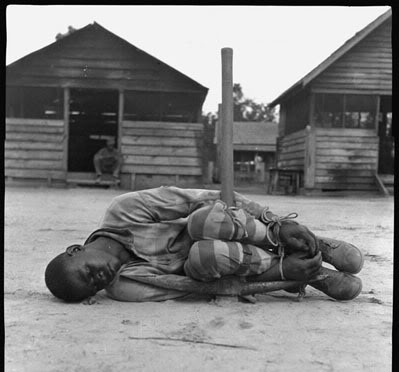 Forced Labor Camp, Georgia, 1930s
American researcher Vicky Peláez writes about the business of “prison slavery”, which usually occurs when state prisons hire out prisoners to private companies to perform labor. This type of business “partnership” does indeed have obvious benefits for private corporations: they pay “hired out” slaves the minimum legal wage set by the state where the labor is performed. And in some places they are even paid below the minimum wage. In the state of Colorado for example, prisoners are paid about $2 per hour, which is significantly lower than the minimum wage. “Prison slaves” are actively exploited by leading American corporations such as IBM, Boeing, Motorola, Microsoft, AT&T, Wireless, Texas Instrument, Dell, Compaq, Honeywell, Hewlett-Packard, Nortel, Lucent Technologies, 3Com, Intel, Northern Telecom, TWA, Nordstrom’s, Revlon, Macy’s, Pierre Cardin, Target Stores and many others. The popularity of this form of exploitation can be measured by the profits generated from inmate labor, which increased from $392 million to $1.031 billion between just 1980 and 1994.
At some point, the American authorities realized that the federal prison system could no longer cope with its overflowing number of prisoners, and turned to services offered by private firms. It turned out that private firms are able to turn a considerable profit by exploiting this labor force, which they are willing to do for the extra profits, just like what people used to do back in the bad old days of slavery. As a result, private prisons began appearing in the United States in the 1980s under President Ronald Reagan, and then state prisons continued to be privatized under presidents George Bush Sr. and Bill Clinton.
The idea of a cost-effective prison is nothing new — the state of Louisiana turned one of its prisons into a business back in 1844. This “industry” began to develop rapidly in the years that followed.
Private prisons are a multibillion-dollar industry, and it is growing. For instance, CoreCivic (formerly Corrections Corporation of America), the largest owner of for-profit prisons and immigration detention facilities in the United States, has seen its revenue increase by over 500 percent in less than 20 years, from about $280 million in 2000 to $1.77 billion in 2017. The three main private prison companies in the US — CoreCivic, the GEO Group and MTC — generate about $5 billion in revenue each year.
By 2018, the combined turnover of these three key business for-profit prisons along with several smaller prison corporations exceeded $7.4 billion. About 10 percent of the estimated 2.3 million people incarcerated in the United States are in private prisons. Private prisons receive a fixed sum from the state for each prisoner, regardless of the real incarceration costs. Thus, the prison business aims to cut costs by organizing a system and security regime that requires a minimal amount of work to be performed by guards. In one of CoreCivic’s ultra-modern prisons, there are only five employees guarding 750 prisoners.
It has come to light that there is a very high rate of profit in the US prison industry. This has not gone unnoticed, transnational corporations (TNCs) have reduced and even scrapped the incentive to transfer their production from the United States to less economically developed countries. The prison industry is one of the fastest growing industries, supported by investors on Wall Street.
Private prisons certainly make a bigger profit when they have more inmates, so they inevitably try to lobby policymakers in their own interest to legislate for longer sentences, such as the 1994 “three strikes laws”, which prescribe mandatory life sentences for anyone who is convicted of a severe violent felony and two other previous convictions. It therefore comes as no surprise that between 1992 and 2003, the number of people serving life sentences shop up by more than 80 percent. When President Trump was elected in 2016, the stock prices of private prison companies CoreCivic and GEO soared. And in 2018, private prison companies donated $1.6 million to campaign committees in the midterm elections.
This private prison lobbying, donating money to political campaigns to push for legislation that would allow the prisons to receive more prisoners with longer sentences and squeeze as many taxpayer dollars as possible, is a clear perversion of the American judicial system. Apart from this, we must not forget that the system is often abused in terms of the collusion that goes on between the administration of state prisons and private companies, as production labor is organized by the prison authorities, and prisoners produce products on the basis of contracts with private companies for a price that is usually far lower than that of the regular labor market. It is difficult to determine exactly how many prisoners are employed indirectly by private companies in the United States. That is what makes this underground economy, the prison industry, a “shady business”.
‘Longest trial in history’: Palestinian aid worker charged with funding Hamas attends 129th hearing

Former World Vision employee Muhammed al-Halabi (L) at a district court in Beersheva, Israel. © AFP / Dudu Grunshpan
RT | October 23, 2019
A former charity manager in the Gaza Strip accused of funding Hamas has attended court for the 129th time in what has become the longest trial of its kind in Israel’s history, dragging on as witnesses are blocked from testifying.
The 41-year-old aid worker, Muhammed al-Halabi, was arrested in June 2016 while working for World Vision, a Christian humanitarian group, charged with funnelling kickbacks to Hamas and its armed wing. For nearly four years, however, Halabi has been denied his proper day in court, instead forced to endure an endless series of stop-go proceedings in which key witnesses are barred from testifying.
His most recent hearing on Wednesday was no different, quickly hitting a dead end soon after it began.
“Today’s hearing was cancelled shortly after it started because the witnesses were not present,” Halabi’s brother, Hamed, told Middle East Eye. “The prosecution then threatened that any witnesses who come from Gaza to give their testimony will be detained.”
“They do not want anyone to prove them wrong. All the eyewitnesses and even the officials at World Vision gave proof that he was innocent. But this is not what the prosecution is looking for.”
The Israeli government has denied travel permits to crucial witnesses in the former charity worker’s case, preventing them from leaving Gaza to give testimony in Israeli courts. Halabi’s lawyer, Maher Hanna, says that guarantees he cannot receive a fair trial.
One of those witnesses – the owner of a company implicated in the alleged money transfer scheme – “could totally undermine the accusations they made against Muhammed,” Hanna told the Times of Israel. “He has begged Israel to allow him to go to the court and testify, but they have not permitted him to do so.”
A father of five from Gaza’s Jabalya refugee camp, Halabi has maintained his innocence since his 2016 arrest and refused to confess to the charges, according to his family, despite facing pressure and even threats from judges. His father said that at one his hearings, a judge promised “long term imprisonment” if Halabi did not admit to collaborating with terrorist groups.
“[The judge] threatened him and tried to force him to confirm the accusations in front of everyone,” Halabi’s father told Middle East Eye.
Halabi’s family also says he has suffered “horrific torture” at the hands of Israeli authorities during several interrogations, including beatings, humiliation and forced sleep deprivation.
A former employee at World Vision said Halabi’s case was part of an ongoing attack on the charity’s aid work in the Gaza Strip and other Palestinian territories.
“There was a political attack on the organisation given that one of its main offices is in the United States,” the employee, who wished to remain anonymous, told Middle East Eye. “The Israeli lobby in the US must have played a major role in impeding the work of the organisation.”
Halabi’s father seconded that take, adding “They know very well that he is innocent, but they cannot release him after four years of interrogation and torture and prove themselves wrong.”
Also on rt.com:
1,700 Gazans shot by IDF face amputation due to funding crisis, UN warns
Palestinians love living under occupation, ex-IDF chief declares, recycling apartheid talking point
Featured Video

When Israel Is Mighty
or go to
Aletho News Archives – Video-Images
From the Archives
US murdering 1 million Iraqis is democracy, Iran giving yogurt to Iraq is “domination”
By Ali Salaam | American Herald Tribune | July 31, 2017
The New York Times, owned by the Zionist Jewish supremacist Ochs-Sulzberger family, has no problem with Iraqi suffering as long as Iran is not the one behind it.
The Iraq War was a genocide of the Iraqi people by Zionist supremacists in the Bush administration. Over 1 million innocent people were killed based on a lie. American soldiers died in an Israeli war and now an average of 22 soldiers commit suicide every day because their consciences cannot cope with the fact they committed crimes in an illegal war that served no purpose other than to benefit Israel, not America.
Benjamin Netanyahu, Prime Minister of the Zionist regime, once said “We are benefiting from one thing, and that is the attack on the Twin Towers and Pentagon, and the American struggle in Iraq.”
Paul Wolfowitz had his sights on Iraq since his time in the first Bush administration. Former Israeli official and Bush administration official Richard Perle had his eyes on Iraq since at least his authorship of the Clean Break white paper. The Zionist regime had their eyes on Iraq since the 1980s when strategist Oded Yinon wrote his white paper in support of dividing the Arab-Muslim world along ethnic and sectarian lines. The global Zionist lobby has had their eyes on Iraq since Theodor Herzl stated that Eretz Israel’s true borders go from the Nile River in Egypt to the Euphrates River in Iraq. … continue
Blog Roll
 Aletho News
- When Will This White House Madness End?
- Huckabee aide goes to ‘unusual lengths’ to portray ‘Israel’ positively
- Trump Announces Diesel Supply Deal With Putin Following Phone Call
- MEP blasts ‘Euro-Gestapo’ for lecturing Russia on democracy
- Syria May Send Troops to Saudi Arabia Amid War with Ansar Allah
- UK whines about losing billions to ‘Putin tax’
- Baghaei to Rubio: Distorted narratives cannot erase US record of broken commitments
- Houthis Don’t Have to Conquer Saudi Arabia to Make It Pay
- MOE: Nearly 22,000 Students and Education Workers Killed
- Guterres in Islamabad: Genocide, cowardice, and the cage of Imran Khan
- If Americans Knew
- Gaza ceasefire exists in name only, say more than 100 organizations
- Nearly 2 Million in Gaza Need Urgent Shelter Assistance as Winter Looms: IOM Chief Warns
- Suppressing Palestinian resistance: US charity under fire for AI monitoring of Gaza classrooms
- Thousands Are Held in Israeli Torture Camps. This Is What Happens Inside
- Israel puts Gaza’s sick, injured, newborn in peril – Daily Update
- Report claimed Mark Levin used by Israeli government to influence Trump
- Over 2,000 Gazans have died awaiting medical evacuation amid Israel’s continued siege
- How a U.S. Diplomat Suppressed and Altered Reports Critical of Israel
- 5 Palestinians Die from Israeli Strikes in Gaza as Relentless Attacks Continue
- Report: Ceasefire Slows Killing but Leaves Devastation Intact
- No Tricks Zone
- New Study: 50 Years Of The Most Aggressive ‘Net Zero’ Policies Can Only Affect The Global Climate By 0.03°C
- US September “Heat” Was No Record…Many Records Set Decades Ago
- Latest European Green Energy Debacle; Portugal’s Largest Flagship Solar Park Insolvent!
- Green Energy Debacle: German Expert Professor Fritz Vahrenholt Warns Of Severe Economic And Social Consequences
- Two More Paleo Reconstructions Affirm Meters-Higher Sea Levels Across Ireland, Brazil 7000-6000 Years Ago
- New Study: Earth And Venus Surface Warmth Largely Explained By Convection And Lapse Rate, Not CO2 Or Radiation
- 2025 Nature Paper Claiming Worsening Global Drought Gets RETRACTED …Heavily Flawed
- New Study: ‘Global Drought Shows No Detectable Recent Acceleration Under Climate Warming’
- Economic Masterminds: German Socialists Suggest Taxing Productivity Gains Stemming From Using AI
- The South China Sea Has Not Been Cooperating With The Climate Change Narrative

