Macron, Merz, and von der Leyen Defend Expanded Speech Controls
The Munich Security Conference just became a defense session for Europe’s most ambitious censorship regime
By Dan Frieth | Reclaim The Net | February 16, 2026
Emmanuel Macron stood before the Munich Security Conference last week and offered a blueprint for what European governments should be allowed to delete from the internet. The French president wants mandatory identity verification for social media users, one account per person, algorithm transparency on the government’s terms, and the legal authority to block platforms that refuse to comply.
“We have to be sure there is one single person with one account,” Macron said. “If this is an AI system, if this is bot or organized by big organization, it should be just forbidden.”
The statement describes a system where every social media user would have their identity verified by platforms and tied to a single permitted account. Anonymous speech, pseudonymous commentary, and the ability to maintain separate personal and professional presences online would effectively end for anyone using platforms that serve the European market.
Macron suggested this as a way to protect democracy. The mechanism would give governments a powerful tool to identify, track, and silence any user whose speech they find objectionable.
France is moving to ban social media access for anyone under 15, a policy that requires verifying every user. Macron defended this by characterizing free expression online as a form of brainwashing.
“Free speech would mean I will give the mind, brand the heart of my teenagers to algorithm of big guys,” he said. “I’m not totally sure I share the values, or Chinese algorithm without any control. We are crazy.”
The argument runs as follows: letting young people encounter ideas online without government permission is insanity. The solution requires every user to prove their age to access platforms where public discussion happens.
Macron suggested that speech illegal in newspapers should remain illegal when moved online. “How is that the craziest and most harmful narratives can go unchecked in our digital space, where they will fall under the law if published in print?”
The question assumes “harmful narratives” is a category the government should define. It also assumes the government should have the power to prevent people from encountering ideas it has labeled crazy.
Macron invoked the Digital Services Act as the foundation for expanded censorship across Europe. “This is a very important regulation because for the first time we created the framework to regulate this platform.”
The DSA gives EU regulators the authority to demand content removal from platforms. Macron called for going further: using the law to “excuse those who clearly decide not to respect our rules and our regulation” and to “block all those [who allow] interferences in our systems.”
He offered a familiar list of speech categories he wants suppressed: “racist speech, hateful speech, anti-Semitic speech.” These terms have no fixed legal definition that applies uniformly across EU member states. Who is racist, what constitutes hatred, which criticism of which policies counts as anti-Semitism: these determinations would be made by regulators and platforms operating under government pressure.
Macron described limits on speech as somehow inherent to democracy itself: “When you have free speech, you have respect, you have rules, and the limit of my freedom is the beginning of your freedom.”
This formulation treats speech as equivalent to physical coercion. Your words are framed as a boundary violation against others simply by existing. The speech that most requires protection is speech that offends, that challenges consensus, that the powerful would prefer to suppress. Macron’s framework offers no protection for any of it.
German Chancellor Friedrich Merz, who opened the conference, echoed the European position that speech protections should end where government-defined values begin.
“A divide has opened up between Europe and the United States,” Merz said. “And Vice President JD Vance said this very openly here at the Munich Security Conference a year ago, and he was right. The battle of cultures of MAGA in the US is not ours. Freedom of speech here ends where the words spoken are directed against human dignity and our basic law.”
“Human dignity” is the phrase German law uses to justify prosecuting speech. The Constitutional Court has interpreted it to cover insults, Holocaust denial, and an expanding category of expression that authorities determine undermines respect for persons or groups. It is the legal mechanism under which German police have raided homes over social media posts and prosecuted people for memes.
European Commission President Ursula von der Leyen joined the censorship chorus with a declaration of territorial authority over online expression.
“I want to be very clear: our digital sovereignty is our digital sovereignty,” she said, adding the EU “will not flinch where this is concerned.”
Von der Leyen described European speech regulation as under attack from the United States, “which has wielded the threats of tariffs on partners to secure preferential access and has decried the EU’s digital rules as an assault on free speech.”
The EU’s digital rules are an assault on free speech. The DSA empowers bureaucrats to demand platforms remove content, under threat of massive fines.
The EU has opened formal proceedings against X for its policies. European regulators have forced platforms to suppress content that would be legally protected in the United States.
Von der Leyen framed resistance to this regime as a threat to Europe’s “democratic foundation.” She claimed Europe has “a long tradition in freedom of speech” while defending a legal structure designed to ensure certain speech never reaches European audiences.
“The European way of life – our democratic foundation and the trust of our citizens – is being challenged in new ways,” she said. “On everything from territories to tariffs or tech regulations.”
The phrasing groups speech regulation with tariffs and territorial disputes. All three are matters where Europe will defend its sovereignty. What Europeans are permitted to say, read, and share online is treated as equivalent to where national borders fall.
The leaders who gathered in Munich spoke of protecting democracy while proposing tools that would let governments identify and punish dissent. They invoked free speech while demanding the power to decide which speech is free. They claimed to defend Europe while stripping Europeans of the ability to speak freely online.
Keir Starmer-tied think tank paid PR firm to target The Grayzone
By Kit Klarenberg | The Grayzone | February 16, 2026
Leaked files have revealed that Labour Together, the shadowy think tank run by disgraced former top Keir Starmer aide Morgan McSweeney, paid the Washington DC-based corporate intelligence firm APCO Worldwide to spy on journalists who reported on their corrupt handling of campaign finances.
The reporters named appear to have been targeted for their efforts to investigate how the UK’s Labour Party elites spent 730,000 pounds in undeclared donations to install Starmer as their leader.
The files show APCO used those funds to oversee the fabrication of a dodgy, evidence-free dossier claiming that Russia was behind damaging disclosures about Labour Together, which it submitted to the National Cyber Security Centre (NCSC) of Britain’s GCHQ — London’s equivalent to the US National Security Agency.
The “significant persons of interest” listed in APCO’s McCarthyite casebook included The Grayzone and myself.
According to my APCO dossier, “While a self described ‘investigative journalist,’ he is an author for the Gray Zone. The site has been described as a ‘conspiracy blog’ and ‘Wagner propaganda channel.’ In 2023,” the dossier reads, I “was arrested by counter-terror police after [I] arrived in the UK.”
APCO bills itself as “a trusted and strategic advisor… that drive[s] our clients’ missions and objectives forward.” Despite its massive contract with Labour Together, the files show the PR firm struggled to identify its targets, and proved unable to establish the most basic facts about them.
When APCO branded The Grayzone as “Wagner propaganda,” it seemed to have confused us with “Grey Zone,” an entirely unrelated and now-defunct Telegram channel affiliated with the Russian military contractor. APCO also claimed I was “arrested by counter-terrorism police” in May 2023 upon returning to Britain. In fact, I had been detained, not arrested.
APCO also targeted journalists Matt Taibbi and Paul Holden, who led investigations into Labour Together’s potentially criminal activities, based on leaks and Freedom of Information requests. The PR firm had sought to secure “leverage” over Holden in order to sabotage his work.
The spying scandal began in November 2023, when Britain’s Sunday Times revealed that Keir Starmer’s campaign manager, Morgan McSweeney, had failed to declare £730,000 in campaign donations which he diverted to advance Starmer’s rise to Labour leadership. One month later, APCO prepared a memo for Labour Together outlining a strategy to blame the damaging disclosure on Russian hackers and attack the journalists who dared to publish details of the offending documents.
The story was given new life in February 2026, when British journalist Peter Geoghehan exposed a secret contract showing Labour Together paid APCO £30,000 to investigate the journalists it blamed for exposing its legally questionable activities.
It has now gone mainstream, with the Sunday Times publishing a lengthy report branding the Labour operation as a “dirty smear” based on a “lie” about Russian hacking.
However, the Times article omitted any mention of this reporter or The Grayzone, even though we were prominently targeted by Labour Together. In the following investigation, we explain why The Grayzone was targeted, tracing the origins of the slimy spying operation to a network of Labourite operatives who have sought to destroy us since well before Starmer came to power.
“Familiar with masters of the same drivers”
Labour Together was founded in 2015 by McSweeney, Starmer’s longtime svengali. After several failed campaigns for establishment candidates, McSweeney managed to transform his organization into a propaganda juggernaut, soliciting large donations from the UK Israel lobby’s most significant moneyman, Trevor Chinn.
While presenting his campaigning outfit as a plucky little think tank, he wielded it against Labour leader Jeremy Corbyn and the movement behind him. To neutralize the ecosystem of alternative media outlets supporting Corbyn as Labour leader, Labour Together contracted a political operative named Imran Ahmed to spin out a censorship front called “Stop Funding Fake News.”
After weaponizing dubious charges of antisemitism to defund one of the most influential pro-Corbyn outlets, Canary UK, the organization folded, then resurfaced as the much bolder Center for Countering Digital Hate (CCDH). Based inside the office of Labour Together, CCDH relied on the funding from Chinn and, as The Grayzone’s Max Blumenthal revealed, secretly coordinated with the Israeli embassy in Washington.
McSweeney entered Downing Street as Starmer’s Chief of Staff just one month before Trump’s re-election. Among his most important tasks was repairing relations with the US President. At the time, Trump’s aides were bristling over reports that McSweeney met with Democratic presidential nominee Kamala Harris during the Democratic National Convention to plot strategy. One of Trump’s top donors, the transhumanist mega-billionaire Elon Musk, also had his knives out for McSweeney after journalists Matt Taibbi and Paul Thacker revealed that CCDH’s top priority for 2024 was to “kill Elon Musk’s Twitter.”
McSweeney’s solution was to dispatch one of Labour’s most seasoned – and scandal-stained – fixers to Washington. He was Lord Peter Mandelson, the architect of the neoliberal New Labour wave whose notoriously transactional tendencies seemed to make him the perfect match for Trump. Mandelson made himself a fixture at Butterworth’s, a favorite Capitol Hill haunt of MAGA operatives, and insinuated himself into Trumpist social circles.
In June 2025, the restaurant erected a plaque honoring Mandelson during a ceremony overseen by Raheem Kassam, a close associate of former Trump chief of staff Steve Bannon. There, a mirthful Mandelson raised a toast and proclaimed a special kinship with the MAGA elite: “Although we don’t have identical politics, we are familiar with masters of the same drivers that brought our respective figures to power — President Trump in your case and Keir Starmer in mine.”
But Mandelson was also dogged by the same sex trafficking figure who constantly inhabited the personal lives of both Trump and Bannon: Jeffrey Epstein. Both McSweeney and Starmer had been keenly aware of the ambassador’s friendship with Epstein, but they dismissed the concerns, even ignoring a warning from UK security services.
However, when a series of emails confirming Mandelson’s friendship with Epstein poured forth as part of a release by the US Department of Justice, the ambassador’s position became untenable. Following his firing in September 2025, a new tranche of emails published this January provided an even more damning portrait of their friendship. They showed, for instance, that Epstein channeled money to Mandelson’s husband, Reinaldo Avila da Silva, for a specious initiative which was never completed. Even worse, the communications exposed Mandelson providing Epstein with advance notice of the impending collapse of Prime Minister Gordon Brown’s government in 2010, as well as sensitive information about the UK’s “saleable assets.”
McSweeney’s scheming had finally caught up with him. Though Starmer initially praised and defended his longtime campaign guru in parliament, he caved soon after, forcing McSweeney to resign his post on February 8.
In the days since, Starmer has been unable to fill the vacancy. Meanwhile, another senior Labour official is reportedly considering leaving his role as well. Amid the chaos, British media has begun to speculate that the Prime Minister will be next to go.
Will the revelation of Labour Together’s media enemies list, and its secret contract with APCO, be the weight that finally sinks Starmer?
Labour Together’s misdirection ploy: blame Russia
McSweeney was aware that Labour Together had secretly contracted APCO to spy on journalists; however, he didn’t carry out the dirty work himself. That job appears to have been commissioned by his successor at the think tank, Josh Simons, who’s now a senior minister in Starmer’s government.
Simons has dismissed reports that the PR firm was tasked with spying on reporters as “nonsense,” insisting that APCO was merely “asked to look into a suspected illegal hack.” Simons’ disingenuous claims are undermined by newly-leaked documents related to the probe, however.
Perhaps most damning is a December 2023 memo prepared by APCO for Labour Together which shows investigators fretting about “recent articles and blog posts” which threatened to draw attention to the political group’s questionable funding schemes. Information published by these meddling journalists, particularly Paul Holden, “[raised] concern about the source of his information and what more he may choose to publish in the future,” the memo continued.
It was therefore deemed “important to identify the source of the information and to ascertain what additional information could be published.” Labour Together tasked APCO with probing several journalists, dubbed “significant persons of interest.”
The memo speculated that Holden and others may have received leaks from inside Labour Together, Labour party headquarters, parliament, or “illegally-gathered information collected” from a purported “hack” of Britain’s Electoral Commission in 2023. APCO concluded it was “essential” for Labour Together to concoct a strategy to counter the critical reporting.
Its response was to blame the organization’s woes on a Russian hack. But rather than hiring a cyber-security firm to investigate the supposed data breach, it contracted a corporate intelligence firm to attack the messengers.
In February 2024, The Guardian contacted Holden to alert him that the paper was preparing a hit piece alleging he was under investigation by the NCSC for receiving illegally obtained information from Russia. The Guardian had clearly been influenced by briefings from Labour Together, as well as by APCO’s report. Yet the outlet backed off when Holden promised to sue them for defamation.
APCO is now under formal investigation for potential standards breaches by Britain’s Public Relations and Communication Association.
How did The Grayzone wind up on Labour Together’s enemies list?
It is unclear how and why I became a “significant person of interest” in APCO and Labour Together’s secret smear campaign. However, their operation dovetailed with another surreptitious attempt by intelligence-tied actors to smear The Grayzone as Russian agents.
I have never spoken to Paul Holden or other journalists named as the firm’s targets, or conducted any journalistic investigations into Labour Together’s corrupt financial dealings. When APCO initiated its probe, I had mentioned Labour Together in a single article months prior that focused on the organization’s censorship-obsessed spinoff, the Center for Countering Digital Hate.
Such sloppiness and paranoia is the hallmark of Amil Khan, a veteran British government psyops warrior turned “disinformation expert” involved with Labour Together and Starmer’s Labour.
Khan cut his teeth running covert British-funded psychological warfare operations during the Syrian dirty war, supporting violent extremist groups armed and financed by the CIA and MI6. He subsequently founded Valent Projects, which “specializes in addressing online manipulation.” Khan’s outfit produced a paper on social media ratfucking strategies for Labour Together entitled, “Power and Persuasion: Understanding the Right’s Playbook.”
In December 2021, The Grayzone exposed how Valent Projects covertly produced Covid vaccine propaganda funded by the British monarchy’s Royal Institute, using then-popular “BreadTube” personality Abigail Thorn as the front person for its campaign. The investigation apparently placed this outlet in the crosshairs of Khan and his information warfare network.
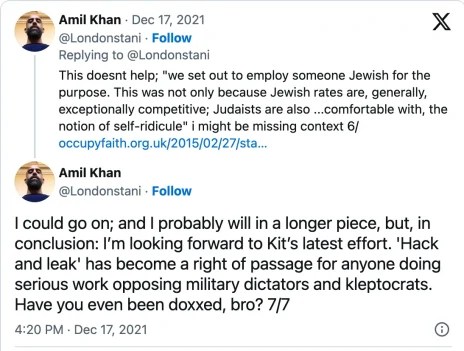
Less than a year later, The Grayzone exposed Khan again – this time, for his role in a covert conspiracy to destroy us. Enlisted by celebrity former leftist journalist Paul Mason, Khan helped coordinate a harebrained scheme to demonetize and deplatform The Grayzone. The pair discussed going “full nuclear legal to squeeze [The Grayzone] financially,” and proposed publishing intelligence agency-sourced smears to delegitimize this outlet.
As their revenge plot approached its paranoid apogee, Mason and Khan fantasized about hosting an anti-Grayzone summit with some of the most rabid, intelligence-tied opponents of our reporting. Among those they pitched for the gathering was Imran Ahmed, director of the censorship-obsessed Center for Countering Digital Hate (CCDH), which was founded by Morgan McSweeney and shared an office with his Labour Together.
While it is unknown if the anti-Grayzone summit ever took place, we have since learned that Mason enlisted a team of high-priced London lawyers to sue this outlet just days after our article exposing his secret smear campaign appeared. In May 2023, I was detained at the UK’s Luton International Airport and interrogated about The Grayzone’s activities by counter-terror police. Six months later, APCO initiated its covert investigation of me, The Grayzone, and others whose reporting had wound them up on the Labour Together enemies list.
APCO has so far remained silent about the scandal. The Grayzone has submitted a request for comment to Tom Short, the PR firm’s London chief. We received an automated response revealing he conveniently slipped away to the US. Upon Short’s return to Britain, APCO will no longer be able to hide behind bogus allegations of Russian hacking.
Apple Just Bought A Sinister ‘Pre-Speech’ Tech Company Implicated In Genocide
By Nate Bear – ¡Do Not Panic! – February 15, 2026
Tech giant Apple has quietly paid nearly $2 billion for a ‘pre-speech’ tech company whose employees helped Israel commit genocide in Gaza.
And Apple has paid this money, the second-biggest deal in its history, for a company that doesn’t have a product, doesn’t have any revenues and whose website is a single page containing 15 words.
The company, Q.ai, is developing sensors which map the imperceptible movements of a human face to determine the words someone is thinking before they’re spoken.
They call it silent speech.
Or pre-speech.
And it’s exactly as sinister as you think it is.
Q.ai was founded by Aviad Maizels, Avi Barliya and Yonatan Wexler, all of whom honed their skills by testing technologies of apartheid on Palestinians. Maizels is a former commander of Unit 81, the IDF division which builds Israel’s offensive cyber weapons. Barliya, according to his LinkedIn, was an intelligence officer in the Israeli air force, while Wexler is a former Unit 8200 agent.
Apple’s genocide intake
In a blog post announcing the deal, Tom Hulme, an executive at Google Ventures, one of the company’s early investors, revealed that 30% of Q.ai’s more than 100 staff were called up to participate in the genocide of Gaza.
This admission means dozens of people implicated in genocidal acts who served under the political command of Yoav Gallant, an ICC indicted war criminal, are now Apple employees.
It should be a huge scandal. The biggest company in the US, one of the world’s most recognisable names, has folded into its staff dozens of people who served in a military during the period it committed genocide, according to all of the world’s most acclaimed rights experts.
But every single mainstream article which covered news of the deal, from Reuters to the FT, ignored this fact.
Mainstream coverage also ignored a number of other extremely cogent elements to the story, including the nature of the deal and the technology itself.
Apple has paid two billion dollars for something that barely appears to exist.
Q.ai’s website consists of just 15 words.
To find out exactly what the company does you have to look beyond the press releases to the patents Q.ai and its founders have filed.
And these patents read like plot lines from the bleakest dystopian futures.
Sensing silent speech
One filing details technology capable of “determining an emotional state of an individual based on facial skin micromovements.” The same filing says the technology could be used “to identify a user based on heart-rate and breathing-rate.” Another filing says Q.ai’s software “synthesises speech in response to words articulated silently by the test subject.”
Q.ai’s technology centres around silent speech.
This is the idea that before we vocalise words and move our mouths to emit sounds, our brain has already sent signals to muscles in our throat and face determining what we’re going to say. Q.ai claims to have invented infrared sensors that can pick up these pre-speech micro-movements.
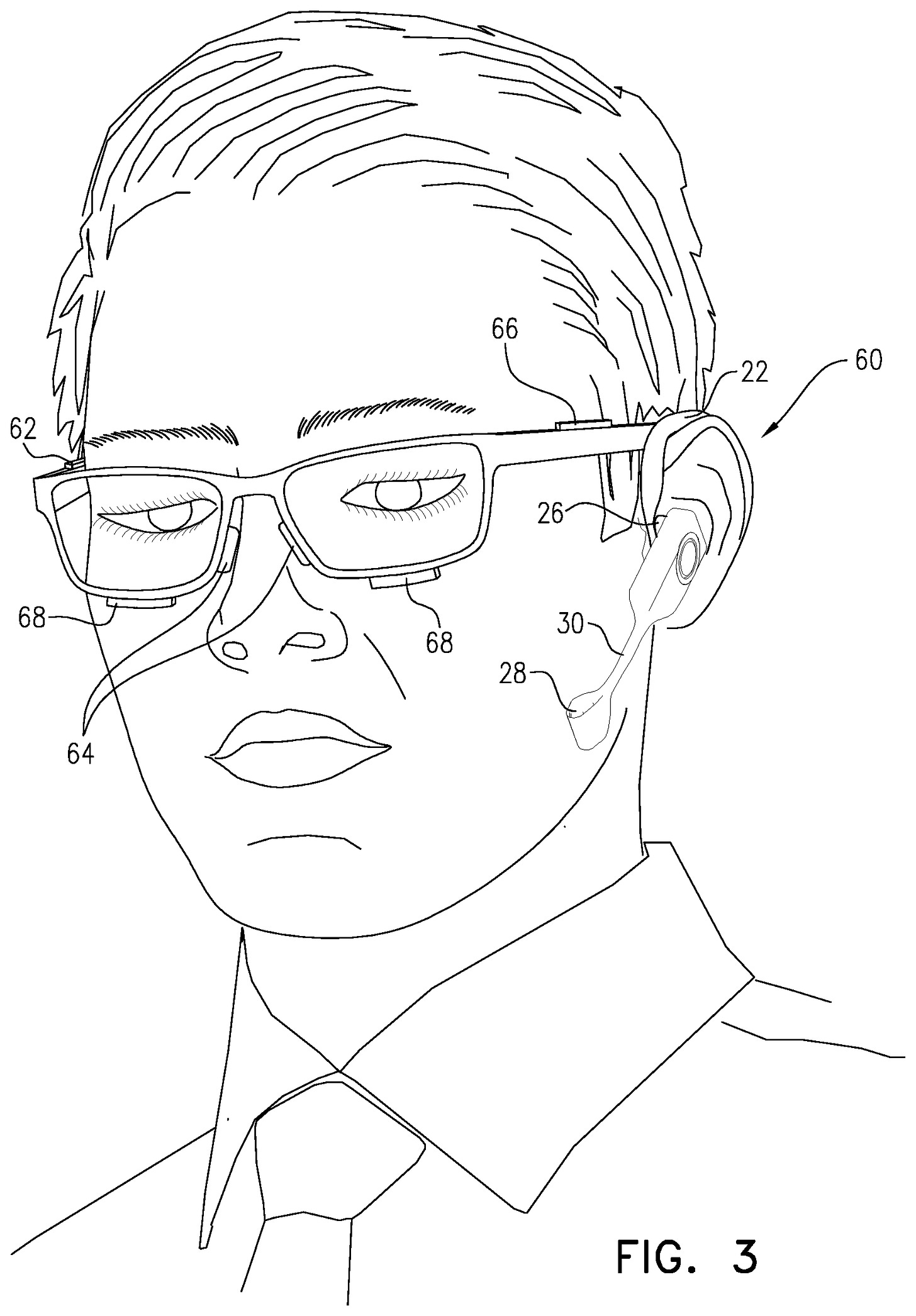
One filing talks about a “sensing device configured to fit an ear of a user, with an optical sensing head which senses light reflected from the face and outputs a signal in response. Processing circuitry processes the signal to generate a speech output.”
Tech bloggers have suggested Apple has bought the company to enable non-verbal control of an iPhone and other devices via its airpod earphones or smart glasses. An annotated diagram included with the patent shows a person wearing glasses and an earpiece integrated with the technology.
Indeed Apple is no stranger to adopting the technologies of Israeli apartheid, and in fact the company is extremely familiar with Maizels himself.
In 2013, Apple bought Maizels’s first company, PrimeSense, a developer of 3D sensing technology. PrimeSense technology went on to become the foundation for Apple’s Face ID system on its newer iPhone and iPad models.
Nonetheless, two billion dollars for a non-existent technology and a three-year old company, is unprecedented. What isn’t unprecedented, however, is a US tech giant overpaying for an Israeli company.
Overpriced Israeli tech
Last year, Google bought Israeli cybersecurity Wiz for $32 billion, which, at 64 times Wiz’s annual sales, was widely seen as an inflated price and far in excess of the sales-to-valuation ratio for similar companies.
At this price, however, Israel received a huge $5 billion tax windfall. At the time Zionists crowed it would help the country buy more warplanes and missiles to commit genocide.
The deal for Q.ai, while a lot smaller, will still generate significant tax income for Israel’s struggling economy.
And Israel is critical to Apple.
The company has a large R&D campus in the country, its second-biggest outside the US, into which large numbers of Unit 8200 and Unit 81 graduates are funnelled. Apple CEO Tim Cook is a devoted Zionist, has visited Israel on numerous occasions, and in 2018 received an award from Zionist lobby group the ADL for his efforts to censor anti-Israel speech. Apple has made good on that promise over the last two years, sacking staff for expressing pro-Palestine, anti-genocide views. Cook has never spoken about Gaza.
The price for a ghost company with a few patents, then, looks as much about politics as it does about technology.
That’s not to say Q.ai’s technology won’t be commercialised for consumer applications. It probably will be. And if the tech is realised, the implications for privacy and data collection are frightening.
As are the security state and military applications.
A pre-crime future
A few days after the Q.ai deal, the head of neurotechnology at Israel’s directorate of defense research and development, the country’s equivalent to the US’s DARPA programme, gave her first-ever interview to Israeli media. In the interview she referenced Q.ai and said the Israeli military is working on similar technology. The US has a DARPA project known as Silent Talk which is also working to develop pre-speech sensing and non-verbal control technologies.
Once the technology is developed, and pre-speech established as a legitimate biological human function, how far behind will pre-crime be?
Given the frenzied efforts we’ve seen to shut down and criminalise criticism of Israel under the guise of antisemitism, one can easily imagine a future of pre-speech sensing technology being rolled out to identify would-be critics of Israel. Or the US. Or Europe. Or imperialism in general.
You can imagine it now. “Based on our silent speech detector we have determined you were going to say something hateful or antisemitic or un-American and are therefore under arrest.”
The most dystopian technologies continue to flow out of Israel. And they continue to flow because Israel is empowered by the US and Europe to maintain a system of apartheid built upon invasive and authoritarian technologies of control.
It is therefore no surprise that the creators of Q.ai are veterans of Israel’s genocidal military security state, or that the largest company in the US sees these technologies as essential to its AI future.
And while this story may be no surprise, we should never get used to, and must resist, technologies of apartheid and genocide, and their creators, becoming embedded in our devices, our economies and our lives.
Two children killed in Palestinian Authority ambush in West Bank; Hamas slams attack as ‘black mark’
Press TV – February 16, 2026
Two children have been killed after Palestinian Authority (PA) forces opened fire on a vehicle carrying their father, a resistance fighter, in the town of Tamoun in the northeastern part of the occupied West Bank.
The three-year-old daughter of Samer Samara succumbed to her wounds on Sunday after being shot by the forces, Palestinian media outlets reported.
Her 16-year-old brother, Ali, was killed after being shot in the head. Their father was wounded and later abducted by PA forces.
According to the reports, the forces shot Samara in the legs before abducting him.
Local reports said units from the PA’s so-called Preventive Security Service and a special unit set up the ambush and fired heavy gunfire at the car during an operation to abduct Samara, who is wanted by Israeli occupation forces.
Following the killings, the youths of the town of Tamoun launched a demonstration and a general strike. Reports said the PA sent reinforcements to suppress the demonstration.
The Gaza Strip’s Hamas resistance movement condemned the atrocities, holding the Authority fully responsible for the consequences of targeting resistance fighters and killing children.
In a statement, the group described what happened as a “serious crime” and a “black mark in the record of the security services that continue to overpower our people instead of protecting them.”
The movement warned that the policy could damage Palestinian internal cohesion and demanded accountability.
It called for “holding all those involved accountable, stopping the pursuit of wanted Palestinians, and releasing political detainees.”
The Committee of Families of Political Prisoners also condemned the shooting, describing it as the result of a “systematic policy targeting resistance fighters.”
It said the incident represented a “dangerous deviation” that placed security services in confrontation with the population rather than protecting them.
Human rights organizations say such incidents risk deepening internal tensions at a time when Palestinians in the West Bank also face ongoing Israeli military raids and settler violence, contributing to what observers describe as a climate of compounded insecurity for civilians.
Senator Rand Paul Introduces Federal Bill to END Vaccine Makers’ Liability Shield
By Nicolas Hulscher, MPH | FOCAL POINTS | February 14, 2026
Senator Rand Paul has introduced S.3853, a federal bill that would amend the Public Health Service Act to end the long-standing liability protections for vaccine makers.
The bill was introduced on February 11, 2026, and referred to the Senate Health, Education, Labor, and Pensions (HELP) Committee.
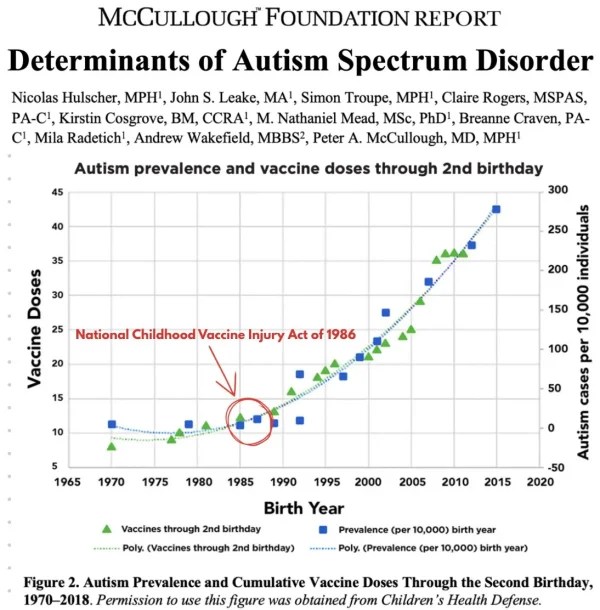
At the time of writing, no bill text has yet been released, so the precise statutory changes remain unknown. However, based on the title and summary, the legislation appears aimed at dismantling the liability framework established under the 1986 National Childhood Vaccine Injury Act, which shields manufacturers from civil lawsuits and routes injury claims through the failed Vaccine Injury Compensation Program (VICP).
Current evidence indicates that the National Childhood Vaccine Injury Act of 1986 likely sparked the autism epidemic. By granting legal immunity to vaccine makers, 3.2% of American children now have autism:
Bill S.3853 would collapse the vaccine cartel’s 40-year reign of penalty-free mass harm. If passed, this legislation would truly Make America Healthy Again.
Patrik Baab: Europe’s New Iron Curtain – Freedom of Speech Dies
Glenn Diesen | February 14, 2026
Patrik Baab is a German journalist and best-selling author who reported on both sides of the frontline in Ukraine. Baab outlines how the freedom of speech is destroyed by a failing political elite.
Follow Prof. Glenn Diesen:
- Substack: https://glenndiesen.substack.com/
- X/Twitter: https://x.com/Glenn_Diesen
- Patreon: / glenndiesen
Support the research by Prof. Glenn Diesen:
- PayPal: https://www.paypal.com/paypalme/glenn…
- Go Fund Me: https://gofund.me/09ea012f
Israeli army closes dozens of cases involving killing of Palestinians inside torture camps
The Cradle | February 13, 2026
The Israeli military has closed dozens of war-crimes investigations into its soldiers arising from the first two years of its genocide of Palestinians in Gaza, the Jerusalem Post reported on 8 February.
Publication of the details of the case closures was delayed by fears that doing so would ease the way for the International Criminal Court (ICC) to pursue war crimes charges against the soldiers.
Many of the closed cases relate to the deaths of as many as 98 Palestinian detainees from Gaza held in military detention facilities.
Torture and rape are common in Israeli detention centers, including Sde Teiman, where a 2024 leaked video showed the gang rape of a Palestinian detainee.
The arrest of the soldiers who carried out the rape was widely condemned by Israeli politicians and media commentators, who argued that rape was justified.
According to the Jerusalem Post, cases involving the deaths of detainees in custody constitute a “significant number” of about 100 criminal probes that the military’s legal division has opened into soldiers’ conduct.
However, the 100 cases where a probe has been opened make up just a “small proportion” of the roughly 3,000 cases of alleged war crimes for which a preliminary review took place.
Additional indictments may be filed in the Sdei Teiman cases, the Jerusalem Post added.
That Israel has closed many cases with no prosecutions undermines its argument that the ICC has no jurisdiction to prosecute its soldiers and politicians for war crimes.
Israel claims that it has a “robust, independent, and functioning” legal system capable of investigating any alleged wrongdoing. Therefore, according to the Complementary Principle, the ICC has no jurisdiction over its actions, Israel argues.
The Complementary Principle asserts that the ICC should complement national criminal systems, not replace them.
In November 2024, the ICC issued arrest warrants for Israeli Prime Minister Benjamin Netanyahu and former defense minister Yoav Gallant on war crimes charges, including using starvation as a weapon of war.
Israel and the US responded by issuing threats and imposing unilateral economic sanctions on the court’s judges.
Israel is also facing charges at a separate international court, the International Court of Justice (ICJ), that it is in breach of the Genocide Convention.
In March 2024, the ICJ issued a preliminary ruling requiring that Israel must take provisional measures to stop the possibility of perpetrating a genocide, including halting the military assault it was carrying out on the city of Rafah, allowing humanitarian aid to enter unhindered, and permitting a fact-finding team to enter the strip.
In December 2023, South Africa filed a case at the ICJ alleging Israel is carrying out a genocide of Palestinians in Gaza.
The Jerusalem Post reported that Israel’s response to the South Africa case, due on March 12, is still being prepared by its legal team. It will reportedly include a 1,000-page legal brief, along with 4,000 or more pages of exhibits.
The South African case covers Israel’s actions in Gaza between 2023 and 2024. Pretoria has not yet submitted a detailed attack on the Israeli military’s conduct in 2025. It is expected to do so this spring or summer.
Israel will likely be required to respond by the spring of 2027.
“There are concerns among Israeli lawyers about the genocide charges, not only due to exaggerated public statements made by National Security Minister Itamar Ben-Gvir and Finance Minister Bezalel Smotrich, but also resulting from statements made near the start of the war by more authoritative defense figures,” the Jerusalem Post reports.
Prime Minister Netanyahu, Defense Minister Gallant, Smotrich, Ben Gvir, and many other Israeli politicians have made multiple public statements urging the army to commit genocide against Palestinians in Gaza.
According to the UN, genocide means any of the following acts committed with the intent to destroy, in whole or in part, a national, ethnic, racial, or religious group:
Killing members of the group; Causing serious bodily or mental harm to members of the group; Deliberately inflicting on the group conditions of life calculated to bring about its physical destruction in whole or in part; Imposing measures intended to prevent births within the group; Forcibly transferring children of the group to another group.
UK High Court rules Palestine Action ban unlawful
Al Mayadeen | February 13, 2026
The UK High Court ruled on Friday that the government’s proscription of Palestine Action under the Terrorism Act was unlawful.
On Friday, three judges led by Dame Victoria Sharp, president of the King’s Bench Division, concluded that the decision to ban the group was unlawful. However, the ban will remain temporarily in place to allow the government time to appeal.
From July 5 last year, membership of or public support for Palestine Action became a criminal offence punishable by up to 14 years in prison. The group had been placed on the list of proscribed organisations, categorizing it alongside internationally recognized armed groups.
The court upheld the challenge on two of four grounds. Judges found that the proscription represented “a very significant interference” with the rights to freedom of speech, peaceful assembly, and association. They also ruled that Yvette Cooper’s decision was inconsistent with her own stated policy.
Sharp described Palestine Action as an organisation “that promotes its political cause through criminality and encouragement of criminality”, but continued, “The court considered that the proscription of Palestine Action was disproportionate. A very small number of Palestine Action’s activities amounted to acts of terrorism within the definition of section 1 of the 2000 Act.”
“For these, and for Palestine Action’s other criminal activities, the general criminal law remains available. The nature and scale of Palestine Action’s activities falling within the definition of terrorism had not yet reached the level, scale, and persistence to warrant proscription,” Sharp added.
Legal and political repercussions
The judgment marks the first time an organisation banned under the Terrorism Act has successfully challenged its proscription in court.
According to the campaign group Defend Our Juries, more than 2,700 people have been arrested since the ban took effect, most under section 13 of the Terrorism Act. More than 500 individuals, including clergy, pensioners, and military veterans, have been charged.
If the proscription order is ultimately quashed, the charges could be dropped. For now, those charged remain in legal uncertainty while the ban stays in force pending appeal.
Government to appeal decision
Current home secretary Shabana Mahmood said she would challenge the ruling.
Palestine Action co-founder Huda Ammori described the decision as a “monumental victory” and said the ban was based on property damage rather than violence against individuals.
“We were banned because Palestine Action’s disruption of Israel’s largest weapons manufacturer, Elbit Systems, cost the corporation millions of pounds in profits and to lose out on multibillion-pound contracts.
“We’ve used the same tactics as direct action organisations throughout history, including anti-war groups Keir Starmer defended in court, and the government acknowledged in these legal proceedings that this ban was based on property damage, not violence against people.
“Banning Palestine Action was always about appeasing pro-Israel lobby groups and weapons manufacturers, and nothing to do with terrorism … Today’s landmark ruling is a victory for freedom for all, and I urge the government to respect the court’s decision and bring this injustice to an end without further delay.”
The case is likely to intensify debate in the United Kingdom over the balance between national security powers and civil liberties.
Ukraine to ban Russian literature – culture minister
RT | February 12, 2026
The Ukrainian authorities are preparing a draft law to take all Russian and Russian-language books out of circulation, Ukrainian Culture Minister Tatyana Berezhnaya told Interfax-Ukraine in an interview published on Thursday.
Moscow maintains that Kiev’s discriminatory policies against ethnic Russians in Ukraine, as well as its persecution of the Russian language and culture are some of the fundamental causes of the current conflict.
According to Berezhnaya, Ukraine’s media authority is working on a bill to ban Russian books with the support of her ministry. She did not specify whether the measure would only remove them from store shelves or include confiscations from private collections.
Vladimir Zelensky’s predecessor, Pyotr Poroshenko, banned the import of books from Russia and Belarus in 2016, long before the escalation of the Ukraine conflict six years later. Kiev has since systematically purged Russian literature from state curricula, and intensified a purge of cultural monuments, memorials, and inscriptions to remove historical links to Russia.
Kiev has also steadily cracked down on the use of the Russian language in public life, restricting or banning its use in media and in professional spheres. Nevertheless, it remains the first and primary language for many people in Ukraine, especially in metropolitan areas and in the east of the country.
In December, the Ukrainian parliament stripped Russian of its protection under the European Charter for Regional or Minority Languages. Berezhnaya at the time proclaimed that the move would “strengthen Ukrainian” as the state language.
Moscow has noted that this crackdown has largely been ignored by Kiev’s Western backers.
“Human rights – ostensibly so dear to the West – must be inviolable. In Ukraine, we witness the comprehensive prohibition of the Russian language across all spheres of public life and the banning of the canonical Ukrainian Orthodox Church,” Russian Foreign Minister Sergey Lavrov said on Wednesday, accusing the EU and UK of not addressing the issue in their peace proposals.
Russia has long said that stopping the persecution of Russians in Ukraine is one of its core peace demands, which it is ready to continue pursuing through military means if Kiev resists diplomacy.
40 State Attorneys General Want To Tie Online Access to ID
The bill’s supporters call it child protection; its architecture looks more like a national ID system for the internet.
Reclaim The Net | February 12, 2026
A bloc of 40 state and territorial attorneys general is urging Congress to adopt the Senate’s version of the controversial Kids Online Safety Act, positioning it as the stronger regulatory instrument and rejecting the House companion as insufficient.
The Act would kill online anonymity and tie online activity and speech to a real-world identity.
Acting through the National Association of Attorneys General, the coalition sent a letter to congressional leadership endorsing S. 1748 and opposing H.R. 6484.
We obtained a copy of the letter for you here.
Their request centers on structural differences between the bills. The Senate proposal would create a federally enforceable “Duty of Care” requiring covered platforms to mitigate defined harms to minors.
Enforcement authority would rest with the Federal Trade Commission, which could investigate and sue companies that fail to prevent minors from encountering content deemed to cause “harm to minors.”
That framework would require regulators to evaluate internal content moderation systems, recommendation algorithms, and safety controls.
S. 1748 also directs the Secretary of Commerce, the FTC, and the Federal Communications Commission to study “the most technologically feasible methods and options for developing systems to verify age at the device or operating system level.”
This language moves beyond platform-level age gates and toward infrastructure embedded directly into hardware or operating systems.
Age verification at that layer would not function without some form of credentialing. Device-level verification would likely depend on digital identity checks tied to government-issued identification, third-party age verification vendors, or persistent account authentication systems.
That means users could be required to submit identifying information before accessing broad categories of lawful online speech. Anonymous browsing depends on the ability to access content without linking identity credentials to activity.
A device-level age verification architecture would establish identity checkpoints upstream of content access, creating records that age was verified and potentially associating that verification with a persistent device or account.
Even if content is not stored, the existence of a verified identity token tied to access creates a paper trail.
Constitutional questions follow. The Supreme Court has repeatedly recognized anonymous speech as protected under the First Amendment. Mandating identity verification before accessing lawful speech raises prior restraint and overbreadth concerns, particularly where the definition of “harm to minors” extends into categories that are legal for adults.
Courts have struck down earlier efforts to impose age verification requirements for online content on First Amendment grounds, citing the chilling effect on lawful expression and adult access.
Despite this history, state officials continue to advocate for broader age verification regimes. Several states have enacted or proposed laws requiring age checks for social media or adult content sites, often triggering litigation over compelled identification and privacy burdens.
The coalition’s letter suggests that state attorneys general are not retreating from that position and are instead seeking federal backing.
The attorneys general argue that social media companies deliberately design products that draw in underage users and monetize their personal data through targeted advertising. They contend that companies have not adequately disclosed addictive features or mental health risks and point to evidence suggesting firms are aware of adverse consequences for minors.
Multiple state offices have already filed lawsuits or opened investigations against Meta and TikTok, alleging “harm” to young users.
At the same time, the coalition objects to provisions in H.R. 6484 that would limit state authority. The House bill contains broader federal preemption language, which could restrict states from enforcing parallel or more stringent requirements. The attorneys general warn that this would curb their ability to pursue emerging online harms under state law. They also fault the House proposal for relying on company-maintained “reasonable policies, practices, and procedures” rather than imposing a statutory Duty of Care.
The Senate approach couples enforceable federal standards with preserved state enforcement power.
The coalition calls on the United States House of Representatives to align with the Senate framework, expand the list of enumerated harms to include even suicide, eating disorders, compulsive use, mental health harms, and financial harms, and ensure that states retain authority to act alongside federal regulators. The measure has bipartisan sponsorship in the United States Senate.
The policy direction is clear. Federal agencies would study device-level age verification systems, the FTC would police compliance with harm mitigation duties, and states would continue to pursue parallel litigation. Those mechanisms would reshape how platforms design their systems and how users access speech.
Whether framed as child protection or platform accountability, the architecture contemplated by S. 1748 would move identity verification closer to the heart of internet access.
Once age checks are embedded at the operating system level, the boundary between verifying age and verifying identity becomes difficult to maintain.
The internet would be changed forever.
Germany demands UN Rapporteur Albanese resign, joining France
Al Mayadeen | February 12, 2026
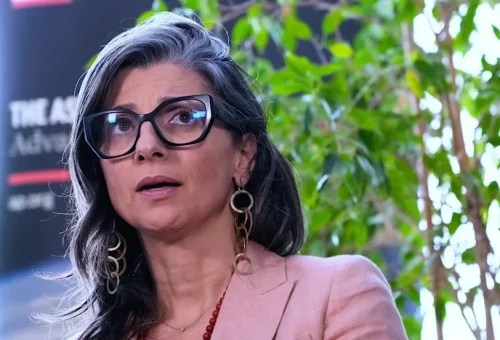
Germany has called for the resignation of UN Special Rapporteur for the Palestinian Territories Francesca Albanese, following remarks she made about the Israeli occupation regime during a forum organized by the Al Jazeera network in Doha.
German Foreign Minister Johann Wadephul said on Thursday that Albanese was no longer fit to continue in her mandate, citing what he described as repeated inappropriate statements.
“I respect the UN system of independent rapporteurs. However, Ms Albanese has made numerous inappropriate remarks in the past. I condemn her recent statements about Israel. She is untenable in her position,” Wadephul wrote on X.
Germany calls for Albanese’s resignation one day after France issued a similar demand, escalating diplomatic pressure on the UN official.
France calls for Albanese’s resignation
On Wednesday, France formally urged Albanese to step down over the same remarks.
French Foreign Minister Jean-Noel Barrot told lawmakers: “France unreservedly condemns the outrageous and reprehensible remarks made by Ms Francesca Albanese, which are directed not at the Israeli government, whose policies may be criticised, but at Israel as a people and as a nation, which is absolutely unacceptable,” arguing that the comments went beyond criticism of Israeli government policies and instead targeted “Israel” as a state and people.
Albanese’s Remarks at the Forum
Speaking via videoconference at the Doha forum on Saturday, Albanese criticized what she described as global complicity in the war on Gaza.
“The fact that instead of stopping Israel, most of the world has armed, given Israel political excuses, political sheltering, economic and financial support is a challenge. The fact that most of the media in the Western world has been amplifying the pro-apartheid genocidal narrative is a challenge. And here also lies the opportunity. Because if international law has been stabbed in the heart, it is also true that never before has the global community seen the challenges that we all face. We who do not control large amounts of financial capital, algorithms, and weapons now see that we, as humanity, have a common enemy, and that freedoms, the respect of fundamental freedoms, are the last peaceful avenue, the last peaceful toolbox that we have to regain our freedom.”
Following the controversy, Albanese posted the full video of her speech on X, writing:
“My full AJ Forum speech last week: the common enemy of humanity is THE SYSTEM that has enabled the genocide in Palestine, including the financial capital that funds it, the algorithms that obscure it and the weapons that enable it.”
Albanese has denied that her remarks described “Israel” as the “common enemy of humanity.”
In an interview with France 24, she denounced what she called “completely false accusations” and “manipulation” of her words.
“I have never, ever, ever said ‘Israel is the common enemy of humanity’,” Albanese told the broadcaster.
She contended that her comments were being misrepresented and maintained that she was referring to broader systemic structures enabling violations of international law in Gaza.
Mounting Diplomatic Pressure on the UN Mandate
The coordinated calls from Germany and France add to a growing campaign of political pressure surrounding Albanese’s mandate as UN special rapporteur for the Palestinian territories.
Her tenure has increasingly drawn opposition from Western governments, particularly following her reports on Gaza and her calls for accountability mechanisms, including action at the International Criminal Court. The US sanctions imposed in July 2025 marked an unprecedented step against a UN mandate holder and signaled Washington’s direct challenge to her work.
Hamas official says Netanyahu joining ‘peace council’ is a farce
MEMO | February 12, 2026
Osama Hamdan, a leader in the Islamic Resistance Movement (Hamas), said on Wednesday that the joining of Israeli Prime Minister Benjamin Netanyahu, who is wanted by the International Criminal Court, to the so-called “Peace Council” represents “the farce of the era.”
In remarks broadcast by Al Jazeera, Hamdan said the movement had not received from mediators any draft or official proposals concerning the weapons of the resistance.
He stressed that Hamas has not officially adopted any decision regarding freezing its weapons, and that its national position is firm in considering resistance a legitimate right as long as the occupation exists.
Hamdan stressed that the Palestinian people reject any form of external guardianship and cannot accept international forces replacing the Israeli army inside the Gaza Strip.
He added that the movement had contacted the Indonesian government and made clear that the role of any international force should be limited to deployment along the borders of the Gaza Strip to separate it from the occupation.
He said that any international stabilisation force, if established, should work to prevent attacks against the Palestinian people, in line with the plan proposed by US President Donald Trump.
Featured Video

Rewriting the risk? Inside the government’s vaccine safety messaging
or go to
Aletho News Archives – Video-Images
Book Review
“Davos Can Really Replace the UN”
Inside the book that maps the architecture behind global governance — from the Epstein files to the Pact for the Future
Lies are Unbekoming | April 1, 2026
On June 13, 2019, the United Nations and the World Economic Forum signed a partnership deal to “accelerate the implementation of the 2030 Agenda for Sustainable Development.” That same evening, WEF president Börge Brende — Norway’s former Foreign Minister — had dinner with Jeffrey Epstein at Epstein’s Manhattan townhouse. The Epstein files, released January 2026, contain an exchange between the two from the previous year. Epstein to Brende: “Davos can really replace the UN. C21, cyber, crypto . genetics… intl coordination.” Brende back to Epstein: “Exactly — we need a new global architecture. World Economic Forum (Davos) is uniquely positioned — public private.”
The next day, the UN General Assembly adopted the framework for restructuring global governance.
That sequence — the partnership signing, the Epstein dinner, the candid admission about replacing the UN with a public-private architecture, and then the formal adoption — opens Jacob Nordangård’s The Digital World Brain. Pages two and three. Footnoted to the UN resolution number, the Epstein files, and the General Assembly record.
I keep coming back to it because it captures what this book does that almost nothing else in the independent research space manages. I’ve followed Jacob’s work for years now and interviewed him about his research. Each book peels back another layer of the same institutional architecture, and each time I think he’s reached the limit of what can be documented, the next one goes further. Nordangård doesn’t speculate. He doesn’t editorialize much. He lays institutional actions next to each other in chronological order and lets the pattern announce itself. … continue
Blog Roll
 Aletho News
- The End of NATO
- 37 days of war on Iran cost US staggering $42bln, tracker shows
- Baghdad tells Asian refiners, traders to begin loading Iraqi crude amid Iranian exemption
- Under fire, Moscow and Tehran close ranks
- Iran, US receive Pakistan-mediated plan for ceasefire then final deal
- Iran submits demands for end to war as mediators scramble ahead of Trump deadline
- Iran Threatens Retaliatory Strike on Stargate AI Project in UAE
- US sent ‘a lot’ of arms to Iranian protesters – Trump
- Barak Ravid Launders Deception To Allow Trump To Back Off Of His Power Plant Threat – Again
- REWRITING THE RISK? INSIDE THE GOVERNMENT’S VACCINE SAFETY MESSAGING
- If Americans Knew
- Trump poised to “blow everything up” (ie. commit war crimes) in Iran – Daily Update
- In Iran, Israel-US take aim at “reason, research, and freedom of thought” – Daily Update
- US loses planes over Iran, Israel downgrades Lebanon war goals – Daily Update
- Israel Is Blocking Palestinians from Easter at Church Where Jesus Resurrected
- Plot to assassinate Palestinian activist follows harassment campaign promoted by Zionist groups and elected officials
- Prominent New York synagogue hosts presentation on why U.S. Jews should support the ethnic cleansing of Gaza
- Tapper vs. Piker: Is the CNN Anchor Auditioning for David Ellison?
- Shouldn’t Democrats Be Able to Condemn Genocide?
- Israel-US kill negotiators, destroy civilian structures, but Iran’s military capabilities still largely intact – Daily Update
- ‘War crime’: Global condemnation as Israeli ministers celebrate death penalty law targeting Palestinian prisoners
- No Tricks Zone
- An Inconvenient Tree: Uncovered In Alps… Europe Much Warmer Than Today 6000 Years Ago
- New Study Reports A 60% Slowdown In Greenland’s Ice Loss Rate In The Last Decade
- Low Intensity Tornado Wrecks Major Solar Farm, Creating A Potential Toxic Dump
- New Study Finds Warming Saves Lives…Cold Temperatures 12 Times More Deadly Than Excess Heat
- German Science Blog Accuses PIK Climate Institute Of Hallucinating Climate Tipping Points
- Devastating Assessment Of Comirnaty Vaccine By Former Senior Pfizer Europe Toxicologist
- New Study: CO2 Is ‘Effectively Negligible’ As An Explanatory Climate Change Factor Since 2000
- Former Pfizer Toxicologist Dr. Helmut Sterz Tells Bundestag Hearing Pfizer Vaccine Should Have Never Been Approved
- Energy Expert: Germany’s Nuclear Phaseout Was A “500 Billion Euro Mistake”
- New Research: South Australia’s Mid-Holocene Sea Surface Temperatures Were 4°C Warmer Than Today
 Aletho News