US Raqqa offensive killing more civilians than claimed – airstrike monitor
RT | July 3, 2017
UN warnings of the “staggering” number of civilian casualties in Raqqa, Syria that were denied by coalition commanders are no exaggeration, a monitoring group insists.
Airwars, a UK-based group that monitors airstrikes and civilian casualties in Iraq, Libya and Syria, reports it has tracked 119 alleged civilian casualty events at Raqqa, claiming up to 770 deaths, between June 6-29.
The coalition began its assault on the so-called capital of the Islamic State (IS, formerly ISIS/ISIL) caliphate, Raqqa, on June 6. It has been accused of having no plan in place for civilian evacuations, and Airwars reports a number of civilians have been killed attempting to flee in boats.
The United Nations Commissioner for Human Rights warned at least 173 civilians have been killed by air and ground strikes in Raqqa since June 1, saying this is “likely a conservative estimate and the real death toll may be much higher.”
The coalition’s Combined Joint Task Force – Operation Inherent Resolve (CJTFOIR) – denies the coalition isn’t being careful enough, with coalition commander General Stephen Townsend saying, “show me some evidence of civilian casualties.”
In June, the UN’s chair of the Independent International Commission of Inquiry on Syria, Paulo Pinheiro, warned the UN Human Rights Council that the fight in Raqqa shouldn’t be “at the expense of civilians,” saying it is “gravely concerned with the mounting number of civilians who perish during airstrikes.”
Pinheiro said the airstrikes had resulted in a “staggering loss of life.”
Townsend called the UN’s concerns “hyperbolic,” saying the coalition is being, “careful as we need to be and as we can be.”
“I would challenge anyone to find a more precise and careful campaign in the history of warfare on this planet,” he told the BBC last week.
“The UN’s Commission of Inquiry is one of a number of international agencies, NGOs and monitors which have expressed significant concern in recent weeks at high numbers of reported civilian fatalities around Raqqa from Coalition actions,” Airwars’ Chris Woods told RT.
“Rather than attacking the messengers, the US and allies should urgently examine their tactics at Raqqa, improving where necessary protections for civilians on the ground.”
“Our present estimate is that around 370-450 civilians have been killed by Coalition airstrikes and artillery at Raqqa in just three weeks,” Airwars said. The group is still working through a significant number of cases to garner a final number of civilian casualties for the month.
“All local monitors, plus UN agencies, reporting high civilian casualties at Raqqa for months. Gen Townsend comments smack of complacency,” Airwars said in tweet, pointing to the additional 132 civilian casualties in both Iraq and Syria that the coalition itself reported in June.
According to Airwars and its sources, the coalition has been targeting boats which are carrying civilians fleeing the battle. The coalition refers to such strikes as hitting “ISIS boats.”
“Four June cases where (mostly named) civilians reportedly bombed as they fled Raqqa by boat. Cars also being bombed as civilians flee,” Airwars said in a Tweet.
The coalition says it has nearly sealed off Raqqa, as the Syrian Democratic forces fight on the ground. Two bridges on the northern bank of the Euphates River have been destroyed by the coalition, “and we shoot every boat we find,” Townsend told the New York Times.
“If you want to get out of Raqqa right now, you’ve got to build a poncho raft,” he added.
Townsend’s comments don’t bode well for civilians desperate to flee the battleground. Between 50,000-100,000 civilians are believed to be trapped in the city.
Raqqa is Being Slaughtered Silently (RIBSS), a group of journalists with alleged ties to Turkish authorities, says people have been trying to flee the bombardment with help from local smugglers, but that IS have already planted hundreds of landmines and banned people from leaving. It has reported 358 civilian casualties in Raqqa in June, with 177 coming from ‘warplane attacks’.
Between June 21-26 specifically, 88 civilians have died or are missing after coalition shelling or bombing. At least 18 of these were fleeing via car or boat, according to RIBSS, as cited by the Daily Beast.
Human rights groups have also criticized the coalition for its use of white phosphorus near civilians, which is against international law.
READ MORE:
Civilian death toll rises to 484 from US-led coalition strikes in Iraq & Syria
Israel abducts Palestinian lawmaker on security allegations
Press TV – July 2, 2017
 Israeli military forces have abducted a Palestinian legislator and a senior member of the Popular Front for the Liberation of Palestine (PFLP) during separate raids across the occupied West Bank.
On Sunday morning, a large number of Israeli troopers raided the home of 55-year-old Khalida Jarrar in the central West Bank city of Ramallah, located 10 kilometers (six miles) north of Jerusalem al-Quds, and arrested her.
Her husband, Ghassan said Israeli forces seized computers during the raid.
Israel’s internal spy agency, Shin Bet, announced in a statement that Jarrar was arrested along with a Palestinian activist for “promoting terror activities,” without providing any further information.
Jarrar is one of the most outspoken critics of the Israeli occupation and has repeatedly slammed the Tel Aviv regime’s atrocities against Palestinians.
The Israeli regime has been denying the lawmaker the right to travel outside the occupied Palestinian territories since 1988. She campaigned for months in 2010 before receiving the permission to travel to Jordan for medical treatment.
In August 2014, Jarrar received a “special supervision order” from the Israeli military, instructing her to leave Ramallah to the West Bank city of Ariha (Jericho).
However, she set up a protest tent outside the Palestinian Legislative Council in Ramallah, where she lived and worked, until the controversial order was overturned later in September that year.
Israeli soldiers last arrested the Palestinian lawmaker on April 2, 2015 after storming her house in Ramallah. She was released from prison on June 3, 2016 on a suspended sentence of 12 months within a five-year period.
According to reports, a total of 13 Palestinian lawmakers are currently imprisoned in Israeli detention facilities.
Nine of them are being held without trial under the so-called administrative detention, which is a policy according to which Palestinian inmates are kept in Israeli detention facilities without trial or charge. Some Palestinian prisoners have been held in administrative detention for up to 11 years.
Palestinian MK enters prison with “pride”
Meanwhile, a Palestinian member of the Knesset (parliament) has headed to prison with “pride” as he began a two-year sentence on charges of giving cellphones and SIM cards to Palestinian prisoners in Israeli jails.
Basel Ghattas of the Joint List, a political alliance of four Arab-dominated parties in Israel, said he was entering prison with his “head held high” and with “support from my people.”

File photo shows Palestinian member of Knesset (Israel’s parliament) Basel Ghattas at his office at the Knesset in Jerusalem al-Quds
More than 6,500 Palestinians are reportedly held at Israeli jails. Hundreds of the inmates have apparently been incarcerated under the practice of administrative detention.
The Palestinian inmates regularly go on hunger strike in protest against the administrative detention policy and their harsh prison conditions.
Instead of Taylor Force Act, Congress should consider Rachel Corrie Act, Orwah Hammad Act

From top left: Emily Henoschowitz, Tariq Abukhdair, Brian Avery, Tristan Anderson, Rachel Corrie, Orwah Hammad.
By Kathryn Shihadah | If Americans Knew | June 30, 2017
Sometimes it takes a tragedy to bring about change. The story of Taylor Force is one such tragedy. A young American in the prime of his life was stabbed to death in an unnecessary, unprovoked act of terrorism while in Israel on a Vanderbilt University study program. Perhaps the only good that can come of such a dreadful event is in learning a lesson to ensure that it never happen again.
Our government wants to protect its citizens wherever they are in the world, so enacting some constructive legislation would be a smart move. Unfortunately, that’s not what Congress is currently contemplating.
The US Senate is debating a bill right now—the Taylor Force Act—that would prohibit foreign aid to the Occupied Palestinian Territories unless the Palestinian Authority ends stipends to the families of those who have been killed, injured, or imprisoned. Congressional reasoning is that the so-called “Martyrs’ Fund” encourages terrorism.
The United States currently gives The Palestinian Authority a relatively small amount of aid each year (in 2016 about $300 million, roughly 8 percent of what Israel receives); the Taylor Force Act would withhold about $230 million until the Fund disappears.
It is important to understand that this fund is not an incentive for Palestinians to commit terrorism. It is a social program to provide for the families of those killed, injured, or held prisoner by hostile forces.
Most of the fund provides for those killed or injured while peacefully demonstrating, defending their property, or going about their business, and the thousands wrongly imprisoned or detained without charge. This is the program that would be shut down by the Taylor Force Act.
The fund also supports Palestinians killed by Israel while using armed resistance – in the case of Taylor Force, a knife – against a country that has one of the most powerful, advanced militaries on earth.
It is customary for members of an oppressed population to resist. In fact, it is an internationally recognized right, as stated by the UN in 1982:
The General Assembly…reaffirms the legitimacy of the struggle of all peoples for independence….and liberation from…foreign occupation by all available means, including armed struggle.
Palestinians have engaged in this struggle for independence from foreign occupation since 1967, only to find themselves losing more lives, land, and rights every day.
Undeniably, the killing of Taylor Force and other civilians is a war crime, and it is legitimate to abhor such a crime–no matter the nationality of the criminal. All countries that engage in war have killed large numbers of civilians–nevertheless, all governments provide for the families of soldiers who have died in the line of duty. This includes the Palestinian government. Enabling these families to put food on the table is not an endorsement of any act of terrorism but a humane, compassionate act. No country should be required to withhold such support.
It must also be said that the shutdown of this social program would likely result in the opposite of the intended outcome: it may lead to yet more resentment and extremism.
Proposed legislation that could make things better, not worse
Perhaps instead of the Taylor Force Act, Congress should bring some other bills to the floor—bills that would begin to address the real problems in Israel/Palestine.
Here are a few suggestions.
 We could start with the Rachel Corrie Act, prohibiting the U.S. from giving aid to countries that practice home demolitions. Rachel Corrie was killed in 2003 as she worked in Palestine with the International Solidarity Movement (ISM). Rachel, clearly visible with a neon vest and bullhorn, confronted an IDF soldier on a bulldozer, about to demolish the home of a Palestinian pharmacist, when she was run over in what is widely believed to be a deliberate act.
The incident was investigated by the Israeli army and deemed “a regrettable accident” (as is often the case when Israelis are violent). An IDF spokesman explained that the group of protesters that day were “acting very irresponsibly, putting everyone in danger.” Interestingly, peacekeepers were the danger, not the demolition team at the home of an innocent man and his family.
The Rachel Corrie Act might discourage Israel from this ongoing, illegal practice. (Over 48,000 homes and other structures have been destroyed since the occupation began in 1967.) Rachel Corrie was from Washington, so Senators Patty Murray (D) and Maria Cantwell (D) from Washington should consider sponsoring such a bill. It might encourage Israel to desist from the collective punishment practice of demolishing homes.
Another idea for legislation would be the Brian Avery Act. This bill would prohibit the U.S. from giving aid to countries that use curfews as a form of collective punishment. Brian Avery was shot in the face in an unprovoked attack by Israeli soldiers during a curfew in the West Bank city of Jenin.
Curfews often last for days or weeks, sometimes even months, with only brief respites to obtain food. Sometimes the interludes are cut short without warning, and then enforced punitively. Palestinians have often been killed or injured during curfews; many more have their education disrupted, lose their jobs, or go out of business; the health of others suffers due to lack of medication or medical treatment. In addition, curfews often include home invasions and detentions.
Brian Avery, an American, was acting as an international observer during the curfew as he, like Rachel Corrie, worked for the ISM. He was wearing a reflective vest and had his hands up, but he was shot and seriously injured. His injuries were too severe to handle in the local hospital, but Israel spent several hours in negotiation before allowing him to be transported to an Israeli hospital. Even still, the ambulance was stopped at the border for an hour.
The investigation into this incident was completely botched and Brian’s injury was deemed “an unfortunate incident” because according to IDF Colonel Dan Hefetz, ISM activists “knowingly endanger themselves.” The Brian Avery Anti-Curfew Act might stop this dangerous form of collective punishment from causing any more tragedies. Brian came to Palestine from New Mexico, so Martin Heinrich (D) and Tom Udall (D) should consider sponsoring the bill. It could save the lives, careers, businesses, and health of many Palestinians.
Another possible piece of legislation would be the Emily Henoschowitz Act, which would limit aid to countries that illegally besiege another country or practice piracy on the high seas. Emily Henoschowitz is an Israeli-American who got involved with ISM in 2010 when she found the Palestinian situation too compelling to ignore.
 While Emily was in Palestine, the Gaza Freedom Flotilla, loaded with humanitarian aid and construction materials for Gaza, was attacked by Israel. Nine Turkish citizens (one also an American citizen) were killed. When Emily heard about this incident, she joined in a demonstration. She was hit in the face with a tear gas canister.
Emily resents the attention she has gotten over her injury, compared to hordes of Palestinians who are injured or killed daily without notice. “I’m white, I’m Jewish, I’m an Israeli citizen and American,” she points out. “When I’m hit by tear gas there are articles, the Israeli government gets involved. When Palestinians are hit, who gives a s***?”
The root of this issue is not Emily’s presence at a demonstration or even the act of piracy against the Freedom Flotilla. The root is the siege of Gaza—now in its tenth year—that necessitated international intervention. The siege by Israel has sealed off Gaza by land, sea, and air, and destroyed the region’s economy. Combined with “wars” against the people of Gaza, contaminated water, and electricity shortages—all perpetrated by Israel—the siege is the real problem. The Emily Henoschowitz Act might cause Israel to finally pull back its brutal blockade. Emily is from Maryland, so Senators Ben Cardin (D) and Chris Van Hollen (D) should bring some accountability by sponsoring this bill.
The Tristan Anderson Act would limit U.S. aid to countries that restrict other countries’ freedom of movement by building barriers. In 2009, Tristan Anderson was in the town of Ni’lin, at one of the weekly demonstrations against the West Bank Barrier. Most of Ni’lin’s residents get their income from agriculture, and the wall was set to cut farmers off from 1/3 of their land.  Israeli Border Police rarely allow such protests occur without reprisal. ISM describes the incident: “Tristan was shot in the face from about 60 meters away, crushing his skull, blinding him in one of his eyes, and sending shards of bone penetrating deep into his brain.” This occurred after the demonstration had finished.
Investigation showed that at the time of the incident, Tristan was half a mile from the wall and had not been near it for hours. Why he was shot with a tear gas canister is not clear—no one has given an explanation. Meanwhile, eight years later, “Tristan continues to require around the clock care because of cognitive impairment and physical disability. He is also paralyzed on half his body and uses a wheelchair.”
The “good” news is that Israel has since begun using a less lethal method of crowd control in Ni’lin. It is nicknamed “skunk water,” [see this video] and Reuters paints a vivid picture of the practice: “Imagine taking a chunk of rotting corpse from a stagnant sewer, placing it in a blender and spraying the filthy liquid in your face. Your gag reflex goes off the charts and you can’t escape, because the nauseating stench persists for days.”
In an official statement that denies freedom of speech and assembly to both Palestinians and visitors, the IDF announced its regret that “foreign nationals co-operate with violent rioters against the building of the security fence, whose purpose is saving the lives of Israeli citizens. [Anyone] who illegally participates in a violent demonstration takes upon himself the risk of personal harm during the dispersal of these disturbances.” The Tristan Anderson Anti-Barrier Act could give Israel the motivation to tear down that wall and so that Palestinians can enjoy the freedom that all people deserve. Tristan is from California, and his senators, Dianne Feinstein (D) and Kamala Harris (D) ought to sponsor this bill in order to encourage the deconstruction of the Wall.
Congress might also consider a Tariq Abukhdeir Act, which would limit U.S. funding of countries that imprison and/or detain minors. Tariq Abukhdeir is an American citizen who was visiting his family in Palestine for the summer. His cousin Mohammed had been burned alive in a horrific act just a day earlier by Israeli settlers.
 In the summer of 2014 Tariq, then 15 years old, was severely beaten by two Israeli police, then dragged and repeatedly kicked before being arrested for allegedly throwing stones. He adamantly denied the charge, but remained in prison for several days. In spite of a video of the assault, “showing at least two Israelis methodically delivering blows to Tariq’s limp body,” only one officer was prosecuted. He was found guilty and sentenced to 45 days of community service.
This case got wide attention because Tariq is an American citizen. At least 8,000 Palestinian children have been arrested since 2000 and placed in a military detention system “notorious for the systematic ill-treatment and torture of Palestinian children.” Most are accused of throwing stones, which carries a potential maximum sentence of 10 to 20 years.
As for adults, If Americans Knew reports, “Since the Israeli occupation of Palestinian territory in 1967, more than 800,000 Palestinians have been detained under Israeli military orders in the occupied Palestinian territory. This number constitutes approximately 20 percent of the total Palestinian population in the oPt and as much as 40 percent of the total male Palestinian population.”
The United States should not tolerate this excessive incarceration–especially of minors. The Tariq Abukhdeir Act might cause Israel to think twice before imprisoning children. Bill Nelson (D) and Marco Rubio (R) of Florida, Tariq’s home state, need to lead the way by sponsoring this bill.
And finally, Congress should propose the Orwah Hammad Act, which would cut off funding to any country that encourages the practice of building of settlements inside other countries. Orwah Hammad, an American citizen, was 14 years old in 2014 when he participated in a weekly demonstration in the town of Silwad. He was shot in the neck with a live bullet, and died that night. During his funeral, IDF soldiers fired rubber-coated steel bullets and tear gas.
Silwad residents have been fighting for their property and livelihood for 20 years, since Israel confiscated much of their farmland to build a settlement. This is an illegal act under international law.
International law hasn’t stopped Israel from building over 250 settlements all over the West Bank, with approximately 500,000 Israeli settlers. In addition to the built-up areas, Jewish-only roads and closed military zones—also illegal—give Israel control of fully fifty percent of the West Bank. The Orwah Hammad Anti-Settlement Act might cause Israel to rethink the wisdom of breaking yet another international law. Senators John N. Kennedy (R) and Bill Cassidy (R) of Orwah’s home state of Louisiana should sponsor the bill.
The stories of Rachel, Brian, Emily, Tristan, Tariq, and Orwah have been heard around the world because they are—or were—American citizens. A handful of European advocates for Palestinians have also been killed or injured, and have also made the papers. A number of Israelis have also tragically died or been hurt. But thousands of Palestinian children, women, and men have died; tens of thousands have been injured; hundreds of thousands live in poverty; millions are without hope and without help.
The Taylor Force Act would lead to more suffering for Palestinians, and more boldness on the part of Israel, as US complicity would only reinforce Israel’s current actions. Home demolitions, detention of minors, the West Bank barrier, settlements, curfews, and skunk water would all continue unchecked.
These illegal practices and collective punishment methods only make Palestinians angrier and more hopeless, resulting in an ever-escalating cycle of violence.
The Foreign Assistance Act, which “prohibits…assistance to any country which engages in a consistent pattern of gross violation of internationally recognized human rights,” sounds like it can be applied to Israel. Why are we forking over $10 million a day, $3.5 billion a year, to the Israeli government?
The answer is in the fine print: “except when extraordinary circumstances exist which necessitate continuation of such assistance or the national interest of the United States requires such assistance.” Our leaders seem to think Israel’s continued human rights abuses are in our best interest.
How is a system of oppression and illegal occupation, that births resentment and violence, good for America? Or Israel? Or anyone?
Kathryn Shihadah is a staff writer for If Americans Knew.
Germany approves bill to fine social media up to €50mn over online hate speech, fake news
RT | June 30, 2017
The German parliament has voted to fine social media networks up to €50 million ($56 million) if they fail to remove hateful content or fake news. The networks will be given 24 hours to block or delete any inappropriate content.
“Freedom of speech ends where criminal law begins,” Justice Minister Heiko Maas said, adding that the measure “end[s] the internet law of the jungle.”
The law gives social media 24 hours to remove or block the illegal content. If a case is more complicated, the platform will be given a week to deal with it. The networks also obliged to report back to those who filed the complaint about the case details and how they dealt with it.
The measure won’t be imposed after only one violation, but only after a company systematically refuses to delete or block illegal content, the bill suggests.
The companies will have to publish a report every six months, describing in detail how they have dealt with complaints of hate speech on their platforms, the bill suggests.
According to Maas, who proposed the bill back in March, the number of hate crimes in Germany jumped by over 300 percent in the last two years.
“This law is the logical next step for effectively tackling hate speech since all voluntary agreements with the platform providers have been virtually unsuccessful,” the Central Council of Jews in Germany said, praising the measure, as cited by Reuters.
However, the companies affected, including Facebook, did not welcome the bill, saying it could crack down on free speech.
“This law as it stands now will not improve efforts to tackle this important social problem,” a Facebook statement said.
“We feel that the lack of scrutiny and consultation do not do justice to the importance of the subject. We will continue to do everything we can to ensure safety for the people on our platform.”
A Facebook spokesperson told RT in an emailed statement that the company has always viewed hate speech as a serious issue, but does not believe that the German law can “improve efforts to tackle this important societal problem.”
“We share the goal of the German government to fight hate speech. We have been working hard on this problem and have made substantial progress in removing illegal content,” the statement read.
Facebook said it was adding 3,000 people to its community operations team, on top of the 4,500 it already has, and was “building better tools to keep our community safe.”
“We believe the best solutions will be found when government, civil society and industry work together and that this law as it stands now will not improve efforts to tackle this important societal problem. We feel that the lack of scrutiny and consultation do not do justice to the importance of the subject,” it added.
In the “background points” provided with the statement, Facebook said that the law was criticized by legal experts for being rushed through parliament despite contradicting the German constitution and EU laws.
According to the company, the legislation would allow deleting “content that is not clearly illegal” and shift complex legal decision-making from the government to tech firms.
In May Reporters Without Borders said the group “fears censorship resulting from German law on online hate content.”
“RSF opposes this bill, which would just contribute to the trend to privatize censorship by delegating the duties of judges to commercial online platforms and making them decide where or not content should be deleted, as if the Internet giants can replace independent and impartial courts,” said Elodie Vialle, the head of RSF’s Journalism and Technology desk.
US court verdict allows seizure of tower owned by Alavi Foundation
Press TV – June 29, 2017
A US court verdict has allowed the American government to seize an office tower in New York City owned largely by an Iranian charity organization, the Alavi Foundation.
A jury on Wednesday claimed that the charity was controlled by the Iranian government and the rent generated from the tower constituted a violation of US sanctions against Iran.
The verdict means that federal prosecutors can move ahead with their attempt to seize the building at 650 Fifth Avenue in Manhattan. The Alavi Foundation is likely to appeal the verdict.
The government plans to sell the property, which is valued at more than $500 million, and distribute much of the proceeds to victims of terrorist attacks.
The finding “represents the largest civil forfeiture jury verdict and the largest terrorism-related civil forfeiture in US history,” Joon H. Kim, the acting US Attorney in Manhattan, said in a statement.
The Iranian government has said it has no links with the Alavi Foundation.
Prosecutors first sought to seize the tower in 2008.
In 2014, US District Judge Katherine Forrest granted authority to federal prosecutors to confiscate the building. However, an appeals court reversed that ruling last year.
The assets of the Alavi Foundation included the building in Manhattan, as well as Islamic centers consisting of schools and mosques in New York City, Maryland, California, Texas and Virginia.
American Legal scholars said they know of only a few cases in US history in which law enforcement authorities have seized a house of worship. Without rent from the office building, the Alavi Foundation would have almost no way to continue supporting the Islamic centers.
The Alavi Foundation, a non-profit organization established in 1978, works to advance the Islamic and Persian culture in the US.
In the last four decades, the organization has also given millions of dollars to American schools, universities and charitable organizations; among them Harvard, Columbia and Rutgers university.
Whither Japan’s democracy?
By Daniel Hurst | Asia Times | June 27, 2017
To some observers, protester Hiroji Yamashiro, 65, has become a symbol of modern Japan’s uneasy attitude towards dissent.
The retired civil servant, a long-standing campaigner against the US military presence in the southern prefecture of Okinawa, was detained for five months from October last year before he was released on bail in March.
Yamashiro admitted cutting a barbed wire fence, but pleaded not guilty to subsequent charges of injuring a defense official and obstructing relocation work by placing blocks in front of a gate.
According to his supporters, Yamashiro is a tireless peace advocate whose continued detention was disproportionate to his alleged behavior.
To the authorities who arrested him, his actions went beyond those of peaceful protest and transgressed criminal laws.

Hiroji Yamashiro, 65, a campaigner against the US military presence in Okinawa prefecture, addresses the Foreign Correspondents’ Club of Japan. Photo: Daniel Hurst
Either way, his yet-to-be-finalized case has attracted so much international attention that he was invited to travel to Geneva earlier this month to address the UN Human Rights Council.
Now Yamashiro is seeking to shine a spotlight on Japan’s new anti-conspiracy law, which according to human rights groups and lawyers risks increased government surveillance and arbitrary arrest.
“The fact that a country like Japan has passed such a terrible law indicates the extent to which democracy is in retreat in this country,” the head of the Okinawa Peace Movement Center said during a press conference in Tokyo late last week.
“It’s something that I feel very sad about and very angry about and I would like the international community to focus upon it.”
Terror justification
Japan’s postwar constitution guarantees freedom of thought, conscience, assembly, association, speech, press “and all other forms of expression” – yet critics say they see a gradual erosion of those rights.
Such concerns grew when Japan’s ruling bloc pushed the anti-conspiracy bill through the upper house in mid-June.
Prime Minister Shinzo Abe and his government argued the legislation would help prevent terrorism ahead of large-scale events like the Tokyo 2020 Olympic and Paralympic Games.
The law targets two or more persons who, “as part of activities of terrorist groups or other organized criminal groups,” plan to carry out certain criminal acts.
The 277 crimes covered by the law also include planning to steal forestry products or to breach copyright. Jail terms of up to five years are possible depending on the crime.
When a UN special rapporteur warned Japan’s government in an open letter that the vague legislation could usher in “undue restrictions” on freedom of expression and privacy, the authorities reacted angrily.
The criticism was called “one-sided” and “obviously inappropriate,” with government officials saying they had not been given a chance to provide information before the letter was published.
Abe, whose popularity has slipped in recent opinion polls, moved to assure the country that “ordinary people” would not face investigation.
“Although we feel [the law] is essential for strengthening international coordination in dealing with terrorism, we’re aware that some members of the public remain uneasy and concerned about it,” the prime minister said at a press conference last week.
International backlash
The UN special rapporteur for privacy, Professor Joseph Cannataci, highlighted the vague definition of planning and preparatory actions and the “over-broad range of crimes” covered.
He told Asia Times he had felt compelled to write the open letter because of the extremely short legislative deadline that the government had set itself.
Cannataci, an independent expert appointed by the UN Human Rights Council, described the official response as “disappointing but not surprising.” He said he was “the third UN special rapporteur in a row whom the Japanese government has decided to be confrontational with.”
“I stand by every single word, full-stop and comma in my letter of the 18th May,” Cannataci said in an email this week.
“If anything, the way the Japanese government has behaved in response to my letter has convinced me even further of the validity of its content and the appropriateness of its timing and form.”
He added: “There has been a deafening silence on the part of the Abe government on the privacy safeguards which I have alleged are missing in Japanese law and the Japanese government has failed to explain, in public or in private, how the new law provides new remedies for privacy protection in a situation where it creates the legal basis where more surveillance could be carried out.”
Japan’s chief cabinet secretary, Yoshihide Suga, said last month: “It is not at all the case that the legislation would be implemented arbitrarily so as to inappropriately restrict the right to privacy and freedom of speech.”
‘Chilling effect’
Cannataci’s concerns are shared by a number of non-government organizations.
Hiroka Shoji, an East Asia researcher at Amnesty International, said the definition of an organized crime group was not limited to terrorist cells.
“Civil society organizations working on areas around national security can be subjected to this category,” Shoji said in an email.
Kazuko Ito, secretary general of the advocacy group Human Rights Now, said in an email: “Even if the judiciary narrowly determine and exonerate the targeted people in the end of the day, they are already targeted for arbitrary surveillance, wiretapping, arrest or detention – these are enough to smash civil society activities and will cause a significant chilling effect.”
Justice minister, Katsutoshi Kaneda, denies that the legislation is vague, arguing it is “expressly limited to organized criminal groups, the applicable crimes are listed and clearly defined and it applies only once actual preparatory actions have taken place.”
Anti-base protester Yamashiro, who was charged under pre-existing laws, views the new legislation as “a great threat”.
“I was arrested for obstruction of a public official, but under the new legislation even if you don’t do what it is that is against the law – if you’re just planning it or discussing it with other people – that is enough basis for an arrest to be made,” he said.
Press freedom concerns
The concerns come against a backdrop of claims that press freedom is deteriorating in Japan. The country declined in the global press freedom rankings issued by Reporters Without Borders, from 11th in 2010 to 72nd in the most recent review.
However, the reliability of that ranking is questioned by some observers.
The academic and consultant Michael Thomas Cucek, for example, has previously pointed to the “astonishing” volatility in Japan’s ranking and raised the possibility of the surveyed experts exaggerating the extent of repression in their own country.
Methodology questions aside, the UN special rapporteur for freedom of expression, David Kaye, has identified what he called “significant worrying signals” in Japan.
“The direct and indirect pressure of government officials over media, the limited space for debating some historical events and the increased restrictions on information access based on national security grounds require attention lest they undermine Japan’s democratic foundations,” Kaye wrote in a report published in May.
Kaye called for safeguards to be added to the state secrets law enacted in late 2013, which allows bureaucrats to be jailed for up to 10 years for revealing specially designated information.
Under Article 25 of the state secrets law, journalists could potentially face a prison term of up to five years under a provision targeting “a person who conspires with, induces or incites another person” to release such secrets.
However, the law offers protection to news reporting “as long as it has the sole aim of furthering the public interest and is not found to have been done in violation of laws or regulations or through the use of extremely unjustifiable means.”
The Japanese government has said it “does not intend to apply Article 25’s harsh penalties to journalists.” And in a broader rebuke to Kaye, it said most of his arguments were based on hearsay or assumptions.
“It is hard for the government of Japan to avoid expressing sincere regret concerning those biased recommendations,” the government said in a formal response.
It cited the constitutional guarantee of freedom of expression and added that “there is no such fact that government of Japan officials and members of the Japanese ruling party have put pressure on journalists illegally and wrongfully.”
Jeff Kingston, director of Asian studies at Temple University Japan, said officials were unlikely to act on previous comments by some lawmakers about the possibility of suspending broadcasting licenses for bias.
“But just making noises about doing so sends a chilling message, a shot across the bow of an already cowering media that may constrain coverage,” Kingston wrote in the book Press Freedom in Contemporary Japan, published earlier this year.
California Scheming: Single-Payer Betrayed By The Democrats Again
By Jim Kavanaugh | The Polemicist | June 26, 2017
Nothing better illustrates the political bankruptcy of the Democratic Party—for all progressive intents and purposes—than California State Assembly Speaker Anthony Rendon’s announcement on Friday afternoon that he was going to put a “hold” on the single-payer health care bill (SB 562) for the state, effectively killing its passage for at least the year.
The Democratic Party finds itself in a bind in California. They hold the governorship and a supermajority in both houses of the legislature, so they can pass any bill they want. SB 562 had passed the Senate 23-14.
There was enormous enthusiasm among California progressive activists, who, with organizations like Campaign for a Healthy California (CHC,) and the National Nurses United (NNU,) and the California Nurses Association (CNA) were working tirelessly, and hopeful of success. After all, Bernie’s people were taking over the California party from the bottom since the election. I recall a night of drinking last year with an old friend who has been spearheading that effort, as he rebuffed my skepticism, and insisted that this time there would be a really progressive takeover of the California party, and single-payer would prove it. After all, once enough progressive pressure was been put on the legislators, the bill would be going to super-progressive Democratic Governor, Jerry Brown, who had made advocacy of single-payer a centerpiece of his run for President in 1992, saying: “We treat health care not as a commodity to be played with for profit but rather the right of every American citizen when they’re born.” Bernie foretold.
Unfortunately, today that Governor is, according to Paul Song, co-chair of the CHC, “doing everything he can to make sure this never gets on his desk.” And it won’t. Unfortunately, all the Democrats like Rendon, who “claims to be a personal supporter of single-payer,” will make sure that their most progressive governor is not put in the embarrassing position of having to reject what he’s been ostensibly arguing for for twenty-five years, of demonstrating so blatantly what a fraud his, and his party’s, progressive pretensions are.
Thus unfolds the typical Democratic strategy: Make all kinds of progressive noises and cast all kinds of progressive votes, while carefully managing the process so that the legislation the putatively progressives putatively support never gets enacted. Usually, they blame Republican obstructionism, and there certainly is enough of that, and where there is, it provides a convenient way for Democrat legislators to “support” legislation they know will be blocked and wouldn’t really enact themselves if they could.
In the California case, the dissembling is obvious. The Republicans can’t be blamed. The only thing standing in the way of single-payer in California is the Democratic Party. As it was on the national level in 2009, when Obama and the Democrats could have passed any healthcare bill they wanted, just as they passed the Republican-inspired gift to the for-profit health insurance industry, the ACA—without a single Republican vote. It was true-believing capitalist Democrats like Max Baucus, led by Obama and his sidekick Rahm Emanuel (who called leftists “fucking retarded”) who arrested single-payer activists (including doctors) in order to prevent single-payer from even being considered. It was they who strong-armed reluctant Democratic legislators, who had signed an oath not to do so, into passing a bill that leaves 28 million Americans without health insurance, and forces the rest into plans whose premiums rise and networks of coverage shrink every year.
In fact, the perfectly reasonable discontent with that plan probably had more to do with helping Trump win than did any actions of bad-old (as opposed to good-new) James Comey. As Marcy Wheeler pointed out, in an analysis that’s contested but should certainly not be ignored, Hillary’s fatal slide in the polls began before Comey’s notorious letter of October 28th, and coincided with the announcement, four days before, of steep Obamacare premium increases. You decide whether you think Anthony Weiner’s sexting emails, part three, had more effect on voters than anger over being hit with stiff premium increases (22% average, 25% in 20 states, 60% in some) on increasingly crappy policies:
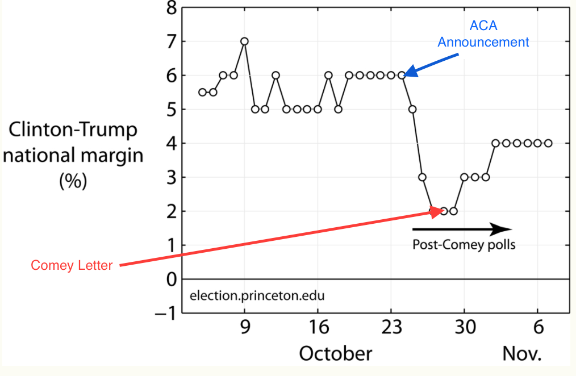
So the Democrats create the ground for Trump by passing a lousy healthcare law that’s sure to piss people off rather quickly, then use the even worse plan that the Republicans come up with to do nothing but trash Trump, while blocking real progressives’ attempts to get the only plan that would actually cover all Americans and save money. In Colorado last November, Democratic Governor John Hickenlooper refused to support a single-payer referendum because he “didn’t want to disrupt” the “strides [made] under Obamacare.” The Democrats’ ACA marched the nation straight into the shoals of Trump and the Republicans’ ACHA, and now the Democrats are blocking the only plan that solves the problems of both.
As Deborah Burger, Co-President of the California Nurses Association put it, Assembly Speaker Rendon, “Acting in secret in the interests of the profiteering insurance companies late Friday afternoon abandons all those people already threatened by Congress and the Trump administration.”
The excuse, of course, from California Democrats and Governor Jerry Brown is that they don’t know how they are going to pay for it, especially on the state level. That would be the same Jerry Brown who explained in 1992 exactly how single-payer would cut costs:
You cut out all the private health insurance. You have one single payer either at the national level or through the 50 states. And that one single payer will be the one that negotiates with the doctors, the hospitals, and the other providers. And since you have only one source of income in the whole medical establishment, you can drive down the cost.
Leaving aside the indispensable point that healthcare, like education and clean water, should be considered a non-discretionary expense, one of the main advantages of single-payer is precisely that it’s the only plan that can cut costs significantly. Not having single-payer will not mean healthcare will cost less; it will cost more every year, for every person and in the aggregate. It just means the for-profit insurance and pharmaceutical companies won’t care. The real problem with single-payer isn’t about costs to the people or to the state; it’s about profits for those companies.
Besides, an economy the size of California has immense power. We’re not talking about Utah. All the hospitals and doctors and pharmaceutical companies are not going to stop selling their goods and services in California. And once single-payer becomes a reality in California, it will catalyze a movement in every other state and on the national level. That—the fact that it will start a wildfire of imitation—and not the fact that it’s too expensive, is what the California Democratic Party is desperate to avoid, and what its donors and lobbyists are ordering it to block.
This is the Democratic Party. Lying losers who will do anything to avoid taking an effective stance for a healthcare policy that would immediately solve one of the worst horrors American families face every day, that would be immediately and concretely helpful to everyone, and, to top it all off, would be immensely popular. The dissembling Democrats are throwing away just about the most popular policy anyone could imagine—something people are literally dying for. As Charles Idelson, spokesman for the NNU, says: “There is broad support for single-payer not only in California, but nationally, even among registered Republicans and Republican and conservative business leaders.”
Passing single-payer in California and fighting for it everywhere else would guarantee the Democrats electoral victories. But they will not do it—they’ll say they will, but they will not—because they are fervent supporters of the capitalist market system in healthcare (and everything else), and they are corrupt agents of the health insurance and pharma industries.
Because it captures and cages the energies of so many well-meaning progressives, the Democratic Party is the most effective obstacle to, and enemy of, single-payer, and it has to be fought. People in wheelchairs and cancer patients and all their healthy friends should be sitting in and obstructing Democrat Rendon’s, as well as any Republican’s, office, until he lets the bill through. Then they should move on to the Democratic governor’s office. And thence to Pelosi’s and Schumer’s offices as well as Graham’s and Ryan’s. This is not a Trump problem, and not a Republican problem, it’s a bipartisan capitalist elite problem.
We have to engage in this kind of fight against all of these politicians. Anyone who thinks such a fight can be avoided in order to play the Democrats’ game of defending the for-profit insurance plan called Obamacare while obsessing about Trump being a Russian spy, is helping to perpetuate this rotten healthcare system. Twenty-eight million people are now without healthcare, and, if the Republicans’ edited version of Obamacare passes (which it probably won’t, because even many Republicans know they can’t get away with making things worse than they are), there’ll be twenty-four million more. There is no time for either of these contemptuous parties and their contemptuous bullshit.
___________________
Related:
The Obamacare Death Spiral, Who’s the Boss? The Obamacare Deception
The Age of No Privacy: The Surveillance State Shifts Into High Gear
By John W. Whitehead | The Rutherford Institute | June 26, 2017
“We are rapidly entering the age of no privacy, where everyone is open to surveillance at all times; where there are no secrets from government.” ― William O. Douglas, Supreme Court Justice, dissenting in Osborn v. United States, 385 U.S. 341 (1966)
The government has become an expert in finding ways to sidestep what it considers “inconvenient laws” aimed at ensuring accountability and thereby bringing about government transparency and protecting citizen privacy.
Indeed, it has mastered the art of stealth maneuvers and end-runs around the Constitution.
It knows all too well how to hide its nefarious, covert, clandestine activities behind the classified language of national security and terrorism. And when that doesn’t suffice, it obfuscates, complicates, stymies or just plain bamboozles the public into remaining in the dark.
Case in point: the National Security Agency (NSA) has been diverting “internet traffic, normally safeguarded by constitutional protections, overseas in order to conduct unrestrained data collection on Americans.”
It’s extraordinary rendition all over again, only this time it’s surveillance instead of torture being outsourced.
In much the same way that the government moved its torture programs overseas in order to bypass legal prohibitions against doing so on American soil, it is doing the same thing for its surveillance programs.
By shifting its data storage, collection and surveillance activities outside of the country—a tactic referred to as “traffic shaping” —the government is able to bypass constitutional protections against unwarranted searches of Americans’ emails, documents, social networking data, and other cloud-stored data.
The government, however, doesn’t even need to move its programs overseas. It just has to push the data over the border in order to “[circumvent] constitutional and statutory safeguards seeking to protect the privacy of Americans.”
Credit for this particular brainchild goes to the Obama administration, which issued Executive Order 12333 authorizing the collection of Americans’ data from surveillance conducted on foreign soil.
Using this rationale, the government has justified hacking into and collecting an estimated 180 million user records from Google and Yahoo data centers every month because the data travels over international fiber-optic cables. The NSA program, dubbed MUSCULAR, is carried out in concert with British intelligence.
No wonder the NSA appeared so unfazed about the USA Freedom Act, which was supposed to put an end to the NSA’s controversial collection of metadata from Americans’ phone calls.
The NSA had already figured out a way to accomplish the same results (illegally spying on Americans’ communications) without being shackled by the legislative or judicial branches of the government.
The USA Freedom Act was just a placebo pill intended to make the citizenry feel better and let the politicians take credit for reforming mass surveillance. In other words, it was a sham, a sleight-of-hand political gag pulled on a gullible public desperate to believe that we still live in a constitutional republic rather than a down-and-out, out-of-control, corporate-controlled, economically impoverished, corrupt, warring, militarized banana republic.
In fact, more than a year before politicians attempted to patch up our mortally wounded privacy rights with the legislative band-aid fix that is the USA Freedom Act, researchers at Harvard and Boston University documented secret loopholes that allow government agents to bypass Fourth Amendment protections to conduct massive domestic surveillance on U.S. citizens.
Mind you, this metadata collection now being carried out overseas is just a small piece of the surveillance pie.
The government and its corporate partners have a veritable arsenal of surveillance programs that will continue to operate largely in secret, carrying out warrantless mass surveillance on hundreds of millions of Americans’ phone calls, emails, text messages and the like, beyond the scrutiny of most of Congress and the taxpayers who are forced to fund its multi-billion dollar secret black ops budget.
In other words, the surveillance state is alive and well and kicking privacy to shreds in America.
On any given day, the average American going about his daily business is monitored, surveilled, spied on and tracked in more than 20 different ways by both government and corporate eyes and ears.
Whether you’re walking through a store, driving your car, checking email, or talking to friends and family on the phone, you can be sure that some government agency, whether the NSA or some other entity, is listening in and tracking your behavior. This doesn’t even begin to touch on the corporate trackers that monitor your purchases, web browsing, Facebook posts and other activities taking place in the cyber sphere.
We have now moved into a full-blown police state that is rapidly shifting into high-gear under the auspices of the surveillance state.
Not content to merely transform local police into extensions of the military, the Department of Homeland Security, the Justice Department and the FBI are working to turn the nation’s police officers into techno-warriors, complete with iris scanners, body scanners, thermal imaging Doppler radar devices, facial recognition programs, license plate readers, cell phone Stingray devices and so much more.
Add in the fusion centers, city-wide surveillance networks, data clouds conveniently hosted overseas by Amazon and Microsoft, drones equipped with thermal imaging cameras, and biometric databases, and you’ve got the makings of a world in which “privacy” is reserved exclusively for government agencies.
Thus, the NSA’s “technotyranny” is the least of our worries.
A government that lies, cheats, steals, sidesteps the law, and then absolves itself of wrongdoing cannot be reformed from the inside out.
Presidents, politicians, and court rulings have come and gone over the course of the NSA’s 60-year history, but none of them have managed to shut down the government’s secret surveillance of Americans’ phone calls, emails, text messages, transactions, communications and activities.
Even with restrictions on its ability to collect mass quantities of telephone metadata, the government and its various spy agencies, from the NSA to the FBI, can still employ an endless number of methods for carrying out warrantless surveillance on Americans, all of which are far more invasive than the bulk collection program.
Just about every branch of the government—from the Postal Service to the Treasury Department and every agency in between—now has its own surveillance sector, authorized to spy on the American people.
And of course that doesn’t even begin to touch on the complicity of the corporate sector, which buys and sells us from cradle to grave, until we have no more data left to mine. Indeed, Facebook, Amazon and Google are among the government’s closest competitors when it comes to carrying out surveillance on Americans, monitoring the content of your emails, tracking your purchases, exploiting your social media posts and turning that information over to the government.
“Few consumers understand what data are being shared, with whom, or how the information is being used,” reports the Los Angeles Times. “Most Americans emit a stream of personal digital exhaust — what they search for, what they buy, who they communicate with, where they are — that is captured and exploited in a largely unregulated fashion.”
It’s not just what we say, where we go and what we buy that is being tracked.
We’re being surveilled right down to our genes, thanks to a potent combination of hardware, software and data collection that scans our biometrics—our faces, irises, voices, genetics, even our gait—runs them through computer programs that can break the data down into unique “identifiers,” and then offers them up to the government and its corporate allies for their respective uses.
All of those internet-connected gadgets we just have to have (Forbes refers to them as “(data) pipelines to our intimate bodily processes”)—the smart watches that can monitor our blood pressure and the smart phones that let us pay for purchases with our fingerprints and iris scans—are setting us up for a brave new world where there is nowhere to run and nowhere to hide.
For instance, imagine what the NSA could do (and is likely already doing) with voiceprint technology, which has been likened to a fingerprint. Described as “the next frontline in the battle against overweening public surveillance,” the collection of voiceprints is a booming industry for governments and businesses alike.
As The Guardian reports, “voice biometrics could be used to pinpoint the location of individuals. There is already discussion about placing voice sensors in public spaces… multiple sensors could be triangulated to identify individuals and specify their location within very small areas.”
Suddenly the NSA’s telephone metadata program seems like child’s play compared to what’s coming down the pike.
That, of course, is the point.
The NSA is merely one small part of the shadowy Deep State comprised of unelected bureaucrats who march in lockstep with profit-driven corporations that actually runs Washington, DC, and works to keep us under surveillance and, thus, under control.
For example, Google openly works with the NSA, Amazon has built a massive $600 million intelligence database for CIA, and the telecommunications industry is making a fat profit by spying on us for the government.
In other words, Corporate America is making a hefty profit by aiding and abetting the government in its domestic surveillance efforts.
At every turn, we have been handicapped in our quest for transparency, accountability and a representative government by an establishment culture of secrecy: secret agencies, secret experiments, secret military bases, secret surveillance, secret budgets, and secret court rulings, all of which exist beyond our reach, operate outside our knowledge, and do not answer to “we the people.”
Incredibly, there are still individuals who insist that they have nothing to fear from the police state and nothing to hide from the surveillance state, because they have done nothing wrong.
To those sanctimonious few, secure in their delusions, let this be a warning.
There is no safe place and no watertight alibi.
The danger posed by the American police/surveillance state applies equally to all of us: lawbreaker and law-abider alike, black and white, rich and poor, liberal and conservative, blue collar and white collar, and any other distinction you’d care to trot out.
As I make clear in my book Battlefield America: The War on the American People, in an age of too many laws, too many prisons, too many government spies, and too many corporations eager to make a fast buck at the expense of the American taxpayer, we are all guilty of some transgression or other.
Eventually, we will all be made to suffer the same consequences in the electronic concentration camp that surrounds us.
Israel refuses entry to UNESCO group expected to visit Hebron’s Old City

Ma’an – June 26, 2017
BETHLEHEM – Israeli authorities have refused to grant entry visas for a United Nations Educational, Scientific and Cultural Organization (UNESCO) investigative team scheduled to conduct a field visit to the Old City in the southern occupied West Bank district of Hebron in advance of an upcoming vote next month to consider the area an endangered world heritage site, Israeli media reported on Sunday.
While Palestinian authorities had planned to introduce the site for consideration on UNESCO’s World Heritage List for 2018, they decided to fast track the site’s application owing to routine Israeli violence in the Old City, which Palestinians have claimed threatens the integrity of the site, and instead propose the area as an endangered site.
A Palestinian delegation to UNESCO had reportedly expressed the “alarming details about the Israeli violations in Al-Khalil/ Hebron, including the continuous acts of vandalism, property damage, and other attacks,” in a letter to the World Heritage Center.
Since Israel took over the West Bank in 1967 and began advancing Israeli settlements across Palestinian territory in violation of international law, Hebron has been a flashpoint for Israeli settler violence on Palestinians and their properties.
The Ibrahimi Mosque, known to Jews as the Cave of the Patriarchs, in the Old City where the Prophet Abraham is believed to be buried has been a focal point of such violence for decades, as the site is holy to both Muslims and Jews and has been a prime site for Israeli settler activities in the area.
The UNESCO team’s visit is aimed at assessing whether or not the Old City of Hebron is actually endangered, and would submit these findings to the International Council on Monuments and Sites (ICOMOS), a body that provides recommendations to UNESCO involving sites that could be considered on the World Heritage in Danger list.
According to The Jerusalem Post, other protected sites in the occupied Palestinian territory, including the Church of Nativity in Bethlehem, the ancient terraces of Battir, and the pilgrimage route in Bethlehem, had also been fast tracked by Palestinian authorities in previous years to include them on UNESCO’s World Heritage in Danger list.
Israel’s Ambassador to UNESCO Carmel Shama Hacohen reportedly said that the UNESCO group was being rejected entry into Israel owing to the fact that ICOMOS had advised against considering the previous sites in the occupied territory as endangered and instead recommended that Palestinian authorities continue with the normal process.
UNESCO, however, had rejected these recommendations by ICOMOS for the Church of Nativity and Battir. Hacohen said that due to these past decisions by UNESCO to ignore recommendations made by ICOMOS, it would be “a shame to waste the time and money” of the committee.
He went on to denounce what he considered “Palestinian political moves under the guise of culture and heritage,” and added that UNESCO’s consideration of the site represented “lies that plot against the state of Israel as well as the history and the connection of the Jewish people to this important holy site.”
The Old City, which is under full Israeli military control, is home to some 30,000 Palestinians and around 800 Israeli settlers who live under the protection of Israeli forces.
UNESCO is scheduled to decide on the status of the Old City during a conference in Krakow, Poland from July 2-12. The vote is expected to include a clause rejecting Israeli sovereignty over occupied East Jerusalem, which Israel annexed in 1980 in a move never recognized by the international community.
Meanwhile, Israeli media site Ynet reported that Israeli authorities have been scrambling to collect the seven votes needed to block the motion.
Ynet also said that in the “context of a peace process,” the inclusion of Hebron’s Old City into UNESCO’s World Heritage List would “impose limits on Israeli construction, the protection and development of the site and on specific areas in the vicinity,” and expressed worry that Israel would “be condemned each time it erects a security checkpoint or conducts work in the area on the grounds that is is damaging a world heritage site.”
However, Israeli activities in Hebron and the rest of occupied Palestine have long been condemned by rights groups and the international community as human rights abuses against the Palestinian people and a threat to any future peace agreements, while the some 500,000 to 600,000 Israeli settlers in the occupied West Bank are residing there in contravention of international law.
Israel has accused the United Nations and its respective bodies of being “anti-Israel” for its stances against the now half-century occupation of the Palestinian territory, including East Jerusalem.
Such allegations have escalated following the passing of UN Resolution 2334, which condemned Israel’s settlement building in Palestinian territory. The US had taken Israel by surprise at the time by abstaining from the vote, in a split from its typical objections to such moves.
Earlier this month, US Ambassador to the United Nations Nikki Haley said that the UN could no longer “bully” Israel over its violations of international law, and said that “we are not going to let that happen anymore.”
US President Donald Trump had also denounced the UN resolution, and even warned in a Twitter post last year that “things will be different” following his inauguration.
Earlier this year, the US House of Representatives even passed a resolution confirming US commitment as a diplomatic ally to the Israeli government, and demanded that the US government dismiss any future UN resolutions they deemed “anti-Israel.”
Featured Video

Seyed M. Marandi: US-Iran War Inevitable: Kuwait and Bahrain May Fall
or go to
Aletho News Archives – Video-Images
From the Archives
Oil and the Israel Lobby
Reknowned economist M. Shahid Alam offers this excellent critique of Noam Chomsky’s defective analysis of the relative influence of Oil versus the Israel lobby over US foreign policy: … continue
Blog Roll
 Aletho News
- ICC ignored ‘very well-documented’ NATO crimes – ex-Libyan minister
- SNSC secretary dismisses US response to Iran’s conditions as ‘inadequate’
- Sanaa says Taiz roads open, secure for residents, warns Saudi forces
- Iraqi resistance group urges Saudi leadership to admit defeat, lift Yemen siege
- Trump’s Retreat: How Al-Aqsa Flood Took Down the US Empire
- Israel’s Military Actions in Lebanon Grossly Violate International Law — Lavrov
- Seyed M. Marandi: US-Iran War Inevitable: Kuwait and Bahrain May Fall
- Leaders Condemn Ansarallah Attack on Saudi Arabia While Ignoring Illegal War Against Yemen
- Leaked: Britain’s Covert Iraqi Psyops Network
- Yemeni Armed Forces Warn Airlines Against Using Saudi Airports, Exempt Mecca and Medina
- If Americans Knew
- How Israel Conquered the Latin American Right
- Agents search Rep. Omar’s Washington home in criminal probe as she vows she won’t ‘be silenced’
- “The Rule Was: ‘Shoot Everyone You See'”
- Israel goes ballistic over Nobel Laureate Navi Pillay
- U.S. May Join Yet Another Middle Eastern War — TCN
- Yellow Line moves again as Israel closes in on trapped Gazans – Daily Update
- Israeli Attacks Kill Seven Palestinians in Gaza Including Six-year-old Girl
- Gaza: Ceasefire Anniversary Marks Year of Failed Promises
- The American Conservative: Mike Huckabee Should Resign
- A C-Section in Shackles: A Palestinian Woman’s Harrowing Birth in Israeli Detention
- No Tricks Zone
- Germany’s Green Energy Debacle: High Energy Costs Force Kahla Porzellan to Close After 182 Years!
- New Study: 50 Years Of The Most Aggressive ‘Net Zero’ Policies Can Only Affect The Global Climate By 0.03°C
- US September “Heat” Was No Record…Many Records Set Decades Ago
- Latest European Green Energy Debacle; Portugal’s Largest Flagship Solar Park Insolvent!
- Green Energy Debacle: German Expert Professor Fritz Vahrenholt Warns Of Severe Economic And Social Consequences
- Two More Paleo Reconstructions Affirm Meters-Higher Sea Levels Across Ireland, Brazil 7000-6000 Years Ago
- New Study: Earth And Venus Surface Warmth Largely Explained By Convection And Lapse Rate, Not CO2 Or Radiation
- 2025 Nature Paper Claiming Worsening Global Drought Gets RETRACTED …Heavily Flawed
- New Study: ‘Global Drought Shows No Detectable Recent Acceleration Under Climate Warming’
- Economic Masterminds: German Socialists Suggest Taxing Productivity Gains Stemming From Using AI

