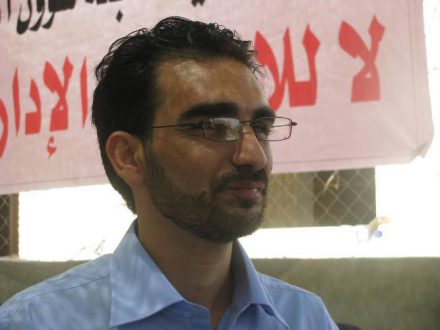
On Friday, 28 April, Thaer Halahleh, former long-term hunger striker in Israeli prisons, was seized by occupation forces at a suddenly placed checkpoint near Bethlehem, when his vehicle was stopped by israeli occupation forces.
Halahleh, from the village of Kharas near al-Khalil, was reportedly taken from the car, his hands tied and taken to an as-yet unknown destination, reported Asra Voice, quoting Halahleh’s family.
He has been seized by Israeli occupation forces on multiple occasions and has spent over nine years in Israeli prisons, most of them in administrative detention, imprisonment without charge or trial. He was most recently released in October 2016; he had been imprisoned without charge or trial since July 2014.
Halahleh engaged in a 77-day hunger strike in 2012, winning his freedom from administrative detention without charge or trial in June 2012 alongside fellow administrative detainee Bilal Diab. He was arrested again in April 2013 and released in May 2014, before being once again arrested and imprisoned without charge or trial.
Halahleh suffers from Hepatitis C, contracted during a dental operation in Israeli prisons where improper sterilization was used. During his previous imprisonment, Halahleh was denied family visits with his wife and children for seven months, and received only painkillers as treatment for his illness.
On 17 April, 1500 Palestinian prisoners launched a hunger strike for a series of demands, including the right to family visits, appropriate medical care, and the end of administrative detention, imprisonment without charge or trial. Protests throughout occupied Palestine and internationally have grown in support of the strikers, with former prisoners often in the leadership of these events.
Roger Waters, the primary composer and lyricist of Pink Floyd during their most prominent years has for decades, used his music to convey a message of peace and humanity. He has typically got it right and occasionally gets it wrong.
One issue he has got totally right is the issue of Palestinian suffering at the hands of Israeli war, occupation and economic blockade. For over ten years, Waters has made the issue of Palestinian freedom a central point in his music and accompanying dramatic stage shows.
Waters is part of the Boycott-Divestment-Sanctions movement which encourages individuals to boycott Israeli products and tourism. Waters uses his status as a ‘music legend’ to highlight the plight of Palestinians. In 2012 he spoke at the United Nations on the issue. He frequently pens open letters to fellow musicians asking them to refrain from performing in Israel until a meaningful peace settlement is reached.
Waters is a perfect example of how the media-industrial complex punishes individuals who do not fit the tired stereotype of a veteran rock star.
Late last year, a grossly under-reported story explained how American Express ditched a planned sponsorship deal with Waters for his 2017 tour in a move which was said to be worth $4 million.
American Express like any other company has the right to refuse sponsoring any individual or organisation however they see fit. But in doing so, American Express has shown that they are willing to sponsor events of every variety including politically charged music performances by Beyonce.
Why then is American Express put-off by Roger Waters’ embrace of the Palestinian movement?
Are they opposed to Waters’ calls to end the starvation and medical deprivation of Palestinian children?
Are they opposed to Waters’ pleas for justice and democracy for Christians, Muslims and Jews in the region?
Are they appalled by his anti-war message?
Where many celebrities use anodyne political causes to enhance their status, I can see no evidence that Waters has profited from his endorsement of Palestine. Quite the contrary is true. It seems that his message of peace for everyone and hatred for no one has cost him millions.
Waters described the situation in his music industry in the following way,
“My industry has been particularly recalcitrant in even raising a voice (against Israel). There’s me and Elvis Costello, Brian Eno, Manic Street Preachers, one or two others, but there’s nobody in the United States where I live. I’ve talked to a lot of them, and they are scared shitless.
If they say something in public they will no longer have a career. They will be destroyed. I’m hoping to encourage some of them to stop being frightened and to stand up and be counted, because we need them. We need them desperately in this conversation in the same way we needed musicians to join protesters over Vietnam”.
The fact is that most musicians neither win nor lose the majority of their fan-base because of politics. The fact is that most people buy albums and concert tickets based on the fact that they like the sound of a song or enjoy singing along with the lyrics, even if they’re hardly paying attention to what the lyrics mean.
But for those who do care, the reaction to Waters’ Palestine politics is shocking. If Waters was advocating for genocide, cruelty, hatred or imperialism, I would agree that his concerts should be boycotted. But the fact that he is advocating for precisely the opposite of the aforementioned things makes the position of American Express seem not only extreme, but illogical.
Roger Waters is being punished for free speech on a subject that ought not to be controversial. The fact that some find it controversial demonstrates how low and beastly the nature of modern debates about human rights have become. No innocent people deserve to be suppressed, repressed and occupied, but that is exactly what is happening to the Palestinians and it has been happening for decades.
I personally disagreed with Roger Waters’ statements about Donald Trump and I also disagreed with his characterisation of Leonid Brezhnev on the otherwise stellar 1983 Pink Floyd album The Final Cut. But at no time would I seek to shut down Waters’ free speech or his ability to peacefully perform what millions consider to be important pieces of music in a peaceful and safe environment.
American Express has shamed its own reputation by treating Roger Waters in the way they have done. Roger Waters remains undeterred and will continue to tour his new show across the world.
As someone who has seen Waters perform many times, I highly recommend it, even for those who disagree with his views but enjoy a challenge.
Baltimore County police – an early adopter of body cameras spending $12.5 million of taxpayer money in the name of transparency – is withholding footage in three police-involved shooting incidents.
County police shot six people in four separate incidents since January, killing two of them, according to theBaltimore Sun, which first broke the story.
Body cameras captured all of the shootings but footage has only been made available in one case. Police said the other cases are still being investigated, or the county prosecutors have told them the footage is evidence in upcoming trials.
“Release could compromise the prosecution and the defendant’s right to fair trials,” Baltimore County police spokeswoman Elise Armacost said in a statement to the Sun.
Armacost said those releases were quick because there were no charges against a suspect.
The missing footage involves three incidents.
In March, two officers investigating a convenience store robbery in Woodlawn shot a vehicle rushing towards them killing a 20-year-old, and injuring two others.
On April 12, police shot a 27-year-old man suspected of breaking into cars in Parkville who police said reached into his waistband.
Nine days later, an officer shot a woman who was a passenger in a stolen car that was being pursued by police.
The department first deployed body cameras last July, with the promise of a gradual rollout through December 2018, after fast-tracking $12.5 million program to equip officers.
The program was accelerated after a series of shootings, including the fatal shooting of Korryn Gaines, 23, and the wounding of her 5-year old son in August 2016 during a standoff in Randallstown. The shooting was not recorded. That led to County Executive Kevin Kamenetz and then-police chief Jim Johnson to speed up the program.
Currently about 550 of the county’s 1,900 officers have body cams. More than 1,400 are to have cameras by the end of this September.
Kamenetz wouldn’t comment on the lack of transparency but his spokesperson, Ellen Kobler, said he had been clear from the beginning “that footage from police body cameras has been and will continue to be released without delay as soon as it can be determined that the release of the footage will not compromise an ongoing investigation.”
The police previously released footage from a case in December when an officer shot and wounded a man who had opened the door of his apartment carrying a knife and saying “Time to die! Time to die!”
County prosecutors ruled the shooting justified.
In another incident in January, footage was released of a police officer fatally shooting a man who had threatened his family and who had raised a “powerful scoped rifle” as an officer was talking to him.
Kamenetz then replaced Police Chief Johnson with Terry Sheridan, who had previously been the chief.
Armacost said there had been no change in policy since Sheridan took over.
The ACLU of Maryland called attempts to withhold the footage “concerning.”
“Despite lip service being paid to transparency and accountability, both their policies and in their actions, what we are seeing is the opposite,” said David Rocah, an attorney with the organization. He said the footage means “we don’t simply have to take officer’s word for what happened in particular situation.”
Cole Weston, president of the Baltimore County Fraternal Order of Police Lodge No. 4, said he’s not in favour of video footage being released to the public before an investigation is closed.
“I think everybody should be cautious about just looking at… one particular piece of what happened,” he told the Sun. “Body camera footage is one piece of information that is captured as it related to an entire incident.”
Neither Netanyahu nor his ministers, who are suffering from hysteria as a result of the courageous Palestinian prisoners staging a hunger strike, have hesitated to call the prisoner leaders murderers.
The Israeli racism machine has not stopped making proposals characterised by severe cruelty and disgrace, such as the suggestion made by Israeli Minister of Intelligence and Transportation, Yisrael Katz, to execute prisoners. Defence Minister, Avigdor Lieberman, also suggested that the prisoners on hunger strike are left to starve to death, which is what happened with the Irish activists led by Bobby Sands.
With the same degree of disgrace, the Israel Prison Service decided to build a military field hospital that allows it to use the internationally prohibited method of “force feeding” because civilian doctors and their union refuse to commit this crime against the prisoners.
The brave Marwan Barghouthi does not need anyone to defend him. His article in the New York Times skilfully put the occupation in the docks, and he never killed anyone with his hands. The most important question here is: Who did? What is the record of Israeli leaders themselves? Those who are honoured in some international forums and are even awarded peace prizes.
Wasn’t Menachem Begin a murderer, responsible for the Deir Yassin massacres, as well as the other crimes committed by his organisation, Irgun, such as the bombing of the King David Hotel and the killing of Brits, Palestinians and Jews?
Furthermore, he and Yitzhak Shamir added to their record the assassination of the UN mediator, Count Bernadotte, and other international diplomats.
Didn’t the former Israeli Prime Minister and Defence Minister, Ehud Barak, use his hands and weapon to kill Kamal Nasser, Kamal Adwan, Abu Yousef Al-Najjar and his wife in Beirut? His unit also assassinated the Palestinian leader Abu Jihad in Tunisia.
Wasn’t it Shimon Peres who ordered the Qana massacre, killing women and children in a UN shelter in Lebanon?
Didn’t Netanyahu, Tzipi Livni and Barak all commit war crimes during the successive attacks on the Gaza Strip, which claimed the lives of thousands of martyrs, including hundreds of children? A file of these crimes is now on the ICC’s table.
Do we need to remind the Israeli ministers of Ariel Sharon’s past in the Qibya massacre in 1953, killing the Egyptian prisoners in 1967, and in the Sabra and Shatila massacre, which surpassed all other massacres in atrocity in 1982.
The Palestinian people have not and will not forget.
However, the world must remember. It is its duty to support the struggle of the prisoners who are practicing the most peaceful forms of struggle and the noblest form of popular resistance by staging a hunger strike. This is the only weapon they possess while trapped in Israeli prisons.
On Friday, we participated in a demonstration in the Jerusalem villages near Ofer Prison. We tried hard to raise our voices so that the prisoners inside would hear us, although they don’t need to hear us to know that their entire nation is behind them.
We had young boys with us who were born and lived their entire lives, like their parents, under occupation, oppression and discrimination.
These boys are not in need of incitement to become fighters. Their lives and suffering drives them to this, but their presence reminded us that the future generation of hope and victory is growing and maturing, despite the oppression, torture and attempts to spread frustration and despair; despite the escape of those who grew tired of the burdens of the struggle.
The Palestinian fighters are not killers, they fight for freedom and they create life and hope. They are willing to sacrifice their lives for the sake of their people’s freedom.
I bet the majority of Israeli ministers think of no one else other than themselves, their position and their future wealth.
That is why we are optimistic and they are pessimistic, drowning in their racism.
This coming Sunday, April 30th, at 5PM, there will be a panel discussion entitled “The Post Political Condition… Trump, Brexit, and The Middle East… What Next? at Theatre 80 located at 80 St. Marks Place on the Lower East Side (LES) of New York City.
Timely, and simple enough in its reach, this discussion will include myself and a number of intellectuals such as history professor Norton Mezvinsky, whistle blower Michael Lesher and author Gilad Atzmon. The panel will focus on the collapse of identity politics, the crises within new left thinking, and the future of liberal and progressive thought.
In particular, I will discuss “Insular View of the American Left” while Professor Mezvinsky will speak to “The Quagmire of Current Political Terminology in U.S. Society.” Mr. Lesher will explore dichotomy between “Jewish Identity and Jewish Religion” and Mr. Atzmon will address “The Tyranny of Correctness- deconstructing identity politics and understanding its origin.”
Although the panel will necessarily touch upon Zionism, Israel, and events in the Middle East, these topics will play but a small part in a much broader exploration of the political winds of today.
To some, the subject matter of the discussion is apparently of less consequence than the makeup of the panel itself. In particular, the presence of Gilad Atzmon, a onetime Israeli citizen and Jew who has since renounced both, has triggered an organized effort to bully the theatre into canceling the event or, failing that, to disrupt it.
I’ve long been accused of being a “self-hating” Jew largely because of my work as legal counsel for the political wing of Hamas and my fervent opposition to the state of Israel as one built from the marrow of ethnic cleansing.
Described as controversial because of my opposition to Zionism, and a long list of revolutionary clients and movements that have included more than a few accused of domestic or international terrorism, I’ve grown accustomed to being “shunned ” by the political opposition that rarely seeks to engage in public discussion or debate. That’s fine. For some, it’s so much easier to toss barbs from the safety of the shadows then it is to withstand open exposure for the weakness of one’s thought.
Yet, Gilad Atzmon presents another picture. Mr. Atzmon’s stinging criticisms of Zionism, Jewish identity… perhaps even Judaism itself… have so enraged both Zionists and some anti-Zionists alike, that the mob seeks to silence him and thereby deny us all the benefit of his speech.
Censors of thought are not new to time or place. Throughout history, they have deigned to dictate the parameters of acceptable dialogue and, when unable to control the discourse, have sought to shut it down as if ideas are in themselves dangerous.
One need only look to recent events in Washington D.C. to understand that those who fear the market place of free ideas often seek to shutter it whether by economic intimidation or through resort to violence.
Just this past month, JDL (Jewish Defense League) imports from Canada brutally attacked, and seriously injured, a 55-year old Palestinian-American professor from North Carolina who had the temerity to pass an anti-AIPAC demonstration with his family.
The mindless brutality of the Canadian JDL members, that day, cannot be seen in a vacuum but rather must be viewed in the light of 50 plus years of terrorism carried out by its US counterpart, now formally designated as an outlawed terrorist organization.
Over these many years, the membership, indeed, leadership of the American branch of the JDL… or “associate organizations”… have unleashed an unprecedented reign of terror which has produced dozens of convictions for crimes ranging from a plot to bomb the office of Arab-American Congressman Darrell Issa and the King Fahd Mosque in Culver City, Calif. to numerous bombings of foreign embassies and properties to attacks on US buildings to conspiracies of kidnap and murder to assaults on foreign nationals and US police. Countless other crimes, including murder and conspiracy to bomb, have been laid at the feet of the JDL but to date remain un-charged.
Despite this documented, nay, unprecedented history of violent attacks by zio-fascists upon free speech and association, neither the JDL of Canada nor its US counterpart will suppress this panel discussion at Theatre 80 or silence our voice. Ours is a community of free spirits and thinkers. Women and men directed by little more than the pursuit of truth and justice.
Indeed, long ago the community of the LES of New York City opened its arms to refugees who fled tyranny abroad and, in so doing, became a welcome host to the dissident, the politically unpopular, the revolutionary idea or person.
Today, that greeting is under attack by some who have failed to learn the history of this community that I have called home for most of my adult life. A journey down the hardscrabble, but exhilarating, road of this community of resistance can say far more than I can about the necessity of the exchange of ideas that will occur this coming Sunday evening at Theatre 80.
The History of Dissent on the Lower East Side
Long before the free speech battles of the 60’s, or the recent ones at Berkeley, there stood a proud tenement building at 208 East 13th Street in New York City. More than a hundred years ago, it echoed with the booming resonance of resistance… a declaration of who we were at the time and, more important, who we could become if only we dared to challenge political and social orthodoxy.
Today, on the façade of that old battered 19th century tenement building on the LES of Manhattan sits a cracked and stained plaque that simply says “Emma Goldman lived here.” Enough said.
The same building was home to “Mother Earth,” Goldman’s periodical that promoted anarchist views and provided a platform for “radical” artists and militant ideas of the day… until it was closed as subversive by the government in 1917.
Goldman was a fierce and tireless supporter of “controversial” revolutionary struggles such as free speech, birth control, women’s equality, union organizing, workers rights, sexual freedom and peace.
Known as “Red Emma”, she was labeled by J. Edgar Hoover as one of the “most dangerous women” in the country.” Among her closest friends and comrades were Alexander Berkman, Margaret Sanger, Roger Baldwin, Max Eastman, John Reed, Dorothy Day and Floyd Dell… a veritable who’s who of radicals who, long ago, confronted political convention not all that different from that which seeks to intimidate or to silence us today.
In 1917, Goldman was sentenced to two years in prison after founding the No-Conscription League in protest against the draft. It was one of several stints she did, beyond bars, for political beliefs that ranged from a year in prison for “inciting to riot”… for a speech she gave at a Union Square hunger demonstration where she told the poor to steal bread if they could not afford to buy it… to another one for illegally distributing information about birth control. Following her arrest during the notorious Palmer Raids that began on November 7, 1919 (the second anniversary of the Russian Revolution), she was deported to Russia along with some 250 other “subversive aliens.”
While the Palmer Raids occurred throughout the United States with more than 10,000 arrests for subversion, they, in particular, targeted hundreds of high profile “militants” who were rounded up on the LES which was then home to a powerful and vibrant community of revolutionary thinkers and activists.
In the life blood of the LES, Goldman has been anything but the exception to the rule in a community that historically has been home to the dissident… the unconventional… those who see more to life than surrender to the whims of politically correct dogma or the constraints of “patriotic” mobs.
Dorothy Day heard the call of the LES. Along with Peter Maurin, she founded the Catholic Worker Movement which, with anarchists and communists, fought for the rights of the homeless, workers, women, immigrants and others disempowered by virtue of gender or class.
Although the Movement found its vigor in Christian charity and promoted a political strategy of total non-violence, Day was never one to shy away from direct action. Jailed for picketing the White House in support of women’s right to vote, while imprisoned for her offense, she helped organize a hunger strike at Occoquan Prison.
It is said that, over the course of a long life of civil disobedience, Day was arrested more than one hundred times. A poster memorializing her final arrest at age 76 declares “our problems stem from our acceptance of this filthy rotten system.” It hangs from the wall of my office.
To Dorothy Day, peaceful resistance necessarily demanded of activists’ controversial speech that directly confronted the tyranny of the status quo… something she excelled at while working as the editor of The Masses.
Based in “Alphabet City” in the LES, Masses was a radical magazine that reported on most of the major labor struggles of its day: from the Paint Creek-Cabin Creek strike of 1912 in West Virginia to the Paterson Silk Strike of 1913 and the Ludlow massacre in Colorado. It strongly supported Big Bill Haywood and his IWW, the political campaigns of Eugene V. Debs and vigorously argued for birth control and women’s suffrage.
At other times, the radical history of the LES has been marked not just by controversial speech or passive resistance alone, but by direct action that, on occasion, has exploded into violence captivating the watch of the rest of New York City as if this one hundred square block area is very much of a different world.
Thus, on January 13, 1874, over 7,000 largely unemployed workers gathered in Tompkins Square Park, in the largest demonstration New York City had ever seen, to demand financial assistance from the City during an economic depression.
Without warning, not long after the demonstration began, some 1,600 policemen charged the park and dispersed most of the crowd beating people throughout it with clubs. Others, on horseback, cleared the surrounding streets. Some of the demonstrators fought back in vain… attempting to defend the square. Hundreds were injured.
Samuel Gompers, himself a resident of the LES, who founded the American Federation of Labor (AFL) and was scheduled to address the demonstration that day, described the events and his experiences:
“. . . mounted police charged the crowd on Eighth Street, riding them down and attacking men, women, and children without discrimination. It was an orgy of brutality. I was caught in the crowd on the street and barely saved my head from being cracked by jumping down a cellar-way.”
Little more than a century later, on August 6, 1988, Tompkins Square Park exploded yet once again when police attacked a large group of peaceful demonstrators protesting a newly established curfew intended to clear the park of activists, homeless and so-called squatters that had made increasing use of Tompkins Square for demonstrations against the City and its misuse of local community space. Bystanders, activists, neighborhood residents and journalists were caught up in the violence.
Despite a brief lull in the fighting, the mêlée continued until 6 a.m. the next day. Numerous injuries resulted with over 100 complaints of police brutality lodged following the riot. One headline in the New York Times summed up the events: “Yes, a Police Riot.”
St. Marks Place
If Tompkins Square Park is the heart of the East Village, St. Marks Place is its soul. James Fenimore Cooper lived at 6 St. Marks from 1834-1836. While there, he published his epic “A letter To My Countrymen.” It proved to be his most scathing work of social criticism in which he denounces the “slavery of party affiliations.”
In 1917, Leon Trotsky arrived on St. Marks Place where he wrote for the Novy Mir (“New World”), then based at 77 St. Marks, while living with his family across the street in an apartment at 80 St. Marks. Just a few years earlier, Berkman and Goldman opened the progressive Modern School at No. 16 St. Marks. Among its teachers were famed muckrakers Jack London and Upton Sinclair.
Elsewhere on the Lower East Side, throughout the 60’s, political activists, movements and artists alike continued its well established tradition of serving as a safe haven for cultural diversity, political dissidents and controversial speech.
For example, just up the block from what had been the home of Charlie Parker, stands the Christodora House. Located on Avenue B, directly across the street from Tompkins Square Park, the Young Lords and Black Panther Party maintained their respective headquarters during this period.
The Young Lords, in particular, played an important role in what was, and remains, a heavily Latino neighborhood… creating community projects similar to those of the Black Panthers but with a Latino flavor. Such projects included a free breakfast program for children, the Emeterio Betances free health clinic, community testing for tuberculosis and lead-poisoning, free clothing drives, cultural events and Puerto Rican history classes. The female leadership in New York pushed the Young Lords to fight for women’s rights.
80 St. Marks Place
The venue for Sunday’s panel discussion has a storied history itself in the LES. Beginning as a nightclub during Prohibition, 80 Saint Marks Place was home to performers that included such Jazz greats as Thelonious Monk, Harry “Sweets” Edison, John Coltrane and Frank Sinatra.
After Theatre 80 was established in the former nightclub, its tradition of diversity in the arts continued as it launched the careers of famous performers including the likes of Gary Burghoff, Bob Balaban and Billy Crystal, who once worked there as an usher.
Richard “Lord” Buckley, described by Bob Dylan in his book “Chronicles” as “the hipster bebop preacher who defied all labels”, had his final performance at Theatre 80 when his cabaret card was seized by police from the vice squad and his show closed. Outraged, Buckley went to the local precinct to demand his card’s return. Not long thereafter he ended up dead in St. Vincent’s Hospital of an apparent stroke. That brought about a movement which eventually ended the Cabaret Card system in New York City.
Not many years later, the legendary play “Hair” was cast at Theatre 80. During the 1970s and 80s it also served as a revival house where one could see vintage films. Among those who attended, often to see their own body of work was Gloria Swanson, Joan Crawford, Myrna Loy,Ruby Keeler and Joan Blondell.
More recently Theatre 80 presented a play by noted poet, playwright, author and racial equality activist, Sonya Sanchez. Fred Hampton Jr. was often seen at the theatre to attend events for famed radical defense attorney, Lynne Stewart, who recently died having been politically persecuted and imprisoned for her life’s work.
Actively involved in a wide range of community issues, the theatre, not long ago, along with Patti Smith, sponsored a concert to raise money for the victims of the Second Avenue gas explosion which caused two deaths, injured at least nineteen people… four critically… and completely destroyed four buildings between East 7th Street and St. Marks Place. It has held a number of so-called “truther” forums that explored the events of 9-11… an issue of burning interest to the local community.
Come this Sunday, the panel discussion will proceed in the ideal venue in the perfect community. To be sure, at times, its participants will surely say things that may offend the sensibilities of some in the audience. On occasion, panel members will disagree with one another as the market place of ideas is not a group-speak but rather a challenge to explore diverse and often competing thoughts in the pursuit of truth.
Ideas may sting, they may hurt, and they may challenge us to explore issues that can cause great personal discomfort. That’s precisely what they are intended to do. There is no question that while the clash of ideas causes pain; the suppression of ideas causes greater harm… and sometimes pain is the stretch of growing.
Thanks to the refusal of Lorcan Otway, owner of Theatre 80, to surrender to howls of a few, join us this Sunday, April 30 at 5PM in the heart of the ongoing American evolution at Theatre 80, 80 St. Marks Place in the Lower East Side of New York City.
Stanley L. Cohen is lawyer and activist in New York City.
For more than a century Canadians have gone abroad to do “good” in poorer parts of the world. Whether they spurred positive change or simply became foreign agents should be of interest to international non-governmental organizations.
Last week the Globe and Mailreported on the Canadians Christians who set off to proselytize in China in 1891. Focused on their medical achievements, the laudatory story hinted at a darker side of their work. It quoted a missionary who was “critical of the lifestyle most of the missionaries led, with their large houses, many servants and imported comforts which contrasted with the far lower standard of living of their Chinese fellow Christians.”
Of more consequence than their opulence, Canadian missionaries aggressively supported colonial officials, as I discovered researching Canada in Africa: 300 years of aid and exploitation. By the end of the colonial period 2,500 Canadian missionaries were proselytizing in Africa and Canadian churches raised large sums to support mission stations across the continent.
Four Québec Jesuit fathers left for the Zambesi Mission in southern Africa in 1883. Alphonse Daignault rose through the ranks of the Catholic male congregation to become Prefect Apostolic of Northern Rhodesia (Zambia). Then Superior of the Jesuits’ Zambezi Mission, Daignault backed the British South Africa Company’s invasion of Mashonaland (Zimbabwe) in 1890. With their evangelizing shunned by the Ndebele people, the Jesuits and other foreign missionaries supported the “destruction of [the] Ndebele system.”
Granted a charter from London in 1889, Cecil Rhodes’ British South Africa Company offered white men in Kimberley, South Africa, 3,000 acres of land and mining rights if they joined the Company’s fight to conquer part of today’s Zimbabwe. Daignault offered the invading force chaplaincy services, mobile ambulances and nurses. The British South Africa Company paid the Jesuit nurses’ costs and compensated Daignault’s mission with conquered territory, including a major piece of land on the outskirts of today’s Harare. In A History of Christian Missions in Zimbabwe C. J. M. Zvobgo writes that the Harare “farm which consisted of 12,000 acres, beautifully surrounded by hills, was given to the Jesuits by the BSA Company in recognition of FR Alphonse Daignault’s service to the [Company’s] sick.”
The Québec Jesuit leader worked with Rhodes and British officials for years. He also supported the colonial authorities’ efforts to drive Africans from their traditional economies into wage work. Reflecting the settler community’s attitude in 1897, Daignault told the deputy administrator of the city of Bulawayo in 1897 that the “natives of this country… are but grown-up children” prone to “idleness”. “Men in authority who have the true interests of the natives at heart ought to treat the natives not only as children but are also to do all they can to make them acquire habits of work. As this cannot be obtained by mere moral persuasion, authority must necessarily be used.”
To the north, dozens of Canadian missionaries helped the colonial authority penetrate Ugandan societies in the early 1900s. The preeminent figure was John Forbes who was a bishop and coadjutor vicar apostolic, making him second in charge of over 30 mission posts in Uganda. A 1929 biography of the founder of the White Father in Canada describes his “good relations” with British colonial authorities and the “important services Forbes rendered the authorities of the Protectorate.”
In 1918 Forbes participated in a major conference in the colony, organized by Governor Robert Coryndon in the hopes of spurring indigenous wage work. The Vaudreuil, Québec, native wrote home that “it’s a big question. The European planters in our area, who cultivate coffee, cotton and rubber need workers for their exploitation. But the workforce is rare. Our Negroes are happy to eat bananas and with a few bits of cotton or bark for clothes, are not excited to put themselves at the service of the planters and work all day for a meager salary.” British officials subsidized the White Fathers schools as part of a bid to expand the indigenous workforce.
During World War I, Canadian White Fathers Ernest Paradis and Wilfred Sarrazin helped Brigadier General Edward Northey conquer German East Africa. Serving as civilian transport officers, Paradis and Sarrazin focused on organizing African carriers, who were generally press ganged into service. Paradis became Senior Transport Officer for all British forces east of Nyasaland and North of Zambesi in today’s Malawi and Zimbabwe.
By volunteering to join the war, the White Fathers sought “respectability … in the eyes of planters and government officials.” Afterwards, Paradis used his heightened status to gain the colonial administration’s support for the White Fathers’ educational work.
Paradis evangelised in Malawi for several decades. He led the White Fathers campaign to supress “the Nyau”, a religious belief among the Chewa and Nyanja people that included elaborate dances. In May 1929 Paradis wrote an East Africa article titled “Devil Dancers of Terror” that claimed Nyau dances were seditious.
Another Canadian missionary engaged in the White Fathers’ efforts to outlaw Nyau customs in Nyasaland. Father Superior David Roy called on colonial officials to criminalize their dances and in 1928 Christians in the Likuni district, which he oversaw, killed two Nyau.
Thomas Buchanan Reginald Westgate was a Canadian missionary who joined the Church Missionary Society in German East Africa in 1902. With the support of the Ontario branch of the Church Mission Society, Westgate remained in Tanzania for over a decade. The Watford, Ontario, born missionary translated parts of the Old Testament into Cigogo, the language spoken by the Gogo nation in the central region of the colony.
Westgate worked with the colonial administration. His son, Wilfrid Westgate, authored a book about his father’s life titled T. B. R. Westgate: A Canadian Missionary on Three Continents. In the biography, Westgate writes: “Governor [Heinrich] Schnee looked upon the mission as an asset to this part of the German colonial empire.” German soldiers protected the Canadian’s mission post when the population rose up in 1905 against the colonial authority. Dissent was sparked by measures to force Africans to grow cotton for export, and an uprising known as the Maji Maji rebellion swept across the vast colony. It lasted two years. During the rebellion, Westgate coordinated with German Captain von Hirsch. Westgate’s wife, Rita, later wrote, “at times we feared the Germans could not suppress the rising.” The Germans succeeded, however, and the Westgate’s fears did not come to pass. In The Specter of Genocide: Mass Murder in Historical Perspective, Isabel Hull writes that 15 Europeans and 389 allied African soldiers were killed by the rebels. By contrast, writes Hull, whole areas of the colony were depopulated with 200,000 to 300,000 Tanzanians killed between 1905 and 1907.
Another Ontario native by the name of Marion Wittich (later Marion Keller) felt called to missionary work while working as an Anglican schoolteacher in Parry Sound, Ontario. She set off with her husband to proselytize in Tanzania in 1913. Her husband died in Tanzania and several years later she remarried a man by the name of Otto Keller, a German born US émigré, who the Pentecostal Assemblies of Canada sponsored to set up a mission station in western Kenya. In 1914 Otto Keller claimed that “here [Africa] we see the power of the devil in an astonishing form, almost beyond belief. The noise of drunken men and women, fulfilling the lusts of the flesh come to our ears. All seemingly bound and determined to fulfill the cup of their iniquity.” By the time Marion Keller died in 1942, the socially conservative Pentecostal Assemblies of Canada had over 200 branch churches in Kenya.
An official history of the Canadian church attacked the anti-colonial movement in Kenya as “a resurgence of primitive animism.” Published in 1958, What God Hath Wrought: A History of the Pentecostal Assemblies of Canada notes: “Unfortunately, sinister forces were bidding high for the souls of Kenya’s millions. In the 1950s there was to be a resurgence of primitive heathenism which had as its aim the expulsion of the white man from Kenya and the extinction of everything Christian in their land. This was the Mau Mau uprising.” In putting down the uprising the British killed tens of thousands.
In 1893 Torontonians Walter Gowans and Rowland Victor Bingham founded what later became the largest interdenominational Protestant mission on the continent: the Sudan Interior Mission (Though SIM initially focused on modern- day Nigeria, at the time “Sudan” generally referred to the area south of the Sahara and North of the equator from the east to west coast of the continent.) Head of SIM for four decades, Bingham described “facing millions of people in the darkness of their heathenism” and “seeing the people in all their savagery and sin.”
In the 1950s SIM described growing Nigerian nationalism as “dark and threatening”. Adeleye Liagbemi writes that “the nationalist upsurge of the post Second World War era engendered a new spirit of independence and experimentation; positive, forward-looking, purposeful and militant. The situation sent chills down the spines of some Christian missionary organizations in the country — including the S.I.M.” In response SIM ramped up its literature output, deciding to “take the offensive out of Satan’s hands”, which it felt had “been winning the war of words among the new literates” of Africa.
Official Canada generally supported these Christian activists. Missionary leaders were well-regarded and received sympathetic media coverage. Leading business people financed mission work and Ottawa sometimes looked to missionaries for advice.
Most of the Canadians who proselytized in Africa were “good Christians” who saw themselves as helping to “civilize the dark continent”. While formal colonialism is over and paternalism has been tempered, Canadians supportive of international NGOs should reflect on missionary history.
A new study claims that medical marijuana use directly correlates with a decline in prescription drug use, which could save the US taxpayer up to $1.1 billion a year on Medicaid prescriptions.
The research follows up on another study carried out last year by Ashley Bradford and W. David Bradford which found that taxpayers would save half a billion dollars each year through the provision of medical marijuana.
“Patients and physicians in the community are reacting to the availability of medical marijuana as if it were medicine,” the father-daughter team wrote in their latest findings, published online this week in the Health Affairs publication. Medical marijuana is legal in 28 states and in Washington DC.
“Using quarterly data on all fee-for-service Medicaid prescriptions in the period 2007–14, we tested the association between those laws and the average number of prescriptions filled by Medicaid beneficiaries,” the researchers wrote.
The revised estimates in the latest study are even more optimistic, and predict that if medical marijuana was made available nationwide it would lead to: an 11 percent drop in prescriptions for pain medication, including opioids; a 17 percent drop in prescriptions for nausea medications; a 13 percent drop in depression medication prescriptions, and a 12 percent decrease in both anti-seizure and anti-psychotic medications.
All of which would amount to a total savings of up to $1.1 billion to the US taxpayer.
A study published on April 1 in the Journal of Drug and Alcohol Dependence also found that states which have legalized medical marijuana have seen an overall reduction in opioid-related hospitalizations per capita compared with those where the drug is still illegal, even for medicinal purposes.
The researchers did concede that a uniform replacement of FDA-approved treatments with medical marijuana across the board would be harmful.
However, they also disputed the Drug Enforcement Agency’s Schedule 1 classification of the drug which is reserved for drugs that have no “currently accepted medical use[s].”
US Attorney General Jeff Sessions has been a noted critic of marijuana legalization, claiming that “there’s more violence around marijuana than one would think,” in a meeting with reporters in February, as cited by CBS. He has also expressed surprise that the American people do not support his anti-marijuana stance.
BETHLEHEM – Israeli authorities have notified Israeli travel agencies that they will be forced to sign a commitment pledging not to take groups of tourists to the occupied West Bank, according to a copy the notification obtained by Ma’an on Sunday.
In the Hebrew-language document dated April 23, the Border Control Department of the Israeli Population and Immigration Authority notifies travel agencies that as of May 15, the day when Palestinians commemorate the 1948 Nakba, they will have to “attach, with each request to bring a group of tourists into the country, a special form pledging that they will not send tourists to Judea and Samaria,” using the Israeli term for the occupied West Bank.
The document only addresses Israeli tourism agencies, and not individual would-be tourists.
The forms must be signed and sent to one of three Population and Immigration Authority email addresses listed in the document.
The document warns tourism agencies that their requests to bring groups of tourists would “not be processed” if the pledge was not signed and attached.
A spokesperson for the Israeli Population and Migration Authority could not immediately be reached for comment.
If implemented, the new regulation described in the document would be an additional blow to a suffering tourism industry in the occupied West Bank, which already has to contend with numerous unequal laws and restrictions that have crippled the Palestinian market, while investing millions of dollars in the Israeli market.
A number of sites which attract thousands of visitors each year, such as the Nativity Church in Bethlehem, could be affected by this directive.
“Israel’s occupation and colonization of Palestine is not limited only to its military elements, but is also manifested in its use of tourism as a political tool. It is a tool used to strengthen its position as occupying power, and to maintain its domination over Palestinian land and people, but also as an instrument for the dissemination of propaganda to millions of tourists, including politicians, community leaders and journalists who receive free-of-charge first class tours to Israel,” human rights lawyer and legal researcher Amjad Alqasis wrote in 2015.
As current regulations stand, when applying for visas, Israeli tourism agencies only need to submit names and passport numbers, while Palestinian agencies attempting the same are met with administrative obstacles, and cannot guarantee that their visa requests will be accepted.
Tourists who tell Israeli border control officials of their intention to visit the occupied West Bank also face the possibility of undergoing lengthy interrogations, or even deportation for alleged security reasons, or without being provided an explanation at all.
When tourists are able to reach the occupied West Bank, they are then forced to negotiate with hundreds of Israeli checkpoints and other military obstacles that restrict movement for Palestinians both within the West Bank and along its borders with Israel and Jordan.
“Another obstacle to operating a tour is the presence of 500,000 to 600,000 illegal Israeli Jewish settlers currently living in the occupied Palestinian territory,” who “constitute a growing and consistent threat to Palestinian livelihoods,” including Palestinian tour guides, Alqasis noted.
Torture and mistreatment of detainees by Afghan security forces is as widespread as ever if not more so, despite promises from Afghan President Ashraf Ghani and new laws enacted by the government, a United Nations report has declared.
Investigators from UNAMA — UN Assistance Mission in Afghanistan — spent two years interviewing 469 detainees in 62 detention centers across Afghanistan.
In all, the report says 39 percent of conflict-related detainees interviewed by the UNAMA gave “credible and reliable accounts” of being tortured or experiencing severe mistreatment at the hands of the Afghan national police, intelligence, or military personnel while in custody.
Among the methods described by interviewees were severe beatings to the body and soles of the feet with sticks, plastic pipes or cables, electric shocks, including to the genitals, prolonged suspension by the arms, and suffocation.
The total compares with 35 percent of interviewees who reported ill treatment in the UN’s previous investigation into the issue in 2015, although this apparently slight uptick in brutality obscures significant spikes in specific areas — for instance, 45 percent who had had been detained by the National Police said they had been tortured or ill-treated, the highest level documented since UNAMA began its monitoring program in 2010, and a leap of 14 percentage points.
More than a quarter of tortured detainees were under the age of 18. Detainees held by the Afghan Local Police were even more likely to experience violence, with 60 percent reporting having been beaten, and 30 percent of interviewees held by the National Directorate of Security faced torture or mistreatment.
Afghan National Army soldiers were also accused of mistreating some detainees, but the prisoners held by the army usually fall in categories less vulnerable to torture.
The majority of detainees said they had been tortured in order to extort false confessions, and the torture ceased once they signed or thumbprinted pre-prepared confession statements. In many cases, interviewees did not understand or could not read what was written on the document.
“Torture does not enhance security. Confessions produced as a result of torture are totally unreliable. People will say anything to stop the pain. It is essential there is proper monitoring of detention facilities in Afghanistan and meaningful investigations to ensure those accused of torture are brought to trial and held accountable for this abhorrent crime. Ensuring accountability for such acts sends a strong message and helps to prevent future violations,” said UN High Commissioner for Human Rights Zeid Ra’ad Al Hussein.
Nonetheless, the report welcomes the government’s efforts to implement its National Plan on the Elimination of Torture, promulgated in February 2015, particularly with regard to enacting legislation, issuing policies, and establishing and developing mechanisms for humanitarian oversight within law enforcement and security institutions.
If proposed legislative changes are adopted, the report said, Afghanistan would formally recognize the authority of the UN Committee Against Torture to conduct visits to places of detention, and undertake to establish an independent monitoring body to visit places of detention with the support of the UN Subcommittee on the Prevention of Torture
The report is published days before senior Afghan officials are scheduled to appear before the UN Committee Against Torture in Geneva, to face a review of Afghanistan’s record of implementing anti-torture laws.
The International Criminal Court in The Hague is conducting a separate review of torture in Afghanistan, although their sphere of research includes abuses committed by US forces during their 13-year occupation of the country.
ICC Prosecutor Fatou Bensouda has said there is a “reasonable basis” for believing US forces and the Central Intelligence Agency resorted to techniques amounting to the commission of the war crimes, including “of torture, cruel treatment, outrages upon personal dignity, and rape.”
International policy statements sometimes attract attention because they deal with serious matters, such as human rights, concerning which an important speech was made to the UN Security Council on April 18 by US Ambassador Nikki Haley.
Ambassador Haley declared that «When a state begins to systematically violate human rights, it is a sign, it is a red flag, it’s a blaring siren – one of the clearest possible indicators that instability and violence may follow and spill across borders». She singled out Burma, Cuba, Burundi, Iran, North Korea and Syria for censure and urged the nations of the world to adopt a policy of «standing for human rights before the absence of human rights forces us to react».
So it seems that the United States wishes to lead the world in penalizing countries judged guilty of violating human rights, which is a principled and admirable stance.
It is appalling that so many countries have no «respect for human rights and for fundamental freedoms for all without distinction as to race, sex, language, or religion» as laid down in the UN Charter and quoted poignantly by Ambassador Haley. And one most effective action that human rights-abiding governments could take to ensure that offending countries would cease their hideous abuses against their citizens would be to end all cooperation with them because, as she observed, «It’s past time that we dedicate ourselves to promoting peace, security, and human rights».
We must agree with Ambassador Haley, because it is indeed «past time» that the United States dedicated itself to promoting peace. Perhaps it has been recognised that the United States failed to do that by invading Iraq, blitzing Libya, and engaging in its longest-ever war, still being waged in Afghanistan. In addition to killing many thousands of innocent people these conflicts created millions of refugees, while radicalizing citizens of all strata and resulting in expansion of Islamic State terrorism.
Then Ambassador Haley rightly warned that «if this Council fails to take human rights violations and abuses seriously, they can escalate into real threats to international peace and security», and we must hope that this message struck home around the world.
Many countries are guilty of human rights violations, as documented in the US State Department’s Human Rights Report of March 3, but it was intriguing that, contrary to long-established custom, the Secretary of State, Mr Rex Tillerson, did not present the report in person in spite of Ambassador Haley’s emphasis on the importance of «standing for human rights» and his declaration that «our values are our interests when it comes to human rights».
But when the Report is examined in detail it is obvious why Secretary Tillerson was reluctant to enthuse about his Department’s findings, because some of them don’t fit in with public pronouncements concerning the essentiality of human rights in all countries.
One inconsistency concerns Turkey whose President Erdogan recently won a referendum granting him almost total power. The first head of state to congratulate him was President Trump «shortly after international monitors delivered a harsh verdict on the referendum on constitutional changes. They found that the opposition campaign had been restricted and media coverage was imbalanced, and that the electoral authority had unfairly changed the rules after polls had opened». Further, Mr Trump’s State Department reported that «multiple articles in the penal code directly restrict press freedom and free speech» while «the government continued to prosecute at least one judge and four prosecutors involved in pursuing charges in connection with a major corruption scandal in 2013 that involved then prime minister Erdogan, his children, and close political advisors and business associates».
Other than Mr Trump, not many heads of state congratulated Erdogan, but one who did was King Salman of Saudi Arabia where violations of human rights include «citizens’ lack of the ability and legal means to choose their government; restrictions on universal rights, such as freedom of expression, including on the internet, and the freedoms of assembly, association, movement, and religion; and pervasive gender discrimination and lack of equal rights that affected most aspects of women’s lives». This oppressive dictatorship is valued by Washington for «playing an important leadership role in working toward a peaceful and prosperous future for the region», while being «the United States’ largest foreign military sales customer, with nearly $100 billion in active cases».
Saudi Arabia enjoys «close friendship and cooperation» with the United States although it is recorded by the State Department that «civil law does not protect human rights, including freedom of speech and the press», and Ambassador Haley declares that «When a state begins to systematically violate human rights, it is a sign, it is a red flag, it’s a blaring siren…»
Then there is another valued ally of the United States, Bahrain, whose king is also an autocrat with «the power to amend the constitution and to propose, ratify, and promulgate laws». His penal code specifies penalties of «no less than one year and no more than seven years in prison, plus a fine, for anyone who ‘offends the monarch of the Kingdom of Bahrain’». His country «plays a key role in regional security architecture and is a vital US partner in defence initiatives» as the base for the US Navy’s nuclear-armed Fifth Fleet which demonstrates US military power in the Persian Gulf.
The State Department records reports of «torture, abuse, and other cruel, inhuman, or degrading treatment or punishment» in Bahrain, while «societal discrimination continued against the Shia population, as did other forms of discrimination based on gender, religion, and nationality». These are exactly the sort of tyrannical human rights’ abuses denounced so vehemently by Ambassador Haley who described the United States as «the moral conscience of the world».
There are complications, however, in ordering Bahrain’s ruler to cease torture and other inhuman punishment because, as Bloomberg reported, there were two related developments on March 29. First, the commander US Central Command, General Joseph Votel, told a Congressional Committee that «foreign arms sales to allies shouldn’t be burdened with preconditions tied to human rights because they could damage military-to-military ties» and singled out Bahrain as an example. Then «the State Department told Congress it backs the sale of 19 Lockheed Martin F-16 fighters to Bahrain [for $2.7 billion] without preconditions on improved human rights previously demanded by the Obama administration».
And suddenly the country with «the moral conscience of the world» looks a trifle off-balance, because you (as an individual, a nation or an international organisation) can’t have it both ways. Either you condemn human rights abuses totally and unconditionally, or you accept them in like manner. It is a moral travesty to accept a little bit of torture or a morsel of gender discrimination. For example, how much torture is permissible? One shriek or two?
It should be heart-warming to hear the ambassador of the United States to the United Nations delivering ethical lectures in the Security Council about how other countries should behave in regard to human rights. But it isn’t much good preaching about human rights and then embracing a policy conveying the message that if a country has «strong military ties» with the United States then it is of no consequence if it persists in «torture, abuse, and other cruel, inhuman, or degrading treatment» of its citizens. It is bizarre that that any such country can continue to enjoy «close friendship and cooperation» with the United States.
This isn’t just hypocrisy. It is a most regrettable example of the arrogance of power.
US-instigated and propelled wars have continued to rage for 15 years in fulfillment of influential neoconservative ideologue Michael Ledeen’s envisioned “creative destruction” through “total war.” General Wesley Clark related the Bush administration’s intention, reported by a Pentagon friend, to “take out” seven countries: Iran plus six Middle Eastern and North African Arab countries – all of which happened to be unfriendly to Israel. Egypt and Jordan, which had peace treaties with Israel, were not on the list. Nor was oil a common denominator. The list included Lebanon, of interest only to Israel, not Exxon, and did not include the oil-saturated Gulf states that collaborate with Israel despite lip service paid the Palestinians. This agenda fits Israel’s long-term strategic game plan recounted in 1982 by Israeli Foreign Service senior official and Jerusalem Post journalist Oded Yinon to control the Arab world by shattering its countries into sectarian political shards emasculated as nations. As John Pilger titled two documentary films 25 years apart, “Palestine is Still the Issue” – the ever-bleeding heart of the Middle East.
The imperial monster behind this agenda is clearly non-partisan. Like the bullfight picadors weakening the bull in preparation for the matador, Bill Clinton had prepared Iraq for easy takedown with eight years of suffocating sanctions that killed an estimated half-million children. Obama/Clinton followed Bush with the wholesale destruction of Libya, a secular, socialist, well-developed nation with the highest human development index in Africa, and using weapons looted from Gaddafi’s arsenal, launched the Syrian war in collusion with the Saudis, Qatar, Turkey and Israel, each with its own motives, none of which Americans should support. However rationalized as oil-driven, currency-protecting or strategic moves on the global chessboard, the monumental financial, moral and societal costs of these wars vastly exceed any benefits, real or imagined. Without the regional conflicts long caused by Israel and relentless pressure and political extortion by the Israel lobby, most or all of these terrible debacles might well have been avoided.
But change – perhaps revolutionary change – seems in the air. Israel no longer exerts automatic mastery of her neighbors and the US government. As Gideon Levy titled his 2014 Haaretzarticle, “The World Is Sick of Israel and Its Insanities.”
Israel failed to prevent the Palestinian Authority from filing war crimes evidence with the International Criminal Court. The Israel lobby failed to stampede the US into attacking Syria. It failed to derail the nuclear negotiations with Iran. After an unbroken 44-veto win streak, it failed to strong-arm an American president into vetoing the 2016 UN Security Council resolution condemning settlements. It is desperately fighting a losing battle against the BDS movement despite mounting a full-court press in American universities, ecumenical faith communities, the mainstream media, and the academic and entertainment industries with its familiar, shrill accusations of “anti-Semitism” and dubious claims of indispensability to American “interests” and “shared values.” In an April 5, 2017 Portland, Oregon city council hearing to consider divestment from socially irresponsible corporations, a third of citizens testifying cited business practices enabling Israeli abuses of Palestinians as a divestment criterion. And on April 16, the reliably pro-Israel New York Times unexpectedly published an occupation-searing op-ed by Palestinian activist Marwan Barghouti, long-imprisoned in Israel for presumed complicity in three attacks that killed five people during the second intifada.
The Palestinian solidarity movement shows signs of burgeoning life, but with uncertain direction now that President Trump announced departure from 23 years of formal US insistence on the fraudulent two-state solution – “as long as both sides agree.” Agreement, of course, is the devil in substance as well as details. Palestinians have the rightful position under international law, but Israel has all the power in the relationship and has never come close to agreeing to anything remotely approaching justice. With Palestinians rendered helpless for 69 years, responsibility for justice falls by default upon “the international community.”
World opinion outside the US is not sanguine toward Israel. Not one among the four other permanent and 10 rotating UNSC members ever joined the US in those 44 UNSC votes. Israel is effectively a US protectorate clinging tenuously to its claims upon the American taxpayer to fund its occupation and its assurance of US protection in the UN from international justice, with a loose cannon in the White House inclined to unpredictable reactions when offended.
With pressure building and the impasse shaking loose, several possible developments are in play.
Trump’s ambiguity evoked immediate UN and Arab League declarations reaffirming a two-state solution as “the only way to achieve comprehensive and just settlement to the Palestinian cause.” But the long-stalled, tentative two-state “Geneva Initiative” blueprint developed through the interminable “peace process” – which largely ignored the refugee and diaspora population’s rights – is neither comprehensive nor just.
Israeli Education Minister Naftali Bennett, leader of the pro-settlement Jewish Home Party, is pushing Netanyahu to abandon the idea of a Palestinian state altogether, abandon restraints and annex a settlement of 40,000 population near Jerusalem for starters.
Hamas and Fatah continue to press for an independent state, anticipating that a single state by annexation would merely create “one state, two systems” continuing Israeli control without even a token pretense of PA administration.
J street also opposes this. Annexation would dismantle the myth of democracy Israel projects to the world. J Street president Jeremy Ben-Ami dreads the one-state model as “not a solution but a dissolution” since this would publicly formalize their apartheid system with a Jewish minority ruling over a Palestinian majority. He is right. But alternatively, were Israel to annex the Palestinian territories and provide constitutionally protected equal citizenship rights to all – which the Arab population would demand, supported by international pressure – this would end Israel as a self-definable “Jewish state.” The Jewish and Palestinian Arab populations of the combined areas are now approximately equal, and Palestinians exercising their right of return coupled with predictable exodus of Jews unwilling to live as equals with Palestinians will shift the demographic balance decisively.
With its collective identity embattled and its stability threatened by BDS, Israel is becoming increasingly desperate, arresting BDS founder Omar Barghouti, a non-citizen resident of Israel, for allegedly evading taxes on income from a Ramallah-based company for 10 years they hadn’t apparently noticed until now, and passing a law banning foreign nationals who support BDS from entry despite significant economic and public image risks. Most troubling to their control obsession, American Jews are no longer reliable Israel supporters. The recent annual AIPAC protest demonstration in Washington was the largest and most vociferous yet, conspicuously amplified by Jewish protesters.
Although this protest was Palestinian-organized with numerous well-known groups and figures, the media spotlight was captured by hundreds of young, spirited American Jews who made themselves newsworthy by blocking entrance to the convention center with a human chain and speaking with passion to the press, demanding freedom, equality, justice and dignity for Palestinians. The stated goal of their main organization, If Not Now, is “to end American Jewish support for the occupation.” Without unison on thorny related issues, their proximal focus is simply the intolerable here and now.
Logically and morally, Jewish voices deserve no special privilege. We all have the same duty to protect human rights. And almost all US taxpayers involuntarily supporting Israel are non-Jewish. But politically, American Jewish voices carry special weight in confronting AIPAC, ADL and 336 tax-exempt “Israel affinity organizations” depriving the US Treasury of tax revenues on $5-6 billion annually supplementing Israel’s current foreign aid allowance of over $3 billion. Anti-Zionist Jewish voices can dispel conflation of Palestine support with anti-Semitism and confer permission to the non-Jewish 97% to challenge Israel without fear of being so labeled. However imbalanced the media coverage of the protest, the size, energy and unequivocal repudiation of Israel by young American Jews may mark a turning point smoothing the path ahead for others.
However, the 2-edged sword here should not be overlooked. The largest, best-established Jewish organization challenging Israel is Jewish Voice for Peace. At the recent Portland hearing, six of 14 advocating divestment from companies enabling the abuse of Palestinians were JVP members. With annual budgets in the $3 million range, JVP is also the largest, best-financed organization within the Palestine Solidarity Movement, which provides it disproportionate visibility and influence. This influence is not without potential hazards.
JVP has endorsed strong positions including the BDS movement, which includes the right of return among its three bottom-line objectives. The right of return was declared by UN Resolution 194 in 1948, has been re-confirmed annually, and remains a yet-unfulfilled condition of Israel’s 1949 admission to the UN. This has been a major roadblock to conflict resolution. A 2009 survey by One Voice, an organization that tries to paper over conflicting goals to discover or manufacture appearances of Israeli/Palestinian agreement, nevertheless found the greatest disagreement on the right of return, with 95% of occupied Palestinians rating this, including compensation, as “essential” to a final resolution, an outcome rated “unacceptable” by 77% of Israelis.
Both JVP and upstart If Not Now are focused on ending the ugly occupation, a deformity on the face of Judaism. But what next? It is the Palestinians who for 69 years have suffered armed robbery, forced exile, political imprisonment, extrajudicial killing, continuous humiliation under apartheid within Israel, suffocating military occupation and blockade in their own land outside Israel, and who, as the oppressed people, have the inalienable right to determine the course and outcomes of their movement. The rights to redress and restitution belong to the victims and cannot as a matter of justice be parsed by the perpetrator or its friends. Full and fair justice for Palestinians will mean significantly restructuring Israel/Palestine. Will JVP be willing to go that far?
It is less a question of principles than of competing loyalties. Can people with personal, familial, cultural and/or financial stakes connected to Israel honestly follow the path to full justice? How many JVP members are potentially compromised by such ties? For example, JVP executive director Rebecca Vilkomerson’s husband, Jonathan Lebowitsch, is employed as a “solution architect” for an Israeli company, Check Point Software Technologies, founded by an IDF Intelligence Corps veteran. Imagining itself ever-threatened, Israel relies heavily on surveillance/security technology and would predictably intend to continue such intrusions to undermine Palestinian self-determination under any new political arrangement. What position would JVP take when faced with restoration of proportional Palestinian political power in historic Palestine with its transfiguring on-the-ground implications?
To be in solidarity as allies of an oppressed people, the rest of us including Jewish Americans must provide unequivocal support along whatever paths toward whatever goals of freedom, equality, justice and dignity under international law Palestinians themselves choose to seek, without efforts to steer them in other directions or toward lesser goals.
Whether within two genuinely equal states, a federation, or a unified single state with universal rights, this would not end the right of Jews to live there as their homeland but would end their current supremacy and privilege, just as the US is the homeland for people of many ethnicities and religions living (at least formally) in political equality. Israel could become a normal country rather than, as encouraged by IDF General Moshe Dayan, “like a mad dog, too dangerous to bother.” To be honest allies, I believe Jewish supporters of Palestinians must embrace this transformative vision.
Jack Dresser, Ph.D. is National vice-chair, Veterans for Peace working group on Palestine and the Middle East and Co-Director of Al-Nakba Awareness Project in Eugene, Oregon
A new study published by JAMA Surgery found that from 2006 to 2012, there were approximately 51,000 emergency department visits per year for patients injured by law enforcement in the United States, with this number stable over this time period.
During this time period, there were 355,677 ED visits for injuries by law enforcement, and frequencies did not increase over time. Of these visits, 0.3 percent (n = 1,202) resulted in death. More than 80 percent of patients were men, and the average age of patients was 32 years. Most lived in zip codes with median household income less than the national average, and 81 percent lived in urban areas. Injuries by law enforcement were more common in the South and West and less common in the Northeast and Midwest. Most injuries by law enforcement resulted from being struck, with gunshot and stab wounds accounting for fewer than seven percent. Most injuries were minor. Medically identified substance abuse was common in patients injured by police, as was mental illness.
The most common cause of injury was “being struck by or against” which accounted for approximately 77 percent of the ER visits.
Lead study author Dr. Elinore Kaufman, a surgical resident at New York-Presbyterian Hospital Weill Cornell Medical Center in New York City, told Live Science that mental illness was common, affecting 20 percent of people injured. She added that the study’s estimate of 51,000 emergency room visits per year does not include deaths that occur at crime scenes or people who are injured but do not seek medical attention.
While public attention has surged in recent years, we found these frequencies [approximately 51,000 ED visits per year] to be stable over 7 years, indicating that this has been a longer-term phenomenon.
While it is impossible to classify how many of these injuries are avoidable, these data can serve as a baseline to evaluate the outcomes of national and regional efforts to reduce law enforcement-related injury.
According to The Counted, a database maintained by The Guardian, 1,146 people were killed by police in the US in 2015, and 1,092 lost their lives to law enforcement in 2016.
The Washington Post maintains a database called Fatal Force that tracks police shootings. So far in 2017, according to the database, 295 people have been fatally shot by police in the US.
A website called Killed By Police lists people who have been killed by police by all means, including gunshot, taser, restraint/physical force, chemical, vehicle, and “other.” The site is updated regularly, and as of the time of this writing, 343 deaths by law enforcement are documented.
Reknowned economist M. Shahid Alamoffers this excellent critique of Noam Chomsky’s defective analysis of the relative influence of Oil versus the Israel lobby over US foreign policy: … continue
This site is provided as a research and reference tool. Although we make every reasonable effort to ensure that the information and data provided at this site are useful, accurate, and current, we cannot guarantee that the information and data provided here will be error-free. By using this site, you assume all responsibility for and risk arising from your use of and reliance upon the contents of this site.
This site and the information available through it do not, and are not intended to constitute legal advice. Should you require legal advice, you should consult your own attorney.
Nothing within this site or linked to by this site constitutes investment advice or medical advice.
Materials accessible from or added to this site by third parties, such as comments posted, are strictly the responsibility of the third party who added such materials or made them accessible and we neither endorse nor undertake to control, monitor, edit or assume responsibility for any such third-party material.
The posting of stories, commentaries, reports, documents and links (embedded or otherwise) on this site does not in any way, shape or form, implied or otherwise, necessarily express or suggest endorsement or support of any of such posted material or parts therein.
The word “alleged” is deemed to occur before the word “fraud.” Since the rule of law still applies. To peasants, at least.
Fair Use
This site contains copyrighted material the use of which has not always been specifically authorized by the copyright owner. We are making such material available in our efforts to advance understanding of environmental, political, human rights, economic, democracy, scientific, and social justice issues, etc. We believe this constitutes a ‘fair use’ of any such copyrighted material as provided for in section 107 of the US Copyright Law. In accordance with Title 17 U.S.C. Section 107, the material on this site is distributed without profit to those who have expressed a prior interest in receiving the included information for research and educational purposes. For more info go to: http://www.law.cornell.edu/uscode/17/107.shtml. If you wish to use copyrighted material from this site for purposes of your own that go beyond ‘fair use’, you must obtain permission from the copyright owner.
DMCA Contact
This is information for anyone that wishes to challenge our “fair use” of copyrighted material.
If you are a legal copyright holder or a designated agent for such and you believe that content residing on or accessible through our website infringes a copyright and falls outside the boundaries of “Fair Use”, please send a notice of infringement by contacting atheonews@gmail.com.
We will respond and take necessary action immediately.
If notice is given of an alleged copyright violation we will act expeditiously to remove or disable access to the material(s) in question.
All 3rd party material posted on this website is copyright the respective owners / authors. Aletho News makes no claim of copyright on such material.


 Aletho News
