Israeli defense minister compares illegal Israeli outpost with native Palestinian villages
Ma’an – September 13, 2016
BETHLEHEM – Israeli Defense Minister Avigdor Lieberman compared the illegal Israeli Amona outpost to the indigenous Palestinian Bedouin village of Susiya and Palestinian land in Jerusalem on Monday in a speech at Ariel University in the occupied West Bank, according to Israeli media.
The Amona outpost was slated for demolition following a 2008 Israeli Supreme Court decision after eight Palestinians from neighboring villages — with the support of Israeli human rights organization Yesh Din — successfully petitioned the court to remove the outpost on grounds that the construction was carried out on privately-owned Palestinian land.
“There is no way that Amona can be left as it is built today, because most of the houses are built on private Palestinian land,” Lieberman reportedly said on Monday, referring to Amona, which was built in 1996.
After years of appeals from right-wing Israeli government officials, and attempts by Amona settlers to prove they had legally purchased the land, an Israeli police investigation in May 2014 found the entirety of the outpost to have been built on Private Palestinian lands, and that the documents used by Amona residents to try claim their “purchases” were in fact forged.
In December 2014, the Israeli Supreme Court ordered again that the outpost be demolished by December 2016.
According to Haaretz, Lieberman followed up on his comments about Amona on Monday with the stipulation that “all the rules that apply to Amona apply to every other place as well.”
Claiming that “there is only one law for both Israelis and Palestinians,” Lieberman reportedly told the audience that it was unacceptable that such rulings — as in the case of Amona, which along with every other settlement and outpost in the occupied West Bank is internationally recognized as being illegal — are unfairly enforced against Israelis but not against “other trespassers.”
The “trespassers” Lieberman was referring to were the Palestinian residents of Susiya in the southern West Bank, and the Palestinians of the area known as the “E1 corridor,” a contentious zone that the Israeli government has set up to link annexed East Jerusalem with the mega settlement of Maale Adumim, which would virtually cut the occupied West Bank in half, making the creation of a contiguous Palestinian State impossible.
“We are a nation based on law and we will honor court decisions in all circumstances,” Lieberman said, saying that “when it comes to enforcing rulings against other trespassers everyone stands up on their hind legs,” seemingly complaining about the international community’s harsh reactions to Israeli government attempts to demolish Susiya and replace it with an illegal Jewish settlement of the exact same name.
Susiya’s residents have been embroiled in a decades-long legal battle to legalize the village and have endured multiple demolitions enforced by Israeli authorities over the years, who say Palestinians lack the proper building permits to live on the land that lies between an Israeli settlement and Israel-controlled archaeological site.
The privately owned Palestinian land is located in Area C — the more than 60 percent of the occupied West Bank under full Israeli control — where building permits for Palestinians are nearly impossible to obtain.
Many of the villagers have ties to the land that predate the creation of the state of Israel, and Ottoman-era land documents to prove it.
Most recently, in mid-July, authorities from Israel’s Civil Administration abruptly halted months of dialog with Susiya’s residents over the possibility of legalizing the village, telling them that a future agreement on the village would now be the responsibility of Lieberman.
Lieberman postponed the announcement of his decision twice, first until November 2016, and then until December.
According to spokesperson for Rabbis for Human Rights (RHR) Yariv Mohar, who is assisting in Susiya’s legal battle, Lieberman’s decision on whether or not to continue the dialogue between the residents of Susiya and the Civil Administration is set to be announced on December 15, 2016.
Lieberman will be responsible for deciding whether to accept the state of Israel’s request to immediately and without prior notice demolish some 40 percent of the southern occupied West Bank village, where half of the some 200 village residents live according to RHR.
The lawyers of RHR have affirmed that there is no question as to whether the residents own the land they are on, also noting that “basic (Jewish) morality dictates it is wrong to demolish part of a village which has previously demolished without any plan or solution for the residents, while international law prohibits the forcible transfer of populations,” Mohar told Ma’an in August.
Though Lieberman has yet to formally announce a decision, his comments on Monday indicate that in his opinion, the residents of Susiya should be subject to the same treatment as the illegal settlers occupying privately owned Palestinian land in Amona.
Lieberman has previously advocated policies ranging from the overthrow of the Palestinian Authority to the deportation of Palestinian citizens of Israel into the occupied Palestinian territory, while promoting the transfer of towns in Israel that are heavily populated by Palestinians to a future Palestinian state in exchange for illegal Israeli settlements in the occupied West Bank.
Lieberman himself lives in the southern occupied West Bank Israeli settlement of Nokdim, in contravention of international law.
Since appointed as defense minister by Israeli Prime Minister Benjamin Netanyahu in May, the two have teamed up to approve hundreds of new housing units in illegal settlements in the West Bank and East Jerusalem.
Last words to the nation of Salvador Allende
Last words to the nation of Salvador Allende
Surely this will be the last opportunity for me to address you. The Air Force has bombed the towers of Radio Portales and Radio Corporación.
My words do not have bitterness but disappointment. May they be a moral punishment for those who have betrayed their oath: soldiers of Chile, titular commanders in chief, Admiral Merino, who has designated himself Commander of the Navy, and Mr. Mendoza, the despicable general who only yesterday pledged his fidelity and loyalty to the Government, and who also has appointed himself Chief of the Carabineros [national police].
Given these facts, the only thing left for me is to say to workers: I am not going to resign!
Placed in a historic transition, I will pay for loyalty to the people with my life. And I say to them that I am certain that the seed which we have planted in the good conscience of thousands and thousands of Chileans will not be shriveled forever.
They have strength and will be able to dominate us, but social processes can be arrested neither by crime nor force. History is ours, and people make history.
Workers of my country: I want to thank you for the loyalty that you always had, the confidence that you deposited in a man who was only an interpreter of great yearnings for justice, who gave his word that he would respect the Constitution and the law and did just that. At this definitive moment, the last moment when I can address you, I wish you to take advantage of the lesson: foreign capital, imperialism, together with the reaction, created the climate in which the Armed Forces broke their tradition, the tradition taught by General Schneider and reaffirmed by Commander Araya, victims of the same social sector which will today be in their homes hoping, with foreign assistance, to retake power to continue defending their profits and their privileges.
I address, above all, the modest woman of our land, the farmer who believed in us, the worker who labored more, the mother who knew our concern for children. I address professionals of Chile, patriotic professionals, those who days ago continued working against the sedition sponsored by professional associations, class-based associations that also defended the advantages which a capitalist society grants to a few.
I address the youth, those who sang and gave us their joy and their spirit of struggle. I address the man of Chile, the worker, the farmer, the intellectual, those who will be persecuted, because in our country fascism has been already present for many hours — in terrorist attacks, blowing up the bridges, cutting the railroad tracks, destroying the oil and gas pipelines, in the face of the silence of those who had the obligation to protect them. They were committed. History will judge them.
Surely Radio Magallanes will be silenced, and the calm metal instrument of my voice will no longer reach you. It does not matter. You will continue hearing it. I will always be next to you. At least my memory will be that of a man of dignity who was loyal to [inaudible] the workers.
The people must defend themselves, but they must not sacrifice themselves. The people must not let themselves be destroyed or riddled with bullets, but they cannot be humiliated either.
Workers of my country, I have faith in Chile and its destiny. Other men will overcome this dark and bitter moment when treason seeks to prevail. Go forward knowing that, sooner rather than later, the great avenues will open again where free men will walk to build a better society.
Long live Chile! Long live the people! Long live the workers!
These are my last words, and I am certain that my sacrifice will not be in vain, I am certain that, at the very least, it will be a moral lesson that will punish felony, cowardice, and treason.
A new international control regime on armed drones led by the US? What is going on?
By Chris Cole • Drone Wars UK • September 2, 2016
The United States has begun moves to develop what amounts to a new international control regime on the proliferation and use of armed drones. US officials presented details of a ‘Proposed Joint Declaration of Principles for the Export and Subsequent Use of Armed or Strike-Enabled Unmanned Aerial Systems (UAS)’ to international export control officials during the arms trade treaty review conference in Geneva this week.
US officials told Defense News, who first revealed the initative, that the joint declaration – to be signed by as many nations as possible – is the first of a two-stage process. The declaration, official stated, would addresses “the misperceptions” about the use of armed drones, as well as “the complicated, sensitive and controversial aspects”. Although the draft joint declaration has not been made public, it appears to echo the US’ own policy guidance on the export of armed drones put in place in Spring 2015. Defense News reports that the current draft
“lays out five key principles for international norms, including the “applicability of International law” and human rights when using armed drones; a dedication to following existing arms control laws when considering the sale of armed unmanned systems; that sales of armed drone exports take “into account the potential recipient country’s history regarding adherence to international obligations and commitments”; that countries who export unmanned strike systems follow “appropriate transparency measures” when required; and a resolution to continue to “ensure these capabilities are transferred and used responsibly by all States.”
The second stage of the process is the establishment of an international working group on armed drones for those who sign the declaration, which will devise “a voluntary Code of Conduct for exporting and importing nations.”
Why is this happening?
Over the past three years, as we have written previously, there has been a real rise in the proliferation of drones by Israel, the US and in particular by China. Iraq, Nigeria, and apparently Egypt have all gone on to launch drone strikes over the past two years utilising armed drones bought from China.
On the one hand US drone industry lobbyists have long argued that their industry is hampered by the US membership of the Missile Technology Control Regime (MTCR) which controls the export of larger drones as neither China nor Israel are members (although Israel says it abides by its rules voluntarily). The drone industry has argued that the MTCR rules need to be ‘relaxed’ in order for the US to gain its fair share of the market. This new initiative seemingly therefore arises in part from drone industry lobbying to put in place a process which they want to see as levelling the playing field.
On the other hand, the outgoing Obama administration is also legacy shopping. Stung by international criticism of its use of armed drones over the past decade it wants at least the appearance of putting in place international rules to restrict the proliferation and use of such technology
It seems these two disparate and contrary ideas have come together in this new process.
Prospects for success?
Although a number of countries are working individually or jointly to develop an advanced drone industry, currently the US, Israel and China are the market leaders. While China is unlikely to be involved in this new US-led initiative, US officials apparently believe that they can persuade Israel to join. Israel has never even confirmed that it operates armed drones, so Israeli officials often refuse to talk on the record about the issue but early reports indicate a great deal of scepticism and alarm from Israel about the initiative.
Israel and China however will not be the only nations suspicious of any drone control initiative led by US, fearing that it is simply about the US promoting its own commercial and political interests. Campaigners and the human rights community too will need convincing that such an initiative is a genuine attempt to curb proliferation and use beyond the bounds of international law. After all, we have spent the last decade watching the US “interpret” (i.e. bend and break) international law in this area in its own interests.
However, despite genuine suspicions, the seeming acceptance of the need for an international control regime on the proliferation and use of armed drones is to be welcomed. Armed drones are a real and genuine danger to international peace and security. While there is a long, long way to go and many – if not most – will need to be convinced, that this is the right process, failure will also play into the hands of those who argue that there should not and cannot be such controls.
CIA Continues to Cover Up Its Involvement in Chile’s 9/11 Coup
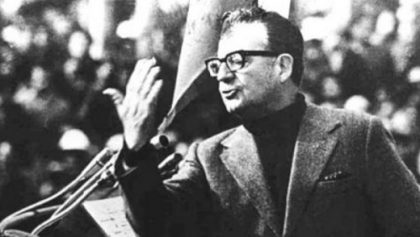
Victim of one the many coups on democracy carried out by the United States: Salvador Allende
teleSUR | September 9, 2016
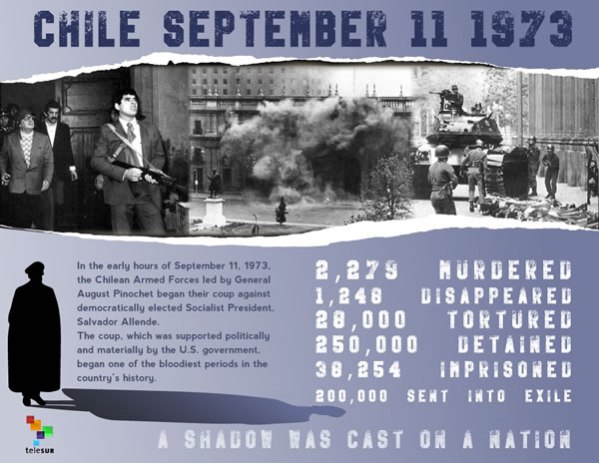
Though intelligence documents from the 1973 coup period have been declassified since 1999, the CIA continues to censor them.
The CIA continues to withhold information on its involvement in the Sept. 11, 1973 coup that led to the death of President Salvador Allende in Chile, followed by a deadly dictatorship, according to documents posted Friday by the National Security Archive.
In the list of published documents, the section regarding Chile is censored. The President’s Daily Briefs, the intelligence reports given daily to the U.S. president, in particular former President Richard Nixon days before Allende’s death, were among those censored.
According to Peter Kornbluh, director of the Archive’s Chile Documentation Project, censorship on this issue makes no sense since the intelligence agency has officially acknowledged its ties to those who plotted the coup from inside the Chilean military, and declassified several intelligence reports since.
“The CIA is trying—but failing—to hold history hostage,” Kornbluh said. “The CIA is attempting to cover up what Nixon knew about coup plotting in Chile and when he knew it, as well as hiding the CIA’s own contacts and connections to the coup plotters.”
According to the documents, three days before the coup—and on the day of the coup—the CIA gave Nixon an intelligence report on the progress of the efforts inside the Chilean military to overthrow Allende, a socialist.
In one document, a CIA operative in Santiago named Jack Devine identifies the new date of the planned coup for the next day, September 11, and confirms all three branches of the Chilean armed forces along with the police “are involved in this action.”
The same sources told the CIA that General Augusto Pinochet, who would later become a dictator with the support of the U.S., was in communication with Air Force General Gustavo Leigh about the planned coup. The Air Force would later bomb La Moneda presidential palace, where Allende and his closest allies were on Sept. 11.
The CIA told the White House that a “key officer” in the coup attempt requested U.S. assistance in case the Chilean military encountered any resistance, according to the documents.
Kornbluh said his institution would press for the release of the censored information.
“The documents provided to Richard Nixon on Chile can and should be released for the sanctity of the historical record. The public has a right to know what the President knew, and when he knew it,” he said.
Netanyahu’s Ethnic Cleansing Blood Libel
By Richard Silverstein | Tikun Olam | September 10, 2016
The pro-Israel crowd love to trot out anti-Semitic memes to smear their opponents. One of them, used widely by Alan Dershowitz and the like is the term “blood libel.” Accuse Israelis of killing Palestinians indiscriminately and it’s a blood libel because, of course, a Jew shedding non-Jewish blood is the same as Jews murdering Christian babies to use their blood in making matzah for Passover. Got that?
Bibi Netanyahu’s latest outrage is this video in which he ever so innocently professes bafflement that Palestinians would oppose Israeli settlements. Why, he asks, if 2-million “Arabs” (the actual number is 1.8-million) live in Israel proper, can’t Jews live in Palestine?
There is a wee-small problem with this analogy: approximately 600,000 Israeli Jews live in settlements. But they have lived in them for at best a generation, while Palestinians have lived in Israel for centuries. The vast bulk of settlers moved to Palestine since 1967, while Palestinians have lived in Israel over a vastly longer span. Nor have Palestinians displaced anyone over this period. While Israeli settlers have literally stolen the land out from under the Palestinian natives.

Ethnic cleansing Israel-style: yet another Palestinian home bulldozed
Bibi’s general argument is not new. He and his supporters have advanced it for years. But he added a new and even more outrageous twist this time: Palestinian opposition to Israeli settlements was akin to ethnic cleansing because it meant no Palestinian would ever accept any Jew living anywhere on Palestinian land.
There are numerous outrageous elements to this charge worth parsing. The first, and most obvious is that it’s Israel, rather than Palestine, that’s engaged in ethnic cleansing. Israel has destroyed a record number of Palestinian homes over the past year, leaving their inhabitants homeless. It has enacted draconian definitions of Palestinian residency which render tens of thousands of Palestinians stateless if they live outside areas like East Jerusalem for any length of time. Israel also depopulates Palestinian neighborhoods of East Jerusalem through forcible eviction and theft of homes. Israel maintains a stranglehold over the West Bank economy so that stifles innovation, independence and development that might sustain the population. The final coup de grâce is the siege of Gaza, which has forced thousands of Gazans to flee their imprisonment by any means possible.
So which Israeli Jew has ever been ethnically cleansed from Palestine? None. Further, the claim that Palestinians will never accept Jews living in Palestine is a hoax perpetrated by none other than Netanyahu himself and his followers. In fact, those like Rabbi Menachem Froman, who lived in the Tekoah settlement before his untimely death, denounced the idea of Israeli national sovereignty in the West Bank. He argued that he would happily live under Palestinian jurisdiction. What was important to him was not which nation owned the land on which he lived. Rather, he believed God owned the land and his allegiance was to Him and not to any particular nation.
Such an approach offered a way for Jews to remain in Palestine after a peace agreement was signed. Undoubtedly, the lion’s share of settlers would return to Israel, rather than remain under Palestinian sovereignty. But to those who really sought to uphold the vision of Abraham and the Bible to live in this Holy land, they could live there as Palestinian (or Israeli) citizens.
The final hypocrisy of Bibi’s video is his refusal to reciprocate with Palestinians regarding Jewish settlers in Palestine. If you truly believe that Jews must live there, then it’s self-evident that Palestinians should be permitted to return to their homes in pre-48 Israel. Jewish settlers see their return to their ancestral homeland as a fulfillment of sacred Biblical texts and a divine promise. The Palestinian return to their homelands from which they were expelled by Israel in 1948 is no less compelling to them. It is, to them, reparation for the Original Sin committed against them by Ben Gurion in the establishment of the State.
So if Bibi wants to argue that Jews who returned to ancient sites like Hebron or Tekoah or Bethlehem must be permitted to remain there, I say fine: then let’s talk about the return of the original refugees expelled in the Nakba and their direct descendants.
The U.S. government was none to happy with Bibi’s incitement against Palestinians. The State Department, in its typical milquetoast fashion, called the comments “inappropriate and unhelpful.” This sort of language is akin to taking a pebble to a gunfight. It’s one thing when David faces off against Goliath with a slingshot. But this is like David blowing bubbles at his well-armed nemesis. Indeed, the motto for U.S. policy toward Israel should be an inversion of the famous military slogan: “always outnumbered, always outgunned.”
NOTE: I’ve just published a new piece at Mint Press News, Israel Ramps Up Its War on BDS. It exposes an official Israeli campaign of death threats and intimidation against Palestinian activists and NGOs.
Addictive painkiller profiteer donates $500k to fight cannabis legalization in Arizona
RT | September 9, 2016
Insys Therapeutics, which profits off of a painkiller 50 times more potent than heroin, has donated $500,000 to a campaign opposing marijuana legalization in the US state of Arizona.
The maker of the drug Subsys, a sublingual fentanyl spray, said that children are their main concern for fighting Proposition 205, which appears on the ballot this November.
“They want to be able to push their far more addictive, far more harmful and far more dangerous opioid drugs,” JP Holyoak, chair of the committee pushing Prop 205, told the Arizona Capitol Times.
Supporters of cannabis legalization say legal access to their natural non-addictive painkiller could eliminate the need for drugs like fentanyl, which contributes to America’s growing epidemic of opioid dependency that claims more lives each year than gunshot wounds or car crashes.
Prince died from an overdose of fentanyl and one third of Ohio’s 3,050 deaths caused by lethal drug consumption last year were linked to the drug, according to the Columbus Dispatch.
A 2014 study by John Hopkins University found that states which legalized medical marijuana had 25 percent less overdose deaths from prescription drugs than those where it remained illegal.
Insys said in a statement that its opposition to the legalization of cannabis was “because it fails to protect the safety of Arizona’s citizens, and particularly its children.”
It did not address whether the outcome could have financial benefits for the company, although all of its profits come from the sale of its only product – the fentanyl-containing spray, according to its August filing.
Last month, Illinois Attorney General, Lisa Madigan, brought a lawsuit against Insys over claims they had deceptively marketed and sold their medication to doctors for uses other than cancer treatment, which the FDA has approved its sole use for.
Madigan said the company’s “desire for increased profits led it to disregard patients’ health and push addictive opioids for non-FDA approved purposes.”
Insys became the largest contributor to the anti-legalization campaign after donating to Arizonans for Responsible Drug Policy, a group opposing the initiative to regulate marijuana in the state under Prop 205.
Their donation was over 400 percent higher than the next largest donor, the Arizona Chamber of Commerce and Industry, with $110,000.
Pro-legalization campaigners have called for the donation to be returned as it has now tainted the campaign against Prop 205.
“We hope that every Arizonan understands that Arizonans for Responsible Drug Policy is now a complete misnomer. Their entire campaign is tainted by this money. Any time an ad airs against Proposition 205, the voters should know that it was paid for by highly suspect Big Pharma actors,” Holyoak said.
When questioned by the Arizona Capitol Times about donations made to the Marijuana Policy Project in support of Prop 205, Holyoak did not dispute that several out-of-state interest donors “stand to make millions if Prop 205 passes.”
Coincidentally, the recently-passed Bill 205 in Canada banned the sale of pill presses for making fentanyl.
European Copyright Ruling Ushers in New Dark Era for Hyperlinks
In a case which threatens to cause turmoil for thousands if not millions of websites, the Court of Justice of the European Union decided today that a website that merely links to material that infringes copyright, can itself be found guilty of copyright infringement, provided only that the operator knew or could reasonably have known that the material was infringing. Worse, they will be presumed to know of this if the links are provided for “the pursuit of financial gain”.
The case, GS Media BV v. Sanoma, concerned a Dutch news website, GeenStijl, that linked to leaked pre-publication photos from Playboy magazine, as well as publishing a thumbnail of one of them. The photos were hosted not by GeenStijl itself but at first by an Australian image hosting website, then later by Imageshack, and subsequently still other web hosts, with GeenStijl updating the links as the copyright owner had the photos taken down from one image host after another.
The court’s press release [PDF] spins this decision in such a positive light that much reporting on the case, including that by Reuters, gets it wrong, and assumes that only for-profit websites are affected by the decision. To be clear, that’s not the case. Even a non-profit website or individual who links to infringing content can be liable for infringing copyright if they knew that the material was infringing, for example after receiving notice of this from the copyright holder. And anyway, the definition of “financial gain” is broad enough to encompass any website, like GeenStijl, that runs ads.
This terrible ruling is hard to fathom given that the court accepted “that hyperlinks contribute to [the Internet’s] sound operation as well as to the exchange of opinions and information in that network”, and that “it may be difficult, in particular for individuals who wish to post such links, to ascertain whether [a] website to which those links are expected to lead, provides access to works [that] the copyright holders … have consented to … posting on the internet”. Nevertheless, that’s exactly what the judgment effectively requires website operators to do, if they are to avoid the risk of being found to have knowingly linked to infringing content.
There are also many times when knowingly linking to something that is infringing is entirely legitimate. For example, a post calling out a plagiarized news article might link to the original article and to the plagiarized one, so that readers can compare and judge for themselves. According to this judgment, the author of that post could themselves be liable for copyright infringement for linking to the plagiarized article—madness.
This judgment is a gift to copyright holders, who now have a vastly expanded array of targets against which to bring copyright infringement lawsuits. The result will be that websites operating in Europe will be much more reticent to allow external hyperlinks, and may even remove historical material that contains such links, in fear of punishing liability.
Increased Israeli attacks on civilians in Gaza endanger two-year-old ceasefire
MEMO | September 8, 2016
Israeli forces markedly increased their attacks on Palestinian civilians in the Gaza Strip during the second quarter of 2016, United Nations (UN) data has revealed, with concerns that such violence endangers the viability of the ceasefire that ended ‘Operation Protective Edge’ in 2014.
During the period April-June, there were an average of more than 90 shooting incidents per month by Israeli forces in Gaza’s so-called access restricted areas (ARA) – some 60 on land, and 30 at sea. This is more than double the equivalent average figures for the last six months of 2015.
Israeli forces have long attacked farmers, fishermen and other civilians in Gaza’s ARA. As the UN described in July, Israel’s unilaterally-imposed access restrictions are “enforced by firing direct or warning live ammunition, the destruction of property, arrests and the confiscation of equipment.”
Presenting the latest figures in a quarterly update published last month, the UN’s Office for the Coordination of Humanitarian Affairs (OCHA) in the Occupied Palestinian Territory (OPT) described “the use of force by Israel” in the ARA as a “particular cause for concern.”
According to James Heenan, head of office at the Office of the United Nations High Commissioner for Human Rights in the occupied Palestinian territory, “there are almost daily shooting incidents by Israeli forces into Gaza, often resulting in injury and even death as well as destruction of property.”
In most cases, Heenan told Middle East Monitor, “there are no indications that Israeli forces were in any imminent threat to have justified the level of force employed, including use of firearms. Often victims are farmers, fishermen, children, and demonstrators.”
On April 3, the Israeli authorities announced an expansion of the permitted fishing zone off the southern Gaza coast from six to nine miles (note that the Oslo Accords stipulate a 20-mile limit). However, on June 26, less than three months later, the six-mile limit was re-imposed.
By July, according to OCHA, more than 90 fishermen had been arrested and detained, “the highest figure in any year since records began in 2009.” Over nine days in August, for example, Israeli forces attacked Palestinian fishermen on six different occasions (Aug. 21, 23, 25, 27, 28, 29).
In May, meanwhile, it was reported that the Israeli army would allow farmers to access land close to the border fence, under the supervision of the International Committee of the Red Cross (ICRC). Since 2014, the ICRC has been helping Gaza’s farmers to rehabilitate land and secure access.
While some farmers have clearly benefited, a Jerusalem-based ICRC spokesperson declined to comment on Israeli forces’ continued attacks in the ARA, saying that “any issues of concern are addressed as part of our confidential and bilateral dialogue with all parties to the conflict.”
As one farmer told activists recently: “My lands are relatively close to the fence, so I cannot set foot in them between 6pm and 6am without getting shot at. What can I do if the electricity does not come before 6pm? I have to leave my land without watering, risking the loss of the crop.”
The violence used by Israeli forces against Palestinian civilians in the Gaza Strip is vastly under-reported in the English-language Western media. The majority of attacks on fishermen, farmers, and demonstrators do not even get a mention.
Such attacks, however, cannot be divorced from the bigger picture in the Gaza Strip, including the ‘security’ dimension that is typically understood by journalists, analysts, and policy-makers in terms of projectile fire and Israeli military responses.
According to Fawzi Barhoum, a Gaza-based Hamas spokesperson, Hamas views Israeli forces’ routine use of violence against Palestinians in the ARA as a violation of the 2014 ceasefire. “Hamas records all the violations, and updates the regional sponsors of the ceasefire accordingly”, he said.
Furthermore, Barhoum added, such attacks by Israeli forces “endanger the status quo.”
Each time, Hamas discusses what happens with the other Palestinian factions, who evaluate together what is the best response to the Israeli violation in question; whether it is silence, condemnation, warnings, firing short-range rockets, unleashing snipers on the borders, etc.
Thus, aside from the cost for farmers and fishermen of Israel’s policy of violently enforcing a ‘no-go zone’ inside Gaza, such attacks, clearly on the rise, also risk further undermining a ceasefire agreement that brought ‘calm’ for Israel, but nothing like it for Palestinians.
Call to action: Olive Harvest 2016
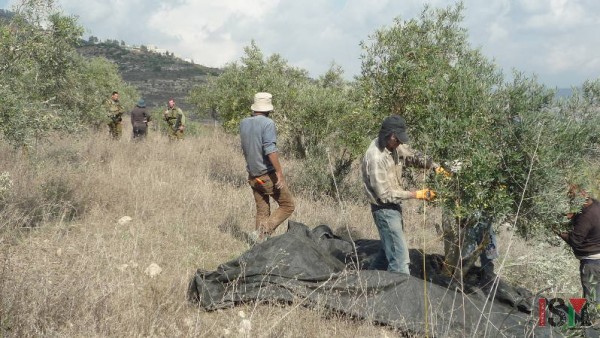
Palestinian farmer and internationals discussing picking permit with Israeli forces.

Nablus: Olive tree cut down by settlers
‘People coming together’: Seattle Seahawks mull BLM-inspired team protest during national anthem
RT | September 8, 2016
At least some members of the American football franchise plan to follow the example of Colin Kaepernick and stage a protest against police brutality during the national anthem, at the upcoming Week 1 game in Seattle.
“Anything we want to do, it’s not going to be individual. It’s going to be a team thing. That’s what the world needs to see. The world needs to see people coming together versus being individuals,” starting linebacker Bobby Wagner told the Seattle Times on Wednesday evening.
Wagner did not specify what form the protest would take, saying only that “whatever we decide to do will be a big surprise.”
San Francisco 49ers quarterback Colin Kaepernick kickstarted a movement among athletes when he sat down during the national anthem during a preseason game last month, later explaining that he was “not going to stand up to show pride in a flag for a country that oppresses black people and people of color.” Kaepernick says that he plans to continue with the protest for the foreseeable future.
Seahawks cornerback Jeremy Lane has followed his example, and receiver Doug Baldwin said that players discussed becoming part of the protests in the locker room, but he wanted to “get all of [his] ducks in a row” before taking a decision that is bound to become a magnet for controversy.
The previous protests, one of which was carried out by white female soccer player Megan Rapinoe, have been dismissed as inflammatory and unpatriotic, and the accusations are bound to be even more intense on Sunday, September 11, when the country will be commemorating the 15th anniversary of the terrorist attacks that resulted in the deaths of nearly 3,000 Americans.
“I think it’s very ironic to me that 15 years ago on September 11 was one of the most devastating times in US history and after that day we were probably the most unified that we have ever been. And today we struggle to see the unity. And it’s very ironic to me that this date is coming up,” Baldwin said.
“So it’s going to be a special day, a very significant day, but at the same time I am looking forward to the may changes and differences, the changes we can make in this country to make better changes in our country.”
The team, which won the Super Bowl in 2014, has been given carte blanche to express their feelings by coach Pete Carroll, who is regarded as being liberal by the media.
“He’s pretty clear on what he did and what he was trying to express and I think it is very simple and so we’ll leave that up to him,” Carroll said, referring to Lane.
Carroll, 64, said he did “not specifically” consider that symbolic significance of September 11, when considering his decision.
Several other major league coaches, such as John Tortorella, who coaches the US national hockey team, and the Columbus Blue Jackets, stated that he would bench any player who made overt political statements during the anthem.
But Seattle players said they would be going ahead with their intentions regardless of reactions from coaches or other team or league officials.
“We have the freedom to do whatever we want here. Whatever we decide to do, we ain’t gonna get into too much trouble. We’re big kids now,” said Wagner.
Shaun King, one of the founders of the Black Lives Matters movement, has called on more players to join the public displays, saying many have expressed a wish to join, mixed with fear about being black listed from the NFL for their political activism.
“The league has 1,696 players. If just 100 of you took a knee during the “Star-Spangled Banner,” it would instantly become one of the largest social protests in sports history,” wrote King in his New York Daily News column.
“Over the past two weeks, every sports network in America has started discussing injustice and police brutality. You have the power to take that to a whole different level.”
An estimated 804 people of all races have been killed by the police since the start of 2016, after 1,207 who died last year. Black Lives Matters says that over 100 of last year’s victims were unarmed blacks, who shouldn’t have lost their lives during their detention.
Conspiracy charge against radio shock jock arrested for 1rst amendment activities relating to Oregon standoff dismissed
The Rutherford Institute | September 7, 2016
PORTLAND, Oregon — Citing a lack of evidence, federal prosecutors have dismissed the government’s conspiracy charge against radio shock jock Pete Santilli, a new media journalist who was arrested and charged in connection with his reporting on the 41-day occupation of the Malheur National Wildlife Refuge in Burns, Oregon. The dismissal came on the eve of Santilli’s trial. Attorneys for The Rutherford Institute advised Santilli’s court-appointed attorney, Thomas Coan, on the First Amendment protections for Santilli’s activities as a journalist. Santilli is the only journalist among those who were charged with conspiracy to impede federal officers from discharging their duties by use of force, intimidation, or threats. However, Santilli was charged solely as a reporter of information and not as an accomplice to any criminal activity. In coming to Santilli’s defense, Institute attorneys warned that Santilli’s case followed a pattern by the government of intimidating journalists whose reporting portrays the government in a negative light or encourages citizens to challenge government injustice and wrongdoing.
“The FBI’s prosecution of this radio shock jock has been consistent with the government’s ongoing attempts to intimidate members of the press who portray the government in a less than favorable light,” said constitutional attorney John W. Whitehead, president of The Rutherford Institute and author of Battlefield America: The War on the American People. “This is not a new tactic. During the protests in Ferguson, Missouri, and Baltimore, Maryland, numerous journalists were arrested while covering the regions’ civil unrest and the conditions that spawned that unrest. These attempts to muzzle the press were clearly concerted, top-down efforts to restrict the fundamental First Amendment rights of the public and the press. Not only does this tactic silence individual journalists, but it has a chilling effect on the press as a whole, signaling that they will become the target of the government if they report on these events with a perspective that casts the government in a bad light.”
In early January 2016, a group of armed activists, reportedly protesting the federal government’s management of federal lands and its prosecution of two local ranchers convicted of arson, staged an act of civil disobedience by occupying the Malheur National Wildlife Refuge in Burns, Oregon. Broadcaster Pete Santilli, who has covered such protests in the past, including the April 2014 standoff in Nevada between the Bundy ranching family and the federal government over grazing rights, described himself as an embedded journalist reporting on the occupation in Burns. Santilli did not participate in the takeover of the refuge, nor did he reside on the grounds of the refuge. However, as a self-described “shock jock” who uses “colorful language,” Santilli was vocal about his commitment to exercising his First Amendment rights in a nonviolent, peaceful fashion and the need for others to do so as well. When asked to clarify his role in relation to the occupation, Santilli declared, “My role is the same here that it was at the Bundy ranch. To talk about the constitutional implications of what is going on here. The Constitution cannot be negotiated.” Santilli also took pains to emphasize during his broadcasts that the only weapon he is using is the First Amendment: “I’m not armed. I am armed with my mouth. I’m armed with my live stream. I’m armed with a coalition of like-minded individuals who sit at home and on YouTube watch this.” In the wake of a roadblock that resulted in the arrests of several key leaders of the occupation and the killing of another, Santilli was arrested and eventually indicted with conspiracy to impede federal officers.
Featured Video

Seyed M. Marandi: US-Iran War Inevitable: Kuwait and Bahrain May Fall
or go to
Aletho News Archives – Video-Images
From the Archives
Oil and the Israel Lobby
Reknowned economist M. Shahid Alam offers this excellent critique of Noam Chomsky’s defective analysis of the relative influence of Oil versus the Israel lobby over US foreign policy: … continue
Blog Roll
 Aletho News
- ICC ignored ‘very well-documented’ NATO crimes – ex-Libyan minister
- SNSC secretary dismisses US response to Iran’s conditions as ‘inadequate’
- Sanaa says Taiz roads open, secure for residents, warns Saudi forces
- Iraqi resistance group urges Saudi leadership to admit defeat, lift Yemen siege
- Trump’s Retreat: How Al-Aqsa Flood Took Down the US Empire
- Israel’s Military Actions in Lebanon Grossly Violate International Law — Lavrov
- Seyed M. Marandi: US-Iran War Inevitable: Kuwait and Bahrain May Fall
- Leaders Condemn Ansarallah Attack on Saudi Arabia While Ignoring Illegal War Against Yemen
- Leaked: Britain’s Covert Iraqi Psyops Network
- Yemeni Armed Forces Warn Airlines Against Using Saudi Airports, Exempt Mecca and Medina
- If Americans Knew
- Israel’s Destruction of Southern Lebanon Intensified After the Cease-Fire
- The Last-Minute Decision That Gave Israel Its Name
- The American Conservative: How Trump Made the World Go Nuclear
- Meet the US generals and admirals advancing Israeli policy
- Opinion: Why news organizations should boycott Israel
- The Israeli witch hunt of Sami Abu Shehadeh exposes the lie of the ‘Jewish and democratic’ state
- No state has a ‘right’ to exist – least of all Israel
- Testimonies about Gaza’s civilian death toll expose Israel’s atrocities – Daily Update
- How Israel Conquered the Latin American Right
- Agents search Rep. Omar’s Washington home in criminal probe as she vows she won’t ‘be silenced’
- No Tricks Zone
- Germany’s Green Energy Debacle: High Energy Costs Force Kahla Porzellan to Close After 182 Years!
- New Study: 50 Years Of The Most Aggressive ‘Net Zero’ Policies Can Only Affect The Global Climate By 0.03°C
- US September “Heat” Was No Record…Many Records Set Decades Ago
- Latest European Green Energy Debacle; Portugal’s Largest Flagship Solar Park Insolvent!
- Green Energy Debacle: German Expert Professor Fritz Vahrenholt Warns Of Severe Economic And Social Consequences
- Two More Paleo Reconstructions Affirm Meters-Higher Sea Levels Across Ireland, Brazil 7000-6000 Years Ago
- New Study: Earth And Venus Surface Warmth Largely Explained By Convection And Lapse Rate, Not CO2 Or Radiation
- 2025 Nature Paper Claiming Worsening Global Drought Gets RETRACTED …Heavily Flawed
- New Study: ‘Global Drought Shows No Detectable Recent Acceleration Under Climate Warming’
- Economic Masterminds: German Socialists Suggest Taxing Productivity Gains Stemming From Using AI

